Are we upto the task? Synchronous and
asynchronous learning activities for young
beginners
Shona Whyte Ciara R. Wigham Euline Cutrim-Schmid
EuroCALL2025 Milan, Italy 29/08/2025
2.
Virtual exchange (VE)for young learners
• Application of VE with young learners
relatively unexplored (Dooly & Vinagre, 2022)
• Provision of engaging, interactive
experiences
• Motivation
• Risk-taking
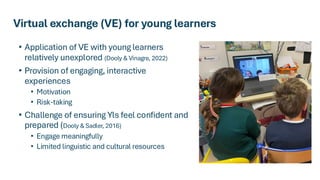
• Challenge of ensuring Yls feel confident and
prepared (Dooly & Sadler, 2016)
• Engage meaningfully
• Limited linguistic and cultural resources
3.
VE Task design
•Task design to facilitate YL exchanges (Cutrim
Schmid & Whyte, 2015; Dooly & Sadler, 2015; Mont & Masats, 2018;
Pennock-Speck & Clavel-Arroitia, 2023; Reader, 2024)
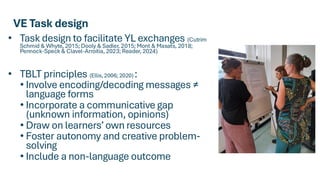
• TBLT principles (Ellis, 2006; 2020) :
• Involve encoding/decoding messages ≠
language forms
• Incorporate a communicative gap
(unknown information, opinions)
• Draw on learners’own resources
• Foster autonomy and creative problem-
solving
• Include a non-language outcome
4.
VE facilitation byteachers (or peers)
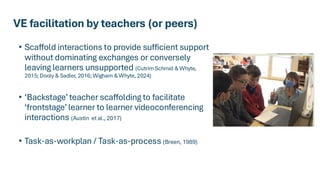
• Scaffold interactions to provide sufficient support
without dominating exchanges or conversely
leaving learners unsupported (Cutrim Schmid & Whyte,
2015; Dooly & Sadler, 2016; Wigham & Whyte, 2024)
• ‘Backstage’ teacher scaffolding to facilitate
‘frontstage’ learner to learner videoconferencing
interactions (Austin et al., 2017)
• Task-as-workplan / Task-as-process (Breen, 1989)
Research focus (ongoingprogramme)
1) Research is needed on how to design and implement VE tasks that
support young learners’language development (Austin et. al, 2017;
Wigham & Whyte, 2024; Whyte & Wigham, in press)
2) To what extent do three project tasks
1) Adhere to TBLT principles
2) Foster meaningful learner-learner interaction
3) Create opportunities for language learning?
(Whyte, Wigham & Cutrim Schmid, in press)
7.
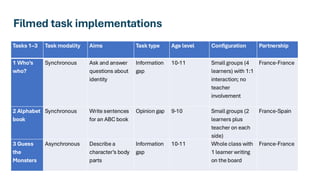
Filmed task implementations
Tasks1–3 Task modality Aims Task type Age level Configuration Partnership
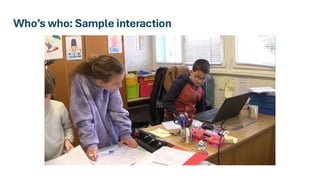
1 Who’s
who?
Synchronous Ask and answer
questions about
identity
Information
gap
10-11 Small groups (4
learners) with 1:1
interaction; no
teacher
involvement
France-France
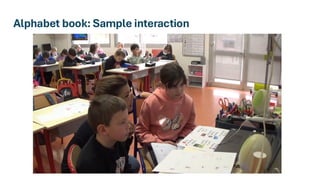
2 Alphabet
book
Synchronous Write sentences
for an ABC book
Opinion gap 9-10 Small groups (2
learners plus
teacher on each
side)
France-Spain
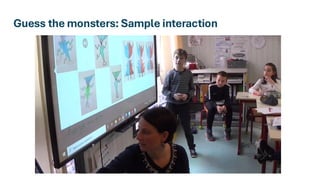
3 Guess
the
Monsters
Asynchronous Describe a
character’s body
parts
Information
gap
10-11 Whole class with
1 learner writing
on the board
France-France
8.
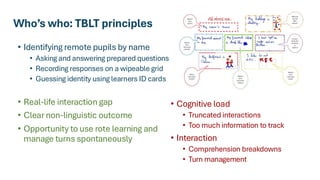
Who’s who: TBLTprinciples
• Identifying remote pupils by name
• Asking and answering prepared questions
• Recording responses on a wipeable grid
• Guessing identity using learners ID cards
• Real-life interaction gap
• Clear non-linguistic outcome
• Opportunity to use rote learning and
manage turns spontaneously
• Cognitive load
• Truncated interactions
• Too much information to track
• Interaction
• Comprehension breakdowns
• Turn management
Who’s who: Interaction& language learning
• High degree of learner autonomy
• Range of questions -> extended interaction
• Turn management
• Scaffolding
• Inclusion of wipeable listening grids
• Absence of teacher
(Wigham & Whyte, 2024 ; Whyte & Wigham, in press)
“putting the child back at the
centre of learning, at the centre of
projects…[and] showing that they
are capable of this, that they can
manage to do things, that they can
communicate and express
themselves”
INTERACTIONAL
SPACE (ARENA)
COGNITIVE LOAD
11.
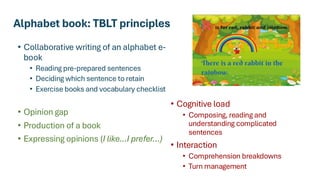
Alphabet book: TBLTprinciples
• Collaborative writing of an alphabet e-
book
• Reading pre-prepared sentences
• Deciding which sentence to retain
• Exercise books and vocabulary checklist
• Opinion gap
• Production of a book
• Expressing opinions (I like…I prefer…)
• Cognitive load
• Composing, reading and
understanding complicated
sentences
• Interaction
• Comprehension breakdowns
• Turn management
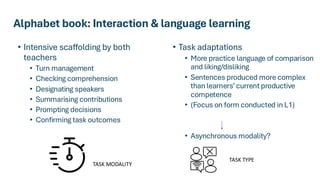
Alphabet book: Interaction& language learning
• Intensive scaffolding by both
teachers
• Turn management
• Checking comprehension
• Designating speakers
• Summarising contributions
• Prompting decisions
• Confirming task outcomes
• Task adaptations
• More practice language of comparison
and liking/disliking
• Sentences produced more complex
than learners’current productive
competence
• (Focus on form conducted in L1)
• Asynchronous modality?
TASK MODALITY
TASK TYPE
14.
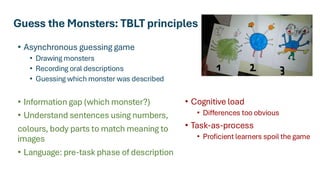
Guess the Monsters:TBLT principles
• Asynchronous guessing game
• Drawing monsters
• Recording oral descriptions
• Guessing which monster was described
• Information gap (which monster?)
• Understand sentences using numbers,
colours, body parts to match meaning to
images
• Language: pre-task phase of description
• Cognitive load
• Differences too obvious
• Task-as-process
• Proficient learners spoil the game
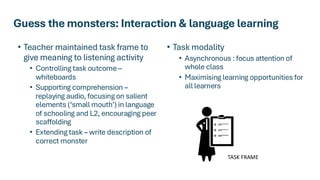
Guess the monsters:Interaction & language learning
• Teacher maintained task frame to
give meaning to listening activity
• Controlling task outcome –
whiteboards
• Supporting comprehension –
replaying audio, focusing on salient
elements (‘small mouth’) in language
of schooling and L2, encouraging peer
scaffolding
• Extending task – write description of
correct monster
• Task modality
• Asynchronous : focus attention of
whole class
• Maximising learning opportunities for
all learners
TASK FRAME
17.
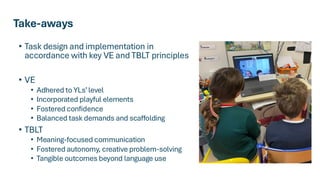
Take-aways
• Task designand implementation in
accordance with key VE and TBLT principles
• VE
• Adhered to YLs’level
• Incorporated playful elements
• Fostered confidence
• Balanced task demands and scaffolding
• TBLT
• Meaning-focused communication
• Fostered autonomy, creative problem-solving
• Tangible outcomes beyond language use
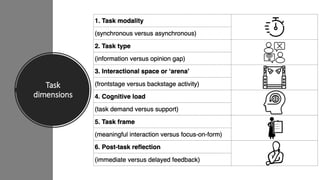
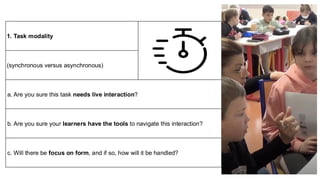
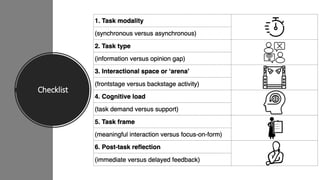
1. Task modality
(synchronousversus asynchronous)
a. Are you sure this task needs live interaction?
b. Are you sure your learners have the tools to navigate this interaction?
c. Will there be focus on form, and if so, how will it be handled?
20.
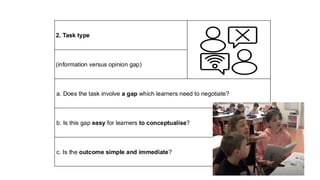
2. Task type
(informationversus opinion gap)
a. Does the task involve a gap which learners need to negotiate?
b. Is this gap easy for learners to conceptualise?
c. Is the outcome simple and immediate?
21.
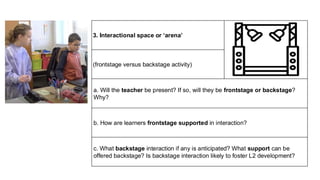
3. Interactional spaceor ‘arena’
(frontstage versus backstage activity)
a. Will the teacher be present? If so, will they be frontstage or backstage?
Why?
b. How are learners frontstage supported in interaction?
c. What backstage interaction if any is anticipated? What support can be
offered backstage? Is backstage interaction likely to foster L2 development?
22.
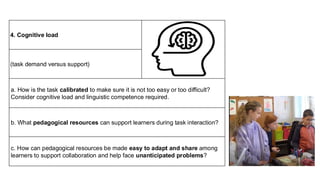
4. Cognitive load
(taskdemand versus support)
a. How is the task calibrated to make sure it is not too easy or too difficult?
Consider cognitive load and linguistic competence required.
b. What pedagogical resources can support learners during task interaction?
c. How can pedagogical resources be made easy to adapt and share among
learners to support collaboration and help face unanticipated problems?
23.
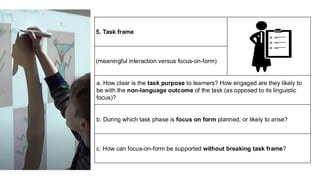
5. Task frame
(meaningfulinteraction versus focus-on-form)
a. How clear is the task purpose to learners? How engaged are they likely to
be with the non-language outcome of the task (as opposed to its linguistic
focus)?
b. During which task phase is focus on form planned, or likely to arise?
c. How can focus-on-form be supported without breaking task frame?
24.
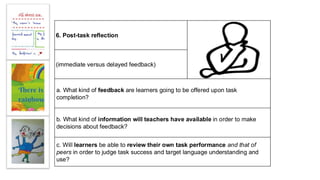
6. Post-task reflection
(immediateversus delayed feedback)
a. What kind of feedback are learners going to be offered upon task
completion?
b. What kind of information will teachers have available in order to make
decisions about feedback?
c. Will learners be able to review their own task performance and that of
peers in order to judge task success and target language understanding and
use?
References
Austin, N., Hampel,R., & Kukulska-Hulme, A. (2017) 'Video conferencing and multimodal expression of voice: Children's conversations using Skype for
second language development in a telecollaborative setting', System, 64, pp. 87-103.
Breen, M. (1989) ‘The evaluation cycle for language learning tasks’, in Johnson, R. K. (ed.) The second language curriculum. Cambridge: Cambridge University
Press, pp. 187–206.
Calvez et al. (2022). GTnum RAVEL (Ressources pour l'Apprentissage en classe Virtuelle et l'Enseignement des Langues) Scénarios pédagogiques.
[https://zenodo.org/record/7441186]
Cutrim Schmid, E. & Whyte, S. (2015)‘Teachingyoung learners with technology’, in Bland, J. (ed.) Teaching English to Young Learners: Critical Issues in
Language Teaching with 3-12 year olds. London: Bloomsbury, pp. 239-260.
Dooly, M. & Sadler, R. (2016) ‘Becoming little scientists: Technologically-enhanced project-based language learning’, Language Learning & Technology, 20(1),
pp. 54-78. https://dx.doi.org/10125/44446
Dooly, M. & Vinagre, M. (2022). Research into practice: Virtual exchange in language teaching and learning. Language Teaching, 55, 392–406.
https://doi.org/10.1017/S0261444821000069
Ellis, R. (2006)‘The methodologyof task-based teaching’, Asian EFLJournal, 8(3), pp. 19-45.
Ellis, R. (2020)‘Task-based language teaching for beginner-level young learners’, Language Teaching for Young Learners, 2(1), pp. 4–27.
Mont, M. & Masats, D. (2018) ‘Tips and suggestions to implement telecollaborative projects with young learners’, in Dooly, M. and O'Dowd, R. (eds.) In this
together: teachers’experiences with transnational, telecollaborative language learning projects. Bern: Peter Lang, pp. 93-122.
Pennock-Speck, B. & Clavel-Arroitia, B. (2023) ‘Virtual exchanges among primary-education pupils: Insights into a new arena’, in Potolia, A. and Derivry-Plard,
M. (eds.) Virtual exchange for intercultural language learning and teaching. London: Routledge, pp. 115-132.
Reader, S. (2024) ‘Asynchronous virtual exchange and young English learners’ intercultural communicative competence: An exploratory study’, Language
Teaching for Young Learners, 2, pp. 220–242. https://doi.org/10.1075/ltyl.00054
Whyte, S., Wigham, C. R., & Younès, N. (2022). Insights into teacher beliefs and practice in primary-school EFL in France. Languages, 7(3), 185. [hal-
03788664]
Whyte, S. & Wigham, C.R. (in press) Young learner autonomy in synchronous oral telecollaborative tasks: participants, arena, and turns, Language
Teaching for Young Learners.
Whyte, S., Wigham, C.R. &Cutrim Schmid, E. (in press) Task-based interaction in virtual exchange withyoung learners. In Bland, J. & Mourãu, S.(ed.)
Teaching English to Young Learners: Critical Issues in Language Teaching with 3-12 year olds. Second edition. London: Bloomsbury
Wigham, C. R. & Whyte, S. (2024) ‘Teacher role in synchronous oral interaction: Young learner telecollaboration’, Language Learning & Technology,
28(1), pp. 1–27. https://hdl.handle.net/10125/73599
27.
Are we upto the task?
Synchronous and
asynchronous learning
activities for young
beginners
Shona Whyte Ciara R. Wigham Euline Cutrim-Schmid

![Who’s who: Interaction & language learning
• High degree of learner autonomy
• Range of questions -> extended interaction
• Turn management
• Scaffolding
• Inclusion of wipeable listening grids
• Absence of teacher
(Wigham & Whyte, 2024 ; Whyte & Wigham, in press)
“putting the child back at the
centre of learning, at the centre of
projects…[and] showing that they
are capable of this, that they can
manage to do things, that they can
communicate and express
themselves”
INTERACTIONAL
SPACE (ARENA)
COGNITIVE LOAD](https://image.slidesharecdn.com/eurocallwhytewighamcutrimschmid20250829-250829125553-d0505670/85/A-synchronous-tasks-for-young-EFL-beginners-10-320.jpg)
![References
Austin, N., Hampel, R., & Kukulska-Hulme, A. (2017) 'Video conferencing and multimodal expression of voice: Children's conversations using Skype for
second language development in a telecollaborative setting', System, 64, pp. 87-103.
Breen, M. (1989) ‘The evaluation cycle for language learning tasks’, in Johnson, R. K. (ed.) The second language curriculum. Cambridge: Cambridge University
Press, pp. 187–206.
Calvez et al. (2022). GTnum RAVEL (Ressources pour l'Apprentissage en classe Virtuelle et l'Enseignement des Langues) Scénarios pédagogiques.
[https://zenodo.org/record/7441186]
Cutrim Schmid, E. & Whyte, S. (2015)‘Teachingyoung learners with technology’, in Bland, J. (ed.) Teaching English to Young Learners: Critical Issues in
Language Teaching with 3-12 year olds. London: Bloomsbury, pp. 239-260.
Dooly, M. & Sadler, R. (2016) ‘Becoming little scientists: Technologically-enhanced project-based language learning’, Language Learning & Technology, 20(1),
pp. 54-78. https://dx.doi.org/10125/44446
Dooly, M. & Vinagre, M. (2022). Research into practice: Virtual exchange in language teaching and learning. Language Teaching, 55, 392–406.
https://doi.org/10.1017/S0261444821000069
Ellis, R. (2006)‘The methodologyof task-based teaching’, Asian EFLJournal, 8(3), pp. 19-45.
Ellis, R. (2020)‘Task-based language teaching for beginner-level young learners’, Language Teaching for Young Learners, 2(1), pp. 4–27.
Mont, M. & Masats, D. (2018) ‘Tips and suggestions to implement telecollaborative projects with young learners’, in Dooly, M. and O'Dowd, R. (eds.) In this
together: teachers’experiences with transnational, telecollaborative language learning projects. Bern: Peter Lang, pp. 93-122.
Pennock-Speck, B. & Clavel-Arroitia, B. (2023) ‘Virtual exchanges among primary-education pupils: Insights into a new arena’, in Potolia, A. and Derivry-Plard,
M. (eds.) Virtual exchange for intercultural language learning and teaching. London: Routledge, pp. 115-132.
Reader, S. (2024) ‘Asynchronous virtual exchange and young English learners’ intercultural communicative competence: An exploratory study’, Language
Teaching for Young Learners, 2, pp. 220–242. https://doi.org/10.1075/ltyl.00054
Whyte, S., Wigham, C. R., & Younès, N. (2022). Insights into teacher beliefs and practice in primary-school EFL in France. Languages, 7(3), 185. [hal-
03788664]
Whyte, S. & Wigham, C.R. (in press) Young learner autonomy in synchronous oral telecollaborative tasks: participants, arena, and turns, Language
Teaching for Young Learners.
Whyte, S., Wigham, C.R. &Cutrim Schmid, E. (in press) Task-based interaction in virtual exchange withyoung learners. In Bland, J. & Mourãu, S.(ed.)
Teaching English to Young Learners: Critical Issues in Language Teaching with 3-12 year olds. Second edition. London: Bloomsbury
Wigham, C. R. & Whyte, S. (2024) ‘Teacher role in synchronous oral interaction: Young learner telecollaboration’, Language Learning & Technology,
28(1), pp. 1–27. https://hdl.handle.net/10125/73599](https://image.slidesharecdn.com/eurocallwhytewighamcutrimschmid20250829-250829125553-d0505670/85/A-synchronous-tasks-for-young-EFL-beginners-26-320.jpg)