ORIGINS
• Research on interaction and second language learning grew
  out of early studies on foreigner talk (FT). (Ferguson, 1975).

• Given the achievement differences between first and second
  languages, Freed (1980) sought to determine the differences
  between Baby Talk (BT) and Foreigner Talk (FT). (Hall &
  Verplaetse, 2000) .

• Longs’ (1981) study on modifications in NS input to NNSs
  made a distinction between linguistic modifications and
  interactive modifications.

• Verplaetse (1993) found NS modifications to have negative
  effects on NNS participation in conversations thus questioning
  Longs’ general idea that NS are primarily beneficial to NNSs.
• Then some research on NNS’s role in interaction outlined the
  importance of interaction in SLA focusing on NNS’s role in the
  negotiation of meaning. For instance, Gass and Varonis (1985a)
  and Varonis and Gass (1985b) argued that NNS-NNS
  interactions provide greater opportunities than NS-NNS
  interactions for the negotiation of meaning and therefore for
  obtaining comprehensible input. (Shehadeh, 1999).

• Beginning in the mid – 1980s, investigatory concerns included
  the importance of the learners output in interaction. Swain
  (1985) argued that comprehensible input is not sufficient for
  successful second language acquisition (SLA), but that
  opportunities for non-native speakers (NNSs) to produce
  comprehensible output are also necessary
INTERACTIVE LEARNING
                DESCRIPTION
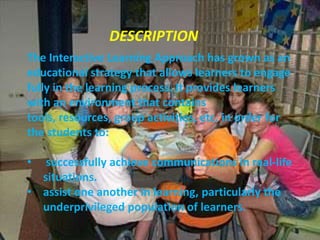
The Interactive Learning Approach has grown as an
educational strategy that allows learners to engage
     J
fully in the learning process. It provides learners
with an environment that contains
tools, resources, group activities, etc. in order for
the students to:

•  successfully achieve communications in real-life
  situations.
• assist one another in learning, particularly the
  underprivileged population of learners.
THEORY OF LANGUAGE

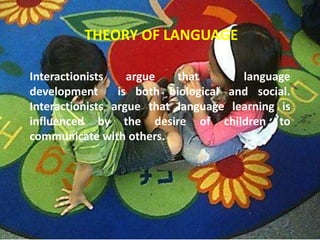
Interactionists    argue   that       language
development      is both biological and social.
Interactionists argue that language learning is
influenced by the desire of children to
communicate with others.
THEORIES OF LEARNING
• students are in charge of their own learning.
  They best learn in a hands-on way.
• Students’s learning styles are involved in the
  classroom (Gardner).
• Learning is facilitated when the teacher sets Ss’
  group on a group task or to solve a multiple-step
  problem.
• Also, when Ss create a performance or a
  presentation that they share with peers, parents,
  etc.
PRINCIPLES
• The student is engaged both intellectually and
  emotionally .

• Encourage cooperative and collaborative
  work.

• Feedback, reflection and dialogue are integral
  components.

• Transmission of meaning is more important
  than form.
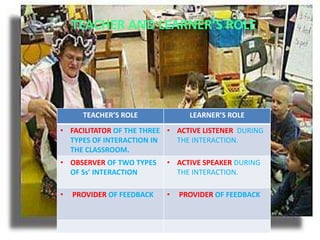
TEACHER AND LEARNER’S ROLE


      TEACHER’S ROLE             LEARNER’S ROLE
• FACILITATOR OF THE THREE • ACTIVE LISTENER DURING
  TYPES OF INTERACTION IN    THE INTERACTION.
  THE CLASSROOM.
• OBSERVER OF TWO TYPES    • ACTIVE SPEAKER DURING
  OF Ss’ INTERACTION         THE INTERACTION.

•   PROVIDER OF FEEDBACK   •   PROVIDER OF FEEDBACK
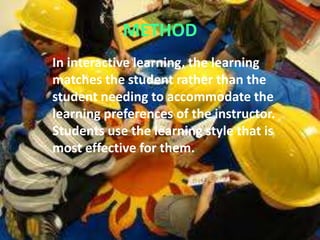
METHOD
In interactive learning, the learning
matches the student rather than the
student needing to accommodate the
learning preferences of the instructor.
Students use the learning style that is
most effective for them.
Hall, J. K., & Verplaetse, L. S. (2000). Second and Foreign Language Learning   through Classroom Interaction (Lawrence Erlbaum Associates, Ed.).


                                                     REFERENCES
                  Hall, J. K., & Verplaetse, L. S. (2000). Second and Foreign Language
                  Learning through Classroom Interaction (Lawrence Erlbaum Associates,
                  Ed.).
                  Long, M. (1981). Input, Interaction, and Second Language Acquisition. In
                  Winitz, (Ed.).
                  Shehadeh, Ali. (1999). Non-native speakers' production of modified
                  comprehensible output and second language learning. Language
                  Learning, 49 (4). p. 627-75. Retrieved September 01, 2006, from Hw
                  Wilson database.

                  http://www.ehow.com/about_5494900_interactive-learning-
                  definition.html
                  http://languagedevelopment.tripod.com/id15.html

Interctive Approach

  • 1.
    ORIGINS • Research oninteraction and second language learning grew out of early studies on foreigner talk (FT). (Ferguson, 1975). • Given the achievement differences between first and second languages, Freed (1980) sought to determine the differences between Baby Talk (BT) and Foreigner Talk (FT). (Hall & Verplaetse, 2000) . • Longs’ (1981) study on modifications in NS input to NNSs made a distinction between linguistic modifications and interactive modifications. • Verplaetse (1993) found NS modifications to have negative effects on NNS participation in conversations thus questioning Longs’ general idea that NS are primarily beneficial to NNSs.
  • 2.
    • Then someresearch on NNS’s role in interaction outlined the importance of interaction in SLA focusing on NNS’s role in the negotiation of meaning. For instance, Gass and Varonis (1985a) and Varonis and Gass (1985b) argued that NNS-NNS interactions provide greater opportunities than NS-NNS interactions for the negotiation of meaning and therefore for obtaining comprehensible input. (Shehadeh, 1999). • Beginning in the mid – 1980s, investigatory concerns included the importance of the learners output in interaction. Swain (1985) argued that comprehensible input is not sufficient for successful second language acquisition (SLA), but that opportunities for non-native speakers (NNSs) to produce comprehensible output are also necessary
  • 3.
    INTERACTIVE LEARNING DESCRIPTION The Interactive Learning Approach has grown as an educational strategy that allows learners to engage J fully in the learning process. It provides learners with an environment that contains tools, resources, group activities, etc. in order for the students to: • successfully achieve communications in real-life situations. • assist one another in learning, particularly the underprivileged population of learners.
  • 4.
    THEORY OF LANGUAGE Interactionists argue that language development is both biological and social. Interactionists argue that language learning is influenced by the desire of children to communicate with others.
  • 5.
    THEORIES OF LEARNING •students are in charge of their own learning. They best learn in a hands-on way. • Students’s learning styles are involved in the classroom (Gardner). • Learning is facilitated when the teacher sets Ss’ group on a group task or to solve a multiple-step problem. • Also, when Ss create a performance or a presentation that they share with peers, parents, etc.
  • 6.
    PRINCIPLES • The studentis engaged both intellectually and emotionally . • Encourage cooperative and collaborative work. • Feedback, reflection and dialogue are integral components. • Transmission of meaning is more important than form.
  • 7.
    TEACHER AND LEARNER’SROLE TEACHER’S ROLE LEARNER’S ROLE • FACILITATOR OF THE THREE • ACTIVE LISTENER DURING TYPES OF INTERACTION IN THE INTERACTION. THE CLASSROOM. • OBSERVER OF TWO TYPES • ACTIVE SPEAKER DURING OF Ss’ INTERACTION THE INTERACTION. • PROVIDER OF FEEDBACK • PROVIDER OF FEEDBACK
  • 8.
    METHOD In interactive learning,the learning matches the student rather than the student needing to accommodate the learning preferences of the instructor. Students use the learning style that is most effective for them.
  • 9.
    Hall, J. K.,& Verplaetse, L. S. (2000). Second and Foreign Language Learning through Classroom Interaction (Lawrence Erlbaum Associates, Ed.). REFERENCES Hall, J. K., & Verplaetse, L. S. (2000). Second and Foreign Language Learning through Classroom Interaction (Lawrence Erlbaum Associates, Ed.). Long, M. (1981). Input, Interaction, and Second Language Acquisition. In Winitz, (Ed.). Shehadeh, Ali. (1999). Non-native speakers' production of modified comprehensible output and second language learning. Language Learning, 49 (4). p. 627-75. Retrieved September 01, 2006, from Hw Wilson database. http://www.ehow.com/about_5494900_interactive-learning- definition.html http://languagedevelopment.tripod.com/id15.html