Download to read offline
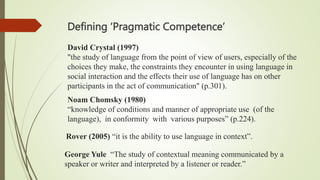

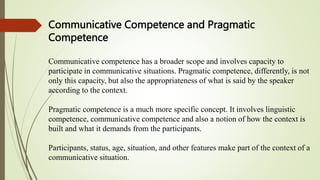


The document discusses pragmatic competence in second language learning. It defines pragmatic competence as the ability to use language appropriately based on context. This involves factors like status, age, situation, and cultural norms. While some pragmatic features may be acquired indirectly through exposure, explicit instruction is important, especially in foreign language contexts. The document suggests that pragmatic competence can be developed through task-based language teaching, where students complete meaningful tasks using the target language. This provides negotiation of meaning and a way to bridge the gap between language study and use.


