TEACHING
SHONA WHYTE
SHONA WHYTE
EDUCATION & LANGUAGES
▸ native speaker of English (Scotland)
▸ BA Languages (Interpreting and
Translation) Heriot-Watt University
1987 (French and German)
▸ maîtrise d’anglais, Université
François Rabelais, Tours
▸ PhD Linguistics, Indiana University
Bloomington, 1994
▸ Université de Nice since 1995
SHONA WHYTE
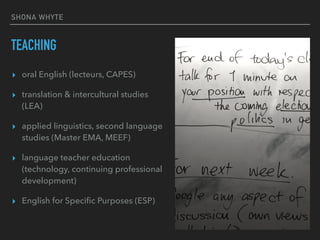
TEACHING
▸ oral English (lecteurs, CAPES)
▸ translation & intercultural studies
(LEA)
▸ applied linguistics, second language
studies (Master EMA, MEEF)
▸ language teacher education
(technology, continuing professional
development)
▸ English for Specific Purposes (ESP)
SHONA WHYTE
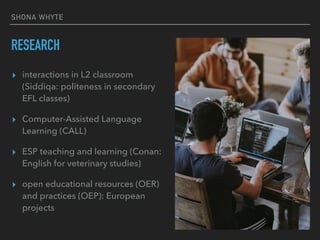
RESEARCH
▸ interactions in L2 classroom
(Siddiqa: politeness in secondary
EFL classes)
▸ Computer-Assisted Language
Learning (CALL)
▸ ESP teaching and learning (Conan:
English for veterinary studies)
▸ open educational resources (OER)
and practices (OEP): European
projects
ABOUT YOURSELVES
1. Where were you born and where did you grow up?
2. What languages do you know? How did you learn each,
how well do you speak, and when do you use each? What
did you learn from family members or travelling or online,
and what did you learn in language classes?
3. What do you like about English studies? Why are you
planning to teach English?
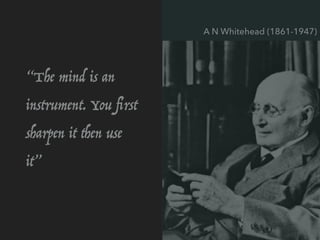
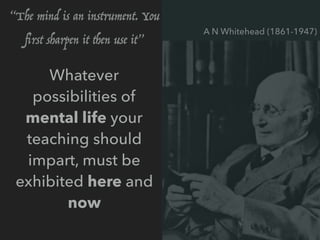
“The mind is an
instrument. You first
sharpen it then use
it”
A N Whitehead (1861-1947)
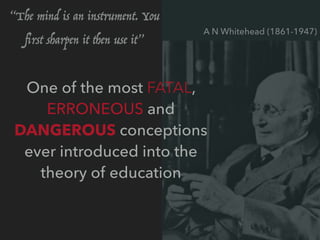
One of the most FATAL,
ERRONEOUS and
DANGEROUS conceptions
ever introduced into the
theory of education
A N Whitehead (1861-1947)
“The mind is an instrument. You
first sharpen it then use it”
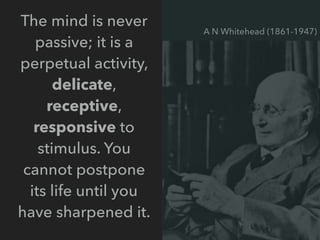
The mind is never
passive; it is a
perpetual activity,
delicate,
receptive,
responsive to
stimulus. You
cannot postpone
its life until you
have sharpened it.
A N Whitehead (1861-1947)
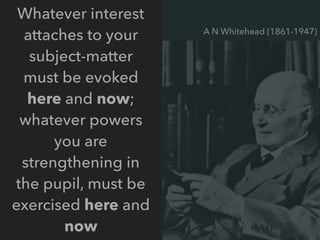
Whatever interest
attaches to your
subject-matter
must be evoked
here and now;
whatever powers
you are
strengthening in
the pupil, must be
exercised here and
now
A N Whitehead (1861-1947)
Whatever
possibilities of
mental life your
teaching should
impart, must be
exhibited here and
now
A N Whitehead (1861-1947)
“The mind is an instrument. You
first sharpen it then use it”
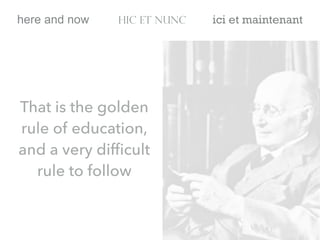
That is the golden
rule of education,
and a very difficult
rule to follow
here and now hic et nunc ici et maintenant
WHAT DOES THAT MEAN FOR THE TEACHER AND THE STUDENTS?
▸ teaching and learning happen in the classroom, not
before or after
▸ the trace of a class (powerpoint, student notes) is only a
record of teaching and learning
▸ students participate in class rather than sit passively or
inattentively
▸ most student questions arise during class, not before, not
after, not via e-mail
SHONA WHYTE EFL.UNICE.FR WHYTE@UNICE.FR
TEACHING & LEARNING
‣ COME TO CLASS
‣ PAY ATTENTION
‣ TAKE NOTES
‣ ASK QUESTIONS
‣ VOLUNTEER
‣ PARTICIPATE
▸ teaching and learning happen in
the classroom, not before or after
▸ the trace of a class (powerpoint,
student notes) is only a record of
teaching and learning
▸ students participate in class rather
than sit passively or inattentively
▸ most student questions arise
during class, not before, after or
by e-mail
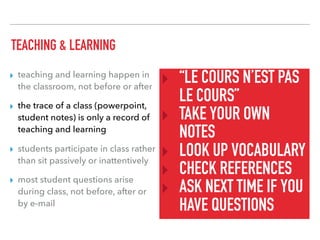
TEACHING & LEARNING
▸ teaching and learning happen in
the classroom, not before or after
▸ the trace of a class (powerpoint,
student notes) is only a record of
teaching and learning
▸ students participate in class rather
than sit passively or inattentively
▸ most student questions arise
during class, not before, after or
by e-mail
‣ “LE COURS N’EST PAS
LE COURS”
‣ TAKE YOUR OWN
NOTES
‣ LOOK UP VOCABULARY
‣ CHECK REFERENCES
‣ ASK NEXT TIME IF YOU
HAVE QUESTIONS
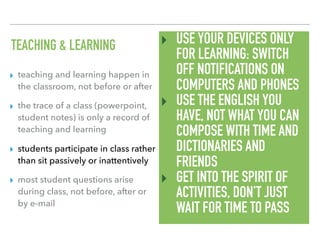
TEACHING & LEARNING
▸ teaching and learning happen in
the classroom, not before or after
▸ the trace of a class (powerpoint,
student notes) is only a record of
teaching and learning
▸ students participate in class rather
than sit passively or inattentively
▸ most student questions arise
during class, not before, after or
by e-mail
‣ USE YOUR DEVICES ONLY
FOR LEARNING: SWITCH
OFF NOTIFICATIONS ON
COMPUTERS AND PHONES
‣ USE THE ENGLISH YOU
HAVE, NOT WHAT YOU CAN
COMPOSE WITH TIME AND
DICTIONARIES AND
FRIENDS
‣ GET INTO THE SPIRIT OF
ACTIVITIES, DON’T JUST
WAIT FOR TIME TO PASS
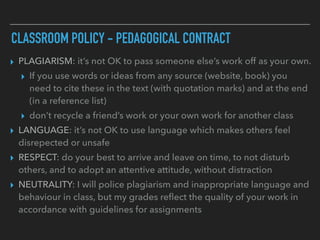
CLASSROOM POLICY - PEDAGOGICAL CONTRACT
▸ PLAGIARISM: it’s not OK to pass someone else’s work off as your own.
▸ If you use words or ideas from any source (website, book) you
need to cite these in the text (with quotation marks) and at the end
(in a reference list)
▸ don’t recycle a friend’s work or your own work for another class
▸ LANGUAGE: it’s not OK to use language which makes others feel
disrepected or unsafe
▸ RESPECT: do your best to arrive and leave on time, to not disturb
others, and to adopt an attentive attitude, without distraction
▸ NEUTRALITY: I will police plagiarism and inappropriate language and
behaviour in class, but my grades reflect the quality of your work in
accordance with guidelines for assignments
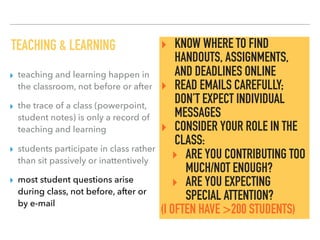
TEACHING & LEARNING
▸ teaching and learning happen in
the classroom, not before or after
▸ the trace of a class (powerpoint,
student notes) is only a record of
teaching and learning
▸ students participate in class rather
than sit passively or inattentively
▸ most student questions arise
during class, not before, after or
by e-mail
‣ KNOW WHERE TO FIND
HANDOUTS, ASSIGNMENTS,
AND DEADLINES ONLINE
‣ READ EMAILS CAREFULLY;
DON’T EXPECT INDIVIDUAL
MESSAGES
‣ CONSIDER YOUR ROLE IN THE
CLASS:
‣ ARE YOU CONTRIBUTING TOO
MUCH/NOT ENOUGH?
‣ ARE YOU EXPECTING
SPECIAL ATTENTION?
(I OFTEN HAVE >200 STUDENTS)
SHONA WHYTE
whyte@unice.fr
shona.whyte@univ-cotedazur.fr
whyteunice@gmail.com
http://efl.unice.fr
shonawhyte.wordpress.com
@whyshona
USE ANY ONE E-MAIL
(NOT ALL THREE)
FIND COURSE
INFORMATION
OTHER RESOURCES

Teaching philosophy

  • 1.
  • 2.
    SHONA WHYTE EDUCATION &LANGUAGES ▸ native speaker of English (Scotland) ▸ BA Languages (Interpreting and Translation) Heriot-Watt University 1987 (French and German) ▸ maîtrise d’anglais, Université François Rabelais, Tours ▸ PhD Linguistics, Indiana University Bloomington, 1994 ▸ Université de Nice since 1995
  • 3.
    SHONA WHYTE TEACHING ▸ oralEnglish (lecteurs, CAPES) ▸ translation & intercultural studies (LEA) ▸ applied linguistics, second language studies (Master EMA, MEEF) ▸ language teacher education (technology, continuing professional development) ▸ English for Specific Purposes (ESP)
  • 4.
    SHONA WHYTE RESEARCH ▸ interactionsin L2 classroom (Siddiqa: politeness in secondary EFL classes) ▸ Computer-Assisted Language Learning (CALL) ▸ ESP teaching and learning (Conan: English for veterinary studies) ▸ open educational resources (OER) and practices (OEP): European projects
  • 5.
    ABOUT YOURSELVES 1. Wherewere you born and where did you grow up? 2. What languages do you know? How did you learn each, how well do you speak, and when do you use each? What did you learn from family members or travelling or online, and what did you learn in language classes? 3. What do you like about English studies? Why are you planning to teach English?
  • 6.
    “The mind isan instrument. You first sharpen it then use it” A N Whitehead (1861-1947)
  • 7.
    One of themost FATAL, ERRONEOUS and DANGEROUS conceptions ever introduced into the theory of education A N Whitehead (1861-1947) “The mind is an instrument. You first sharpen it then use it”
  • 8.
    The mind isnever passive; it is a perpetual activity, delicate, receptive, responsive to stimulus. You cannot postpone its life until you have sharpened it. A N Whitehead (1861-1947)
  • 9.
    Whatever interest attaches toyour subject-matter must be evoked here and now; whatever powers you are strengthening in the pupil, must be exercised here and now A N Whitehead (1861-1947)
  • 10.
    Whatever possibilities of mental lifeyour teaching should impart, must be exhibited here and now A N Whitehead (1861-1947) “The mind is an instrument. You first sharpen it then use it”
  • 11.
    That is thegolden rule of education, and a very difficult rule to follow here and now hic et nunc ici et maintenant
  • 12.
    WHAT DOES THATMEAN FOR THE TEACHER AND THE STUDENTS? ▸ teaching and learning happen in the classroom, not before or after ▸ the trace of a class (powerpoint, student notes) is only a record of teaching and learning ▸ students participate in class rather than sit passively or inattentively ▸ most student questions arise during class, not before, not after, not via e-mail
  • 13.
    SHONA WHYTE EFL.UNICE.FRWHYTE@UNICE.FR TEACHING & LEARNING ‣ COME TO CLASS ‣ PAY ATTENTION ‣ TAKE NOTES ‣ ASK QUESTIONS ‣ VOLUNTEER ‣ PARTICIPATE ▸ teaching and learning happen in the classroom, not before or after ▸ the trace of a class (powerpoint, student notes) is only a record of teaching and learning ▸ students participate in class rather than sit passively or inattentively ▸ most student questions arise during class, not before, after or by e-mail
  • 14.
    TEACHING & LEARNING ▸teaching and learning happen in the classroom, not before or after ▸ the trace of a class (powerpoint, student notes) is only a record of teaching and learning ▸ students participate in class rather than sit passively or inattentively ▸ most student questions arise during class, not before, after or by e-mail ‣ “LE COURS N’EST PAS LE COURS” ‣ TAKE YOUR OWN NOTES ‣ LOOK UP VOCABULARY ‣ CHECK REFERENCES ‣ ASK NEXT TIME IF YOU HAVE QUESTIONS
  • 15.
    TEACHING & LEARNING ▸teaching and learning happen in the classroom, not before or after ▸ the trace of a class (powerpoint, student notes) is only a record of teaching and learning ▸ students participate in class rather than sit passively or inattentively ▸ most student questions arise during class, not before, after or by e-mail ‣ USE YOUR DEVICES ONLY FOR LEARNING: SWITCH OFF NOTIFICATIONS ON COMPUTERS AND PHONES ‣ USE THE ENGLISH YOU HAVE, NOT WHAT YOU CAN COMPOSE WITH TIME AND DICTIONARIES AND FRIENDS ‣ GET INTO THE SPIRIT OF ACTIVITIES, DON’T JUST WAIT FOR TIME TO PASS
  • 16.
    CLASSROOM POLICY -PEDAGOGICAL CONTRACT ▸ PLAGIARISM: it’s not OK to pass someone else’s work off as your own. ▸ If you use words or ideas from any source (website, book) you need to cite these in the text (with quotation marks) and at the end (in a reference list) ▸ don’t recycle a friend’s work or your own work for another class ▸ LANGUAGE: it’s not OK to use language which makes others feel disrepected or unsafe ▸ RESPECT: do your best to arrive and leave on time, to not disturb others, and to adopt an attentive attitude, without distraction ▸ NEUTRALITY: I will police plagiarism and inappropriate language and behaviour in class, but my grades reflect the quality of your work in accordance with guidelines for assignments
  • 17.
    TEACHING & LEARNING ▸teaching and learning happen in the classroom, not before or after ▸ the trace of a class (powerpoint, student notes) is only a record of teaching and learning ▸ students participate in class rather than sit passively or inattentively ▸ most student questions arise during class, not before, after or by e-mail ‣ KNOW WHERE TO FIND HANDOUTS, ASSIGNMENTS, AND DEADLINES ONLINE ‣ READ EMAILS CAREFULLY; DON’T EXPECT INDIVIDUAL MESSAGES ‣ CONSIDER YOUR ROLE IN THE CLASS: ‣ ARE YOU CONTRIBUTING TOO MUCH/NOT ENOUGH? ‣ ARE YOU EXPECTING SPECIAL ATTENTION? (I OFTEN HAVE >200 STUDENTS)
  • 18.