




Interaction and second language
acquisition: an ecological perspective


             Vera Menezes (UFMG/CNPq)
  http://www.veramenezes.com/interactionvera.pdf
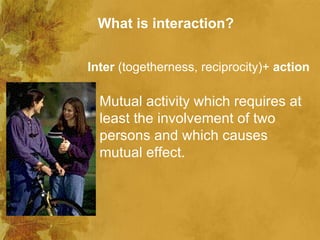
What is interaction?


Inter (togetherness, reciprocity)+ action

  Mutual activity which requires at
  least the involvement of two
  persons and which causes
  mutual effect.
Interaction as an instinct


According to Lee et al (2009, p. 5) “crucial
for language acquisition is what we call an
“interactional instinct”. This instinct is an
innate drive among human infants to
interact with conspecific caregivers.”
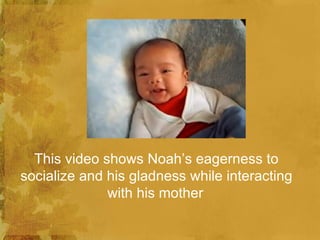
This video shows Noah’s eagerness to
socialize and his gladness while interacting
              with his mother
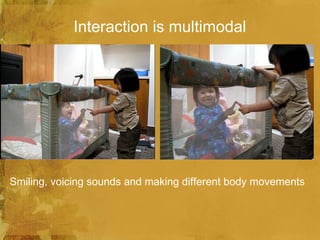
Interaction is multimodal


Smiling, voicing sounds and making different body movements
An experiment entitled “Still Face Experiment”
shows how babies react when they do not manage
to interact with their mothers.
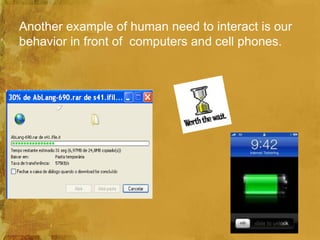
Another example of human need to interact is our
behavior in front of computers and cell phones.
Second Language Classroom Interaction
As Lee et al (2009, p.9) point out “the interactional
drive essentially motivates infants to achieve
attachment and social affiliation with their
caregivers.” They explain that it is out of social
interactions that grammatical patterns emerge and
language is acquired. Lee et al (2009, preface)
argue that “interaction produces grammatical
structure in evolutionary time”. They assume that
“innate mechanisms for bonding, attachment, and
affiliation ensure that children engage in sufficient
and appropriate interactions to guarantee language
acquisition” (2009, preface).
Second Language Classroom Interaction

“whereas primary-language acquisition is
inevitable in all normal children, adult second-
language acquisition (SLA) is never guaranteed”
(p.170). (…)
“under conditions where social and emotional
affiliation with target language speakers is
sufficiently strong, aspects of the mechanisms
underlying the interactional instinct may be
activated in ways that facilitate second-language
learning” (p. 8).
Interaction is essential for SLA
Hatch (1978); Long (1981, 1996); Larsen-Freeman and
Long (1991 ); Pica, (1987), Tsui (1995), Ellis (1999) and
his collaborators, van Lier (1996) Hall, Verplaetse (2000)
and collaborators; Hall (2004, 2007, 2009, 2010),
Figueiredo (2003); Consolo, in Kelly Hall and Verplaetse
(2000), Consolo (2006), Lima (2000), Lima and Fontana
(2003); Sturm and Lima (2008), etc.
Kelly Hall (2004, p. 611)
• Kelly Hall (2004, p. 611) highlights the developmental
  significance of social interaction. She explains that the
  role of interaction is not just a matter of gathering
  “individuals to work toward a common goal that leads to
  transformation”. She adds that “rather, it is the actual
  interactional relationships that are developed, with the
  methods – the interactional procedures – by which talk is
  accomplished in these relationships creating the object
  of knowledge and, at the same time, the tools by which
  that knowledge is known”.
Kelly Hall (2004, p. 611)
    Hall closes her text with a question:

    How can we, in that context, create revolutionary
    interactional relationships whose accomplished
    procedures can transform both how learners do and
    come to understand the enterprise of language and
    language learning?

   My hypothesis is that the answer lies beyond the
   classroom.
An ecological view of interaction
 In spite of the paramount importance of
 the studies about classroom interaction, I
 would like to propose an ecological view
 of interaction. In this approach interaction
 is understood as “the relation between
 species that live together in a community;
 specifically, the effect an individual of one
 species may exert on an individual of
 another species”
An ecological view of interaction
 As pointed out by Leffa (2003, p. 2), “nobody learns
 alone, the same way nobody grows up, lives, suffers or
 dies alone; we are always acting and reacting with the
 context around us”.

 An ecological approach, according to van Lier (2004)
 takes into consideration what is happening in the
 environment. He explains that “things are happening all
 the time, in schools, classrooms, at desks and around
 computers” (p. 11). In fact, learning might happen
 anywhere the learner is likely to have interpersonal or
 intrapersonal linguistic experiences.
An ecological view of interaction
• We live in biomes, in ecological communities,
  understood as “a group of actually or potentially
  interacting species living in the same place”. In order to
  grow and reproduce in our biomes we need some
  resources. Language is a powerful resource for
  language learners who need linguistic input and
  interaction to acquire the language.

• A Chinese student of English, in a corpus of learning
  narratives collected by Alice Chick in Hong Kong,
  illustrates this point, by saying: (…) as my mom often
  said, “language is as vital as water and oxygen
  because human cannot live alone without any
  interaction with the outside world. Human needs to
  communicate with each other by language…”
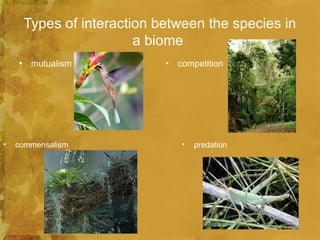
Types of interaction between the species in
                          a biome
    •    mutualism            •   competition


•   commensalism                   •   predation
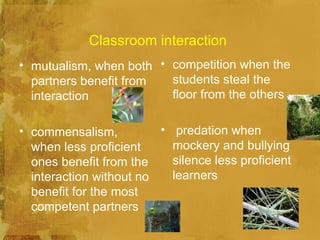
Classroom interaction
• mutualism, when both • competition when the
  partners benefit from  students steal the
  interaction            floor from the others

• commensalism,          • predation when
  when less proficient     mockery and bullying
  ones benefit from the    silence less proficient
  interaction without no   learners
  benefit for the most
  competent partners
Mediated interaction
• Man is the only species able to develop
  technology to improve his interaction
  within and outside his own biome. Books,
  mail, telegraph, telephone, TV, radio,
  cinema, and the Internet are some of the
  examples. Most of those cultural artifacts
  have been employed by education to
  improve interaction in the classroom.
Mediated interaction
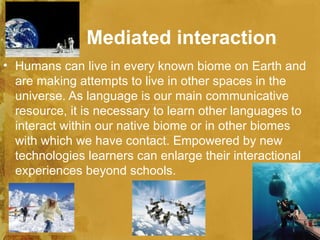
• Humans can live in every known biome on Earth and
  are making attempts to live in other spaces in the
  universe. As language is our main communicative
  resource, it is necessary to learn other languages to
  interact within our native biome or in other biomes
  with which we have contact. Empowered by new
  technologies learners can enlarge their interactional
  experiences beyond schools.
Classroom interaction is not enough for
SLA
• Language learning narrative research
  (MURPHEY, 1997, 1998; MENEZES, 2008;
  MURRAY, 2009) has shown the importance of
  interaction in natural environments for SLA.

• Narrators repeatedly complain about lack of
  interaction in the classroom. One of them said “I
  do not think that my course was communicative
  enough. It lacked more interaction, functional
  language, role-playings and dynamism. Its focus
  was more on grammar and correct structures”.
Experiences outside school contribute
                 for language acquisition

• In fact skateboard has been a ‘catapult’ to my English
  learning process. It is common to meet native English
  speakers in skateboard contests, so I had to communicate
  with them in order comment the contest, or even about my
  turn in it, for instance. This first steps where then, related to
  communicative learning process, since real use of language
  was required in order to communicate. Slangs and jargons
  were used all the time, and I did not know what exactly they
  meant, but I could get their meaning through the context we
  were in. After that, my interest have increased in many
  aspects of English, such as music, art and sports, what is just
  the continuity of the process that I began with when I was a
CONCLUSION
• It is not my intention to minimize the role of
  interaction in the classroom, but, in my corpus of
  language learning narratives, learners with
  interactional opportunities beyond the classroom
  report that those experiences were turning points in
  their SLA. Those stories indicate that learners will
  only become fluent if they have the chance to
  broaden their perceptions as language users and
  engage themselves in authentic linguistic social
  practices.
CONCLUSION
• My assumption is that we teachers can collaborate to
  enlarge our students’ biomes by putting them in touch
  with learners or speakers in other environments
  mediated by technology. Several examples could be
  mentioned here. One is the International Writing
  Exchange (http://www.writeit.to/), coordinated by Ruth
  Vilmi, in Helsinki. A Brazilian example is the Teletandem
  Project, coordinated by João Telles at UNESP, where
  pairs of students work together by teaching his or her
  own language and learning the partner’s language at the
  same time. A third example is the Ibunka project,
  coordinated by Watanabe in Japan.
CONCLUSION

I would like to close this discussion using
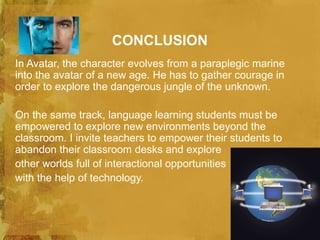
the Avatar film as a metaphor.
CONCLUSION
In Avatar, the character evolves from a paraplegic marine
into the avatar of a new age. He has to gather courage in
order to explore the dangerous jungle of the unknown.

On the same track, language learning students must be
empowered to explore new environments beyond the
classroom. I invite teachers to empower their students to
abandon their classroom desks and explore
other worlds full of interactional opportunities
with the help of technology.

Interaction and second language acquisition: an ecological perspective

  • 1.
    Interaction and secondlanguage acquisition: an ecological perspective Vera Menezes (UFMG/CNPq) http://www.veramenezes.com/interactionvera.pdf
  • 2.
    What is interaction? Inter(togetherness, reciprocity)+ action Mutual activity which requires at least the involvement of two persons and which causes mutual effect.
  • 3.
    Interaction as aninstinct According to Lee et al (2009, p. 5) “crucial for language acquisition is what we call an “interactional instinct”. This instinct is an innate drive among human infants to interact with conspecific caregivers.”
  • 4.
    This video showsNoah’s eagerness to socialize and his gladness while interacting with his mother
  • 5.
    Interaction is multimodal Smiling,voicing sounds and making different body movements
  • 6.
    An experiment entitled“Still Face Experiment” shows how babies react when they do not manage to interact with their mothers.
  • 7.
    Another example ofhuman need to interact is our behavior in front of computers and cell phones.
  • 8.
    Second Language ClassroomInteraction As Lee et al (2009, p.9) point out “the interactional drive essentially motivates infants to achieve attachment and social affiliation with their caregivers.” They explain that it is out of social interactions that grammatical patterns emerge and language is acquired. Lee et al (2009, preface) argue that “interaction produces grammatical structure in evolutionary time”. They assume that “innate mechanisms for bonding, attachment, and affiliation ensure that children engage in sufficient and appropriate interactions to guarantee language acquisition” (2009, preface).
  • 9.
    Second Language ClassroomInteraction “whereas primary-language acquisition is inevitable in all normal children, adult second- language acquisition (SLA) is never guaranteed” (p.170). (…) “under conditions where social and emotional affiliation with target language speakers is sufficiently strong, aspects of the mechanisms underlying the interactional instinct may be activated in ways that facilitate second-language learning” (p. 8).
  • 10.
    Interaction is essentialfor SLA Hatch (1978); Long (1981, 1996); Larsen-Freeman and Long (1991 ); Pica, (1987), Tsui (1995), Ellis (1999) and his collaborators, van Lier (1996) Hall, Verplaetse (2000) and collaborators; Hall (2004, 2007, 2009, 2010), Figueiredo (2003); Consolo, in Kelly Hall and Verplaetse (2000), Consolo (2006), Lima (2000), Lima and Fontana (2003); Sturm and Lima (2008), etc.
  • 11.
    Kelly Hall (2004,p. 611) • Kelly Hall (2004, p. 611) highlights the developmental significance of social interaction. She explains that the role of interaction is not just a matter of gathering “individuals to work toward a common goal that leads to transformation”. She adds that “rather, it is the actual interactional relationships that are developed, with the methods – the interactional procedures – by which talk is accomplished in these relationships creating the object of knowledge and, at the same time, the tools by which that knowledge is known”.
  • 12.
    Kelly Hall (2004,p. 611) Hall closes her text with a question: How can we, in that context, create revolutionary interactional relationships whose accomplished procedures can transform both how learners do and come to understand the enterprise of language and language learning? My hypothesis is that the answer lies beyond the classroom.
  • 13.
    An ecological viewof interaction In spite of the paramount importance of the studies about classroom interaction, I would like to propose an ecological view of interaction. In this approach interaction is understood as “the relation between species that live together in a community; specifically, the effect an individual of one species may exert on an individual of another species”
  • 14.
    An ecological viewof interaction As pointed out by Leffa (2003, p. 2), “nobody learns alone, the same way nobody grows up, lives, suffers or dies alone; we are always acting and reacting with the context around us”. An ecological approach, according to van Lier (2004) takes into consideration what is happening in the environment. He explains that “things are happening all the time, in schools, classrooms, at desks and around computers” (p. 11). In fact, learning might happen anywhere the learner is likely to have interpersonal or intrapersonal linguistic experiences.
  • 15.
    An ecological viewof interaction • We live in biomes, in ecological communities, understood as “a group of actually or potentially interacting species living in the same place”. In order to grow and reproduce in our biomes we need some resources. Language is a powerful resource for language learners who need linguistic input and interaction to acquire the language. • A Chinese student of English, in a corpus of learning narratives collected by Alice Chick in Hong Kong, illustrates this point, by saying: (…) as my mom often said, “language is as vital as water and oxygen because human cannot live alone without any interaction with the outside world. Human needs to communicate with each other by language…”
  • 16.
    Types of interactionbetween the species in a biome • mutualism • competition • commensalism • predation
  • 17.
    Classroom interaction • mutualism,when both • competition when the partners benefit from students steal the interaction floor from the others • commensalism, • predation when when less proficient mockery and bullying ones benefit from the silence less proficient interaction without no learners benefit for the most competent partners
  • 18.
    Mediated interaction • Manis the only species able to develop technology to improve his interaction within and outside his own biome. Books, mail, telegraph, telephone, TV, radio, cinema, and the Internet are some of the examples. Most of those cultural artifacts have been employed by education to improve interaction in the classroom.
  • 19.
    Mediated interaction • Humanscan live in every known biome on Earth and are making attempts to live in other spaces in the universe. As language is our main communicative resource, it is necessary to learn other languages to interact within our native biome or in other biomes with which we have contact. Empowered by new technologies learners can enlarge their interactional experiences beyond schools.
  • 20.
    Classroom interaction isnot enough for SLA • Language learning narrative research (MURPHEY, 1997, 1998; MENEZES, 2008; MURRAY, 2009) has shown the importance of interaction in natural environments for SLA. • Narrators repeatedly complain about lack of interaction in the classroom. One of them said “I do not think that my course was communicative enough. It lacked more interaction, functional language, role-playings and dynamism. Its focus was more on grammar and correct structures”.
  • 21.
    Experiences outside schoolcontribute for language acquisition • In fact skateboard has been a ‘catapult’ to my English learning process. It is common to meet native English speakers in skateboard contests, so I had to communicate with them in order comment the contest, or even about my turn in it, for instance. This first steps where then, related to communicative learning process, since real use of language was required in order to communicate. Slangs and jargons were used all the time, and I did not know what exactly they meant, but I could get their meaning through the context we were in. After that, my interest have increased in many aspects of English, such as music, art and sports, what is just the continuity of the process that I began with when I was a
  • 22.
    CONCLUSION • It isnot my intention to minimize the role of interaction in the classroom, but, in my corpus of language learning narratives, learners with interactional opportunities beyond the classroom report that those experiences were turning points in their SLA. Those stories indicate that learners will only become fluent if they have the chance to broaden their perceptions as language users and engage themselves in authentic linguistic social practices.
  • 23.
    CONCLUSION • My assumptionis that we teachers can collaborate to enlarge our students’ biomes by putting them in touch with learners or speakers in other environments mediated by technology. Several examples could be mentioned here. One is the International Writing Exchange (http://www.writeit.to/), coordinated by Ruth Vilmi, in Helsinki. A Brazilian example is the Teletandem Project, coordinated by João Telles at UNESP, where pairs of students work together by teaching his or her own language and learning the partner’s language at the same time. A third example is the Ibunka project, coordinated by Watanabe in Japan.
  • 24.
    CONCLUSION I would liketo close this discussion using the Avatar film as a metaphor.
  • 25.
    CONCLUSION In Avatar, thecharacter evolves from a paraplegic marine into the avatar of a new age. He has to gather courage in order to explore the dangerous jungle of the unknown. On the same track, language learning students must be empowered to explore new environments beyond the classroom. I invite teachers to empower their students to abandon their classroom desks and explore other worlds full of interactional opportunities with the help of technology.