Sociocultural Perspective
The zone of proximal development
Scaffolding
The participation metaphor
Collaborative dialogue
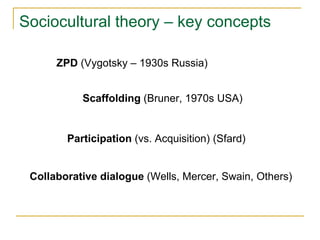
Sociocultural theory – key concepts
ZPD (Vygotsky – 1930s Russia)
Scaffolding (Bruner, 1970s USA)
Participation (vs. Acquisition) (Sfard)
Collaborative dialogue (Wells, Mercer, Swain, Others)
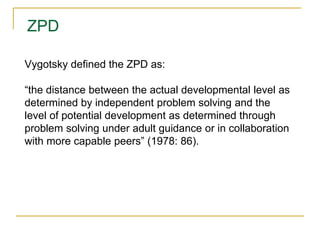
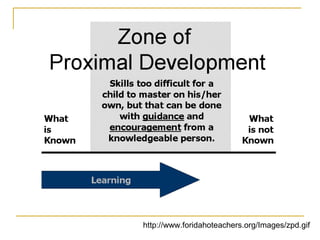
ZPD
Vygotsky defined the ZPD as:
“the distance between the actual developmental level as
determined by independent problem solving and the
level of potential development as determined through
problem solving under adult guidance or in collaboration
with more capable peers” (1978: 86).
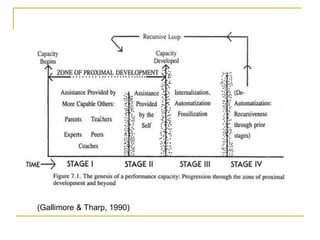
(Gallimore & Tharp, 1990)
http://www.foridahoteachers.org/Images/zpd.gif
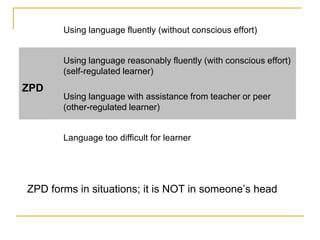
Language too difficult for learner
Using language with assistance from teacher or peer
(other-regulated learner)
Using language reasonably fluently (with conscious effort)
(self-regulated learner)
ZPD
Using language fluently (without conscious effort)
ZPD forms in situations; it is NOT in someone’s head
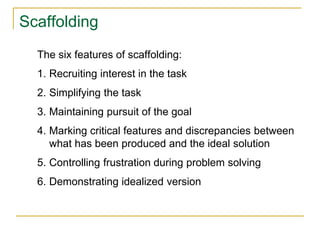
Scaffolding
The six features of scaffolding:
1. Recruiting interest in the task
2. Simplifying the task
3. Maintaining pursuit of the goal
4. Marking critical features and discrepancies between
what has been produced and the ideal solution
5. Controlling frustration during problem solving
6. Demonstrating idealized version
Participation
task-as-plan vs. task-in-action
“learners are not wholly under the control of the teacher, [and] that
they have some freedom concerning the nature and extent of their
participation in class” (Allwright, 1980, p. 166).
Participation arises from:
❖ Teacher, context, peers, task, previous knowledge etc
❖ Learner contributions / interpretations / improvisations
❖ Individual cognitive and social dynamics
❖ Temporal / knock-on effects
Teacher: Wy are you late to school Eric.
Eric: Ehmmh… im… went to the wrong school Yeh! thats right
Teacher: Eric!!! How did you manage to go to the wrong school.
Eric: Eh… wel
Teacher: Answer me!!!!!!
Eric: I lent map and my compas to a friend on that school
Teacher: But you said that you did go to the wrong school
Eric: I did go to the wrong school befor I went to the other school
to pick up my map
Teacher: I GIV UP
Well… let my take a look on your homework
Eric: I dident do my home work
Teacher: WYE
Eric: Well… eh… becouse i… eh… my mom diddent come home last
night and I was to wory to do my homework
Teacher: Oh, I GIVE UP! Well... class, the lesson is over Take a brake
Student’s written output
Collaborative Dialogue
Morten: my mom --
Tim: didn't
(2)
Morten: come (1) home (...) last night
Tim: <L1 du you want to include this? L1>
well ehm --
Morten: and
(1) last night
and I was worry
Tim: last (.) NIGHT
(2)
Morten: and (.) I was worry?
Tim: I was --
(...) too worry to do my home work
Morten: ja
(1.5) <L1 how do you write L1> worry?
Tim: W-O-R-Y <L1 we write L1>@
Morten: so worry
Tim: I was too worry
(12 second pause)
Morten: <L1 let’s only do one more L1>
Tim: <L1 yes, like this L1>
and I --
(2) and I ehm --
and I --
(..) forget --
forgot to do my homework
(2)
Morten: too worry
(.) too worry to do my homework?
Tim: do (..) my (.) homework
References – Sociocultural theory
Cameron, L. (2001). Teaching languages to young learners. Cambridge, Cambridge
University Press.
Donato, R. (1994). Collective scaffolding in second language learning. Vygotskian
approaches to second language research. J. P. Lantolf and G. Appel. Norwood, NJ,
Ablex: 33-56.
Gallimore, R. & Tharp, R. (1990). Teaching mind in society (pp. 175-205). In
L. Moll (Ed.). Vygotsky and education: Instructional implications and social
applications of sociohistorical psychology. New York: Cambridge University
Press.
Mercer, N. (1995) The Guided Construction of Knowledge: talk amongst teachers and
learners. Clevedon: Multilingual Matters
Sfard, A. (1998). On Two Metaphors for Learning and the Dangers of Choosing
Just One. Educational Researcher 27: 4-13.
Vygotsky, L. S. (1978). Mind in Society: The development of higher psychological
processes. Cambridge, MA, Harvard University Press.
The Nassaji and Swain Paper

Sociocultural Theory

  • 1.
    Sociocultural Perspective The zoneof proximal development Scaffolding The participation metaphor Collaborative dialogue
  • 2.
    Sociocultural theory –key concepts ZPD (Vygotsky – 1930s Russia) Scaffolding (Bruner, 1970s USA) Participation (vs. Acquisition) (Sfard) Collaborative dialogue (Wells, Mercer, Swain, Others)
  • 3.
    ZPD Vygotsky defined theZPD as: “the distance between the actual developmental level as determined by independent problem solving and the level of potential development as determined through problem solving under adult guidance or in collaboration with more capable peers” (1978: 86).
  • 4.
  • 5.
  • 6.
    Language too difficultfor learner Using language with assistance from teacher or peer (other-regulated learner) Using language reasonably fluently (with conscious effort) (self-regulated learner) ZPD Using language fluently (without conscious effort) ZPD forms in situations; it is NOT in someone’s head
  • 7.
    Scaffolding The six featuresof scaffolding: 1. Recruiting interest in the task 2. Simplifying the task 3. Maintaining pursuit of the goal 4. Marking critical features and discrepancies between what has been produced and the ideal solution 5. Controlling frustration during problem solving 6. Demonstrating idealized version
  • 8.
    Participation task-as-plan vs. task-in-action “learnersare not wholly under the control of the teacher, [and] that they have some freedom concerning the nature and extent of their participation in class” (Allwright, 1980, p. 166). Participation arises from: ❖ Teacher, context, peers, task, previous knowledge etc ❖ Learner contributions / interpretations / improvisations ❖ Individual cognitive and social dynamics ❖ Temporal / knock-on effects
  • 9.
    Teacher: Wy areyou late to school Eric. Eric: Ehmmh… im… went to the wrong school Yeh! thats right Teacher: Eric!!! How did you manage to go to the wrong school. Eric: Eh… wel Teacher: Answer me!!!!!! Eric: I lent map and my compas to a friend on that school Teacher: But you said that you did go to the wrong school Eric: I did go to the wrong school befor I went to the other school to pick up my map Teacher: I GIV UP Well… let my take a look on your homework Eric: I dident do my home work Teacher: WYE Eric: Well… eh… becouse i… eh… my mom diddent come home last night and I was to wory to do my homework Teacher: Oh, I GIVE UP! Well... class, the lesson is over Take a brake Student’s written output
  • 10.
    Collaborative Dialogue Morten: mymom -- Tim: didn't (2) Morten: come (1) home (...) last night Tim: <L1 du you want to include this? L1> well ehm -- Morten: and (1) last night and I was worry Tim: last (.) NIGHT (2) Morten: and (.) I was worry? Tim: I was -- (...) too worry to do my home work Morten: ja (1.5) <L1 how do you write L1> worry? Tim: W-O-R-Y <L1 we write L1>@ Morten: so worry Tim: I was too worry (12 second pause) Morten: <L1 let’s only do one more L1> Tim: <L1 yes, like this L1> and I -- (2) and I ehm -- and I -- (..) forget -- forgot to do my homework (2) Morten: too worry (.) too worry to do my homework? Tim: do (..) my (.) homework
  • 11.
    References – Socioculturaltheory Cameron, L. (2001). Teaching languages to young learners. Cambridge, Cambridge University Press. Donato, R. (1994). Collective scaffolding in second language learning. Vygotskian approaches to second language research. J. P. Lantolf and G. Appel. Norwood, NJ, Ablex: 33-56. Gallimore, R. & Tharp, R. (1990). Teaching mind in society (pp. 175-205). In L. Moll (Ed.). Vygotsky and education: Instructional implications and social applications of sociohistorical psychology. New York: Cambridge University Press. Mercer, N. (1995) The Guided Construction of Knowledge: talk amongst teachers and learners. Clevedon: Multilingual Matters Sfard, A. (1998). On Two Metaphors for Learning and the Dangers of Choosing Just One. Educational Researcher 27: 4-13. Vygotsky, L. S. (1978). Mind in Society: The development of higher psychological processes. Cambridge, MA, Harvard University Press.
  • 12.
    The Nassaji andSwain Paper