This document discusses different conditions affecting the nails including paronychia, acute paronychia, chronic paronychia, and subungual hematoma. It describes the anatomy of the nail including the nail plate, matrix, lunula, cuticle, and nail bed. Acute paronychia is usually caused by minor nail injuries allowing bacterial infection, while chronic paronychia is often due to Candida infection. Treatment involves draining pus or blood and using antibiotics or antifungals. Subungual hematoma causes intense pain due to blood collecting under the nail requiring drainage through cautery or needle.
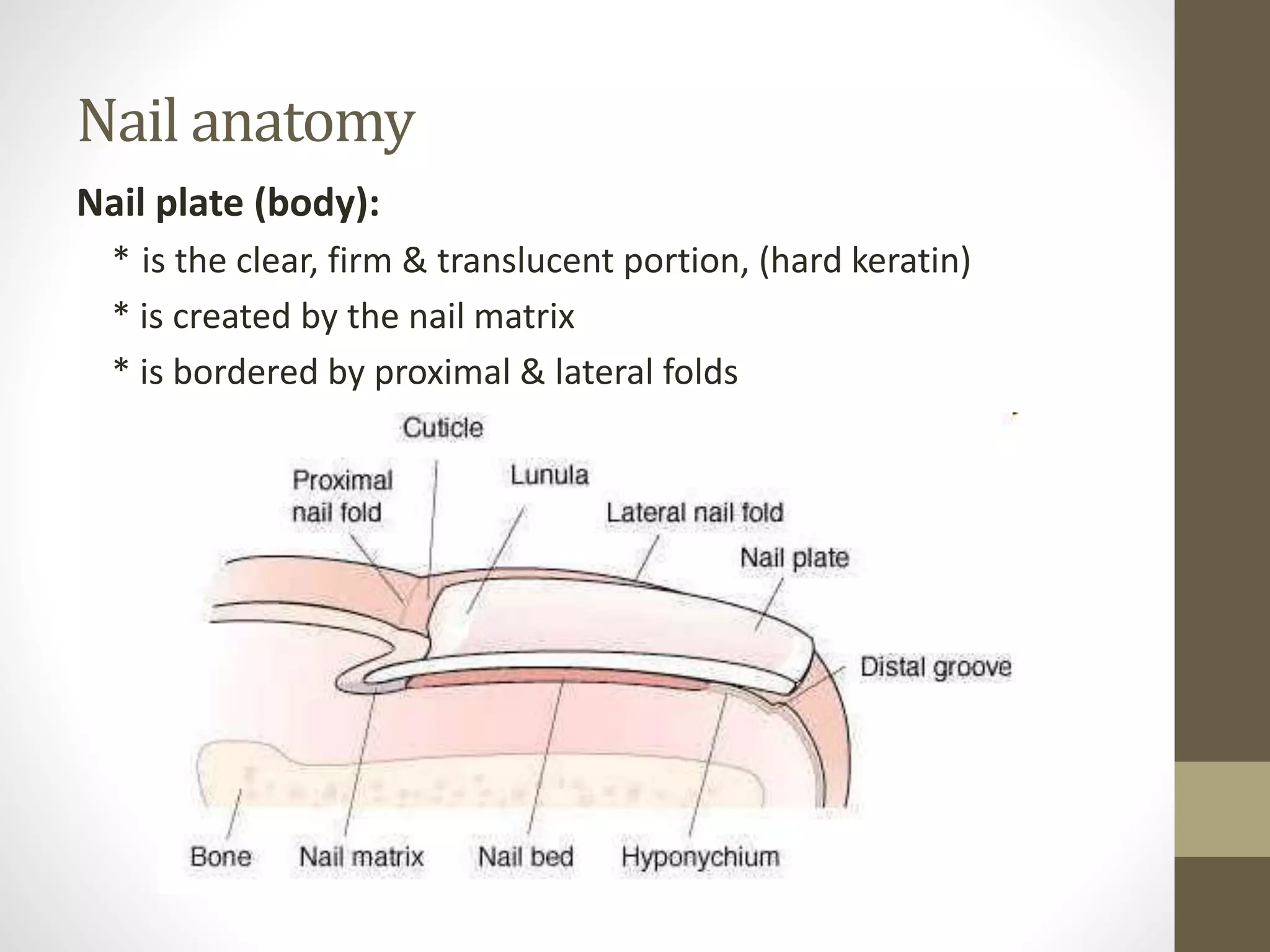
Nail anatomy
Nail plate(body):
* is the clear, firm & translucent portion, (hard keratin)
* is created by the nail matrix
* is bordered by proximal & lateral folds
3.
Nail anatomy
Nail matrix: directly below the cuticle.
* produces the nail plate.
* contains blood vessels and nerves.
* If the matrix is damaged the nail will grow deformed
4.
Nail anatomy
Lunula :is the crescent shaped whitish area of the nail
bed
Cuticle or (Eponychium): skin fold at the proximal end
of the nail
Nail fold : hard skin overlapping the base & sides of
the nail
Nail bed : is continuation of the matrix & the the nail plate
rests on
Hyponychium: is under the free edge of the nail
plate
5.
Paronychia
• It isa soft tissue infection around a fingernail
• It is the most common hand infection
• Occurs in the subcuticular area under the eponychium
6.
Acute paronychia
• Minorinjury to the finger is the common cause (nail
biting)
• nail biting breaks down the physical barrier between
the nail bed and the nail allowing the infiltration of
infectious organisms
• Organisms – staph.aureus & strep.pyogenes
• It tracks around the skin margin – spreads under the
nail causing floating nail or hang nail
7.
Acute paronychia
Clinical features:
• Edema, erythema andsevere THROBBING pain
along the lateral edge of the nail fold.
• Nail on touch is very tender
• May have extension to the proximal nail edge.
• Presence of frank abscess and fluctuation
• Subungual abscess ( floating nail ) if pus has
extended under the nail plate.
Acute paronychia
• Treatment:
• Pus is drained by making an incision over
eponychium
• Pus is sent for c/s
• Antibiotics like cloxacillin,amoxycillin
• Floating nail – indicates that nail is dead –
excision of nail is done
Chronic paronychia
• Symptomspresent for 6 weeks or longer
• Caused by Candida. Albicans
• Secondary bacterial infection may supervene
• Can be a complication of eczema
• In housekeepers, dishwashers, and swimmers
12.
Chronic paronychia
• Clinicalfeatures :
• Itching in nail bed
• Recurrent pain
• Discharge
The nail folds are swollen, erythematous, and tender
with pronounced
transverse ridges
Chronic paronychia
• Management:
• Culture of scrapings for fungus and other
causative agents .
• Long term anti fungal therapy
• Antibiotics – if bacterial infection
supervenes
• In severe cases – removal of nail
15.
Subungual hematoma
• Collectionof blood in the space between the nailbed and
fingernail.
• The pressure generated by this collection of blood under
the nail causes intense pain.
16.
Subungual hematoma
• Etiology:
• They occur most commonly due to a crush type
injury to the tip of the finger or toe.
This injury can occur in many ways:
• Hitting your finger with a hammer
• Dropping a heavy object on your toe
• Closing your finger in a door
17.
Subungual hematoma
• Clinicalfeatures :
• The most common symptom is intense pain.
• Pressure generated between the nail and the
nailbed, where the blood collects, causes this
pain.
• You will have a discoloration of red, maroon, or
other dark color beneath the nail after an injury.
18.
Subungual hematoma
Management :
•Ice, limb elevation, and anti-inflammatory
medications, such as ibuprofen, are
recommended for minor hematomas
• If the hematoma is 25% or more of the
underlying nail area, then medical attention is
required.
• x-ray is taken to look for the possibility of a
fracture
19.
Subungual hematoma
• Management:
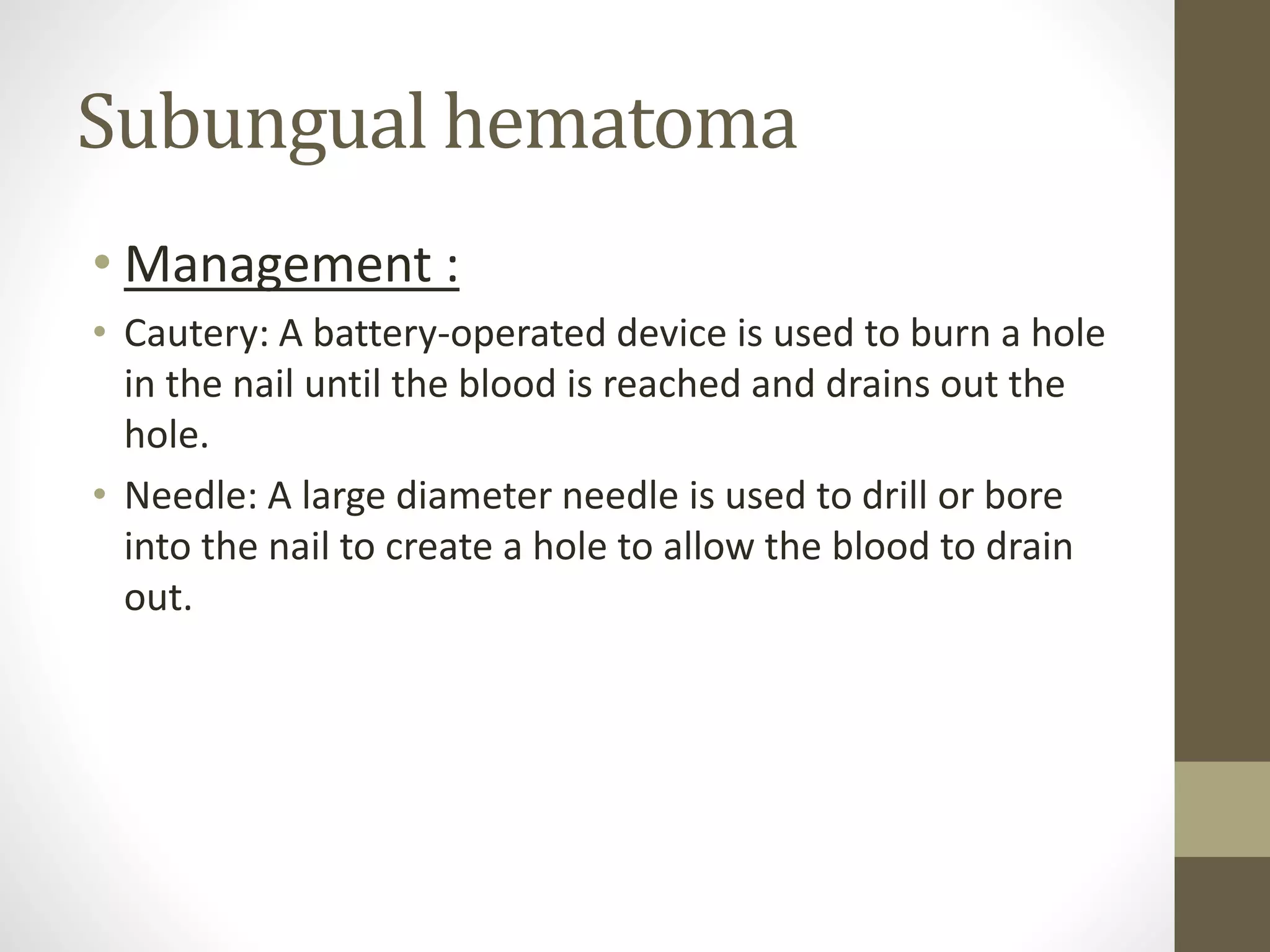
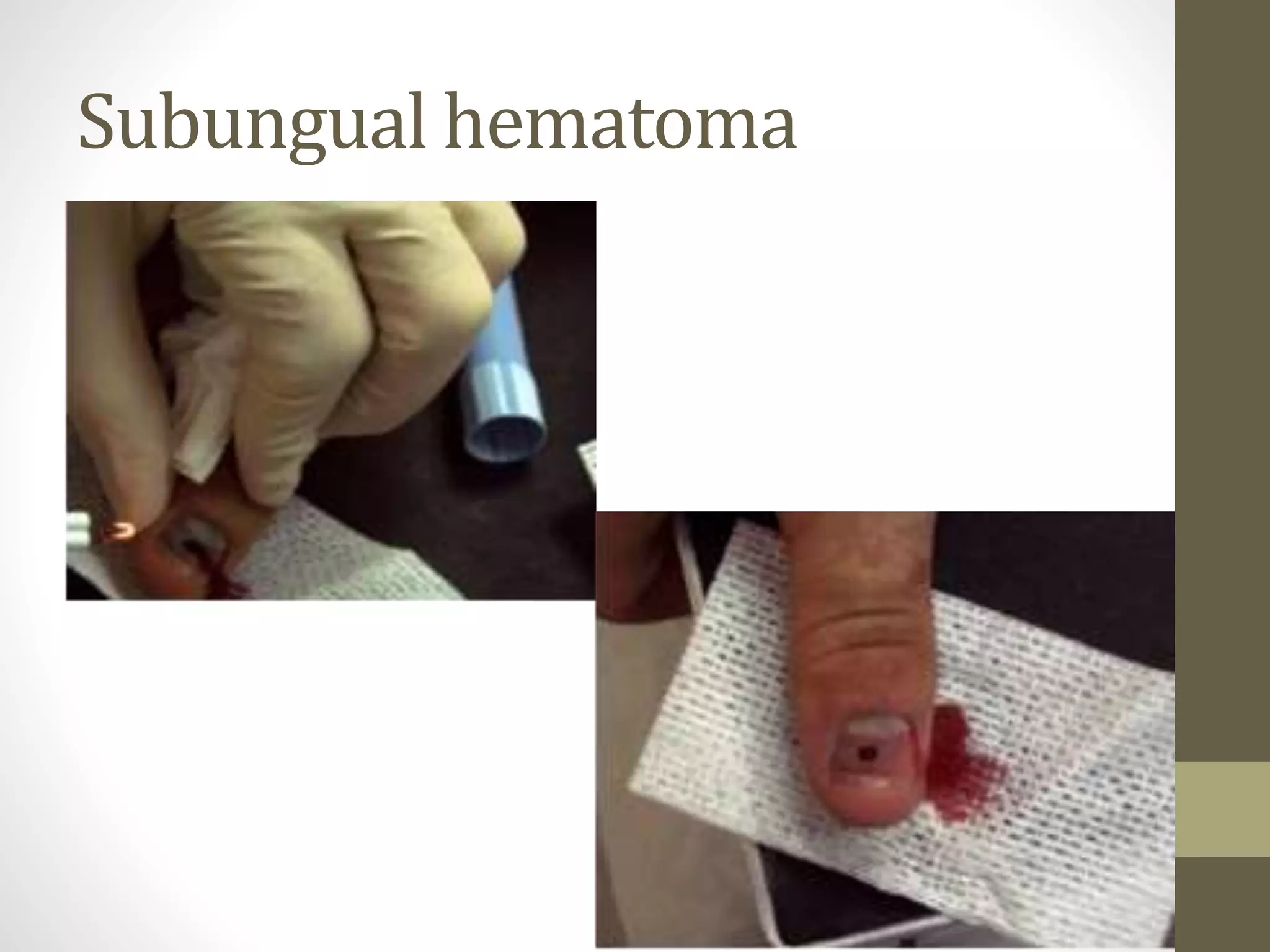
• Cautery: A battery-operated device is used to burn a hole
in the nail until the blood is reached and drains out the
hole.
• Needle: A large diameter needle is used to drill or bore
into the nail to create a hole to allow the blood to drain
out.