Howard Gardner and the Theory of
     Multiple Intelligences


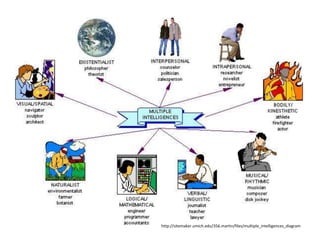
                    http://sitemaker.umich.edu/356.martin/files/multiple_intelligences_diagram


            By Patrick Gardner
The Plan
• Background information about Howard
  Gardner and MI theory
• A short clip of Howard Gardner discussing the
  theory of multiple intelligences
• Individual/group activity
• Implications and criticism of the theory
• Assessment
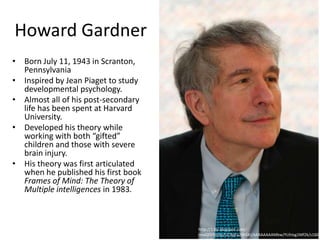
Howard Gardner
• Born July 11, 1943 in Scranton,
  Pennsylvania
• Inspired by Jean Piaget to study
  developmental psychology.
• Almost all of his post-secondary
  life has been spent at Harvard
  University.
• Developed his theory while
  working with both “gifted”
  children and those with severe
  brain injury.
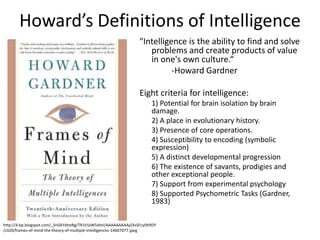
• His theory was first articulated
  when he published his first book
  Frames of Mind: The Theory of
  Multiple intelligences in 1983.


                                     http://1.bp.blogspot.com/-
                                     lmoQFEfVeSo/UCAqFa2WGKI/AAAAAAAAMbw/YUhIxg1Mf2k/s1600
Howard’s Definitions of Intelligence
                                                                 "Intelligence is the ability to find and solve
                                                                    problems and create products of value
                                                                    in one's own culture.“
                                                                           -Howard Gardner

                                                                 Eight criteria for intelligence:
                                                                      1) Potential for brain isolation by brain
                                                                      damage.
                                                                      2) A place in evolutionary history.
                                                                      3) Presence of core operations.
                                                                      4) Susceptibility to encoding (symbolic
                                                                      expression)
                                                                      5) A distinct developmental progression
                                                                      6) The existence of savants, prodigies and
                                                                      other exceptional people.
                                                                      7) Support from experimental psychology
                                                                      8) Supported Psychometric Tasks (Gardner,
                                                                      1983)

http://4.bp.blogspot.com/_SnGKYdtstRg/TR1hSzW5dmI/AAAAAAAAAjI/ksSFcy0h9DY
/s320/frames-of-mind-the-theory-of-multiple-intelligences-14607077.jpeg
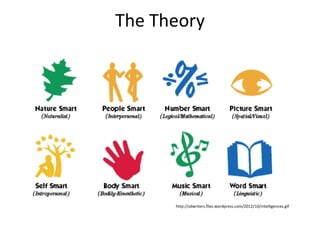
The Theory


      http://sdwriters.files.wordpress.com/2012/10/intelligences.gif
Clip of Howard Gardner
         discussing his theory


• http://www.youtube.com/watch?v=l2QtSbP4F
  Rg&feature=player_detailpage
http://sitemaker.umich.edu/356.martin/files/multiple_intelligences_diagram
Implications
• Not readily accepted in the
  psychological community but
  very influential in education.
• Many teachers have adopted the
  idea of multiple intelligences as a
  way to meet all students’ needs.
• Entire Schools, such as the New
  City School in St. Louis, Missouri
  are using the theory as a
  framework for running their
  school.
• Howard’s work with Project Zero
  and the GoodWork project.             http://www.newcityschool.org/Visit_13.aspx
Criticism
• MI theory is simply common sense and rather
  than intelligences they refer to a student’s
  abilities and strengths.
• The theory is not validated by research,
  particularly in the field of cognitive
  neuroscience (Kincheloe, 2007).
• Working memory is not taken into account
  (Eggen & Kauchak, 2013).
References:
• Eggen, P., & Kauchak, D. (2013) “Educational
  psychology: Windows into classrooms.” New
  York: Pearsons.
• Gardner, Howard. (1983) "Frames of Mind: The
  Theory of Multiple Intelligences." New York: Basic
  Books.
• Gardner, Howard. (1999) "Intelligence Reframed:
  Multiple Intelligences for the 21st Century." New
  York: Basic Books.
• Joe L. Kincheloe (ed.). (2007) Multiple
  Intelligences Reconsidered. New York: Peter Lang

Howard Gardner

  • 1.
    Howard Gardner andthe Theory of Multiple Intelligences http://sitemaker.umich.edu/356.martin/files/multiple_intelligences_diagram By Patrick Gardner
  • 2.
    The Plan • Backgroundinformation about Howard Gardner and MI theory • A short clip of Howard Gardner discussing the theory of multiple intelligences • Individual/group activity • Implications and criticism of the theory • Assessment
  • 3.
    Howard Gardner • BornJuly 11, 1943 in Scranton, Pennsylvania • Inspired by Jean Piaget to study developmental psychology. • Almost all of his post-secondary life has been spent at Harvard University. • Developed his theory while working with both “gifted” children and those with severe brain injury. • His theory was first articulated when he published his first book Frames of Mind: The Theory of Multiple intelligences in 1983. http://1.bp.blogspot.com/- lmoQFEfVeSo/UCAqFa2WGKI/AAAAAAAAMbw/YUhIxg1Mf2k/s1600
  • 4.
    Howard’s Definitions ofIntelligence "Intelligence is the ability to find and solve problems and create products of value in one's own culture.“ -Howard Gardner Eight criteria for intelligence: 1) Potential for brain isolation by brain damage. 2) A place in evolutionary history. 3) Presence of core operations. 4) Susceptibility to encoding (symbolic expression) 5) A distinct developmental progression 6) The existence of savants, prodigies and other exceptional people. 7) Support from experimental psychology 8) Supported Psychometric Tasks (Gardner, 1983) http://4.bp.blogspot.com/_SnGKYdtstRg/TR1hSzW5dmI/AAAAAAAAAjI/ksSFcy0h9DY /s320/frames-of-mind-the-theory-of-multiple-intelligences-14607077.jpeg
  • 5.
    The Theory http://sdwriters.files.wordpress.com/2012/10/intelligences.gif
  • 6.
    Clip of HowardGardner discussing his theory • http://www.youtube.com/watch?v=l2QtSbP4F Rg&feature=player_detailpage
  • 7.
  • 8.
    Implications • Not readilyaccepted in the psychological community but very influential in education. • Many teachers have adopted the idea of multiple intelligences as a way to meet all students’ needs. • Entire Schools, such as the New City School in St. Louis, Missouri are using the theory as a framework for running their school. • Howard’s work with Project Zero and the GoodWork project. http://www.newcityschool.org/Visit_13.aspx
  • 9.
    Criticism • MI theoryis simply common sense and rather than intelligences they refer to a student’s abilities and strengths. • The theory is not validated by research, particularly in the field of cognitive neuroscience (Kincheloe, 2007). • Working memory is not taken into account (Eggen & Kauchak, 2013).
  • 10.
    References: • Eggen, P.,& Kauchak, D. (2013) “Educational psychology: Windows into classrooms.” New York: Pearsons. • Gardner, Howard. (1983) "Frames of Mind: The Theory of Multiple Intelligences." New York: Basic Books. • Gardner, Howard. (1999) "Intelligence Reframed: Multiple Intelligences for the 21st Century." New York: Basic Books. • Joe L. Kincheloe (ed.). (2007) Multiple Intelligences Reconsidered. New York: Peter Lang