





Evolutionary Psychology

    Dr. Atiqul Haq Mazumder
 MD (Psychiatry) Part III Student
Department of Psychiatry, BSMMU
              Dhaka
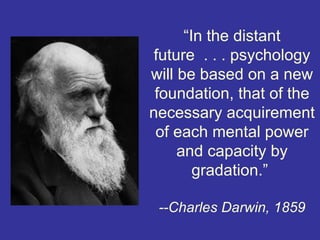
“In the distant
 future . . . psychology
will be based on a new
 foundation, that of the
necessary acquirement
 of each mental power
     and capacity by
        gradation.”

 --Charles Darwin, 1859
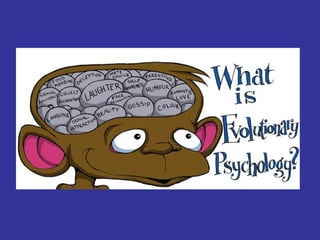
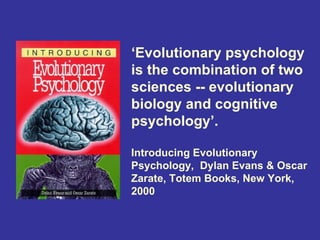
‘Evolutionary psychology
is the combination of two
sciences -- evolutionary
biology and cognitive
psychology’.

Introducing Evolutionary
Psychology, Dylan Evans & Oscar
Zarate, Totem Books, New York,
2000
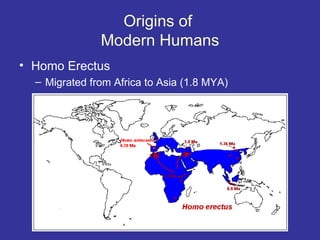
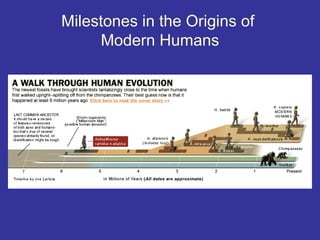
Origins of
               Modern Humans
• Homo Erectus
  – Migrated from Africa to Asia (1.8 MYA)
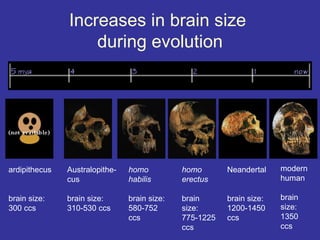
Increases in brain size
                   during evolution


ardipithecus   Australopithe-   homo          homo       Neandertal    modern
               cus              habilis       erectus                  human

brain size:    brain size:      brain size:   brain      brain size:   brain
300 ccs        310-530 ccs      580-752       size:      1200-1450     size:
                                ccs           775-1225   ccs           1350
                                              ccs                      ccs
Milestones in the Origins of
     Modern Humans
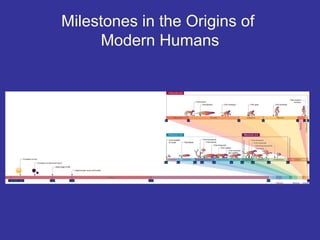
Milestones in the Origins of
     Modern Humans
The three theories of the
origins of complex adaptive
        mechanisms
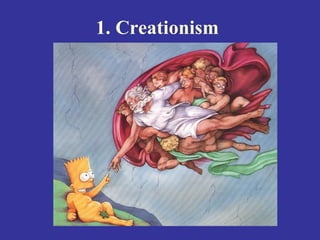
1. Creationism
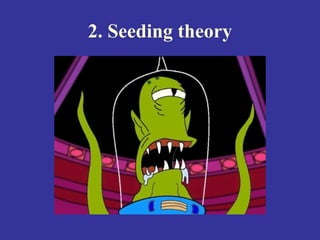
2. Seeding theory
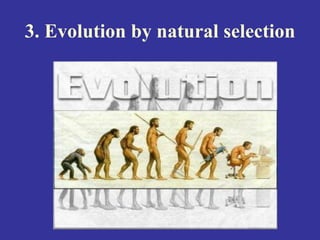
3. Evolution by natural selection
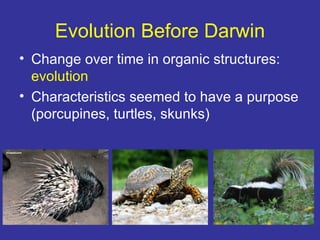
Evolution Before Darwin
• Change over time in organic structures:
  evolution
• Characteristics seemed to have a purpose
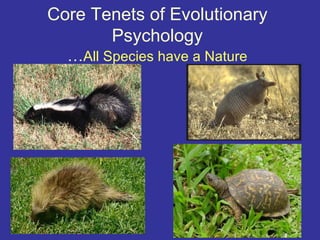
  (porcupines, turtles, skunks)
Darwin’s Theory of
        Natural Selection

• The explanatory challenge:

   1. why change takes place
   2. how new species emerge
   3. what the functions are of parts
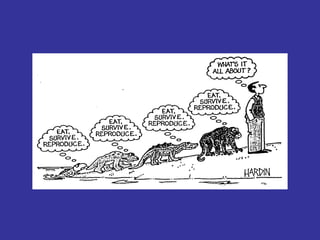
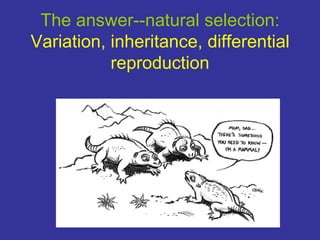
The answer--natural selection:
Variation, inheritance, differential
           reproduction
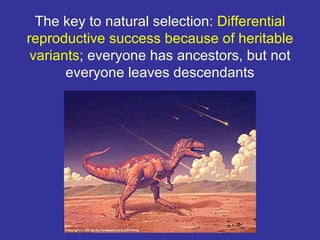
The key to natural selection: Differential
reproductive success because of heritable
 variants; everyone has ancestors, but not
       everyone leaves descendants
Natural selection provided
          3 key answers
• Explained change over time: descent with
  modification

• Explained the apparent purposive quality
  of component parts: adaptive function

• United all species into one grand tree of
  descent: including humans
Sexual Selection
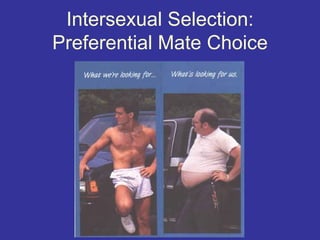
Intersexual Selection:
Preferential Mate Choice
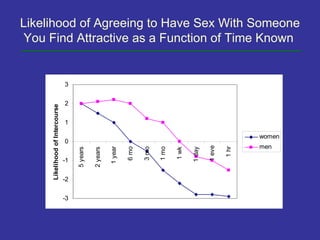
Likelihood of Agreeing to Have Sex With Someone
You Find Attractive as a Function of Time Known


                                 3


                                 2
     Likelihood of Intercourse


                                 1

                                                                                                                      women
                                 0
                                                                                                                      men


                                                                                                       1 eve
                                                          1 year


                                                                                                               1 hr
                                                                   6 mo

                                                                          3 mo

                                                                                 1 mo


                                                                                               1 day
                                      5 years

                                                2 years


                                                                                        1 wk
                                 -1


                                 -2


                                 -3
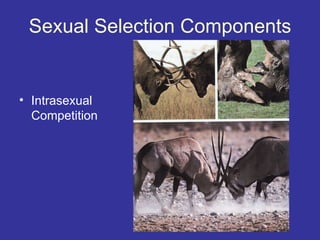
Sexual Selection Components


• Intrasexual
  Competition
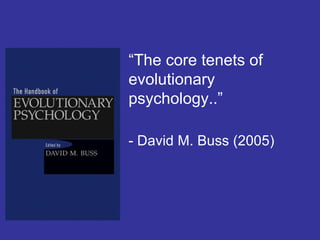
“The core tenets of
evolutionary
psychology..”

- David M. Buss (2005)
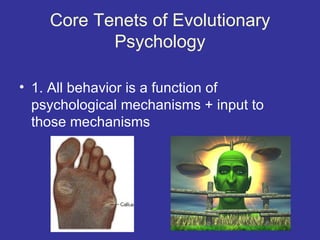
Core Tenets of Evolutionary
           Psychology

• 1. All behavior is a function of
  psychological mechanisms + input to
  those mechanisms
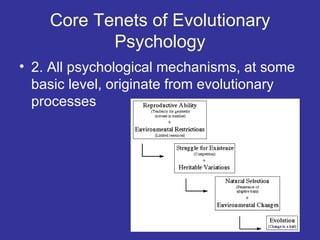
Core Tenets of Evolutionary
           Psychology
• 2. All psychological mechanisms, at some
  basic level, originate from evolutionary
  processes
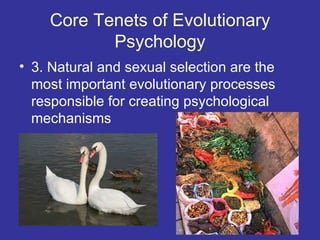
Core Tenets of Evolutionary
           Psychology
• 3. Natural and sexual selection are the
  most important evolutionary processes
  responsible for creating psychological
  mechanisms
Core Tenets of Evolutionary
       Psychology
  …All Species have a Nature
Core Tenets of Evolutionary
           Psychology
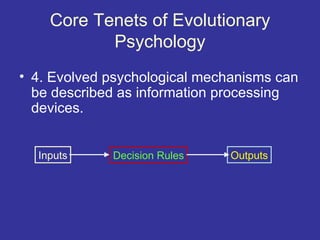
• 4. Evolved psychological mechanisms can
  be described as information processing
  devices.


  Inputs     Decision Rules    Outputs
Core Tenets of Evolutionary
           Psychology
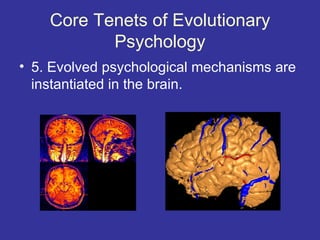
• 5. Evolved psychological mechanisms are
  instantiated in the brain.
Core Tenets of Evolutionary
           Psychology
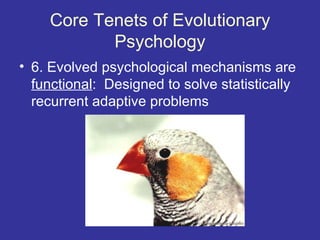
• 6. Evolved psychological mechanisms are
  functional: Designed to solve statistically
  recurrent adaptive problems
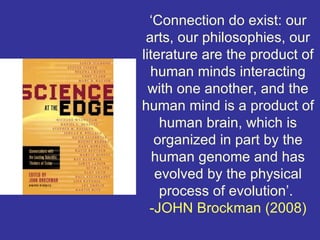
‘Connection do exist: our
 arts, our philosophies, our
literature are the product of
  human minds interacting
  with one another, and the
human mind is a product of
    human brain, which is
   organized in part by the
   human genome and has
   evolved by the physical
    process of evolution’.
  -JOHN Brockman (2008)
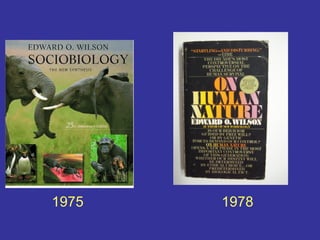
1975   1978
‘Gene-culture coevolution’

 -Edward O Wilson (1978)
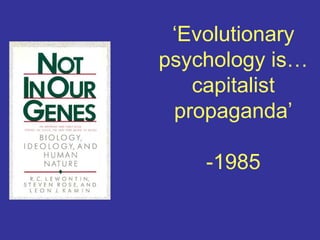
‘Evolutionary
psychology is…
   capitalist
 propaganda’

    -1985
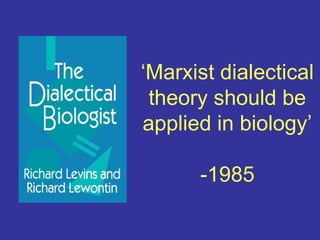
‘Marxist dialectical
 theory should be
applied in biology’

      -1985
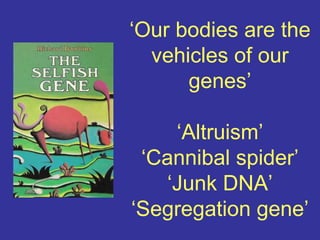
‘Our bodies are the
  vehicles of our
      genes’

    ‘Altruism’
 ‘Cannibal spider’
   ‘Junk DNA’
‘Segregation gene’
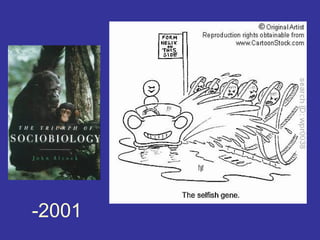
-2001
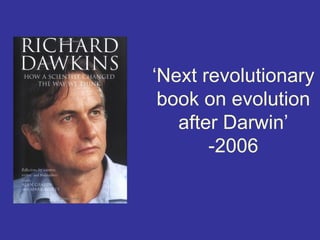
‘Next revolutionary
 book on evolution
   after Darwin’
       -2006
2006 Best seller
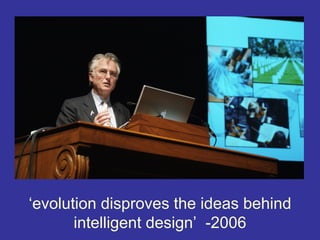
‘evolution disproves the ideas behind
       intelligent design’ -2006
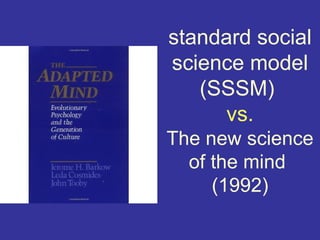
standard social
science model
   (SSSM)
      vs.
The new science
  of the mind
     (1992)
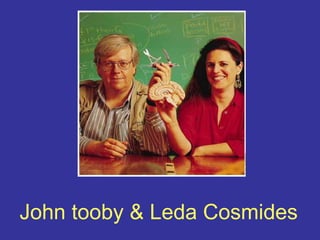
John tooby & Leda Cosmides
Principle 1. The brain is a
physical system. It functions
as a computer. Its circuits
are designed to generate
behavior that is appropriate
to your environmental
circumstances.
Principle 2. Our neural
circuits were designed by
natural selection to solve
problems that our ancestors
faced during our species'
evolutionary history.
Principle 3. Consciousness is just the
tip of the iceberg; most of what goes
on in your mind is hidden from you. As
a result, your conscious experience
can mislead you into thinking that our
circuitry is simpler that it really is.
Most problems that you experience as
easy to solve are very difficult to solve
-- they require very complicated
neural circuitry.
Principle 4. Different neural
circuits are specialized for
solving different adaptive
problems.
Principle 5. Our modern
skulls house a stone age
mind.
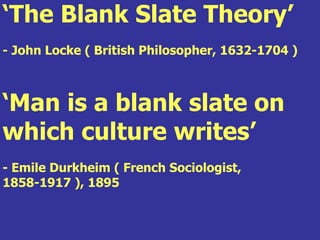
‘The Blank Slate Theory’
- John Locke ( British Philosopher, 1632-1704 )


‘Man is a blank slate on
which culture writes’
- Emile Durkheim ( French Sociologist,
1858-1917 ), 1895
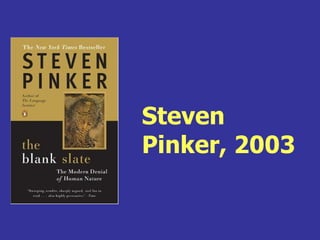
Steven
Pinker, 2003
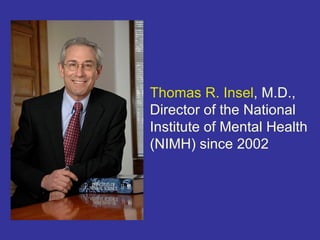
Thomas R. Insel, M.D.,
Director of the National
Institute of Mental Health
(NIMH) since 2002
Prairie voles
      vs.
Mountain voles
    -1993
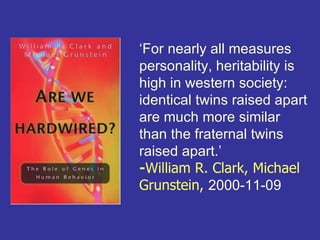
‘For nearly all measures
personality, heritability is
high in western society:
identical twins raised apart
are much more similar
than the fraternal twins
raised apart.’
-William R. Clark, Michael
Grunstein, 2000-11-09
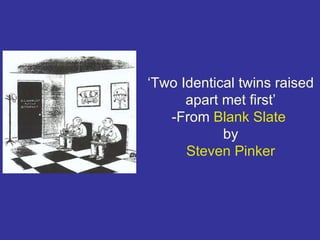
‘Two Identical twins raised
      apart met first’
   -From Blank Slate
            by
      Steven Pinker
by Martha Stout,
     2005
Robert D. Hare,1999
Psychopaths, as far we know, cannot be 'cured'.
Indeed, the psychologists Marine Rice has shown
   that has shown that certain harebrain ideas for
  therapy, such as boosting their self esteem and
 teaching them social skills, can even make more
                    dangerous.

             -Steven Pinker, 2003
Jack Henry Abbott, 2005
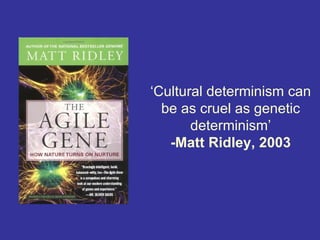
‘Cultural determinism can
  be as cruel as genetic
       determinism’
   -Matt Ridley, 2003
‘Epigenetics’
 ‘Neuroplasticity’
‘Malleable gene’
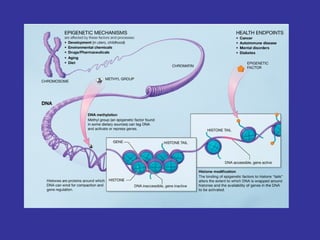
presence or absence of epigenetic factors at
target sites controls whether particular genes can
    generate proteins, the workhorses of most
              physiological processes.
 -Douglas Steinberg, Determining Nature vs. Nurture : Molecular evidence is finally emerging to
        inform the long-standing debate, Scientific American Mind, 17, 12 - 14 (2006)
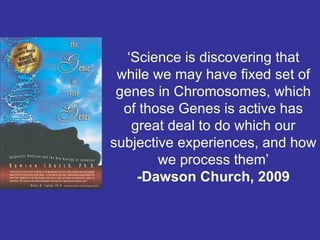
‘Science is discovering that
 while we may have fixed set of
 genes in Chromosomes, which
  of those Genes is active has
   great deal to do which our
subjective experiences, and how
        we process them’
    -Dawson Church, 2009
Josephine Tesauro, left, active and healthy at 92, is part of a study
  trying to determine why some people age better than others, even
                    when they are closely related.

Live Long? Die Young? Answer Isn’t Just in Genes, GINA KOLATA, The NewYork Times,
   August 31, 2006, Online link: http://www.nytimes.com/2006/08/31/health/31age.html
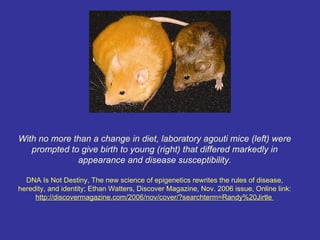
With no more than a change in diet, laboratory agouti mice (left) were
   prompted to give birth to young (right) that differed markedly in
              appearance and disease susceptibility.

  DNA Is Not Destiny, The new science of epigenetics rewrites the rules of disease,
heredity, and identity; Ethan Watters, Discover Magazine, Nov. 2006 issue, Online link:
     http://discovermagazine.com/2006/nov/cover/?searchterm=Randy%20Jirtle
Nature vs. Nurture           No
  Nature via nurture         Yes
 We are the minders of our
               genes
   Evolutionary psychology
describes what human nature
 is like - it does not prescribe
   what humans should do'।
Thank you!

Evolutionary psychology

  • 1.
    Evolutionary Psychology Dr. Atiqul Haq Mazumder MD (Psychiatry) Part III Student Department of Psychiatry, BSMMU Dhaka
  • 2.
    “In the distant future . . . psychology will be based on a new foundation, that of the necessary acquirement of each mental power and capacity by gradation.” --Charles Darwin, 1859
  • 5.
    ‘Evolutionary psychology is thecombination of two sciences -- evolutionary biology and cognitive psychology’. Introducing Evolutionary Psychology, Dylan Evans & Oscar Zarate, Totem Books, New York, 2000
  • 7.
    Origins of Modern Humans • Homo Erectus – Migrated from Africa to Asia (1.8 MYA)
  • 8.
    Increases in brainsize during evolution ardipithecus Australopithe- homo homo Neandertal modern cus habilis erectus human brain size: brain size: brain size: brain brain size: brain 300 ccs 310-530 ccs 580-752 size: 1200-1450 size: ccs 775-1225 ccs 1350 ccs ccs
  • 9.
    Milestones in theOrigins of Modern Humans
  • 10.
    Milestones in theOrigins of Modern Humans
  • 11.
    The three theoriesof the origins of complex adaptive mechanisms
  • 12.
  • 13.
  • 14.
    3. Evolution bynatural selection
  • 16.
    Evolution Before Darwin •Change over time in organic structures: evolution • Characteristics seemed to have a purpose (porcupines, turtles, skunks)
  • 17.
    Darwin’s Theory of Natural Selection • The explanatory challenge: 1. why change takes place 2. how new species emerge 3. what the functions are of parts
  • 18.
    The answer--natural selection: Variation,inheritance, differential reproduction
  • 19.
    The key tonatural selection: Differential reproductive success because of heritable variants; everyone has ancestors, but not everyone leaves descendants
  • 20.
    Natural selection provided 3 key answers • Explained change over time: descent with modification • Explained the apparent purposive quality of component parts: adaptive function • United all species into one grand tree of descent: including humans
  • 21.
  • 22.
  • 23.
    Likelihood of Agreeingto Have Sex With Someone You Find Attractive as a Function of Time Known 3 2 Likelihood of Intercourse 1 women 0 men 1 eve 1 year 1 hr 6 mo 3 mo 1 mo 1 day 5 years 2 years 1 wk -1 -2 -3
  • 24.
    Sexual Selection Components •Intrasexual Competition
  • 26.
    “The core tenetsof evolutionary psychology..” - David M. Buss (2005)
  • 27.
    Core Tenets ofEvolutionary Psychology • 1. All behavior is a function of psychological mechanisms + input to those mechanisms
  • 28.
    Core Tenets ofEvolutionary Psychology • 2. All psychological mechanisms, at some basic level, originate from evolutionary processes
  • 29.
    Core Tenets ofEvolutionary Psychology • 3. Natural and sexual selection are the most important evolutionary processes responsible for creating psychological mechanisms
  • 30.
    Core Tenets ofEvolutionary Psychology …All Species have a Nature
  • 31.
    Core Tenets ofEvolutionary Psychology • 4. Evolved psychological mechanisms can be described as information processing devices. Inputs Decision Rules Outputs
  • 32.
    Core Tenets ofEvolutionary Psychology • 5. Evolved psychological mechanisms are instantiated in the brain.
  • 33.
    Core Tenets ofEvolutionary Psychology • 6. Evolved psychological mechanisms are functional: Designed to solve statistically recurrent adaptive problems
  • 34.
    ‘Connection do exist:our arts, our philosophies, our literature are the product of human minds interacting with one another, and the human mind is a product of human brain, which is organized in part by the human genome and has evolved by the physical process of evolution’. -JOHN Brockman (2008)
  • 35.
    1975 1978
  • 36.
  • 37.
    ‘Evolutionary psychology is… capitalist propaganda’ -1985
  • 38.
    ‘Marxist dialectical theoryshould be applied in biology’ -1985
  • 39.
    ‘Our bodies arethe vehicles of our genes’ ‘Altruism’ ‘Cannibal spider’ ‘Junk DNA’ ‘Segregation gene’
  • 40.
  • 41.
    ‘Next revolutionary bookon evolution after Darwin’ -2006
  • 42.
  • 43.
    ‘evolution disproves theideas behind intelligent design’ -2006
  • 44.
    standard social science model (SSSM) vs. The new science of the mind (1992)
  • 45.
    John tooby &Leda Cosmides
  • 46.
    Principle 1. Thebrain is a physical system. It functions as a computer. Its circuits are designed to generate behavior that is appropriate to your environmental circumstances.
  • 47.
    Principle 2. Ourneural circuits were designed by natural selection to solve problems that our ancestors faced during our species' evolutionary history.
  • 48.
    Principle 3. Consciousnessis just the tip of the iceberg; most of what goes on in your mind is hidden from you. As a result, your conscious experience can mislead you into thinking that our circuitry is simpler that it really is. Most problems that you experience as easy to solve are very difficult to solve -- they require very complicated neural circuitry.
  • 49.
    Principle 4. Differentneural circuits are specialized for solving different adaptive problems.
  • 50.
    Principle 5. Ourmodern skulls house a stone age mind.
  • 51.
    ‘The Blank SlateTheory’ - John Locke ( British Philosopher, 1632-1704 ) ‘Man is a blank slate on which culture writes’ - Emile Durkheim ( French Sociologist, 1858-1917 ), 1895
  • 52.
  • 53.
    Thomas R. Insel,M.D., Director of the National Institute of Mental Health (NIMH) since 2002
  • 54.
    Prairie voles vs. Mountain voles -1993
  • 55.
    ‘For nearly allmeasures personality, heritability is high in western society: identical twins raised apart are much more similar than the fraternal twins raised apart.’ -William R. Clark, Michael Grunstein, 2000-11-09
  • 56.
    ‘Two Identical twinsraised apart met first’ -From Blank Slate by Steven Pinker
  • 57.
  • 58.
  • 59.
    Psychopaths, as farwe know, cannot be 'cured'. Indeed, the psychologists Marine Rice has shown that has shown that certain harebrain ideas for therapy, such as boosting their self esteem and teaching them social skills, can even make more dangerous. -Steven Pinker, 2003
  • 60.
  • 62.
    ‘Cultural determinism can be as cruel as genetic determinism’ -Matt Ridley, 2003
  • 63.
  • 64.
    presence or absenceof epigenetic factors at target sites controls whether particular genes can generate proteins, the workhorses of most physiological processes. -Douglas Steinberg, Determining Nature vs. Nurture : Molecular evidence is finally emerging to inform the long-standing debate, Scientific American Mind, 17, 12 - 14 (2006)
  • 66.
    ‘Science is discoveringthat while we may have fixed set of genes in Chromosomes, which of those Genes is active has great deal to do which our subjective experiences, and how we process them’ -Dawson Church, 2009
  • 67.
    Josephine Tesauro, left,active and healthy at 92, is part of a study trying to determine why some people age better than others, even when they are closely related. Live Long? Die Young? Answer Isn’t Just in Genes, GINA KOLATA, The NewYork Times, August 31, 2006, Online link: http://www.nytimes.com/2006/08/31/health/31age.html
  • 68.
    With no morethan a change in diet, laboratory agouti mice (left) were prompted to give birth to young (right) that differed markedly in appearance and disease susceptibility. DNA Is Not Destiny, The new science of epigenetics rewrites the rules of disease, heredity, and identity; Ethan Watters, Discover Magazine, Nov. 2006 issue, Online link: http://discovermagazine.com/2006/nov/cover/?searchterm=Randy%20Jirtle
  • 69.
    Nature vs. Nurture No Nature via nurture Yes We are the minders of our genes Evolutionary psychology describes what human nature is like - it does not prescribe what humans should do'।
  • 70.