After  X , what is ne X t How to Invent? Ramesh Raskar, MIT Media Lab
Camera Culture Ramesh  Raskar Camera Culture MIT Media Lab http://raskar.info http://cameraculture.info Ramesh Raskar Associate Professor
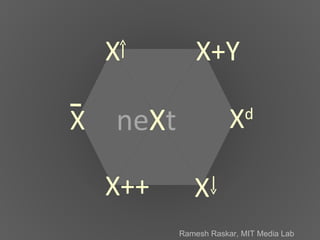
X d X++ X X+Y X X ne X t Ramesh Raskar, MIT Media Lab
Simple Exercise ..  Image Compression Save Bandwidth and storage What is ne X t
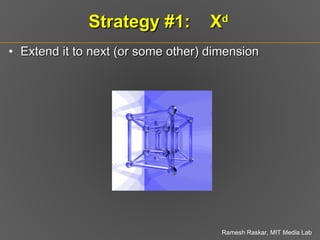
Strategy #1:  X d Extend it to next (or some other) dimension
X =  Idea you just heard Concept Patent New Product Product feature Design Art Algorithm
Strategy #1:  X d Extend it to next dimension (or some other) dimension Flickr to Youtube Wikipedia to .. ? Generalize the concept  (common in patent applications) Text, Audio (Speech), Image, Video .. Whats next ? CD .. Images to infrared, sound, ultrasound to EM spectrum Macro scale to microscale Airbag for car to airbag for .. ?
Strategy #2:  X+Y Fusion of the dissimilar More dissimilar, more spectacular the output Example Scientific imaging + Photography Coded aperture Tomography
Prototype camera 4000  × 4000 pixels  ÷  292 × 292 lenses  =  14 × 14 pixels per lens Contax medium format camera Kodak 16-megapixel sensor Adaptive Optics microlens array 125 μ  square-sided microlenses
Example of digital refocusing
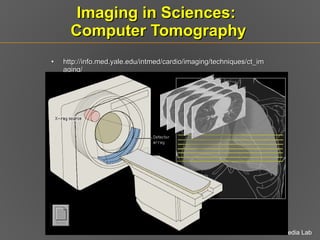
Imaging in Sciences:  Computer Tomography http://info.med.yale.edu/intmed/cardio/imaging/techniques/ct_imaging/
Self Evaluation of Eye
 
Strategy #3:  X  Do exactly the opposite
Strategy #3:  X  Do exactly the opposite Processing, Memory, Bandwidth In Computing world, in any era, one of this is a bottleneck But overtime, they change. You can often take an older idea and do exactly the opposite. E.g. bandwidth is now considered virtually limitless Business Process Reengineering (BPR)  Michael Hammer, James Champy, 1990s In imaging: SLR: Faster mirror flip or no mirror flip Companies spent years improving mirror flip speed Why not just remove it? More computation Less light
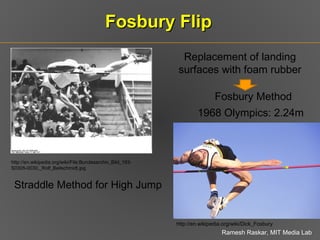
Fosbury Flip http://en.wikipedia.org/wiki/File:Bundesarchiv_Bild_183-S0305-0030,_Rolf_Beilschmidt.jpg http://en.wikipedia.org/wiki/Dick_Fosbury Straddle Method for High Jump Fosbury Method Replacement of landing surfaces with foam rubber 1968 Olympics: 2.24m
Toll Free calls Reverse Auction
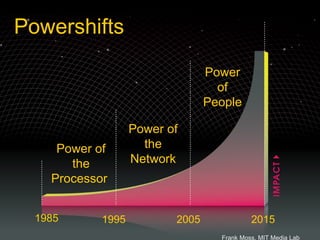
Power of the Processor  Power of the Network Power of People 1985 1995 2005 2015 Powershifts Frank Moss, MIT Media Lab
Coded Aperture Camera The aperture of a 100 mm lens is modified Rest of the camera is unmodified Insert a  coded mask  with chosen binary pattern
Captured Blurred Photo
Refocused on Person
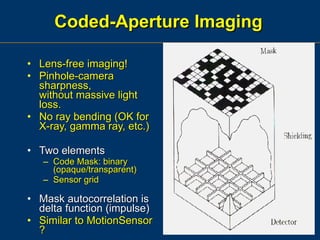
Coded-Aperture Imaging Lens-free imaging! Pinhole-camera sharpness, without massive light loss. No ray bending (OK for X-ray, gamma ray, etc.) Two elements Code Mask: binary (opaque/transparent) Sensor grid Mask autocorrelation is delta function (impulse) Similar to MotionSensor ?
Less is More Blocking Light  ==  More Information Coding in Time  Coding in Space
Larval Trematode Worm
X d X++ X X+Y X X ne X t Ramesh Raskar, MIT Media Lab
Strategy #4:  X  Given a Hammer .. Find all the nails Sometimes even screws and bolts
Strategy #4:  X  Given a Hammer .. Find all the nails Sometimes even screws and bolts Given a cool solution/technique/Opportunity  Find other problems (Where to find them?) Examples Peltier effect:  Create a jacket that keeps you warm or cold Mobile phone opportunity
Strategy #5:  X  Given a nail,  Find all hammers Sometimes even screwdrivers and pliers may work Given a problem,  Find other solutions (Where to find them?) Examples App store (Apple) .. Open platform for all devices ..
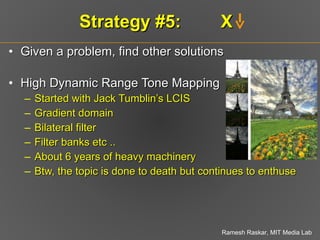
Strategy #5:  X  Given a problem, find other solutions High Dynamic Range Tone Mapping Started with Jack Tumblin’s LCIS Gradient domain Bilateral filter Filter banks etc ..  About 6 years of heavy machinery Btw, the topic is done to death but continues to enthuse
Strategy #6:  X++ Pick your adjective .. Making it faster, better, cheaper neXt = adjective + X
X++  : Add your favorite adjective Context aware,  Adaptive (temporally) Coherent,  Hierarchical,  Progressive Efficient Parallelized Distributed Good example: Image or video compression schemes Personalized/Customized Democratized
X++  : Add your favorite adjective Good example: Image or video compression schemes But X++ is a sign The field is maturing in terms of research but booming in business impact Kaizen Small incremental changes Japanese Management styles (6sigma, Kanban) Mainly to save money/time/resources. Not everyone can do it. GM, 0.84 suggestions per employee vs Toyota 18. GM accepted 23%, Toyota 90%
Hexagon Corners for Different Stages [Bruce Tuckman, 1965] Forming Storming Norming Performing Adjourning
Other Techniques Ideation Including idea mgmnt software Mind-mapping  Brainstorming Randomization Follow-on triggers Problem Solving (Have I done everything) How to solve it (1945) Mathematician  George Pólya Convert to a known problem ‘ Reducing’ a problem Analogy Generalization Induction Variation of the Problem Auxiliary Problem Pattern Matching (related problem solved before) Specialization Decomposing and Recombining Working backward Draw a Figure Auxiliary Elements
Other Techniques Problem Solving TRIZ 40 Mechanical engineering problems, e.g. how to increase volume w/o extra weight Overcome constraints by using transform of existing solutions TRIZ matrix: database of known solutions to overcome constraints Advanced Systematic Inventive Thinking (ASIT) Unification: Multiplication: Division: Breaking Symmetry: Object Removal How to make incremental changes to solve an engineering problem   http://www.triz40.com/
Where to find the ‘X’ Annual Awards (best product, researchers) Talks abstract (no need to attend) Network and talk to people Avoid small-talk .. Ask ‘what is the latest X’ Patents Table of Contents Index pages
Pitfalls These six ways are only a start  They are a good mental exercise and will allow you to train as a researcher Great for projects But  Maynot produce radically new ideas Sometimes a danger of being labeled incremental Could be into ‘public domain ideas’
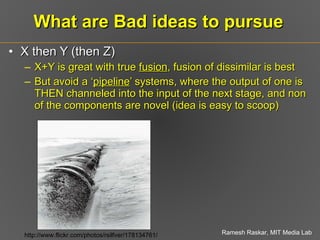
What are Bad ideas to pursue X then Y (then Z) X+Y is great with true  fusion , fusion of dissimilar is best But avoid a ‘ pipeline ’ systems, where the output of one is THEN channeled into the input of the next stage, and non of the components are novel (idea is easy to scoop) http://www.flickr.com/photos/rsilfver/178134761/
What are Bad ideas to pursue X then Y (then Z) X+Y is great with true fusion, fusion of dissimilar is best But avoid a ‘pipeline’ systems, where the output of one is THEN channeled into the input of the next stage, and non of the components are novel (idea is easy to scoop) Follow the hype (too much competition)  Do because it can be done  (Why do we climb a mountain? because it is there! ) But only the first one gets a credit.  May make you strong, and give you a sense of achievement but not a research project.
There is more ..  How to decide if the idea is worth pursuing My personal triangle of criteria Intersection of interests, skills, demand Maybe another talk ..
Acknowledgements Members of Camera Culture, MIT group Vitor Pamplona Kari Pulli, Nokia Asmita Joshi Rupesh Nasre, IISc Mark Bolas, USC Rajiv Narayan, Broad Institute, MIT Joost Bonsen, MIT
X d X++ X X+Y X X ne X t Ramesh Raskar, MIT Media Lab

Raskar ideahexagonapr2010

  • 1.
    After X, what is ne X t How to Invent? Ramesh Raskar, MIT Media Lab
  • 2.
    Camera Culture Ramesh Raskar Camera Culture MIT Media Lab http://raskar.info http://cameraculture.info Ramesh Raskar Associate Professor
  • 3.
    X d X++X X+Y X X ne X t Ramesh Raskar, MIT Media Lab
  • 4.
    Simple Exercise .. Image Compression Save Bandwidth and storage What is ne X t
  • 5.
    Strategy #1: X d Extend it to next (or some other) dimension
  • 6.
    X = Idea you just heard Concept Patent New Product Product feature Design Art Algorithm
  • 7.
    Strategy #1: X d Extend it to next dimension (or some other) dimension Flickr to Youtube Wikipedia to .. ? Generalize the concept (common in patent applications) Text, Audio (Speech), Image, Video .. Whats next ? CD .. Images to infrared, sound, ultrasound to EM spectrum Macro scale to microscale Airbag for car to airbag for .. ?
  • 8.
    Strategy #2: X+Y Fusion of the dissimilar More dissimilar, more spectacular the output Example Scientific imaging + Photography Coded aperture Tomography
  • 9.
    Prototype camera 4000 × 4000 pixels ÷ 292 × 292 lenses = 14 × 14 pixels per lens Contax medium format camera Kodak 16-megapixel sensor Adaptive Optics microlens array 125 μ square-sided microlenses
  • 10.
  • 11.
    Imaging in Sciences: Computer Tomography http://info.med.yale.edu/intmed/cardio/imaging/techniques/ct_imaging/
  • 12.
  • 13.
  • 14.
    Strategy #3: X Do exactly the opposite
  • 15.
    Strategy #3: X Do exactly the opposite Processing, Memory, Bandwidth In Computing world, in any era, one of this is a bottleneck But overtime, they change. You can often take an older idea and do exactly the opposite. E.g. bandwidth is now considered virtually limitless Business Process Reengineering (BPR) Michael Hammer, James Champy, 1990s In imaging: SLR: Faster mirror flip or no mirror flip Companies spent years improving mirror flip speed Why not just remove it? More computation Less light
  • 16.
    Fosbury Flip http://en.wikipedia.org/wiki/File:Bundesarchiv_Bild_183-S0305-0030,_Rolf_Beilschmidt.jpghttp://en.wikipedia.org/wiki/Dick_Fosbury Straddle Method for High Jump Fosbury Method Replacement of landing surfaces with foam rubber 1968 Olympics: 2.24m
  • 17.
    Toll Free callsReverse Auction
  • 18.
    Power of theProcessor Power of the Network Power of People 1985 1995 2005 2015 Powershifts Frank Moss, MIT Media Lab
  • 19.
    Coded Aperture CameraThe aperture of a 100 mm lens is modified Rest of the camera is unmodified Insert a coded mask with chosen binary pattern
  • 20.
  • 21.
  • 22.
    Coded-Aperture Imaging Lens-freeimaging! Pinhole-camera sharpness, without massive light loss. No ray bending (OK for X-ray, gamma ray, etc.) Two elements Code Mask: binary (opaque/transparent) Sensor grid Mask autocorrelation is delta function (impulse) Similar to MotionSensor ?
  • 23.
    Less is MoreBlocking Light == More Information Coding in Time Coding in Space
  • 24.
  • 25.
    X d X++X X+Y X X ne X t Ramesh Raskar, MIT Media Lab
  • 26.
    Strategy #4: X Given a Hammer .. Find all the nails Sometimes even screws and bolts
  • 27.
    Strategy #4: X Given a Hammer .. Find all the nails Sometimes even screws and bolts Given a cool solution/technique/Opportunity Find other problems (Where to find them?) Examples Peltier effect: Create a jacket that keeps you warm or cold Mobile phone opportunity
  • 28.
    Strategy #5: X Given a nail, Find all hammers Sometimes even screwdrivers and pliers may work Given a problem, Find other solutions (Where to find them?) Examples App store (Apple) .. Open platform for all devices ..
  • 29.
    Strategy #5: X Given a problem, find other solutions High Dynamic Range Tone Mapping Started with Jack Tumblin’s LCIS Gradient domain Bilateral filter Filter banks etc .. About 6 years of heavy machinery Btw, the topic is done to death but continues to enthuse
  • 30.
    Strategy #6: X++ Pick your adjective .. Making it faster, better, cheaper neXt = adjective + X
  • 31.
    X++ :Add your favorite adjective Context aware, Adaptive (temporally) Coherent, Hierarchical, Progressive Efficient Parallelized Distributed Good example: Image or video compression schemes Personalized/Customized Democratized
  • 32.
    X++ :Add your favorite adjective Good example: Image or video compression schemes But X++ is a sign The field is maturing in terms of research but booming in business impact Kaizen Small incremental changes Japanese Management styles (6sigma, Kanban) Mainly to save money/time/resources. Not everyone can do it. GM, 0.84 suggestions per employee vs Toyota 18. GM accepted 23%, Toyota 90%
  • 33.
    Hexagon Corners forDifferent Stages [Bruce Tuckman, 1965] Forming Storming Norming Performing Adjourning
  • 34.
    Other Techniques IdeationIncluding idea mgmnt software Mind-mapping Brainstorming Randomization Follow-on triggers Problem Solving (Have I done everything) How to solve it (1945) Mathematician  George Pólya Convert to a known problem ‘ Reducing’ a problem Analogy Generalization Induction Variation of the Problem Auxiliary Problem Pattern Matching (related problem solved before) Specialization Decomposing and Recombining Working backward Draw a Figure Auxiliary Elements
  • 35.
    Other Techniques ProblemSolving TRIZ 40 Mechanical engineering problems, e.g. how to increase volume w/o extra weight Overcome constraints by using transform of existing solutions TRIZ matrix: database of known solutions to overcome constraints Advanced Systematic Inventive Thinking (ASIT) Unification: Multiplication: Division: Breaking Symmetry: Object Removal How to make incremental changes to solve an engineering problem   http://www.triz40.com/
  • 36.
    Where to findthe ‘X’ Annual Awards (best product, researchers) Talks abstract (no need to attend) Network and talk to people Avoid small-talk .. Ask ‘what is the latest X’ Patents Table of Contents Index pages
  • 37.
    Pitfalls These sixways are only a start They are a good mental exercise and will allow you to train as a researcher Great for projects But Maynot produce radically new ideas Sometimes a danger of being labeled incremental Could be into ‘public domain ideas’
  • 38.
    What are Badideas to pursue X then Y (then Z) X+Y is great with true fusion , fusion of dissimilar is best But avoid a ‘ pipeline ’ systems, where the output of one is THEN channeled into the input of the next stage, and non of the components are novel (idea is easy to scoop) http://www.flickr.com/photos/rsilfver/178134761/
  • 39.
    What are Badideas to pursue X then Y (then Z) X+Y is great with true fusion, fusion of dissimilar is best But avoid a ‘pipeline’ systems, where the output of one is THEN channeled into the input of the next stage, and non of the components are novel (idea is easy to scoop) Follow the hype (too much competition) Do because it can be done (Why do we climb a mountain? because it is there! ) But only the first one gets a credit. May make you strong, and give you a sense of achievement but not a research project.
  • 40.
    There is more.. How to decide if the idea is worth pursuing My personal triangle of criteria Intersection of interests, skills, demand Maybe another talk ..
  • 41.
    Acknowledgements Members ofCamera Culture, MIT group Vitor Pamplona Kari Pulli, Nokia Asmita Joshi Rupesh Nasre, IISc Mark Bolas, USC Rajiv Narayan, Broad Institute, MIT Joost Bonsen, MIT
  • 42.
    X d X++X X+Y X X ne X t Ramesh Raskar, MIT Media Lab

Editor's Notes

  • #2 Six ways of coming up with new ideas based on an idea ‘X’. Ramesh Raskar Associate Professor MIT Media Lab http://raskar.info http://cameraculture.info http://raskar.info http://cameraculture.info
  • #3 Ramesh Raskar Associate Professor MIT Media Lab http://raskar.info http://cameraculture.info
  • #5 X up: Airbags for car, for helicopter
  • #13 Beautiful theory but strikingly simple implementation .. Combination of simple optics and some intelligent software Based on wavefront manipulation
  • #14 Moving towards penny diagnostics Click Diagnostics Hardware app store not just software app store, we have seen this with Wii and Guitarhero
  • #21 Reversibly encode all the information in this otherwise blurred photo
  • #22 The glint out of focus shows the unusual pattern.
  • #25 Shielded by screening pigment. The visual organ provides no spatial information, but by comparing the signal from 2 organs or by moving the body, the worm can navigate towards brighter or darker places. It can also keep certain body orientation. Despite lack of spatial vision, this is an evolutionary forerunner to real eyes.