Camera Culture Ramesh  Raskar Camera Culture MIT Media Lab http://raskar.info http://cameraculture.info Ramesh Raskar Associate Professor Future of Imaging
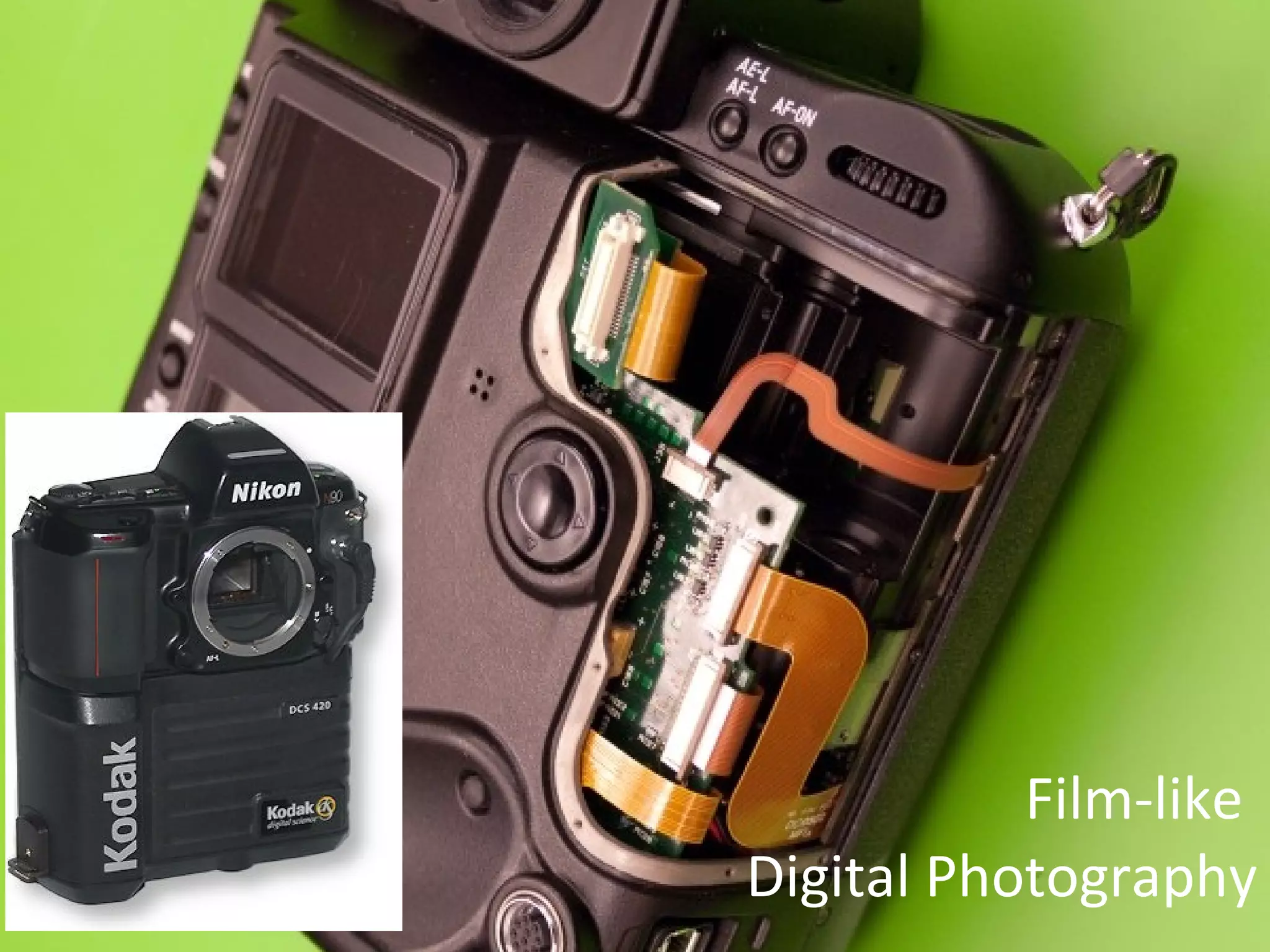
Film-like  Digital Photography
 
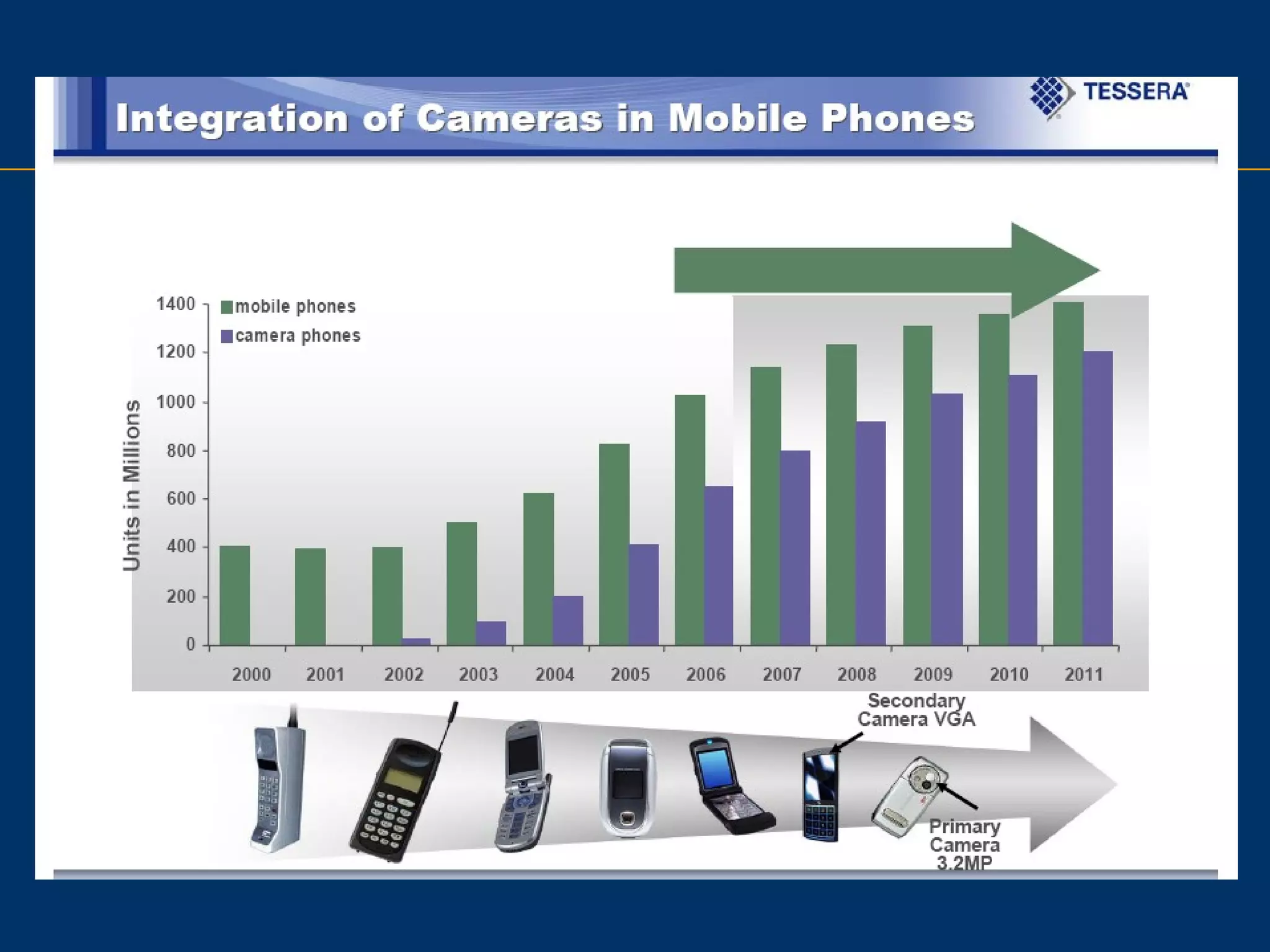
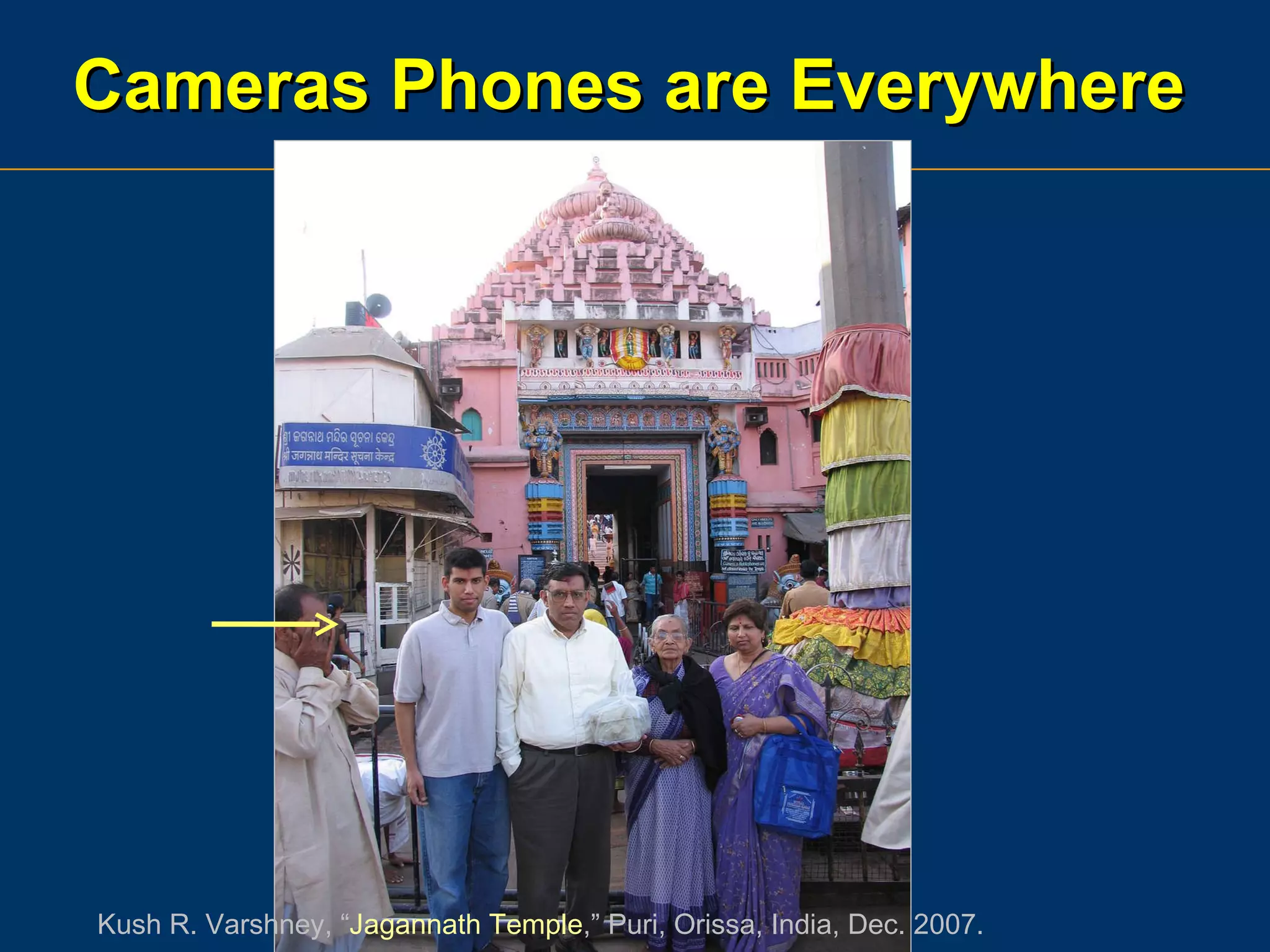
Cameras Phones are Everywhere Kush R. Varshney, “ Jagannath Temple ,” Puri, Orissa, India, Dec. 2007.
Wish List Today Consumers Super-human vision Microscope like resolution High speed (burst, video, no blur) See inside the body (health) Auto-trigger Battery life Zero start or shutter delay Keep only ‘good’ pics Find ‘relevant’ pics and better archiving/access Put photographer back in photo! Companies Cost Resolution Low-light sensitivity, HDR ( For cameraphone ) Size and depth Stereo and 3D Mecha-free zoom/focus Auto-tagging for sharing Recognition
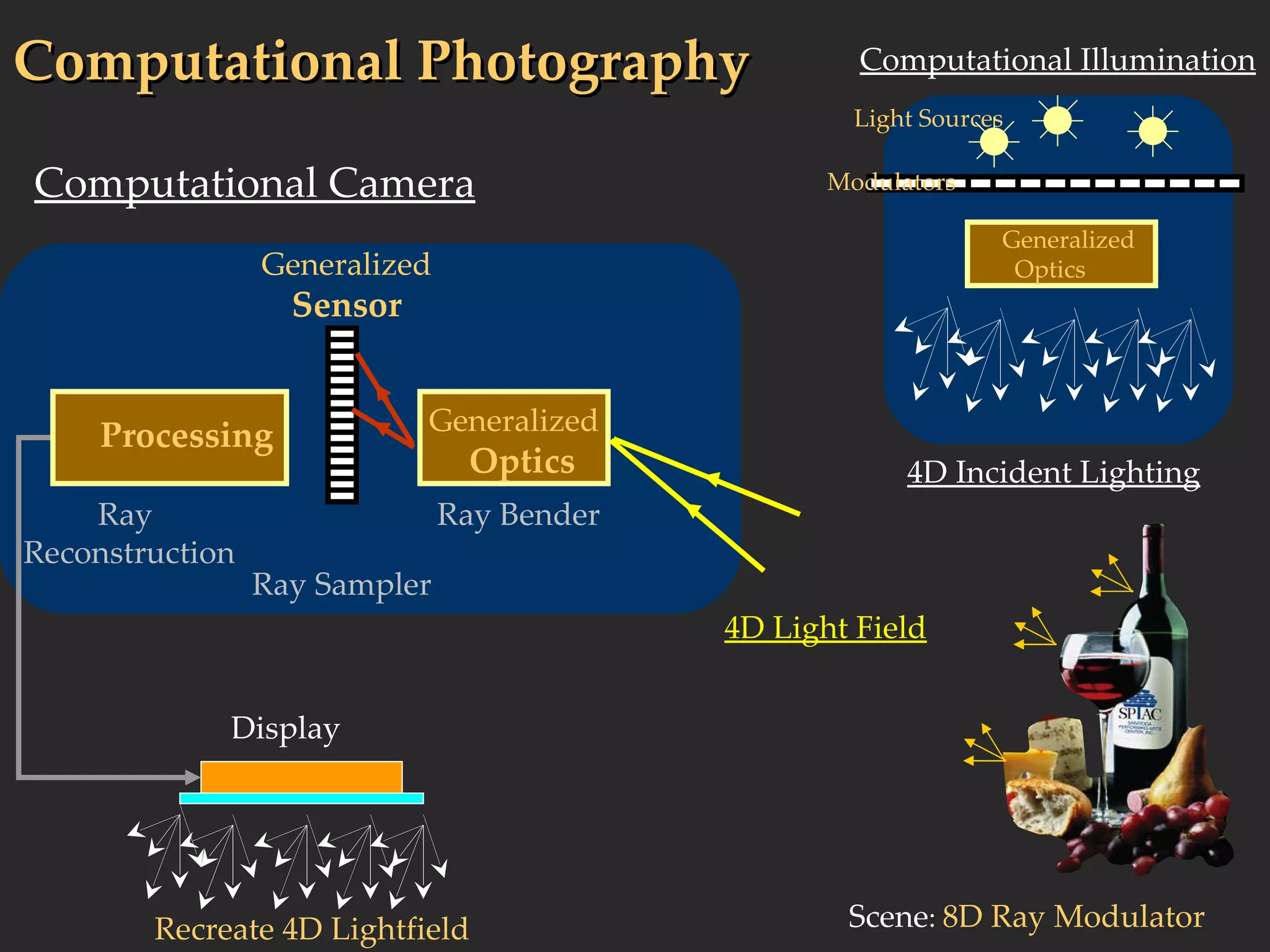
Computational Photography Computational Illumination Computational Camera Scene :  8D Ray Modulator Display Generalized Sensor Generalized Optics Processing Ray Bender Ray Sampler Ray  Reconstruction Generalized Optics Recreate 4D Lightfield Light Sources Modulators 4D Incident Lighting 4D Light Field
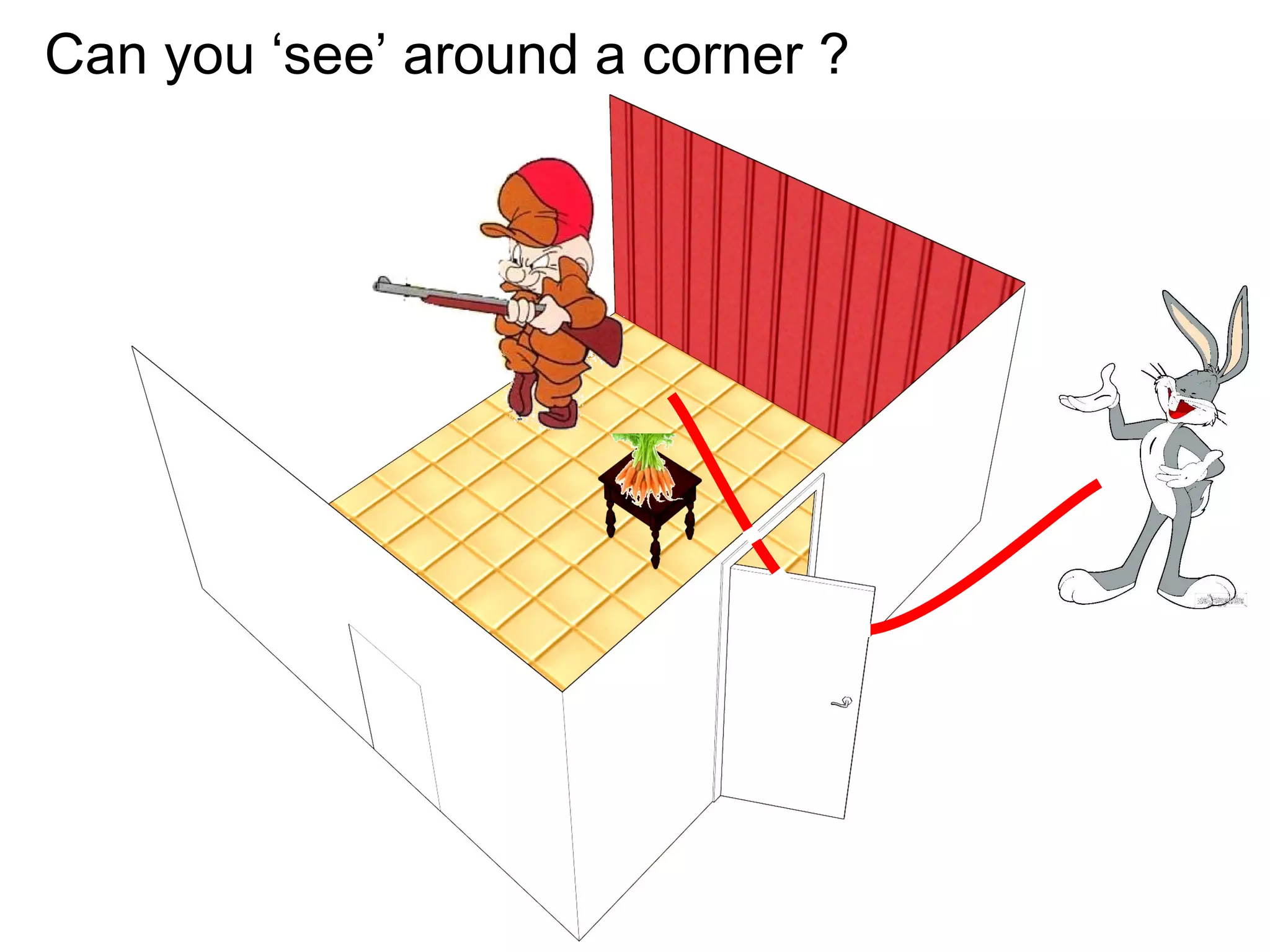
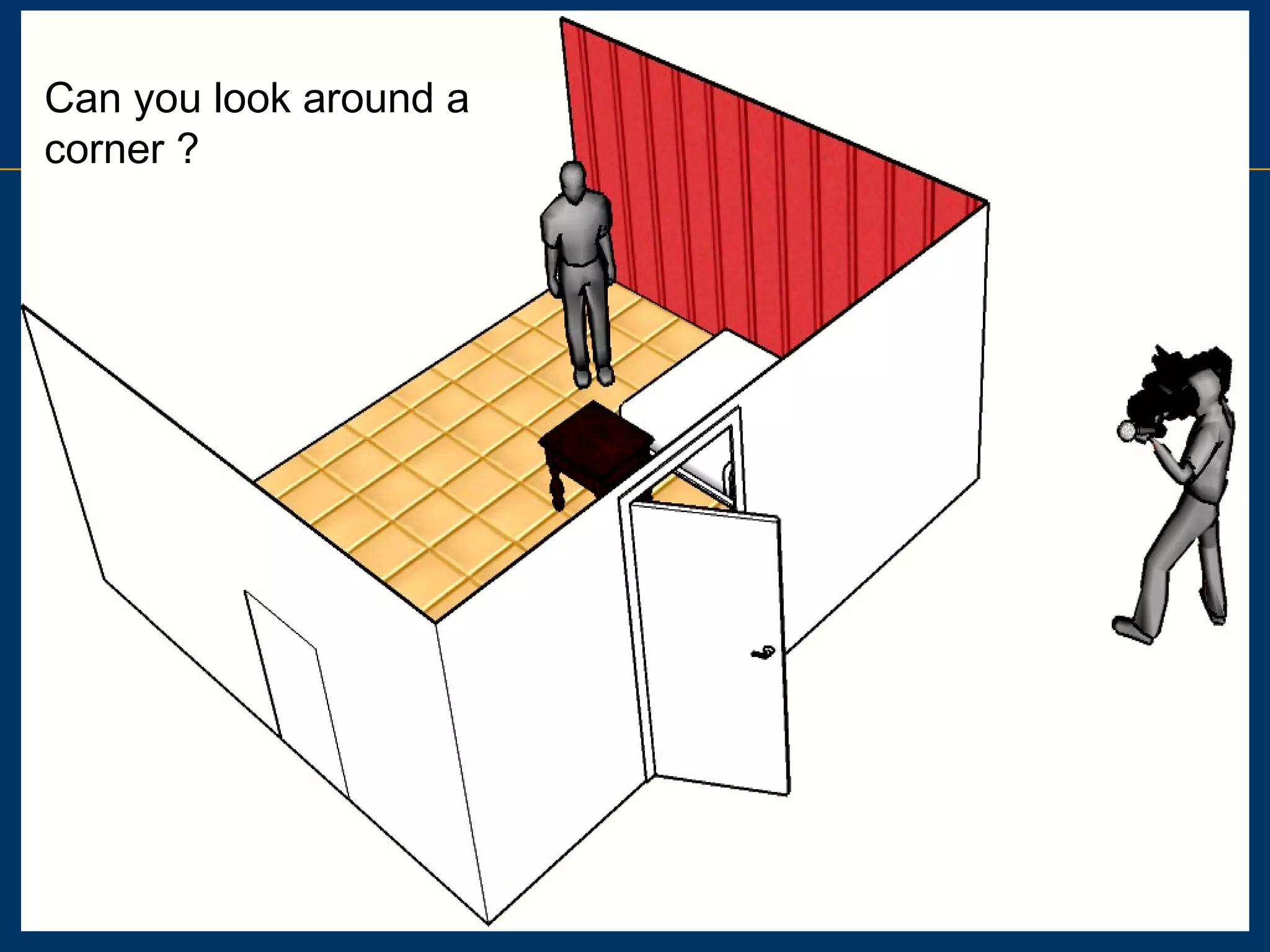
Can you look around a corner ?
 
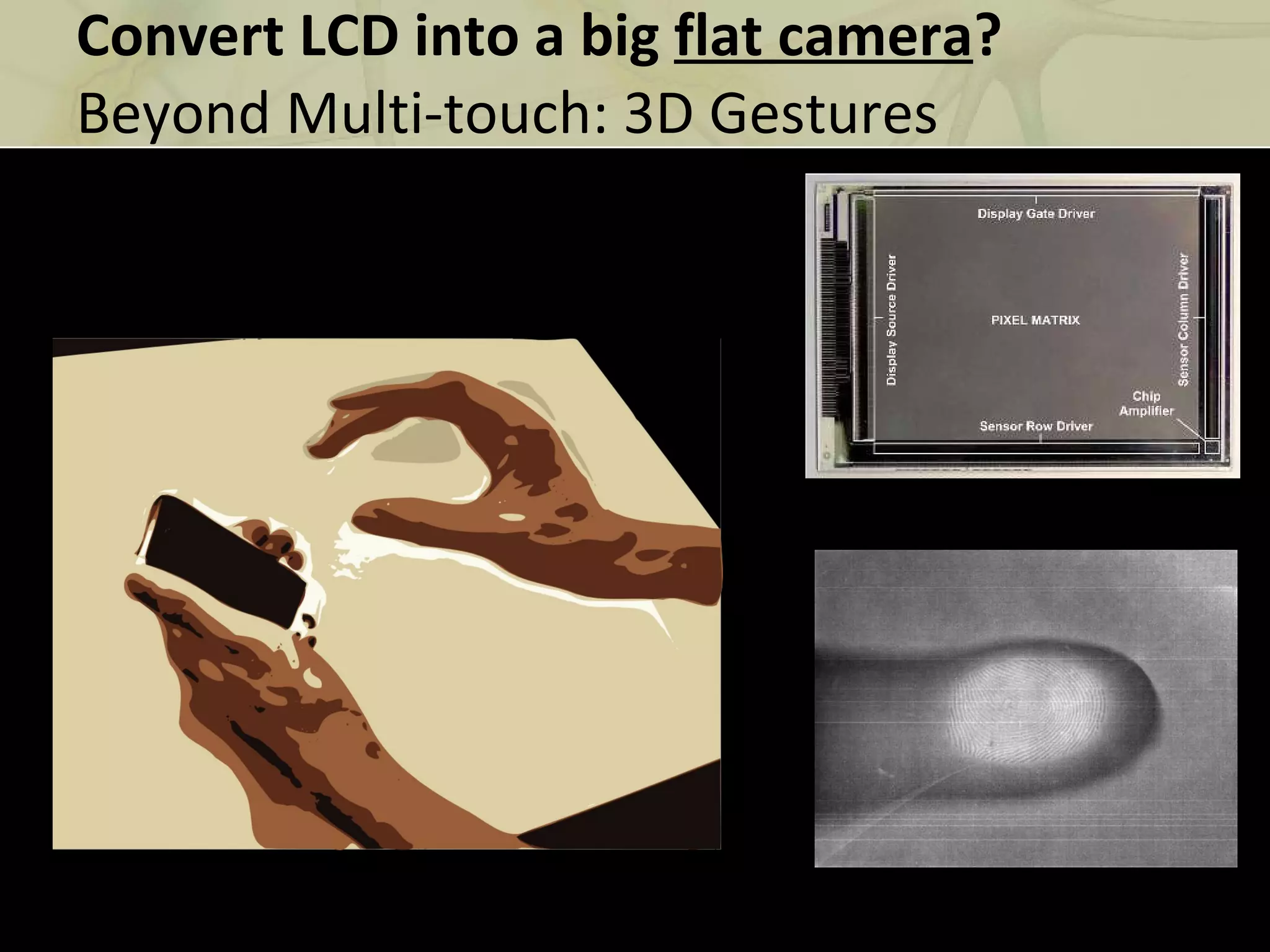
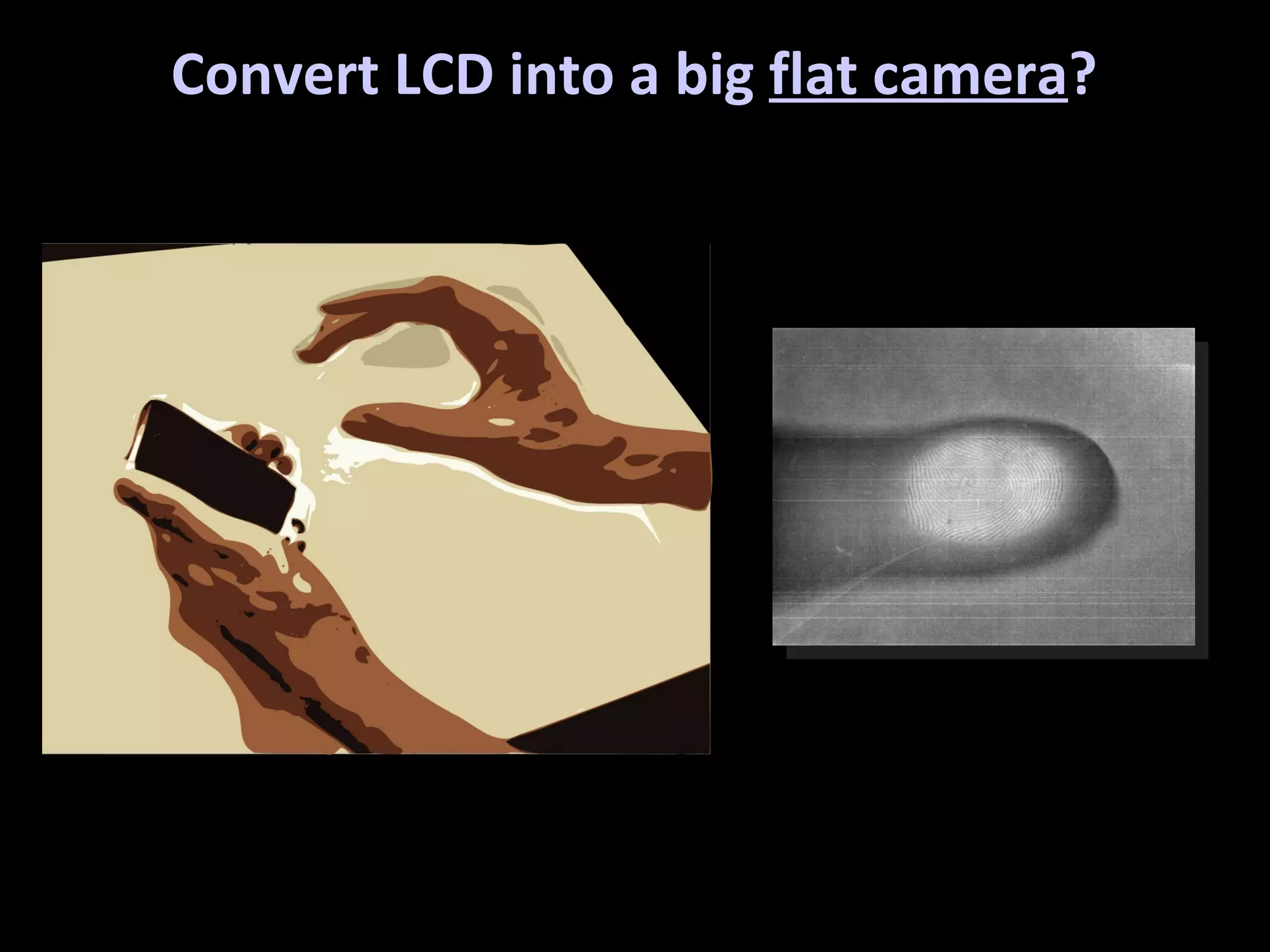
Convert LCD into a big  flat camera ?
 
Fernald,  Science [Sept 2006] Shadow Refractive Reflective
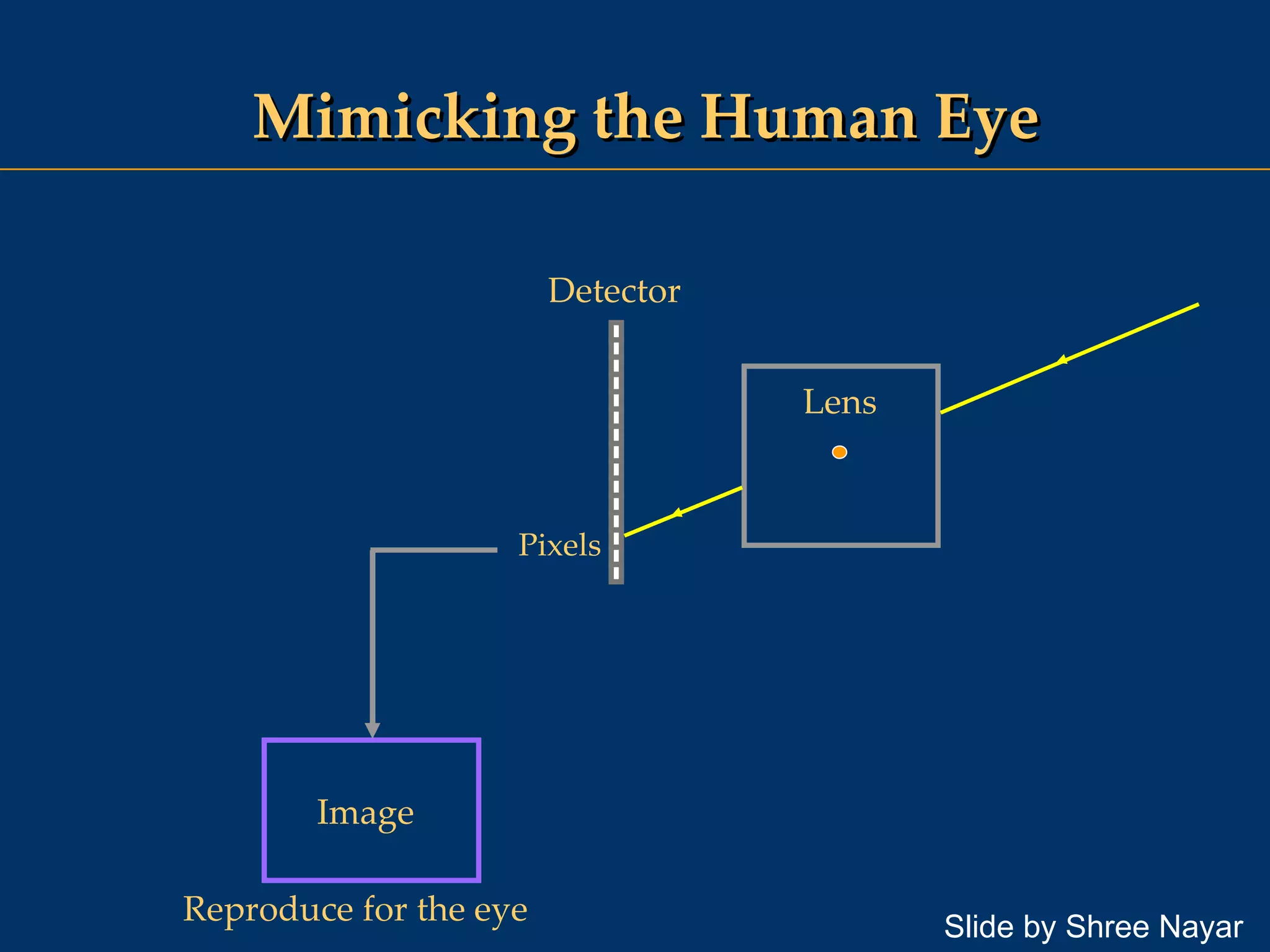
Mimicking the Human Eye Lens Detector Pixels Image Slide by Shree Nayar Reproduce for the eye
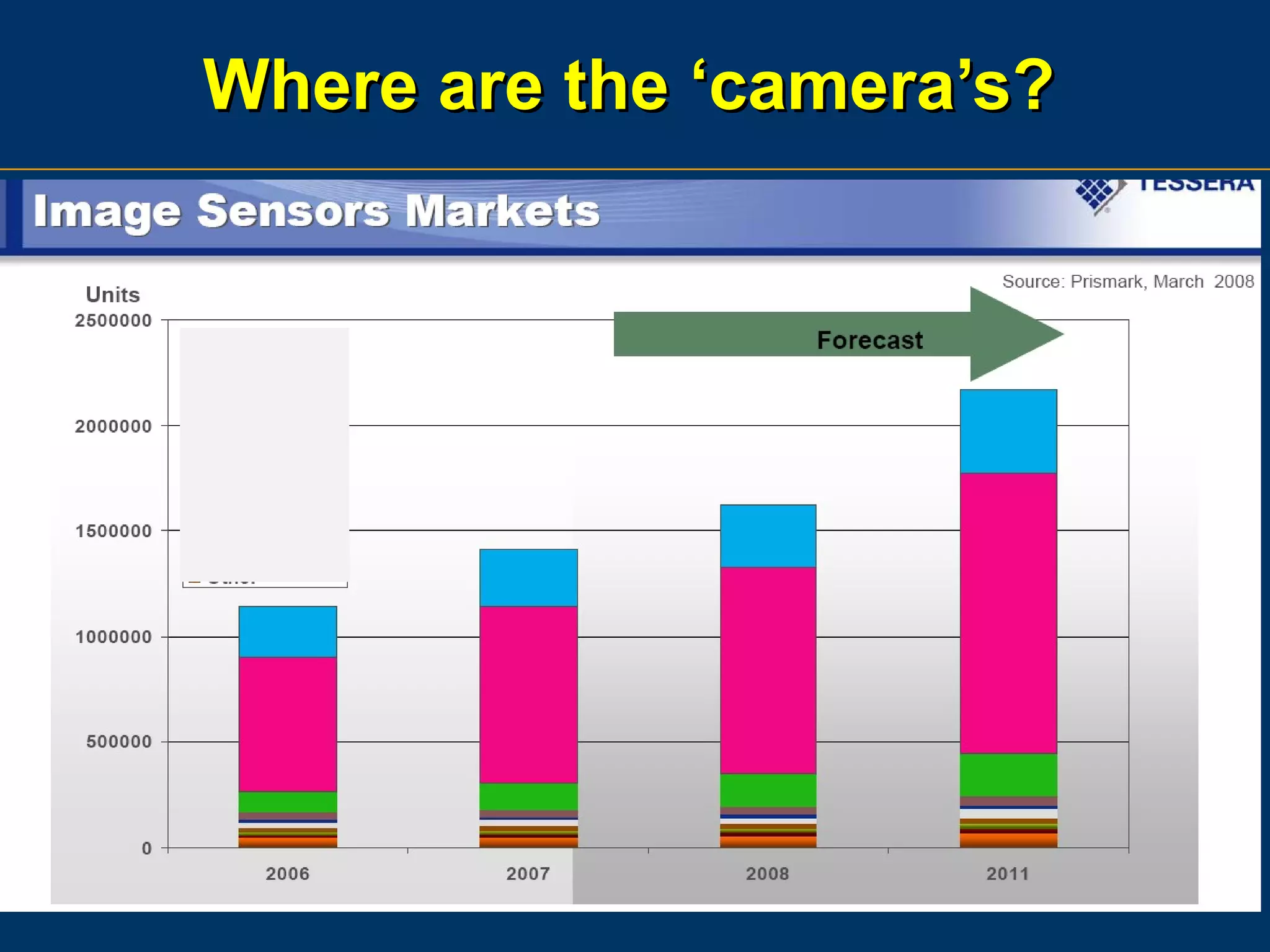
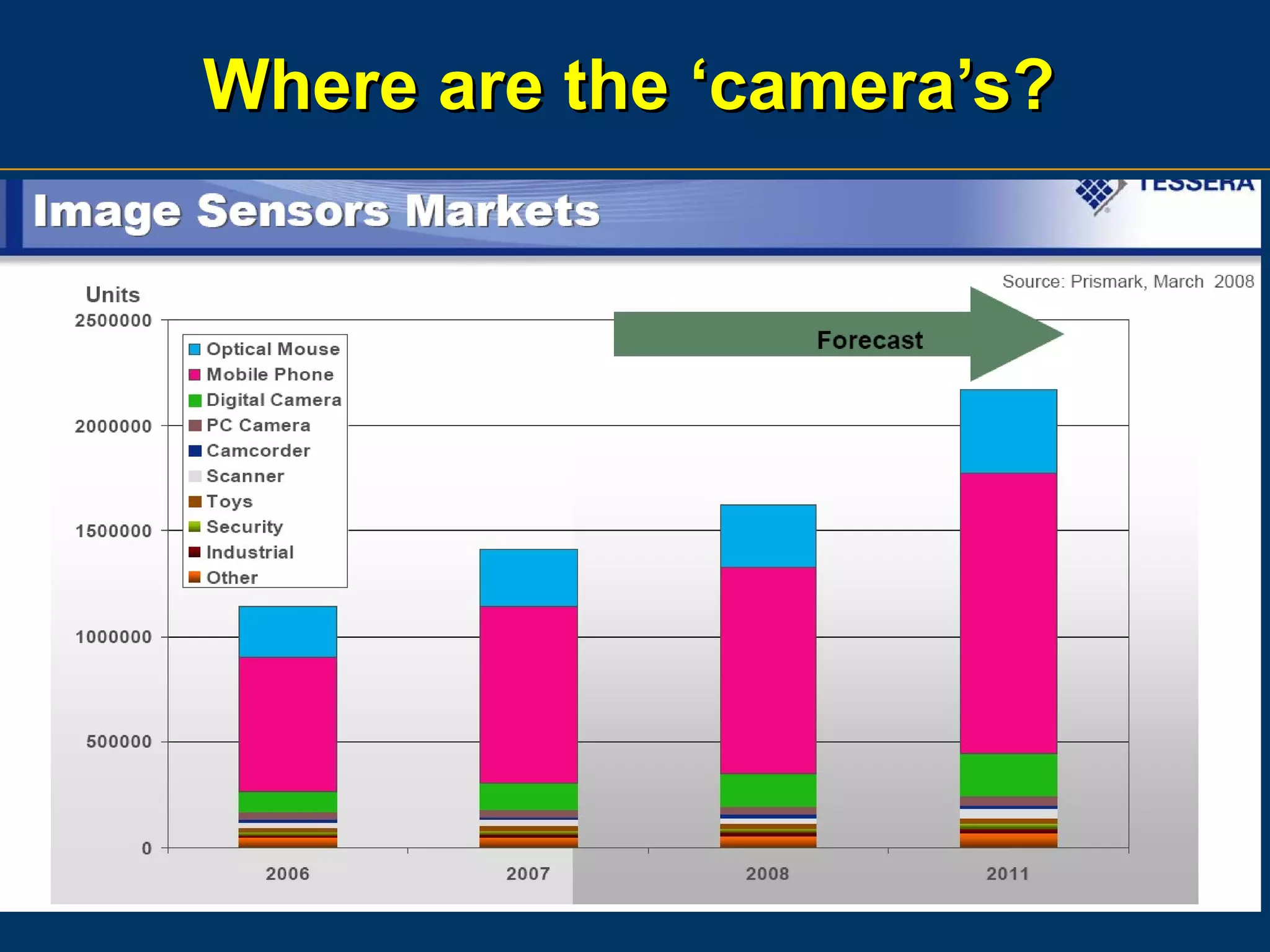
Where are the ‘camera’s?
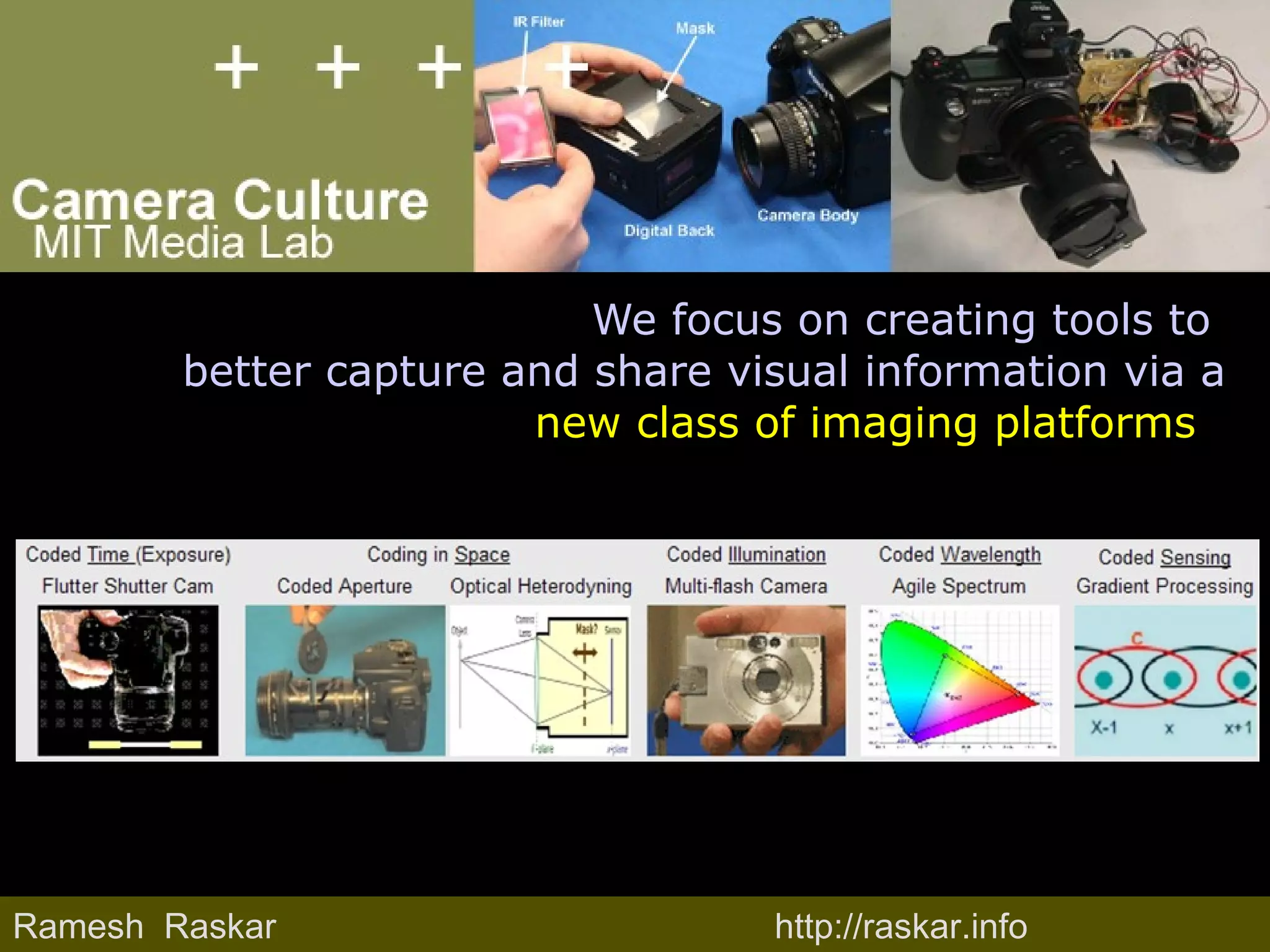
We focus on creating tools to  better capture and share visual information via a  new class of imaging platforms   Ramesh  Raskar Ramesh  Raskar http://raskar.info
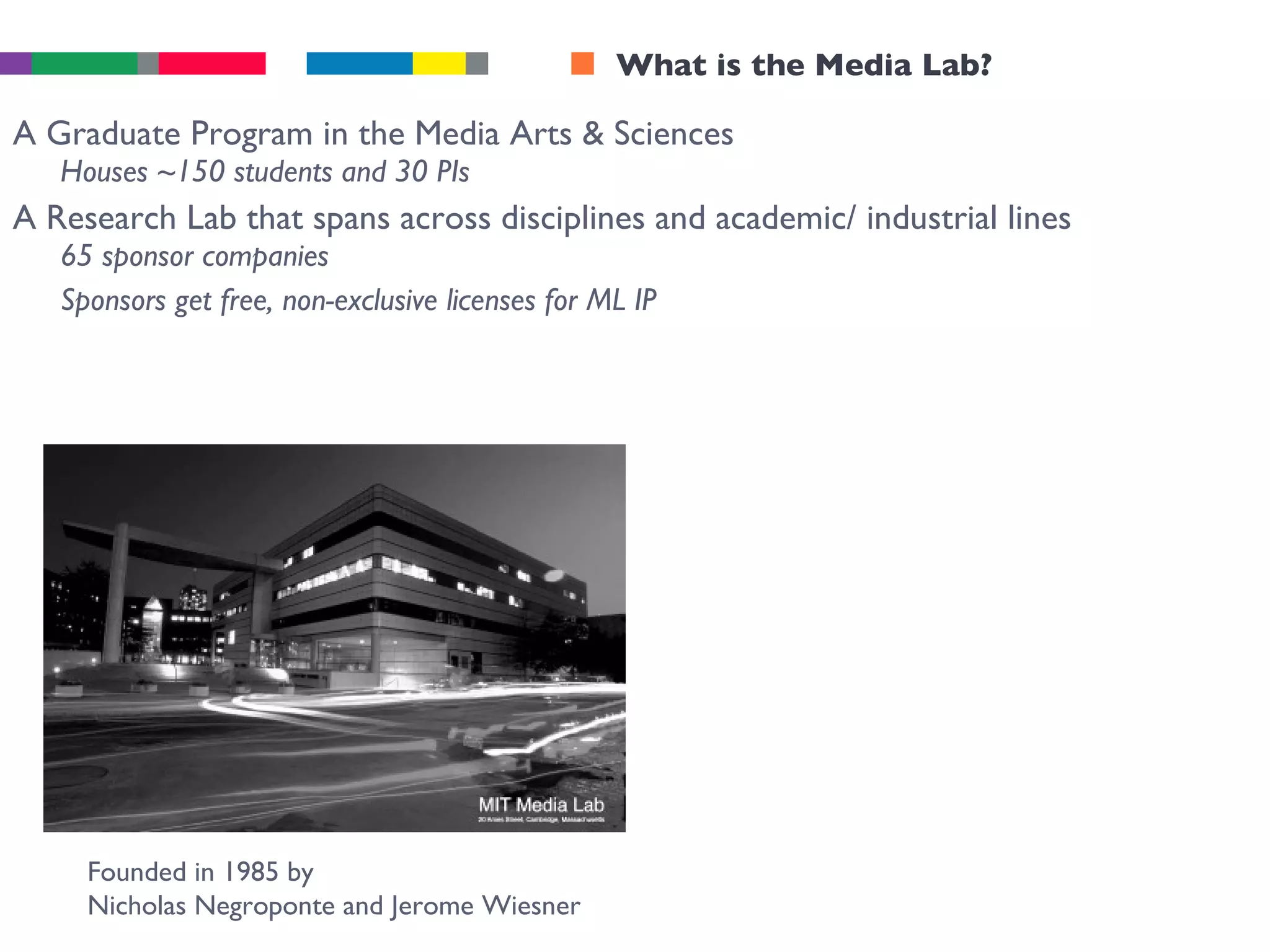
What is the Media Lab? A Graduate Program in the Media Arts & Sciences Houses ~150 students and 30 PIs A Research Lab that spans across disciplines and academic/ industrial lines 65 sponsor companies Sponsors get free, non-exclusive licenses for ML IP Founded in 1985 by  Nicholas Negroponte and Jerome Wiesner
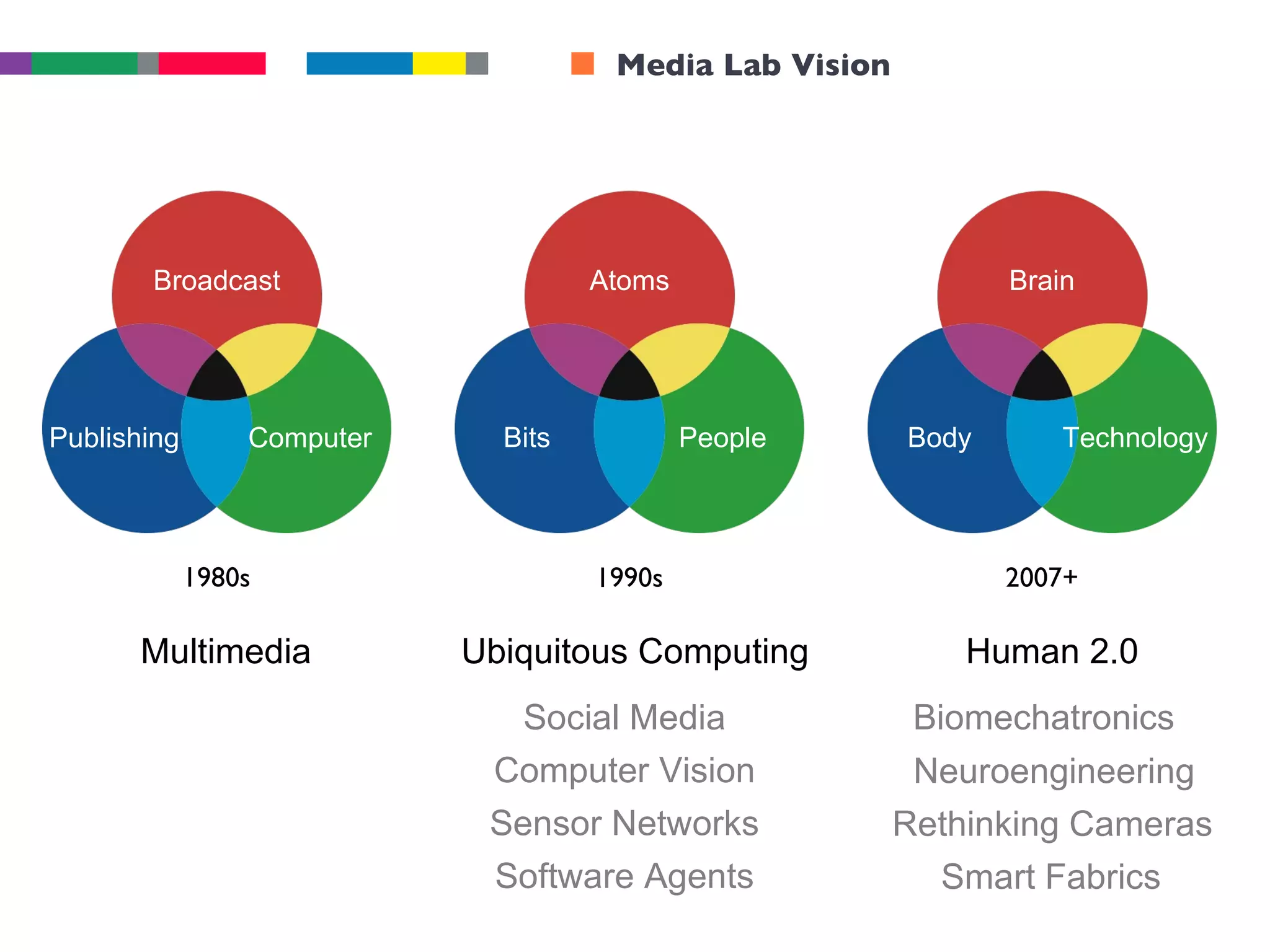
Media Lab Vision Biomechatronics Neuroengineering Smart Fabrics Rethinking Cameras Human 2.0 Multimedia Ubiquitous Computing Social Media Computer Vision Sensor Networks Software Agents Bits Atoms People 1990s Body Brain Technology 2007+ Publishing Broadcast Computer 1980s
Close Ties With Industry 03/08/10 R E S E A R C H  S T R A T E G Y Our 65 corporate sponsors include some of the most creative companies in the world
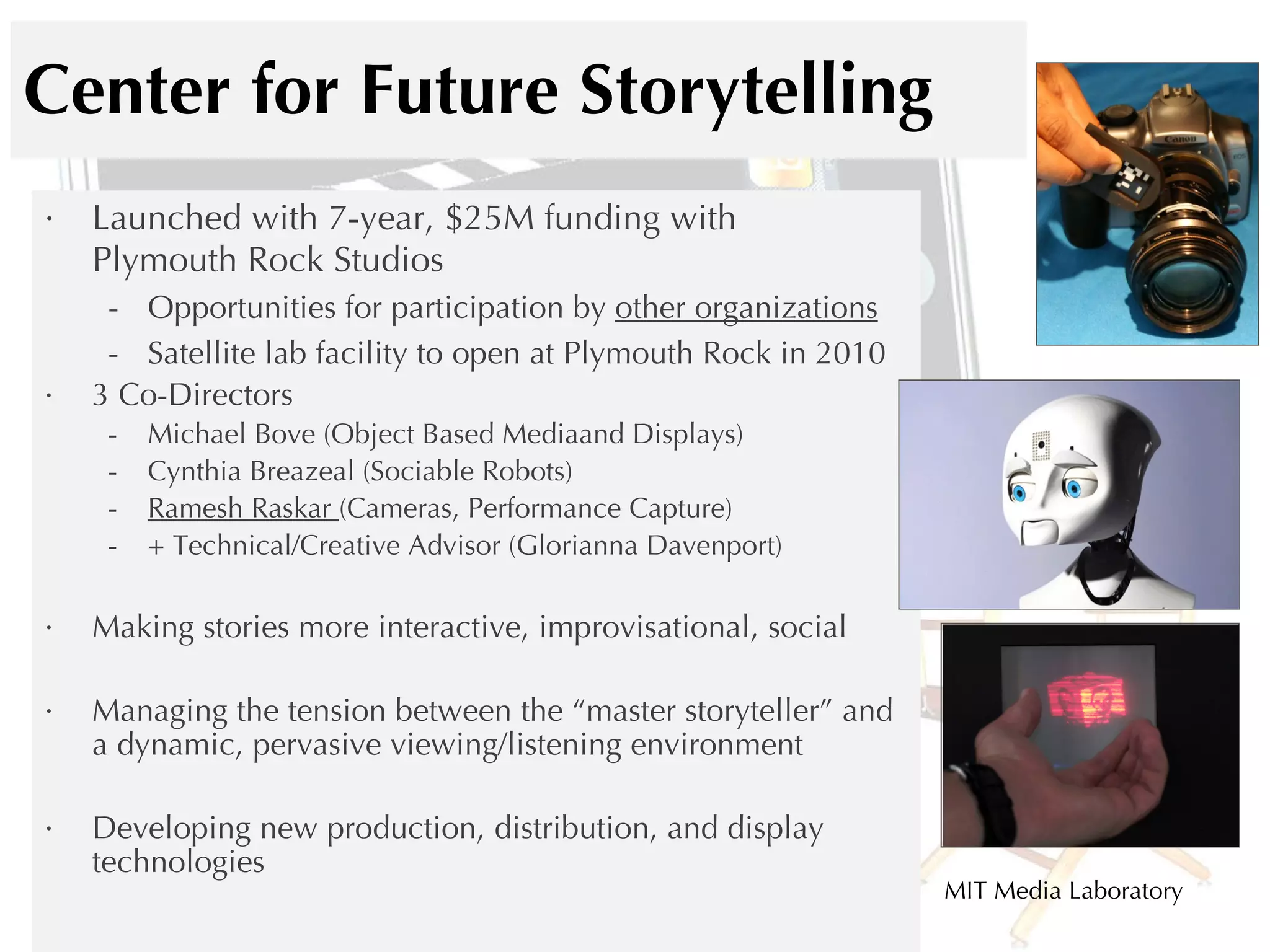
Center for Future Storytelling Launched with 7-year, $25M funding with  Plymouth Rock Studios Opportunities for participation by  other organizations Satellite lab facility to open at Plymouth Rock in 2010 3 Co-Directors Michael Bove (Object Based Mediaand Displays) Cynthia Breazeal (Sociable Robots) Ramesh Raskar  (Cameras, Performance Capture) + Technical/Creative Advisor (Glorianna Davenport) Making stories more interactive, improvisational, social Managing the tension between the “master storyteller” and a dynamic, pervasive viewing/listening environment Developing new production, distribution, and display technologies MIT Media Laboratory
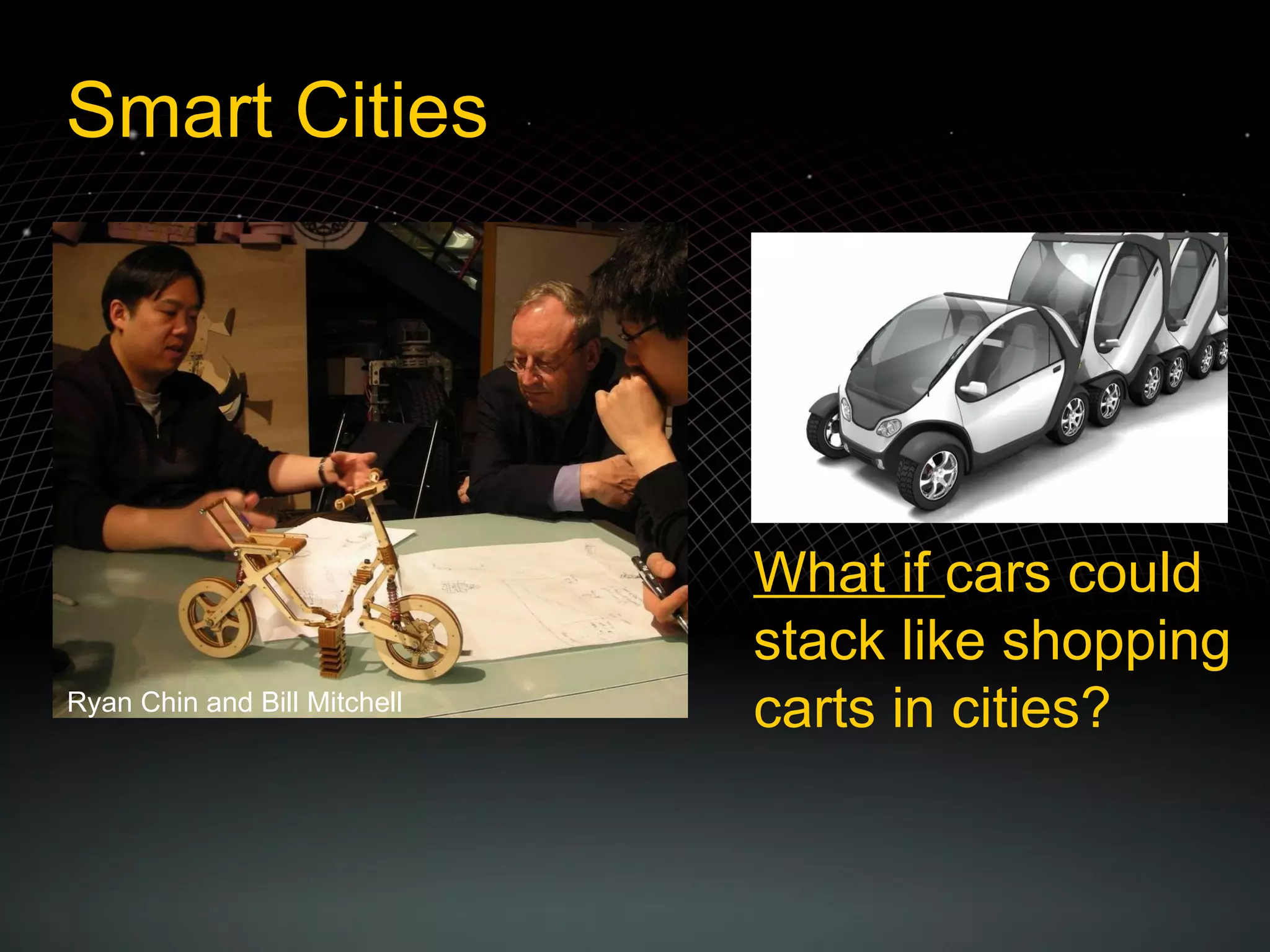
Smart Cities What if  cars could stack like shopping carts in cities? Ryan Chin and Bill Mitchell
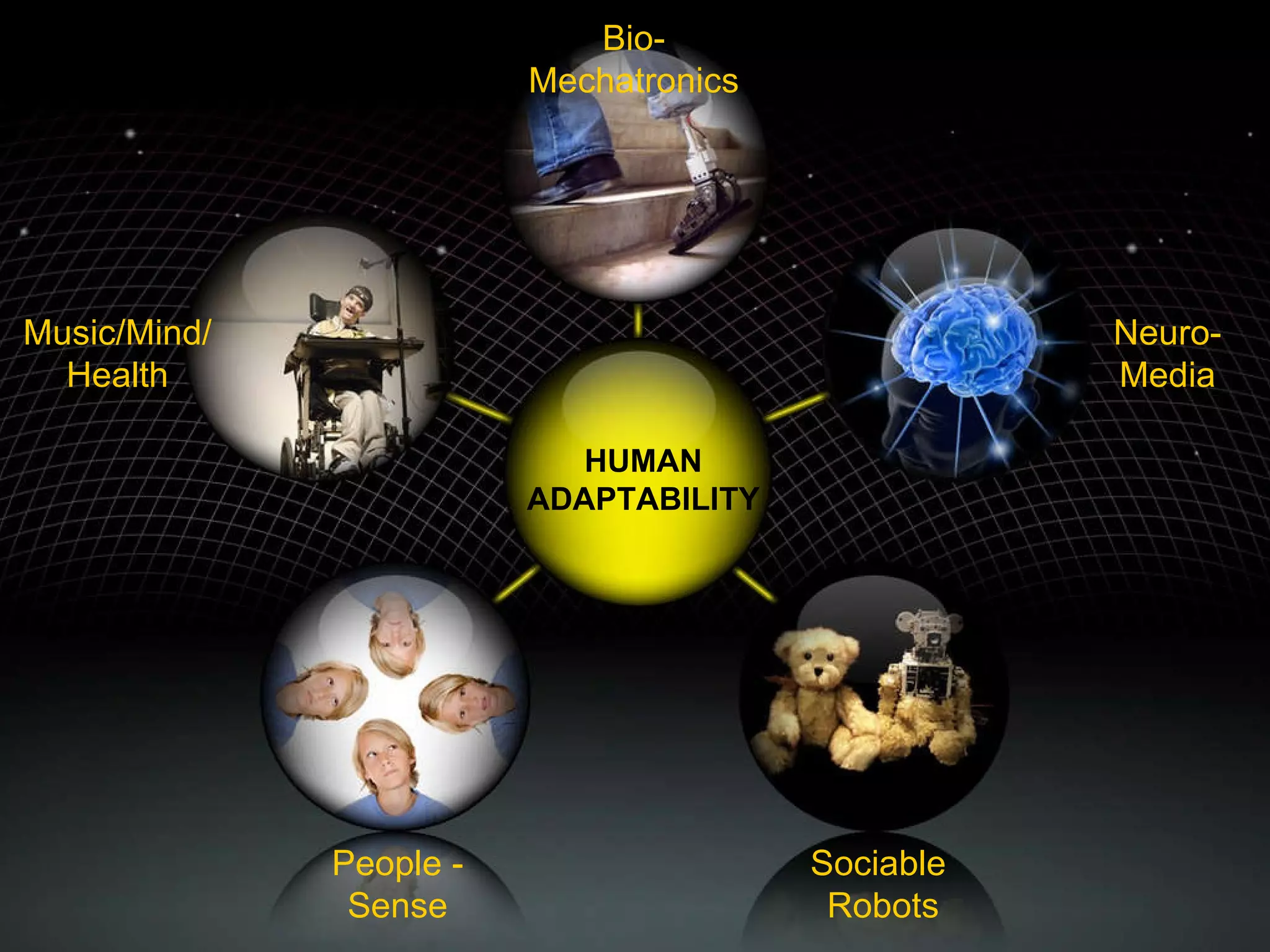
ADAPTABILTIY Hyper -  Adaptability Bio- Mechatronics Music/Mind/ Health People - Sense Sociable  Robots Neuro- Media HUMAN ADAPTABILITY Bio- Mechatronics Neuro- Media Sociable  Robots People - Sense Music/Mind/ Health
Camera Culture Ramesh  Raskar Ramesh Raskar Associate Professor, MIT Media Lab http://raskar.info New Emerging Technologies Medical Imaging Entertainment User Interfaces Industrial Vision The impact of  Next Billion Cameras Movie-making, news reporting Social stability Visual Social Computing Image-based commerce Future of Imaging
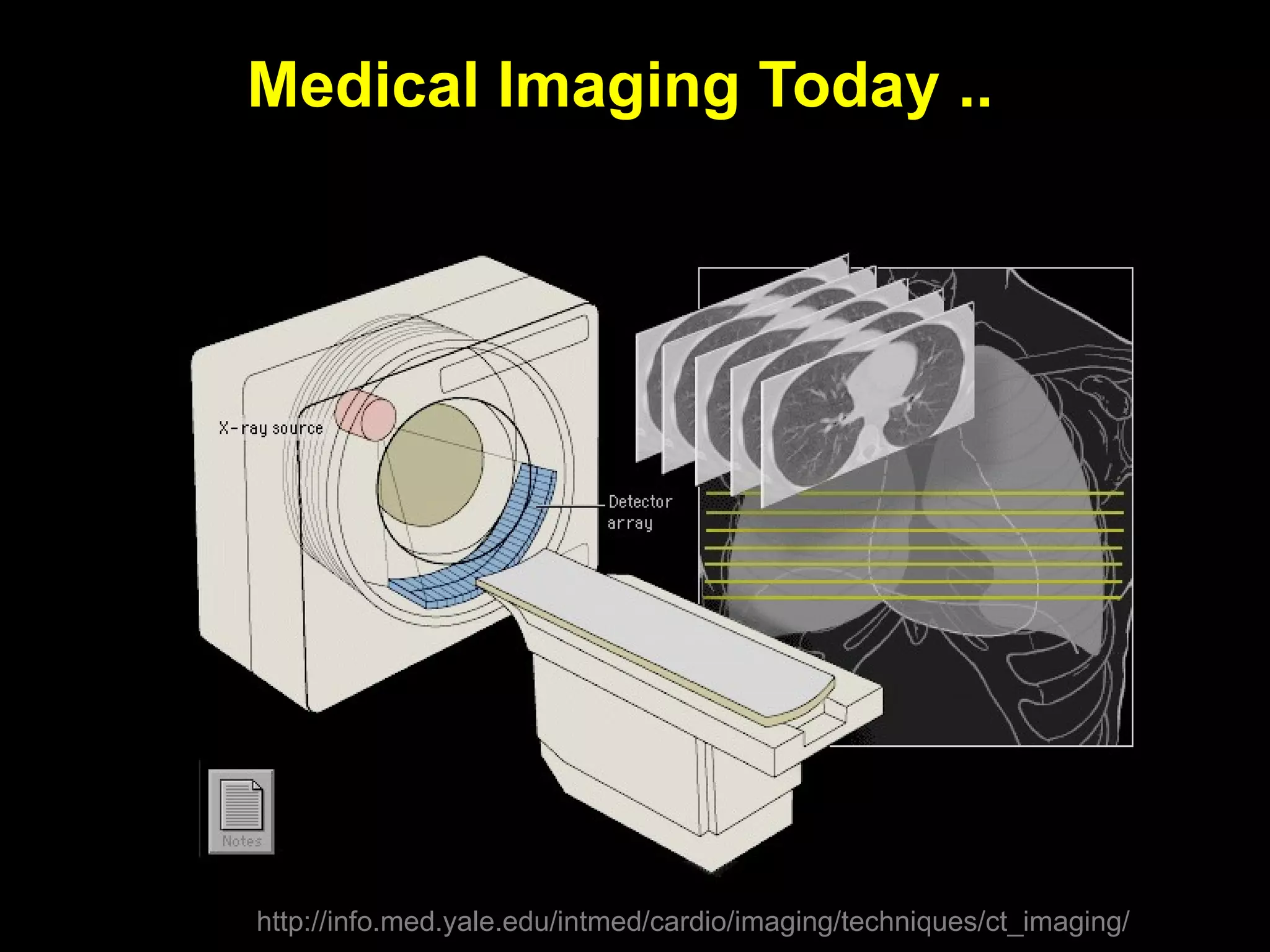
Medical Imaging Today ..  http://info.med.yale.edu/intmed/cardio/imaging/techniques/ct_imaging/
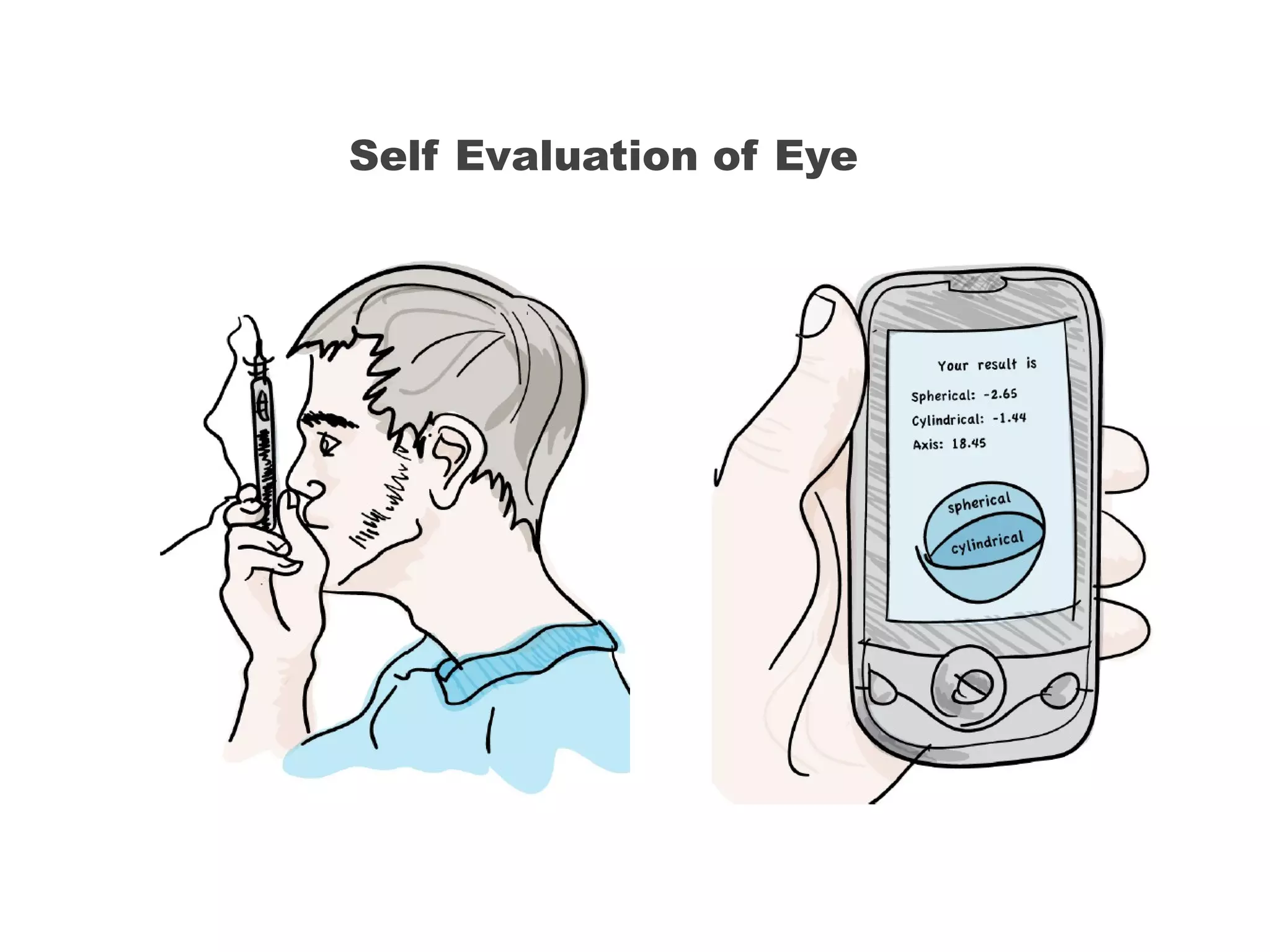
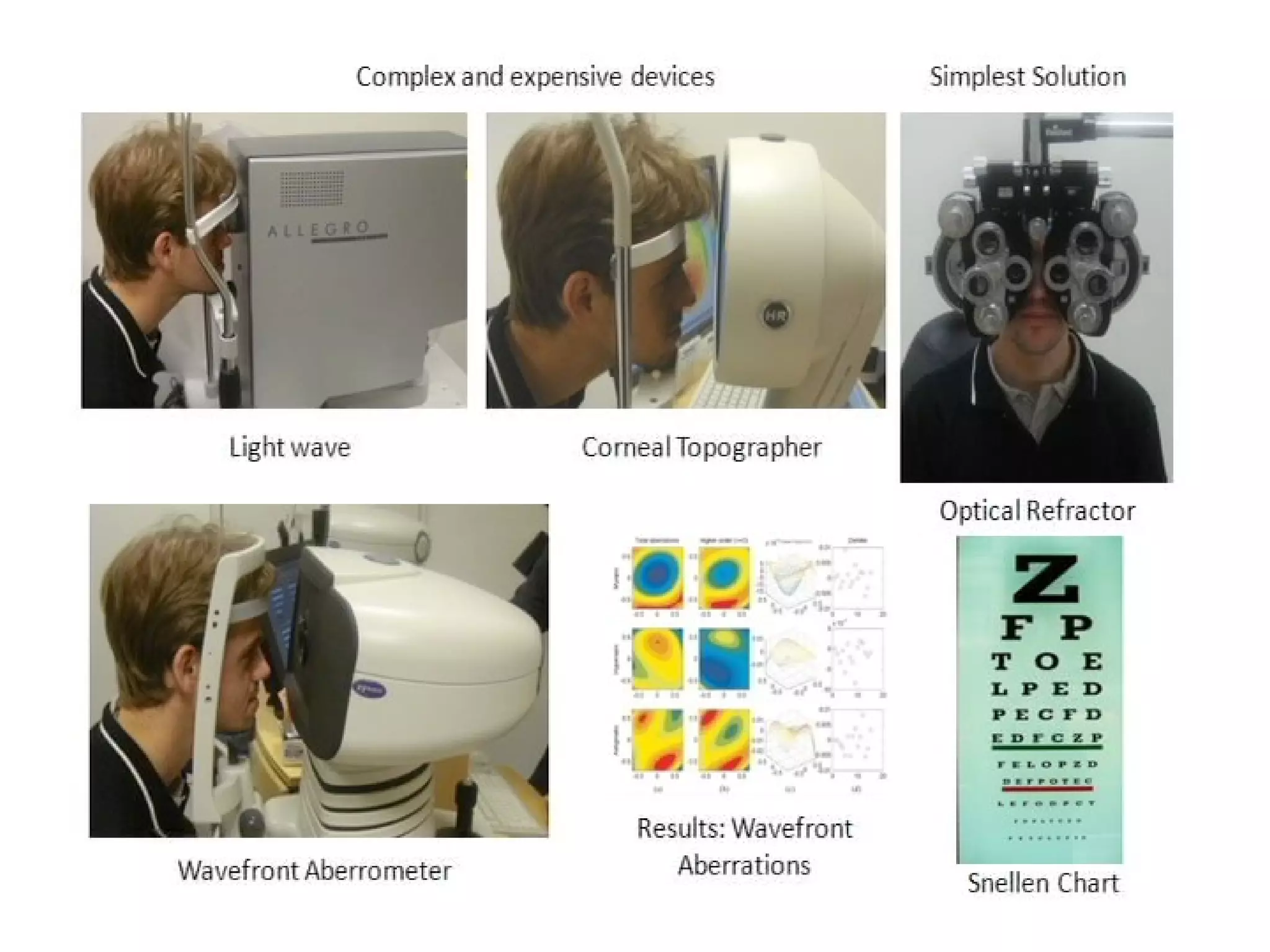
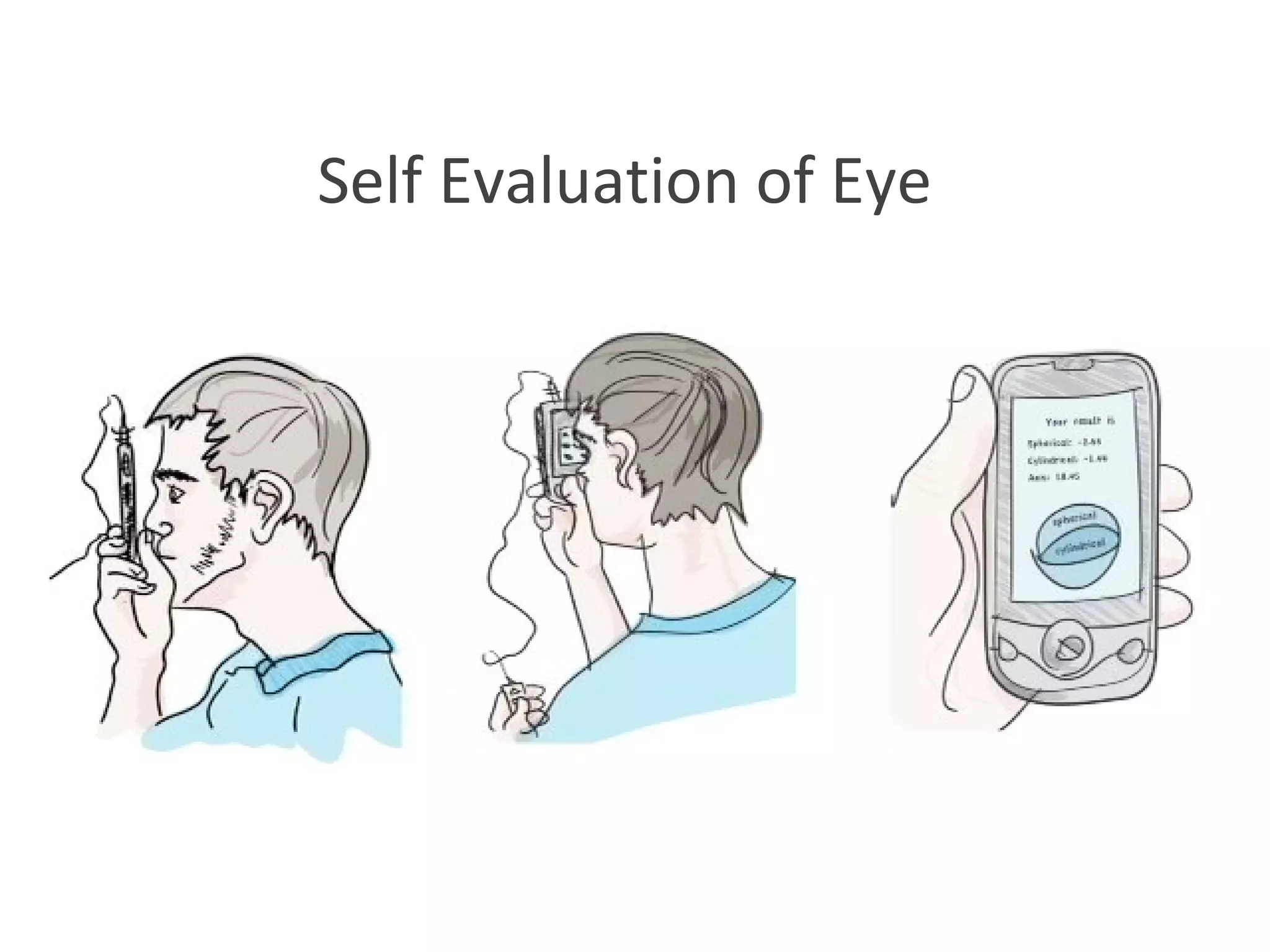
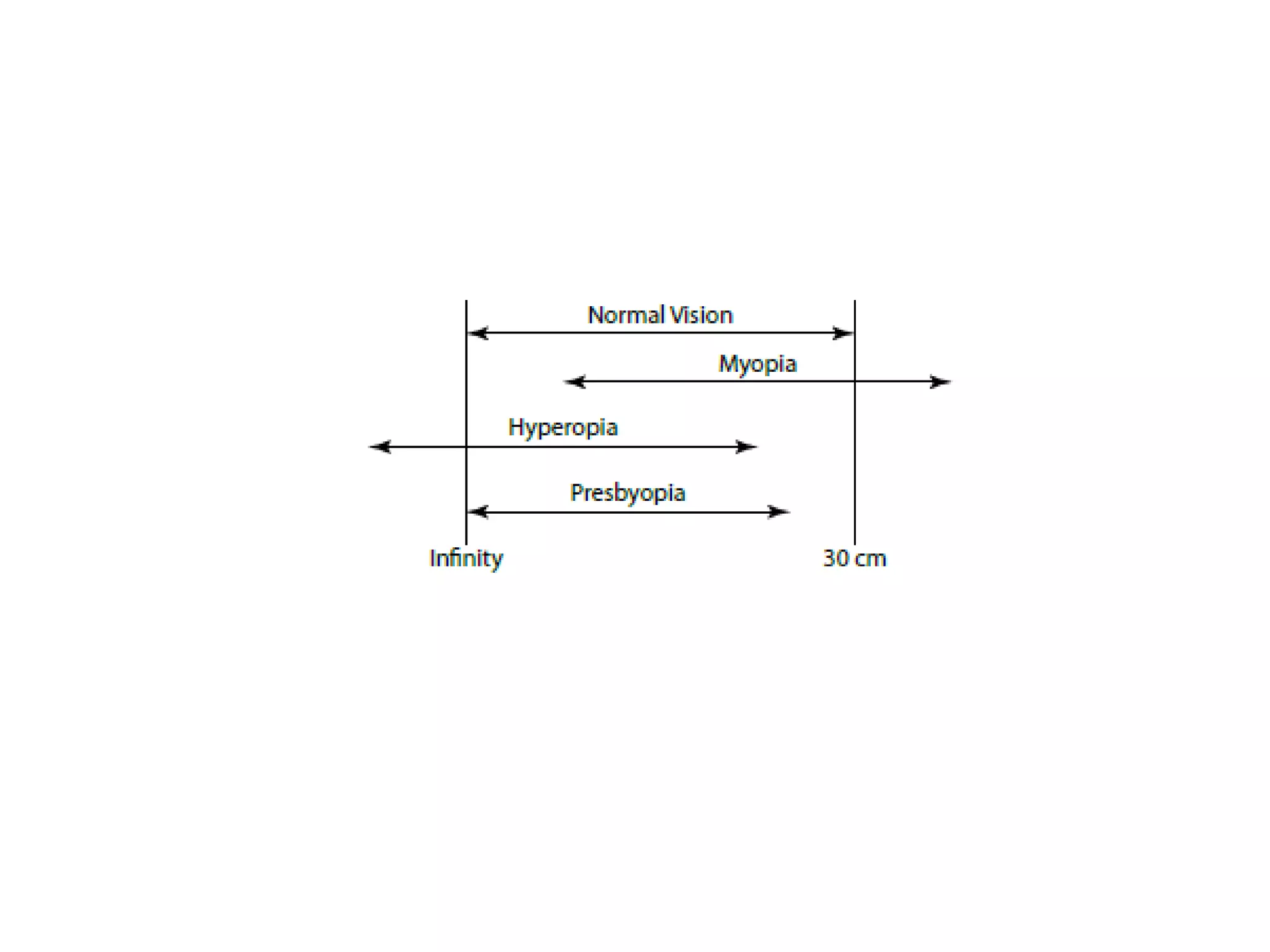
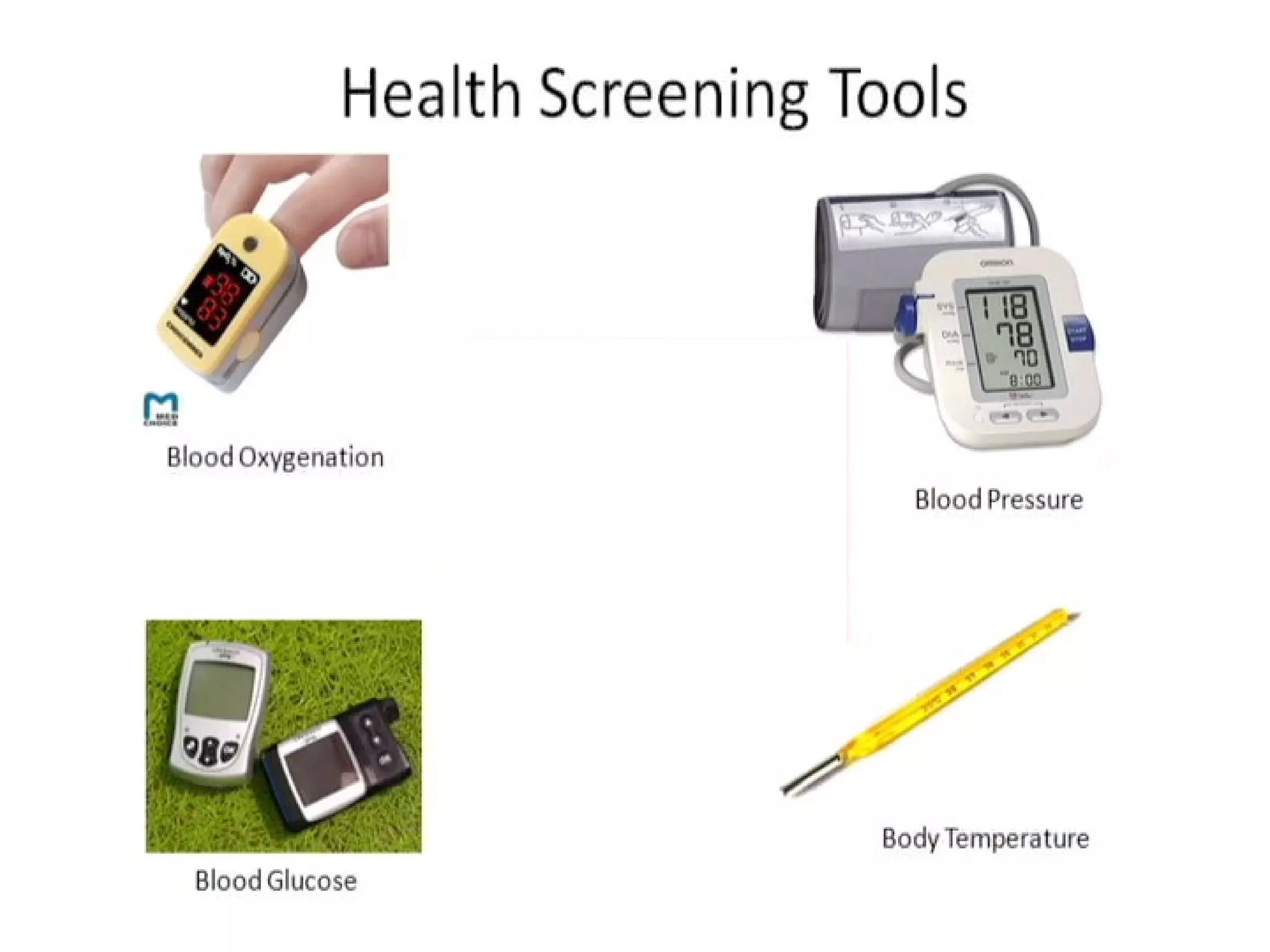
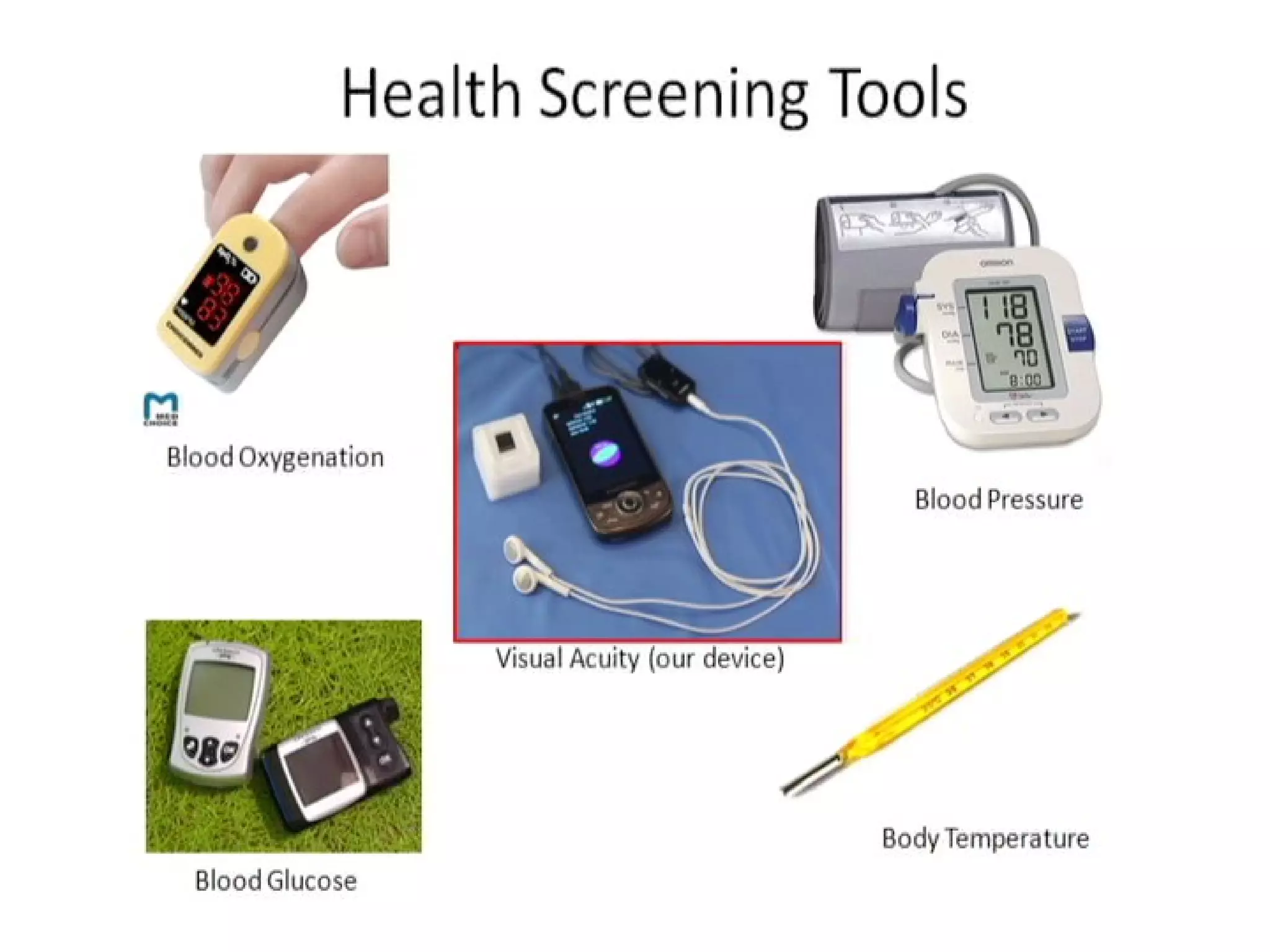
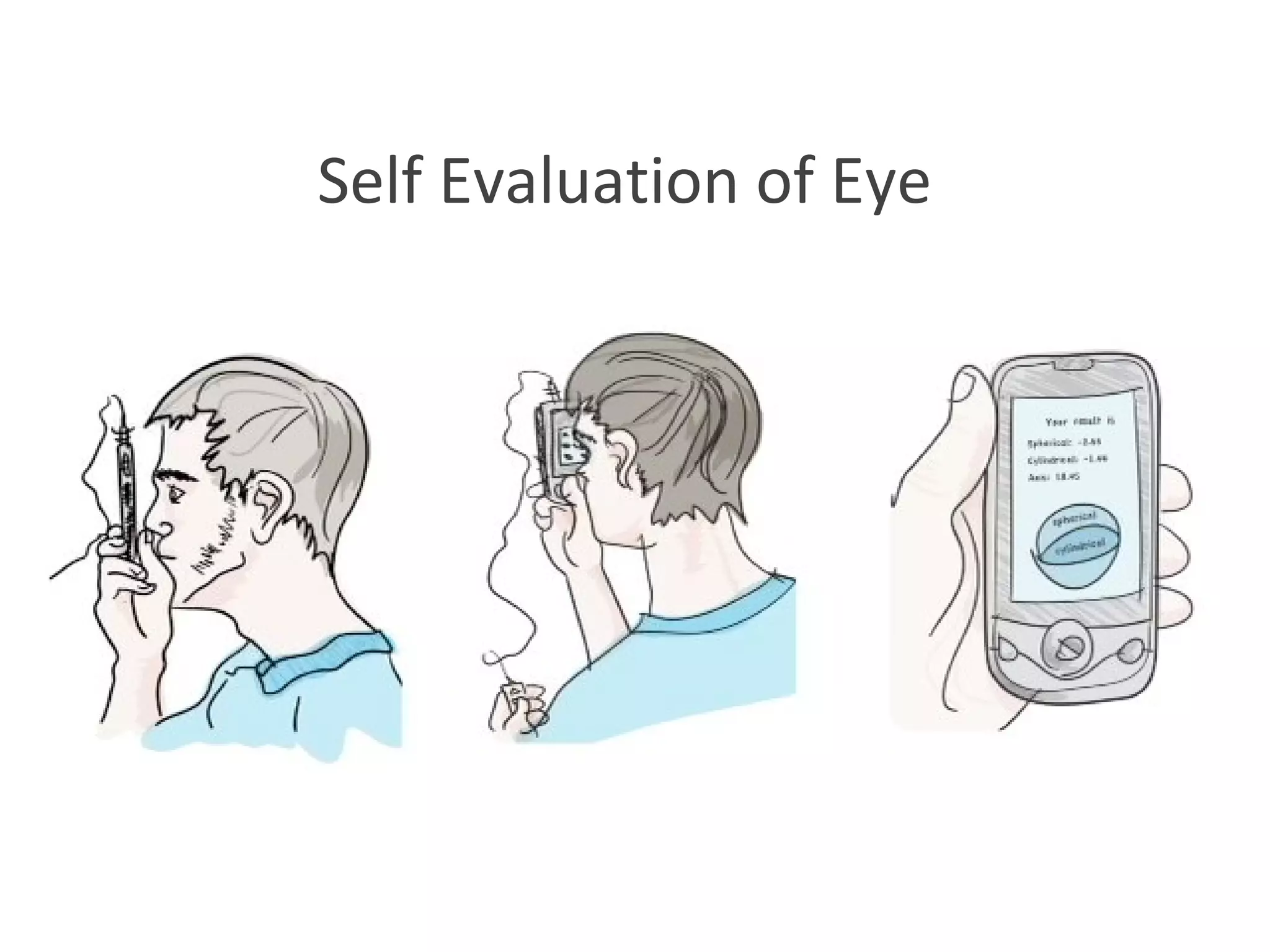
Self Evaluation of Eye
 
Self Evaluation of Eye


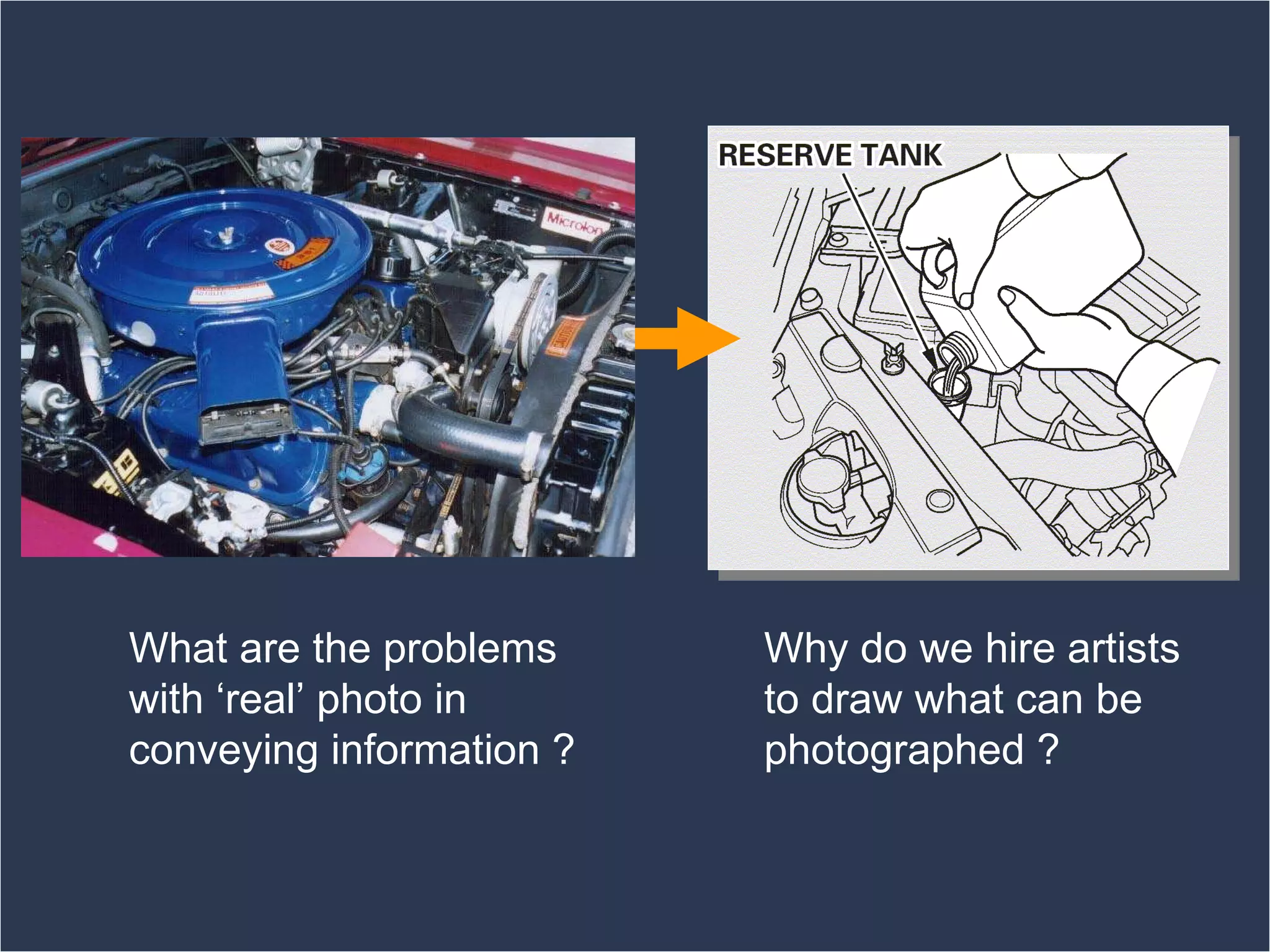
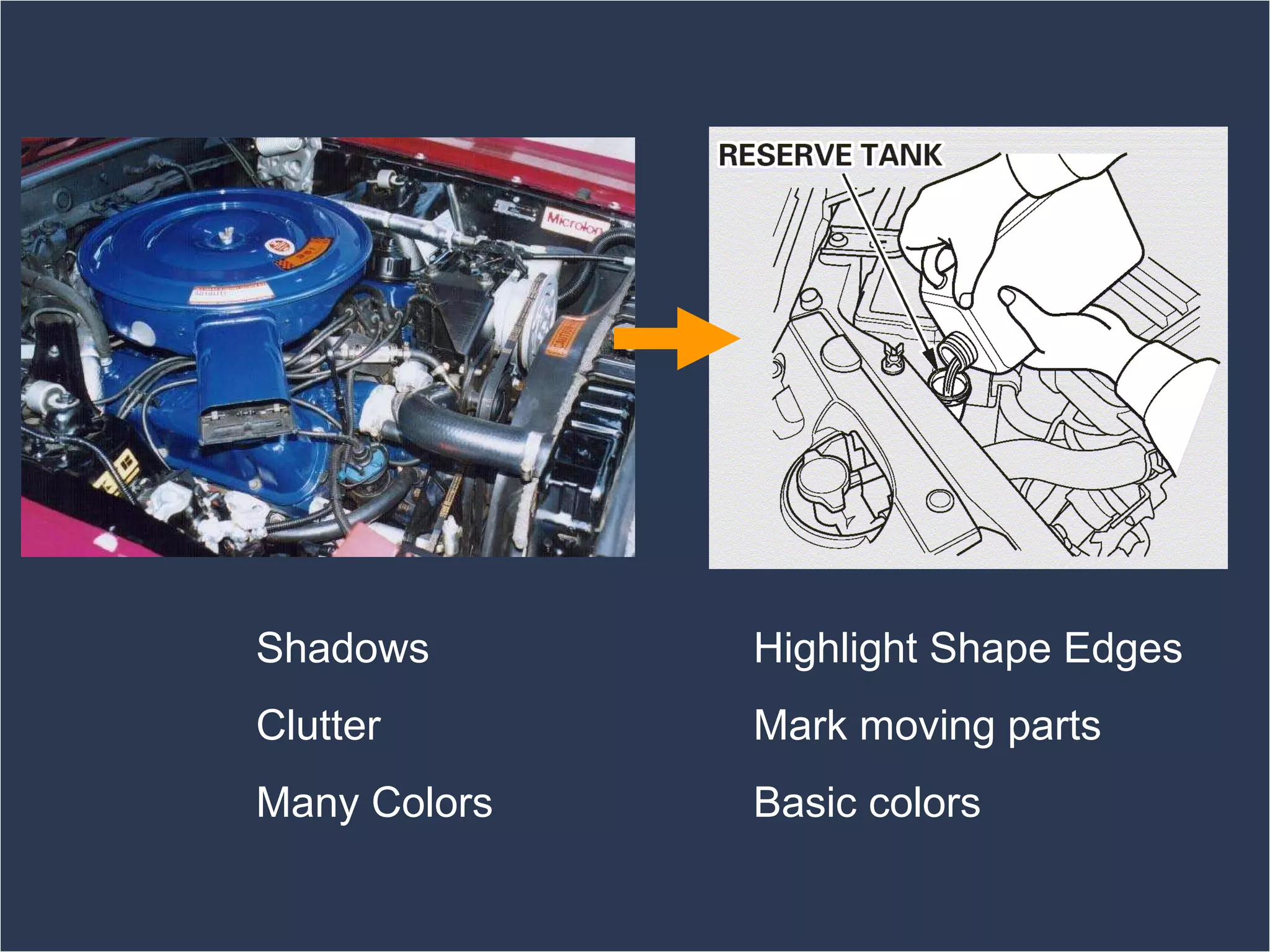
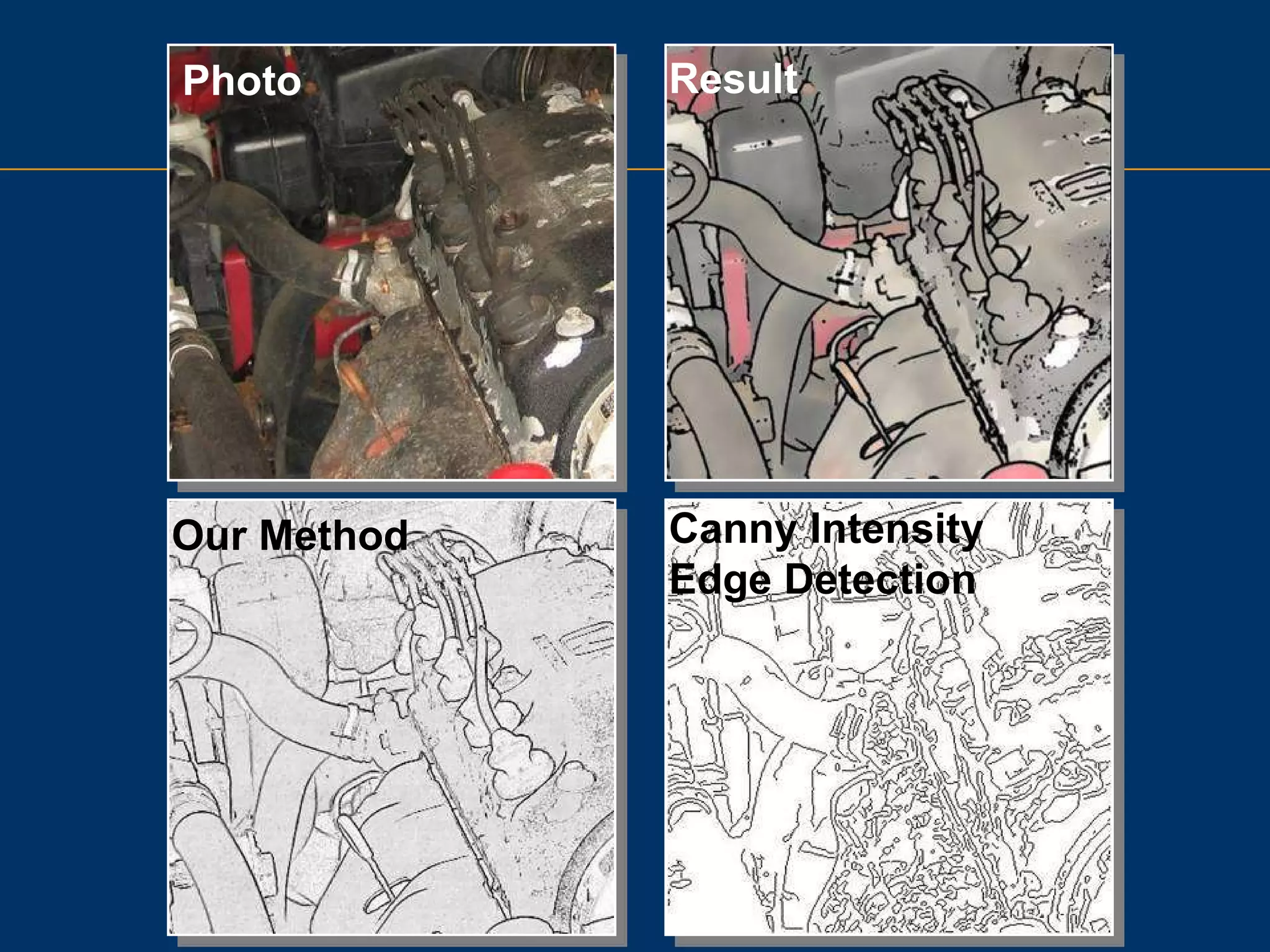
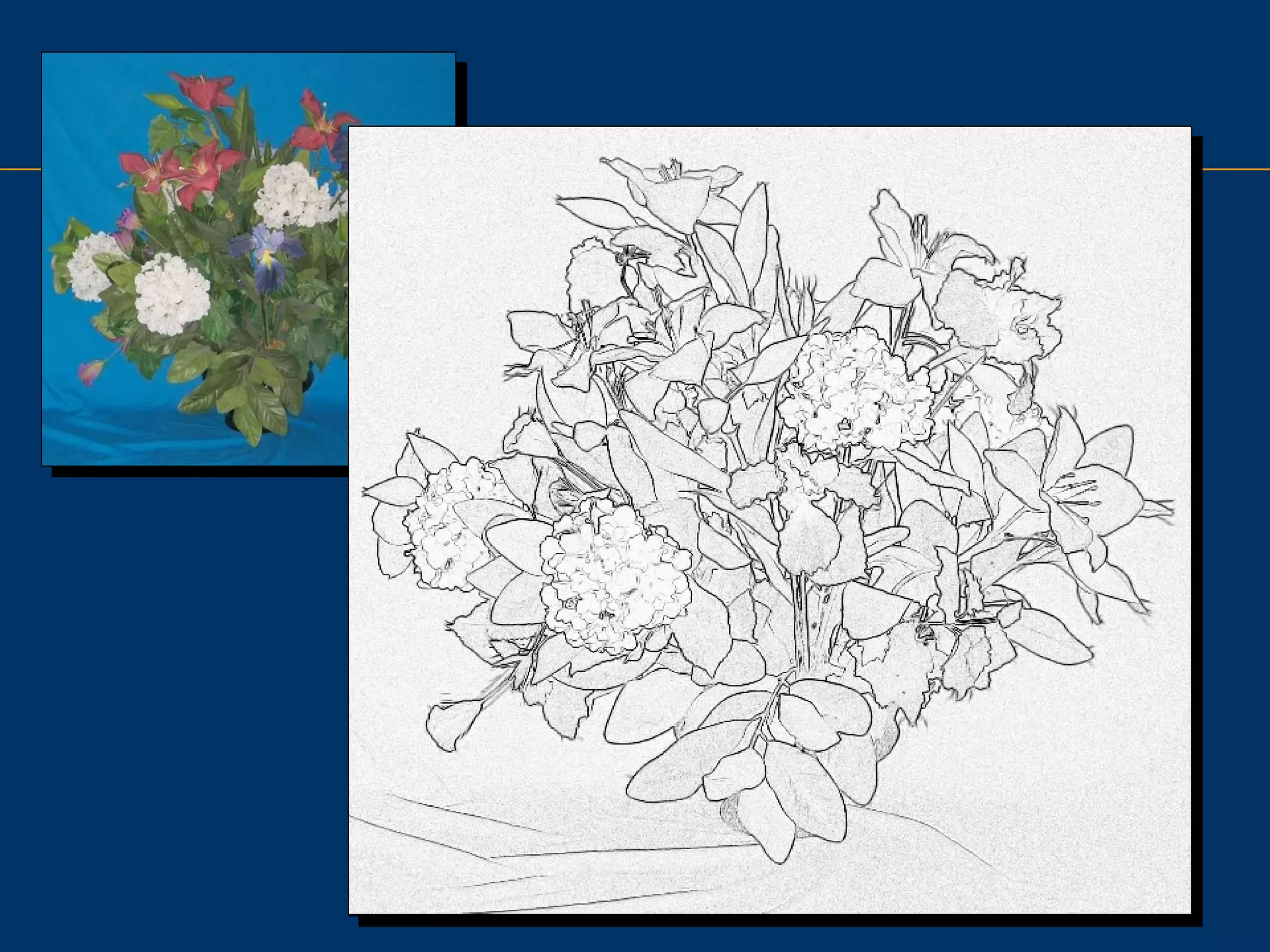
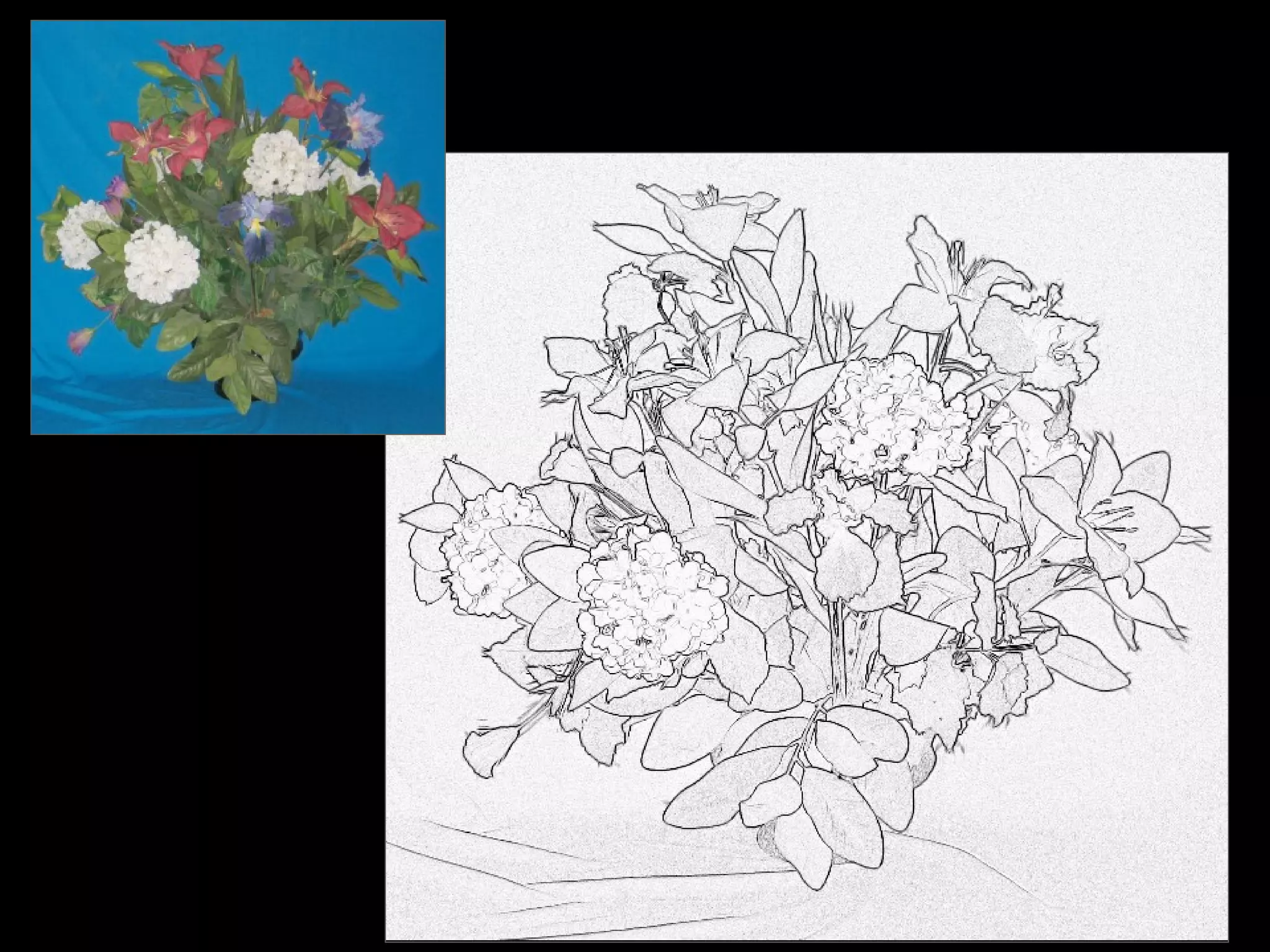
What are the problems with ‘real’ photo in conveying information ? Why do we hire artists to draw what can be photographed ?
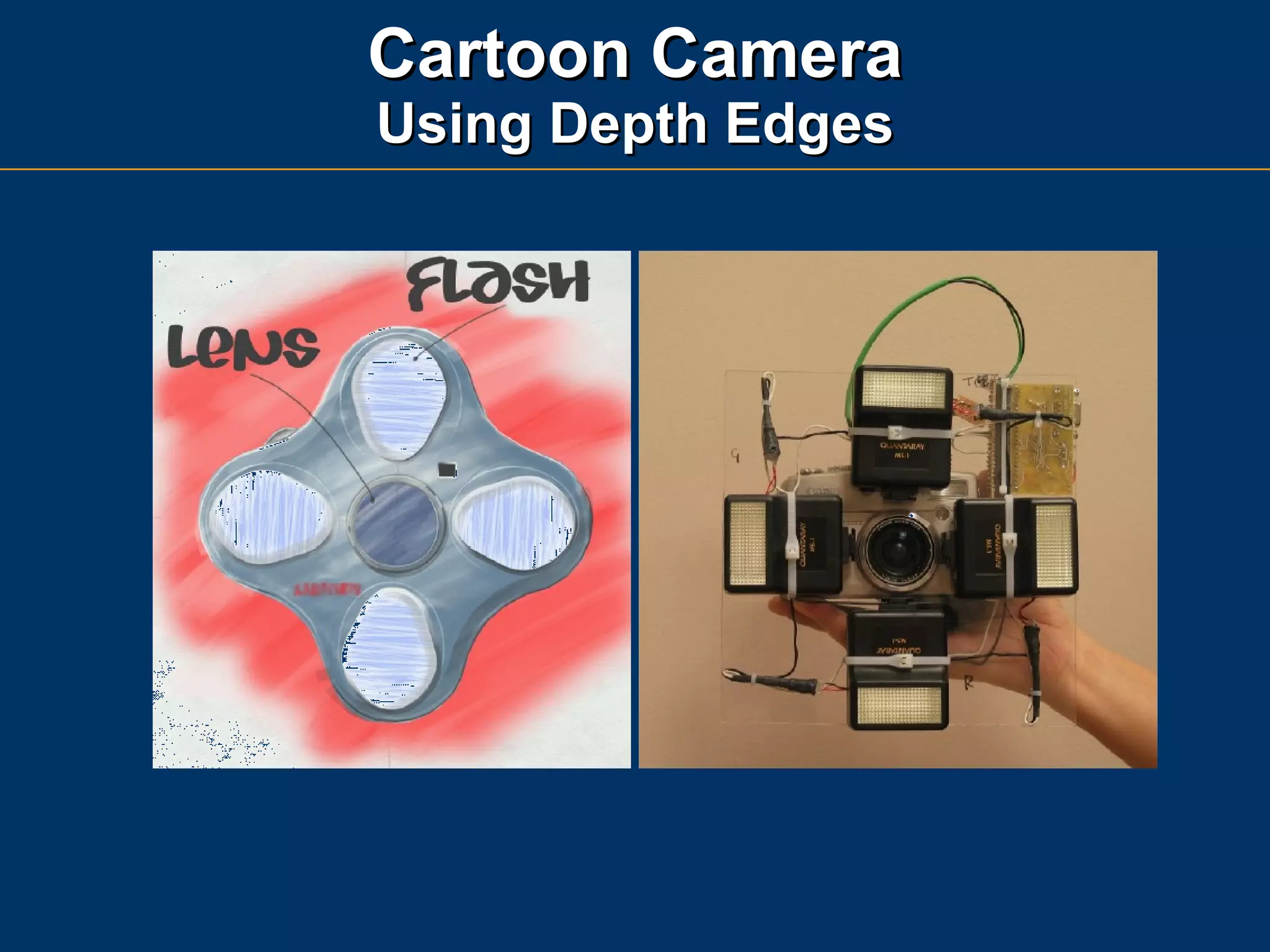
Shadows Clutter Many Colors Highlight Shape Edges Mark moving parts Basic colors
Cartoon Camera Using Depth Edges


Canny Intensity  Edge Detection Our Method Photo Result
 
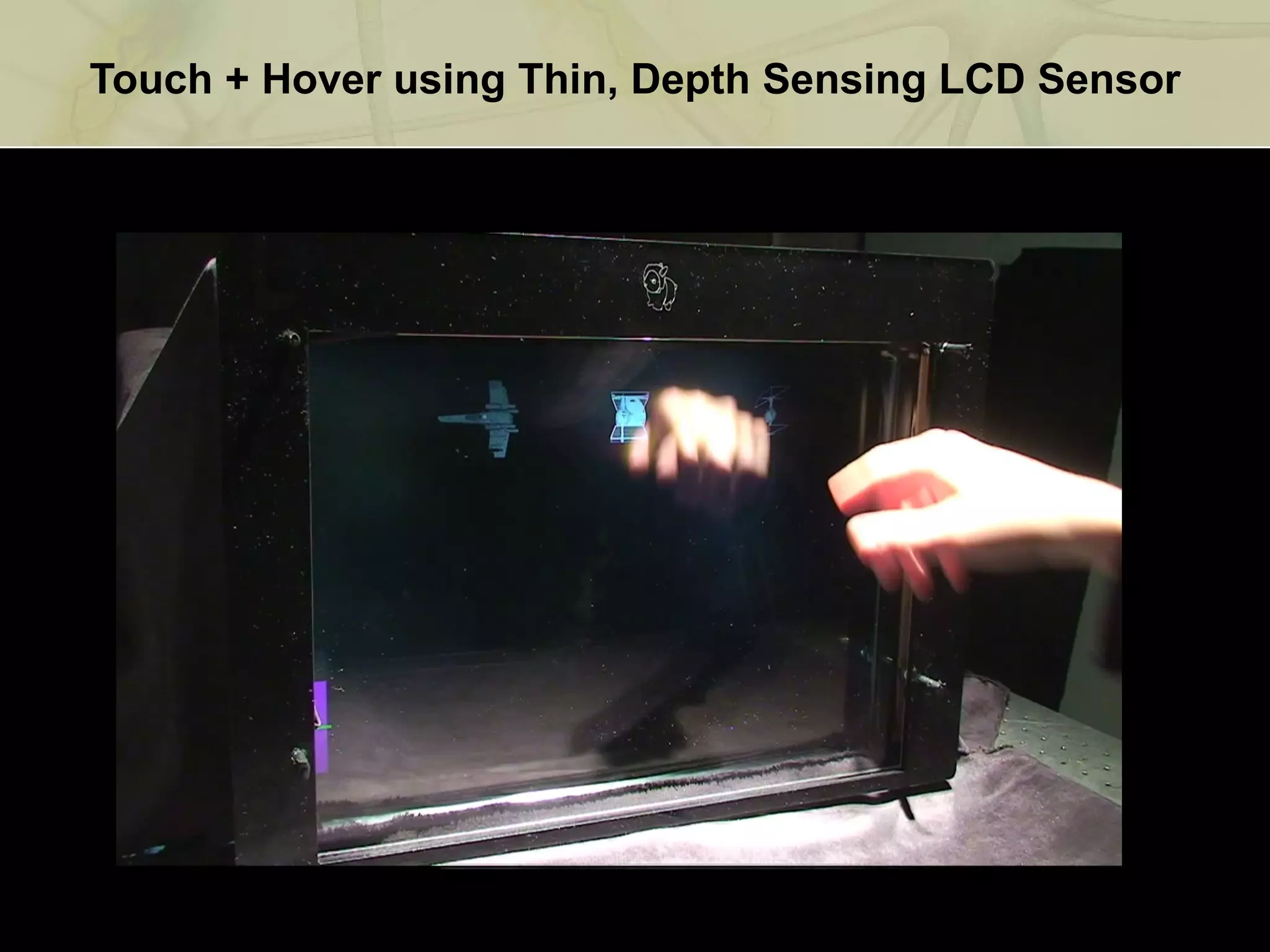
Convert LCD into a big  flat camera ? Beyond Multi-touch: 3D Gestures
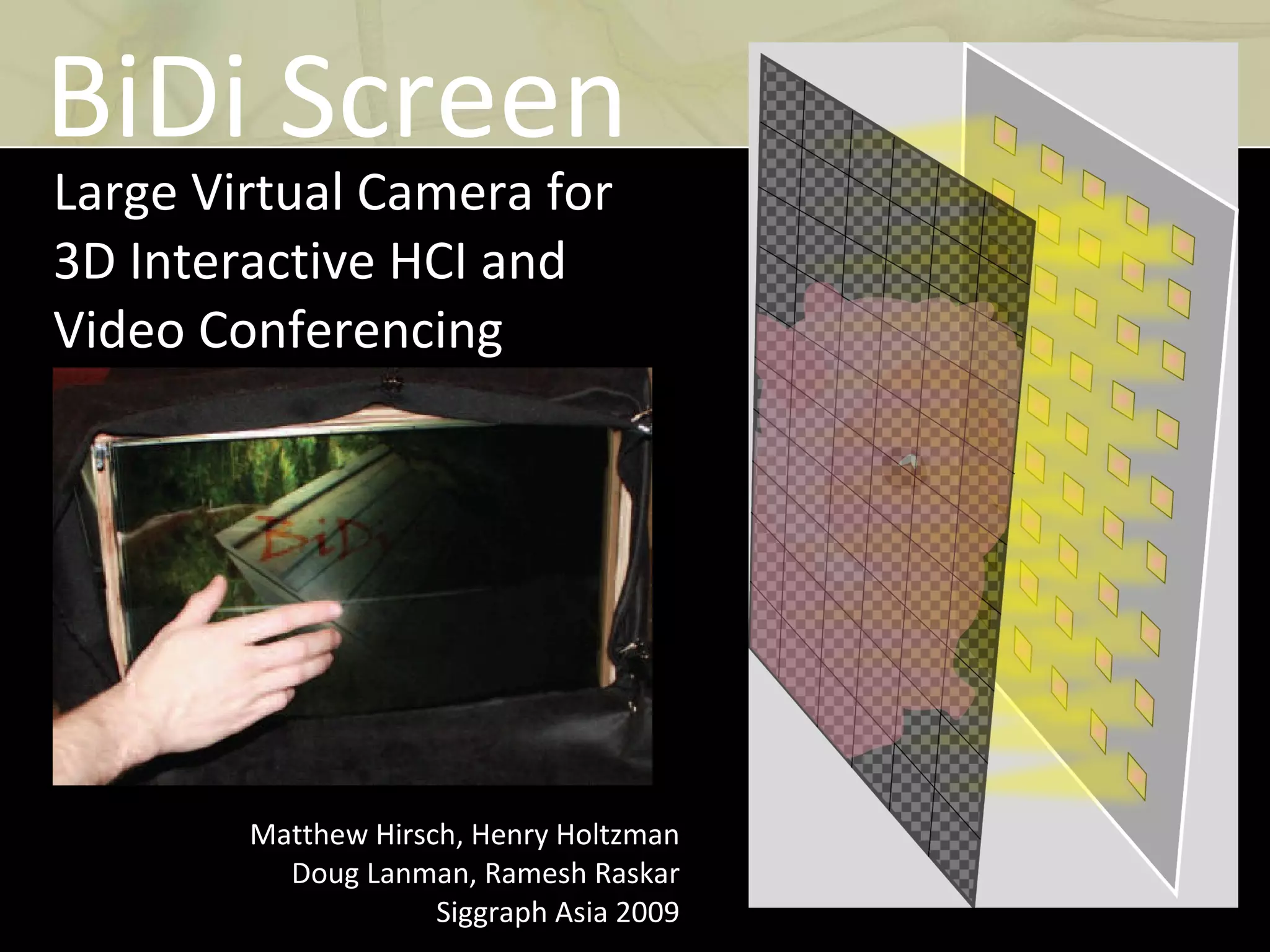
Large Virtual Camera for  3D Interactive HCI and  Video Conferencing Matthew Hirsch, Henry Holtzman Doug Lanman, Ramesh Raskar Siggraph Asia 2009 BiDi Screen
Touch + Hover using Thin, Depth Sensing LCD Sensor
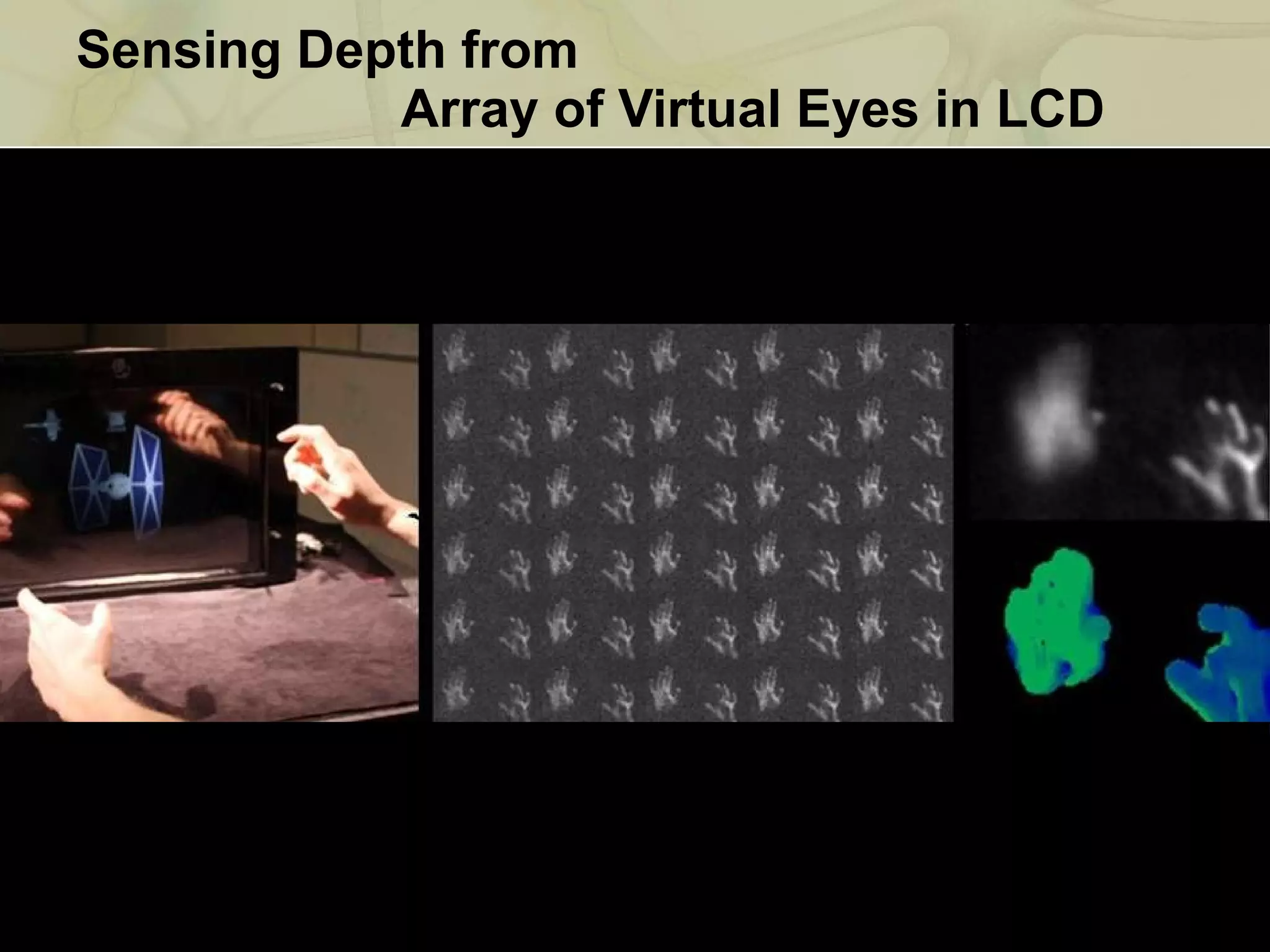
Sensing Depth from    Array of Virtual Eyes in LCD
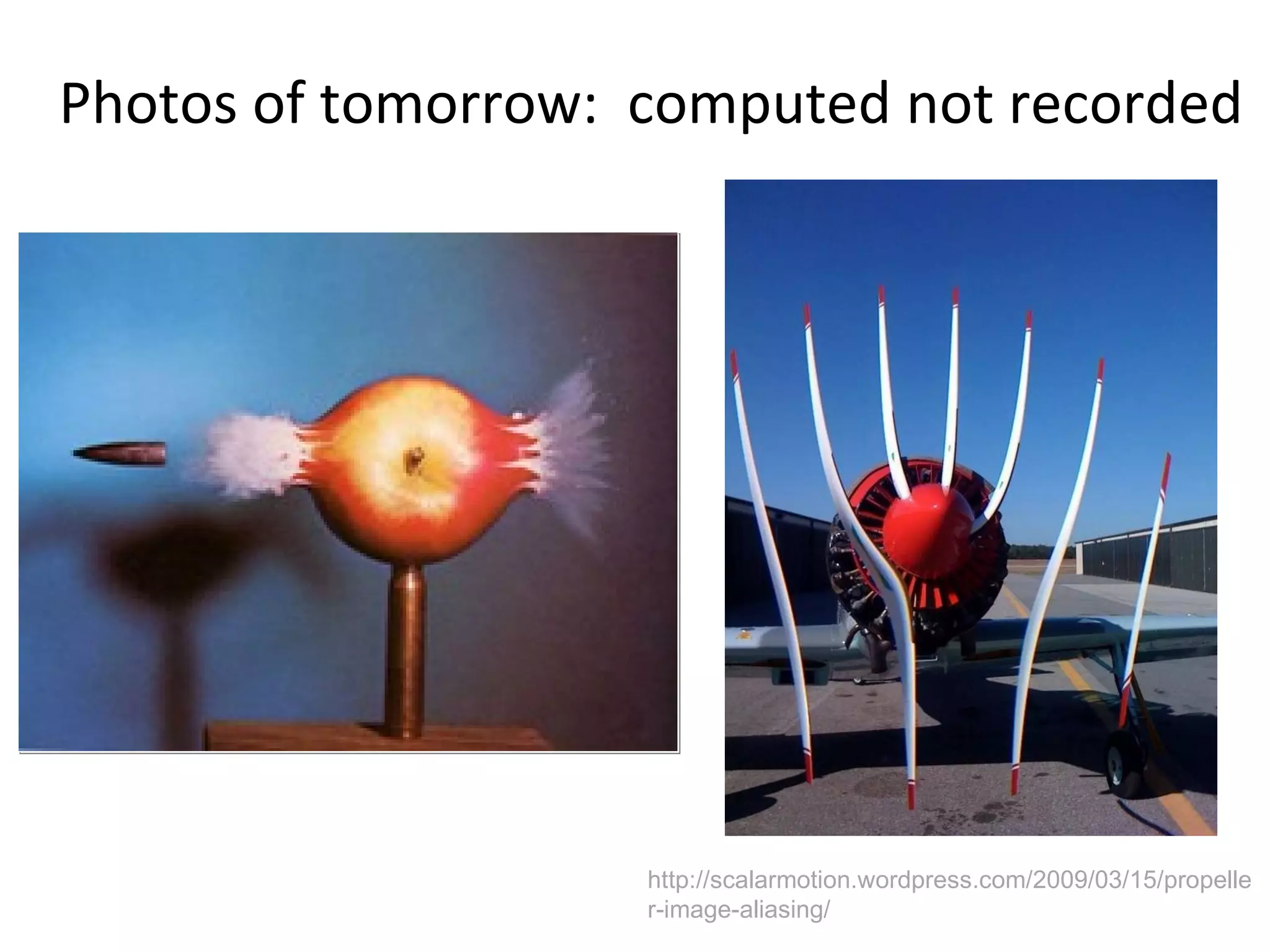
Photos of tomorrow:  computed not recorded http://scalarmotion.wordpress.com/2009/03/15/propeller-image-aliasing/
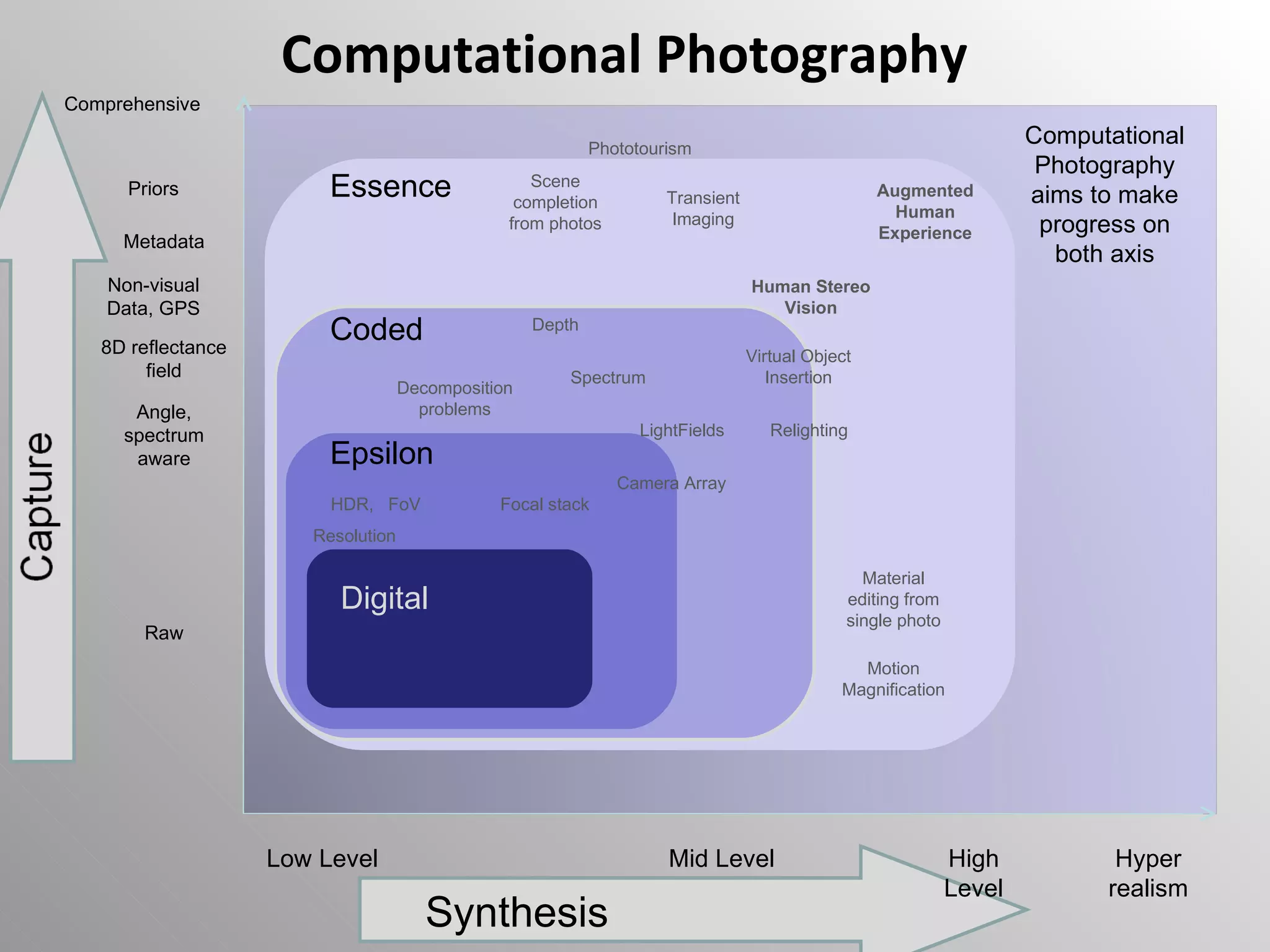
Synthesis Low Level Mid Level High Level Hyper realism Raw Angle, spectrum aware Non-visual Data, GPS Metadata Priors Comprehensive 8D reflectance field Computational Photography Digital Epsilon Coded Essence Computational Photography aims to make progress on both axis Camera Array HDR,  FoV Focal stack Decomposition problems Depth Spectrum LightFields Human Stereo Vision Transient Imaging Virtual Object Insertion Relighting Augmented Human Experience Material editing from single photo Scene completion from photos Motion Magnification Phototourism Resolution
Camera Culture Ramesh  Raskar Understand the World Identify/recognize Objects 3D Awareness Interact with embedded information
Can you ‘see’ around a corner ?
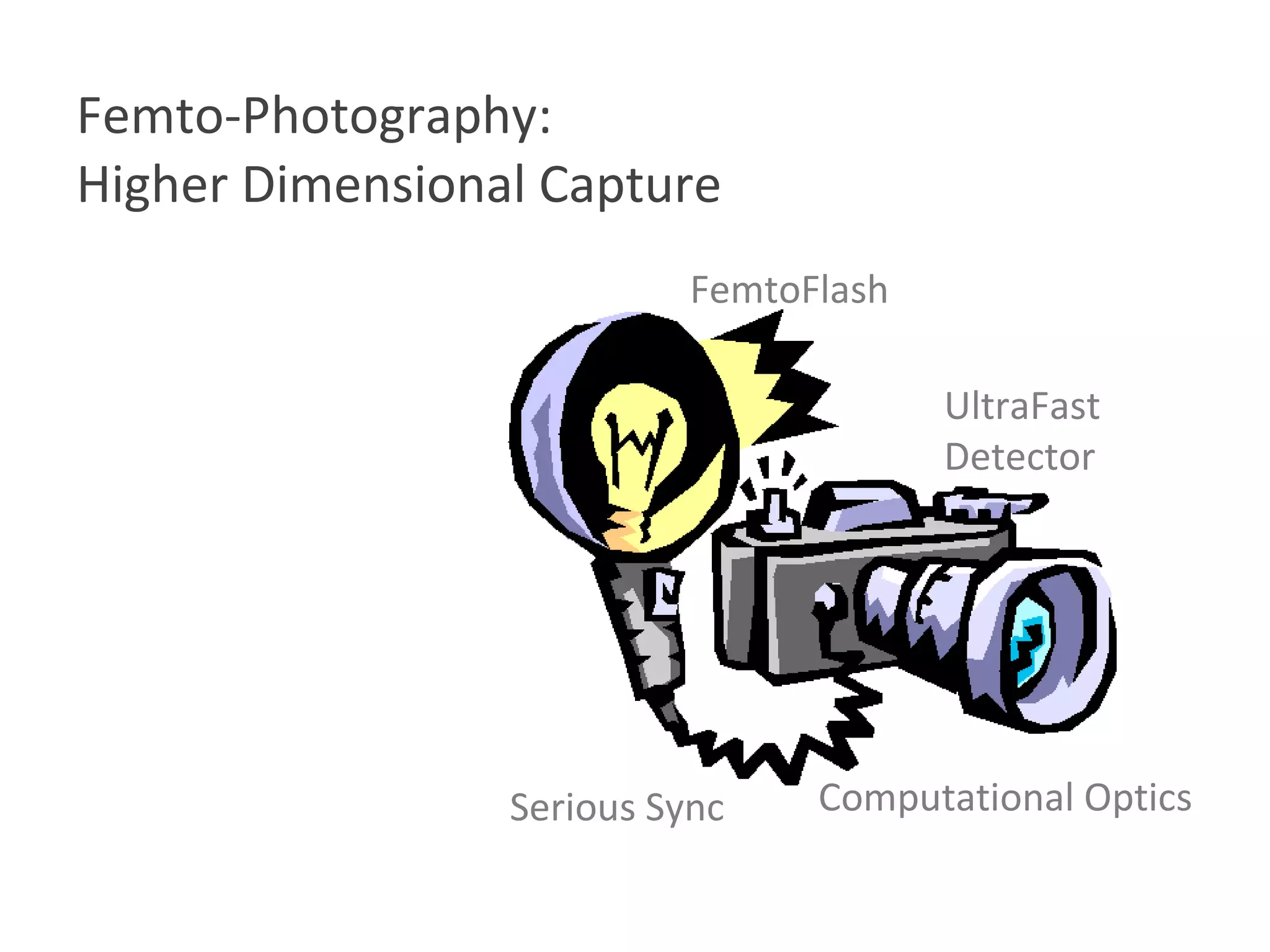
Femto-Photography:  Higher Dimensional Capture FemtoFlash UltraFast Detector Computational Optics Serious Sync
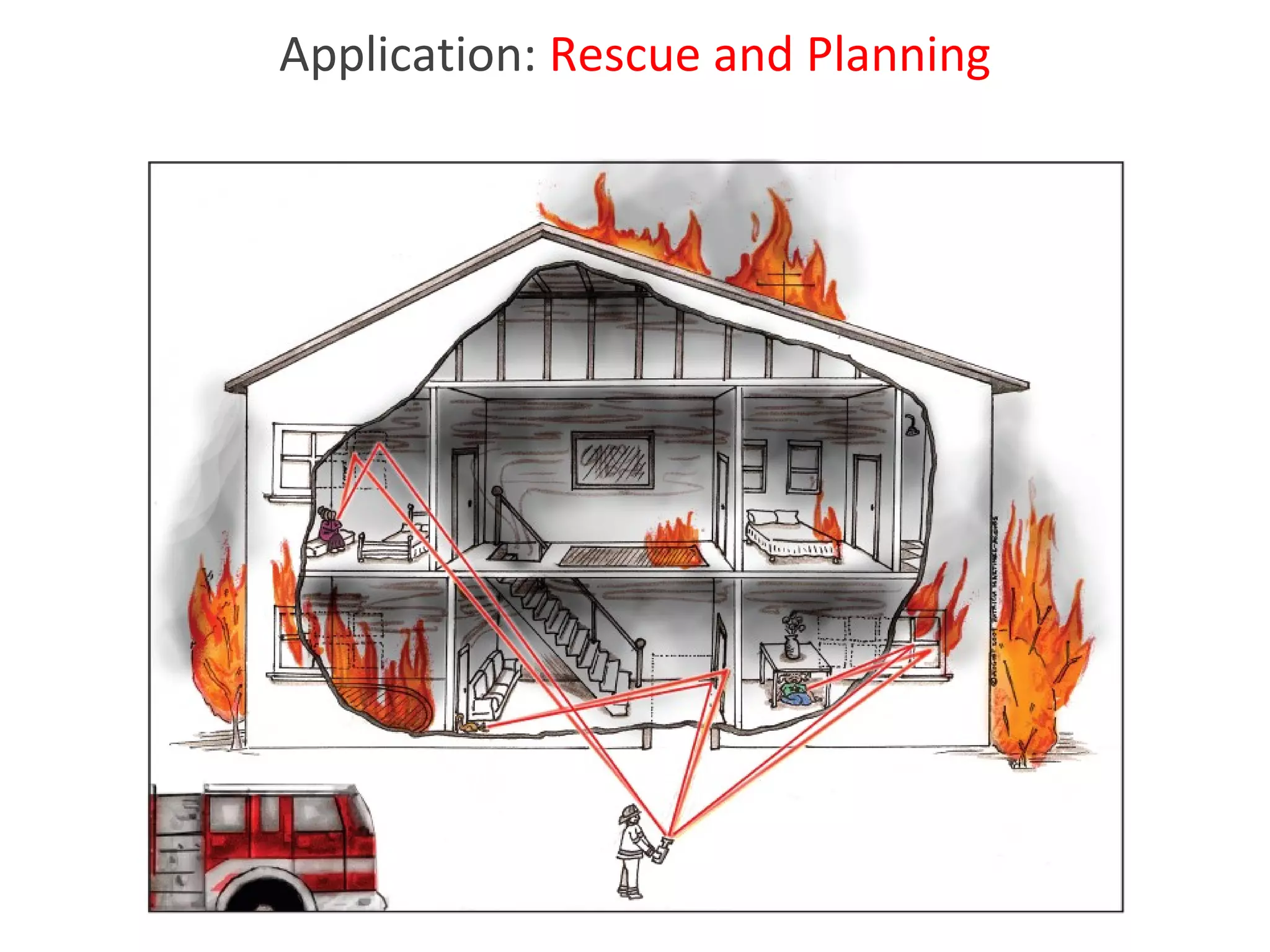
Application:  Rescue and Planning
 
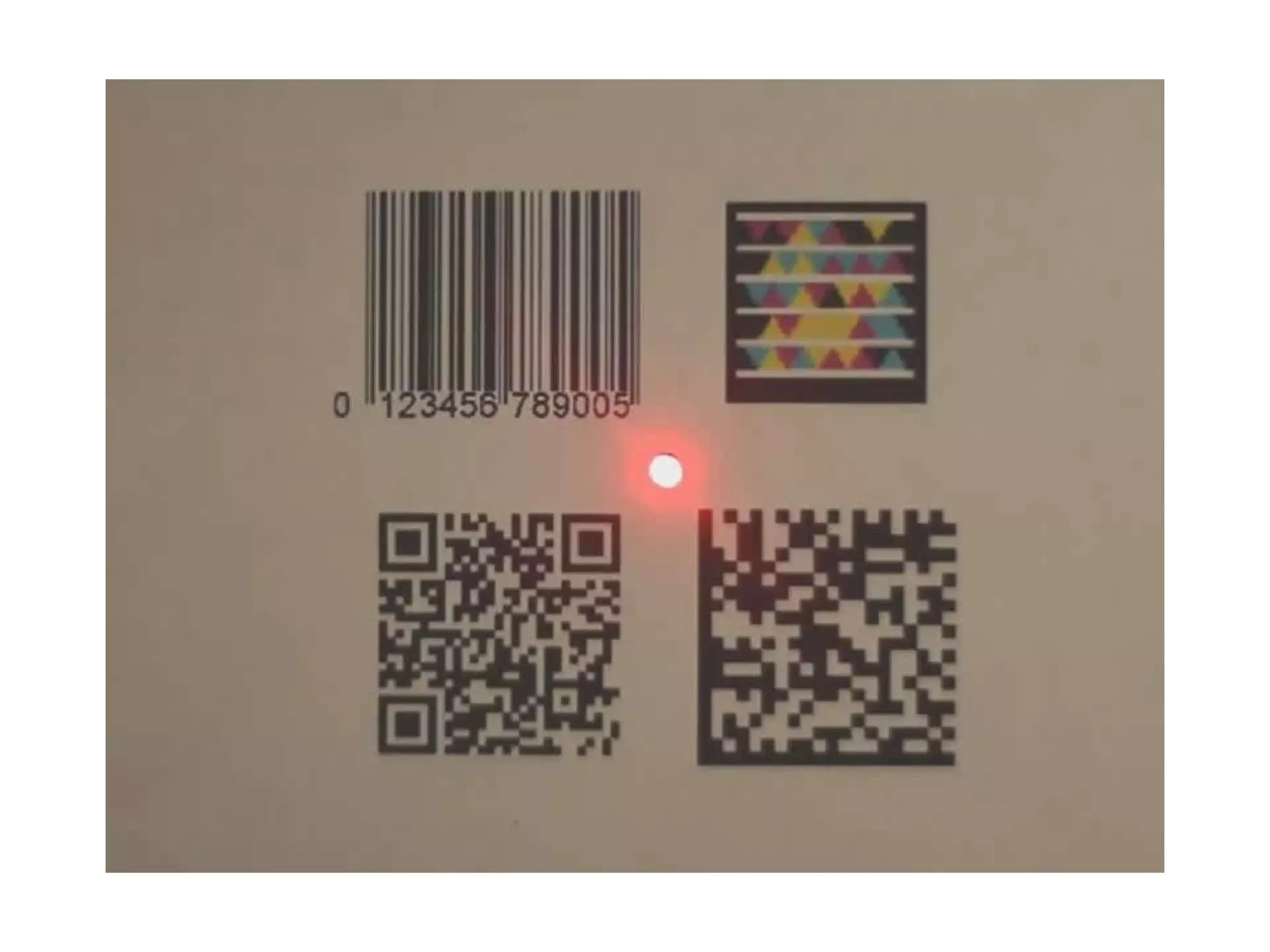
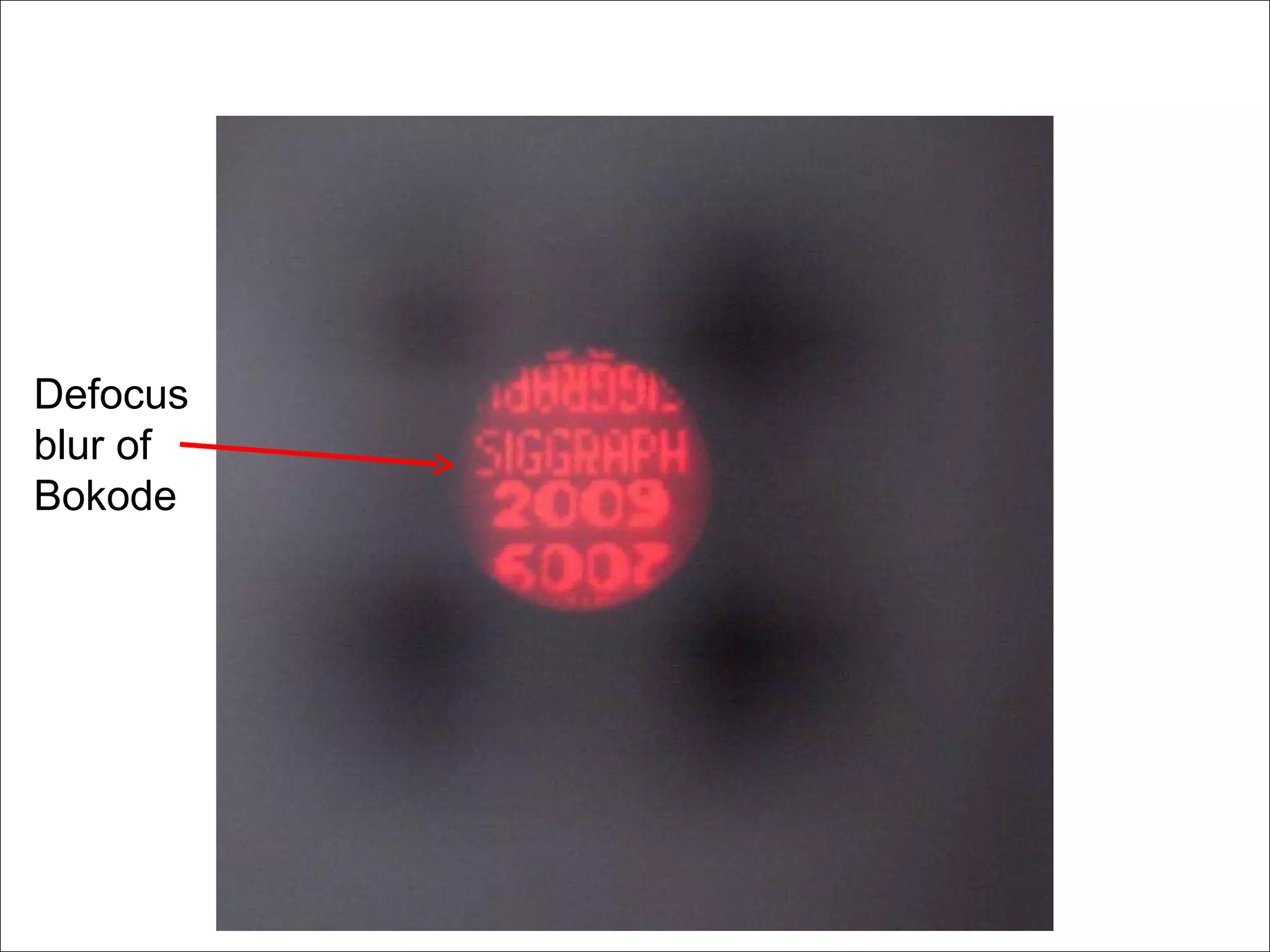
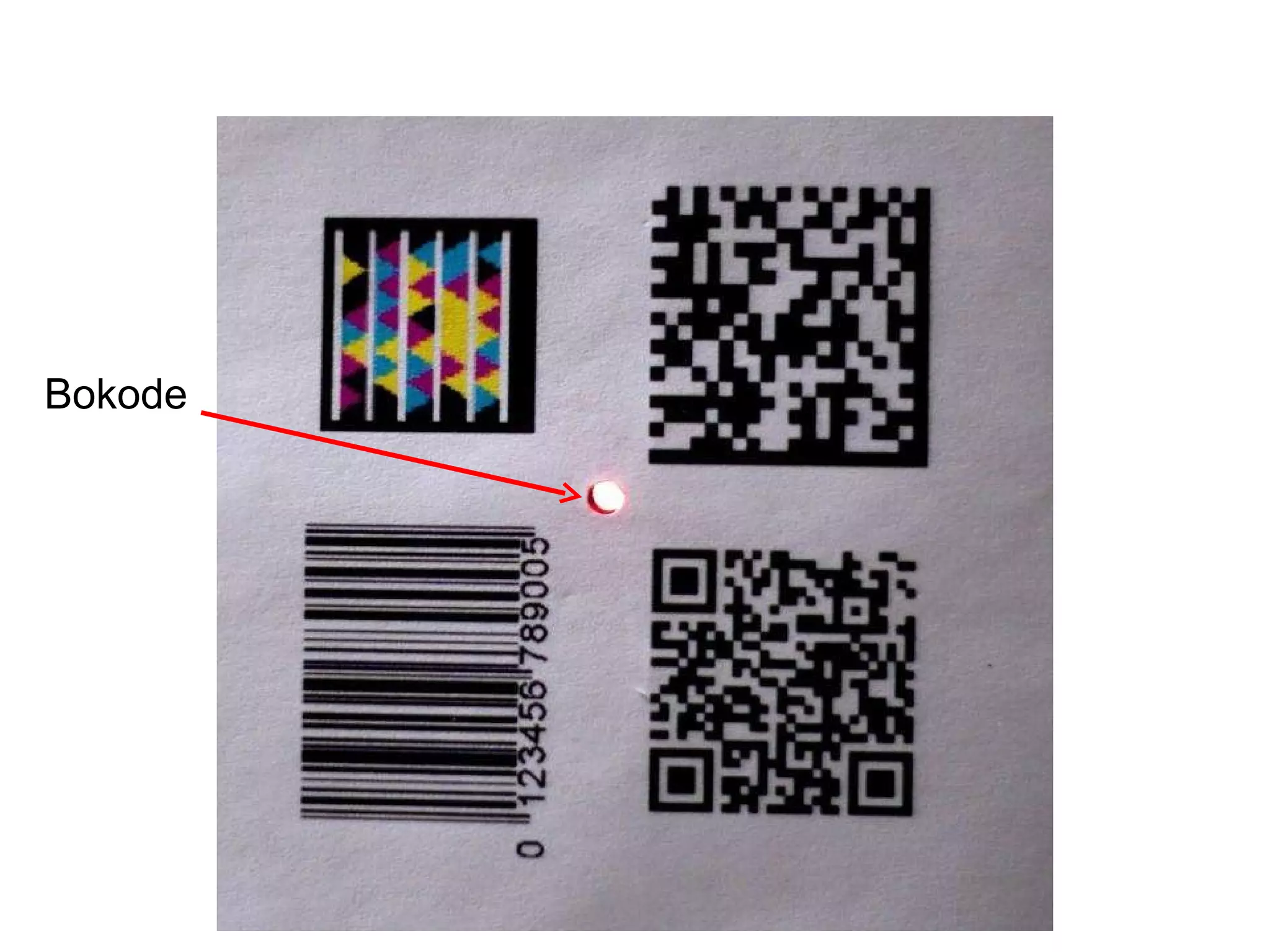
Bokode
 
Defocus blur of Bokode
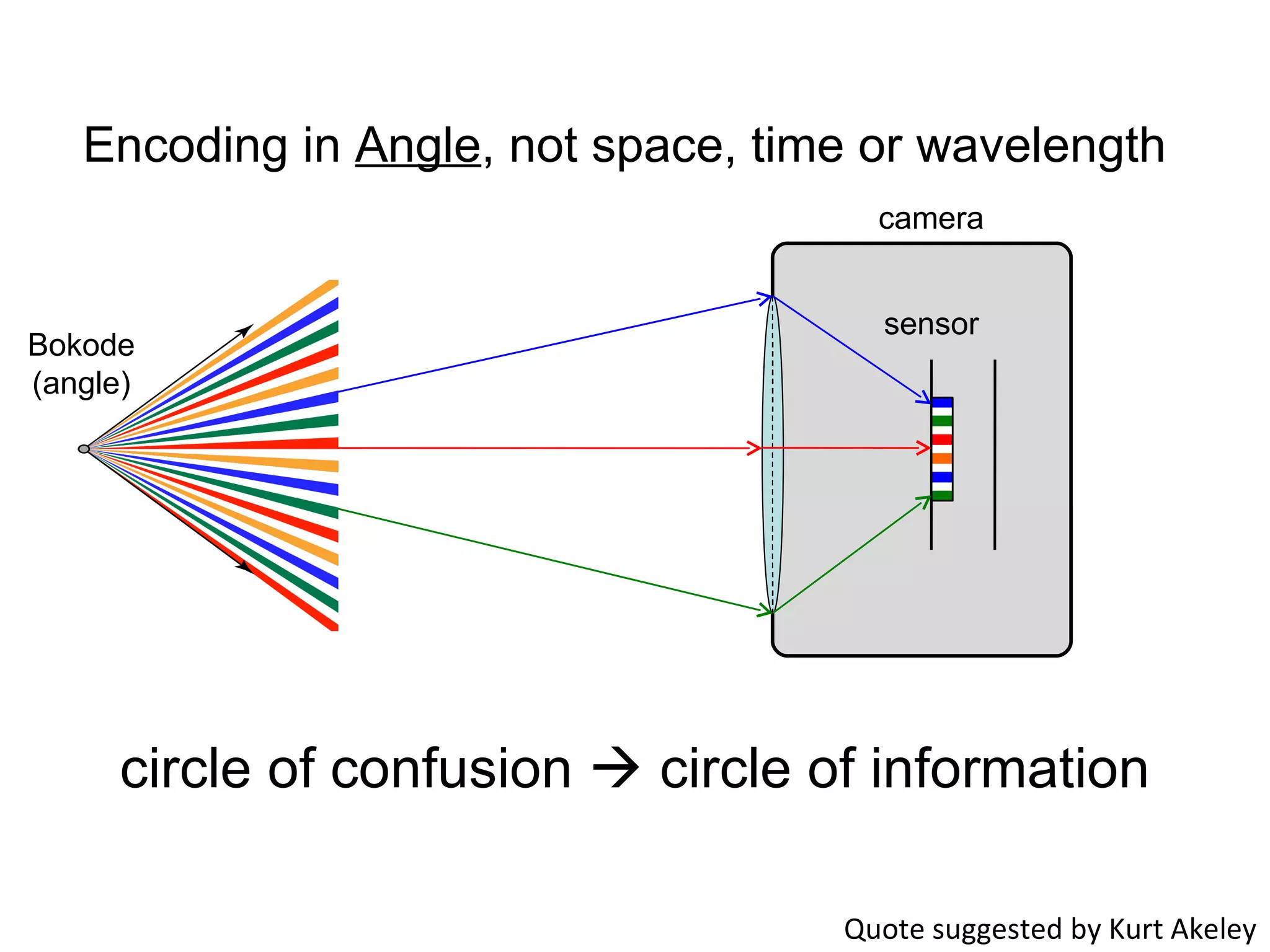
Coding in Angle Mohan, Woo, Smithwick, Hiura, Raskar [Siggraph 2009]
circle of confusion    circle of information camera Bokode (angle) Quote suggested by Kurt Akeley Encoding in  Angle , not space, time or wavelength sensor
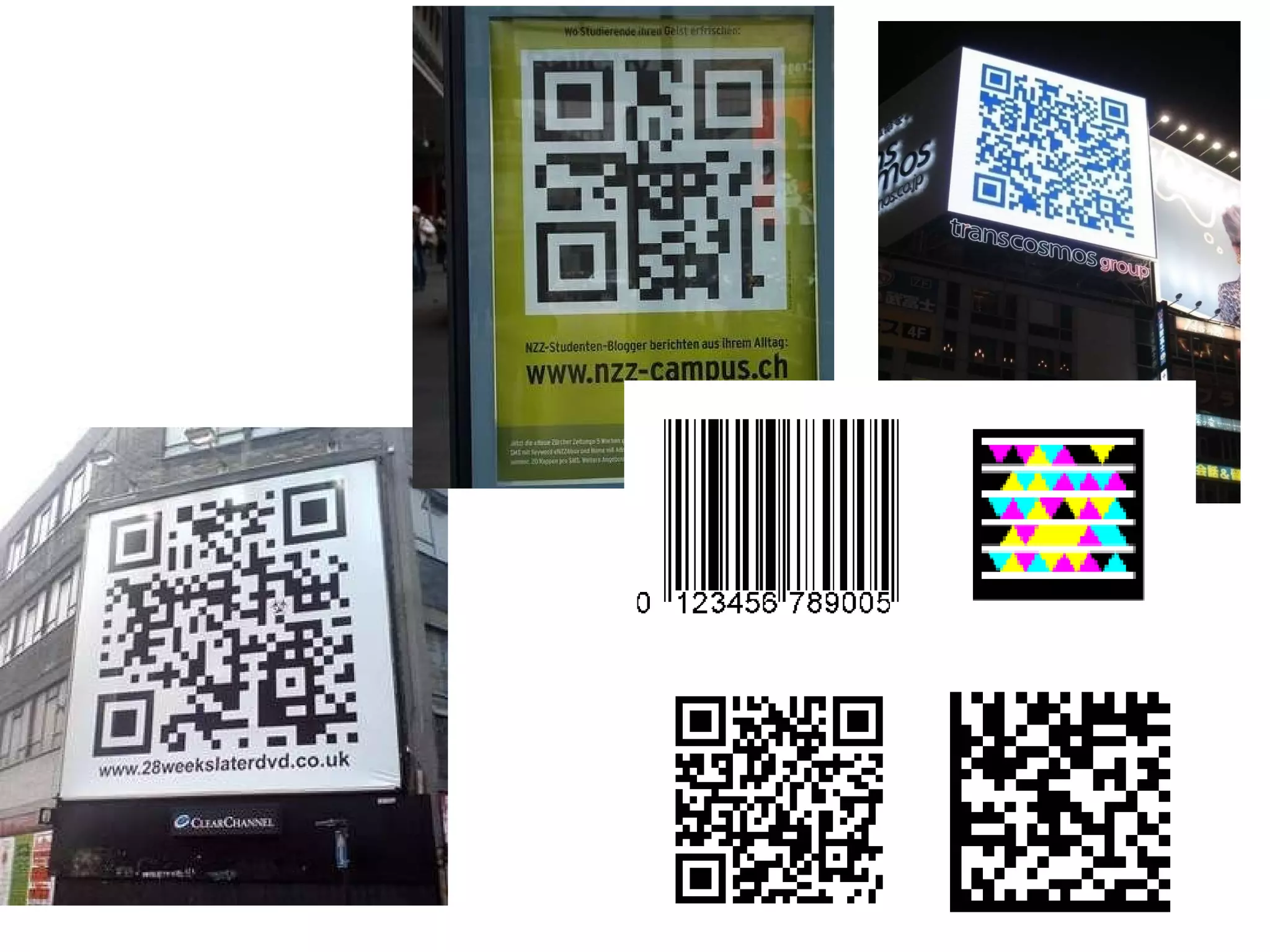
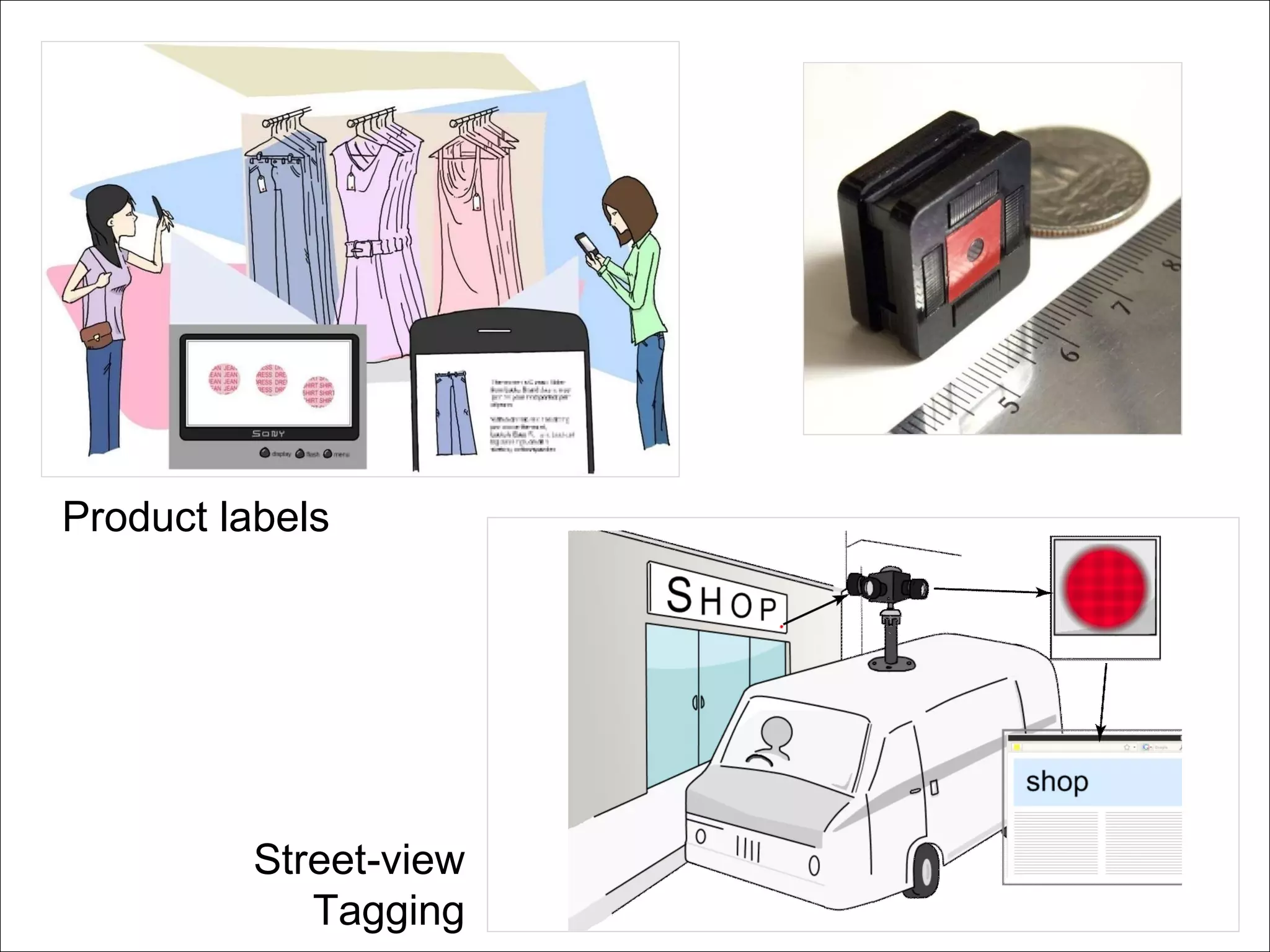
Product labels Street-view  Tagging
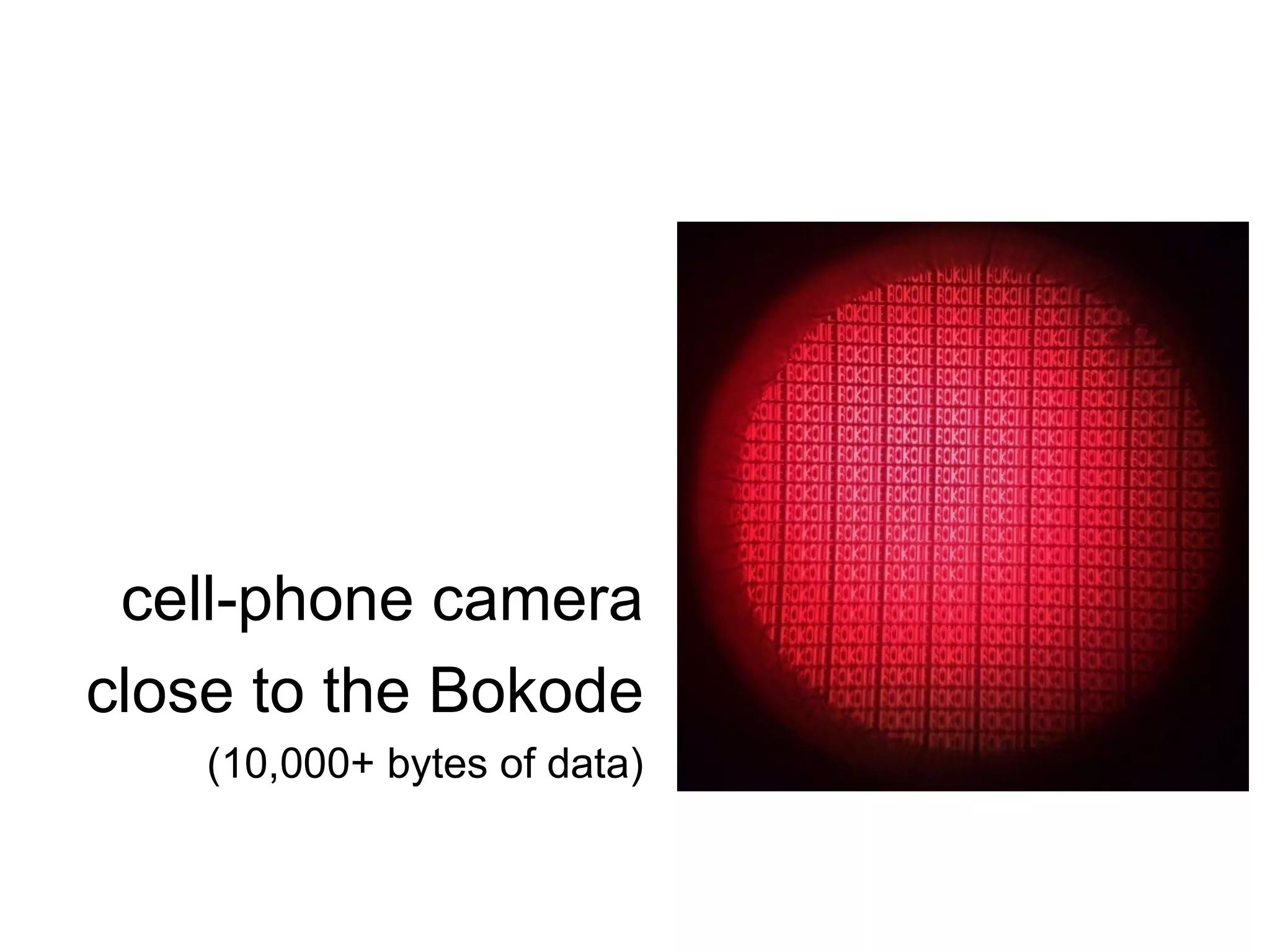
cell-phone camera close to the Bokode (10,000+ bytes of data)
Camera Culture Ramesh  Raskar Understand the World Identify/recognize Objects 3D Awareness Interact with embedded information
Visual Computing Forward  (Synthesize) Special Effects, Image Processing, Design Inverse  (Understand) Human-like performance Recognizing/finding objects, image search Challenging  !
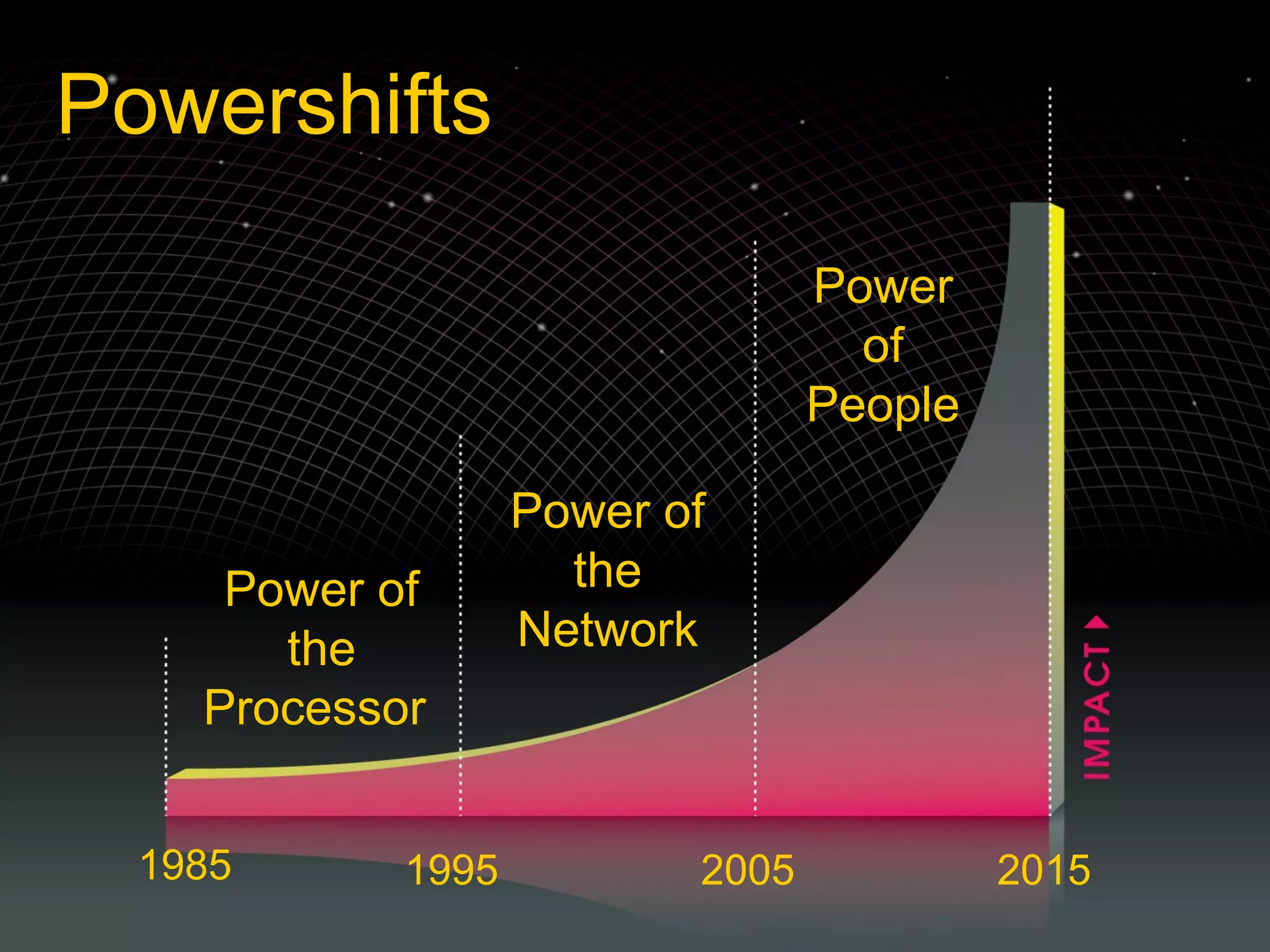
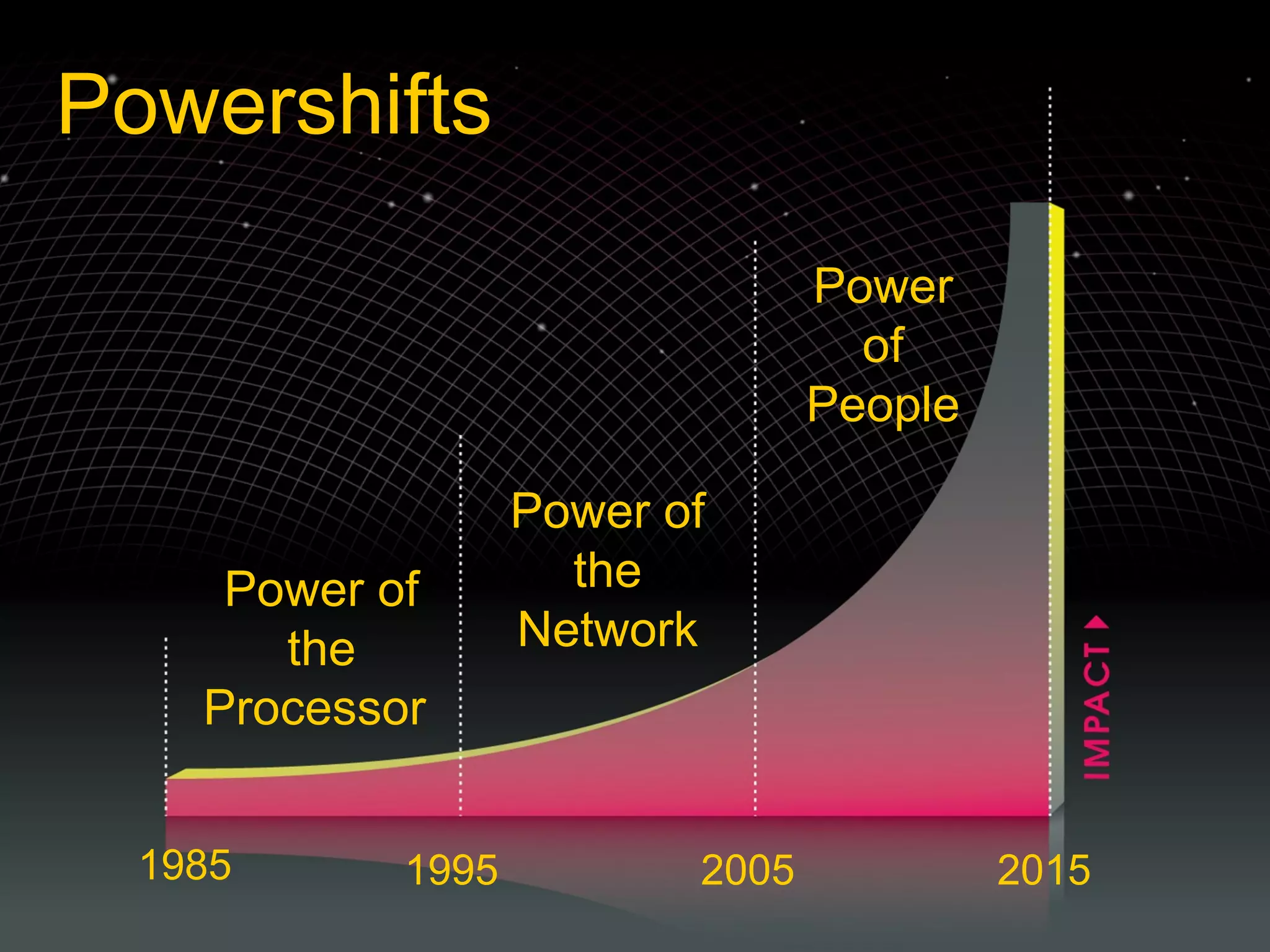
Power of the Processor  Power of the Network Power of People 1985 1995 2005 2015 Powershifts
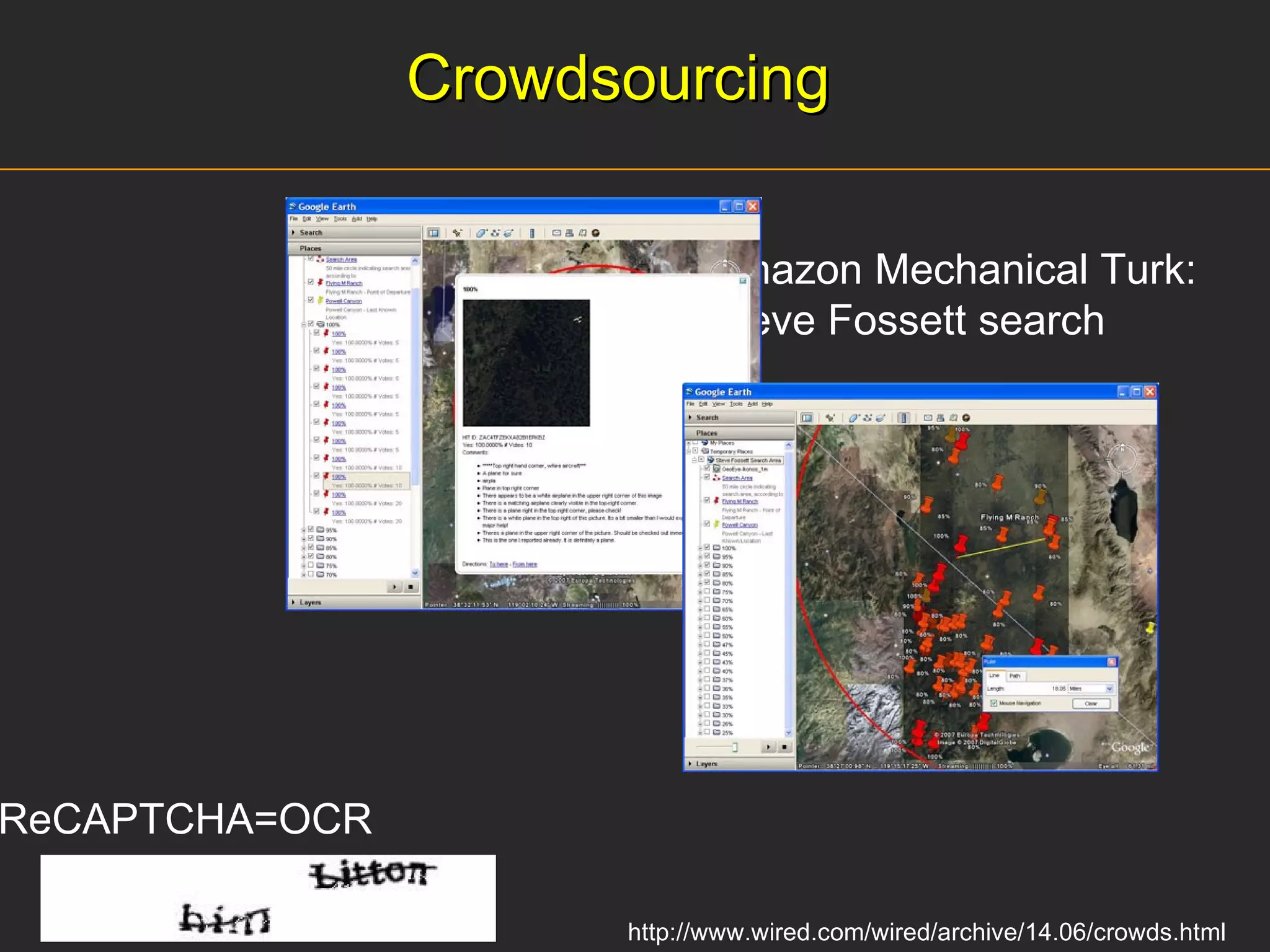
Crowdsourcing http://www.wired.com/wired/archive/14.06/crowds.html Amazon Mechanical Turk:  Steve Fossett search ReCAPTCHA=OCR
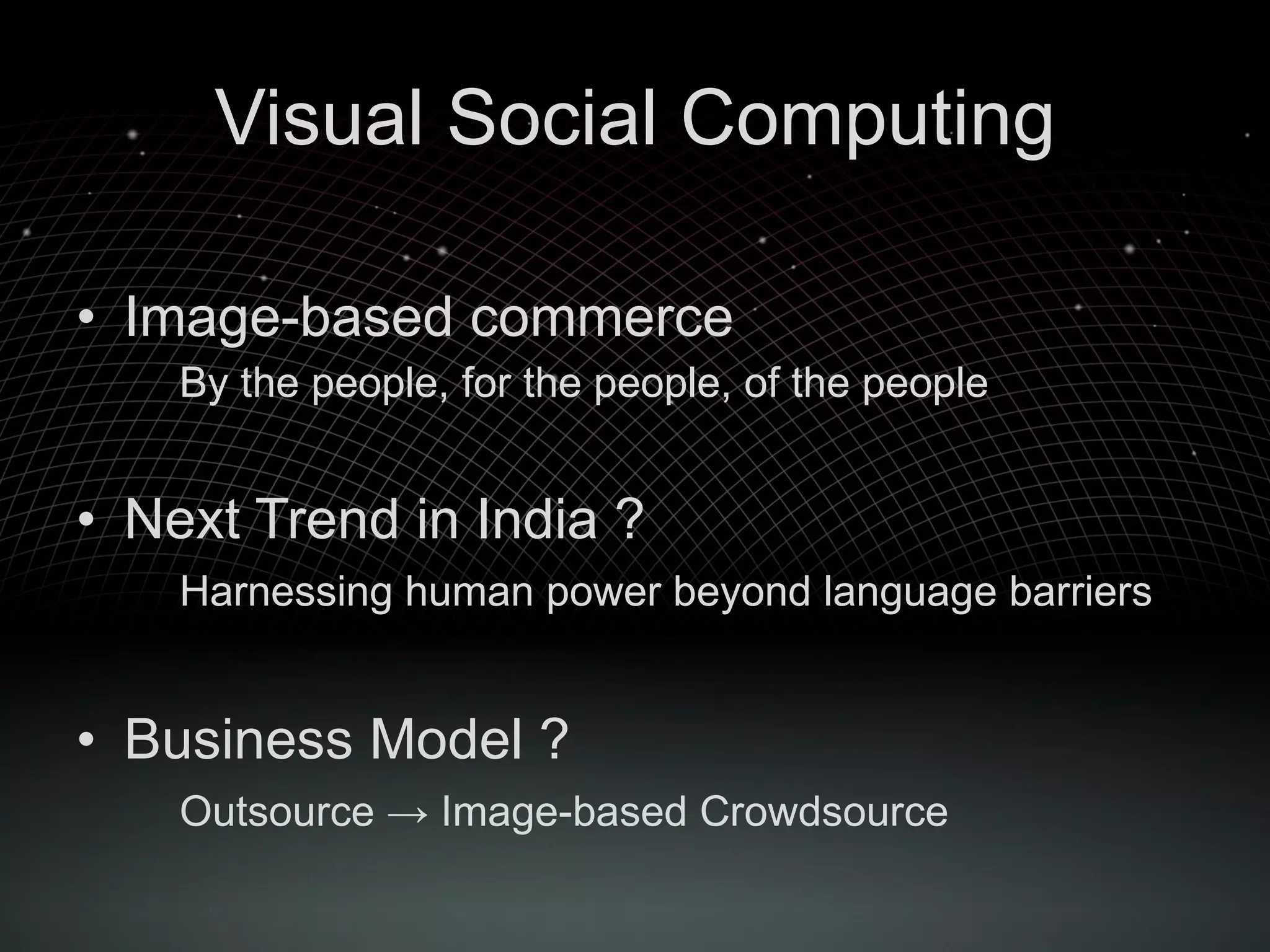
Visual Social Computing Image-based commerce By the people, for the people, of the people Next Trend in India ? Harnessing human power beyond language barriers Business Model ? Outsource -> Image-based Crowdsource
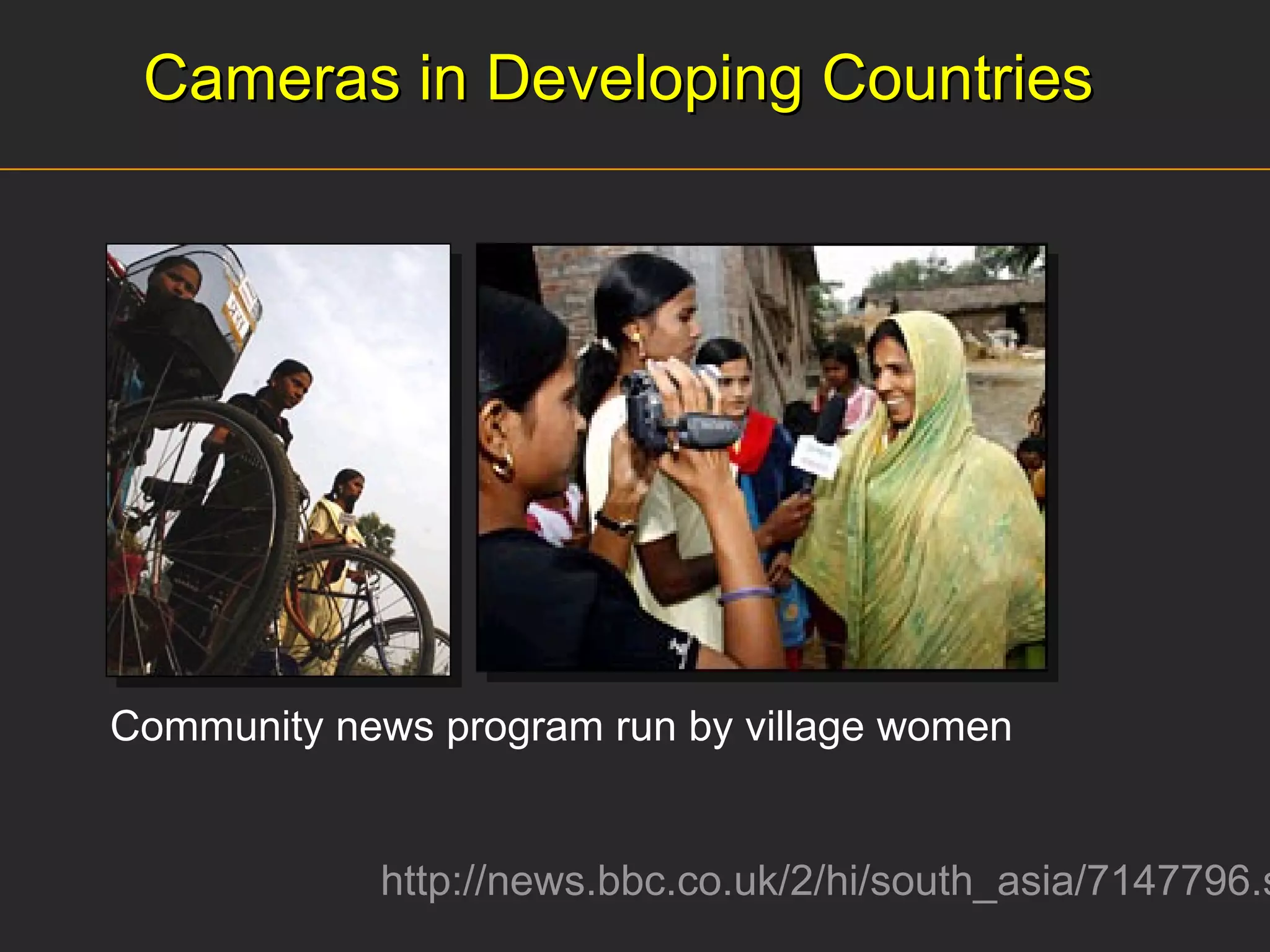
Cameras in Developing Countries http://news.bbc.co.uk/2/hi/south_asia/7147796.stm Community news program run by village women
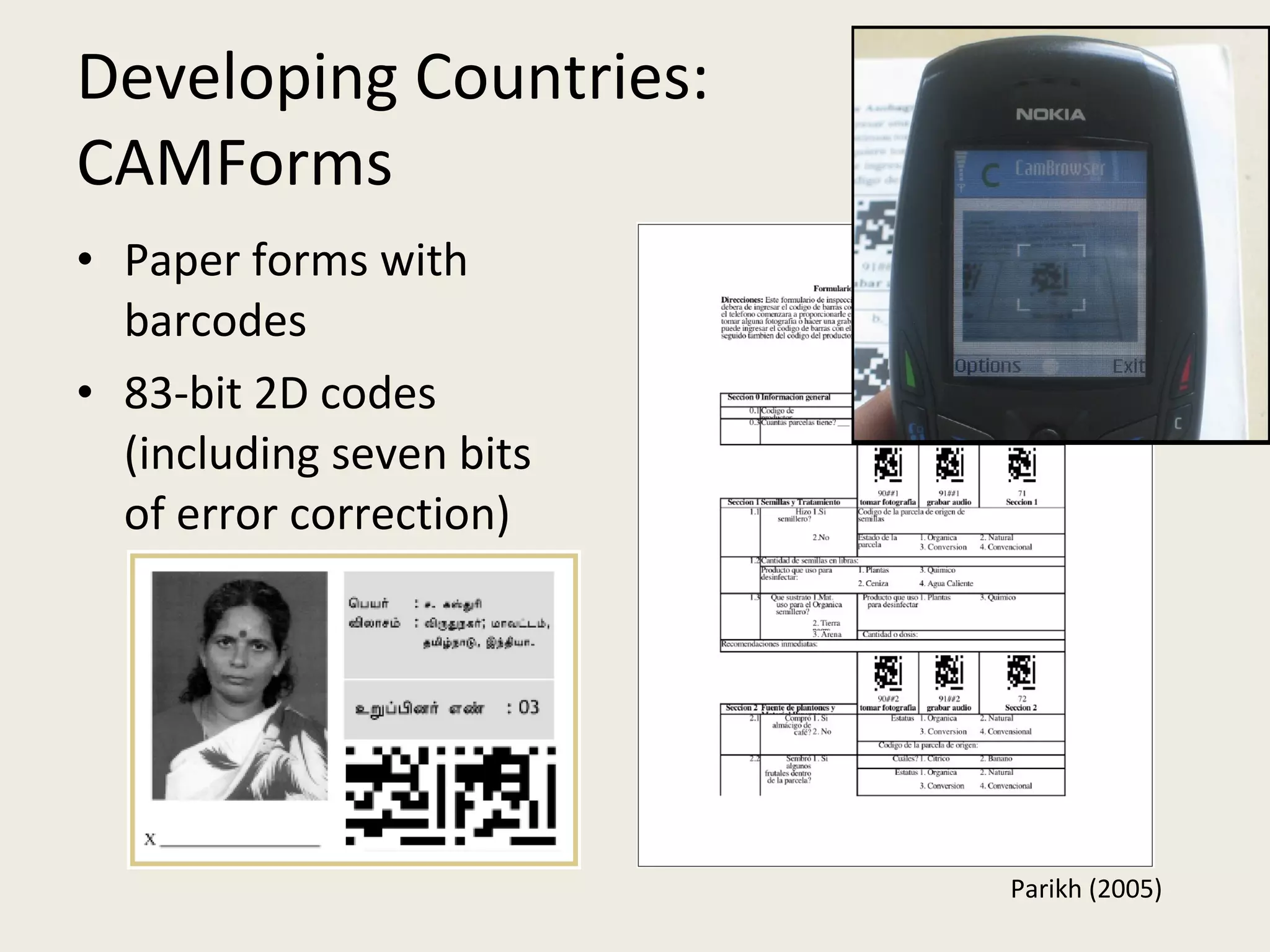
Developing Countries:  CAMForms Paper forms with barcodes 83-bit 2D codes (including seven bits of error correction)  Parikh (2005)
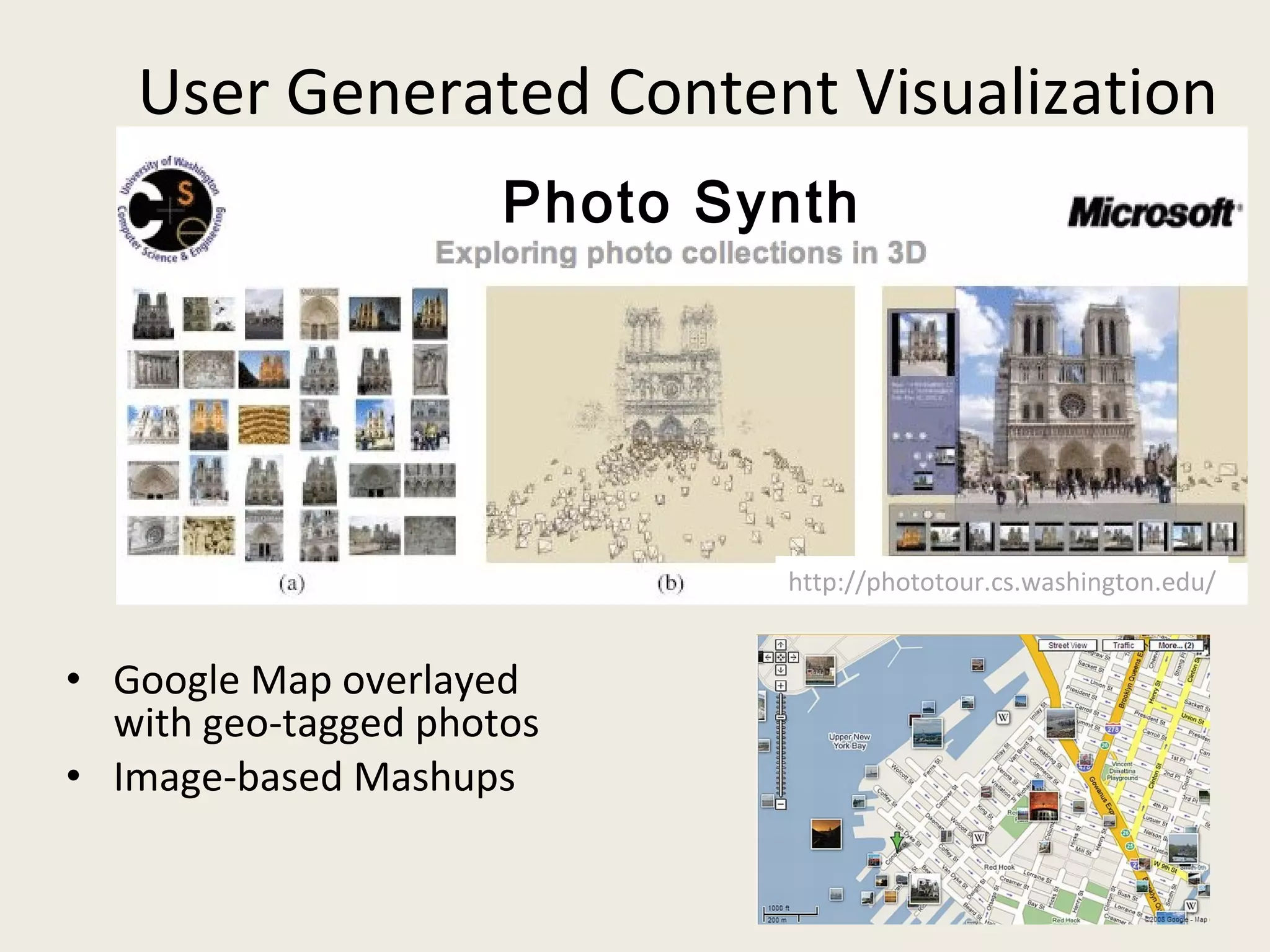
User Generated Content Visualization Google Map overlayed with geo-tagged photos Image-based Mashups http://phototour.cs.washington.edu/ Photo Synth
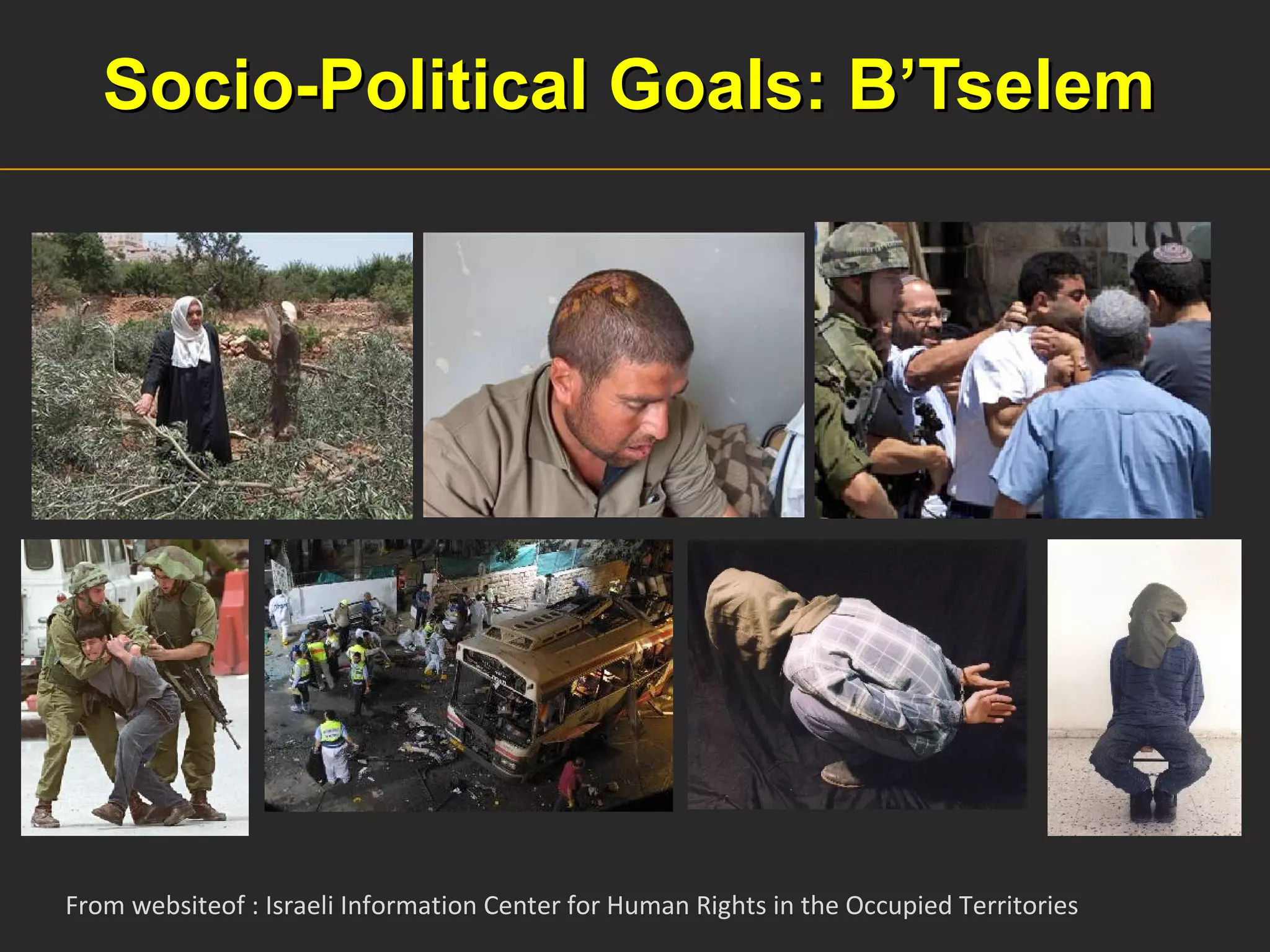
Socio-Political Goals: B’Tselem From websiteof : Israeli Information Center for Human Rights in the Occupied Territories
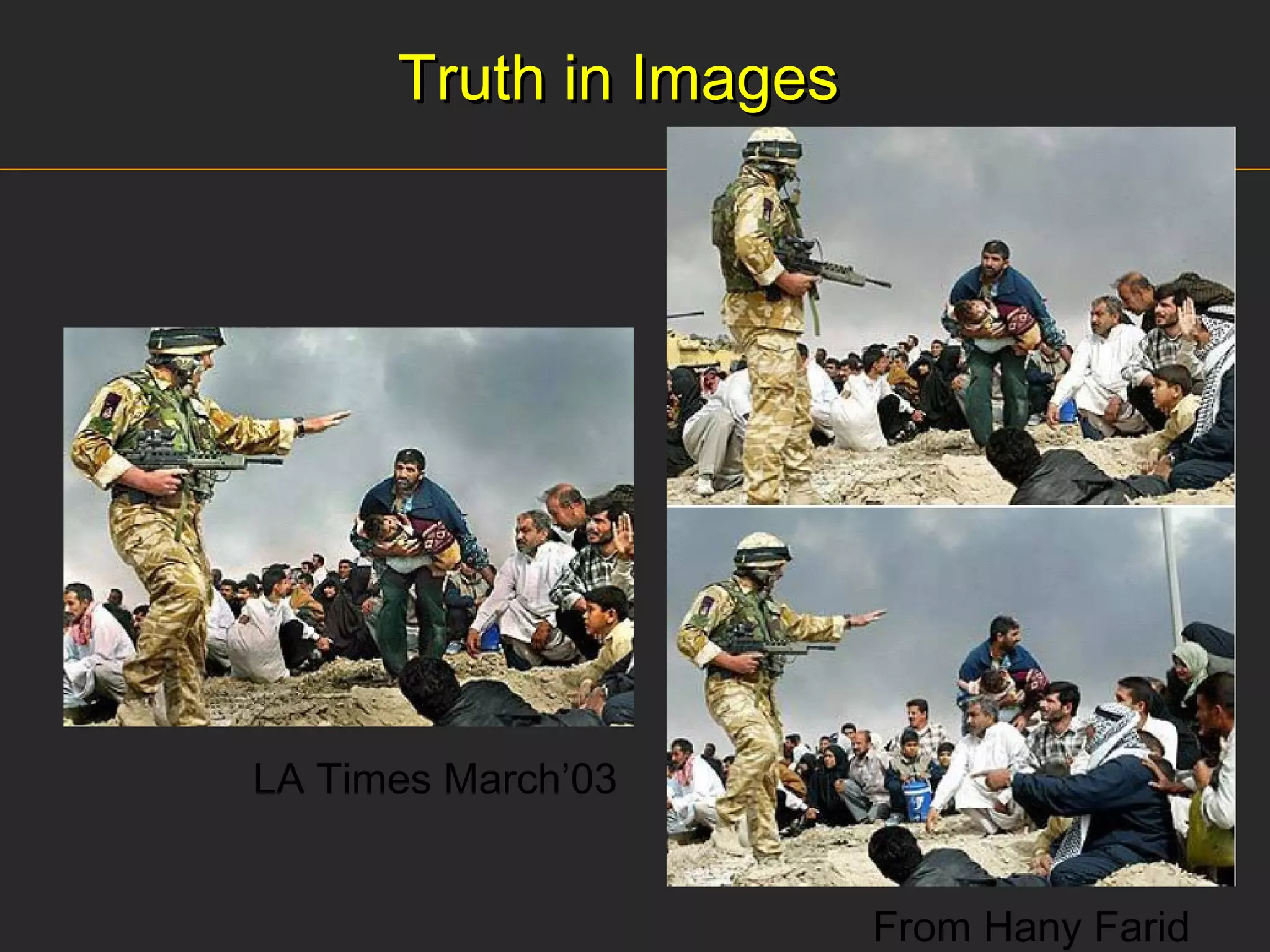
Truth in Images From Hany Farid LA Times March’03
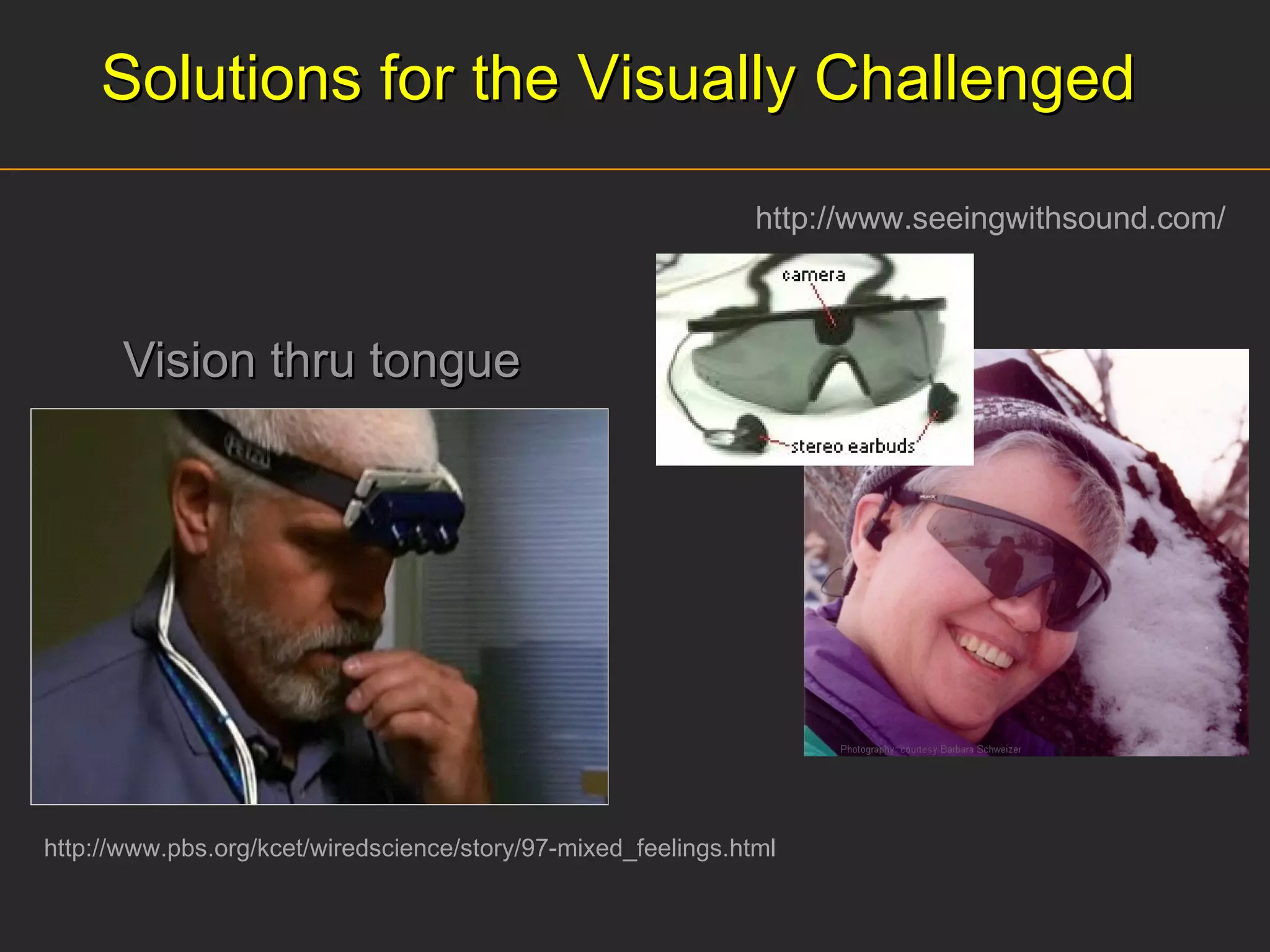
Vision thru tongue http://www.pbs.org/kcet/wiredscience/story/97-mixed_feelings.html Solutions for the Visually Challenged http://www.seeingwithsound.com/
Camera Culture Ramesh  Raskar How will the  next billion cameras  change the social culture ? How can we augment the camera to support best ‘image search’ ? How will camera improve  trust  and  social stability  ? How will movie-making, news reporting change ? Next model for  image-based commerce  ? Visual Social Computing
MIT Media Lab Workshops Session before lunch (12:15 to 1pm): How to Invent? Health, Entertainment and User Interfaces Session after lunch: (by Invitation Only) How to innovate Brainstorming
Camera Culture Ramesh  Raskar Ramesh Raskar Associate Professor, MIT Media Lab http://raskar.info New Emerging Technologies Medical Imaging Entertainment User Interfaces Industrial Vision The impact of  Next Billion Cameras Movie-making, news reporting Social stability Visual Social Computing Image-based commerce Future of Imaging
END Part 1
Start Part 2
Camera Culture Ramesh  Raskar Camera Culture MIT Media Lab http://raskar.info http://cameraculture.info Ramesh Raskar Associate Professor
After  X , what is ne X t How to Invent? Ramesh Raskar, MIT Media Lab
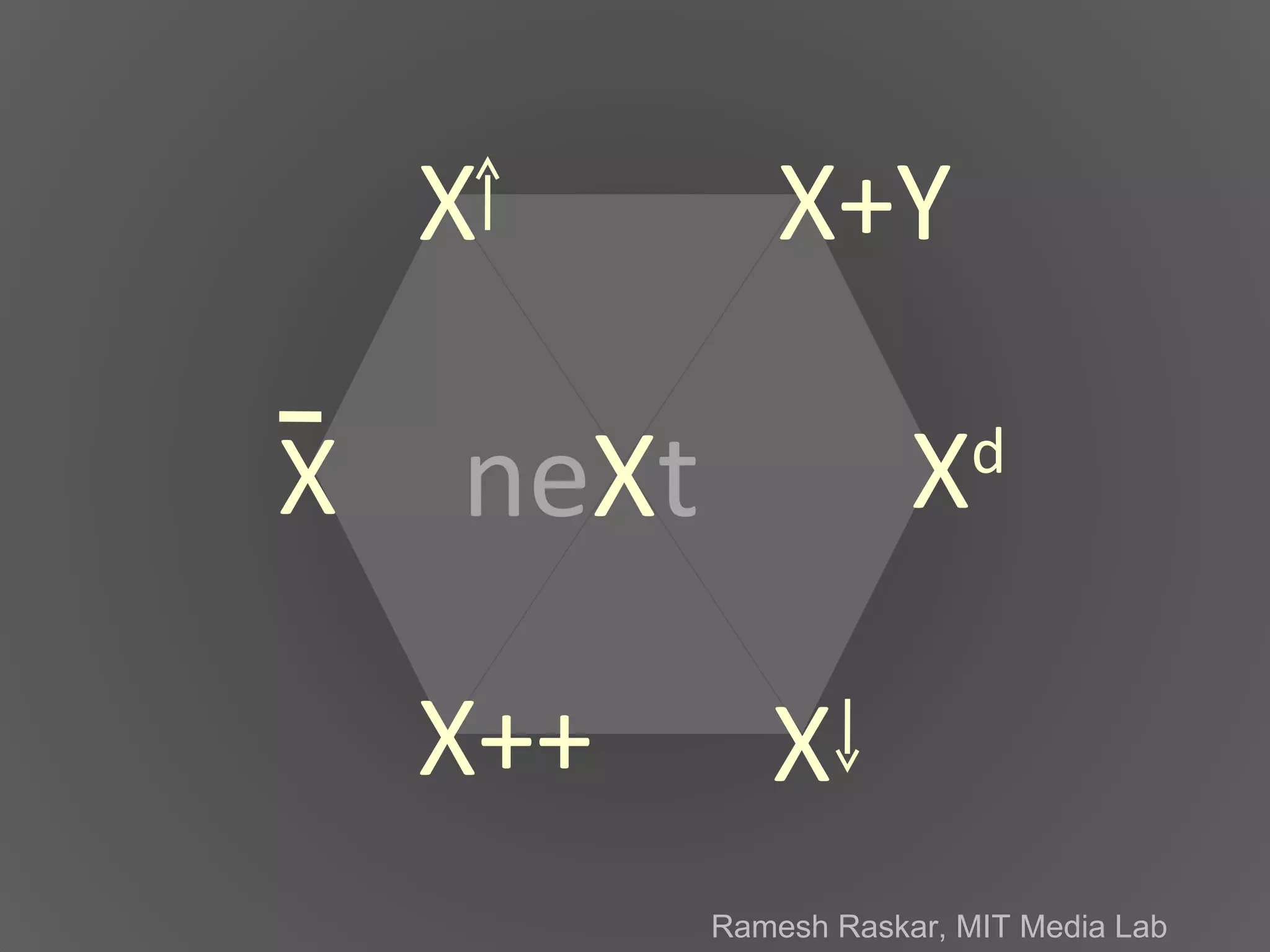
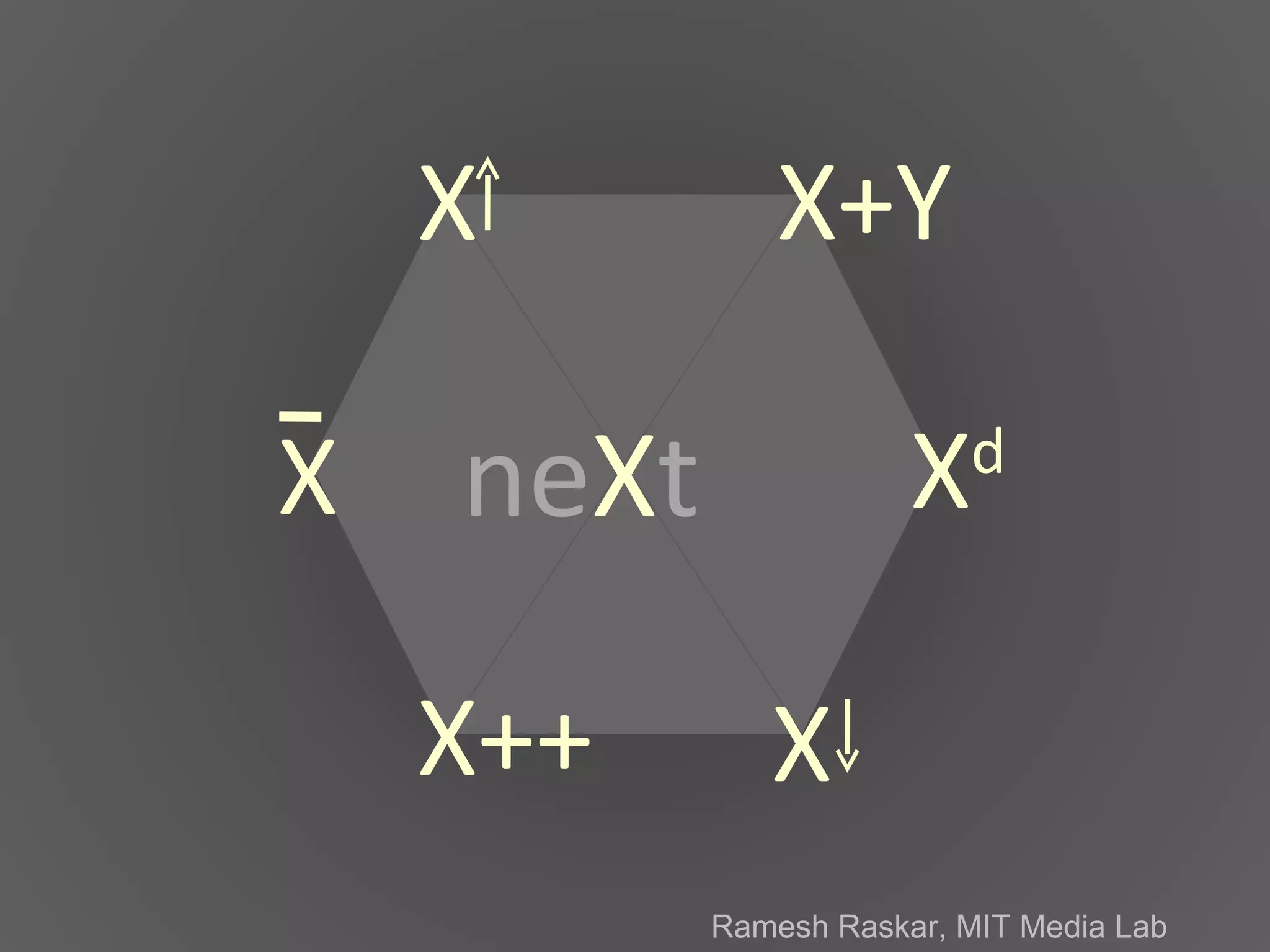
X d X++ X X+Y X X ne X t Ramesh Raskar, MIT Media Lab
Simple Exercise ..  Image Compression Save Bandwidth and storage What is ne X t
Strategy #1:  X d Extend it to next dimension (or some other) dimension Flickr to Youtube Wikipedia to .. ? Text, Audio (Speech), Image, Video .. Whats next ? CD .. Images to infrared, sound, ultrasound Macro scale to microscale Airbag for car to airbag for .. ?
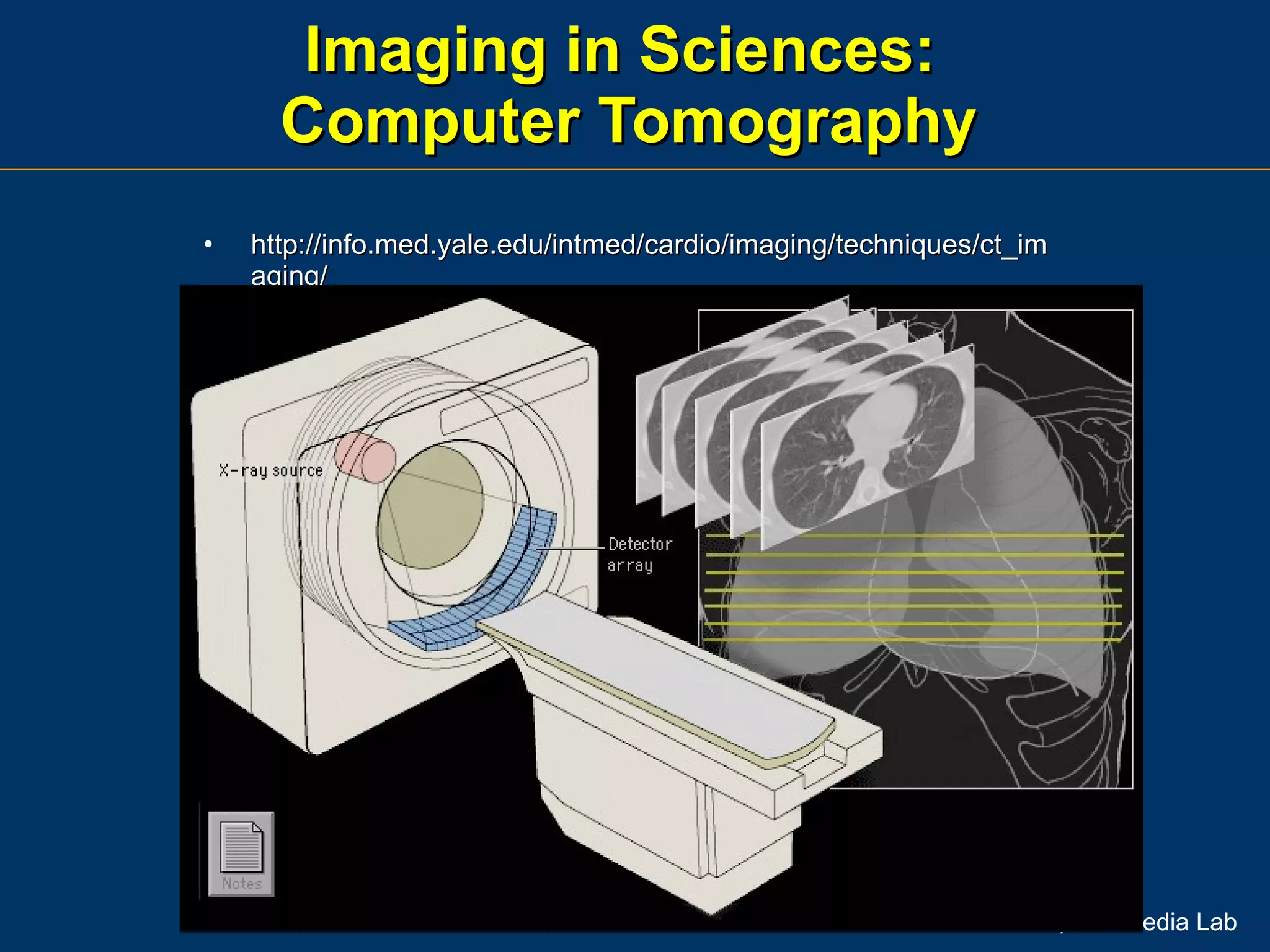
Strategy #2:  X+Y Fusion of the dissimilar More dissimilar, more spectacular the output Example Scientific imaging + Photography Coded aperture Tomography
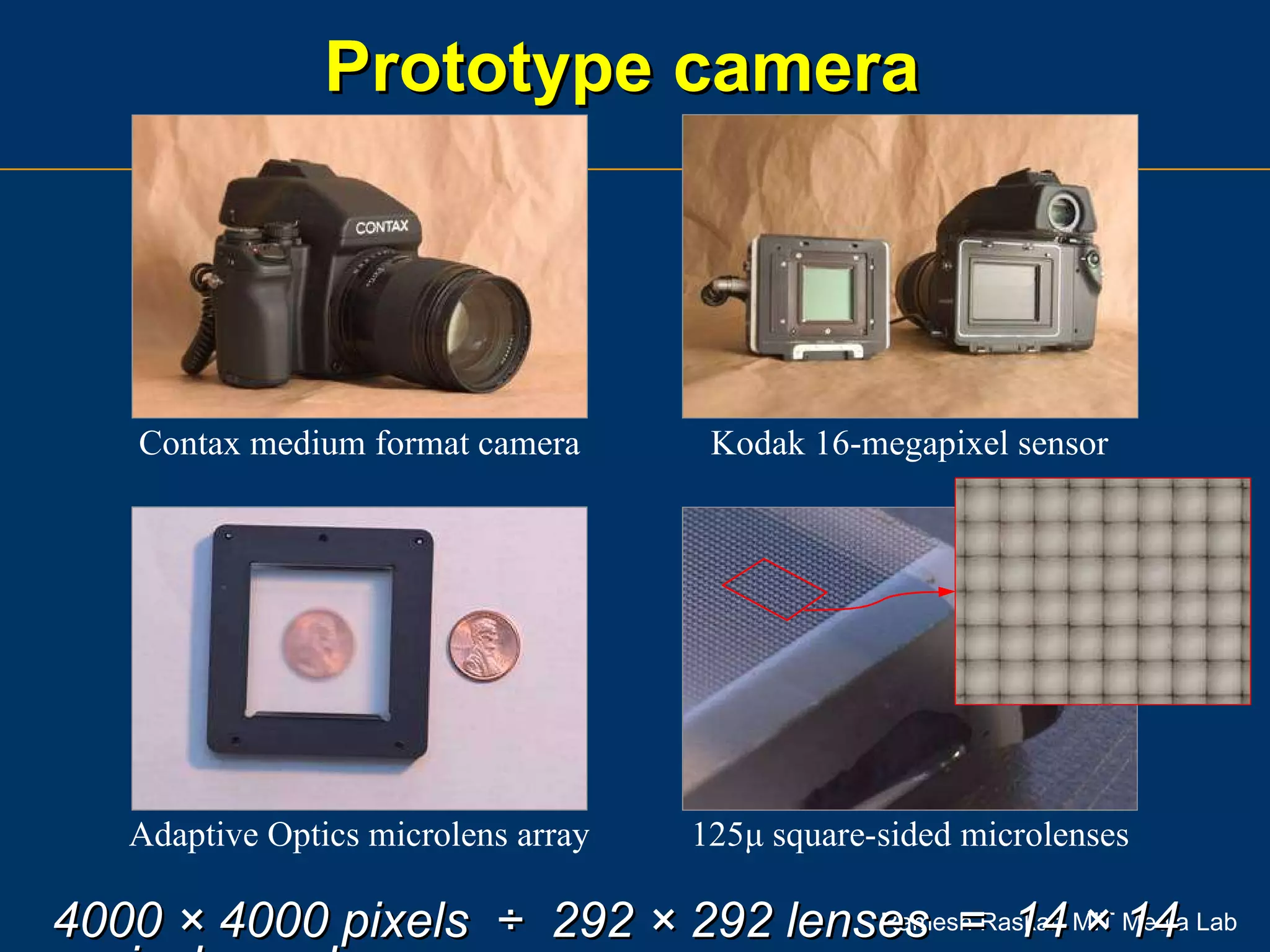
Prototype camera 4000  × 4000 pixels  ÷  292 × 292 lenses  =  14 × 14 pixels per lens Contax medium format camera Kodak 16-megapixel sensor Adaptive Optics microlens array 125 μ  square-sided microlenses
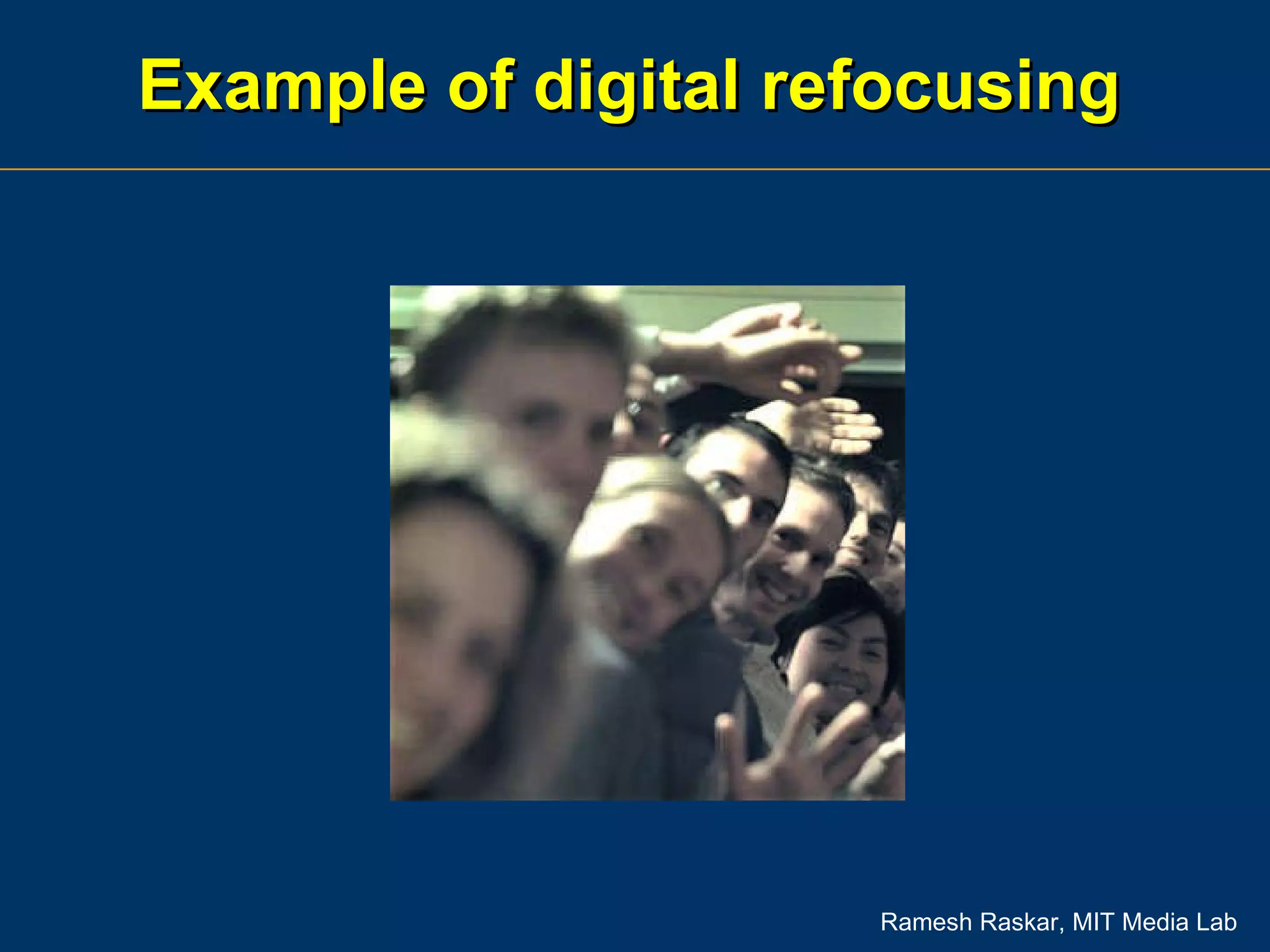
Example of digital refocusing
Imaging in Sciences:  Computer Tomography http://info.med.yale.edu/intmed/cardio/imaging/techniques/ct_imaging/
Self Evaluation of Eye
 
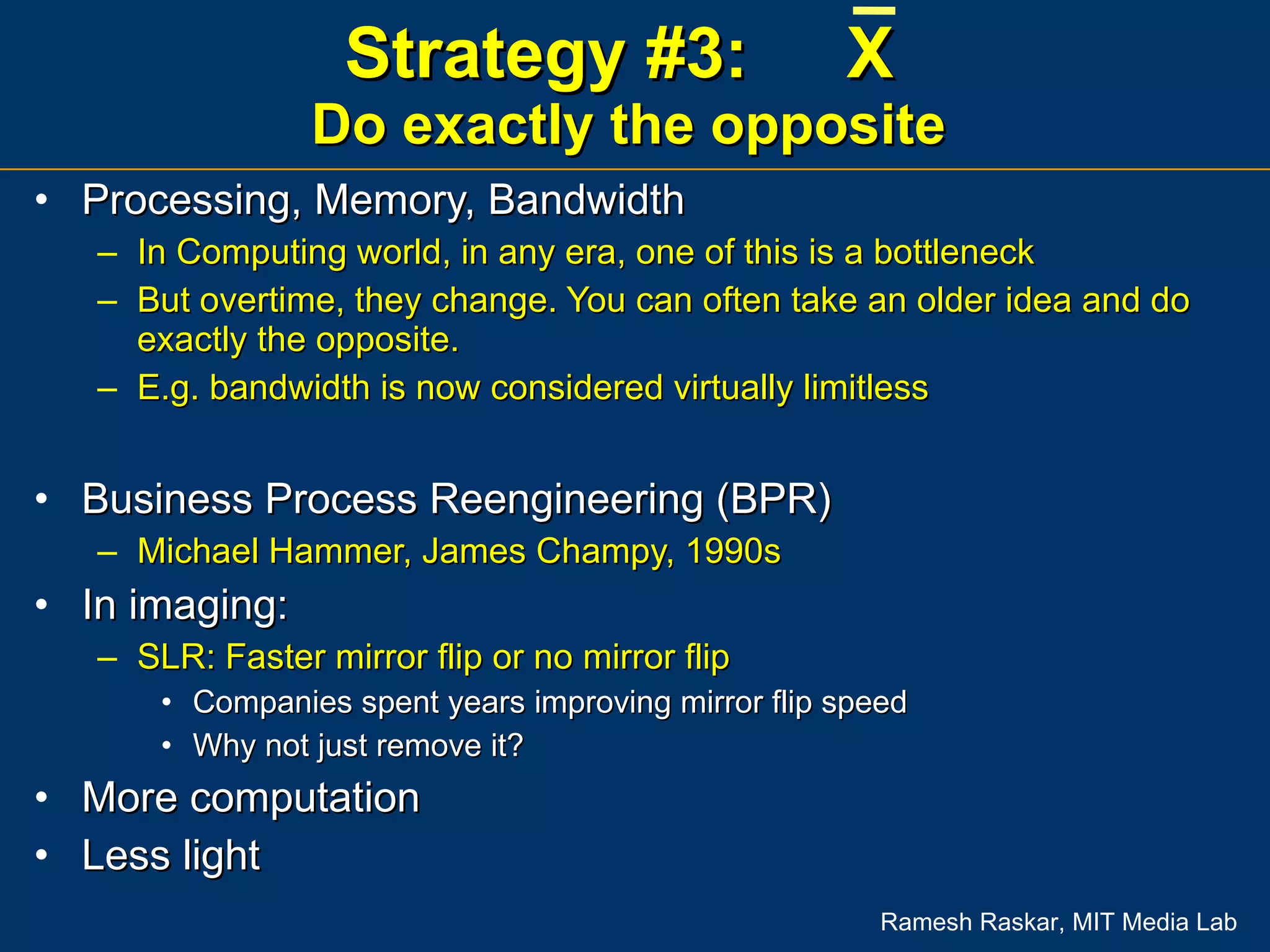
Strategy #3:  X  Do exactly the opposite Processing, Memory, Bandwidth In Computing world, in any era, one of this is a bottleneck But overtime, they change. You can often take an older idea and do exactly the opposite. E.g. bandwidth is now considered virtually limitless Business Process Reengineering (BPR)  Michael Hammer, James Champy, 1990s In imaging: SLR: Faster mirror flip or no mirror flip Companies spent years improving mirror flip speed Why not just remove it? More computation Less light
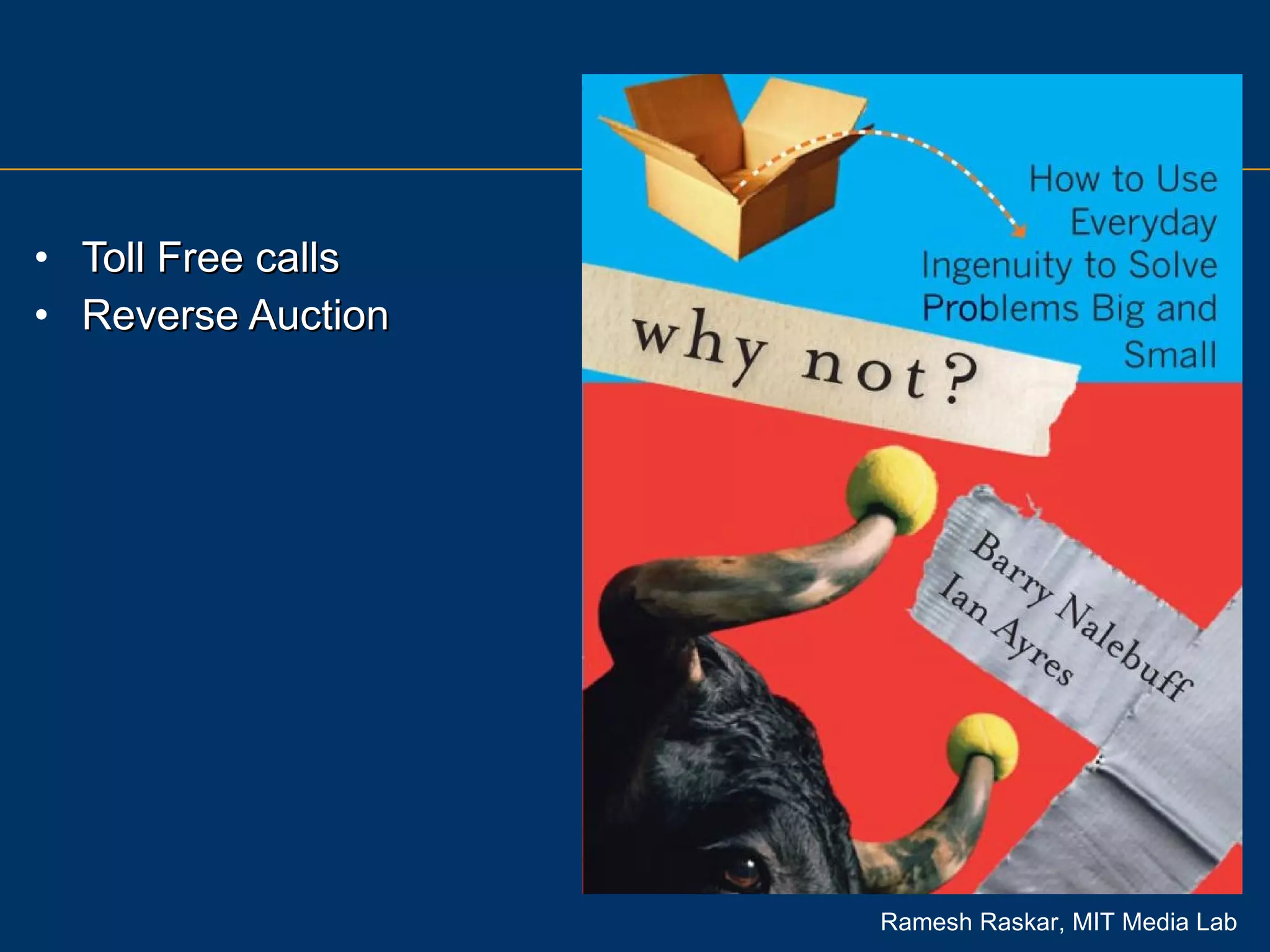
Toll Free calls Reverse Auction
Power of the Processor  Power of the Network Power of People 1985 1995 2005 2015 Powershifts
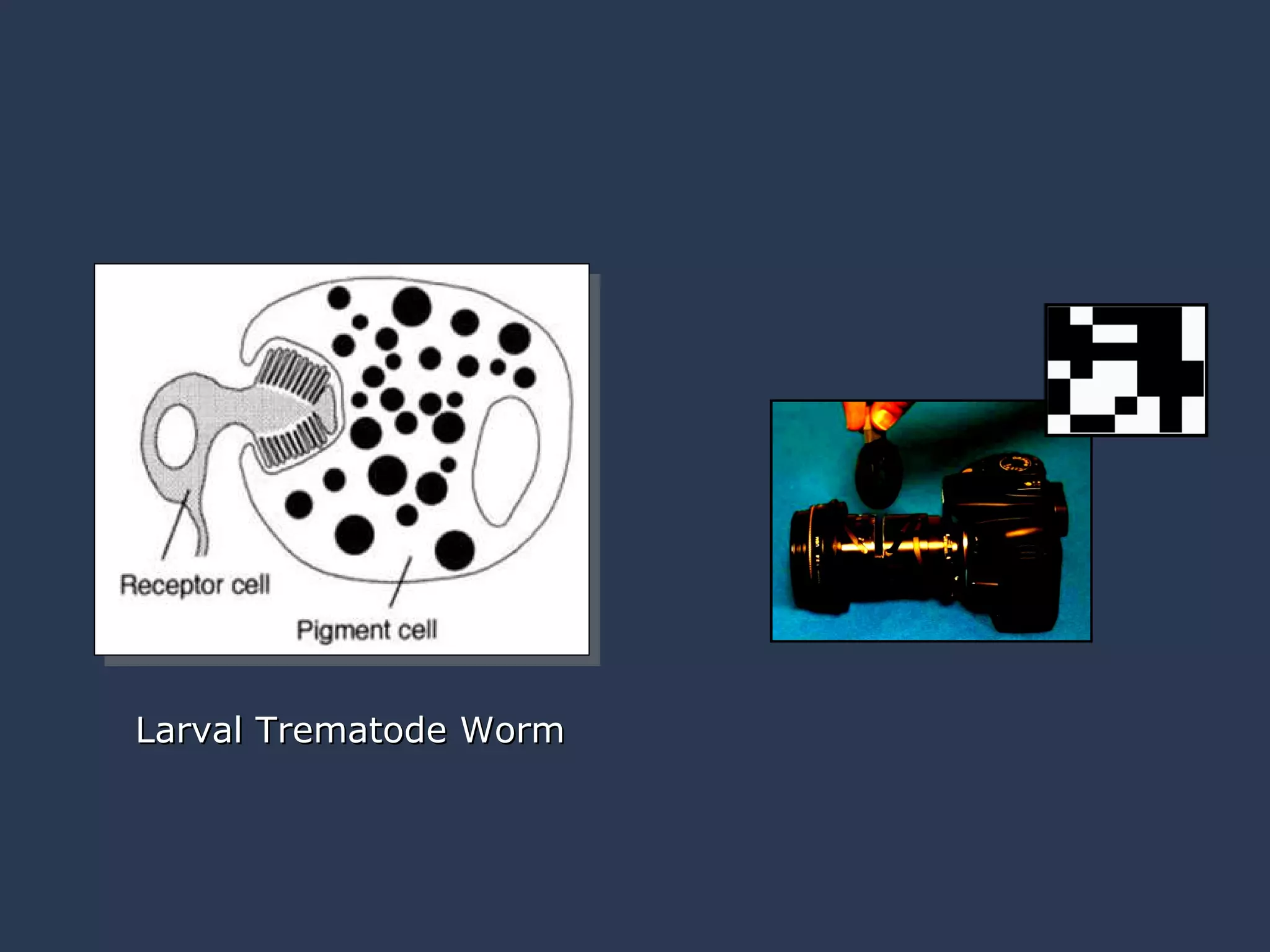
Larval Trematode Worm
Strategy #4:  X  Given a Hammer .. Find all the nails Sometimes even screws and bolts Given a cool solution/technique/Opportunity  Find other problems (Where to find them?) Examples Peltier effect:  Create a jacket that keeps you warm or cold Mobile phone opportunity
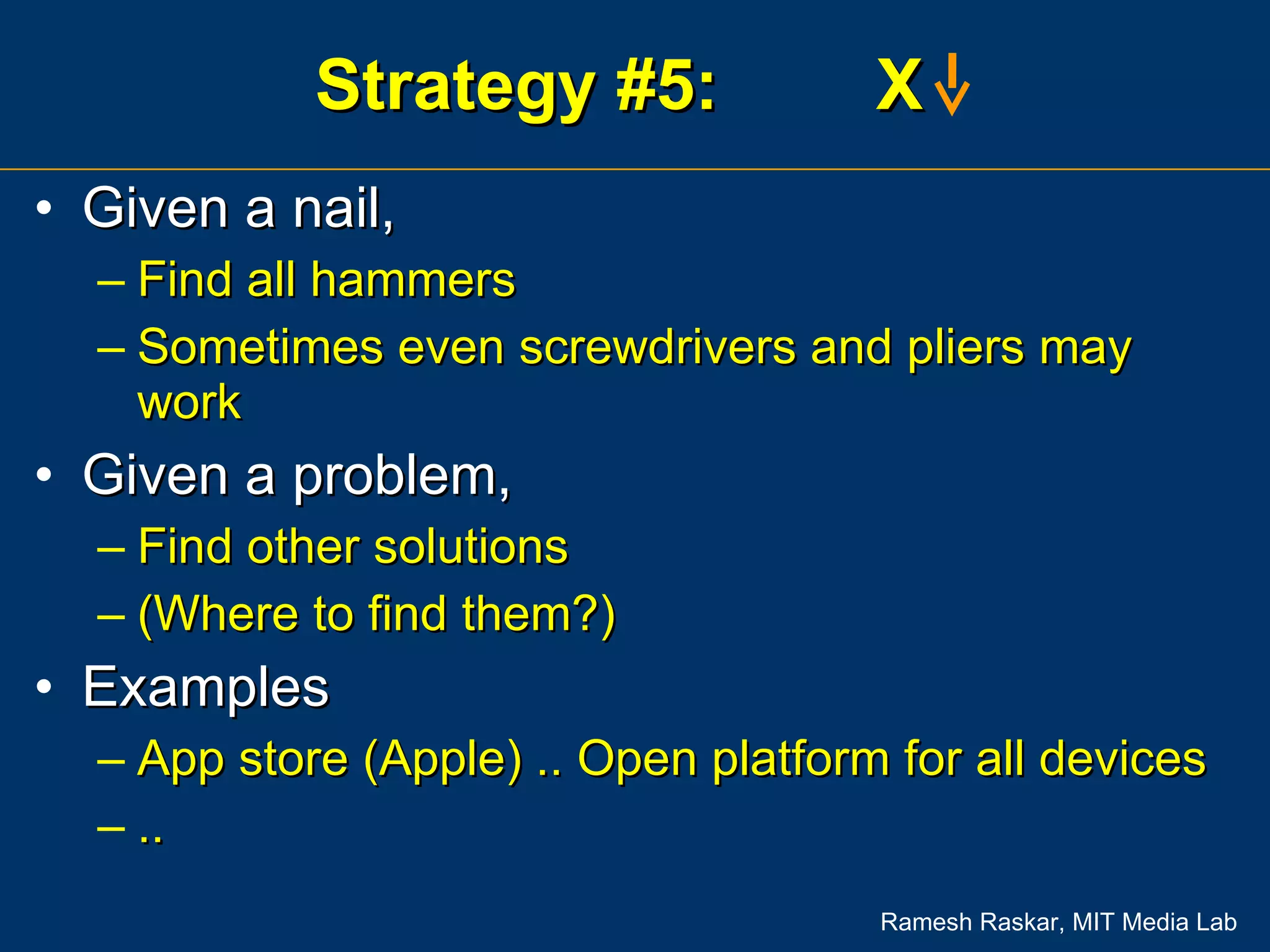
Strategy #5:  X  Given a nail,  Find all hammers Sometimes even screwdrivers and pliers may work Given a problem,  Find other solutions (Where to find them?) Examples App store (Apple) .. Open platform for all devices ..
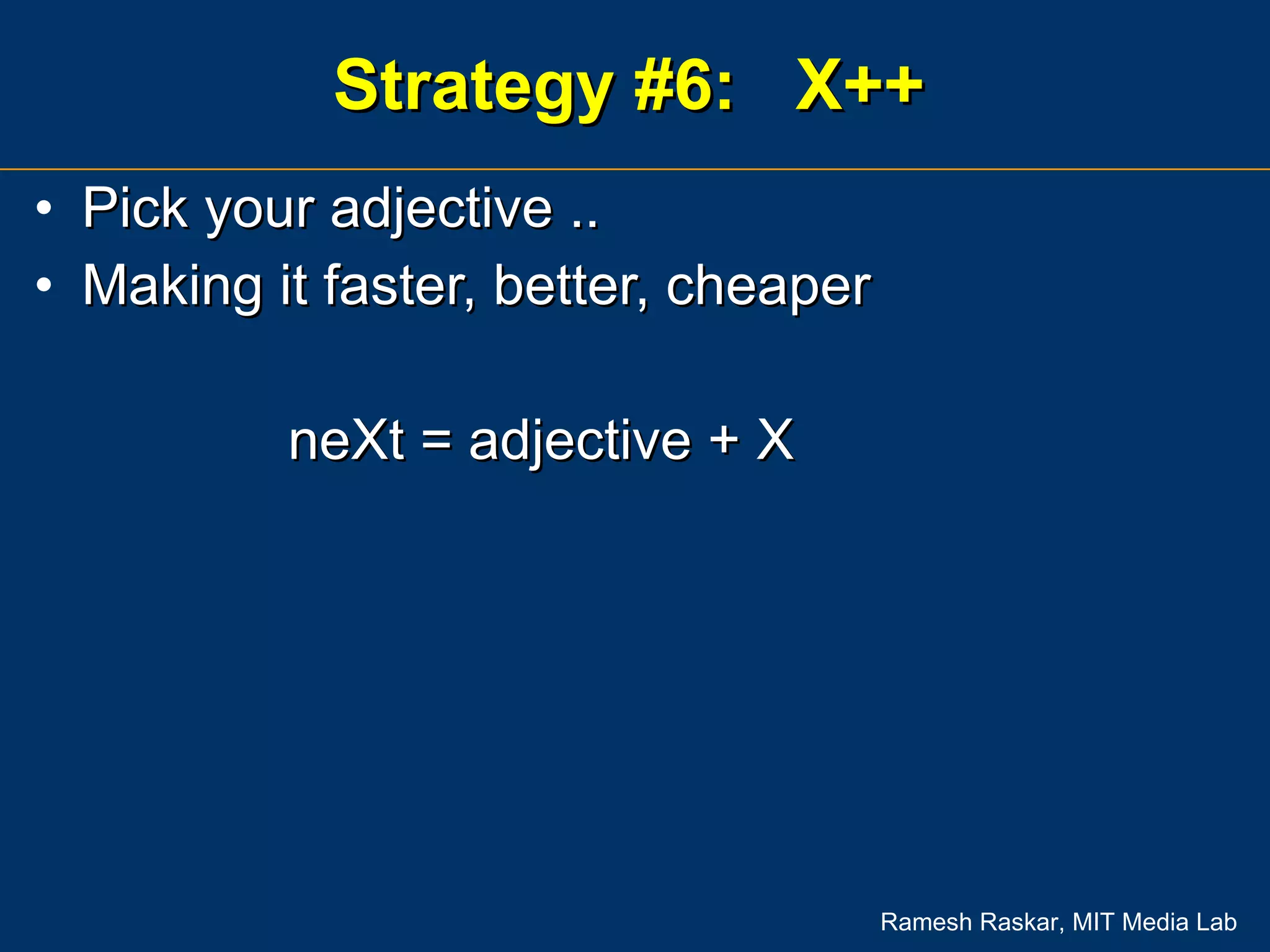
Strategy #6:  X++ Pick your adjective .. Making it faster, better, cheaper neXt = adjective + X
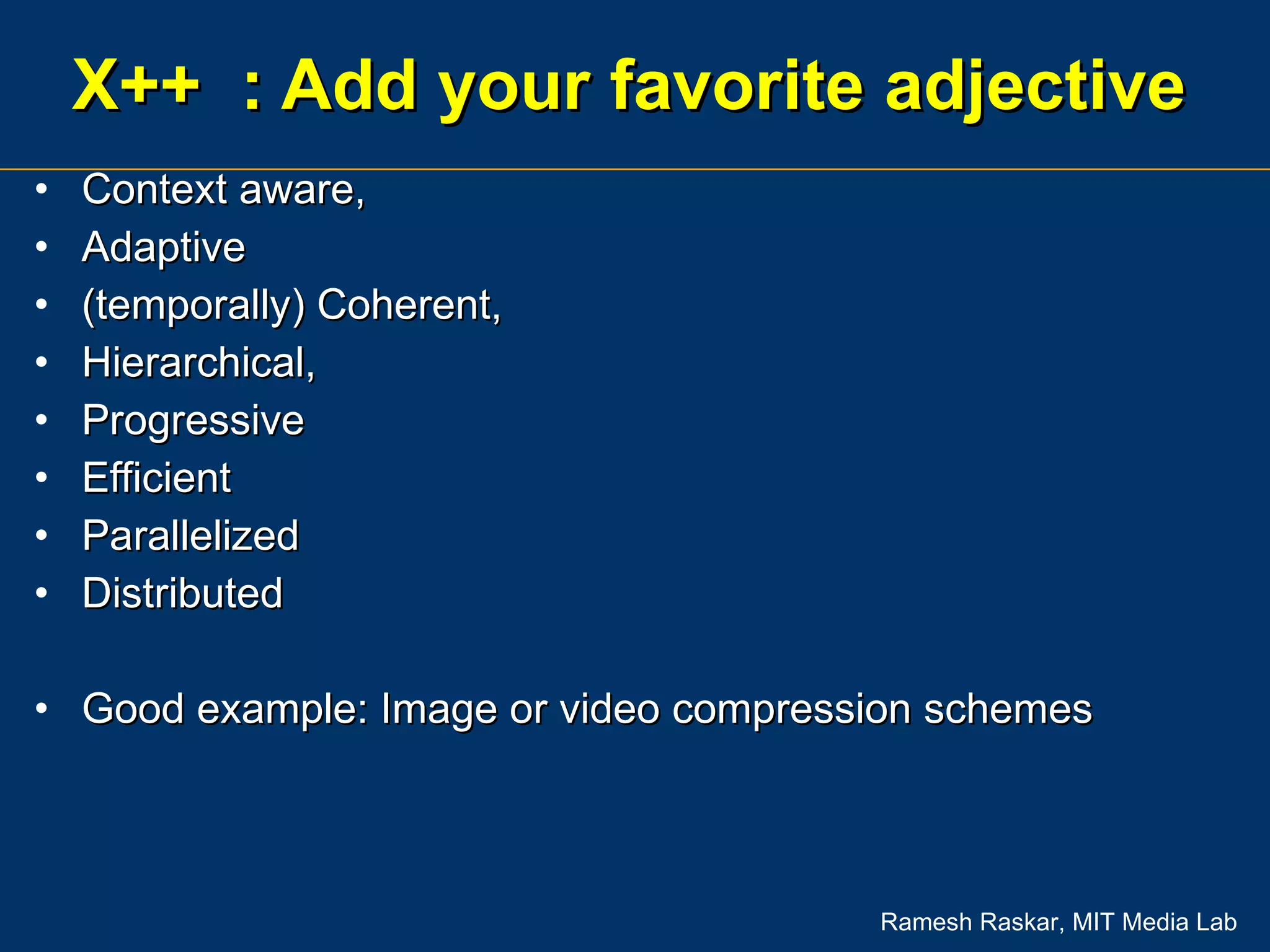
X++  : Add your favorite adjective Context aware,  Adaptive (temporally) Coherent,  Hierarchical,  Progressive Efficient Parallelized Distributed Good example: Image or video compression schemes
X++  : Add your favorite adjective Good example: Image or video compression schemes But X++ is a sign The field is maturing in terms of research but booming in business impact Kaizen Small incremental changes Japanese Management styles (6sigma, Kanban) Mainly to save money/time/resources. Not everyone can do it. GM, 0.84 suggestions per employee vs Toyota 18. GM accepted 23%, Toyota 90%
Hexagon Corners for Different Stages [Bruce Tuckman, 1965] Forming Storming Norming Performing Adjourning
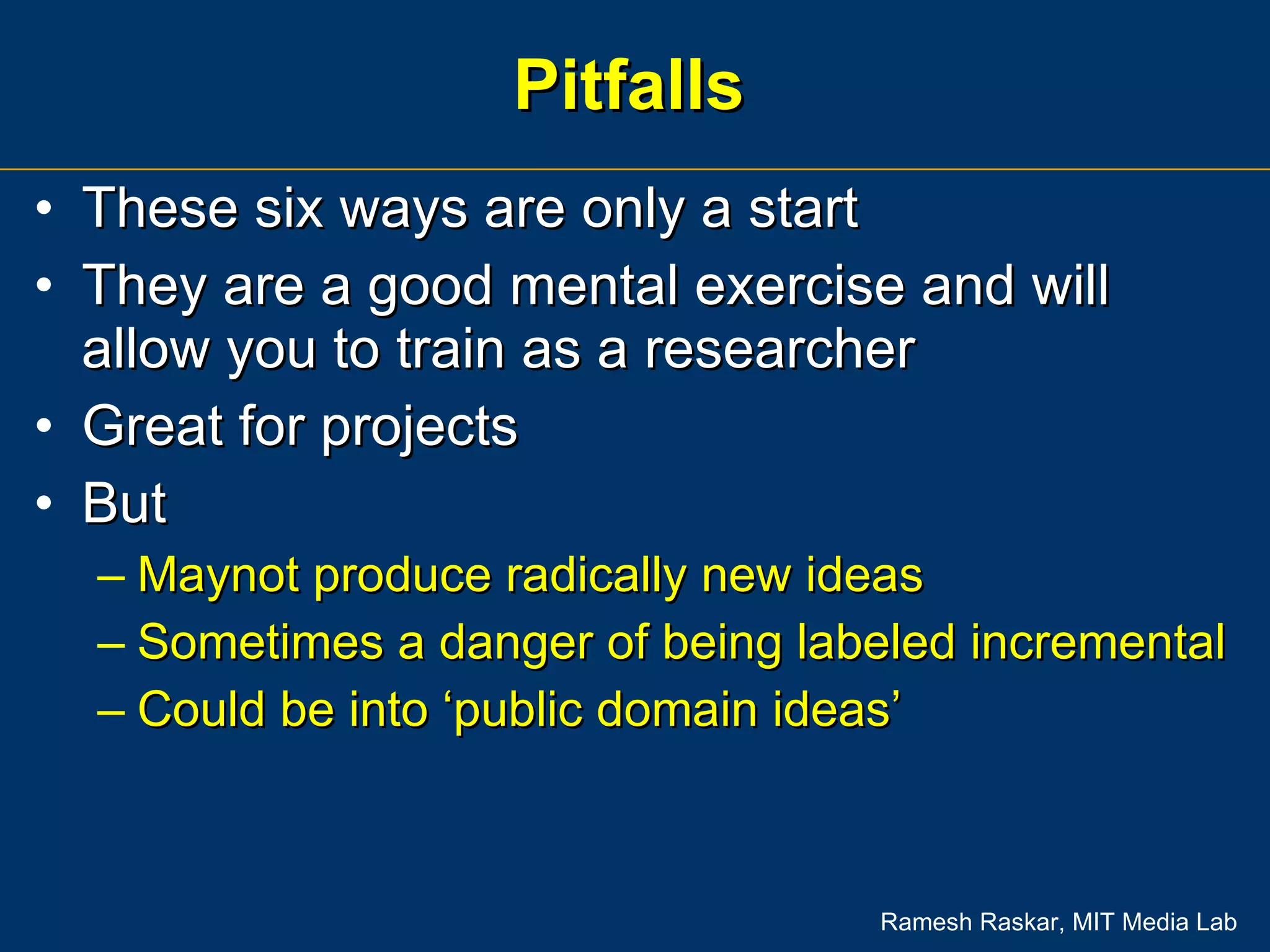
Pitfalls These six ways are only a start  They are a good mental exercise and will allow you to train as a researcher Great for projects But  Maynot produce radically new ideas Sometimes a danger of being labeled incremental Could be into ‘public domain ideas’
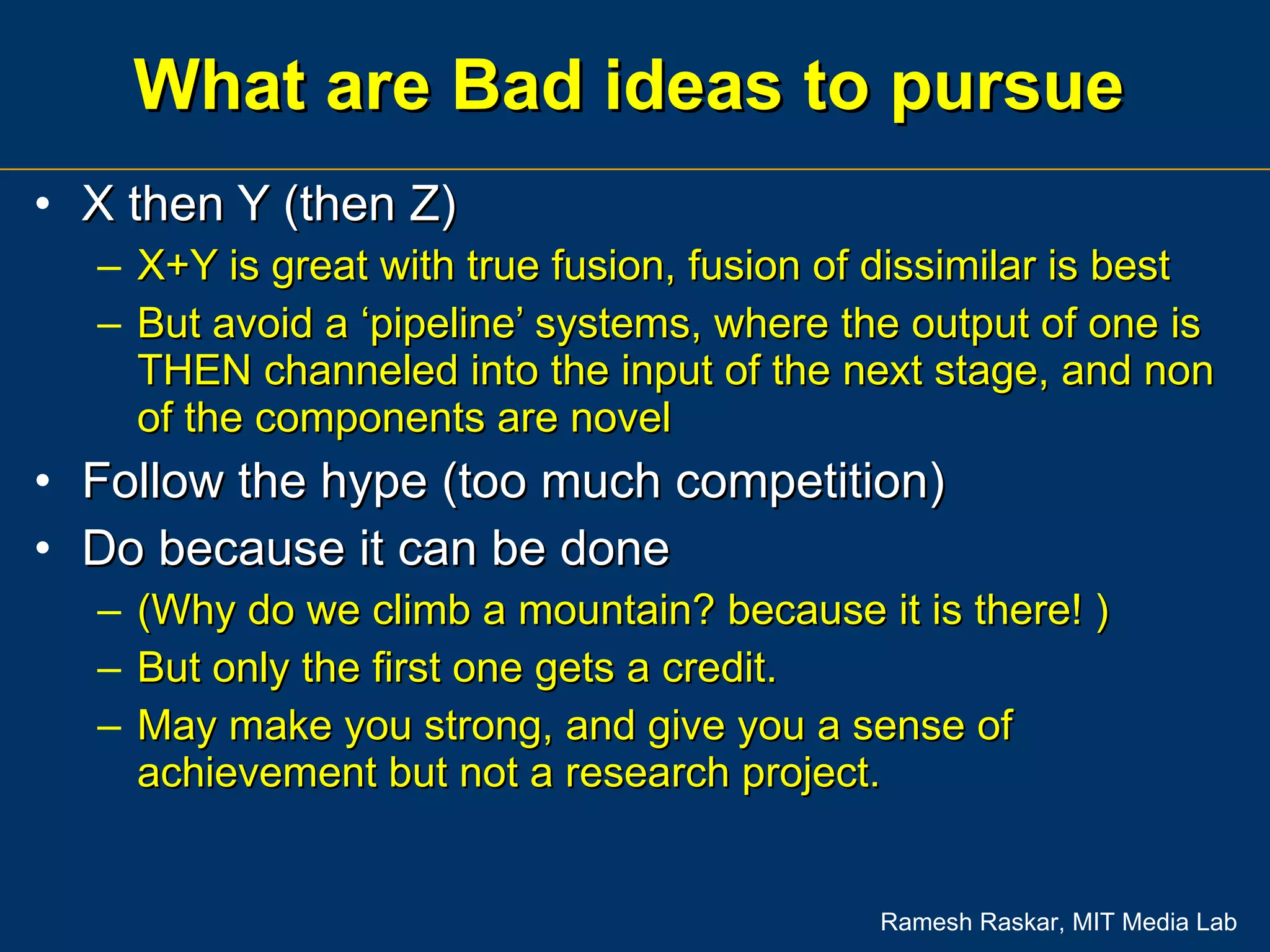
What are Bad ideas to pursue X then Y (then Z) X+Y is great with true fusion, fusion of dissimilar is best But avoid a ‘pipeline’ systems, where the output of one is THEN channeled into the input of the next stage, and non of the components are novel Follow the hype (too much competition)  Do because it can be done  (Why do we climb a mountain? because it is there! ) But only the first one gets a credit.  May make you strong, and give you a sense of achievement but not a research project.
X d X++ X X+Y X X ne X t Ramesh Raskar, MIT Media Lab
End Part 2
Camera Culture Ramesh  Raskar Camera Culture MIT Media Lab http://raskar.info http://cameraculture.info
Extra Slides
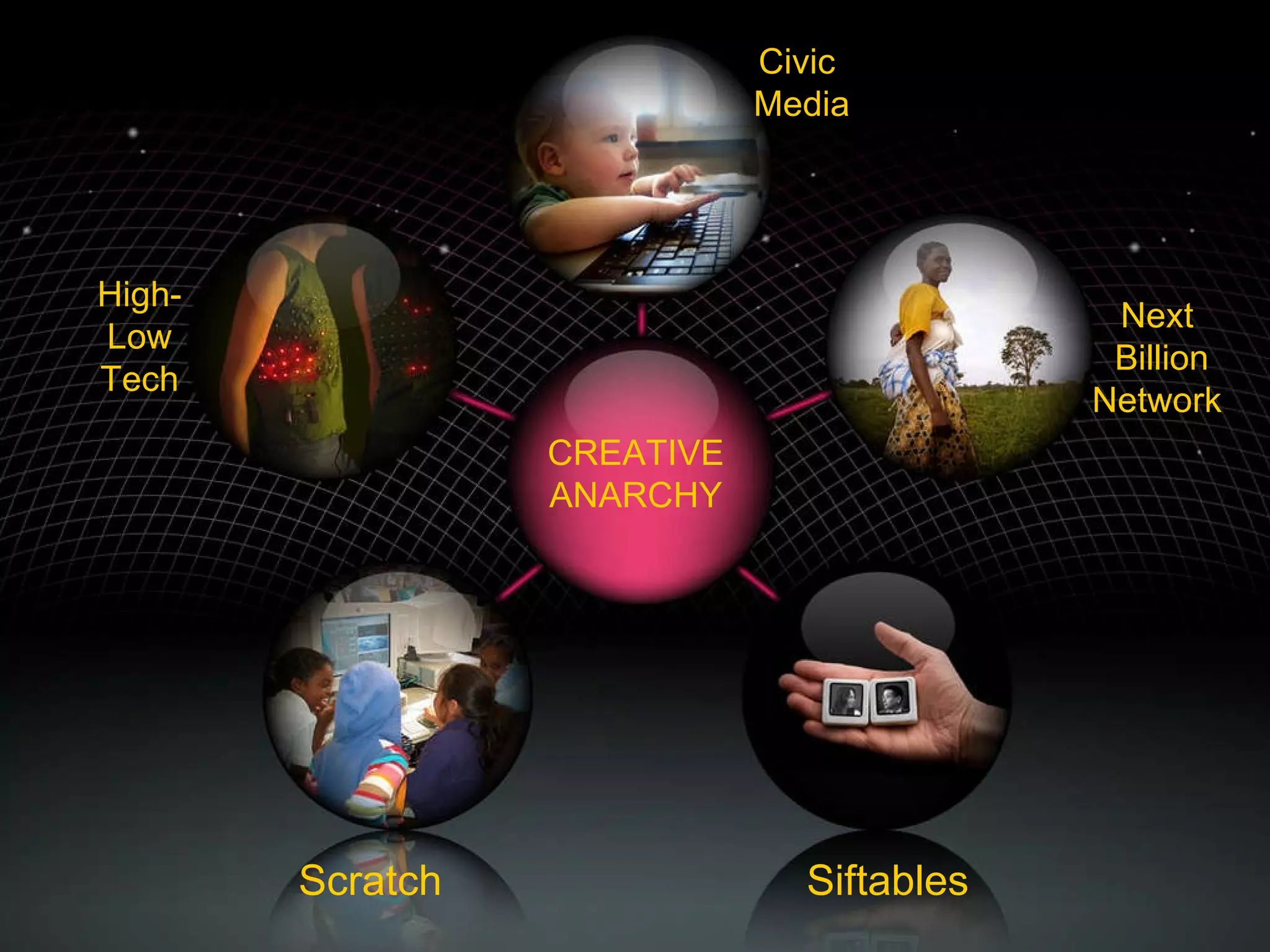
CREATIVITY Civic  Media Next Billion Network Siftables Scratch Hyper -  Creativity High- Low Tech CREATIVE ANARCHY Civic  Media Next Billion Network Siftables Scratch High- Low Tech
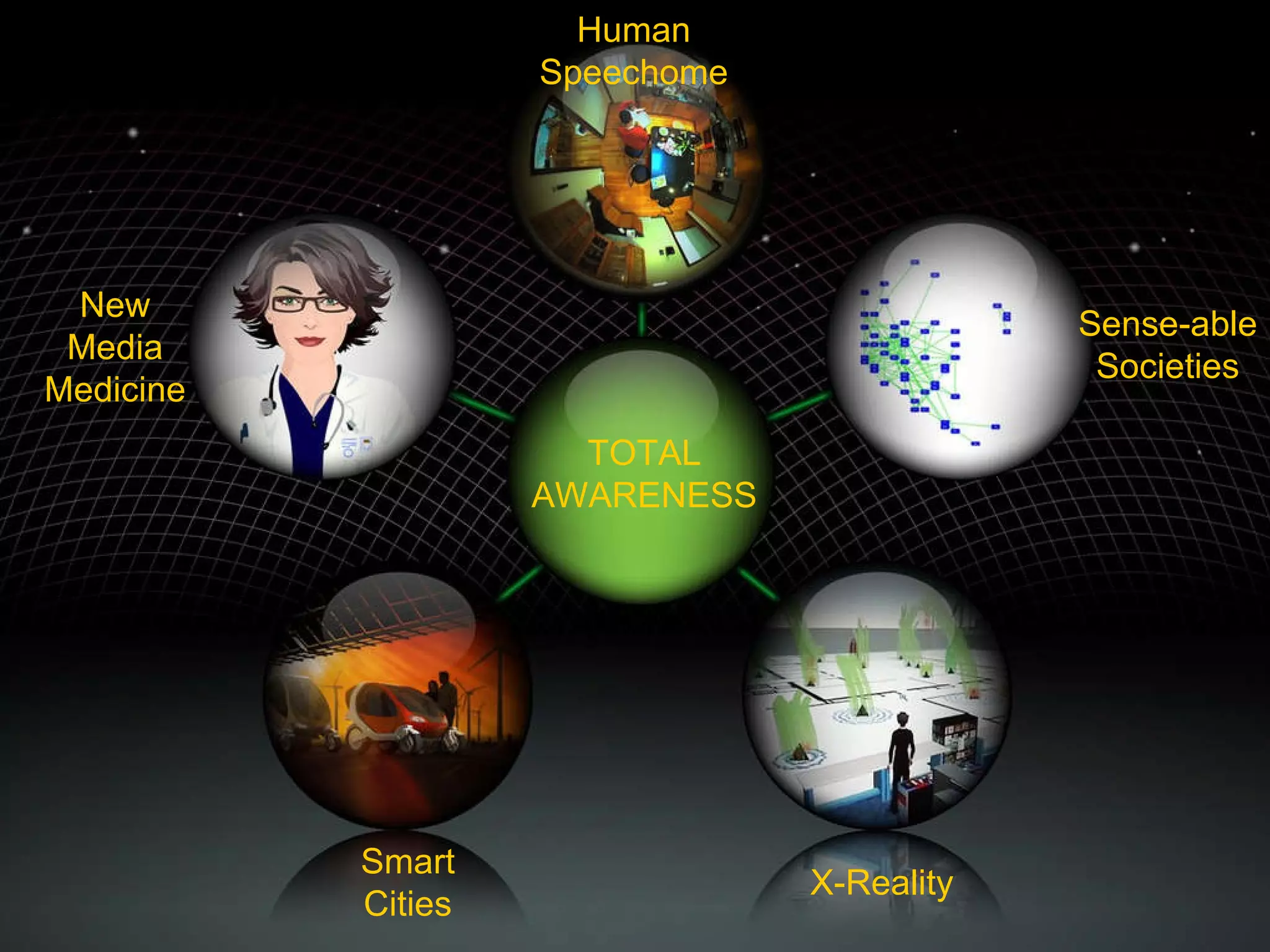
AWARENESS New Media Medicine Smart Cities Sense-able Societies Hyper- Awareness Human Speechome X-Reality TOTAL AWARENESS Human Speechome Sense-able Societies X-Reality Smart Cities New Media Medicine
Today a billion plus people enjoy the benefits of a  digital lifestyle BUT The  deep impact  of technology on individuals, society and business lies just ahead.  Frank Moss, MIT Media Lab
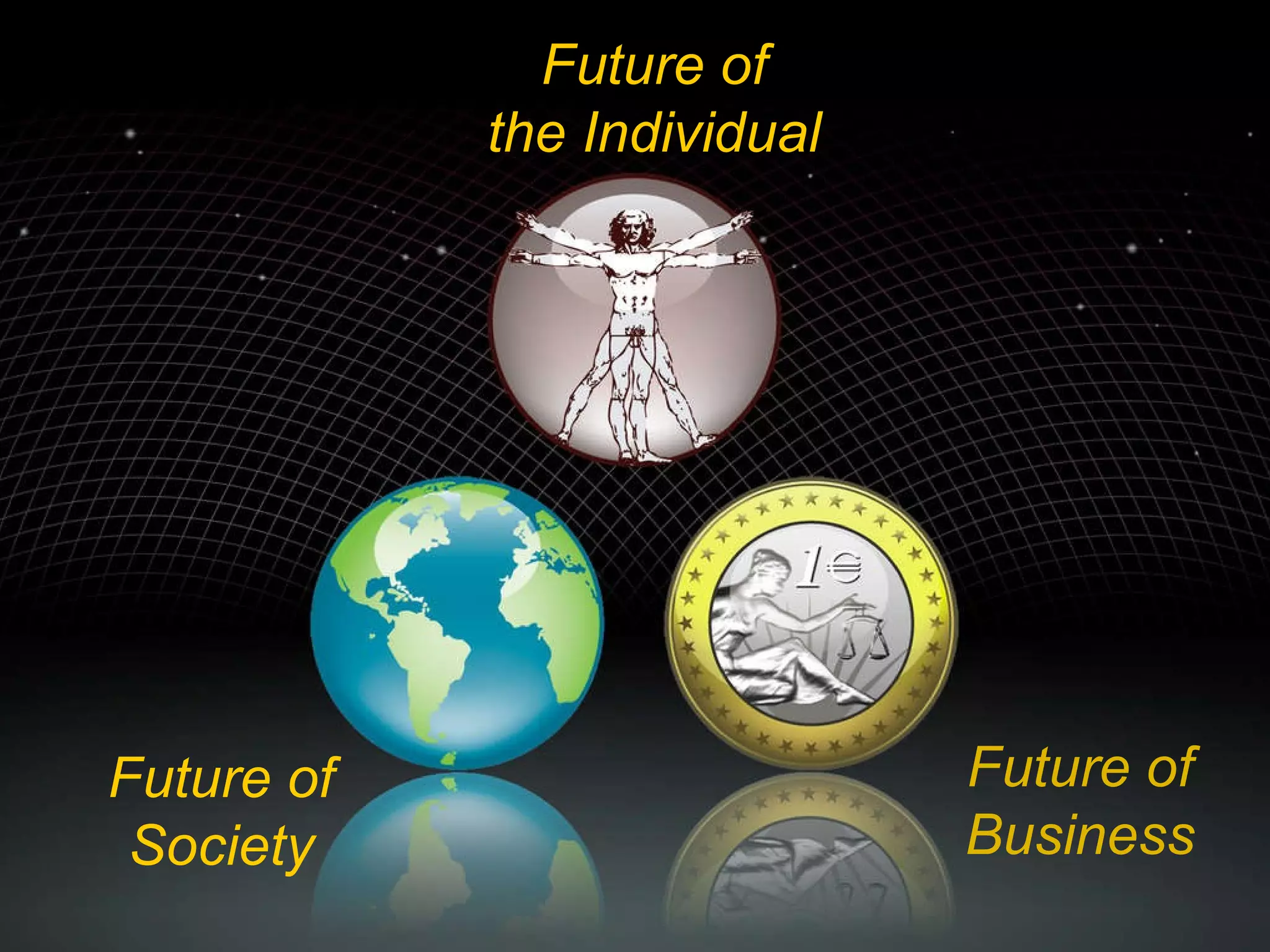
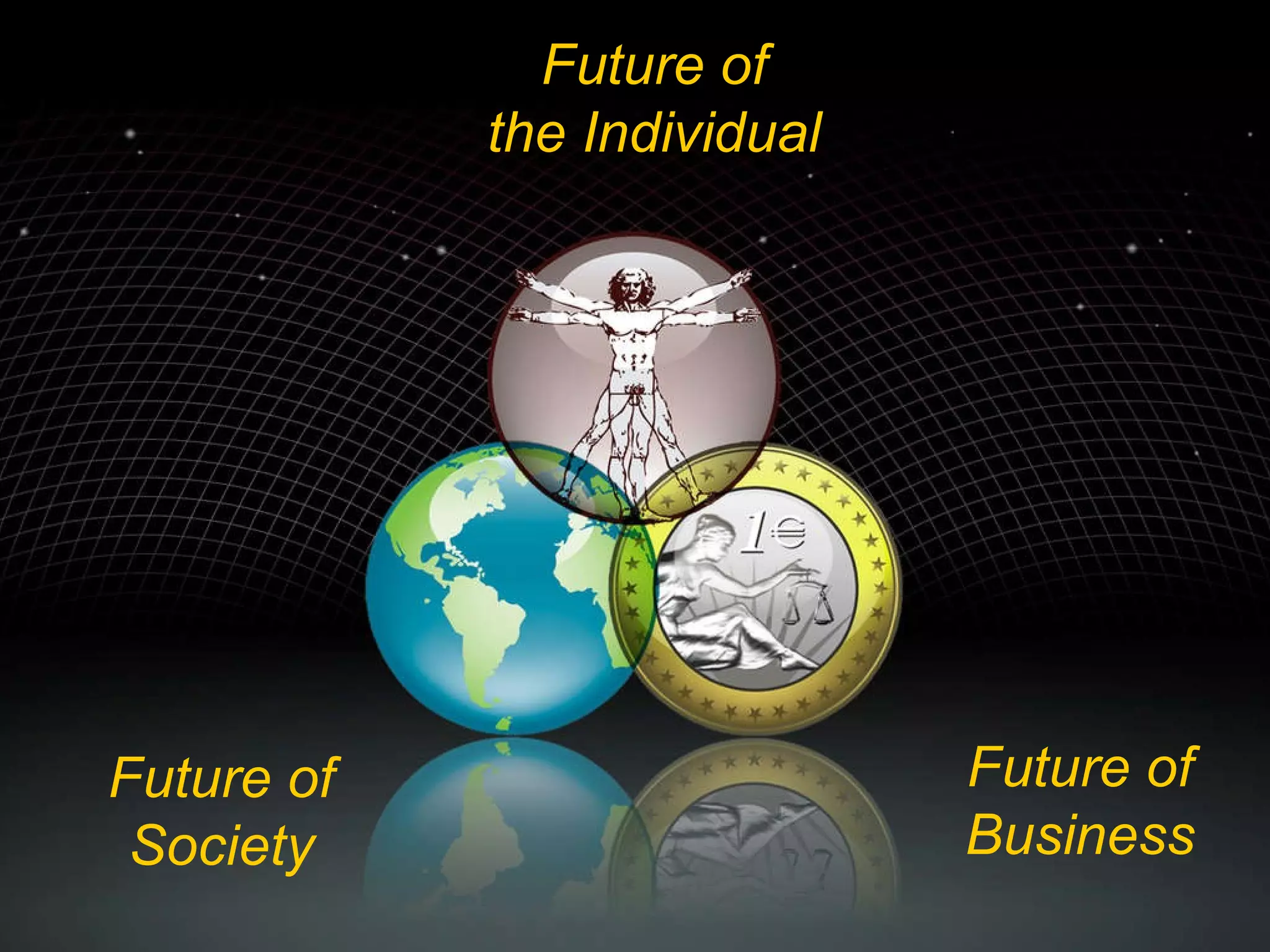
Future of the Individual Future of Society Future of Business

Raskar Emtech2010 Mar Final

  • 1.
    Camera Culture Ramesh Raskar Camera Culture MIT Media Lab http://raskar.info http://cameraculture.info Ramesh Raskar Associate Professor Future of Imaging
  • 2.
    Film-like DigitalPhotography
  • 3.
  • 4.
    Cameras Phones areEverywhere Kush R. Varshney, “ Jagannath Temple ,” Puri, Orissa, India, Dec. 2007.
  • 5.
    Wish List TodayConsumers Super-human vision Microscope like resolution High speed (burst, video, no blur) See inside the body (health) Auto-trigger Battery life Zero start or shutter delay Keep only ‘good’ pics Find ‘relevant’ pics and better archiving/access Put photographer back in photo! Companies Cost Resolution Low-light sensitivity, HDR ( For cameraphone ) Size and depth Stereo and 3D Mecha-free zoom/focus Auto-tagging for sharing Recognition
  • 6.
    Computational Photography ComputationalIllumination Computational Camera Scene : 8D Ray Modulator Display Generalized Sensor Generalized Optics Processing Ray Bender Ray Sampler Ray Reconstruction Generalized Optics Recreate 4D Lightfield Light Sources Modulators 4D Incident Lighting 4D Light Field
  • 7.
    Can you lookaround a corner ?
  • 8.
  • 9.
    Convert LCD intoa big flat camera ?
  • 10.
  • 11.
    Fernald, Science[Sept 2006] Shadow Refractive Reflective
  • 12.
    Mimicking the HumanEye Lens Detector Pixels Image Slide by Shree Nayar Reproduce for the eye
  • 13.
    Where are the‘camera’s?
  • 14.
    Where are the‘camera’s?
  • 15.
    We focus oncreating tools to better capture and share visual information via a new class of imaging platforms Ramesh Raskar Ramesh Raskar http://raskar.info
  • 16.
    What is theMedia Lab? A Graduate Program in the Media Arts & Sciences Houses ~150 students and 30 PIs A Research Lab that spans across disciplines and academic/ industrial lines 65 sponsor companies Sponsors get free, non-exclusive licenses for ML IP Founded in 1985 by Nicholas Negroponte and Jerome Wiesner
  • 17.
    Media Lab VisionBiomechatronics Neuroengineering Smart Fabrics Rethinking Cameras Human 2.0 Multimedia Ubiquitous Computing Social Media Computer Vision Sensor Networks Software Agents Bits Atoms People 1990s Body Brain Technology 2007+ Publishing Broadcast Computer 1980s
  • 18.
    Close Ties WithIndustry 03/08/10 R E S E A R C H S T R A T E G Y Our 65 corporate sponsors include some of the most creative companies in the world
  • 19.
    Center for FutureStorytelling Launched with 7-year, $25M funding with Plymouth Rock Studios Opportunities for participation by other organizations Satellite lab facility to open at Plymouth Rock in 2010 3 Co-Directors Michael Bove (Object Based Mediaand Displays) Cynthia Breazeal (Sociable Robots) Ramesh Raskar (Cameras, Performance Capture) + Technical/Creative Advisor (Glorianna Davenport) Making stories more interactive, improvisational, social Managing the tension between the “master storyteller” and a dynamic, pervasive viewing/listening environment Developing new production, distribution, and display technologies MIT Media Laboratory
  • 20.
    Smart Cities Whatif cars could stack like shopping carts in cities? Ryan Chin and Bill Mitchell
  • 21.
    ADAPTABILTIY Hyper - Adaptability Bio- Mechatronics Music/Mind/ Health People - Sense Sociable Robots Neuro- Media HUMAN ADAPTABILITY Bio- Mechatronics Neuro- Media Sociable Robots People - Sense Music/Mind/ Health
  • 22.
    Camera Culture Ramesh Raskar Ramesh Raskar Associate Professor, MIT Media Lab http://raskar.info New Emerging Technologies Medical Imaging Entertainment User Interfaces Industrial Vision The impact of Next Billion Cameras Movie-making, news reporting Social stability Visual Social Computing Image-based commerce Future of Imaging
  • 23.
    Medical Imaging Today.. http://info.med.yale.edu/intmed/cardio/imaging/techniques/ct_imaging/
  • 24.
  • 25.
  • 26.
  • 27.
  • 28.
  • 29.
  • 30.
    What are theproblems with ‘real’ photo in conveying information ? Why do we hire artists to draw what can be photographed ?
  • 31.
    Shadows Clutter ManyColors Highlight Shape Edges Mark moving parts Basic colors
  • 32.
  • 33.
  • 34.
  • 35.
  • 36.
  • 37.
    Canny Intensity Edge Detection Our Method Photo Result
  • 38.
  • 39.
    Convert LCD intoa big flat camera ? Beyond Multi-touch: 3D Gestures
  • 40.
    Large Virtual Camerafor 3D Interactive HCI and Video Conferencing Matthew Hirsch, Henry Holtzman Doug Lanman, Ramesh Raskar Siggraph Asia 2009 BiDi Screen
  • 41.
    Touch + Hoverusing Thin, Depth Sensing LCD Sensor
  • 42.
    Sensing Depth from Array of Virtual Eyes in LCD
  • 43.
    Photos of tomorrow: computed not recorded http://scalarmotion.wordpress.com/2009/03/15/propeller-image-aliasing/
  • 44.
    Synthesis Low LevelMid Level High Level Hyper realism Raw Angle, spectrum aware Non-visual Data, GPS Metadata Priors Comprehensive 8D reflectance field Computational Photography Digital Epsilon Coded Essence Computational Photography aims to make progress on both axis Camera Array HDR, FoV Focal stack Decomposition problems Depth Spectrum LightFields Human Stereo Vision Transient Imaging Virtual Object Insertion Relighting Augmented Human Experience Material editing from single photo Scene completion from photos Motion Magnification Phototourism Resolution
  • 45.
    Camera Culture Ramesh Raskar Understand the World Identify/recognize Objects 3D Awareness Interact with embedded information
  • 46.
    Can you ‘see’around a corner ?
  • 47.
    Femto-Photography: HigherDimensional Capture FemtoFlash UltraFast Detector Computational Optics Serious Sync
  • 48.
    Application: Rescueand Planning
  • 49.
  • 50.
  • 51.
  • 52.
  • 53.
    Coding in AngleMohan, Woo, Smithwick, Hiura, Raskar [Siggraph 2009]
  • 54.
    circle of confusion  circle of information camera Bokode (angle) Quote suggested by Kurt Akeley Encoding in Angle , not space, time or wavelength sensor
  • 55.
  • 56.
    cell-phone camera closeto the Bokode (10,000+ bytes of data)
  • 57.
    Camera Culture Ramesh Raskar Understand the World Identify/recognize Objects 3D Awareness Interact with embedded information
  • 58.
    Visual Computing Forward (Synthesize) Special Effects, Image Processing, Design Inverse (Understand) Human-like performance Recognizing/finding objects, image search Challenging !
  • 59.
    Power of theProcessor Power of the Network Power of People 1985 1995 2005 2015 Powershifts
  • 60.
    Crowdsourcing http://www.wired.com/wired/archive/14.06/crowds.html AmazonMechanical Turk: Steve Fossett search ReCAPTCHA=OCR
  • 61.
    Visual Social ComputingImage-based commerce By the people, for the people, of the people Next Trend in India ? Harnessing human power beyond language barriers Business Model ? Outsource -> Image-based Crowdsource
  • 62.
    Cameras in DevelopingCountries http://news.bbc.co.uk/2/hi/south_asia/7147796.stm Community news program run by village women
  • 63.
    Developing Countries: CAMForms Paper forms with barcodes 83-bit 2D codes (including seven bits of error correction) Parikh (2005)
  • 64.
    User Generated ContentVisualization Google Map overlayed with geo-tagged photos Image-based Mashups http://phototour.cs.washington.edu/ Photo Synth
  • 65.
    Socio-Political Goals: B’TselemFrom websiteof : Israeli Information Center for Human Rights in the Occupied Territories
  • 66.
    Truth in ImagesFrom Hany Farid LA Times March’03
  • 67.
    Vision thru tonguehttp://www.pbs.org/kcet/wiredscience/story/97-mixed_feelings.html Solutions for the Visually Challenged http://www.seeingwithsound.com/
  • 68.
    Camera Culture Ramesh Raskar How will the next billion cameras change the social culture ? How can we augment the camera to support best ‘image search’ ? How will camera improve trust and social stability ? How will movie-making, news reporting change ? Next model for image-based commerce ? Visual Social Computing
  • 69.
    MIT Media LabWorkshops Session before lunch (12:15 to 1pm): How to Invent? Health, Entertainment and User Interfaces Session after lunch: (by Invitation Only) How to innovate Brainstorming
  • 70.
    Camera Culture Ramesh Raskar Ramesh Raskar Associate Professor, MIT Media Lab http://raskar.info New Emerging Technologies Medical Imaging Entertainment User Interfaces Industrial Vision The impact of Next Billion Cameras Movie-making, news reporting Social stability Visual Social Computing Image-based commerce Future of Imaging
  • 71.
  • 72.
  • 73.
    Camera Culture Ramesh Raskar Camera Culture MIT Media Lab http://raskar.info http://cameraculture.info Ramesh Raskar Associate Professor
  • 74.
    After X, what is ne X t How to Invent? Ramesh Raskar, MIT Media Lab
  • 75.
    X d X++X X+Y X X ne X t Ramesh Raskar, MIT Media Lab
  • 76.
    Simple Exercise .. Image Compression Save Bandwidth and storage What is ne X t
  • 77.
    Strategy #1: X d Extend it to next dimension (or some other) dimension Flickr to Youtube Wikipedia to .. ? Text, Audio (Speech), Image, Video .. Whats next ? CD .. Images to infrared, sound, ultrasound Macro scale to microscale Airbag for car to airbag for .. ?
  • 78.
    Strategy #2: X+Y Fusion of the dissimilar More dissimilar, more spectacular the output Example Scientific imaging + Photography Coded aperture Tomography
  • 79.
    Prototype camera 4000 × 4000 pixels ÷ 292 × 292 lenses = 14 × 14 pixels per lens Contax medium format camera Kodak 16-megapixel sensor Adaptive Optics microlens array 125 μ square-sided microlenses
  • 80.
  • 81.
    Imaging in Sciences: Computer Tomography http://info.med.yale.edu/intmed/cardio/imaging/techniques/ct_imaging/
  • 82.
  • 83.
  • 84.
    Strategy #3: X Do exactly the opposite Processing, Memory, Bandwidth In Computing world, in any era, one of this is a bottleneck But overtime, they change. You can often take an older idea and do exactly the opposite. E.g. bandwidth is now considered virtually limitless Business Process Reengineering (BPR) Michael Hammer, James Champy, 1990s In imaging: SLR: Faster mirror flip or no mirror flip Companies spent years improving mirror flip speed Why not just remove it? More computation Less light
  • 85.
    Toll Free callsReverse Auction
  • 86.
    Power of theProcessor Power of the Network Power of People 1985 1995 2005 2015 Powershifts
  • 87.
  • 88.
    Strategy #4: X Given a Hammer .. Find all the nails Sometimes even screws and bolts Given a cool solution/technique/Opportunity Find other problems (Where to find them?) Examples Peltier effect: Create a jacket that keeps you warm or cold Mobile phone opportunity
  • 89.
    Strategy #5: X Given a nail, Find all hammers Sometimes even screwdrivers and pliers may work Given a problem, Find other solutions (Where to find them?) Examples App store (Apple) .. Open platform for all devices ..
  • 90.
    Strategy #6: X++ Pick your adjective .. Making it faster, better, cheaper neXt = adjective + X
  • 91.
    X++ :Add your favorite adjective Context aware, Adaptive (temporally) Coherent, Hierarchical, Progressive Efficient Parallelized Distributed Good example: Image or video compression schemes
  • 92.
    X++ :Add your favorite adjective Good example: Image or video compression schemes But X++ is a sign The field is maturing in terms of research but booming in business impact Kaizen Small incremental changes Japanese Management styles (6sigma, Kanban) Mainly to save money/time/resources. Not everyone can do it. GM, 0.84 suggestions per employee vs Toyota 18. GM accepted 23%, Toyota 90%
  • 93.
    Hexagon Corners forDifferent Stages [Bruce Tuckman, 1965] Forming Storming Norming Performing Adjourning
  • 94.
    Pitfalls These sixways are only a start They are a good mental exercise and will allow you to train as a researcher Great for projects But Maynot produce radically new ideas Sometimes a danger of being labeled incremental Could be into ‘public domain ideas’
  • 95.
    What are Badideas to pursue X then Y (then Z) X+Y is great with true fusion, fusion of dissimilar is best But avoid a ‘pipeline’ systems, where the output of one is THEN channeled into the input of the next stage, and non of the components are novel Follow the hype (too much competition) Do because it can be done (Why do we climb a mountain? because it is there! ) But only the first one gets a credit. May make you strong, and give you a sense of achievement but not a research project.
  • 96.
    X d X++X X+Y X X ne X t Ramesh Raskar, MIT Media Lab
  • 97.
  • 98.
    Camera Culture Ramesh Raskar Camera Culture MIT Media Lab http://raskar.info http://cameraculture.info
  • 99.
  • 100.
    CREATIVITY Civic Media Next Billion Network Siftables Scratch Hyper - Creativity High- Low Tech CREATIVE ANARCHY Civic Media Next Billion Network Siftables Scratch High- Low Tech
  • 101.
    AWARENESS New MediaMedicine Smart Cities Sense-able Societies Hyper- Awareness Human Speechome X-Reality TOTAL AWARENESS Human Speechome Sense-able Societies X-Reality Smart Cities New Media Medicine
  • 102.
    Today a billionplus people enjoy the benefits of a digital lifestyle BUT The deep impact of technology on individuals, society and business lies just ahead. Frank Moss, MIT Media Lab
  • 103.
    Future of theIndividual Future of Society Future of Business
  • 104.
    Future of theIndividual Future of Society Future of Business

Editor's Notes

  • #2 Ramesh Raskar Associate Professor MIT Media Lab http://raskar.info http://cameraculture.info
  • #3 Kodak DCS400 in Nikon F3 body in early 90’s Commendable first 1.3MP digital but film cartridge still there! (First one in 1991 but even in 1995 the space for cartridge) Quote from Jack Tumblin Digital photography is like a caged lion that is uncaged in a jungle after years .. The lion stays in place rather than rushing out to explore Billion cameras but they all look like human eye KODAK Professional Digital Camera DCS-100: a camera back and camera winder fitted to an unmodified Nikon F3 camera
  • #6 Wishlist by consumers and companies today .. i.e. what is NOT available today but they wish it was So, I am not including Wifi, GPS, face detection etc in the list here. But let us dream beyond this list.
  • #7 4 blocks : light, optics, sensors, processing, (display: light sensitive display) + 5 th element: Network
  • #8 Lets dream big .. Can we look around at something beyond the line of sight?
  • #9 Can photos become emotive abstract renderings ?
  • #10 How to exploit Sharp’s photosensing LCD originally designed for touch sensing and convert into a large area flat camera Since we are adapting LCD technology we can fit a BiDi screen into laptops and mobile devices.
  • #12 CPUs and computers don’t mimic the human brain. And robots don’t mimic human activities. Should the hardware for visual computing which is cameras and capture devices, mimic the human eye? Even if we decide to use a successful biological vision system as basis, we have a range of choices. For single chambered to compounds eyes, shadow-based to refractive to reflective optics. So the goal of my group at Media Lab is to explore new designs and develop software algorithms that exploit these designs.
  • #13 currently we solve the human visual perception problem by simply reproducing what the eye would see. (even for 3D, we show stereo pair) But this makes it difficult to understand or manipulate for computers. (machine readable rep)
  • #16 Platforms = optics, illum + Applications + Social Impact
  • #23 So how will the next billion cameras in people pocket change us? Will optically smart sensor help disabled people, portable devices improve social stability and pixel-coordinated activities harness the power of crowdsourcing for image-based commerce?
  • #24 (add pic here .. Camera is simplified .. Medical imaging is not)
  • #26 Very complex or very rudimentary
  • #27 Beautiful theory but strikingly simple implementation .. Combination of simple optics and some intelligent software Based on wavefront manipulation
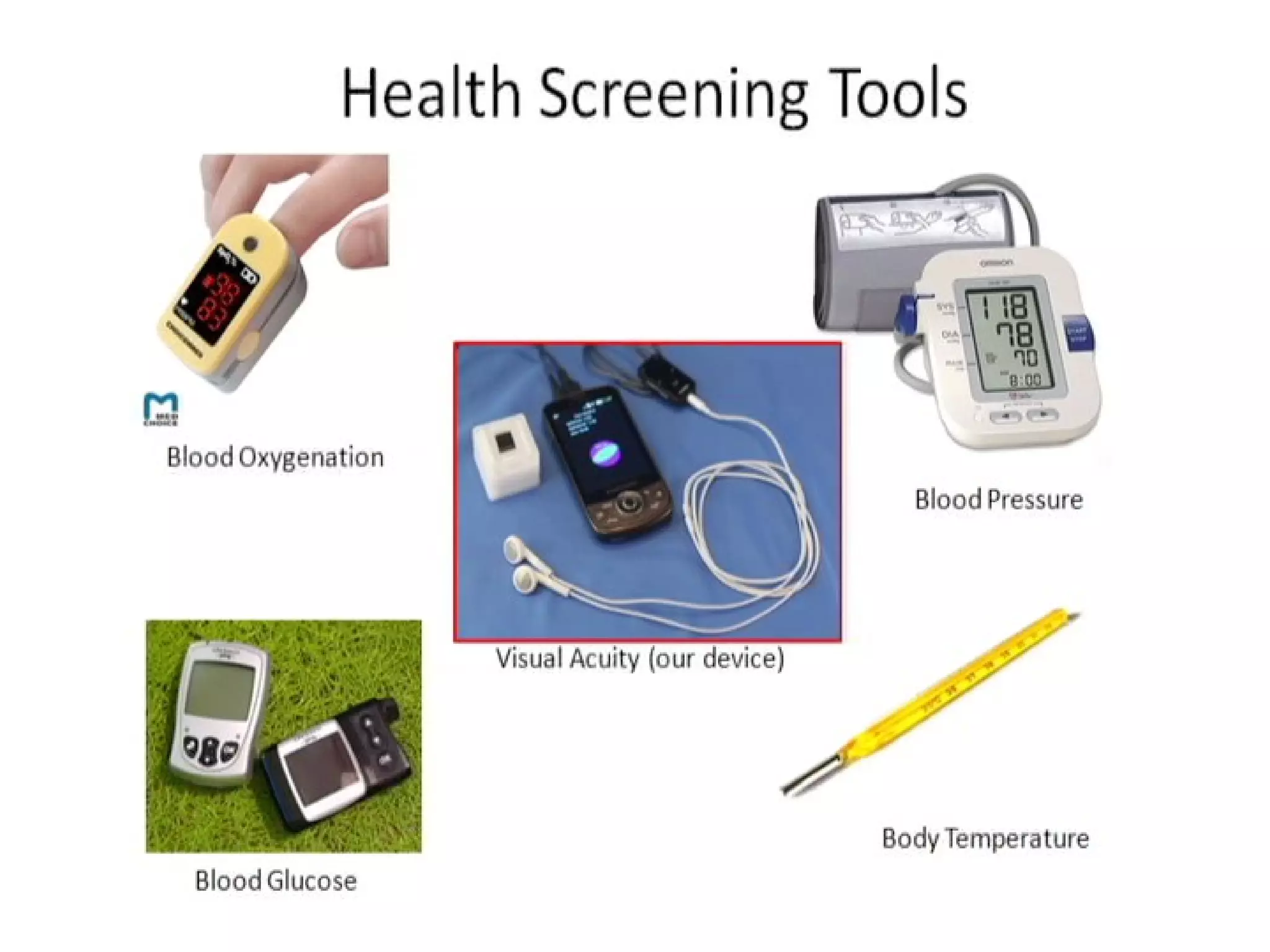
  • #30 Moving towards penny diagnostics Click Diagnostics Hardware app store not just software app store, we have seen this with Wii and Guitarhero
  • #40 How to exploit Sharp’s photosensing LCD originally designed for touch sensing and convert into a large area flat camera Since we are adapting LCD technology we can fit a BiDi screen into laptops and mobile devices.
  • #43 So here is a preview of our quantitative results. I’ll explain this in more detail later on, but you can see we’re able to accurately distinguish the depth of a set of resolution targets. We show above a portion of portion of views form our virtual cameras, a synthetically refocused image, and the depth map derived from it.
  • #44 photos will be computed rather than recorded Comp photo will be there It will change the workflow, just with digital many pipeline have turned upside down and we will even more At the same time with cameras that understand our world better, there will be a lot of new opportunities http://scalarmotion.wordpress.com/2009/03/15/propeller-image-aliasing/
  • #45 Pioneered by Nayar and Levoy Synthesis Minimal change of hardware Goals are often opposite (human perception) Use of non-visual data And Network
  • #46 = Material index and compute bounces (real vs fake) = Automatic 3D, phototourism, and 3D awareness (look around a corner) = Find relationship (network) between all photos = Understand the world (recognize, categorize, make world smarter bokode)
  • #49 If you can look around a corners, firefighters can use such a device for planning rescue of trapped people without actually having to go in the line of fire
  • #51 Bokode.com
  • #58 = Material index and compute bounces (real vs fake) = Automatic 3D, phototourism, and 3D awareness (look around a corner) = Find relationship (network) between all photos = Understand the world (recognize, categorize, make world smarter bokode)
  • #59 Very challenging but a new trend is emerging: in using the power of the people.
  • #62 What is the key resource we have in India ..
  • #64 The camera phone provides an easy interface to fill in and verify government forms. The paper form is printed with 2D bar-codes which are decoded by camera phone and info is transmitted to a central location.
  • #65 Microsoft Photosynth and U-Washington’s Phototourism software takes a large collection of photos of a place or an object, analyzes them for similarities, and then displays the photos in a reconstructed three-dimensional space , showing you how each one relates to the next. New options on Google Maps allows users to post and view populated map with geo-tagged photos provided by Panoramio .
  • #66 Israeli Information Center for Human Rights in the Occupied Territories captures photos of events. From their website: “Goal is to Document and educate Israeli public and policymakers about human rights violations in Occupied Territories. Second goal is to combat phenomenon of denial prevalent among Israeli public. We hope to create human rights culture in Israel.”
  • #69 So how will the next billion cameras in people pocket change us? Will optically smart sensor help disabled people, portable devices improve social stability and pixel-coordinated activities harness the power of crowdsourcing for image-based commerce? Not outsourcing but image-based crowdsourcing
  • #71 So how will the next billion cameras in people pocket change us? Will optically smart sensor help disabled people, portable devices improve social stability and pixel-coordinated activities harness the power of crowdsourcing for image-based commerce?
  • #74 Ramesh Raskar Associate Professor MIT Media Lab http://raskar.info http://cameraculture.info
  • #75 Six ways of coming up with new ideas based on an idea ‘X’. Ramesh Raskar Associate Professor MIT Media Lab http://raskar.info http://cameraculture.info http://raskar.info http://cameraculture.info
  • #77 X up: Airbags for car, for helicopter
  • #83 Beautiful theory but strikingly simple implementation .. Combination of simple optics and some intelligent software Based on wavefront manipulation
  • #84 Moving towards penny diagnostics Click Diagnostics Hardware app store not just software app store, we have seen this with Wii and Guitarhero
  • #88 Shielded by screening pigment. The visual organ provides no spatial information, but by comparing the signal from 2 organs or by moving the body, the worm can navigate towards brighter or darker places. It can also keep certain body orientation. Despite lack of spatial vision, this is an evolutionary forerunner to real eyes.
  • #99 http://raskar.info http://cameraculture.media.mit.edu