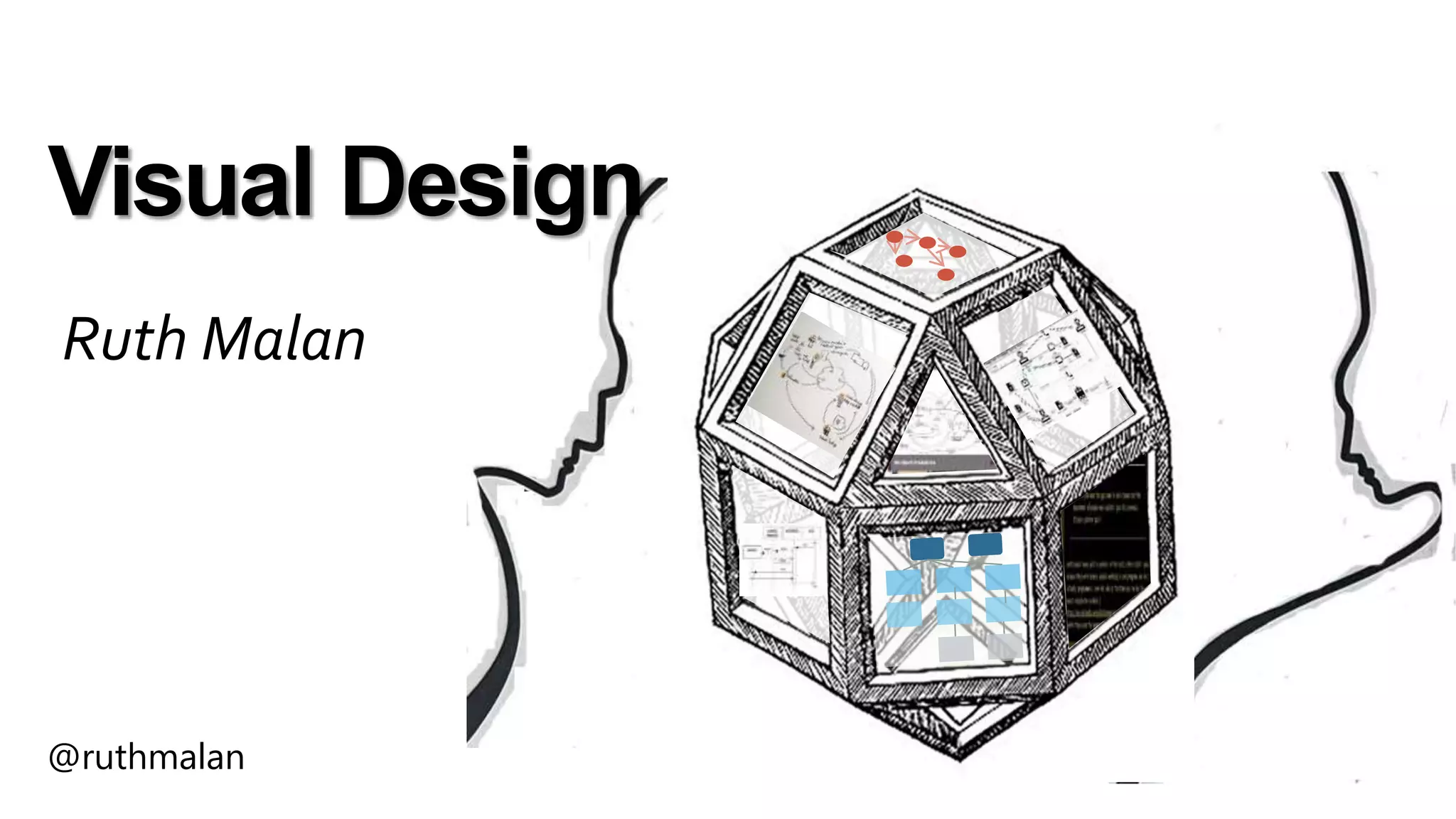



Visual Design
Ruth Malan
@ruthmalan
“we put our thoughts into the
world”
— Barbara Tversky
<Emergency
Appeal to Authority>
How is design like
a comic?
VISUAL
DESIGN
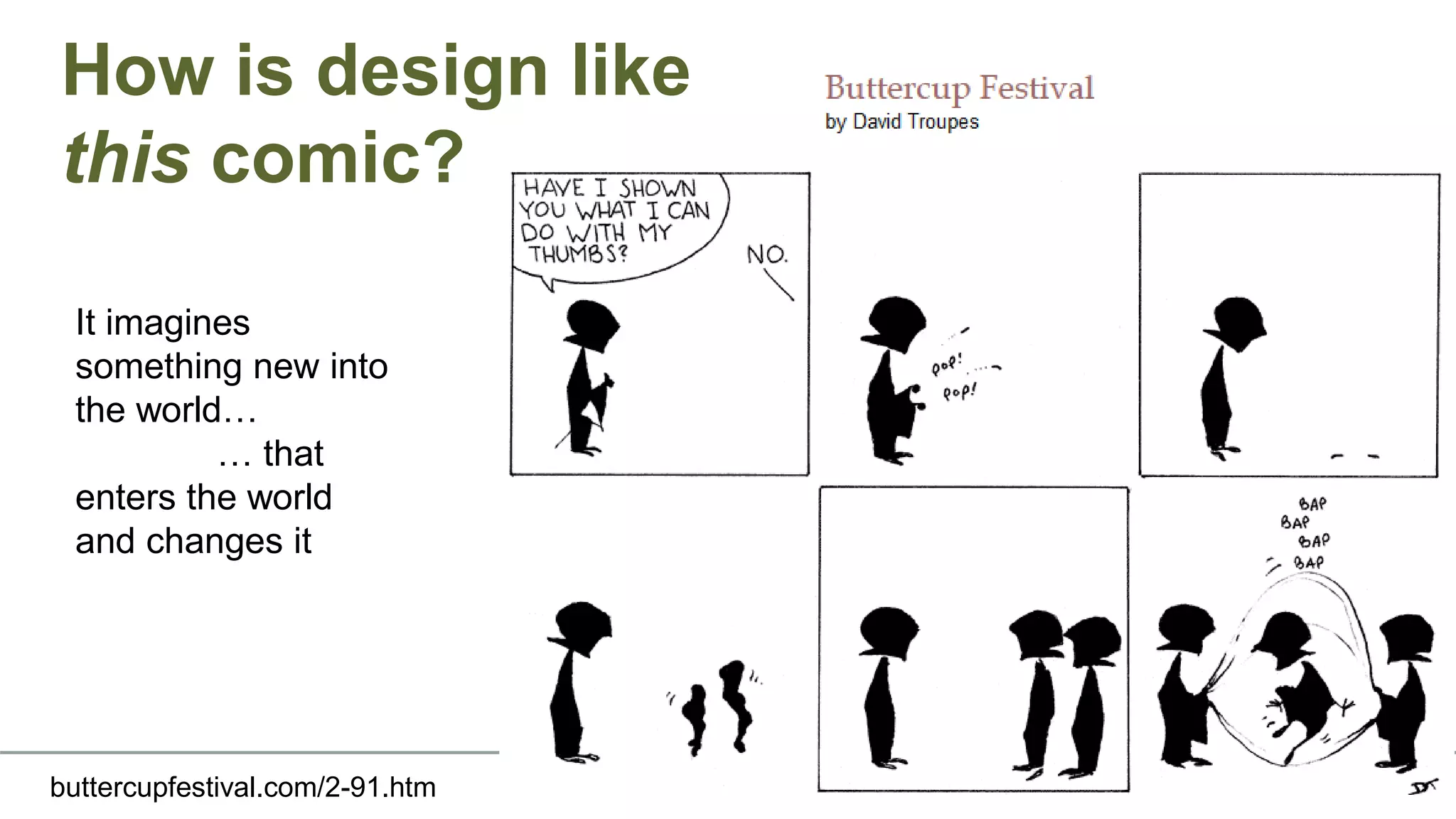
How is design like
this comic?
buttercupfestival.com/2-91.htm
It imagines
something new into
the world…
… that
enters the world
and changes it
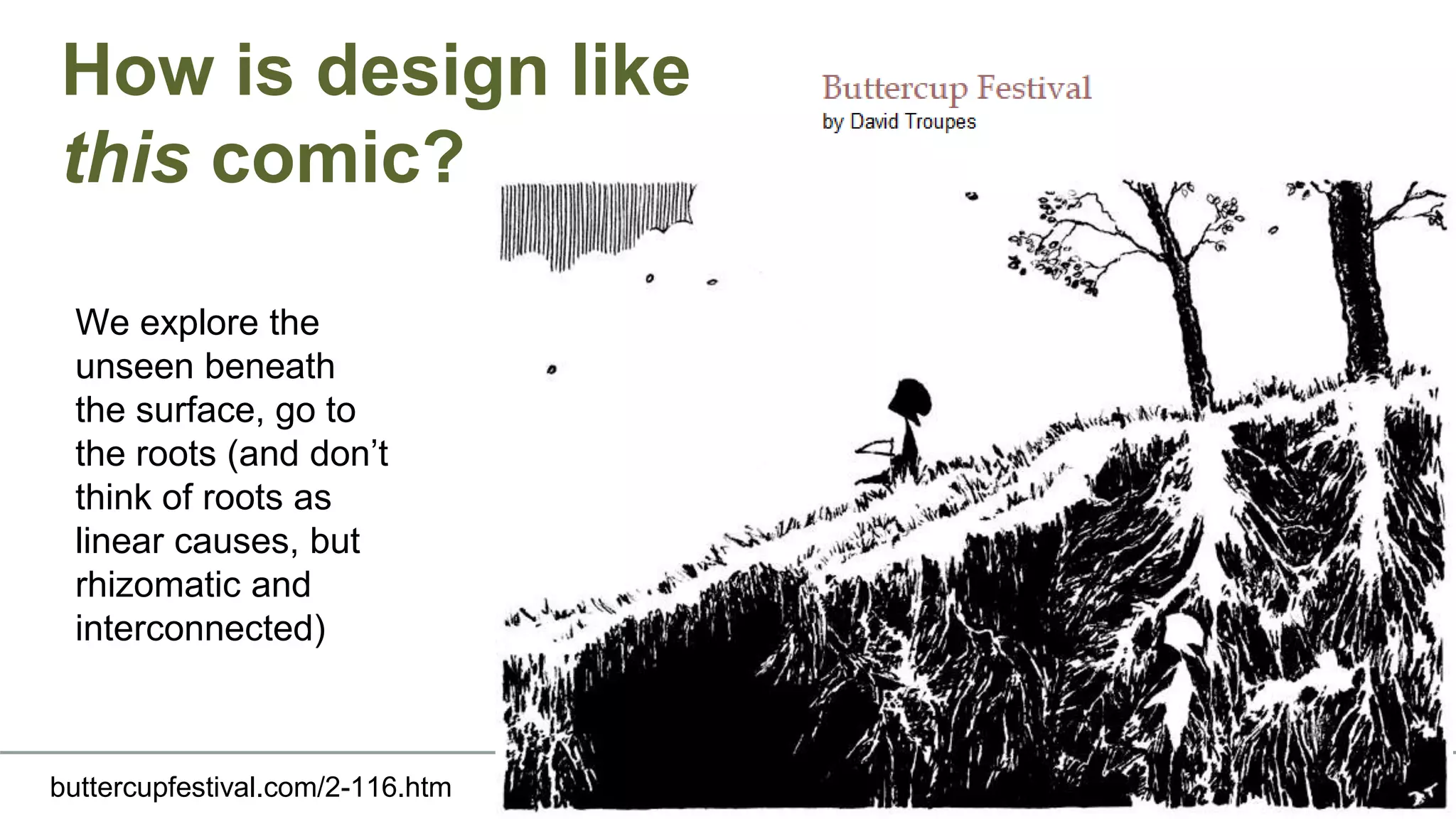
How is design like
this comic?
buttercupfestival.com/2-116.htm
We explore the
unseen beneath
the surface, go to
the roots (and don’t
think of roots as
linear causes, but
rhizomatic and
interconnected)
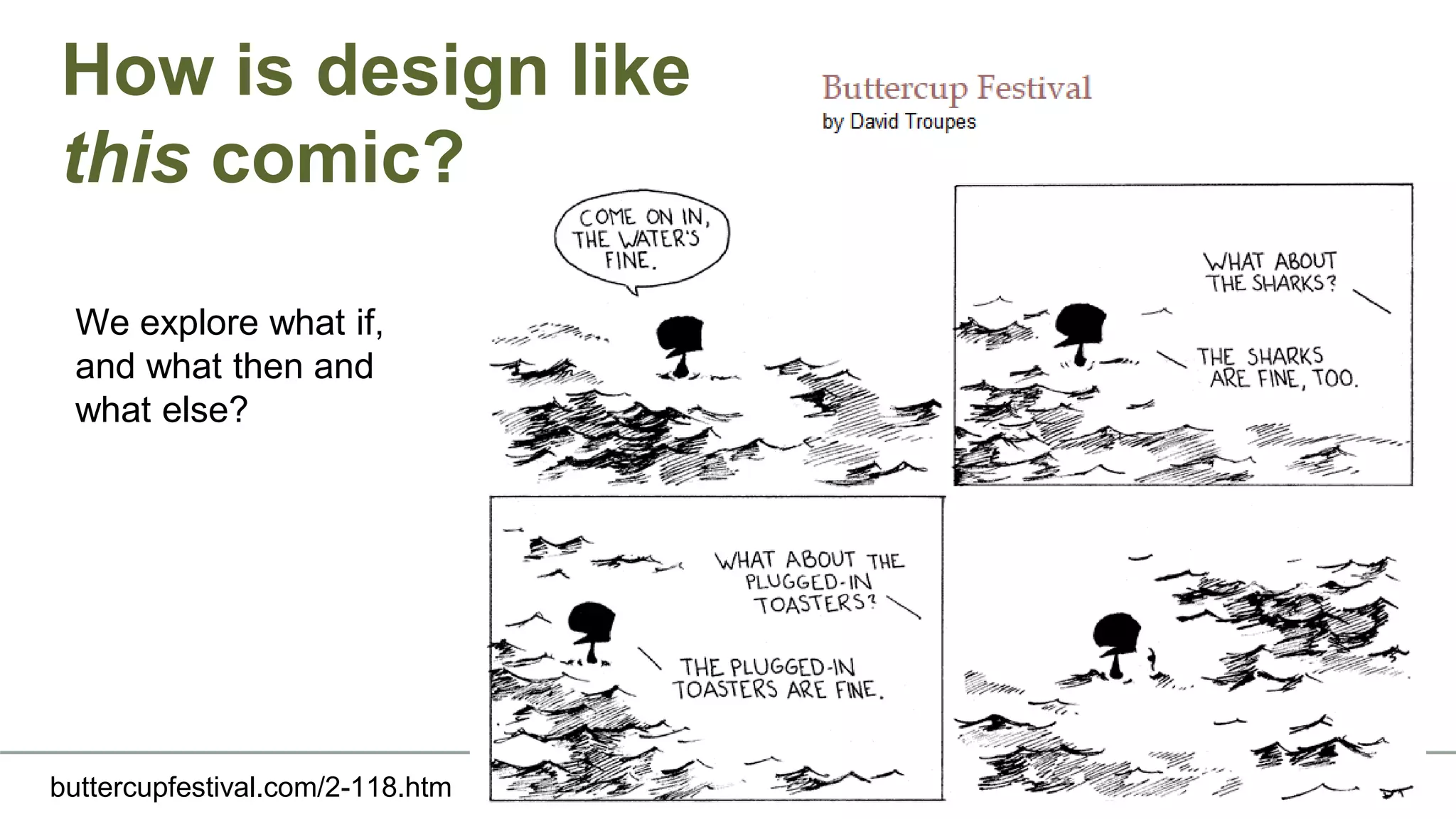
How is design like
this comic?
buttercupfestival.com/2-118.htm
We explore what if,
and what then and
what else?
How is design like
a comic?
VISUAL
DESIGN
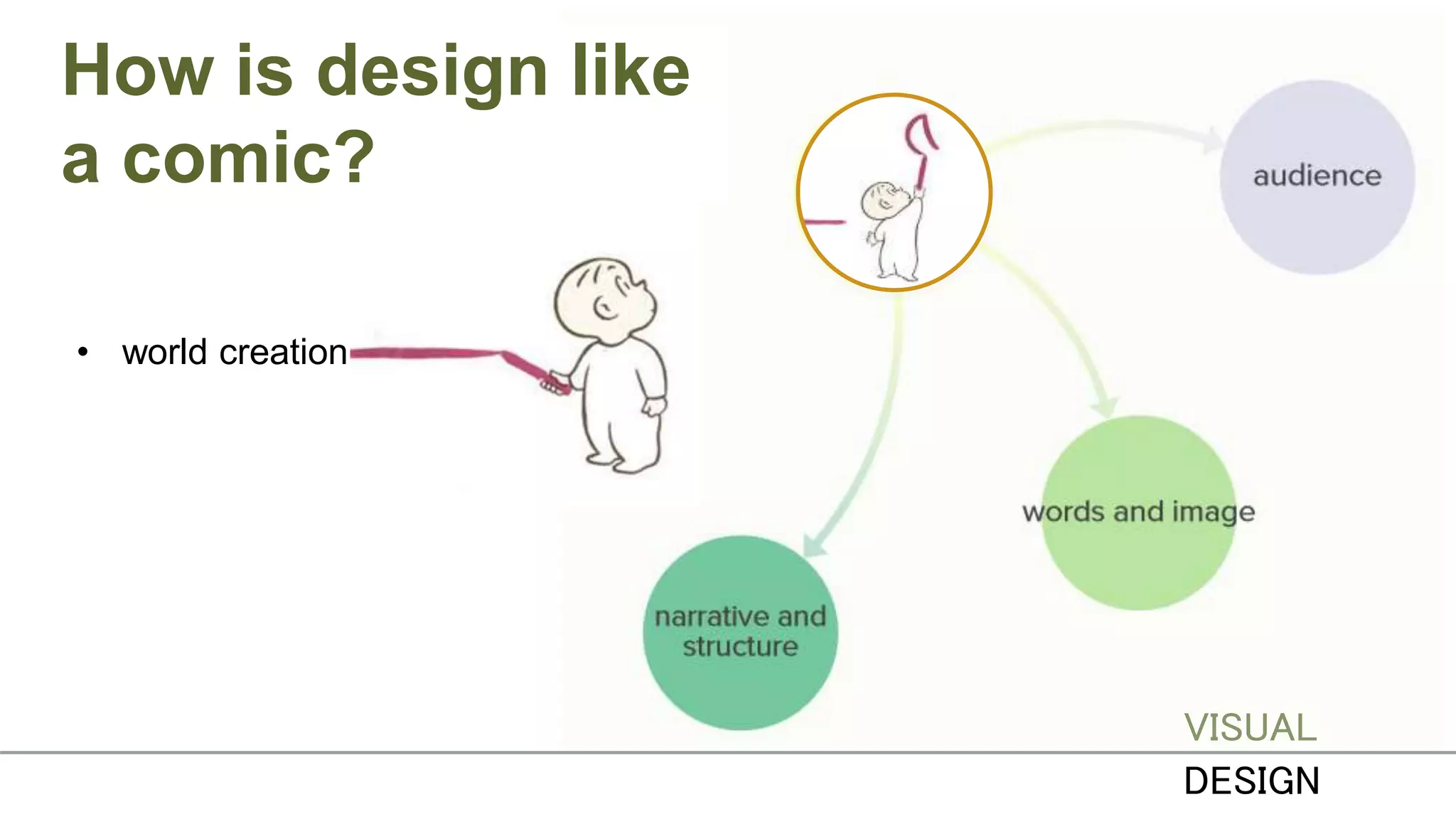
• world creation
How is design like
a comic?
VISUAL
DESIGN
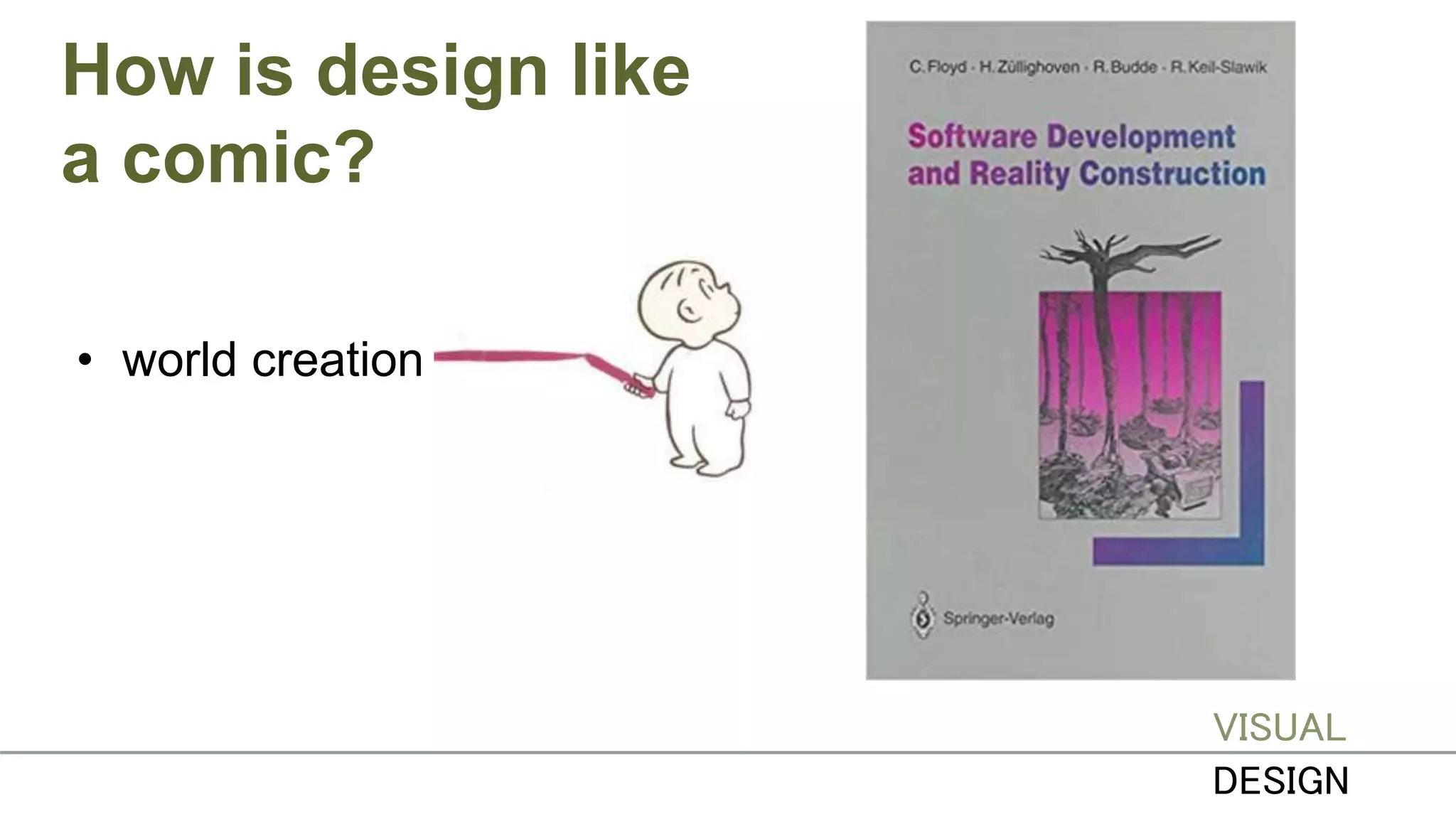
• world creation
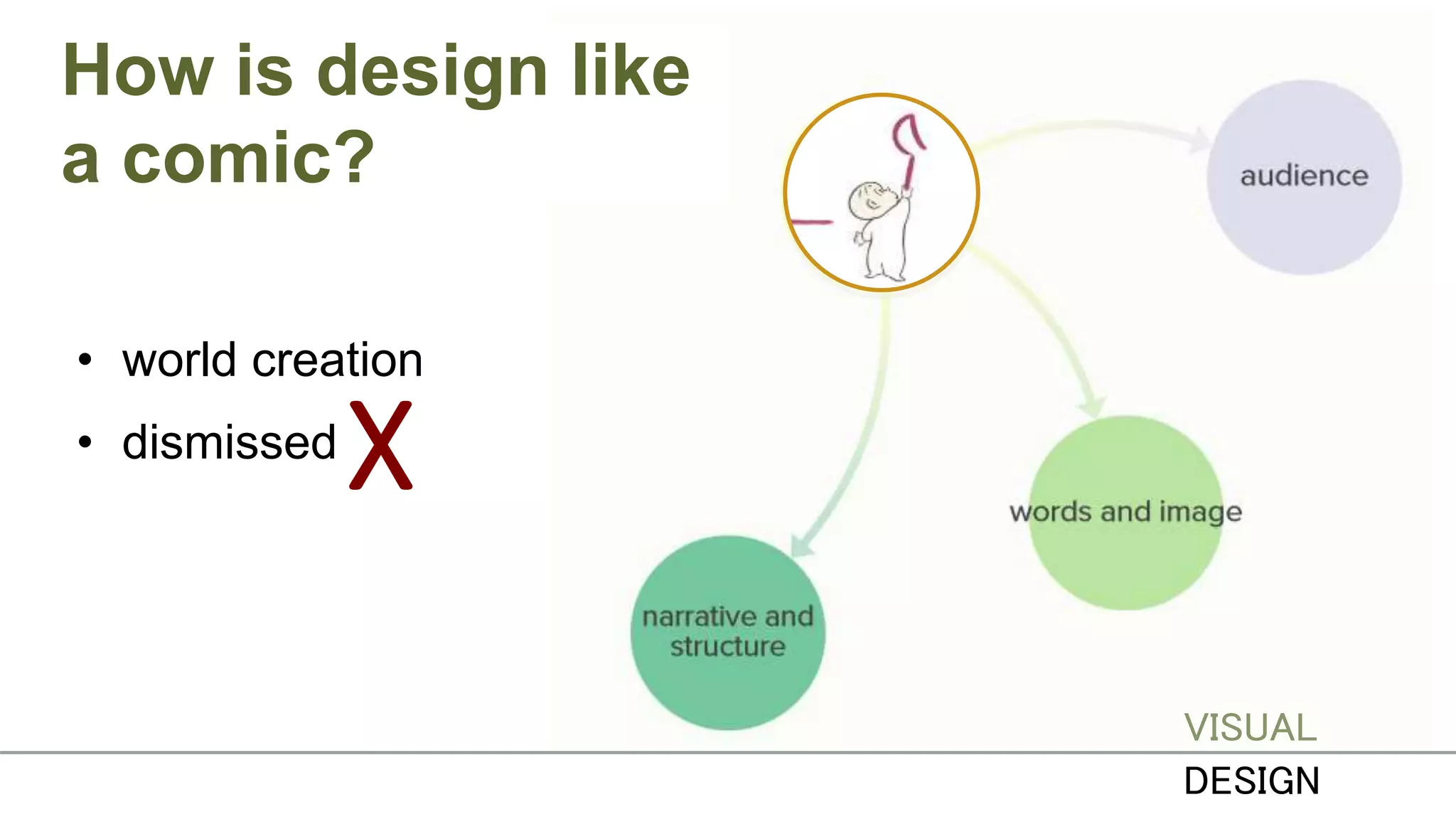
How is design like
a comic?
VISUAL
DESIGN
• world creation
• dismissed
X
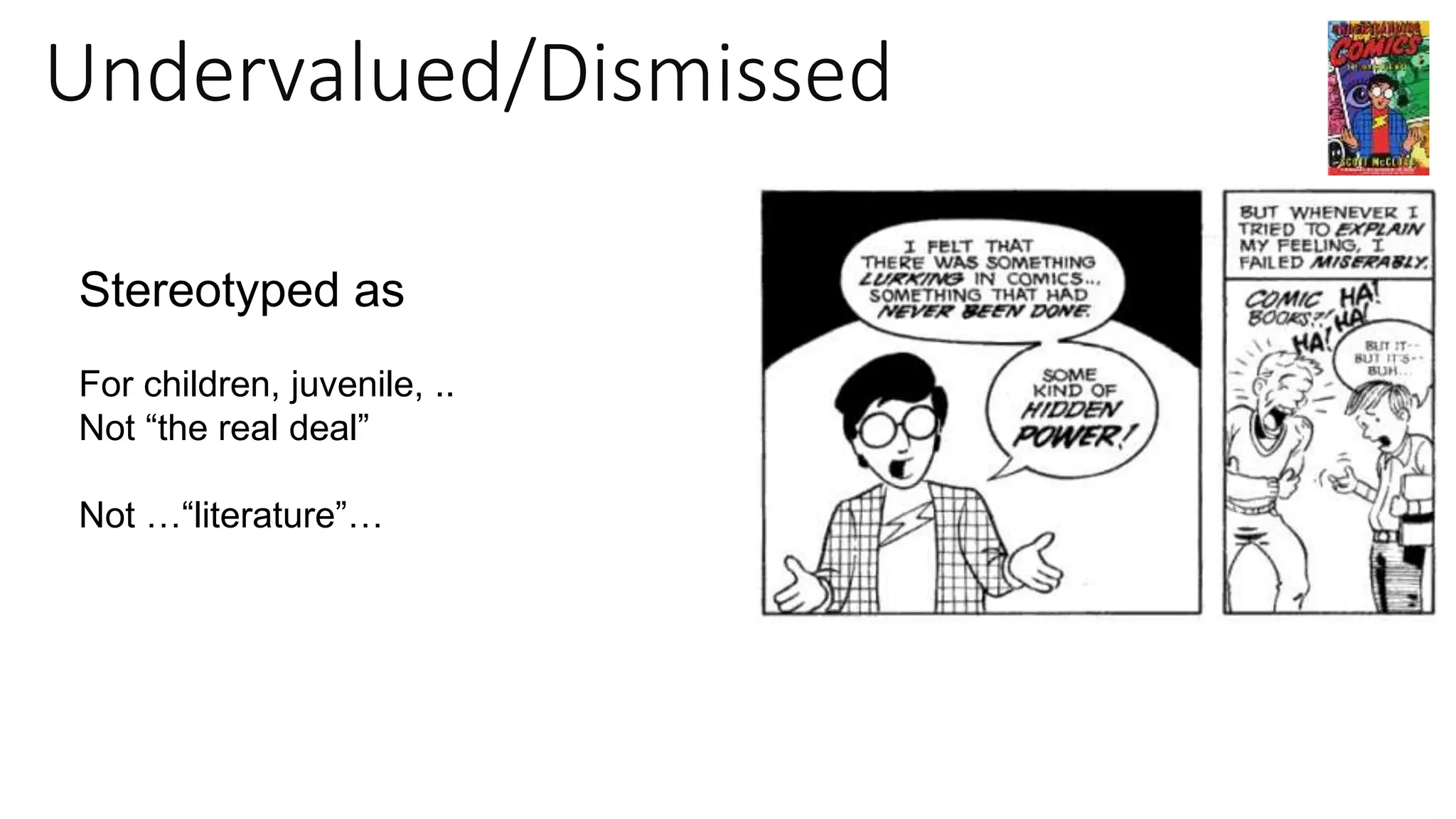
Undervalued/Dismissed
Stereotyped as
For children, juvenile, ..
Not “the real deal”
Not …“literature”…
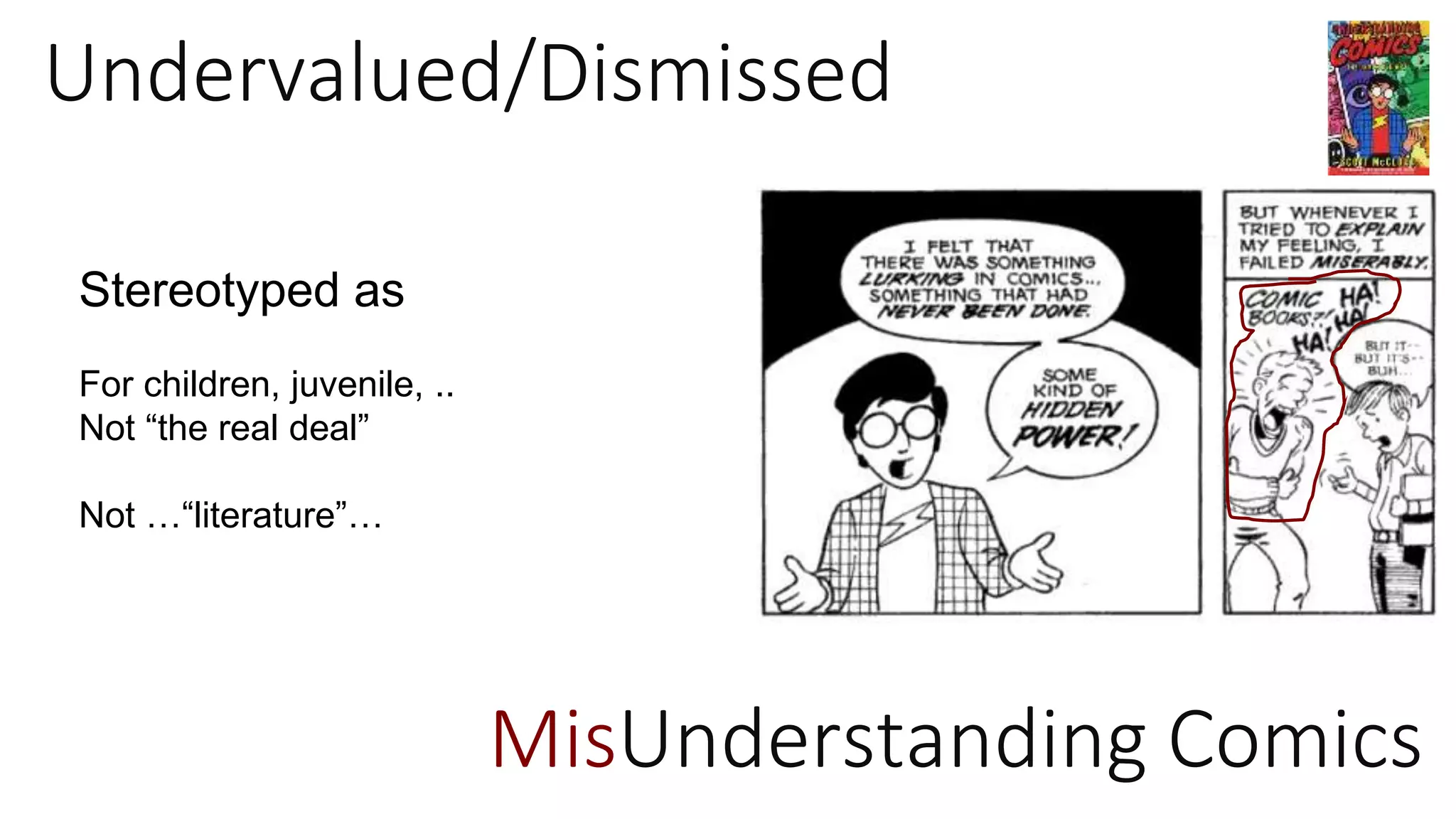
Undervalued/Dismissed
Stereotyped as
For children, juvenile, ..
Not “the real deal”
Not …“literature”…
MisUnderstanding Comics
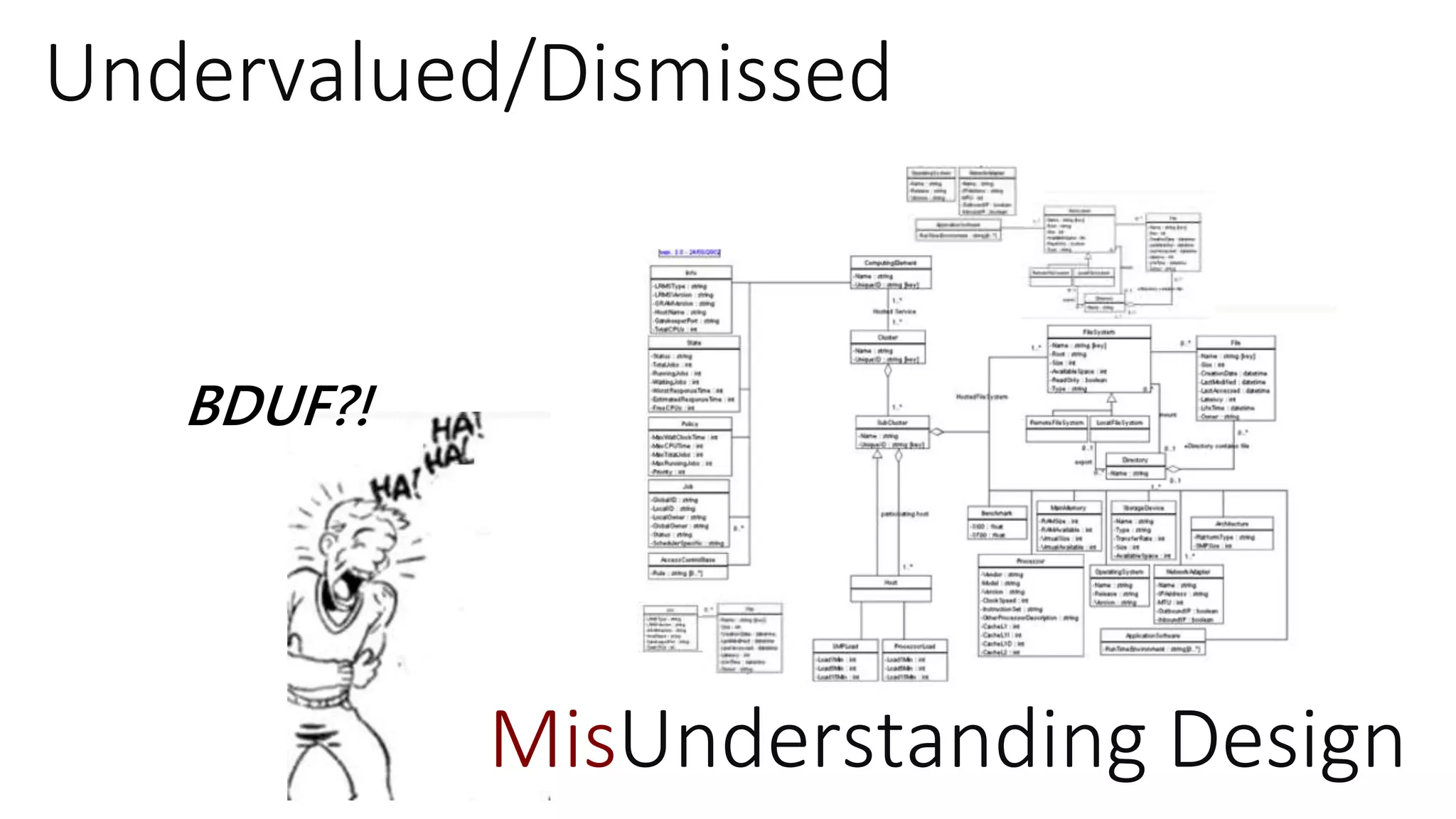
Undervalued/Dismissed
BDUF?!
MisUnderstanding Design
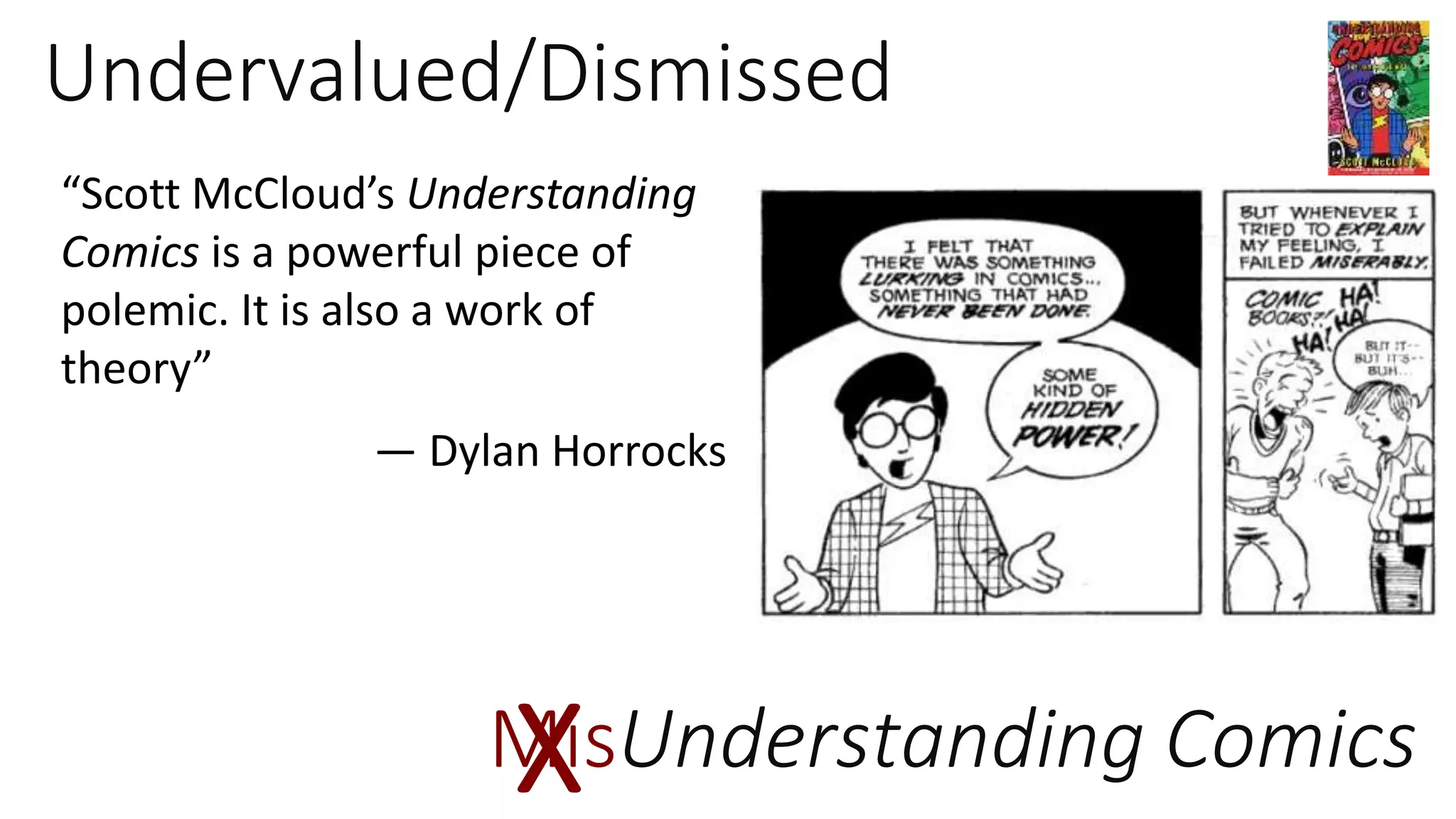
Undervalued/Dismissed
“Scott McCloud’s Understanding
Comics is a powerful piece of
polemic. It is also a work of
theory”
— Dylan Horrocks
MisUnderstanding Comics
X
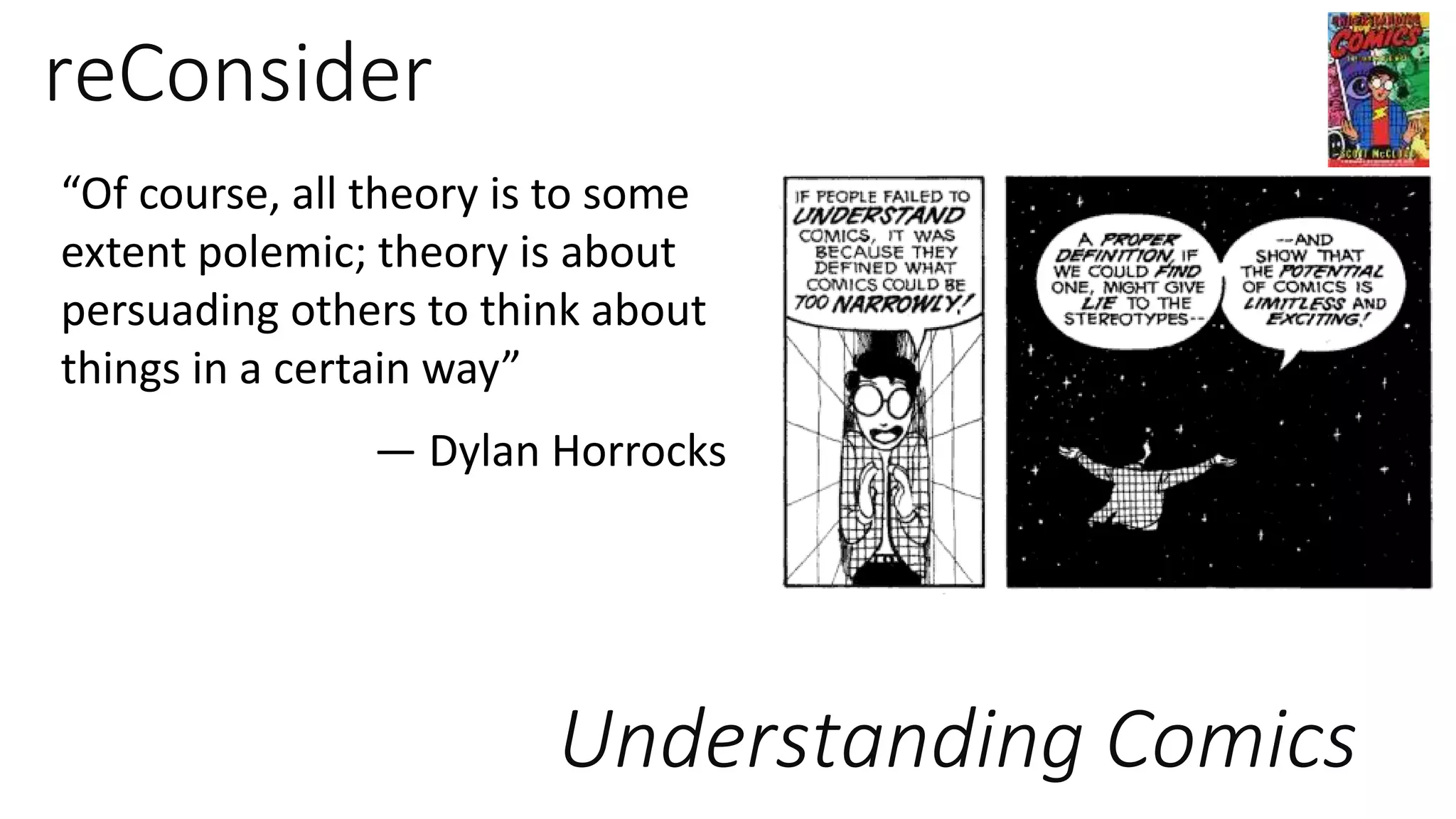
reConsider
“Of course, all theory is to some
extent polemic; theory is about
persuading others to think about
things in a certain way”
— Dylan Horrocks
Understanding Comics
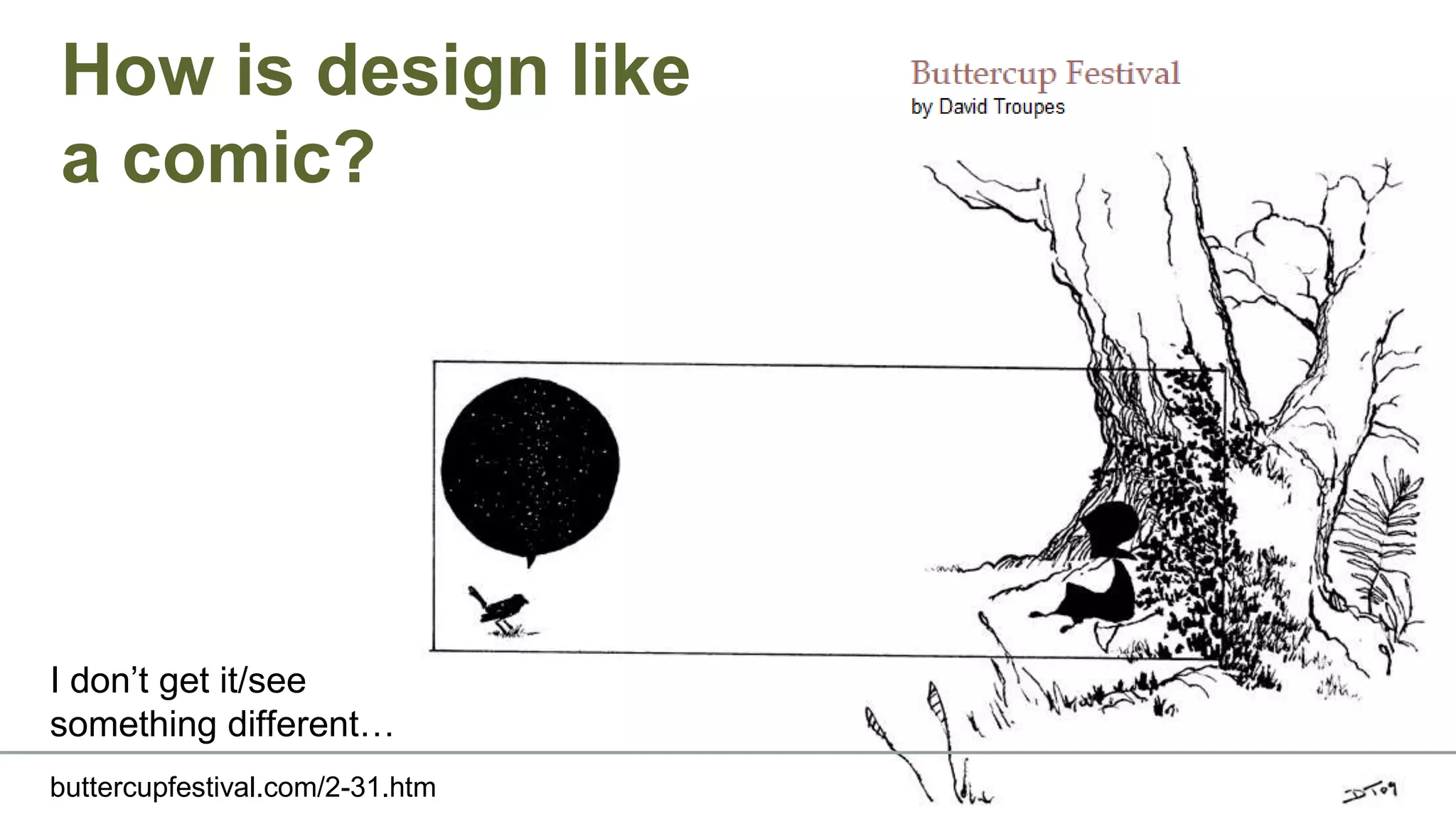
How is design like
a comic?
buttercupfestival.com/2-31.htm
I don’t get it/see
something different…
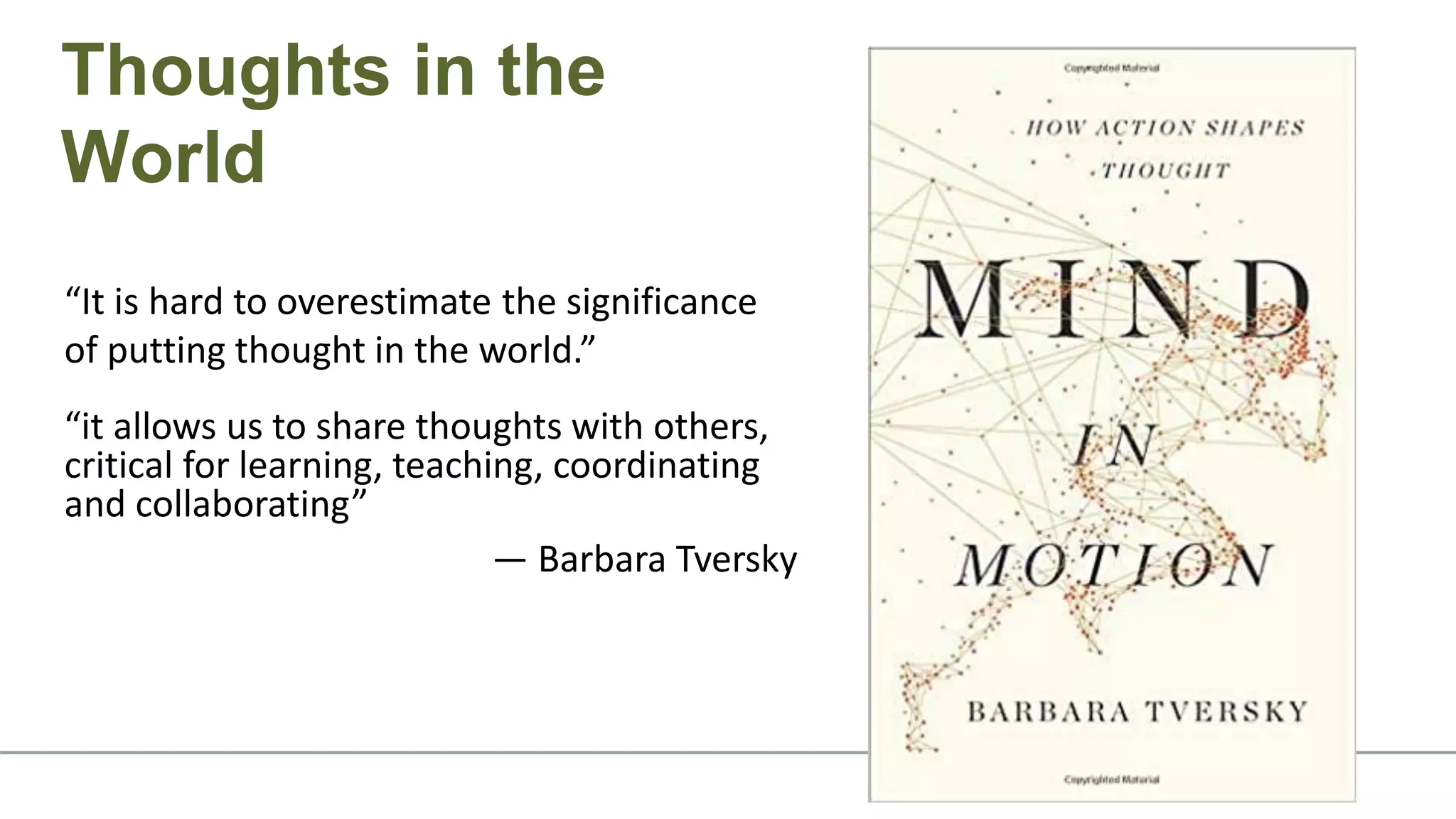
“It is hard to overestimate the significance
of putting thought in the world.”
“it allows us to share thoughts with others,
critical for learning, teaching, coordinating
and collaborating”
— Barbara Tversky
Thoughts in the
World
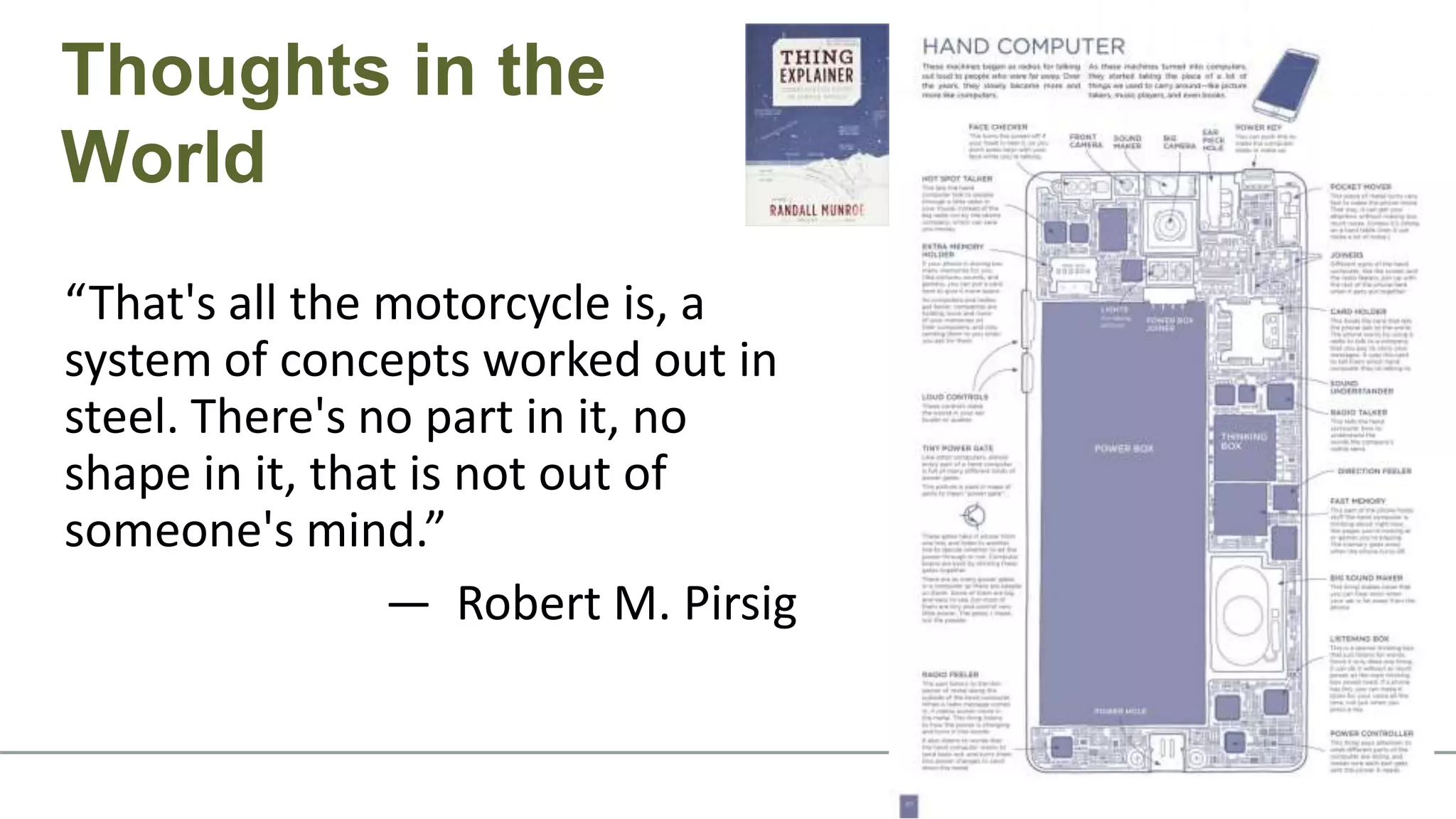
“That's all the motorcycle is, a
system of concepts worked out in
steel. There's no part in it, no
shape in it, that is not out of
someone's mind.”
— Robert M. Pirsig
Thoughts in the
World
TECHNICAL
LEADERSHIP
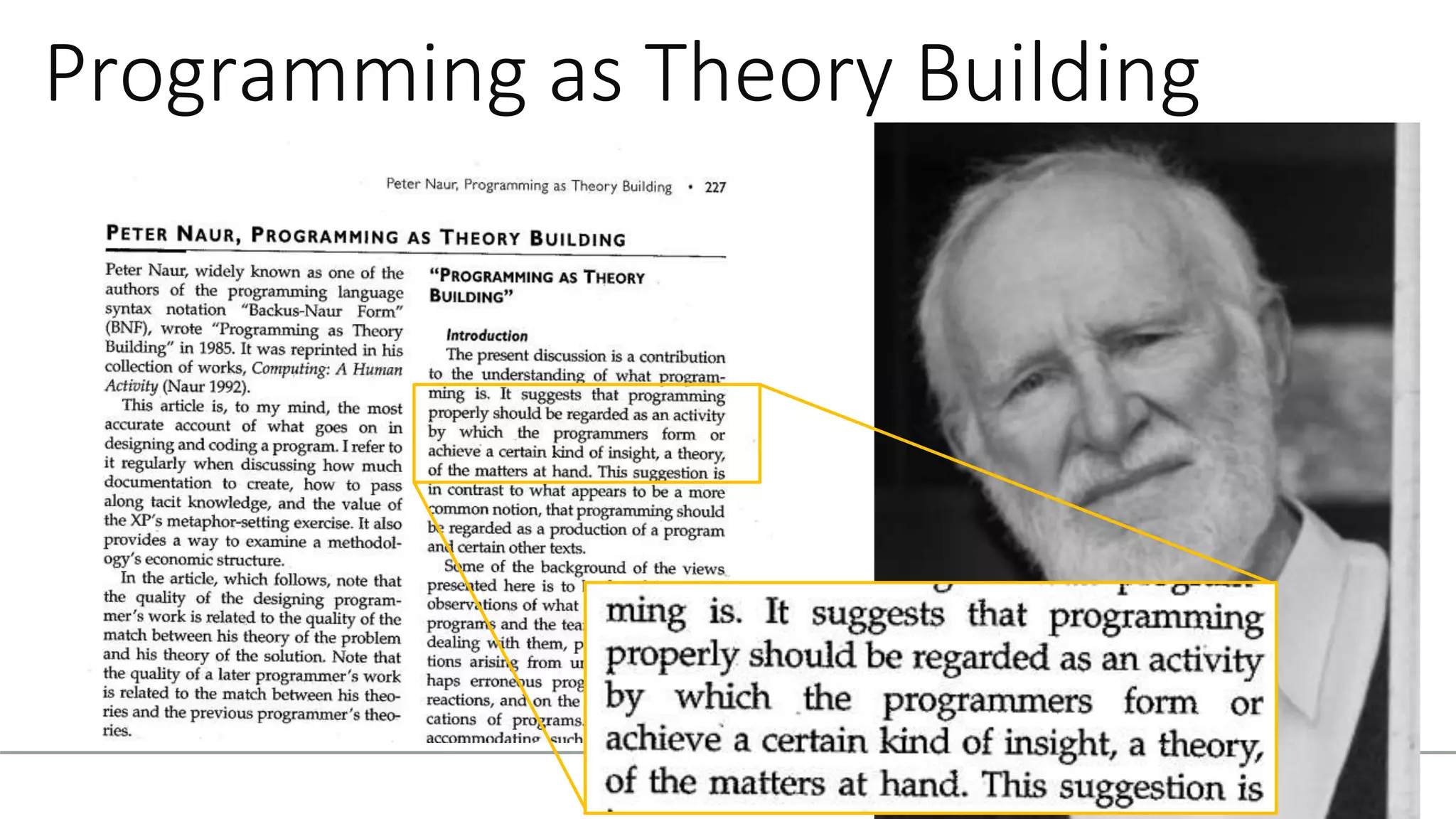
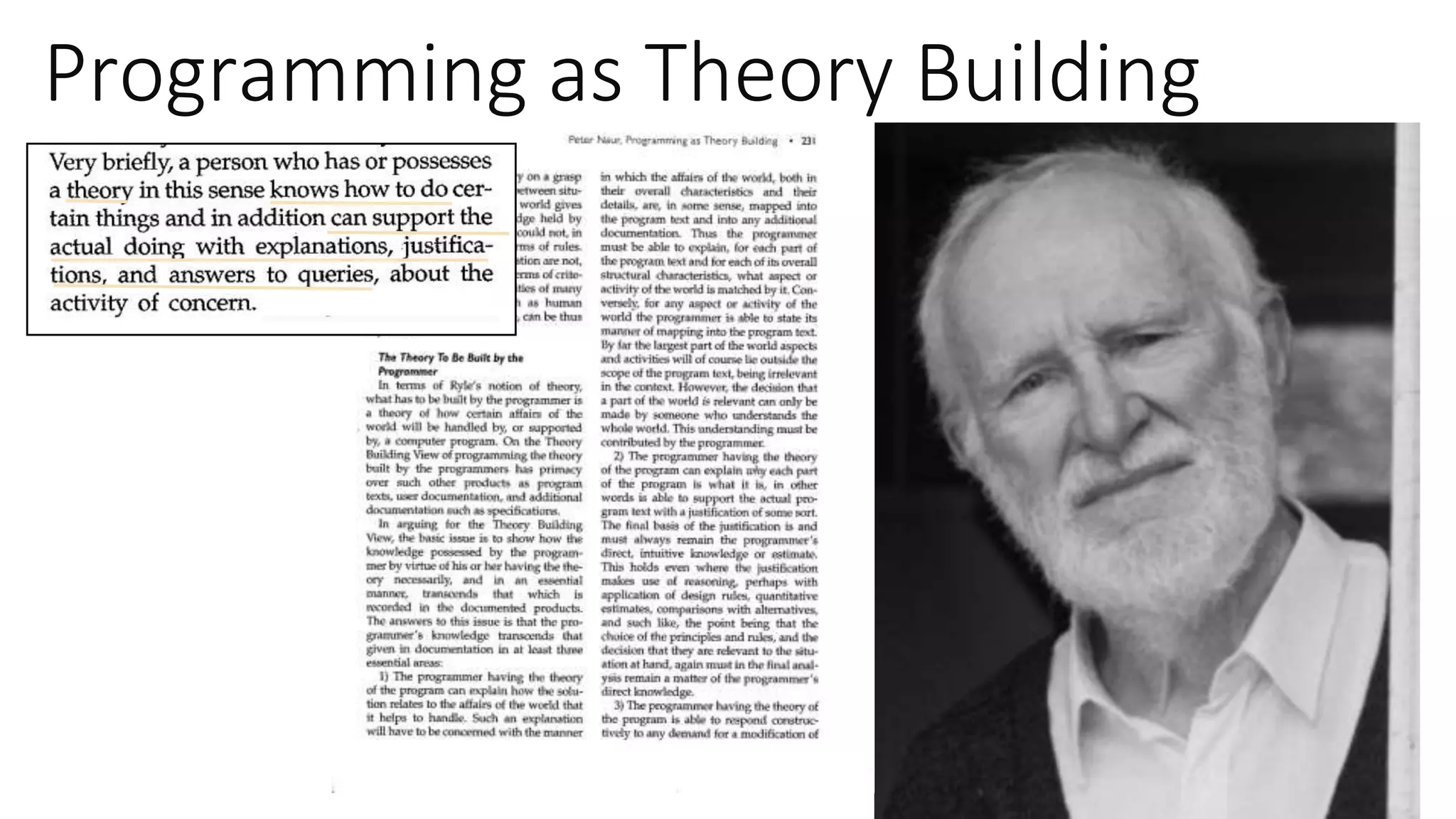
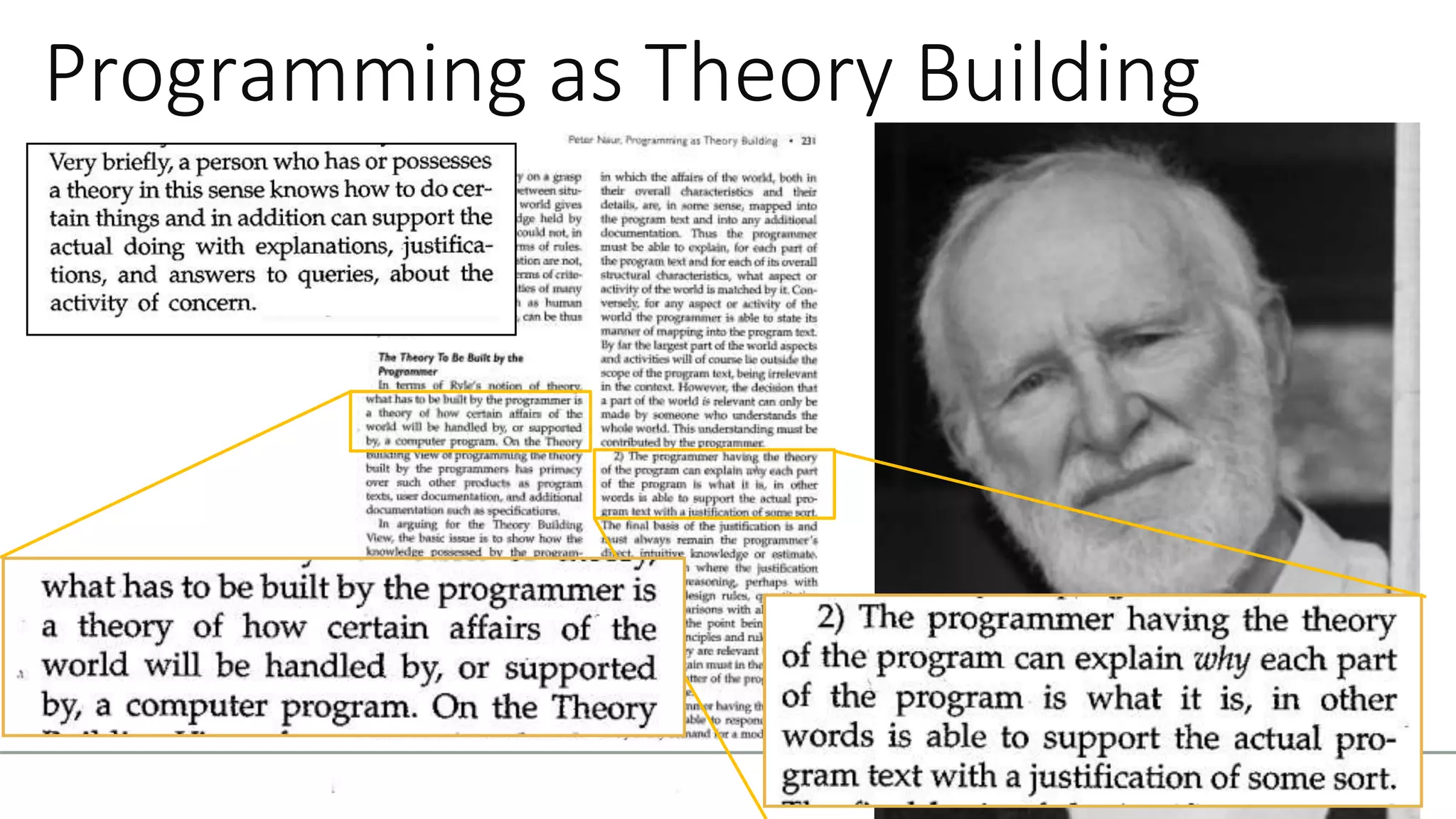
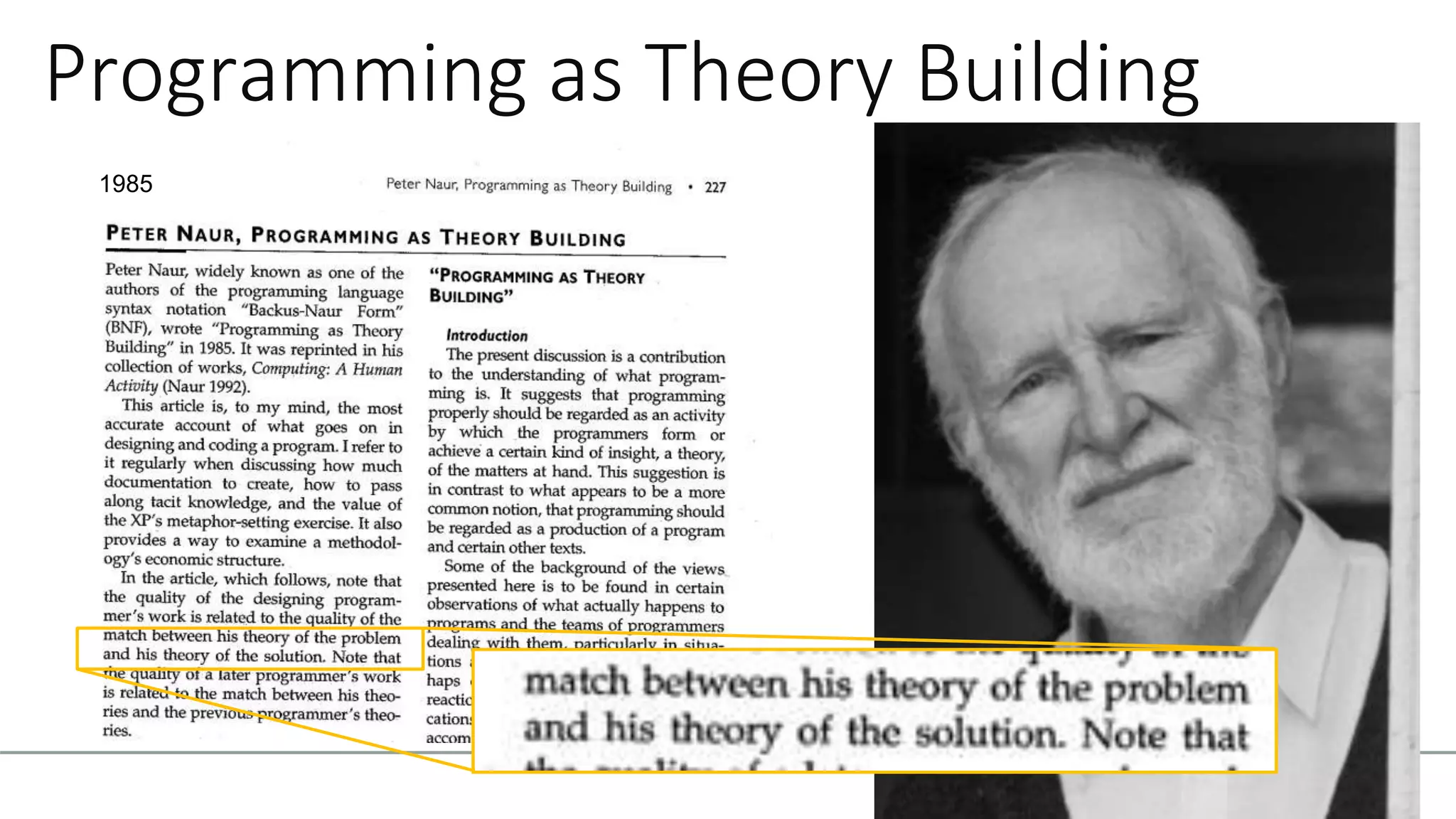
Programming as Theory Building
TECHNICAL
LEADERSHIP
Programming as Theory Building
TECHNICAL
LEADERSHIP
Programming as Theory Building
1985
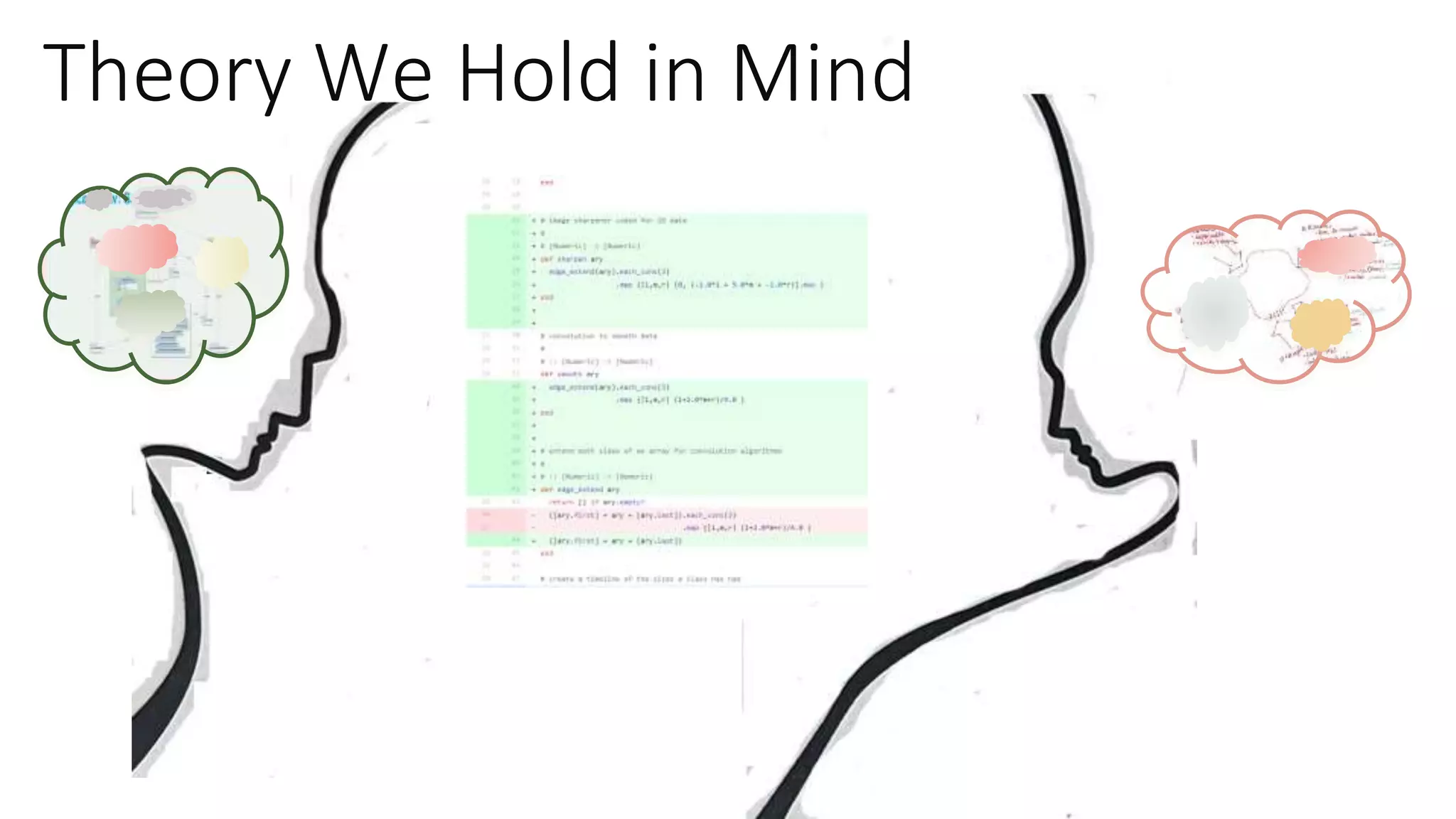
Theory We Hold in Mind
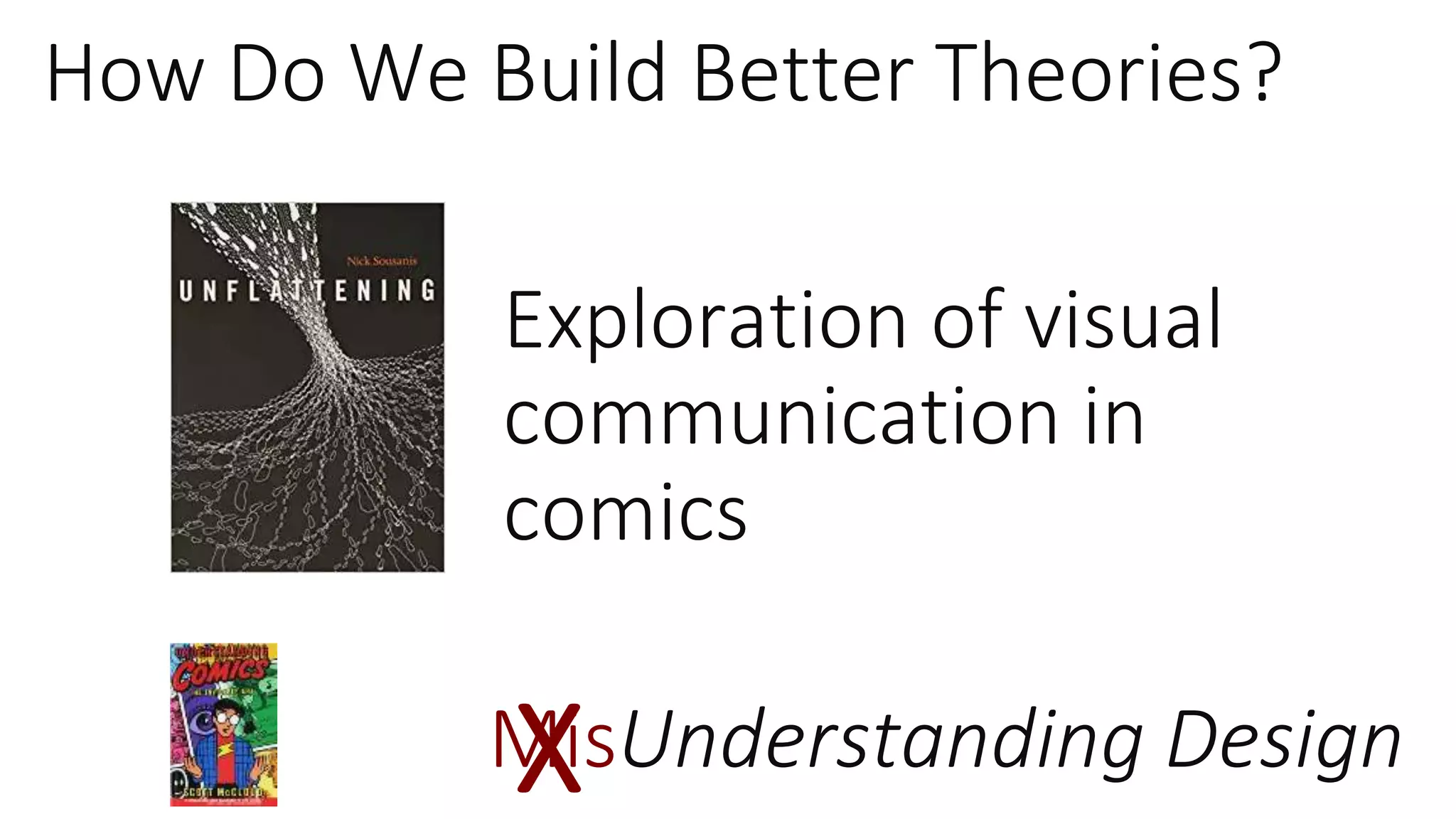
How Do We Build Better Theories?
MisUnderstanding Design
X
Exploration of visual
communication in
comics
Thinking
with the World
“Drawing [..] is a means of
orchestrating a
conversation with yourself”
— Nick Sousanis
From Unflattening
by Nick Sousanis
“Our stereoscopic vision is the
creation and integration of two
views. [..] It is this displacement
that allows us to perceive depth.”
— Nick Sousanis
Integration of Views
From Unflattening by Nick Sousanis
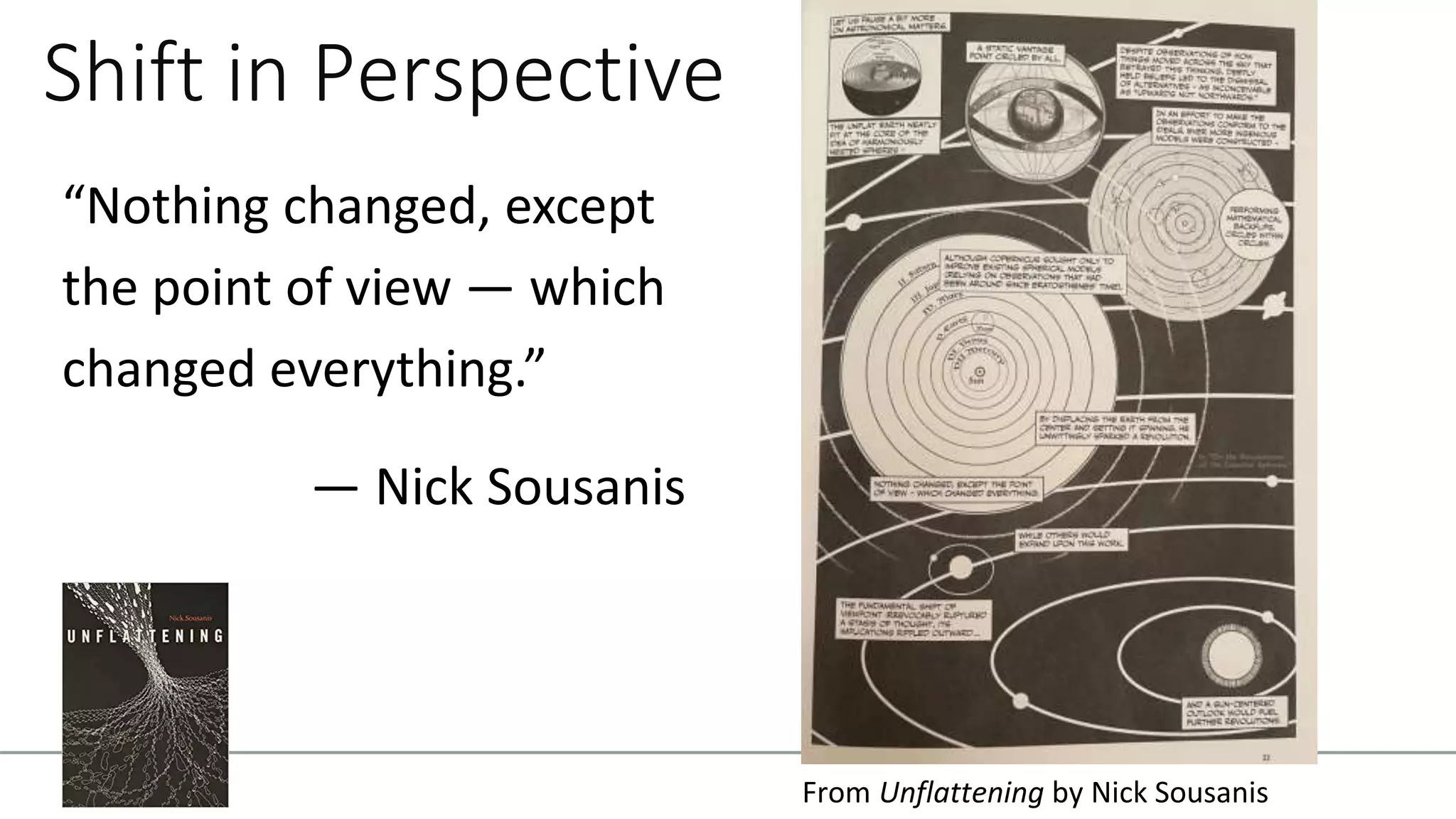
Shift in Perspective
“Nothing changed, except
the point of view — which
changed everything.”
— Nick Sousanis
From Unflattening by Nick Sousanis
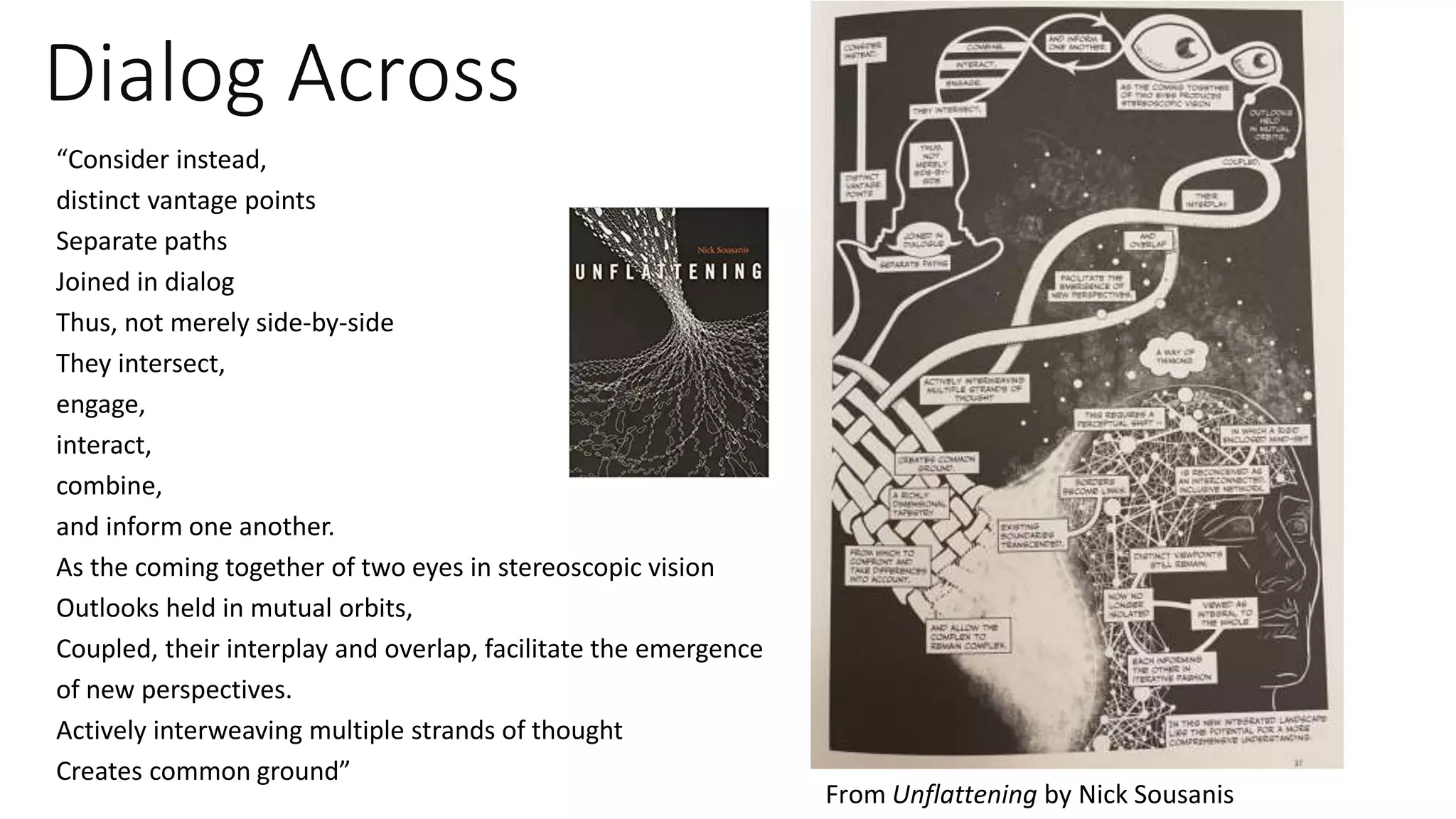
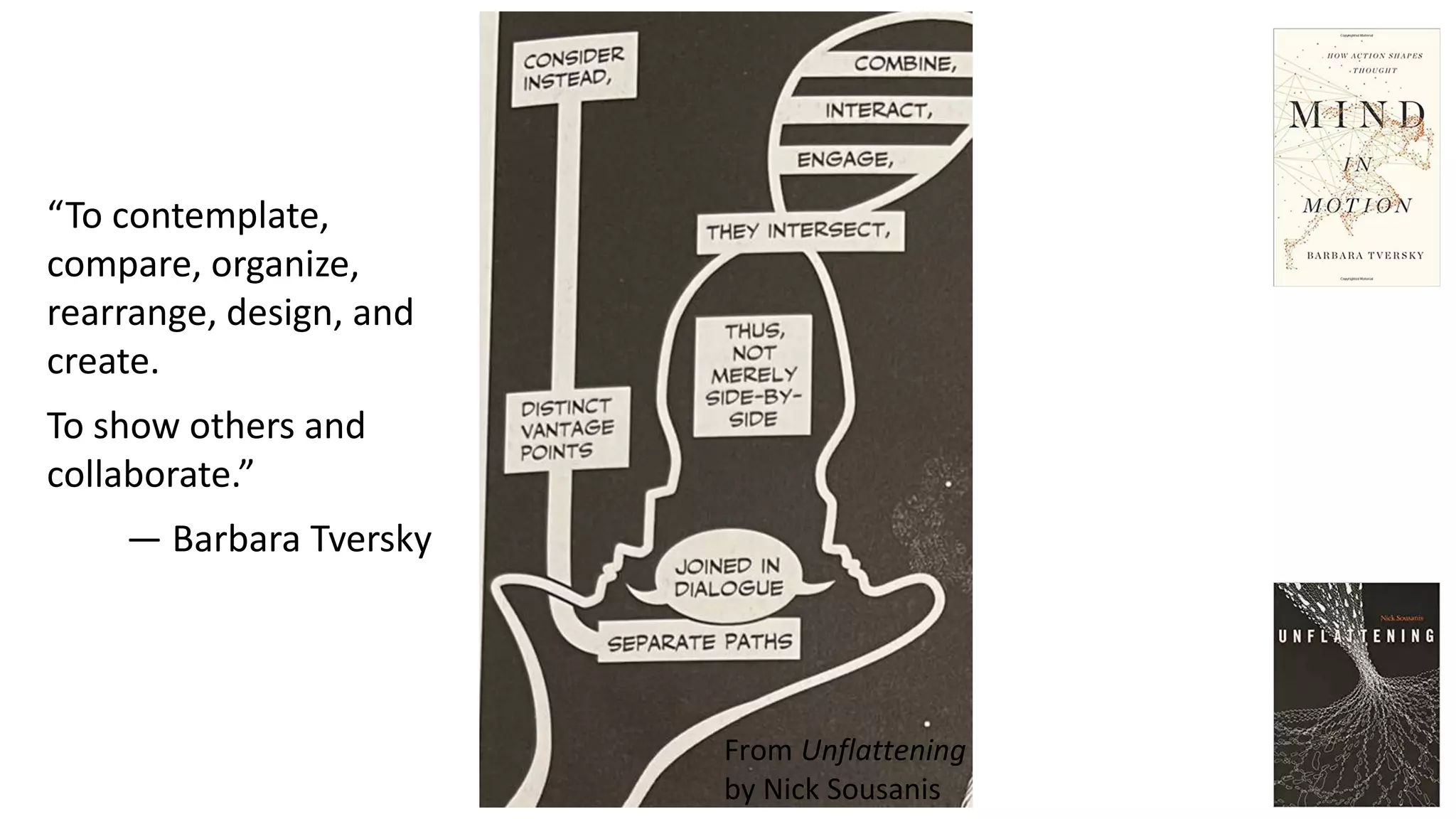
Dialog Across
“Consider instead,
distinct vantage points
Separate paths
Joined in dialog
Thus, not merely side-by-side
They intersect,
engage,
interact,
combine,
and inform one another.
As the coming together of two eyes in stereoscopic vision
Outlooks held in mutual orbits,
Coupled, their interplay and overlap, facilitate the emergence
of new perspectives.
Actively interweaving multiple strands of thought
Creates common ground”
From Unflattening by Nick Sousanis
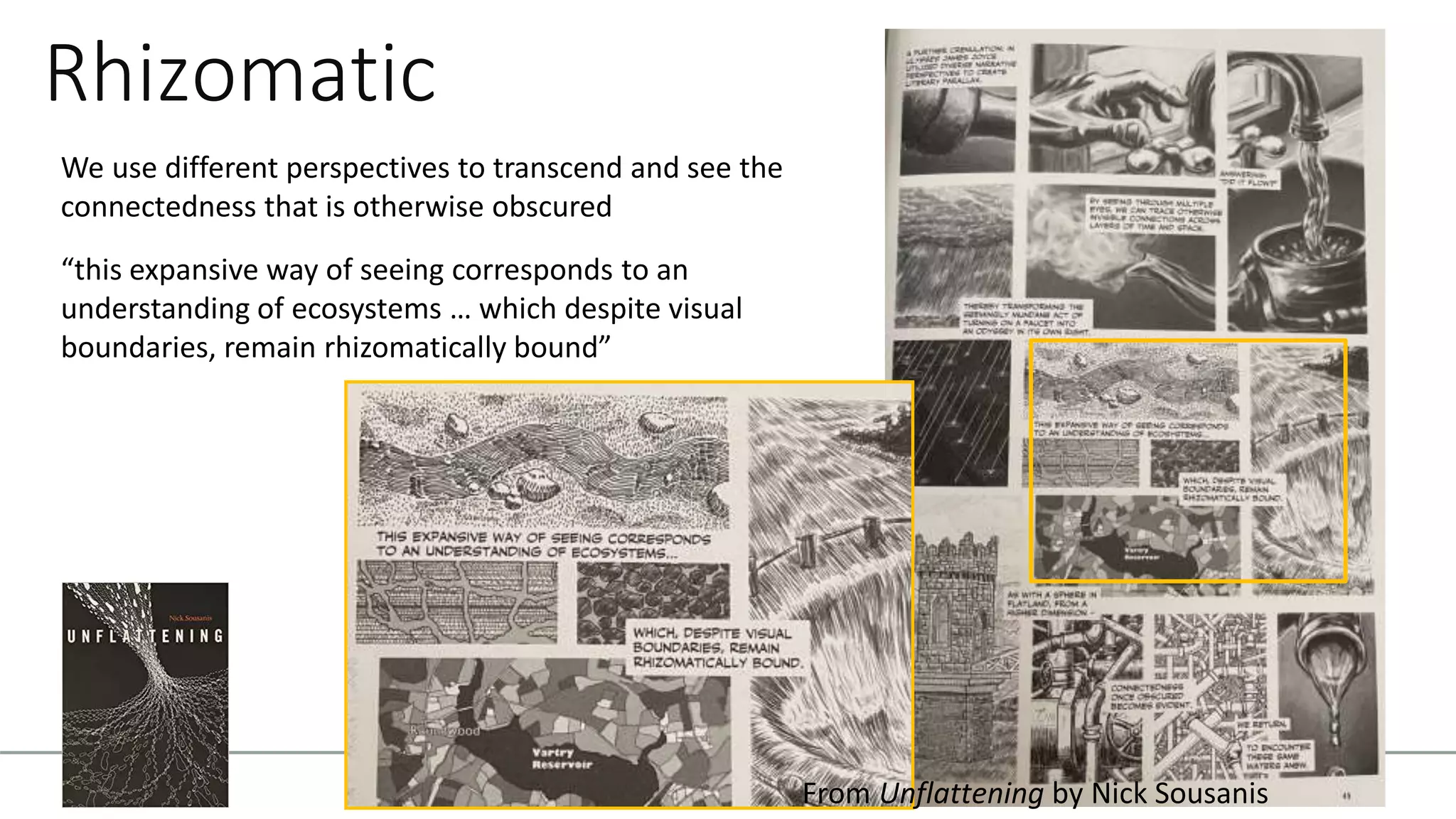
Rhizomatic
We use different perspectives to transcend and see the
connectedness that is otherwise obscured
“this expansive way of seeing corresponds to an
understanding of ecosystems … which despite visual
boundaries, remain rhizomatically bound”
—
From Unflattening by Nick Sousanis
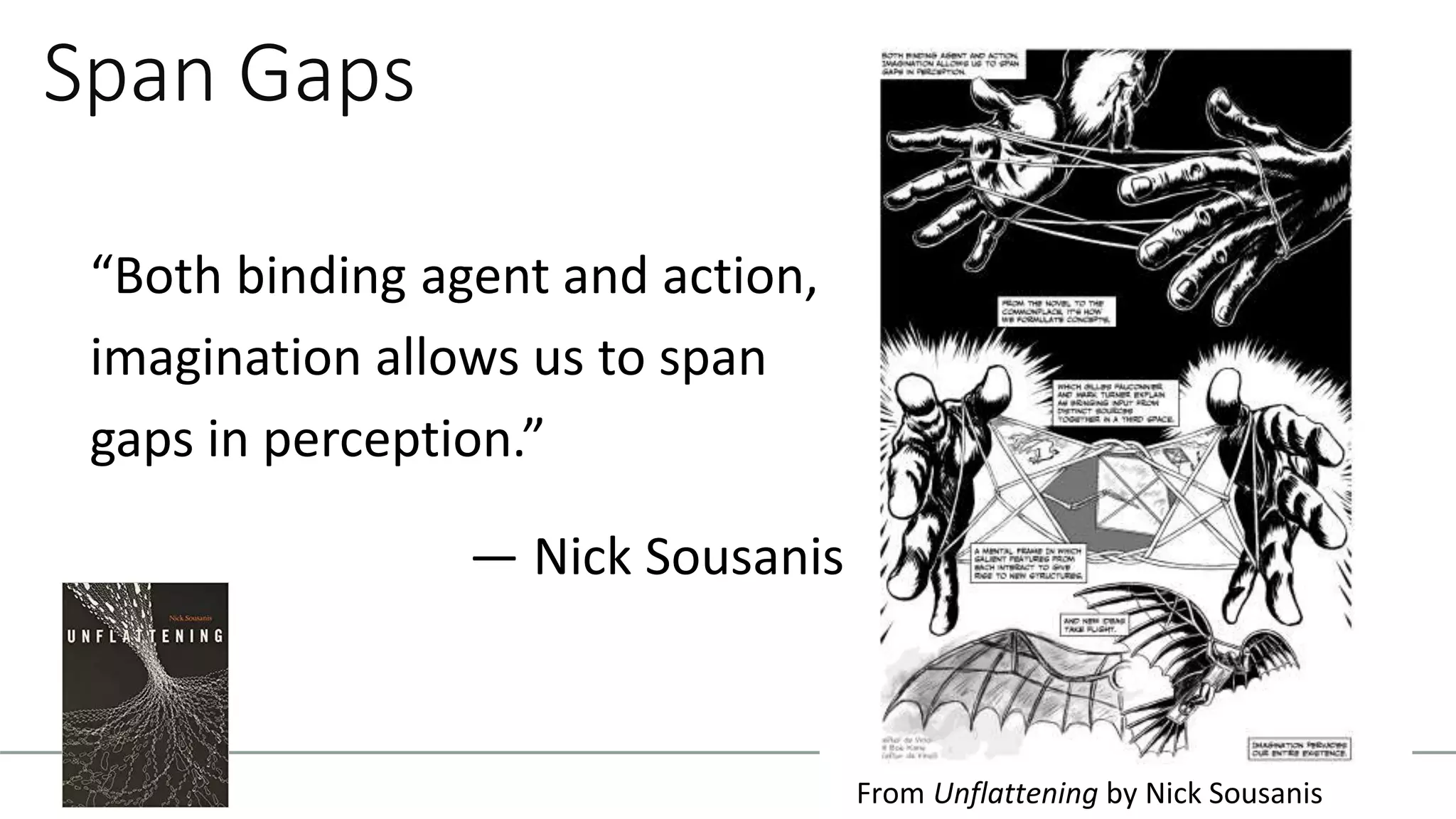
Span Gaps
“Both binding agent and action,
imagination allows us to span
gaps in perception.”
— Nick Sousanis
From Unflattening by Nick Sousanis
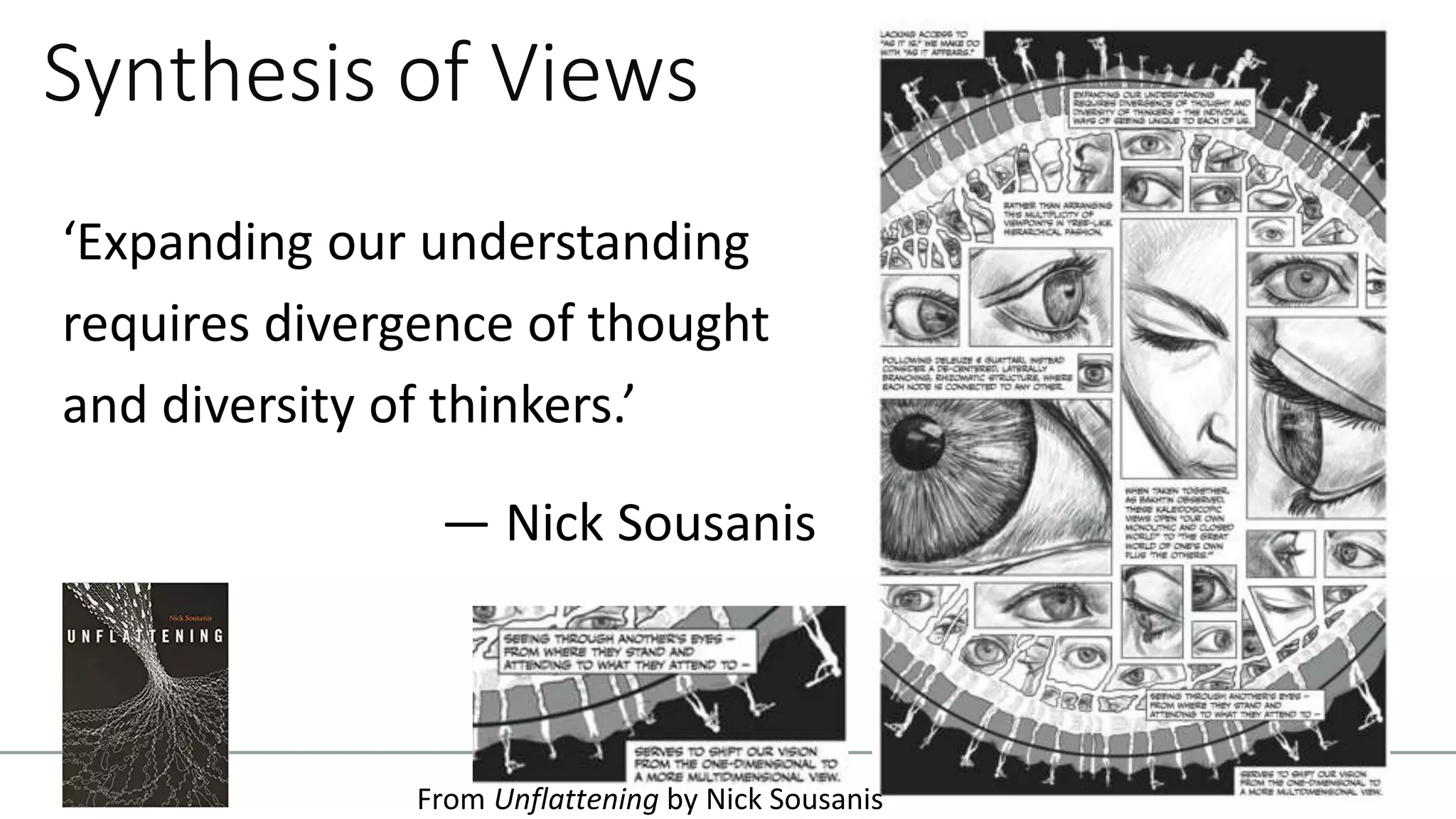
Synthesis of Views
‘Expanding our understanding
requires divergence of thought
and diversity of thinkers.’
— Nick Sousanis
From Unflattening by Nick Sousanis
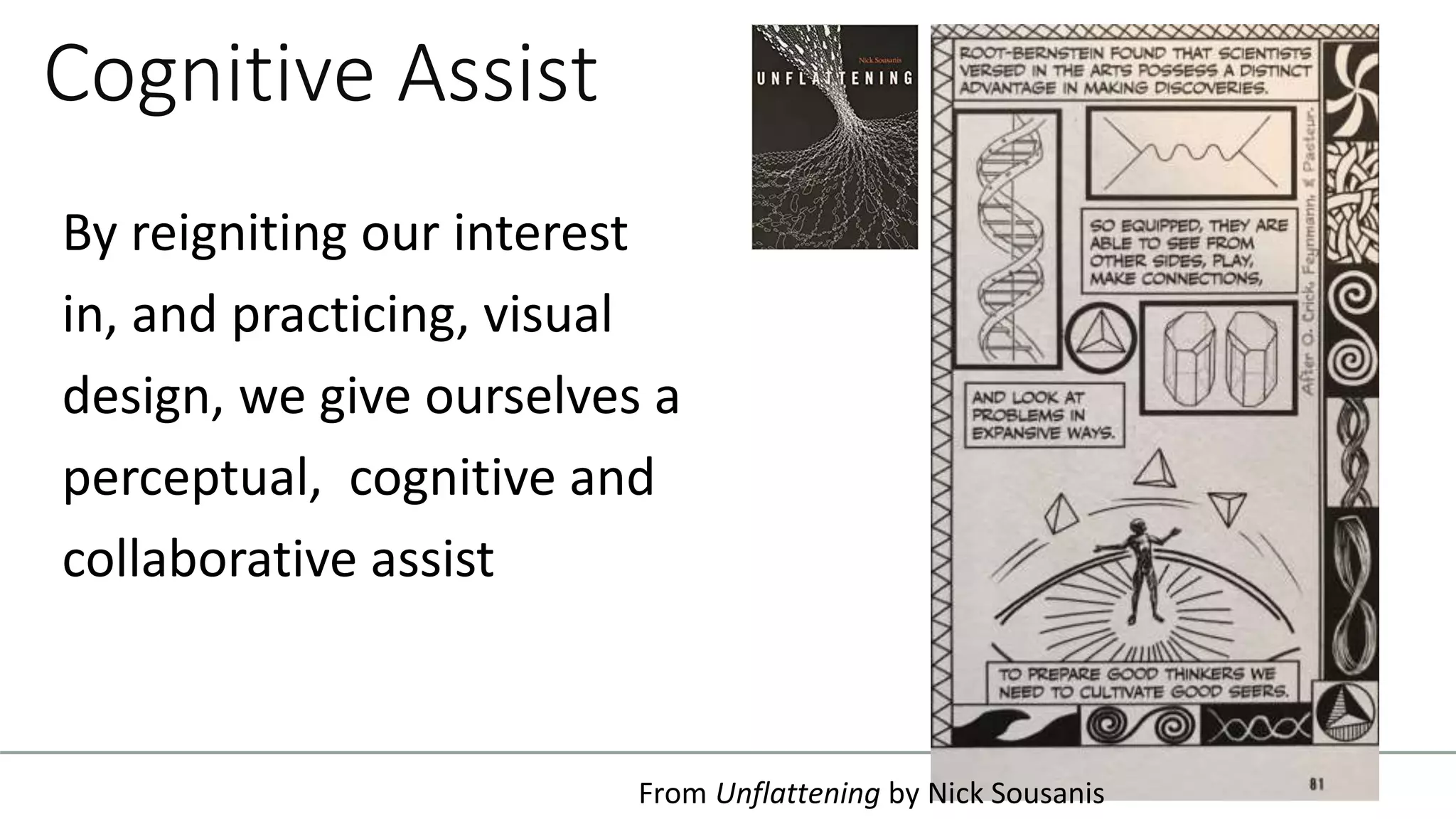
Cognitive Assist
By reigniting our interest
in, and practicing, visual
design, we give ourselves a
perceptual, cognitive and
collaborative assist
From Unflattening by Nick Sousanis
“thoughts put in the world become thinking
tools. A spiral: we put thought in the world,
use it, revise it, use it again. [..]
To remember, remind, and record.
To inform, to influence
— Barbara Tversky
Become Tools to Think (Together)
“To contemplate,
compare, organize,
rearrange, design, and
create.
To show others and
collaborate.”
— Barbara Tversky
From Unflattening
by Nick Sousanis
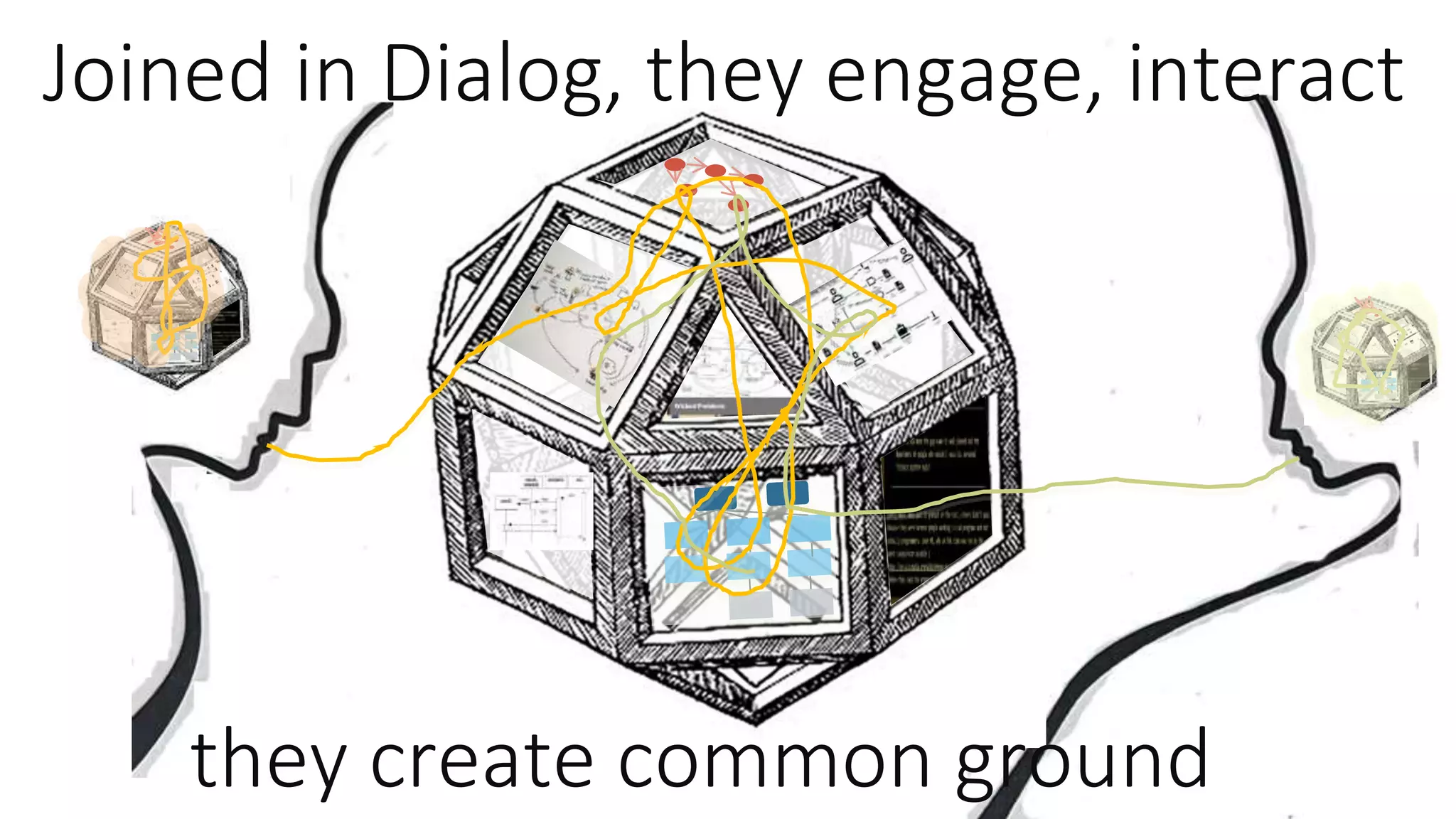
Joined in Dialog, they engage, interact
they create common ground
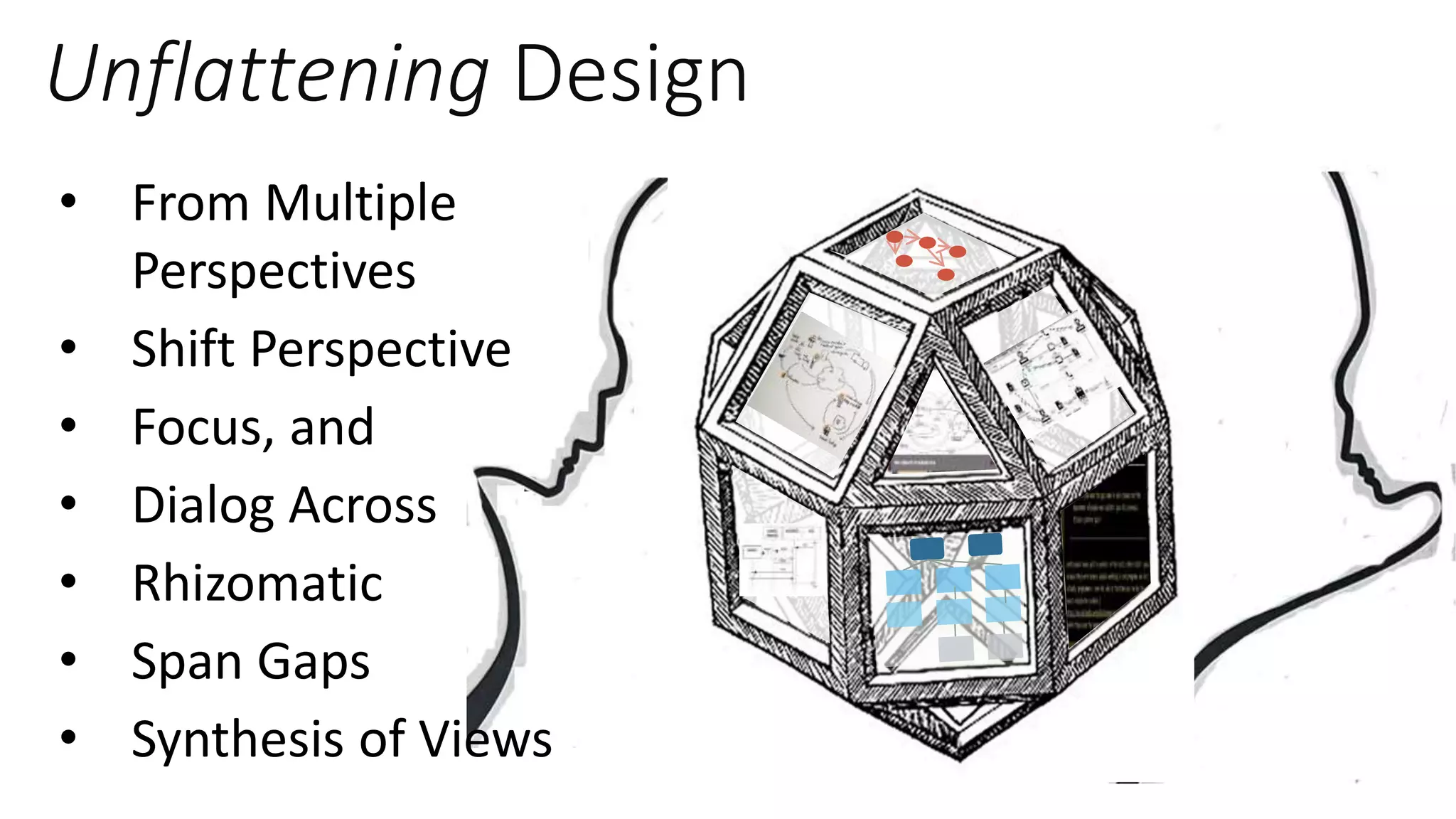
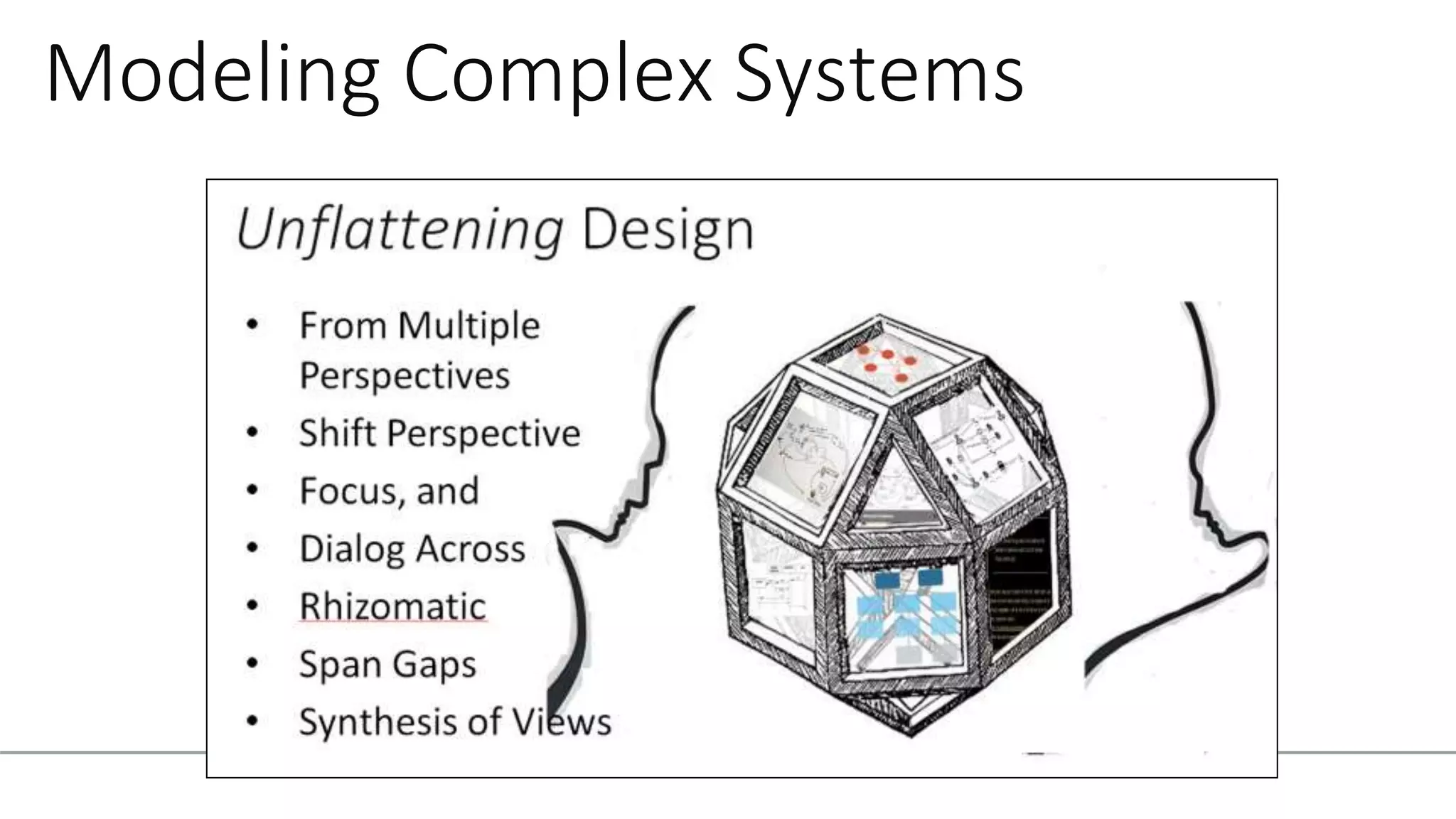
Unflattening Design
• From Multiple
Perspectives
• Shift Perspective
• Focus, and
• Dialog Across
• Rhizomatic
• Span Gaps
• Synthesis of Views
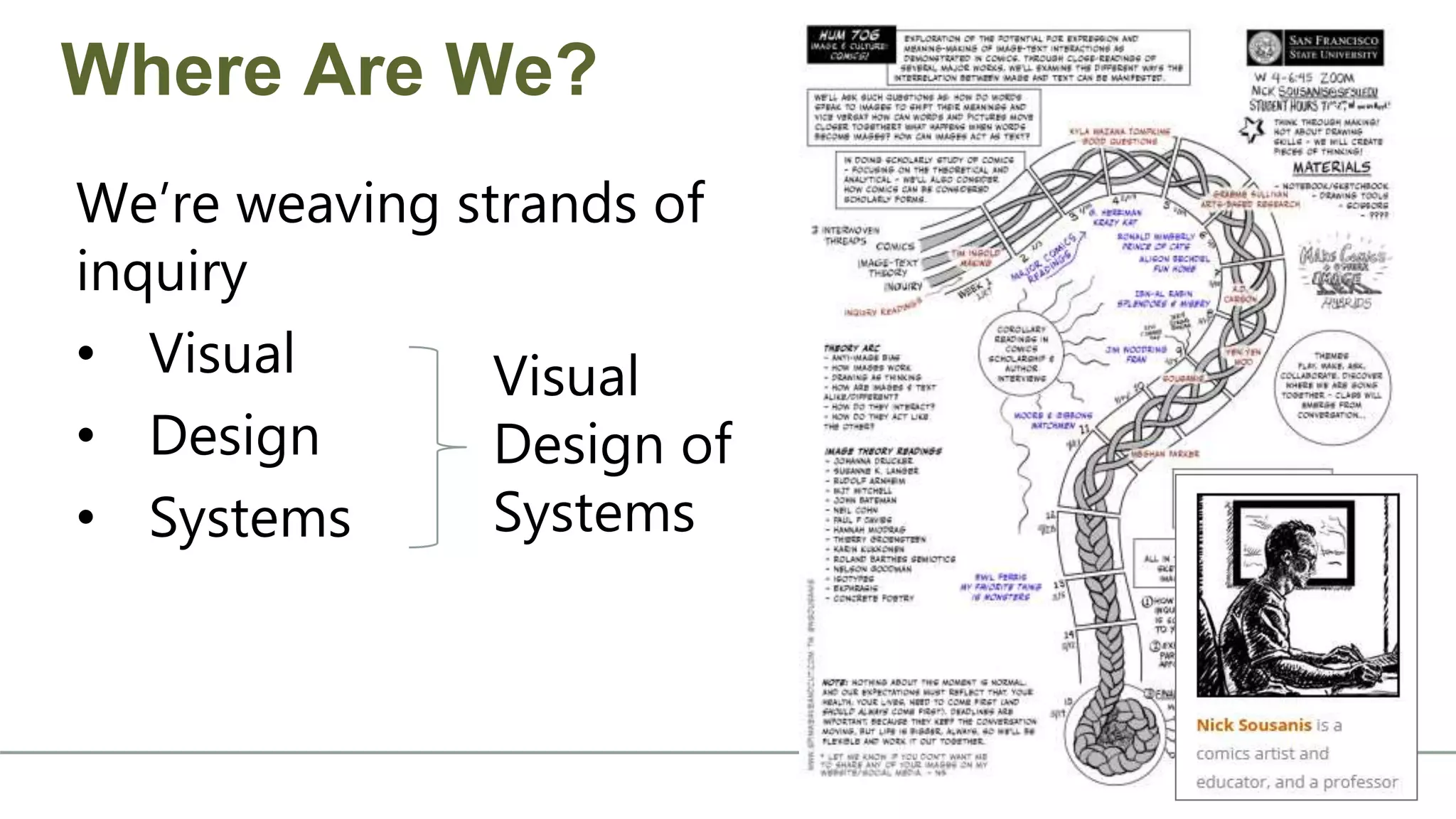
We’re weaving strands of
inquiry
• Visual
• Design
• Systems
Where Are We?
Visual
Design of
Systems
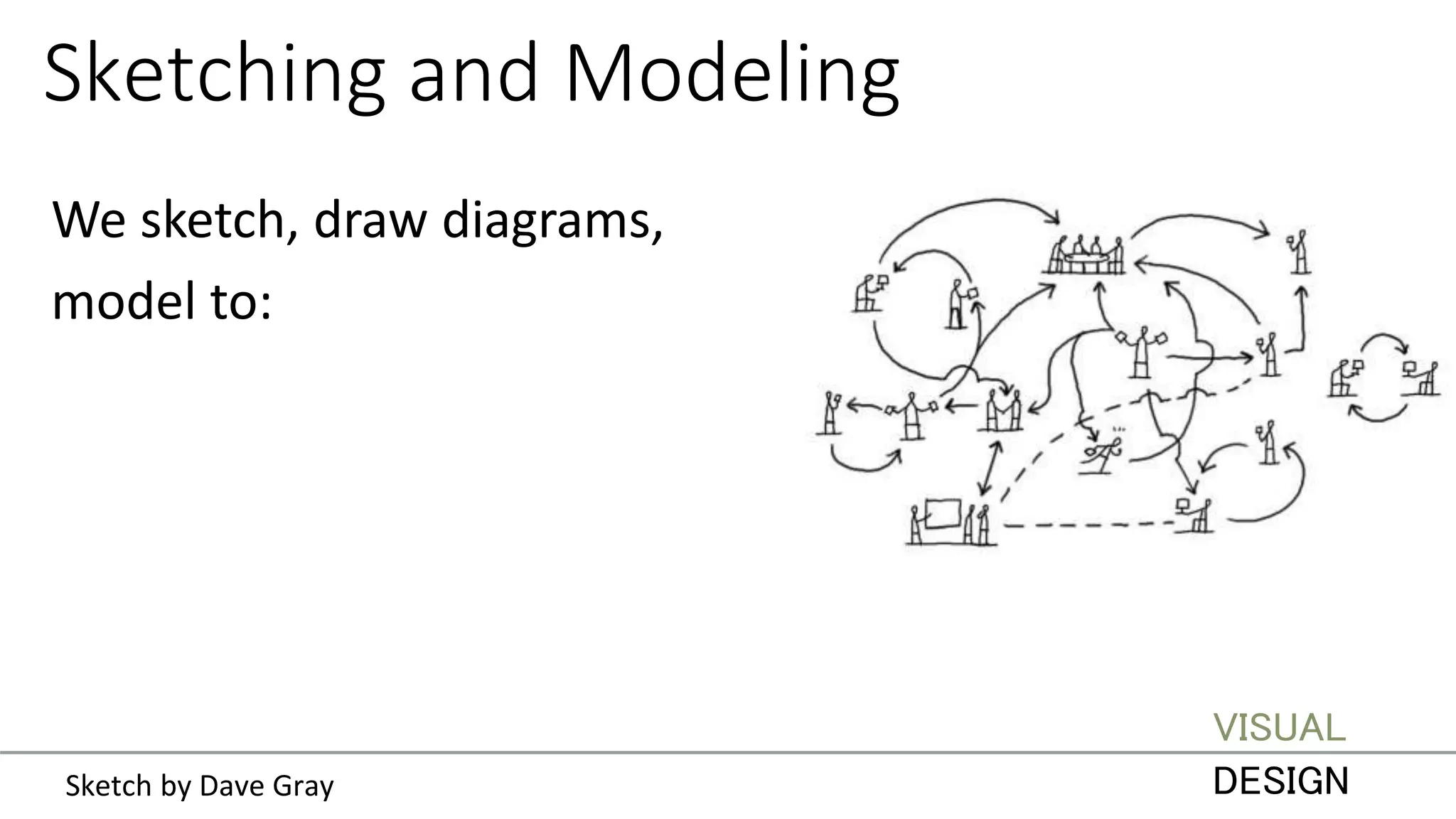
Sketching and Modeling
VISUAL
DESIGN
We sketch, draw diagrams,
model to:
Sketch by Dave Gray
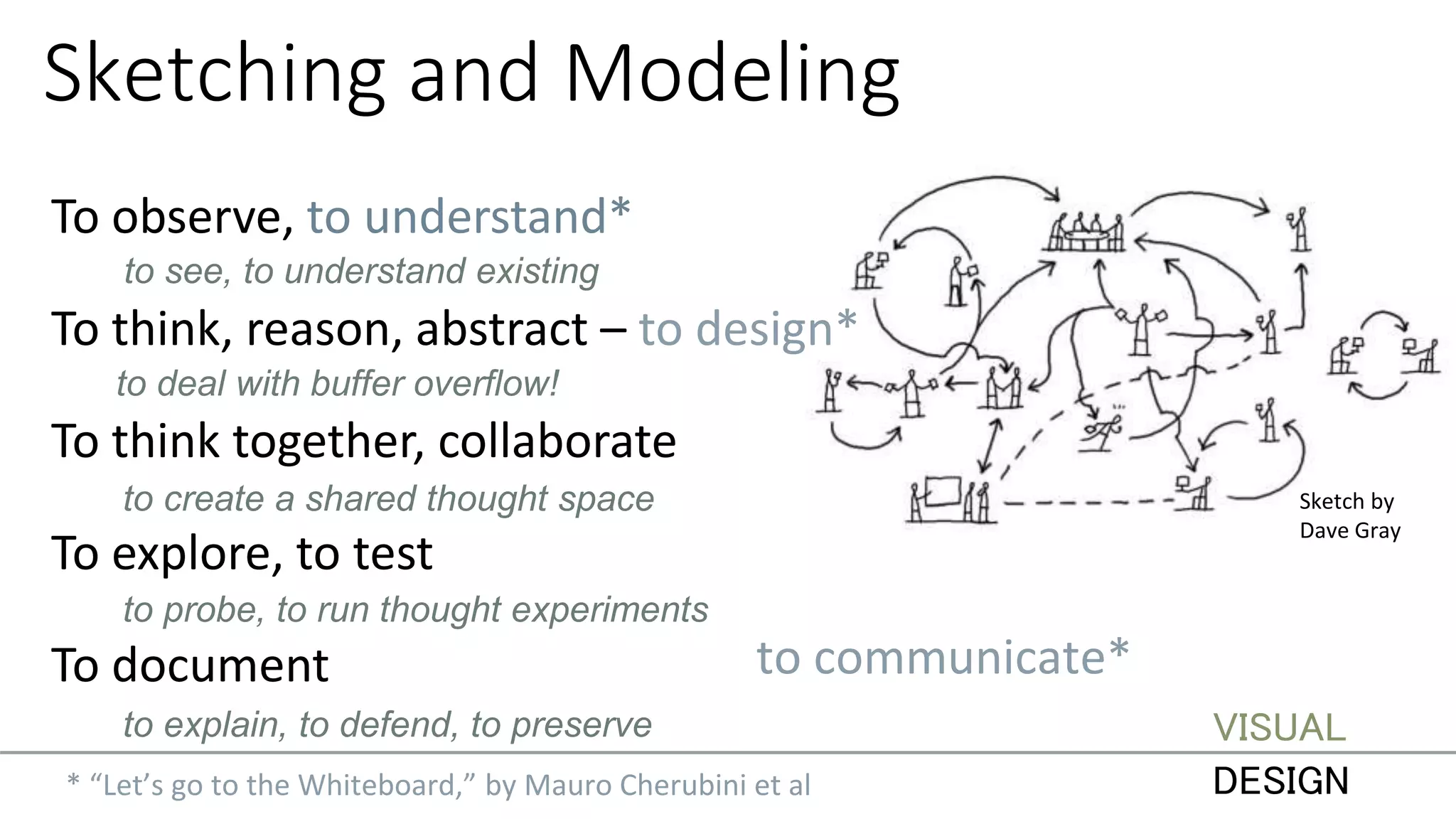
Sketching and Modeling
VISUAL
DESIGN
to deal with buffer overflow!
to create a shared thought space
to explain, to defend, to preserve
to probe, to run thought experiments
to see, to understand existing
To observe, to understand*
To think, reason, abstract – to design*
To think together, collaborate
To explore, to test
To document to communicate*
* “Let’s go to the Whiteboard,” by Mauro Cherubini et al
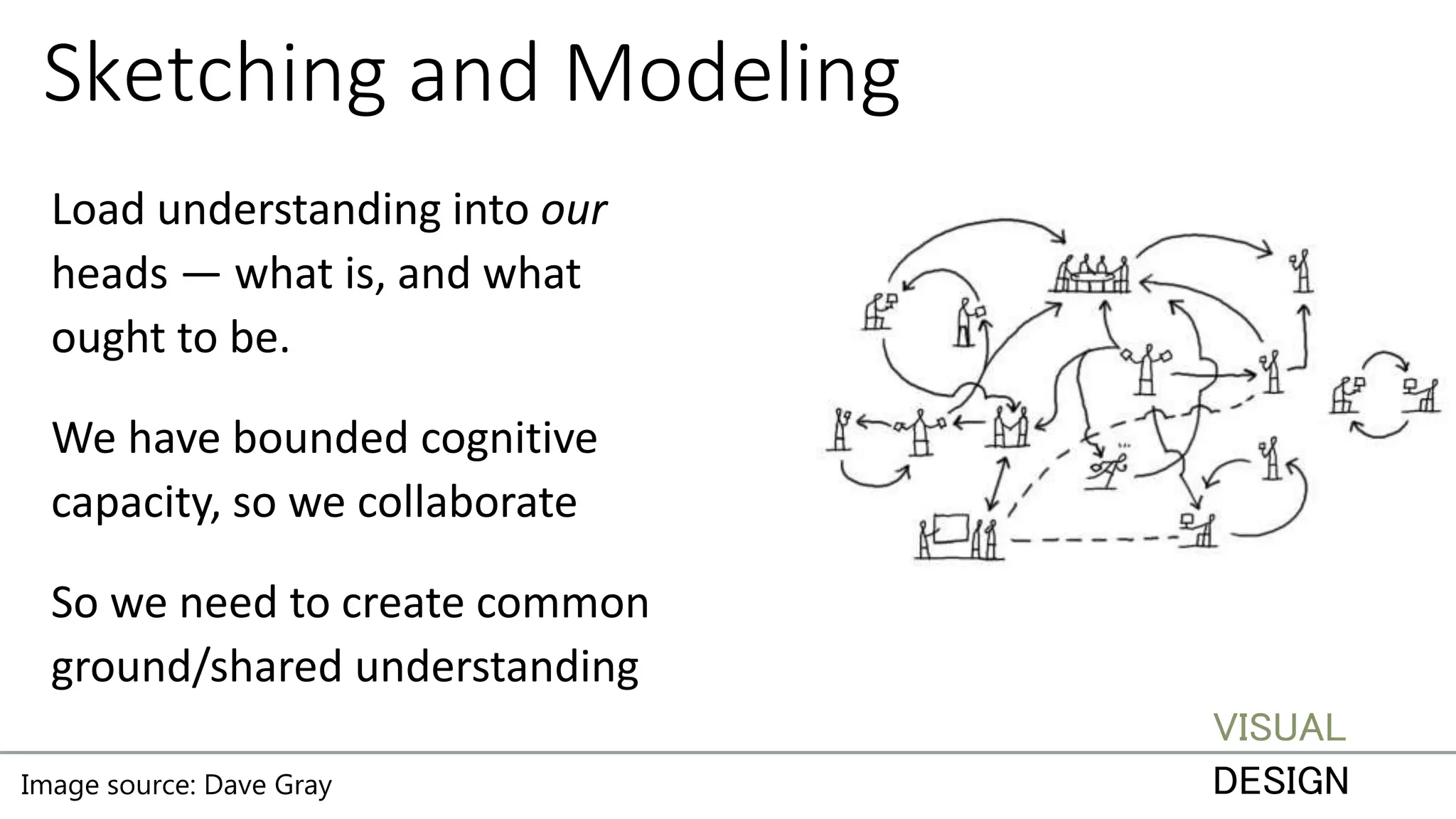
Sketch by
Dave Gray
Why Designers Use Diagrams
• To share: Diagrams externalize internal thought making it
visible to self and others, reifying the mental model for
others to act upon.
• To ground: Human communication embeds ambiguous
interpretations that need to be clarified in conversations:
diagrams can serve this purpose.
• To manipulate: By externalizing a mental model in a drawing,
part of the cognitive process needed to hold it in memory is
relieved and other operations can take place, like joining
different parts, evaluating the design, checking the
consistency, etc. Once externalized, these phases can happen
collaboratively, capturing joint attention and enabling
gesturing.
• To brainstorm: Ambiguity in sketches is a source of creativity.
Unintended interpretations and ideas can arise when
inspecting an initial arrangement of a sketch.
Sketching and Modeling
Load understanding into our
heads — what is, and what
ought to be.
We have bounded cognitive
capacity, so we collaborate
So we need to create common
ground/shared understanding
Image source: Dave Gray
VISUAL
DESIGN
1995
Put Thought into the World text too
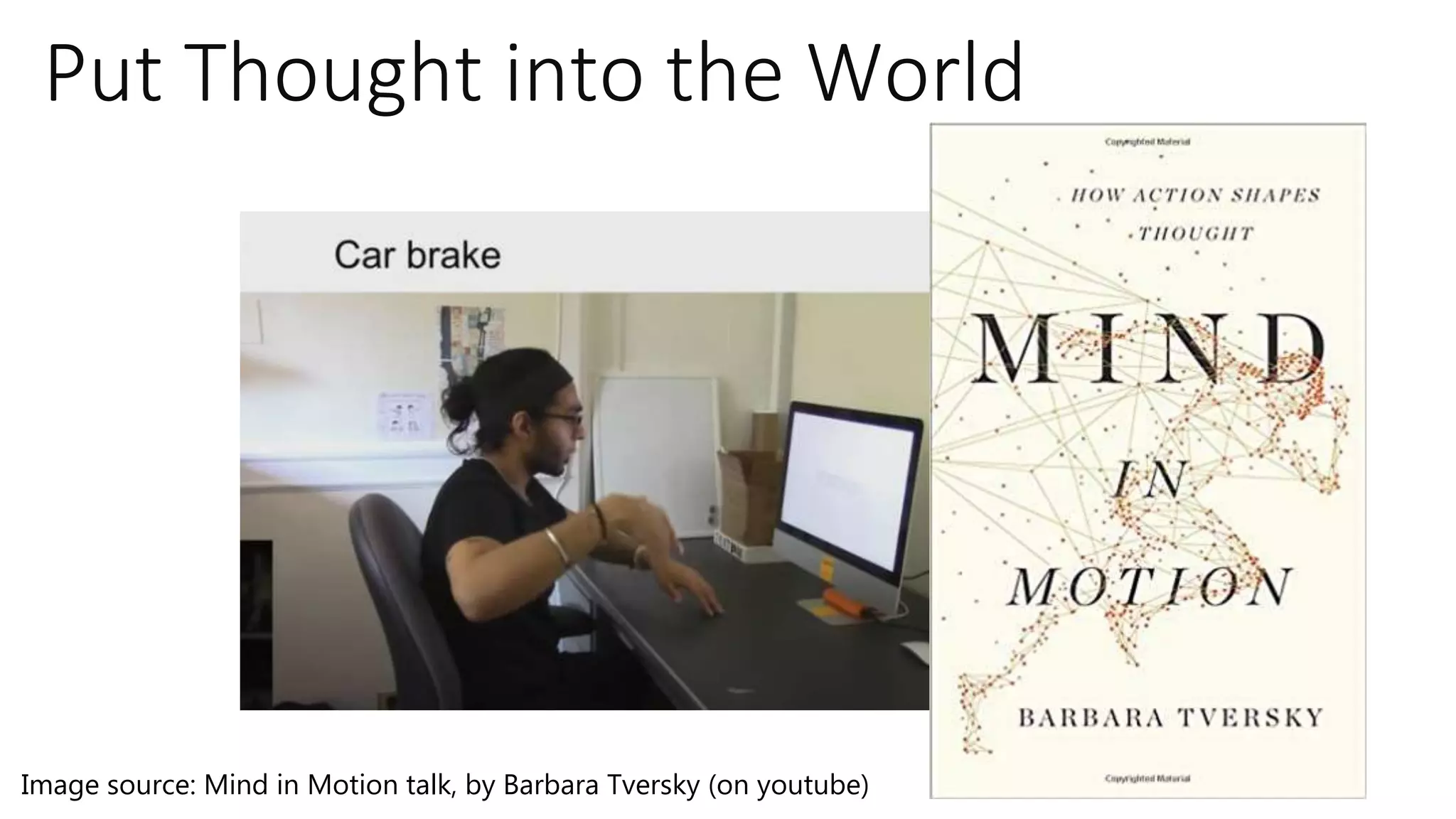
Put Thought into the World
Image source: Mind in Motion talk, by Barbara Tversky (on youtube)
Let’s Try This
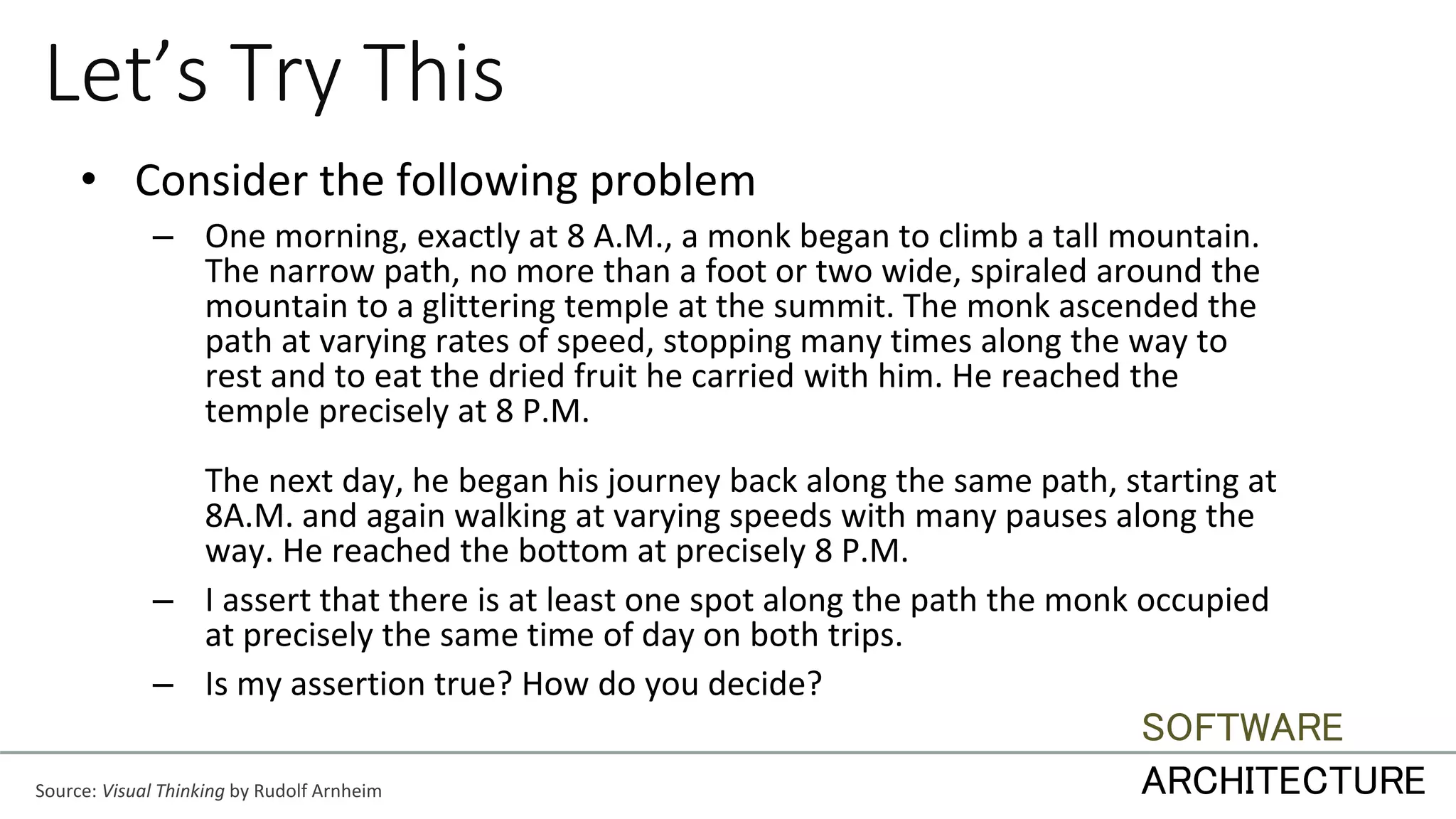
• Consider the following problem
– One morning, exactly at 8 A.M., a monk began to climb a tall mountain.
The narrow path, no more than a foot or two wide, spiraled around the
mountain to a glittering temple at the summit. The monk ascended the
path at varying rates of speed, stopping many times along the way to
rest and to eat the dried fruit he carried with him. He reached the
temple precisely at 8 P.M.
The next day, he began his journey back along the same path, starting at
8A.M. and again walking at varying speeds with many pauses along the
way. He reached the bottom at precisely 8 P.M.
– I assert that there is at least one spot along the path the monk occupied
at precisely the same time of day on both trips.
– Is my assertion true? How do you decide?
Source: Visual Thinking by Rudolf Arnheim
SOFTWARE
ARCHITECTURE
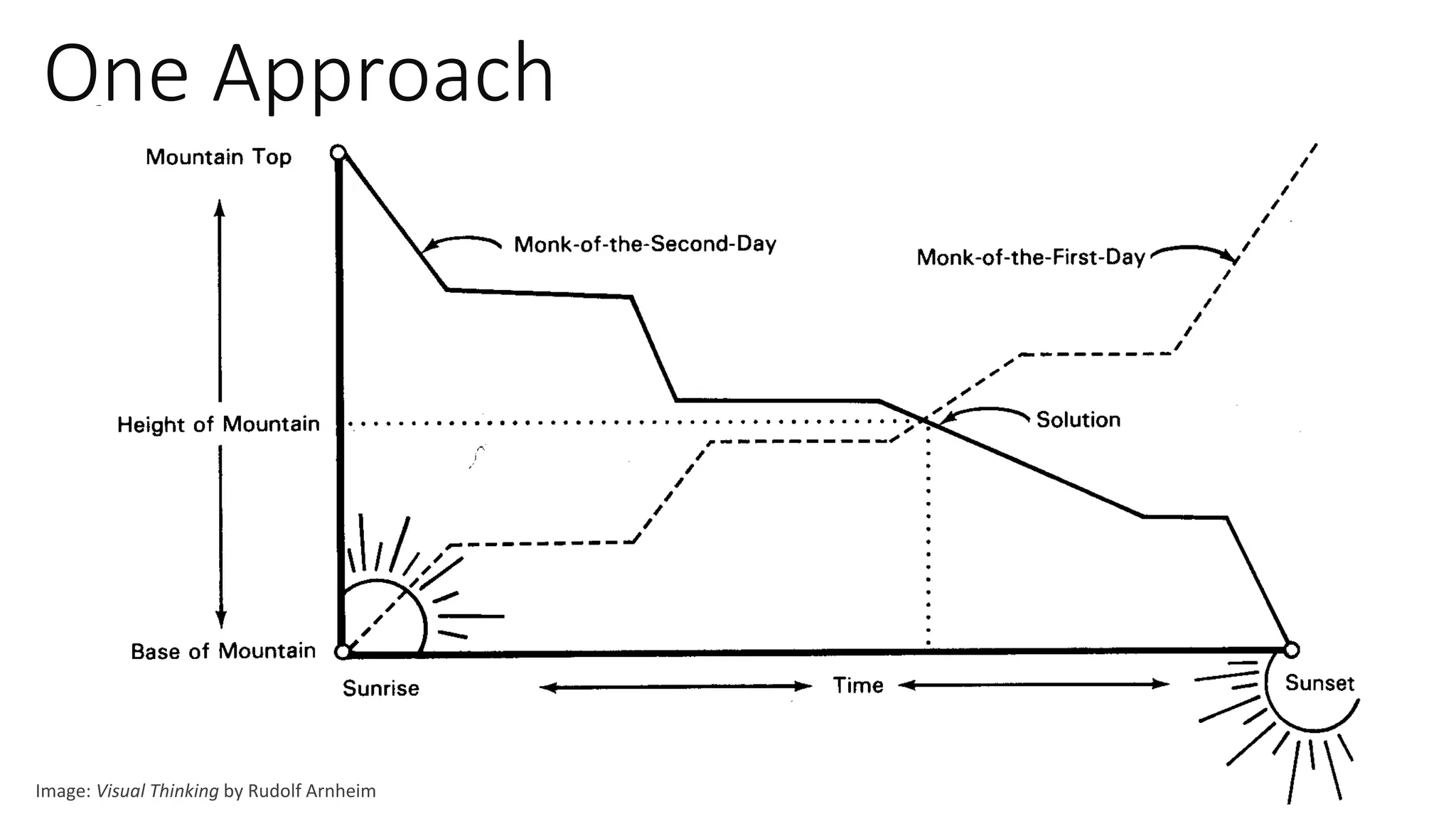
One Approach
Image: Visual Thinking by Rudolf Arnheim
System
“The defining properties of
any system, are properties
of the whole, which none of
the parts have. If you take
the system apart, it loses its
essential properties”
— Russell Ackoff
VISUAL
DESIGN
Boundaries
“In order to be recognisable as such, a system
must be bounded in some way.”
“Weoftenfallintothetrapof thinking of a
boundary as something that separates one thing
from another. We should ratherthinkofa
boundaryassomethingthatconstitutesthatwhich
isbounded.”
—PaulCilliers
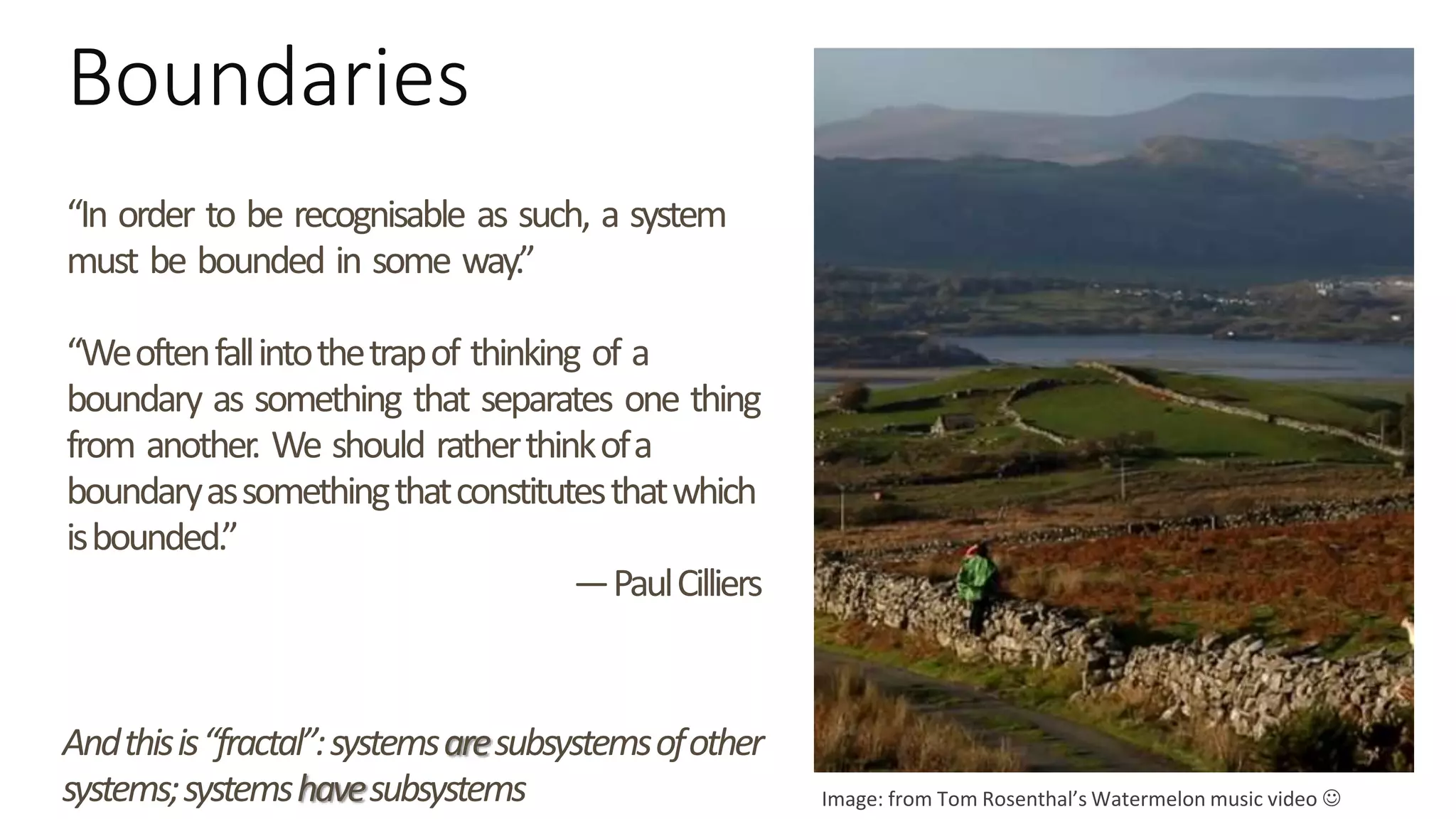
Image: from Tom Rosenthal’s Watermelon music video 
Andthisis“fractal”:systemsaresubsystemsofother
systems;systemshavesubsystems
Design: System (Inside)
System
Architecture
Structure and
mechanisms
Systemelementsandrelationships
• (de)composition
• isthiscomponentdifferentiating(keep
internal)?ordoweneedtosupportan
externalinteraction?
Systembehaviorsandproperties
• interactionsgiverisetocapabilitiesand
properties(emergence)
Whymodel?Codeputsthoughtsintheworld,but
eventhatgetstoobig!Toreasonacrossthesystem. To
reasonaboutinteractions.Toreasontogether.
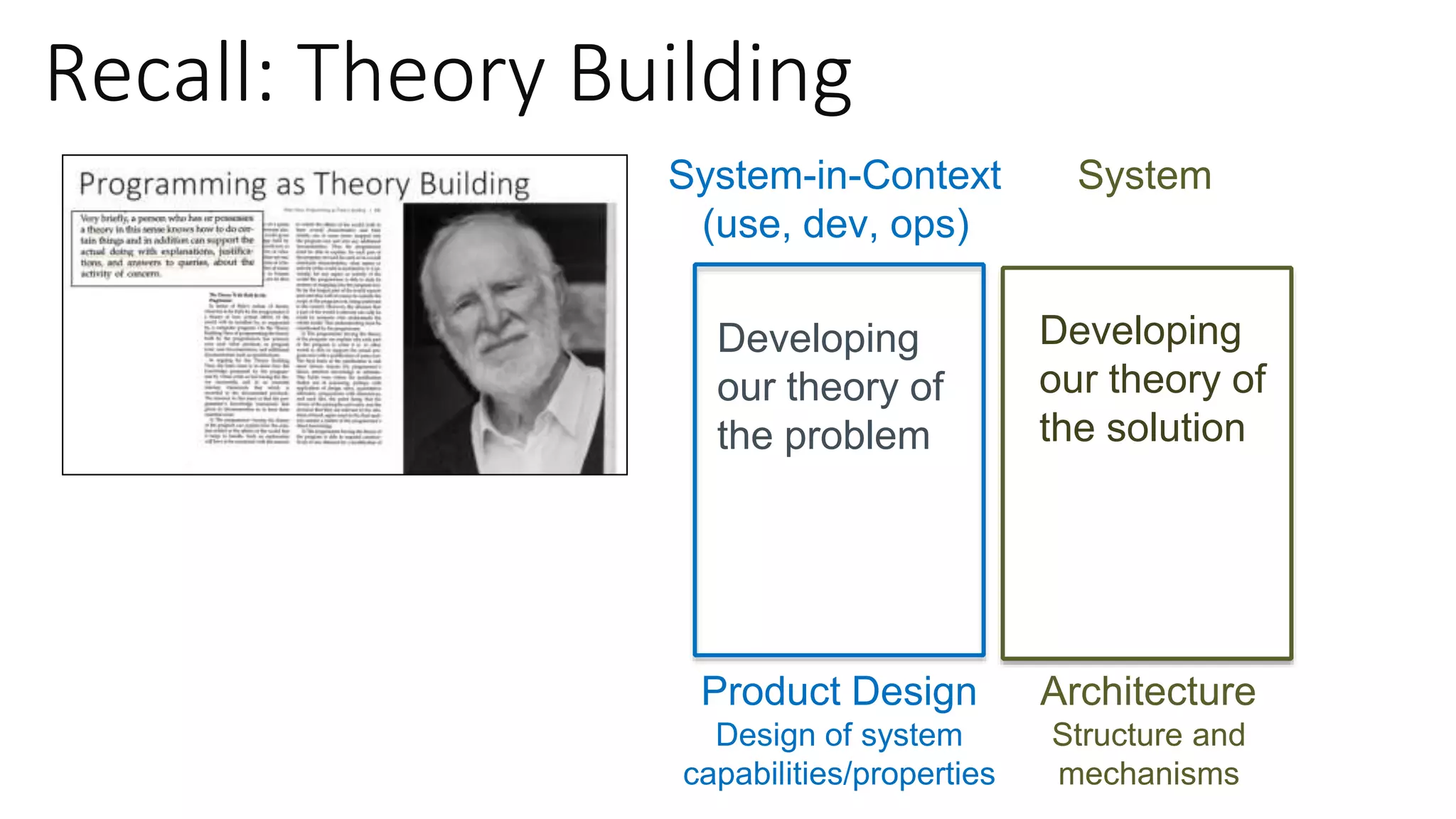
Recall: Theory Building
System-in-Context
(use, dev, ops)
Product Design
Design of system
capabilities/properties
Architecture
Structure and
mechanisms
System
Developing
our theory of
the problem
Developing
our theory of
the solution
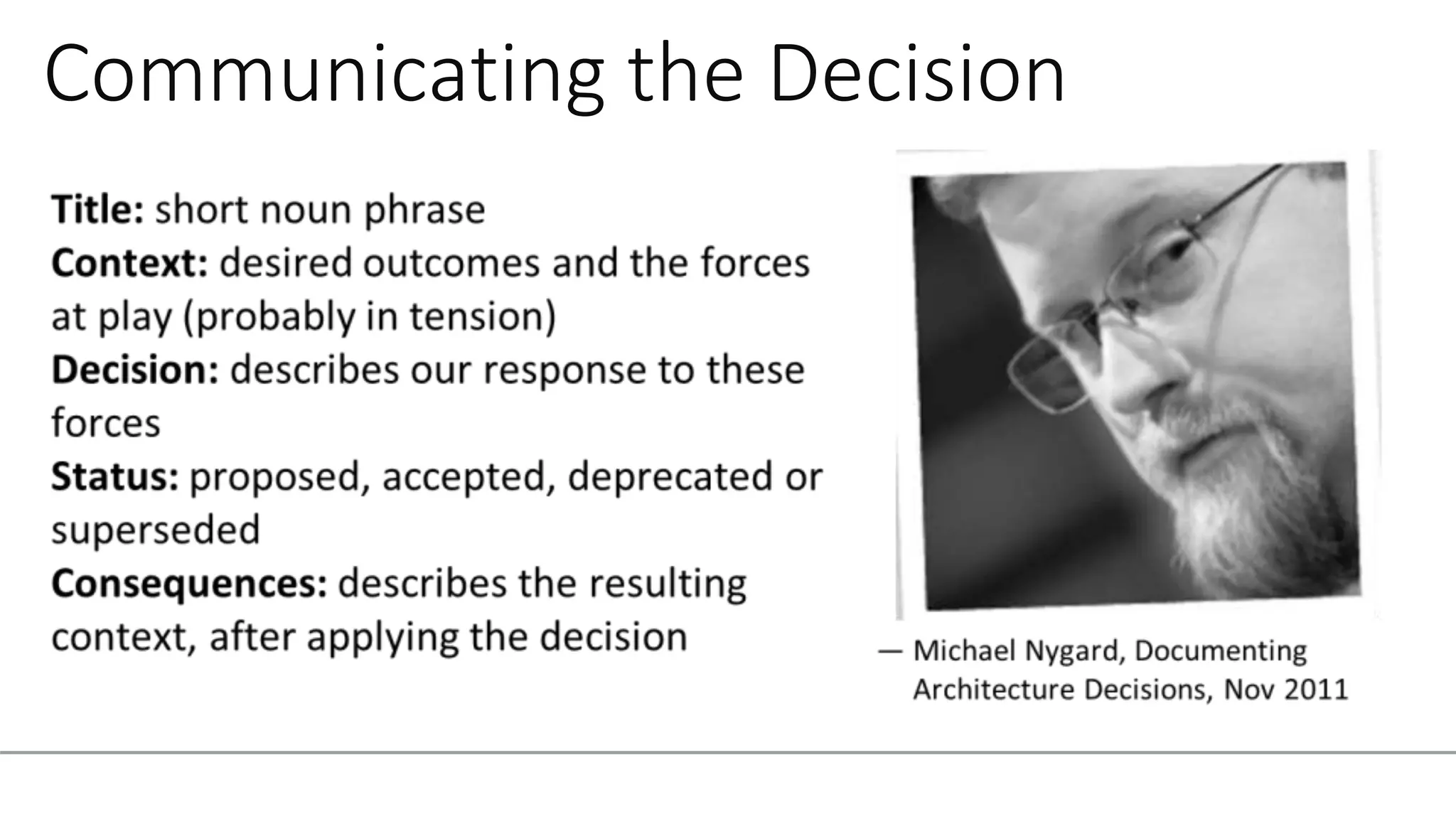
Communicating the Decision
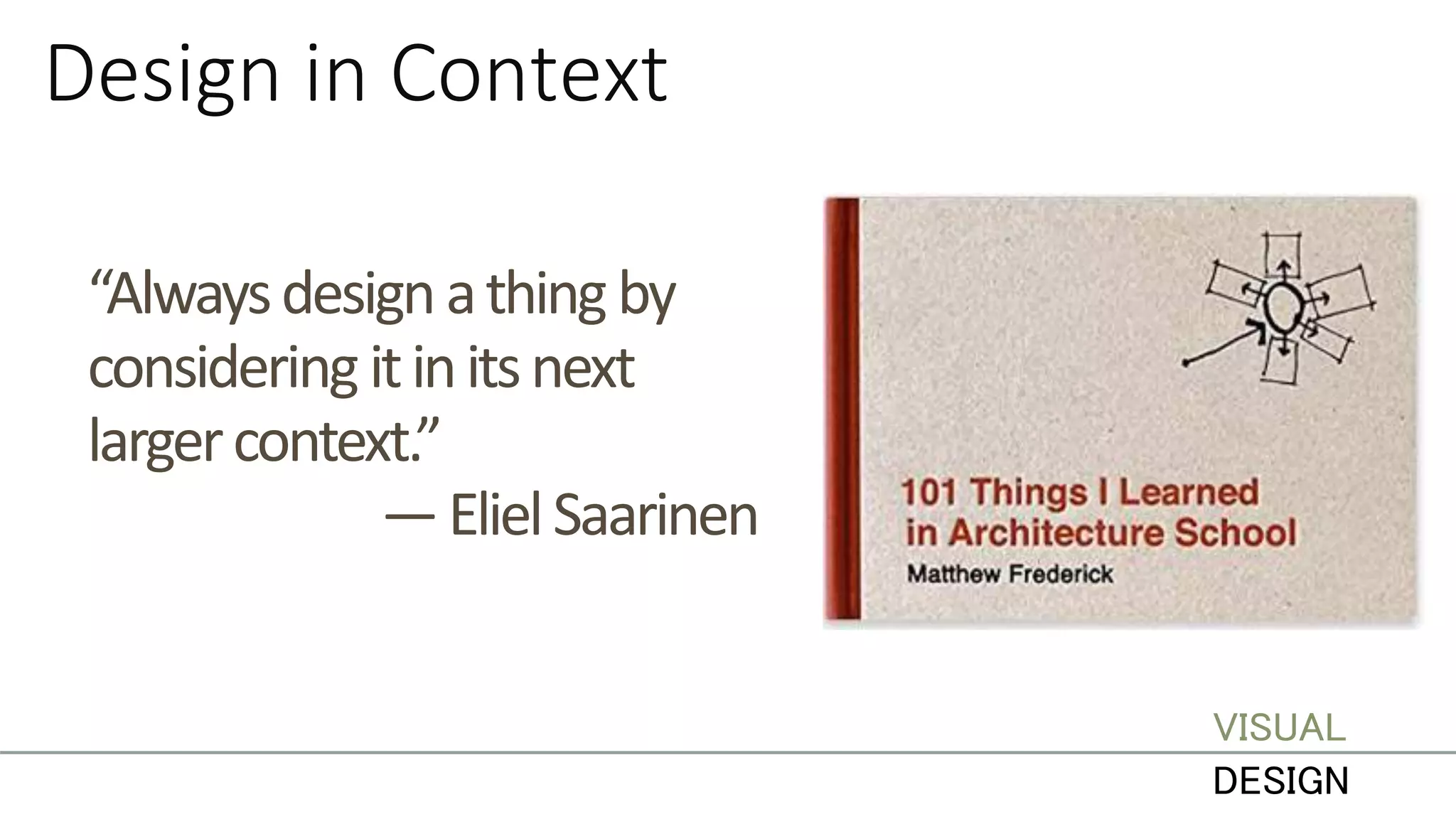
Design in Context
“Alwaysdesignathing by
considering itinitsnext
largercontext.”
—ElielSaarinen
VISUAL
DESIGN
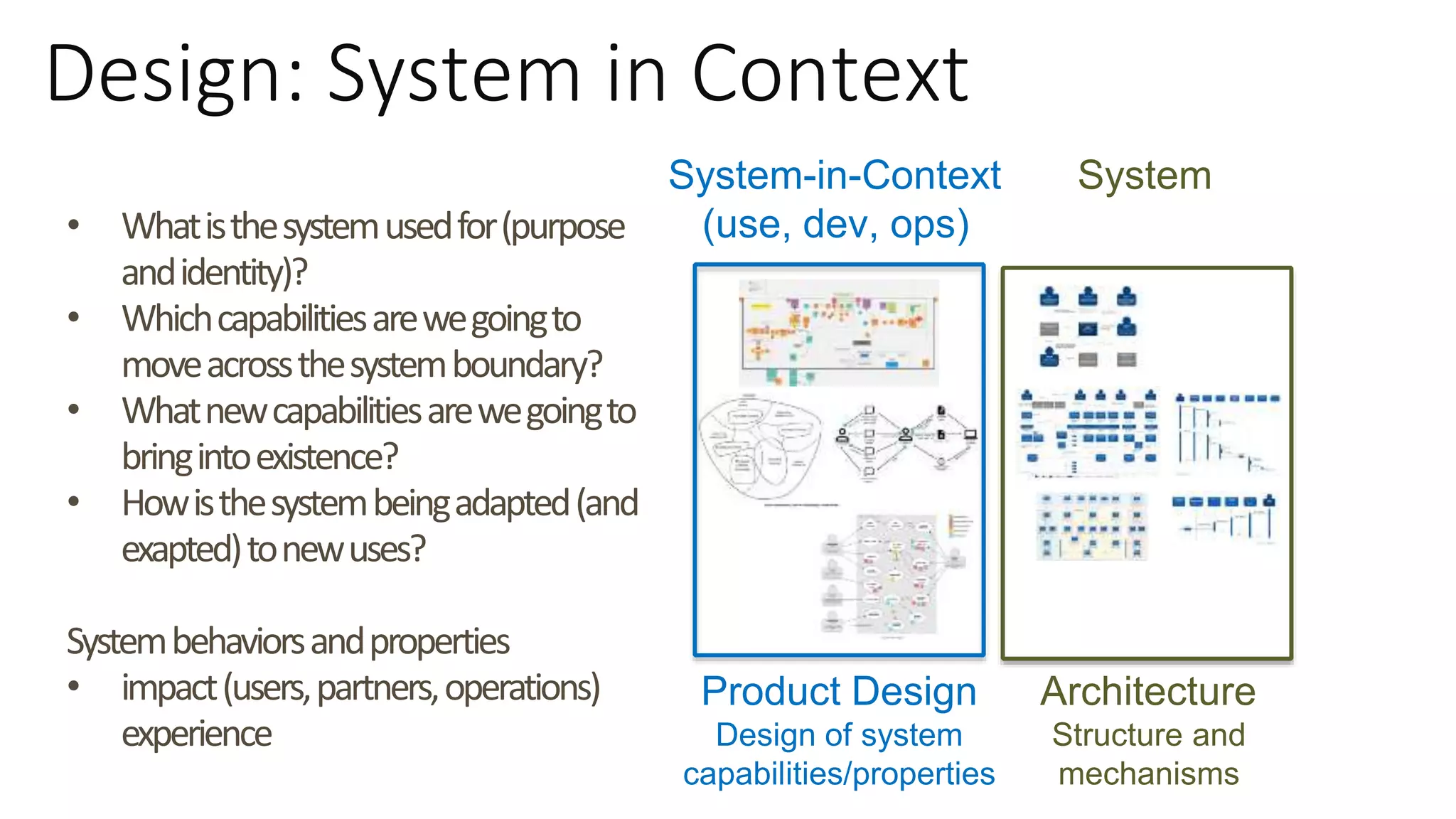
Design: System in Context
System-in-Context
(use, dev, ops)
Product Design
Design of system
capabilities/properties
Architecture
Structure and
mechanisms
• Whatisthesystemusedfor(purpose
andidentity)?
• Whichcapabilitiesarewegoingto
moveacrossthesystemboundary?
• Whatnewcapabilitiesarewegoingto
bringintoexistence?
• Howisthesystembeingadapted(and
exapted)tonewuses?
Systembehaviorsandproperties
• impact(users,partners,operations)
experience
System
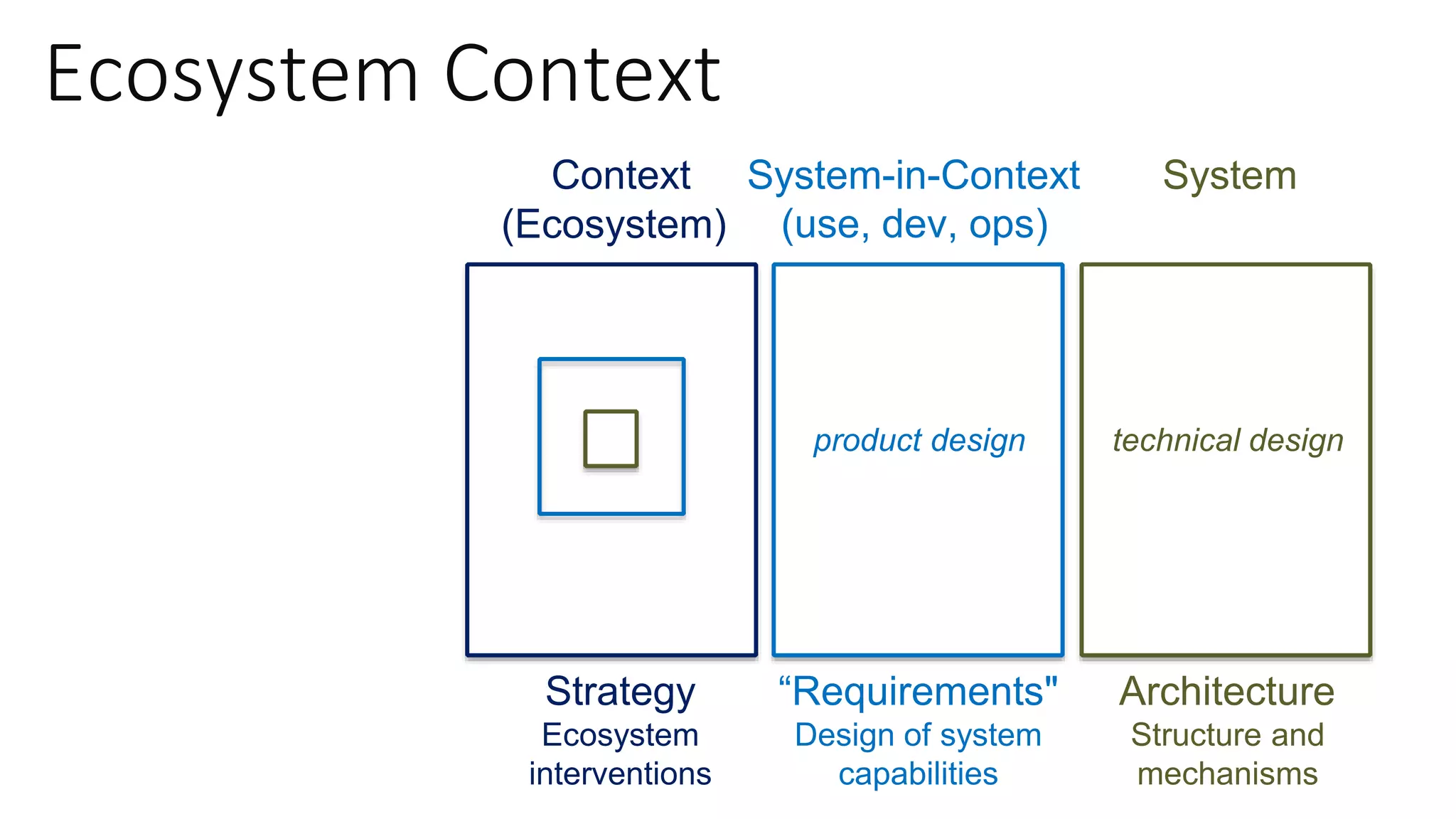
Ecosystem Context
Context System-in-Context
(use, dev, ops)
System
(Ecosystem)
Strategy
Ecosystem
interventions
“Requirements"
Design of system
capabilities
Architecture
Structure and
mechanisms
product design technical design
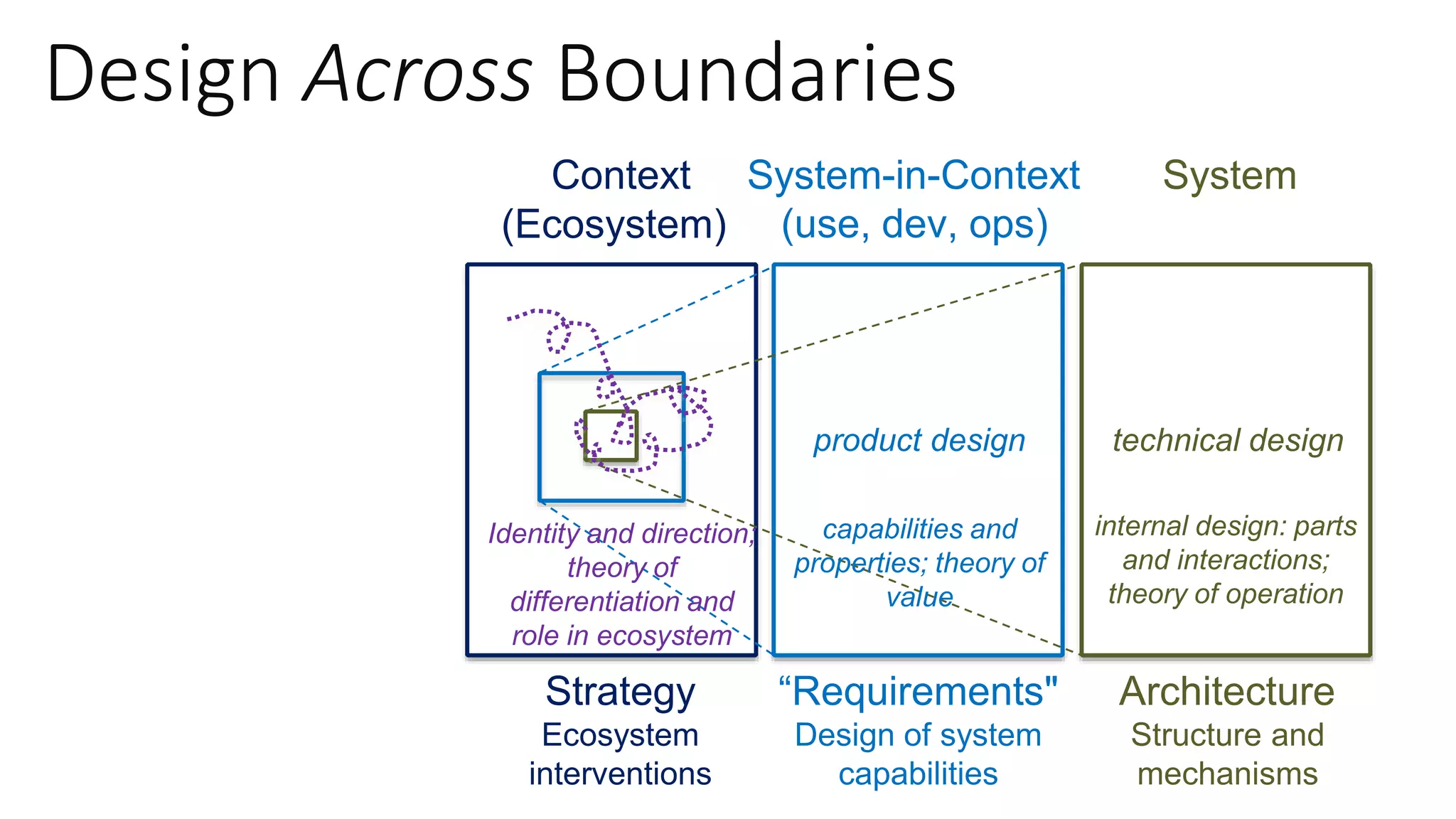
Design Across Boundaries
Context System-in-Context
(use, dev, ops)
System
(Ecosystem)
Strategy
Ecosystem
interventions
“Requirements"
Design of system
capabilities
Architecture
Structure and
mechanisms
internal design: parts
and interactions;
theory of operation
product design technical design
capabilities and
properties; theory of
value
Identity and direction;
theory of
differentiation and
role in ecosystem
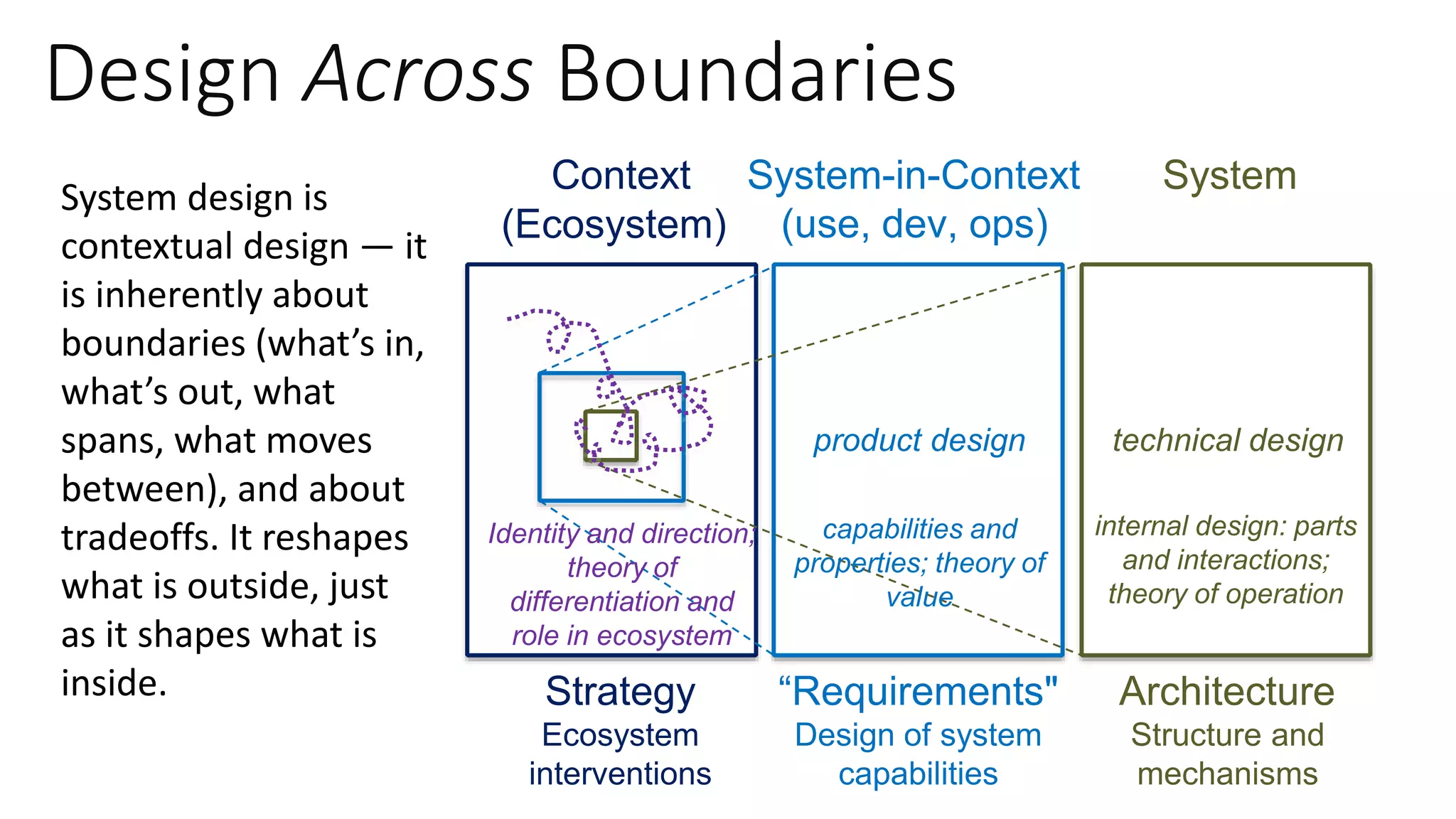
Design Across Boundaries
Context System-in-Context
(use, dev, ops)
System
(Ecosystem)
Strategy
Ecosystem
interventions
“Requirements"
Design of system
capabilities
Architecture
Structure and
mechanisms
System design is
contextual design — it
is inherently about
boundaries (what’s in,
what’s out, what
spans, what moves
between), and about
tradeoffs. It reshapes
what is outside, just
as it shapes what is
inside.
internal design: parts
and interactions;
theory of operation
product design technical design
capabilities and
properties; theory of
value
Identity and direction;
theory of
differentiation and
role in ecosystem
Modeling Complex Systems
Sociotechnical Systems
Sociotechnical systems
refers to systems that have
social and technical
elements, and there is
mutual influence and
interaction of technical and
social elements
How Complex Systems Fail
1. Complex systems are intrinsically hazardous systems
2. Complex systems are heavily and successfully
defended against failure
3. Catastrophe requires multiple failures – single point
failures are not enough
4. Complex systems contain changing mixtures of
failures latent within them
6. Catastrophe is always just around the corner
16. Safety is a characteristic of systems and not of their
components: Safety is an emergent property of systems
-- Richard I. Cook
Source: Richard I. Cook, How Complex Systems Fail
How Complex Systems Fail
1. Complex systems are intrinsically hazardous systems
2. Complex systems are heavily and successfully
defended against failure
3. Catastrophe requires multiple failures – single point
failures are not enough
4. Complex systems contain changing mixtures of
failures latent within them
6. Catastrophe is always just around the corner
16. Safety is a characteristic of systems and not of their
components: Safety is an emergent property of systems
Modeling Complex Systems
It’s a lot! To grasp.
Still, choose (how much, which views, ..) wisely
Diana Montalion’s heuristic equation:
Wisdom = f(knowledge, experience, good judgment)
VISUAL
DESIGN
TECHNICAL
LEADERSHIP
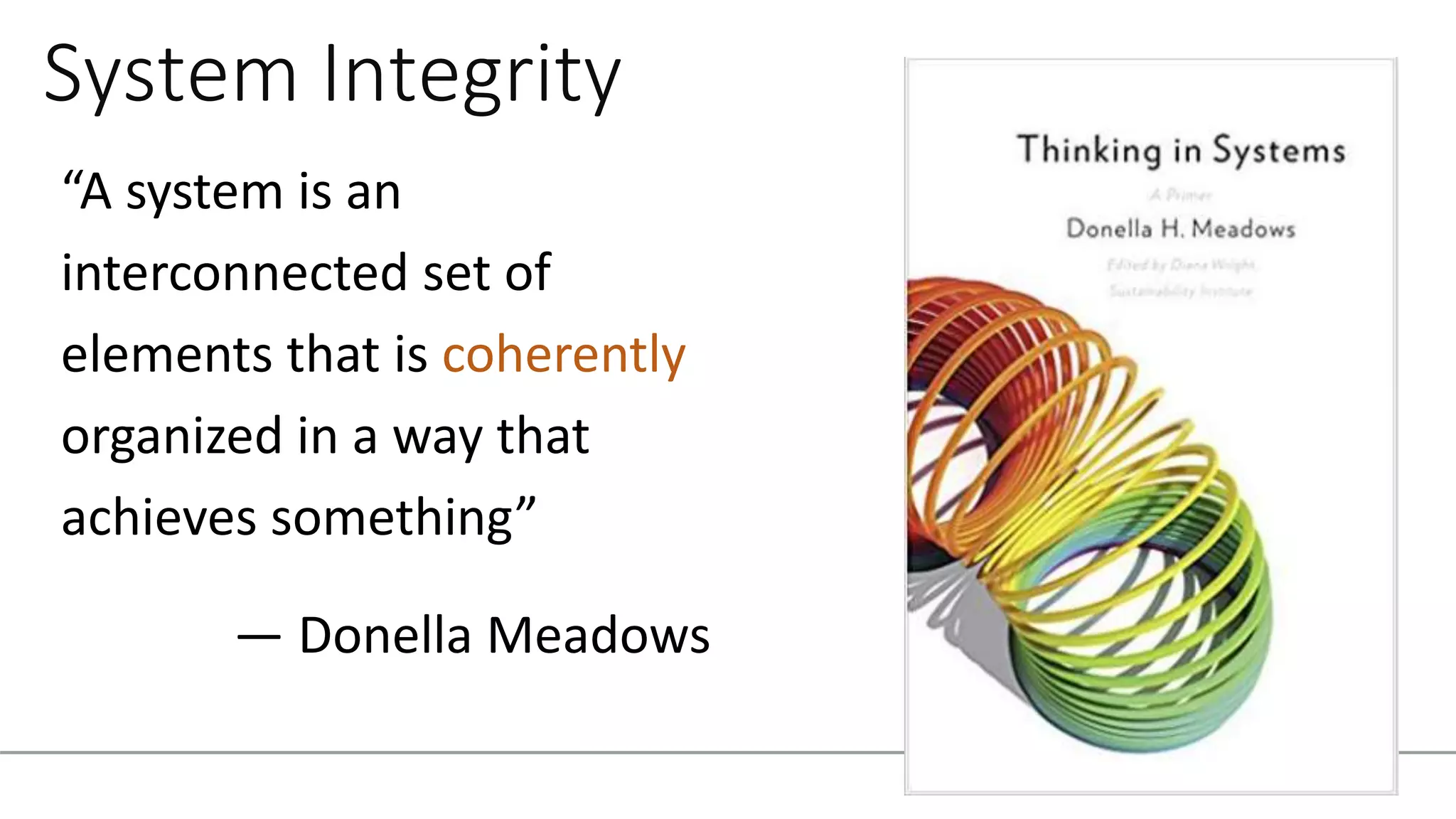
System Integrity
“A system is an
interconnected set of
elements that is coherently
organized in a way that
achieves something”
— Donella Meadows
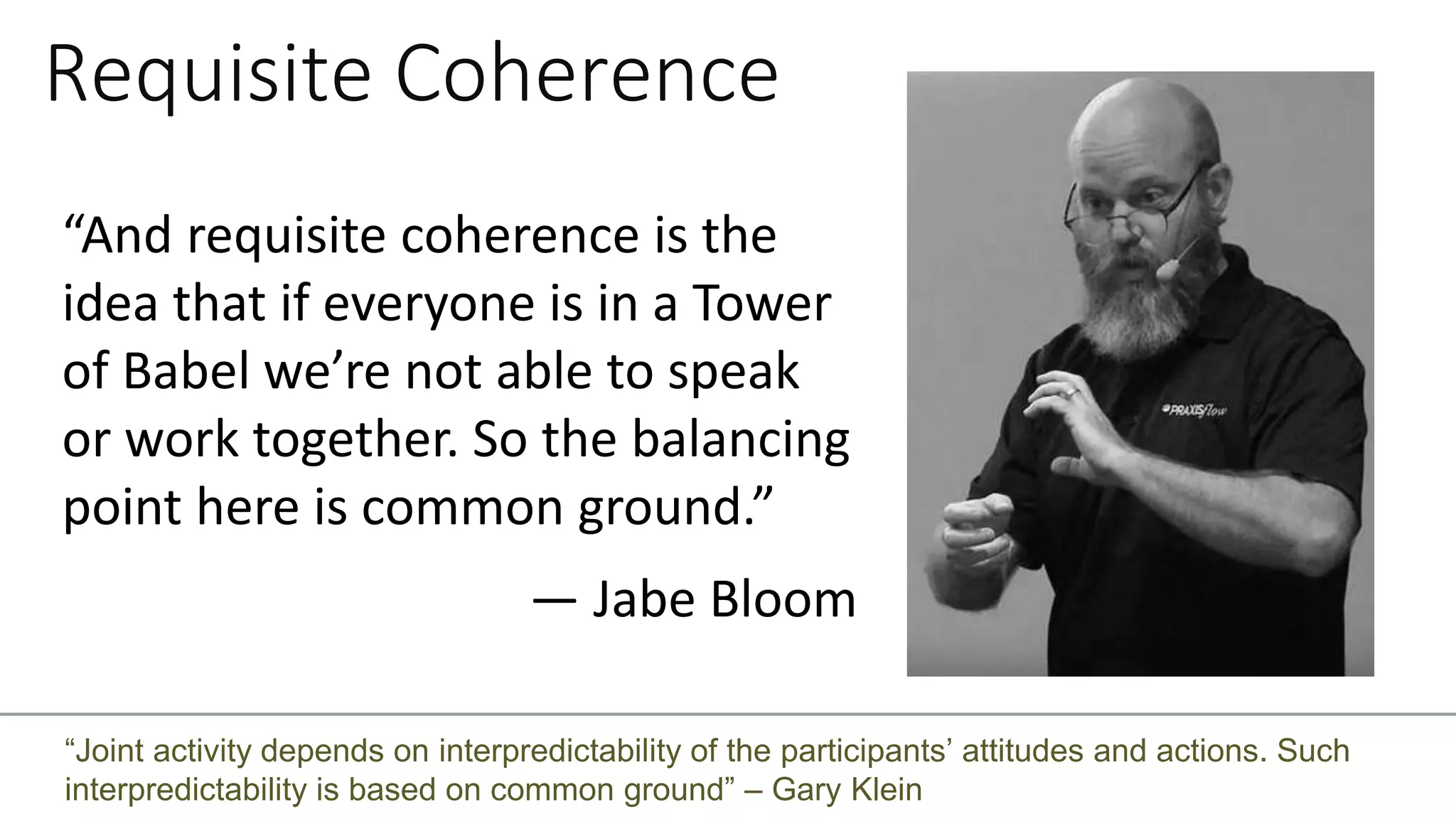
Requisite Coherence
“And requisite coherence is the
idea that if everyone is in a Tower
of Babel we’re not able to speak
or work together. So the balancing
point here is common ground.”
— Jabe Bloom
“Joint activity depends on interpredictability of the participants’ attitudes and actions. Such
interpredictability is based on common ground” – Gary Klein
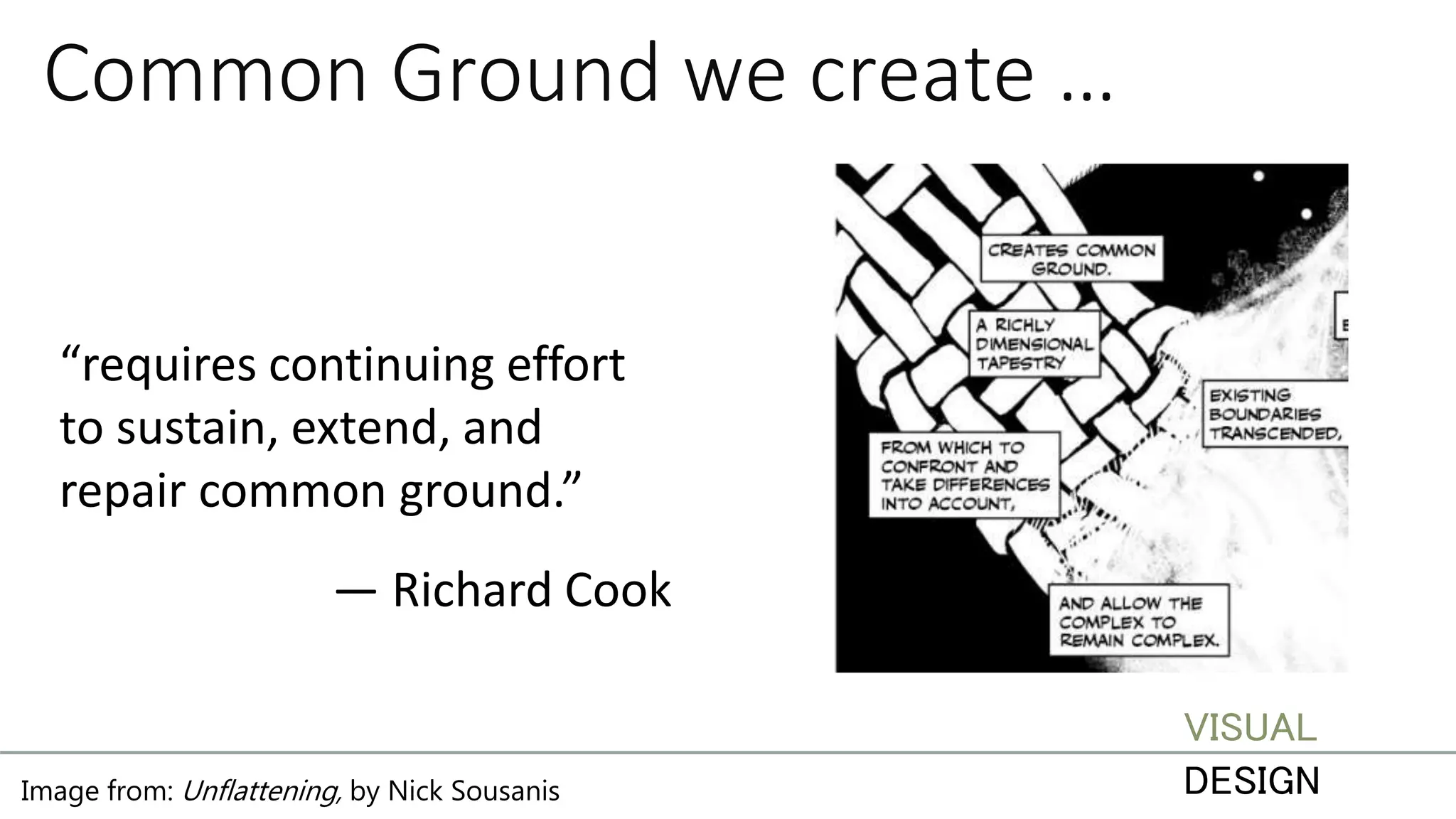
Common Ground we create …
“requires continuing effort
to sustain, extend, and
repair common ground.”
— Richard Cook
Image from: Unflattening, by Nick Sousanis
VISUAL
DESIGN
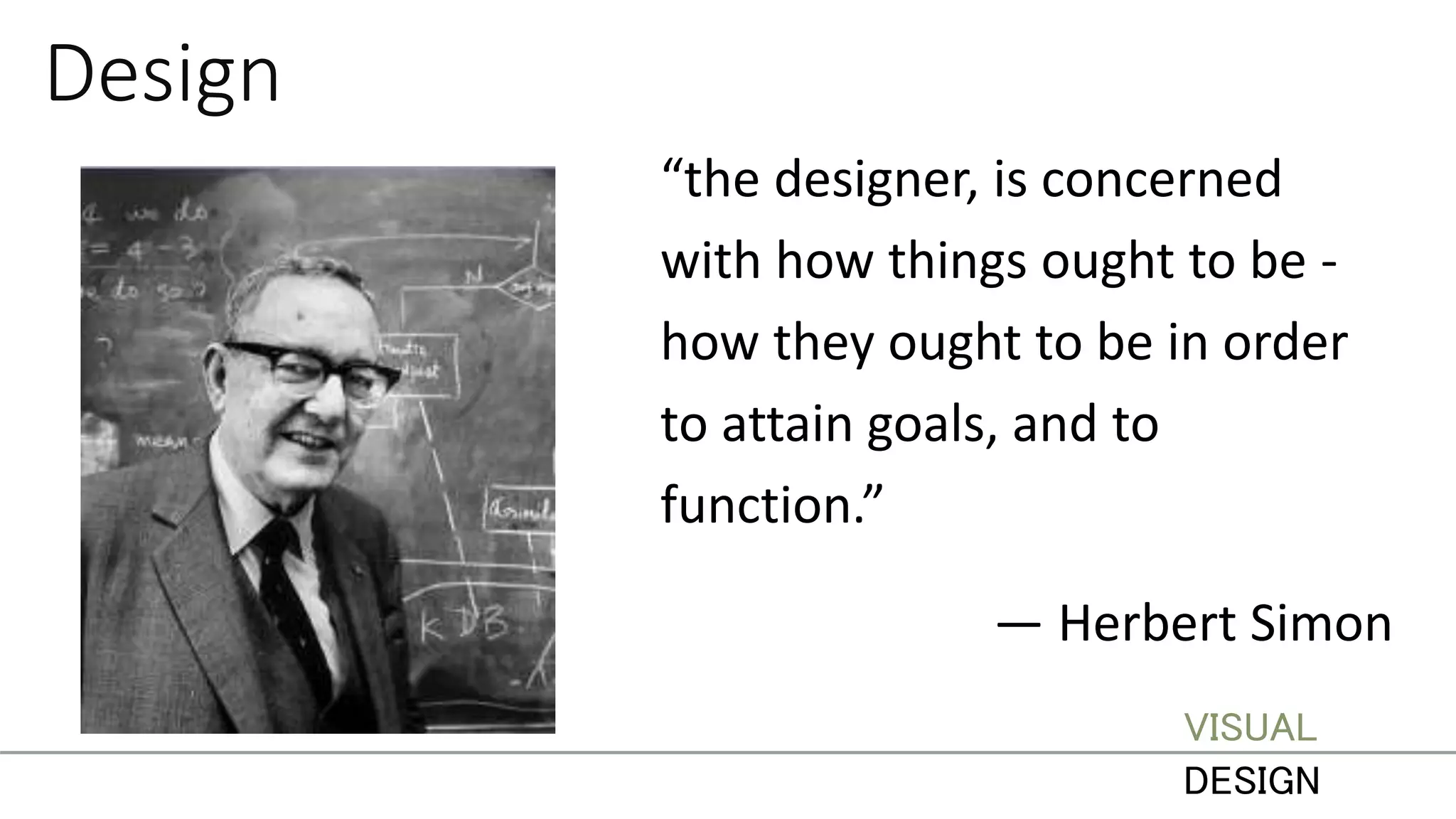
Design
“the designer, is concerned
with how things ought to be -
how they ought to be in order
to attain goals, and to
function.”
— Herbert Simon
VISUAL
DESIGN
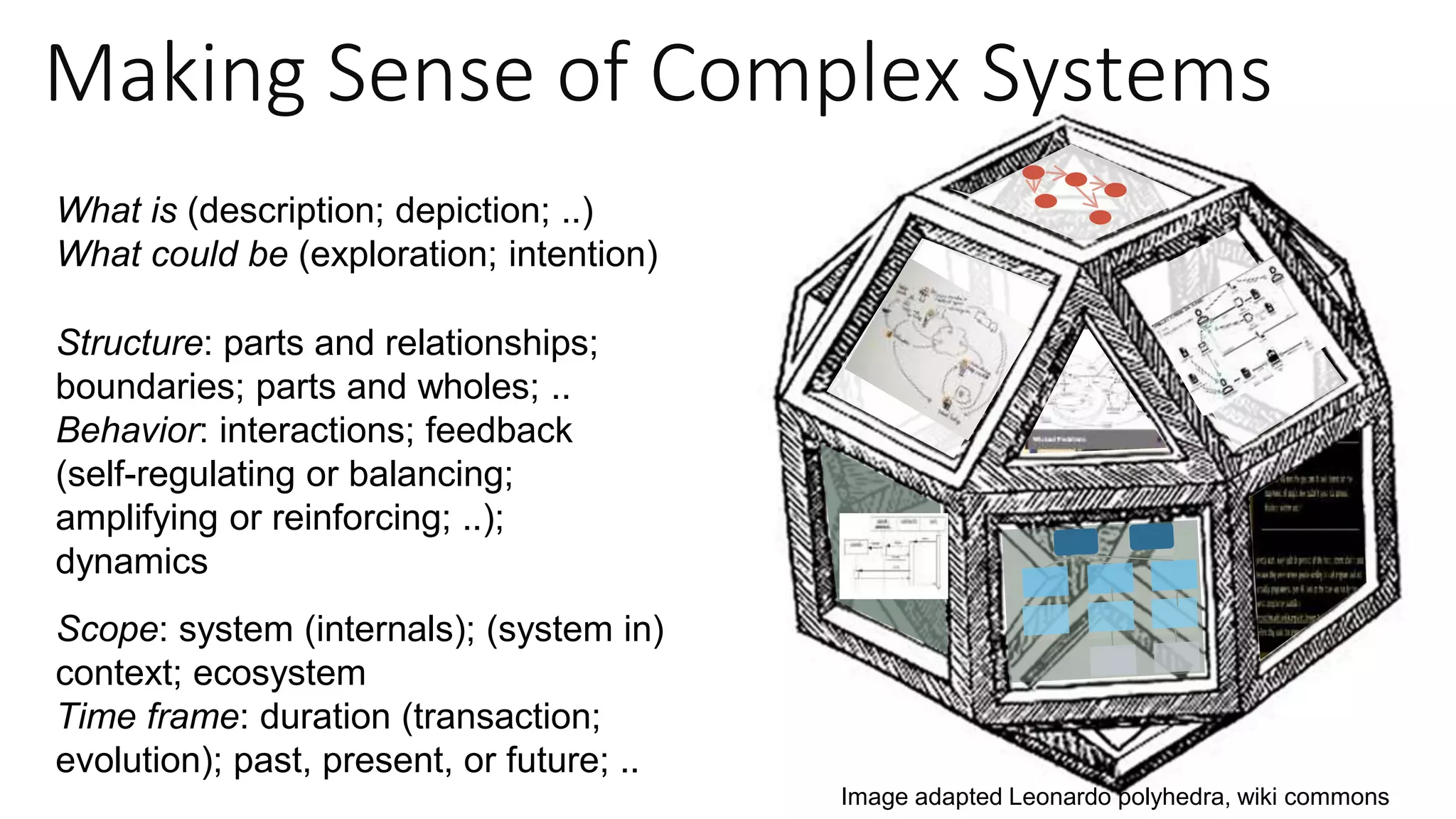
Making Sense of Complex Systems
What is (description; depiction; ..)
What could be (exploration; intention)
Structure: parts and relationships;
boundaries; parts and wholes; ..
Behavior: interactions; feedback
(self-regulating or balancing;
amplifying or reinforcing; ..);
dynamics
Scope: system (internals); (system in)
context; ecosystem
Time frame: duration (transaction;
evolution); past, present, or future; ..
Image adapted Leonardo polyhedra, wiki commons
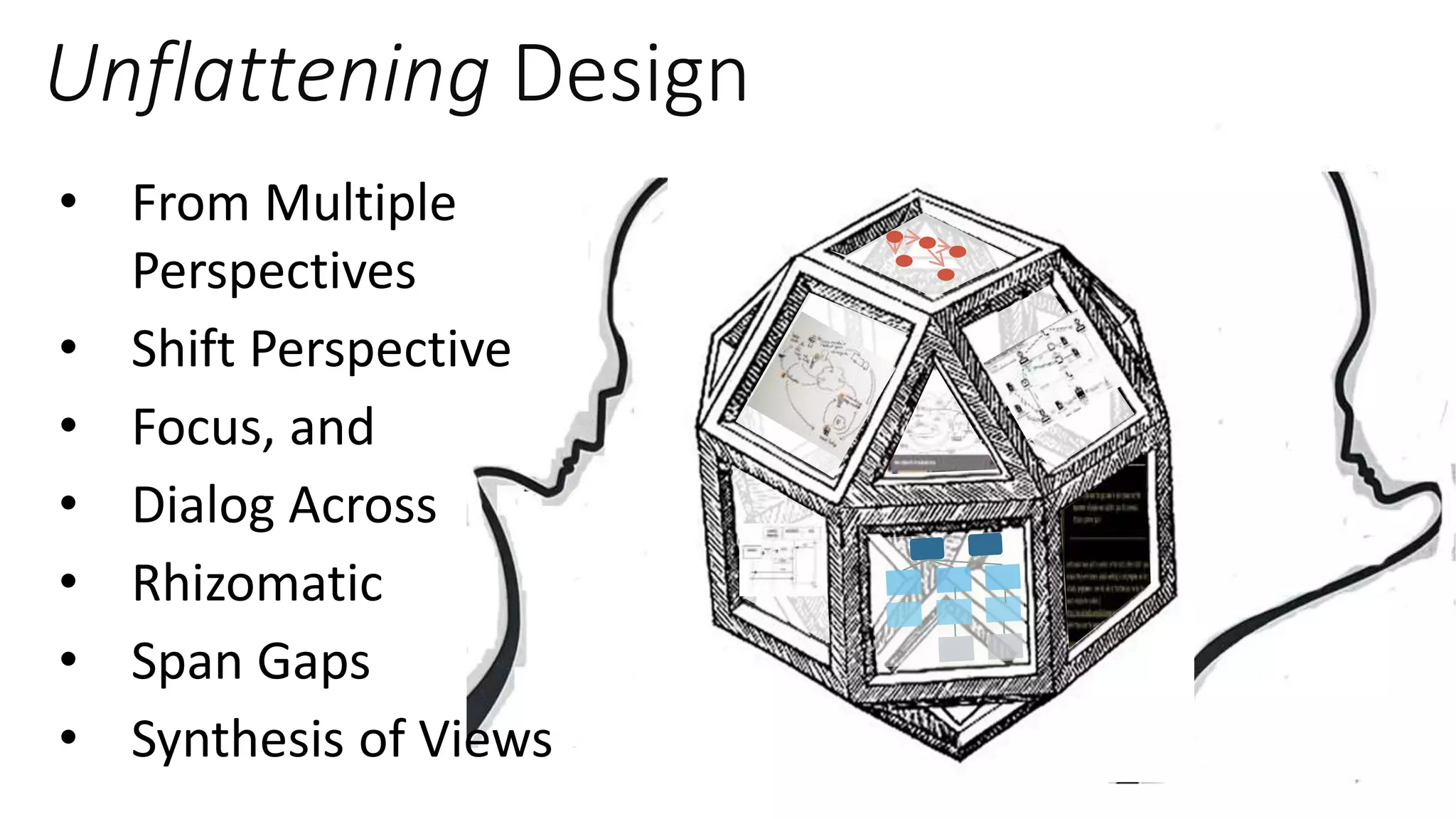
Unflattening Design
• From Multiple
Perspectives
• Shift Perspective
• Focus, and
• Dialog Across
• Rhizomatic
• Span Gaps
• Synthesis of Views
Stay in Touch
Ruth Malan:
Twitter: @ruthmalan
Web: ruthmalan.com
Web: bredemeyer.com
Bredemeyer Consulting

Visual Design

  • 1.
  • 5.
    “we put ourthoughts into the world” — Barbara Tversky <Emergency Appeal to Authority>
  • 6.
    How is designlike a comic? VISUAL DESIGN
  • 7.
    How is designlike this comic? buttercupfestival.com/2-91.htm It imagines something new into the world… … that enters the world and changes it
  • 8.
    How is designlike this comic? buttercupfestival.com/2-116.htm We explore the unseen beneath the surface, go to the roots (and don’t think of roots as linear causes, but rhizomatic and interconnected)
  • 9.
    How is designlike this comic? buttercupfestival.com/2-118.htm We explore what if, and what then and what else?
  • 10.
    How is designlike a comic? VISUAL DESIGN • world creation
  • 11.
    How is designlike a comic? VISUAL DESIGN • world creation
  • 12.
    How is designlike a comic? VISUAL DESIGN • world creation • dismissed X
  • 13.
    Undervalued/Dismissed Stereotyped as For children,juvenile, .. Not “the real deal” Not …“literature”…
  • 14.
    Undervalued/Dismissed Stereotyped as For children,juvenile, .. Not “the real deal” Not …“literature”… MisUnderstanding Comics
  • 15.
  • 16.
    Undervalued/Dismissed “Scott McCloud’s Understanding Comicsis a powerful piece of polemic. It is also a work of theory” — Dylan Horrocks MisUnderstanding Comics X
  • 17.
    reConsider “Of course, alltheory is to some extent polemic; theory is about persuading others to think about things in a certain way” — Dylan Horrocks Understanding Comics
  • 18.
    How is designlike a comic? buttercupfestival.com/2-31.htm I don’t get it/see something different…
  • 19.
    “It is hardto overestimate the significance of putting thought in the world.” “it allows us to share thoughts with others, critical for learning, teaching, coordinating and collaborating” — Barbara Tversky Thoughts in the World
  • 20.
    “That's all themotorcycle is, a system of concepts worked out in steel. There's no part in it, no shape in it, that is not out of someone's mind.” — Robert M. Pirsig Thoughts in the World
  • 21.
  • 22.
  • 23.
  • 24.
  • 25.
  • 26.
    How Do WeBuild Better Theories? MisUnderstanding Design X Exploration of visual communication in comics
  • 27.
    Thinking with the World “Drawing[..] is a means of orchestrating a conversation with yourself” — Nick Sousanis From Unflattening by Nick Sousanis
  • 28.
    “Our stereoscopic visionis the creation and integration of two views. [..] It is this displacement that allows us to perceive depth.” — Nick Sousanis Integration of Views From Unflattening by Nick Sousanis
  • 29.
    Shift in Perspective “Nothingchanged, except the point of view — which changed everything.” — Nick Sousanis From Unflattening by Nick Sousanis
  • 30.
    Dialog Across “Consider instead, distinctvantage points Separate paths Joined in dialog Thus, not merely side-by-side They intersect, engage, interact, combine, and inform one another. As the coming together of two eyes in stereoscopic vision Outlooks held in mutual orbits, Coupled, their interplay and overlap, facilitate the emergence of new perspectives. Actively interweaving multiple strands of thought Creates common ground” From Unflattening by Nick Sousanis
  • 31.
    Rhizomatic We use differentperspectives to transcend and see the connectedness that is otherwise obscured “this expansive way of seeing corresponds to an understanding of ecosystems … which despite visual boundaries, remain rhizomatically bound” — From Unflattening by Nick Sousanis
  • 32.
    Span Gaps “Both bindingagent and action, imagination allows us to span gaps in perception.” — Nick Sousanis From Unflattening by Nick Sousanis
  • 33.
    Synthesis of Views ‘Expandingour understanding requires divergence of thought and diversity of thinkers.’ — Nick Sousanis From Unflattening by Nick Sousanis
  • 34.
    Cognitive Assist By reignitingour interest in, and practicing, visual design, we give ourselves a perceptual, cognitive and collaborative assist From Unflattening by Nick Sousanis
  • 35.
    “thoughts put inthe world become thinking tools. A spiral: we put thought in the world, use it, revise it, use it again. [..] To remember, remind, and record. To inform, to influence — Barbara Tversky Become Tools to Think (Together)
  • 36.
    “To contemplate, compare, organize, rearrange,design, and create. To show others and collaborate.” — Barbara Tversky From Unflattening by Nick Sousanis
  • 37.
    Joined in Dialog,they engage, interact they create common ground
  • 38.
    Unflattening Design • FromMultiple Perspectives • Shift Perspective • Focus, and • Dialog Across • Rhizomatic • Span Gaps • Synthesis of Views
  • 39.
    We’re weaving strandsof inquiry • Visual • Design • Systems Where Are We? Visual Design of Systems
  • 40.
    Sketching and Modeling VISUAL DESIGN Wesketch, draw diagrams, model to: Sketch by Dave Gray
  • 41.
    Sketching and Modeling VISUAL DESIGN todeal with buffer overflow! to create a shared thought space to explain, to defend, to preserve to probe, to run thought experiments to see, to understand existing To observe, to understand* To think, reason, abstract – to design* To think together, collaborate To explore, to test To document to communicate* * “Let’s go to the Whiteboard,” by Mauro Cherubini et al Sketch by Dave Gray
  • 42.
    Why Designers UseDiagrams • To share: Diagrams externalize internal thought making it visible to self and others, reifying the mental model for others to act upon. • To ground: Human communication embeds ambiguous interpretations that need to be clarified in conversations: diagrams can serve this purpose. • To manipulate: By externalizing a mental model in a drawing, part of the cognitive process needed to hold it in memory is relieved and other operations can take place, like joining different parts, evaluating the design, checking the consistency, etc. Once externalized, these phases can happen collaboratively, capturing joint attention and enabling gesturing. • To brainstorm: Ambiguity in sketches is a source of creativity. Unintended interpretations and ideas can arise when inspecting an initial arrangement of a sketch.
  • 43.
    Sketching and Modeling Loadunderstanding into our heads — what is, and what ought to be. We have bounded cognitive capacity, so we collaborate So we need to create common ground/shared understanding Image source: Dave Gray VISUAL DESIGN
  • 44.
    1995 Put Thought intothe World text too
  • 45.
  • 46.
    Put Thought intothe World Image source: Mind in Motion talk, by Barbara Tversky (on youtube)
  • 47.
    Let’s Try This •Consider the following problem – One morning, exactly at 8 A.M., a monk began to climb a tall mountain. The narrow path, no more than a foot or two wide, spiraled around the mountain to a glittering temple at the summit. The monk ascended the path at varying rates of speed, stopping many times along the way to rest and to eat the dried fruit he carried with him. He reached the temple precisely at 8 P.M. The next day, he began his journey back along the same path, starting at 8A.M. and again walking at varying speeds with many pauses along the way. He reached the bottom at precisely 8 P.M. – I assert that there is at least one spot along the path the monk occupied at precisely the same time of day on both trips. – Is my assertion true? How do you decide? Source: Visual Thinking by Rudolf Arnheim SOFTWARE ARCHITECTURE
  • 48.
    One Approach Image: VisualThinking by Rudolf Arnheim
  • 49.
    System “The defining propertiesof any system, are properties of the whole, which none of the parts have. If you take the system apart, it loses its essential properties” — Russell Ackoff VISUAL DESIGN
  • 50.
    Boundaries “In order tobe recognisable as such, a system must be bounded in some way.” “Weoftenfallintothetrapof thinking of a boundary as something that separates one thing from another. We should ratherthinkofa boundaryassomethingthatconstitutesthatwhich isbounded.” —PaulCilliers Image: from Tom Rosenthal’s Watermelon music video  Andthisis“fractal”:systemsaresubsystemsofother systems;systemshavesubsystems
  • 51.
    Design: System (Inside) System Architecture Structureand mechanisms Systemelementsandrelationships • (de)composition • isthiscomponentdifferentiating(keep internal)?ordoweneedtosupportan externalinteraction? Systembehaviorsandproperties • interactionsgiverisetocapabilitiesand properties(emergence) Whymodel?Codeputsthoughtsintheworld,but eventhatgetstoobig!Toreasonacrossthesystem. To reasonaboutinteractions.Toreasontogether.
  • 52.
    Recall: Theory Building System-in-Context (use,dev, ops) Product Design Design of system capabilities/properties Architecture Structure and mechanisms System Developing our theory of the problem Developing our theory of the solution
  • 53.
  • 54.
    Design in Context “Alwaysdesignathingby considering itinitsnext largercontext.” —ElielSaarinen VISUAL DESIGN
  • 55.
    Design: System inContext System-in-Context (use, dev, ops) Product Design Design of system capabilities/properties Architecture Structure and mechanisms • Whatisthesystemusedfor(purpose andidentity)? • Whichcapabilitiesarewegoingto moveacrossthesystemboundary? • Whatnewcapabilitiesarewegoingto bringintoexistence? • Howisthesystembeingadapted(and exapted)tonewuses? Systembehaviorsandproperties • impact(users,partners,operations) experience System
  • 56.
    Ecosystem Context Context System-in-Context (use,dev, ops) System (Ecosystem) Strategy Ecosystem interventions “Requirements" Design of system capabilities Architecture Structure and mechanisms product design technical design
  • 57.
    Design Across Boundaries ContextSystem-in-Context (use, dev, ops) System (Ecosystem) Strategy Ecosystem interventions “Requirements" Design of system capabilities Architecture Structure and mechanisms internal design: parts and interactions; theory of operation product design technical design capabilities and properties; theory of value Identity and direction; theory of differentiation and role in ecosystem
  • 58.
    Design Across Boundaries ContextSystem-in-Context (use, dev, ops) System (Ecosystem) Strategy Ecosystem interventions “Requirements" Design of system capabilities Architecture Structure and mechanisms System design is contextual design — it is inherently about boundaries (what’s in, what’s out, what spans, what moves between), and about tradeoffs. It reshapes what is outside, just as it shapes what is inside. internal design: parts and interactions; theory of operation product design technical design capabilities and properties; theory of value Identity and direction; theory of differentiation and role in ecosystem
  • 59.
  • 60.
    Sociotechnical Systems Sociotechnical systems refersto systems that have social and technical elements, and there is mutual influence and interaction of technical and social elements
  • 61.
    How Complex SystemsFail 1. Complex systems are intrinsically hazardous systems 2. Complex systems are heavily and successfully defended against failure 3. Catastrophe requires multiple failures – single point failures are not enough 4. Complex systems contain changing mixtures of failures latent within them 6. Catastrophe is always just around the corner 16. Safety is a characteristic of systems and not of their components: Safety is an emergent property of systems -- Richard I. Cook Source: Richard I. Cook, How Complex Systems Fail
  • 62.
    How Complex SystemsFail 1. Complex systems are intrinsically hazardous systems 2. Complex systems are heavily and successfully defended against failure 3. Catastrophe requires multiple failures – single point failures are not enough 4. Complex systems contain changing mixtures of failures latent within them 6. Catastrophe is always just around the corner 16. Safety is a characteristic of systems and not of their components: Safety is an emergent property of systems
  • 63.
    Modeling Complex Systems It’sa lot! To grasp. Still, choose (how much, which views, ..) wisely Diana Montalion’s heuristic equation: Wisdom = f(knowledge, experience, good judgment) VISUAL DESIGN
  • 64.
    TECHNICAL LEADERSHIP System Integrity “A systemis an interconnected set of elements that is coherently organized in a way that achieves something” — Donella Meadows
  • 65.
    Requisite Coherence “And requisitecoherence is the idea that if everyone is in a Tower of Babel we’re not able to speak or work together. So the balancing point here is common ground.” — Jabe Bloom “Joint activity depends on interpredictability of the participants’ attitudes and actions. Such interpredictability is based on common ground” – Gary Klein
  • 66.
    Common Ground wecreate … “requires continuing effort to sustain, extend, and repair common ground.” — Richard Cook Image from: Unflattening, by Nick Sousanis VISUAL DESIGN
  • 67.
    Design “the designer, isconcerned with how things ought to be - how they ought to be in order to attain goals, and to function.” — Herbert Simon VISUAL DESIGN
  • 68.
    Making Sense ofComplex Systems What is (description; depiction; ..) What could be (exploration; intention) Structure: parts and relationships; boundaries; parts and wholes; .. Behavior: interactions; feedback (self-regulating or balancing; amplifying or reinforcing; ..); dynamics Scope: system (internals); (system in) context; ecosystem Time frame: duration (transaction; evolution); past, present, or future; .. Image adapted Leonardo polyhedra, wiki commons
  • 69.
    Unflattening Design • FromMultiple Perspectives • Shift Perspective • Focus, and • Dialog Across • Rhizomatic • Span Gaps • Synthesis of Views
  • 70.
    Stay in Touch RuthMalan: Twitter: @ruthmalan Web: ruthmalan.com Web: bredemeyer.com Bredemeyer Consulting