
Increasing Your “Innovation IQ” March 11, 2009 Maria B. Thompson www.linkedin.com/in/mariabthompson Director, Intellectual Asset Management  Process, Tools & Quality Motorola Law Department
Why increase your “Innovation IQ?” Your “IQ” can be thought of as a predictable measure of intelligence and performance… We will cover ways to enhance your performance in  creative problem solving  to support  Invention: novel idea generation Innovation: successful implementation of novel ideas Creative problem solving skills are critical for success in ENGINEERING & SCIENCE!
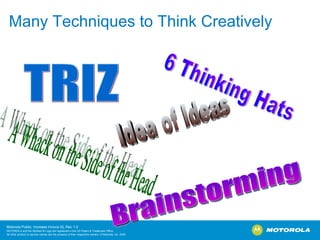
Many Techniques to Think Creatively TRIZ Brainstorming 6 Thinking Hats A Whack on the Side of the Head Idea of Ideas
Tools for Increasing Individual and Team “Innovation IQ” The Power of QUESTIONS & Question Banking * (*see Corinne Miller’s “One Thing Every Innovator Does” presentation) TRiZ: The Theory of Inventive Problem Solving  Patents or Intellectual Property (IP) Focused idea-generation
“ Millions saw the apple  fall, but Newton was the  one who asked  why .” Bernard Baruch
How Questions Help  Creative Problem Solving Clarifies problems Engages minds Increases brain flow Cultivates curiosity Improves Listening Promotes analogous thinking Enhances quality thinking Accelerates innovation Improves idea management
What is the  Q uestion  B anking Methodology? IDENTIFY Sources of Questions COLLECT Questions ORGANIZE Questions IMPROVE Questions APPLY Questions (Questionate to Ideate)
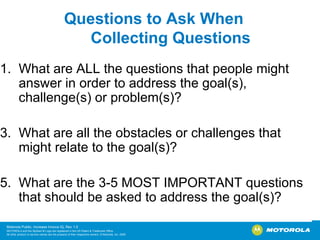
Questions to Ask When Collecting Questions What are ALL the questions that people might answer in order to address the goal(s), challenge(s) or problem(s)? What are all the obstacles or challenges that might relate to the goal(s)? What are the 3-5 MOST IMPORTANT questions that should be asked to address the goal(s)?
 
 
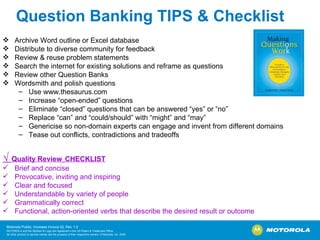
Question Banking TIPS & Checklist Archive Word outline or Excel database  Distribute to diverse community for feedback Review & reuse problem statements Search the internet for existing solutions and reframe as questions Review other Question Banks Wordsmith and polish questions Use www.thesaurus.com Increase “open-ended” questions Eliminate “closed” questions that can be answered “yes” or “no” Replace “can” and “could/should” with “might” and “may” Genericise so non-domain experts can engage and invent from different domains Tease out conflicts, contradictions and tradeoffs √  Quality Review   CHECKLIST Brief and concise Provocative, inviting and inspiring Clear and focused Understandable by variety of people Grammatically correct Functional, action-oriented verbs that describe the desired result or outcome                           
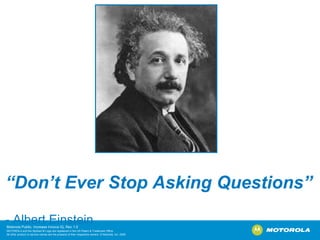
“ Don’t Ever Stop Asking Questions”   - Albert Einstein
TRIZ   T eoriya  R esheniya  I zobretatel’skikh  Z adach   The Theory of Inventive Problem Solving Dan Heck                            847.570.0449 847.420.1744 c 847.400.0880 fax http://www.bluefuseinc.com
Albert Einstein "The  mere formulation of a problem is far  more often essential than its solution , which  may be merely a matter of mathematical or  experimental skill. To raise new questions,  new possibilities,  to regard old problems from  a new angle requires creative imagination   and marks real advances in science."
TRIZ-An amazing set of tools Theory of Inventive Problem Solving Techniques for creative problem solving validated by over 50 years of research and 19 years of real world application Invented by Genrich Altshuller in 1946 Premise: Creative Problem Solving isn’t just brainstorming!!!
Objects and Functions  Psychological Inertia Lines of engineering system evolution  Ideal Model   Some Aspects of TRIZ Contradictions
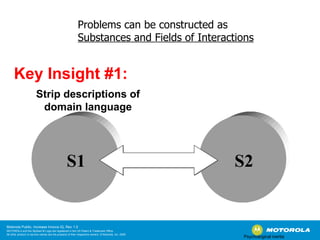
Problems can be constructed as Substances and Fields of Interactions S1 S2 Psychological inertia Key Insight #1: Strip descriptions of domain language
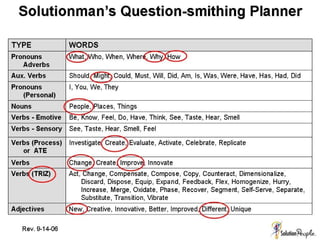
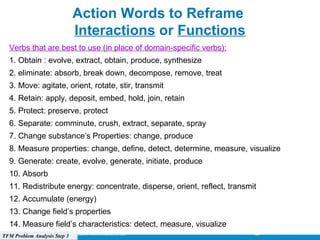
Action Words to Reframe  Interactions  or  Functions Verbs that are best to use (in place of domain-specific verbs): 1. Obtain : evolve, extract, obtain, produce, synthesize 2. eliminate: absorb, break down, decompose, remove, treat 3. Move: agitate, orient, rotate, stir, transmit 4. Retain: apply, deposit, embed, hold, join, retain 5. Protect: preserve, protect 6. Separate: comminute, crush, extract, separate, spray 7. Change substance’s Properties: change, produce 8. Measure properties: change, define, detect, determine, measure, visualize 9. Generate: create, evolve, generate, initiate, produce 10. Absorb 11. Redistribute energy: concentrate, disperse, orient, reflect, transmit 12. Accumulate (energy) 13. Change field’s properties 14. Measure field’s characteristics: detect, measure, visualize TFM Problem Analysis Step 3
Our mind tends to automatically organize new information with our current knowledge.
“ Even though one was correct at each stage, the situation may still have to be restructured to proceed.”  Edward de Bono [ http://www.edwdebono.com/] contradictions Key Insight #2: Be willing to rearrange what you know (overcome psychological inertia!)
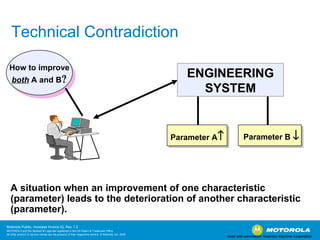
Technical Contradiction A situation when an improvement of one characteristic (parameter) leads to the deterioration of another characteristic (parameter). How to improve  both  A and B  Parameter B   ENGINEERING SYSTEM Used with permission: Invention Machine Corporation Parameter A 
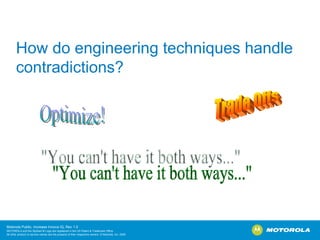
How do engineering techniques handle contradictions? "You can't have it both ways..." Trade Offs Optimize!
What did Altshuller observe? Inventors  Don’t Optimize First…
Inventors start with a different question! How can I build a SMALL cellphone  that’s lightweight, AND with BIG buttons my elderly parents can see and select without  misdialing?
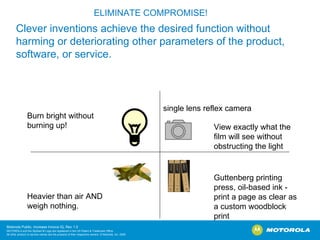
Clever inventions achieve the desired function without harming or deteriorating other parameters of the product, software, or service.  Burn bright without burning up! View exactly what the film will see without obstructing the light Heavier than air AND weigh nothing. Guttenberg printing press, oil-based ink - print a page as clear as a custom woodblock print single lens reflex camera ELIMINATE COMPROMISE!
400,000 Inventions Studied by Altshuller –  The Most Clever Solved Contradictions Key Insight #3: If you find yourself trading off features, reframe your desire into, “I want BOTH [feature 1] AND [feature 2].” Then stay in this creative space!
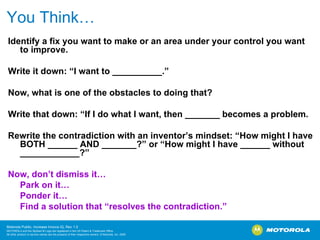
You Think… Identify a fix you want to make or an area under your control you want to improve. Write it down: “I want to __________.” Now, what is one of the obstacles to doing that? Write that down: “If I do what I want, then _______ becomes a problem. Rewrite the contradiction with an inventor’s mindset: “How might I have BOTH ______ AND _______?” or “How might I have ______ without ____________?” Now, don’t dismiss it… Park on it… Ponder it… Find a solution that “resolves the contradiction.”
“ Do inventors use any common approaches to solve contradictions?” Altshuller was a very curious fellow…
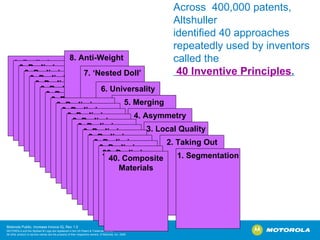
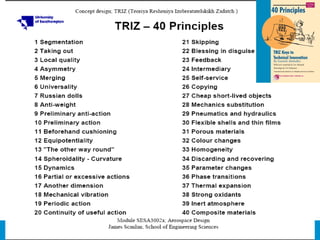
Across  400,000 patents, Altshuller identified 40 approaches repeatedly used by inventors called the   40 Inventive Principles . 9. Preliminary 9. Preliminary 9. Preliminary 9. Preliminary 9. Preliminary 9. Preliminary 9. Preliminary 9. Preliminary 8. Anti-Weight 7. ‘Nested Doll’ 6. Universality 5. Merging 4. Asymmetry 3. Local Quality 2. Taking Out 1. Segmentation 9. Preliminary 9. Preliminary 9. Preliminary 9. Preliminary 9. Preliminary 9. Preliminary 9. Preliminary 9. Preliminary 9. Preliminary 39. Preliminary 40. Composite Materials
 
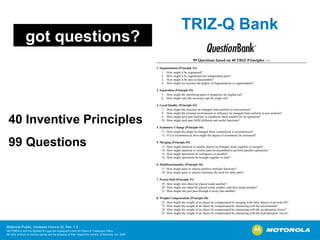
TRIZ-Q Bank 40 Inventive Principles 99 Questions got questions?
Summarize Recognize the Contradiction
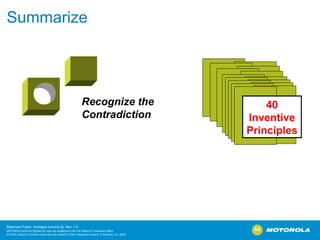
Summarize 40 Inventive Principles Recognize the Contradiction
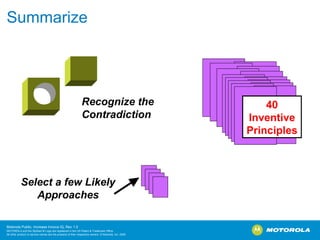
Summarize 40 Inventive Principles Select a few Likely Approaches Recognize the Contradiction
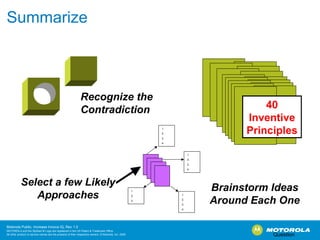
Summarize 40 Inventive Principles Select a few Likely Approaches Brainstorm Ideas Around Each One Recognize the Contradiction Question # # # # # # # # # # # # # # #
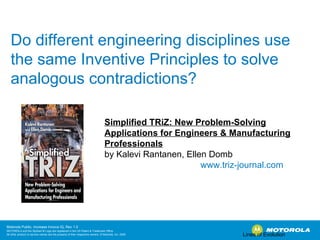
Do different engineering disciplines use the same Inventive Principles to solve analogous contradictions? Lines of Evolution Simplified TRiZ: New Problem-Solving Applications for Engineers & Manufacturing Professionals by Kalevi Rantanen, Ellen Domb www.triz-journal.com
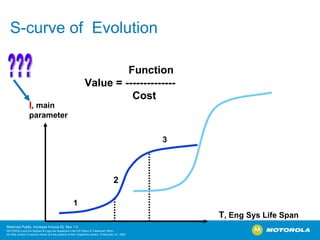
S-curve of  Evolution 2 3 I , main  parameter T , Eng Sys Life Span   1   Function  Value = -------------- Cost  ???
Key Insight #4: Technology matures along repeated curves.  Look for solutions already implemented in any area you think might have trade-offs similar to yours.
Ideality -in the physical world…applies to software An Ideal System occupies no space,  has no weight, requires no service or  maintenance,  but still performs the  Main Function  with all the benefits and no harmful interactions. What is the ideal software program?   What is ideal data? no memory? functions require no cycle time?
Key Insight #5: Clearly define the IDEAL outcome …  if anything were possible, what are all the parameters & characteristics that describe the ideal solution?
Think CreaTRIZively TM ! #1  Strip descriptions of  domain language   #2  Be willing to  rearrange  what you know   #3  Describe  contradictions  and park on them! #4  Is this problem or trade-off solved in  other disciplines ?   #5  What would this  ideally  look like?
Patents & Intellectual Property Rights Innovate Like Edison: The Success System of  America’s Greatest Inventor   by Michael Gelb, Sarah Miller Caldicott “ Next came the patent laws.  These began in England in 1624, and in this country with the adoption of our Constitution.  Before then, any man might instantly use what another man had invented, so that the inventor had no special advantage from his invention.  The patent system changed this;  it secured to the inventor for a limited time the exclusive use of his invention, and thereby added the fuel of interest to the fire of genius in discovery and production of new and useful things."     - Abraham Lincoln
What is so great about patents? Novel solution to problem Teach others to advance science "The patent system is nothing more than a way to encourage people to innovate... to take risks... to make the world a better place.”  -- Dean Kamen, Spotlight On: The U.S. Patent System Prevent others from using, copying or selling your solution (invention)
Why you and your employer might need patents Intellectual Property Rights include: Patents, Copyrights, Trademarks, Service  Marks, Trade Secrets, Domain Names Considerations Costs – 1 patent filing (US) ~ $15,000;  3 additional maintenance payments to keep for ~20 yrs. What is your market differentiator, core competencies or “crown jewels?” What (novel aspects of your work) do you want or need to exclude others from replicating? Who is in a position to easily practice your art or copy your idea? Who are your competitors? Do they already have patents, trademarks, copyrights? Check out  http://www.google.com/patents Freedom of Action  In what countries do you plan to ship product or provide services?
The power of patents - continued Cost Avoidance / Loss of Market Share RIM paid NTP $612M in litigation settlement RIM had to stop selling Blackberry’s in US for period of time until settled Detectability & Enforceability Will you be able to identify whether someone is copying (“infringing”) your product or service? If not, better to pursue trade secrets, copyrights, etc.  BOTTOM LINE: NEED TO USE CREATIVE PROBLEM SOLVING SKILLS EVERY BUSINESS DAY!
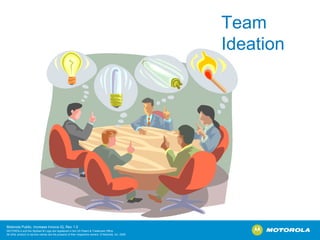
Team Ideation
“ Don’t worry about other people stealing your ideas. If your ideas are any good, you’ll have to ram them down people’s throats .”  – Howard Aiken, IBM Engineer
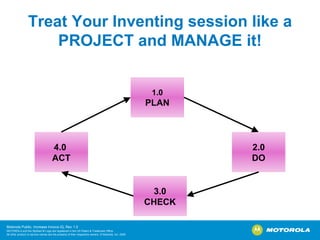
Treat Your Inventing session like a PROJECT and MANAGE it! 1.0 PLAN 4.0  ACT 3.0 CHECK 2.0 DO
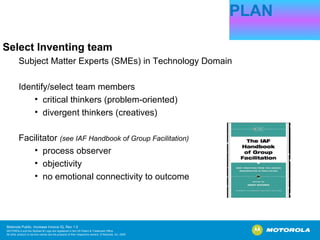
PLAN Select Inventing team Subject Matter Experts (SMEs) in Technology Domain Identify/select team members critical thinkers (problem-oriented) divergent thinkers (creatives) Facilitator  (see IAF Handbook of Group Facilitation) process observer  objectivity  no emotional connectivity to outcome
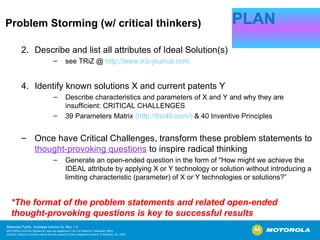
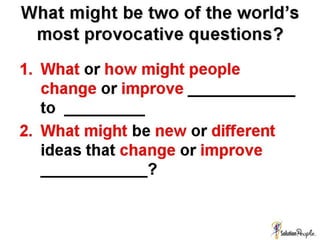
Problem Storming (w/ critical thinkers) Describe and list all attributes of Ideal Solution(s) see TRiZ @  http://www.triz-journal.com Identify known solutions X and current patents Y Describe characteristics and parameters of X and Y and why they are insufficient: CRITICAL CHALLENGES 39 Parameters Matrix  ( http://triz40.com/)  & 40 Inventive Principles Once have Critical Challenges, transform these problem statements to  thought-provoking questions  to inspire radical thinking Generate an open-ended question in the form of "How might we achieve the IDEAL attribute by applying X or Y technology or solution without introducing a limiting characteristic (parameter) of X or Y technologies or solutions?” PLAN *The format of the problem statements and related open-ended thought-provoking questions is key to successful results
2.0 DO = CREATE  Schedule venue & gather materials  Laptop w/ projection system Round table(s) Easel boards w/ large Post-it 3M  sheets to hang on walls Small lined Post-its 3M  – CAPTURE  PROBLEMS  TOO! Provocation Templates, Idea Booklets, Idea Exchange Template Pens & Pencils & Colored Markers Toys & puzzles & Silly Putty TM  or Play-Doh TM Chocolate & cinnamon & popcorn Chocolate may boost brain power:  http://health.yahoo.com/news/162487 Painting with Chocolate:  http:// painting.about.com/cs/inspiration/a/chocolatepaint.htm   DO
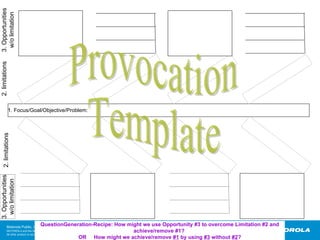
1. Focus/Goal/Objective/Problem: 2. limitations 2. limitations 3. Opportunities w/o limitation 3. Opportunities w/o limitation QuestionGeneration-Recipe: How might we use Opportunity #3 to overcome Limitation #2 and achieve/remove #1?  OR  How might we achieve/remove  #1  by using  #3  without  #2 ? Provocation Template
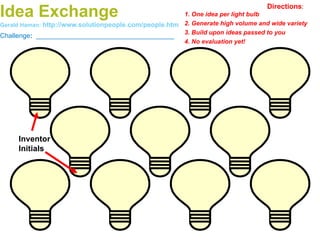
Idea Exchange Gerald Haman:  http:// www.solutionpeople.com/people.htm Challenge :   _____________________________________ 1. One idea per light bulb 2. Generate high volume and wide variety 3. Build upon ideas passed to you 4. No evaluation yet! Inventor Initials Directions :
CHECK 3.0 CHECK =  EVALUATE For each concept or idea generated, assign a value score How well does the concept “solve” the original Problem? Is the solution novel vs. patents and internet search results?
Stay vigilant and track trends Google industry-specific news = business or technology press releases http:// www.googlescholar.com Monitor relevant blogs, RSS feeds, email alerts, twitter Read patents   USPTO, EPO, JPO, wipo.org = patent trend analysis http://www.google.com/patents ACT 4.0 ACT
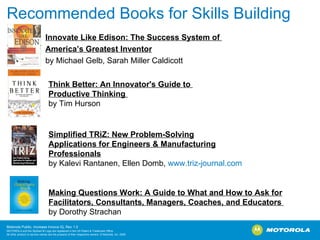
Recommended Books for Skills Building Innovate Like Edison: The Success System of  America’s Greatest Inventor   by Michael Gelb, Sarah Miller Caldicott Think Better: An Innovator's Guide to  Productive Thinking  by Tim Hurson Simplified TRiZ: New Problem-Solving Applications for Engineers & Manufacturing Professionals by Kalevi Rantanen, Ellen Domb,  www.triz-journal.com Making Questions Work: A Guide to What and How to Ask for Facilitators, Consultants, Managers, Coaches, and Educators  by Dorothy Strachan
Good News! "The truly great advances of this generation will be made by  those who can make outrageous connections,  and only a mind which knows how to play can do that." - Nagle Jackson, Playwright   Science of Play http://abcnews.go.com/Video/playerIndex?id=7001867    National Institute for Play http://www.nifplay.org/    Play: Introductory Video http://www.nifplay.org/index2.html
"If I were to wish for anything, I should not wish  for wealth and power, but for the passionate  sense of the potential, for the eye which, ever  young and ardent, sees the possible. Pleasure  disappoints, possibility never. And what wine is  so sparkling, what so fragrant, what so  intoxicating, as possibility!" - Soren Kierkegaard  For more information go to:  http://www.linkedin.com/in/mariabthompson

Increasing Innovation IQ

  • 1.
    Increasing Your “InnovationIQ” March 11, 2009 Maria B. Thompson www.linkedin.com/in/mariabthompson Director, Intellectual Asset Management Process, Tools & Quality Motorola Law Department
  • 2.
    Why increase your“Innovation IQ?” Your “IQ” can be thought of as a predictable measure of intelligence and performance… We will cover ways to enhance your performance in creative problem solving to support Invention: novel idea generation Innovation: successful implementation of novel ideas Creative problem solving skills are critical for success in ENGINEERING & SCIENCE!
  • 3.
    Many Techniques toThink Creatively TRIZ Brainstorming 6 Thinking Hats A Whack on the Side of the Head Idea of Ideas
  • 4.
    Tools for IncreasingIndividual and Team “Innovation IQ” The Power of QUESTIONS & Question Banking * (*see Corinne Miller’s “One Thing Every Innovator Does” presentation) TRiZ: The Theory of Inventive Problem Solving Patents or Intellectual Property (IP) Focused idea-generation
  • 5.
    “ Millions sawthe apple fall, but Newton was the one who asked why .” Bernard Baruch
  • 6.
    How Questions Help Creative Problem Solving Clarifies problems Engages minds Increases brain flow Cultivates curiosity Improves Listening Promotes analogous thinking Enhances quality thinking Accelerates innovation Improves idea management
  • 7.
    What is the Q uestion B anking Methodology? IDENTIFY Sources of Questions COLLECT Questions ORGANIZE Questions IMPROVE Questions APPLY Questions (Questionate to Ideate)
  • 8.
    Questions to AskWhen Collecting Questions What are ALL the questions that people might answer in order to address the goal(s), challenge(s) or problem(s)? What are all the obstacles or challenges that might relate to the goal(s)? What are the 3-5 MOST IMPORTANT questions that should be asked to address the goal(s)?
  • 9.
  • 10.
  • 11.
    Question Banking TIPS& Checklist Archive Word outline or Excel database Distribute to diverse community for feedback Review & reuse problem statements Search the internet for existing solutions and reframe as questions Review other Question Banks Wordsmith and polish questions Use www.thesaurus.com Increase “open-ended” questions Eliminate “closed” questions that can be answered “yes” or “no” Replace “can” and “could/should” with “might” and “may” Genericise so non-domain experts can engage and invent from different domains Tease out conflicts, contradictions and tradeoffs √ Quality Review CHECKLIST Brief and concise Provocative, inviting and inspiring Clear and focused Understandable by variety of people Grammatically correct Functional, action-oriented verbs that describe the desired result or outcome                           
  • 12.
    “ Don’t EverStop Asking Questions” - Albert Einstein
  • 13.
    TRIZ T eoriya R esheniya I zobretatel’skikh Z adach The Theory of Inventive Problem Solving Dan Heck                            847.570.0449 847.420.1744 c 847.400.0880 fax http://www.bluefuseinc.com
  • 14.
    Albert Einstein "The mere formulation of a problem is far more often essential than its solution , which may be merely a matter of mathematical or experimental skill. To raise new questions, new possibilities, to regard old problems from a new angle requires creative imagination and marks real advances in science."
  • 15.
    TRIZ-An amazing setof tools Theory of Inventive Problem Solving Techniques for creative problem solving validated by over 50 years of research and 19 years of real world application Invented by Genrich Altshuller in 1946 Premise: Creative Problem Solving isn’t just brainstorming!!!
  • 16.
    Objects and Functions Psychological Inertia Lines of engineering system evolution Ideal Model Some Aspects of TRIZ Contradictions
  • 17.
    Problems can beconstructed as Substances and Fields of Interactions S1 S2 Psychological inertia Key Insight #1: Strip descriptions of domain language
  • 18.
    Action Words toReframe Interactions or Functions Verbs that are best to use (in place of domain-specific verbs): 1. Obtain : evolve, extract, obtain, produce, synthesize 2. eliminate: absorb, break down, decompose, remove, treat 3. Move: agitate, orient, rotate, stir, transmit 4. Retain: apply, deposit, embed, hold, join, retain 5. Protect: preserve, protect 6. Separate: comminute, crush, extract, separate, spray 7. Change substance’s Properties: change, produce 8. Measure properties: change, define, detect, determine, measure, visualize 9. Generate: create, evolve, generate, initiate, produce 10. Absorb 11. Redistribute energy: concentrate, disperse, orient, reflect, transmit 12. Accumulate (energy) 13. Change field’s properties 14. Measure field’s characteristics: detect, measure, visualize TFM Problem Analysis Step 3
  • 19.
    Our mind tendsto automatically organize new information with our current knowledge.
  • 20.
    “ Even thoughone was correct at each stage, the situation may still have to be restructured to proceed.” Edward de Bono [ http://www.edwdebono.com/] contradictions Key Insight #2: Be willing to rearrange what you know (overcome psychological inertia!)
  • 21.
    Technical Contradiction Asituation when an improvement of one characteristic (parameter) leads to the deterioration of another characteristic (parameter). How to improve both A and B  Parameter B  ENGINEERING SYSTEM Used with permission: Invention Machine Corporation Parameter A 
  • 22.
    How do engineeringtechniques handle contradictions? "You can't have it both ways..." Trade Offs Optimize!
  • 23.
    What did Altshullerobserve? Inventors Don’t Optimize First…
  • 24.
    Inventors start witha different question! How can I build a SMALL cellphone that’s lightweight, AND with BIG buttons my elderly parents can see and select without misdialing?
  • 25.
    Clever inventions achievethe desired function without harming or deteriorating other parameters of the product, software, or service. Burn bright without burning up! View exactly what the film will see without obstructing the light Heavier than air AND weigh nothing. Guttenberg printing press, oil-based ink - print a page as clear as a custom woodblock print single lens reflex camera ELIMINATE COMPROMISE!
  • 26.
    400,000 Inventions Studiedby Altshuller – The Most Clever Solved Contradictions Key Insight #3: If you find yourself trading off features, reframe your desire into, “I want BOTH [feature 1] AND [feature 2].” Then stay in this creative space!
  • 27.
    You Think… Identifya fix you want to make or an area under your control you want to improve. Write it down: “I want to __________.” Now, what is one of the obstacles to doing that? Write that down: “If I do what I want, then _______ becomes a problem. Rewrite the contradiction with an inventor’s mindset: “How might I have BOTH ______ AND _______?” or “How might I have ______ without ____________?” Now, don’t dismiss it… Park on it… Ponder it… Find a solution that “resolves the contradiction.”
  • 28.
    “ Do inventorsuse any common approaches to solve contradictions?” Altshuller was a very curious fellow…
  • 29.
    Across 400,000patents, Altshuller identified 40 approaches repeatedly used by inventors called the 40 Inventive Principles . 9. Preliminary 9. Preliminary 9. Preliminary 9. Preliminary 9. Preliminary 9. Preliminary 9. Preliminary 9. Preliminary 8. Anti-Weight 7. ‘Nested Doll’ 6. Universality 5. Merging 4. Asymmetry 3. Local Quality 2. Taking Out 1. Segmentation 9. Preliminary 9. Preliminary 9. Preliminary 9. Preliminary 9. Preliminary 9. Preliminary 9. Preliminary 9. Preliminary 9. Preliminary 39. Preliminary 40. Composite Materials
  • 30.
  • 31.
    TRIZ-Q Bank 40Inventive Principles 99 Questions got questions?
  • 32.
  • 33.
    Summarize 40 InventivePrinciples Recognize the Contradiction
  • 34.
    Summarize 40 InventivePrinciples Select a few Likely Approaches Recognize the Contradiction
  • 35.
    Summarize 40 InventivePrinciples Select a few Likely Approaches Brainstorm Ideas Around Each One Recognize the Contradiction Question # # # # # # # # # # # # # # #
  • 36.
    Do different engineeringdisciplines use the same Inventive Principles to solve analogous contradictions? Lines of Evolution Simplified TRiZ: New Problem-Solving Applications for Engineers & Manufacturing Professionals by Kalevi Rantanen, Ellen Domb www.triz-journal.com
  • 37.
    S-curve of Evolution 2 3 I , main parameter T , Eng Sys Life Span 1 Function Value = -------------- Cost ???
  • 38.
    Key Insight #4:Technology matures along repeated curves. Look for solutions already implemented in any area you think might have trade-offs similar to yours.
  • 39.
    Ideality -in thephysical world…applies to software An Ideal System occupies no space, has no weight, requires no service or maintenance, but still performs the Main Function with all the benefits and no harmful interactions. What is the ideal software program? What is ideal data? no memory? functions require no cycle time?
  • 40.
    Key Insight #5:Clearly define the IDEAL outcome … if anything were possible, what are all the parameters & characteristics that describe the ideal solution?
  • 41.
    Think CreaTRIZively TM! #1 Strip descriptions of domain language #2 Be willing to rearrange what you know #3 Describe contradictions and park on them! #4 Is this problem or trade-off solved in other disciplines ? #5 What would this ideally look like?
  • 42.
    Patents & IntellectualProperty Rights Innovate Like Edison: The Success System of America’s Greatest Inventor by Michael Gelb, Sarah Miller Caldicott “ Next came the patent laws.  These began in England in 1624, and in this country with the adoption of our Constitution.  Before then, any man might instantly use what another man had invented, so that the inventor had no special advantage from his invention.  The patent system changed this;  it secured to the inventor for a limited time the exclusive use of his invention, and thereby added the fuel of interest to the fire of genius in discovery and production of new and useful things."   - Abraham Lincoln
  • 43.
    What is sogreat about patents? Novel solution to problem Teach others to advance science "The patent system is nothing more than a way to encourage people to innovate... to take risks... to make the world a better place.” -- Dean Kamen, Spotlight On: The U.S. Patent System Prevent others from using, copying or selling your solution (invention)
  • 44.
    Why you andyour employer might need patents Intellectual Property Rights include: Patents, Copyrights, Trademarks, Service Marks, Trade Secrets, Domain Names Considerations Costs – 1 patent filing (US) ~ $15,000; 3 additional maintenance payments to keep for ~20 yrs. What is your market differentiator, core competencies or “crown jewels?” What (novel aspects of your work) do you want or need to exclude others from replicating? Who is in a position to easily practice your art or copy your idea? Who are your competitors? Do they already have patents, trademarks, copyrights? Check out http://www.google.com/patents Freedom of Action In what countries do you plan to ship product or provide services?
  • 45.
    The power ofpatents - continued Cost Avoidance / Loss of Market Share RIM paid NTP $612M in litigation settlement RIM had to stop selling Blackberry’s in US for period of time until settled Detectability & Enforceability Will you be able to identify whether someone is copying (“infringing”) your product or service? If not, better to pursue trade secrets, copyrights, etc. BOTTOM LINE: NEED TO USE CREATIVE PROBLEM SOLVING SKILLS EVERY BUSINESS DAY!
  • 46.
  • 47.
    “ Don’t worryabout other people stealing your ideas. If your ideas are any good, you’ll have to ram them down people’s throats .” – Howard Aiken, IBM Engineer
  • 48.
    Treat Your Inventingsession like a PROJECT and MANAGE it! 1.0 PLAN 4.0 ACT 3.0 CHECK 2.0 DO
  • 49.
    PLAN Select Inventingteam Subject Matter Experts (SMEs) in Technology Domain Identify/select team members critical thinkers (problem-oriented) divergent thinkers (creatives) Facilitator (see IAF Handbook of Group Facilitation) process observer objectivity no emotional connectivity to outcome
  • 50.
    Problem Storming (w/critical thinkers) Describe and list all attributes of Ideal Solution(s) see TRiZ @ http://www.triz-journal.com Identify known solutions X and current patents Y Describe characteristics and parameters of X and Y and why they are insufficient: CRITICAL CHALLENGES 39 Parameters Matrix ( http://triz40.com/) & 40 Inventive Principles Once have Critical Challenges, transform these problem statements to thought-provoking questions to inspire radical thinking Generate an open-ended question in the form of "How might we achieve the IDEAL attribute by applying X or Y technology or solution without introducing a limiting characteristic (parameter) of X or Y technologies or solutions?” PLAN *The format of the problem statements and related open-ended thought-provoking questions is key to successful results
  • 51.
    2.0 DO =CREATE Schedule venue & gather materials Laptop w/ projection system Round table(s) Easel boards w/ large Post-it 3M sheets to hang on walls Small lined Post-its 3M – CAPTURE PROBLEMS TOO! Provocation Templates, Idea Booklets, Idea Exchange Template Pens & Pencils & Colored Markers Toys & puzzles & Silly Putty TM or Play-Doh TM Chocolate & cinnamon & popcorn Chocolate may boost brain power: http://health.yahoo.com/news/162487 Painting with Chocolate: http:// painting.about.com/cs/inspiration/a/chocolatepaint.htm DO
  • 52.
    1. Focus/Goal/Objective/Problem: 2.limitations 2. limitations 3. Opportunities w/o limitation 3. Opportunities w/o limitation QuestionGeneration-Recipe: How might we use Opportunity #3 to overcome Limitation #2 and achieve/remove #1? OR How might we achieve/remove #1 by using #3 without #2 ? Provocation Template
  • 53.
    Idea Exchange GeraldHaman: http:// www.solutionpeople.com/people.htm Challenge : _____________________________________ 1. One idea per light bulb 2. Generate high volume and wide variety 3. Build upon ideas passed to you 4. No evaluation yet! Inventor Initials Directions :
  • 54.
    CHECK 3.0 CHECK= EVALUATE For each concept or idea generated, assign a value score How well does the concept “solve” the original Problem? Is the solution novel vs. patents and internet search results?
  • 55.
    Stay vigilant andtrack trends Google industry-specific news = business or technology press releases http:// www.googlescholar.com Monitor relevant blogs, RSS feeds, email alerts, twitter Read patents USPTO, EPO, JPO, wipo.org = patent trend analysis http://www.google.com/patents ACT 4.0 ACT
  • 56.
    Recommended Books forSkills Building Innovate Like Edison: The Success System of America’s Greatest Inventor by Michael Gelb, Sarah Miller Caldicott Think Better: An Innovator's Guide to Productive Thinking by Tim Hurson Simplified TRiZ: New Problem-Solving Applications for Engineers & Manufacturing Professionals by Kalevi Rantanen, Ellen Domb, www.triz-journal.com Making Questions Work: A Guide to What and How to Ask for Facilitators, Consultants, Managers, Coaches, and Educators by Dorothy Strachan
  • 57.
    Good News! "Thetruly great advances of this generation will be made by those who can make outrageous connections, and only a mind which knows how to play can do that." - Nagle Jackson, Playwright   Science of Play http://abcnews.go.com/Video/playerIndex?id=7001867   National Institute for Play http://www.nifplay.org/   Play: Introductory Video http://www.nifplay.org/index2.html
  • 58.
    "If I wereto wish for anything, I should not wish for wealth and power, but for the passionate sense of the potential, for the eye which, ever young and ardent, sees the possible. Pleasure disappoints, possibility never. And what wine is so sparkling, what so fragrant, what so intoxicating, as possibility!" - Soren Kierkegaard For more information go to: http://www.linkedin.com/in/mariabthompson