Tools for creativity
May 2010
Warning; the future is always closer
than it appears

                              Faith Popcorn
Why creativity is important
Globalisation and shorter product life cycles mean the old ways of doing
business are no longer relevant. Innovation is vital for companies to stay
ahead of competition and – in many cases – to stay in business.

The race is on to develop a new product or service that brings superior
value to the customer. If you come up with a really innovative solution that
leapfrogs the competition, chances are you will be more successful.
Creativity plays a vital role in this process.

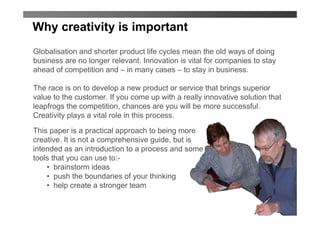
This paper is a practical approach to being more
creative. It is not a comprehensive guide, but is
intended as an introduction to a process and some
tools that you can use to:-
    • brainstorm ideas
    • push the boundaries of your thinking
    • help create a stronger team
Stop before you start
Plan before you start
The human mind is incredibly efficient. Given a problem, it immediately
gets thinking about how to solve the problem without considering:-

    • Am I working on the right problem?
    • And is this the best solution?

Better to explore the situation to understand:-

    • Who are the stakeholders? What would success look like for them?
    • What is the root of the issue, the technical problem, the unmet
    need, the identified gap?
    • What resources do I have at my disposal to help solve the
    problem?

Time spent planning at this stage is never wasted, and can often save
significant time and money overall.
Frame the problem – situation analysis
Who is the customer? (Your immediate customer, and their
successive customers until you reach the end user)
Who are the other stakeholders (use the 9 Cs tool). What are
their expectations and requirements?
What is their need/ goal/ challenge/ problem?
What do people dislike about the current solution/ products/
service?
What do people like about the current solution/ products/
service?
In what way is current solution ineffective?
Situation Analysis Tool –
    Ideal Final Result
Ideal Final Result
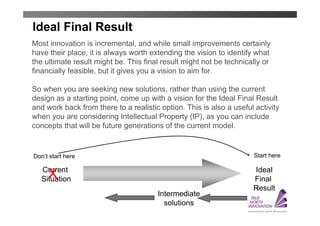
Most innovation is incremental, and while small improvements certainly
have their place, it is always worth extending the vision to identify what
the ultimate result might be. This final result might not be technically or
financially feasible, but it gives you a vision to aim for.

So when you are seeking new solutions, rather than using the current
design as a starting point, come up with a vision for the Ideal Final Result
and work back from there to a realistic option. This is also a useful activity
when you are considering Intellectual Property (IP), as you can include
concepts that will be future generations of the current model.


Don’t start here                                                     Start here

   Current                                                           Ideal
     X
   Situation                                                         Final
                                                                     Result
                                       Intermediate
                                         solutions
Ideal Final Result – questions to ask

What is the final aim of the product?
What is the IFR outcome?
What is stopping you achieving this?
Why is it stopping you achieving this?
How could you make this disappear?
Has anyone else solved this problem?
Situation Analysis Tool –
        Resources
Resources
Another useful tool at this stage is to consider what resources you have to
hand that could be applied to your project.

Resources include the more obvious tangible resources, such as people
and equipment. But they also include intangible resources, such as useful
information or skills that your team or associates might have. A full list
appears on the next page.

Another step is to consider not just the current resources you have
available, but resources you had in the past that you could draw on again
(e.g. a retired employee), or that you tried and didn’t work (to save going
down that path again).

Finally, a useful exercise is to define your ‘system’. This might be the
team, the product, your organisation, whatever makes sense. Then
consider resources that are within your system, external to the system
and in the subsystem. Carry out this exercise for tangible and then
intangible resources.
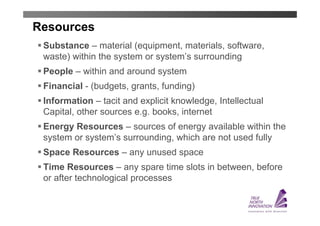
Resources
 Substance – material (equipment, materials, software,
 waste) within the system or system’s surrounding
 People – within and around system
 Financial - (budgets, grants, funding)
 Information – tacit and explicit knowledge, Intellectual
 Capital, other sources e.g. books, internet
 Energy Resources – sources of energy available within the
 system or system’s surrounding, which are not used fully
 Space Resources – any unused space
 Time Resources – any spare time slots in between, before
 or after technological processes
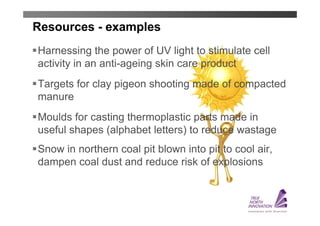
Resources - examples
Harnessing the power of UV light to stimulate cell
activity in an anti-ageing skin care product
Targets for clay pigeon shooting made of compacted
manure
Moulds for casting thermoplastic parts made in
useful shapes (alphabet letters) to reduce wastage
Snow in northern coal pit blown into pit to cool air,
dampen coal dust and reduce risk of explosions
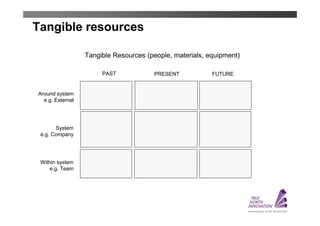
Tangible resources

                  Tangible Resources (people, materials, equipment)

                       PAST            PRESENT            FUTURE


Around system
  e.g. External


       System
 e.g. Company


 Within system
     e.g. Team
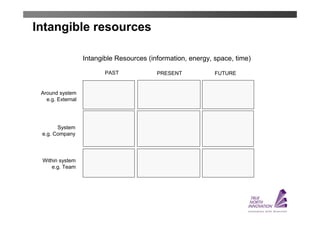
Intangible resources

                   Intangible Resources (information, energy, space, time)

                          PAST             PRESENT            FUTURE


 Around system
   e.g. External


       System
 e.g. Company


 Within system
     e.g. Team
Generate ideas
Start creating
Now you can start to come up with new ideas. The best way to get good
ideas is to expand your thinking, generate lots of ideas and then discard
the poor ones.

Use the rules of brainstorming:-
1.   Defer criticism
     At this stage there are no bad ideas; don’t be negative.
     Judgement can come later.
2.   Go for quantity
     It’s simple maths – the more ideas, the greater the chance of a really good idea.

3.   Go for wild ideas
     The wild ideas can prove to be the most insightful. Remember the Ideal Final Result.

4.   Build on ideas
     What can you add to the idea? What other ideas come to mind? How can your
     experience add to this?
Problem Solving Tool –
  Trends of Evolution
Problem Solving Tool – Trends of Evolution

  Based on the premise that:-
  ̶      All technical systems evolve in set patterns
  ̶      These patterns are the same across
         different industries
  ̶      All trends work towards the ideal solution
  ̶      By understanding these patterns you can
         shortcut the process for generation of new
         ideas

      How to use Trends of Evolution:-
      1. Select the most relevant trends for your product/service
      2. Identify where you are on the trend
      3. Brainstorm for each of the trends to the right of where you are.

                                                      Adapted from TRIZ, www.triz-journal.com/
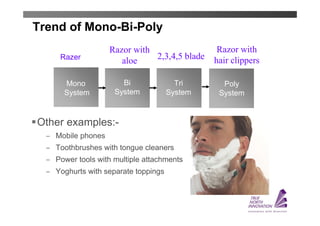
Trend of Mono-Bi-Poly
                    Razor with                  Razor with
     Razer
                       aloe    2,3,4,5 blade   hair clippers

      Mono             Bi               Tri      Poly
      System         System           System    System


Other examples:-
  ̶ Mobile phones
  ̶ Toothbrushes with tongue cleaners
  ̶ Power tools with multiple attachments
  ̶ Yoghurts with separate toppings
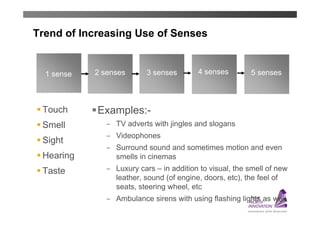
Trend of Increasing Use of Senses


  1 sense   2 senses       3 senses        4 senses        5 senses


 Touch      Examples:-
 Smell          ̶ TV adverts with jingles and slogans
                ̶ Videophones
 Sight
                ̶ Surround sound and sometimes motion and even
 Hearing          smells in cinemas
 Taste          ̶ Luxury cars – in addition to visual, the smell of new
                  leather, sound (of engine, doors, etc), the feel of
                  seats, steering wheel, etc
                ̶ Ambulance sirens with using flashing lights as well
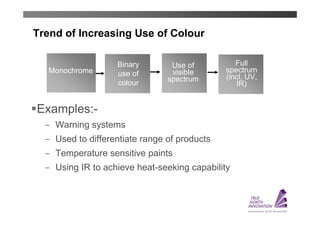
Trend of Increasing Use of Colour

                    Binary        Use of          Full
   Monochrome       use of        visible      spectrum
                                 spectrum      (incl. UV,
                    colour                        IR)


Examples:-
   ̶ Warning systems
   ̶ Used to differentiate range of products
   ̶ Temperature sensitive paints
   ̶ Using IR to achieve heat-seeking capability
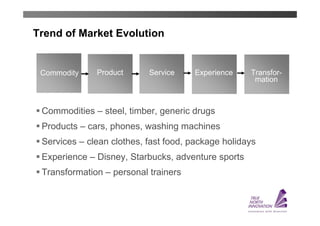
Trend of Market Evolution


 Commodity    Product      Service    Experience    Transfor-
                                                     mation


 Commodities – steel, timber, generic drugs
 Products – cars, phones, washing machines
 Services – clean clothes, fast food, package holidays
 Experience – Disney, Starbucks, adventure sports
 Transformation – personal trainers
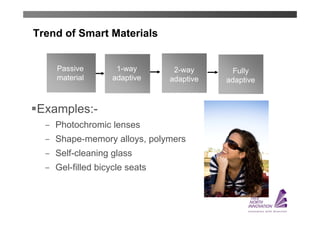
Trend of Smart Materials


    Passive         1-way        2-way       Fully
    material       adaptive     adaptive   adaptive


Examples:-
   ̶ Photochromic lenses
   ̶ Shape-memory alloys, polymers
   ̶ Self-cleaning glass
   ̶ Gel-filled bicycle seats
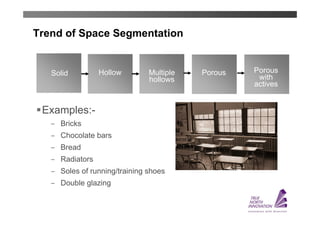
Trend of Space Segmentation


   Solid          Hollow        Multiple   Porous   Porous
                                hollows              with
                                                    actives


 Examples:-
    ̶ Bricks
    ̶ Chocolate bars
    ̶ Bread
    ̶ Radiators
    ̶ Soles of running/training shoes
    ̶ Double glazing
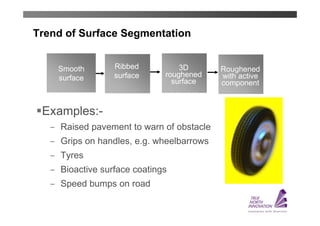
Trend of Surface Segmentation


    Smooth        Ribbed           3D       Roughened
    surface       surface      roughened    with active
                                 surface    component


 Examples:-
    ̶ Raised pavement to warn of obstacle
    ̶ Grips on handles, e.g. wheelbarrows
    ̶ Tyres
    ̶ Bioactive surface coatings
    ̶ Speed bumps on road
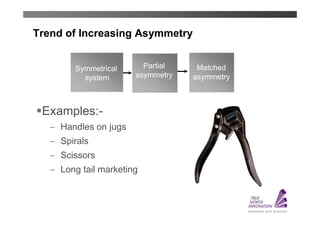
Trend of Increasing Asymmetry


        Symmetrical      Partial    Matched
          system       asymmetry   asymmetry


 Examples:-
   ̶ Handles on jugs
   ̶ Spirals
   ̶ Scissors
   ̶ Long tail marketing
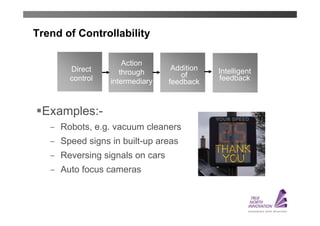
Trend of Controllability

                      Action
       Direct                      Addition   Intelligent
                     through         of
       control    intermediary    feedback    feedback


 Examples:-
    ̶ Robots, e.g. vacuum cleaners
    ̶ Speed signs in built-up areas
    ̶ Reversing signals on cars
    ̶ Auto focus cameras
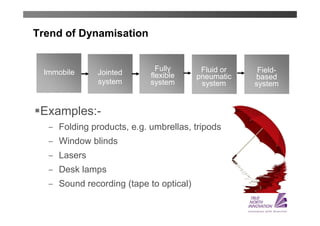
Trend of Dynamisation


 Immobile                    Fully        Fluid or    Field-
              Jointed      flexible      pneumatic   based
              system       system         system     system


 Examples:-
   ̶ Folding products, e.g. umbrellas, tripods
   ̶ Window blinds
   ̶ Lasers
   ̶ Desk lamps
   ̶ Sound recording (tape to optical)
The greatest danger for most of us is not
that our aim is too high and we miss it,
but that it is too low and we reach it.

                               Michelangelo
Rowan Norrie
 True North Innovation
www.truenorthinnovation
Tel: +44(0)1698 389 456

Tools For Creativity

  • 1.
  • 2.
    Warning; the futureis always closer than it appears Faith Popcorn
  • 3.
    Why creativity isimportant Globalisation and shorter product life cycles mean the old ways of doing business are no longer relevant. Innovation is vital for companies to stay ahead of competition and – in many cases – to stay in business. The race is on to develop a new product or service that brings superior value to the customer. If you come up with a really innovative solution that leapfrogs the competition, chances are you will be more successful. Creativity plays a vital role in this process. This paper is a practical approach to being more creative. It is not a comprehensive guide, but is intended as an introduction to a process and some tools that you can use to:- • brainstorm ideas • push the boundaries of your thinking • help create a stronger team
  • 4.
  • 5.
    Plan before youstart The human mind is incredibly efficient. Given a problem, it immediately gets thinking about how to solve the problem without considering:- • Am I working on the right problem? • And is this the best solution? Better to explore the situation to understand:- • Who are the stakeholders? What would success look like for them? • What is the root of the issue, the technical problem, the unmet need, the identified gap? • What resources do I have at my disposal to help solve the problem? Time spent planning at this stage is never wasted, and can often save significant time and money overall.
  • 6.
    Frame the problem– situation analysis Who is the customer? (Your immediate customer, and their successive customers until you reach the end user) Who are the other stakeholders (use the 9 Cs tool). What are their expectations and requirements? What is their need/ goal/ challenge/ problem? What do people dislike about the current solution/ products/ service? What do people like about the current solution/ products/ service? In what way is current solution ineffective?
  • 7.
    Situation Analysis Tool– Ideal Final Result
  • 8.
    Ideal Final Result Mostinnovation is incremental, and while small improvements certainly have their place, it is always worth extending the vision to identify what the ultimate result might be. This final result might not be technically or financially feasible, but it gives you a vision to aim for. So when you are seeking new solutions, rather than using the current design as a starting point, come up with a vision for the Ideal Final Result and work back from there to a realistic option. This is also a useful activity when you are considering Intellectual Property (IP), as you can include concepts that will be future generations of the current model. Don’t start here Start here Current Ideal X Situation Final Result Intermediate solutions
  • 9.
    Ideal Final Result– questions to ask What is the final aim of the product? What is the IFR outcome? What is stopping you achieving this? Why is it stopping you achieving this? How could you make this disappear? Has anyone else solved this problem?
  • 10.
  • 11.
    Resources Another useful toolat this stage is to consider what resources you have to hand that could be applied to your project. Resources include the more obvious tangible resources, such as people and equipment. But they also include intangible resources, such as useful information or skills that your team or associates might have. A full list appears on the next page. Another step is to consider not just the current resources you have available, but resources you had in the past that you could draw on again (e.g. a retired employee), or that you tried and didn’t work (to save going down that path again). Finally, a useful exercise is to define your ‘system’. This might be the team, the product, your organisation, whatever makes sense. Then consider resources that are within your system, external to the system and in the subsystem. Carry out this exercise for tangible and then intangible resources.
  • 12.
    Resources Substance –material (equipment, materials, software, waste) within the system or system’s surrounding People – within and around system Financial - (budgets, grants, funding) Information – tacit and explicit knowledge, Intellectual Capital, other sources e.g. books, internet Energy Resources – sources of energy available within the system or system’s surrounding, which are not used fully Space Resources – any unused space Time Resources – any spare time slots in between, before or after technological processes
  • 13.
    Resources - examples Harnessingthe power of UV light to stimulate cell activity in an anti-ageing skin care product Targets for clay pigeon shooting made of compacted manure Moulds for casting thermoplastic parts made in useful shapes (alphabet letters) to reduce wastage Snow in northern coal pit blown into pit to cool air, dampen coal dust and reduce risk of explosions
  • 14.
    Tangible resources Tangible Resources (people, materials, equipment) PAST PRESENT FUTURE Around system e.g. External System e.g. Company Within system e.g. Team
  • 15.
    Intangible resources Intangible Resources (information, energy, space, time) PAST PRESENT FUTURE Around system e.g. External System e.g. Company Within system e.g. Team
  • 16.
  • 17.
    Start creating Now youcan start to come up with new ideas. The best way to get good ideas is to expand your thinking, generate lots of ideas and then discard the poor ones. Use the rules of brainstorming:- 1. Defer criticism At this stage there are no bad ideas; don’t be negative. Judgement can come later. 2. Go for quantity It’s simple maths – the more ideas, the greater the chance of a really good idea. 3. Go for wild ideas The wild ideas can prove to be the most insightful. Remember the Ideal Final Result. 4. Build on ideas What can you add to the idea? What other ideas come to mind? How can your experience add to this?
  • 18.
    Problem Solving Tool– Trends of Evolution
  • 19.
    Problem Solving Tool– Trends of Evolution Based on the premise that:- ̶ All technical systems evolve in set patterns ̶ These patterns are the same across different industries ̶ All trends work towards the ideal solution ̶ By understanding these patterns you can shortcut the process for generation of new ideas How to use Trends of Evolution:- 1. Select the most relevant trends for your product/service 2. Identify where you are on the trend 3. Brainstorm for each of the trends to the right of where you are. Adapted from TRIZ, www.triz-journal.com/
  • 20.
    Trend of Mono-Bi-Poly Razor with Razor with Razer aloe 2,3,4,5 blade hair clippers Mono Bi Tri Poly System System System System Other examples:- ̶ Mobile phones ̶ Toothbrushes with tongue cleaners ̶ Power tools with multiple attachments ̶ Yoghurts with separate toppings
  • 21.
    Trend of IncreasingUse of Senses 1 sense 2 senses 3 senses 4 senses 5 senses Touch Examples:- Smell ̶ TV adverts with jingles and slogans ̶ Videophones Sight ̶ Surround sound and sometimes motion and even Hearing smells in cinemas Taste ̶ Luxury cars – in addition to visual, the smell of new leather, sound (of engine, doors, etc), the feel of seats, steering wheel, etc ̶ Ambulance sirens with using flashing lights as well
  • 22.
    Trend of IncreasingUse of Colour Binary Use of Full Monochrome use of visible spectrum spectrum (incl. UV, colour IR) Examples:- ̶ Warning systems ̶ Used to differentiate range of products ̶ Temperature sensitive paints ̶ Using IR to achieve heat-seeking capability
  • 23.
    Trend of MarketEvolution Commodity Product Service Experience Transfor- mation Commodities – steel, timber, generic drugs Products – cars, phones, washing machines Services – clean clothes, fast food, package holidays Experience – Disney, Starbucks, adventure sports Transformation – personal trainers
  • 24.
    Trend of SmartMaterials Passive 1-way 2-way Fully material adaptive adaptive adaptive Examples:- ̶ Photochromic lenses ̶ Shape-memory alloys, polymers ̶ Self-cleaning glass ̶ Gel-filled bicycle seats
  • 25.
    Trend of SpaceSegmentation Solid Hollow Multiple Porous Porous hollows with actives Examples:- ̶ Bricks ̶ Chocolate bars ̶ Bread ̶ Radiators ̶ Soles of running/training shoes ̶ Double glazing
  • 26.
    Trend of SurfaceSegmentation Smooth Ribbed 3D Roughened surface surface roughened with active surface component Examples:- ̶ Raised pavement to warn of obstacle ̶ Grips on handles, e.g. wheelbarrows ̶ Tyres ̶ Bioactive surface coatings ̶ Speed bumps on road
  • 27.
    Trend of IncreasingAsymmetry Symmetrical Partial Matched system asymmetry asymmetry Examples:- ̶ Handles on jugs ̶ Spirals ̶ Scissors ̶ Long tail marketing
  • 28.
    Trend of Controllability Action Direct Addition Intelligent through of control intermediary feedback feedback Examples:- ̶ Robots, e.g. vacuum cleaners ̶ Speed signs in built-up areas ̶ Reversing signals on cars ̶ Auto focus cameras
  • 29.
    Trend of Dynamisation Immobile Fully Fluid or Field- Jointed flexible pneumatic based system system system system Examples:- ̶ Folding products, e.g. umbrellas, tripods ̶ Window blinds ̶ Lasers ̶ Desk lamps ̶ Sound recording (tape to optical)
  • 30.
    The greatest dangerfor most of us is not that our aim is too high and we miss it, but that it is too low and we reach it. Michelangelo
  • 31.
    Rowan Norrie TrueNorth Innovation www.truenorthinnovation Tel: +44(0)1698 389 456