Dr. Basudev Pradhan
What is Biomass?
Biomass is biological material derived from living, or recently
living organisms. In the context of biomass for energy this is
often used to mean plant based material, but biomass can
equally apply to both animal and vegetable derived material.
Chemical composition
Biomass is carbon based and is composed of a mixture of organic
molecules containing hydrogen, usually including atoms of
oxygen, often nitrogen and also small quantities of other atoms,
including alkali, alkaline earth and heavy metals. These metals
are often found in functional molecules such as the porphyrins
which include chlorophyll which contains magnesium.
Plant material
 The carbon used to construct biomass is absorbed from the
atmosphere as carbon dioxide (CO2) by plant life, using energy
from the sun.
 Plants may subsequently be eaten by animals and thus converted
into animal biomass. However the primary absorption is
performed by plants.
 If plant material is not eaten it is generally either broken down
by micro-organisms or burned:
 If broken down it releases the carbon back to the atmosphere,
mainly as either carbon dioxide (CO2) or methane (CH4),
depending upon the conditions and processes involved.
 If burned the carbon is returned to the atmosphere as CO2.
 These processes have happened for as long as there have been
plants on Earth and is part of what is known as the carbon cycle.
Fossil fuels
 Fossil fuels such as coal, oil and gas are also derived from
biological material, however material that absorbed
CO2 from the atmosphere many millions of years ago.
 As fuels they offer high energy density, but making use of
that energy involves burning the fuel, with the oxidation of
the carbon to carbon dioxide and the hydrogen to water
(vapour). Unless they are captured and stored, these
combustion products are usually released to the
atmosphere, returning carbon sequestered millions of
years ago and thus contributing to increased atmospheric
concentrations.
The difference between biomass
and fossil fuels
 The vital difference between biomass and fossil fuels is one
of time scale.
 Biomass takes carbon out of the atmosphere while it is
growing, and returns it as it is burned. If it is managed on
a sustainable basis, biomass is harvested as part of a
constantly replenished crop. This is either during
woodland or arboricultural management or coppicing or as
part of a continuous program of replanting with the new
growth taking up CO2 from the atmosphere at the same
time as it is released by combustion of the previous
harvest.
 This maintains a closed carbon cycle with no net increase
in atmospheric CO2 levels.
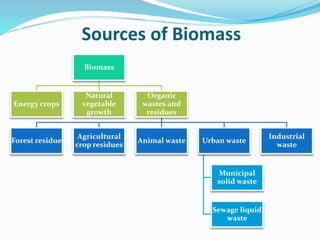
Sources of Biomass
Biomass
Energy crops
Natural
vegetable
growth
Organic
wastes and
residues
Forest residue
Agricultural
crop residues
Animal waste Urban waste
Municipal
solid waste
Sewage liquid
waste
Industrial
waste
Categories of biomass materials
 Biomass for energy can include a wide range of materials.
 There are five basic categories of material:
 Virgin wood, from forestry, arboricultural activities or
from wood processing
 Energy crops: high yield crops grown specifically for
energy applications
 Agricultural residues: residues from agriculture
harvesting or processing
 Food waste, from food and drink manufacture,
preparation and processing, and post-consumer waste
 Industrial waste and co-products from manufacturing
and industrial processes.
Virgin wood
 Virgin wood consists of wood and other products such
as bark and sawdust which have had no chemical
treatments or finishes applied. Wood may be obtained
from a number of sources which may influence it's
physical and chemical characteristics.
Energy crops
 Energy crops are grown specifically for use as fuel and
offer high output per hectare with low inputs.
Different classes of energy crops are,
 Short rotation energy crops
 Grasses and non woody energy corps
 Agricultural energy crops
 Aquatics
Agricultural residues
 Agricultural residues are of a wide variety of types, and
the most appropriate energy conversion technologies
and handling protocols vary from type to type. The
most significant division is between those residues
that are predominantly dry (such as straw) and those
that are wet (such as animal slurry).
Sources of agricultural residues
 Many agricultural crops and processes yield residues
that can potentially be used for energy applications, in
a number of ways. Sources can include:
 Arable crop residues such as straw or husks
 Animal manures and slurries
 Animal bedding such as poultry litter
 Most organic material from excess production or
insufficient market, such as grass silage.
Wet Residue
 These are residues and wastes that have a high water
content as collected.
 This makes them energetically inefficient to use for
combustion or gasification, and financially and
energetically costly to transport. It is therefore
preferable to process them close to production, and to
use processes that can make use of biomass in an
aqueous environment. They include,
 Animal Slurry
 Grass Silage
Dry residues
 These include those parts of arable crops not to be
used for the primary purpose of producing food, feed
or fiber, used animal bedding and feathers. They are
generally,
 Straw
 Corn Stover
 Poultry litter
Food waste
 There are residues and waste at all points in the food
supply chain from initial production, through processing,
handling and distributions to post-consumer waste from
hotels, restaurants and individual houses
 It has been calculated that about a third of all food grown
for human consumption in the UK is thrown away.
 Many food materials are processed at some stage to remove
components that are inedible or not required such as
peel/skin, shells, husks, cores, pips/stones, fish heads, pulp
from juice and oil extraction, etc
 Many manufactured foods and drinks, and cheese and other
dairy products generate large quantities of organic waste
material. It has been estimated that up to 92% of ingredients
used in brewing ultimately become waste, principally spent
grains, and the dairy industry uses around 40 million
m3 annually, mainly for cleaning, which produces effluent
containing high levels of organic residues
 Food preparation on both the commercial and domestic scale
yield residues and waste, used cooking oils and food that has
had to be disposed of because it has gone bad, for health and
safety reasons or because it is surplus to requirements.
 Food waste can be divided into dry waste and wet waste,
however the majority is of relatively high moisture content.
Industrial waste and co-products
 Many industrial processes and manufacturing
operations produce residues, waste or co-products that
can potentially be used or converted to biomass
fuel. These can be divided into woody materials and
non-woody materials.
 Woody wastes and residues
 Non-woody wastes and residues
Forms of biomass and wood fuel
 Raw biomass typically has a low energy density as a
result of both its physical form and moisture
content. This makes it inconvenient and inefficient
for storage and transport, and also usually unsuitable
for use without some kind of pre-processing
 There are however a range of processes available to
convert it into a more convenient form. Depending on
the biomass itself, and the purpose to which it is to be
put, this may consist of
 Physical preprocessing
 Conversion by thermal or chemical process
In this way raw biomass is converted into what can be
described as a 'biomass fuel‘
 For example, virgin wood (above) is a simple form of
biomass and for many applications may require relatively
straightforward processing. For ease of handling,
transport and storage it may be cut into a number of
physical forms, as best suit the requirements of the next
handling or processing stage
Pre-processing forestry and
arboricultural residues
 Pre-processing may be required to change the
physical form or to reduce the moisture content.
 As harvested, forest derived biomass tends to be of a
range of lengths and size, and is of relatively low
density. Physical pre-processing can consist of
 Cutting to uniform length
 Chipping
 Grinding or shredding
 Reducing moisture content.
Conversion technologies
 There are a number of technological options available
to make use of a wide variety of biomass types as a
renewable energy source. Conversion technologies
may release the energy directly, in the form of heat or
electricity, or may convert it to another form, such as
liquid biofuel or combustible biogas. While for some
classes of biomass resource there may be a number of
usage options, for others there may only one
appropriate technology
 Thermal conversion technologies
 Chemical Conversion technologies
Thermal conversion
 These are processes in which heat is the dominant
mechanism to convert the biomass into another
chemical form. The basic alternatives are separated
principally by the extent to which the chemical
reactions involved are allowed to proceed:
 Combustion
 Gassification
 Pyrolysis
Combustion
 Combustion is the process with which everyone is
familiar by which flammable materials are allowed to
burn in the presence of air or oxygen with the release
of heat.
Improved Chulha by Philips Design
http://www.lowsmokechulha.com
What is combustion?
 The basic process is oxidation.
 Combustion is the simplest method by which biomass
can be used for energy, and has been used for
millennia to provide heat. This heat can itself be used
in a number of ways:
 Space heating
 Water (or other fluid) heating for central or district
heating or process heat
 Steam raising for electricity generation or motive force.
Combustion of biomass material
 When the flammable fuel material is a form of
biomass the oxidation is of predominantly the carbon
(C) and hydrogen (H) in the cellulose, hemicellulose,
lignin, and other molecules present to form carbon
dioxide (CO2) and water (H2O)
Oxidation of other elements into
gasses, ash or slag
 The above, and other, molecules within the biomass also
contain other atoms in different quantities and some of
these too can be oxidized, with the oxide released as gas in
the flue gasses, or as solid as ash or slag.
 All carbohydrates, such as cellulose, also contain oxygen in
the molecular structure.
 Other atoms potentially found in biomass include:
 Nitrogen (N)
 Phosphorus (P)
 Potassium (K)
 Silicon (Si)
 Sulphur (S).
Gasification
 Gasification is a partial oxidation process whereby a
carbon source such as coal, natural gas or biomass, is
broken down into carbon monoxide (CO) and
hydrogen (H2), plus carbon dioxide (CO2) and possibly
hydrocarbon molecules such as methane (CH4).
What is gasification?
 This mix of gases is known as 'producer gas' or product
gas (or wood gas or coal gas, depending on the
feedstock), and the precise characteristics of the gas
will depend on the gasification parameters, such as
temperature, and also the oxidizer used. The oxidizer
may be air, in which case the producer gas will also
contain nitrogen (N2), or steam or oxygen.
Applications
 Gasification technology can be used for:
 Heating water in central heating, district heating or
process heating applications
 Steam for electricity generation or motive force
 As part of systems producing electricity or motive
force
 Transport using an internal combustion engine.
Low temperature gasification
 If the gasification takes place at a relatively low
temperature, such as 700ºC to 1000ºC, the product gas
will have a relatively high level of hydrocarbons
compared to high temperature gasification. As a result
it may be used directly, to be burned for heat or
electricity generation via a steam turbine or, with
suitable gas clean up, to run an internal combustion
engine for electricity generation.
High temperature gasification
 Higher temperature gasification (1200ºC to 1600ºC)
leads to few hydrocarbons in the product gas, and a
higher proportion of CO and H2.
 This is known as synthesis gas (syngas or biosyngas) as
it can be used to synthesize longer chain hydrocarbons
using techniques such as Fischer-Tropsch (FT)
synthesis.
 If the ratio of H2 to CO is correct (2:1) FT synthesis can
be used to convert syngas into high quality synthetic
diesel biofuel which is completely compatible with
conventional fossil diesel and diesel engines.
Pyrolysis
Pyrolysis is the precursor to gasification, and takes place
as part of both gasification and combustion. It
consists of thermal decomposition in the absence of
oxygen. It is essentially based on a long established
process, being the basis of charcoal burning
Products of pyrolysis: The products of pyrolysis
include gas, liquid and a sold char, with the
proportions of each depending upon the parameters of
the process.
Applications
 Applications for pyrolysis include:
 Biomass energy densification for transport or storage
 Co-firing for heat or power
 Feedstock for gasification.
Lower vs. higher temperature
pyrolysis
 Lower temperatures (around 400ºC) tend to produce
more solid char (slow pyrolysis), whereas somewhat
higher temperatures (around 500ºC) produce a much
higher proportion of liquid (bio-oil).
Chemical conversion Processes
 A range of chemical processes may be used to convert
biomass into other forms, such as to produce a fuel
that is more conveniently used, transported or stored,
or to exploit some property of the process itself.
Biochemical conversion
 As biomass is a natural material, many highly efficient
biochemical processes have developed in nature to break
down the molecules of which biomass is composed, and
many of these biochemical conversion processes can be
harnessed.
 Biochemical conversion makes use of the enzymes of
bacteria and other micro-organisms to break down
biomass. In most cases micro-organisms are used to
perform the conversion process:
 Anaerobic digestion
 Fermentation
 Composting
 Trans esterification
Anaerobic Digestion
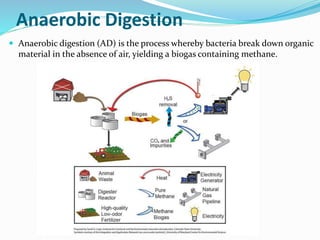
 Anaerobic digestion (AD) is the process whereby bacteria break down organic
material in the absence of air, yielding a biogas containing methane.
About anaerobic digestion
 The products of this process are:
 Biogas (principally methane (CH4) and carbon dioxide
(CO2))
 A solid residue (fiber or digestate) that is similar, but
not identical, to compost.
 A liquid liquor that can be used as a fertilizer.
Using the outputs from the anaerobic digestion
of biomass material
 Methane can be burned for heat or electricity
generation.
 The solid residue of the AD process can be used as a
soil conditioner, however its properties:
 Will depend on the AD feedstock used
 May or may not contain useful levels of nitrate or
phosphate
 May be contaminated with heavy metals.
 The solid residue can, alternatively, be burned as a
fuel, or gasified.
Fermentation
 Fermentation is the process used in brewing and wine
making for the conversion of sugars to alcohol (ethanol
CH3CH2OH). The same process, followed by distillation,
can be used to obtain pure ethanol (bioethanol) for use as a
transport biofuel.
 Conventional fermentation processes for the production of
bioethanol make use of the starch and sugar components
of typically cereal or sugar (beet or cane) crops.
 Second generation bioethanol precedes this with acid
and/or enzymatic hydrolysis of hemicellulose and cellulose
into fermentable saccharides to make use of a much larger
proportion of available biomass
Using bioethanol
 (Bio)ethanol can be readily added to conventional
petrol in concentrations up to 10%, but most European
manufacturers' vehicle warranties only cover up to a
5% bioethanol/95% petrol blend.
Composting
 Similarly to anaerobic digestion, though making use of
different bacteria, composting is the aerobic
decomposition of organic matter by micro organisms.
It is however typically performed on relatively dry
material rather than a slurry
Using composting for heat and power
 Instead of, or in addition to, collecting the flammable
biogas emitted, the exothermic nature of the
composting process can be exploited and the heat
produced used, usually using a heat pump.
Trans esterification
 This chemical conversion process can be used to
convert straight and waste vegetable oils into
biodiesel.
Problems with using vegetable oils
as fuel
 Vegetable oils and animal fats are triglycerides: esters of
glycerol with three fatty acid chains. Although some
unmodified vegetable oils have been used as fuel in
internal combustion engines, in general the viscosity is
significantly higher than that of conventional diesel and a
number of modifications are required to a vehicle's fuel
system (including heaters, additional filters and modified
injectors) to use them.
 Even then, the lack of a transport fuel specification for
straight vegetable oil (SVO) and concerns about long term
engine reliability using SVO as a fuel, make this inadvisable
for the present
Converting vegetable oils into
biodiesel
 Instead, SVO and filtered waste vegetable oil (WVO) can
be reacted with methanol (or ethanol) to change the
triglyceride esters into methanol (or ethanol) monoesters,
each with single fatty acid chains making fatty acid methyl
ester (FAME), commonly known as biodiesel.
 Although not all oils and fats are suitable for this process,
depending on such chemical characteristics as degree of
saturation of the fatty acid chains (iodine number),
melting point, etc., many oils have been successfully used,
including rape seed oil, palm oil and soybean oil.
 Both virgin oil and waste oil can potentially be used.
However WVO needs both to be filtered before use and
assayed for iodine number and free fatty acid concentration
before use
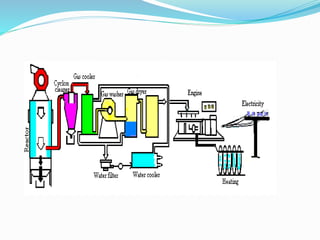
Basic Process : therm0-chemical conversion
• Conversion of solid fuels into combustible
gas mixture called producer gas (CO + H2 +
CH4)
• Involves partial combustion of biomass
• Four distinct process in the gasifier viz.
• Drying
• Pyrolysis
• Combustion
• Reduction
What is Biomass Gasification?
Biomass Gasifiers
Downdraft Gasifier
Gasification flow diagram
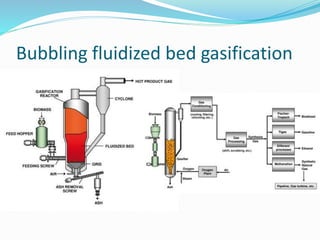
Bubbling fluidized bed gasification
Particulars Rice Husk Woody Biomass
CO 15-20% 15-20%
H2 10-15% 15-20%
CH4 Upto 4% Upto 3%
N2 45-55% 45-50%
CO2 8-12% 8-12%
Gas C.V. (kcal/Nm3) Above 1050 Above 1100
Gas generated in Nm3/kg
of biomass
2 2.5
Producer Gas - Composition?
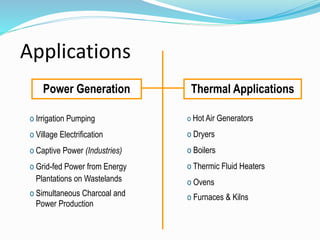
Applications
Power Generation Thermal Applications
o Irrigation Pumping
o Village Electrification
o Captive Power (Industries)
o Grid-fed Power from Energy
Plantations on Wastelands
o Simultaneous Charcoal and
Power Production
o Hot Air Generators
o Dryers
o Boilers
o Thermic Fluid Heaters
o Ovens
o Furnaces & Kilns
Gasifier Plant
Indicative Schematic – Power Gen
Biodiesel plant
Biodiesel is a liquid fuel produced from non-edible oil seeds as Jatropha, karanja,
jajoba, etc which can be grown on wasteland.
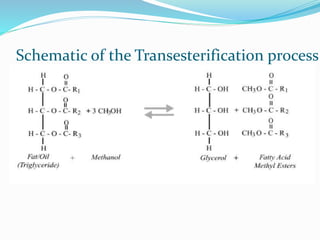
Viscosity 20 times higher than diesel, to solve by trans-esterification (raw vegitables
oils are treated with alcohol to form methyl or ethyl ester(monoester or biodiesel)
Schematic of the Transesterification process
Biodiesel – Final Product
Biodiesel 100%
Glycerin
 BioDiesel is here
Using biodiesel
 The biodiesel produced can be used on its own or
mixed with petroleum based diesel fuel as a 5%
biodiesel/95% fossil diesel blend and used by
unmodified, conventional diesel engines
 In USA, anhydrous ethanol (10%)+petrol (90%)~
gasohol
 In India 18 M tonnes sugar production per year,
ethanol ~1700 M litres, 1200 M litres for chemical
sector, leaving 500 M litres sufficient for 5% blending
with petrol in our country
Biogas and biogas technology
Biogas:
Biogas is a renewable energy derived from organic wastes such as cattle
dung, human waste, etc. It is a safe fuel for cooking, and lighting. Left over
digested slurry is used as enriched manure in agriculture lands.
Biogas technology:
Biogas is produced from wet biomas through a biological conversion process
that involves bactrial breakdown organic matter by micro-organisms to
produce CH4, CO2 and H2O......”anaerobic digestion” in three steps
•Hydrolysis by celluolytic bacteria/hydrobytic bacteria), pH(6-7),
temp(30-40°C)
•Acid formation ( acetic acid)
•Methane formation
Factor affecting biogas production
 Solid–to-water ratio
Cattle dung (gobar) contains 18% solid matter+82% water. Anaerobic fermentations better
if slurry contain 9% solid, so digester feed is prepared by mixing water in 1:1 weight ratio,
to increase the solid matter, crop residues, weed plants may be mixed
 Volumetric loading rate (1-1.5 kg/m3/day)
 Temperature (35-38°C, deceases below 20°C stop below 8°C)
 Seeding
 pH value(6.8- 7.8)
 Carbon –to –nitrogen ratio(30:1)
 Retention time (120 litre digester , fed 5 litre per day,
retentation time24 days)
 Stirring digester contents
Calorific values of commonly used fuels
Commonly used
fuels
Calorific values in
Kilo calories
Thermal
efficiency
Bio-gas 4713/M3 60%
Dung cake 2093/Kg 11%
Firewood 4978/Kg 17.3%
Diesel (HSD) 10550/Kg 66%
Kerosene 10850/Kg 50%
Petrol 11100/Kg ---
Biogas Production Potential from different Wastes
Raw Materials for Gasification
Average maximum biogas production from different feeds
Sl. No. Feed Stock
Litre /kg of
dry matter
% Methane
content
1. Dung 350* 60
2. Night-soil 400 65
3. Poultry manure 440 65
4. Dry leaf 450 44
5. Sugar cane Trash 750 45
6. Maize straw 800 46
7. Straw Powder 930 46
* Average gas production from dung may be taken as 40 lit/kg. of fresh
dung when no temperature control is provided in the plant. One Cu. m gas
is equivalent to 1000 litres.
What is Biogas Plant
 Basically Methane & CO2 Gas Producer.
 Methane – Odorless, Colorless, Good Calorific
Value, Green House Gas
 Sources : Animal Manures, excreta, kitchen waste,
Industrial Chemical Processes, Sea Water Bed, etc.
 Animal Manure & Excreta contributes around 16 %
of the total global methane emission.
Components of the bio-gas production
plant
There are two major models - fixed dome type and floating drum type
Both the above types have the following components
(i) Digester : This is the fermentation tank. It is built partially or fully
underground. It is generally cylindrical in shape and made up of bricks and
cement mortars.
(ii) Gas holder: This component is meant for holding the gas after it leaves the
digester. It may be a floating drum or a fixed dome on the basis of which the
plants are broadly classified. The gas connection is taken from the top of this
holder to the gas burners or for any other purposes by suitable pipelines.
(iii) Slurry mixing tank: This is a tank in which the dung is mixed with water and
fed to the digester through an inlet pipe.
(iv) Outlet tank and slurry pit: An outlet tank is usually provided in a fixed dome
type of plant from where slurry in directly taken to the field or to a slurry pit. In
case of a floating drum plant, the slurry is taken to a pit where it can be dried or
taken to the field for direct applications.
Points to be considered for construction of a biogas
plant
Site selection: While selecting a site for a bio-gas plant, following aspects should be considered:
 The land should be levelled and at a higher elevation than the surroundings to avoid water
stagnation
 Soil should not be too loose and should have a bearing strength of 2 kg/cm2
 It should be nearer to the intended place of gas use (eg. home or farm).
 It should also be nearer to the cattle shed/ stable for easy handling of raw materials.
 The water table should not be very high.
 Adequate supply of water should be there at the plant site.
 The plant should get clear sunshine during most part of the day.
 The plant site should be well ventilated.
 A minimum distance of 1.5m should be kept between the plant and any wall or foundation.
 It should be away from any tree to prevent root interference.
 It should be at least 15m away from any well used for drinking water purpose.
Availability of raw materials : The size of the biogas plant is to be decided based on availability
of raw material. It is generally said that, average cattle yield is about 10 kg dung per day. For eg.
the average gas production from dung may be taken as 40 lit/kg. of fresh dung. The total dung
required for production of 3 m3 biogas is 3/0.04= 75 kgs. Hence, a minimum of 4 cattle is
required to generate the required quantity of cow dung.
Schematic of a typical Biogas Plant
Floating dome type Bio-gas Plant
A KVIC Type Biogas Plant
Fixed dome type Bio-gas Plant
Benefits of Biogas Plants
 Contributes substantially in reducing Global Warming.
 Cost effective replacement for Fossil Fuels.
 This Smoke Free gas emits less carbon dioxide as
compared to other fuels.
 A very efficient and environmentally friendly solution
for disposing off various organic matter.
METHANE
 Contributes largely in Global Warming
 Traps 21 times more heat than CO2
 Over the 100 years – 25 times more temperature impact
than that by CO2
--------------------------------------------------------------------------------------------------------
Biogas Plant  Traps Methane 
Fuel  Carbon Dioxide.
Biogas Plants – Reduction in Global Warming
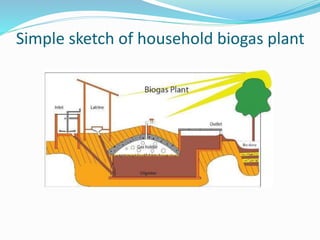
Simple sketch of household biogas plant
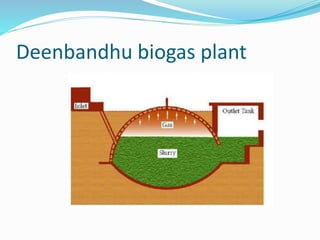
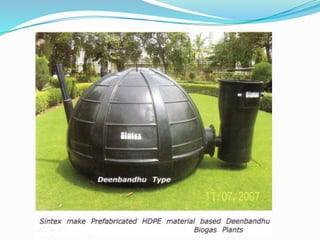
Deenbandhu biogas plant
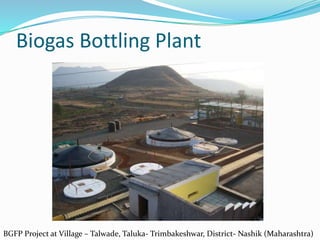
Biogas Bottling Plant
BGFP Project at Village – Talwade, Taluka- Trimbakeshwar, District- Nashik (Maharashtra)
Conclusions
 India has second largest biogas programme in the world at rural
and as well as urban levels.
 Many technologies/models have been successfully developed in
India for biogas programme.
 There is need to develop a sustainable renewable energy
programme on biogas for replacing petroleum products by
utilization of biogas in the country.
 This will help in green energy technology and reducing green
house gases emissions.
 Biogas is a potential renewable energy source for rural India and
other developing countries.
 Biogas generation and subsequent bottling will cater the energy
needs of villages, supply enriched manure and maintain village
sanitation.
 The bottling system will work as a decentralize source of power
with uninterrupted supply using local resources, generate ample
opportunities for employment and income of the rural people.
Biogas flame
THANK YOU

Biomass by Bapi Kumar Das

  • 1.
  • 2.
    What is Biomass? Biomassis biological material derived from living, or recently living organisms. In the context of biomass for energy this is often used to mean plant based material, but biomass can equally apply to both animal and vegetable derived material. Chemical composition Biomass is carbon based and is composed of a mixture of organic molecules containing hydrogen, usually including atoms of oxygen, often nitrogen and also small quantities of other atoms, including alkali, alkaline earth and heavy metals. These metals are often found in functional molecules such as the porphyrins which include chlorophyll which contains magnesium.
  • 3.
    Plant material  Thecarbon used to construct biomass is absorbed from the atmosphere as carbon dioxide (CO2) by plant life, using energy from the sun.  Plants may subsequently be eaten by animals and thus converted into animal biomass. However the primary absorption is performed by plants.  If plant material is not eaten it is generally either broken down by micro-organisms or burned:  If broken down it releases the carbon back to the atmosphere, mainly as either carbon dioxide (CO2) or methane (CH4), depending upon the conditions and processes involved.  If burned the carbon is returned to the atmosphere as CO2.  These processes have happened for as long as there have been plants on Earth and is part of what is known as the carbon cycle.
  • 4.
    Fossil fuels  Fossilfuels such as coal, oil and gas are also derived from biological material, however material that absorbed CO2 from the atmosphere many millions of years ago.  As fuels they offer high energy density, but making use of that energy involves burning the fuel, with the oxidation of the carbon to carbon dioxide and the hydrogen to water (vapour). Unless they are captured and stored, these combustion products are usually released to the atmosphere, returning carbon sequestered millions of years ago and thus contributing to increased atmospheric concentrations.
  • 5.
    The difference betweenbiomass and fossil fuels  The vital difference between biomass and fossil fuels is one of time scale.  Biomass takes carbon out of the atmosphere while it is growing, and returns it as it is burned. If it is managed on a sustainable basis, biomass is harvested as part of a constantly replenished crop. This is either during woodland or arboricultural management or coppicing or as part of a continuous program of replanting with the new growth taking up CO2 from the atmosphere at the same time as it is released by combustion of the previous harvest.  This maintains a closed carbon cycle with no net increase in atmospheric CO2 levels.
  • 7.
    Sources of Biomass Biomass Energycrops Natural vegetable growth Organic wastes and residues Forest residue Agricultural crop residues Animal waste Urban waste Municipal solid waste Sewage liquid waste Industrial waste
  • 8.
    Categories of biomassmaterials  Biomass for energy can include a wide range of materials.  There are five basic categories of material:  Virgin wood, from forestry, arboricultural activities or from wood processing  Energy crops: high yield crops grown specifically for energy applications  Agricultural residues: residues from agriculture harvesting or processing  Food waste, from food and drink manufacture, preparation and processing, and post-consumer waste  Industrial waste and co-products from manufacturing and industrial processes.
  • 9.
    Virgin wood  Virginwood consists of wood and other products such as bark and sawdust which have had no chemical treatments or finishes applied. Wood may be obtained from a number of sources which may influence it's physical and chemical characteristics.
  • 10.
    Energy crops  Energycrops are grown specifically for use as fuel and offer high output per hectare with low inputs. Different classes of energy crops are,  Short rotation energy crops  Grasses and non woody energy corps  Agricultural energy crops  Aquatics
  • 11.
    Agricultural residues  Agriculturalresidues are of a wide variety of types, and the most appropriate energy conversion technologies and handling protocols vary from type to type. The most significant division is between those residues that are predominantly dry (such as straw) and those that are wet (such as animal slurry).
  • 12.
    Sources of agriculturalresidues  Many agricultural crops and processes yield residues that can potentially be used for energy applications, in a number of ways. Sources can include:  Arable crop residues such as straw or husks  Animal manures and slurries  Animal bedding such as poultry litter  Most organic material from excess production or insufficient market, such as grass silage.
  • 13.
    Wet Residue  Theseare residues and wastes that have a high water content as collected.  This makes them energetically inefficient to use for combustion or gasification, and financially and energetically costly to transport. It is therefore preferable to process them close to production, and to use processes that can make use of biomass in an aqueous environment. They include,  Animal Slurry  Grass Silage
  • 14.
    Dry residues  Theseinclude those parts of arable crops not to be used for the primary purpose of producing food, feed or fiber, used animal bedding and feathers. They are generally,  Straw  Corn Stover  Poultry litter
  • 15.
    Food waste  Thereare residues and waste at all points in the food supply chain from initial production, through processing, handling and distributions to post-consumer waste from hotels, restaurants and individual houses  It has been calculated that about a third of all food grown for human consumption in the UK is thrown away.  Many food materials are processed at some stage to remove components that are inedible or not required such as peel/skin, shells, husks, cores, pips/stones, fish heads, pulp from juice and oil extraction, etc
  • 16.
     Many manufacturedfoods and drinks, and cheese and other dairy products generate large quantities of organic waste material. It has been estimated that up to 92% of ingredients used in brewing ultimately become waste, principally spent grains, and the dairy industry uses around 40 million m3 annually, mainly for cleaning, which produces effluent containing high levels of organic residues  Food preparation on both the commercial and domestic scale yield residues and waste, used cooking oils and food that has had to be disposed of because it has gone bad, for health and safety reasons or because it is surplus to requirements.  Food waste can be divided into dry waste and wet waste, however the majority is of relatively high moisture content.
  • 17.
    Industrial waste andco-products  Many industrial processes and manufacturing operations produce residues, waste or co-products that can potentially be used or converted to biomass fuel. These can be divided into woody materials and non-woody materials.  Woody wastes and residues  Non-woody wastes and residues
  • 18.
    Forms of biomassand wood fuel  Raw biomass typically has a low energy density as a result of both its physical form and moisture content. This makes it inconvenient and inefficient for storage and transport, and also usually unsuitable for use without some kind of pre-processing  There are however a range of processes available to convert it into a more convenient form. Depending on the biomass itself, and the purpose to which it is to be put, this may consist of
  • 19.
     Physical preprocessing Conversion by thermal or chemical process In this way raw biomass is converted into what can be described as a 'biomass fuel‘  For example, virgin wood (above) is a simple form of biomass and for many applications may require relatively straightforward processing. For ease of handling, transport and storage it may be cut into a number of physical forms, as best suit the requirements of the next handling or processing stage
  • 20.
    Pre-processing forestry and arboriculturalresidues  Pre-processing may be required to change the physical form or to reduce the moisture content.  As harvested, forest derived biomass tends to be of a range of lengths and size, and is of relatively low density. Physical pre-processing can consist of  Cutting to uniform length  Chipping  Grinding or shredding  Reducing moisture content.
  • 21.
    Conversion technologies  Thereare a number of technological options available to make use of a wide variety of biomass types as a renewable energy source. Conversion technologies may release the energy directly, in the form of heat or electricity, or may convert it to another form, such as liquid biofuel or combustible biogas. While for some classes of biomass resource there may be a number of usage options, for others there may only one appropriate technology  Thermal conversion technologies  Chemical Conversion technologies
  • 22.
    Thermal conversion  Theseare processes in which heat is the dominant mechanism to convert the biomass into another chemical form. The basic alternatives are separated principally by the extent to which the chemical reactions involved are allowed to proceed:  Combustion  Gassification  Pyrolysis
  • 23.
    Combustion  Combustion isthe process with which everyone is familiar by which flammable materials are allowed to burn in the presence of air or oxygen with the release of heat.
  • 24.
    Improved Chulha byPhilips Design http://www.lowsmokechulha.com
  • 25.
    What is combustion? The basic process is oxidation.  Combustion is the simplest method by which biomass can be used for energy, and has been used for millennia to provide heat. This heat can itself be used in a number of ways:  Space heating  Water (or other fluid) heating for central or district heating or process heat  Steam raising for electricity generation or motive force.
  • 26.
    Combustion of biomassmaterial  When the flammable fuel material is a form of biomass the oxidation is of predominantly the carbon (C) and hydrogen (H) in the cellulose, hemicellulose, lignin, and other molecules present to form carbon dioxide (CO2) and water (H2O)
  • 27.
    Oxidation of otherelements into gasses, ash or slag  The above, and other, molecules within the biomass also contain other atoms in different quantities and some of these too can be oxidized, with the oxide released as gas in the flue gasses, or as solid as ash or slag.  All carbohydrates, such as cellulose, also contain oxygen in the molecular structure.  Other atoms potentially found in biomass include:  Nitrogen (N)  Phosphorus (P)  Potassium (K)  Silicon (Si)  Sulphur (S).
  • 28.
    Gasification  Gasification isa partial oxidation process whereby a carbon source such as coal, natural gas or biomass, is broken down into carbon monoxide (CO) and hydrogen (H2), plus carbon dioxide (CO2) and possibly hydrocarbon molecules such as methane (CH4).
  • 29.
    What is gasification? This mix of gases is known as 'producer gas' or product gas (or wood gas or coal gas, depending on the feedstock), and the precise characteristics of the gas will depend on the gasification parameters, such as temperature, and also the oxidizer used. The oxidizer may be air, in which case the producer gas will also contain nitrogen (N2), or steam or oxygen.
  • 30.
    Applications  Gasification technologycan be used for:  Heating water in central heating, district heating or process heating applications  Steam for electricity generation or motive force  As part of systems producing electricity or motive force  Transport using an internal combustion engine.
  • 31.
    Low temperature gasification If the gasification takes place at a relatively low temperature, such as 700ºC to 1000ºC, the product gas will have a relatively high level of hydrocarbons compared to high temperature gasification. As a result it may be used directly, to be burned for heat or electricity generation via a steam turbine or, with suitable gas clean up, to run an internal combustion engine for electricity generation.
  • 32.
    High temperature gasification Higher temperature gasification (1200ºC to 1600ºC) leads to few hydrocarbons in the product gas, and a higher proportion of CO and H2.  This is known as synthesis gas (syngas or biosyngas) as it can be used to synthesize longer chain hydrocarbons using techniques such as Fischer-Tropsch (FT) synthesis.  If the ratio of H2 to CO is correct (2:1) FT synthesis can be used to convert syngas into high quality synthetic diesel biofuel which is completely compatible with conventional fossil diesel and diesel engines.
  • 33.
    Pyrolysis Pyrolysis is theprecursor to gasification, and takes place as part of both gasification and combustion. It consists of thermal decomposition in the absence of oxygen. It is essentially based on a long established process, being the basis of charcoal burning Products of pyrolysis: The products of pyrolysis include gas, liquid and a sold char, with the proportions of each depending upon the parameters of the process.
  • 34.
    Applications  Applications forpyrolysis include:  Biomass energy densification for transport or storage  Co-firing for heat or power  Feedstock for gasification.
  • 35.
    Lower vs. highertemperature pyrolysis  Lower temperatures (around 400ºC) tend to produce more solid char (slow pyrolysis), whereas somewhat higher temperatures (around 500ºC) produce a much higher proportion of liquid (bio-oil).
  • 36.
    Chemical conversion Processes A range of chemical processes may be used to convert biomass into other forms, such as to produce a fuel that is more conveniently used, transported or stored, or to exploit some property of the process itself.
  • 37.
    Biochemical conversion  Asbiomass is a natural material, many highly efficient biochemical processes have developed in nature to break down the molecules of which biomass is composed, and many of these biochemical conversion processes can be harnessed.  Biochemical conversion makes use of the enzymes of bacteria and other micro-organisms to break down biomass. In most cases micro-organisms are used to perform the conversion process:  Anaerobic digestion  Fermentation  Composting  Trans esterification
  • 38.
    Anaerobic Digestion  Anaerobicdigestion (AD) is the process whereby bacteria break down organic material in the absence of air, yielding a biogas containing methane.
  • 39.
    About anaerobic digestion The products of this process are:  Biogas (principally methane (CH4) and carbon dioxide (CO2))  A solid residue (fiber or digestate) that is similar, but not identical, to compost.  A liquid liquor that can be used as a fertilizer.
  • 40.
    Using the outputsfrom the anaerobic digestion of biomass material  Methane can be burned for heat or electricity generation.  The solid residue of the AD process can be used as a soil conditioner, however its properties:  Will depend on the AD feedstock used  May or may not contain useful levels of nitrate or phosphate  May be contaminated with heavy metals.  The solid residue can, alternatively, be burned as a fuel, or gasified.
  • 41.
    Fermentation  Fermentation isthe process used in brewing and wine making for the conversion of sugars to alcohol (ethanol CH3CH2OH). The same process, followed by distillation, can be used to obtain pure ethanol (bioethanol) for use as a transport biofuel.  Conventional fermentation processes for the production of bioethanol make use of the starch and sugar components of typically cereal or sugar (beet or cane) crops.  Second generation bioethanol precedes this with acid and/or enzymatic hydrolysis of hemicellulose and cellulose into fermentable saccharides to make use of a much larger proportion of available biomass
  • 42.
    Using bioethanol  (Bio)ethanolcan be readily added to conventional petrol in concentrations up to 10%, but most European manufacturers' vehicle warranties only cover up to a 5% bioethanol/95% petrol blend.
  • 43.
    Composting  Similarly toanaerobic digestion, though making use of different bacteria, composting is the aerobic decomposition of organic matter by micro organisms. It is however typically performed on relatively dry material rather than a slurry
  • 44.
    Using composting forheat and power  Instead of, or in addition to, collecting the flammable biogas emitted, the exothermic nature of the composting process can be exploited and the heat produced used, usually using a heat pump.
  • 45.
    Trans esterification  Thischemical conversion process can be used to convert straight and waste vegetable oils into biodiesel.
  • 46.
    Problems with usingvegetable oils as fuel  Vegetable oils and animal fats are triglycerides: esters of glycerol with three fatty acid chains. Although some unmodified vegetable oils have been used as fuel in internal combustion engines, in general the viscosity is significantly higher than that of conventional diesel and a number of modifications are required to a vehicle's fuel system (including heaters, additional filters and modified injectors) to use them.  Even then, the lack of a transport fuel specification for straight vegetable oil (SVO) and concerns about long term engine reliability using SVO as a fuel, make this inadvisable for the present
  • 47.
    Converting vegetable oilsinto biodiesel  Instead, SVO and filtered waste vegetable oil (WVO) can be reacted with methanol (or ethanol) to change the triglyceride esters into methanol (or ethanol) monoesters, each with single fatty acid chains making fatty acid methyl ester (FAME), commonly known as biodiesel.  Although not all oils and fats are suitable for this process, depending on such chemical characteristics as degree of saturation of the fatty acid chains (iodine number), melting point, etc., many oils have been successfully used, including rape seed oil, palm oil and soybean oil.  Both virgin oil and waste oil can potentially be used. However WVO needs both to be filtered before use and assayed for iodine number and free fatty acid concentration before use
  • 49.
    Basic Process :therm0-chemical conversion • Conversion of solid fuels into combustible gas mixture called producer gas (CO + H2 + CH4) • Involves partial combustion of biomass • Four distinct process in the gasifier viz. • Drying • Pyrolysis • Combustion • Reduction What is Biomass Gasification?
  • 50.
  • 51.
  • 54.
  • 55.
    Particulars Rice HuskWoody Biomass CO 15-20% 15-20% H2 10-15% 15-20% CH4 Upto 4% Upto 3% N2 45-55% 45-50% CO2 8-12% 8-12% Gas C.V. (kcal/Nm3) Above 1050 Above 1100 Gas generated in Nm3/kg of biomass 2 2.5 Producer Gas - Composition?
  • 56.
    Applications Power Generation ThermalApplications o Irrigation Pumping o Village Electrification o Captive Power (Industries) o Grid-fed Power from Energy Plantations on Wastelands o Simultaneous Charcoal and Power Production o Hot Air Generators o Dryers o Boilers o Thermic Fluid Heaters o Ovens o Furnaces & Kilns
  • 57.
  • 59.
  • 60.
    Biodiesel plant Biodiesel isa liquid fuel produced from non-edible oil seeds as Jatropha, karanja, jajoba, etc which can be grown on wasteland. Viscosity 20 times higher than diesel, to solve by trans-esterification (raw vegitables oils are treated with alcohol to form methyl or ethyl ester(monoester or biodiesel)
  • 61.
    Schematic of theTransesterification process
  • 62.
    Biodiesel – FinalProduct Biodiesel 100% Glycerin
  • 63.
  • 65.
    Using biodiesel  Thebiodiesel produced can be used on its own or mixed with petroleum based diesel fuel as a 5% biodiesel/95% fossil diesel blend and used by unmodified, conventional diesel engines  In USA, anhydrous ethanol (10%)+petrol (90%)~ gasohol  In India 18 M tonnes sugar production per year, ethanol ~1700 M litres, 1200 M litres for chemical sector, leaving 500 M litres sufficient for 5% blending with petrol in our country
  • 67.
    Biogas and biogastechnology Biogas: Biogas is a renewable energy derived from organic wastes such as cattle dung, human waste, etc. It is a safe fuel for cooking, and lighting. Left over digested slurry is used as enriched manure in agriculture lands. Biogas technology: Biogas is produced from wet biomas through a biological conversion process that involves bactrial breakdown organic matter by micro-organisms to produce CH4, CO2 and H2O......”anaerobic digestion” in three steps •Hydrolysis by celluolytic bacteria/hydrobytic bacteria), pH(6-7), temp(30-40°C) •Acid formation ( acetic acid) •Methane formation
  • 68.
    Factor affecting biogasproduction  Solid–to-water ratio Cattle dung (gobar) contains 18% solid matter+82% water. Anaerobic fermentations better if slurry contain 9% solid, so digester feed is prepared by mixing water in 1:1 weight ratio, to increase the solid matter, crop residues, weed plants may be mixed  Volumetric loading rate (1-1.5 kg/m3/day)  Temperature (35-38°C, deceases below 20°C stop below 8°C)  Seeding  pH value(6.8- 7.8)  Carbon –to –nitrogen ratio(30:1)  Retention time (120 litre digester , fed 5 litre per day, retentation time24 days)  Stirring digester contents
  • 69.
    Calorific values ofcommonly used fuels Commonly used fuels Calorific values in Kilo calories Thermal efficiency Bio-gas 4713/M3 60% Dung cake 2093/Kg 11% Firewood 4978/Kg 17.3% Diesel (HSD) 10550/Kg 66% Kerosene 10850/Kg 50% Petrol 11100/Kg ---
  • 70.
    Biogas Production Potentialfrom different Wastes
  • 71.
    Raw Materials forGasification
  • 72.
    Average maximum biogasproduction from different feeds Sl. No. Feed Stock Litre /kg of dry matter % Methane content 1. Dung 350* 60 2. Night-soil 400 65 3. Poultry manure 440 65 4. Dry leaf 450 44 5. Sugar cane Trash 750 45 6. Maize straw 800 46 7. Straw Powder 930 46 * Average gas production from dung may be taken as 40 lit/kg. of fresh dung when no temperature control is provided in the plant. One Cu. m gas is equivalent to 1000 litres.
  • 73.
    What is BiogasPlant  Basically Methane & CO2 Gas Producer.  Methane – Odorless, Colorless, Good Calorific Value, Green House Gas  Sources : Animal Manures, excreta, kitchen waste, Industrial Chemical Processes, Sea Water Bed, etc.  Animal Manure & Excreta contributes around 16 % of the total global methane emission.
  • 74.
    Components of thebio-gas production plant There are two major models - fixed dome type and floating drum type Both the above types have the following components (i) Digester : This is the fermentation tank. It is built partially or fully underground. It is generally cylindrical in shape and made up of bricks and cement mortars. (ii) Gas holder: This component is meant for holding the gas after it leaves the digester. It may be a floating drum or a fixed dome on the basis of which the plants are broadly classified. The gas connection is taken from the top of this holder to the gas burners or for any other purposes by suitable pipelines. (iii) Slurry mixing tank: This is a tank in which the dung is mixed with water and fed to the digester through an inlet pipe. (iv) Outlet tank and slurry pit: An outlet tank is usually provided in a fixed dome type of plant from where slurry in directly taken to the field or to a slurry pit. In case of a floating drum plant, the slurry is taken to a pit where it can be dried or taken to the field for direct applications.
  • 75.
    Points to beconsidered for construction of a biogas plant Site selection: While selecting a site for a bio-gas plant, following aspects should be considered:  The land should be levelled and at a higher elevation than the surroundings to avoid water stagnation  Soil should not be too loose and should have a bearing strength of 2 kg/cm2  It should be nearer to the intended place of gas use (eg. home or farm).  It should also be nearer to the cattle shed/ stable for easy handling of raw materials.  The water table should not be very high.  Adequate supply of water should be there at the plant site.  The plant should get clear sunshine during most part of the day.  The plant site should be well ventilated.  A minimum distance of 1.5m should be kept between the plant and any wall or foundation.  It should be away from any tree to prevent root interference.  It should be at least 15m away from any well used for drinking water purpose. Availability of raw materials : The size of the biogas plant is to be decided based on availability of raw material. It is generally said that, average cattle yield is about 10 kg dung per day. For eg. the average gas production from dung may be taken as 40 lit/kg. of fresh dung. The total dung required for production of 3 m3 biogas is 3/0.04= 75 kgs. Hence, a minimum of 4 cattle is required to generate the required quantity of cow dung.
  • 76.
    Schematic of atypical Biogas Plant
  • 77.
    Floating dome typeBio-gas Plant
  • 79.
    A KVIC TypeBiogas Plant
  • 80.
    Fixed dome typeBio-gas Plant
  • 82.
    Benefits of BiogasPlants  Contributes substantially in reducing Global Warming.  Cost effective replacement for Fossil Fuels.  This Smoke Free gas emits less carbon dioxide as compared to other fuels.  A very efficient and environmentally friendly solution for disposing off various organic matter.
  • 83.
    METHANE  Contributes largelyin Global Warming  Traps 21 times more heat than CO2  Over the 100 years – 25 times more temperature impact than that by CO2 -------------------------------------------------------------------------------------------------------- Biogas Plant  Traps Methane  Fuel  Carbon Dioxide. Biogas Plants – Reduction in Global Warming
  • 84.
    Simple sketch ofhousehold biogas plant
  • 85.
  • 87.
    Biogas Bottling Plant BGFPProject at Village – Talwade, Taluka- Trimbakeshwar, District- Nashik (Maharashtra)
  • 88.
    Conclusions  India hassecond largest biogas programme in the world at rural and as well as urban levels.  Many technologies/models have been successfully developed in India for biogas programme.  There is need to develop a sustainable renewable energy programme on biogas for replacing petroleum products by utilization of biogas in the country.  This will help in green energy technology and reducing green house gases emissions.
  • 89.
     Biogas isa potential renewable energy source for rural India and other developing countries.  Biogas generation and subsequent bottling will cater the energy needs of villages, supply enriched manure and maintain village sanitation.  The bottling system will work as a decentralize source of power with uninterrupted supply using local resources, generate ample opportunities for employment and income of the rural people.
  • 90.
  • 91.