Why Biogas?
• Dealing with wastes has become a nightmare for
various people all over the world and no doubt has
brought about sanitation problems.
• Power has also become a major concern especially
in the less privileged rural areas.
• Integration of these two problems would be a plus
point for various communities.
• From Biogas, various components can be powered
by properly making use of the gas obtained. Less
pollutant manure can be obtained ultimately.
Biogas
• Biogas is clean environment friendly fuel.
• Biogas is generated when bacteria degrade biological material in
the absence of oxygen, in a process known as anaerobic
digestion.
• Biogas generally comprise of 55-65 % methane, 35-45 % carbon
dioxide, 0.5-1.0 % hydrogen sulfide and traces of water vapour.
• The heating value of biogas is about 60% of natural gas and
about 25% of propane. [Average calorific value of biogas is 20
mj/m3].
• Biogas has corrosive nature and storage of biogas is not
practical.
Process Of Bio-digestion
• Anaerobic digestion is basically a simple
process carried out in a number of steps that
can use almost any organic material as a
substrate.
• Conventional anaerobic digestion is a "liquid"
process, where waste is mixed with water to
facilitate digestion. Since biogas is a mixture of
methane and carbon dioxide it is a renewable
fuel.
Process Of Bio-digestion
Biogas production process (Anaerobic
digestion) is a multiple-stage process in
which some main stages are:
Liquefaction
Acid Production
Acetate Production
Methane Production
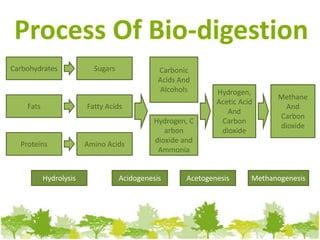
Carbohydrates

Fats

Sugars

Carbonic
Acids And
Alcohols

Fatty Acids

Proteins

Hydrolysis

Amino Acids

Hydrogen, C
arbon
dioxide and
Ammonia

Acidogenesis

Hydrogen,
Acetic Acid
And
Carbon
dioxide

Acetogenesis

Methane
And
Carbon
dioxide

Methanogenesis
Process Of Biodigestion
(1) LIQUEFICATION
• Complex organic matter is degraded to basic structure by
hydraulic bacteria.
o Protein -> Polypeptide and Amino Acid
o Fat -> Glycerin and Fatty Acid
o Amylase -> Monosacride and Polysacride
(2) ACID PRODUCTION (Acidogenesis)
• Simple organic matters are converted into H2 and CO2
• Acting bacteria in this process are called hydrogen-producing
bacteria and acid-producing bacteria.
Process Of Biodigestion
(4)ACETATE PRODUCTION (Acetogenesis)
• The short-chain fatty acids are metabolized by synthrophic
acetogenic and homoacetogenic bacteria into acetate, carbon
dioxide, and hydrogen.
(5)METHANE PRODUCTION (Methanogenesis)
• In this process, acetic acid, H2, CO2, are converted into CH4.
• Methane-producing bacteria have strict PH requirement and
low adaptability to temperature.
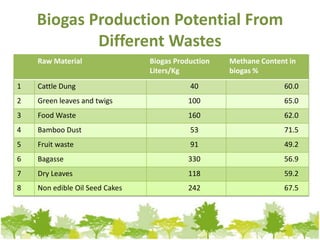
Biogas Production Potential From
Different Wastes
Raw Material

Biogas Production
Liters/Kg

Methane Content in
biogas %

1

Cattle Dung

40

60.0

2

Green leaves and twigs

100

65.0

3

Food Waste

160

62.0

4

Bamboo Dust

53

71.5

5

Fruit waste

91

49.2

6

Bagasse

330

56.9

7

Dry Leaves

118

59.2

8

Non edible Oil Seed Cakes

242

67.5
Utilization Of Biogas
• Cooking: A biogas plant of 2 cubic meters is sufficient for
providing cooking fuel needs of a family of about five persons.
• Lighting: Biogas is used in silk mantle lamps for lighting purposes.
The requirement of gas for powering a 100 candle lamp (60 W) is
0.13 cubic meter per hour.
• Power Generation: Biogas can be used to operate a dual fuel
engine to replace up to 80 % of diesel-oil. Diesel engines have
been modified to run 100 per cent on biogas. Petrol and CNG
engines can also be modified easily to use biogas.
• Transport Fuel: After removal of CO2, H2S and water
vapor, biogas can be converted to natural gas quality for use in
vehicles.
Benefits Of Biogas
•
•
•
•
•
•
•
•
•

Availability of power at affordable rates
Reduces pollution
Reduces time wastage while collecting firewood
Reduces reliance on fossil fuels
Saves on the environment (Reduces deforestation)
Improves living standards in rural areas
Reduces global warming
Produces good quality enriched manure to improve soil fertility.
Effective and convenient way for sanitary disposal of organinc
wastes, improving the hygienic conditions.
• As a smokeless domestic fuel it reduces the incidence of eye and lung
diseases.
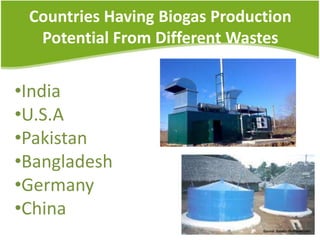
Countries Having Biogas Production
Potential From Different Wastes

•India
•U.S.A
•Pakistan
•Bangladesh
•Germany
•China
Disadvantages Of Biogas
• The process is not very attractive
economically on a large industrial scale.
• It is very difficult to enhance the efficiency of
biogas systems.
• Biogas contains some gases as
impurities, which are corrosive to the metal
parts of internal combustion engines.
• Not feasible to set up at all the locations.
Bio gas

Bio gas

  • 2.
    Why Biogas? • Dealingwith wastes has become a nightmare for various people all over the world and no doubt has brought about sanitation problems. • Power has also become a major concern especially in the less privileged rural areas. • Integration of these two problems would be a plus point for various communities. • From Biogas, various components can be powered by properly making use of the gas obtained. Less pollutant manure can be obtained ultimately.
  • 3.
    Biogas • Biogas isclean environment friendly fuel. • Biogas is generated when bacteria degrade biological material in the absence of oxygen, in a process known as anaerobic digestion. • Biogas generally comprise of 55-65 % methane, 35-45 % carbon dioxide, 0.5-1.0 % hydrogen sulfide and traces of water vapour. • The heating value of biogas is about 60% of natural gas and about 25% of propane. [Average calorific value of biogas is 20 mj/m3]. • Biogas has corrosive nature and storage of biogas is not practical.
  • 4.
    Process Of Bio-digestion •Anaerobic digestion is basically a simple process carried out in a number of steps that can use almost any organic material as a substrate. • Conventional anaerobic digestion is a "liquid" process, where waste is mixed with water to facilitate digestion. Since biogas is a mixture of methane and carbon dioxide it is a renewable fuel.
  • 5.
    Process Of Bio-digestion Biogasproduction process (Anaerobic digestion) is a multiple-stage process in which some main stages are: Liquefaction Acid Production Acetate Production Methane Production
  • 6.
    Carbohydrates Fats Sugars Carbonic Acids And Alcohols Fatty Acids Proteins Hydrolysis AminoAcids Hydrogen, C arbon dioxide and Ammonia Acidogenesis Hydrogen, Acetic Acid And Carbon dioxide Acetogenesis Methane And Carbon dioxide Methanogenesis
  • 7.
    Process Of Biodigestion (1)LIQUEFICATION • Complex organic matter is degraded to basic structure by hydraulic bacteria. o Protein -> Polypeptide and Amino Acid o Fat -> Glycerin and Fatty Acid o Amylase -> Monosacride and Polysacride (2) ACID PRODUCTION (Acidogenesis) • Simple organic matters are converted into H2 and CO2 • Acting bacteria in this process are called hydrogen-producing bacteria and acid-producing bacteria.
  • 8.
    Process Of Biodigestion (4)ACETATEPRODUCTION (Acetogenesis) • The short-chain fatty acids are metabolized by synthrophic acetogenic and homoacetogenic bacteria into acetate, carbon dioxide, and hydrogen. (5)METHANE PRODUCTION (Methanogenesis) • In this process, acetic acid, H2, CO2, are converted into CH4. • Methane-producing bacteria have strict PH requirement and low adaptability to temperature.
  • 9.
    Biogas Production PotentialFrom Different Wastes Raw Material Biogas Production Liters/Kg Methane Content in biogas % 1 Cattle Dung 40 60.0 2 Green leaves and twigs 100 65.0 3 Food Waste 160 62.0 4 Bamboo Dust 53 71.5 5 Fruit waste 91 49.2 6 Bagasse 330 56.9 7 Dry Leaves 118 59.2 8 Non edible Oil Seed Cakes 242 67.5
  • 10.
    Utilization Of Biogas •Cooking: A biogas plant of 2 cubic meters is sufficient for providing cooking fuel needs of a family of about five persons. • Lighting: Biogas is used in silk mantle lamps for lighting purposes. The requirement of gas for powering a 100 candle lamp (60 W) is 0.13 cubic meter per hour. • Power Generation: Biogas can be used to operate a dual fuel engine to replace up to 80 % of diesel-oil. Diesel engines have been modified to run 100 per cent on biogas. Petrol and CNG engines can also be modified easily to use biogas. • Transport Fuel: After removal of CO2, H2S and water vapor, biogas can be converted to natural gas quality for use in vehicles.
  • 11.
    Benefits Of Biogas • • • • • • • • • Availabilityof power at affordable rates Reduces pollution Reduces time wastage while collecting firewood Reduces reliance on fossil fuels Saves on the environment (Reduces deforestation) Improves living standards in rural areas Reduces global warming Produces good quality enriched manure to improve soil fertility. Effective and convenient way for sanitary disposal of organinc wastes, improving the hygienic conditions. • As a smokeless domestic fuel it reduces the incidence of eye and lung diseases.
  • 12.
    Countries Having BiogasProduction Potential From Different Wastes •India •U.S.A •Pakistan •Bangladesh •Germany •China
  • 13.
    Disadvantages Of Biogas •The process is not very attractive economically on a large industrial scale. • It is very difficult to enhance the efficiency of biogas systems. • Biogas contains some gases as impurities, which are corrosive to the metal parts of internal combustion engines. • Not feasible to set up at all the locations.