
Available Energy Resources in
Rural India
Rural Energy Technology
Dr. Basudev Pradhan
Available Energy Resources in Rural India
Unit-III: Available Energy resources: Traditional Resources
Biomass: Wood, Dung, Human waste, crop residues, harvested biomass (
Jatropha, koranj oil, palm fruit), Grasses, Refined biomass: Oils, Alcohols), Basic
solar, Basic wind, Food (ATP to ADP reactions resulting in muscle power), food
to fuel. Humans: Basic Labor, Labor saving devices. Animals, water.
Unit-IV: Available Energy resources: Modern Resources
Internal combustion Engines: Generators, Shaft power, Modern solar, modern
wind turbines, water treatment facilities,
Available Energy resources
Traditional Resources
Modern Resources
A list of projects that have been undertaken in this class over the last few years follows:
Thermoelectric lighting
Gel fuel production system (Biomass treatment, fermentation, distilling, gelling.)
Three generations of gel fuel stoves
Solar cell phone charger
Pyrolizer for production of Bio-Char
A GlobalResolve “Do-Tank”
Educational curricula:
o Framework and methodology for education of villagers in maintenance and upkeep of
technologies "dropped" off in villages
o Grade School science curriculum using indigenous materials
Available Energy Resources in Rural India
Solar powered battery charging "kiosk" with battery exchange. (Netflix for batteries.)
Personal water filter designed for small children (charcoal based)
Micro-scale biogas digester
Mosquito repelling system
Solar Ovens
“Breeder stove” that generates charcoal while cooking.
Pacifier imbedded inside of particle filter mask
Solar hot water system (for heating and personal use)
Replacement of batteries by super-capacitors charged by thermoelectric devices
Lantern based on ultra-clean combustion of animal fat
Soap manufacturing
Wind turbines:
Automatic solar actuated drip irrigation system with measurement of soil moisture
content.
Design of photo voltaic systems for
 water pumping,
 lighting,
 solar cell phone charger, battery charging “kiosk”,,
Solar power irrigation system
Solar hot water system (for heating and personal use)
 solar cookers,
solar drying and distillation,
Solar power irrigation system,
Micro-scale biogas digester,
Bio gassifer,
food preservation,
wind turbine power treadle pump
Rural Energy Technology Development
6
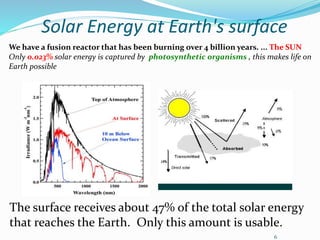
Solar Energy at Earth's surface
The surface receives about 47% of the total solar energy
that reaches the Earth. Only this amount is usable.
We have a fusion reactor that has been burning over 4 billion years. ... The SUN
Only 0.023% solar energy is captured by photosynthetic organisms , this makes life on
Earth possible
7
Solar Energy at Earth's surface
www.altenergy.org
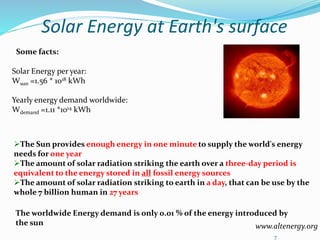
The Sun provides enough energy in one minute to supply the world's energy
needs for one year
The amount of solar radiation striking the earth over a three-day period is
equivalent to the energy stored in all fossil energy sources
The amount of solar radiation striking to earth in a day, that can be use by the
whole 7 billion human in 27 years
Solar Energy per year:
Wsun =1.56 * 1018 kWh
Yearly energy demand worldwide:
Wdemand =1.11 *1014 kWh
The worldwide Energy demand is only 0.01 % of the energy introduced by
the sun
Some facts:
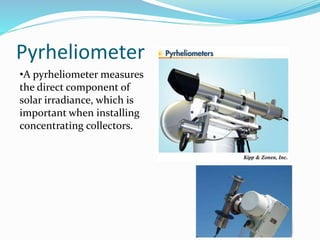
•A pyrheliometer measures
the direct component of
solar irradiance, which is
important when installing
concentrating collectors.
Pyrheliometer
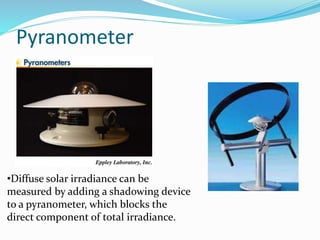
Pyranometer
•Diffuse solar irradiance can be
measured by adding a shadowing device
to a pyranometer, which blocks the
direct component of total irradiance.
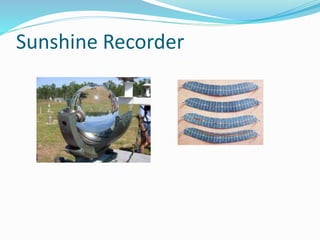
Sunshine Recorder
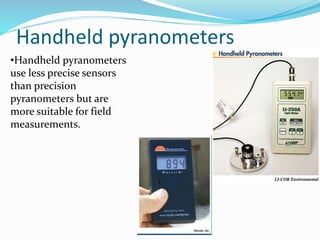
Handheld pyranometers
•Handheld pyranometers
use less precise sensors
than precision
pyranometers but are
more suitable for field
measurements.
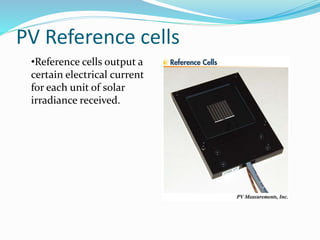
PV Reference cells
•Reference cells output a
certain electrical current
for each unit of solar
irradiance received.
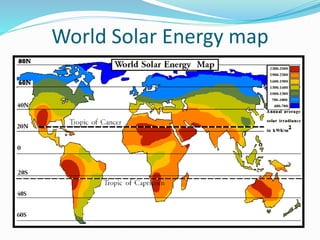
World Solar Energy map
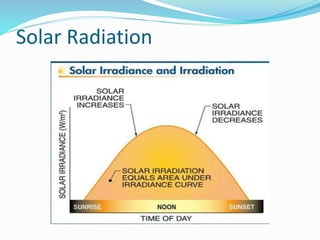
Solar Radiation
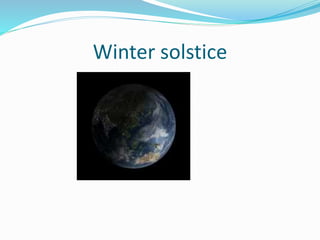
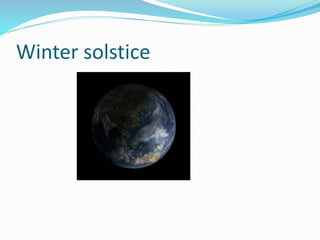
Winter solstice
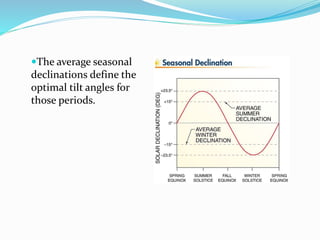
The average seasonal
declinations define the
optimal tilt angles for
those periods.
Solar Radiation
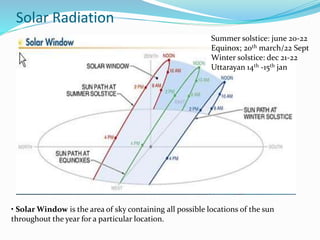
• Solar Window is the area of sky containing all possible locations of the sun
throughout the year for a particular location.
Summer solstice: june 20-22
Equinox; 20th march/22 Sept
Winter solstice: dec 21-22
Uttarayan 14th -15th jan
Winter solstice
Solar Radiation
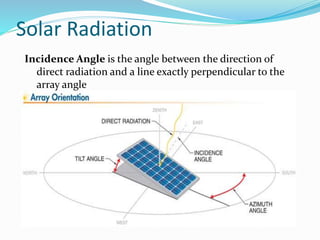
Incidence Angle is the angle between the direction of
direct radiation and a line exactly perpendicular to the
array angle
Solar Radiation
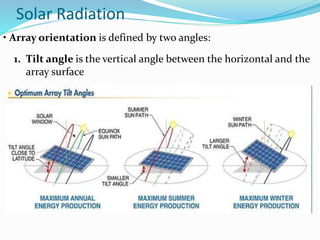
1. Tilt angle is the vertical angle between the horizontal and the
array surface
• Array orientation is defined by two angles:
Solar Radiation
Solar Radiation
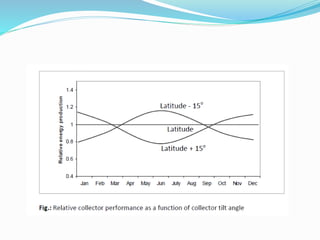
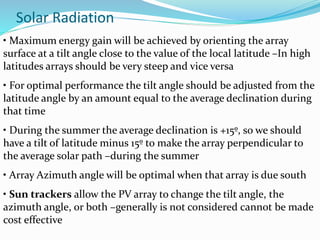
• Maximum energy gain will be achieved by orienting the array
surface at a tilt angle close to the value of the local latitude –In high
latitudes arrays should be very steep and vice versa
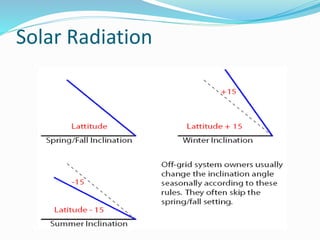
• For optimal performance the tilt angle should be adjusted from the
latitude angle by an amount equal to the average declination during
that time
• During the summer the average declination is +15º, so we should
have a tilt of latitude minus 15º to make the array perpendicular to
the average solar path –during the summer
• Array Azimuth angle will be optimal when that array is due south
• Sun trackers allow the PV array to change the tilt angle, the
azimuth angle, or both –generally is not considered cannot be made
cost effective
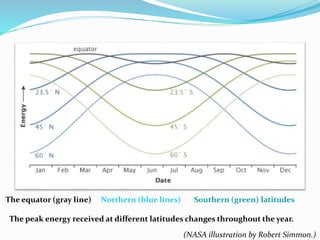
Solar radiation received in year
The equator (gray line) Northern (blue lines) Southern (green) latitudes
The peak energy received at different latitudes changes throughout the year.
(NASA illustration by Robert Simmon.)
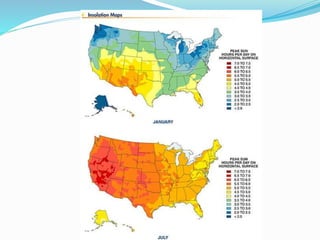
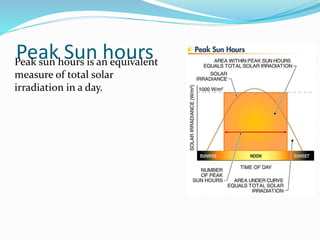
Peak Sun hoursPeak sun hours is an equivalent
measure of total solar
irradiation in a day.
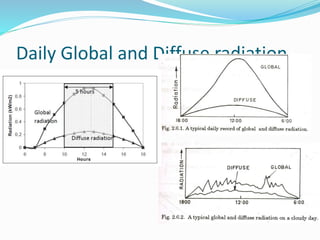
Daily Global and Diffuse radiation
30
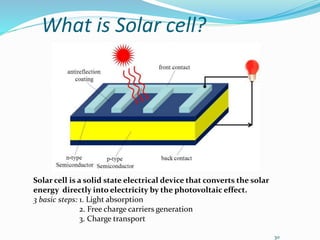
What is Solar cell?
Solar cell is a solid state electrical device that converts the solar
energy directly into electricity by the photovoltaic effect.
3 basic steps: 1. Light absorption
2. Free charge carriers generation
3. Charge transport
31
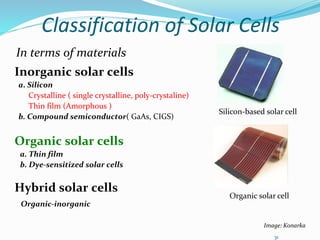
Classification of Solar Cells
Silicon-based solar cell
Inorganic solar cells
a. Silicon
Crystalline ( single crystalline, poly-crystaline)
Thin film (Amorphous )
b. Compound semiconductor( GaAs, CIGS)
Organic solar cells
a. Thin film
b. Dye-sensitized solar cells
Hybrid solar cells
Organic-inorganic
Organic solar cell
In terms of materials
Image: Konarka
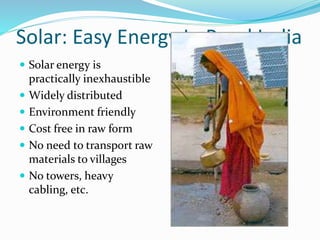
Solar: Easy Energy In Rural India
 Solar energy is
practically inexhaustible
 Widely distributed
 Environment friendly
 Cost free in raw form
 No need to transport raw
materials to villages
 No towers, heavy
cabling, etc.
Governmental Rural Initiative:
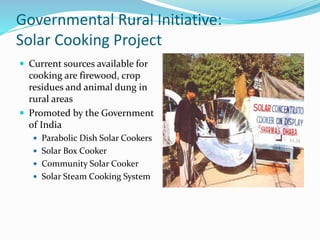
Solar Cooking Project
 Current sources available for
cooking are firewood, crop
residues and animal dung in
rural areas
 Promoted by the Government
of India
 Parabolic Dish Solar Cookers
 Solar Box Cooker
 Community Solar Cooker
 Solar Steam Cooking System
Private Initiative:
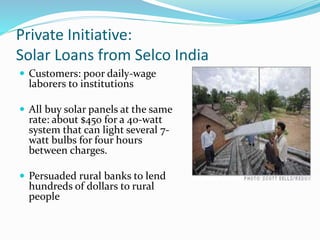
Solar Loans from Selco India
 Customers: poor daily-wage
laborers to institutions
 All buy solar panels at the same
rate: about $450 for a 40-watt
system that can light several 7-
watt bulbs for four hours
between charges.
 Persuaded rural banks to lend
hundreds of dollars to rural
people

Ret leccture 3 available energy resources

  • 1.
    Available Energy Resourcesin Rural India Rural Energy Technology Dr. Basudev Pradhan
  • 2.
    Available Energy Resourcesin Rural India Unit-III: Available Energy resources: Traditional Resources Biomass: Wood, Dung, Human waste, crop residues, harvested biomass ( Jatropha, koranj oil, palm fruit), Grasses, Refined biomass: Oils, Alcohols), Basic solar, Basic wind, Food (ATP to ADP reactions resulting in muscle power), food to fuel. Humans: Basic Labor, Labor saving devices. Animals, water. Unit-IV: Available Energy resources: Modern Resources Internal combustion Engines: Generators, Shaft power, Modern solar, modern wind turbines, water treatment facilities, Available Energy resources Traditional Resources Modern Resources
  • 3.
    A list ofprojects that have been undertaken in this class over the last few years follows: Thermoelectric lighting Gel fuel production system (Biomass treatment, fermentation, distilling, gelling.) Three generations of gel fuel stoves Solar cell phone charger Pyrolizer for production of Bio-Char A GlobalResolve “Do-Tank” Educational curricula: o Framework and methodology for education of villagers in maintenance and upkeep of technologies "dropped" off in villages o Grade School science curriculum using indigenous materials Available Energy Resources in Rural India
  • 4.
    Available Energy Resourcesin Rural India Solar powered battery charging "kiosk" with battery exchange. (Netflix for batteries.) Personal water filter designed for small children (charcoal based) Micro-scale biogas digester Mosquito repelling system Solar Ovens “Breeder stove” that generates charcoal while cooking. Pacifier imbedded inside of particle filter mask Solar hot water system (for heating and personal use) Replacement of batteries by super-capacitors charged by thermoelectric devices Lantern based on ultra-clean combustion of animal fat Soap manufacturing Wind turbines: Automatic solar actuated drip irrigation system with measurement of soil moisture content.
  • 5.
    Design of photovoltaic systems for  water pumping,  lighting,  solar cell phone charger, battery charging “kiosk”,, Solar power irrigation system Solar hot water system (for heating and personal use)  solar cookers, solar drying and distillation, Solar power irrigation system, Micro-scale biogas digester, Bio gassifer, food preservation, wind turbine power treadle pump Rural Energy Technology Development
  • 6.
    6 Solar Energy atEarth's surface The surface receives about 47% of the total solar energy that reaches the Earth. Only this amount is usable. We have a fusion reactor that has been burning over 4 billion years. ... The SUN Only 0.023% solar energy is captured by photosynthetic organisms , this makes life on Earth possible
  • 7.
    7 Solar Energy atEarth's surface www.altenergy.org The Sun provides enough energy in one minute to supply the world's energy needs for one year The amount of solar radiation striking the earth over a three-day period is equivalent to the energy stored in all fossil energy sources The amount of solar radiation striking to earth in a day, that can be use by the whole 7 billion human in 27 years Solar Energy per year: Wsun =1.56 * 1018 kWh Yearly energy demand worldwide: Wdemand =1.11 *1014 kWh The worldwide Energy demand is only 0.01 % of the energy introduced by the sun Some facts:
  • 8.
    •A pyrheliometer measures thedirect component of solar irradiance, which is important when installing concentrating collectors. Pyrheliometer
  • 9.
    Pyranometer •Diffuse solar irradiancecan be measured by adding a shadowing device to a pyranometer, which blocks the direct component of total irradiance.
  • 10.
  • 11.
    Handheld pyranometers •Handheld pyranometers useless precise sensors than precision pyranometers but are more suitable for field measurements.
  • 12.
    PV Reference cells •Referencecells output a certain electrical current for each unit of solar irradiance received.
  • 13.
  • 17.
  • 18.
  • 19.
    The average seasonal declinationsdefine the optimal tilt angles for those periods.
  • 20.
    Solar Radiation • SolarWindow is the area of sky containing all possible locations of the sun throughout the year for a particular location. Summer solstice: june 20-22 Equinox; 20th march/22 Sept Winter solstice: dec 21-22 Uttarayan 14th -15th jan
  • 21.
  • 22.
    Solar Radiation Incidence Angleis the angle between the direction of direct radiation and a line exactly perpendicular to the array angle
  • 23.
    Solar Radiation 1. Tiltangle is the vertical angle between the horizontal and the array surface • Array orientation is defined by two angles:
  • 25.
  • 26.
    Solar Radiation • Maximumenergy gain will be achieved by orienting the array surface at a tilt angle close to the value of the local latitude –In high latitudes arrays should be very steep and vice versa • For optimal performance the tilt angle should be adjusted from the latitude angle by an amount equal to the average declination during that time • During the summer the average declination is +15º, so we should have a tilt of latitude minus 15º to make the array perpendicular to the average solar path –during the summer • Array Azimuth angle will be optimal when that array is due south • Sun trackers allow the PV array to change the tilt angle, the azimuth angle, or both –generally is not considered cannot be made cost effective
  • 27.
    Solar radiation receivedin year The equator (gray line) Northern (blue lines) Southern (green) latitudes The peak energy received at different latitudes changes throughout the year. (NASA illustration by Robert Simmon.)
  • 28.
    Peak Sun hoursPeaksun hours is an equivalent measure of total solar irradiation in a day.
  • 29.
    Daily Global andDiffuse radiation
  • 30.
    30 What is Solarcell? Solar cell is a solid state electrical device that converts the solar energy directly into electricity by the photovoltaic effect. 3 basic steps: 1. Light absorption 2. Free charge carriers generation 3. Charge transport
  • 31.
    31 Classification of SolarCells Silicon-based solar cell Inorganic solar cells a. Silicon Crystalline ( single crystalline, poly-crystaline) Thin film (Amorphous ) b. Compound semiconductor( GaAs, CIGS) Organic solar cells a. Thin film b. Dye-sensitized solar cells Hybrid solar cells Organic-inorganic Organic solar cell In terms of materials Image: Konarka
  • 33.
    Solar: Easy EnergyIn Rural India  Solar energy is practically inexhaustible  Widely distributed  Environment friendly  Cost free in raw form  No need to transport raw materials to villages  No towers, heavy cabling, etc.
  • 34.
    Governmental Rural Initiative: SolarCooking Project  Current sources available for cooking are firewood, crop residues and animal dung in rural areas  Promoted by the Government of India  Parabolic Dish Solar Cookers  Solar Box Cooker  Community Solar Cooker  Solar Steam Cooking System
  • 35.
    Private Initiative: Solar Loansfrom Selco India  Customers: poor daily-wage laborers to institutions  All buy solar panels at the same rate: about $450 for a 40-watt system that can light several 7- watt bulbs for four hours between charges.  Persuaded rural banks to lend hundreds of dollars to rural people