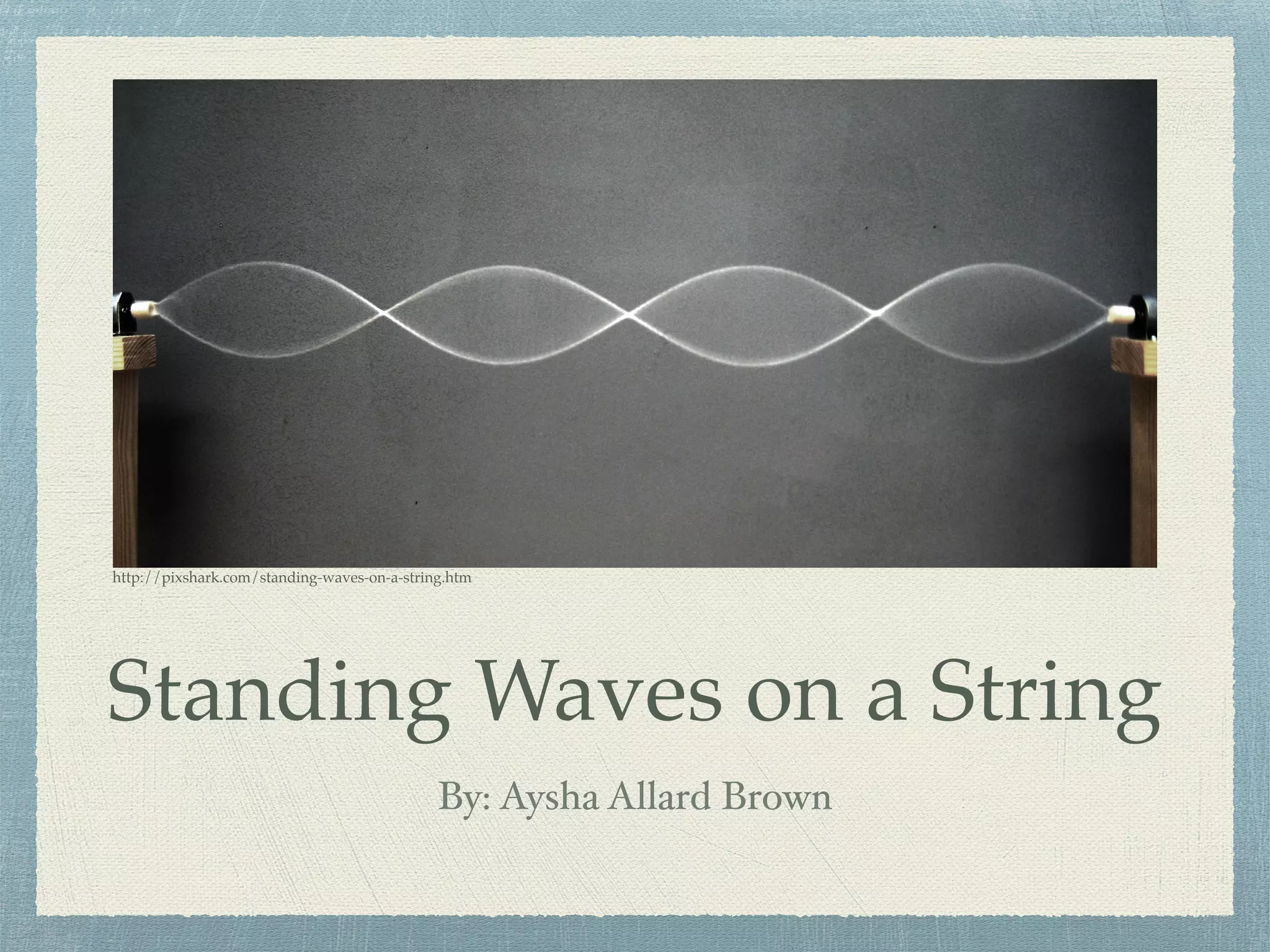
Standing Waves on a String
By: Aysha Allard Brown
http://pixshark.com/standing-waves-on-a-string.htm
Definitions
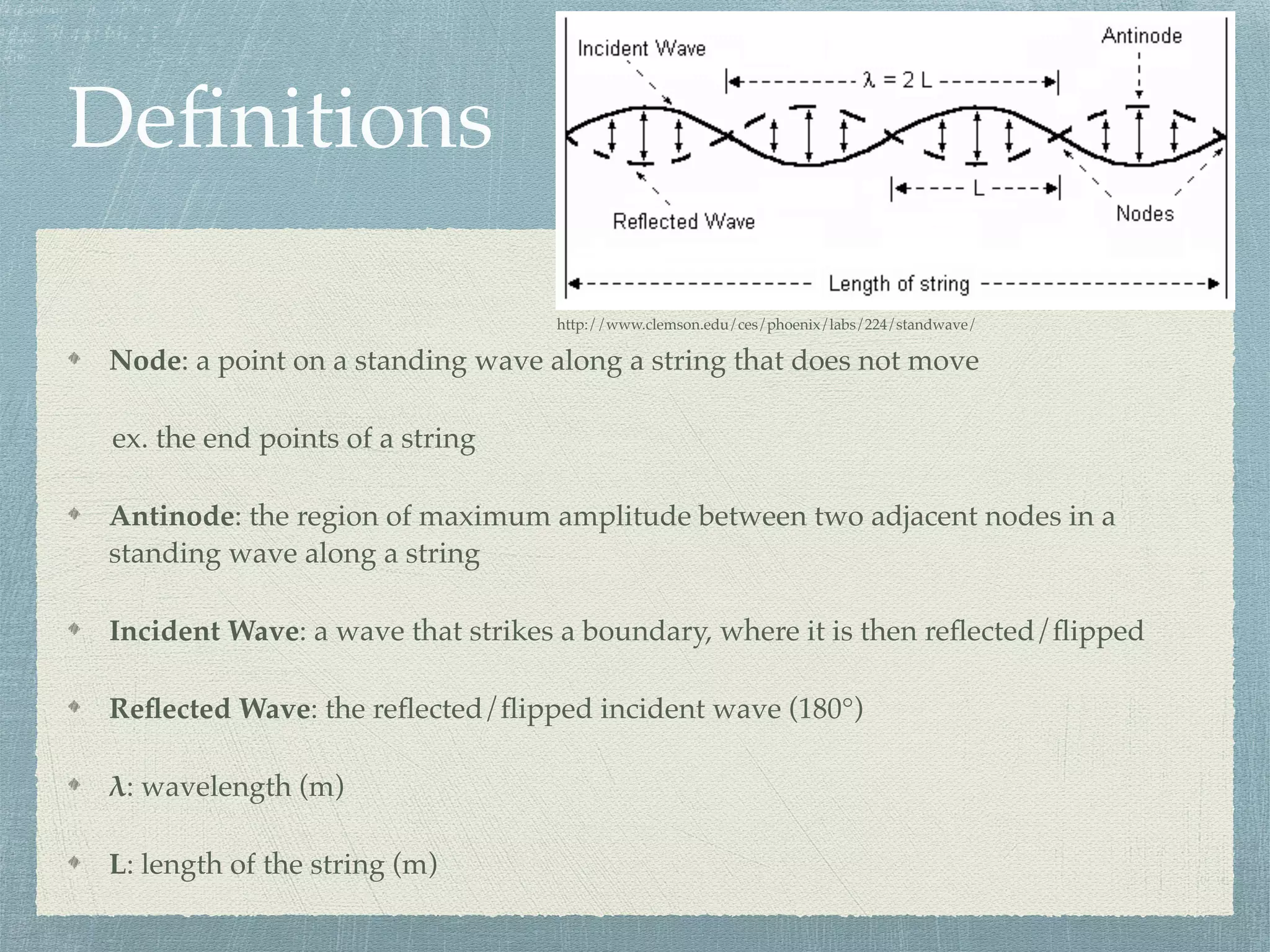
Node: a point on a standing wave along a string that does not move
ex. the end points of a string
Antinode: the region of maximum amplitude between two adjacent nodes in a
standing wave along a string
Incident Wave: a wave that strikes a boundary, where it is then reflected/flipped
Reflected Wave: the reflected/flipped incident wave (180°)
λ: wavelength (m)
L: length of the string (m)
http://www.clemson.edu/ces/phoenix/labs/224/standwave/
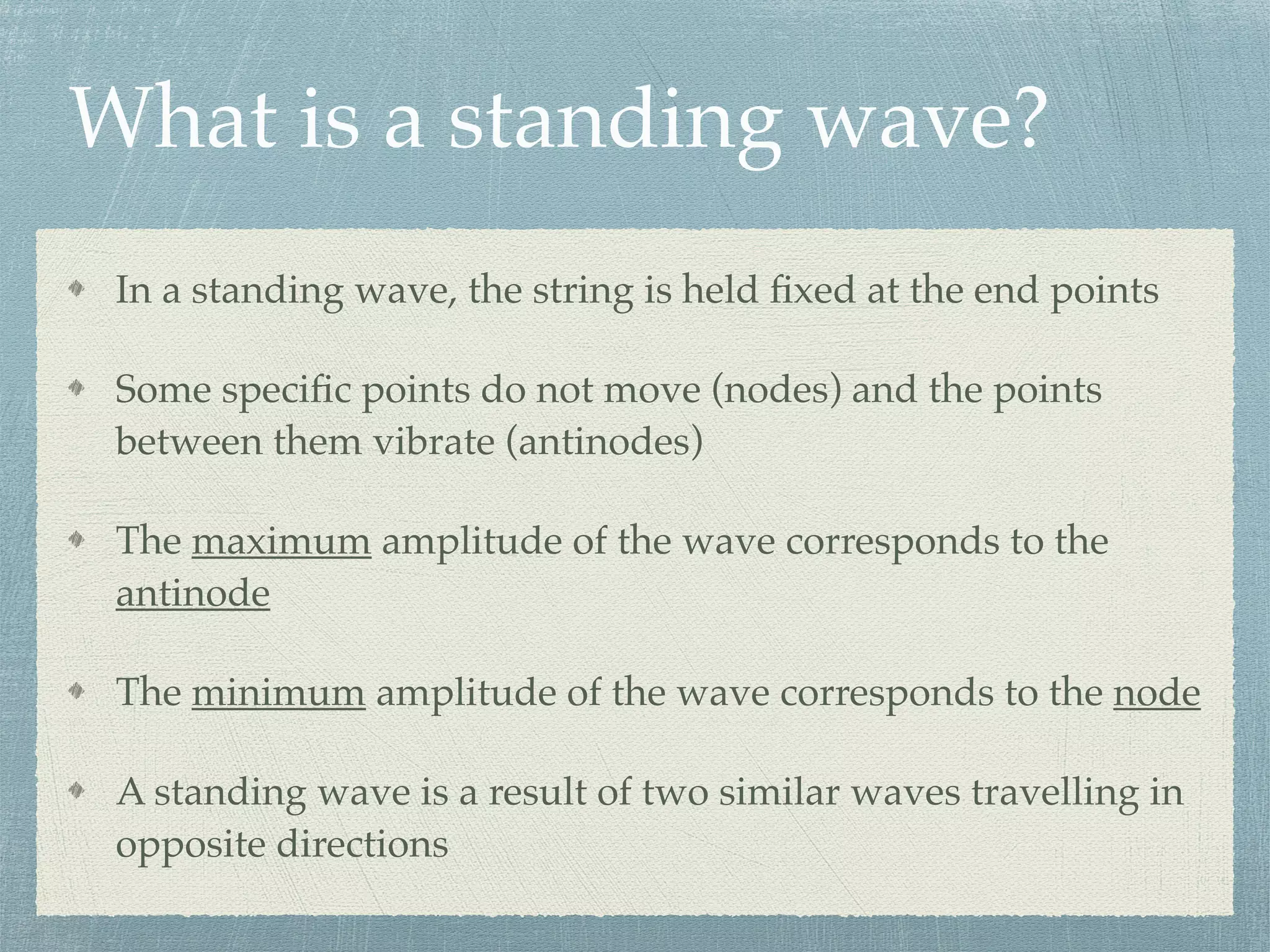
In a standing wave, the string is held fixed at the end points
Some specific points do not move (nodes) and the points
between them vibrate (antinodes)
The maximum amplitude of the wave corresponds to the
antinode
The minimum amplitude of the wave corresponds to the node
A standing wave is a result of two similar waves travelling in
opposite directions
What is a standing wave?
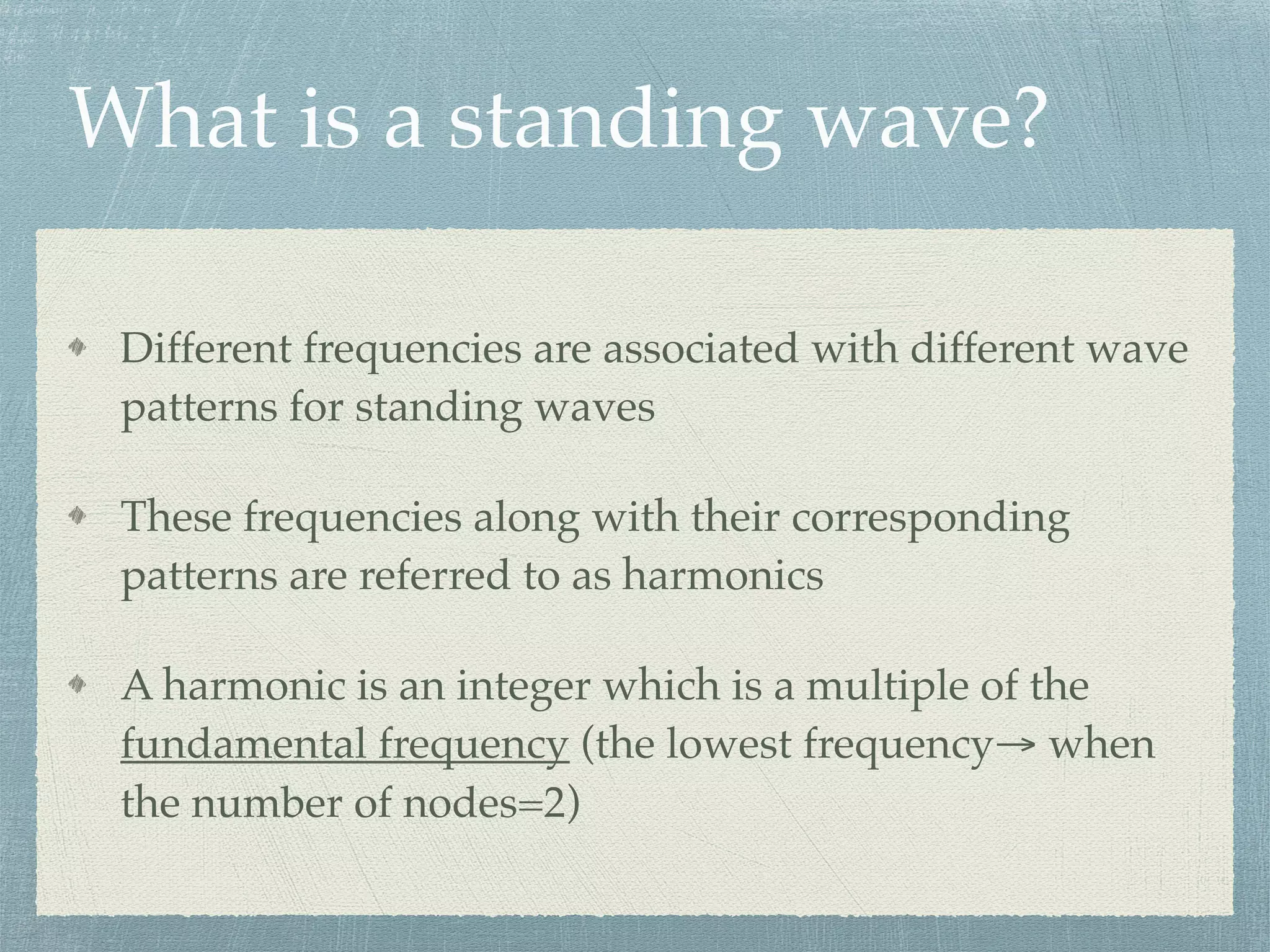
Different frequencies are associated with different wave
patterns for standing waves
These frequencies along with their corresponding
patterns are referred to as harmonics
A harmonic is an integer which is a multiple of the
fundamental frequency (the lowest frequency→ when
the number of nodes=2)
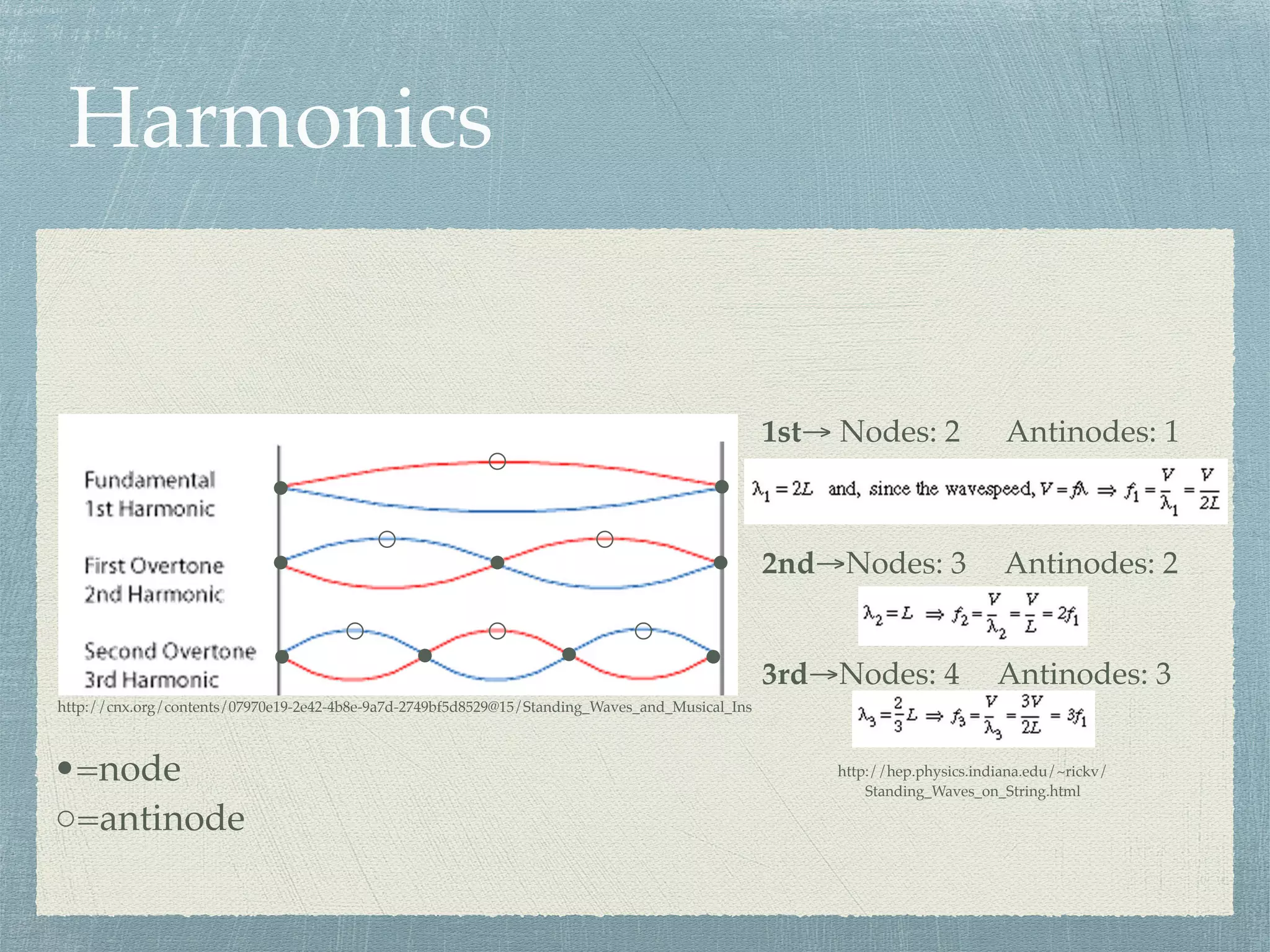
Harmonics
1st→ Nodes: 2 Antinodes: 1
2nd→Nodes: 3 Antinodes: 2
3rd→Nodes: 4 Antinodes: 3
•=node
•
• •
•
•
•
• • •
○=antinode
○
○
○
○
○ ○
http://cnx.org/contents/07970e19-2e42-4b8e-9a7d-2749bf5d8529@15/Standing_Waves_and_Musical_Ins
http://hep.physics.indiana.edu/~rickv/
Standing_Waves_on_String.html
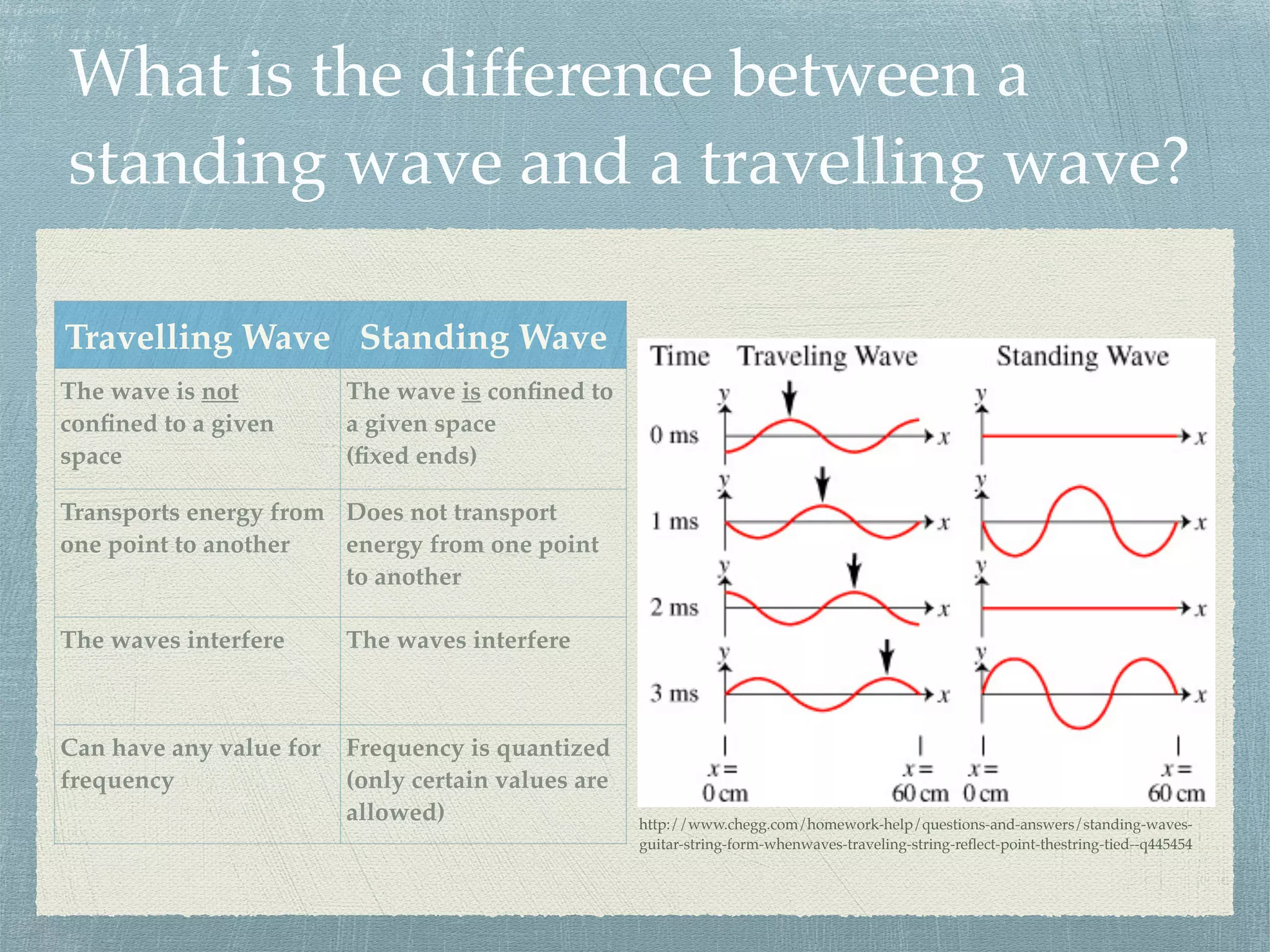
What is the difference between a
standing wave and a travelling wave?
Travelling Wave Standing Wave
The wave is not
confined to a given
space
The wave is confined to
a given space
(fixed ends)
Transports energy from
one point to another
Does not transport
energy from one point
to another
The waves interfere The waves interfere
Can have any value for
frequency
Frequency is quantized
(only certain values are
allowed) http://www.chegg.com/homework-help/questions-and-answers/standing-waves-
guitar-string-form-whenwaves-traveling-string-reflect-point-thestring-tied--q445454
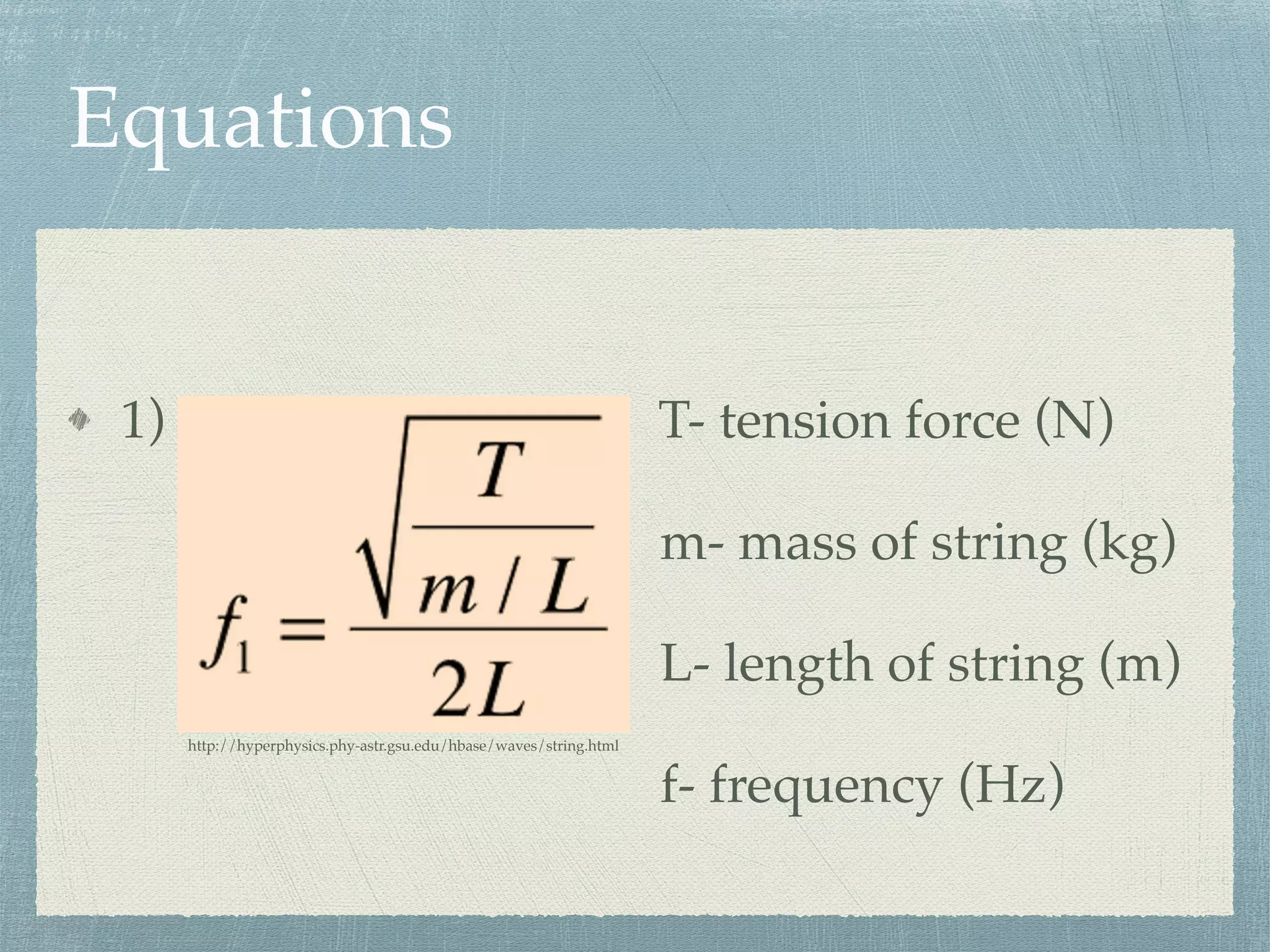
Equations
1) T- tension force (N)
m- mass of string (kg)
L- length of string (m)
f- frequency (Hz)
http://hyperphysics.phy-astr.gsu.edu/hbase/waves/string.html
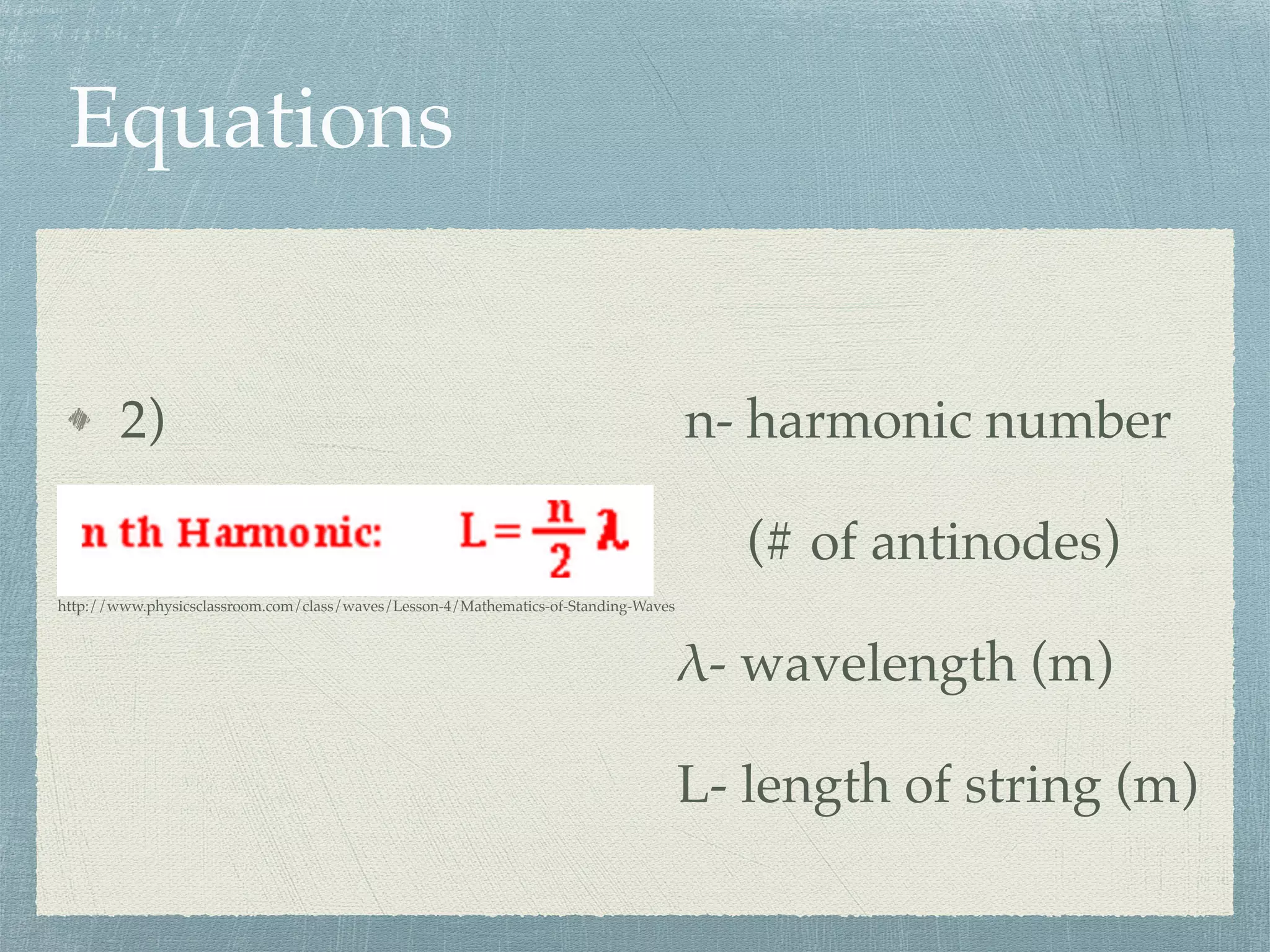
Equations
2) n- harmonic number
(# of antinodes)
λ- wavelength (m)
L- length of string (m)
http://www.physicsclassroom.com/class/waves/Lesson-4/Mathematics-of-Standing-Waves
Question #1
A string is 5.0 meters long and is vibrating at
the 3rd harmonic. The string vibrates up and
down with 48 complete vibrational cycles in
20 seconds. Determine the frequency, period,
wavelength and speed for this wave.
Solution (pt. 1)
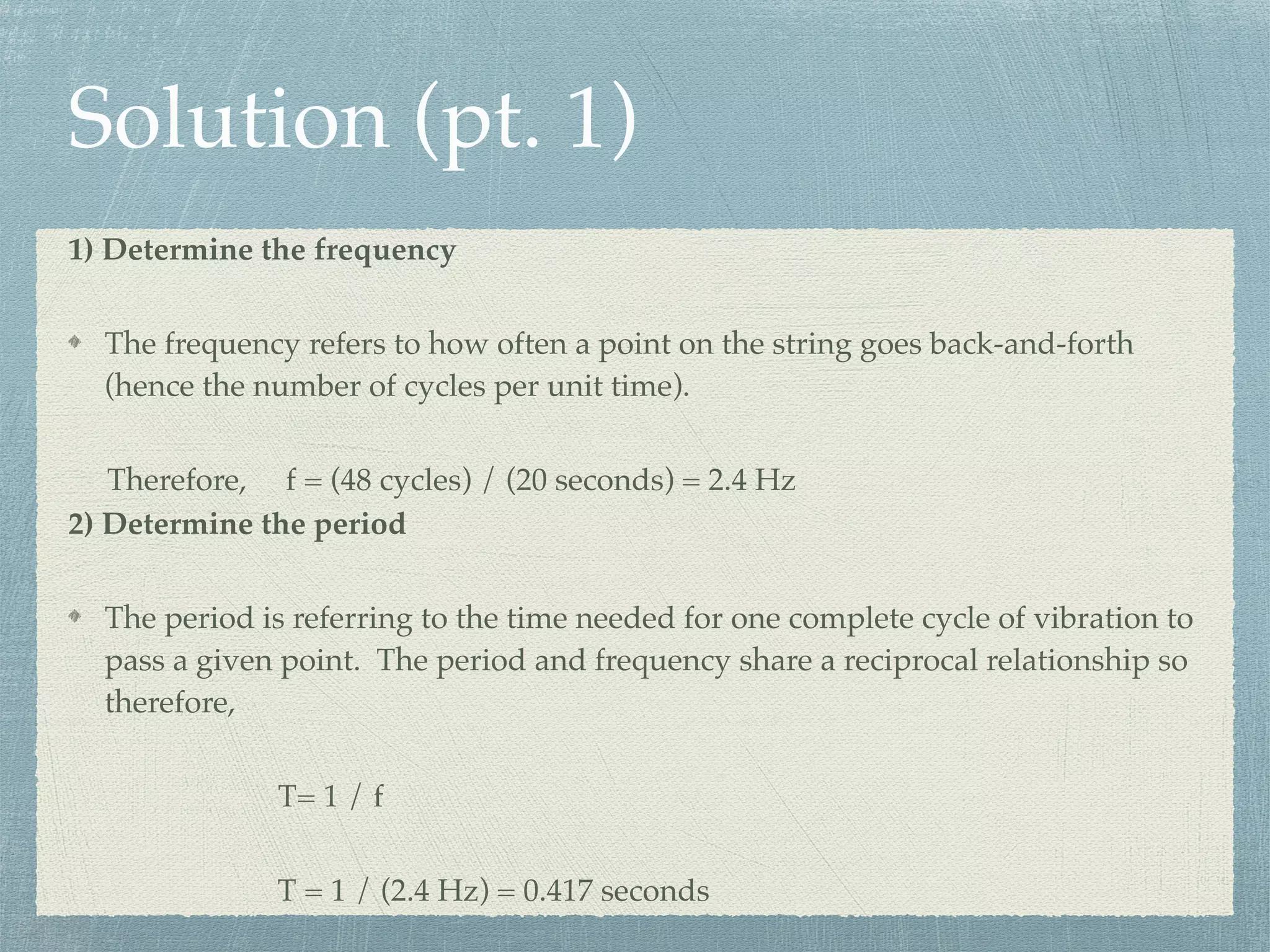
1) Determine the frequency
The frequency refers to how often a point on the string goes back-and-forth
(hence the number of cycles per unit time).
Therefore, f = (48 cycles) / (20 seconds) = 2.4 Hz
2) Determine the period
The period is referring to the time needed for one complete cycle of vibration to
pass a given point. The period and frequency share a reciprocal relationship so
therefore,
T= 1 / f
T = 1 / (2.4 Hz) = 0.417 seconds
Solution (pt. 2)
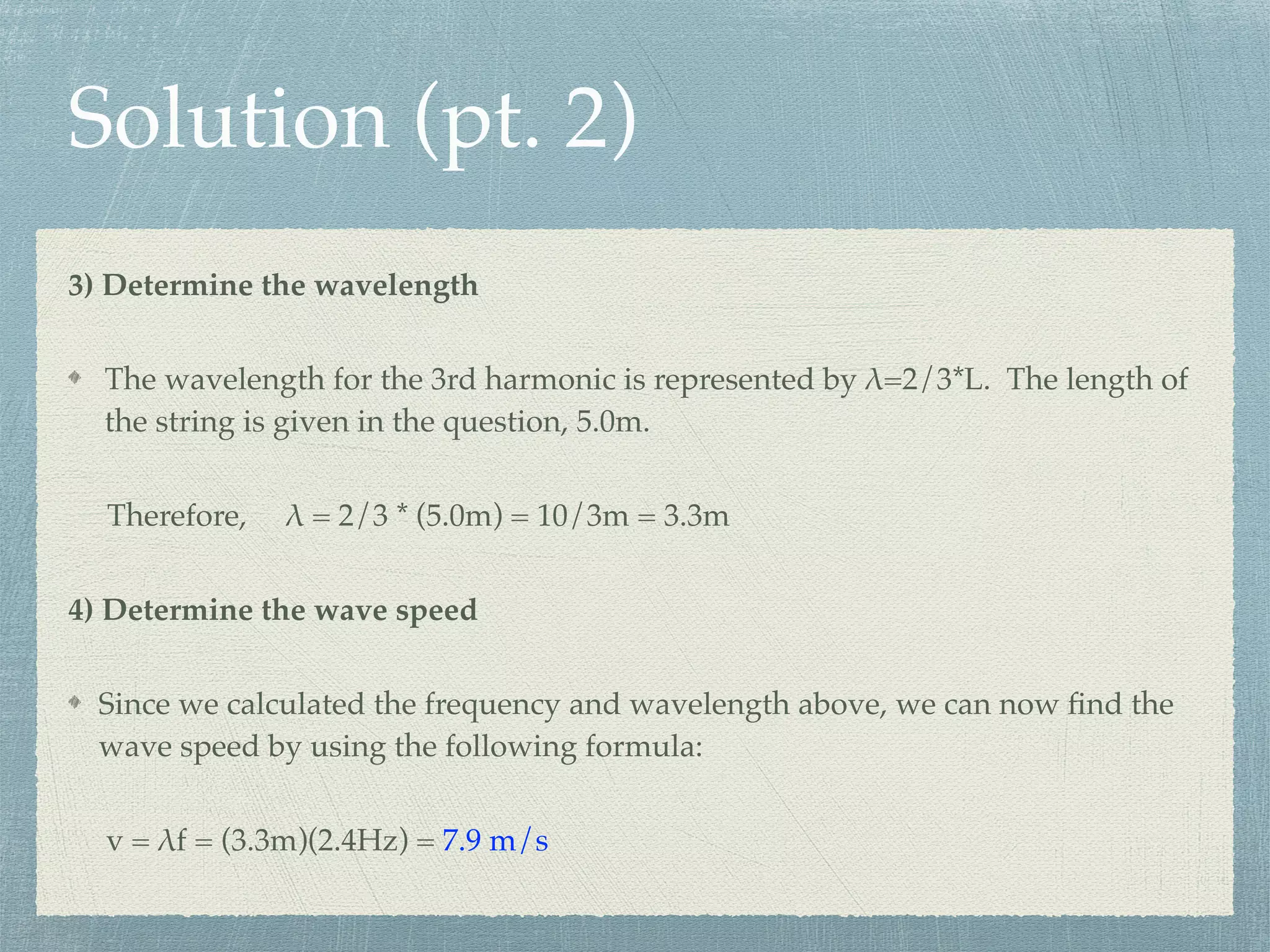
3) Determine the wavelength
The wavelength for the 3rd harmonic is represented by λ=2/3*L. The length of
the string is given in the question, 5.0m.
Therefore, λ = 2/3 * (5.0m) = 10/3m = 3.3m
4) Determine the wave speed
Since we calculated the frequency and wavelength above, we can now find the
wave speed by using the following formula:
v = λf = (3.3m)(2.4Hz) = 7.9 m/s
Question #2
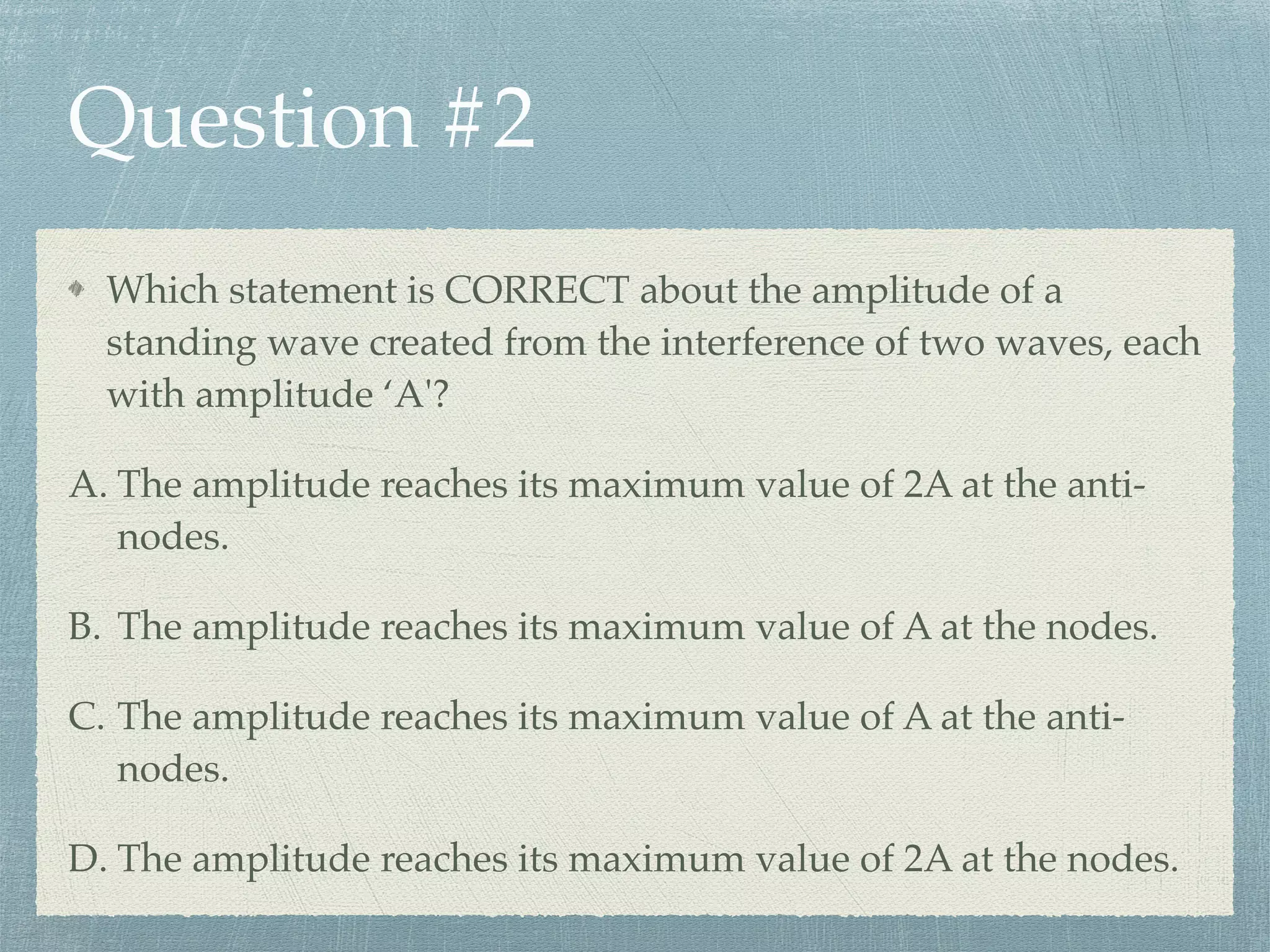
Which statement is CORRECT about the amplitude of a
standing wave created from the interference of two waves, each
with amplitude ‘A'?
A. The amplitude reaches its maximum value of 2A at the anti-
nodes.
B. The amplitude reaches its maximum value of A at the nodes.
C. The amplitude reaches its maximum value of A at the anti-
nodes.
D. The amplitude reaches its maximum value of 2A at the nodes.
Solution
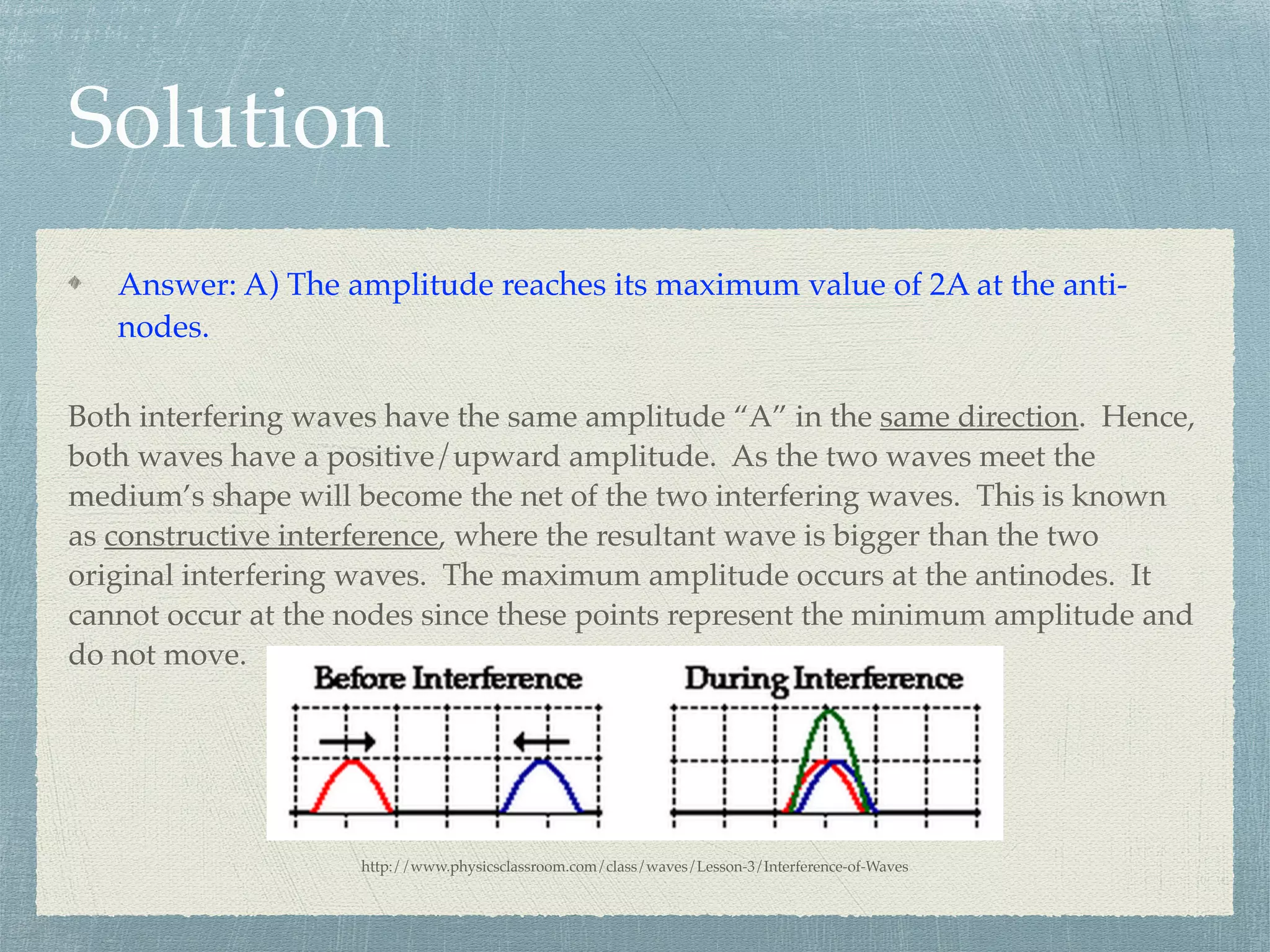
Answer: A) The amplitude reaches its maximum value of 2A at the anti-
nodes.
Both interfering waves have the same amplitude “A” in the same direction. Hence,
both waves have a positive/upward amplitude. As the two waves meet the
medium’s shape will become the net of the two interfering waves. This is known
as constructive interference, where the resultant wave is bigger than the two
original interfering waves. The maximum amplitude occurs at the antinodes. It
cannot occur at the nodes since these points represent the minimum amplitude and
do not move.
http://www.physicsclassroom.com/class/waves/Lesson-3/Interference-of-Waves
YouTube Videos
Standing Waves: Demo
https://www.youtube.com/watch?v=-gr7KmTOrx0
Standing Waves: Calculations
https://www.youtube.com/watch?v=QcoQvzNQp6Q
Thank you.
Bibliography
http://hyperphysics.phy-astr.gsu.edu/hbase/waves/string.html
http://www.physicsclassroom.com/class/sound/Lesson-4/Standing-Wave-
Patterns
http://hep.physics.indiana.edu/~rickv/Standing_Waves_on_String.html
http://www.physicsclassroom.com/class/waves/Lesson-4/Harmonics-and-
Patterns
http://astarmathsandphysics.com/a-level-physics-notes/waves-and-
oscillations/a-level-physics-notes-the-difference-between-standing-waves-
and-travelling-waves.html

Standing Waves on a String

  • 1.
    Standing Waves ona String By: Aysha Allard Brown http://pixshark.com/standing-waves-on-a-string.htm
  • 2.
    Definitions Node: a pointon a standing wave along a string that does not move ex. the end points of a string Antinode: the region of maximum amplitude between two adjacent nodes in a standing wave along a string Incident Wave: a wave that strikes a boundary, where it is then reflected/flipped Reflected Wave: the reflected/flipped incident wave (180°) λ: wavelength (m) L: length of the string (m) http://www.clemson.edu/ces/phoenix/labs/224/standwave/
  • 3.
    In a standingwave, the string is held fixed at the end points Some specific points do not move (nodes) and the points between them vibrate (antinodes) The maximum amplitude of the wave corresponds to the antinode The minimum amplitude of the wave corresponds to the node A standing wave is a result of two similar waves travelling in opposite directions What is a standing wave?
  • 4.
    What is astanding wave? Different frequencies are associated with different wave patterns for standing waves These frequencies along with their corresponding patterns are referred to as harmonics A harmonic is an integer which is a multiple of the fundamental frequency (the lowest frequency→ when the number of nodes=2)
  • 5.
    Harmonics 1st→ Nodes: 2Antinodes: 1 2nd→Nodes: 3 Antinodes: 2 3rd→Nodes: 4 Antinodes: 3 •=node • • • • • • • • • ○=antinode ○ ○ ○ ○ ○ ○ http://cnx.org/contents/07970e19-2e42-4b8e-9a7d-2749bf5d8529@15/Standing_Waves_and_Musical_Ins http://hep.physics.indiana.edu/~rickv/ Standing_Waves_on_String.html
  • 6.
    What is thedifference between a standing wave and a travelling wave? Travelling Wave Standing Wave The wave is not confined to a given space The wave is confined to a given space (fixed ends) Transports energy from one point to another Does not transport energy from one point to another The waves interfere The waves interfere Can have any value for frequency Frequency is quantized (only certain values are allowed) http://www.chegg.com/homework-help/questions-and-answers/standing-waves- guitar-string-form-whenwaves-traveling-string-reflect-point-thestring-tied--q445454
  • 7.
    Equations 1) T- tensionforce (N) m- mass of string (kg) L- length of string (m) f- frequency (Hz) http://hyperphysics.phy-astr.gsu.edu/hbase/waves/string.html
  • 8.
    Equations 2) n- harmonicnumber (# of antinodes) λ- wavelength (m) L- length of string (m) http://www.physicsclassroom.com/class/waves/Lesson-4/Mathematics-of-Standing-Waves
  • 9.
    Question #1 A stringis 5.0 meters long and is vibrating at the 3rd harmonic. The string vibrates up and down with 48 complete vibrational cycles in 20 seconds. Determine the frequency, period, wavelength and speed for this wave.
  • 10.
    Solution (pt. 1) 1)Determine the frequency The frequency refers to how often a point on the string goes back-and-forth (hence the number of cycles per unit time). Therefore, f = (48 cycles) / (20 seconds) = 2.4 Hz 2) Determine the period The period is referring to the time needed for one complete cycle of vibration to pass a given point. The period and frequency share a reciprocal relationship so therefore, T= 1 / f T = 1 / (2.4 Hz) = 0.417 seconds
  • 11.
    Solution (pt. 2) 3)Determine the wavelength The wavelength for the 3rd harmonic is represented by λ=2/3*L. The length of the string is given in the question, 5.0m. Therefore, λ = 2/3 * (5.0m) = 10/3m = 3.3m 4) Determine the wave speed Since we calculated the frequency and wavelength above, we can now find the wave speed by using the following formula: v = λf = (3.3m)(2.4Hz) = 7.9 m/s
  • 12.
    Question #2 Which statementis CORRECT about the amplitude of a standing wave created from the interference of two waves, each with amplitude ‘A'? A. The amplitude reaches its maximum value of 2A at the anti- nodes. B. The amplitude reaches its maximum value of A at the nodes. C. The amplitude reaches its maximum value of A at the anti- nodes. D. The amplitude reaches its maximum value of 2A at the nodes.
  • 13.
    Solution Answer: A) Theamplitude reaches its maximum value of 2A at the anti- nodes. Both interfering waves have the same amplitude “A” in the same direction. Hence, both waves have a positive/upward amplitude. As the two waves meet the medium’s shape will become the net of the two interfering waves. This is known as constructive interference, where the resultant wave is bigger than the two original interfering waves. The maximum amplitude occurs at the antinodes. It cannot occur at the nodes since these points represent the minimum amplitude and do not move. http://www.physicsclassroom.com/class/waves/Lesson-3/Interference-of-Waves
  • 14.
    YouTube Videos Standing Waves:Demo https://www.youtube.com/watch?v=-gr7KmTOrx0 Standing Waves: Calculations https://www.youtube.com/watch?v=QcoQvzNQp6Q
  • 15.
  • 16.