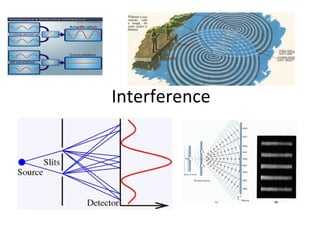
Interference
Superposition in water Create your own wave superposition in your tub. Take a photograph and print off a picture Show on the picture  where the waves have a supercrest,  where they have a supertrough  Where a crest meets a trough and the resultant displacement is zero
Hearing superposition 1m Same frequency from Signal generator Walk along a path that is one metre away What do you hear?
Today you will... Find out about  interference  patterns  and answer these questions What are coherent sources? What is the general condition for the formation of a bright fringe? Are Young’s fringes equally spaced? What factors could be (i) increased or (ii) decreased, to increase the fringe spacing Why are slits used, rather than two separate light sources, in Young’s double slits experiment? What are the roles of diffraction, and interference, when producing Young’s fringes? What do we mean by diffraction?   What feature of two waves must combine in order to produce reinforcement? What is the phase difference between two waves if they produce maximum cancellation? Why is total cancellation rarely achieved in practice?
Thomas Young Newton’s view that light was made from particles was questioned by young in his ‘Young’s double slit’ experiment. The experiment showed that light had wave  properties because they formed interference patterns. Interference patterns happen for light, water and sound. http:// www.youtube.com/watch?v =DfPeprQ7oGc
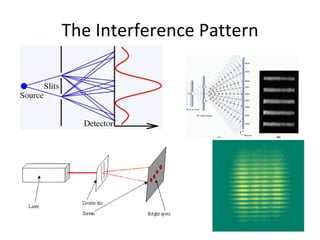
The Interference Pattern
The laser interference Laser light is highly monochromatic  (only gives out 1 frequency of light) The emitted light is also coherent (of the same phase) This gives a very sharp image
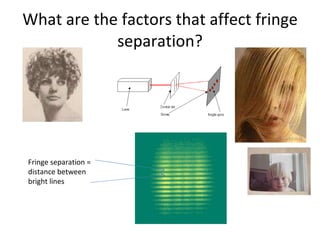
What are the factors that affect fringe separation? Fringe separation = distance between bright lines
Fringe separation w  =  separation of the fringes (bright to bright or dark to dark) λ = wavelength of the light s  = separation of the two slits D  = distance between slits and screen w D s W = λD S
Young’s Questions Finding the wavelength of sodium light In a two-slit apparatus the slits are 0.3 mm apart. Fringes in sodium are observed at a distance of 1.2 m from the slits. The separation of the fringes is 2.4 mm. 1. What is the wavelength of sodium light?   2. The same light gives a fringe separation of 3.6 mm with a different pair of slits. What is the slit separation if the distance between the slits and the fringes is the same?      Red light of wavelength 7.0 x 10 –7  m is shone at right angles through two slits of separation 0.3 mm. Fringes are formed at a distance of 1.3 m from the slits. 3. What is the fringe spacing?    4. The same light gives a fringe spacing of 2 mm when passed through a different pair of slits. What is the slit separation if the distance between the slits and the fringes is the same?    In a two-slit apparatus the slits are 0.3 mm apart. White light passes through the slits and fringes are observed at a distance of 2 m from the slits. Red light has a wavelength of 700 nm and blue light has a wavelength of 400 nm. 5. Calculate the fringe spacing for each colour.    6. Use your answers to explain the coloured fringes seen on the screen.  W = λD S
Young’s answers
Ripple Tank
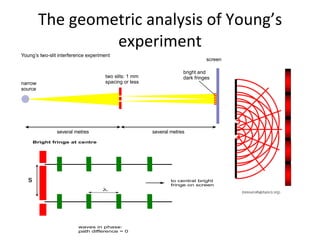
The geometric analysis of Young’s experiment s
What is the use of knowing  θ ? For it to be in phase (first fringe) θ  = sin -1  d/ λ For it to be out of phase  θ  = sin -1  2d/ λ
At the first dark fringe The waves must be in anti-phase λ\2 difference at the point on the wall λ\2 = s sin  θ θ  = sin -1  2d/ λ θ s θ What is this length? O = s sin  θ Opposite Sin  θ    Hypotenuse s s
At the first Bright fringe The waves must be in phase λ difference at the point on the wall λ = s sin  θ θ  = sin -1  s/ λ s s s
What is the use of knowing  θ ? For it to be in phase (first fringe) θ  = sin -1  d/ λ For it to be out of phase  θ  = sin -1  2d/ λ

Interference And Youngs two Slit

  • 1.
  • 2.
    Superposition in waterCreate your own wave superposition in your tub. Take a photograph and print off a picture Show on the picture where the waves have a supercrest, where they have a supertrough Where a crest meets a trough and the resultant displacement is zero
  • 3.
    Hearing superposition 1mSame frequency from Signal generator Walk along a path that is one metre away What do you hear?
  • 4.
    Today you will...Find out about interference patterns and answer these questions What are coherent sources? What is the general condition for the formation of a bright fringe? Are Young’s fringes equally spaced? What factors could be (i) increased or (ii) decreased, to increase the fringe spacing Why are slits used, rather than two separate light sources, in Young’s double slits experiment? What are the roles of diffraction, and interference, when producing Young’s fringes? What do we mean by diffraction?   What feature of two waves must combine in order to produce reinforcement? What is the phase difference between two waves if they produce maximum cancellation? Why is total cancellation rarely achieved in practice?
  • 5.
    Thomas Young Newton’sview that light was made from particles was questioned by young in his ‘Young’s double slit’ experiment. The experiment showed that light had wave properties because they formed interference patterns. Interference patterns happen for light, water and sound. http:// www.youtube.com/watch?v =DfPeprQ7oGc
  • 6.
  • 7.
    The laser interferenceLaser light is highly monochromatic (only gives out 1 frequency of light) The emitted light is also coherent (of the same phase) This gives a very sharp image
  • 8.
    What are thefactors that affect fringe separation? Fringe separation = distance between bright lines
  • 9.
    Fringe separation w = separation of the fringes (bright to bright or dark to dark) λ = wavelength of the light s  = separation of the two slits D  = distance between slits and screen w D s W = λD S
  • 10.
    Young’s Questions Findingthe wavelength of sodium light In a two-slit apparatus the slits are 0.3 mm apart. Fringes in sodium are observed at a distance of 1.2 m from the slits. The separation of the fringes is 2.4 mm. 1. What is the wavelength of sodium light?   2. The same light gives a fringe separation of 3.6 mm with a different pair of slits. What is the slit separation if the distance between the slits and the fringes is the same?     Red light of wavelength 7.0 x 10 –7 m is shone at right angles through two slits of separation 0.3 mm. Fringes are formed at a distance of 1.3 m from the slits. 3. What is the fringe spacing?   4. The same light gives a fringe spacing of 2 mm when passed through a different pair of slits. What is the slit separation if the distance between the slits and the fringes is the same?   In a two-slit apparatus the slits are 0.3 mm apart. White light passes through the slits and fringes are observed at a distance of 2 m from the slits. Red light has a wavelength of 700 nm and blue light has a wavelength of 400 nm. 5. Calculate the fringe spacing for each colour.   6. Use your answers to explain the coloured fringes seen on the screen. W = λD S
  • 11.
  • 12.
  • 13.
    The geometric analysisof Young’s experiment s
  • 14.
    What is theuse of knowing θ ? For it to be in phase (first fringe) θ = sin -1 d/ λ For it to be out of phase θ = sin -1 2d/ λ
  • 15.
    At the firstdark fringe The waves must be in anti-phase λ\2 difference at the point on the wall λ\2 = s sin θ θ = sin -1 2d/ λ θ s θ What is this length? O = s sin θ Opposite Sin θ Hypotenuse s s
  • 16.
    At the firstBright fringe The waves must be in phase λ difference at the point on the wall λ = s sin θ θ = sin -1 s/ λ s s s
  • 17.
    What is theuse of knowing θ ? For it to be in phase (first fringe) θ = sin -1 d/ λ For it to be out of phase θ = sin -1 2d/ λ