Sound Waves
Power and Intensity
Physics 101 Learning Object
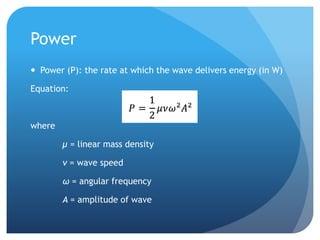
Power
 Power (P): the rate at which the wave delivers energy (in W)
Equation:
where
μ = linear mass density
ν = wave speed
ω = angular frequency
A = amplitude of wave
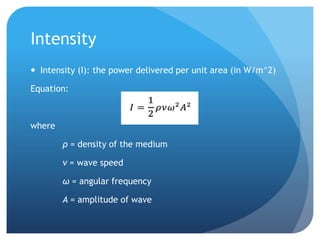
Intensity
 Intensity (I): the power delivered per unit area (in W/m^2)
Equation:
where
ρ = density of the medium
ν = wave speed
ω = angular frequency
A = amplitude of wave
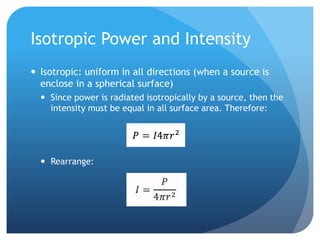
Isotropic Power and Intensity
 Isotropic: uniform in all directions (when a source is
enclose in a spherical surface)
 Since power is radiated isotropically by a source, then the
intensity must be equal in all surface area. Therefore:
 Rearrange:
Target Problem
A person is standing beside a speaker as it plays 10,000 Hz tone.
The sound waves travels away from the speaker uniformly in all
directions. If the distance from the speaker doubles, then the
amplitude of the waves that the person observes:
a) Decrease by a factor greater than 2 but less than 4
b) Halves
c) Doesn’t change
d) Decrease by a factor of 8
e) Decrease by less than half
f) Decrease by a factor of 4
Key Words in the Problem
A person is standing beside a speaker as it plays 10,000 Hz
tone. The sound waves travels away from the speaker
uniformly in all directions. If the distance from the
speaker doubles, then the amplitude of the waves that
the person observes:
 UNIFORMLY = isotropically
 distance from speaker DOUBLES = r -> 2r
 AMPLITUDE = what we want to find
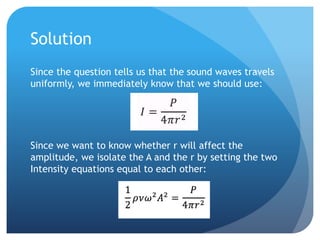
Solution
Since the question tells us that the sound waves travels
uniformly, we immediately know that we should use:
Since we want to know whether r will affect the
amplitude, we isolate the A and the r by setting the two
Intensity equations equal to each other:
Solution Cont’d
Then, we isolate A and r:
Solution Cont’d
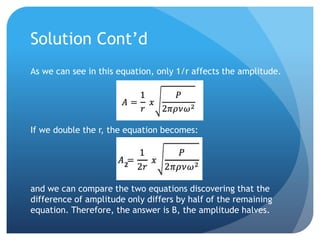
As we can see in this equation, only 1/r affects the amplitude.
If we double the r, the equation becomes:
and we can compare the two equations discovering that the
difference of amplitude only differs by half of the remaining
equation. Therefore, the answer is B, the amplitude halves.
Key Concept
The key concept of this problem is that the intensity of a
sound source radiated isotropically is inversely
proportional to the square of the distance from the source:
Therefore, if we substitute the amplitude from another
intensity question, we can find out the relationship
between the amplitude and the distance:
Common Mistake
A common mistake is that students will use the power
equation to solve for this question.
But why can’t we use the power equation?
If we use common sense to think about this question, we
know that power never changes, but intensity will change
as the distance differs. The further the distance, the
smaller the intensity. Therefore, we know not to use the
power equation to solve this question because we need a
variable (or several variables in this case) that will not
change to find out the relationship/ ratio of the amplitude
and the radius.

Sound waves- Power and Intensity

  • 1.
    Sound Waves Power andIntensity Physics 101 Learning Object
  • 2.
    Power  Power (P):the rate at which the wave delivers energy (in W) Equation: where μ = linear mass density ν = wave speed ω = angular frequency A = amplitude of wave
  • 3.
    Intensity  Intensity (I):the power delivered per unit area (in W/m^2) Equation: where ρ = density of the medium ν = wave speed ω = angular frequency A = amplitude of wave
  • 4.
    Isotropic Power andIntensity  Isotropic: uniform in all directions (when a source is enclose in a spherical surface)  Since power is radiated isotropically by a source, then the intensity must be equal in all surface area. Therefore:  Rearrange:
  • 5.
    Target Problem A personis standing beside a speaker as it plays 10,000 Hz tone. The sound waves travels away from the speaker uniformly in all directions. If the distance from the speaker doubles, then the amplitude of the waves that the person observes: a) Decrease by a factor greater than 2 but less than 4 b) Halves c) Doesn’t change d) Decrease by a factor of 8 e) Decrease by less than half f) Decrease by a factor of 4
  • 6.
    Key Words inthe Problem A person is standing beside a speaker as it plays 10,000 Hz tone. The sound waves travels away from the speaker uniformly in all directions. If the distance from the speaker doubles, then the amplitude of the waves that the person observes:  UNIFORMLY = isotropically  distance from speaker DOUBLES = r -> 2r  AMPLITUDE = what we want to find
  • 7.
    Solution Since the questiontells us that the sound waves travels uniformly, we immediately know that we should use: Since we want to know whether r will affect the amplitude, we isolate the A and the r by setting the two Intensity equations equal to each other:
  • 8.
  • 9.
    Solution Cont’d As wecan see in this equation, only 1/r affects the amplitude. If we double the r, the equation becomes: and we can compare the two equations discovering that the difference of amplitude only differs by half of the remaining equation. Therefore, the answer is B, the amplitude halves.
  • 10.
    Key Concept The keyconcept of this problem is that the intensity of a sound source radiated isotropically is inversely proportional to the square of the distance from the source: Therefore, if we substitute the amplitude from another intensity question, we can find out the relationship between the amplitude and the distance:
  • 11.
    Common Mistake A commonmistake is that students will use the power equation to solve for this question. But why can’t we use the power equation? If we use common sense to think about this question, we know that power never changes, but intensity will change as the distance differs. The further the distance, the smaller the intensity. Therefore, we know not to use the power equation to solve this question because we need a variable (or several variables in this case) that will not change to find out the relationship/ ratio of the amplitude and the radius.