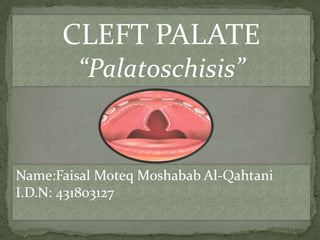
CLEFT PALATE
“Palatoschisis”

Name:Faisal Moteq Moshabab Al-Qahtani
I.D.N: 431803127
Definition
The palate is essentially the roof of the
mouth.
It is composed of two parts, the hard
palate and the soft palate.
The teeth erupt in the anterior hard
palate called the alveolar ridge , and the
posterior hard palate serves as the base of
the nasal cavity.
•The soft palate is the posterior portion of
the roof of the mouth.
•The soft palate is mobile and is composed
of several muscles important for normal
speech and proper function of the
eustachian tubes (associated with the
middle ear).
Cleft palate:
An opening in the roof of the mouth due
to a failure of the palatal shelves to come
fully together from either side of the
mouth and fuse during the first months of
development as an embryo. The opening
in the palate permits communication
between the nasal passages and the
mouth. Surgery is needed to close the
palate. Cleft palate can occur alone or in
association with cleft lip.
Basic classification of cleft palate
A cleft palate is first categorized
according to whether it affects the hard
palate, the soft palate, or both

The hard palate is the front part of the
roof of the mouth
The soft palate is the back part of the roof
of the mouth. This description may
include whether the uvula is affected
Schematic diagrams of the development of the palate
development cont.
a | The developing frontonasal prominence, paired maxillary
processes and paired mandibular processes surround the primitive
oral cavity by the fourth week of embryonic development.
b | By the fifth week, the nasal pits have formed, which leads to the
formation of the paired medial and lateral nasal processes.
c | The medial nasal processes have merged with the maxillary
processes to form the upper lip and primary palate by the end of the
sixth week. The lateral nasal processes form the nasal alae. Similarly,
the mandibular processes fuse to form the lower jaw.
d | During the sixth week of embryogenesis, the secondary palate
develops as bilateral outgrowths from the maxillary processes, which
grow vertically down the side of the tongue.
e | Subsequently, the palatal shelves elevate to a horizontal position
above the tongue, contact one another and commence fusion.
f | Fusion of the palatal shelves ultimately divides the oronasal space
into separate oral and nasal cavities.
Cleft palate etiology
•Cleft palate occur when tissues in the baby's face and mouth don't form
properly.
• Normally, the tissues that make up the lip and palate fuse together in
the second and third months of pregnancy, but in babies with cleft
palate, the fusion never takes place or occurs only partially, leaving an
opening (cleft).
• Researchers believe that most cases of cleft palate are caused by an
interaction of genetic and environmental factors.
• In many babies, a definite cause isn't discovered.
• Genes inherited from the parents. Either the mother or the father can
pass on genes that cause clefting, either as an isolated defect or as part of
a syndrome that includes clefting as one of its signs. In some cases,
babies inherit a gene that makes them more likely to develop a cleft, and
then an environmental trigger actually causes the cleft to occur.
• Exposure to certain substances during pregnancy.
• Cleft palate may be more likely to occur in pregnant women who smoke
cigarettes, drink alcohol and take certain medications.
Cleft palate complications
1.

2.

3.
4.

5.

Difficulty feeding your baby . (a cleft palate can make
sucking difficult or cause gagging or breast milk to come out
through the nose )
Ear infections and hearing loss. (Otitis media)(Babies
with cleft palate are especially susceptible to middle ear
infections. Over time, repeated ear infections increase the
risk of hearing loss)
Dental problems.(If the cleft extends through the upper
gum, tooth development will likely be affected.)
Speech difficulties.(Because the palate is used in forming
sounds, the development of normal speech can be affected
by a cleft palate)
Challenges of coping with a medical condition.
(Children with clefts may face social, emotional and
behavioral problems due to differences in appearance , a
psychologist and a social worker can help your child
Treatments are available for cleft palate
• You will need to speak with your baby's doctor
to determine what is best for your child.
• Many clefts can be fixed with surgery.
• Surgery can't happen right away but is done
when your child is the right age and size.
• Some children need more than one surgery to
fix the cleft over time.
• Many children see a team of professionals who
are experts in helping families with children
who have cleft lips and palates.
Surgical Repair- Cleft Palate
• Several Techniques- Trend is towards less scarring
and less tension on palate
• Scarring of palate may cause impaired mid-facial
growth(alveolar arch collapse, midface retrusion,
malocclusion)
• Facial growth may be less affected if surgery is delayed
until 18-24 months, but feeding, speech, socialization
may suffer.
• Bardach Method- Two Flap technique
1.
2.
3.
4.
5.

Medial incisions made, which separate oral and nasal mucosa
Lateral incisions made at junction of palate and alveolar ridge
Elevate flaps, preserve greater palatine artery.
Detach velar muscles from posterior palate
Close in 3 layers
Non-Surgical Treatment
Dental Obturator
• For high-risk patients or those that refuse surgery.
• Advantage- High rate of closure
• Disadvantage- Need to wear a prosthesis, and need
to modify prosthesis as child grows.
Conclusions
•Cleft Palate is common congenital deformities that
often affect speech, hearing, and cosmesis; and may at
times lead to airway compromise.
•The otolaryngologist is a key member of the cleft
palate team, and is in a unique position to identify and
manage many of these problems .

Cleft palate dental oral pathology

  • 1.
    CLEFT PALATE “Palatoschisis” Name:Faisal MoteqMoshabab Al-Qahtani I.D.N: 431803127
  • 2.
    Definition The palate isessentially the roof of the mouth. It is composed of two parts, the hard palate and the soft palate. The teeth erupt in the anterior hard palate called the alveolar ridge , and the posterior hard palate serves as the base of the nasal cavity.
  • 3.
    •The soft palateis the posterior portion of the roof of the mouth. •The soft palate is mobile and is composed of several muscles important for normal speech and proper function of the eustachian tubes (associated with the middle ear).
  • 4.
    Cleft palate: An openingin the roof of the mouth due to a failure of the palatal shelves to come fully together from either side of the mouth and fuse during the first months of development as an embryo. The opening in the palate permits communication between the nasal passages and the mouth. Surgery is needed to close the palate. Cleft palate can occur alone or in association with cleft lip.
  • 5.
    Basic classification ofcleft palate A cleft palate is first categorized according to whether it affects the hard palate, the soft palate, or both The hard palate is the front part of the roof of the mouth The soft palate is the back part of the roof of the mouth. This description may include whether the uvula is affected
  • 7.
    Schematic diagrams ofthe development of the palate
  • 8.
    development cont. a |The developing frontonasal prominence, paired maxillary processes and paired mandibular processes surround the primitive oral cavity by the fourth week of embryonic development. b | By the fifth week, the nasal pits have formed, which leads to the formation of the paired medial and lateral nasal processes. c | The medial nasal processes have merged with the maxillary processes to form the upper lip and primary palate by the end of the sixth week. The lateral nasal processes form the nasal alae. Similarly, the mandibular processes fuse to form the lower jaw. d | During the sixth week of embryogenesis, the secondary palate develops as bilateral outgrowths from the maxillary processes, which grow vertically down the side of the tongue. e | Subsequently, the palatal shelves elevate to a horizontal position above the tongue, contact one another and commence fusion. f | Fusion of the palatal shelves ultimately divides the oronasal space into separate oral and nasal cavities.
  • 9.
    Cleft palate etiology •Cleftpalate occur when tissues in the baby's face and mouth don't form properly. • Normally, the tissues that make up the lip and palate fuse together in the second and third months of pregnancy, but in babies with cleft palate, the fusion never takes place or occurs only partially, leaving an opening (cleft). • Researchers believe that most cases of cleft palate are caused by an interaction of genetic and environmental factors. • In many babies, a definite cause isn't discovered. • Genes inherited from the parents. Either the mother or the father can pass on genes that cause clefting, either as an isolated defect or as part of a syndrome that includes clefting as one of its signs. In some cases, babies inherit a gene that makes them more likely to develop a cleft, and then an environmental trigger actually causes the cleft to occur. • Exposure to certain substances during pregnancy. • Cleft palate may be more likely to occur in pregnant women who smoke cigarettes, drink alcohol and take certain medications.
  • 10.
    Cleft palate complications 1. 2. 3. 4. 5. Difficultyfeeding your baby . (a cleft palate can make sucking difficult or cause gagging or breast milk to come out through the nose ) Ear infections and hearing loss. (Otitis media)(Babies with cleft palate are especially susceptible to middle ear infections. Over time, repeated ear infections increase the risk of hearing loss) Dental problems.(If the cleft extends through the upper gum, tooth development will likely be affected.) Speech difficulties.(Because the palate is used in forming sounds, the development of normal speech can be affected by a cleft palate) Challenges of coping with a medical condition. (Children with clefts may face social, emotional and behavioral problems due to differences in appearance , a psychologist and a social worker can help your child
  • 11.
    Treatments are availablefor cleft palate • You will need to speak with your baby's doctor to determine what is best for your child. • Many clefts can be fixed with surgery. • Surgery can't happen right away but is done when your child is the right age and size. • Some children need more than one surgery to fix the cleft over time. • Many children see a team of professionals who are experts in helping families with children who have cleft lips and palates.
  • 12.
    Surgical Repair- CleftPalate • Several Techniques- Trend is towards less scarring and less tension on palate • Scarring of palate may cause impaired mid-facial growth(alveolar arch collapse, midface retrusion, malocclusion) • Facial growth may be less affected if surgery is delayed until 18-24 months, but feeding, speech, socialization may suffer. • Bardach Method- Two Flap technique 1. 2. 3. 4. 5. Medial incisions made, which separate oral and nasal mucosa Lateral incisions made at junction of palate and alveolar ridge Elevate flaps, preserve greater palatine artery. Detach velar muscles from posterior palate Close in 3 layers
  • 13.
    Non-Surgical Treatment Dental Obturator •For high-risk patients or those that refuse surgery. • Advantage- High rate of closure • Disadvantage- Need to wear a prosthesis, and need to modify prosthesis as child grows.
  • 14.
    Conclusions •Cleft Palate iscommon congenital deformities that often affect speech, hearing, and cosmesis; and may at times lead to airway compromise. •The otolaryngologist is a key member of the cleft palate team, and is in a unique position to identify and manage many of these problems .