CLEFT LIP AND PALATE 
Dr. Azmiry Sultana Mousumi
Welcome
INTRODUCTION 
A cleft lip and palate is a type of birth 
defect that affects the upper lip and 
the roof of the palate. If the tissue in 
the developing mouth and the palate 
don’t fuse together, a baby could be 
born with a condition called cleft lip or 
cleft palate.
INTRODUCTION 
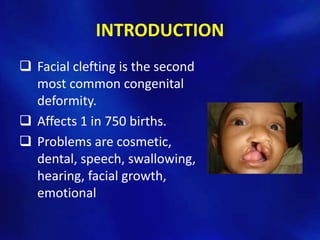
 Facial clefting is the second 
most common congenital 
deformity. 
 Affects 1 in 750 births. 
 Problems are cosmetic, 
dental, speech, swallowing, 
hearing, facial growth, 
emotional
Anatomy 
• Lip 
-Muscle : Orbicularis oris 
• Hard Palate 
–Bones: Maxilla( Palatine Processes) + 
Palatine Bones(Horizontal Lamina) 
–Blood Supply: Greater Palatine Artery 
–Nerve Supply: Anterior Palatine Nerve
Anatomy 
• Soft Palate 
– Fibromuscular shelf attached like a shelf to 
posterior portion of hard palate 
– Tenses, elevates, contacts Passavant’s Ridge 
– Muscles: Tensor Veli Palatini, Levator Veli 
Palatini(Primary Elevator), Musculus 
Uvulae, Palatoglossus, Palatopharyngeus
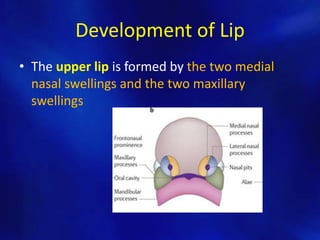
Development of Lip 
• The upper lip is formed by the two medial 
nasal swellings and the two maxillary 
swellings
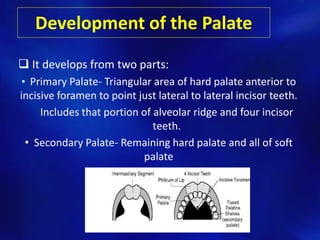
Development of the Palate 
 It develops from two parts: 
• Primary Palate- Triangular area of hard palate anterior to 
incisive foramen to point just lateral to lateral incisor teeth. 
Includes that portion of alveolar ridge and four incisor 
teeth. 
• Secondary Palate- Remaining hard palate and all of soft 
palate
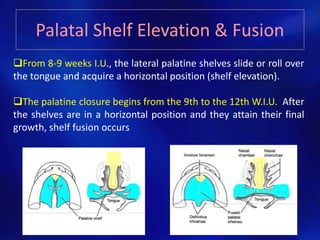
Palatal Shelf Elevation & Fusion 
From 8-9 weeks I.U., the lateral palatine shelves slide or roll over 
the tongue and acquire a horizontal position (shelf elevation). 
The palatine closure begins from the 9th to the 12th W.I.U. After 
the shelves are in a horizontal position and they attain their final 
growth, shelf fusion occurs
Developmental Anomalies Cleft Palate 
• It may be due to lack of growth. 
• It may also be due to interference with palatal shelves 
elevation. 
• Failure of fusion between the median and lateral palatine 
processes and the nasal septum. 
• It may be due to initial fusion with interruption of growth 
at any point along its course. 
• Clefts of primary palate occur anterior to incisive 
foramen 
• Clefts of secondary palate occur posterior to incisive 
foramen
ETIOLOGY 
The exact cause of clefting is unknown. 
 
• Chemical exposures, 
• Radiation, 
• Maternal hypoxia, 
• Teratogenic drugs 
• Nutritional deficiencies, 
• Physical obstruction, 
• Genetic influences.
ETIOLOGY 
• Some of these genes include the MSX, LHX, 
goosecoid, and DLX genes. 
• Some Syndromes Associated with Cleft Palate like: 
Down’s syndrome 
Pierre Robin syndrome 
Treacher collins syndrome 
Marfan syndrome 
Stickler syndrome 
Edward syndrome
Classification 
Cleft Lip 
Unilateral or Bilateral 
Complete or Incomplete 
Palatal Cleft 
Bifid Uvula 
Soft palate only 
Both hard and soft palate 
Combined lip and palatal defect 
Unilateral , complete or incomplete 
Cleft palate with bilateral cleft lip , complete or 
incomplete
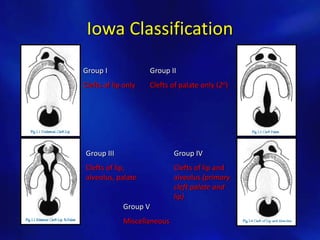
Iowa Classification 
Group I 
Clefts of lip only 
Group II 
Clefts of palate only (2o) 
Group III 
Clefts of lip, 
alveolus, palate 
Group IV 
Clefts of lip and 
alveolus (primary 
cleft palate and 
lip) 
Group V 
Miscellaneous
DEFECTS IN CLEFT LIP AND PALATE 
PATIENTS 
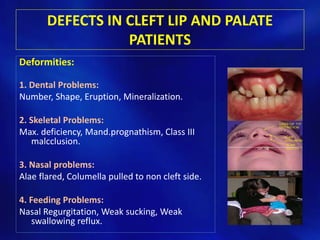
Deformities: 
1. Dental Problems: 
Number, Shape, Eruption, Mineralization. 
2. Skeletal Problems: 
Max. deficiency, Mand.prognathism, Class III 
malcclusion. 
3. Nasal problems: 
Alae flared, Columella pulled to non cleft side. 
4. Feeding Problems: 
Nasal Regurgitation, Weak sucking, Weak 
swallowing reflux.
DEFECTS IN CLEFT LIP AND PALATE 
PATIENTS 
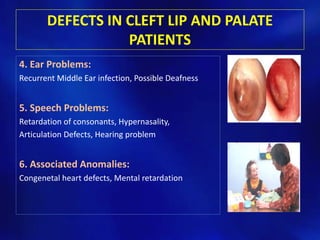
4. Ear Problems: 
Recurrent Middle Ear infection, Possible Deafness 
5. Speech Problems: 
Retardation of consonants, Hypernasality, 
Articulation Defects, Hearing problem 
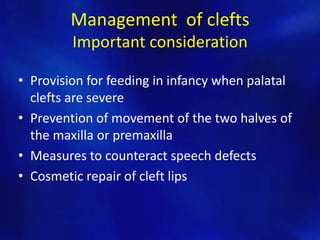
6. Associated Anomalies: 
Congenetal heart defects, Mental retardation
Management of clefts 
Important consideration 
• Provision for feeding in infancy when palatal 
clefts are severe 
• Prevention of movement of the two halves of 
the maxilla or premaxilla 
• Measures to counteract speech defects 
• Cosmetic repair of cleft lips
Non-Surgical Treatment 
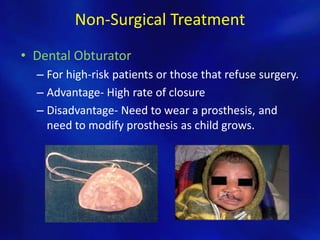
• Dental Obturator 
– For high-risk patients or those that refuse surgery. 
– Advantage- High rate of closure 
– Disadvantage- Need to wear a prosthesis, and 
need to modify prosthesis as child grows.
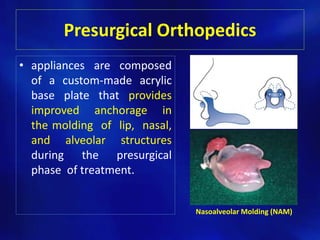
Presurgical Orthopedics 
• appliances are composed 
of a custom-made acrylic 
base plate that provides 
improved anchorage in 
the molding of lip, nasal, 
and alveolar structures 
during the presurgical 
phase of treatment. 
Nasoalveolar Molding (NAM)
Primary 
Surgical Repair 
Isolated Cleft Lip 
3-4 months 
Isolated Cleft Palate 
Hard +/or Soft Palate 
8-9 months 
Cleft Lip and Palate 
3-4 months 
Soft palate 
8-9 months
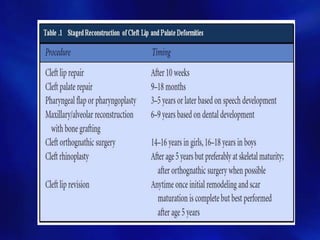
Secondary Surgery 
Speech surgery - (Pre school) 
Velopharyngeal insufficiency 
Alveolar bone graft - (8-10 years) 
Boney union of alveolus 
Orthognathic surgery - (Adult) 
Malocclusion / aesthetic
Surgical Management 
Staging and Timing of Surgery 
Different institutions = different practice 
Cleft Lip Cleft Palate 
Rule of 10’s 
Hb = 10g 
Weight of 10lbs 
Age 10wks 
6-8 weeks 
9-12 months of age
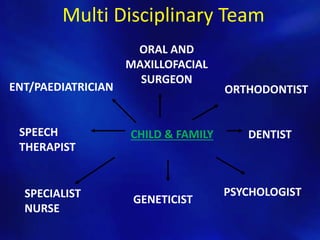
Multi Disciplinary Team 
ORAL AND 
MAXILLOFACIAL 
SURGEON 
CHILD & FAMILY 
SPEECH 
THERAPIST 
SPECIALIST 
NURSE 
ORTHODONTIST 
DENTIST 
GENETICIST 
ENT/PAEDIATRICIAN 
PSYCHOLOGIST
Surgical Management 
Complete Cleft Lip 
Goal: Symmetric shaped nostrils, nasal seal, and alar bases; well 
defined philtral dimple and columns; natural appearing Cupid’s 
bow; functional muscle repair 
Flap designs: 
1)Rotation-advancement (Millard*, Mohler) 
2)Quadrangular 
3)Triangular (Tennison-Randall)
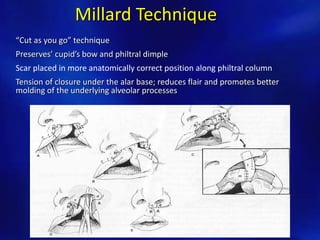
Millard Technique 
“Cut as you go” technique 
Preserves’ cupid’s bow and philtral dimple 
Scar placed in more anatomically correct position along philtral column 
Tension of closure under the alar base; reduces flair and promotes better 
molding of the underlying alveolar processes
Surgical Management 
Cleft Palate 
Goal: Production of a competent 
velopharyngeal sphincter 
Two most common repairs: 
1) von Langenbeck 
2) V-Y (Veau-Wardill-Kilner) 
Main difference: V-Y repair involves elongation of the palate, while 
von Langenbeck does not
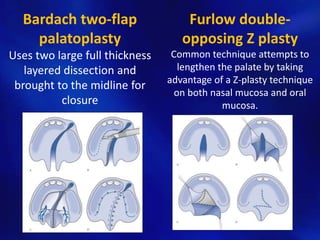
Furlow double-opposing 
Z plasty 
Common technique attempts to 
lengthen the palate by taking 
advantage of a Z-plasty technique 
on both nasal mucosa and oral 
mucosa. 
Bardach two-flap 
palatoplasty 
Uses two large full thickness 
layered dissection and 
brought to the midline for 
closure
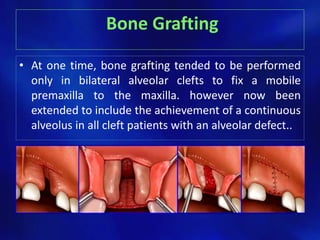
Bone Grafting 
• At one time, bone grafting tended to be performed 
only in bilateral alveolar clefts to fix a mobile 
premaxilla to the maxilla. however now been 
extended to include the achievement of a continuous 
alveolus in all cleft patients with an alveolar defect..
Conclusions 
• Cleft Lip and Palate are common congenital 
deformities that often affect speech, hearing, and 
cosmetic ; and may at times lead to airway 
compromise. 
• The Oral and Maxillofacial surgeon is a key 
member of the cleft palate team, and is in a 
unique position to identify and manage many of 
these problems .
Thank 
you

Cleft lip and palate

  • 1.
    CLEFT LIP ANDPALATE Dr. Azmiry Sultana Mousumi
  • 2.
  • 3.
    INTRODUCTION A cleftlip and palate is a type of birth defect that affects the upper lip and the roof of the palate. If the tissue in the developing mouth and the palate don’t fuse together, a baby could be born with a condition called cleft lip or cleft palate.
  • 4.
    INTRODUCTION  Facialclefting is the second most common congenital deformity.  Affects 1 in 750 births.  Problems are cosmetic, dental, speech, swallowing, hearing, facial growth, emotional
  • 5.
    Anatomy • Lip -Muscle : Orbicularis oris • Hard Palate –Bones: Maxilla( Palatine Processes) + Palatine Bones(Horizontal Lamina) –Blood Supply: Greater Palatine Artery –Nerve Supply: Anterior Palatine Nerve
  • 6.
    Anatomy • SoftPalate – Fibromuscular shelf attached like a shelf to posterior portion of hard palate – Tenses, elevates, contacts Passavant’s Ridge – Muscles: Tensor Veli Palatini, Levator Veli Palatini(Primary Elevator), Musculus Uvulae, Palatoglossus, Palatopharyngeus
  • 7.
    Development of Lip • The upper lip is formed by the two medial nasal swellings and the two maxillary swellings
  • 8.
    Development of thePalate  It develops from two parts: • Primary Palate- Triangular area of hard palate anterior to incisive foramen to point just lateral to lateral incisor teeth. Includes that portion of alveolar ridge and four incisor teeth. • Secondary Palate- Remaining hard palate and all of soft palate
  • 9.
    Palatal Shelf Elevation& Fusion From 8-9 weeks I.U., the lateral palatine shelves slide or roll over the tongue and acquire a horizontal position (shelf elevation). The palatine closure begins from the 9th to the 12th W.I.U. After the shelves are in a horizontal position and they attain their final growth, shelf fusion occurs
  • 11.
    Developmental Anomalies CleftPalate • It may be due to lack of growth. • It may also be due to interference with palatal shelves elevation. • Failure of fusion between the median and lateral palatine processes and the nasal septum. • It may be due to initial fusion with interruption of growth at any point along its course. • Clefts of primary palate occur anterior to incisive foramen • Clefts of secondary palate occur posterior to incisive foramen
  • 12.
    ETIOLOGY The exactcause of clefting is unknown.  • Chemical exposures, • Radiation, • Maternal hypoxia, • Teratogenic drugs • Nutritional deficiencies, • Physical obstruction, • Genetic influences.
  • 13.
    ETIOLOGY • Someof these genes include the MSX, LHX, goosecoid, and DLX genes. • Some Syndromes Associated with Cleft Palate like: Down’s syndrome Pierre Robin syndrome Treacher collins syndrome Marfan syndrome Stickler syndrome Edward syndrome
  • 14.
    Classification Cleft Lip Unilateral or Bilateral Complete or Incomplete Palatal Cleft Bifid Uvula Soft palate only Both hard and soft palate Combined lip and palatal defect Unilateral , complete or incomplete Cleft palate with bilateral cleft lip , complete or incomplete
  • 15.
    Iowa Classification GroupI Clefts of lip only Group II Clefts of palate only (2o) Group III Clefts of lip, alveolus, palate Group IV Clefts of lip and alveolus (primary cleft palate and lip) Group V Miscellaneous
  • 16.
    DEFECTS IN CLEFTLIP AND PALATE PATIENTS Deformities: 1. Dental Problems: Number, Shape, Eruption, Mineralization. 2. Skeletal Problems: Max. deficiency, Mand.prognathism, Class III malcclusion. 3. Nasal problems: Alae flared, Columella pulled to non cleft side. 4. Feeding Problems: Nasal Regurgitation, Weak sucking, Weak swallowing reflux.
  • 17.
    DEFECTS IN CLEFTLIP AND PALATE PATIENTS 4. Ear Problems: Recurrent Middle Ear infection, Possible Deafness 5. Speech Problems: Retardation of consonants, Hypernasality, Articulation Defects, Hearing problem 6. Associated Anomalies: Congenetal heart defects, Mental retardation
  • 18.
    Management of clefts Important consideration • Provision for feeding in infancy when palatal clefts are severe • Prevention of movement of the two halves of the maxilla or premaxilla • Measures to counteract speech defects • Cosmetic repair of cleft lips
  • 19.
    Non-Surgical Treatment •Dental Obturator – For high-risk patients or those that refuse surgery. – Advantage- High rate of closure – Disadvantage- Need to wear a prosthesis, and need to modify prosthesis as child grows.
  • 20.
    Presurgical Orthopedics •appliances are composed of a custom-made acrylic base plate that provides improved anchorage in the molding of lip, nasal, and alveolar structures during the presurgical phase of treatment. Nasoalveolar Molding (NAM)
  • 21.
    Primary Surgical Repair Isolated Cleft Lip 3-4 months Isolated Cleft Palate Hard +/or Soft Palate 8-9 months Cleft Lip and Palate 3-4 months Soft palate 8-9 months
  • 22.
    Secondary Surgery Speechsurgery - (Pre school) Velopharyngeal insufficiency Alveolar bone graft - (8-10 years) Boney union of alveolus Orthognathic surgery - (Adult) Malocclusion / aesthetic
  • 23.
    Surgical Management Stagingand Timing of Surgery Different institutions = different practice Cleft Lip Cleft Palate Rule of 10’s Hb = 10g Weight of 10lbs Age 10wks 6-8 weeks 9-12 months of age
  • 25.
    Multi Disciplinary Team ORAL AND MAXILLOFACIAL SURGEON CHILD & FAMILY SPEECH THERAPIST SPECIALIST NURSE ORTHODONTIST DENTIST GENETICIST ENT/PAEDIATRICIAN PSYCHOLOGIST
  • 26.
    Surgical Management CompleteCleft Lip Goal: Symmetric shaped nostrils, nasal seal, and alar bases; well defined philtral dimple and columns; natural appearing Cupid’s bow; functional muscle repair Flap designs: 1)Rotation-advancement (Millard*, Mohler) 2)Quadrangular 3)Triangular (Tennison-Randall)
  • 27.
    Millard Technique “Cutas you go” technique Preserves’ cupid’s bow and philtral dimple Scar placed in more anatomically correct position along philtral column Tension of closure under the alar base; reduces flair and promotes better molding of the underlying alveolar processes
  • 28.
    Surgical Management CleftPalate Goal: Production of a competent velopharyngeal sphincter Two most common repairs: 1) von Langenbeck 2) V-Y (Veau-Wardill-Kilner) Main difference: V-Y repair involves elongation of the palate, while von Langenbeck does not
  • 29.
    Furlow double-opposing Zplasty Common technique attempts to lengthen the palate by taking advantage of a Z-plasty technique on both nasal mucosa and oral mucosa. Bardach two-flap palatoplasty Uses two large full thickness layered dissection and brought to the midline for closure
  • 30.
    Bone Grafting •At one time, bone grafting tended to be performed only in bilateral alveolar clefts to fix a mobile premaxilla to the maxilla. however now been extended to include the achievement of a continuous alveolus in all cleft patients with an alveolar defect..
  • 32.
    Conclusions • CleftLip and Palate are common congenital deformities that often affect speech, hearing, and cosmetic ; and may at times lead to airway compromise. • The Oral and Maxillofacial surgeon is a key member of the cleft palate team, and is in a unique position to identify and manage many of these problems .
  • 33.