CLEFT LIP & PALATE
EMBRYOLOGY
&
MANAGEMENT
Dr SD Sanyal
Wg Cdr RD Bavdekar
Cl Spl Surg & Plastic surgeon
EMBRYOGENESIS
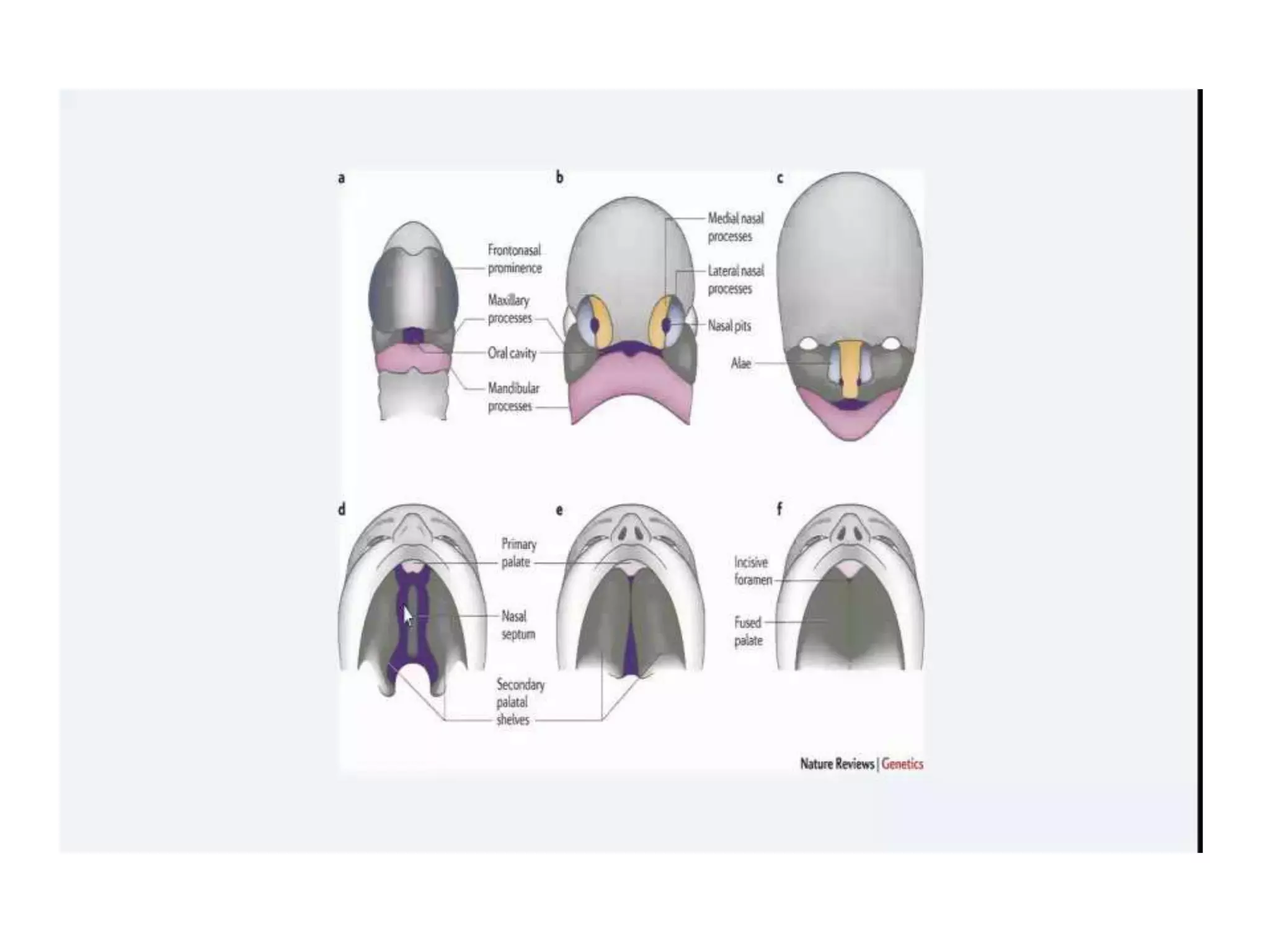
Lip
Formation of Stomatodaeum
Appearance of FN process & Mandibular
arches
Maxillary & Mandibular processes develop
Lip
Formation of Nasal placodes
Medial and Lateral nasal processes form
Both nasal processes fuse together & with the
Maxillary process
Lip
Upper lip is formed
Lower lip is formed by the fusion of the B/L
Mandibular processes
Palate
Palatal processes arise from the maxillary
processes
Premaxilla develops from the FN process
B/L Palatal processes fuse with post border of
the Premaxilla
Palate
B/L palatal processes fuse together in the
midline
Fusion proceeds ant to post
Medial edge of the palatal processes fuse with
the free end of nasal septum
Incidence
• Cleft lip and palate 1:600
• Isolated cleft palate 1:1000
• Oriental (1:500) > black (1:2000)
• Cleft lip alone: 15 per cent
• Cleft lip and palate: 45 per cent
• Iisolated cleft palate: 40 per cent
• Cleft lip/palate predominates in males
• Cleft palate alone more common in females
• Unilateral cleft lip - left side in 60 %
Etiology
• Familial
• Protein & vit deficiency
• Rubella infection
• Radiation
• Drugs : Steroids, Phenytoin, Diazepam
• Syndromes
- Downs
Muscle Rings of Face
CLASSIFICATION
Nagpur Classification
LAHSHAL System
• Describes site, size and extent, as well as type
of cleft
• Complete clefts of the lip, alveolus and hard
and soft palate designated as capitals
- L, A, H and S
• Incomplete clefts recorded in lower case
letters
• Microform clefts documented with asterisks
DAVIS & RITCHIE
• Three groups according to position of cleft in
relation to alveolar process:
• Group I – Pre alveolar clefts:
- Unilateral cleft lip
- Bilateral cleft lip
- Median cleft lip
• Group II - Post alveolar clefts:
- Cleft hard palate alone
- Cleft soft palate alone
- Cleft soft palate and hard palate
- Sub mucous cleft
DAVIS & RITCHIE
• Group III-Alveolar clefts:
- Unilateral alveolar cleft
- Bilateral alveolar cleft
- Median alveolar cleft
VEAU Classification
• Group I (A) - Defects of the soft palate only
• Group II (B) - Defects involving the hard palate and soft
palate extending not further than the incisive foramen,
thus involving the secondary palate alone
• Group III (C) – Complete unilateral cleft, extending
from the soft palate to the alveolus, usually involving
the lip
• Group IV (D) - Complete bilateral clefts, resembles
Group III but is bilateral. When cleft is bilateral, pre-
maxilla is suspended from the nasal septum
Management
• Primary management
• Surgery
• Secondary management
Primary Management
Antenatal Diagnosis:
• Antenatal diagnosis of cleft lip U/L or B/L :
- US scan after 18 weeks of gestation
• Isolated cleft palate :
- Antenatal scan has no role
• Plastic surgery referral & counselling
Primary Management
Feeding :
• Most babies feed well
• Soft bottles
• Modified teats
• Feeding plates
Primary Management
Airway:
• Major airway obstruction uncommon
• During feeding and sleep
• Intermittant episodes – Prone nursing
• Persistant – Retained nasopharyngeal
intubation
• Labioglossopexy
Surgery
• Aims:
- Normal appearance of lip, nose and face
- Normal speech
- Dentition and facial growth within normal
range
Surgery
Millard Criteriae for cleft lip:
-10 months of age
- 10 weeks old
- 10gm % Hb
Cleft palate :
-10 kgs weight
- 10-18mths old
- 10gm% Hb
Principles of cleft lip repair:
- Proper pre-surgical skin markings
- Full thickness skin incisions
- 1: 200000 Adr
-Skin incisions developed to restore
tissues to normal position
-Ms continuity achieved by sub-
periosteal undermining over ant
maxilla
-Nasolabial ms anchored to pre-
maxilla
- Oblique muscles of orbicularis oris
sutured to the nasal spine
- Horizontal fibres of orbicularis oris
are sutured to achieve a functional
sphincter
- Three layer repair
- Horizontal Cupid’s bow
- Continuity of whiteline
- No vermilion notching
Principles of cleft palate repair :
- Mobilisation and re-
construction of aberrant soft
palate musculature
- Closure of hard palate with
minimal dissection and scar
formation
- O2 stage closure ensuring
physiological anrrowing of the
cleft
Timing of Surgery
Cleft lip alone :
- U/L: One operation at 3–6 months
- B/L :One operation at 4–5 months
Cleft palate alone :
Soft palate only : One operationat 6 months
Soft and hard palate:Two operations
- Soft palate at 6 months
- Hard palate at 15–18 months
Timing of Surgery
Cleft lip and palate :
• U/L : Two operations
- Cleft lip and soft palate at 5–6 months
- Hard palate and gum pad +/- lip revision at 15–18 months
• B/L : Two operations
- Cleft lip and soft palate at 4–5 months
- Hard palate and gum pad +/- lip revision at 15–18 months
Secondary Management
Hearing :
• Serous Otitis Media
• SNHL
• Early audiological assessment – 1 yr
• ABR & Tympanomometry
• Role of Myringotomy & grommet insertion
Secondary Management
Speech :
• Initial assessment by 18 months
• Velopharyngeal incompetence:
- Hypernasal speech
- Soft palate dysfn
• Articulation defects:
- Due to VP incompetence or poor dental occlusion
• Speech:
- Speech therapy and speech training devices
Secondary Management
Dental :
• Delayed development & eruption
• Abnormal morphology
• Hypo/hyperdontia
• Regular dental check up
• Flouride supplementation & use of fissure
sealants
• Dietary advice
Secondary Management
Secondary surgery :
• Orthodontic & orthognathic surgery
• Alveolar bone grafts
• Lip revision
• Rhinoplasty
THANK YOU

cleft lip and palate

  • 1.
    CLEFT LIP &PALATE EMBRYOLOGY & MANAGEMENT Dr SD Sanyal Wg Cdr RD Bavdekar Cl Spl Surg & Plastic surgeon
  • 2.
  • 5.
    Lip Formation of Stomatodaeum Appearanceof FN process & Mandibular arches Maxillary & Mandibular processes develop
  • 6.
    Lip Formation of Nasalplacodes Medial and Lateral nasal processes form Both nasal processes fuse together & with the Maxillary process
  • 7.
    Lip Upper lip isformed Lower lip is formed by the fusion of the B/L Mandibular processes
  • 9.
    Palate Palatal processes arisefrom the maxillary processes Premaxilla develops from the FN process B/L Palatal processes fuse with post border of the Premaxilla
  • 10.
    Palate B/L palatal processesfuse together in the midline Fusion proceeds ant to post Medial edge of the palatal processes fuse with the free end of nasal septum
  • 11.
    Incidence • Cleft lipand palate 1:600 • Isolated cleft palate 1:1000 • Oriental (1:500) > black (1:2000) • Cleft lip alone: 15 per cent • Cleft lip and palate: 45 per cent • Iisolated cleft palate: 40 per cent • Cleft lip/palate predominates in males • Cleft palate alone more common in females • Unilateral cleft lip - left side in 60 %
  • 12.
    Etiology • Familial • Protein& vit deficiency • Rubella infection • Radiation • Drugs : Steroids, Phenytoin, Diazepam • Syndromes - Downs
  • 13.
  • 14.
  • 17.
  • 18.
    LAHSHAL System • Describessite, size and extent, as well as type of cleft • Complete clefts of the lip, alveolus and hard and soft palate designated as capitals - L, A, H and S • Incomplete clefts recorded in lower case letters • Microform clefts documented with asterisks
  • 20.
    DAVIS & RITCHIE •Three groups according to position of cleft in relation to alveolar process: • Group I – Pre alveolar clefts: - Unilateral cleft lip - Bilateral cleft lip - Median cleft lip • Group II - Post alveolar clefts: - Cleft hard palate alone - Cleft soft palate alone - Cleft soft palate and hard palate - Sub mucous cleft
  • 21.
    DAVIS & RITCHIE •Group III-Alveolar clefts: - Unilateral alveolar cleft - Bilateral alveolar cleft - Median alveolar cleft
  • 22.
    VEAU Classification • GroupI (A) - Defects of the soft palate only • Group II (B) - Defects involving the hard palate and soft palate extending not further than the incisive foramen, thus involving the secondary palate alone • Group III (C) – Complete unilateral cleft, extending from the soft palate to the alveolus, usually involving the lip • Group IV (D) - Complete bilateral clefts, resembles Group III but is bilateral. When cleft is bilateral, pre- maxilla is suspended from the nasal septum
  • 23.
    Management • Primary management •Surgery • Secondary management
  • 24.
    Primary Management Antenatal Diagnosis: •Antenatal diagnosis of cleft lip U/L or B/L : - US scan after 18 weeks of gestation • Isolated cleft palate : - Antenatal scan has no role • Plastic surgery referral & counselling
  • 25.
    Primary Management Feeding : •Most babies feed well • Soft bottles • Modified teats • Feeding plates
  • 27.
    Primary Management Airway: • Majorairway obstruction uncommon • During feeding and sleep • Intermittant episodes – Prone nursing • Persistant – Retained nasopharyngeal intubation • Labioglossopexy
  • 28.
    Surgery • Aims: - Normalappearance of lip, nose and face - Normal speech - Dentition and facial growth within normal range
  • 29.
    Surgery Millard Criteriae forcleft lip: -10 months of age - 10 weeks old - 10gm % Hb Cleft palate : -10 kgs weight - 10-18mths old - 10gm% Hb
  • 30.
    Principles of cleftlip repair: - Proper pre-surgical skin markings - Full thickness skin incisions - 1: 200000 Adr -Skin incisions developed to restore tissues to normal position -Ms continuity achieved by sub- periosteal undermining over ant maxilla -Nasolabial ms anchored to pre- maxilla - Oblique muscles of orbicularis oris sutured to the nasal spine - Horizontal fibres of orbicularis oris are sutured to achieve a functional sphincter - Three layer repair - Horizontal Cupid’s bow - Continuity of whiteline - No vermilion notching Principles of cleft palate repair : - Mobilisation and re- construction of aberrant soft palate musculature - Closure of hard palate with minimal dissection and scar formation - O2 stage closure ensuring physiological anrrowing of the cleft
  • 31.
    Timing of Surgery Cleftlip alone : - U/L: One operation at 3–6 months - B/L :One operation at 4–5 months Cleft palate alone : Soft palate only : One operationat 6 months Soft and hard palate:Two operations - Soft palate at 6 months - Hard palate at 15–18 months
  • 32.
    Timing of Surgery Cleftlip and palate : • U/L : Two operations - Cleft lip and soft palate at 5–6 months - Hard palate and gum pad +/- lip revision at 15–18 months • B/L : Two operations - Cleft lip and soft palate at 4–5 months - Hard palate and gum pad +/- lip revision at 15–18 months
  • 34.
    Secondary Management Hearing : •Serous Otitis Media • SNHL • Early audiological assessment – 1 yr • ABR & Tympanomometry • Role of Myringotomy & grommet insertion
  • 35.
    Secondary Management Speech : •Initial assessment by 18 months • Velopharyngeal incompetence: - Hypernasal speech - Soft palate dysfn • Articulation defects: - Due to VP incompetence or poor dental occlusion • Speech: - Speech therapy and speech training devices
  • 36.
    Secondary Management Dental : •Delayed development & eruption • Abnormal morphology • Hypo/hyperdontia • Regular dental check up • Flouride supplementation & use of fissure sealants • Dietary advice
  • 37.
    Secondary Management Secondary surgery: • Orthodontic & orthognathic surgery • Alveolar bone grafts • Lip revision • Rhinoplasty
  • 38.