DIFFERENCE BETWEEN
GROWTH AND DEVELOPMENT:
A SIMPLE AND EASY WAY
NAME : SABEEN SHAIKH
D/O : ALEEMUDDIN SHAIKH
ROLL : 63
CLASS : B.ED 1.5 MORNING
PRESENTATION : GROWTH AND DEVELOPMNET
TOPIC
ASSIGNED BY : DR. AMJAD ALI ARAIN
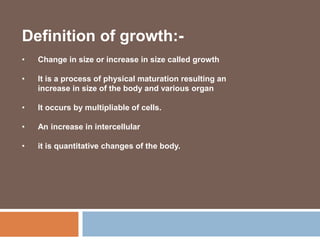
Definition of growth:-
• Change in size or increase in size called growth
• It is a process of physical maturation resulting an
increase in size of the body and various organ
• It occurs by multipliable of cells.
• An increase in intercellular
• it is quantitative changes of the body.
GROWTH ASSESSMENT
1. Growth is fundamental characteristics of childhood.
2. Normal growth is indicator of optimum health.
3. Deviation from the normal pattern is indicative of
pathological process.
4. Periodic assessment facilitates early detection of growth
faltering, which may be first manifestation of undernutrition /
infection / disease.
GROWTH ASSESSMENT
PERIODS OF GROWTH
TERMINOLOGY PERIOD
Prental period
Ovum
Embryo
Foetus
Ovulatation to 14 days
15 days to 8 weeks
9 weeks to birth
Perintal period 22 weeks of gestation
To 7 days after birth
Postnatal period
New born / neonate
Infant
Todler
Preschool child
School age child
First 28 days after birth
1st year
1-3 years
3-6 years
6-10 years (girls)
6-12 (boys)
Adolescent
Prepubescent or
Late child hood
10-12 years (girls)
12-14 years (boys)
Pubescent 12-14 years (girls)
14-16 years (boys)
Postpubescent 14-19 years (girls)
16-20 years (boys)
GROWTH CAN BE MEASURED IN TERMS
OF
1. PHYSICAL ANTHROPOMETRY
2. ASSESSMENT OF TISSUE GROWTH
3. BONE AGE
4. DENTAL AGE
DEVELOPMENT
It is the process of functional and physiological
maturation of the individual
it is related to maturation and myelination of the
nervous system
it includes psychological emotional and social
changes
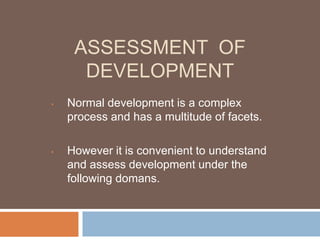
ASSESSMENT OF
DEVELOPMENT
• Normal development is a complex
process and has a multitude of facets.
• However it is convenient to understand
and assess development under the
following domans.
• Gross motor development.
• Fine motor skill development.
• Personal and social development.
• Language
• Vision and hearing
GROSS MOTOR DEVELOPMENT
MILESTONE
AGE MILESTON
3 m Neck holding
5 m Rolls over
6 m Sits with own support
8 m Sitting without support
9 m Standing holding on (with support)
12 m Creep well, stand without support
15 m Walks alone creeps upstairs
18 m Runs
2 years Walks up and down stairs
3 years Rides tricycle
4 years Hopes on one foot, alternate feet
going down stairs
FINE MOTOR SKILLS DEVELOPMENT
AGE MILESTON
4 m Reaching out for the objects With
both hands Reaching out for the
objects with one hand
9 m Immature pincer graps
12 m Pincer graps mature
15 m Imitates Scribbling, tower of 2 blocks
18 m Scribbles, tower of 3 block
2 years Towers of 6 blocks, vertical and
circular stroke
3 years Towers of 9 blocks, copies circle
4 years Copies cross, bridge with blocks
5 years Copies triangle, gate with block
SOCIAL AND ADAPTIVE MILESTONE
AGE MILESTON
7 m Social smile
3 m Recognize mother
9 m Waves “bye bye”
12 m Comes when called, plays simple ball
game
15 m Jargon
18 m Copies parents in tasks
2 years Ask for food, drink, toilet
3 years Share toys, know full game and
gender
4 years Play cooperatively in a group, goes
go toilet alone
5 years Helps in house hold tasks, dressing
and undressing
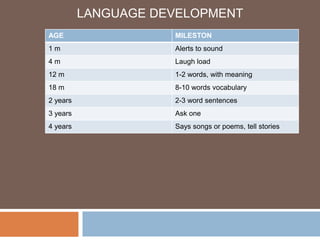
LANGUAGE DEVELOPMENT
AGE MILESTON
1 m Alerts to sound
4 m Laugh load
12 m 1-2 words, with meaning
18 m 8-10 words vocabulary
2 years 2-3 word sentences
3 years Ask one
4 years Says songs or poems, tell stories
• Healthy development, in all form,
particularly social / emotional /
communication, and behavior, should be
monitored by parents and physicians
through screenings at each will visit
GROWTH & DEVELOPMENT AGE
PERIODS
• Infancy
neonate (BIRTH to 1 month)
• Infancy
1 month to 1 year
• Farley child wood
• Toddler (1-3 years)
• Pre school (3-6 years)
• Middle child hood
• School age (6-12 years)
• Late child hood
• Adolescent (13 years to approximately 18
years)

Difference between growth and development a simple and easy way

  • 1.
    DIFFERENCE BETWEEN GROWTH ANDDEVELOPMENT: A SIMPLE AND EASY WAY
  • 2.
    NAME : SABEENSHAIKH D/O : ALEEMUDDIN SHAIKH ROLL : 63 CLASS : B.ED 1.5 MORNING PRESENTATION : GROWTH AND DEVELOPMNET TOPIC ASSIGNED BY : DR. AMJAD ALI ARAIN
  • 3.
    Definition of growth:- •Change in size or increase in size called growth • It is a process of physical maturation resulting an increase in size of the body and various organ • It occurs by multipliable of cells. • An increase in intercellular • it is quantitative changes of the body.
  • 5.
    GROWTH ASSESSMENT 1. Growthis fundamental characteristics of childhood. 2. Normal growth is indicator of optimum health. 3. Deviation from the normal pattern is indicative of pathological process. 4. Periodic assessment facilitates early detection of growth faltering, which may be first manifestation of undernutrition / infection / disease.
  • 6.
  • 7.
    PERIODS OF GROWTH TERMINOLOGYPERIOD Prental period Ovum Embryo Foetus Ovulatation to 14 days 15 days to 8 weeks 9 weeks to birth Perintal period 22 weeks of gestation To 7 days after birth Postnatal period New born / neonate Infant Todler Preschool child School age child First 28 days after birth 1st year 1-3 years 3-6 years 6-10 years (girls) 6-12 (boys) Adolescent Prepubescent or Late child hood 10-12 years (girls) 12-14 years (boys) Pubescent 12-14 years (girls) 14-16 years (boys) Postpubescent 14-19 years (girls) 16-20 years (boys)
  • 8.
    GROWTH CAN BEMEASURED IN TERMS OF 1. PHYSICAL ANTHROPOMETRY 2. ASSESSMENT OF TISSUE GROWTH 3. BONE AGE 4. DENTAL AGE
  • 9.
    DEVELOPMENT It is theprocess of functional and physiological maturation of the individual it is related to maturation and myelination of the nervous system it includes psychological emotional and social changes
  • 10.
    ASSESSMENT OF DEVELOPMENT • Normaldevelopment is a complex process and has a multitude of facets. • However it is convenient to understand and assess development under the following domans.
  • 11.
    • Gross motordevelopment. • Fine motor skill development. • Personal and social development. • Language • Vision and hearing
  • 12.
    GROSS MOTOR DEVELOPMENT MILESTONE AGEMILESTON 3 m Neck holding 5 m Rolls over 6 m Sits with own support 8 m Sitting without support 9 m Standing holding on (with support) 12 m Creep well, stand without support 15 m Walks alone creeps upstairs 18 m Runs 2 years Walks up and down stairs 3 years Rides tricycle 4 years Hopes on one foot, alternate feet going down stairs
  • 13.
    FINE MOTOR SKILLSDEVELOPMENT AGE MILESTON 4 m Reaching out for the objects With both hands Reaching out for the objects with one hand 9 m Immature pincer graps 12 m Pincer graps mature 15 m Imitates Scribbling, tower of 2 blocks 18 m Scribbles, tower of 3 block 2 years Towers of 6 blocks, vertical and circular stroke 3 years Towers of 9 blocks, copies circle 4 years Copies cross, bridge with blocks 5 years Copies triangle, gate with block
  • 14.
    SOCIAL AND ADAPTIVEMILESTONE AGE MILESTON 7 m Social smile 3 m Recognize mother 9 m Waves “bye bye” 12 m Comes when called, plays simple ball game 15 m Jargon 18 m Copies parents in tasks 2 years Ask for food, drink, toilet 3 years Share toys, know full game and gender 4 years Play cooperatively in a group, goes go toilet alone 5 years Helps in house hold tasks, dressing and undressing
  • 15.
    LANGUAGE DEVELOPMENT AGE MILESTON 1m Alerts to sound 4 m Laugh load 12 m 1-2 words, with meaning 18 m 8-10 words vocabulary 2 years 2-3 word sentences 3 years Ask one 4 years Says songs or poems, tell stories
  • 16.
    • Healthy development,in all form, particularly social / emotional / communication, and behavior, should be monitored by parents and physicians through screenings at each will visit
  • 17.
    GROWTH & DEVELOPMENTAGE PERIODS • Infancy neonate (BIRTH to 1 month) • Infancy 1 month to 1 year
  • 18.
    • Farley childwood • Toddler (1-3 years) • Pre school (3-6 years)
  • 19.
    • Middle childhood • School age (6-12 years) • Late child hood • Adolescent (13 years to approximately 18 years)