submitted By
Agneya Sahoo
Growth and
Development
Growth;-
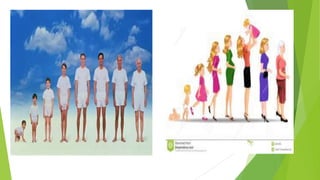
• Growth is the progressive increase in the size,mass,weight or
volume of a living organism, organ or cell of child or part of
a child.
• Change-height , weight, shape
• From the very beginning ,a child needs food. When he eats
foods, it becomes a part of his body. During this time new
cells are produce which result in physical increase.
• This physical increase is called growth
Development;-
• The term development refer to certain change that occur in
human being between birth and death.
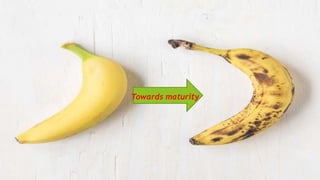
• It is a process towards maturity.
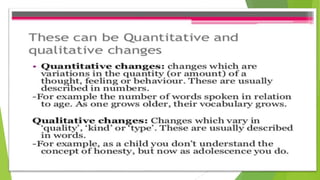
• Development is qualitative in nature, meaning that is
immeasurable.
• Changes- intellectual , social & emotional
• Development refers to the continuous progression where by a
child gains more complex knowledge.
Towards maturity
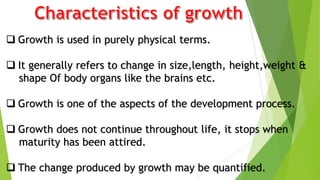
 Growth is used in purely physical terms.
 It generally refers to change in size,length, height,weight &
shape Of body organs like the brains etc.
 Growth is one of the aspects of the development process.
 Growth does not continue throughout life, it stops when
maturity has been attired.
 The change produced by growth may be quantified.
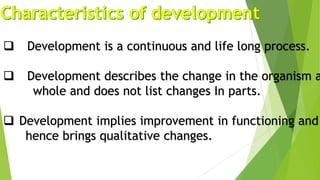
 Development is a continuous and life long process.
 Development describes the change in the organism a
whole and does not list changes In parts.
 Development implies improvement in functioning and
hence brings qualitative changes.
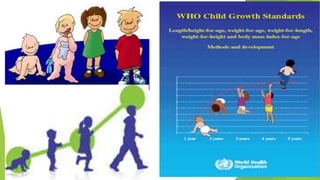
Growth of a baby
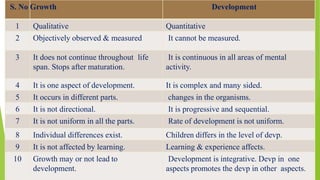
S. No Growth Development
1 Qualitative Quantitative
2 Objectively observed & measured It cannot be measured.
3 It does not continue throughout life
span. Stops after maturation.
It is continuous in all areas of mental
activity.
4 It is one aspect of development. It is complex and many sided.
5 It occurs in different parts. changes in the organisms.
6 It is not directional. It is progressive and sequential.
7 It is not uniform in all the parts. Rate of development is not uniform.
8 Individual differences exist. Children differs in the level of devp.
9 It is not affected by learning. Learning & experience affects.
10 Growth may or not lead to
development.
Development is integrative. Devp in one
aspects promotes the devp in other aspects.
Baby's visual development
THANKU

Growth and development

  • 1.
  • 2.
    Growth;- • Growth isthe progressive increase in the size,mass,weight or volume of a living organism, organ or cell of child or part of a child. • Change-height , weight, shape • From the very beginning ,a child needs food. When he eats foods, it becomes a part of his body. During this time new cells are produce which result in physical increase. • This physical increase is called growth
  • 4.
    Development;- • The termdevelopment refer to certain change that occur in human being between birth and death. • It is a process towards maturity. • Development is qualitative in nature, meaning that is immeasurable. • Changes- intellectual , social & emotional • Development refers to the continuous progression where by a child gains more complex knowledge.
  • 6.
  • 7.
     Growth isused in purely physical terms.  It generally refers to change in size,length, height,weight & shape Of body organs like the brains etc.  Growth is one of the aspects of the development process.  Growth does not continue throughout life, it stops when maturity has been attired.  The change produced by growth may be quantified.
  • 8.
     Development isa continuous and life long process.  Development describes the change in the organism a whole and does not list changes In parts.  Development implies improvement in functioning and hence brings qualitative changes.
  • 9.
  • 10.
    S. No GrowthDevelopment 1 Qualitative Quantitative 2 Objectively observed & measured It cannot be measured. 3 It does not continue throughout life span. Stops after maturation. It is continuous in all areas of mental activity. 4 It is one aspect of development. It is complex and many sided. 5 It occurs in different parts. changes in the organisms. 6 It is not directional. It is progressive and sequential. 7 It is not uniform in all the parts. Rate of development is not uniform. 8 Individual differences exist. Children differs in the level of devp. 9 It is not affected by learning. Learning & experience affects. 10 Growth may or not lead to development. Development is integrative. Devp in one aspects promotes the devp in other aspects.
  • 12.
  • 13.