1
Project Stakeholder Management
Chapter 13
2
 13.1 Identify Stakeholder
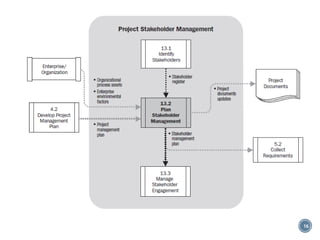
 13.2 Plan Stakeholder Management
 13.3 Manage Stakeholder Engagement
 13.4 Control Stakeholder Engagement
KEY TERMS
3
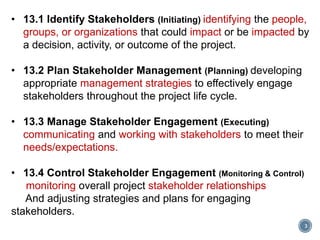
• 13.1 Identify Stakeholders (Initiating) identifying the people,
groups, or organizations that could impact or be impacted by
a decision, activity, or outcome of the project.
• 13.2 Plan Stakeholder Management (Planning) developing
appropriate management strategies to effectively engage
stakeholders throughout the project life cycle.
• 13.3 Manage Stakeholder Engagement (Executing)
communicating and working with stakeholders to meet their
needs/expectations.
• 13.4 Control Stakeholder Engagement (Monitoring & Control)
monitoring overall project stakeholder relationships
And adjusting strategies and plans for engaging
stakeholders.
4
13.1 Identify Stakeholders
5
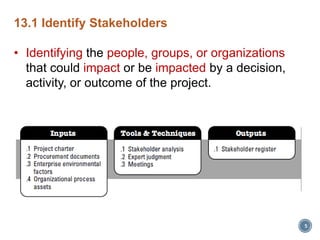
13.1 Identify Stakeholders
• Identifying the people, groups, or organizations
that could impact or be impacted by a decision,
activity, or outcome of the project.
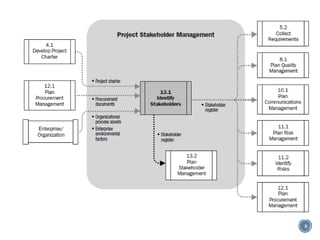
6
7
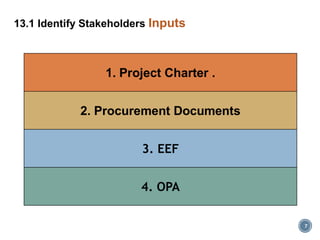
13.1 Identify Stakeholders Inputs
1. Project Charter .
2. Procurement Documents
3. EEF
4. OPA
8
13.1 Identify Stakeholders T & T
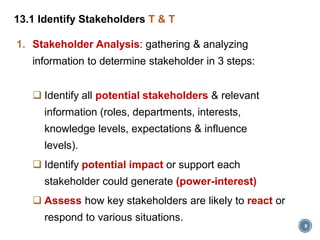
1. Stakeholder Analysis: gathering & analyzing
information to determine stakeholder in 3 steps:
 Identify all potential stakeholders & relevant
information (roles, departments, interests,
knowledge levels, expectations & influence
levels).
 Identify potential impact or support each
stakeholder could generate (power-interest)
 Assess how key stakeholders are likely to react or
respond to various situations.
9
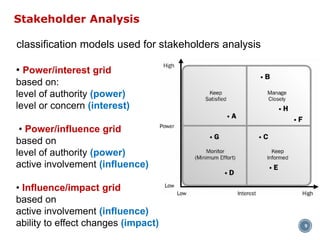
Stakeholder Analysis
classification models used for stakeholders analysis
• Power/interest grid
based on:
level of authority (power)
level or concern (interest)
• Power/influence grid
based on
level of authority (power)
active involvement (influence)
• Influence/impact grid
based on
active involvement (influence)
ability to effect changes (impact)
10
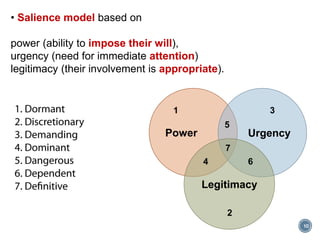
• Salience model based on
power (ability to impose their will),
urgency (need for immediate attention)
legitimacy (their involvement is appropriate).
Power Urgency
Legitimacy
1
2
3
4
5
6
7
11
13.1 Identify Stakeholders T & T
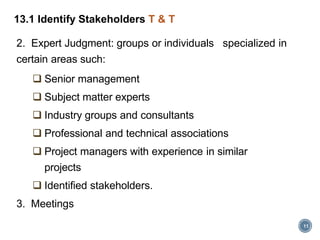
2. Expert Judgment: groups or individuals specialized in
certain areas such:
 Senior management
 Subject matter experts
 Industry groups and consultants
 Professional and technical associations
 Project managers with experience in similar
projects
 Identified stakeholders.
3. Meetings
12
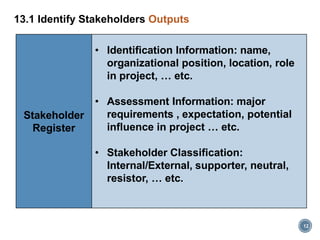
13.1 Identify Stakeholders Outputs
Stakeholder
Register
• Identification Information: name,
organizational position, location, role
in project, … etc.
• Assessment Information: major
requirements , expectation, potential
influence in project … etc.
• Stakeholder Classification:
Internal/External, supporter, neutral,
resistor, … etc.
13
14
13.2 Plan Stakeholders
Management
15
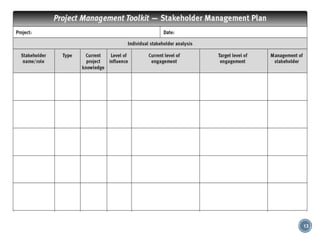
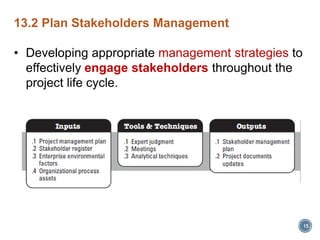
13.2 Plan Stakeholders Management
• Developing appropriate management strategies to
effectively engage stakeholders throughout the
project life cycle.
16
17
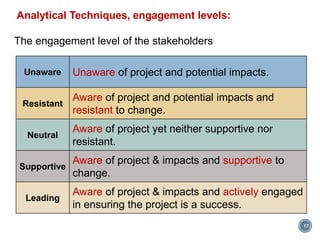
Analytical Techniques, engagement levels:
The engagement level of the stakeholders
Unaware Unaware of project and potential impacts.
Resistant
Aware of project and potential impacts and
resistant to change.
Neutral
Aware of project yet neither supportive nor
resistant.
Supportive
Aware of project & impacts and supportive to
change.
Leading
Aware of project & impacts and actively engaged
in ensuring the project is a success.
18
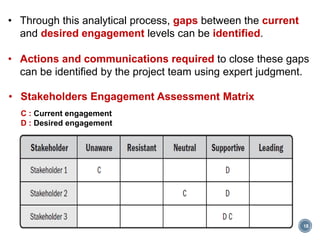
C : Current engagement
D : Desired engagement
• Stakeholders Engagement Assessment Matrix
• Through this analytical process, gaps between the current
and desired engagement levels can be identified.
• Actions and communications required to close these gaps
can be identified by the project team using expert judgment.
19
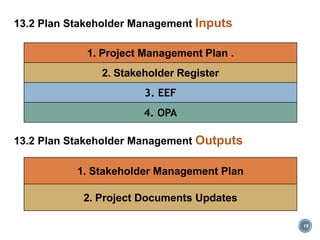
13.2 Plan Stakeholder Management Inputs
1. Project Management Plan .
2. Stakeholder Register
3. EEF
4. OPA
13.2 Plan Stakeholder Management Outputs
1. Stakeholder Management Plan
2. Project Documents Updates
20
13.3 Manage Stakeholders
Engagement
21
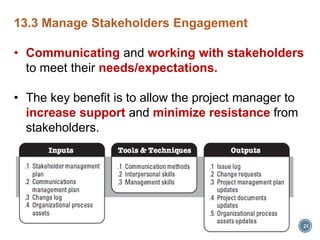
13.3 Manage Stakeholders Engagement
• Communicating and working with stakeholders
to meet their needs/expectations.
• The key benefit is to allow the project manager to
increase support and minimize resistance from
stakeholders.
22
23
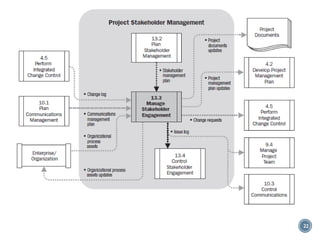
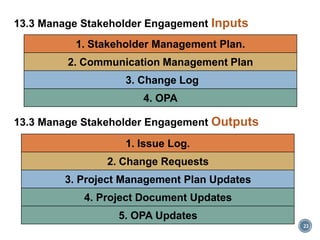
13.3 Manage Stakeholder Engagement Inputs
1. Stakeholder Management Plan.
2. Communication Management Plan
3. Change Log
4. OPA
13.3 Manage Stakeholder Engagement Outputs
1. Issue Log.
2. Change Requests
3. Project Management Plan Updates
4. Project Document Updates
5. OPA Updates
24
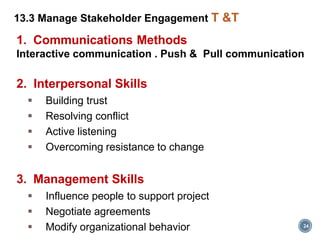
13.3 Manage Stakeholder Engagement T &T
1. Communications Methods
Interactive communication . Push & Pull communication
2. Interpersonal Skills
 Building trust
 Resolving conflict
 Active listening
 Overcoming resistance to change
3. Management Skills
 Influence people to support project
 Negotiate agreements
 Modify organizational behavior
25
13.4 Control Stakeholders
Engagement
26
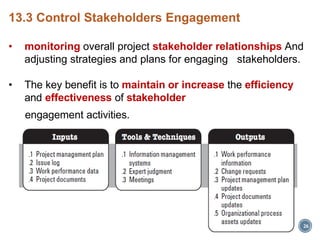
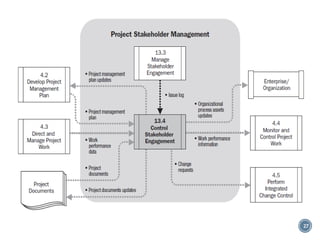
13.3 Control Stakeholders Engagement
• monitoring overall project stakeholder relationships And
adjusting strategies and plans for engaging stakeholders.
• The key benefit is to maintain or increase the efficiency
and effectiveness of stakeholder
engagement activities.
27
28
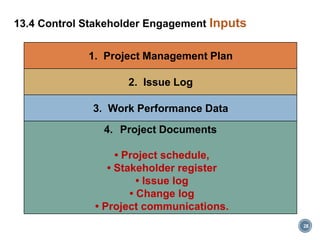
13.4 Control Stakeholder Engagement Inputs
1. Project Management Plan
2. Issue Log
3. Work Performance Data
4. Project Documents
• Project schedule,
• Stakeholder register
• Issue log
• Change log
• Project communications.
29
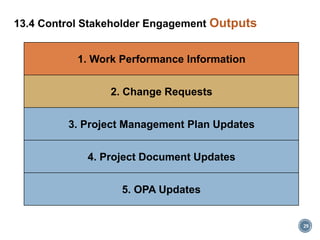
13.4 Control Stakeholder Engagement Outputs
1. Work Performance Information
2. Change Requests
3. Project Management Plan Updates
4. Project Document Updates
5. OPA Updates
30
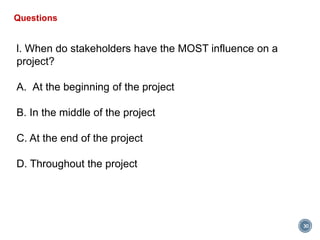
Questions
l. When do stakeholders have the MOST influence on a
project?
A. At the beginning of the project
B. In the middle of the project
C. At the end of the project
D. Throughout the project
31
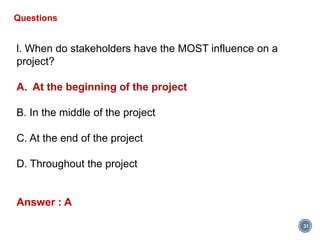
Questions
l. When do stakeholders have the MOST influence on a
project?
A. At the beginning of the project
B. In the middle of the project
C. At the end of the project
D. Throughout the project
Answer : A
32
Questions
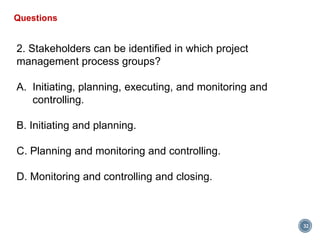
2. Stakeholders can be identified in which project
management process groups?
A. Initiating, planning, executing, and monitoring and
controlling.
B. Initiating and planning.
C. Planning and monitoring and controlling.
D. Monitoring and controlling and closing.
33
Questions
2. Stakeholders can be identified in which project
management process groups?
A. Initiating, planning, executing, and monitoring and
controlling.
B. Initiating and planning.
C. Planning and monitoring and controlling.
D. Monitoring and controlling and closing.
Answer : A .
The early you identify stakeholder. The less conflicts you get.
34
Questions
3. A particular stakeholder has a reputation for requesting many
changes on projects. What is the BEST approach a project
manager can take at the beginning of the project to manage this
situation?
A. Say "No" to the stakeholder a few times to dissuade him from
submitting more changes.
B. Get the stakeholder involved in the project as early as possible.
C. Talk to the stakeholder's boss to find ways of directing the stakeholder's
activities to another project.
D. Ask that the stakeholder not be included in the stakeholder listing.
35
Questions
3. A particular stakeholder has a reputation for requesting many
changes on projects. What is the BEST approach a project
manager can take at the beginning of the project to manage this
situation?
A. Say "No" to the stakeholder a few times to dissuade him from
submitting more changes.
B. Get the stakeholder involved in the project as early as possible.
C. Talk to the stakeholder's boss to find ways of directing the stakeholder's
activities to another project.
D. Ask that the stakeholder not be included in the stakeholder listing.
Answer : B
36
Questions
4. A project manager wants to more extensively involve the
stakeholders on the project. Which of the following would be
the BEST way to accomplish this?
A. Have the stakeholders periodically review the list of project
requirements.
B. Invite the stakeholders to attend project status meetings.
C. Send status reports to the stakeholders.
D. Update the stakeholders on the status of all project
changes.
37
Questions
4. A project manager wants to more extensively involve the
stakeholders on the project. Which of the following would be
the BEST way to accomplish this?
A. Have the stakeholders periodically review the list of project
requirements.
B. Invite the stakeholders to attend project status meetings.
C. Send status reports to the stakeholders.
D. Update the stakeholders on the status of all project
changes.
Answer : A
38
Questions
5. A stakeholders engagement assessment matrix can be
used to identify:
A. Communication gaps.
B. Additional stakeholders.
C. Key relationships between stakeholders.
D. Skill levels of stakeholders.
39
Questions
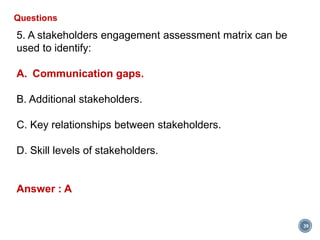
5. A stakeholders engagement assessment matrix can be
used to identify:
A. Communication gaps.
B. Additional stakeholders.
C. Key relationships between stakeholders.
D. Skill levels of stakeholders.
Answer : A
40
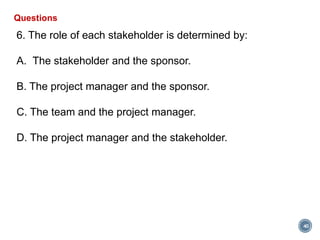
Questions
6. The role of each stakeholder is determined by:
A. The stakeholder and the sponsor.
B. The project manager and the sponsor.
C. The team and the project manager.
D. The project manager and the stakeholder.
41
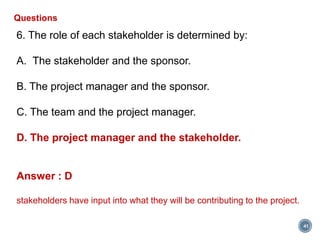
Questions
6. The role of each stakeholder is determined by:
A. The stakeholder and the sponsor.
B. The project manager and the sponsor.
C. The team and the project manager.
D. The project manager and the stakeholder.
Answer : D
stakeholders have input into what they will be contributing to the project.
42
Questions
7. The project manager is trying to recall a stakeholder's
preferred communication method. Where can she find that
information?
A. RACI chart
B. Stakeholders engagement assessment matrix
C. Stakeholder management plan
D. Human resource management plan
43
Questions
7. The project manager is trying to recall a stakeholder's
preferred communication method. Where can she find that
information?
A. RACI chart
B. Stakeholders engagement assessment matrix
C. Stakeholder management plan
D. Human resource management plan
Answer : C
44
Questions
8. The degree to which a particular stakeholder may be able
to positively or negatively affect a project is his or her:
A. Level of engagement.
B. Level of interest.
C. Level of commitment.
D. Level of influence.
45
Questions
8. The degree to which a particular stakeholder may be able
to positively or negatively affect a project is his or her:
A. Level of engagement.
B. Level of interest.
C. Level of commitment.
D. Level of influence.
Answer : D
46
Questions
9. The stakeholder register is an input to which of the
following processes?
A. Plan Risk Management and Collect Requirements
B. Perform Integrated Change Control and Plan
Communications Management
C. Plan Quality Management and Perform Quality Assurance
D. Identify Risks and Develop Project Charter
47
Questions
9. The stakeholder register is an input to which of the
following processes?
A. Plan Risk Management and Collect Requirements
B. Perform Integrated Change Control and Plan
Communications Management
C. Plan Quality Management and Perform Quality Assurance
D. Identify Risks and Develop Project Charter
Answer : A
the stakeholder register is an input to :
Collect Requirements / Plan Quality Management / Plan Communications
Management / Plan Risk / Management / and Identify Risks.
48
Questions
10. The key objective of stakeholder management is:
A. Communication.
B. Coordination.
C. Satisfaction.
D. Relationships.
49
Questions
10. The key objective of stakeholder management is:
A. Communication.
B. Coordination.
C. Satisfaction.
D. Relationships.
Answer : C

Pmp stakeholder chapter 13

  • 1.
  • 2.
    2  13.1 IdentifyStakeholder  13.2 Plan Stakeholder Management  13.3 Manage Stakeholder Engagement  13.4 Control Stakeholder Engagement KEY TERMS
  • 3.
    3 • 13.1 IdentifyStakeholders (Initiating) identifying the people, groups, or organizations that could impact or be impacted by a decision, activity, or outcome of the project. • 13.2 Plan Stakeholder Management (Planning) developing appropriate management strategies to effectively engage stakeholders throughout the project life cycle. • 13.3 Manage Stakeholder Engagement (Executing) communicating and working with stakeholders to meet their needs/expectations. • 13.4 Control Stakeholder Engagement (Monitoring & Control) monitoring overall project stakeholder relationships And adjusting strategies and plans for engaging stakeholders.
  • 4.
  • 5.
    5 13.1 Identify Stakeholders •Identifying the people, groups, or organizations that could impact or be impacted by a decision, activity, or outcome of the project.
  • 6.
  • 7.
    7 13.1 Identify StakeholdersInputs 1. Project Charter . 2. Procurement Documents 3. EEF 4. OPA
  • 8.
    8 13.1 Identify StakeholdersT & T 1. Stakeholder Analysis: gathering & analyzing information to determine stakeholder in 3 steps:  Identify all potential stakeholders & relevant information (roles, departments, interests, knowledge levels, expectations & influence levels).  Identify potential impact or support each stakeholder could generate (power-interest)  Assess how key stakeholders are likely to react or respond to various situations.
  • 9.
    9 Stakeholder Analysis classification modelsused for stakeholders analysis • Power/interest grid based on: level of authority (power) level or concern (interest) • Power/influence grid based on level of authority (power) active involvement (influence) • Influence/impact grid based on active involvement (influence) ability to effect changes (impact)
  • 10.
    10 • Salience modelbased on power (ability to impose their will), urgency (need for immediate attention) legitimacy (their involvement is appropriate). Power Urgency Legitimacy 1 2 3 4 5 6 7
  • 11.
    11 13.1 Identify StakeholdersT & T 2. Expert Judgment: groups or individuals specialized in certain areas such:  Senior management  Subject matter experts  Industry groups and consultants  Professional and technical associations  Project managers with experience in similar projects  Identified stakeholders. 3. Meetings
  • 12.
    12 13.1 Identify StakeholdersOutputs Stakeholder Register • Identification Information: name, organizational position, location, role in project, … etc. • Assessment Information: major requirements , expectation, potential influence in project … etc. • Stakeholder Classification: Internal/External, supporter, neutral, resistor, … etc.
  • 13.
  • 14.
  • 15.
    15 13.2 Plan StakeholdersManagement • Developing appropriate management strategies to effectively engage stakeholders throughout the project life cycle.
  • 16.
  • 17.
    17 Analytical Techniques, engagementlevels: The engagement level of the stakeholders Unaware Unaware of project and potential impacts. Resistant Aware of project and potential impacts and resistant to change. Neutral Aware of project yet neither supportive nor resistant. Supportive Aware of project & impacts and supportive to change. Leading Aware of project & impacts and actively engaged in ensuring the project is a success.
  • 18.
    18 C : Currentengagement D : Desired engagement • Stakeholders Engagement Assessment Matrix • Through this analytical process, gaps between the current and desired engagement levels can be identified. • Actions and communications required to close these gaps can be identified by the project team using expert judgment.
  • 19.
    19 13.2 Plan StakeholderManagement Inputs 1. Project Management Plan . 2. Stakeholder Register 3. EEF 4. OPA 13.2 Plan Stakeholder Management Outputs 1. Stakeholder Management Plan 2. Project Documents Updates
  • 20.
  • 21.
    21 13.3 Manage StakeholdersEngagement • Communicating and working with stakeholders to meet their needs/expectations. • The key benefit is to allow the project manager to increase support and minimize resistance from stakeholders.
  • 22.
  • 23.
    23 13.3 Manage StakeholderEngagement Inputs 1. Stakeholder Management Plan. 2. Communication Management Plan 3. Change Log 4. OPA 13.3 Manage Stakeholder Engagement Outputs 1. Issue Log. 2. Change Requests 3. Project Management Plan Updates 4. Project Document Updates 5. OPA Updates
  • 24.
    24 13.3 Manage StakeholderEngagement T &T 1. Communications Methods Interactive communication . Push & Pull communication 2. Interpersonal Skills  Building trust  Resolving conflict  Active listening  Overcoming resistance to change 3. Management Skills  Influence people to support project  Negotiate agreements  Modify organizational behavior
  • 25.
  • 26.
    26 13.3 Control StakeholdersEngagement • monitoring overall project stakeholder relationships And adjusting strategies and plans for engaging stakeholders. • The key benefit is to maintain or increase the efficiency and effectiveness of stakeholder engagement activities.
  • 27.
  • 28.
    28 13.4 Control StakeholderEngagement Inputs 1. Project Management Plan 2. Issue Log 3. Work Performance Data 4. Project Documents • Project schedule, • Stakeholder register • Issue log • Change log • Project communications.
  • 29.
    29 13.4 Control StakeholderEngagement Outputs 1. Work Performance Information 2. Change Requests 3. Project Management Plan Updates 4. Project Document Updates 5. OPA Updates
  • 30.
    30 Questions l. When dostakeholders have the MOST influence on a project? A. At the beginning of the project B. In the middle of the project C. At the end of the project D. Throughout the project
  • 31.
    31 Questions l. When dostakeholders have the MOST influence on a project? A. At the beginning of the project B. In the middle of the project C. At the end of the project D. Throughout the project Answer : A
  • 32.
    32 Questions 2. Stakeholders canbe identified in which project management process groups? A. Initiating, planning, executing, and monitoring and controlling. B. Initiating and planning. C. Planning and monitoring and controlling. D. Monitoring and controlling and closing.
  • 33.
    33 Questions 2. Stakeholders canbe identified in which project management process groups? A. Initiating, planning, executing, and monitoring and controlling. B. Initiating and planning. C. Planning and monitoring and controlling. D. Monitoring and controlling and closing. Answer : A . The early you identify stakeholder. The less conflicts you get.
  • 34.
    34 Questions 3. A particularstakeholder has a reputation for requesting many changes on projects. What is the BEST approach a project manager can take at the beginning of the project to manage this situation? A. Say "No" to the stakeholder a few times to dissuade him from submitting more changes. B. Get the stakeholder involved in the project as early as possible. C. Talk to the stakeholder's boss to find ways of directing the stakeholder's activities to another project. D. Ask that the stakeholder not be included in the stakeholder listing.
  • 35.
    35 Questions 3. A particularstakeholder has a reputation for requesting many changes on projects. What is the BEST approach a project manager can take at the beginning of the project to manage this situation? A. Say "No" to the stakeholder a few times to dissuade him from submitting more changes. B. Get the stakeholder involved in the project as early as possible. C. Talk to the stakeholder's boss to find ways of directing the stakeholder's activities to another project. D. Ask that the stakeholder not be included in the stakeholder listing. Answer : B
  • 36.
    36 Questions 4. A projectmanager wants to more extensively involve the stakeholders on the project. Which of the following would be the BEST way to accomplish this? A. Have the stakeholders periodically review the list of project requirements. B. Invite the stakeholders to attend project status meetings. C. Send status reports to the stakeholders. D. Update the stakeholders on the status of all project changes.
  • 37.
    37 Questions 4. A projectmanager wants to more extensively involve the stakeholders on the project. Which of the following would be the BEST way to accomplish this? A. Have the stakeholders periodically review the list of project requirements. B. Invite the stakeholders to attend project status meetings. C. Send status reports to the stakeholders. D. Update the stakeholders on the status of all project changes. Answer : A
  • 38.
    38 Questions 5. A stakeholdersengagement assessment matrix can be used to identify: A. Communication gaps. B. Additional stakeholders. C. Key relationships between stakeholders. D. Skill levels of stakeholders.
  • 39.
    39 Questions 5. A stakeholdersengagement assessment matrix can be used to identify: A. Communication gaps. B. Additional stakeholders. C. Key relationships between stakeholders. D. Skill levels of stakeholders. Answer : A
  • 40.
    40 Questions 6. The roleof each stakeholder is determined by: A. The stakeholder and the sponsor. B. The project manager and the sponsor. C. The team and the project manager. D. The project manager and the stakeholder.
  • 41.
    41 Questions 6. The roleof each stakeholder is determined by: A. The stakeholder and the sponsor. B. The project manager and the sponsor. C. The team and the project manager. D. The project manager and the stakeholder. Answer : D stakeholders have input into what they will be contributing to the project.
  • 42.
    42 Questions 7. The projectmanager is trying to recall a stakeholder's preferred communication method. Where can she find that information? A. RACI chart B. Stakeholders engagement assessment matrix C. Stakeholder management plan D. Human resource management plan
  • 43.
    43 Questions 7. The projectmanager is trying to recall a stakeholder's preferred communication method. Where can she find that information? A. RACI chart B. Stakeholders engagement assessment matrix C. Stakeholder management plan D. Human resource management plan Answer : C
  • 44.
    44 Questions 8. The degreeto which a particular stakeholder may be able to positively or negatively affect a project is his or her: A. Level of engagement. B. Level of interest. C. Level of commitment. D. Level of influence.
  • 45.
    45 Questions 8. The degreeto which a particular stakeholder may be able to positively or negatively affect a project is his or her: A. Level of engagement. B. Level of interest. C. Level of commitment. D. Level of influence. Answer : D
  • 46.
    46 Questions 9. The stakeholderregister is an input to which of the following processes? A. Plan Risk Management and Collect Requirements B. Perform Integrated Change Control and Plan Communications Management C. Plan Quality Management and Perform Quality Assurance D. Identify Risks and Develop Project Charter
  • 47.
    47 Questions 9. The stakeholderregister is an input to which of the following processes? A. Plan Risk Management and Collect Requirements B. Perform Integrated Change Control and Plan Communications Management C. Plan Quality Management and Perform Quality Assurance D. Identify Risks and Develop Project Charter Answer : A the stakeholder register is an input to : Collect Requirements / Plan Quality Management / Plan Communications Management / Plan Risk / Management / and Identify Risks.
  • 48.
    48 Questions 10. The keyobjective of stakeholder management is: A. Communication. B. Coordination. C. Satisfaction. D. Relationships.
  • 49.
    49 Questions 10. The keyobjective of stakeholder management is: A. Communication. B. Coordination. C. Satisfaction. D. Relationships. Answer : C