PROJECT STAKEHOLDER MANAGEMENT
“Stakeholder management is critical to the
success of every project in every organization .
By engaging the right people in the right way in
your project, you can make a big difference to
its success. ”
13.1 Identify Stakeholders
The people, groups, or organizations that could impact or be impacted by
a decision, activity, or outcome of the project; and analyzing and
documenting relevant information regarding their interests, involvement,
interdependencies, influence, and potential impact on project success.
13.2 Plan Stakeholder Management
Developing appropriate management strategies to effectively engage
stakeholders throughout the project life cycle, based on the analysis of
their needs, interests, and potential impact on project success.
13.3 Manage Stakeholder Engagement
Communicating and working with stakeholders to meet their
needs/expectations, address issues as they occur, and foster appropriate
stakeholder engagement in project activities throughout the project life
cycle.
13.4 control Stakeholder Engagement
Monitoring overall project stakeholder relationships and adjusting
strategies and plans for engaging stakeholders.
Stakeholder Management
Includes the processes required to identify the people, groups, or organizations
that could impact or be impacted by the project, to analyze stakeholder
expectations and their impact on the project, and to develop appropriate
management strategies for effectively engaging stakeholders in project decisions
and execution.
3
Project
Project Management Process Group
Initiating Planning Executing Monitoring & Controlling Closing
Knowledge
Area
Integration
Develop
Project Charter
Develop Project Management
Plan
Direct & Manage Project
Execution
Monitor & Control Project
Work
Close Project or
Phase
Perform Integrated Change
Control
Scope
Plan Scope
Validate Scope
Collect Requirements
Define Scope
Control Scope
Create WBS
Time
Plan Schedule
Control Schedule
Define Activities
Sequence Activities
Estimate Activity Resource
Estimate Activity Duration
Develop Schedule
Cost
Plan Cost
Control Costs
Estimate Costs
Determine Budget
Quality Plan Quality
Perform Quality
Assurance
Perform quality control
HR Develop HR Plan
Acquire Project Team
Develop Project Team
Manage Project Team
Communication. Plan Communications Manage Communications Control Communication
Risk
Plan Risk Management
Monitor & Control Risks
Identify Risks
Perform Qualitative Analysis
Perform Quantitative Analysis
Plan Risk Responses
Procurement Plan Procurements Conduct Procurements Administer Procurements
Close
Procurements
Stakeholder
Identify
Stakeholders
Plan Stakeholder
Manage Stakeholder
Engagement
Control Stakeholder
Engagement
13.1 Identify Stakeholders
• Process of identifying all people or organizations
impacted by the project, and documenting relevant
information regarding their interests, involvement,
and impact on project success.
• Stakeholders are persons and organizations such
as customers, sponsors, the performing
organization.
• It is critical for project success to identify the
stakeholders early in the project, and to analyze their
levels of interest, expectations, importance and
influence.
• As the project manager’s time is limited and must be
used as efficiently as possible, these stakeholders
should be classified according to their interest,
influence, and involvement in the project.
13.1 Identify Stakeholders: Inputs
• Project Charter : Information about internal and
external parties related with the project and affected by the
result or the execution of the project
• Procurement Documents : If a project is the
result of a procurement activity or is based on an established
contract, the parties in that contract are key project
stakeholders.
• Enterprise Environmental Factors
• Organizational Process Assets
13.1 Identify Stakeholders Tools & Techniques
Step 1 Identify :
Identify all potential project stakeholders and
relevant information, such as their roles,
departments, interests, knowledge levels,
expectations.
Step 2 Analyze :
Identify the potential impact or support each
stakeholder could generate, and classify them
so as to define an approach strategy.
Step 3 Assess :
Assess how key stakeholders are likely to react
or respond in various situations.
1. Stakeholder Analysis
Stakeholder analysis is a technique of systematically gathering and analyzing
quantitative and qualitative information to determine whose interests should be
taken into account throughout the project.
Stakeholder analysis generally follows the steps described below:
13.1 Identify Stakeholders Tools & Techniques
1. Stakeholder Analysis
Example Power/Interest grid
with Stakeholders
 High power, interested people: these
are the people you must fully engage with,
and make the greatest efforts to satisfy.
 High power, less interested people:
put enough work in with these people to
keep them satisfied, but not so much that
they become bored with your message.
 Low power, interested people: keep
these people adequately informed, and
talk to them to ensure that no major issues
are arising. These people can often be
very helpful with the detail of your project.
 Low power, less interested people:
again, monitor these people, but do not
bore them with excessive communication.
13.1 Identify Stakeholders Tools & Techniques
2 Expert Judgment
 Senior management;
 Other units within the organization; •Identified key
stakeholders;
 Project managers who have worked on projects in the
same area (directly or through lessons learned);
 Subject matter experts (SMEs) in the business or
project area;
 Industry groups and consultants; and •Professional
and technical associations, regulatory bodies, and
nongovernmental organizations (NGOs).
3 Meetings
Profile analysis meetings are project meetings
designed to develop an understanding of major
project stakeholders, and they can be used to
exchange and analyze information about roles,
interests, knowledge, and the overall position
of each stakeholder facing the project.
13.1 Identify Stakeholders: Outputs
• Identification information:
Name, organizational position, location, role
in the project, contact information;
• Assessment information:
Major requirements, main expectations,
potential influence in the project, phase in
the life cycle with the most interest; and
• Stakeholder classification:
Internal/external,
supporter/neutral/resistor, etc.
Stakeholder Register
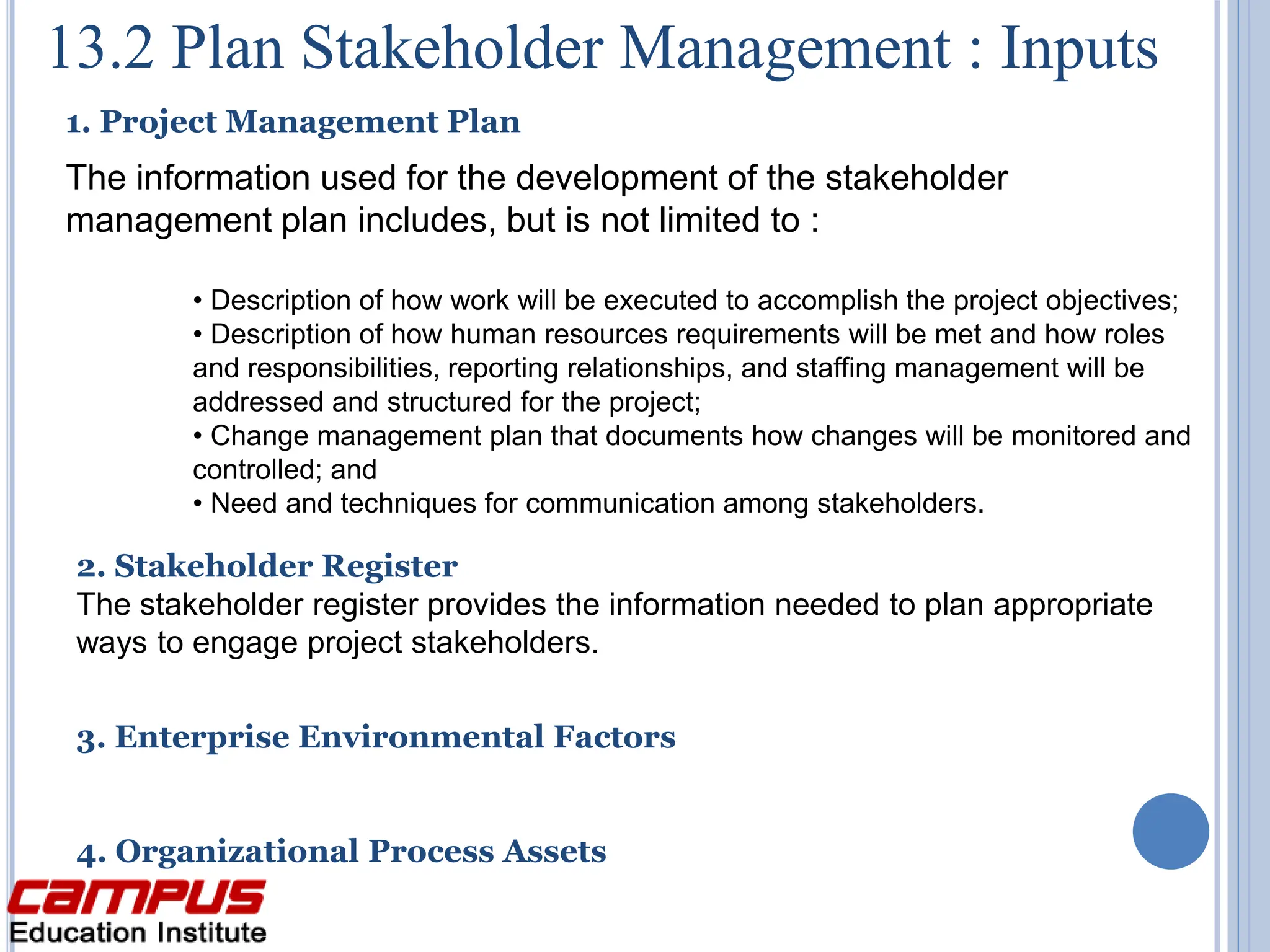
13.2 Plan Stakeholder Management
Developing appropriate management strategies to
effectively engage stakeholders throughout the
project life cycle, based on the analysis of their
needs, interests, and potential impact on project
success. The key benefit of this process is that it
provides a clear, actionable plan to interact with
project stakeholders to support the project’s interests.
13.2 Plan Stakeholder Management : Inputs
The information used for the development of the stakeholder
management plan includes, but is not limited to :
• Description of how work will be executed to accomplish the project objectives;
• Description of how human resources requirements will be met and how roles
and responsibilities, reporting relationships, and staffing management will be
addressed and structured for the project;
• Change management plan that documents how changes will be monitored and
controlled; and
• Need and techniques for communication among stakeholders.
1. Project Management Plan
2. Stakeholder Register
The stakeholder register provides the information needed to plan appropriate
ways to engage project stakeholders.
3. Enterprise Environmental Factors
4. Organizational Process Assets
13.2 Plan Stakeholder Management Tools & Techniques
1 Expert Judgment
 Senior management;
 Other units within the organization; •Identified key
stakeholders;
 Project managers who have worked on projects in the same
area (directly or through lessons learned);
 Subject matter experts (SMEs) in the business or project
area;
 Industry groups and consultants; and •Professional and
technical associations, regulatory bodies, and
nongovernmental organizations (NGOs).
2 Meetings & Analytical Techniques
Meetings should be held with experts and the
project team to define the required
engagement levels of all stakeholders.
Stakeholders Engagement Assessment
Matrix
13.2 Plan Stakeholder : Outputs
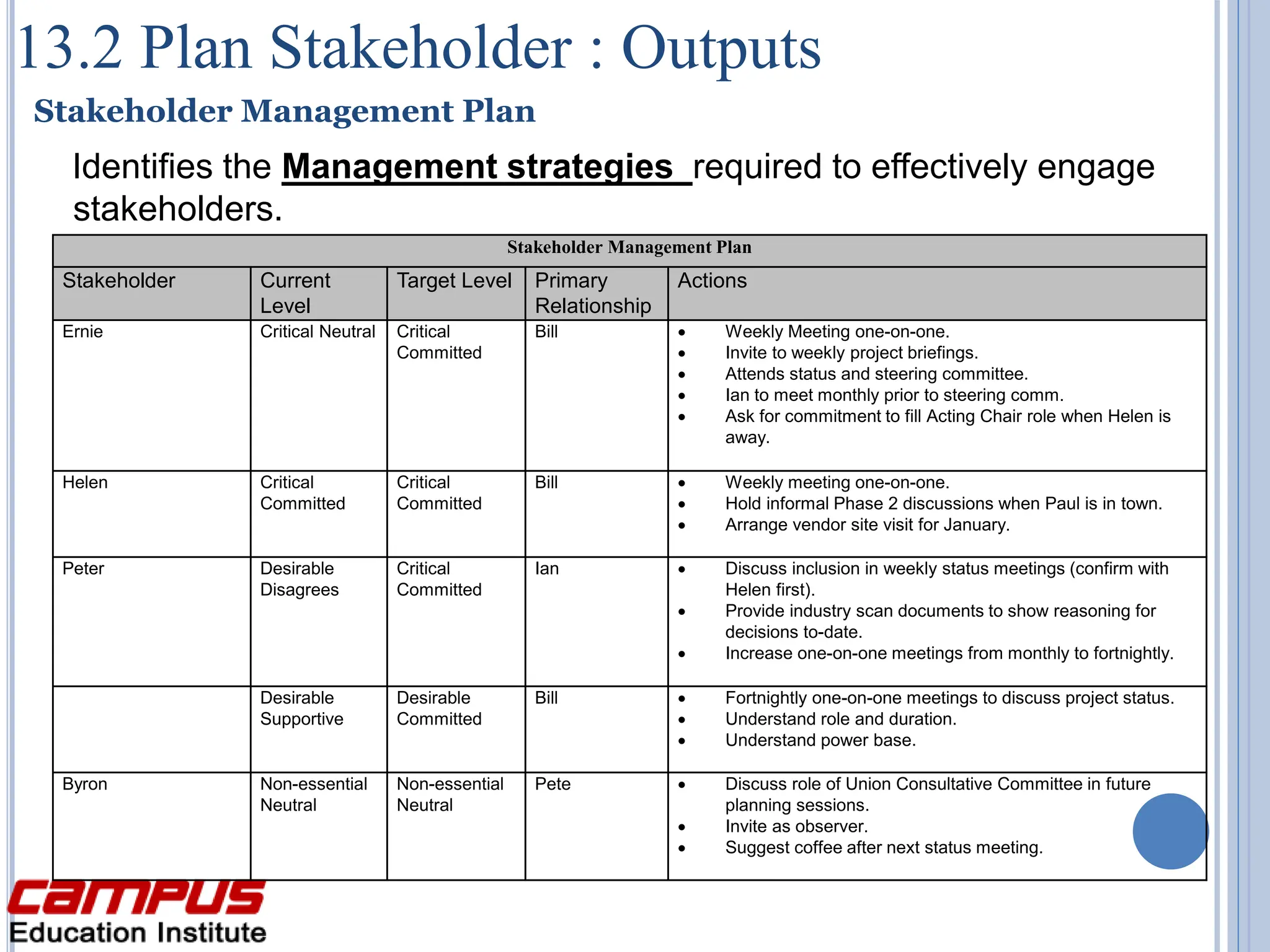
Identifies the Management strategies required to effectively engage
stakeholders.
Stakeholder Management Plan
Stakeholder Current
Level
Target Level Primary
Relationship
Actions
Ernie Critical Neutral Critical
Committed
Bill  Weekly Meeting one-on-one.
 Invite to weekly project briefings.
 Attends status and steering committee.
 Ian to meet monthly prior to steering comm.
 Ask for commitment to fill Acting Chair role when Helen is
away.
Helen Critical
Committed
Critical
Committed
Bill  Weekly meeting one-on-one.
 Hold informal Phase 2 discussions when Paul is in town.
 Arrange vendor site visit for January.
Peter Desirable
Disagrees
Critical
Committed
Ian  Discuss inclusion in weekly status meetings (confirm with
Helen first).
 Provide industry scan documents to show reasoning for
decisions to-date.
 Increase one-on-one meetings from monthly to fortnightly.
Desirable
Supportive
Desirable
Committed
Bill  Fortnightly one-on-one meetings to discuss project status.
 Understand role and duration.
 Understand power base.
Byron Non-essential
Neutral
Non-essential
Neutral
Pete  Discuss role of Union Consultative Committee in future
planning sessions.
 Invite as observer.
 Suggest coffee after next status meeting.
13.3 Manage Stakeholder Engagement
The process of communicating and working with stakeholders to
meet their needs/expectation and addressing issues as they occur and
foster appropriate stakeholder engagement in project activities
throughout the project life cycle .
Manage Stakeholder Engagement involves activities such as:
• Engaging stakeholders at appropriate project stages to obtain or confirm
their continued commitment to the success of the project;
• Managing stakeholder expectations through negotiation and
communication, ensuring project goals are achieved;
• Addressing potential concerns that have not yet become issues and
anticipating future problems that may be raised by stakeholders. Such
concerns need to be identified and discussed as soon as possible to assess
associated project risks; and
• Clarifying and resolving issues that have been identified.
13.3 Manage Stakeholder Engagement: Inputs
provides guidance on how the various stakeholders can be best involved
in the project. The stakeholder management plan describes the methods
and technologies used for stakeholder communication.
1. Stakeholder Management Plan
2. communications Management Plan
• Stakeholder communications requirements;
• Information to be communicated, including language, format, content, and
level of detail;
• Reason for distribution of information;
• Person or groups who will receive information; and
• Escalation process.
3. Enterprise Environmental Factors
4. Organizational Process Assets
The methods of communication identified for each
stakeholder in the communications management
plan are utilized during stakeholder engagement
management.
The project manager applies interpersonal skills to
manage stakeholders’ expectations. For example:
•Building trust,
•Resolving conflict,
•Active listening, and
•Overcoming resistance to change.
13.3 Manage Stakeholder Engagement Tools & Techniques
1. Communication methods
2. Interpersonal skills & Management Skills
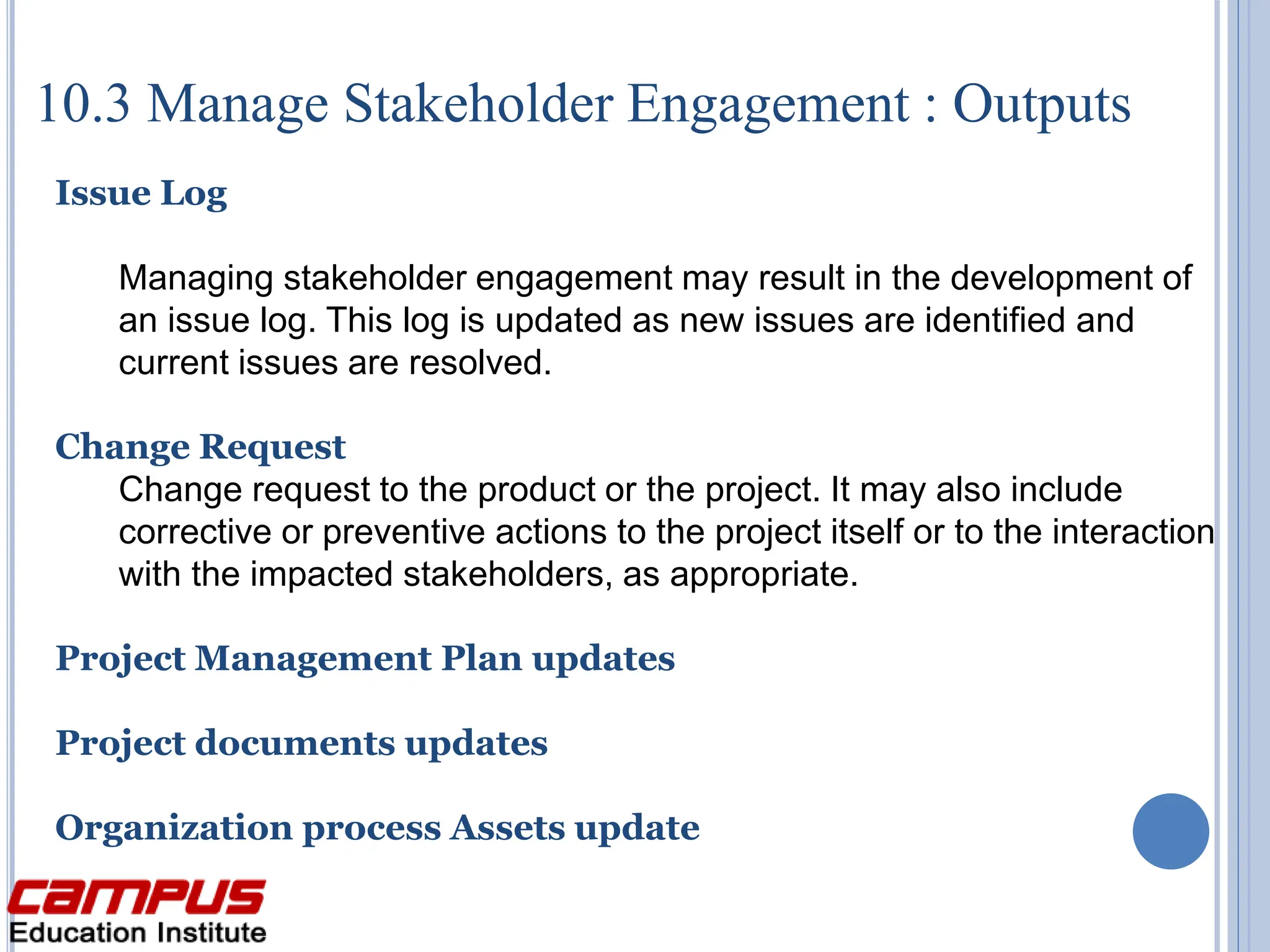
10.3 Manage Stakeholder Engagement : Outputs
Issue Log
Managing stakeholder engagement may result in the development of
an issue log. This log is updated as new issues are identified and
current issues are resolved.
Change Request
Change request to the product or the project. It may also include
corrective or preventive actions to the project itself or to the interaction
with the impacted stakeholders, as appropriate.
Project Management Plan updates
Project documents updates
Organization process Assets update
13.4 Control Stakeholder Engagement
The process monitoring overall project stakeholder relationships and
adjusting strategies and plans for engaging stakeholders .
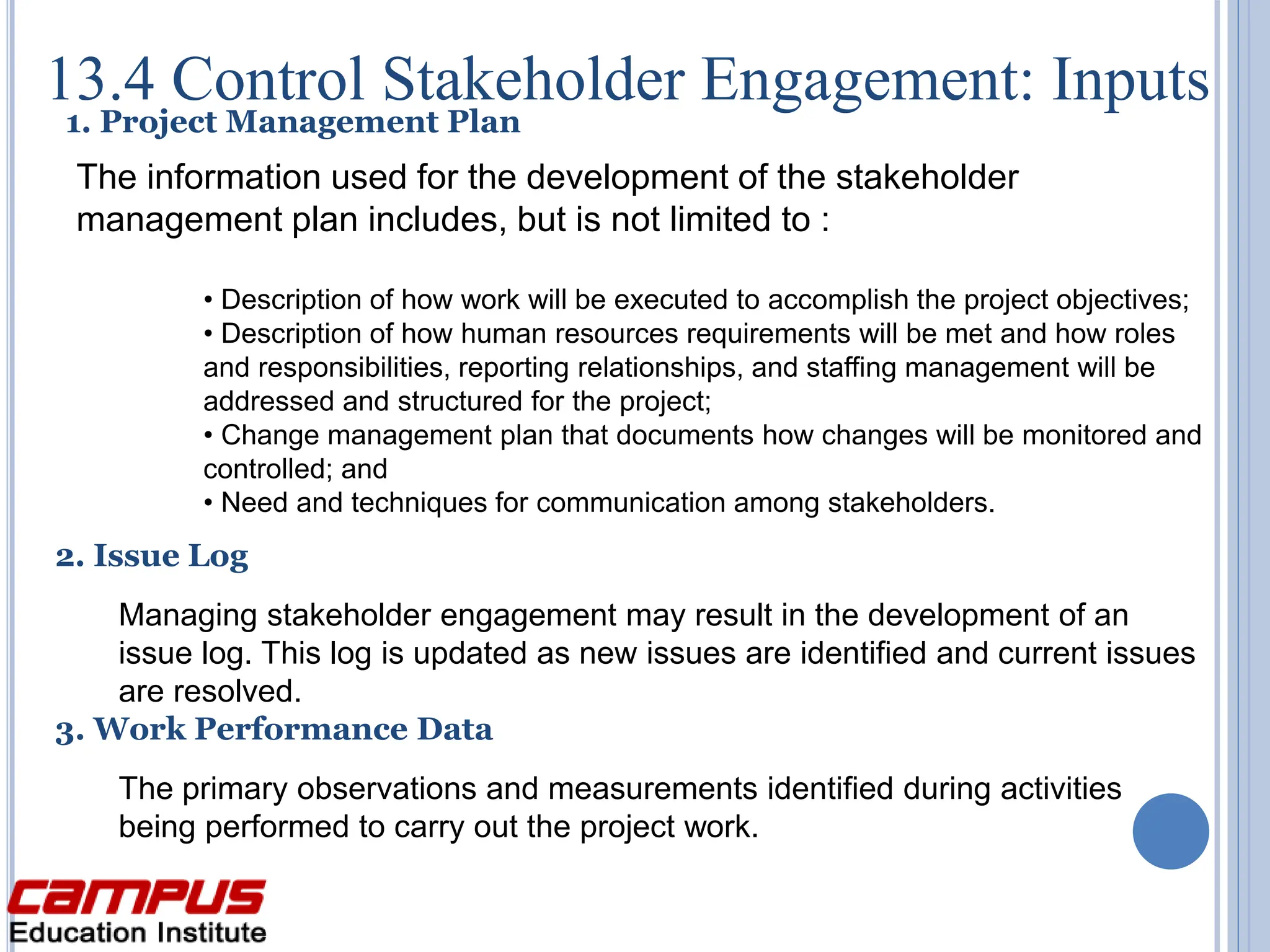
13.4 Control Stakeholder Engagement: Inputs
2. Issue Log
Managing stakeholder engagement may result in the development of an
issue log. This log is updated as new issues are identified and current issues
are resolved.
3. Work Performance Data
The primary observations and measurements identified during activities
being performed to carry out the project work.
The information used for the development of the stakeholder
management plan includes, but is not limited to :
• Description of how work will be executed to accomplish the project objectives;
• Description of how human resources requirements will be met and how roles
and responsibilities, reporting relationships, and staffing management will be
addressed and structured for the project;
• Change management plan that documents how changes will be monitored and
controlled; and
• Need and techniques for communication among stakeholders.
1. Project Management Plan
Standard tool for the project manager to
capture, store, and distribute information to
stakeholders about the project cost, schedule
progress, and performance.
13.4 Control Stakeholder Engagement Tools & Techniques
1. Information Management Systems
2 Expert Judgment
 Senior management;
 Other units within the organization; •Identified key
stakeholders;
 Project managers who have worked on projects in the same
area (directly or through lessons learned);
 Subject matter experts (SMEs) in the business or project
area;
 Industry groups and consultants; and •Professional and
technical associations, regulatory bodies, and
nongovernmental organizations (NGOs).
10.4 Control Stakeholder Engagement : Outputs
Work Performance Information
the performance data collected from various controlling processes,
analyzed in context, and integrated based on relationships across
areas. Thus work performance data have been transformed into work
performance information.
Change Request
• Recommended corrective actions include changes that bring the expected future
performance of the project in line with the project management plan
• Recommended preventive actions can reduce the probability of incurring future
negative project performance.
Project Management Plan updates
Project documents updates
Organization process Assets update
THANK YOU

10. PMP Project Stakeholder Management.ppt

  • 1.
    PROJECT STAKEHOLDER MANAGEMENT “Stakeholdermanagement is critical to the success of every project in every organization . By engaging the right people in the right way in your project, you can make a big difference to its success. ”
  • 2.
    13.1 Identify Stakeholders Thepeople, groups, or organizations that could impact or be impacted by a decision, activity, or outcome of the project; and analyzing and documenting relevant information regarding their interests, involvement, interdependencies, influence, and potential impact on project success. 13.2 Plan Stakeholder Management Developing appropriate management strategies to effectively engage stakeholders throughout the project life cycle, based on the analysis of their needs, interests, and potential impact on project success. 13.3 Manage Stakeholder Engagement Communicating and working with stakeholders to meet their needs/expectations, address issues as they occur, and foster appropriate stakeholder engagement in project activities throughout the project life cycle. 13.4 control Stakeholder Engagement Monitoring overall project stakeholder relationships and adjusting strategies and plans for engaging stakeholders. Stakeholder Management Includes the processes required to identify the people, groups, or organizations that could impact or be impacted by the project, to analyze stakeholder expectations and their impact on the project, and to develop appropriate management strategies for effectively engaging stakeholders in project decisions and execution.
  • 3.
    3 Project Project Management ProcessGroup Initiating Planning Executing Monitoring & Controlling Closing Knowledge Area Integration Develop Project Charter Develop Project Management Plan Direct & Manage Project Execution Monitor & Control Project Work Close Project or Phase Perform Integrated Change Control Scope Plan Scope Validate Scope Collect Requirements Define Scope Control Scope Create WBS Time Plan Schedule Control Schedule Define Activities Sequence Activities Estimate Activity Resource Estimate Activity Duration Develop Schedule Cost Plan Cost Control Costs Estimate Costs Determine Budget Quality Plan Quality Perform Quality Assurance Perform quality control HR Develop HR Plan Acquire Project Team Develop Project Team Manage Project Team Communication. Plan Communications Manage Communications Control Communication Risk Plan Risk Management Monitor & Control Risks Identify Risks Perform Qualitative Analysis Perform Quantitative Analysis Plan Risk Responses Procurement Plan Procurements Conduct Procurements Administer Procurements Close Procurements Stakeholder Identify Stakeholders Plan Stakeholder Manage Stakeholder Engagement Control Stakeholder Engagement
  • 4.
    13.1 Identify Stakeholders •Process of identifying all people or organizations impacted by the project, and documenting relevant information regarding their interests, involvement, and impact on project success. • Stakeholders are persons and organizations such as customers, sponsors, the performing organization. • It is critical for project success to identify the stakeholders early in the project, and to analyze their levels of interest, expectations, importance and influence. • As the project manager’s time is limited and must be used as efficiently as possible, these stakeholders should be classified according to their interest, influence, and involvement in the project.
  • 5.
    13.1 Identify Stakeholders:Inputs • Project Charter : Information about internal and external parties related with the project and affected by the result or the execution of the project • Procurement Documents : If a project is the result of a procurement activity or is based on an established contract, the parties in that contract are key project stakeholders. • Enterprise Environmental Factors • Organizational Process Assets
  • 6.
    13.1 Identify StakeholdersTools & Techniques Step 1 Identify : Identify all potential project stakeholders and relevant information, such as their roles, departments, interests, knowledge levels, expectations. Step 2 Analyze : Identify the potential impact or support each stakeholder could generate, and classify them so as to define an approach strategy. Step 3 Assess : Assess how key stakeholders are likely to react or respond in various situations. 1. Stakeholder Analysis Stakeholder analysis is a technique of systematically gathering and analyzing quantitative and qualitative information to determine whose interests should be taken into account throughout the project. Stakeholder analysis generally follows the steps described below:
  • 7.
    13.1 Identify StakeholdersTools & Techniques 1. Stakeholder Analysis Example Power/Interest grid with Stakeholders  High power, interested people: these are the people you must fully engage with, and make the greatest efforts to satisfy.  High power, less interested people: put enough work in with these people to keep them satisfied, but not so much that they become bored with your message.  Low power, interested people: keep these people adequately informed, and talk to them to ensure that no major issues are arising. These people can often be very helpful with the detail of your project.  Low power, less interested people: again, monitor these people, but do not bore them with excessive communication.
  • 8.
    13.1 Identify StakeholdersTools & Techniques 2 Expert Judgment  Senior management;  Other units within the organization; •Identified key stakeholders;  Project managers who have worked on projects in the same area (directly or through lessons learned);  Subject matter experts (SMEs) in the business or project area;  Industry groups and consultants; and •Professional and technical associations, regulatory bodies, and nongovernmental organizations (NGOs). 3 Meetings Profile analysis meetings are project meetings designed to develop an understanding of major project stakeholders, and they can be used to exchange and analyze information about roles, interests, knowledge, and the overall position of each stakeholder facing the project.
  • 9.
    13.1 Identify Stakeholders:Outputs • Identification information: Name, organizational position, location, role in the project, contact information; • Assessment information: Major requirements, main expectations, potential influence in the project, phase in the life cycle with the most interest; and • Stakeholder classification: Internal/external, supporter/neutral/resistor, etc. Stakeholder Register
  • 10.
    13.2 Plan StakeholderManagement Developing appropriate management strategies to effectively engage stakeholders throughout the project life cycle, based on the analysis of their needs, interests, and potential impact on project success. The key benefit of this process is that it provides a clear, actionable plan to interact with project stakeholders to support the project’s interests.
  • 11.
    13.2 Plan StakeholderManagement : Inputs The information used for the development of the stakeholder management plan includes, but is not limited to : • Description of how work will be executed to accomplish the project objectives; • Description of how human resources requirements will be met and how roles and responsibilities, reporting relationships, and staffing management will be addressed and structured for the project; • Change management plan that documents how changes will be monitored and controlled; and • Need and techniques for communication among stakeholders. 1. Project Management Plan 2. Stakeholder Register The stakeholder register provides the information needed to plan appropriate ways to engage project stakeholders. 3. Enterprise Environmental Factors 4. Organizational Process Assets
  • 12.
    13.2 Plan StakeholderManagement Tools & Techniques 1 Expert Judgment  Senior management;  Other units within the organization; •Identified key stakeholders;  Project managers who have worked on projects in the same area (directly or through lessons learned);  Subject matter experts (SMEs) in the business or project area;  Industry groups and consultants; and •Professional and technical associations, regulatory bodies, and nongovernmental organizations (NGOs). 2 Meetings & Analytical Techniques Meetings should be held with experts and the project team to define the required engagement levels of all stakeholders. Stakeholders Engagement Assessment Matrix
  • 13.
    13.2 Plan Stakeholder: Outputs Identifies the Management strategies required to effectively engage stakeholders. Stakeholder Management Plan Stakeholder Management Plan Stakeholder Current Level Target Level Primary Relationship Actions Ernie Critical Neutral Critical Committed Bill  Weekly Meeting one-on-one.  Invite to weekly project briefings.  Attends status and steering committee.  Ian to meet monthly prior to steering comm.  Ask for commitment to fill Acting Chair role when Helen is away. Helen Critical Committed Critical Committed Bill  Weekly meeting one-on-one.  Hold informal Phase 2 discussions when Paul is in town.  Arrange vendor site visit for January. Peter Desirable Disagrees Critical Committed Ian  Discuss inclusion in weekly status meetings (confirm with Helen first).  Provide industry scan documents to show reasoning for decisions to-date.  Increase one-on-one meetings from monthly to fortnightly. Desirable Supportive Desirable Committed Bill  Fortnightly one-on-one meetings to discuss project status.  Understand role and duration.  Understand power base. Byron Non-essential Neutral Non-essential Neutral Pete  Discuss role of Union Consultative Committee in future planning sessions.  Invite as observer.  Suggest coffee after next status meeting.
  • 14.
    13.3 Manage StakeholderEngagement The process of communicating and working with stakeholders to meet their needs/expectation and addressing issues as they occur and foster appropriate stakeholder engagement in project activities throughout the project life cycle . Manage Stakeholder Engagement involves activities such as: • Engaging stakeholders at appropriate project stages to obtain or confirm their continued commitment to the success of the project; • Managing stakeholder expectations through negotiation and communication, ensuring project goals are achieved; • Addressing potential concerns that have not yet become issues and anticipating future problems that may be raised by stakeholders. Such concerns need to be identified and discussed as soon as possible to assess associated project risks; and • Clarifying and resolving issues that have been identified.
  • 15.
    13.3 Manage StakeholderEngagement: Inputs provides guidance on how the various stakeholders can be best involved in the project. The stakeholder management plan describes the methods and technologies used for stakeholder communication. 1. Stakeholder Management Plan 2. communications Management Plan • Stakeholder communications requirements; • Information to be communicated, including language, format, content, and level of detail; • Reason for distribution of information; • Person or groups who will receive information; and • Escalation process. 3. Enterprise Environmental Factors 4. Organizational Process Assets
  • 16.
    The methods ofcommunication identified for each stakeholder in the communications management plan are utilized during stakeholder engagement management. The project manager applies interpersonal skills to manage stakeholders’ expectations. For example: •Building trust, •Resolving conflict, •Active listening, and •Overcoming resistance to change. 13.3 Manage Stakeholder Engagement Tools & Techniques 1. Communication methods 2. Interpersonal skills & Management Skills
  • 17.
    10.3 Manage StakeholderEngagement : Outputs Issue Log Managing stakeholder engagement may result in the development of an issue log. This log is updated as new issues are identified and current issues are resolved. Change Request Change request to the product or the project. It may also include corrective or preventive actions to the project itself or to the interaction with the impacted stakeholders, as appropriate. Project Management Plan updates Project documents updates Organization process Assets update
  • 18.
    13.4 Control StakeholderEngagement The process monitoring overall project stakeholder relationships and adjusting strategies and plans for engaging stakeholders .
  • 19.
    13.4 Control StakeholderEngagement: Inputs 2. Issue Log Managing stakeholder engagement may result in the development of an issue log. This log is updated as new issues are identified and current issues are resolved. 3. Work Performance Data The primary observations and measurements identified during activities being performed to carry out the project work. The information used for the development of the stakeholder management plan includes, but is not limited to : • Description of how work will be executed to accomplish the project objectives; • Description of how human resources requirements will be met and how roles and responsibilities, reporting relationships, and staffing management will be addressed and structured for the project; • Change management plan that documents how changes will be monitored and controlled; and • Need and techniques for communication among stakeholders. 1. Project Management Plan
  • 20.
    Standard tool forthe project manager to capture, store, and distribute information to stakeholders about the project cost, schedule progress, and performance. 13.4 Control Stakeholder Engagement Tools & Techniques 1. Information Management Systems 2 Expert Judgment  Senior management;  Other units within the organization; •Identified key stakeholders;  Project managers who have worked on projects in the same area (directly or through lessons learned);  Subject matter experts (SMEs) in the business or project area;  Industry groups and consultants; and •Professional and technical associations, regulatory bodies, and nongovernmental organizations (NGOs).
  • 21.
    10.4 Control StakeholderEngagement : Outputs Work Performance Information the performance data collected from various controlling processes, analyzed in context, and integrated based on relationships across areas. Thus work performance data have been transformed into work performance information. Change Request • Recommended corrective actions include changes that bring the expected future performance of the project in line with the project management plan • Recommended preventive actions can reduce the probability of incurring future negative project performance. Project Management Plan updates Project documents updates Organization process Assets update
  • 22.