Project Scope &
Product Requirements Management


Sarath Sasikumar PMP, CBAP
Mahindra Satyam


                      Project Management Institute (PMI®) - A Guide to the Project Management Body of Knowledge (PMBOK® Guide)    1
                      International Institute of Business Analysis (IIBA®) - Business Analysis Body of Knowledge (BABOK® Guide)
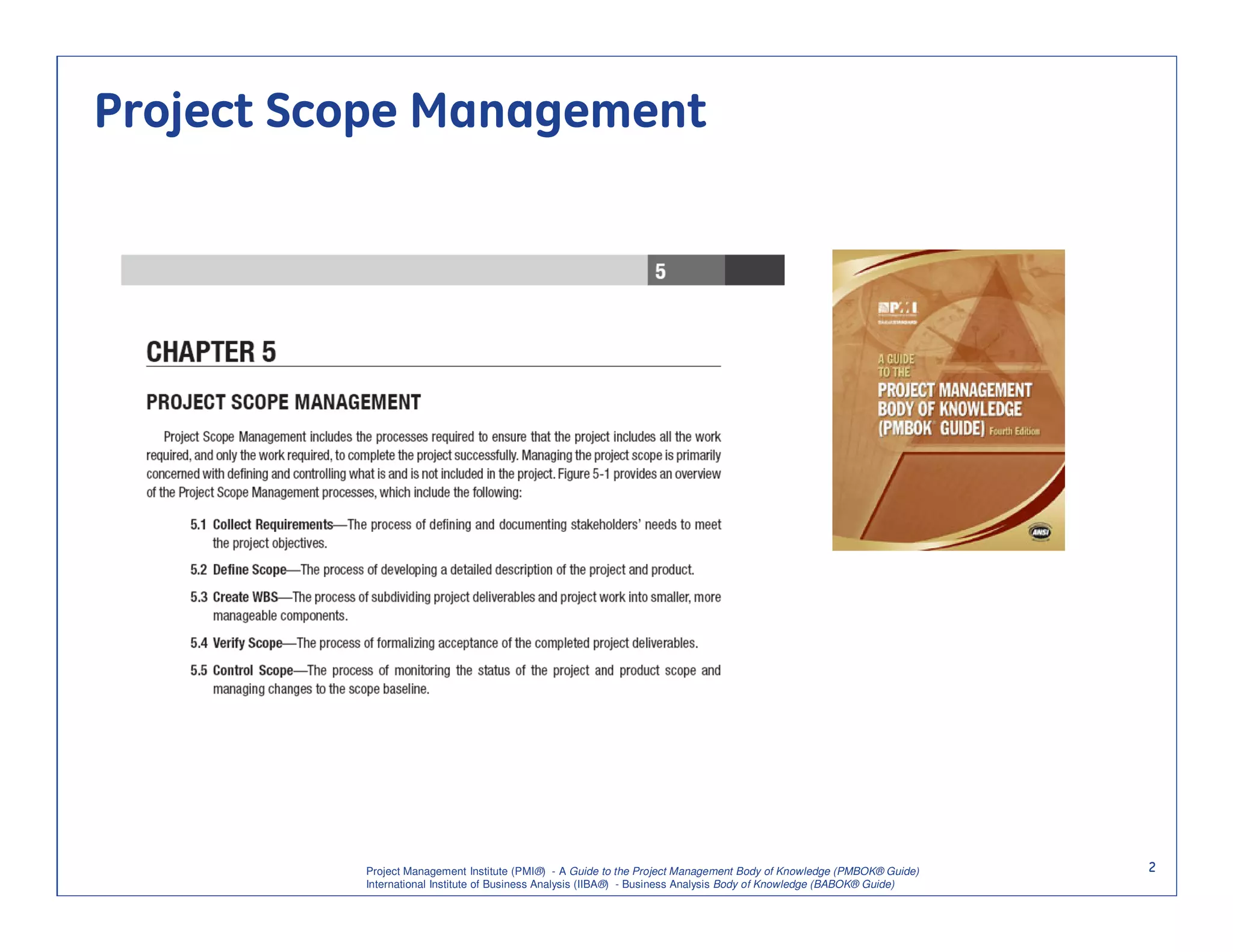
Project Scope Management


          Project Management Institute (PMI®) - A Guide to the Project Management Body of Knowledge (PMBOK® Guide)    2
          International Institute of Business Analysis (IIBA®) - Business Analysis Body of Knowledge (BABOK® Guide)
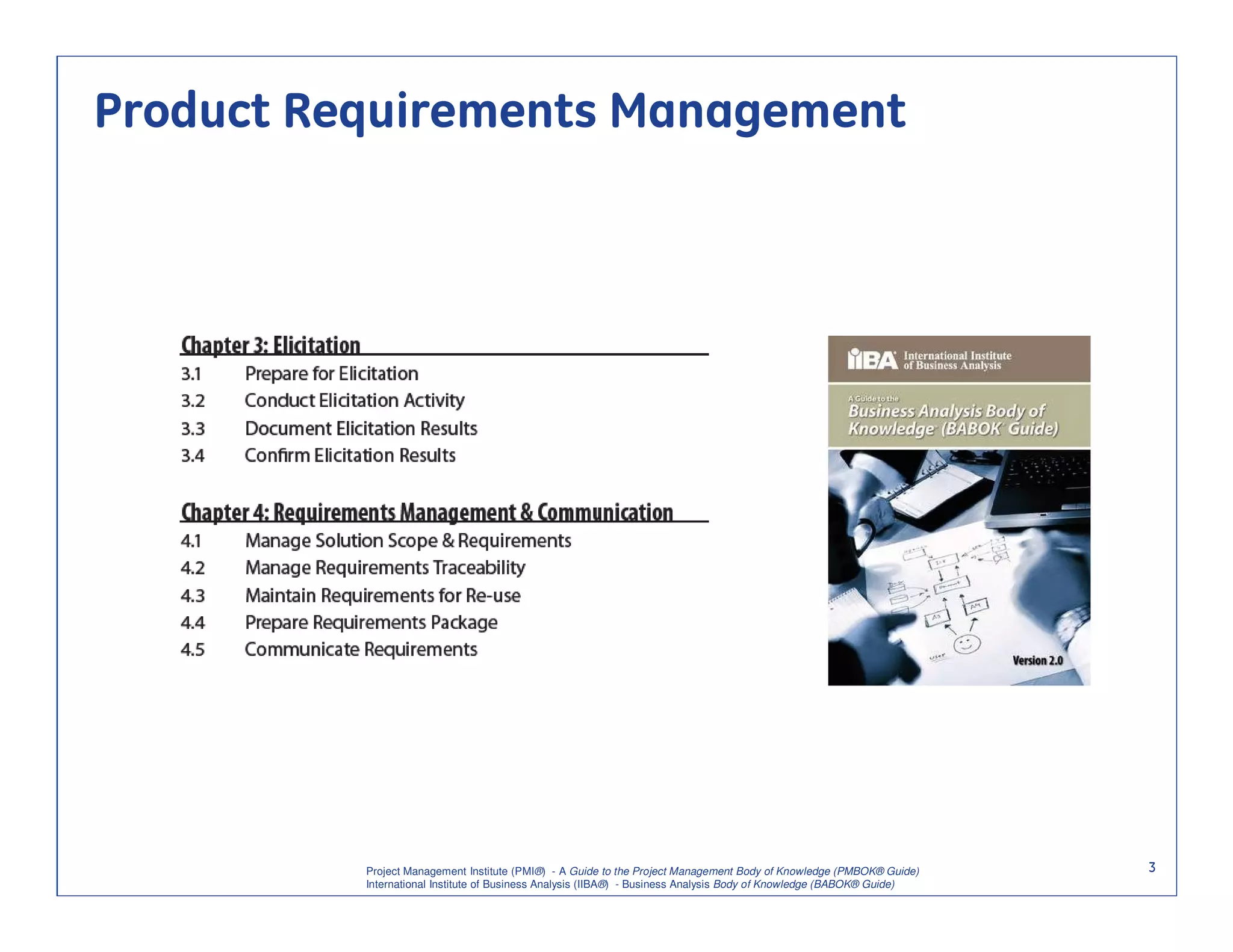
Product Requirements Management


          Project Management Institute (PMI®) - A Guide to the Project Management Body of Knowledge (PMBOK® Guide)    3
          International Institute of Business Analysis (IIBA®) - Business Analysis Body of Knowledge (BABOK® Guide)
Scope Management

• Managing the project scope is primarily concerned
  with defining and controlling what is and is not
  included in the project. PMI


• Project Scope Management includes the processes
  required to ensure that the project includes all the
  work required, and only the work required, to
  complete the project successfully. PMI


              Project Management Institute (PMI®) - A Guide to the Project Management Body of Knowledge (PMBOK® Guide)    4
              International Institute of Business Analysis (IIBA®) - Business Analysis Body of Knowledge (BABOK® Guide)
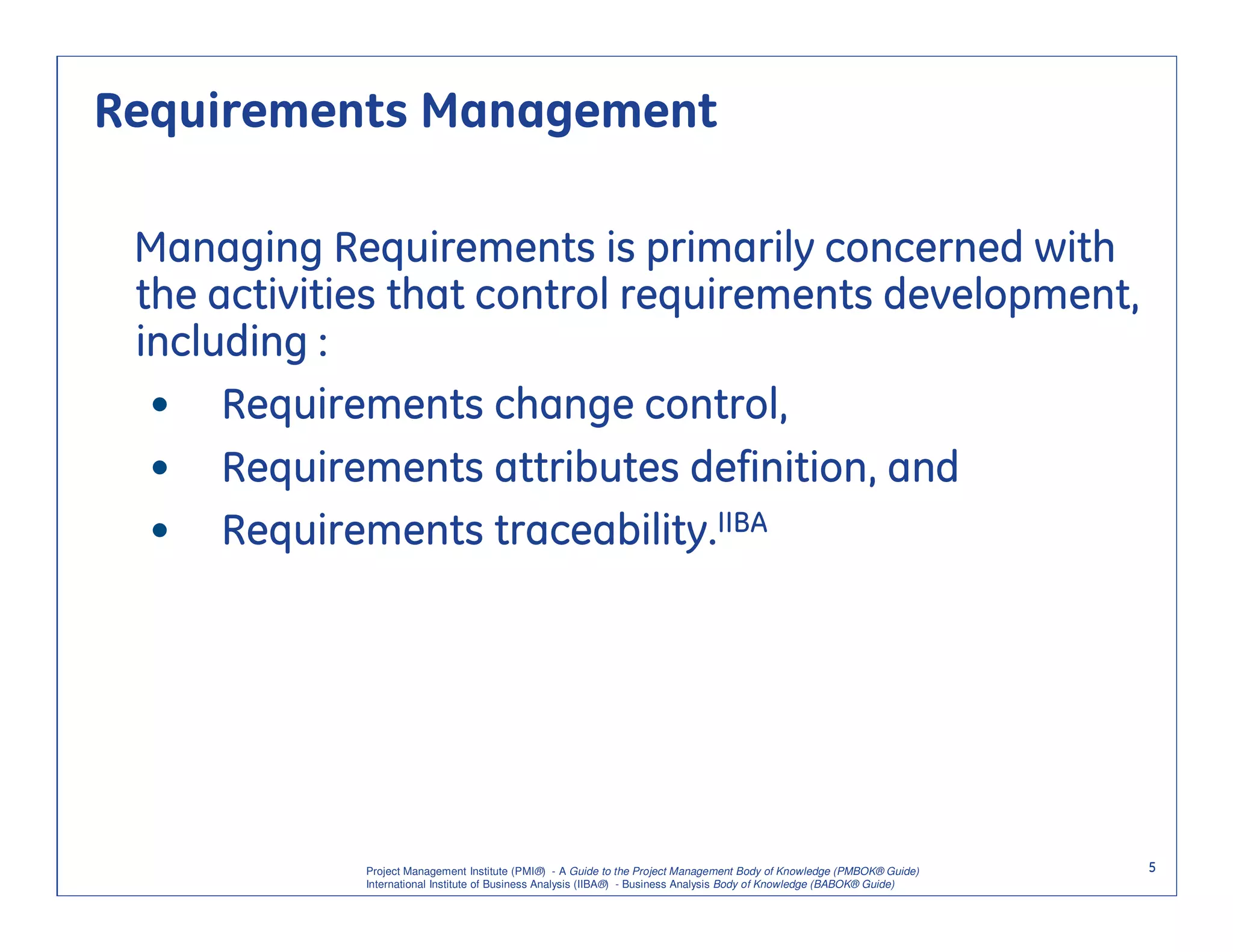
Requirements Management

 Managing Requirements is primarily concerned with
 the activities that control requirements development,
 including :
  • Requirements change control,
  • Requirements attributes definition, and
  • Requirements traceability.IIBA


             Project Management Institute (PMI®) - A Guide to the Project Management Body of Knowledge (PMBOK® Guide)    5
             International Institute of Business Analysis (IIBA®) - Business Analysis Body of Knowledge (BABOK® Guide)
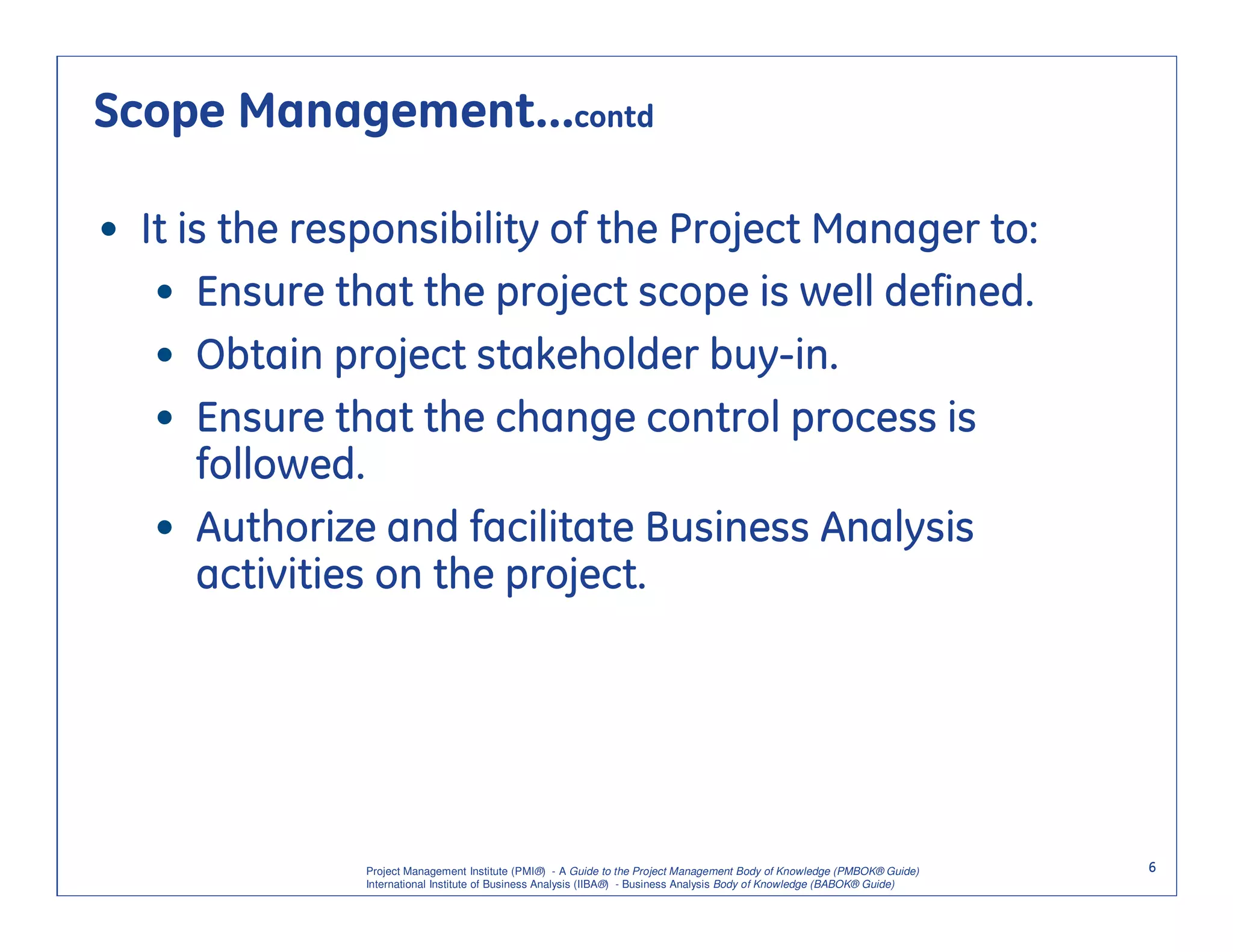
Scope Management…contd

• It is the responsibility of the Project Manager to:
   • Ensure that the project scope is well defined.
   • Obtain project stakeholder buy-in.
   • Ensure that the change control process is
      followed.
   • Authorize and facilitate Business Analysis
      activities on the project.


               Project Management Institute (PMI®) - A Guide to the Project Management Body of Knowledge (PMBOK® Guide)    6
               International Institute of Business Analysis (IIBA®) - Business Analysis Body of Knowledge (BABOK® Guide)
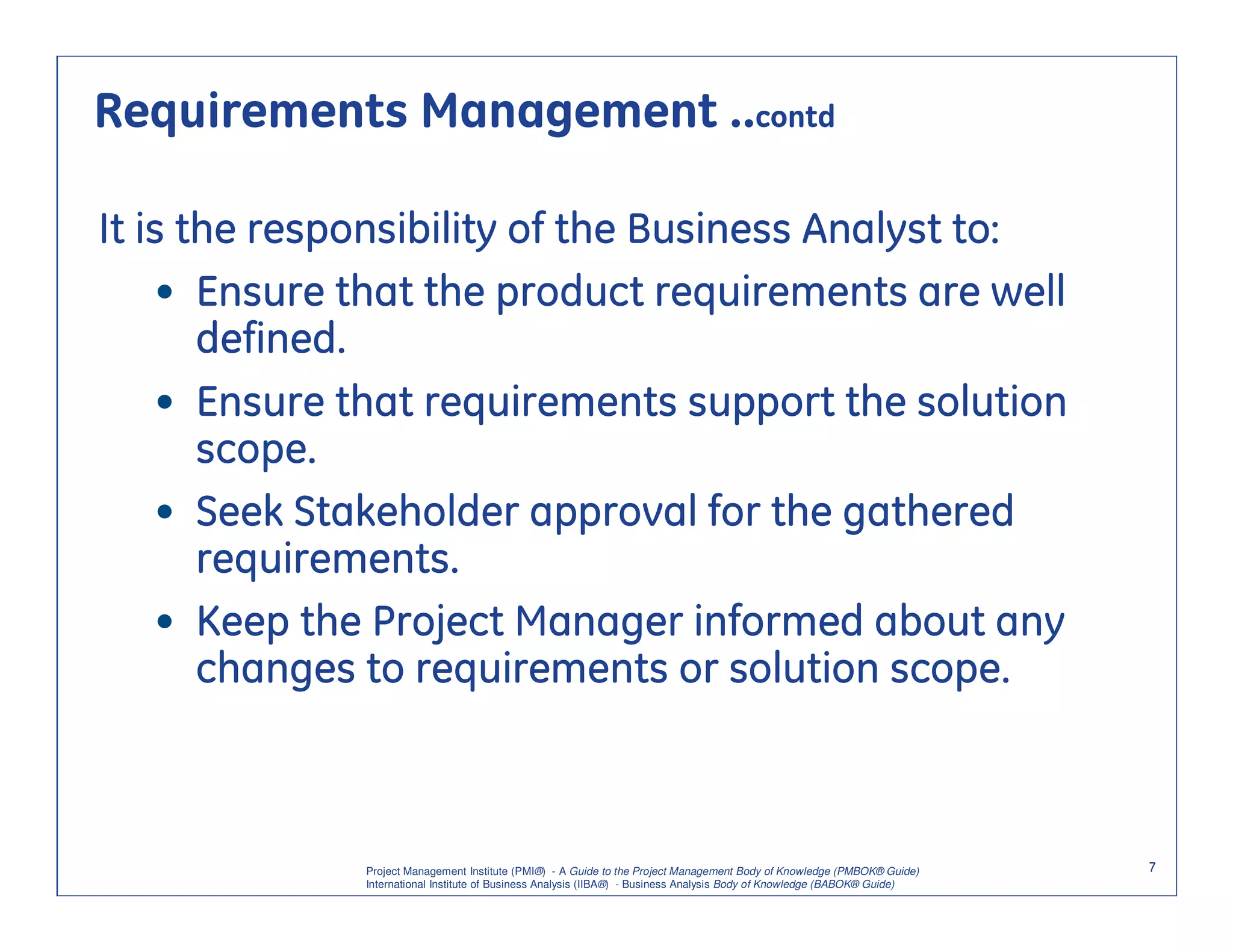
Requirements Management ..contd

It is the responsibility of the Business Analyst to:
    • Ensure that the product requirements are well
       defined.
    • Ensure that requirements support the solution
       scope.
    • Seek Stakeholder approval for the gathered
       requirements.
    • Keep the Project Manager informed about any
       changes to requirements or solution scope.


              Project Management Institute (PMI®) - A Guide to the Project Management Body of Knowledge (PMBOK® Guide)    7
              International Institute of Business Analysis (IIBA®) - Business Analysis Body of Knowledge (BABOK® Guide)
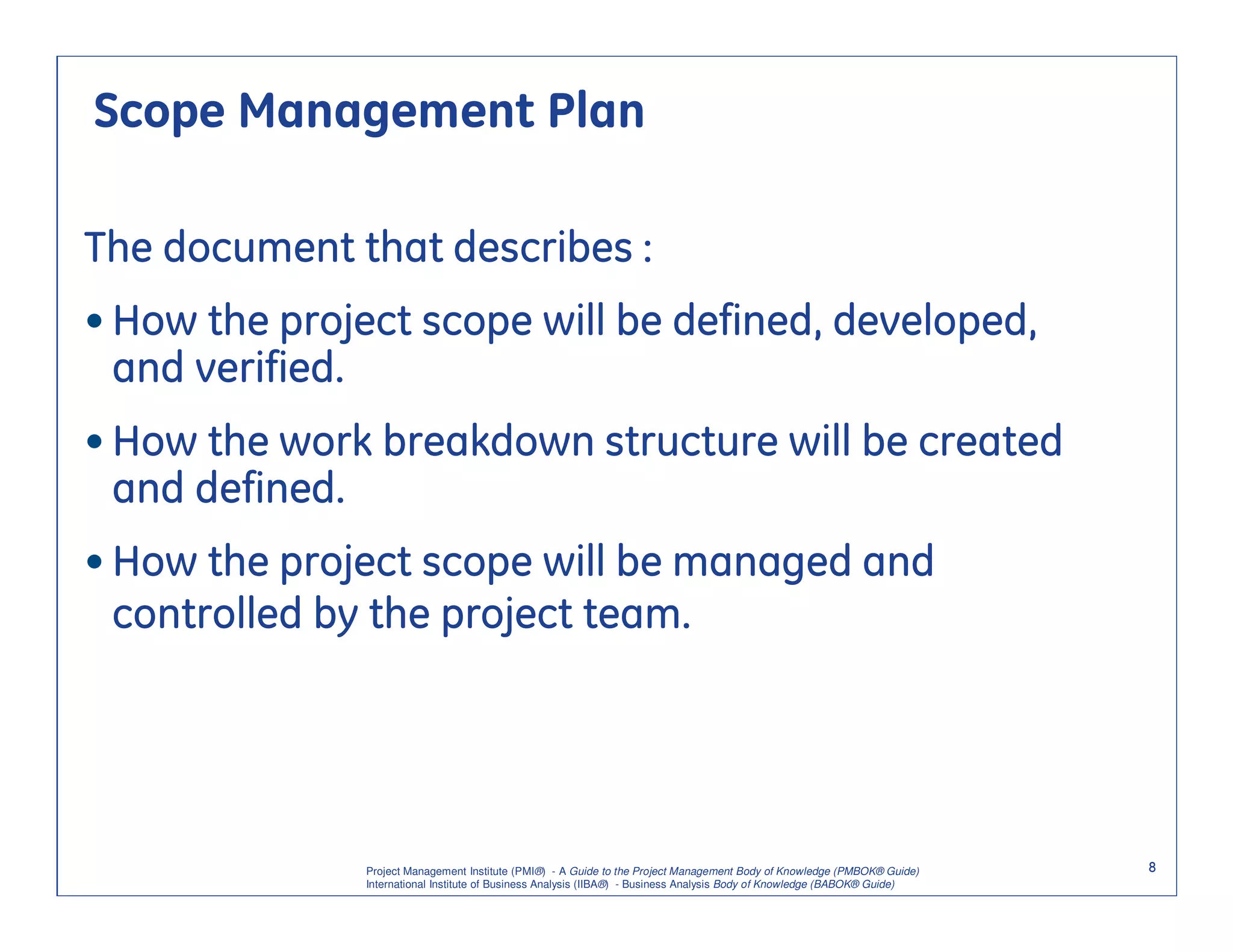
Scope Management Plan

The document that describes :
• How the project scope will be defined, developed,
  and verified.
• How the work breakdown structure will be created
  and defined.
• How the project scope will be managed and
  controlled by the project team.


               Project Management Institute (PMI®) - A Guide to the Project Management Body of Knowledge (PMBOK® Guide)    8
               International Institute of Business Analysis (IIBA®) - Business Analysis Body of Knowledge (BABOK® Guide)
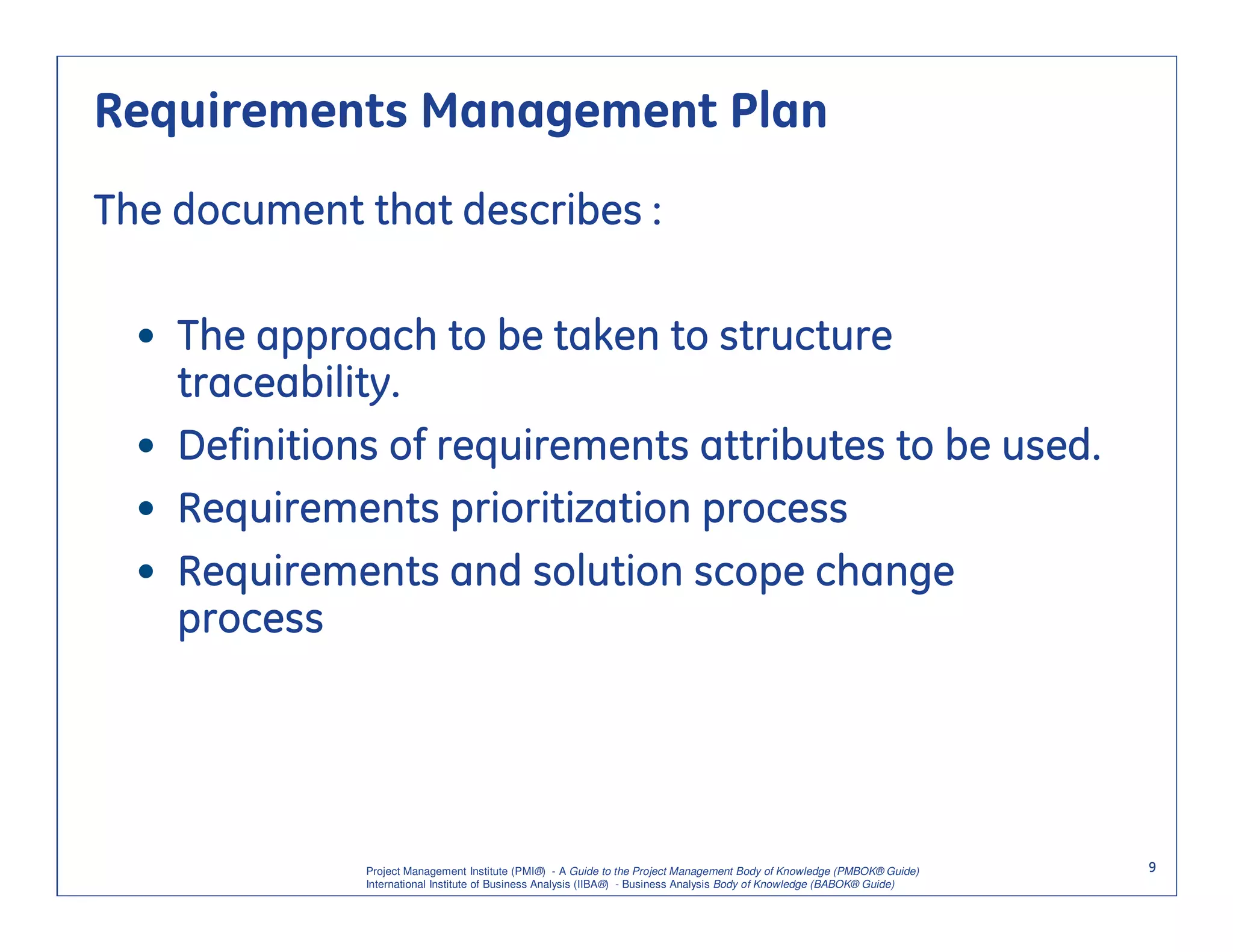
Requirements Management Plan
The document that describes :

  • The approach to be taken to structure
    traceability.
  • Definitions of requirements attributes to be used.
  • Requirements prioritization process
  • Requirements and solution scope change
    process


              Project Management Institute (PMI®) - A Guide to the Project Management Body of Knowledge (PMBOK® Guide)    9
              International Institute of Business Analysis (IIBA®) - Business Analysis Body of Knowledge (BABOK® Guide)
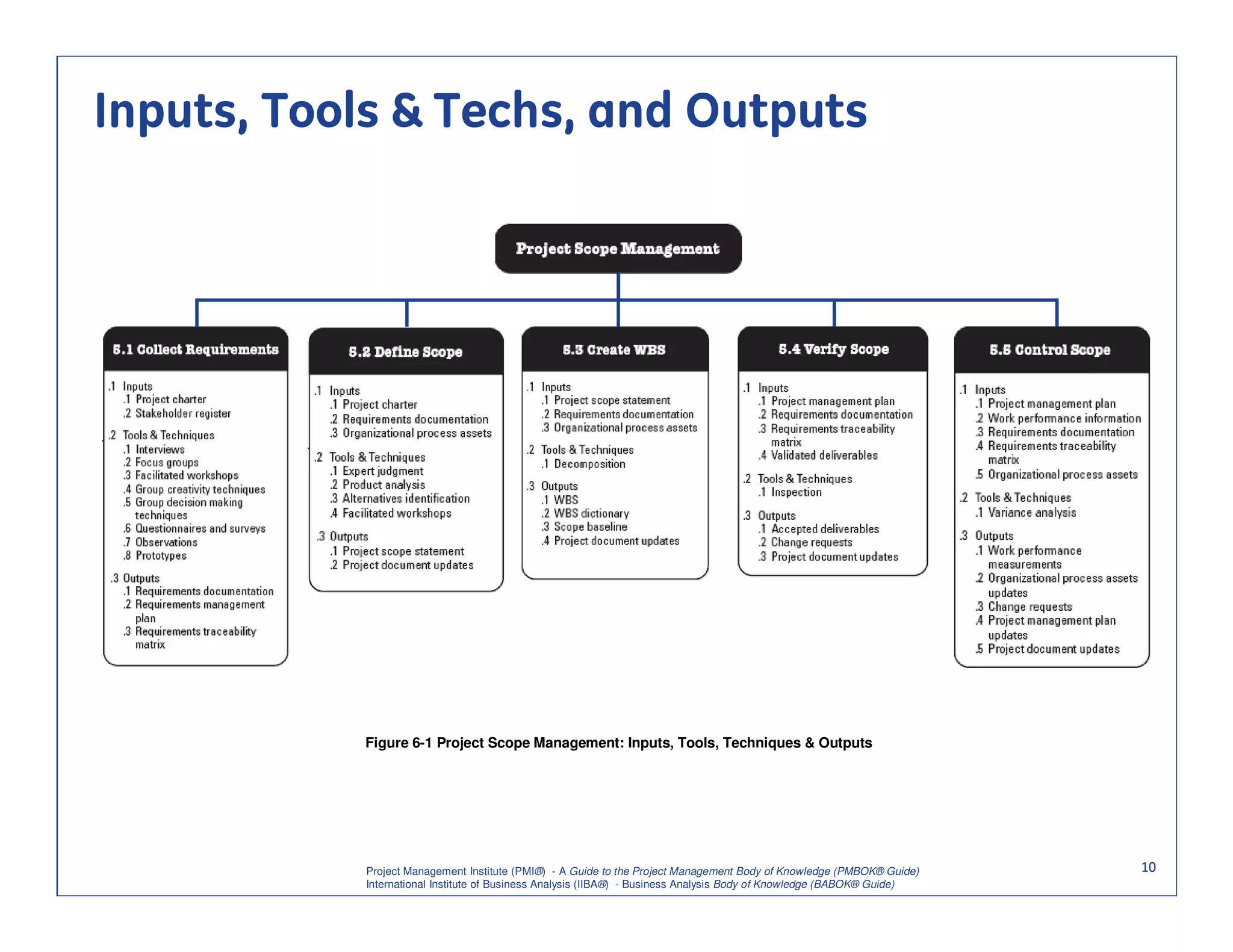
Inputs, Tools & Techs, and Outputs


           Figure 6-1 Project Scope Management: Inputs, Tools, Techniques & Outputs


           Project Management Institute (PMI®) - A Guide to the Project Management Body of Knowledge (PMBOK® Guide)    10
           International Institute of Business Analysis (IIBA®) - Business Analysis Body of Knowledge (BABOK® Guide)
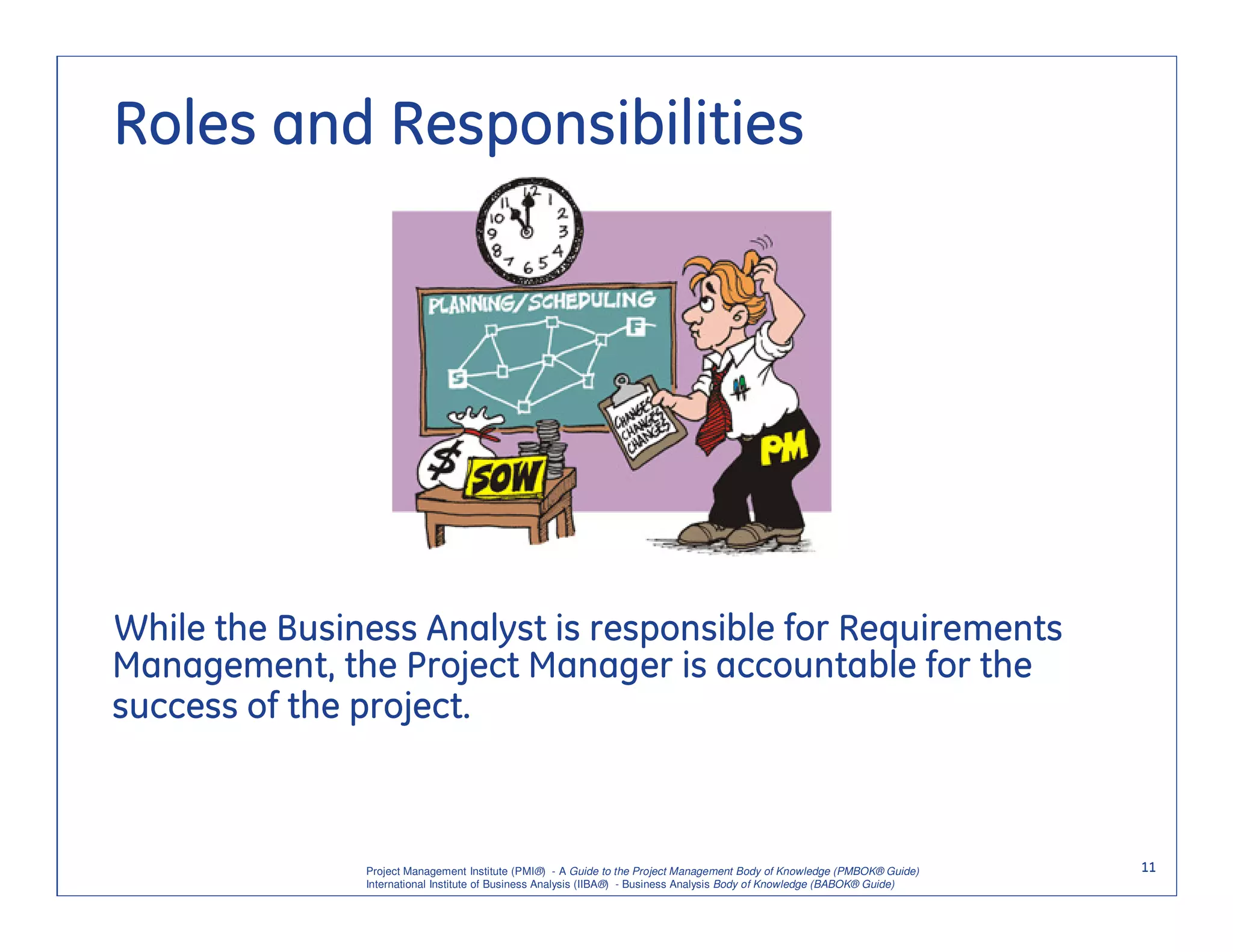
Roles and Responsibilities


While the Business Analyst is responsible for Requirements
Management, the Project Manager is accountable for the
success of the project.


               Project Management Institute (PMI®) - A Guide to the Project Management Body of Knowledge (PMBOK® Guide)    11
               International Institute of Business Analysis (IIBA®) - Business Analysis Body of Knowledge (BABOK® Guide)
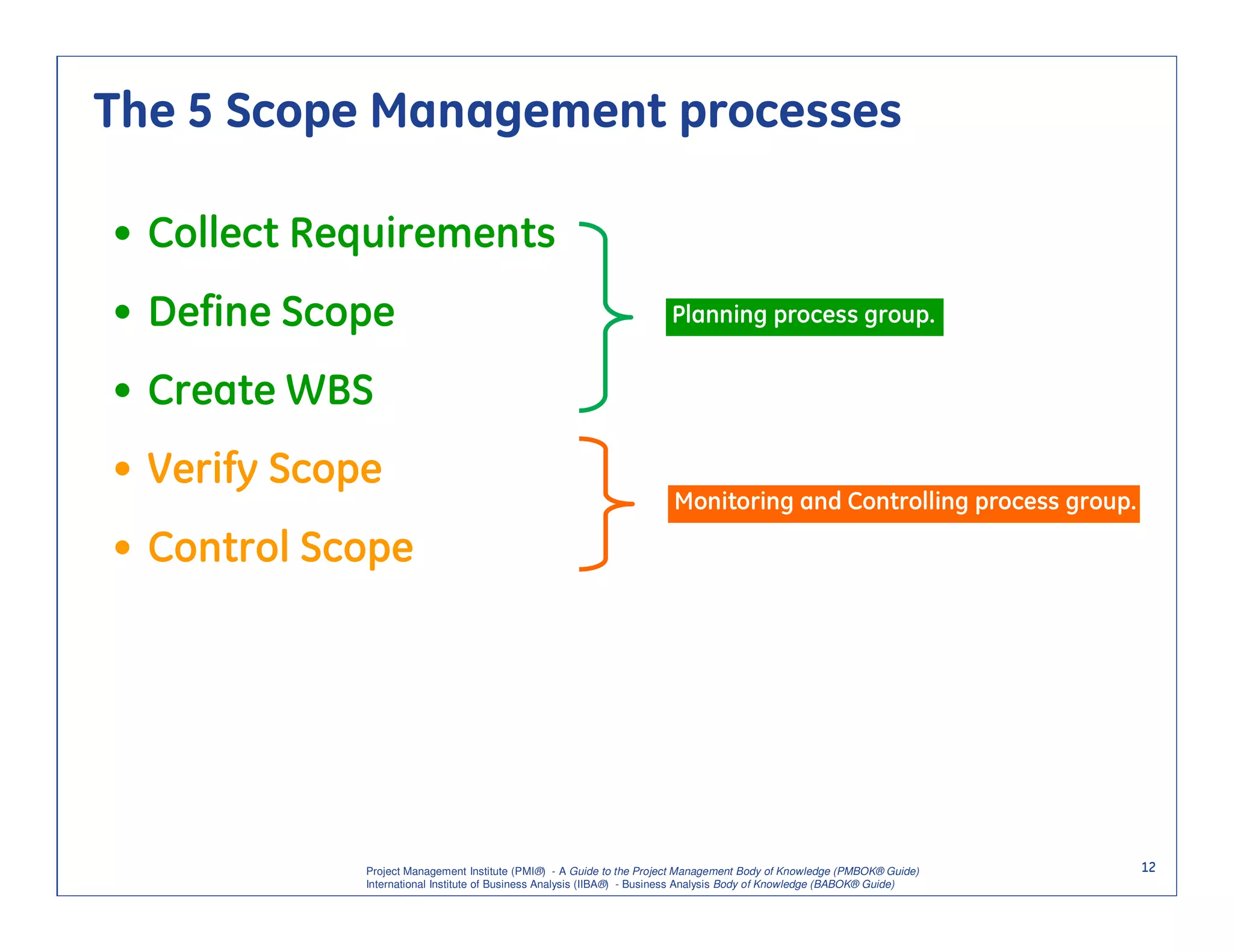
The 5 Scope Management processes

• Collect Requirements
• Define Scope                                                         Planning process group.


• Create WBS
• Verify Scope
                                                                       Monitoring and Controlling process group.

• Control Scope


             Project Management Institute (PMI®) - A Guide to the Project Management Body of Knowledge (PMBOK® Guide)    12
             International Institute of Business Analysis (IIBA®) - Business Analysis Body of Knowledge (BABOK® Guide)
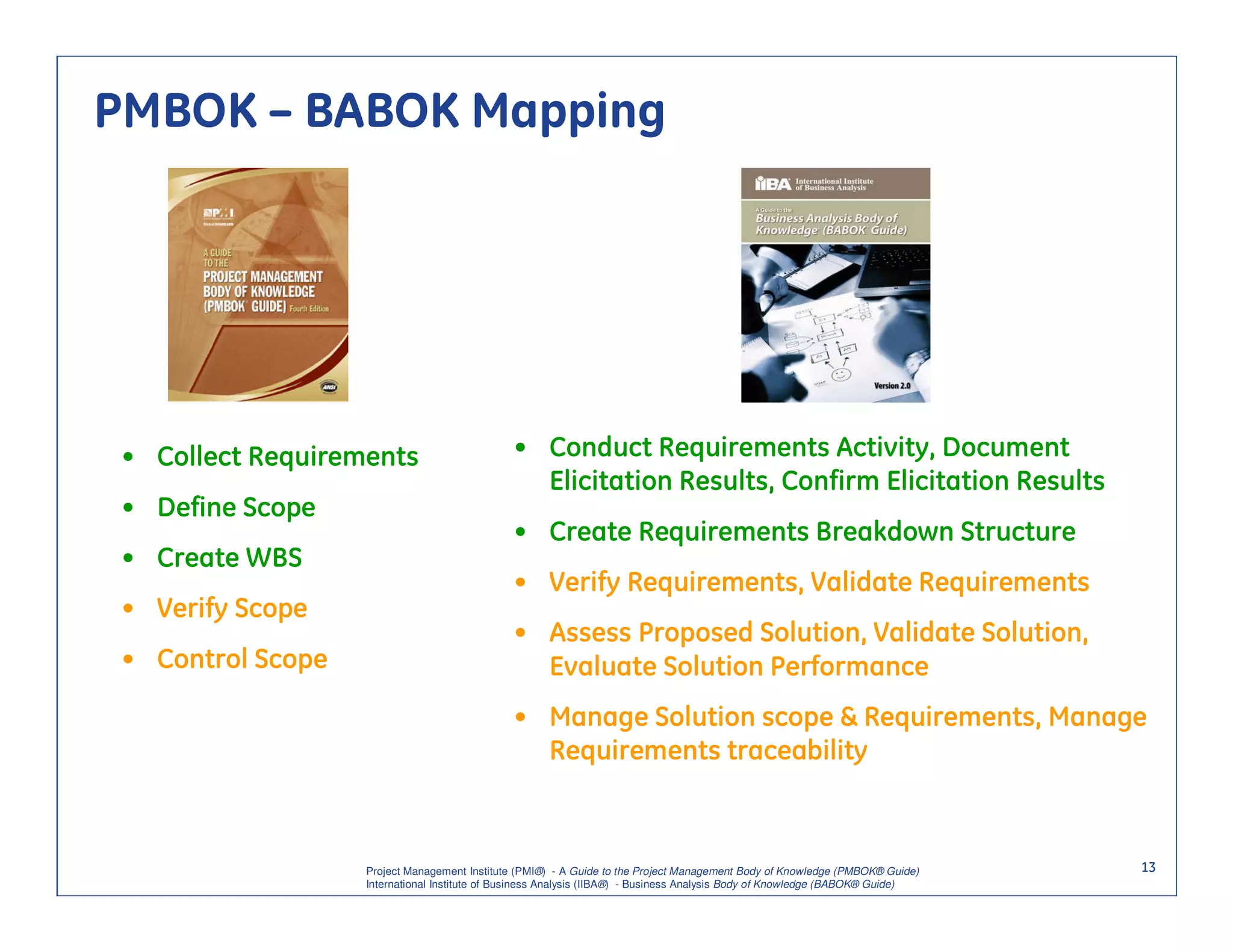
PMBOK – BABOK Mapping


 • Collect Requirements                        • Conduct Requirements Activity, Document
                                                 Elicitation Results, Confirm Elicitation Results
 • Define Scope
                                               • Create Requirements Breakdown Structure
 • Create WBS
                                               • Verify Requirements, Validate Requirements
 • Verify Scope
                                               • Assess Proposed Solution, Validate Solution,
 • Control Scope                                 Evaluate Solution Performance
                                               • Manage Solution scope & Requirements, Manage
                                                 Requirements traceability


                   Project Management Institute (PMI®) - A Guide to the Project Management Body of Knowledge (PMBOK® Guide)    13
                   International Institute of Business Analysis (IIBA®) - Business Analysis Body of Knowledge (BABOK® Guide)
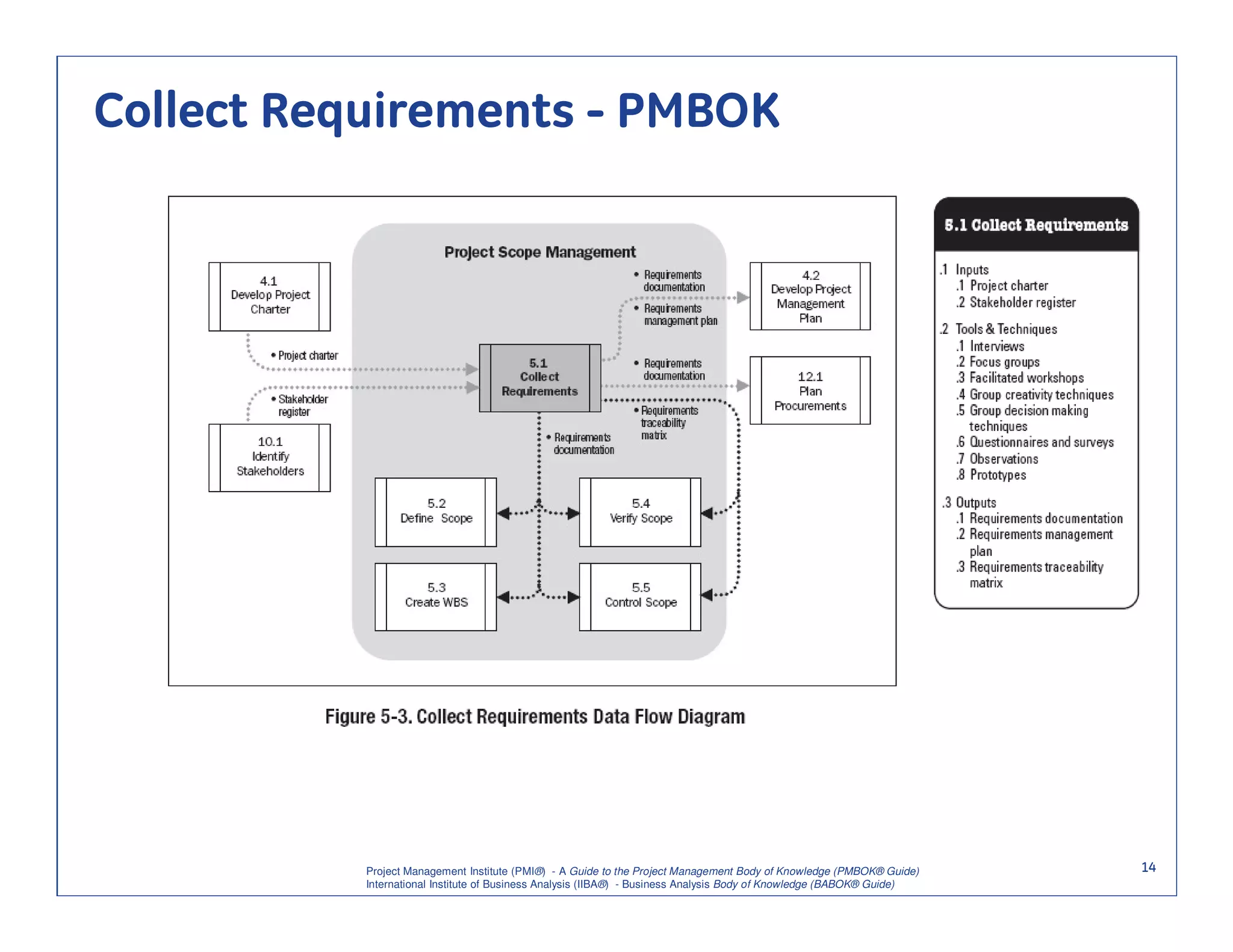
Collect Requirements - PMBOK


           Project Management Institute (PMI®) - A Guide to the Project Management Body of Knowledge (PMBOK® Guide)    14
           International Institute of Business Analysis (IIBA®) - Business Analysis Body of Knowledge (BABOK® Guide)
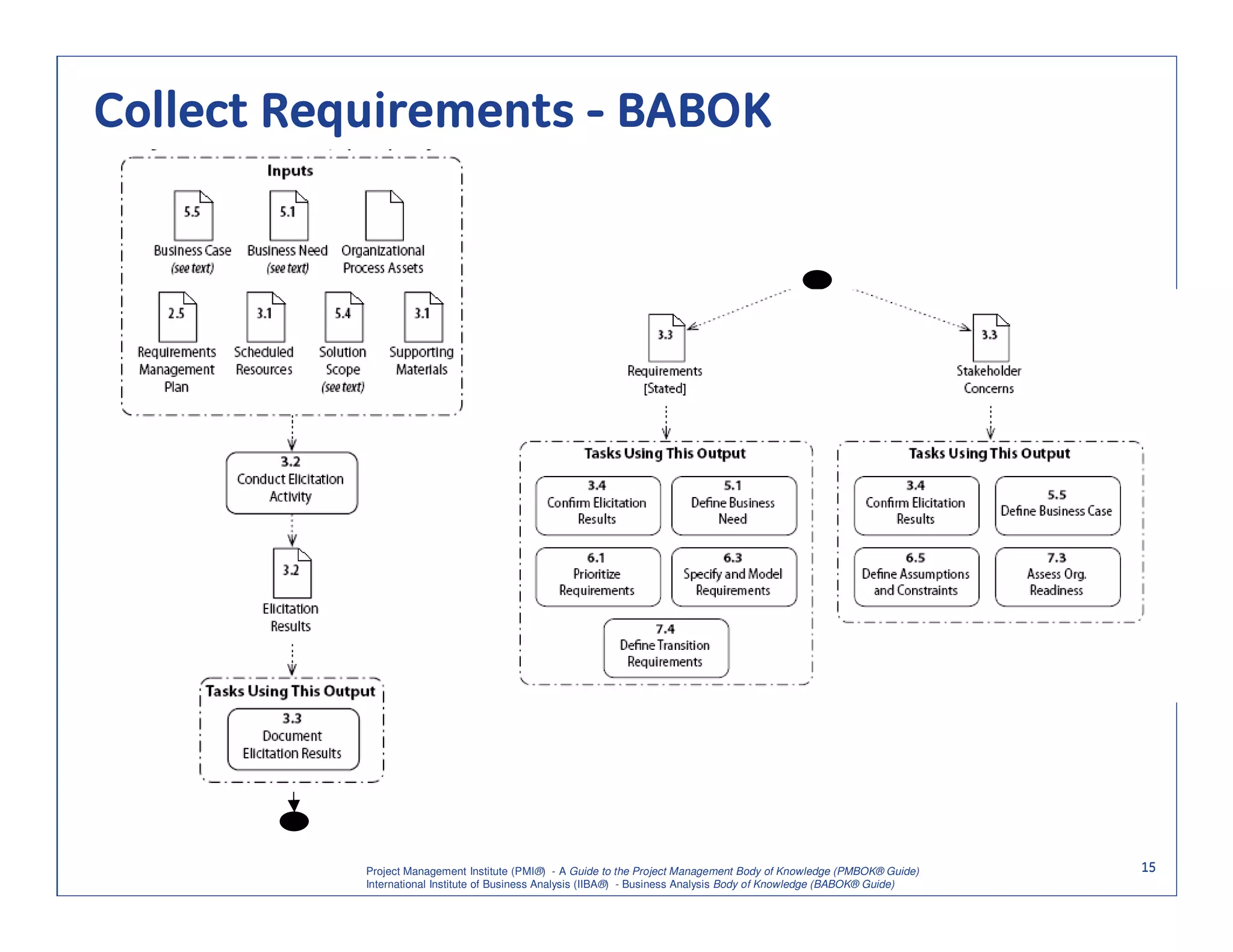
Collect Requirements - BABOK


           Project Management Institute (PMI®) - A Guide to the Project Management Body of Knowledge (PMBOK® Guide)    15
           International Institute of Business Analysis (IIBA®) - Business Analysis Body of Knowledge (BABOK® Guide)
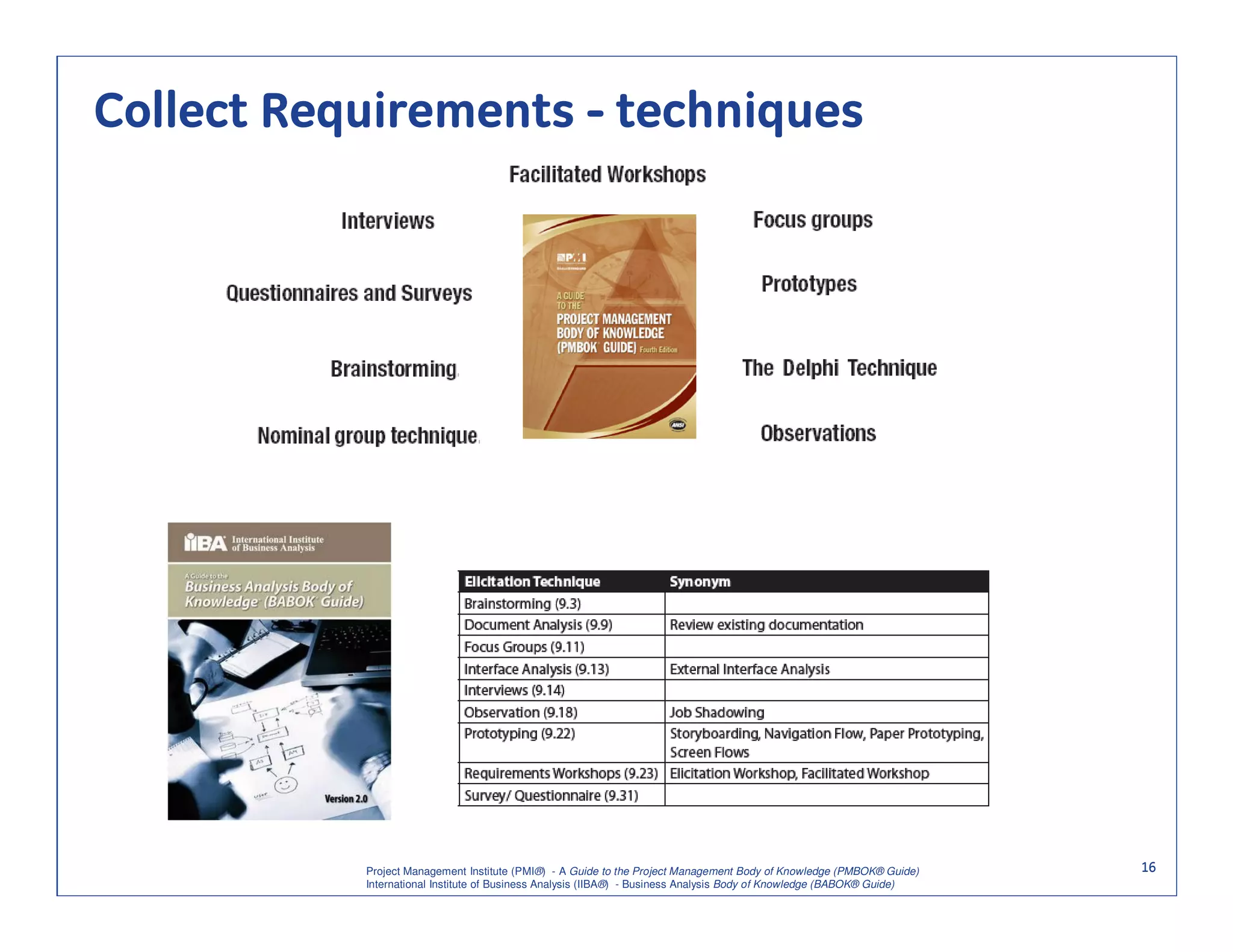
Collect Requirements - techniques


           Project Management Institute (PMI®) - A Guide to the Project Management Body of Knowledge (PMBOK® Guide)    16
           International Institute of Business Analysis (IIBA®) - Business Analysis Body of Knowledge (BABOK® Guide)
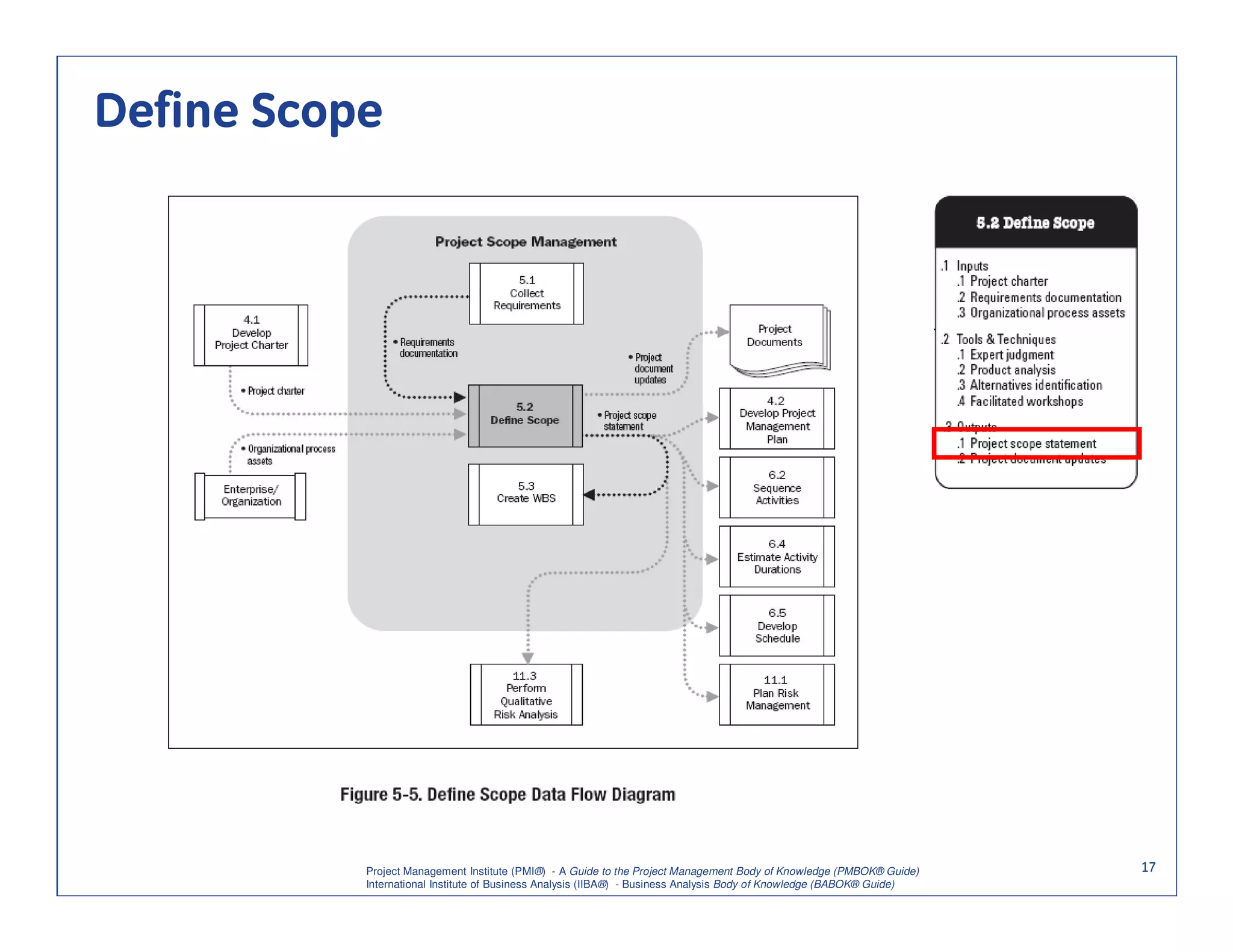
Define Scope


           Project Management Institute (PMI®) - A Guide to the Project Management Body of Knowledge (PMBOK® Guide)    17
           International Institute of Business Analysis (IIBA®) - Business Analysis Body of Knowledge (BABOK® Guide)
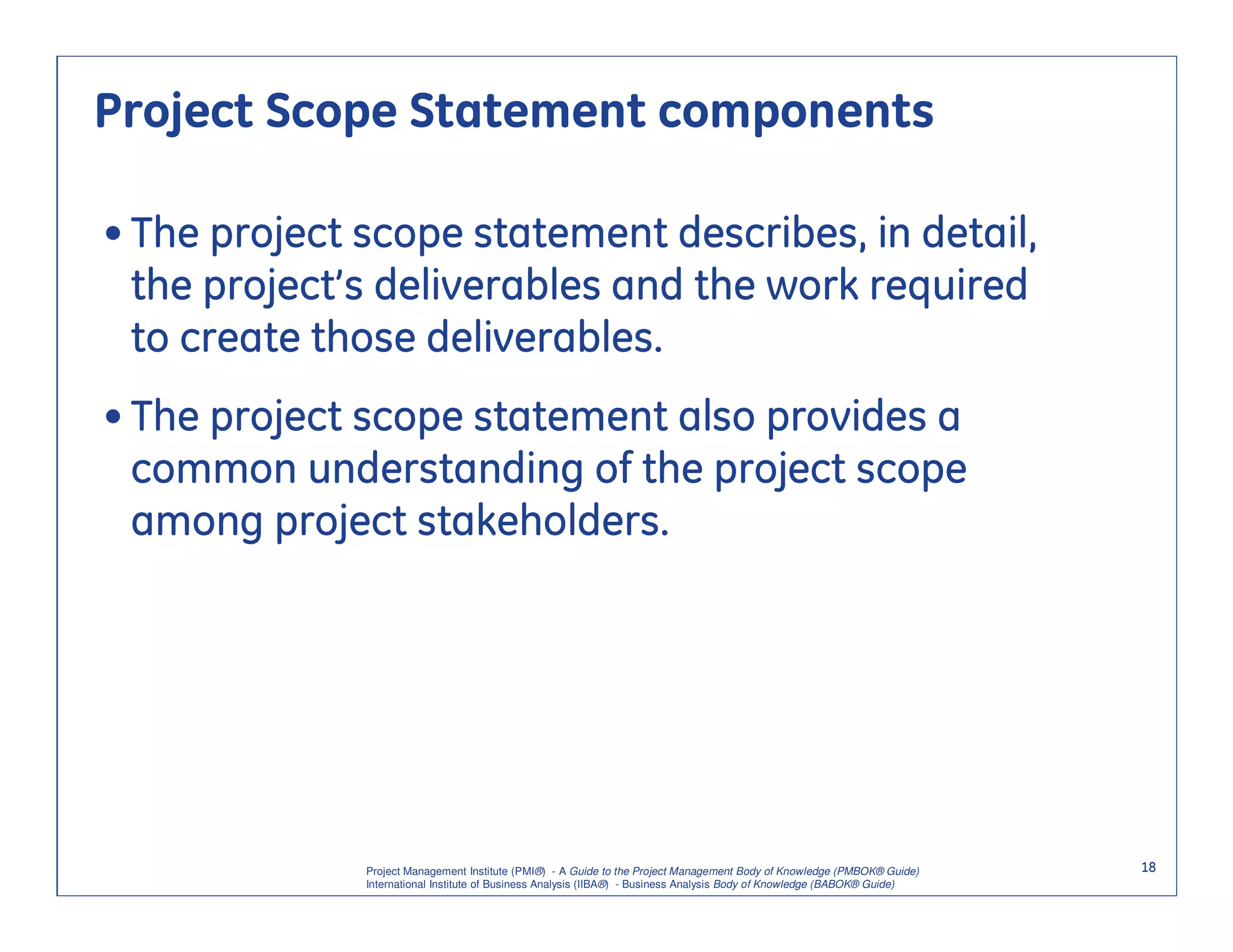
Project Scope Statement components

• The project scope statement describes, in detail,
  the project’s deliverables and the work required
  to create those deliverables.
• The project scope statement also provides a
  common understanding of the project scope
  among project stakeholders.


              Project Management Institute (PMI®) - A Guide to the Project Management Body of Knowledge (PMBOK® Guide)    18
              International Institute of Business Analysis (IIBA®) - Business Analysis Body of Knowledge (BABOK® Guide)
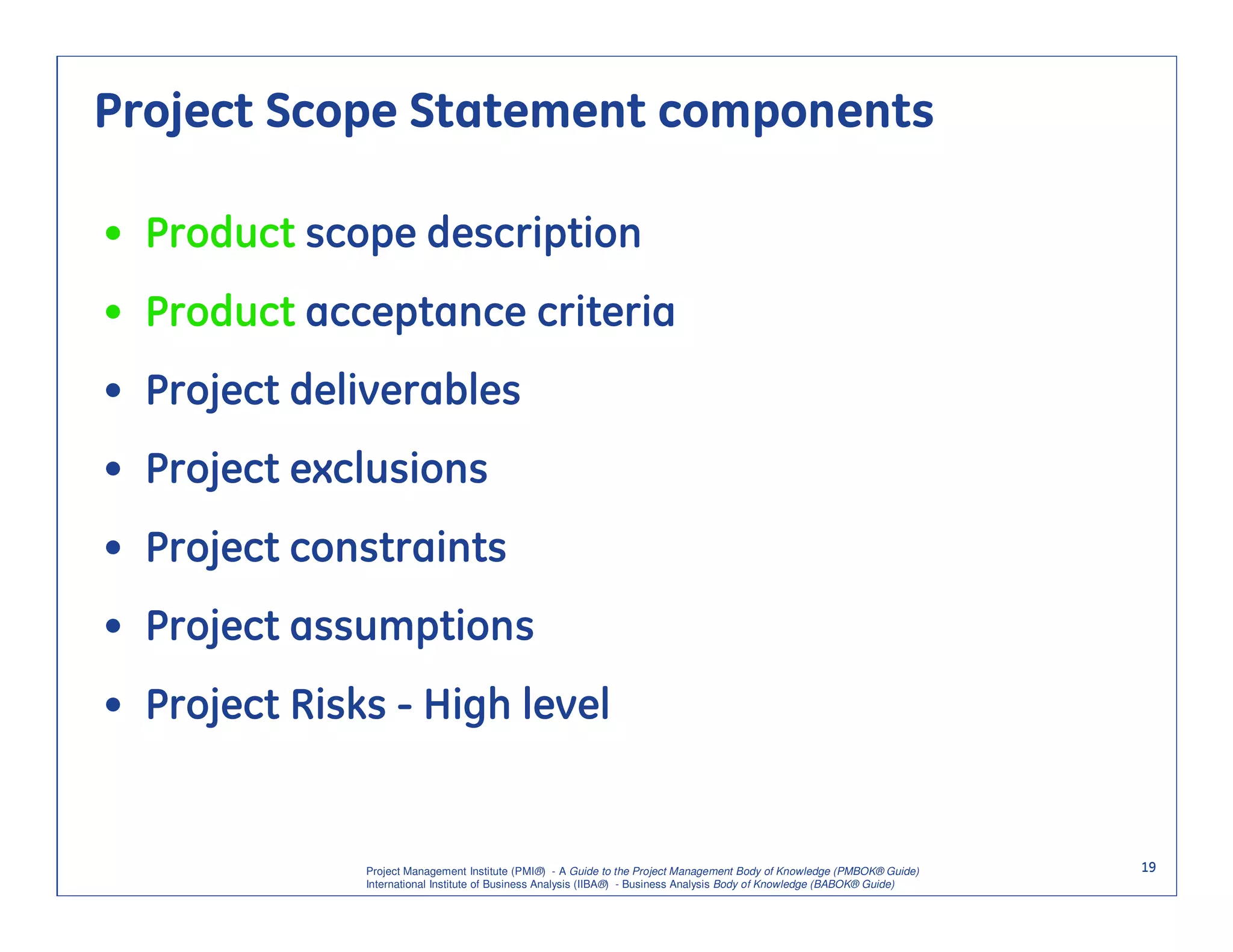
Project Scope Statement components

• Product scope description
• Product acceptance criteria
• Project deliverables
• Project exclusions
• Project constraints
• Project assumptions
• Project Risks - High level


              Project Management Institute (PMI®) - A Guide to the Project Management Body of Knowledge (PMBOK® Guide)    19
              International Institute of Business Analysis (IIBA®) - Business Analysis Body of Knowledge (BABOK® Guide)
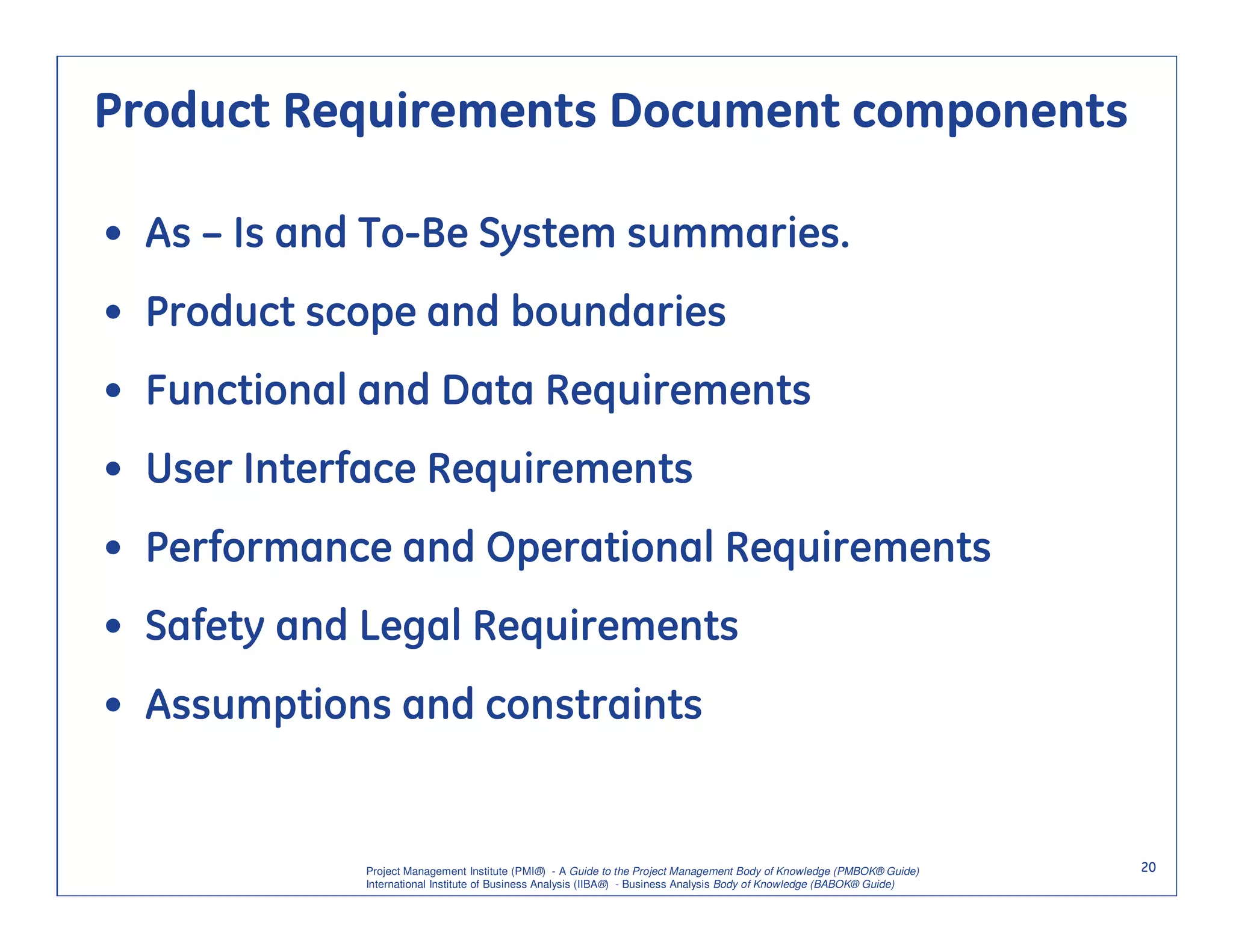
Product Requirements Document components

• As – Is and To-Be System summaries.
• Product scope and boundaries
• Functional and Data Requirements
• User Interface Requirements
• Performance and Operational Requirements
• Safety and Legal Requirements
• Assumptions and constraints


             Project Management Institute (PMI®) - A Guide to the Project Management Body of Knowledge (PMBOK® Guide)    20
             International Institute of Business Analysis (IIBA®) - Business Analysis Body of Knowledge (BABOK® Guide)
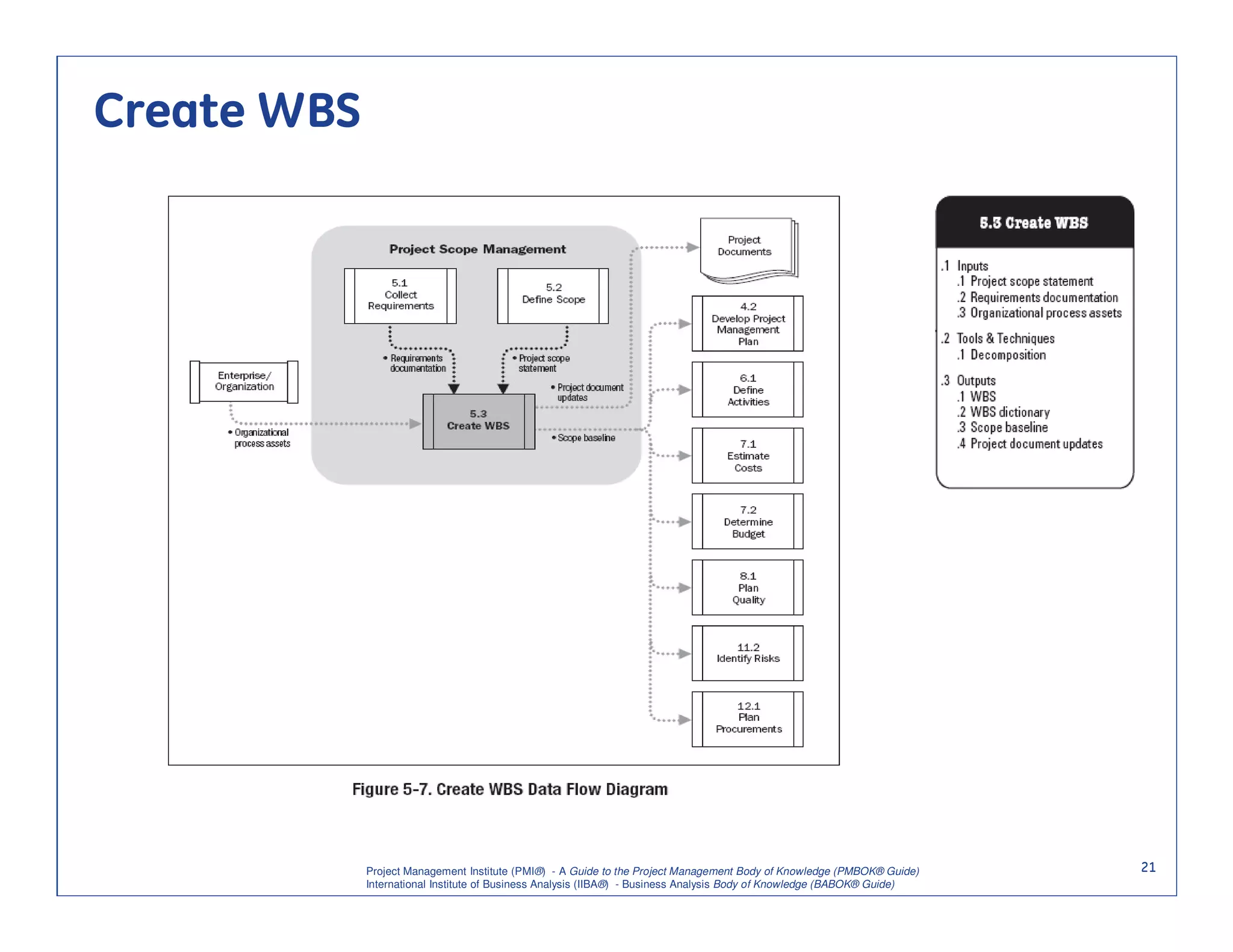
Create WBS


             Project Management Institute (PMI®) - A Guide to the Project Management Body of Knowledge (PMBOK® Guide)    21
             International Institute of Business Analysis (IIBA®) - Business Analysis Body of Knowledge (BABOK® Guide)
Work Breakdown Structure (WBS)

• The Work Breakdown Structure (WBS) is the
  hierarchical breakdown that divides the project
  scope into definable work packages that can be
  more easily managed.
• Provides a clean structure for project deliverables.
• Straight forward way of identifying the appropriate
  level of detail for scope definition, ownership &
  managing the project.


              Project Management Institute (PMI®) - A Guide to the Project Management Body of Knowledge (PMBOK® Guide)    22
              International Institute of Business Analysis (IIBA®) - Business Analysis Body of Knowledge (BABOK® Guide)
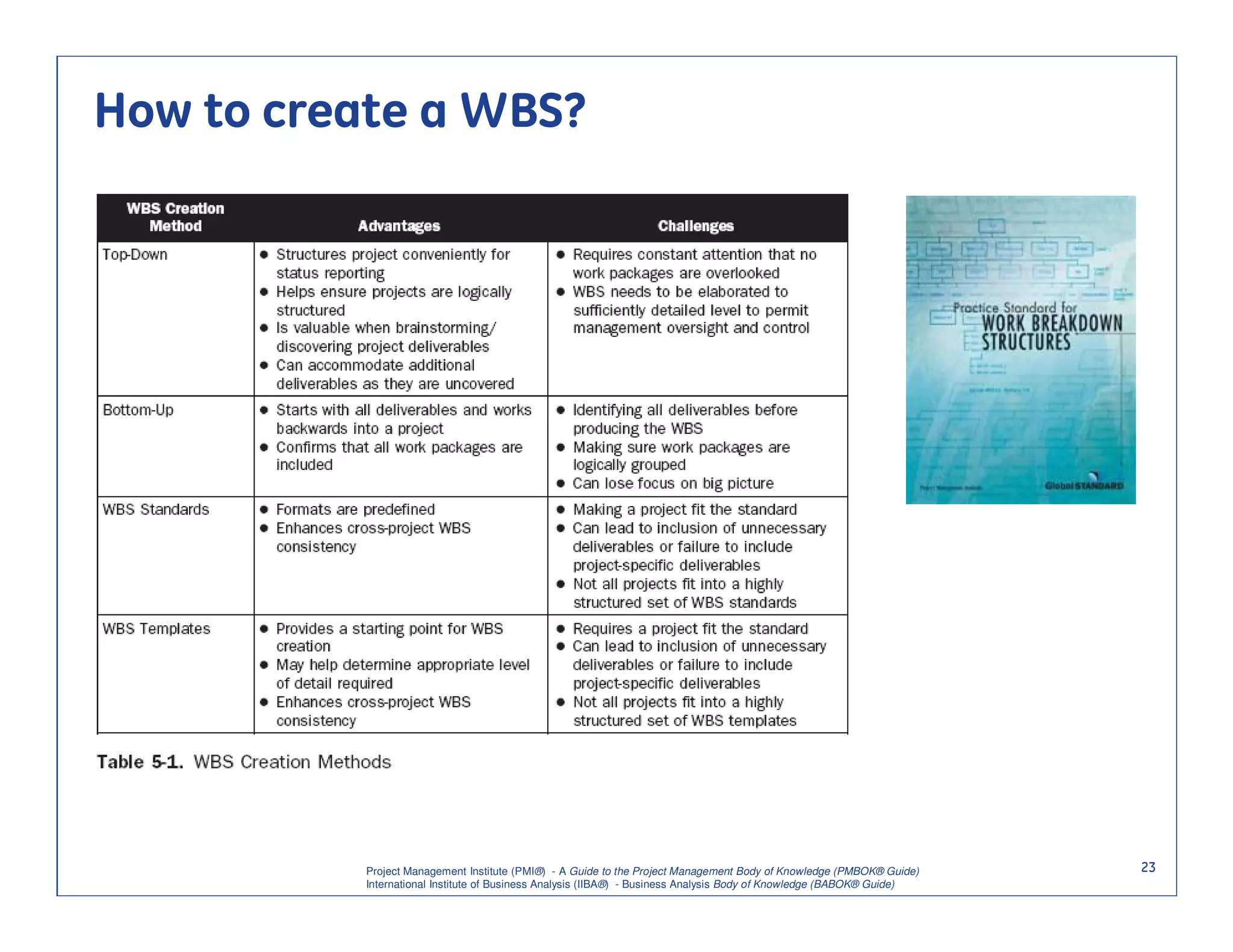
How to create a WBS?


           Project Management Institute (PMI®) - A Guide to the Project Management Body of Knowledge (PMBOK® Guide)    23
           International Institute of Business Analysis (IIBA®) - Business Analysis Body of Knowledge (BABOK® Guide)
Work Breakdown Structure (WBS)

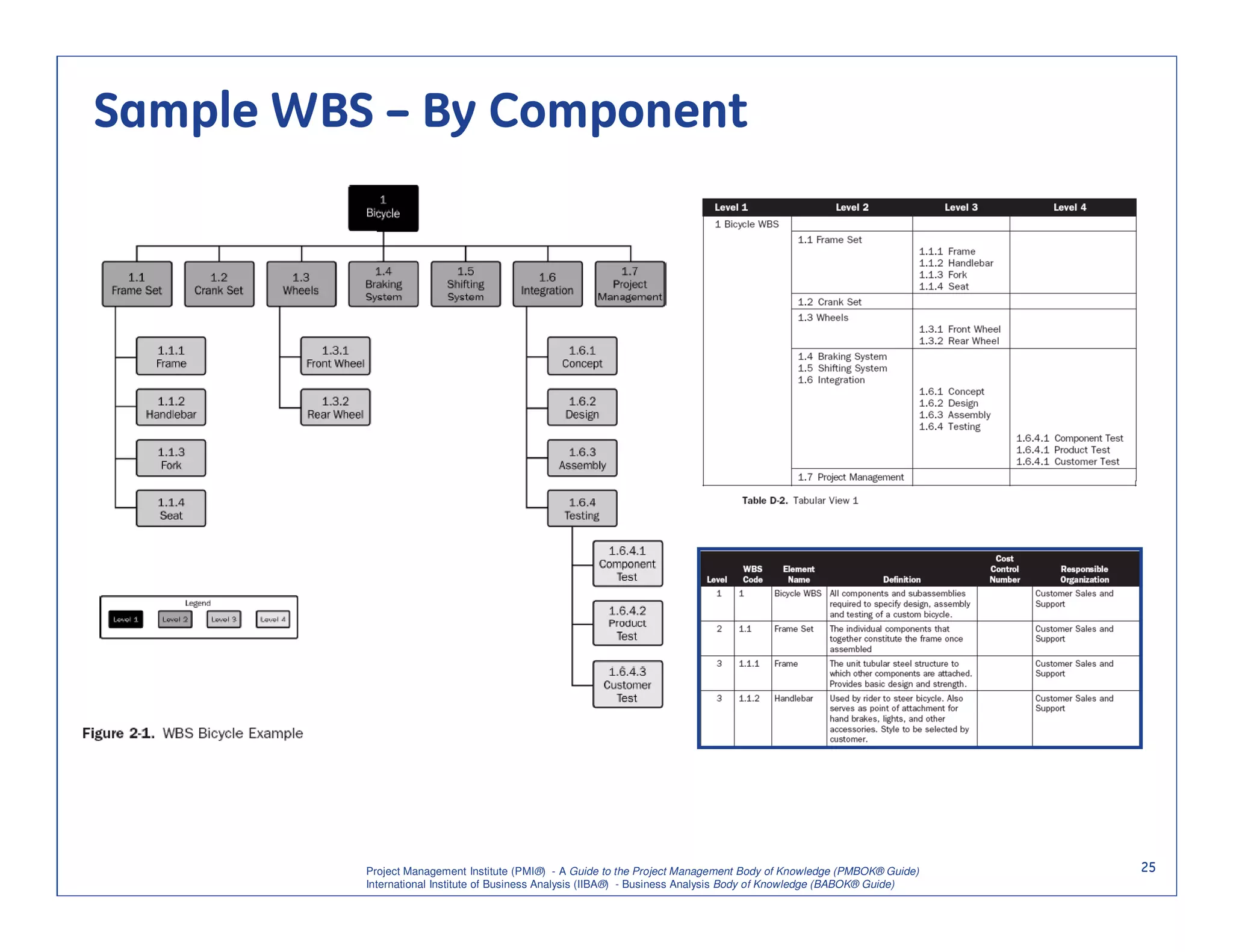
• The WBS can be represented in a tabular or
  graphical format.
• The WBS….
   – Ensures that the entire scope of the project has
     been identified
   – Helps in the creation of the project schedule
   – Assists in resource estimation
   – Assists in cost estimation
   – Helps in risk identification


              Project Management Institute (PMI®) - A Guide to the Project Management Body of Knowledge (PMBOK® Guide)    24
              International Institute of Business Analysis (IIBA®) - Business Analysis Body of Knowledge (BABOK® Guide)
Sample WBS – By Component


          Project Management Institute (PMI®) - A Guide to the Project Management Body of Knowledge (PMBOK® Guide)    25
          International Institute of Business Analysis (IIBA®) - Business Analysis Body of Knowledge (BABOK® Guide)
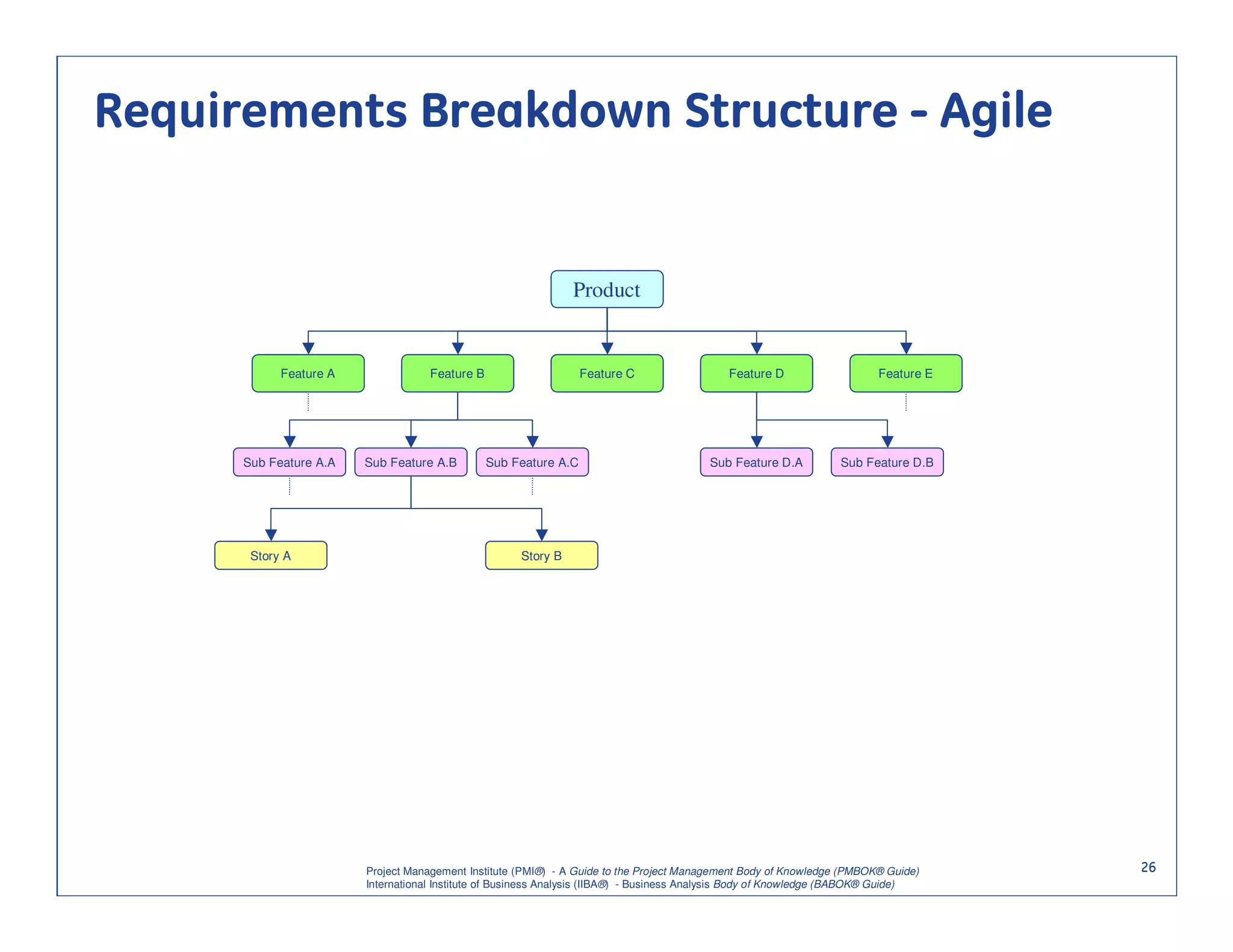
Requirements Breakdown Structure - Agile


                                                               Product


            Feature A               Feature B                     Feature C                 Feature D                    Feature E


      Sub Feature A.A   Sub Feature A.B         Sub Feature A.C                          Sub Feature D.A          Sub Feature D.B


       Story A                                       Story B


                        Project Management Institute (PMI®) - A Guide to the Project Management Body of Knowledge (PMBOK® Guide)     26
                        International Institute of Business Analysis (IIBA®) - Business Analysis Body of Knowledge (BABOK® Guide)
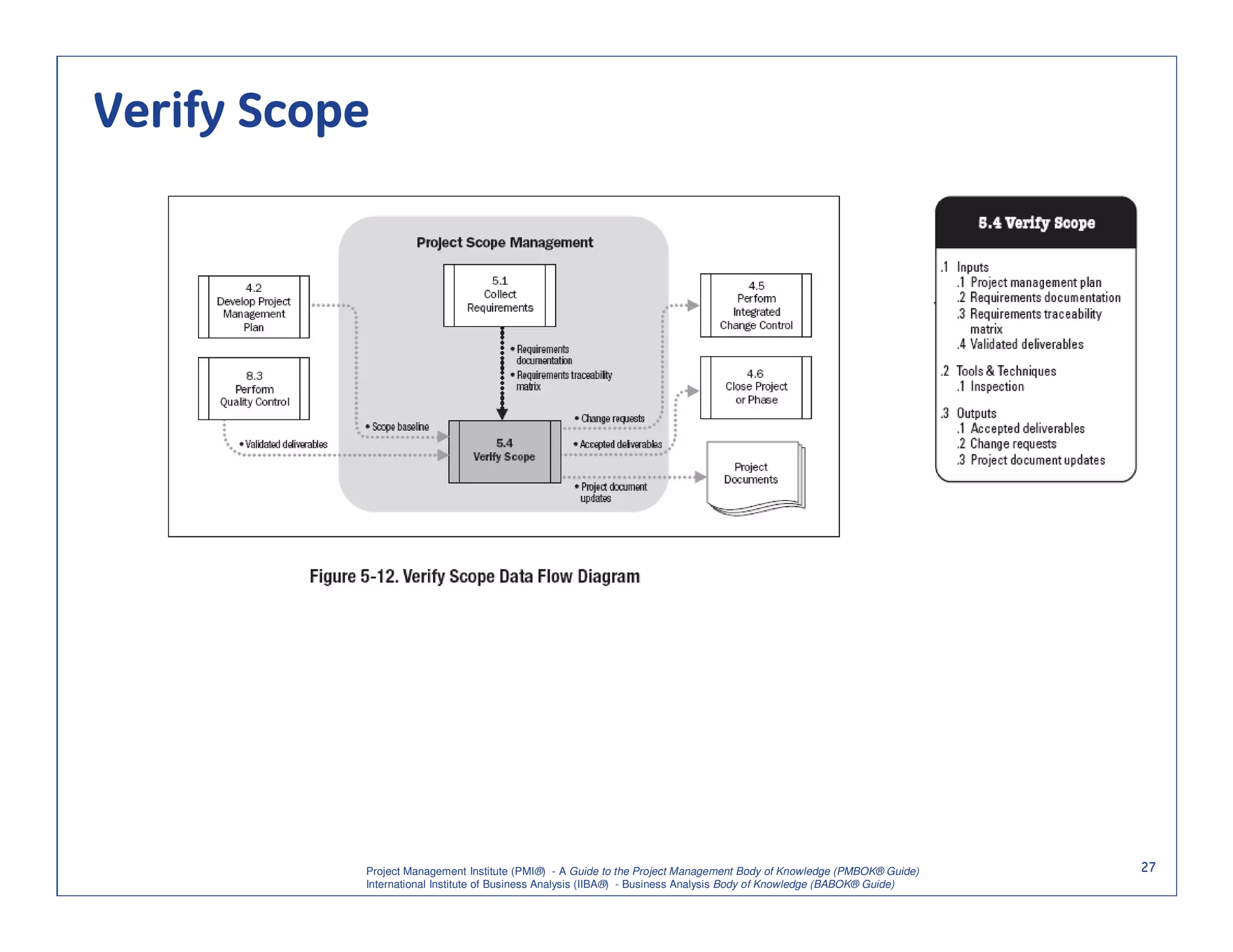
Verify Scope


           Project Management Institute (PMI®) - A Guide to the Project Management Body of Knowledge (PMBOK® Guide)    27
           International Institute of Business Analysis (IIBA®) - Business Analysis Body of Knowledge (BABOK® Guide)
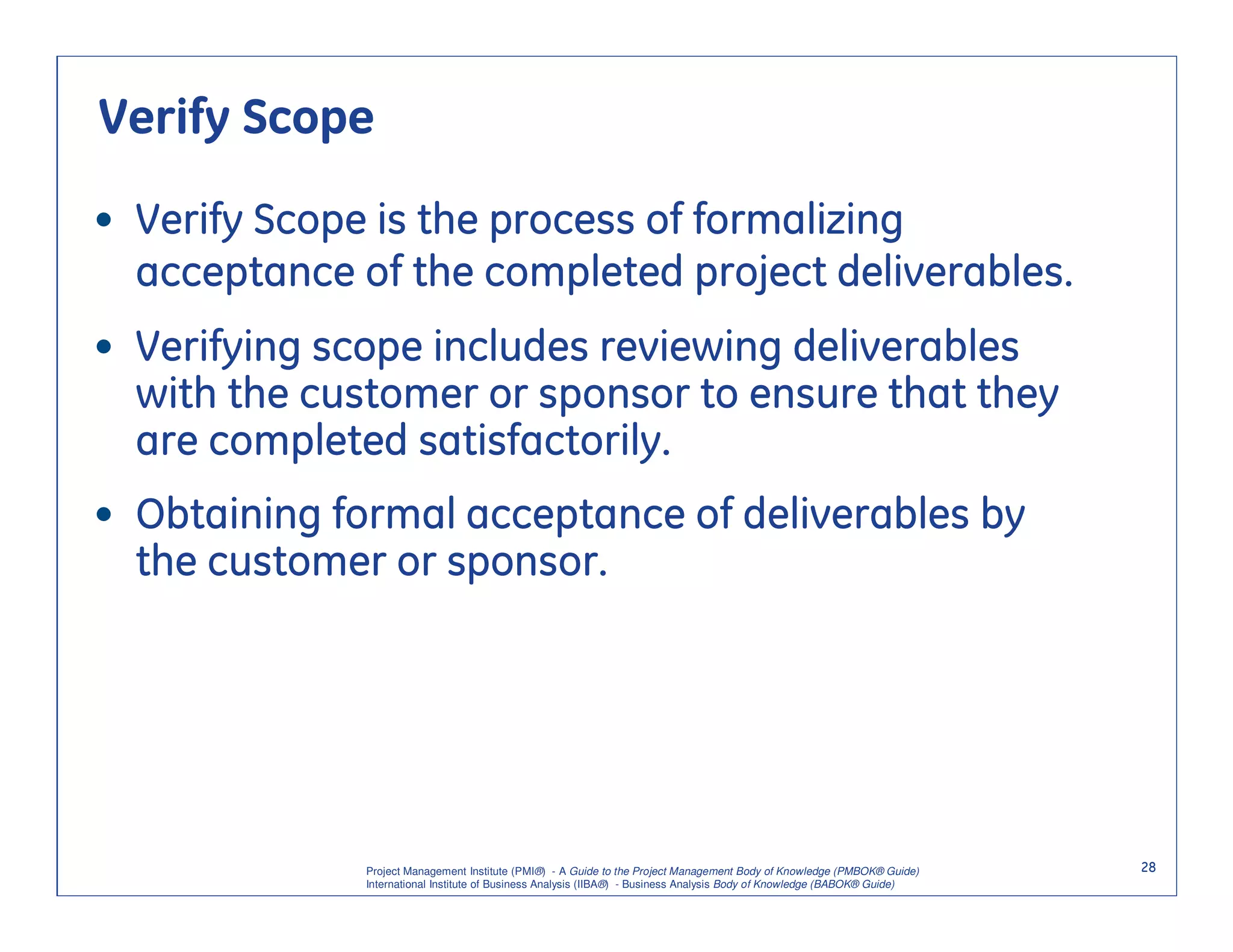
Verify Scope

• Verify Scope is the process of formalizing
  acceptance of the completed project deliverables.
• Verifying scope includes reviewing deliverables
  with the customer or sponsor to ensure that they
  are completed satisfactorily.
• Obtaining formal acceptance of deliverables by
  the customer or sponsor.


              Project Management Institute (PMI®) - A Guide to the Project Management Body of Knowledge (PMBOK® Guide)    28
              International Institute of Business Analysis (IIBA®) - Business Analysis Body of Knowledge (BABOK® Guide)
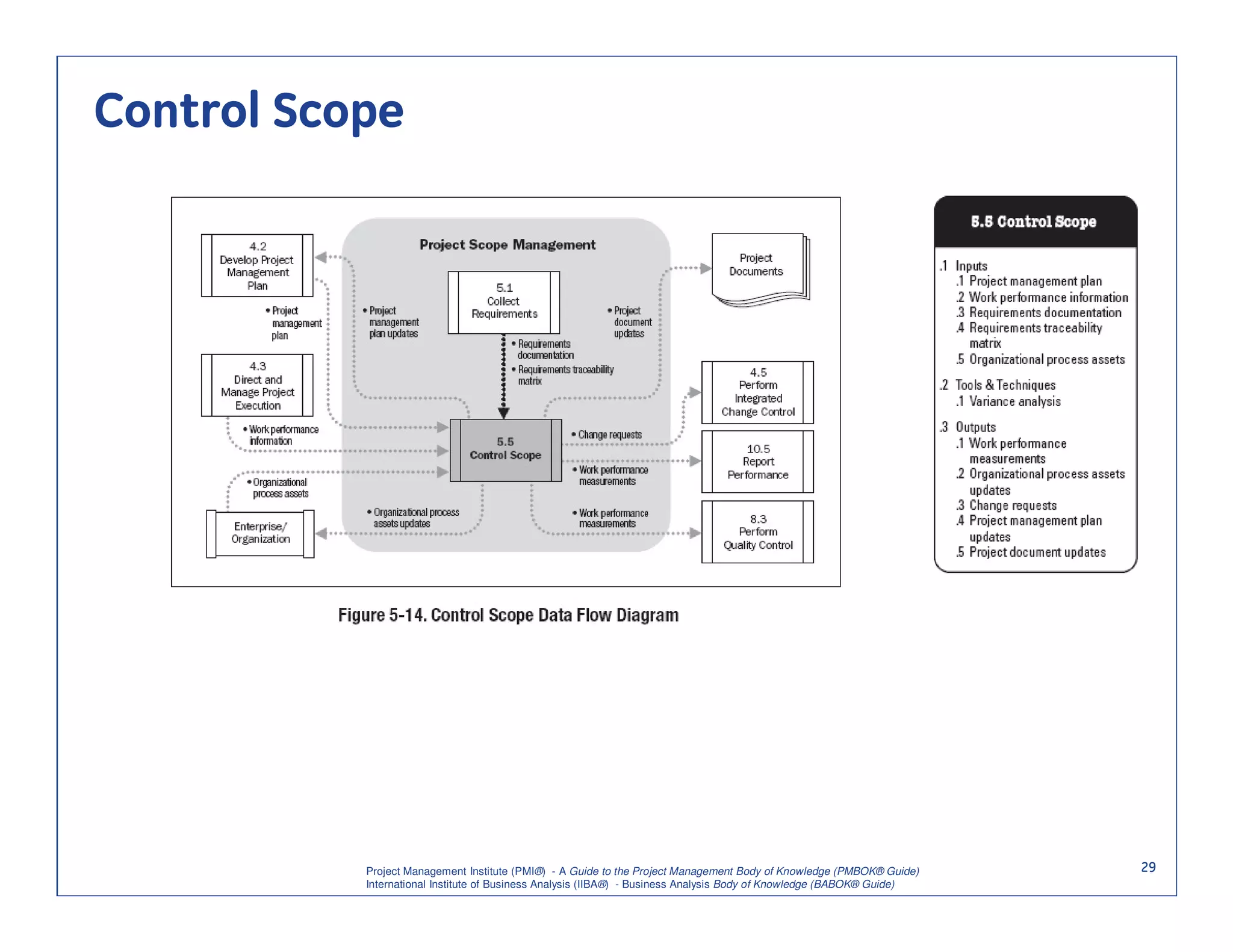
Control Scope


           Project Management Institute (PMI®) - A Guide to the Project Management Body of Knowledge (PMBOK® Guide)    29
           International Institute of Business Analysis (IIBA®) - Business Analysis Body of Knowledge (BABOK® Guide)
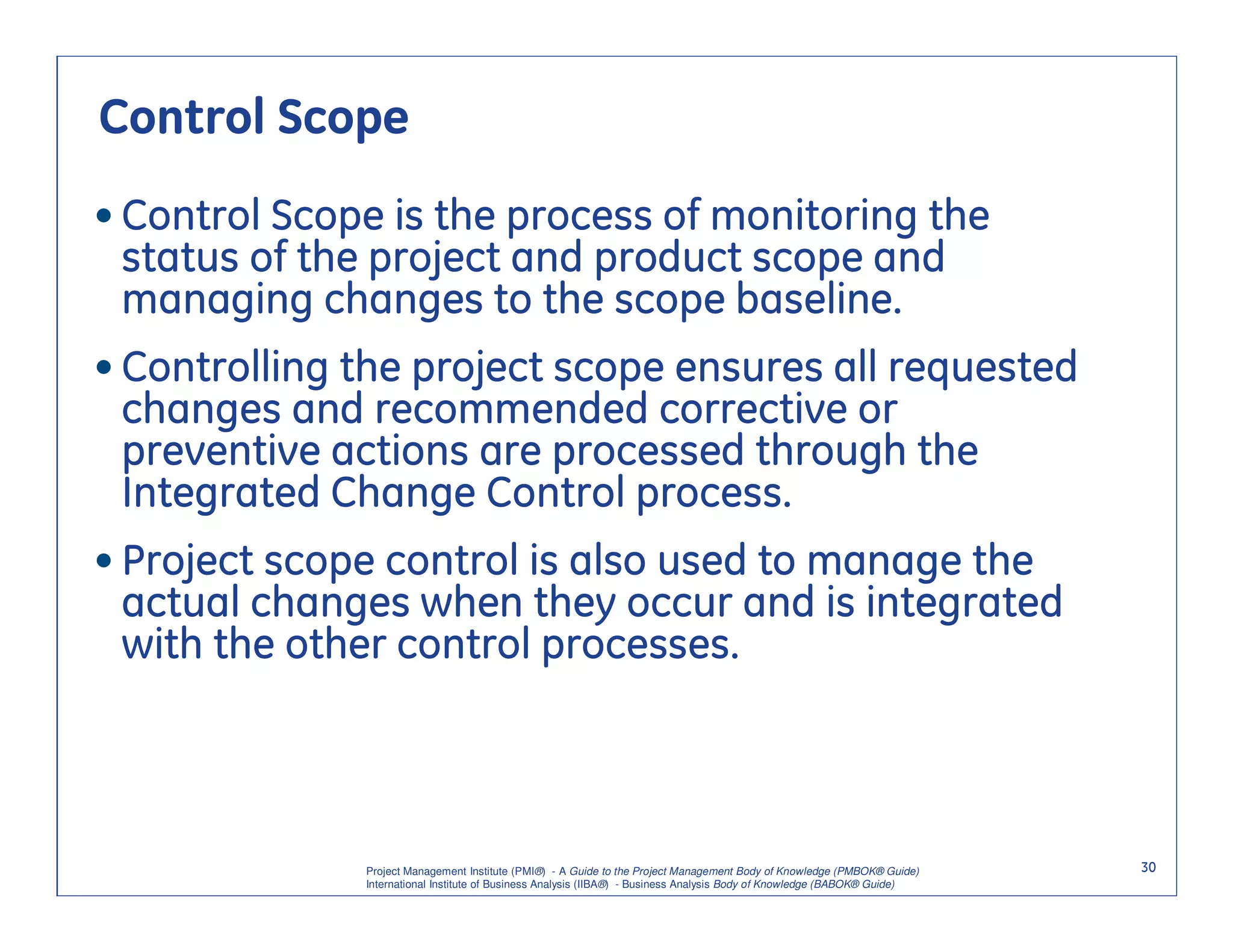
Control Scope
• Control Scope is the process of monitoring the
  status of the project and product scope and
  managing changes to the scope baseline.
• Controlling the project scope ensures all requested
  changes and recommended corrective or
  preventive actions are processed through the
  Integrated Change Control process.
• Project scope control is also used to manage the
  actual changes when they occur and is integrated
  with the other control processes.


              Project Management Institute (PMI®) - A Guide to the Project Management Body of Knowledge (PMBOK® Guide)    30
              International Institute of Business Analysis (IIBA®) - Business Analysis Body of Knowledge (BABOK® Guide)
Control Scope

• Uncontrolled changes are often referred to as
  project scope creep.
• Change is inevitable, thereby mandating some
  type of change control process.


              Project Management Institute (PMI®) - A Guide to the Project Management Body of Knowledge (PMBOK® Guide)    31
              International Institute of Business Analysis (IIBA®) - Business Analysis Body of Knowledge (BABOK® Guide)
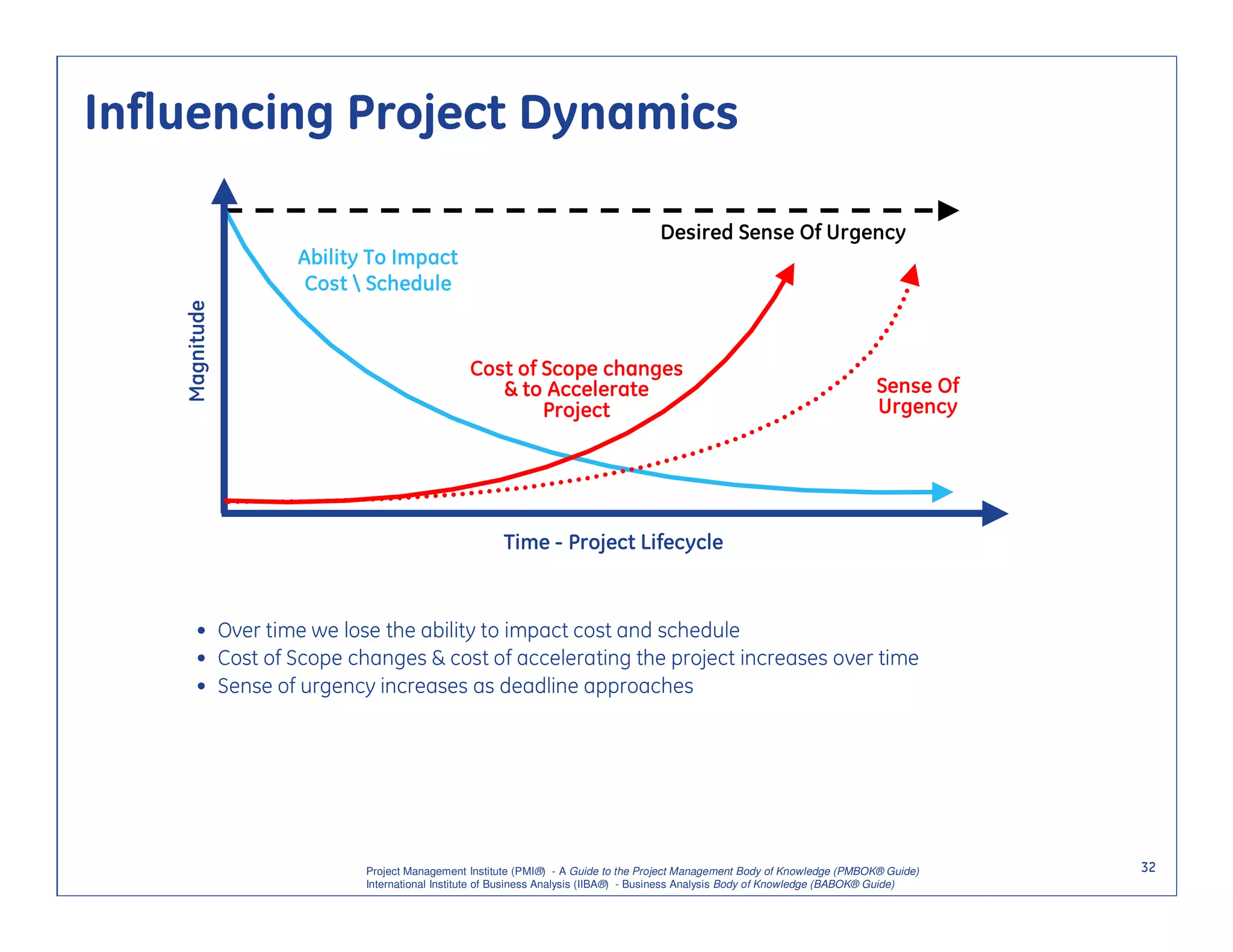
Influencing Project Dynamics

                                                                                Desired Sense Of Urgency
                 Ability To Impact
                  Cost  Schedule
    Magnitude


                                            Cost of Scope changes
                                               & to Accelerate                                                           Sense Of
                                                    Project                                                              Urgency


                                                   Time - Project Lifecycle


       • Over time we lose the ability to impact cost and schedule
       • Cost of Scope changes & cost of accelerating the project increases over time
       • Sense of urgency increases as deadline approaches


                         Project Management Institute (PMI®) - A Guide to the Project Management Body of Knowledge (PMBOK® Guide)    32
                         International Institute of Business Analysis (IIBA®) - Business Analysis Body of Knowledge (BABOK® Guide)
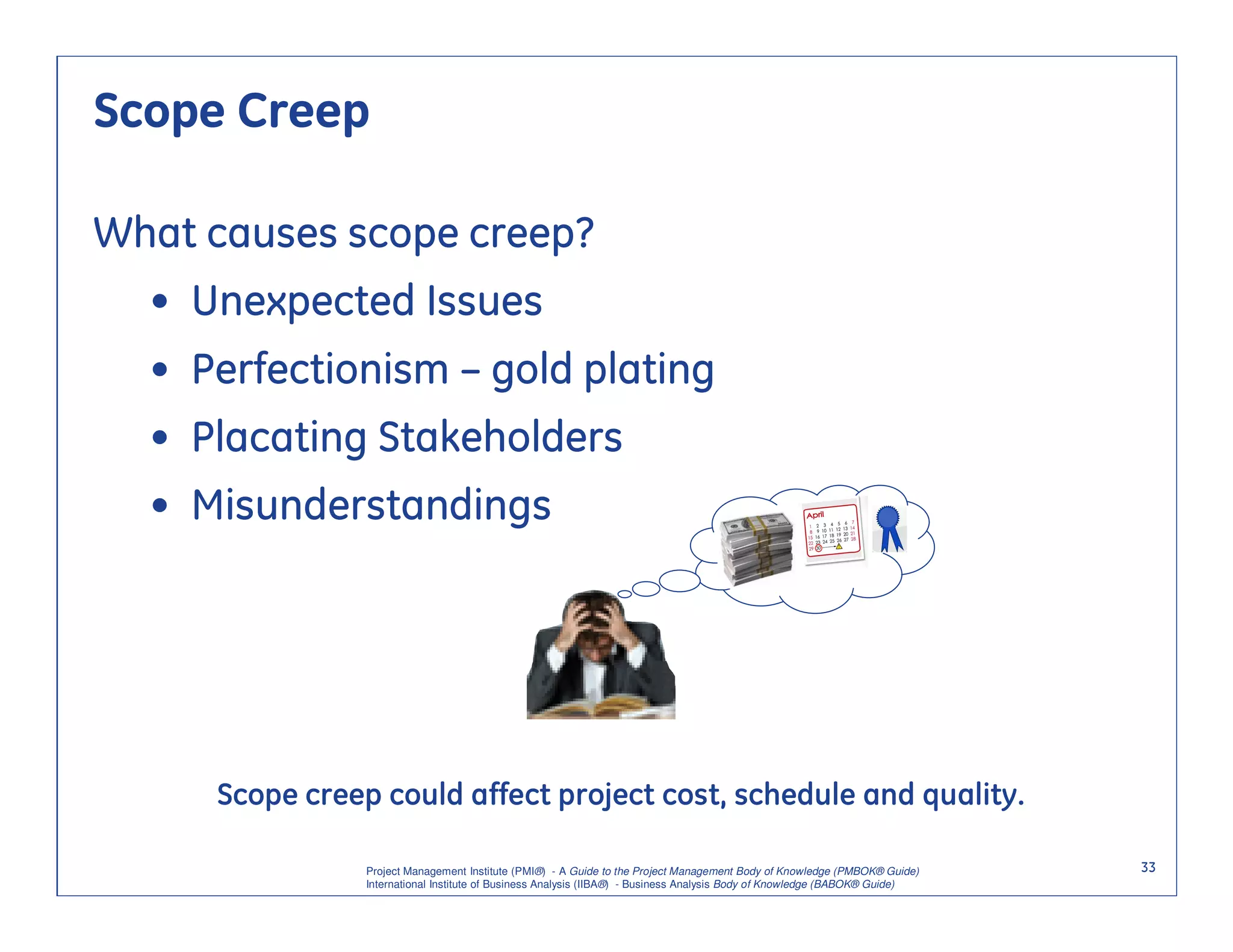
Scope Creep

What causes scope creep?
  • Unexpected Issues
  • Perfectionism – gold plating
  • Placating Stakeholders
  • Misunderstandings


     Scope creep could affect project cost, schedule and quality.

                Project Management Institute (PMI®) - A Guide to the Project Management Body of Knowledge (PMBOK® Guide)    33
                International Institute of Business Analysis (IIBA®) - Business Analysis Body of Knowledge (BABOK® Guide)
Scope Creep

Impact of Scope Creep:
  • Late projects – Missed deadlines
  • Cost overruns - Loss of profit
  • Unhappy Customers - Loss of Business
  • Killed Projects – Shut Down Business
  • Career Killer!


             Project Management Institute (PMI®) - A Guide to the Project Management Body of Knowledge (PMBOK® Guide)    34
             International Institute of Business Analysis (IIBA®) - Business Analysis Body of Knowledge (BABOK® Guide)
References

 • A Guide to the Project Management Body Of Knowledge (PMBOK® Guide) -
   Fourth Edition ©2009 Project Management Institute.
 • A Guide to the Business Analysis Body Of Knowledge (BABOK® Guide) -
   Second Edition ©2009 International Institute of Business Analysis.
 • Practice Standard for Work Breakdown Structures—Second Edition ©2006
   Project Management Institute


                   Project Management Institute (PMI®) - A Guide to the Project Management Body of Knowledge (PMBOK® Guide)    35
                   International Institute of Business Analysis (IIBA®) - Business Analysis Body of Knowledge (BABOK® Guide)
Back up


Project Management Institute (PMI®) - A Guide to the Project Management Body of Knowledge (PMBOK® Guide)    36
International Institute of Business Analysis (IIBA®) - Business Analysis Body of Knowledge (BABOK® Guide)
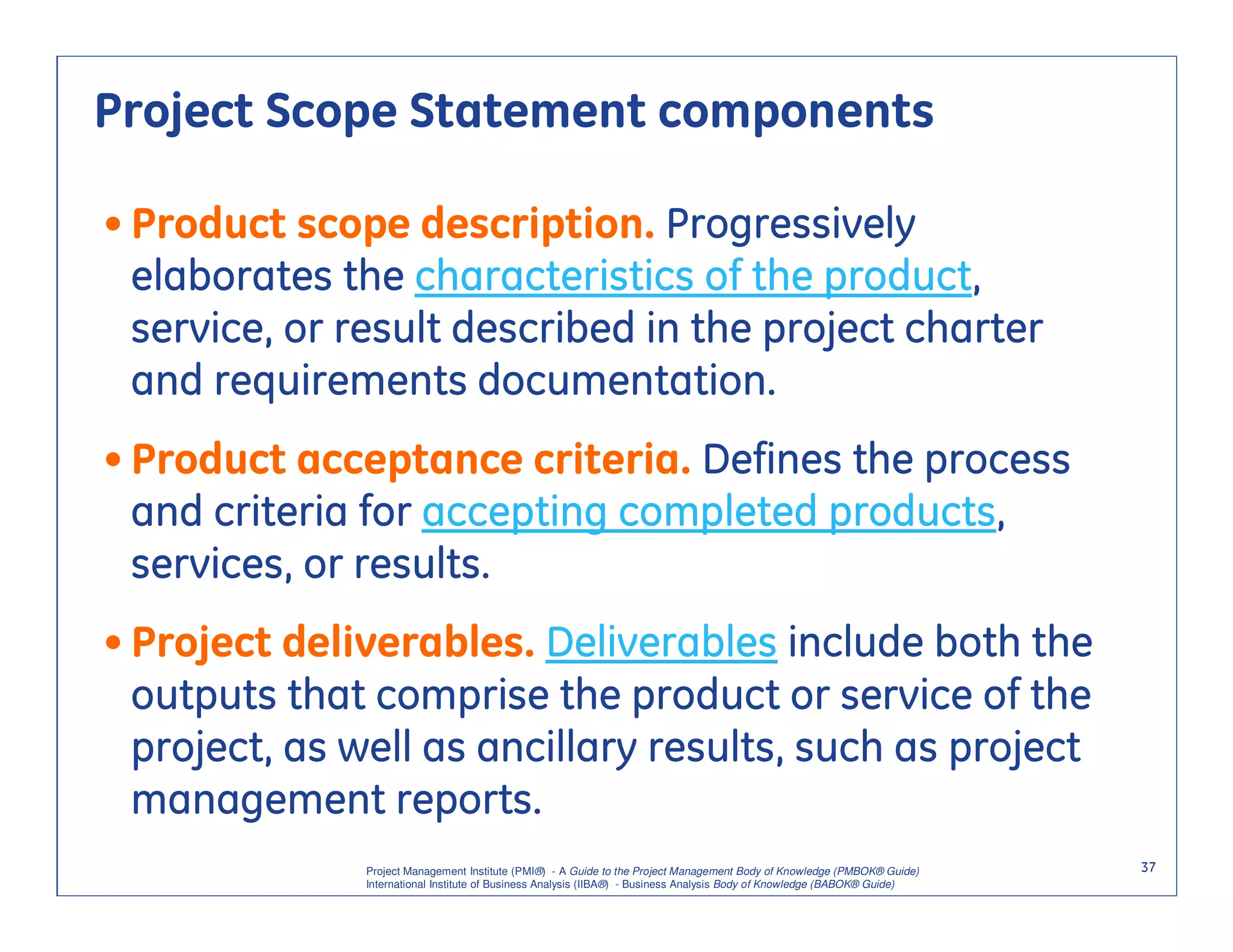
Project Scope Statement components

• Product scope description. Progressively
  elaborates the characteristics of the product,
  service, or result described in the project charter
  and requirements documentation.
• Product acceptance criteria. Defines the process
  and criteria for accepting completed products,
  services, or results.
• Project deliverables. Deliverables include both the
  outputs that comprise the product or service of the
  project, as well as ancillary results, such as project
  management reports.
              Project Management Institute (PMI®) - A Guide to the Project Management Body of Knowledge (PMBOK® Guide)    37
              International Institute of Business Analysis (IIBA®) - Business Analysis Body of Knowledge (BABOK® Guide)
Project Scope Statement components

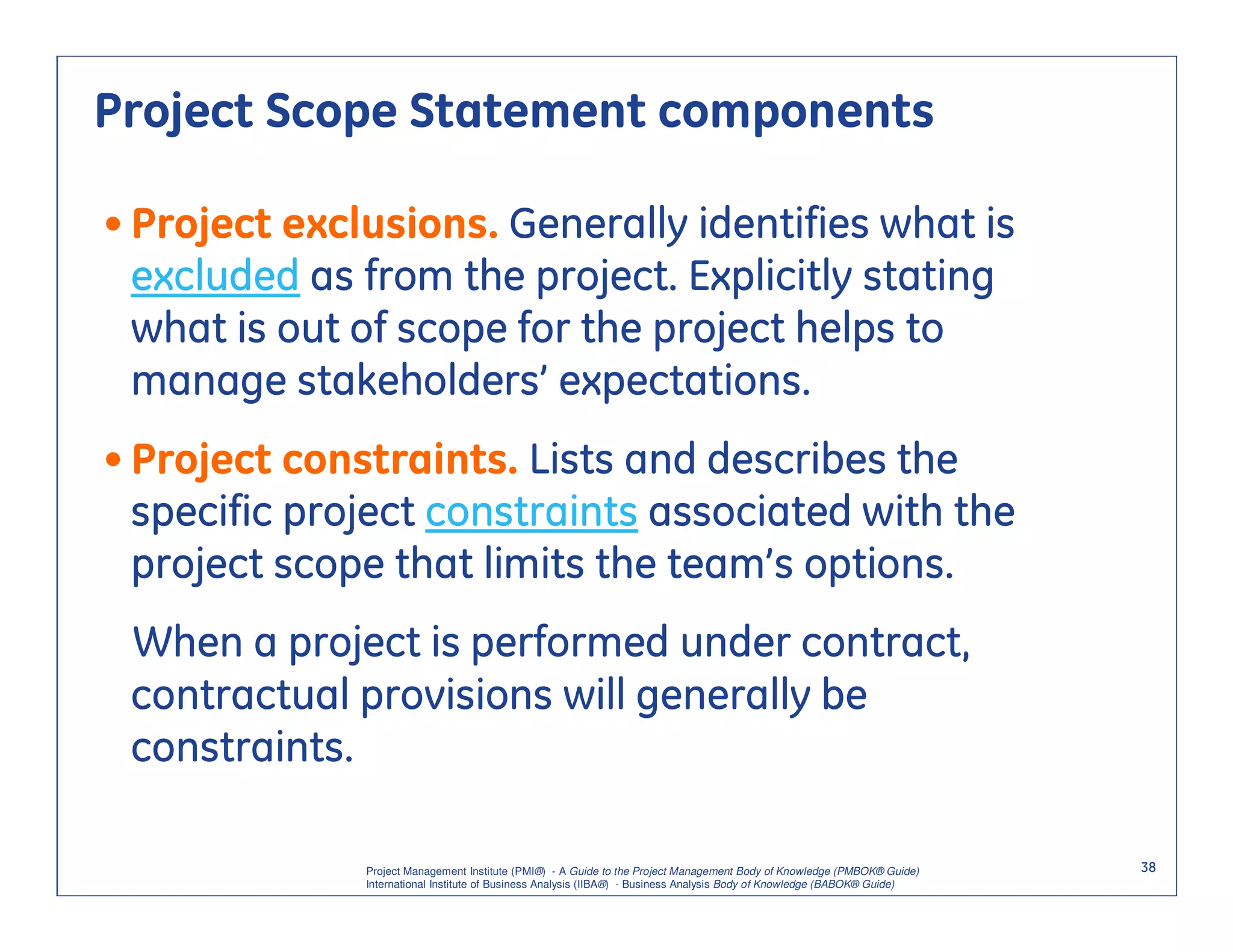
• Project exclusions. Generally identifies what is
  excluded as from the project. Explicitly stating
  what is out of scope for the project helps to
  manage stakeholders’ expectations.
• Project constraints. Lists and describes the
  specific project constraints associated with the
  project scope that limits the team’s options.
 When a project is performed under contract,
 contractual provisions will generally be
 constraints.

              Project Management Institute (PMI®) - A Guide to the Project Management Body of Knowledge (PMBOK® Guide)    38
              International Institute of Business Analysis (IIBA®) - Business Analysis Body of Knowledge (BABOK® Guide)
Project Scope Statement components

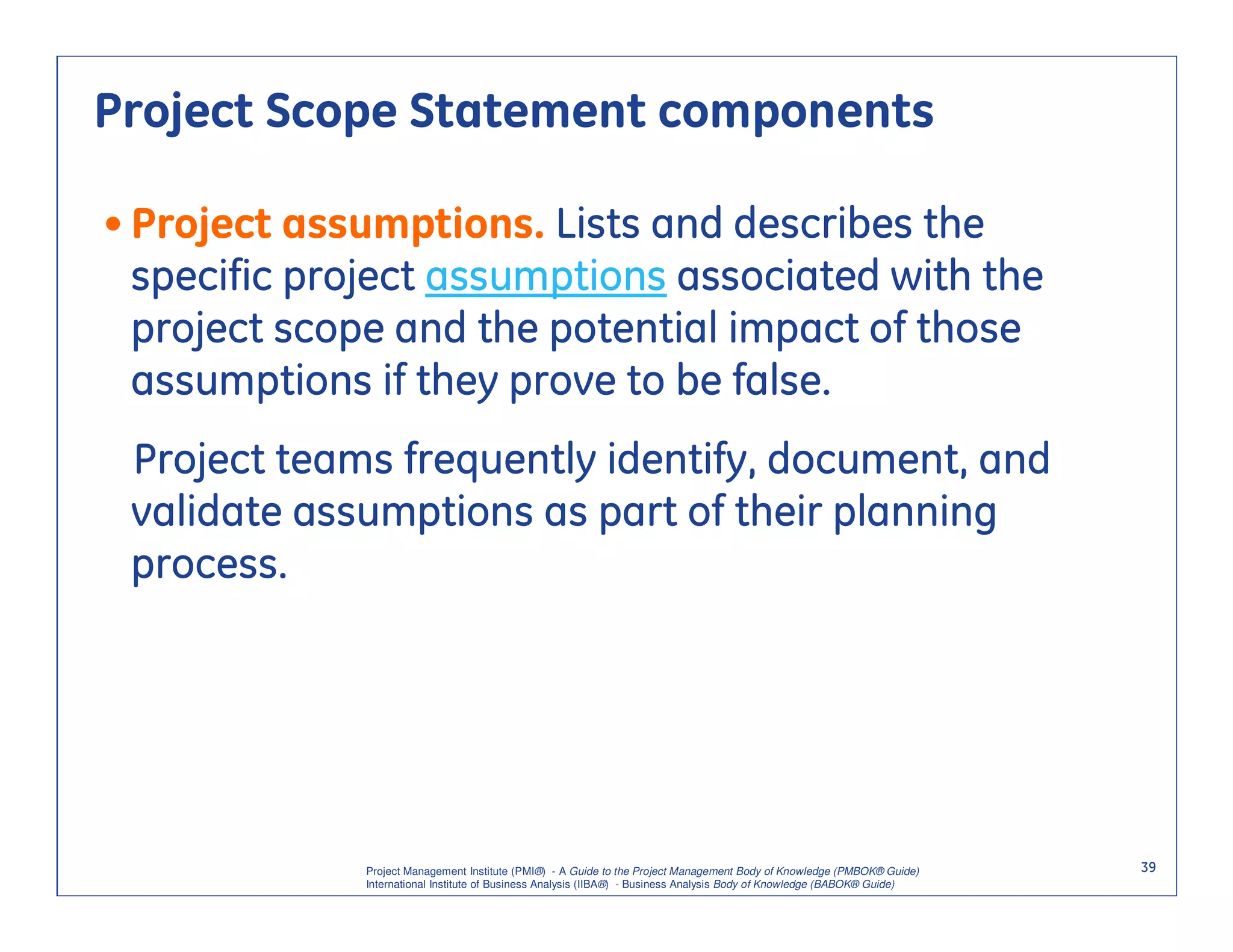
• Project assumptions. Lists and describes the
  specific project assumptions associated with the
  project scope and the potential impact of those
  assumptions if they prove to be false.
 Project teams frequently identify, document, and
 validate assumptions as part of their planning
 process.


             Project Management Institute (PMI®) - A Guide to the Project Management Body of Knowledge (PMBOK® Guide)    39
             International Institute of Business Analysis (IIBA®) - Business Analysis Body of Knowledge (BABOK® Guide)

Project scope and requirements management

  • 1.
    Project Scope & ProductRequirements Management Sarath Sasikumar PMP, CBAP Mahindra Satyam Project Management Institute (PMI®) - A Guide to the Project Management Body of Knowledge (PMBOK® Guide) 1 International Institute of Business Analysis (IIBA®) - Business Analysis Body of Knowledge (BABOK® Guide)
  • 2.
    Project Scope Management Project Management Institute (PMI®) - A Guide to the Project Management Body of Knowledge (PMBOK® Guide) 2 International Institute of Business Analysis (IIBA®) - Business Analysis Body of Knowledge (BABOK® Guide)
  • 3.
    Product Requirements Management Project Management Institute (PMI®) - A Guide to the Project Management Body of Knowledge (PMBOK® Guide) 3 International Institute of Business Analysis (IIBA®) - Business Analysis Body of Knowledge (BABOK® Guide)
  • 4.
    Scope Management • Managingthe project scope is primarily concerned with defining and controlling what is and is not included in the project. PMI • Project Scope Management includes the processes required to ensure that the project includes all the work required, and only the work required, to complete the project successfully. PMI Project Management Institute (PMI®) - A Guide to the Project Management Body of Knowledge (PMBOK® Guide) 4 International Institute of Business Analysis (IIBA®) - Business Analysis Body of Knowledge (BABOK® Guide)
  • 5.
    Requirements Management ManagingRequirements is primarily concerned with the activities that control requirements development, including : • Requirements change control, • Requirements attributes definition, and • Requirements traceability.IIBA Project Management Institute (PMI®) - A Guide to the Project Management Body of Knowledge (PMBOK® Guide) 5 International Institute of Business Analysis (IIBA®) - Business Analysis Body of Knowledge (BABOK® Guide)
  • 6.
    Scope Management…contd • Itis the responsibility of the Project Manager to: • Ensure that the project scope is well defined. • Obtain project stakeholder buy-in. • Ensure that the change control process is followed. • Authorize and facilitate Business Analysis activities on the project. Project Management Institute (PMI®) - A Guide to the Project Management Body of Knowledge (PMBOK® Guide) 6 International Institute of Business Analysis (IIBA®) - Business Analysis Body of Knowledge (BABOK® Guide)
  • 7.
    Requirements Management ..contd Itis the responsibility of the Business Analyst to: • Ensure that the product requirements are well defined. • Ensure that requirements support the solution scope. • Seek Stakeholder approval for the gathered requirements. • Keep the Project Manager informed about any changes to requirements or solution scope. Project Management Institute (PMI®) - A Guide to the Project Management Body of Knowledge (PMBOK® Guide) 7 International Institute of Business Analysis (IIBA®) - Business Analysis Body of Knowledge (BABOK® Guide)
  • 8.
    Scope Management Plan Thedocument that describes : • How the project scope will be defined, developed, and verified. • How the work breakdown structure will be created and defined. • How the project scope will be managed and controlled by the project team. Project Management Institute (PMI®) - A Guide to the Project Management Body of Knowledge (PMBOK® Guide) 8 International Institute of Business Analysis (IIBA®) - Business Analysis Body of Knowledge (BABOK® Guide)
  • 9.
    Requirements Management Plan Thedocument that describes : • The approach to be taken to structure traceability. • Definitions of requirements attributes to be used. • Requirements prioritization process • Requirements and solution scope change process Project Management Institute (PMI®) - A Guide to the Project Management Body of Knowledge (PMBOK® Guide) 9 International Institute of Business Analysis (IIBA®) - Business Analysis Body of Knowledge (BABOK® Guide)
  • 10.
    Inputs, Tools &Techs, and Outputs Figure 6-1 Project Scope Management: Inputs, Tools, Techniques & Outputs Project Management Institute (PMI®) - A Guide to the Project Management Body of Knowledge (PMBOK® Guide) 10 International Institute of Business Analysis (IIBA®) - Business Analysis Body of Knowledge (BABOK® Guide)
  • 11.
    Roles and Responsibilities Whilethe Business Analyst is responsible for Requirements Management, the Project Manager is accountable for the success of the project. Project Management Institute (PMI®) - A Guide to the Project Management Body of Knowledge (PMBOK® Guide) 11 International Institute of Business Analysis (IIBA®) - Business Analysis Body of Knowledge (BABOK® Guide)
  • 12.
    The 5 ScopeManagement processes • Collect Requirements • Define Scope Planning process group. • Create WBS • Verify Scope Monitoring and Controlling process group. • Control Scope Project Management Institute (PMI®) - A Guide to the Project Management Body of Knowledge (PMBOK® Guide) 12 International Institute of Business Analysis (IIBA®) - Business Analysis Body of Knowledge (BABOK® Guide)
  • 13.
    PMBOK – BABOKMapping • Collect Requirements • Conduct Requirements Activity, Document Elicitation Results, Confirm Elicitation Results • Define Scope • Create Requirements Breakdown Structure • Create WBS • Verify Requirements, Validate Requirements • Verify Scope • Assess Proposed Solution, Validate Solution, • Control Scope Evaluate Solution Performance • Manage Solution scope & Requirements, Manage Requirements traceability Project Management Institute (PMI®) - A Guide to the Project Management Body of Knowledge (PMBOK® Guide) 13 International Institute of Business Analysis (IIBA®) - Business Analysis Body of Knowledge (BABOK® Guide)
  • 14.
    Collect Requirements -PMBOK Project Management Institute (PMI®) - A Guide to the Project Management Body of Knowledge (PMBOK® Guide) 14 International Institute of Business Analysis (IIBA®) - Business Analysis Body of Knowledge (BABOK® Guide)
  • 15.
    Collect Requirements -BABOK Project Management Institute (PMI®) - A Guide to the Project Management Body of Knowledge (PMBOK® Guide) 15 International Institute of Business Analysis (IIBA®) - Business Analysis Body of Knowledge (BABOK® Guide)
  • 16.
    Collect Requirements -techniques Project Management Institute (PMI®) - A Guide to the Project Management Body of Knowledge (PMBOK® Guide) 16 International Institute of Business Analysis (IIBA®) - Business Analysis Body of Knowledge (BABOK® Guide)
  • 17.
    Define Scope Project Management Institute (PMI®) - A Guide to the Project Management Body of Knowledge (PMBOK® Guide) 17 International Institute of Business Analysis (IIBA®) - Business Analysis Body of Knowledge (BABOK® Guide)
  • 18.
    Project Scope Statementcomponents • The project scope statement describes, in detail, the project’s deliverables and the work required to create those deliverables. • The project scope statement also provides a common understanding of the project scope among project stakeholders. Project Management Institute (PMI®) - A Guide to the Project Management Body of Knowledge (PMBOK® Guide) 18 International Institute of Business Analysis (IIBA®) - Business Analysis Body of Knowledge (BABOK® Guide)
  • 19.
    Project Scope Statementcomponents • Product scope description • Product acceptance criteria • Project deliverables • Project exclusions • Project constraints • Project assumptions • Project Risks - High level Project Management Institute (PMI®) - A Guide to the Project Management Body of Knowledge (PMBOK® Guide) 19 International Institute of Business Analysis (IIBA®) - Business Analysis Body of Knowledge (BABOK® Guide)
  • 20.
    Product Requirements Documentcomponents • As – Is and To-Be System summaries. • Product scope and boundaries • Functional and Data Requirements • User Interface Requirements • Performance and Operational Requirements • Safety and Legal Requirements • Assumptions and constraints Project Management Institute (PMI®) - A Guide to the Project Management Body of Knowledge (PMBOK® Guide) 20 International Institute of Business Analysis (IIBA®) - Business Analysis Body of Knowledge (BABOK® Guide)
  • 21.
    Create WBS Project Management Institute (PMI®) - A Guide to the Project Management Body of Knowledge (PMBOK® Guide) 21 International Institute of Business Analysis (IIBA®) - Business Analysis Body of Knowledge (BABOK® Guide)
  • 22.
    Work Breakdown Structure(WBS) • The Work Breakdown Structure (WBS) is the hierarchical breakdown that divides the project scope into definable work packages that can be more easily managed. • Provides a clean structure for project deliverables. • Straight forward way of identifying the appropriate level of detail for scope definition, ownership & managing the project. Project Management Institute (PMI®) - A Guide to the Project Management Body of Knowledge (PMBOK® Guide) 22 International Institute of Business Analysis (IIBA®) - Business Analysis Body of Knowledge (BABOK® Guide)
  • 23.
    How to createa WBS? Project Management Institute (PMI®) - A Guide to the Project Management Body of Knowledge (PMBOK® Guide) 23 International Institute of Business Analysis (IIBA®) - Business Analysis Body of Knowledge (BABOK® Guide)
  • 24.
    Work Breakdown Structure(WBS) • The WBS can be represented in a tabular or graphical format. • The WBS…. – Ensures that the entire scope of the project has been identified – Helps in the creation of the project schedule – Assists in resource estimation – Assists in cost estimation – Helps in risk identification Project Management Institute (PMI®) - A Guide to the Project Management Body of Knowledge (PMBOK® Guide) 24 International Institute of Business Analysis (IIBA®) - Business Analysis Body of Knowledge (BABOK® Guide)
  • 25.
    Sample WBS –By Component Project Management Institute (PMI®) - A Guide to the Project Management Body of Knowledge (PMBOK® Guide) 25 International Institute of Business Analysis (IIBA®) - Business Analysis Body of Knowledge (BABOK® Guide)
  • 26.
    Requirements Breakdown Structure- Agile Product Feature A Feature B Feature C Feature D Feature E Sub Feature A.A Sub Feature A.B Sub Feature A.C Sub Feature D.A Sub Feature D.B Story A Story B Project Management Institute (PMI®) - A Guide to the Project Management Body of Knowledge (PMBOK® Guide) 26 International Institute of Business Analysis (IIBA®) - Business Analysis Body of Knowledge (BABOK® Guide)
  • 27.
    Verify Scope Project Management Institute (PMI®) - A Guide to the Project Management Body of Knowledge (PMBOK® Guide) 27 International Institute of Business Analysis (IIBA®) - Business Analysis Body of Knowledge (BABOK® Guide)
  • 28.
    Verify Scope • VerifyScope is the process of formalizing acceptance of the completed project deliverables. • Verifying scope includes reviewing deliverables with the customer or sponsor to ensure that they are completed satisfactorily. • Obtaining formal acceptance of deliverables by the customer or sponsor. Project Management Institute (PMI®) - A Guide to the Project Management Body of Knowledge (PMBOK® Guide) 28 International Institute of Business Analysis (IIBA®) - Business Analysis Body of Knowledge (BABOK® Guide)
  • 29.
    Control Scope Project Management Institute (PMI®) - A Guide to the Project Management Body of Knowledge (PMBOK® Guide) 29 International Institute of Business Analysis (IIBA®) - Business Analysis Body of Knowledge (BABOK® Guide)
  • 30.
    Control Scope • ControlScope is the process of monitoring the status of the project and product scope and managing changes to the scope baseline. • Controlling the project scope ensures all requested changes and recommended corrective or preventive actions are processed through the Integrated Change Control process. • Project scope control is also used to manage the actual changes when they occur and is integrated with the other control processes. Project Management Institute (PMI®) - A Guide to the Project Management Body of Knowledge (PMBOK® Guide) 30 International Institute of Business Analysis (IIBA®) - Business Analysis Body of Knowledge (BABOK® Guide)
  • 31.
    Control Scope • Uncontrolledchanges are often referred to as project scope creep. • Change is inevitable, thereby mandating some type of change control process. Project Management Institute (PMI®) - A Guide to the Project Management Body of Knowledge (PMBOK® Guide) 31 International Institute of Business Analysis (IIBA®) - Business Analysis Body of Knowledge (BABOK® Guide)
  • 32.
    Influencing Project Dynamics Desired Sense Of Urgency Ability To Impact Cost Schedule Magnitude Cost of Scope changes & to Accelerate Sense Of Project Urgency Time - Project Lifecycle • Over time we lose the ability to impact cost and schedule • Cost of Scope changes & cost of accelerating the project increases over time • Sense of urgency increases as deadline approaches Project Management Institute (PMI®) - A Guide to the Project Management Body of Knowledge (PMBOK® Guide) 32 International Institute of Business Analysis (IIBA®) - Business Analysis Body of Knowledge (BABOK® Guide)
  • 33.
    Scope Creep What causesscope creep? • Unexpected Issues • Perfectionism – gold plating • Placating Stakeholders • Misunderstandings Scope creep could affect project cost, schedule and quality. Project Management Institute (PMI®) - A Guide to the Project Management Body of Knowledge (PMBOK® Guide) 33 International Institute of Business Analysis (IIBA®) - Business Analysis Body of Knowledge (BABOK® Guide)
  • 34.
    Scope Creep Impact ofScope Creep: • Late projects – Missed deadlines • Cost overruns - Loss of profit • Unhappy Customers - Loss of Business • Killed Projects – Shut Down Business • Career Killer! Project Management Institute (PMI®) - A Guide to the Project Management Body of Knowledge (PMBOK® Guide) 34 International Institute of Business Analysis (IIBA®) - Business Analysis Body of Knowledge (BABOK® Guide)
  • 35.
    References • AGuide to the Project Management Body Of Knowledge (PMBOK® Guide) - Fourth Edition ©2009 Project Management Institute. • A Guide to the Business Analysis Body Of Knowledge (BABOK® Guide) - Second Edition ©2009 International Institute of Business Analysis. • Practice Standard for Work Breakdown Structures—Second Edition ©2006 Project Management Institute Project Management Institute (PMI®) - A Guide to the Project Management Body of Knowledge (PMBOK® Guide) 35 International Institute of Business Analysis (IIBA®) - Business Analysis Body of Knowledge (BABOK® Guide)
  • 36.
    Back up Project ManagementInstitute (PMI®) - A Guide to the Project Management Body of Knowledge (PMBOK® Guide) 36 International Institute of Business Analysis (IIBA®) - Business Analysis Body of Knowledge (BABOK® Guide)
  • 37.
    Project Scope Statementcomponents • Product scope description. Progressively elaborates the characteristics of the product, service, or result described in the project charter and requirements documentation. • Product acceptance criteria. Defines the process and criteria for accepting completed products, services, or results. • Project deliverables. Deliverables include both the outputs that comprise the product or service of the project, as well as ancillary results, such as project management reports. Project Management Institute (PMI®) - A Guide to the Project Management Body of Knowledge (PMBOK® Guide) 37 International Institute of Business Analysis (IIBA®) - Business Analysis Body of Knowledge (BABOK® Guide)
  • 38.
    Project Scope Statementcomponents • Project exclusions. Generally identifies what is excluded as from the project. Explicitly stating what is out of scope for the project helps to manage stakeholders’ expectations. • Project constraints. Lists and describes the specific project constraints associated with the project scope that limits the team’s options. When a project is performed under contract, contractual provisions will generally be constraints. Project Management Institute (PMI®) - A Guide to the Project Management Body of Knowledge (PMBOK® Guide) 38 International Institute of Business Analysis (IIBA®) - Business Analysis Body of Knowledge (BABOK® Guide)
  • 39.
    Project Scope Statementcomponents • Project assumptions. Lists and describes the specific project assumptions associated with the project scope and the potential impact of those assumptions if they prove to be false. Project teams frequently identify, document, and validate assumptions as part of their planning process. Project Management Institute (PMI®) - A Guide to the Project Management Body of Knowledge (PMBOK® Guide) 39 International Institute of Business Analysis (IIBA®) - Business Analysis Body of Knowledge (BABOK® Guide)