CONSTRUCTIVISMCONSTRUCTIVISM
INDIVIDUAL AND SOCIALINDIVIDUAL AND SOCIAL
Submitted by PHYSICAL SCIENCESubmitted by PHYSICAL SCIENCE
Roshin AnieRoshin Anie
RoyRoy
OUR SINCERE THANKS TO OUR TEACHERS
Dr .Giby Geevarughese
Dr.Ancy A.S
CONSTRUCTIVISMCONSTRUCTIVISM
Constructivism suggests that the learner is much
more actively involved in a joint enterprise with
the teacher of creating (“constructivism”) new
meanings.
The theory of constructivism suggests that the
learners construct knowledge out of their
experiences.
CONSTRUCTIVISMCONSTRUCTIVISM
- A Learning Theory- A Learning Theory
 Learning is an active process in which a learner uses
sensory input and constructs meaning out of it.
 People learn to learn as they learn.
 The crucial action of constructing meaning is mental.
 Learning involves language.
 Learning is a social activity.
 Learning is contextual.
 One needs knowledge to learn.
 It takes time to learn.
 Motivation is a key component in learning.
TYPES OF CONSTRUCTIVISMTYPES OF CONSTRUCTIVISM
• Cognitive Constructivism.
or
Individual Constructivism.
• Social Constructivism.
COGNITIVE CONSTRUCTIVISMCOGNITIVE CONSTRUCTIVISM
• Cognitive constructivism also called as individual
constructivism emphasizes on individual, internal
construction of knowledge.
• Largely based on Piaget’s theory.
• Learners should be allowed to discover principles
through their own exploration rather than direct
instruction by the teacher.
COGNITIVE CONSTRUCTIVISM –COGNITIVE CONSTRUCTIVISM –
Classroom ProcessClassroom Process
COGNITIVE CONSTRUCTIVISM-
classroom process
Goes through
experience
Goes through
experience
Attains the
concepts
Evaluates and
feed back
Jointly decide
the content data
Learner
Teacher
SOCIAL CONSTRUCTIVISMSOCIAL CONSTRUCTIVISM
• Knowledge exits in a social context and is
initially shared with others instead of being
represented solely in the mind of an individual.
• Based on Vygotsky’s theory.
SOCIAL CONSTRUCTIVISM –SOCIAL CONSTRUCTIVISM –
Classroom ProcessClassroom Process
SOCIAL CONSTRUCTIVISM-
classroom process
Principles in
activities &
discussion/ debate
Jointly decide the
content and
learning activities
Intervention
&
scaffolding
Intervention
& scaffolding
Evaluation
& feed back
Learner
Teacher
Activities
&
discussion
Activities
&
discussion
Attain the
concept
PRINCIPLES OFPRINCIPLES OF
CONSTRUCTIVISMCONSTRUCTIVISM
 Learners construct their own meaning.
 New learning builds on prior knowledge.
 Learning enhanced by social interaction.
 Meaningful learning develops through authentic
task.
LEARNING IMPACTS OFLEARNING IMPACTS OF
CONSTRUCTIVISMCONSTRUCTIVISM
• Curriculum : Constructivism calls for the elimination
of a standardized curriculum.
• Instruction : Teacher rely heavily on open ended
questions and promote extensive dialogue among
students.
• Assessment : Constructivism calls for the elimination
of grades and standardized testing.
FOUR EPISTEMOLOGICALFOUR EPISTEMOLOGICAL
ASSUMPTIONASSUMPTION
• Knowledge is PHYSICALLY constructed.
• Knowledge is SYMBOLICALLY constructed.
• Knowledge is SOCIALLY constructed.
• Knowledge is THEORETICALLY constructed.
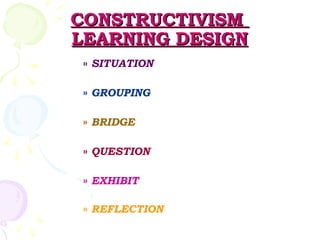
CONSTRUCTIVISMCONSTRUCTIVISM
LEARNING DESIGNLEARNING DESIGN
» SITUATION
» GROUPING
» BRIDGE
» QUESTION
» EXHIBIT
» REFLECTION
~ Physical Science Option

Constructivism

  • 1.
    CONSTRUCTIVISMCONSTRUCTIVISM INDIVIDUAL AND SOCIALINDIVIDUALAND SOCIAL Submitted by PHYSICAL SCIENCESubmitted by PHYSICAL SCIENCE Roshin AnieRoshin Anie RoyRoy
  • 2.
    OUR SINCERE THANKSTO OUR TEACHERS Dr .Giby Geevarughese Dr.Ancy A.S
  • 3.
    CONSTRUCTIVISMCONSTRUCTIVISM Constructivism suggests thatthe learner is much more actively involved in a joint enterprise with the teacher of creating (“constructivism”) new meanings. The theory of constructivism suggests that the learners construct knowledge out of their experiences.
  • 4.
    CONSTRUCTIVISMCONSTRUCTIVISM - A LearningTheory- A Learning Theory  Learning is an active process in which a learner uses sensory input and constructs meaning out of it.  People learn to learn as they learn.  The crucial action of constructing meaning is mental.  Learning involves language.  Learning is a social activity.  Learning is contextual.  One needs knowledge to learn.  It takes time to learn.  Motivation is a key component in learning.
  • 5.
    TYPES OF CONSTRUCTIVISMTYPESOF CONSTRUCTIVISM • Cognitive Constructivism. or Individual Constructivism. • Social Constructivism.
  • 6.
    COGNITIVE CONSTRUCTIVISMCOGNITIVE CONSTRUCTIVISM •Cognitive constructivism also called as individual constructivism emphasizes on individual, internal construction of knowledge. • Largely based on Piaget’s theory. • Learners should be allowed to discover principles through their own exploration rather than direct instruction by the teacher.
  • 7.
    COGNITIVE CONSTRUCTIVISM –COGNITIVECONSTRUCTIVISM – Classroom ProcessClassroom Process COGNITIVE CONSTRUCTIVISM- classroom process Goes through experience Goes through experience Attains the concepts Evaluates and feed back Jointly decide the content data Learner Teacher
  • 8.
    SOCIAL CONSTRUCTIVISMSOCIAL CONSTRUCTIVISM •Knowledge exits in a social context and is initially shared with others instead of being represented solely in the mind of an individual. • Based on Vygotsky’s theory.
  • 9.
    SOCIAL CONSTRUCTIVISM –SOCIALCONSTRUCTIVISM – Classroom ProcessClassroom Process SOCIAL CONSTRUCTIVISM- classroom process Principles in activities & discussion/ debate Jointly decide the content and learning activities Intervention & scaffolding Intervention & scaffolding Evaluation & feed back Learner Teacher Activities & discussion Activities & discussion Attain the concept
  • 10.
    PRINCIPLES OFPRINCIPLES OF CONSTRUCTIVISMCONSTRUCTIVISM Learners construct their own meaning.  New learning builds on prior knowledge.  Learning enhanced by social interaction.  Meaningful learning develops through authentic task.
  • 11.
    LEARNING IMPACTS OFLEARNINGIMPACTS OF CONSTRUCTIVISMCONSTRUCTIVISM • Curriculum : Constructivism calls for the elimination of a standardized curriculum. • Instruction : Teacher rely heavily on open ended questions and promote extensive dialogue among students. • Assessment : Constructivism calls for the elimination of grades and standardized testing.
  • 12.
    FOUR EPISTEMOLOGICALFOUR EPISTEMOLOGICAL ASSUMPTIONASSUMPTION •Knowledge is PHYSICALLY constructed. • Knowledge is SYMBOLICALLY constructed. • Knowledge is SOCIALLY constructed. • Knowledge is THEORETICALLY constructed.
  • 13.
    CONSTRUCTIVISMCONSTRUCTIVISM LEARNING DESIGNLEARNING DESIGN »SITUATION » GROUPING » BRIDGE » QUESTION » EXHIBIT » REFLECTION
  • 14.