IR SPECTROSCOPY
Aamna Tabassum
M.Pharm 1st year
INTRODUCTION
 IR Spectroscopy is one of the most powerful analytical technique which is used for chemical
identification of substances.
 We use specific range of electromagnetic spectrum i.e called IR radiation.
 One of the most important advantage of IR spectroscopy over the other methods are it provides useful
information about the structure of the molecule without evaluation.
 IR is useful for determination of organic and inorganic structure.
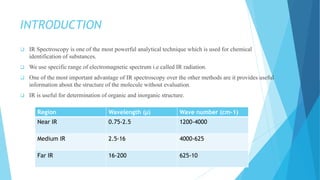
Region Wavelength (μ) Wave number (cm-1)
Near IR 0.75-2.5 1200-4000
Medium IR 2.5-16 4000-625
Far IR 16-200 625-10
PRINCIPLE
 Molecules are made up of atoms linked by chemical bonds. The movement of atoms and the chemical
bonds like vibration
 IR spectroscopy is related to vibrational and rotational energy of a molecule .
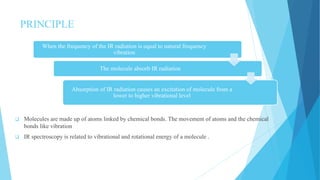
When the frequency of the IR radiation is equal to natural frequency
vibration
The molecule absorb IR radiation
Absorption of IR radiation causes an excitation of molecule from a
lower to higher vibrational level
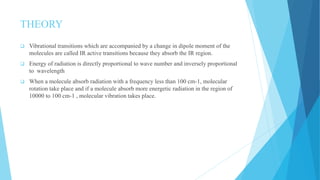
 Vibrational transitions which are accompanied by a change in dipole moment of the
molecules are called IR active transitions because they absorb the IR region.
 Energy of radiation is directly proportional to wave number and inversely proportional
to wavelength
 When a molecule absorb radiation with a frequency less than 100 cm-1, molecular
rotation take place and if a molecule absorb more energetic radiation in the region of
10000 to 100 cm-1 , molecular vibration takes place.
THEORY
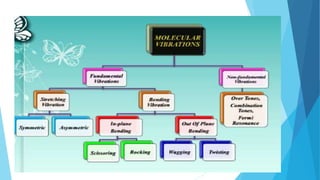
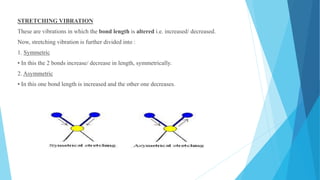
STRETCHING VIBRATION
These are vibrations in which the bond length is altered i.e. increased/ decreased.
Now, stretching vibration is further divided into :
1. Symmetric
• In this the 2 bonds increase/ decrease in length, symmetrically.
2. Asymmetric
• In this one bond length is increased and the other one decreases.
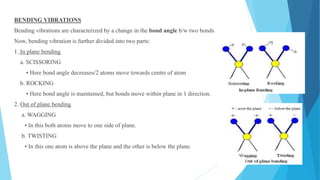
BENDING VIBRATIONS
Bending vibrations are characterized by a change in the bond angle b/w two bonds.
Now, bending vibration is further divided into two parts:
1. In plane bending
a. SCISSORING
• Here bond angle decreases/2 atoms move towards centre of atom
b. ROCKING
• Here bond angle is maintained, but bonds move within plane in 1 direction.
2. Out of plane bending
a. WAGGING
• In this both atoms move to one side of plane.
b. TWISTING
• In this one atom is above the plane and the other is below the plane.
FACTORS INFLUENCING VIBRATIONAL
FREQUENCIES
1. Coupled Vibrations
2. Electronic Effects
3. Hydrogen Bonding
4. Bond Angles
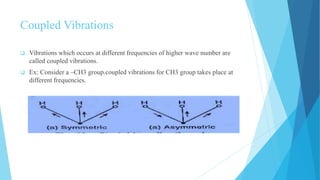
Coupled Vibrations
 Vibrations which occurs at different frequencies of higher wave number are
called coupled vibrations.
 Ex: Consider a –CH3 group.coupled vibrations for CH3 group takes place at
different frequencies.
ELECTRONIC EFFECTS
 Changes in the absorption frequencies for a particular group takes place when the substituents
next to that of a particular group are changed. The frequency shifts includes:
i. Inductive Effect
 Introduction of alkyl groups causes +I effect. It results in lengthening or weakening of the bond
 The introduction of electronegative atom causes –I effect. It results in the increase of bond order.
ii. Mesomeric Effect
iii. Field Effect
BOND ANGLES
 Difference in bond angles can also leads to the changes is absorption bands.
HYDROGEN BONDING
 Hydrogen bonding gives rise to downward frequency shifts.
 Stronger is the hydrogen bonding,greater is the absorption shift towards lower wave
numbers.
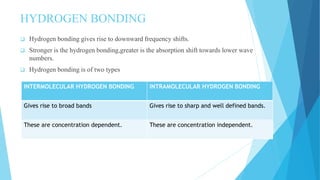
 Hydrogen bonding is of two types
INTERMOLECULAR HYDROGEN BONDING INTRAMOLECULAR HYDROGEN BONDING
Gives rise to broad bands Gives rise to sharp and well defined bands.
These are concentration dependent. These are concentration independent.
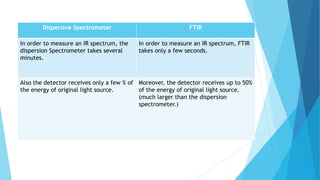
Dispersive Spectrometer FTIR
In order to measure an IR spectrum, the
dispersion Spectrometer takes several
minutes.
In order to measure an IR spectrum, FTIR
takes only a few seconds.
Also the detector receives only a few % of
the energy of original light source.
Moreover, the detector receives up to 50%
of the energy of original light source.
(much larger than the dispersion
spectrometer.)
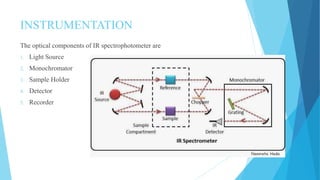
INSTRUMENTATION
The optical components of IR spectrophotometer are
1. Light Source
2. Monochromator
3. Sample Holder
4. Detector
5. Recorder
IR RADIATION SOURCE
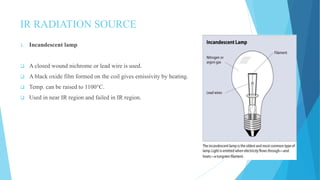
1. Incandescent lamp
 A closed wound nichrome or lead wire is used.
 A black oxide film formed on the coil gives emissivity by heating.
 Temp. can be raised to 1100°C.
 Used in near IR region and failed in IR region.
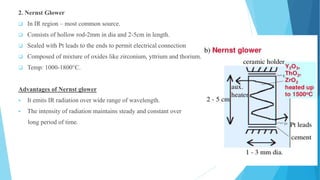
2. Nernst Glower
 In IR region – most common source.
 Consists of hollow rod-2mm in dia and 2-5cm in length.
 Sealed with Pt leads to the ends to permit electrical connection
 Composed of mixture of oxides like zirconium, yttrium and thorium.
 Temp: 1000-1800°C.
Advantages of Nernst glower
 It emits IR radiation over wide range of wavelength.
 The intensity of radiation maintains steady and constant over
long period of time.
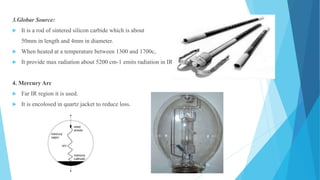
3.Globar Source:
 It is a rod of sintered silicon carbide which is about
50mm in length and 4mm in diameter.
 When heated at a temperature between 1300 and 1700c,
 It provide max radiation about 5200 cm-1 emits radiation in IR region.
4. Mercury Arc
 Far IR region it is used.
 It is encolosed in quartz jacket to reduce loss.
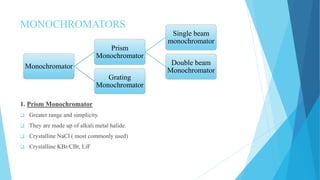
MONOCHROMATORS
1. Prism Monochromator
 Greater range and simplicity.
 They are made up of alkali metal halide.
 Crystalline NaCl ( most commonly used)
 Crystalline KBr/CBr, LiF
Monochromator
Prism
Monochromator
Single beam
monochromator
Double beam
Monochromator
Grating
Monochromator
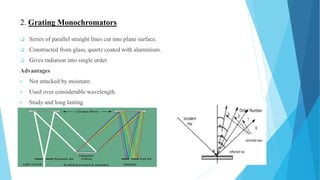
2. Grating Monochromators
 Series of parallel straight lines cut into plane surface.
 Constructed from glass, quartz coated with aluminium.
 Gives radiation into single order.
Advantages
 Not attacked by moisture.
 Used over considerable wavelength.
 Study and long lasting.
SAMPLE HANDLING
 Used for solid, liquid and gas.
 Material containing sample must be transperent to IR region.
 Sample cell constructed from rock salt.
 Sample must be pure and free from water.
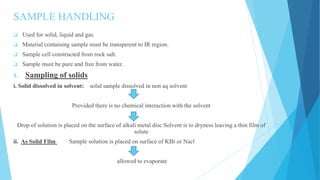
1. Sampling of solids
i. Solid dissolved in solvent: solid sample dissolved in non aq solvent
Provided there is no chemical interaction with the solvent
Drop of solution is placed on the surface of alkali metal disc Solvent is to dryness leaving a thin film of
solute
ii. As Solid Film Sample solution is placed on surface of KBr or Nacl
allowed to evaporate
iii. Mull technique
Solid sample mixed with nujol to form a paste.
This paste is then sandwiched between two salt plates
and used for spectral measurement.
iv. Pressed pellet technique:
Here finely ground solid sample is mixed with KBr.
The mixture is then passed under high pressure in a press to form a small pellet
IR radiation is passed through it.
2. Sampling of liquids:
 Samples that are liquids at room temperature are directly put into the cells
( sandwitch cell, demountable cell and cavity cell are used).
 which are made up of NaCl, KBr and their IR spectra are obtained directly.
3. Sampling of gases:
 The dried gases introduced via a stop cock.
 The gas sample is introduced into the gas cell made up of glass or metal cylinder of
about 10cm long.
 The end walls of the gas cell made up of NaCl.
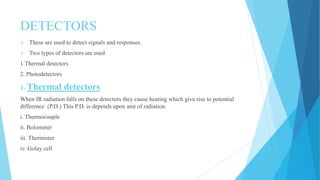
DETECTORS
 These are used to detect signals and responses.
 Two types of detectors are used
1.Thermal detectors
2. Photodetectors
1. Thermal detectors
When IR radiation falls on these detectors they cause heating which give rise to potential
difference (P.D.) This P.D. is depends upon amt of radiation.
i. Thermocouple
ii. Bolometer
iii. Thermister
iv. Golay cell
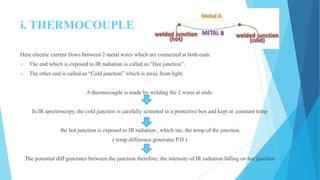
i. THERMOCOUPLE
Here electric current flows between 2 metal wires which are connected at both ends.
 The end which is exposed to IR radiation is called as “Hot junction”.
 The other end is called as “Cold junction” which is away from light.
A thermocouple is made by welding the 2 wires at ends.
In IR spectroscopy, the cold junction is carefully screened in a protective box and kept at constant temp
the hot junction is exposed to IR radiation , which inc. the temp of the junction.
( temp difference generates P.D.)
The potential diff generates between the junction therefore, the intensity of IR radiation falling on hot junction
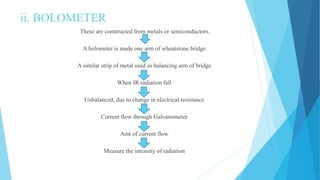
ii. BOLOMETER
These are constructed from metals or semiconductors.
A bolometer is made one arm of wheatstone bridge
A similar strip of metal used as balancing arm of bridge
When IR radiation fall
Unbalanced, due to change in electrical resistance
Current flow through Galvanometer
Amt of current flow
Measure the intensity of radiation
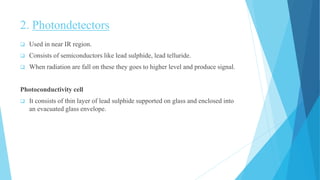
2. Photondetectors
 Used in near IR region.
 Consists of semiconductors like lead sulphide, lead telluride.
 When radiation are fall on these they goes to higher level and produce signal.
Photoconductivity cell
 It consists of thin layer of lead sulphide supported on glass and enclosed into
an evacuated glass envelope.
APPLICATIONS OF IR
1. Determination of purity of compounds.
2. Shape and symmetry of the compound.
3. In industry for detection of impurities, and to produce satisfactory products.
4. Identification of functional groups & structure elucidation of organic compounds.
5. Quantitative analysis of a number of organic compounds.
6. Study of covalent bonds in molecules.
7. Studying the progress of reactions.
8. Study the presence of water in a sample.
INTERPRETATION OF IR
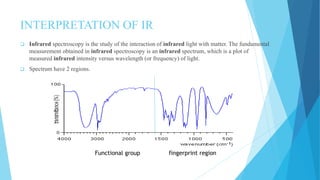
 Infrared spectroscopy is the study of the interaction of infrared light with matter. The fundamental
measurement obtained in infrared spectroscopy is an infrared spectrum, which is a plot of
measured infrared intensity versus wavelength (or frequency) of light.
 Spectrum have 2 regions.
Functional group fingerprint region
Peak
Shape
Broad
Sharp
Intensity
-Strong
-Medium
-Weak
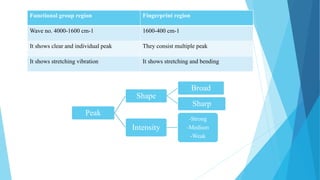
Functional group region Fingerprint region
Wave no. 4000-1600 cm-1 1600-400 cm-1
It shows clear and individual peak They consist multiple peak
It shows stretching vibration It shows stretching and bending

IR spectroscopy

  • 1.
  • 2.
    INTRODUCTION  IR Spectroscopyis one of the most powerful analytical technique which is used for chemical identification of substances.  We use specific range of electromagnetic spectrum i.e called IR radiation.  One of the most important advantage of IR spectroscopy over the other methods are it provides useful information about the structure of the molecule without evaluation.  IR is useful for determination of organic and inorganic structure. Region Wavelength (μ) Wave number (cm-1) Near IR 0.75-2.5 1200-4000 Medium IR 2.5-16 4000-625 Far IR 16-200 625-10
  • 3.
    PRINCIPLE  Molecules aremade up of atoms linked by chemical bonds. The movement of atoms and the chemical bonds like vibration  IR spectroscopy is related to vibrational and rotational energy of a molecule . When the frequency of the IR radiation is equal to natural frequency vibration The molecule absorb IR radiation Absorption of IR radiation causes an excitation of molecule from a lower to higher vibrational level
  • 4.
     Vibrational transitionswhich are accompanied by a change in dipole moment of the molecules are called IR active transitions because they absorb the IR region.  Energy of radiation is directly proportional to wave number and inversely proportional to wavelength  When a molecule absorb radiation with a frequency less than 100 cm-1, molecular rotation take place and if a molecule absorb more energetic radiation in the region of 10000 to 100 cm-1 , molecular vibration takes place. THEORY
  • 6.
    STRETCHING VIBRATION These arevibrations in which the bond length is altered i.e. increased/ decreased. Now, stretching vibration is further divided into : 1. Symmetric • In this the 2 bonds increase/ decrease in length, symmetrically. 2. Asymmetric • In this one bond length is increased and the other one decreases.
  • 7.
    BENDING VIBRATIONS Bending vibrationsare characterized by a change in the bond angle b/w two bonds. Now, bending vibration is further divided into two parts: 1. In plane bending a. SCISSORING • Here bond angle decreases/2 atoms move towards centre of atom b. ROCKING • Here bond angle is maintained, but bonds move within plane in 1 direction. 2. Out of plane bending a. WAGGING • In this both atoms move to one side of plane. b. TWISTING • In this one atom is above the plane and the other is below the plane.
  • 8.
    FACTORS INFLUENCING VIBRATIONAL FREQUENCIES 1.Coupled Vibrations 2. Electronic Effects 3. Hydrogen Bonding 4. Bond Angles
  • 9.
    Coupled Vibrations  Vibrationswhich occurs at different frequencies of higher wave number are called coupled vibrations.  Ex: Consider a –CH3 group.coupled vibrations for CH3 group takes place at different frequencies.
  • 10.
    ELECTRONIC EFFECTS  Changesin the absorption frequencies for a particular group takes place when the substituents next to that of a particular group are changed. The frequency shifts includes: i. Inductive Effect  Introduction of alkyl groups causes +I effect. It results in lengthening or weakening of the bond  The introduction of electronegative atom causes –I effect. It results in the increase of bond order. ii. Mesomeric Effect iii. Field Effect BOND ANGLES  Difference in bond angles can also leads to the changes is absorption bands.
  • 11.
    HYDROGEN BONDING  Hydrogenbonding gives rise to downward frequency shifts.  Stronger is the hydrogen bonding,greater is the absorption shift towards lower wave numbers.  Hydrogen bonding is of two types INTERMOLECULAR HYDROGEN BONDING INTRAMOLECULAR HYDROGEN BONDING Gives rise to broad bands Gives rise to sharp and well defined bands. These are concentration dependent. These are concentration independent.
  • 12.
    Dispersive Spectrometer FTIR Inorder to measure an IR spectrum, the dispersion Spectrometer takes several minutes. In order to measure an IR spectrum, FTIR takes only a few seconds. Also the detector receives only a few % of the energy of original light source. Moreover, the detector receives up to 50% of the energy of original light source. (much larger than the dispersion spectrometer.)
  • 13.
    INSTRUMENTATION The optical componentsof IR spectrophotometer are 1. Light Source 2. Monochromator 3. Sample Holder 4. Detector 5. Recorder
  • 14.
    IR RADIATION SOURCE 1.Incandescent lamp  A closed wound nichrome or lead wire is used.  A black oxide film formed on the coil gives emissivity by heating.  Temp. can be raised to 1100°C.  Used in near IR region and failed in IR region.
  • 15.
    2. Nernst Glower In IR region – most common source.  Consists of hollow rod-2mm in dia and 2-5cm in length.  Sealed with Pt leads to the ends to permit electrical connection  Composed of mixture of oxides like zirconium, yttrium and thorium.  Temp: 1000-1800°C. Advantages of Nernst glower  It emits IR radiation over wide range of wavelength.  The intensity of radiation maintains steady and constant over long period of time.
  • 16.
    3.Globar Source:  Itis a rod of sintered silicon carbide which is about 50mm in length and 4mm in diameter.  When heated at a temperature between 1300 and 1700c,  It provide max radiation about 5200 cm-1 emits radiation in IR region. 4. Mercury Arc  Far IR region it is used.  It is encolosed in quartz jacket to reduce loss.
  • 17.
    MONOCHROMATORS 1. Prism Monochromator Greater range and simplicity.  They are made up of alkali metal halide.  Crystalline NaCl ( most commonly used)  Crystalline KBr/CBr, LiF Monochromator Prism Monochromator Single beam monochromator Double beam Monochromator Grating Monochromator
  • 18.
    2. Grating Monochromators Series of parallel straight lines cut into plane surface.  Constructed from glass, quartz coated with aluminium.  Gives radiation into single order. Advantages  Not attacked by moisture.  Used over considerable wavelength.  Study and long lasting.
  • 19.
    SAMPLE HANDLING  Usedfor solid, liquid and gas.  Material containing sample must be transperent to IR region.  Sample cell constructed from rock salt.  Sample must be pure and free from water. 1. Sampling of solids i. Solid dissolved in solvent: solid sample dissolved in non aq solvent Provided there is no chemical interaction with the solvent Drop of solution is placed on the surface of alkali metal disc Solvent is to dryness leaving a thin film of solute ii. As Solid Film Sample solution is placed on surface of KBr or Nacl allowed to evaporate
  • 20.
    iii. Mull technique Solidsample mixed with nujol to form a paste. This paste is then sandwiched between two salt plates and used for spectral measurement. iv. Pressed pellet technique: Here finely ground solid sample is mixed with KBr. The mixture is then passed under high pressure in a press to form a small pellet IR radiation is passed through it.
  • 21.
    2. Sampling ofliquids:  Samples that are liquids at room temperature are directly put into the cells ( sandwitch cell, demountable cell and cavity cell are used).  which are made up of NaCl, KBr and their IR spectra are obtained directly. 3. Sampling of gases:  The dried gases introduced via a stop cock.  The gas sample is introduced into the gas cell made up of glass or metal cylinder of about 10cm long.  The end walls of the gas cell made up of NaCl.
  • 22.
    DETECTORS  These areused to detect signals and responses.  Two types of detectors are used 1.Thermal detectors 2. Photodetectors 1. Thermal detectors When IR radiation falls on these detectors they cause heating which give rise to potential difference (P.D.) This P.D. is depends upon amt of radiation. i. Thermocouple ii. Bolometer iii. Thermister iv. Golay cell
  • 23.
    i. THERMOCOUPLE Here electriccurrent flows between 2 metal wires which are connected at both ends.  The end which is exposed to IR radiation is called as “Hot junction”.  The other end is called as “Cold junction” which is away from light. A thermocouple is made by welding the 2 wires at ends. In IR spectroscopy, the cold junction is carefully screened in a protective box and kept at constant temp the hot junction is exposed to IR radiation , which inc. the temp of the junction. ( temp difference generates P.D.) The potential diff generates between the junction therefore, the intensity of IR radiation falling on hot junction
  • 24.
    ii. BOLOMETER These areconstructed from metals or semiconductors. A bolometer is made one arm of wheatstone bridge A similar strip of metal used as balancing arm of bridge When IR radiation fall Unbalanced, due to change in electrical resistance Current flow through Galvanometer Amt of current flow Measure the intensity of radiation
  • 25.
    2. Photondetectors  Usedin near IR region.  Consists of semiconductors like lead sulphide, lead telluride.  When radiation are fall on these they goes to higher level and produce signal. Photoconductivity cell  It consists of thin layer of lead sulphide supported on glass and enclosed into an evacuated glass envelope.
  • 26.
    APPLICATIONS OF IR 1.Determination of purity of compounds. 2. Shape and symmetry of the compound. 3. In industry for detection of impurities, and to produce satisfactory products. 4. Identification of functional groups & structure elucidation of organic compounds. 5. Quantitative analysis of a number of organic compounds. 6. Study of covalent bonds in molecules. 7. Studying the progress of reactions. 8. Study the presence of water in a sample.
  • 27.
    INTERPRETATION OF IR Infrared spectroscopy is the study of the interaction of infrared light with matter. The fundamental measurement obtained in infrared spectroscopy is an infrared spectrum, which is a plot of measured infrared intensity versus wavelength (or frequency) of light.  Spectrum have 2 regions. Functional group fingerprint region
  • 28.
    Peak Shape Broad Sharp Intensity -Strong -Medium -Weak Functional group regionFingerprint region Wave no. 4000-1600 cm-1 1600-400 cm-1 It shows clear and individual peak They consist multiple peak It shows stretching vibration It shows stretching and bending

Editor's Notes

  • #17 3 globar is less intense then nernest glower