:
the ancient art and science of
position fixing
Created by:
Student of IAN 409
Anastasiia Kovalova
Kiev-2015
The science of Astronomy studies the positions and motions of
celestial bodies and seeks to understand and explain their
physical properties.
Navigational astronomy deals with their coordinates, time, and
motions.
Celestial navigation - a set of methods for the determination
of navigation parameters of the object, based on the use of
electromagnetic radiation of astronomical objects.
It is used to determine the course and navigational
coordinates at ground targets, as well as to determine the
orientation of the aircraft.
NorthPolar
Constellations
Camelopardus
Cassiopeia
Cepheus
Draco
Ursa Major
Ursa Minor
SouthPolar
Constellations
Pavo
Triangulum
Australe
Tucana
Volans
Hydrus
Mensa
Musca
Norma
Octans
Apus
Chamaeleon
Circinus
Crux
Dorado
— that half of the Earth which is east of the 0° line of
longitude (Greenwich Meridian). — that half of the Earth which is west of the 0° line of
longitude (Greenwich Meridian).
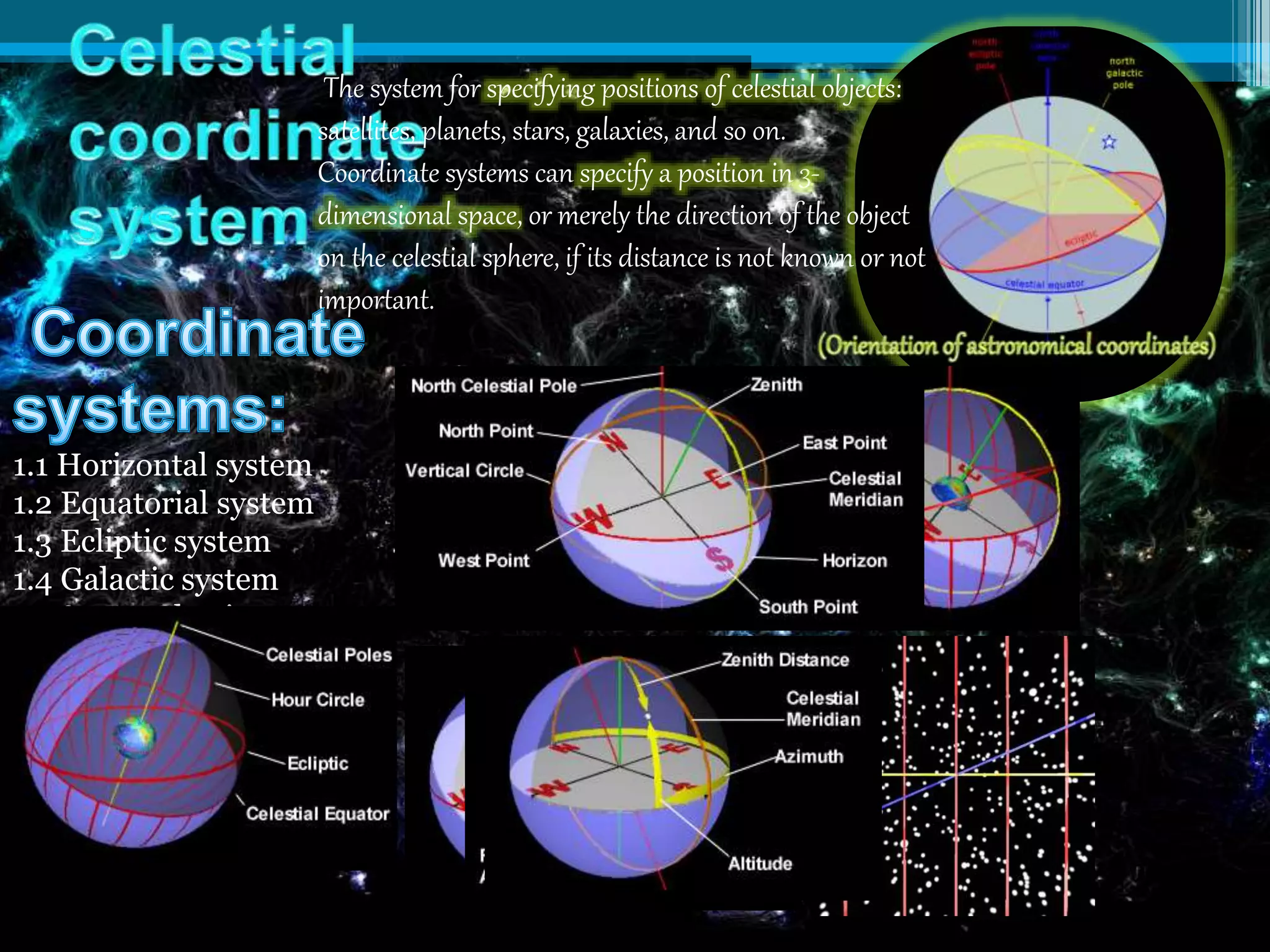
The system for specifying positions of celestial objects:
satellites, planets, stars, galaxies, and so on.
Coordinate systems can specify a position in 3-
dimensional space, or merely the direction of the object
on the celestial sphere, if its distance is not known or not
important.
1.1 Horizontal system
1.2 Equatorial system
1.3 Ecliptic system
1.4 Galactic system
1.5 Supergalactic system
Photoelectric servo systems
(Photoelectric magnitude)
(The Yearbook of Aviation Astronomy)Photometers
(Visual magnitude)
To address the daily visibility of stars can
be used difference maxima of radiation
spectra of the stars and the Earth's
atmosphere.
With an increase in the wavelength of the
radiation intensity of the atmosphere
decreases rapidly.
At the same time the radiation spectra a
fairly large number of stars have a
significant long-wave, infrared component.
The use of servo devices,
photocells that are sensitive to
infrared rays, and optical filters
that absorb blue rays will allow
to allocate these "infra-red"
stars and watch them
sustainably in a day flight.
Radio sextant
(radio signals magnitude of celestial bodies)
TELEVISION AND
RADIOLOGICAL DF SYSTEM
The image forming areas of starry sky
The determining the position of the horizon line
The DF of luminaries
Is a very ancient astronomical
computer for solving problems relating
to time and the position of the Sun and
stars in the sky.
to show how the sky looks at a specific
place at a given time;
done by drawing the sky on the face of
the astrolabe and marking it so positions in
the sky are easy to find;
locating and predicting the positions of
the Sun, Moon, planets, and stars;
the astrolabe and the mariner's
astrolabe:
for determining latitude on land;
for use on the heaving deck of a ship
or in wind.
"star-taker"
Rising Sign is in 14 Degrees
Sagittarius
Sun is in 25 Degrees Libra.
Moon is in 07 Degrees
Capricorn.
Mercury is in 08 Degrees
Libra.
Venus is in 09 Degrees
Virgo.
Mars is in 15 Degrees Virgo.
Jupiter is in 14 Degrees
Virgo.
Saturn is in 02 Degrees
Sagittarius.
Uranus is in 18 Degrees
Aries.
Neptune is in 07 Degrees
Pisces.
Pluto is in 13 Degrees
Capricorn.
N. Node is in 00 Degrees
Libra.
The doubly reflecting navigation
instrument used
to measure the angle between any two
visible objects.
The sextant makes use of two mirrors.
Mirror A is half-silvered, which allows some light to
pass through.
In navigating, you look at the horizon
through this mirror.
Mirror B in the diagram is attached to a movable
arm.
Light from an object (the sun), reflects off this
mirror.
The arm can be moved to a position where the
sun's reflection off the mirror also reflects off mirror A
and through the eyepiece.
What you see when this happens is one
object (the sun) superimposed on the other (the
horizon).
The angle between the two objects is
then read off the scale.
What makes sextant impractical for
modern air travel ?
Are sextants could be found in any
cockpits today?
Can a sextant be used while?
Navigational instrument for giving directional
bearings from the centre of the earth to a
particular star.~Can predict true north rather
than magnetic north.
~The use of astrocompass in
determining the exact direction of true
north requires the accurate information of
time, date, longitudinal and latitudinal
location.
Getting the local time (by means of
a clock)
Setting the latitude
Setting (in the alidade) the
star's local hour angle (LHA) for that
day obtained by means of tables or a
computer program
Pointing the compass pinnula to the
star (sun or moon)
Reading the true course on the limb
- the instrument's arc is one eighth of a
circle;
-reflecting quadrant derives from the
instrument using mirrors to reflect the
path of light to the observer and doubles
the angle measured;
Celestial Navigation Instuctor
The bubble
octant
From the early 1930s
through the end of the
1950s, several types of
civilian and military bubble
octant instruments were
produced for use aboard
aircraft.
Thesightwaseasyto alignbecausethe
horizonandthestarseemto move
togetherastheshippitchedandrolled
It does nothing more than simply receives signals.
It's the applied technology that gives GPSits versatility.
Aviation GPS units are sophisticated and specialized.
The principles involved are the same as any standard
system but the software is much more highly developed.
The GPS constellation consists of 24 non-geosynchronous
satellites and is designed so that a minimum of five are
always in view by a user anywhere on Earth.
Three satellites provide the intersection point and the fourth is
used to check that the positioning is accurate.
.
The GPS receiver needs at least four
satellites to give a three-dimensional
position (latitude, longitude, and
altitude).
The GPS software interprets the
signal, identifying the satellite that it
came from, where it was located, and
the time that it took for the signal to
reach the system.
Celestial navigation

Celestial navigation

  • 1.
    : the ancient artand science of position fixing Created by: Student of IAN 409 Anastasiia Kovalova Kiev-2015
  • 2.
    The science ofAstronomy studies the positions and motions of celestial bodies and seeks to understand and explain their physical properties. Navigational astronomy deals with their coordinates, time, and motions. Celestial navigation - a set of methods for the determination of navigation parameters of the object, based on the use of electromagnetic radiation of astronomical objects. It is used to determine the course and navigational coordinates at ground targets, as well as to determine the orientation of the aircraft.
  • 5.
    NorthPolar Constellations Camelopardus Cassiopeia Cepheus Draco Ursa Major Ursa Minor SouthPolar Constellations Pavo Triangulum Australe Tucana Volans Hydrus Mensa Musca Norma Octans Apus Chamaeleon Circinus Crux Dorado —that half of the Earth which is east of the 0° line of longitude (Greenwich Meridian). — that half of the Earth which is west of the 0° line of longitude (Greenwich Meridian).
  • 7.
    The system forspecifying positions of celestial objects: satellites, planets, stars, galaxies, and so on. Coordinate systems can specify a position in 3- dimensional space, or merely the direction of the object on the celestial sphere, if its distance is not known or not important. 1.1 Horizontal system 1.2 Equatorial system 1.3 Ecliptic system 1.4 Galactic system 1.5 Supergalactic system
  • 8.
    Photoelectric servo systems (Photoelectricmagnitude) (The Yearbook of Aviation Astronomy)Photometers (Visual magnitude) To address the daily visibility of stars can be used difference maxima of radiation spectra of the stars and the Earth's atmosphere. With an increase in the wavelength of the radiation intensity of the atmosphere decreases rapidly. At the same time the radiation spectra a fairly large number of stars have a significant long-wave, infrared component. The use of servo devices, photocells that are sensitive to infrared rays, and optical filters that absorb blue rays will allow to allocate these "infra-red" stars and watch them sustainably in a day flight. Radio sextant (radio signals magnitude of celestial bodies) TELEVISION AND RADIOLOGICAL DF SYSTEM The image forming areas of starry sky The determining the position of the horizon line The DF of luminaries
  • 9.
    Is a veryancient astronomical computer for solving problems relating to time and the position of the Sun and stars in the sky. to show how the sky looks at a specific place at a given time; done by drawing the sky on the face of the astrolabe and marking it so positions in the sky are easy to find; locating and predicting the positions of the Sun, Moon, planets, and stars; the astrolabe and the mariner's astrolabe: for determining latitude on land; for use on the heaving deck of a ship or in wind. "star-taker"
  • 10.
    Rising Sign isin 14 Degrees Sagittarius Sun is in 25 Degrees Libra. Moon is in 07 Degrees Capricorn. Mercury is in 08 Degrees Libra. Venus is in 09 Degrees Virgo. Mars is in 15 Degrees Virgo. Jupiter is in 14 Degrees Virgo. Saturn is in 02 Degrees Sagittarius. Uranus is in 18 Degrees Aries. Neptune is in 07 Degrees Pisces. Pluto is in 13 Degrees Capricorn. N. Node is in 00 Degrees Libra.
  • 16.
    The doubly reflectingnavigation instrument used to measure the angle between any two visible objects. The sextant makes use of two mirrors. Mirror A is half-silvered, which allows some light to pass through. In navigating, you look at the horizon through this mirror. Mirror B in the diagram is attached to a movable arm. Light from an object (the sun), reflects off this mirror. The arm can be moved to a position where the sun's reflection off the mirror also reflects off mirror A and through the eyepiece. What you see when this happens is one object (the sun) superimposed on the other (the horizon). The angle between the two objects is then read off the scale. What makes sextant impractical for modern air travel ? Are sextants could be found in any cockpits today? Can a sextant be used while?
  • 17.
    Navigational instrument forgiving directional bearings from the centre of the earth to a particular star.~Can predict true north rather than magnetic north. ~The use of astrocompass in determining the exact direction of true north requires the accurate information of time, date, longitudinal and latitudinal location. Getting the local time (by means of a clock) Setting the latitude Setting (in the alidade) the star's local hour angle (LHA) for that day obtained by means of tables or a computer program Pointing the compass pinnula to the star (sun or moon) Reading the true course on the limb
  • 18.
    - the instrument'sarc is one eighth of a circle; -reflecting quadrant derives from the instrument using mirrors to reflect the path of light to the observer and doubles the angle measured; Celestial Navigation Instuctor The bubble octant From the early 1930s through the end of the 1950s, several types of civilian and military bubble octant instruments were produced for use aboard aircraft. Thesightwaseasyto alignbecausethe horizonandthestarseemto move togetherastheshippitchedandrolled
  • 19.
    It does nothingmore than simply receives signals. It's the applied technology that gives GPSits versatility. Aviation GPS units are sophisticated and specialized. The principles involved are the same as any standard system but the software is much more highly developed. The GPS constellation consists of 24 non-geosynchronous satellites and is designed so that a minimum of five are always in view by a user anywhere on Earth. Three satellites provide the intersection point and the fourth is used to check that the positioning is accurate. . The GPS receiver needs at least four satellites to give a three-dimensional position (latitude, longitude, and altitude). The GPS software interprets the signal, identifying the satellite that it came from, where it was located, and the time that it took for the signal to reach the system.