Gel
Chromatography
When an organic solvent is used as a mobile
phase, then it is tend to called as gel
permeation chromatography.
When an aqueous solution is used to
transport the sample through the column,
the technique is known as gel filtration
chromatography.
Advantages:
Very simple to performed
Not sensitive to eluant composition and its
temperature
Range of separation can be varied by varying the
contents of gel matrices
Gels are very stable and can be reused
Can be used to find shape also
Rapid, routine analysis
Identify high mass components even in low
concentration
Can analyze polydisperse samples
Branching studies can be done
Absolute molecular weights can be obtained
Drawbacks
There is a size window
Bad response for very small molecular weights
Standards are needed.
Sensitive for flow rate variation.
Internal standard should be used whenever
possible.
High Investment cost
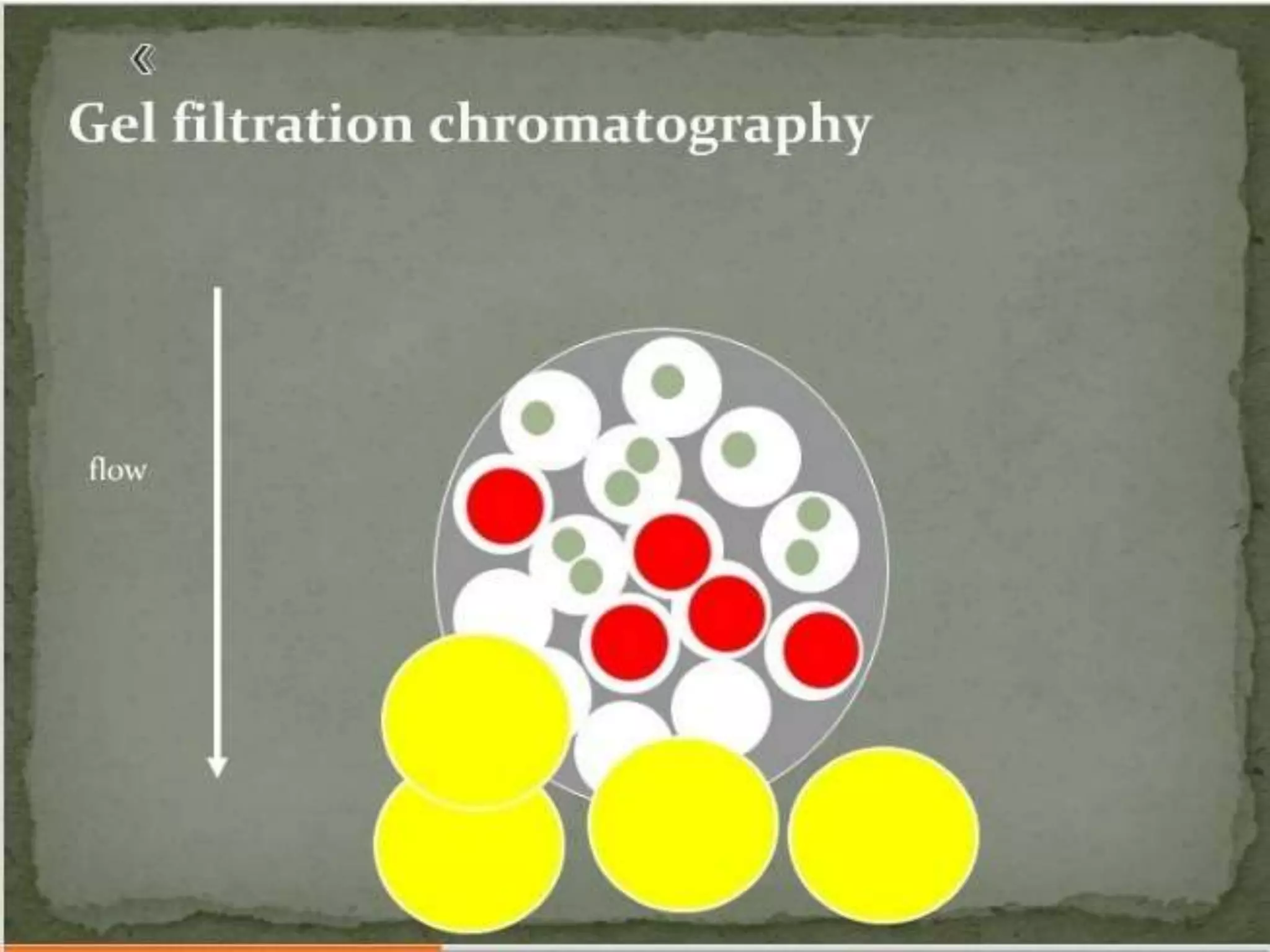
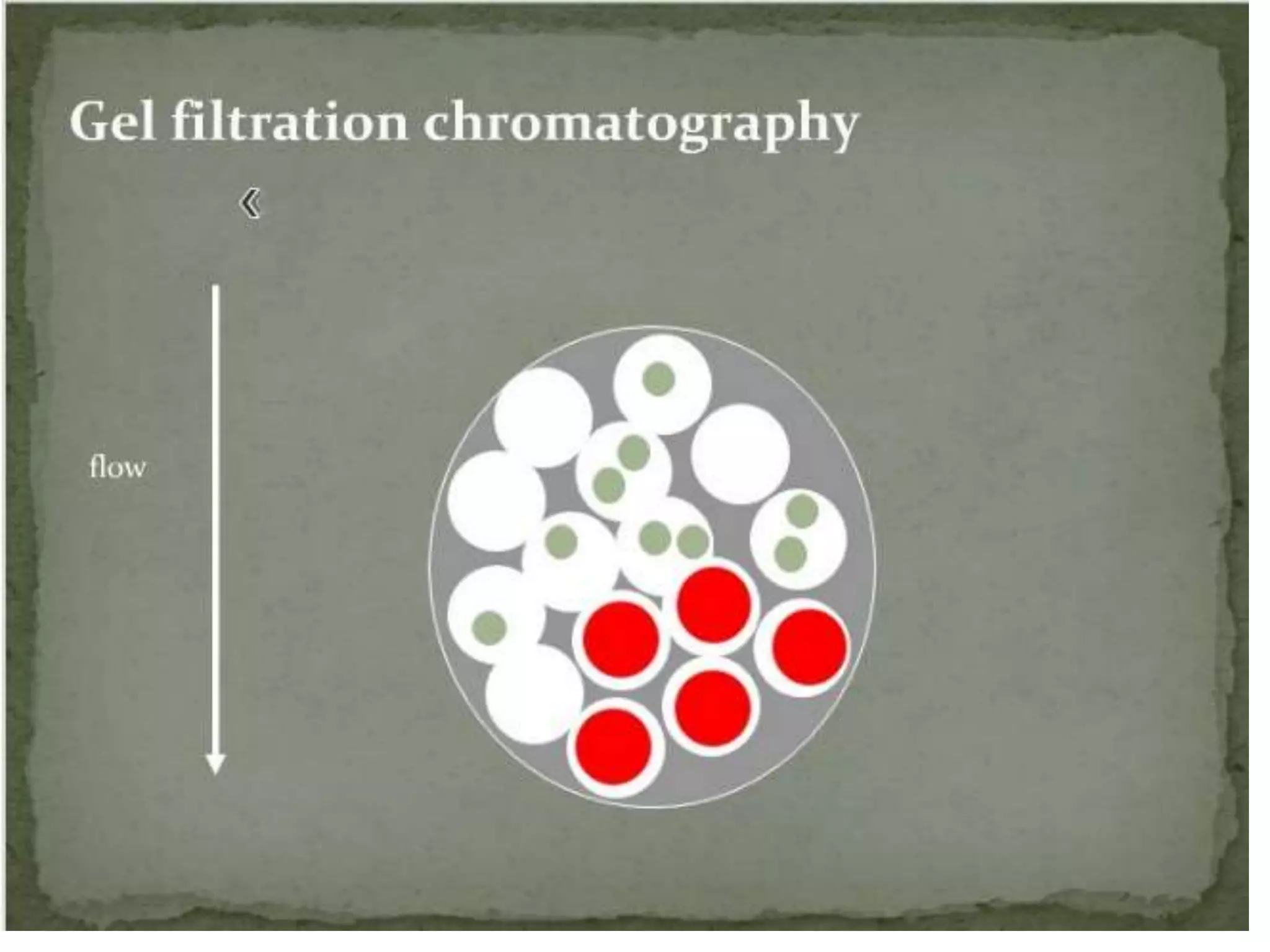
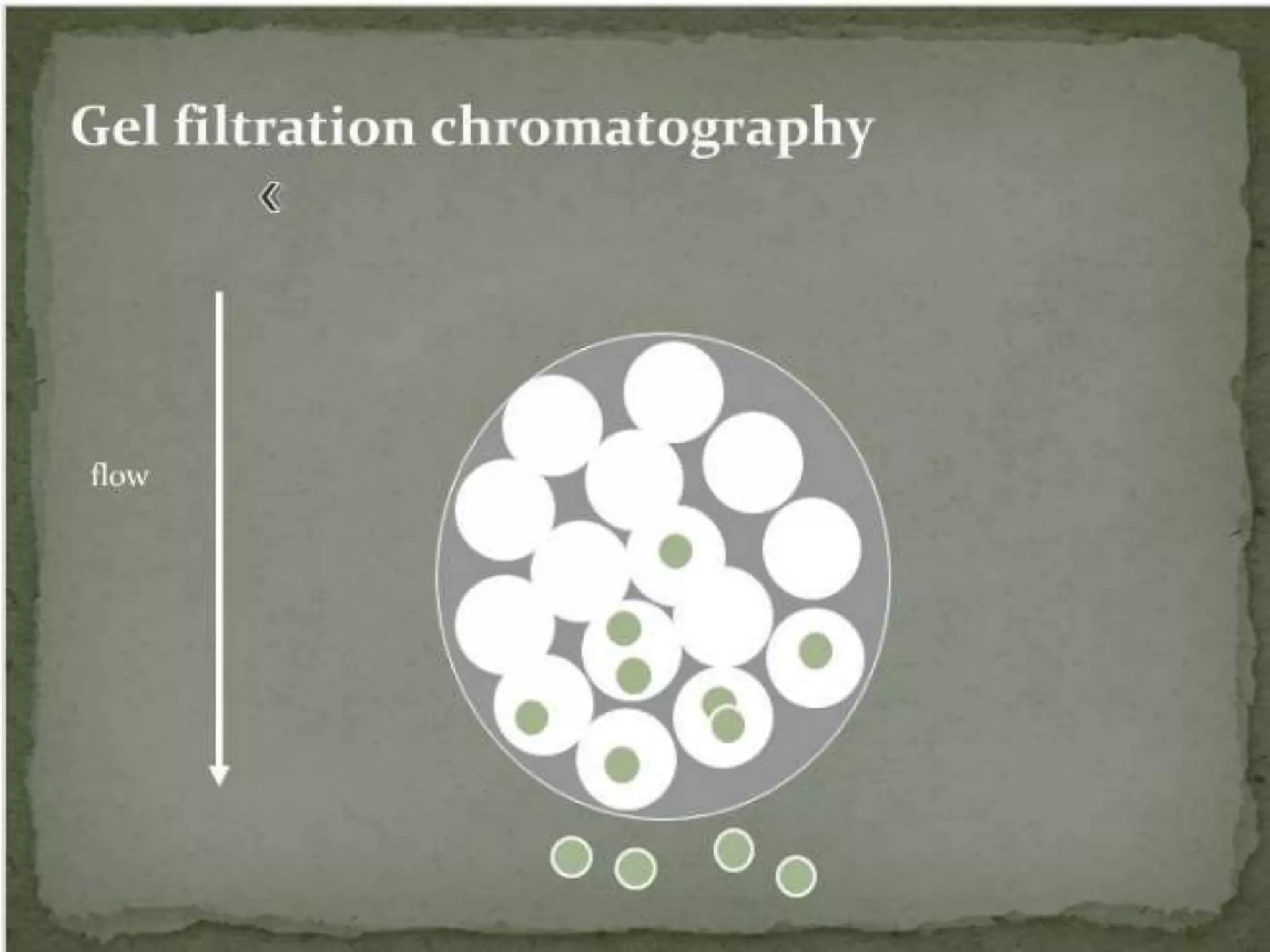
Different sizes will elute (filter) through at different rates.
Column consists of a hollow tube tightly packed with extremely small
porous polymer beads designed to have pores of different sizes. Pores
may be depressions on the surface or channels through the bead.
Smaller particles enter into the pores, larger particles don't. The larger
the particles, the less overall volume to traverse over the length of the
column, and the faster the elution.
Principle of separation
 It is a kind of chromatography technique based on
the difference of molecular weight and is one of the
effective and mild methods extensively used to
isolate and analyze the biomacromocular substances.
 The stationary phase consists of beads containing
pores that span a relatively narrow size range.
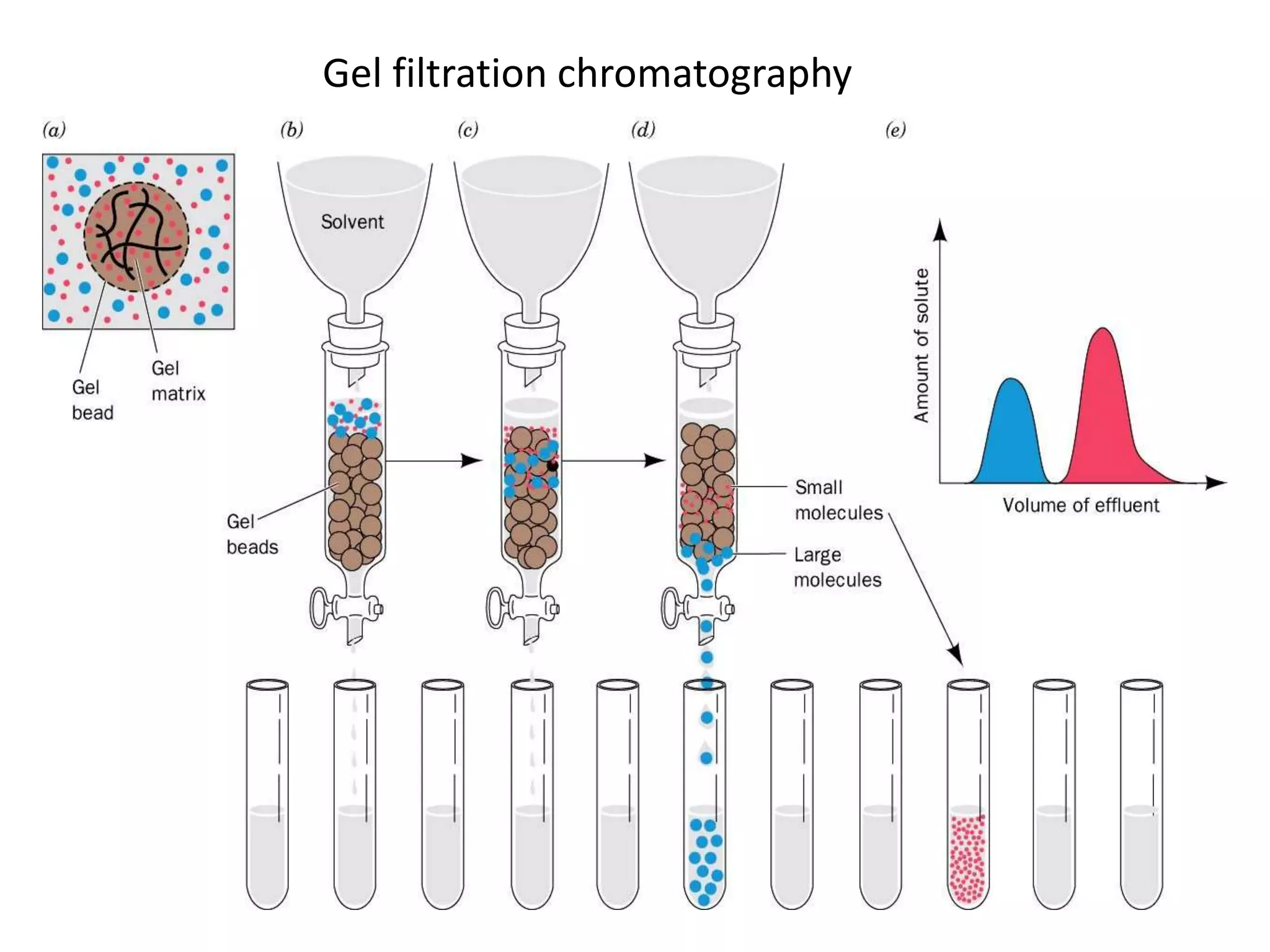
 When the gel is packed into a column and percolated
with a solvent, it permits the large molecular weight
compounds to pass rapidly without penetration of
the pores
 Smaller molecules spend more time inside the beads
than larger molecules and therefore elute later (after
a larger volume of mobile phase has passed through
the column).
Smaller molecules penetrate the particles to
varying extents depending upon their shape and
size, there is thus partition of the molecules
between the liquid inside the gel particles and
that outside, the smaller the molecules, the
larger the percentage of liquid within the
particles that is available to them. Molecules
therefore leave the column in the order of
decreasing molecular size, the large size will leave
the column first followed by the smaller sizes
depending on their partition (shape and size)
ranges
Gel filtration chromatography
• The molecular mass of the smallest molecule unable to
penetrate the pores of the gel is at the exclusion limit.
• The exclusion limit is a function of molecular shape, since
elongated molecules are less likely to penetrate a gel pore
than other shapes.
• Behavior of the molecule on the gel can be quantitatively
characterized.
Total bed volume of the column
Vt = Vx + V0
Vx = volume occupied by gel beads
V0 = volume of solvent space surrounding gel; Typically 35%
Gel filtration chromatography
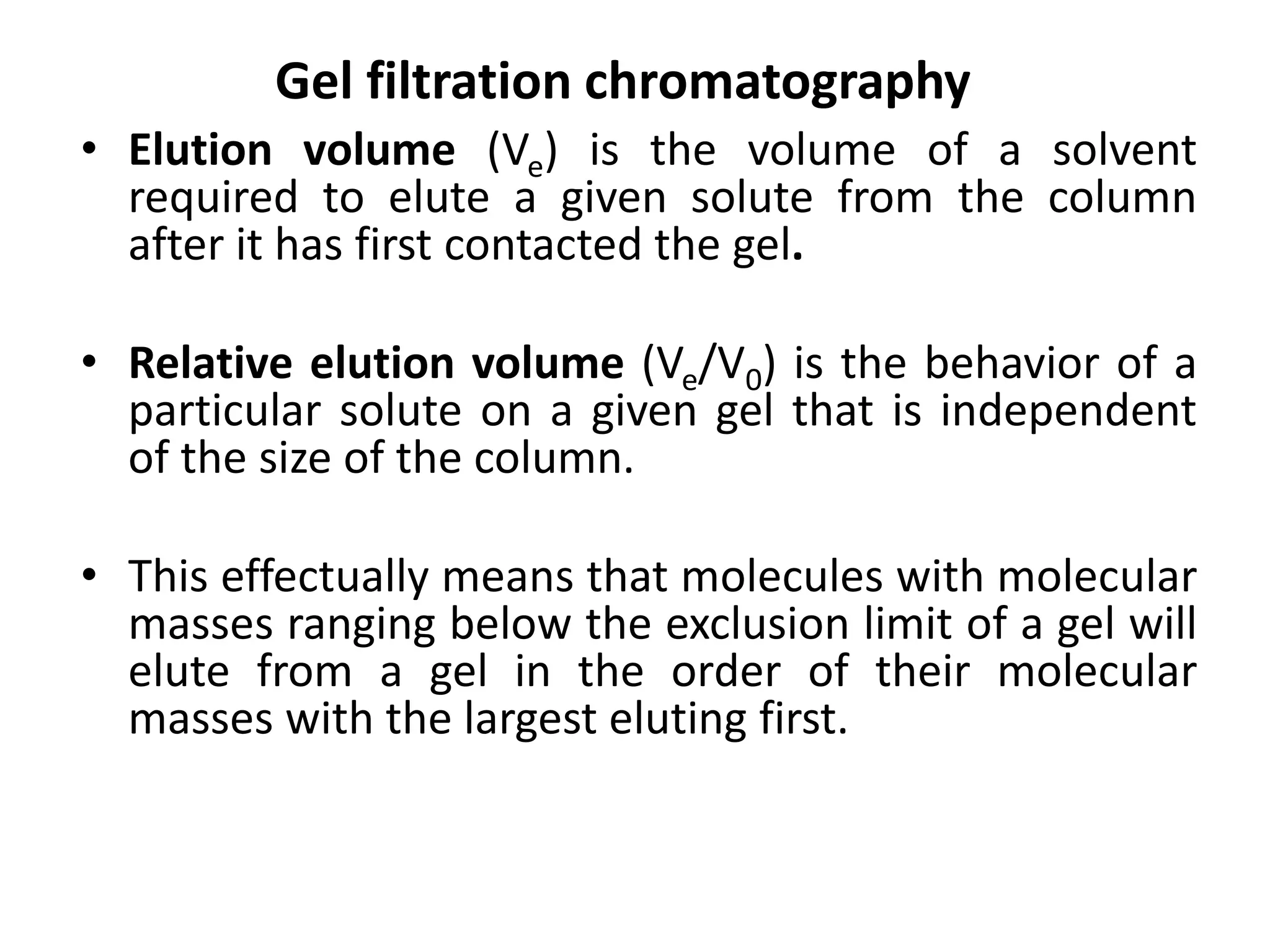
• Elution volume (Ve) is the volume of a solvent
required to elute a given solute from the column
after it has first contacted the gel.
• Relative elution volume (Ve/V0) is the behavior of a
particular solute on a given gel that is independent
of the size of the column.
• This effectually means that molecules with molecular
masses ranging below the exclusion limit of a gel will
elute from a gel in the order of their molecular
masses with the largest eluting first.
Nature of the gel
• Chemically inert
• Mechanically stable
• Ideal porous structure
• Wide pore size give low resolution
• Uniform particle size
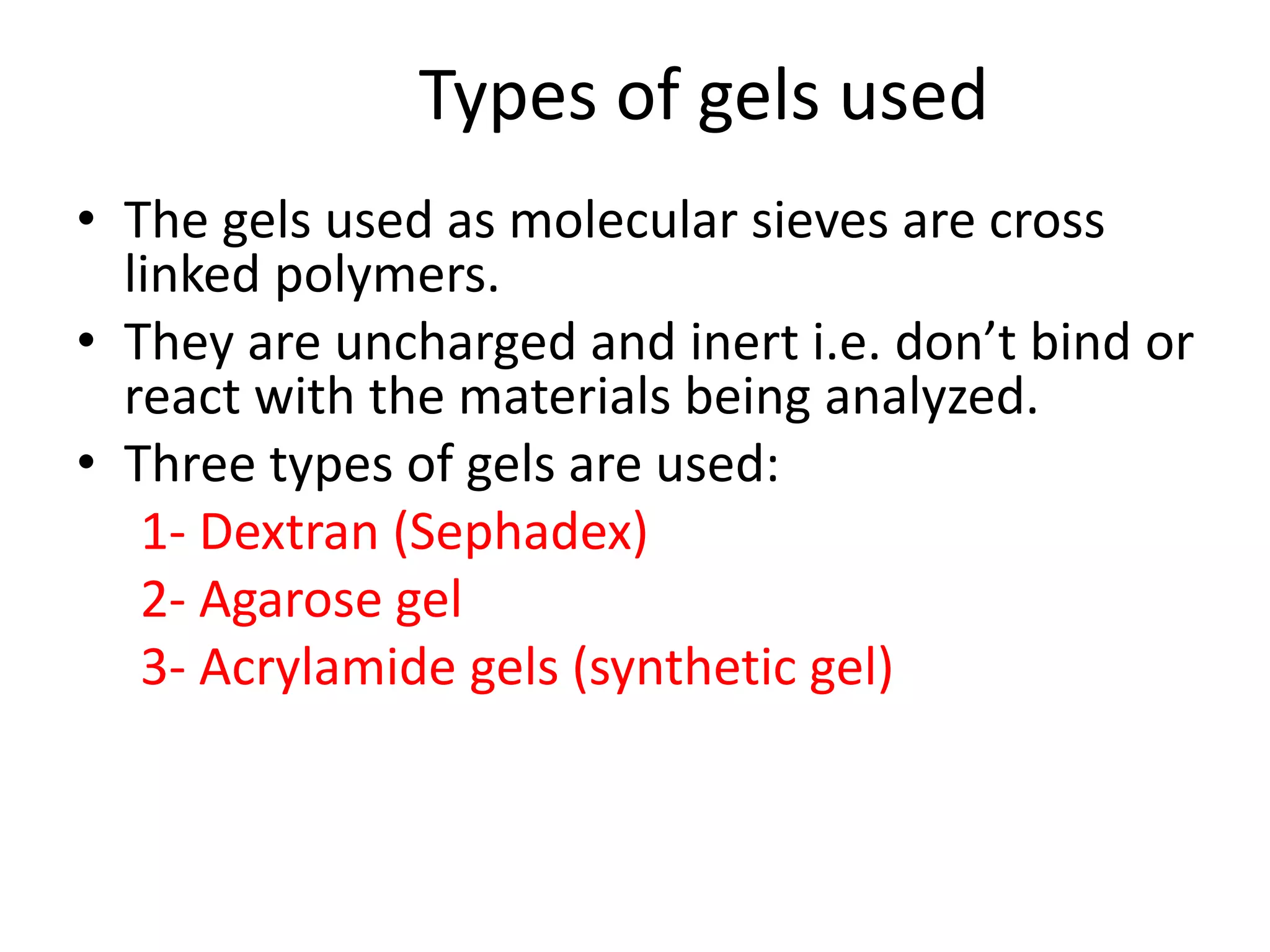
Types of gels used
• The gels used as molecular sieves are cross
linked polymers.
• They are uncharged and inert i.e. don’t bind or
react with the materials being analyzed.
• Three types of gels are used:
1- Dextran (Sephadex)
2- Agarose gel
3- Acrylamide gels (synthetic gel)
Types of gel:
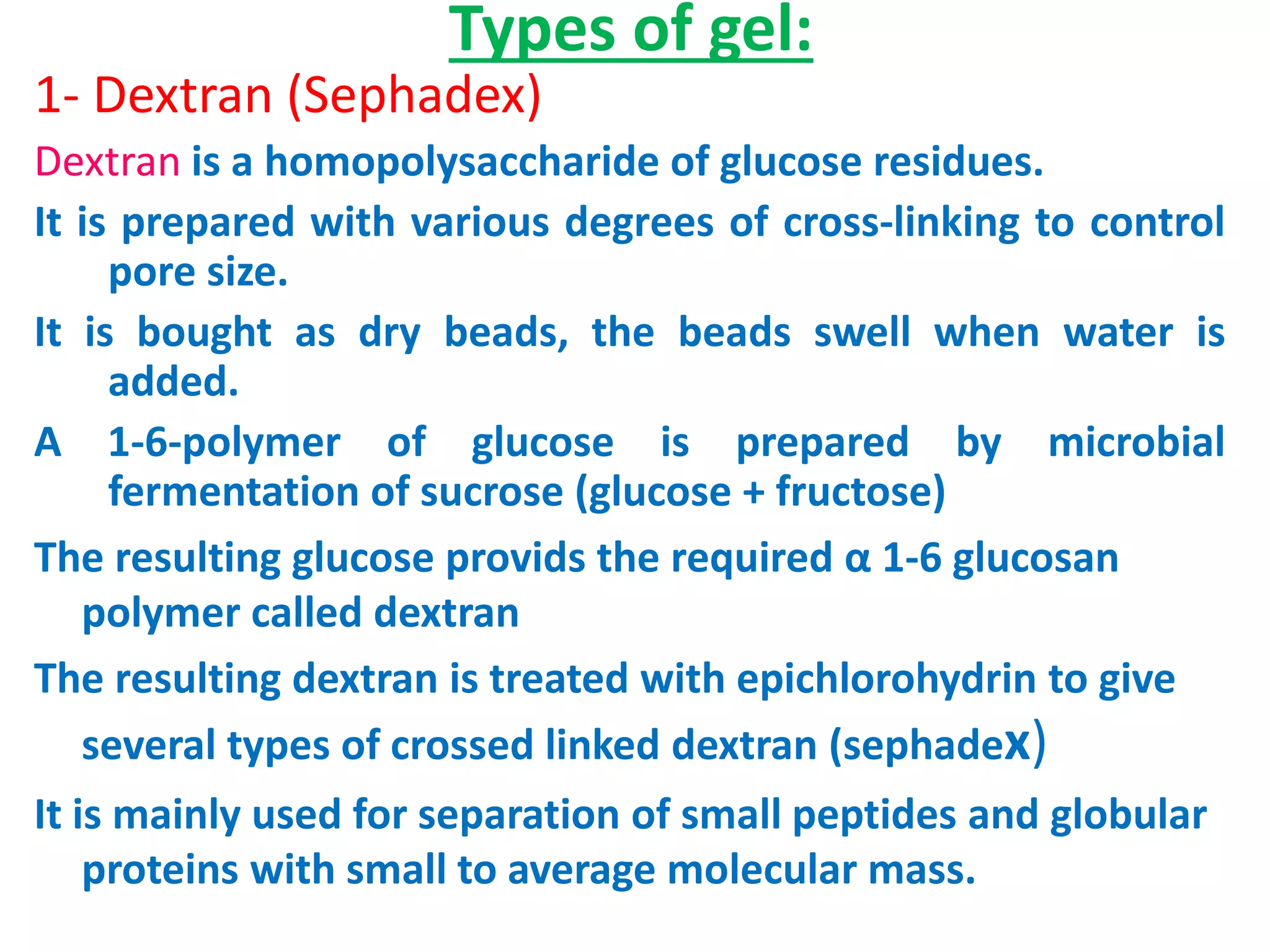
1- Dextran (Sephadex)
Dextran is a homopolysaccharide of glucose residues.
It is prepared with various degrees of cross-linking to control
pore size.
It is bought as dry beads, the beads swell when water is
added.
Α 1-6-polymer of glucose is prepared by microbial
fermentation of sucrose (glucose + fructose)
The resulting glucose provids the required α 1-6 glucosan
polymer called dextran
The resulting dextran is treated with epichlorohydrin to give
several types of crossed linked dextran (sephadex)
It is mainly used for separation of small peptides and globular
proteins with small to average molecular mass.
Gl-Gl-Gl
O
CH2
CH
CH2
OH
O
Gl-Gl-Gl n
Gl-Gl-Gl-
OH
Gl-Gl-Gl-
OH
+
CH2Cl
HOHC
CH2Cl
Sephadex
Sucrose
Microbial fermentation
Specific PH
Glucose + fructose
Dertan (a-1-6 glucosan polymer)
Cross linking
Sephadex is obtained in different degrees depending
on the pore size
High percentage of epichlorohydrin give high degree
of cross linking (small pore size)
Lower percentage produce sephadex with large pore
size
Characters of Sephadex
1- Highly stable gels
2- Stable at pH 2-12
3- Their particles are free from ions
4- Insoluble in water and organic solvent
5- They swell in water and other hydrophillic solvent
6- They require bactericidal such as Hg acetate
• 2- Agarose gel
• Obtained from agar and composed of
alternating units of 1,3 linked β-D-gal and 1,4
linked 3,6-anhydro-α, L-galactose
• This was subjected to epichlorohydrin to give
sepharose
Characters:
1- It dissolves in H2O at 50oC and on cooling
form gel
2- Insoluble below 40 oC
3- Freezing destroys the gel
3- Acrylamide gels (synthetic gel)
• It is not dextran polymer
• It is polymerized acrylamide or methylen-bis-acrylamide
NH
O O
NH
O
NH
NH
O
NH
O
H
N
O
n
The pore size is determined by the degree of cross-linking.
The separation properties of polyacrylamide gels are mainly
the same as those of dextrans.
They are sold as bio-gel P. They are available in wide range of
pore sizes.
Some Commonly Used Gel Filtration Materials
It is usually applied to large molecules or macromolecular
complexes such as proteins and industrial polymers
Application of gel filtration chromatography
1- Separation of large molecular weight compound
as protein, carbohydrate, peptides, nucleic acids
2- Desalting of colloids
Small size of contaminating salt will allow them to
diffuse inside the gel particles
E.g. Desalting of albumin from 25% ammonium
sulfate
3- Molecular weight determination
A linear relationship exists between the logarithm
of the molecular weight and the elution volume

Gel permeation chromatography copy

  • 1.
  • 5.
    When an organicsolvent is used as a mobile phase, then it is tend to called as gel permeation chromatography. When an aqueous solution is used to transport the sample through the column, the technique is known as gel filtration chromatography.
  • 6.
    Advantages: Very simple toperformed Not sensitive to eluant composition and its temperature Range of separation can be varied by varying the contents of gel matrices Gels are very stable and can be reused Can be used to find shape also Rapid, routine analysis Identify high mass components even in low concentration Can analyze polydisperse samples Branching studies can be done Absolute molecular weights can be obtained
  • 7.
    Drawbacks There is asize window Bad response for very small molecular weights Standards are needed. Sensitive for flow rate variation. Internal standard should be used whenever possible. High Investment cost
  • 9.
    Different sizes willelute (filter) through at different rates. Column consists of a hollow tube tightly packed with extremely small porous polymer beads designed to have pores of different sizes. Pores may be depressions on the surface or channels through the bead. Smaller particles enter into the pores, larger particles don't. The larger the particles, the less overall volume to traverse over the length of the column, and the faster the elution.
  • 10.
    Principle of separation It is a kind of chromatography technique based on the difference of molecular weight and is one of the effective and mild methods extensively used to isolate and analyze the biomacromocular substances.  The stationary phase consists of beads containing pores that span a relatively narrow size range.  When the gel is packed into a column and percolated with a solvent, it permits the large molecular weight compounds to pass rapidly without penetration of the pores  Smaller molecules spend more time inside the beads than larger molecules and therefore elute later (after a larger volume of mobile phase has passed through the column).
  • 11.
    Smaller molecules penetratethe particles to varying extents depending upon their shape and size, there is thus partition of the molecules between the liquid inside the gel particles and that outside, the smaller the molecules, the larger the percentage of liquid within the particles that is available to them. Molecules therefore leave the column in the order of decreasing molecular size, the large size will leave the column first followed by the smaller sizes depending on their partition (shape and size) ranges
  • 19.
  • 21.
    Gel filtration chromatography •The molecular mass of the smallest molecule unable to penetrate the pores of the gel is at the exclusion limit. • The exclusion limit is a function of molecular shape, since elongated molecules are less likely to penetrate a gel pore than other shapes. • Behavior of the molecule on the gel can be quantitatively characterized. Total bed volume of the column Vt = Vx + V0 Vx = volume occupied by gel beads V0 = volume of solvent space surrounding gel; Typically 35%
  • 22.
    Gel filtration chromatography •Elution volume (Ve) is the volume of a solvent required to elute a given solute from the column after it has first contacted the gel. • Relative elution volume (Ve/V0) is the behavior of a particular solute on a given gel that is independent of the size of the column. • This effectually means that molecules with molecular masses ranging below the exclusion limit of a gel will elute from a gel in the order of their molecular masses with the largest eluting first.
  • 34.
    Nature of thegel • Chemically inert • Mechanically stable • Ideal porous structure • Wide pore size give low resolution • Uniform particle size
  • 35.
    Types of gelsused • The gels used as molecular sieves are cross linked polymers. • They are uncharged and inert i.e. don’t bind or react with the materials being analyzed. • Three types of gels are used: 1- Dextran (Sephadex) 2- Agarose gel 3- Acrylamide gels (synthetic gel)
  • 36.
    Types of gel: 1-Dextran (Sephadex) Dextran is a homopolysaccharide of glucose residues. It is prepared with various degrees of cross-linking to control pore size. It is bought as dry beads, the beads swell when water is added. Α 1-6-polymer of glucose is prepared by microbial fermentation of sucrose (glucose + fructose) The resulting glucose provids the required α 1-6 glucosan polymer called dextran The resulting dextran is treated with epichlorohydrin to give several types of crossed linked dextran (sephadex) It is mainly used for separation of small peptides and globular proteins with small to average molecular mass.
  • 37.
  • 38.
    Sephadex is obtainedin different degrees depending on the pore size High percentage of epichlorohydrin give high degree of cross linking (small pore size) Lower percentage produce sephadex with large pore size Characters of Sephadex 1- Highly stable gels 2- Stable at pH 2-12 3- Their particles are free from ions 4- Insoluble in water and organic solvent 5- They swell in water and other hydrophillic solvent 6- They require bactericidal such as Hg acetate
  • 39.
    • 2- Agarosegel • Obtained from agar and composed of alternating units of 1,3 linked β-D-gal and 1,4 linked 3,6-anhydro-α, L-galactose • This was subjected to epichlorohydrin to give sepharose Characters: 1- It dissolves in H2O at 50oC and on cooling form gel 2- Insoluble below 40 oC 3- Freezing destroys the gel
  • 40.
    3- Acrylamide gels(synthetic gel) • It is not dextran polymer • It is polymerized acrylamide or methylen-bis-acrylamide NH O O NH O NH NH O NH O H N O n The pore size is determined by the degree of cross-linking. The separation properties of polyacrylamide gels are mainly the same as those of dextrans. They are sold as bio-gel P. They are available in wide range of pore sizes.
  • 42.
    Some Commonly UsedGel Filtration Materials
  • 43.
    It is usuallyapplied to large molecules or macromolecular complexes such as proteins and industrial polymers
  • 44.
    Application of gelfiltration chromatography 1- Separation of large molecular weight compound as protein, carbohydrate, peptides, nucleic acids 2- Desalting of colloids Small size of contaminating salt will allow them to diffuse inside the gel particles E.g. Desalting of albumin from 25% ammonium sulfate 3- Molecular weight determination A linear relationship exists between the logarithm of the molecular weight and the elution volume