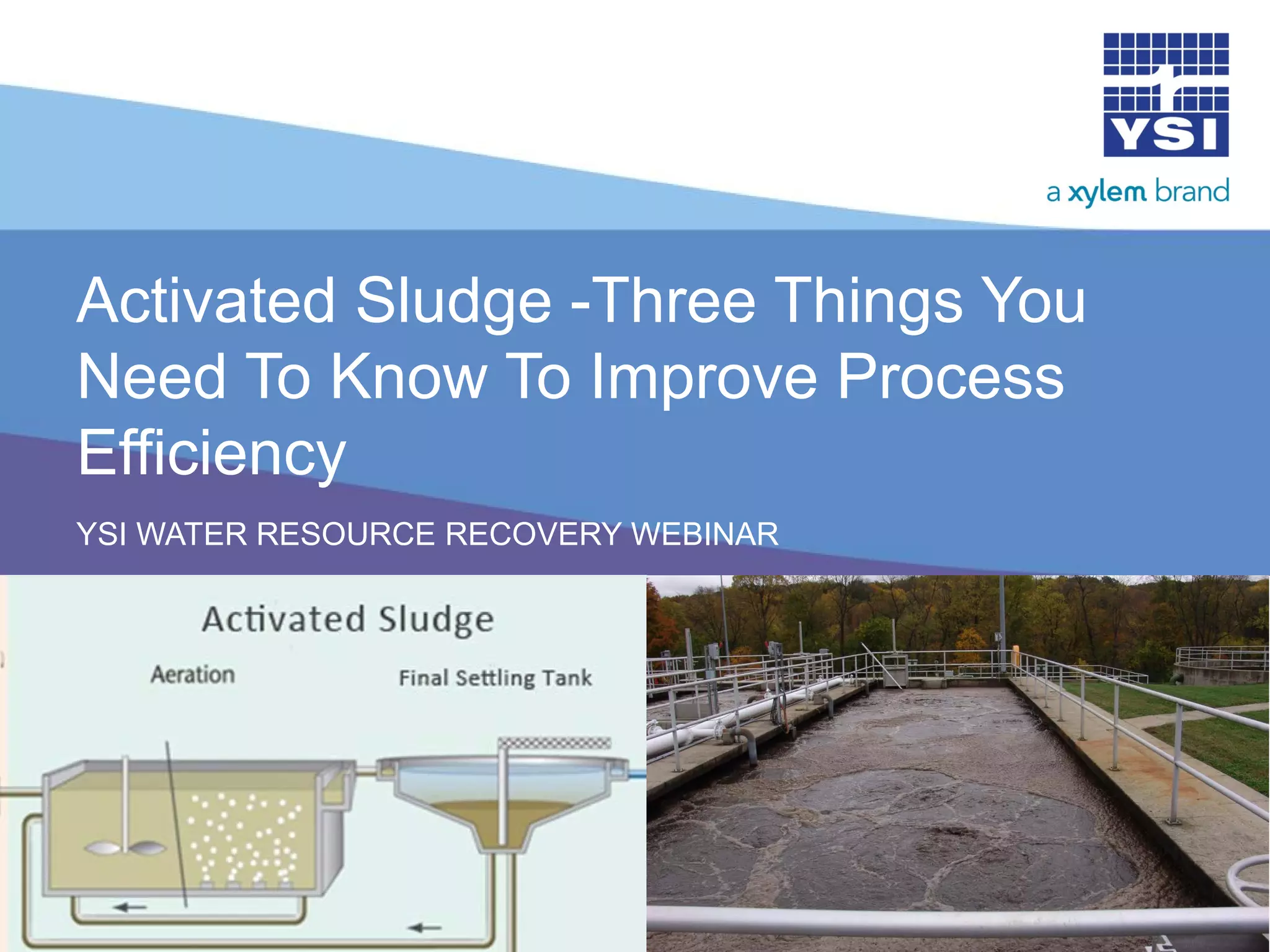
Activated Sludge -Three Things You
Need To Know To Improve Process
Efficiency
YSI WATER RESOURCE RECOVERY WEBINAR
1
Activated Sludge Process Control
Influent
Return Activated Sludge (RAS)
Mixed liquor Effluent
Final settling tank
AIR
Aeration tank
Waste
Activated
Sludge (WAS)
Internal Mixed Liquor Recycle (IMLR)
Great Inventions of the
20th Century
3
Ardern and Lockett Published 1914
The culmination of years of research and discovery
4
Aeration
Growth of ‘humus’
‘Activation’
Activated Sludge
• (micro-) biological
• Aerated
• Suspended growth
• Hydraulic retention time ≠ Solids retention time
• Requires specially trained personnel
What all configurations have in common
5
Aeration
6
Aeration and the (Bio-Chemical) Environment
7
0
+
Nitrification
Denitrification
Fermentation
‘P’ release
ORP, mV
OxicAnaerobic Anoxic
-
BOD removal
‘P’ uptake
Effect of DO Concentration on Biological
Treatment
Basis for maintaining DO at or below 2 mg/L setpoint
D.O.  Reaction 
0.75
D.O.  : Reaction 
Control of nitrification also
ensures BOD removal
cBOD removal
Nitrification
0.5 1.0 2.01.5 2.5 3.0 O2 (mg/l)
1/2 vmax
vmax
Reactionrate
0.3
Dissolved Oxygen and Performance
Balancing nitrification - denitrification
9
%ofmaxprocessrate
Dissolved oxygen
Source: Gustaf Olsson, Lund University, Sweden
Dissolved Oxygen and Energy
10 Source: Blum, D., High Efficiency Aeration, Clarifier, Illinois WEA, Summer 2013
D.O.
1.5 x
> 4 x
Optical DO Measurement
ASTM D888-09 Test Method C
• Very stable calibration
• Less maintenance
• No sulfide interference
• Accuracy: +/- 1%
• No stirring
• No warm-up
11
Continuous
Spot sampling
ORP
Ion selective electrode (ISE)
Continuous
Spot sampling
Reference
electrode
Membrane
Junction
ISE
(mV)
Sludge Wasting
13
Sludge Wasting Controls How Much
Biomass
Approaches to sludge wasting • Settleability
• Constant MLSS
• Centrifuge/spin
• F/M
• Solids Retention Time
14
Sludge Age, MCRT, SRT, CRT
15
Qe, Xe
V, MLSS
Qr, Xr
Qw, Xr
Qi, Xi
Biomass in the system Biomass entering / leaving the system÷
Target SRT
COD removal COD removal +
nitrification
COD removal +
nitrification +
denitrification
COD removal +
nitrfication +
denitrification + P
removal
SRT
What are treatment requirements?
16
function
0.0
4.0
8.0
12.0
16.0
5 10 15 20 25
NitrificationSRT,d
Nitrification Design
17
Design SRT; SF=1.5
Operating Range
Min. SRT
18
SRT and Energy
SRT and Performance
19
EffluentTSS
1 year
Source: Wahlberg, E. “What makes secondary clarifiers work”, WEFTEC 2013
Solids Measurement - Optical
Reflectance or absorbance
• Fast
• Simple
• Factory calibrated
• Low maintenance
Continuous
Spot
sampling
Sludge Recirculation
(RAS and IMLR)
21
• Constant flow – set RAS flow rate manually (open loop)
• Constant percentage – set RAS flow proportional to ww flow (feed forward)
Sludge Recirculation for Control of Biomass
Distribution
RAS is critical to clarifier performance
22
RAS Flow Rate Control
Sludge blanket depth approach
23
WW flow
RAS flow
MLSS
Thickening
Failure
Q + Qras
Qras
Q
MLSS
Flux
RAS Flow Rate Control
Sludge blanket depth approach
24
WW flow
RAS flow
MLSS
MLSS ↓
Thickening
Failure
Q + Qras
Qras
Q
MLSS
Flux
RAS Flow Rate Control
Sludge blanket depth approach
25
WW flow
RAS flow
MLSS
MLSS ↓
Thickening
Failure
Solids
washout
Q + Qras
Qras
Q
MLSS
Flux
RAS Flow Rate Control
Sludge blanket depth approach
26
WW flow
RAS flow
MLSS
Thickening
Failure
Q + Qras
Qras
Q
MLSS
Flux
RAS Flow Rate Control
Sludge blanket depth approach
27
WW flow
RAS flow
Increase RAS
MLSS
MLSS ↓
Thickening
Failure
Q + Qras
Qras
Q
MLSS
Flux
Sludge Blanket Depth Measurement
28
Visual Acoustic (sludge level detector)
Sludge Recirculation for Control of
Denitrification
Nitrate is the critical measurement 1) Meet nitrogen limits
2) Maximize use of
wastewater COD
3) Minimize external
carbon
29
Source: Ingildsen, P, Wendelboe, H., “Improved nutrient removal results using in situ continuous on-line sensors
with reduced response time”, WEFTEC 2003
ISE Ammonium and Nitrate
Potentiometric (like pH/ORP)
• Measuring electrodes: NH4
+, NO3
-,
• Compensation electrodes: K+, Cl-
• Reagentless
• Stable calibration
• Replaceable electrodes
• Large measuring range
Continuous
ISE Ammonium and Nitrate
Potentiometric (like pH/ORP)
• Measuring electrodes: NH4
+, NO3
-,
• Compensation electrodes: K+, Cl-
• Reagentless
• Stable calibration
• Replaceable electrodes
• Large measuring range
Continuous
Spot sampling
Optical Nitrate
Spectral or single-wavelength
• No electrodes
• Factory calibrated (spectral)
32
Summary and Future Webinar Topics
Process control – it is easier than you think
33
• Aeration to control the
environment
• Sludge wasting to
control the total
biomass
• Sludge recirculation to
control biomass
distribution

YSI Activated Sludge - 3 Things You Need to Know to Improve Process Control

  • 1.
    Activated Sludge -ThreeThings You Need To Know To Improve Process Efficiency YSI WATER RESOURCE RECOVERY WEBINAR 1
  • 2.
    Activated Sludge ProcessControl Influent Return Activated Sludge (RAS) Mixed liquor Effluent Final settling tank AIR Aeration tank Waste Activated Sludge (WAS) Internal Mixed Liquor Recycle (IMLR)
  • 3.
    Great Inventions ofthe 20th Century 3
  • 4.
    Ardern and LockettPublished 1914 The culmination of years of research and discovery 4 Aeration Growth of ‘humus’ ‘Activation’
  • 5.
    Activated Sludge • (micro-)biological • Aerated • Suspended growth • Hydraulic retention time ≠ Solids retention time • Requires specially trained personnel What all configurations have in common 5
  • 6.
  • 7.
    Aeration and the(Bio-Chemical) Environment 7 0 + Nitrification Denitrification Fermentation ‘P’ release ORP, mV OxicAnaerobic Anoxic - BOD removal ‘P’ uptake
  • 8.
    Effect of DOConcentration on Biological Treatment Basis for maintaining DO at or below 2 mg/L setpoint D.O.  Reaction  0.75 D.O.  : Reaction  Control of nitrification also ensures BOD removal cBOD removal Nitrification 0.5 1.0 2.01.5 2.5 3.0 O2 (mg/l) 1/2 vmax vmax Reactionrate 0.3
  • 9.
    Dissolved Oxygen andPerformance Balancing nitrification - denitrification 9 %ofmaxprocessrate Dissolved oxygen Source: Gustaf Olsson, Lund University, Sweden
  • 10.
    Dissolved Oxygen andEnergy 10 Source: Blum, D., High Efficiency Aeration, Clarifier, Illinois WEA, Summer 2013 D.O. 1.5 x > 4 x
  • 11.
    Optical DO Measurement ASTMD888-09 Test Method C • Very stable calibration • Less maintenance • No sulfide interference • Accuracy: +/- 1% • No stirring • No warm-up 11 Continuous Spot sampling
  • 12.
    ORP Ion selective electrode(ISE) Continuous Spot sampling Reference electrode Membrane Junction ISE (mV)
  • 13.
  • 14.
    Sludge Wasting ControlsHow Much Biomass Approaches to sludge wasting • Settleability • Constant MLSS • Centrifuge/spin • F/M • Solids Retention Time 14
  • 15.
    Sludge Age, MCRT,SRT, CRT 15 Qe, Xe V, MLSS Qr, Xr Qw, Xr Qi, Xi Biomass in the system Biomass entering / leaving the system÷
  • 16.
    Target SRT COD removalCOD removal + nitrification COD removal + nitrification + denitrification COD removal + nitrfication + denitrification + P removal SRT What are treatment requirements? 16 function
  • 17.
    0.0 4.0 8.0 12.0 16.0 5 10 1520 25 NitrificationSRT,d Nitrification Design 17 Design SRT; SF=1.5 Operating Range Min. SRT
  • 18.
  • 19.
    SRT and Performance 19 EffluentTSS 1year Source: Wahlberg, E. “What makes secondary clarifiers work”, WEFTEC 2013
  • 20.
    Solids Measurement -Optical Reflectance or absorbance • Fast • Simple • Factory calibrated • Low maintenance Continuous Spot sampling
  • 21.
  • 22.
    • Constant flow– set RAS flow rate manually (open loop) • Constant percentage – set RAS flow proportional to ww flow (feed forward) Sludge Recirculation for Control of Biomass Distribution RAS is critical to clarifier performance 22
  • 23.
    RAS Flow RateControl Sludge blanket depth approach 23 WW flow RAS flow MLSS Thickening Failure Q + Qras Qras Q MLSS Flux
  • 24.
    RAS Flow RateControl Sludge blanket depth approach 24 WW flow RAS flow MLSS MLSS ↓ Thickening Failure Q + Qras Qras Q MLSS Flux
  • 25.
    RAS Flow RateControl Sludge blanket depth approach 25 WW flow RAS flow MLSS MLSS ↓ Thickening Failure Solids washout Q + Qras Qras Q MLSS Flux
  • 26.
    RAS Flow RateControl Sludge blanket depth approach 26 WW flow RAS flow MLSS Thickening Failure Q + Qras Qras Q MLSS Flux
  • 27.
    RAS Flow RateControl Sludge blanket depth approach 27 WW flow RAS flow Increase RAS MLSS MLSS ↓ Thickening Failure Q + Qras Qras Q MLSS Flux
  • 28.
    Sludge Blanket DepthMeasurement 28 Visual Acoustic (sludge level detector)
  • 29.
    Sludge Recirculation forControl of Denitrification Nitrate is the critical measurement 1) Meet nitrogen limits 2) Maximize use of wastewater COD 3) Minimize external carbon 29 Source: Ingildsen, P, Wendelboe, H., “Improved nutrient removal results using in situ continuous on-line sensors with reduced response time”, WEFTEC 2003
  • 30.
    ISE Ammonium andNitrate Potentiometric (like pH/ORP) • Measuring electrodes: NH4 +, NO3 -, • Compensation electrodes: K+, Cl- • Reagentless • Stable calibration • Replaceable electrodes • Large measuring range Continuous
  • 31.
    ISE Ammonium andNitrate Potentiometric (like pH/ORP) • Measuring electrodes: NH4 +, NO3 -, • Compensation electrodes: K+, Cl- • Reagentless • Stable calibration • Replaceable electrodes • Large measuring range Continuous Spot sampling
  • 32.
    Optical Nitrate Spectral orsingle-wavelength • No electrodes • Factory calibrated (spectral) 32
  • 33.
    Summary and FutureWebinar Topics Process control – it is easier than you think 33 • Aeration to control the environment • Sludge wasting to control the total biomass • Sludge recirculation to control biomass distribution