ION EXCHANGE PROCESS
or Demineralization or Deionzation
• Hardness causing ions are exchanged with ions of resins
• Water obtained- free from minerals and hardness causing ions
(Known as deionized or demineralized water)
ION-EXCHANGE RESINS
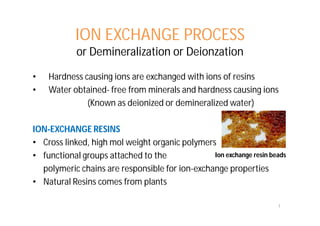
• Cross linked, high mol weight organic polymers
• functional groups attached to the
polymeric chains are responsible for ion-exchange properties
• Natural Resins comes from plants
Ion exchange resin beads
1
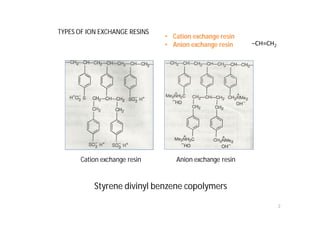
TYPES OF ION EXCHANGE RESINS
Cation exchange resin Anion exchange resin
• Cation exchange resin
• Anion exchange resin −CH=CH2
2
Styrene divinyl benzene copolymers
• Cation exchange resin
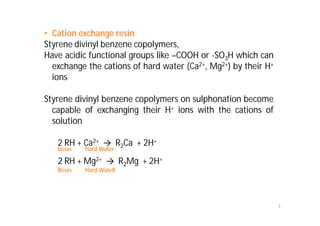
Styrene divinyl benzene copolymers,
Have acidic functional groups like –COOH or -SO3H which can
exchange the cations of hard water (Ca2+, Mg2+) by their H+
ions
Styrene divinyl benzene copolymers on sulphonation become
capable of exchanging their H+ ions with the cations of
solution
2 RH + Ca2+ → R2Ca + 2H+
Resin Hard Water
2 RH + Mg2+ → R2Mg + 2H+
Resin Hard WateR
3
• Anion exchange resin
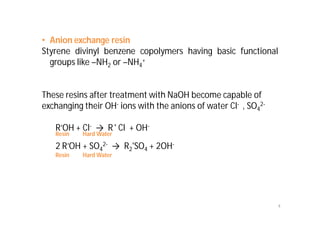
Styrene divinyl benzene copolymers having basic functional
groups like –NH2 or –NH4
+
These resins after treatment with NaOH become capable of
exchanging their OH- ions with the anions of water Cl- , SO4
2-
R’OH + Cl- → R' Cl + OH-
Resin Hard Water
2 R’OH + SO4
2- → R2'SO4 + 2OH-
Resin Hard Water
4
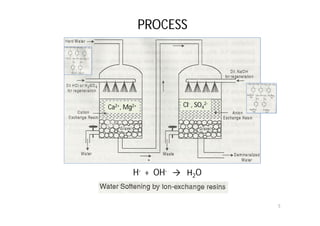
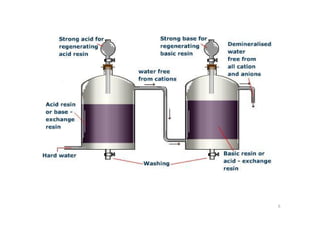
PROCESS
Ca2+, Mg2+ Cl- , SO4
2-
5
H- + OH- → H2O
6
7
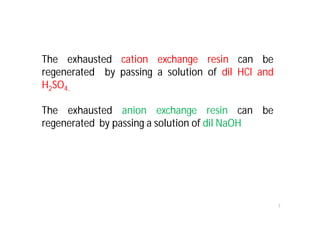
The exhausted cation exchange resin can be
regenerated by passing a solution of dil HCl and
H2SO4.
The exhausted anion exchange resin can be
regenerated by passing a solution of dil NaOH

Ion exchange process

  • 1.
    ION EXCHANGE PROCESS orDemineralization or Deionzation • Hardness causing ions are exchanged with ions of resins • Water obtained- free from minerals and hardness causing ions (Known as deionized or demineralized water) ION-EXCHANGE RESINS • Cross linked, high mol weight organic polymers • functional groups attached to the polymeric chains are responsible for ion-exchange properties • Natural Resins comes from plants Ion exchange resin beads 1
  • 2.
    TYPES OF IONEXCHANGE RESINS Cation exchange resin Anion exchange resin • Cation exchange resin • Anion exchange resin −CH=CH2 2 Styrene divinyl benzene copolymers
  • 3.
    • Cation exchangeresin Styrene divinyl benzene copolymers, Have acidic functional groups like –COOH or -SO3H which can exchange the cations of hard water (Ca2+, Mg2+) by their H+ ions Styrene divinyl benzene copolymers on sulphonation become capable of exchanging their H+ ions with the cations of solution 2 RH + Ca2+ → R2Ca + 2H+ Resin Hard Water 2 RH + Mg2+ → R2Mg + 2H+ Resin Hard WateR 3
  • 4.
    • Anion exchangeresin Styrene divinyl benzene copolymers having basic functional groups like –NH2 or –NH4 + These resins after treatment with NaOH become capable of exchanging their OH- ions with the anions of water Cl- , SO4 2- R’OH + Cl- → R' Cl + OH- Resin Hard Water 2 R’OH + SO4 2- → R2'SO4 + 2OH- Resin Hard Water 4
  • 5.
    PROCESS Ca2+, Mg2+ Cl-, SO4 2- 5 H- + OH- → H2O
  • 6.
  • 7.
    7 The exhausted cationexchange resin can be regenerated by passing a solution of dil HCl and H2SO4. The exhausted anion exchange resin can be regenerated by passing a solution of dil NaOH