1
CONTROL CHARTS
(For Attributes)
Prepared by : VIPUL WADHWA
2
◦ WHAT IS AN ATTRIBUTE?
◦ CONTROL CHARTS FOR ATTRIBUTE DATA
◦ TYPES & SELECTION OF CONTROL CHART
◦ WHAT IS p CHART , np CHART , c CHART , u CHART.
◦ CALCULATE THE PARAMETERS OF THE CONTROL
CHARTS
◦ ADVANTAGES OF ATTRIBUTE CONTROL CHARTS
Objectives :-
3
4
The term Attribute refers to those quality characteristics
that conform to specifications or do not conform to
specifications. This data may be expressed as ok/not ok,
go/no go, yes/no, or presence/absence of a defect.
Attribute are used:
1. Where measurements are not possible.
2. Where measurements can be made but are not made
because of time, cost, or need.
◦What is an Attribute?
5
CONTROLCHARTS FOR ATTRIBUTE DATA:
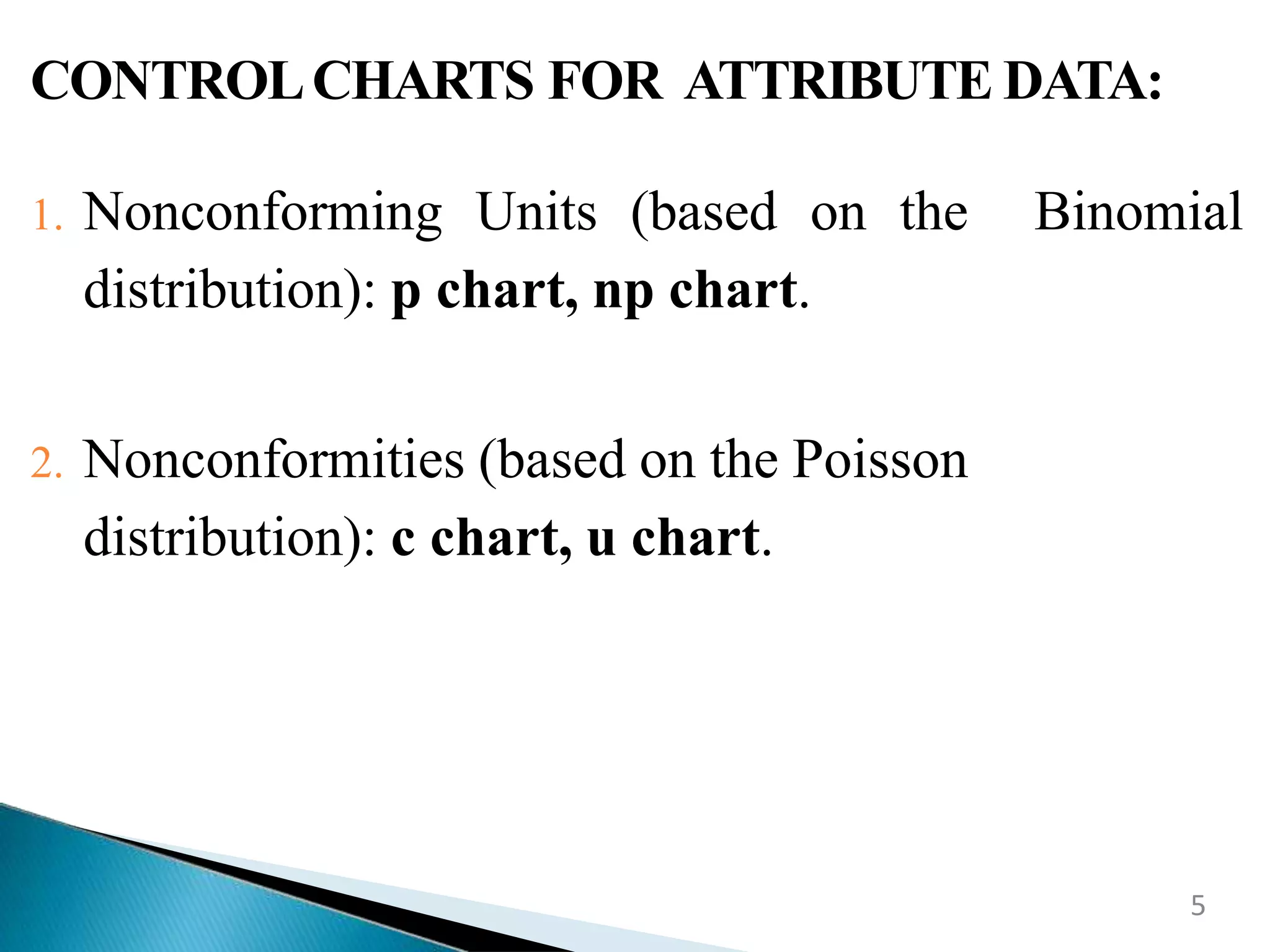
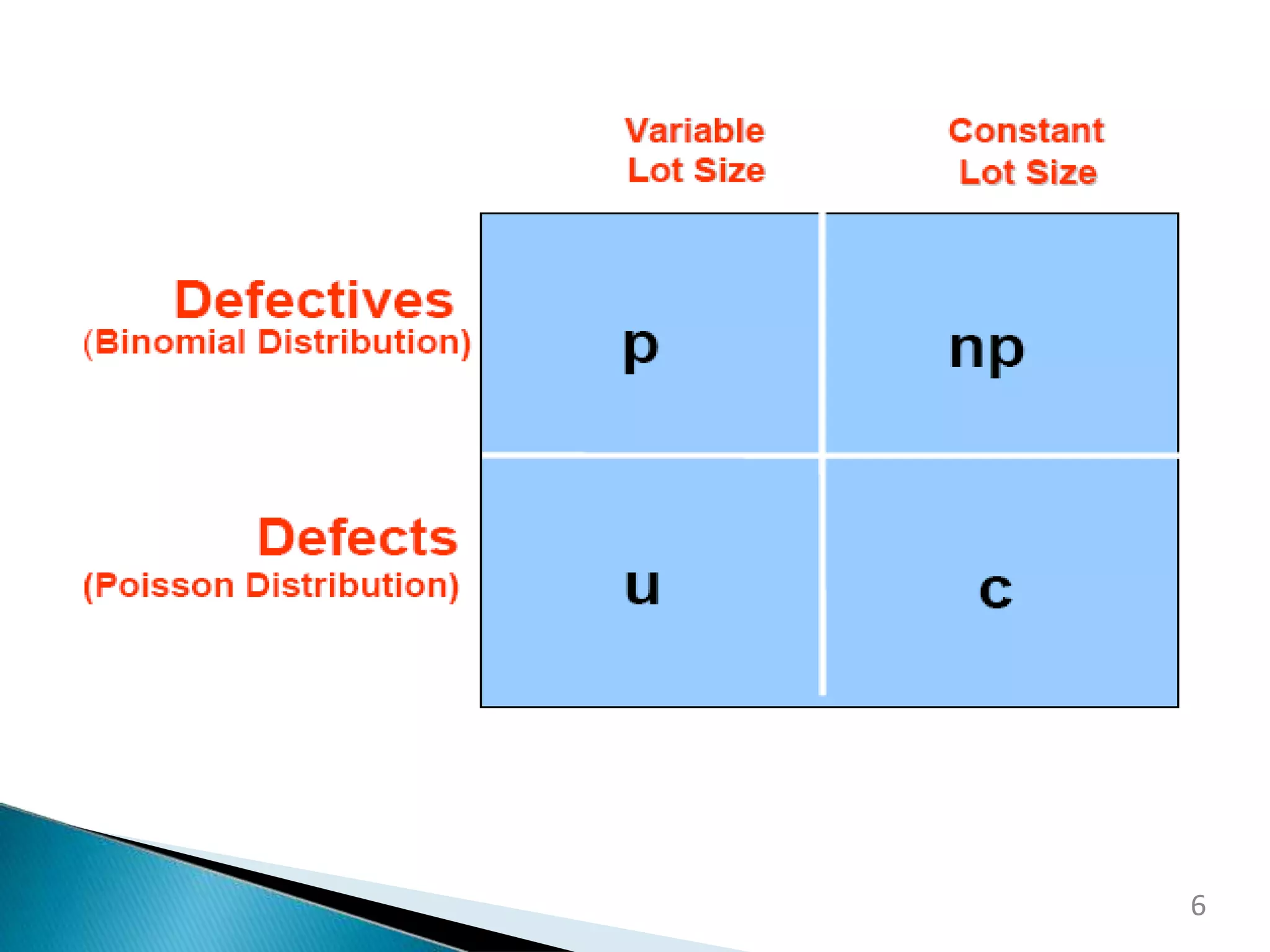
1. Nonconforming Units (based on the Binomial
distribution): p chart, np chart.
2. Nonconformities (based on the Poisson
distribution): c chart, u chart.
6
7
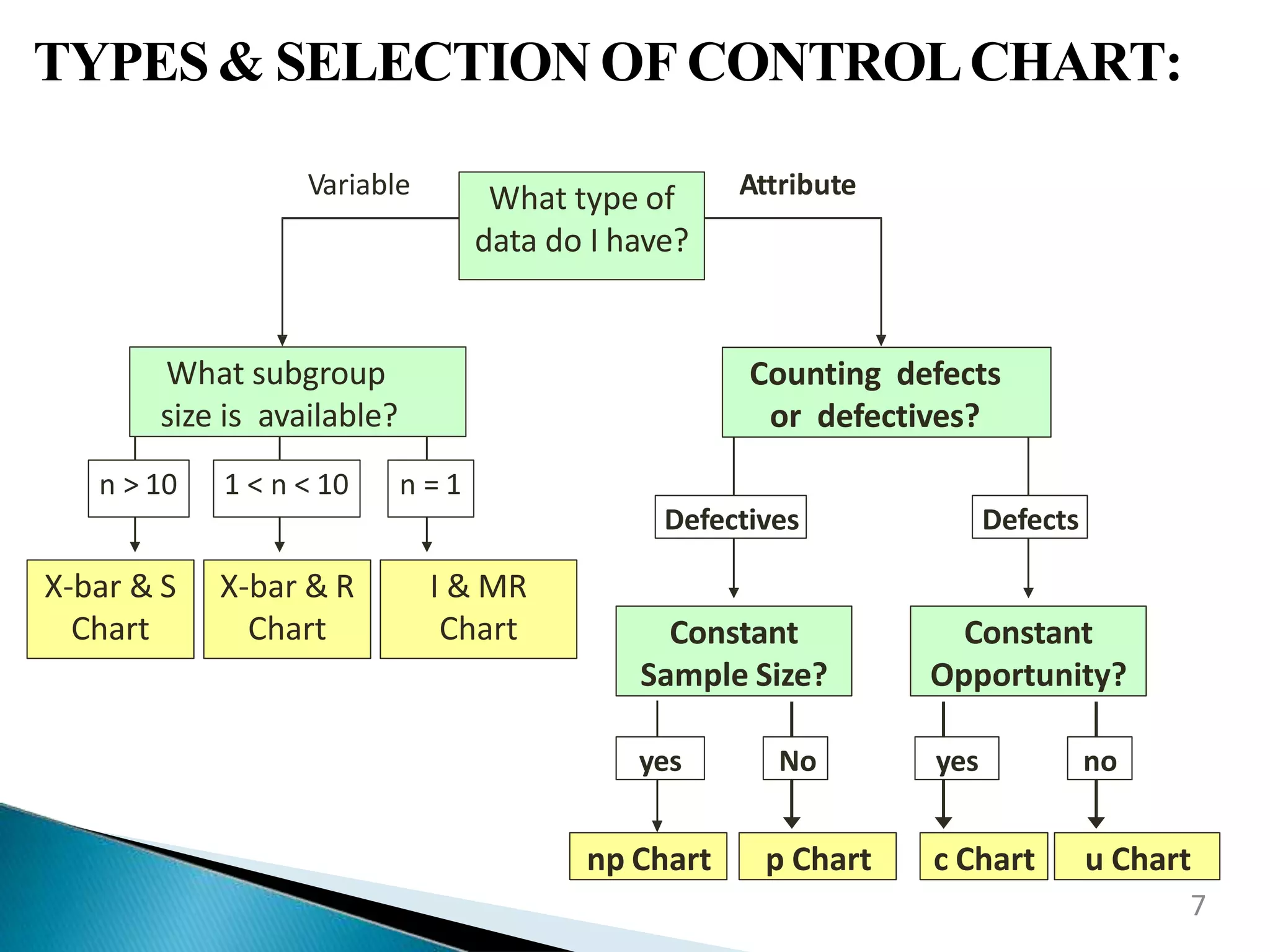
TYPES & SELECTION OF CONTROLCHART:
What type of
data do I have?
Variable Attribute
Counting defects
or defectives?
X-bar & S
Chart
I & MR
Chart
X-bar & R
Chart
n > 10 1 < n < 10 n = 1
Defectives Defects
What subgroup
size is available?
Constant
Sample Size?
Constant
Opportunity?
yes yesNo no
np Chart u Chartp Chart c Chart
8
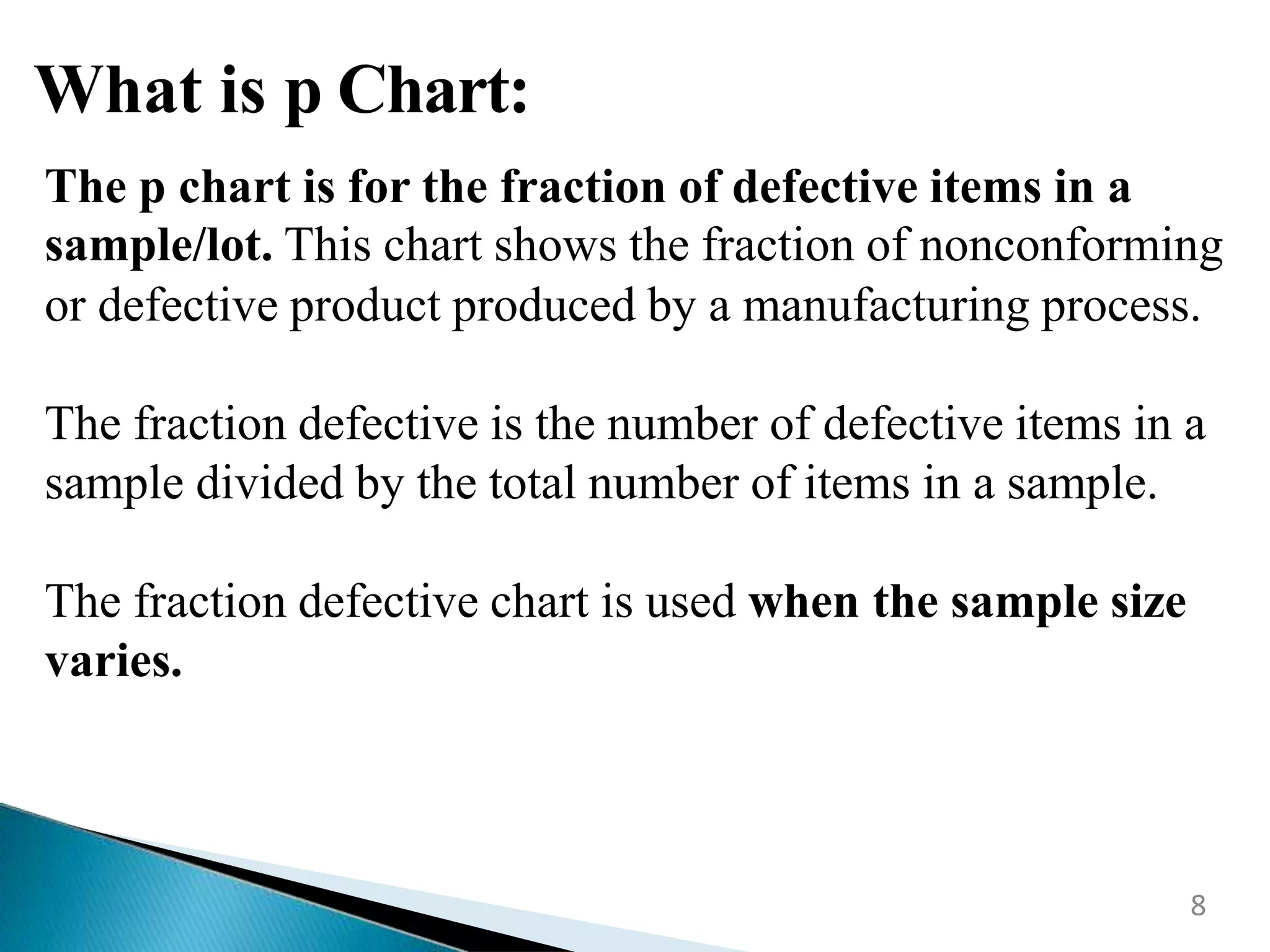
The p chart is for the fraction of defective items in a
sample/lot. This chart shows the fraction of nonconforming
or defective product produced by a manufacturing process.
The fraction defective is the number of defective items in a
sample divided by the total number of items in a sample.
The fraction defective chart is used when the sample size
varies.
What is p Chart:
9
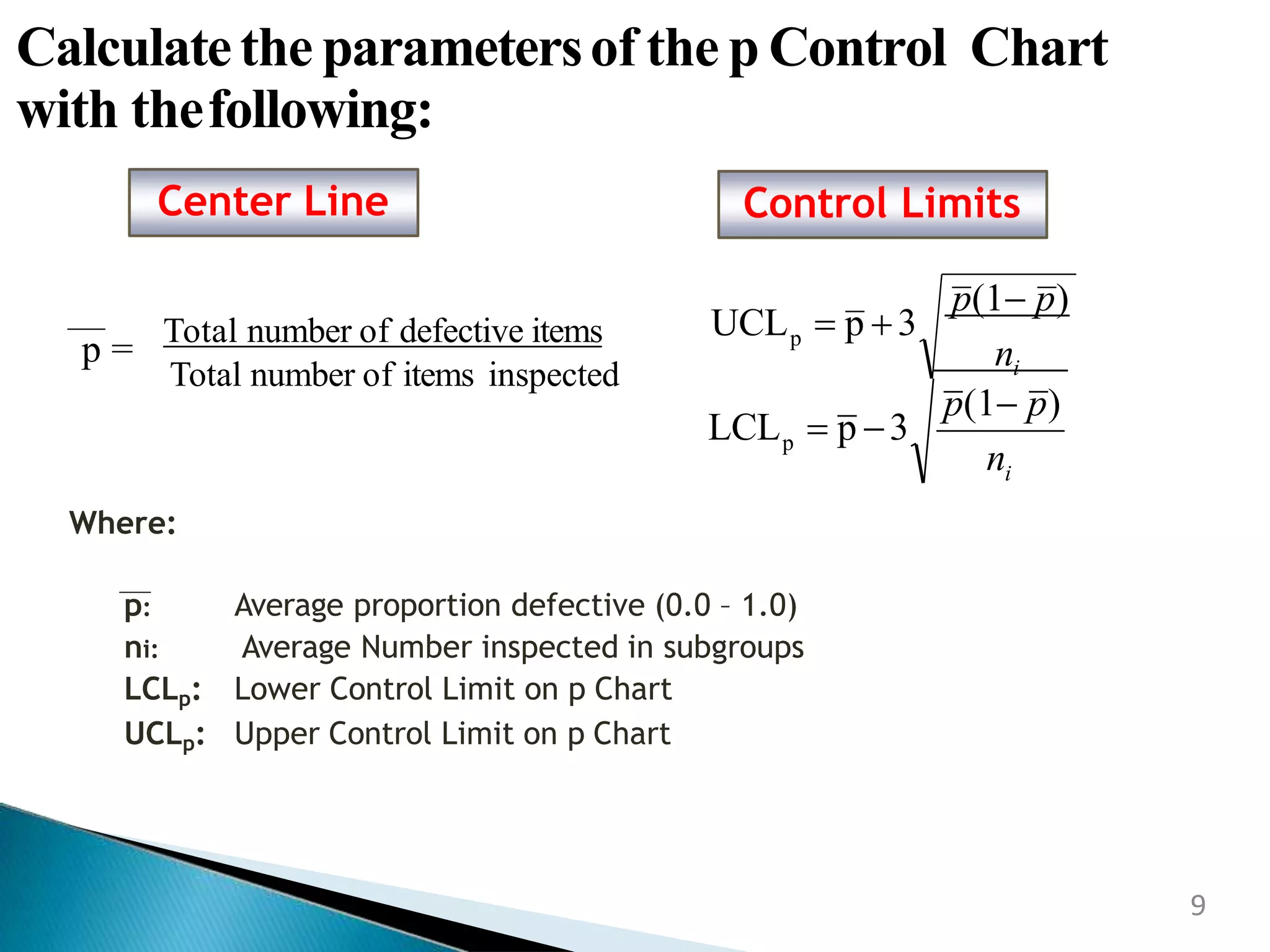
Calculatethe parametersof the p Control Chart
with thefollowing:
Where:
p: Average proportion defective (0.0 – 1.0)
ni: Average Number inspected in subgroups
LCLp: Lower Control Limit on p Chart
UCLp: Upper Control Limit on p Chart
Total number of defective items
Total number of items inspected
n
p
p(1 p)
UCL  p 3
Center Line Control Limits
in
p
i
p(1 p)
LCL  p 3
p =
10
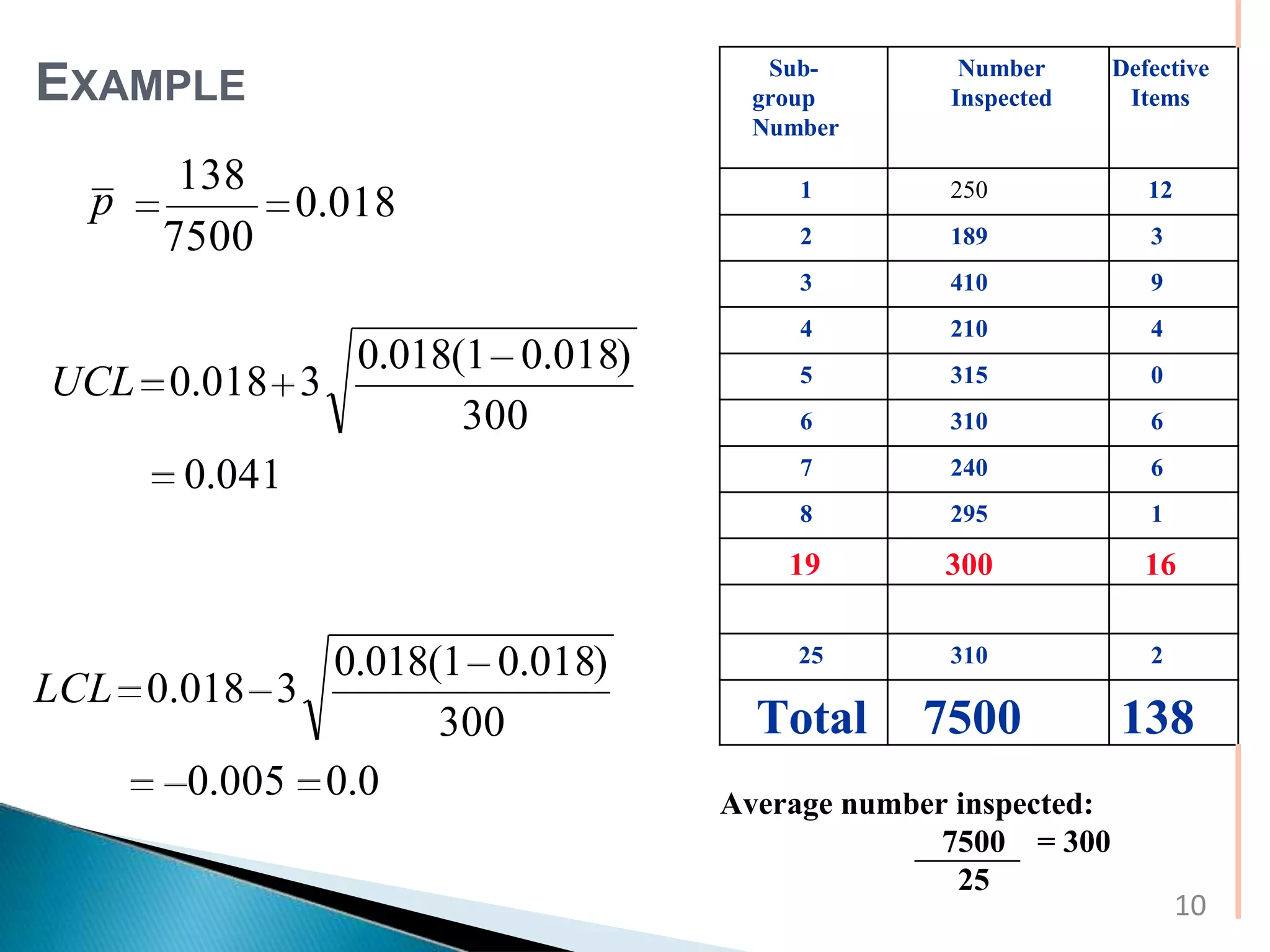
EXAMPLE
Sub-
group
Number
Number
Inspected
Defective
Items
1 250 12
2 189 3
3 410 9
4 210 4
5 315 0
6 310 6
7 240 6
8 295 1
19 300 16
25 310 2
Total 7500 138
Average number inspected:
7500 = 300
25
0.018
138
7500
p
300
0.018)0.018(1
LCL 0.018 3
0.005 0.0
0.041
300
0.018)0.018(1
UCL 0.018 3
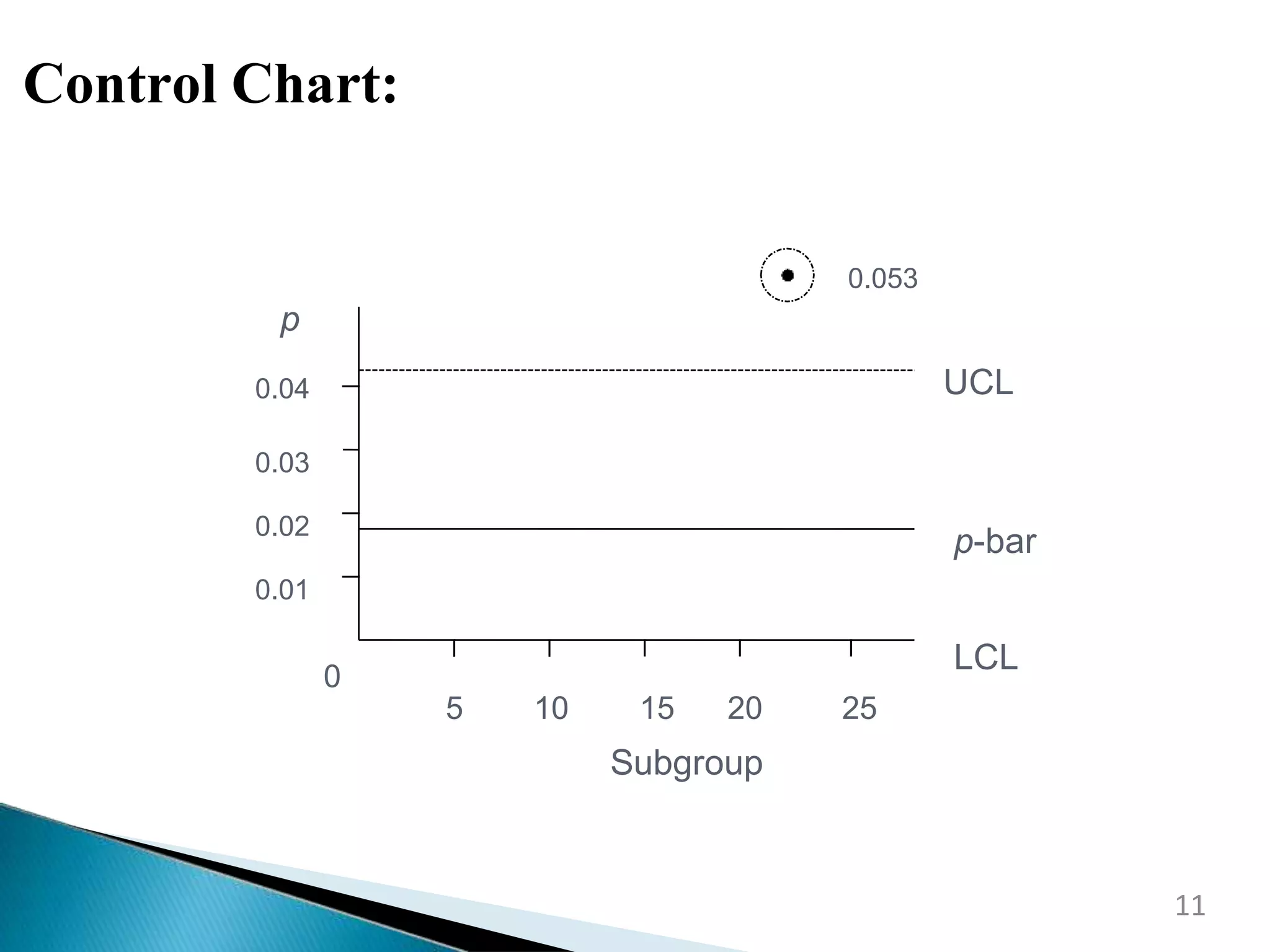
11
0.053
p-bar
LCL
UCL
p
5 10 15 20
Subgroup
25
0
0.01
0.02
0.03
0.04
Control Chart:
12
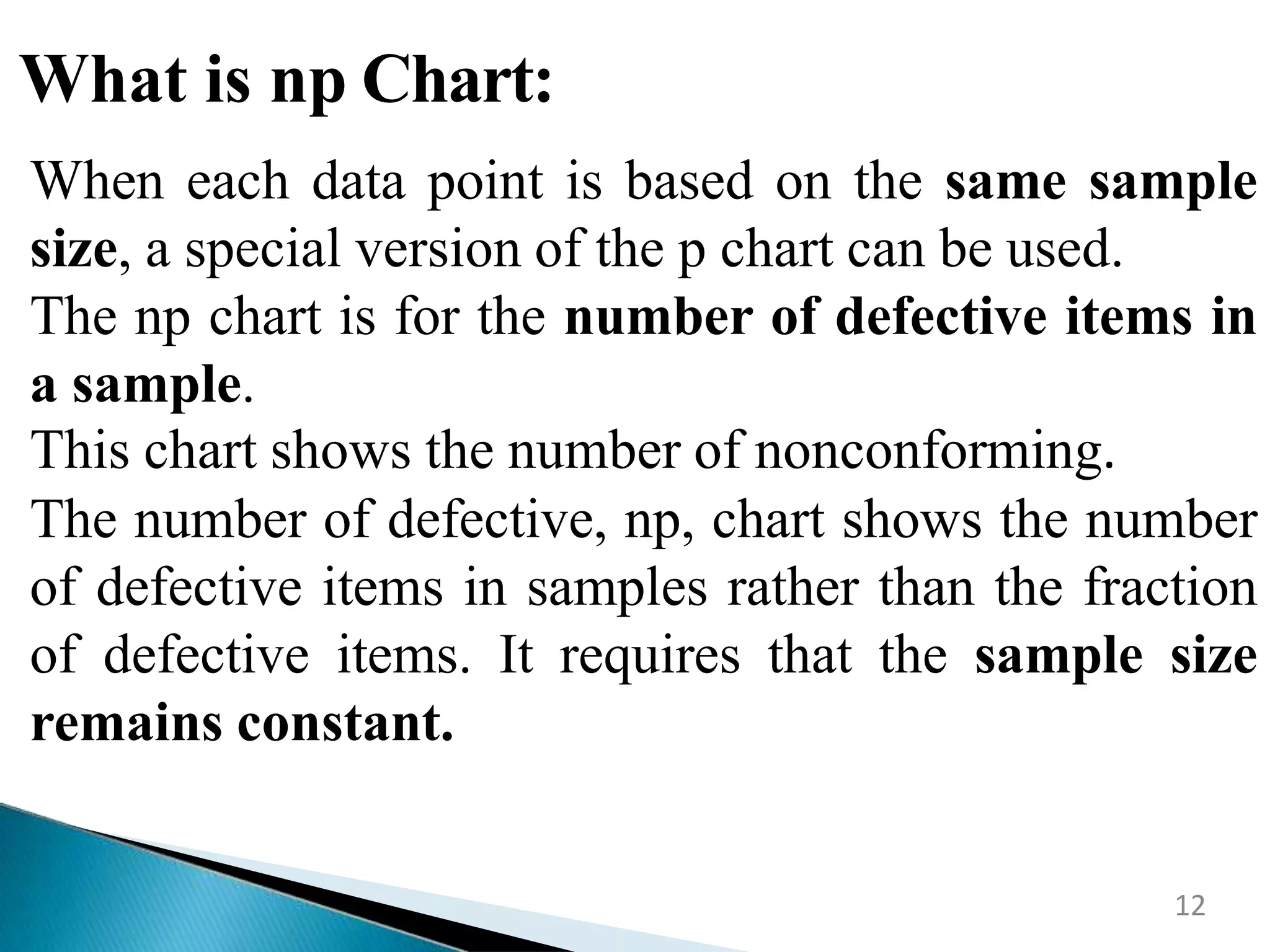
What is np Chart:
When each data point is based on the same sample
size, a special version of the p chart can be used.
The np chart is for the number of defective items in
a sample.
This chart shows the number of nonconforming.
The number of defective, np, chart shows the number
of defective items in samples rather than the fraction
of defective items. It requires that the sample size
remains constant.
13
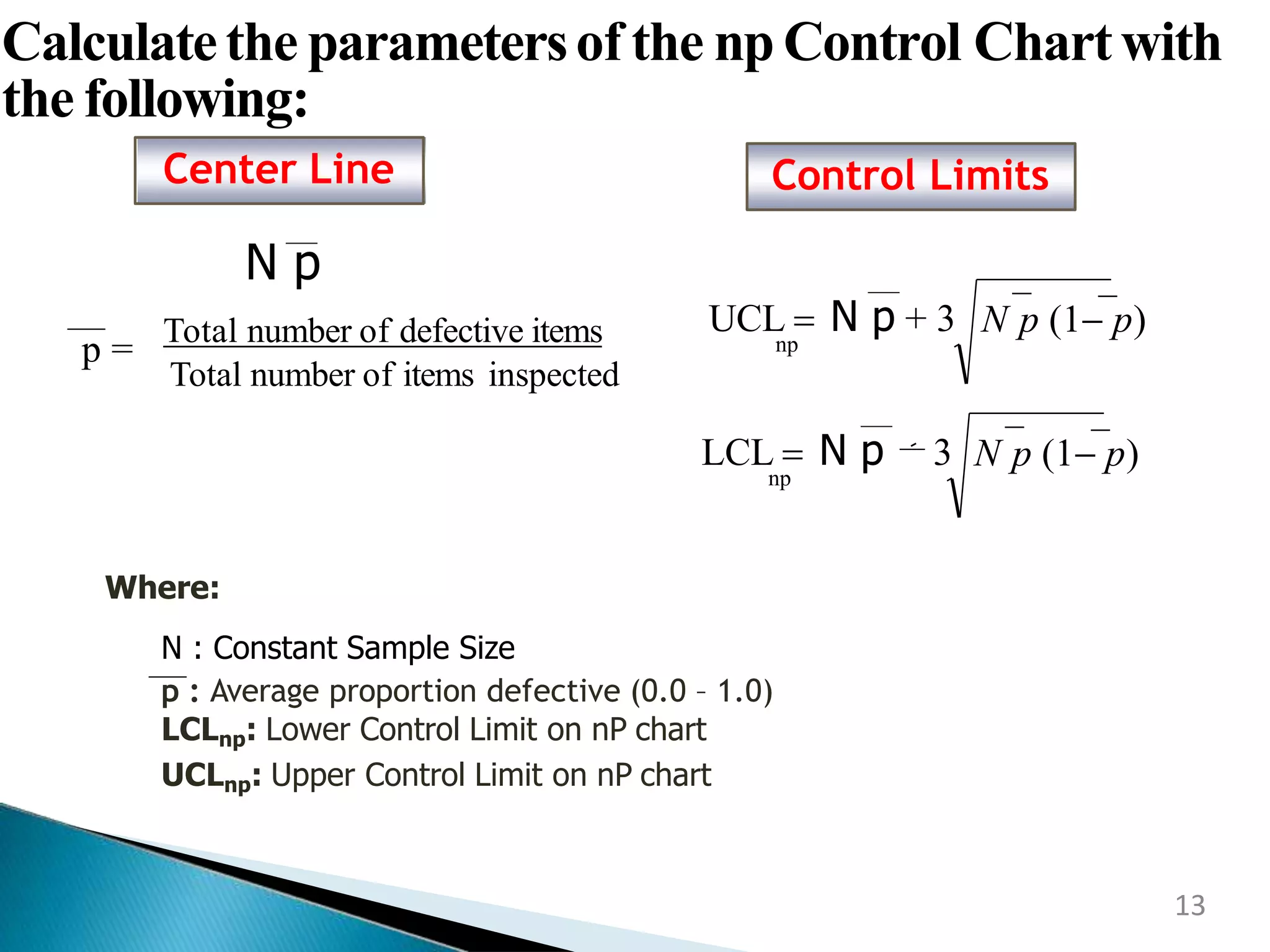
Calculatethe parametersof the np Control Chartwith
the following:
Center Line Control Limits
Where:
N : Constant Sample Size
p : Average proportion defective (0.0 – 1.0)
LCLnp: Lower Control Limit on nP chart
UCLnp: Upper Control Limit on nP chart
N p
Total number of items inspected
p =
Total number of defective items UCL  N p + 3
np
N p (1 p)
LCL  N p 3
np
N p (1 p)
14
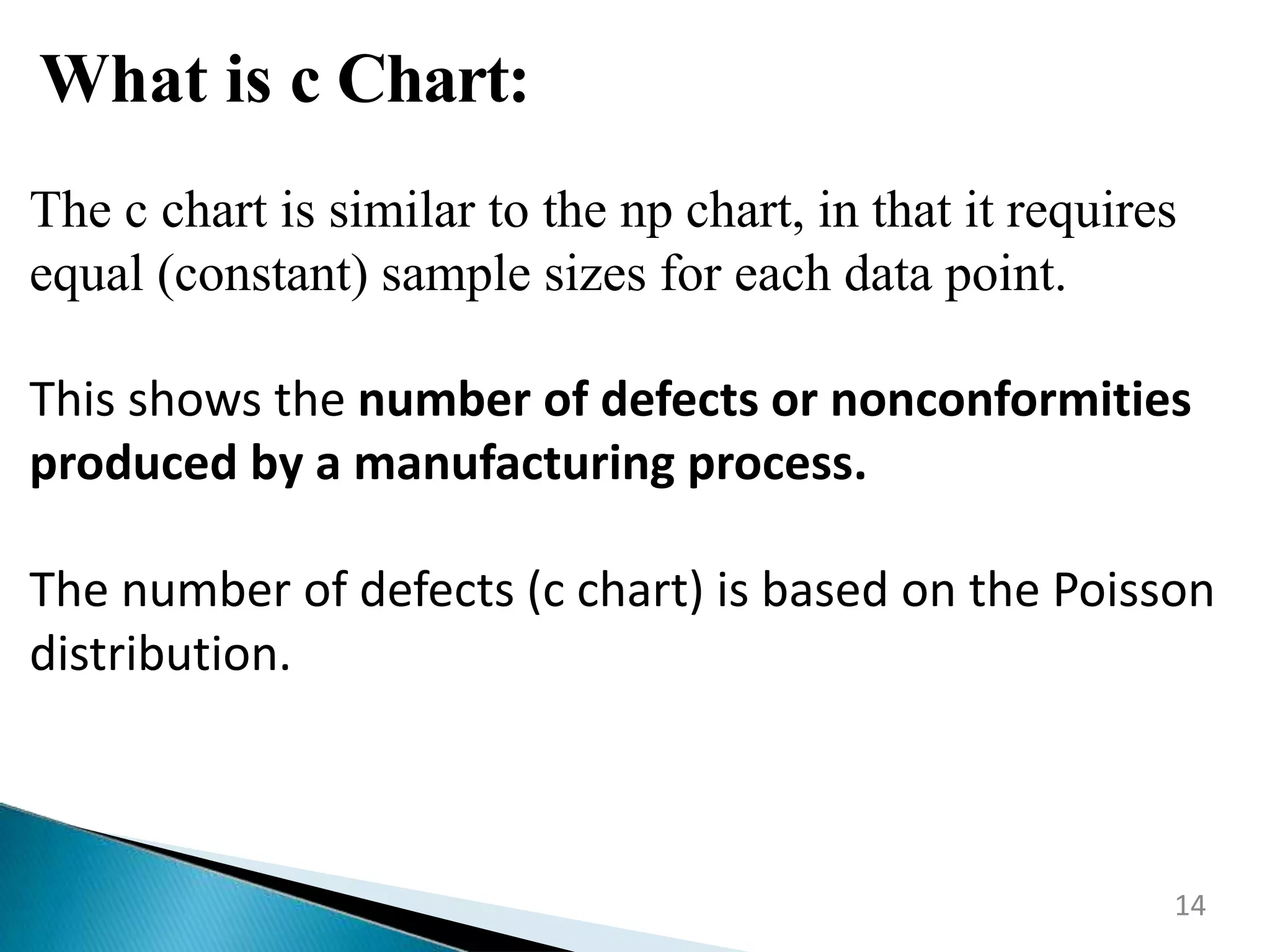
What is c Chart:
The c chart is similar to the np chart, in that it requires
equal (constant) sample sizes for each data point.
This shows the number of defects or nonconformities
produced by a manufacturing process.
The number of defects (c chart) is based on the Poisson
distribution.
15
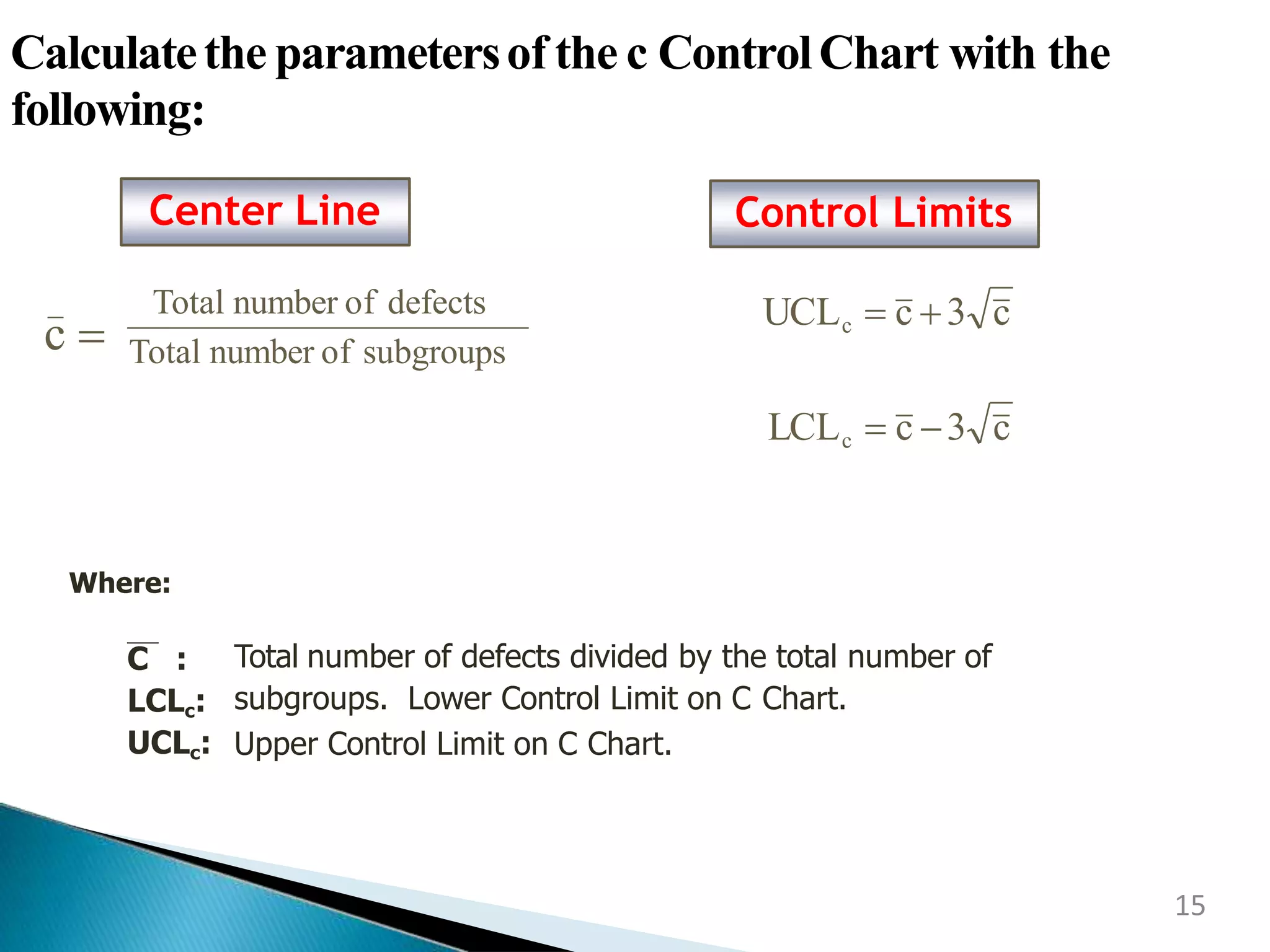
Calculatethe parametersof the c ControlChart with the
following:
2
Center Line Control Limits
Total number of subgroups
Total number of defects
c 
UCLc  c 3 c
LCLc  c 3 c
Where:
C :
LCLc:
UCLc:
Total number of defects divided by the total number of
subgroups. Lower Control Limit on C Chart.
Upper Control Limit on C Chart.
16
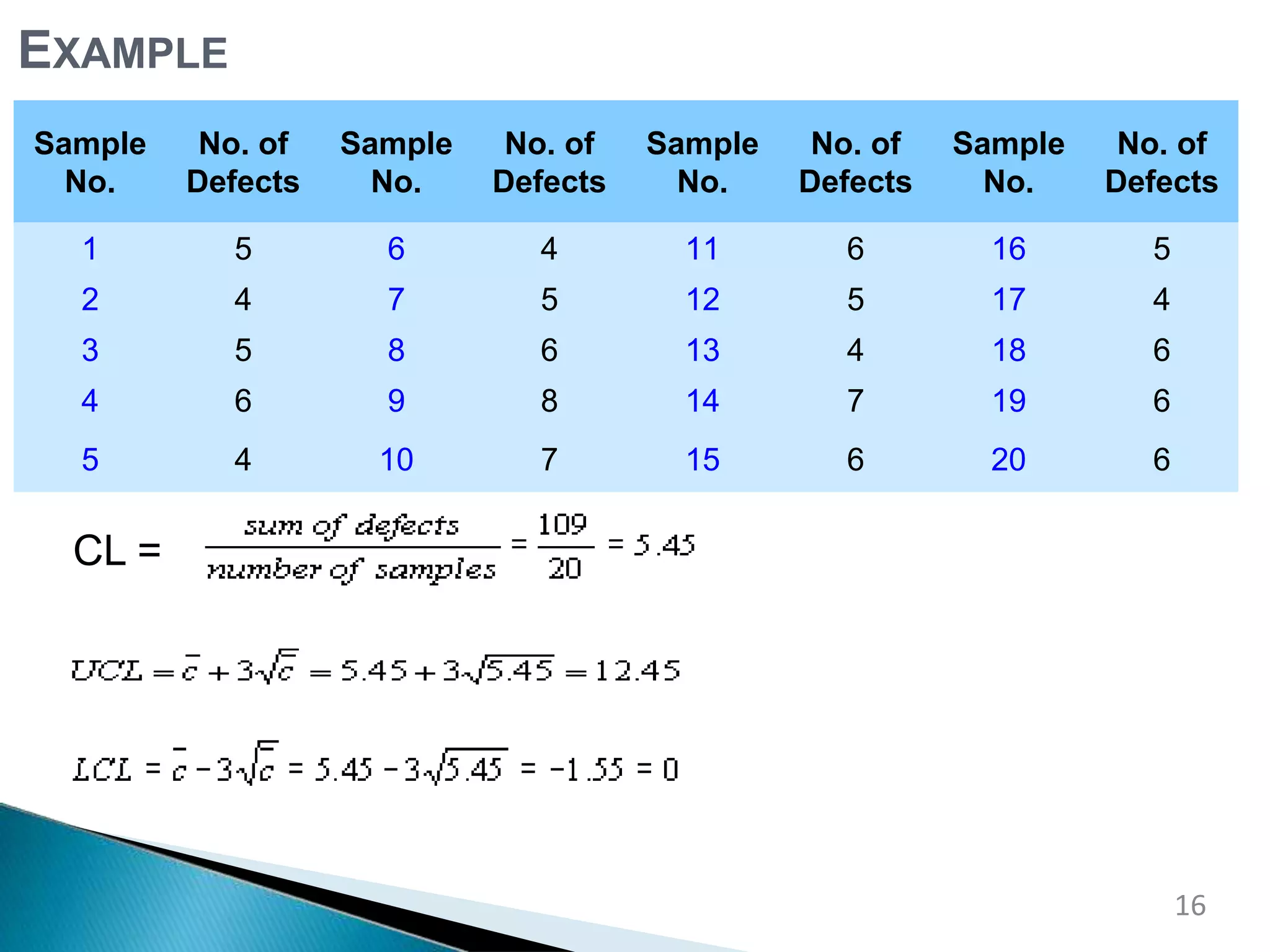
Sample
No.
No. of
Defects
Sample
No.
No. of
Defects
Sample
No.
No. of
Defects
Sample
No.
No. of
Defects
1 5 6 4 11 6 16 5
2 4 7 5 12 5 17 4
3 5 8 6 13 4 18 6
4 6 9 8 14 7 19 6
5 4 10 7 15 6 20 6
CL =
EXAMPLE
17
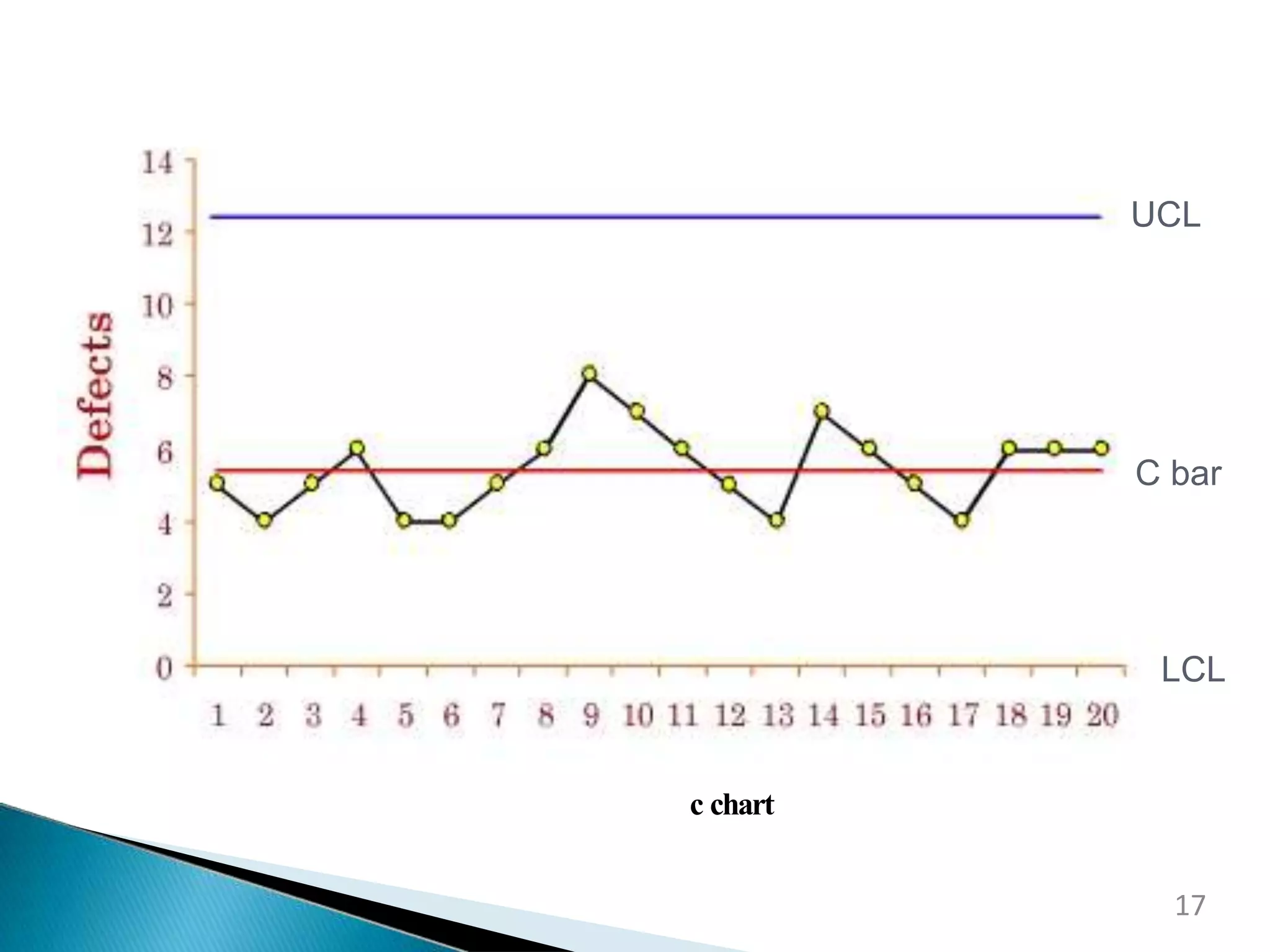
c chart
LCL
UCL
C bar
18
What is u Chart:
The u chart is a more general version of the c chart for use
when the data points do not come from equal-sized
samples.
The symbol u is used to represent defects per unit.
The u chart is used in cases where the samples are of
different size.
This chart shows the nonconformities per unit produced by a
manufacturing process.
19
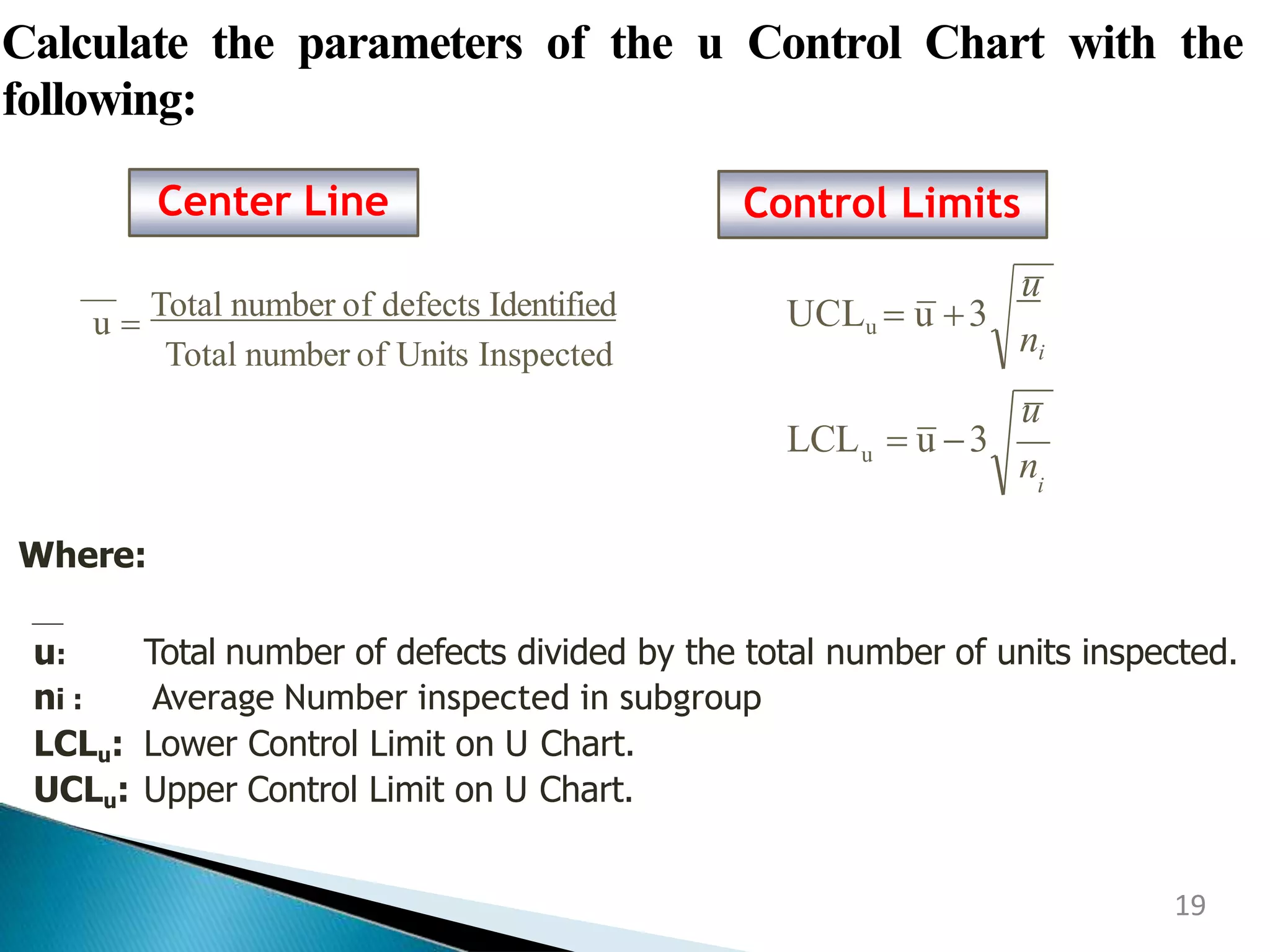
Calculate the parameters of the u Control Chart with the
following:
30
Center Line Control Limits
u 
Total number of defects Identified
Total number of Units Inspected
u
ni
UCLu  u 3
i
u
nuLCL  u 3
Where:
u: Total number of defects divided by the total number of units inspected.
ni : Average Number inspected in subgroup
LCLu: Lower Control Limit on U Chart.
UCLu: Upper Control Limit on U Chart.
20
Advantages of attribute control charts:
Allowing for quick summaries, that is, the engineer
may simply classify products as acceptable or
unacceptable, based on various quality criteria.
Thus, attribute charts sometimes bypass the need for
expensive, precise devices and time-consuming
measurement procedures.
Easily understood by managers unfamiliar with
quality control procedures.
Thank you very much for your attention!
21

Control charts (p np c u)

  • 1.
  • 2.
  • 3.
    ◦ WHAT ISAN ATTRIBUTE? ◦ CONTROL CHARTS FOR ATTRIBUTE DATA ◦ TYPES & SELECTION OF CONTROL CHART ◦ WHAT IS p CHART , np CHART , c CHART , u CHART. ◦ CALCULATE THE PARAMETERS OF THE CONTROL CHARTS ◦ ADVANTAGES OF ATTRIBUTE CONTROL CHARTS Objectives :- 3
  • 4.
    4 The term Attributerefers to those quality characteristics that conform to specifications or do not conform to specifications. This data may be expressed as ok/not ok, go/no go, yes/no, or presence/absence of a defect. Attribute are used: 1. Where measurements are not possible. 2. Where measurements can be made but are not made because of time, cost, or need. ◦What is an Attribute?
  • 5.
    5 CONTROLCHARTS FOR ATTRIBUTEDATA: 1. Nonconforming Units (based on the Binomial distribution): p chart, np chart. 2. Nonconformities (based on the Poisson distribution): c chart, u chart.
  • 6.
  • 7.
    7 TYPES & SELECTIONOF CONTROLCHART: What type of data do I have? Variable Attribute Counting defects or defectives? X-bar & S Chart I & MR Chart X-bar & R Chart n > 10 1 < n < 10 n = 1 Defectives Defects What subgroup size is available? Constant Sample Size? Constant Opportunity? yes yesNo no np Chart u Chartp Chart c Chart
  • 8.
    8 The p chartis for the fraction of defective items in a sample/lot. This chart shows the fraction of nonconforming or defective product produced by a manufacturing process. The fraction defective is the number of defective items in a sample divided by the total number of items in a sample. The fraction defective chart is used when the sample size varies. What is p Chart:
  • 9.
    9 Calculatethe parametersof thep Control Chart with thefollowing: Where: p: Average proportion defective (0.0 – 1.0) ni: Average Number inspected in subgroups LCLp: Lower Control Limit on p Chart UCLp: Upper Control Limit on p Chart Total number of defective items Total number of items inspected n p p(1 p) UCL  p 3 Center Line Control Limits in p i p(1 p) LCL  p 3 p =
  • 10.
    10 EXAMPLE Sub- group Number Number Inspected Defective Items 1 250 12 2189 3 3 410 9 4 210 4 5 315 0 6 310 6 7 240 6 8 295 1 19 300 16 25 310 2 Total 7500 138 Average number inspected: 7500 = 300 25 0.018 138 7500 p 300 0.018)0.018(1 LCL 0.018 3 0.005 0.0 0.041 300 0.018)0.018(1 UCL 0.018 3
  • 11.
    11 0.053 p-bar LCL UCL p 5 10 1520 Subgroup 25 0 0.01 0.02 0.03 0.04 Control Chart:
  • 12.
    12 What is npChart: When each data point is based on the same sample size, a special version of the p chart can be used. The np chart is for the number of defective items in a sample. This chart shows the number of nonconforming. The number of defective, np, chart shows the number of defective items in samples rather than the fraction of defective items. It requires that the sample size remains constant.
  • 13.
    13 Calculatethe parametersof thenp Control Chartwith the following: Center Line Control Limits Where: N : Constant Sample Size p : Average proportion defective (0.0 – 1.0) LCLnp: Lower Control Limit on nP chart UCLnp: Upper Control Limit on nP chart N p Total number of items inspected p = Total number of defective items UCL  N p + 3 np N p (1 p) LCL  N p 3 np N p (1 p)
  • 14.
    14 What is cChart: The c chart is similar to the np chart, in that it requires equal (constant) sample sizes for each data point. This shows the number of defects or nonconformities produced by a manufacturing process. The number of defects (c chart) is based on the Poisson distribution.
  • 15.
    15 Calculatethe parametersof thec ControlChart with the following: 2 Center Line Control Limits Total number of subgroups Total number of defects c  UCLc  c 3 c LCLc  c 3 c Where: C : LCLc: UCLc: Total number of defects divided by the total number of subgroups. Lower Control Limit on C Chart. Upper Control Limit on C Chart.
  • 16.
    16 Sample No. No. of Defects Sample No. No. of Defects Sample No. No.of Defects Sample No. No. of Defects 1 5 6 4 11 6 16 5 2 4 7 5 12 5 17 4 3 5 8 6 13 4 18 6 4 6 9 8 14 7 19 6 5 4 10 7 15 6 20 6 CL = EXAMPLE
  • 17.
  • 18.
    18 What is uChart: The u chart is a more general version of the c chart for use when the data points do not come from equal-sized samples. The symbol u is used to represent defects per unit. The u chart is used in cases where the samples are of different size. This chart shows the nonconformities per unit produced by a manufacturing process.
  • 19.
    19 Calculate the parametersof the u Control Chart with the following: 30 Center Line Control Limits u  Total number of defects Identified Total number of Units Inspected u ni UCLu  u 3 i u nuLCL  u 3 Where: u: Total number of defects divided by the total number of units inspected. ni : Average Number inspected in subgroup LCLu: Lower Control Limit on U Chart. UCLu: Upper Control Limit on U Chart.
  • 20.
    20 Advantages of attributecontrol charts: Allowing for quick summaries, that is, the engineer may simply classify products as acceptable or unacceptable, based on various quality criteria. Thus, attribute charts sometimes bypass the need for expensive, precise devices and time-consuming measurement procedures. Easily understood by managers unfamiliar with quality control procedures.
  • 21.
    Thank you verymuch for your attention! 21