Tools of Quality
Start-Tech Academy
Control chart
• A control chart is a time-ordered plot of sample statistics.
• Each point is a sample statistics
Lower control
Limit
Upper control
Limit
Tools of Quality
Start-Tech Academy
Control chart
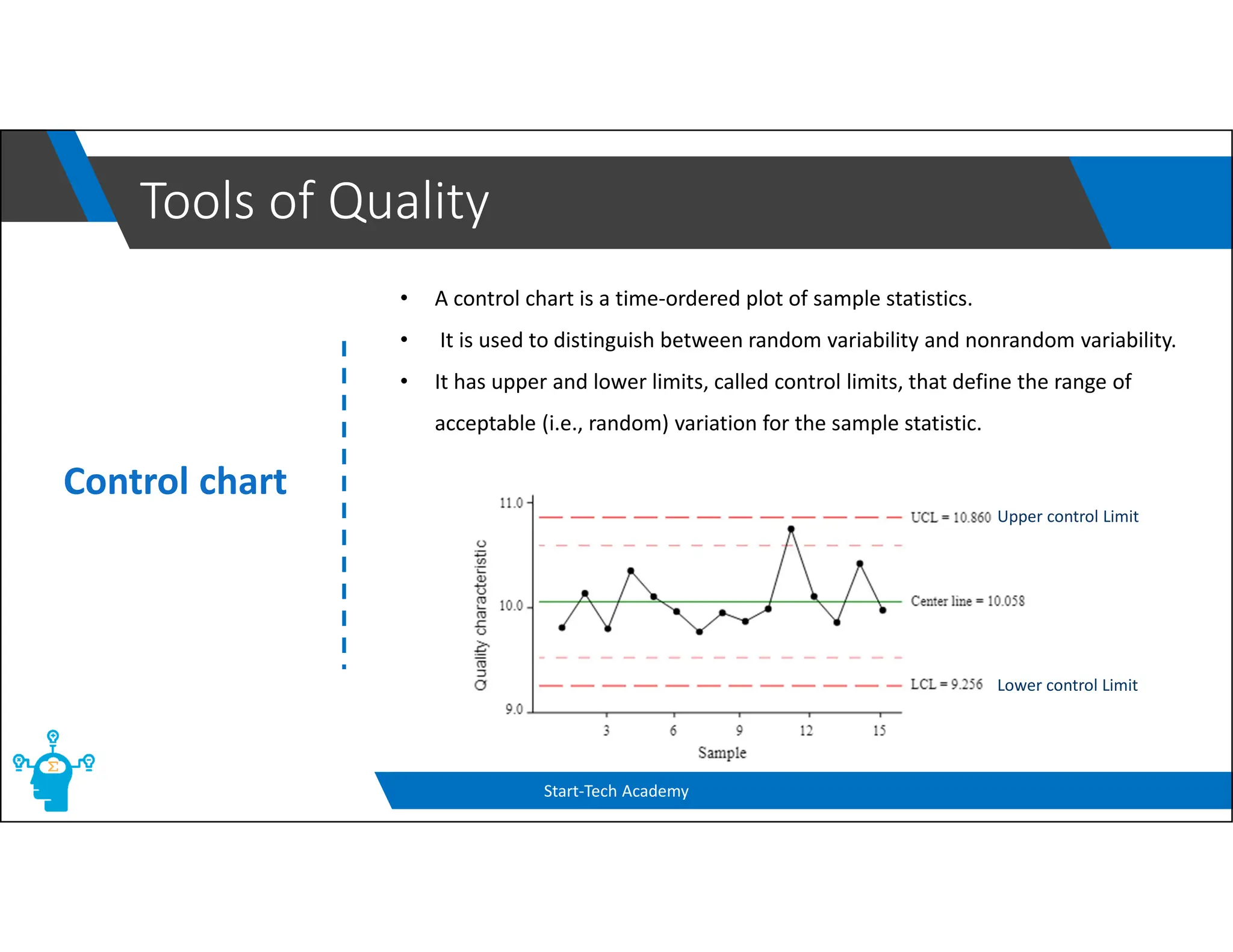
• A control chart is a time-ordered plot of sample statistics.
• It is used to distinguish between random variability and nonrandom variability.
• It has upper and lower limits, called control limits, that define the range of
acceptable (i.e., random) variation for the sample statistic.
Lower control Limit
Upper control Limit
Tools of Quality
Start-Tech Academy
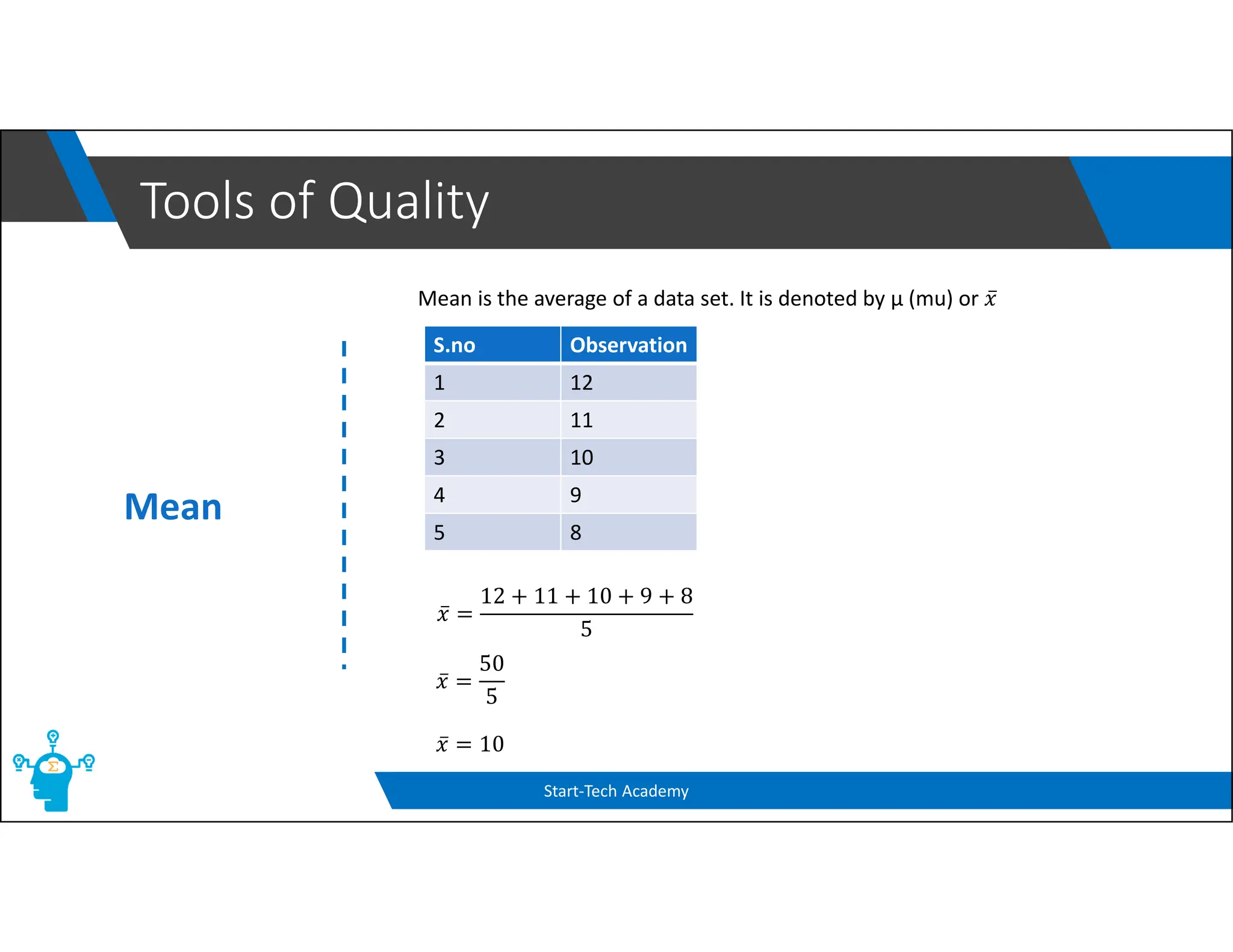
Mean
Mean is the average of a data set. It is denoted by µ (mu) or ̅
S.no Observation
1 12
2 11
3 10
4 9
5 8
̅
12 11 10 9 8
5
̅
50
5
̅ 10
Tools of Quality
Start-Tech Academy
Standard
Deviation
Standard deviation is a measure of dispersement in statistics. “Dispersement” tells you
how much your data is spread out. It is denoted by (sigma)
S.no Observation
1 12
2 11
3 10
4 9
5 8
12 10 11 10 10 10 9 10 8 10
5
2 1.41
S.no Observation
1 14
2 12
3 10
4 8
5 6
14 10 12 10 10 10 8 10 6 10
5
8 2.82
Statistical Inference
Population &
Sample
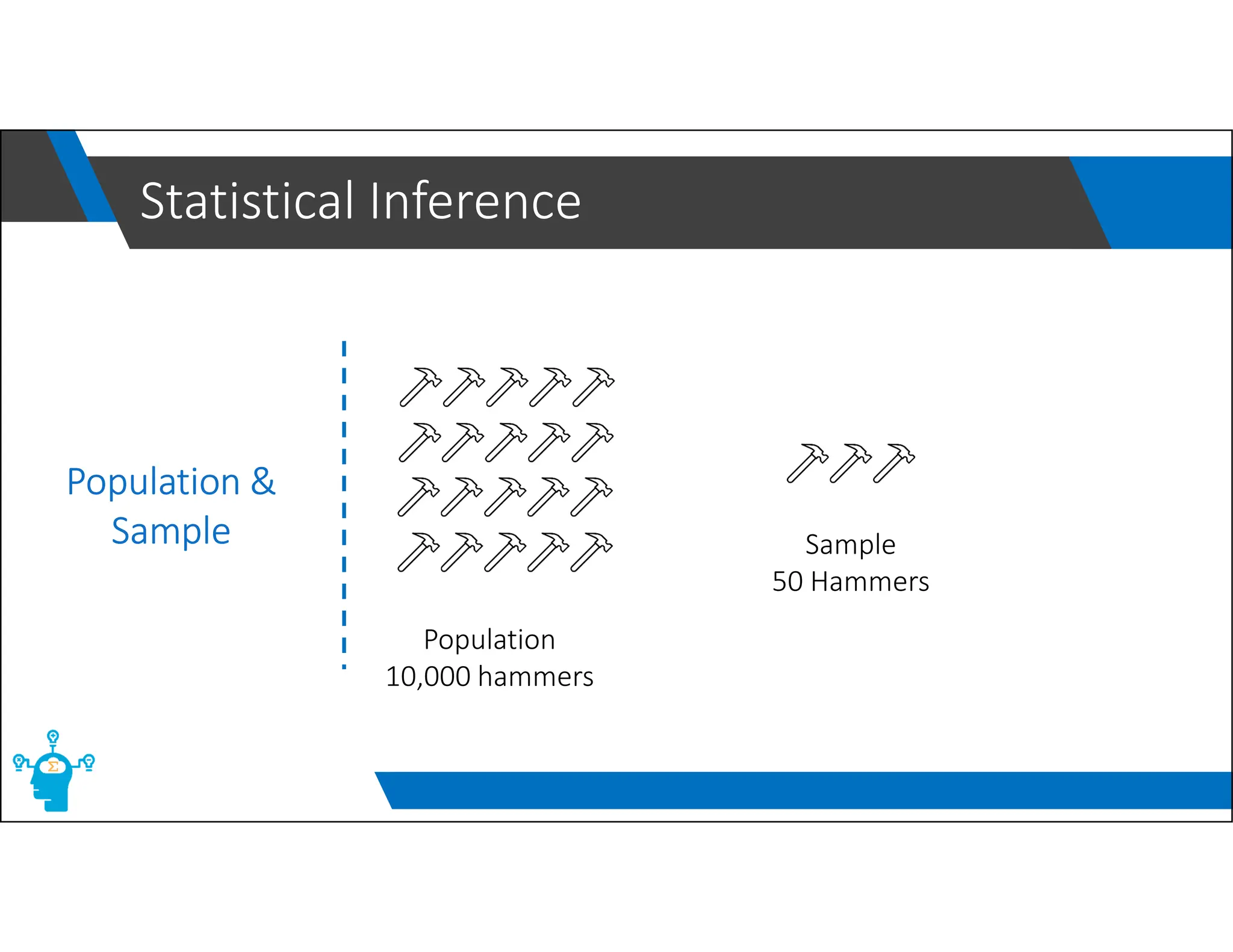
Population
10,000 hammers
Sample
50 Hammers
Statistical Inference
Population &
Sample
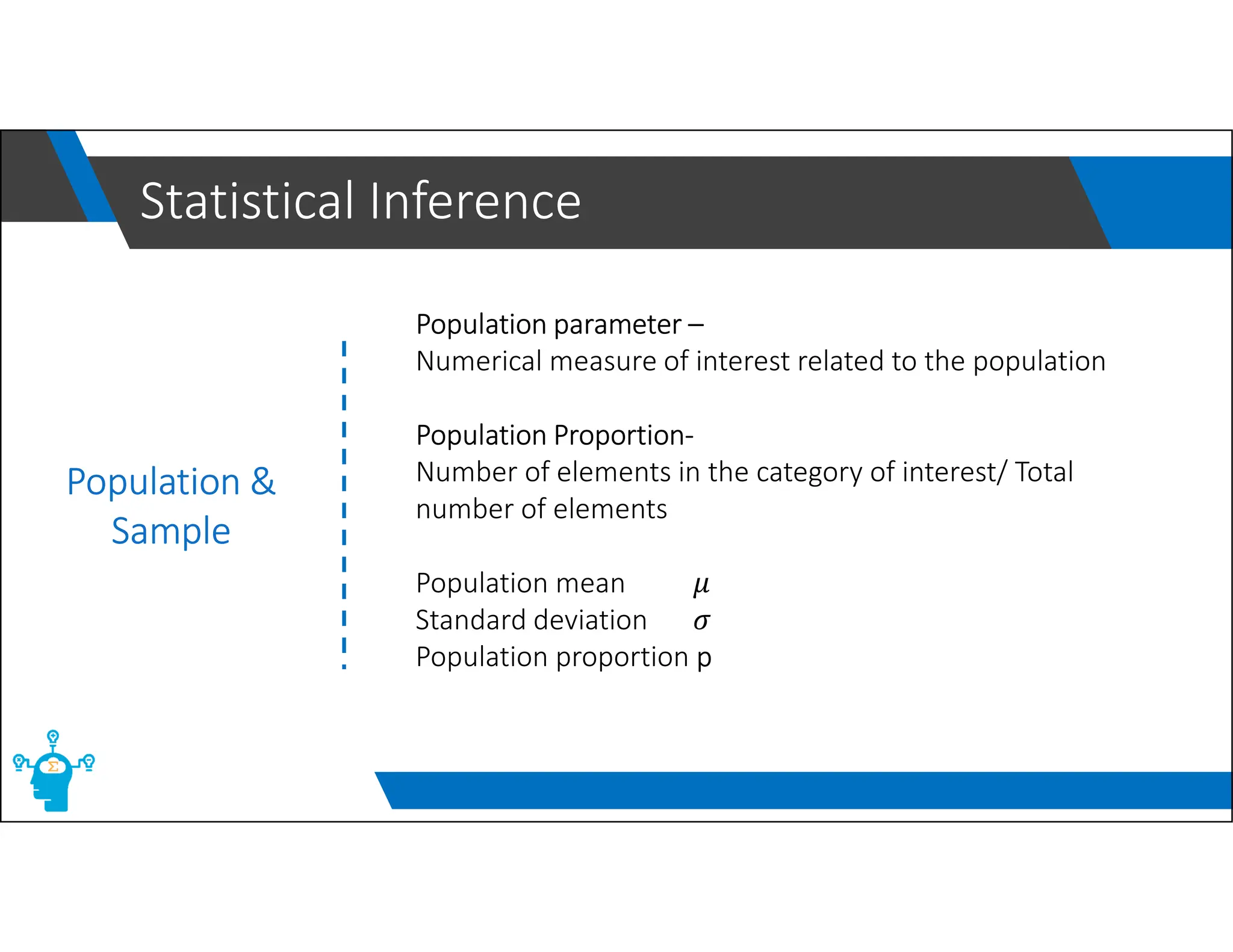
Population parameter –
Numerical measure of interest related to the population
Population Proportion-
Number of elements in the category of interest/ Total
number of elements
Population mean
Standard deviation
Population proportion p
Statistical Inference
Population &
Sample
Population
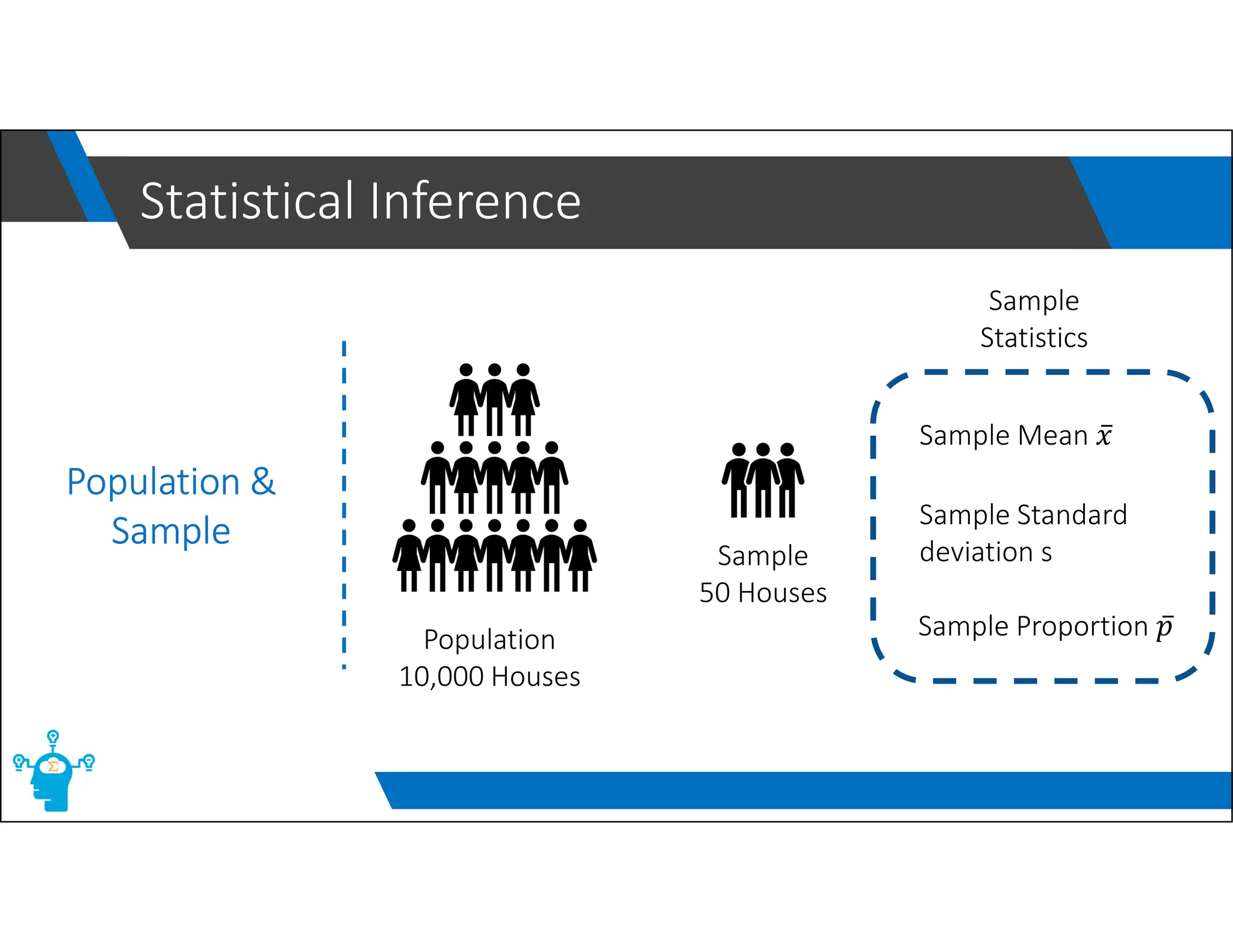
10,000 Houses
Sample
50 Houses
Sample Mean ̅
Sample Standard
deviation s
Sample Proportion ̅
Sample
Statistics
Statistical Inference
Population &
Sample
Sample
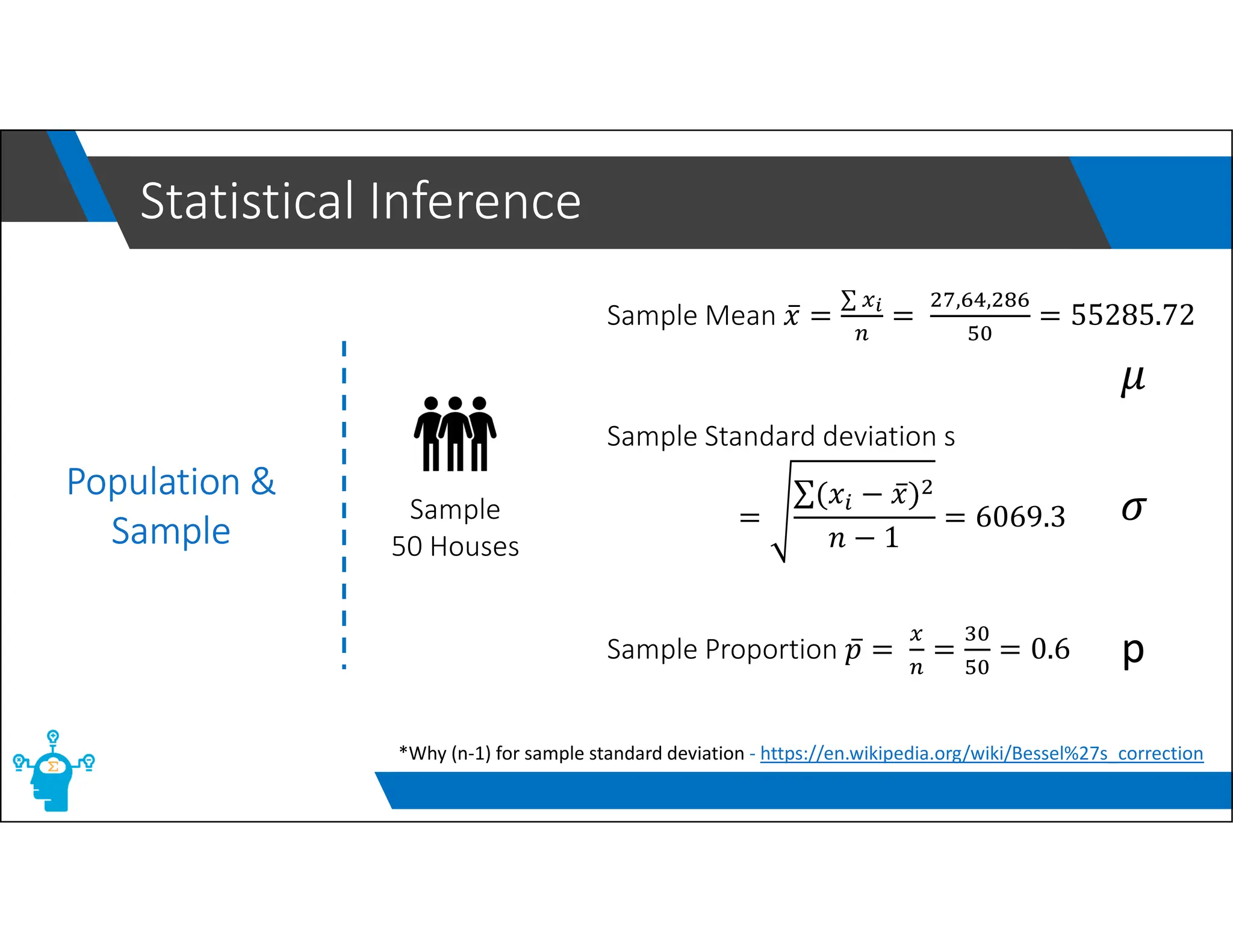
50 Houses
Sample Mean ̅
∑ , , "
55285.72
Sample Standard deviation s
∑ $ ̅
% 1
6069.3
Sample Proportion ̅
'
0.6 p
*Why (n-1) for sample standard deviation - https://en.wikipedia.org/wiki/Bessel%27s_correction
Tools of Quality
Start-Tech Academy
Control chart
• A control chart is a time-ordered plot of sample statistics.
• It is used to distinguish between random variability and nonrandom variability.
• It has upper and lower limits, called control limits, that define the range of
acceptable (i.e., random) variation for the sample statistic.
Lower control Limit
Upper control Limit
Tools of Quality
Start-Tech Academy
Mean Control
chart
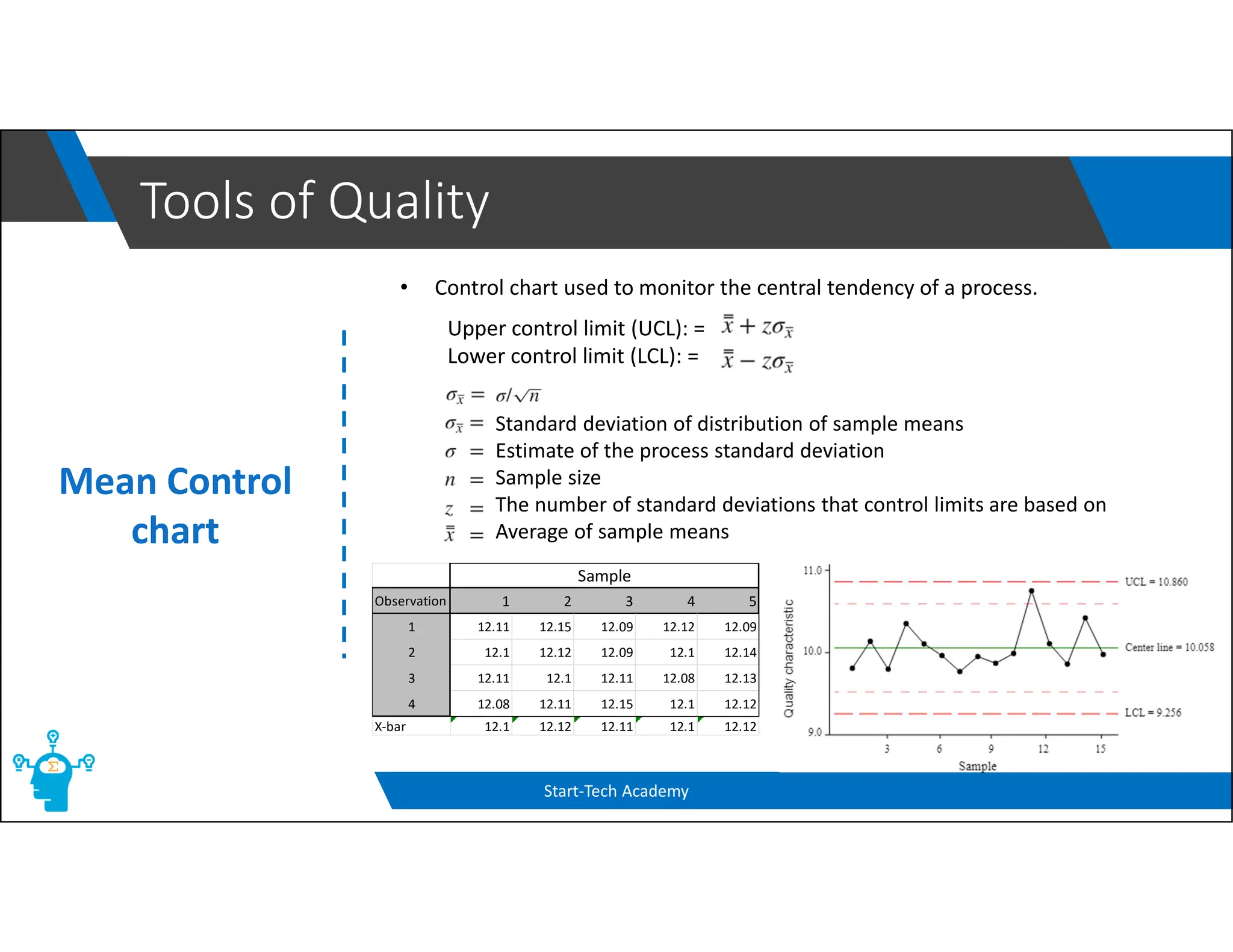
• Control chart used to monitor the central tendency of a process.
Upper control limit (UCL): =
Lower control limit (LCL): =
Standard deviation of distribution of sample means
Estimate of the process standard deviation
Sample size
The number of standard deviations that control limits are based on
Average of sample means
Observation 1 2 3 4 5
1 12.11 12.15 12.09 12.12 12.09
2 12.1 12.12 12.09 12.1 12.14
3 12.11 12.1 12.11 12.08 12.13
4 12.08 12.11 12.15 12.1 12.12
X-bar 12.1 12.12 12.11 12.1 12.12
Sample
Tools of Quality
Start-Tech Academy
Mean Control
chart
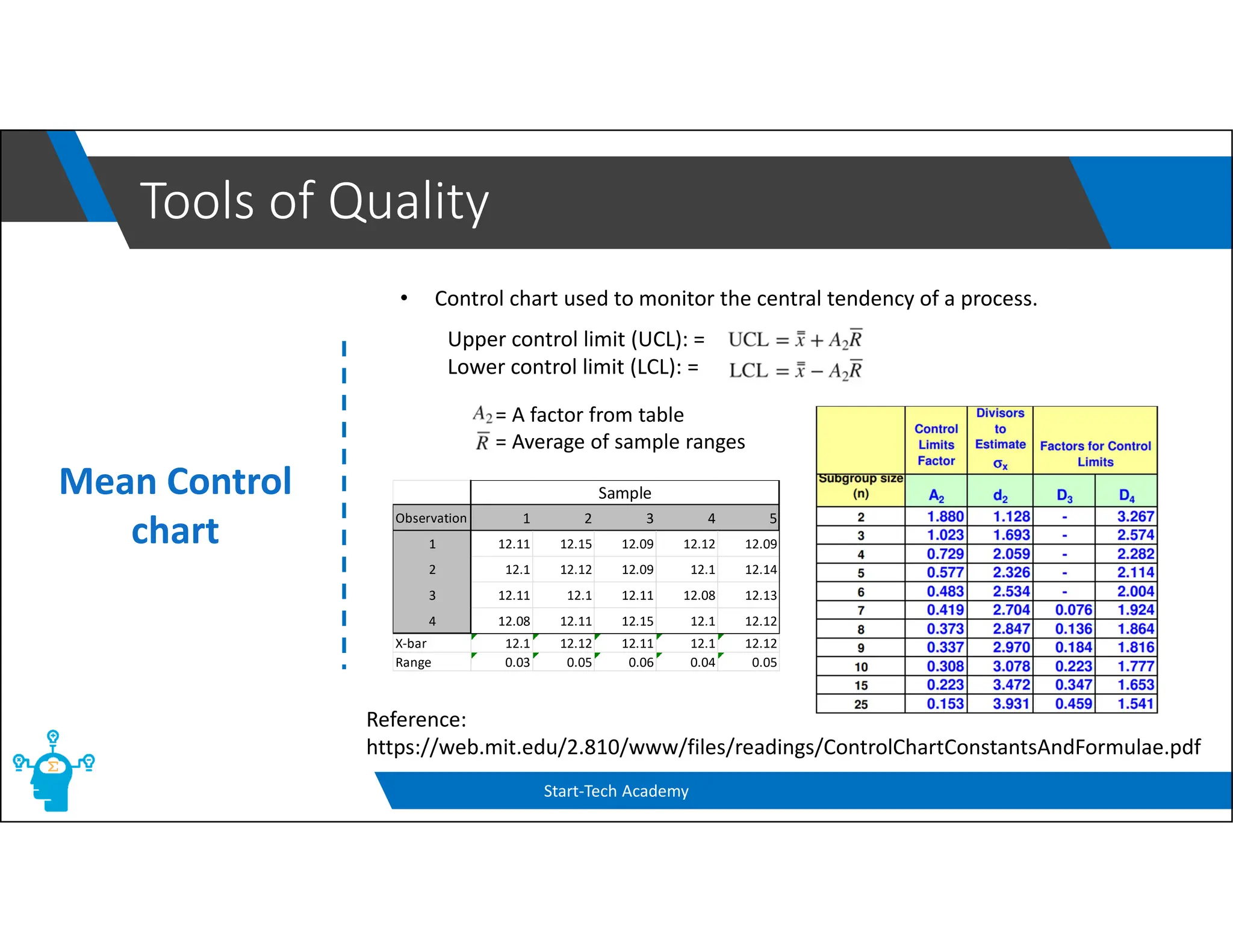
• Control chart used to monitor the central tendency of a process.
Upper control limit (UCL): =
Lower control limit (LCL): =
= A factor from table
= Average of sample ranges
Reference:
https://web.mit.edu/2.810/www/files/readings/ControlChartConstantsAndFormulae.pdf
Observation 1 2 3 4 5
1 12.11 12.15 12.09 12.12 12.09
2 12.1 12.12 12.09 12.1 12.14
3 12.11 12.1 12.11 12.08 12.13
4 12.08 12.11 12.15 12.1 12.12
X-bar 12.1 12.12 12.11 12.1 12.12
Range 0.03 0.05 0.06 0.04 0.05
Sample
Tools of Quality
Start-Tech Academy
Range Control
chart
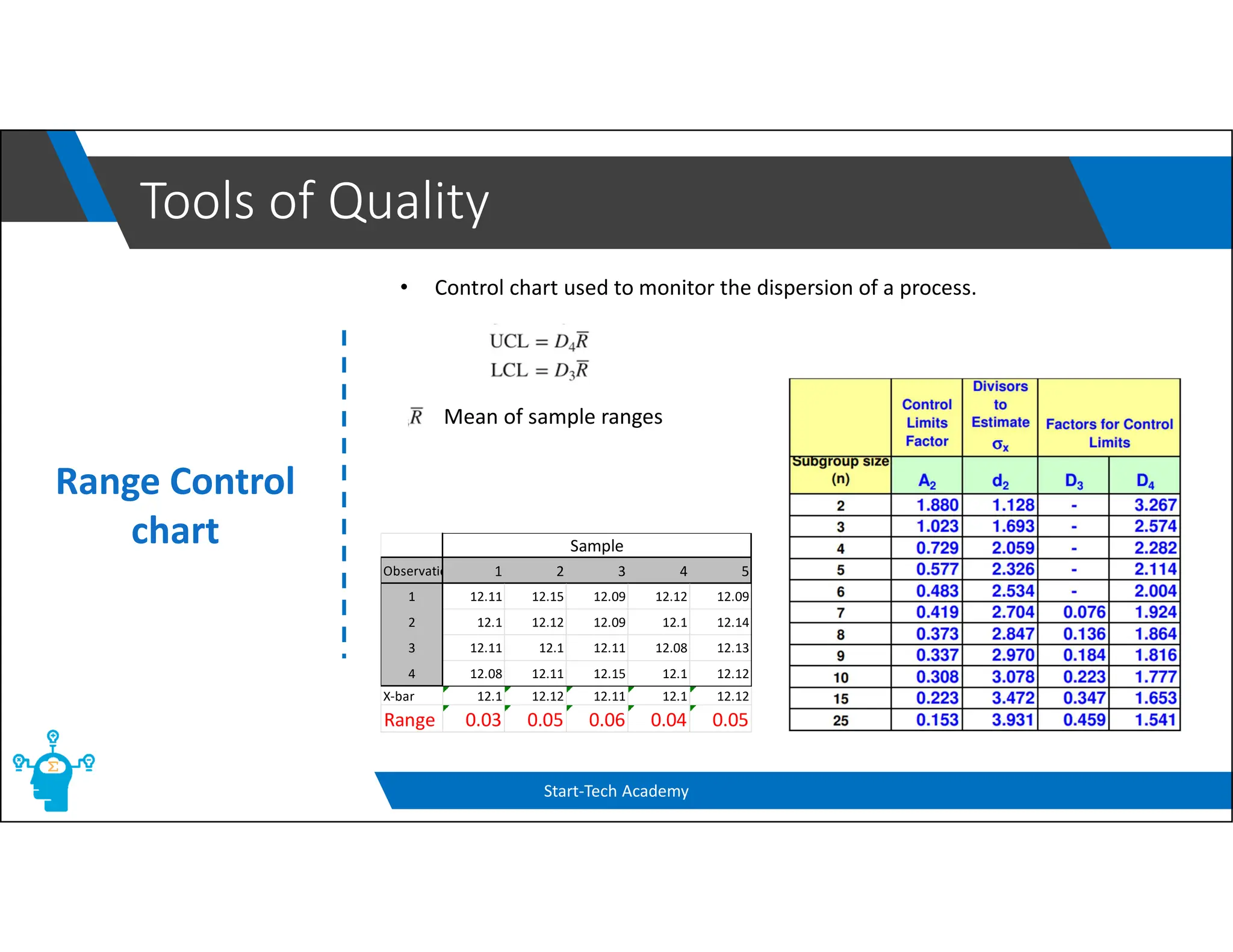
• Control chart used to monitor the dispersion of a process.
Observation 1 2 3 4 5
1 12.11 12.16 12.07 12.17 12.03
2 12.1 12.13 12.06 12.13 12.2
3 12.11 12.09 12.14 12.03 12.13
4 12.08 12.1 12.17 12.07 12.12
X-bar 12.1 12.12 12.11 12.1 12.12
Range 0.03 0.07 0.11 0.14 0.17
Sample
Observation 1 2 3 4 5
1 12.11 12.15 12.09 12.12 12.09
2 12.1 12.12 12.09 12.1 12.14
3 12.11 12.1 12.11 12.08 12.13
4 12.08 12.11 12.15 12.1 12.12
X-bar 12.1 12.12 12.11 12.1 12.12
Range 0.03 0.05 0.06 0.04 0.05
Sample
Tools of Quality
Start-Tech Academy
Range Control
chart
• Control chart used to monitor the dispersion of a process.
Observation 1 2 3 4 5
1 12.11 12.15 12.09 12.12 12.09
2 12.1 12.12 12.09 12.1 12.14
3 12.11 12.1 12.11 12.08 12.13
4 12.08 12.11 12.15 12.1 12.12
X-bar 12.1 12.12 12.11 12.1 12.12
Range 0.03 0.05 0.06 0.04 0.05
Sample
Mean of sample ranges
Tools of Quality
Start-Tech Academy
Control Charts
for Attributes
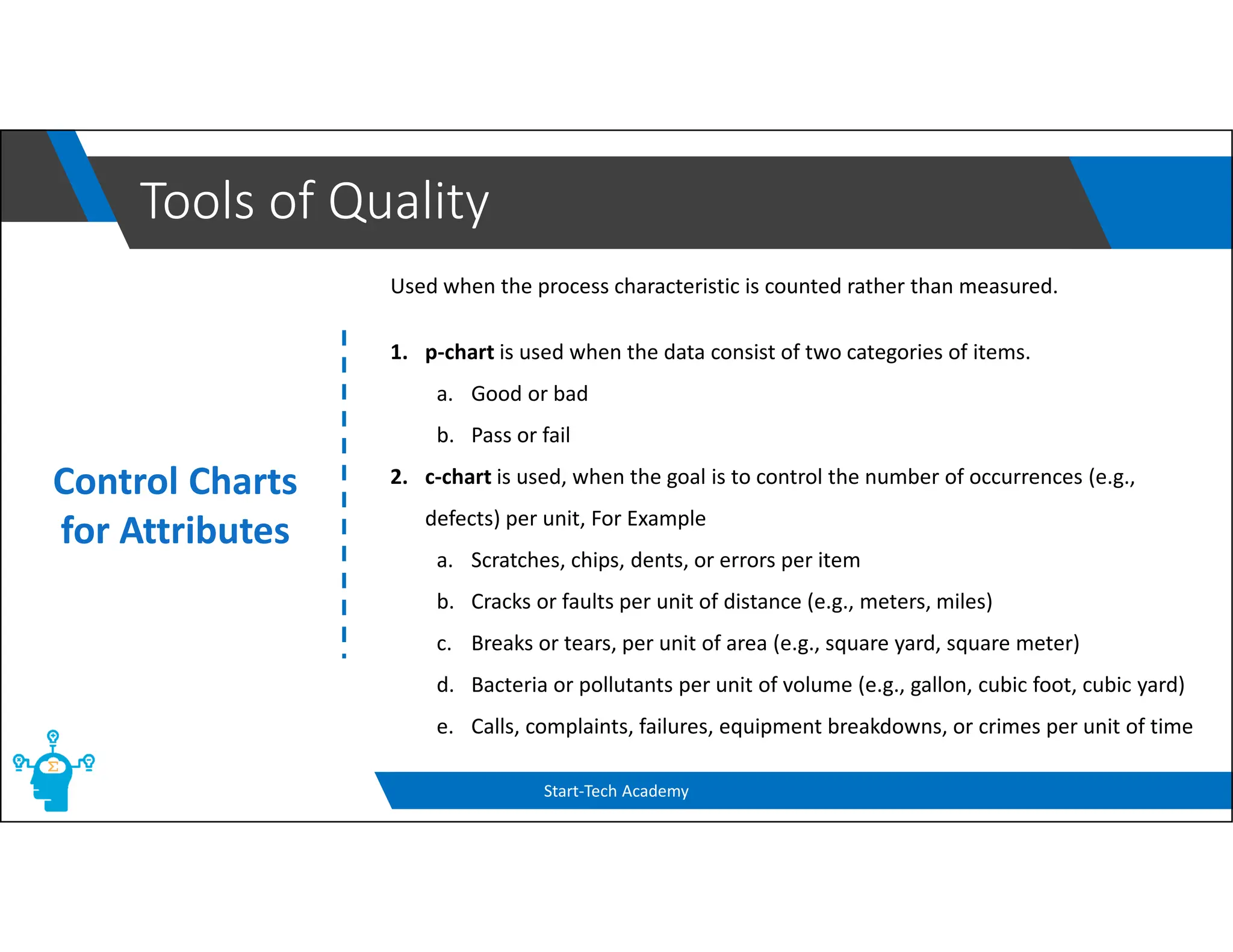
Used when the process characteristic is counted rather than measured.
1. p-chart is used when the data consist of two categories of items.
a. Good or bad
b. Pass or fail
2. c-chart is used, when the goal is to control the number of occurrences (e.g.,
defects) per unit, For Example
a. Scratches, chips, dents, or errors per item
b. Cracks or faults per unit of distance (e.g., meters, miles)
c. Breaks or tears, per unit of area (e.g., square yard, square meter)
d. Bacteria or pollutants per unit of volume (e.g., gallon, cubic foot, cubic yard)
e. Calls, complaints, failures, equipment breakdowns, or crimes per unit of time
Tools of Quality
Start-Tech Academy
p Chart
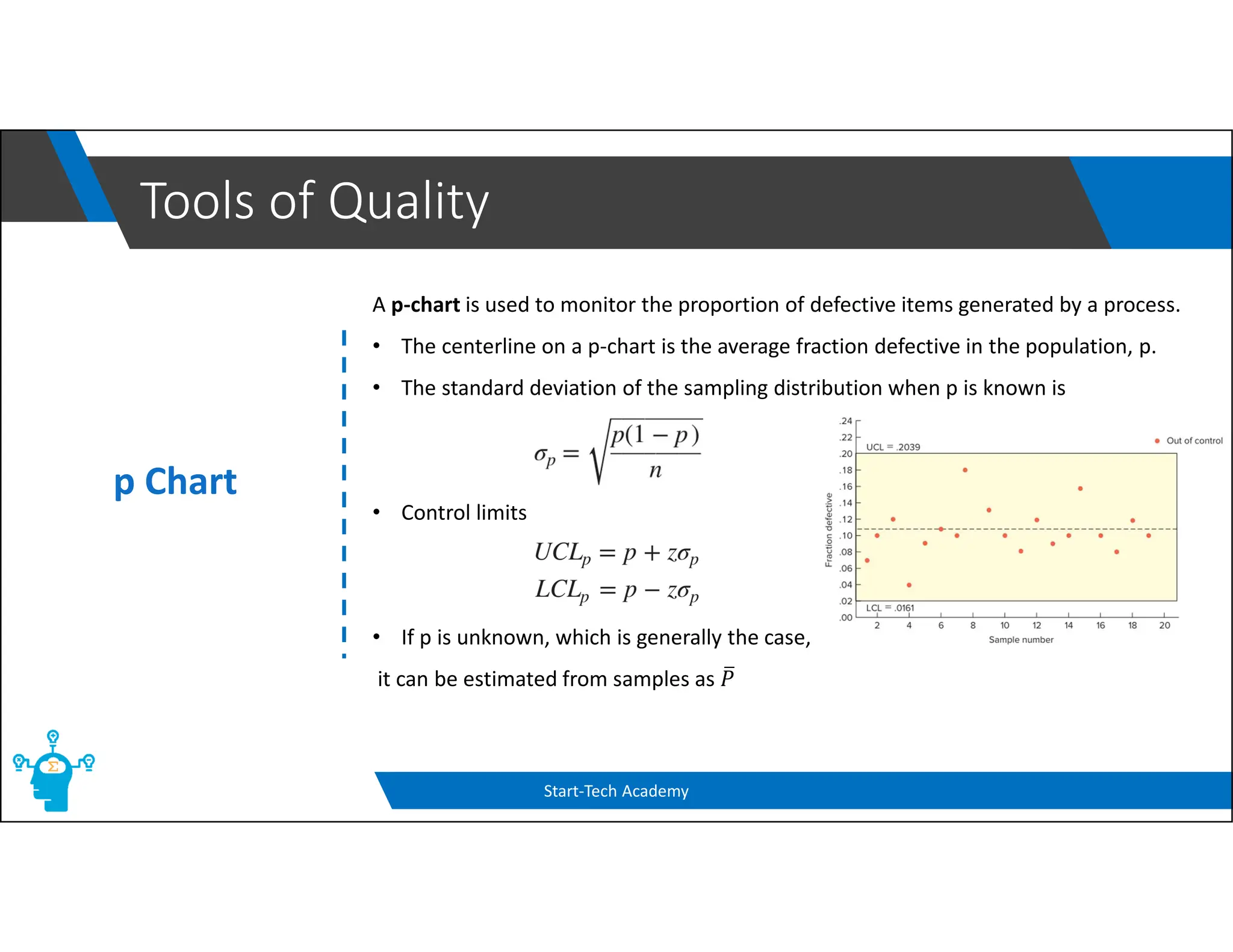
A p-chart is used to monitor the proportion of defective items generated by a process.
• The centerline on a p-chart is the average fraction defective in the population, p.
• The standard deviation of the sampling distribution when p is known is
• Control limits
• If p is unknown, which is generally the case,
it can be estimated from samples as (
)
Tools of Quality
Start-Tech Academy
c Chart
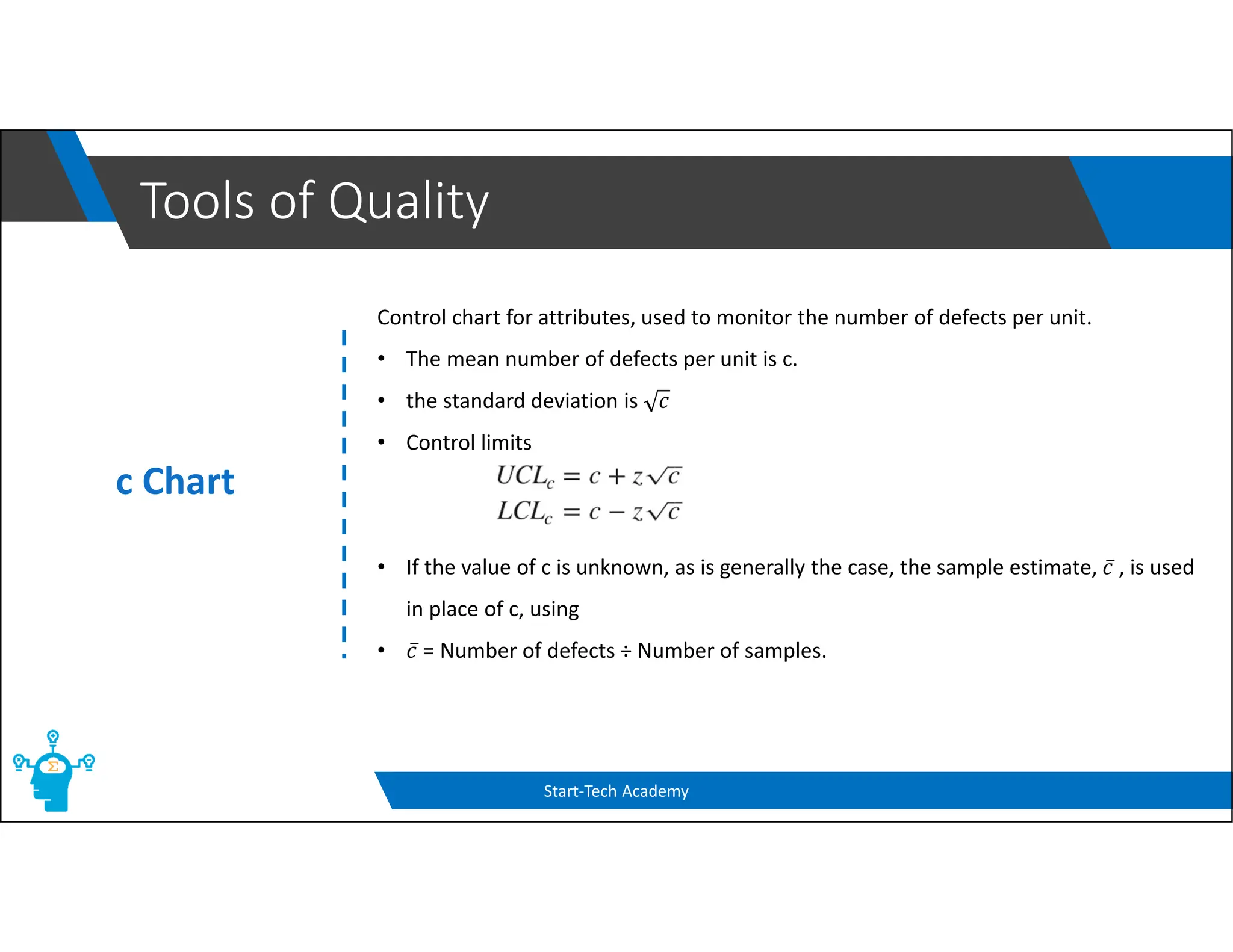
Control chart for attributes, used to monitor the number of defects per unit.
• The mean number of defects per unit is c.
• the standard deviation is *
• Control limits
• If the value of c is unknown, as is generally the case, the sample estimate, *̅ , is used
in place of c, using
• *̅ = Number of defects ÷ Number of samples.

control chart contoh materi untuk mengontrol

  • 1.
    Tools of Quality Start-TechAcademy Control chart • A control chart is a time-ordered plot of sample statistics. • Each point is a sample statistics Lower control Limit Upper control Limit
  • 2.
    Tools of Quality Start-TechAcademy Control chart • A control chart is a time-ordered plot of sample statistics. • It is used to distinguish between random variability and nonrandom variability. • It has upper and lower limits, called control limits, that define the range of acceptable (i.e., random) variation for the sample statistic. Lower control Limit Upper control Limit
  • 3.
    Tools of Quality Start-TechAcademy Mean Mean is the average of a data set. It is denoted by µ (mu) or ̅ S.no Observation 1 12 2 11 3 10 4 9 5 8 ̅ 12 11 10 9 8 5 ̅ 50 5 ̅ 10
  • 4.
    Tools of Quality Start-TechAcademy Standard Deviation Standard deviation is a measure of dispersement in statistics. “Dispersement” tells you how much your data is spread out. It is denoted by (sigma) S.no Observation 1 12 2 11 3 10 4 9 5 8 12 10 11 10 10 10 9 10 8 10 5 2 1.41 S.no Observation 1 14 2 12 3 10 4 8 5 6 14 10 12 10 10 10 8 10 6 10 5 8 2.82
  • 5.
  • 6.
    Statistical Inference Population & Sample Populationparameter – Numerical measure of interest related to the population Population Proportion- Number of elements in the category of interest/ Total number of elements Population mean Standard deviation Population proportion p
  • 7.
    Statistical Inference Population & Sample Population 10,000Houses Sample 50 Houses Sample Mean ̅ Sample Standard deviation s Sample Proportion ̅ Sample Statistics
  • 8.
    Statistical Inference Population & Sample Sample 50Houses Sample Mean ̅ ∑ , , " 55285.72 Sample Standard deviation s ∑ $ ̅ % 1 6069.3 Sample Proportion ̅ ' 0.6 p *Why (n-1) for sample standard deviation - https://en.wikipedia.org/wiki/Bessel%27s_correction
  • 9.
    Tools of Quality Start-TechAcademy Control chart • A control chart is a time-ordered plot of sample statistics. • It is used to distinguish between random variability and nonrandom variability. • It has upper and lower limits, called control limits, that define the range of acceptable (i.e., random) variation for the sample statistic. Lower control Limit Upper control Limit
  • 10.
    Tools of Quality Start-TechAcademy Mean Control chart • Control chart used to monitor the central tendency of a process. Upper control limit (UCL): = Lower control limit (LCL): = Standard deviation of distribution of sample means Estimate of the process standard deviation Sample size The number of standard deviations that control limits are based on Average of sample means Observation 1 2 3 4 5 1 12.11 12.15 12.09 12.12 12.09 2 12.1 12.12 12.09 12.1 12.14 3 12.11 12.1 12.11 12.08 12.13 4 12.08 12.11 12.15 12.1 12.12 X-bar 12.1 12.12 12.11 12.1 12.12 Sample
  • 11.
    Tools of Quality Start-TechAcademy Mean Control chart • Control chart used to monitor the central tendency of a process. Upper control limit (UCL): = Lower control limit (LCL): = = A factor from table = Average of sample ranges Reference: https://web.mit.edu/2.810/www/files/readings/ControlChartConstantsAndFormulae.pdf Observation 1 2 3 4 5 1 12.11 12.15 12.09 12.12 12.09 2 12.1 12.12 12.09 12.1 12.14 3 12.11 12.1 12.11 12.08 12.13 4 12.08 12.11 12.15 12.1 12.12 X-bar 12.1 12.12 12.11 12.1 12.12 Range 0.03 0.05 0.06 0.04 0.05 Sample
  • 12.
    Tools of Quality Start-TechAcademy Range Control chart • Control chart used to monitor the dispersion of a process. Observation 1 2 3 4 5 1 12.11 12.16 12.07 12.17 12.03 2 12.1 12.13 12.06 12.13 12.2 3 12.11 12.09 12.14 12.03 12.13 4 12.08 12.1 12.17 12.07 12.12 X-bar 12.1 12.12 12.11 12.1 12.12 Range 0.03 0.07 0.11 0.14 0.17 Sample Observation 1 2 3 4 5 1 12.11 12.15 12.09 12.12 12.09 2 12.1 12.12 12.09 12.1 12.14 3 12.11 12.1 12.11 12.08 12.13 4 12.08 12.11 12.15 12.1 12.12 X-bar 12.1 12.12 12.11 12.1 12.12 Range 0.03 0.05 0.06 0.04 0.05 Sample
  • 13.
    Tools of Quality Start-TechAcademy Range Control chart • Control chart used to monitor the dispersion of a process. Observation 1 2 3 4 5 1 12.11 12.15 12.09 12.12 12.09 2 12.1 12.12 12.09 12.1 12.14 3 12.11 12.1 12.11 12.08 12.13 4 12.08 12.11 12.15 12.1 12.12 X-bar 12.1 12.12 12.11 12.1 12.12 Range 0.03 0.05 0.06 0.04 0.05 Sample Mean of sample ranges
  • 14.
    Tools of Quality Start-TechAcademy Control Charts for Attributes Used when the process characteristic is counted rather than measured. 1. p-chart is used when the data consist of two categories of items. a. Good or bad b. Pass or fail 2. c-chart is used, when the goal is to control the number of occurrences (e.g., defects) per unit, For Example a. Scratches, chips, dents, or errors per item b. Cracks or faults per unit of distance (e.g., meters, miles) c. Breaks or tears, per unit of area (e.g., square yard, square meter) d. Bacteria or pollutants per unit of volume (e.g., gallon, cubic foot, cubic yard) e. Calls, complaints, failures, equipment breakdowns, or crimes per unit of time
  • 15.
    Tools of Quality Start-TechAcademy p Chart A p-chart is used to monitor the proportion of defective items generated by a process. • The centerline on a p-chart is the average fraction defective in the population, p. • The standard deviation of the sampling distribution when p is known is • Control limits • If p is unknown, which is generally the case, it can be estimated from samples as ( )
  • 16.
    Tools of Quality Start-TechAcademy c Chart Control chart for attributes, used to monitor the number of defects per unit. • The mean number of defects per unit is c. • the standard deviation is * • Control limits • If the value of c is unknown, as is generally the case, the sample estimate, *̅ , is used in place of c, using • *̅ = Number of defects ÷ Number of samples.