Control Charts
The control chart is a
statistical quality control tool
used in the monitoring variation
in the characteristics of
a product or service
Control Charts
The control chart focuses
on the time dimension and
the nature of the variability
in the system.
Control Charts
The control chart may be
used to study past
performance and/or to
evaluate present conditions.
Control Charts
Data collected from a
control chart may form the
basis for process
improvement.
Control Charts
Levine, Prentic-Hall
Control Charts
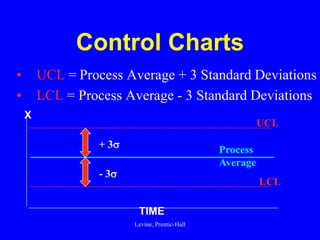
• UCL = Process Average + 3 Standard Deviations
• LCL = Process Average - 3 Standard Deviations
Process
Average
UCL
LCL
X
+ 3
- 3
TIME
Levine, Prentice-Hall
0
20
40
60
1 3 5 7 9 11
X
Time
0
20
40
60
1 3 5 7 9 11
X
Time
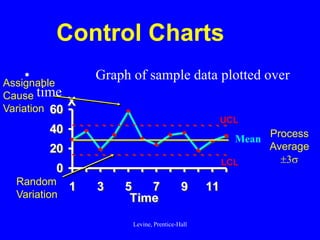
• Graph of sample data plotted over
time
Assignable
Cause
Variation
Random
Variation
Process
Average

Mean
Control Charts
UCL
LCL
Levine, Prentice-Hall
Control Charts
X X
X
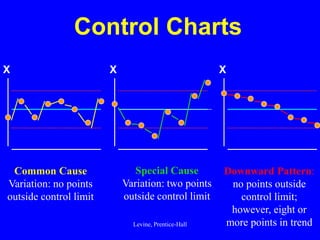
Common Cause
Variation: no points
outside control limit
Special Cause
Variation: two points
outside control limit
Downward Pattern:
no points outside
control limit;
however, eight or
more points in trend
Control Charts
• Attribute charts
• Variables charts
Control Charts
Charts may
be used for
categorical
variables.
[i.e.: attributes]
Control Charts
Whenever a character of
interest is measured on a
nominative or an interval,
ie: categorical, scale…an
attributes control chart is used
to monitor a process.
Control Charts
• Attributes Control Charts
counts [c-chart]
proportion [p-charts]
Control Charts
• Attributes Control Charts
when sample size are not constant
and/or are unknown
use counts charts
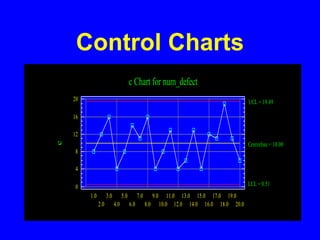
[c-charts]
Control Charts
c Chart for num_defect
1.0
2.0
3.0
4.0
5.0
6.0
7.0
8.0
9.0
10.0
11.0
12.0
13.0
14.0
15.0
16.0
17.0
18.0
19.0
20.0
0
4
8
12
16
20
c
Centerline = 10.00
UCL = 19.49
LCL = 0.51
Control Charts
• Attributes Control Charts
when sample size are constant
and are known
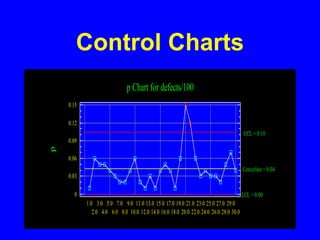
use proportion charts
[p-charts]
Control Charts
p Chart for defects/100
1.0
2.0
3.0
4.0
5.0
6.0
7.0
8.0
9.0
10.0
11.0
12.0
13.0
14.0
15.0
16.0
17.0
18.0
19.0
20.0
21.0
22.0
23.0
24.0
25.0
26.0
27.0
28.0
29.0
30.0
0
0.03
0.06
0.09
0.12
0.15
p
Centerline = 0.04
UCL = 0.10
LCL = 0.00
Control Charts
Charts may
be used for
interval or
ratio data
[i.e.: variables ]
Control Charts
Whenever a character of
interest is measured on an
interval or a ratio scale, a
variables control chart is
used to monitor a process.
Control Charts
• Variables Control Charts
Mean and Range charts
[x-bar & R charts]
Control Charts
Variables control charts are
typically used used in pairs.
…… one chart monitors process
average while the other monitors
the variation in a process.
Control Charts
p Chart for defects/100
1.0
2.0
3.0
4.0
5.0
6.0
7.0
8.0
9.0
10.0
11.0
12.0
13.0
14.0
15.0
16.0
17.0
18.0
19.0
20.0
21.0
22.0
23.0
24.0
25.0
26.0
27.0
28.0
29.0
30.0
0
0.03
0.06
0.09
0.12
0.15
p
Centerline = 0.04
UCL = 0.10
LCL = 0.00
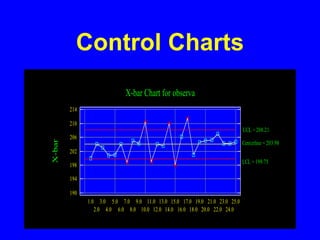
X-bar Chart for observa
1.0
2.0
3.0
4.0
5.0
6.0
7.0
8.0
9.0
10.0
11.0
12.0
13.0
14.0
15.0
16.0
17.0
18.0
19.0
20.0
21.0
22.0
23.0
24.0
25.0
190
194
198
202
206
210
214
X-bar
Centerline = 203.98
UCL = 208.21
LCL = 199.75
Control Charts
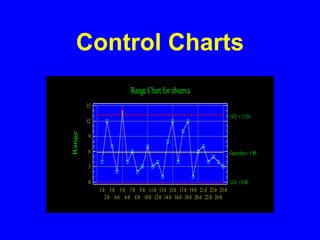
Range Chart for observa
1.0
2.0
3.0
4.0
5.0
6.0
7.0
8.0
9.0
10.0
11.0
12.0
13.0
14.0
15.0
16.0
17.0
18.0
19.0
20.0
21.0
22.0
23.0
24.0
25.0
0
3
6
9
12
15
Range
Centerline = 5.80
UCL = 13.24
LCL = 0.00
Control Charts
In conclusion:
the control chart is a means of
monitoring variation in the
characteristics of
a product or service
Control Charts
Know the
assumptions
… let the
computer do
the hard work.
Control Charts
Questions?
ANOVA
ControlCharts1.ppt

ControlCharts1.ppt

  • 1.
    Control Charts The controlchart is a statistical quality control tool used in the monitoring variation in the characteristics of a product or service
  • 2.
    Control Charts The controlchart focuses on the time dimension and the nature of the variability in the system.
  • 3.
    Control Charts The controlchart may be used to study past performance and/or to evaluate present conditions.
  • 4.
    Control Charts Data collectedfrom a control chart may form the basis for process improvement.
  • 5.
  • 6.
    Levine, Prentic-Hall Control Charts •UCL = Process Average + 3 Standard Deviations • LCL = Process Average - 3 Standard Deviations Process Average UCL LCL X + 3 - 3 TIME
  • 7.
    Levine, Prentice-Hall 0 20 40 60 1 35 7 9 11 X Time 0 20 40 60 1 3 5 7 9 11 X Time • Graph of sample data plotted over time Assignable Cause Variation Random Variation Process Average  Mean Control Charts UCL LCL
  • 8.
    Levine, Prentice-Hall Control Charts XX X Common Cause Variation: no points outside control limit Special Cause Variation: two points outside control limit Downward Pattern: no points outside control limit; however, eight or more points in trend
  • 9.
    Control Charts • Attributecharts • Variables charts
  • 10.
    Control Charts Charts may beused for categorical variables. [i.e.: attributes]
  • 11.
    Control Charts Whenever acharacter of interest is measured on a nominative or an interval, ie: categorical, scale…an attributes control chart is used to monitor a process.
  • 12.
    Control Charts • AttributesControl Charts counts [c-chart] proportion [p-charts]
  • 13.
    Control Charts • AttributesControl Charts when sample size are not constant and/or are unknown use counts charts [c-charts]
  • 14.
    Control Charts c Chartfor num_defect 1.0 2.0 3.0 4.0 5.0 6.0 7.0 8.0 9.0 10.0 11.0 12.0 13.0 14.0 15.0 16.0 17.0 18.0 19.0 20.0 0 4 8 12 16 20 c Centerline = 10.00 UCL = 19.49 LCL = 0.51
  • 15.
    Control Charts • AttributesControl Charts when sample size are constant and are known use proportion charts [p-charts]
  • 16.
    Control Charts p Chartfor defects/100 1.0 2.0 3.0 4.0 5.0 6.0 7.0 8.0 9.0 10.0 11.0 12.0 13.0 14.0 15.0 16.0 17.0 18.0 19.0 20.0 21.0 22.0 23.0 24.0 25.0 26.0 27.0 28.0 29.0 30.0 0 0.03 0.06 0.09 0.12 0.15 p Centerline = 0.04 UCL = 0.10 LCL = 0.00
  • 17.
    Control Charts Charts may beused for interval or ratio data [i.e.: variables ]
  • 18.
    Control Charts Whenever acharacter of interest is measured on an interval or a ratio scale, a variables control chart is used to monitor a process.
  • 19.
    Control Charts • VariablesControl Charts Mean and Range charts [x-bar & R charts]
  • 20.
    Control Charts Variables controlcharts are typically used used in pairs. …… one chart monitors process average while the other monitors the variation in a process.
  • 21.
    Control Charts p Chartfor defects/100 1.0 2.0 3.0 4.0 5.0 6.0 7.0 8.0 9.0 10.0 11.0 12.0 13.0 14.0 15.0 16.0 17.0 18.0 19.0 20.0 21.0 22.0 23.0 24.0 25.0 26.0 27.0 28.0 29.0 30.0 0 0.03 0.06 0.09 0.12 0.15 p Centerline = 0.04 UCL = 0.10 LCL = 0.00 X-bar Chart for observa 1.0 2.0 3.0 4.0 5.0 6.0 7.0 8.0 9.0 10.0 11.0 12.0 13.0 14.0 15.0 16.0 17.0 18.0 19.0 20.0 21.0 22.0 23.0 24.0 25.0 190 194 198 202 206 210 214 X-bar Centerline = 203.98 UCL = 208.21 LCL = 199.75
  • 22.
    Control Charts Range Chartfor observa 1.0 2.0 3.0 4.0 5.0 6.0 7.0 8.0 9.0 10.0 11.0 12.0 13.0 14.0 15.0 16.0 17.0 18.0 19.0 20.0 21.0 22.0 23.0 24.0 25.0 0 3 6 9 12 15 Range Centerline = 5.80 UCL = 13.24 LCL = 0.00
  • 23.
    Control Charts In conclusion: thecontrol chart is a means of monitoring variation in the characteristics of a product or service
  • 24.
    Control Charts Know the assumptions …let the computer do the hard work.
  • 25.
  • 26.