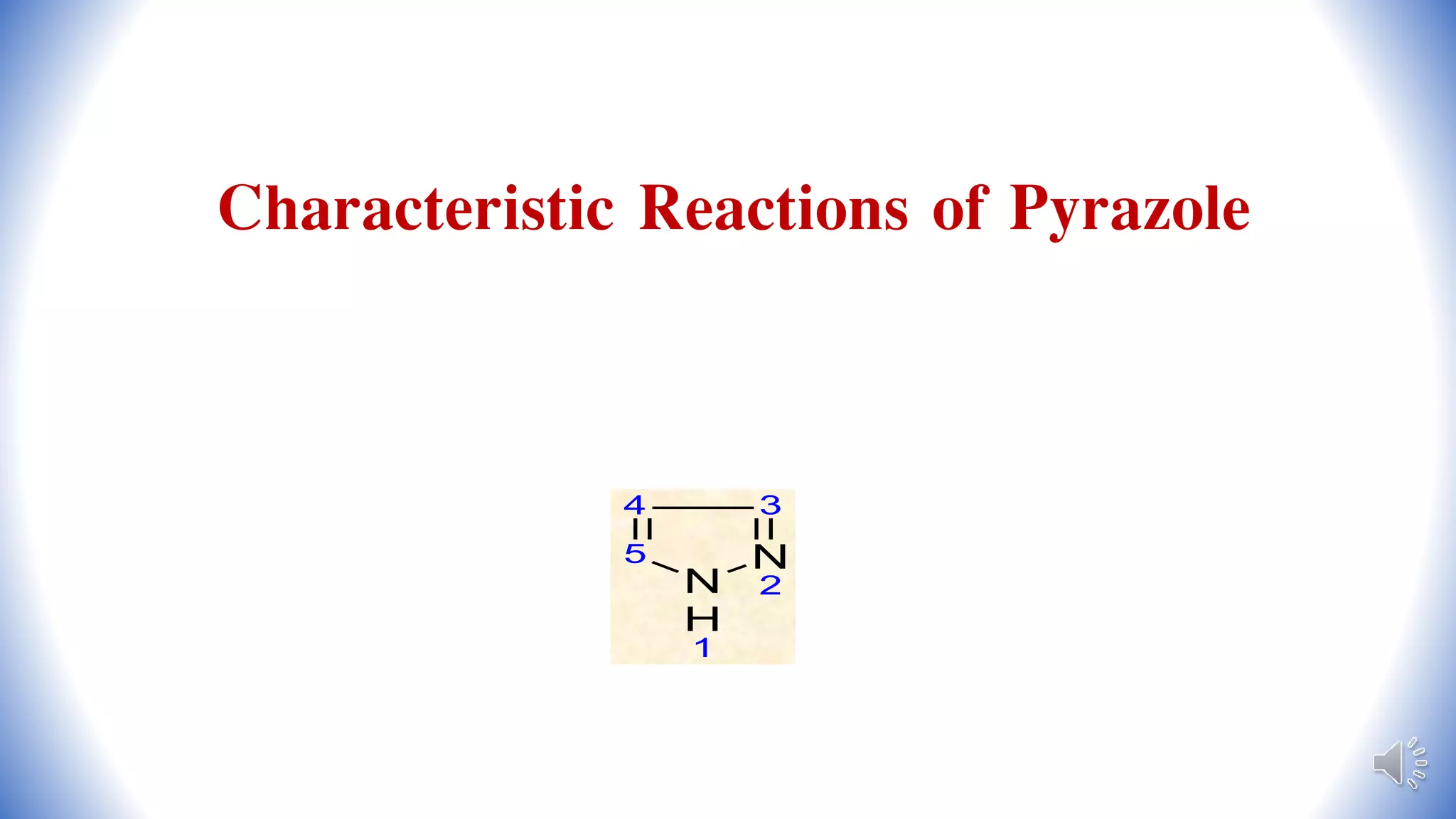
Pyrazole - Synthesis of Pyrazole - Characteristic Reactions of Pyrazole - Medicinal uses of Pyrazole
The document discusses various methods for the synthesis of pyrazole, including reactions with carboxylic acids, hydrazine, and unsaturated carbonyl compounds. It also details the characteristic reactions of pyrazole and its derivatives, such as acylation, nitration, and medicinal uses like antipyrine and celecoxib. Additionally, the document highlights the importance of pyrazole in pharmacology for treating conditions like pain and infections.
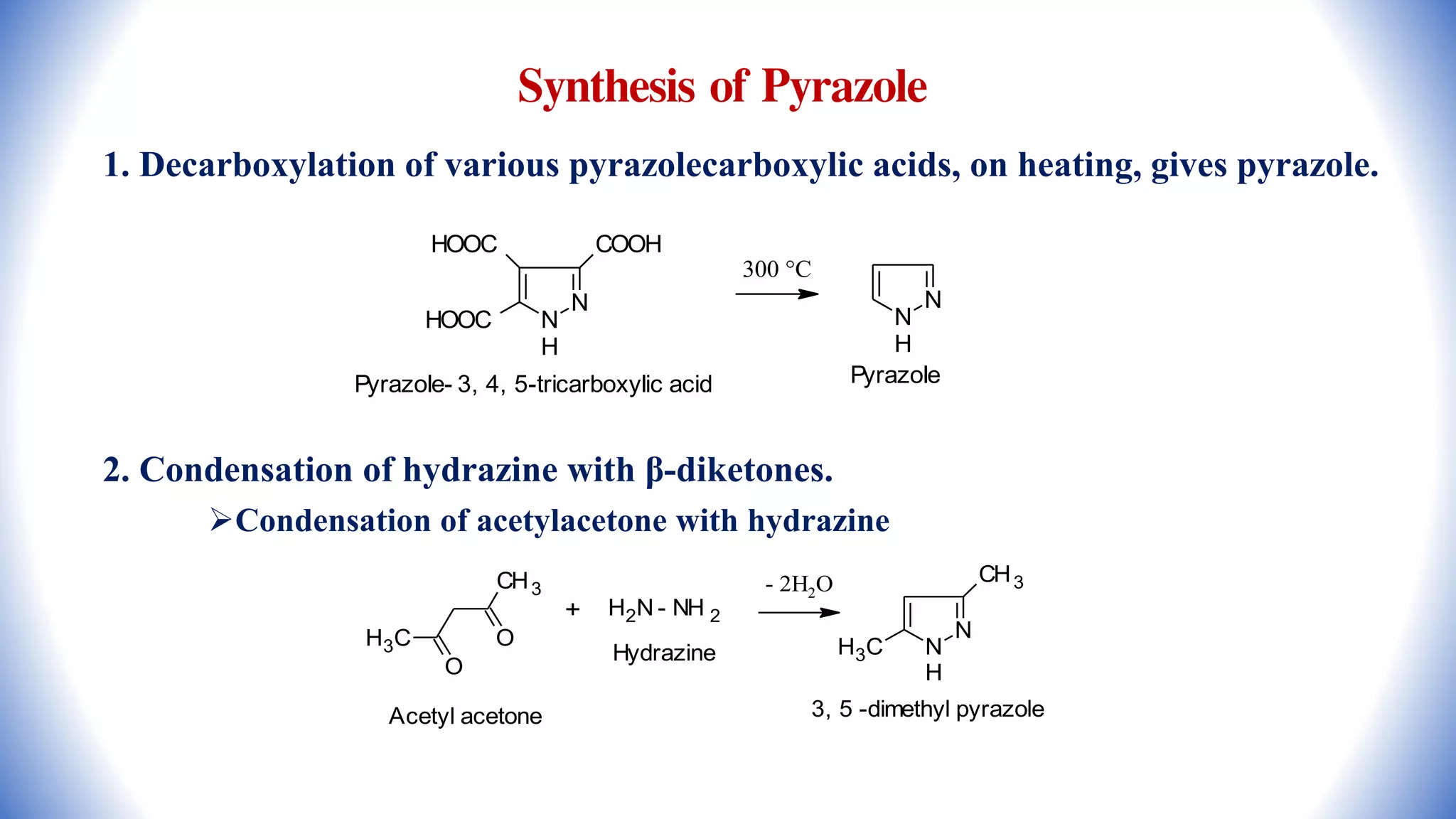
Synthesis of Pyrazole
1.Decarboxylation of various pyrazolecarboxylic acids, on heating, gives pyrazole.
2. Condensation of hydrazine with β-diketones.
Condensation of acetylacetone with hydrazine
N
N
H
COOH
HOOC
HOOC
Pyrazole- 3, 4, 5-tricarboxylic acid
300 °C
N
N
H
Pyrazole
H3C
O
CH3
O
+ H2N - NH 2
Hydrazine
N
N
H
CH3
H3C
3, 5 -dimethyl pyrazole
Acetyl acetone
- 2H2O
3.
Condensation of benzoylacetonewith phenylhydrazine
H5C6
O
CH3
O
Benzoylacetone
+ C6H5NH.NH 2
Phenylhydrazine
- H2O
H5C6
O
CH3
N
NHC 6H5
N
N
CH3
HO
C6H5
H5C6
- H2O
N
N
CH3
H5C6
C6H5
3 -methyl- 1, 5 -diphenylpyrazole
4.
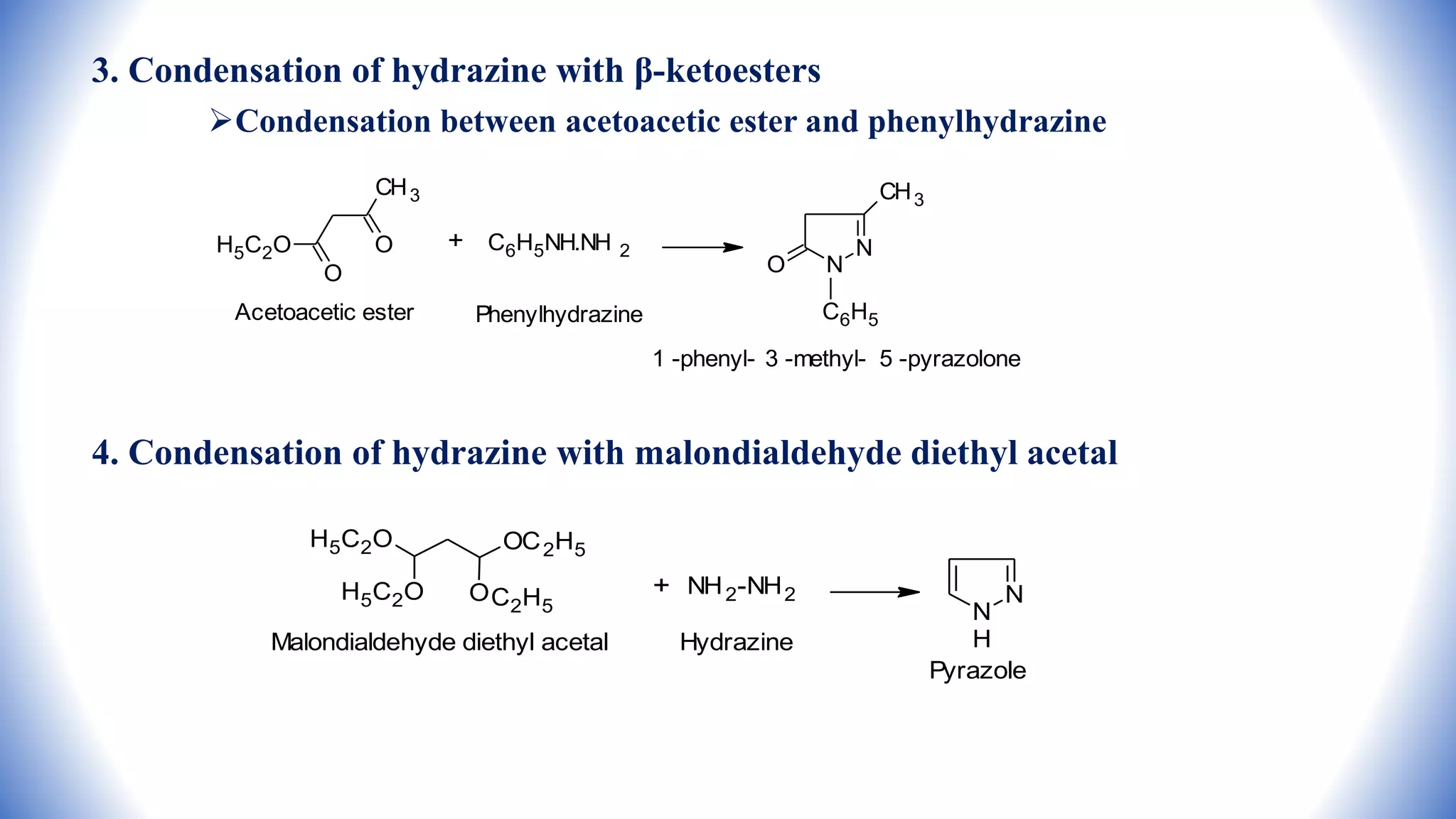
3. Condensation ofhydrazine with β-ketoesters
Condensation between acetoacetic ester and phenylhydrazine
4. Condensation of hydrazine with malondialdehyde diethyl acetal
H5C2O
O
CH3
O + C6H5NH.NH 2
Acetoacetic ester Phenylhydrazine
N
N
CH3
O
C6H5
1 -phenyl- 3 -methyl- 5 -pyrazolone
OC2H5
O
H5C2O
H5C2O C2H5
Malondialdehyde diethyl acetal
+ NH2-NH2
Hydrazine
N
N
H
Pyrazole
5.
5. Condensation ofhydrazine with α,β-unsaturated carbonyl compounds.
Condensation of hydrazine with acrolein gives Pyrazoline which can be oxidised to
pyrazole.
In α,β-unsaturated carbonyl compound, if either of the doubly bonded carbon atom is
attached to a halogen atom, pyrazole is directly obtained.
CHO
H2C
Acrolein
+
NH2-NH2
Hydrazine
N
CH2
NH2
Acraldehyde
hydrazone
N
N
H
Pyrazoline
Br (or) HgO
[O]
N
N
H
Pyrazole
C6H5-CH=C-CO-C 6H5
Br
2 -Bromo chalcone
+ C6H5NH.NH 2
Phenylhydrazine
N
N
C6H5
H5C6
C6H5
1, 3, 5 -triphenylpyrazole
+ HBr + H2O
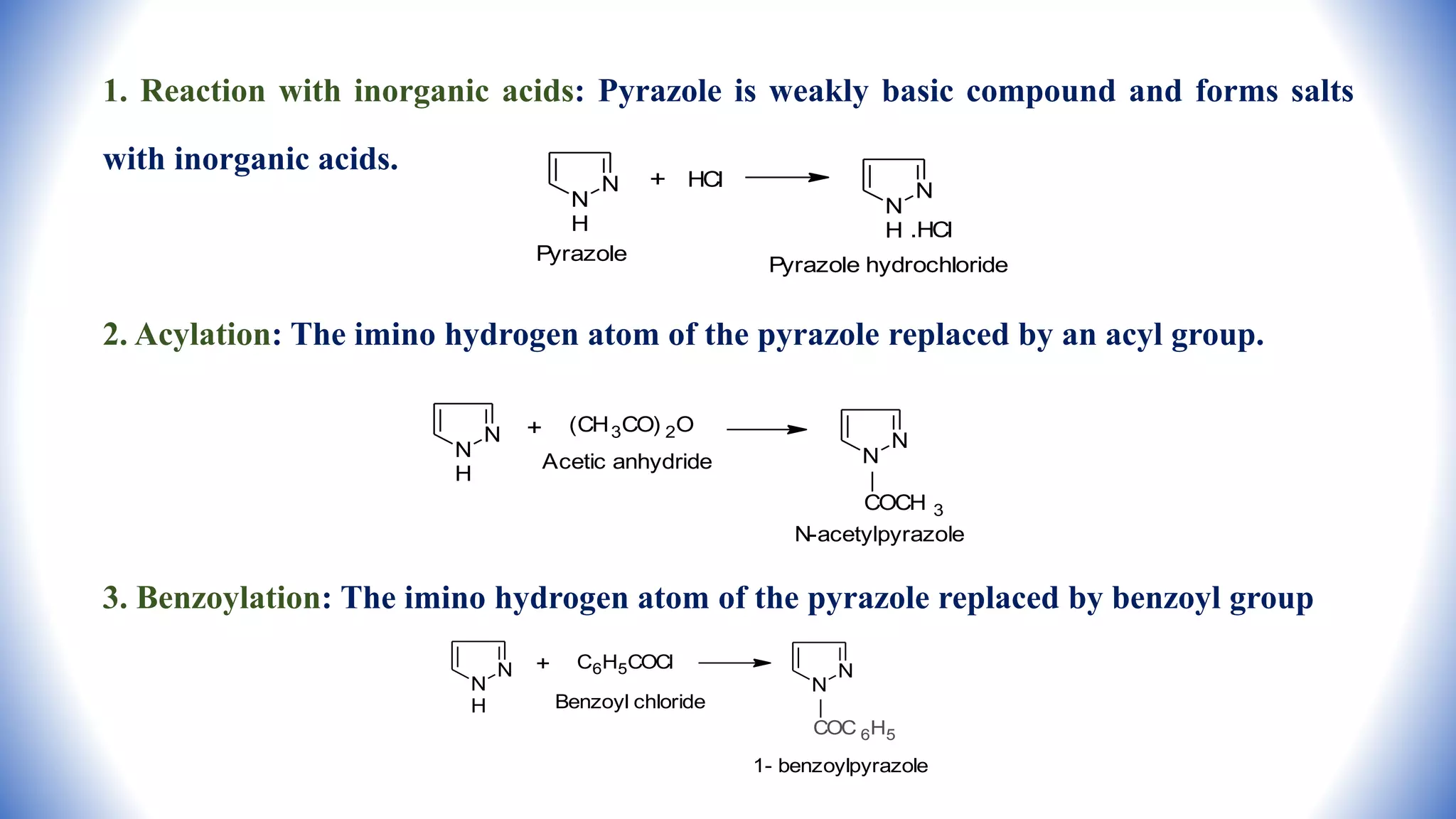
1. Reaction withinorganic acids: Pyrazole is weakly basic compound and forms salts
with inorganic acids.
2. Acylation: The imino hydrogen atom of the pyrazole replaced by an acyl group.
3. Benzoylation: The imino hydrogen atom of the pyrazole replaced by benzoyl group
N
N
H
+ HCl
N
N
H .HCl
Pyrazole
Pyrazole hydrochloride
N
N
H
+ (CH3CO) 2O
Acetic anhydride
N
N
COCH 3
N-acetylpyrazole
N
N
H
+ C6H5COCl N
N
COC 6H5
Benzoyl chloride
1- benzoylpyrazole
8.
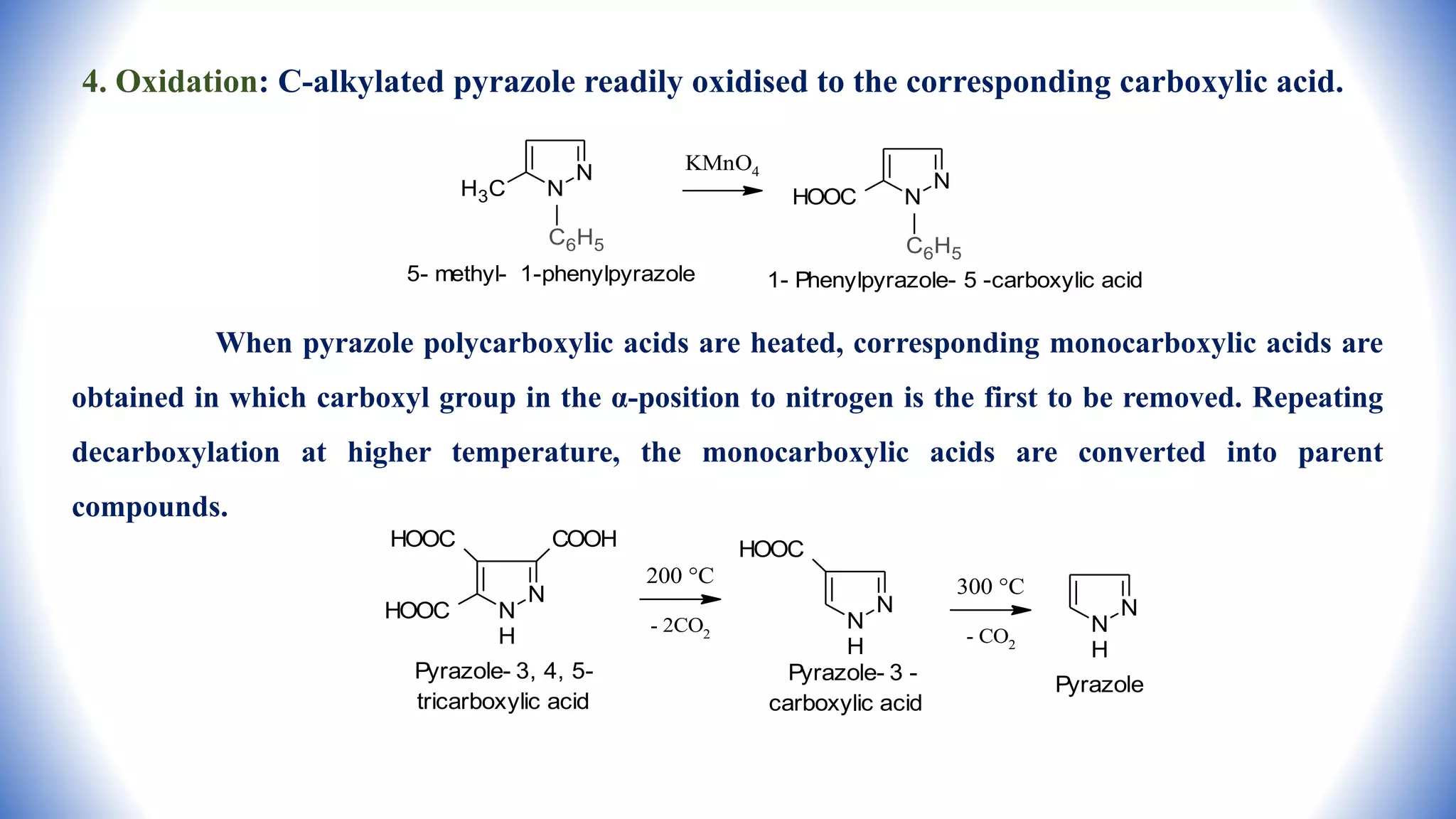
4. Oxidation: C-alkylatedpyrazole readily oxidised to the corresponding carboxylic acid.
When pyrazole polycarboxylic acids are heated, corresponding monocarboxylic acids are
obtained in which carboxyl group in the α-position to nitrogen is the first to be removed. Repeating
decarboxylation at higher temperature, the monocarboxylic acids are converted into parent
compounds.
N
N
H3C
C6H5
5- methyl- 1-phenylpyrazole
KMnO4
N
N
HOOC
C6H5
1- Phenylpyrazole- 5 -carboxylic acid
N
N
H
COOH
HOOC
HOOC
Pyrazole- 3, 4, 5-
tricarboxylic acid
200 °C
- 2CO2
N
N
H
HOOC
Pyrazole- 3 -
carboxylic acid
300 °C
- CO2
N
N
H
Pyrazole
9.
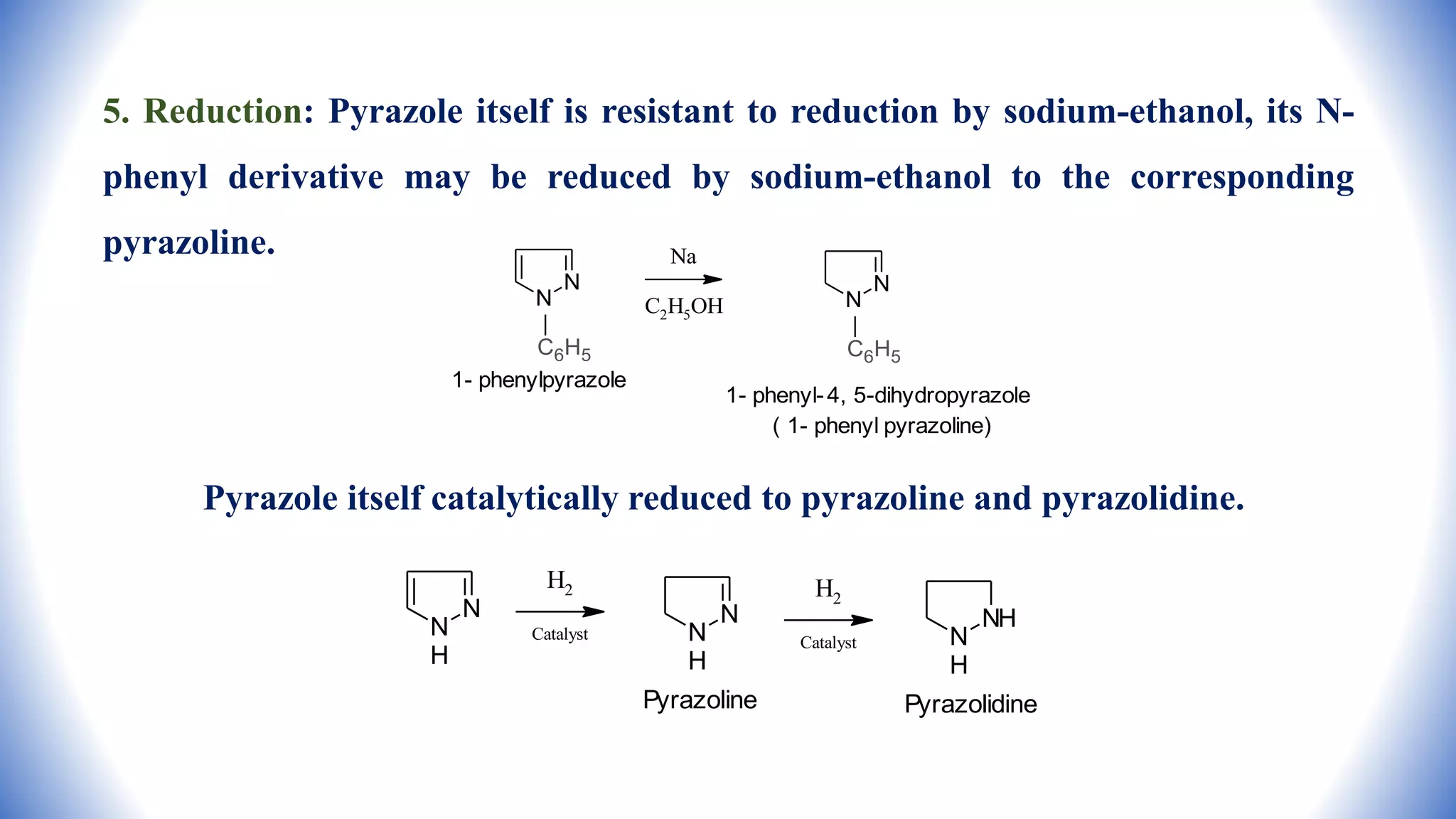
5. Reduction: Pyrazoleitself is resistant to reduction by sodium-ethanol, its N-
phenyl derivative may be reduced by sodium-ethanol to the corresponding
pyrazoline.
Pyrazole itself catalytically reduced to pyrazoline and pyrazolidine.
N
N
C6H5
1- phenylpyrazole
Na
C2H5OH
N
N
C6H5
1- phenyl-4, 5-dihydropyrazole
( 1- phenyl pyrazoline)
N
N
H
H2
Catalyst
N
N
H
Pyrazoline
H2
Catalyst
NH
N
H
Pyrazolidine
10.
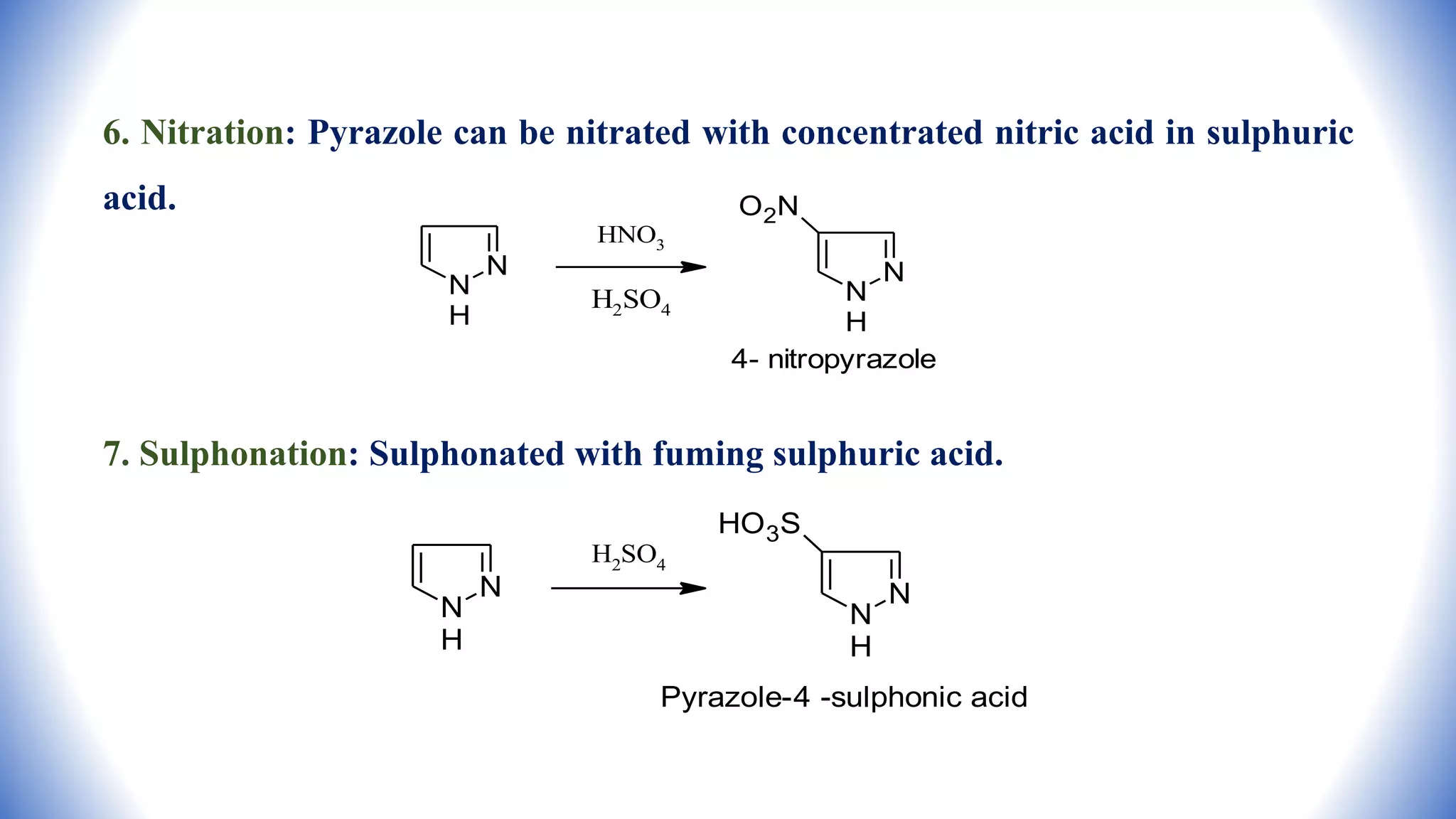
6. Nitration: Pyrazolecan be nitrated with concentrated nitric acid in sulphuric
acid.
7. Sulphonation: Sulphonated with fuming sulphuric acid.
N
N
H
N
N
H
O2N
4- nitropyrazole
HNO3
H2SO4
N
N
H
N
N
H
HO3S
Pyrazole-4 -sulphonic acid
H2SO4
11.
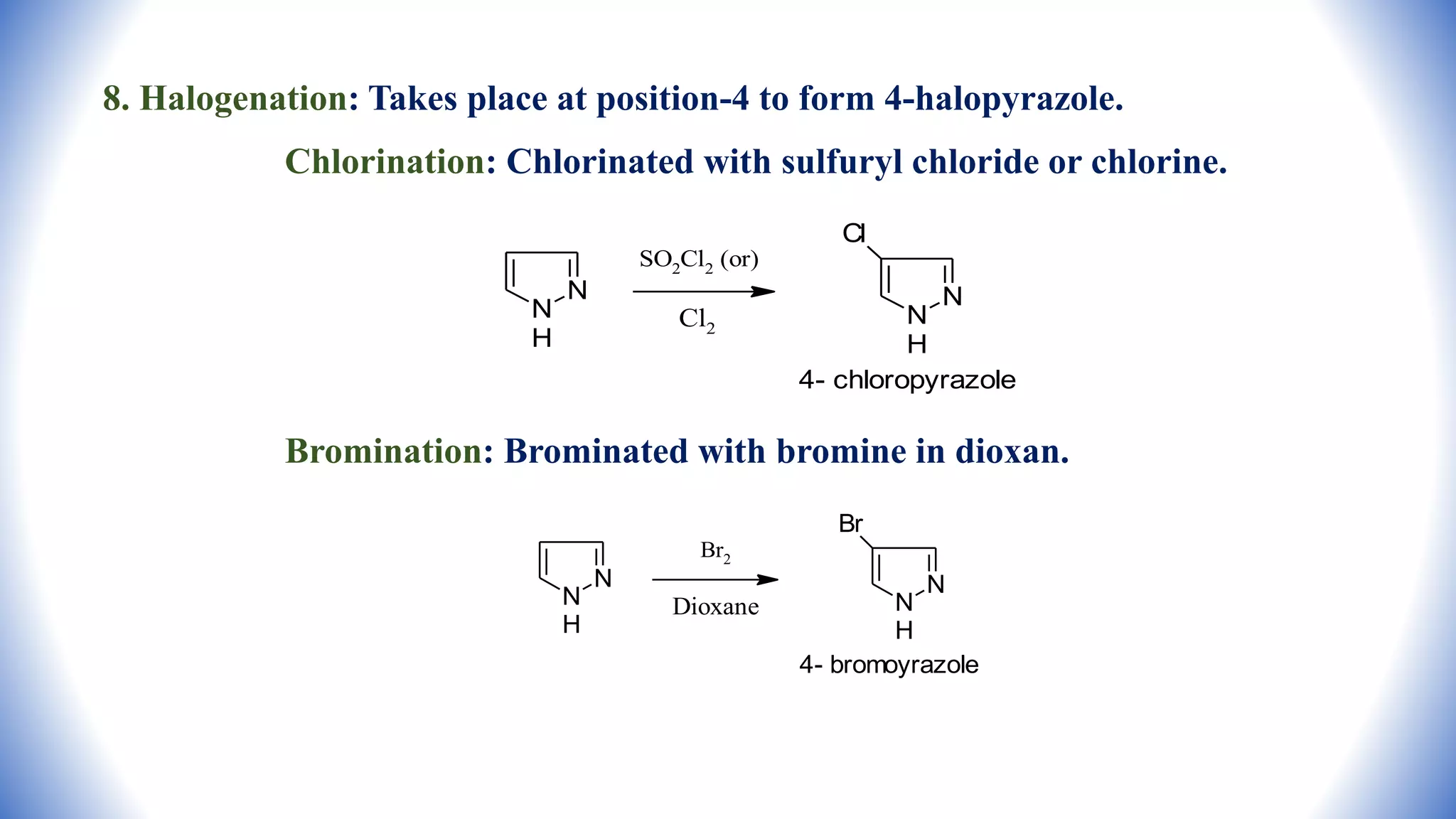
8. Halogenation: Takesplace at position-4 to form 4-halopyrazole.
Chlorination: Chlorinated with sulfuryl chloride or chlorine.
Bromination: Brominated with bromine in dioxan.
N
N
H
SO2Cl2 (or)
Cl2
N
N
H
Cl
4- chloropyrazole
N
N
H
N
N
H
Br
4- bromoyrazole
Br2
Dioxane
12.
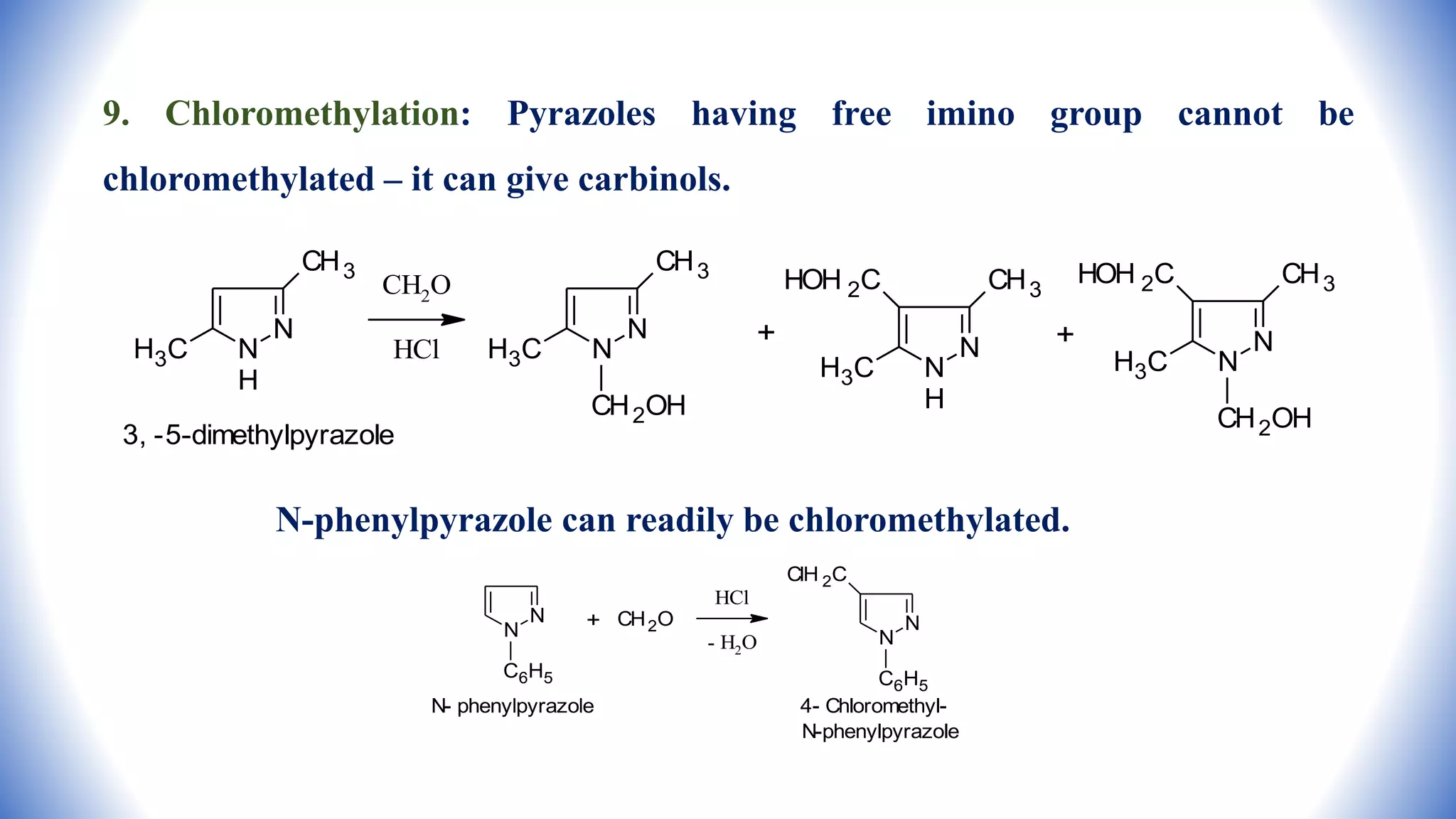
9. Chloromethylation: Pyrazoleshaving free imino group cannot be
chloromethylated – it can give carbinols.
N-phenylpyrazole can readily be chloromethylated.
N
N
H
CH3
H3C
CH2O
HCl
N
N
CH3
H3C
CH2OH
+ N
N
H
CH3
H3C
HOH 2C
+ N
N
CH3
H3C
HOH 2C
CH2OH
3, -5-dimethylpyrazole
N
N
C6H5
N- phenylpyrazole
+ CH2O
HCl
- H2O
N
N
ClH 2C
C6H5
4- Chloromethyl-
N-phenylpyrazole
13.
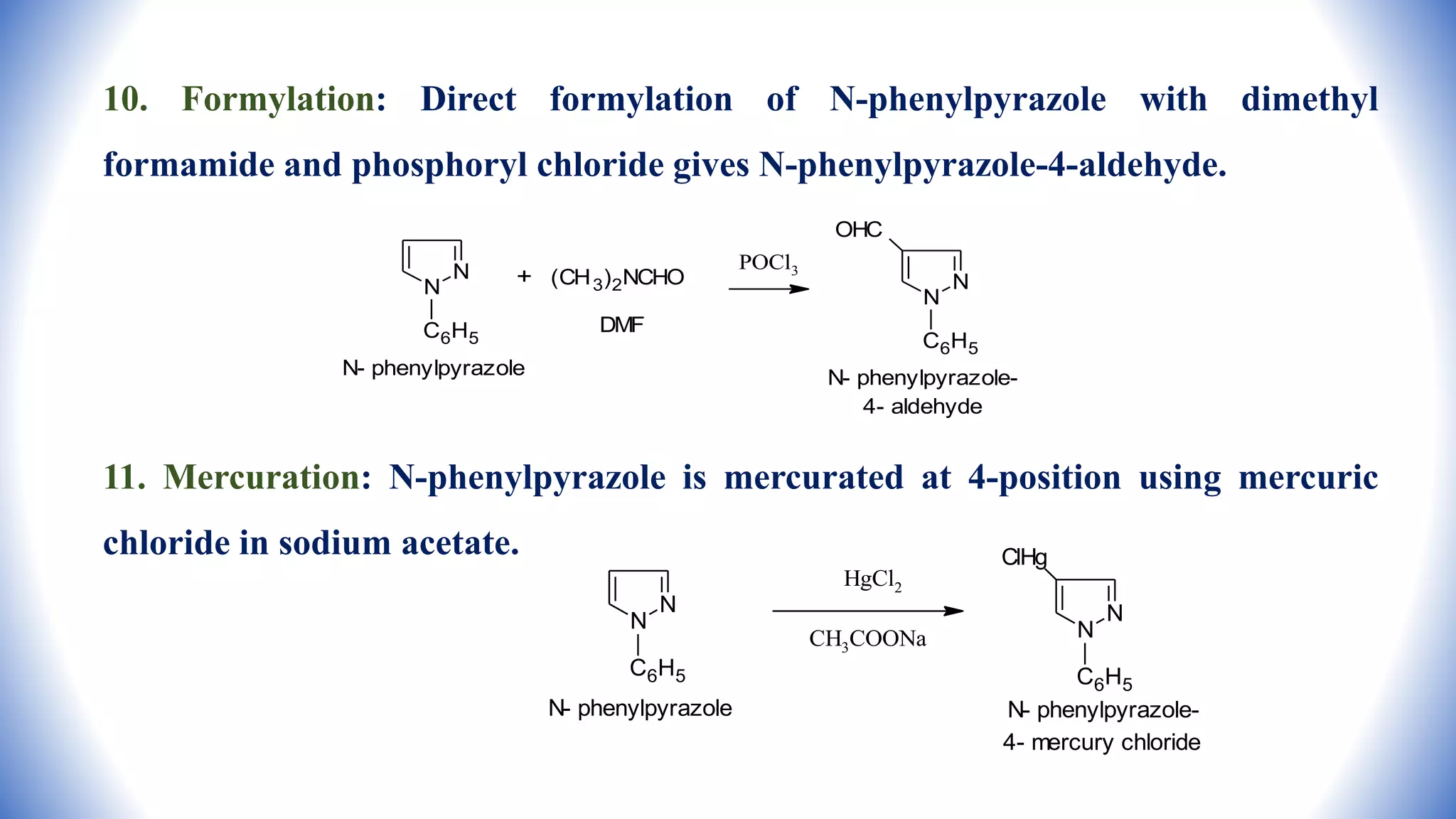
10. Formylation: Directformylation of N-phenylpyrazole with dimethyl
formamide and phosphoryl chloride gives N-phenylpyrazole-4-aldehyde.
11. Mercuration: N-phenylpyrazole is mercurated at 4-position using mercuric
chloride in sodium acetate.
N
N
C6H5
N- phenylpyrazole
+ (CH3)2NCHO
DMF
POCl3
N
N
OHC
C6H5
N- phenylpyrazole-
4- aldehyde
N
N
C6H5
N- phenylpyrazole
HgCl2
CH3COONa
N
N
ClHg
C6H5
N- phenylpyrazole-
4- mercury chloride
14.
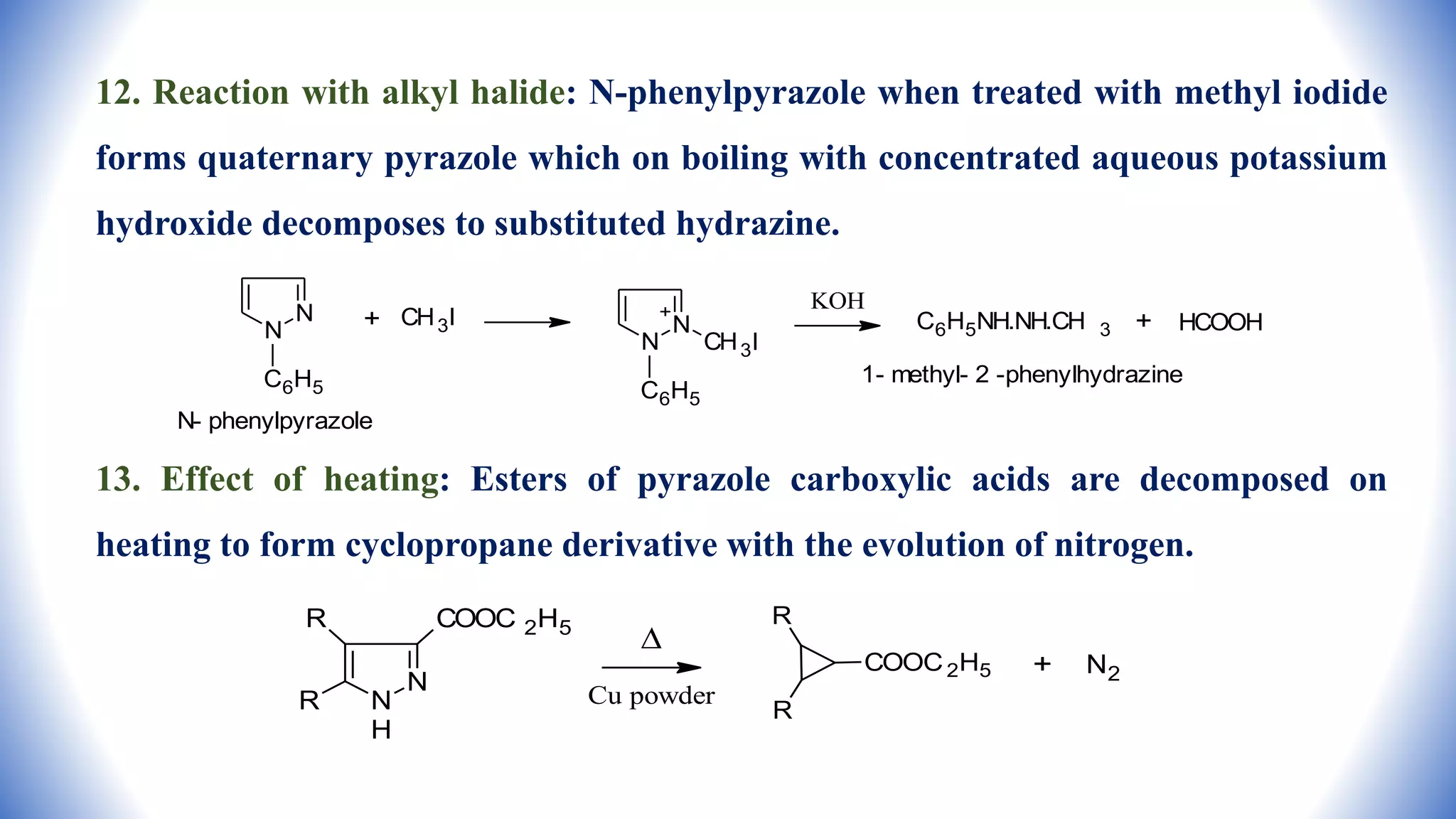
12. Reaction withalkyl halide: N-phenylpyrazole when treated with methyl iodide
forms quaternary pyrazole which on boiling with concentrated aqueous potassium
hydroxide decomposes to substituted hydrazine.
13. Effect of heating: Esters of pyrazole carboxylic acids are decomposed on
heating to form cyclopropane derivative with the evolution of nitrogen.
N
N
C6H5
N- phenylpyrazole
+ CH3I N
N CH3I
C6H5
+
KOH
C6H5NH.NH.CH 3 + HCOOH
1- methyl- 2 -phenylhydrazine
N
N
H
COOC 2H5
R
R
Cu powder
R
R
COOC2H5 + N2
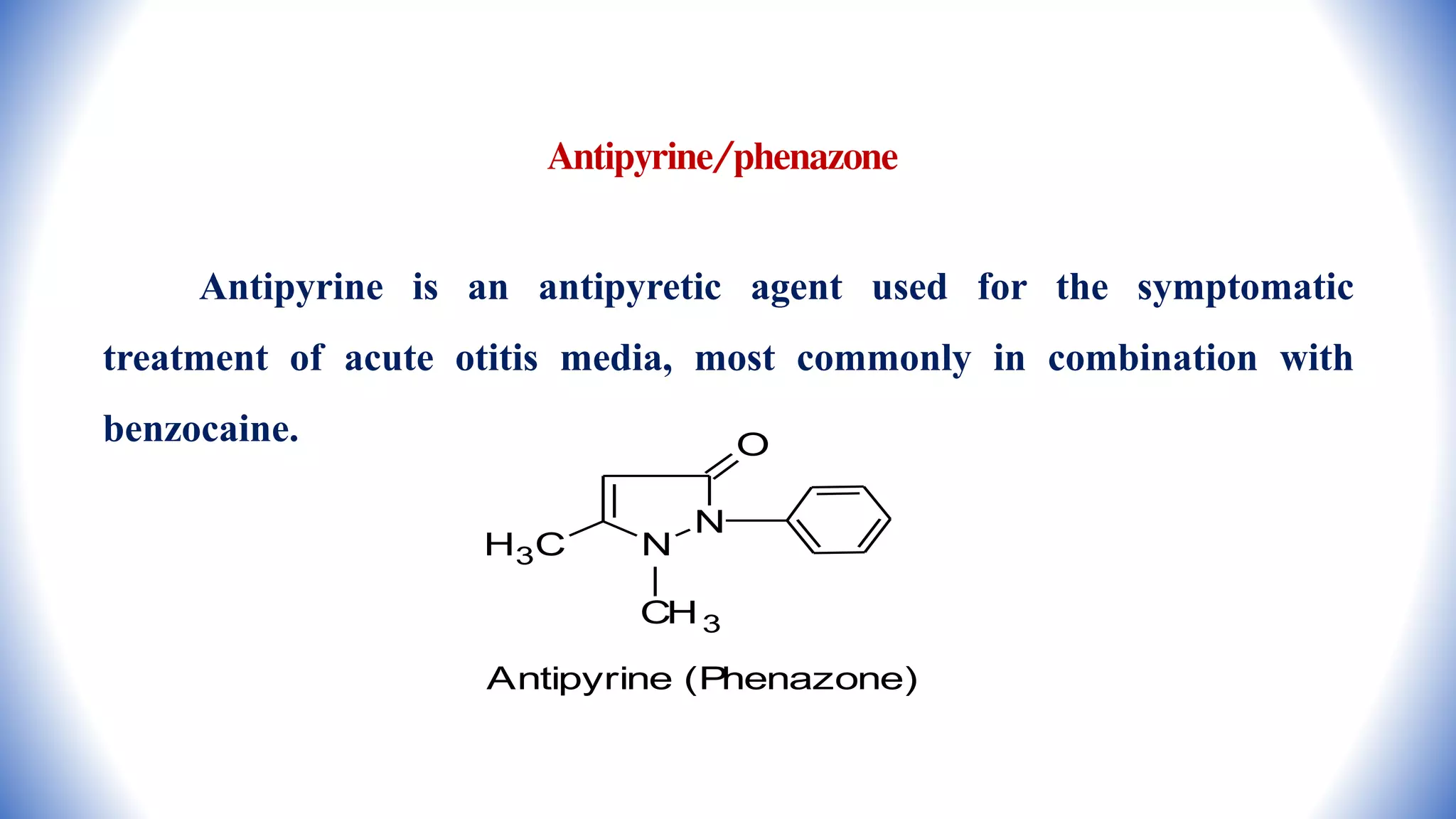
Antipyrine/phenazone
Antipyrine is anantipyretic agent used for the symptomatic
treatment of acute otitis media, most commonly in combination with
benzocaine.
N
N
O
H3C
CH3
Antipyrine (P
henazone)
17.
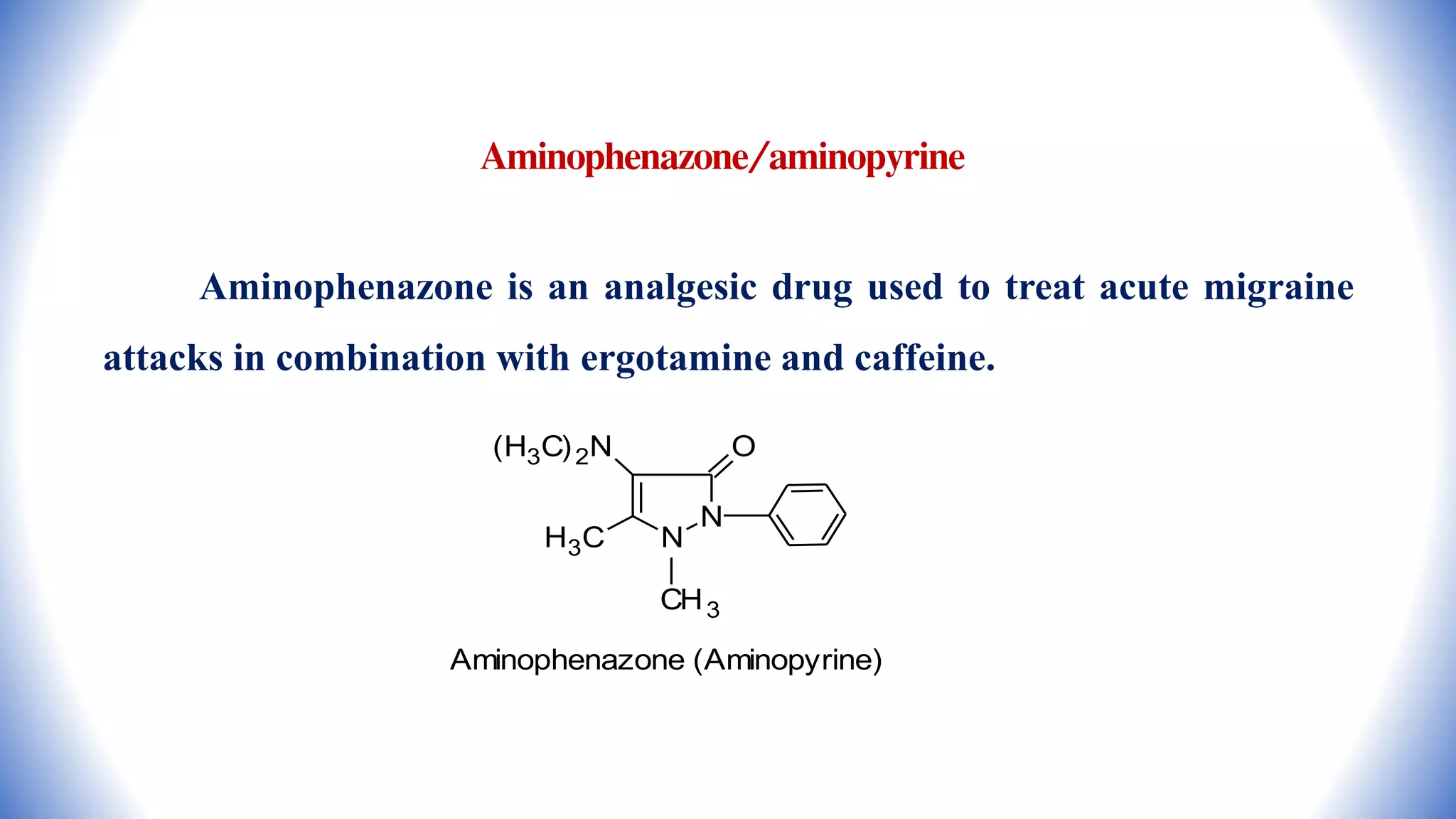
Aminophenazone/aminopyrine
Aminophenazone is ananalgesic drug used to treat acute migraine
attacks in combination with ergotamine and caffeine.
N
N
O
H3C
(H3C)2N
CH3
Aminophenazone (Aminopyrine)
18.
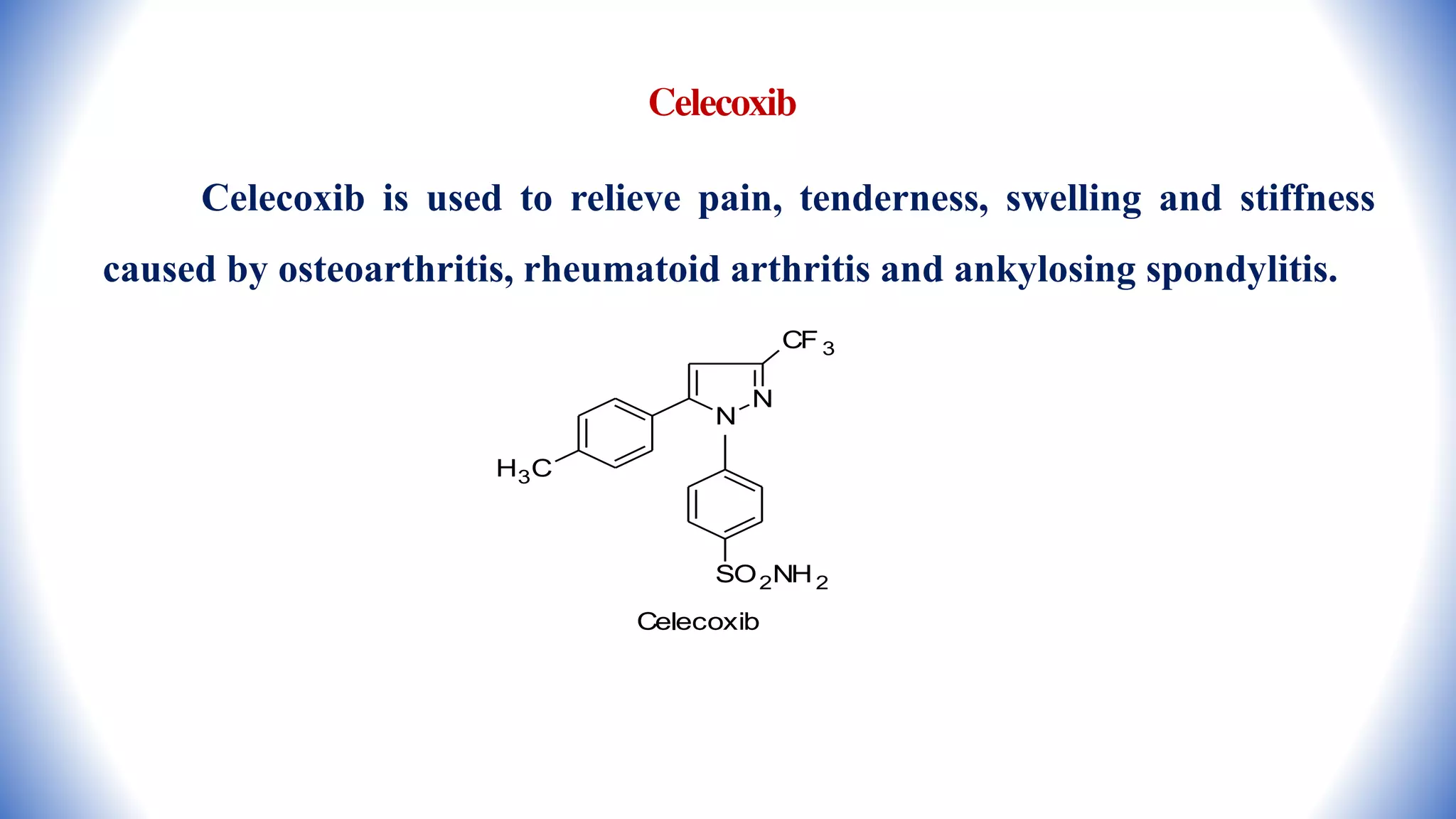
Celecoxib
Celecoxib is usedto relieve pain, tenderness, swelling and stiffness
caused by osteoarthritis, rheumatoid arthritis and ankylosing spondylitis.
N
N
CF 3
H3C
SO2NH2
Celecoxib
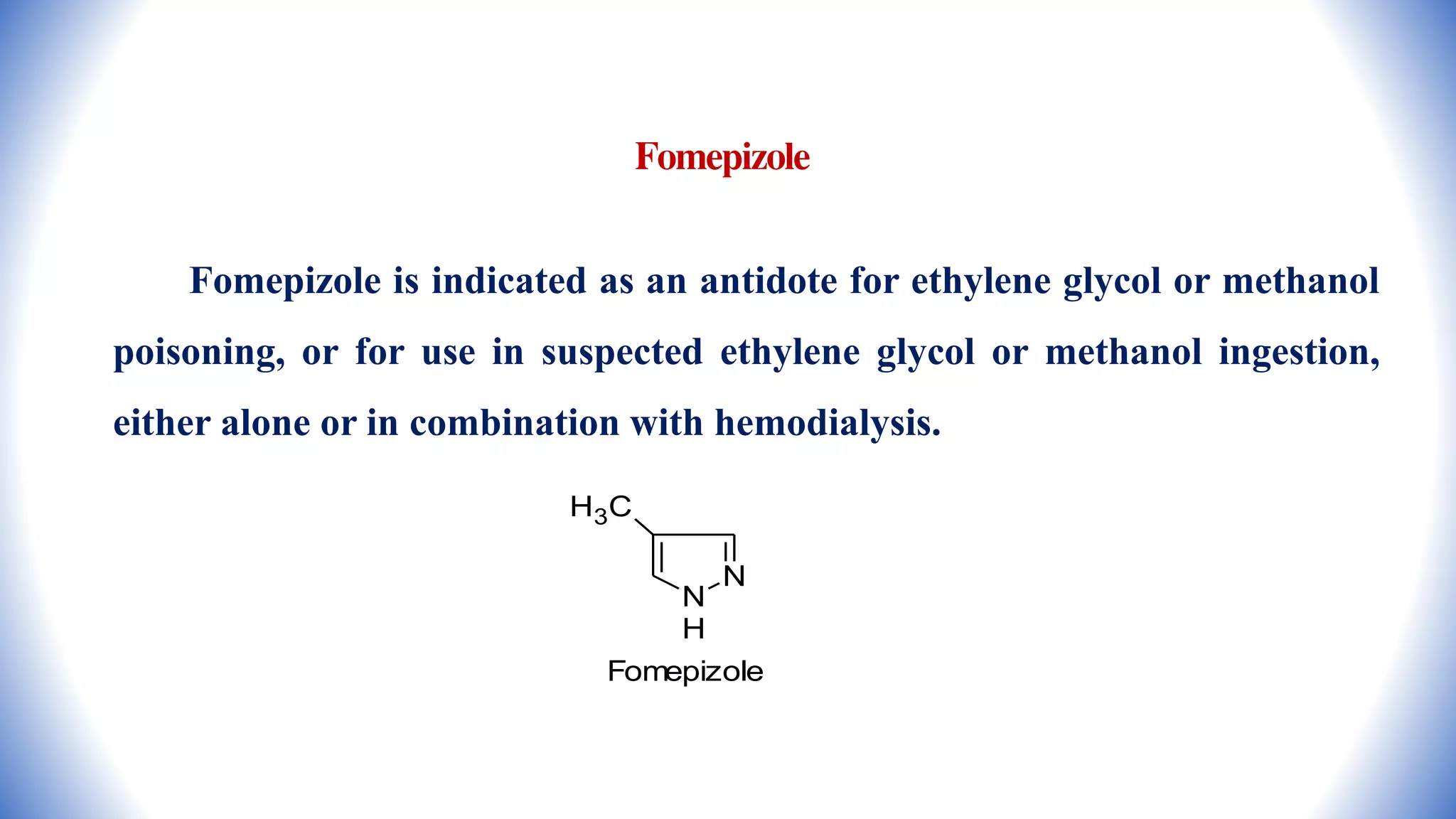
Fomepizole
Fomepizole is indicatedas an antidote for ethylene glycol or methanol
poisoning, or for use in suspected ethylene glycol or methanol ingestion,
either alone or in combination with hemodialysis.
N
N
H
H3C
Fomepizole
21.
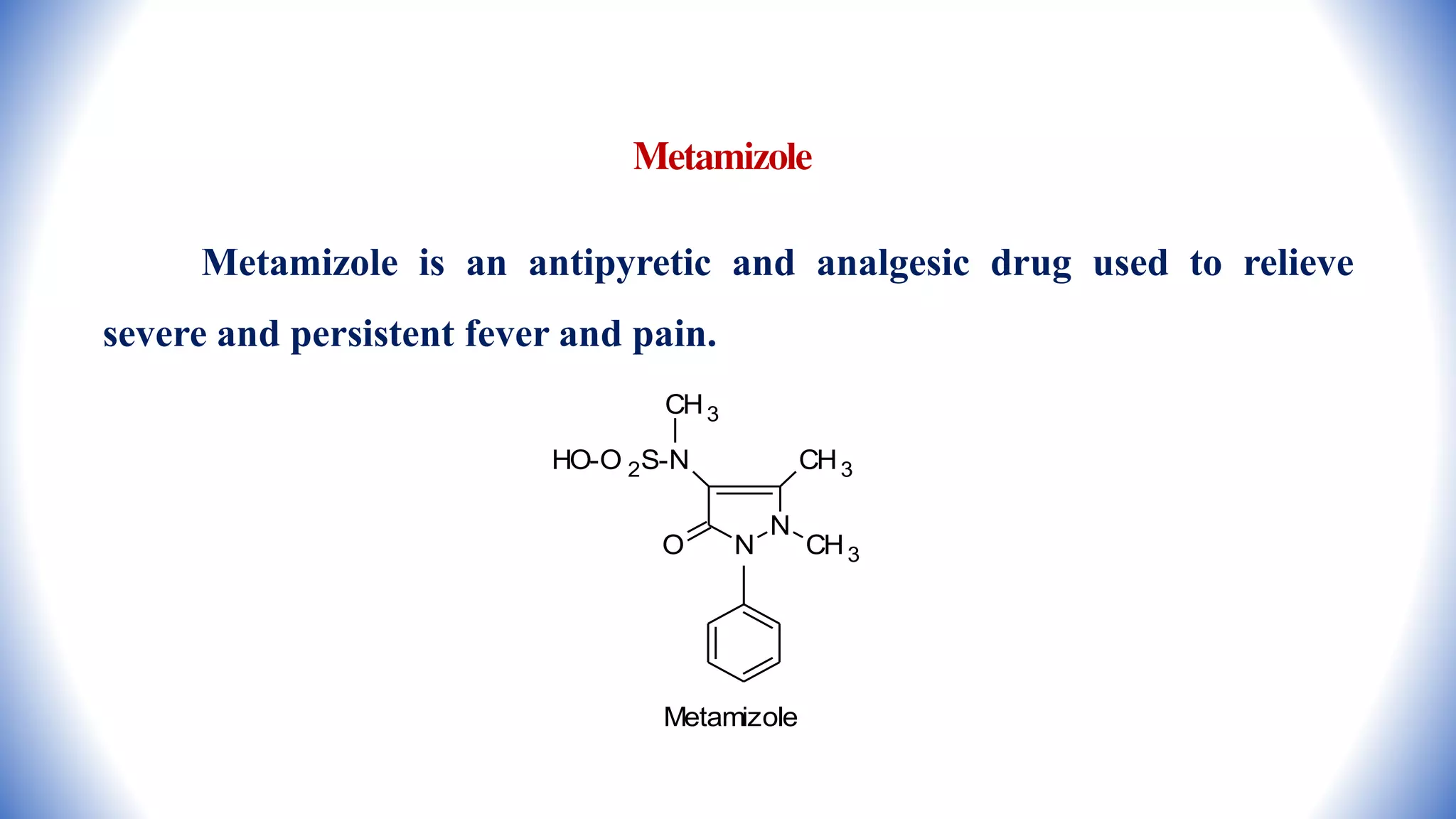
Metamizole
Metamizole is anantipyretic and analgesic drug used to relieve
severe and persistent fever and pain.
N
N CH3
CH3
HO-O 2S-N
O
CH3
Metamizole

![5. Condensation of hydrazine with α,β-unsaturated carbonyl compounds.
Condensation of hydrazine with acrolein gives Pyrazoline which can be oxidised to
pyrazole.
In α,β-unsaturated carbonyl compound, if either of the doubly bonded carbon atom is
attached to a halogen atom, pyrazole is directly obtained.
CHO
H2C
Acrolein
+
NH2-NH2
Hydrazine
N
CH2
NH2
Acraldehyde
hydrazone
N
N
H
Pyrazoline
Br (or) HgO
[O]
N
N
H
Pyrazole
C6H5-CH=C-CO-C 6H5
Br
2 -Bromo chalcone
+ C6H5NH.NH 2
Phenylhydrazine
N
N
C6H5
H5C6
C6H5
1, 3, 5 -triphenylpyrazole
+ HBr + H2O](https://image.slidesharecdn.com/heterocycliccompounds-pyrazole-synthesisofpyrazole-characteristicreactionsofpyrazole-medicinalusesof-210820155511/75/Pyrazole-Synthesis-of-Pyrazole-Characteristic-Reactions-of-Pyrazole-Medicinal-uses-of-Pyrazole-5-2048.jpg)