






Best Practices for Teaching English to Young Learners Joan Kang Shin,  Ph.D. University of Maryland, Baltimore County Education Department
Teaching English to Young Learners (TEYL)   is a rapidly growing field around the world, and English education is increasingly found at the primary levels. However, starting earlier is not necessarily the solution for producing better English speakers. Therefore, what can EFL teachers of young learners do to take advantage of the flexibility of young minds and the malleability of young tongues to grow better speakers of English?  
Outline Introduction to TEYL Considerations for teaching young learners Effective teaching approaches for young learners Useful resources for TEYL
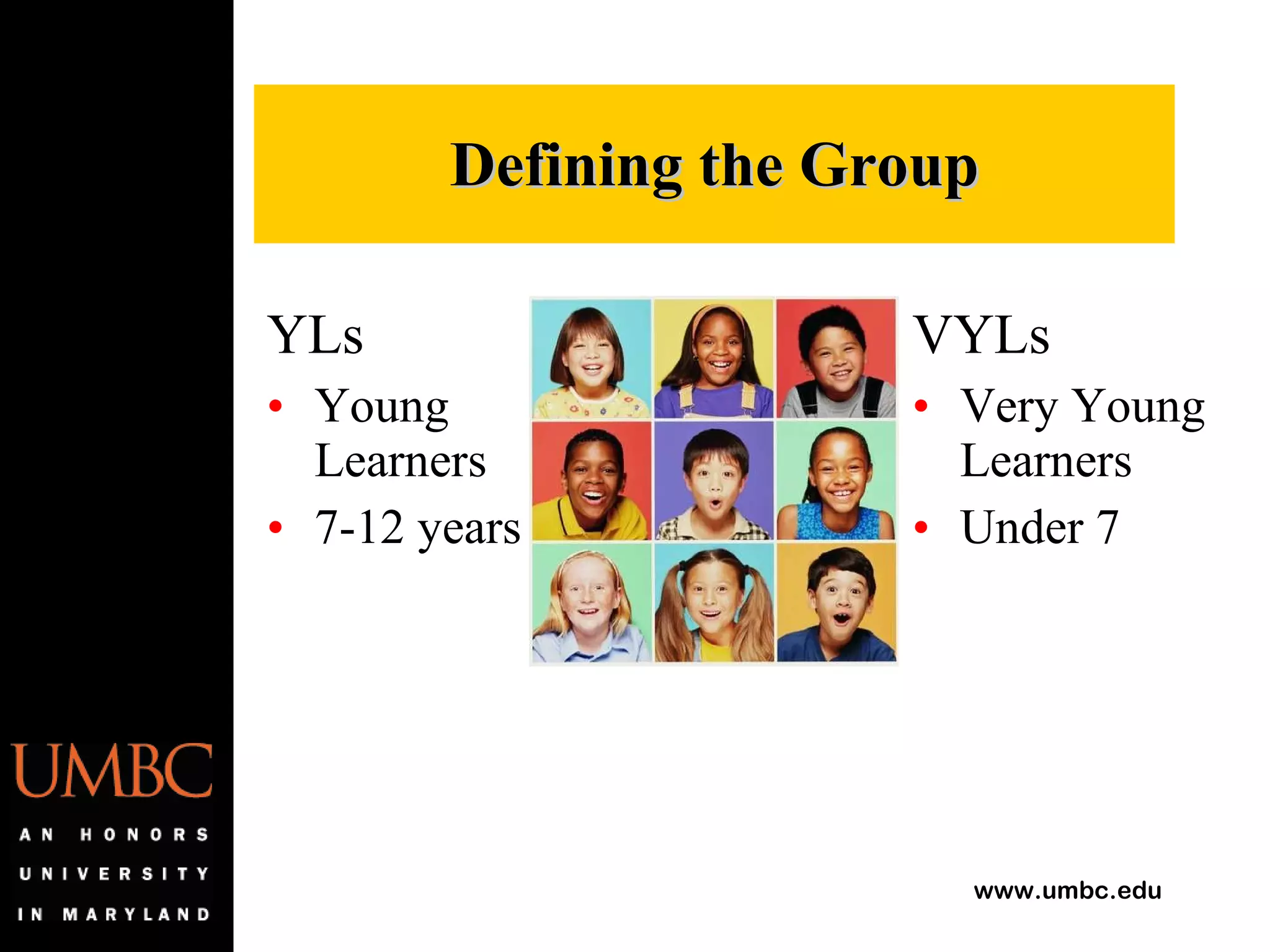
VYLs Very Young Learners Under 7 YLs Young Learners 7-12 years Defining the Group
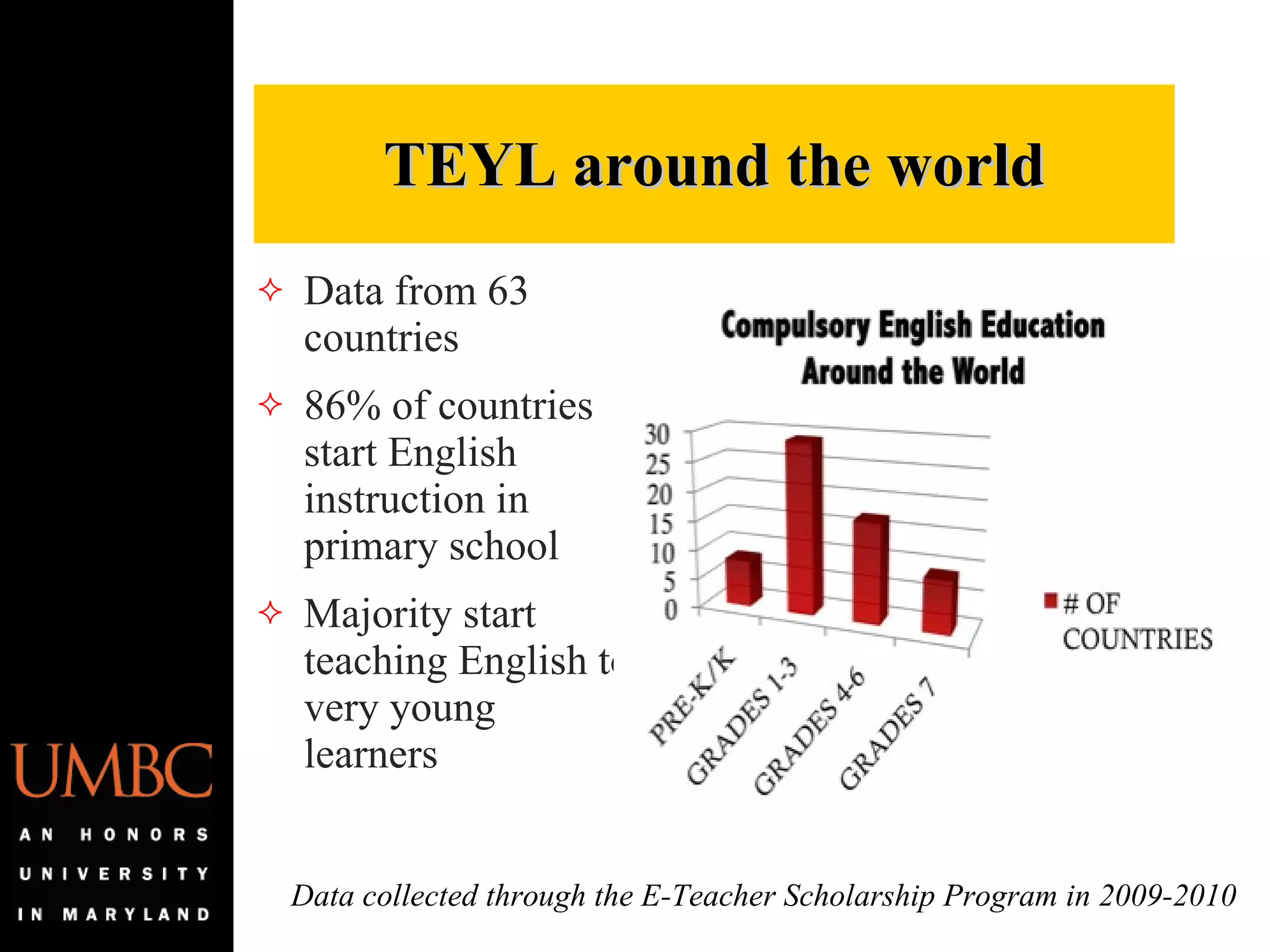
Data from 63 countries 86% of countries start English instruction in primary school Majority start teaching English to very young learners TEYL around the world Data collected through the E-Teacher Scholarship Program in 2009-2010
Is earlier really better? Characteristics of young learners How children learn Language learning environment Considerations for TEYL
Type of program and curriculum Number of hours spent in English Techniques and activities used FLEXIBILITY OF YOUNG MINDS MALLEABILITY OF YOUNG TONGUES Is earlier really better?
a. Workshop approach E __ P __ R __ E __ T __ A __  E  X  P  E  R  I  E  N  T  I  A  L
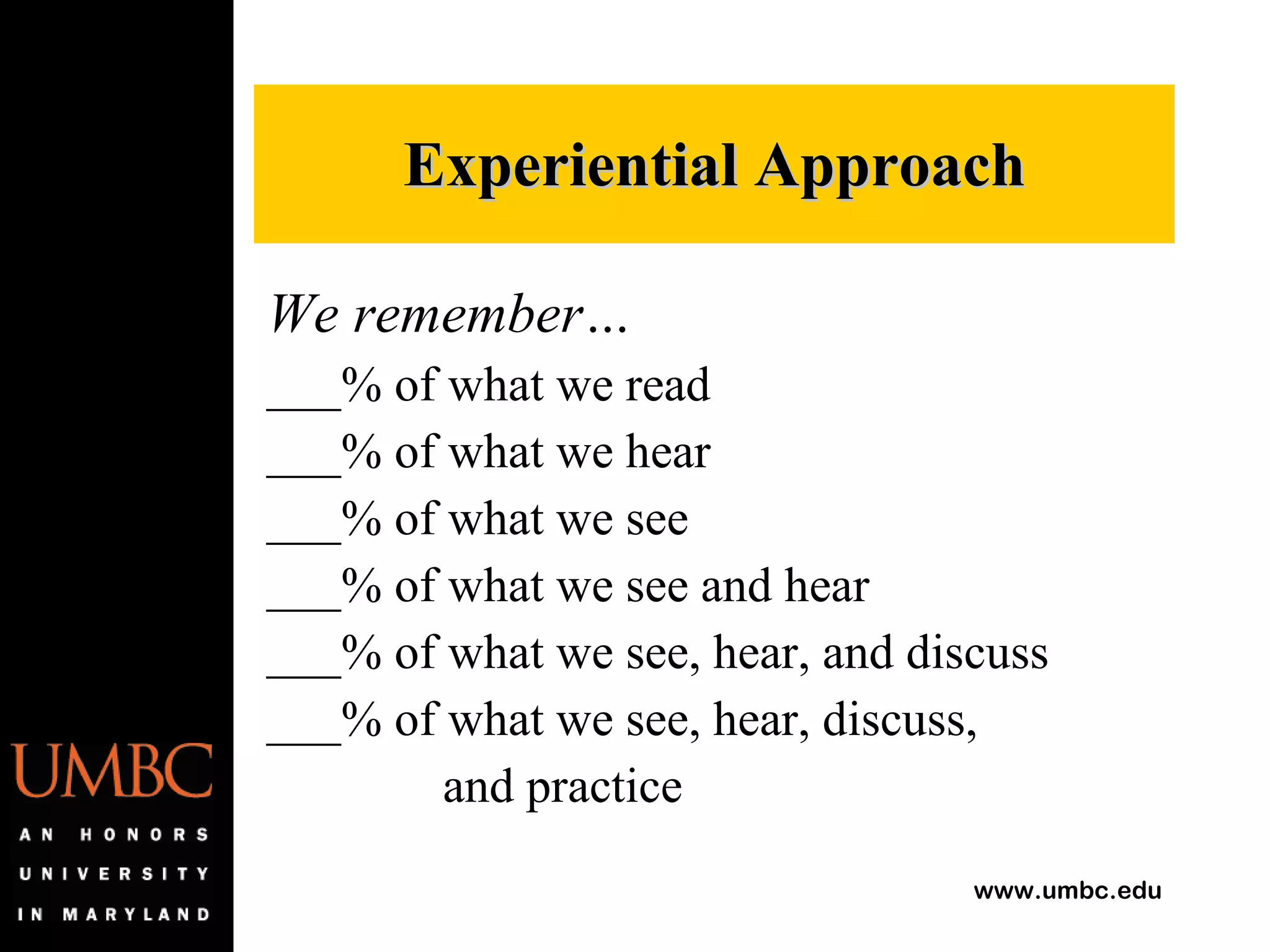
Experiential Approach We remember… ___% of what we read ___% of what we hear ___% of what we see ___% of what we see and hear ___% of what we see, hear, and discuss ___% of what we see, hear, discuss,   and practice
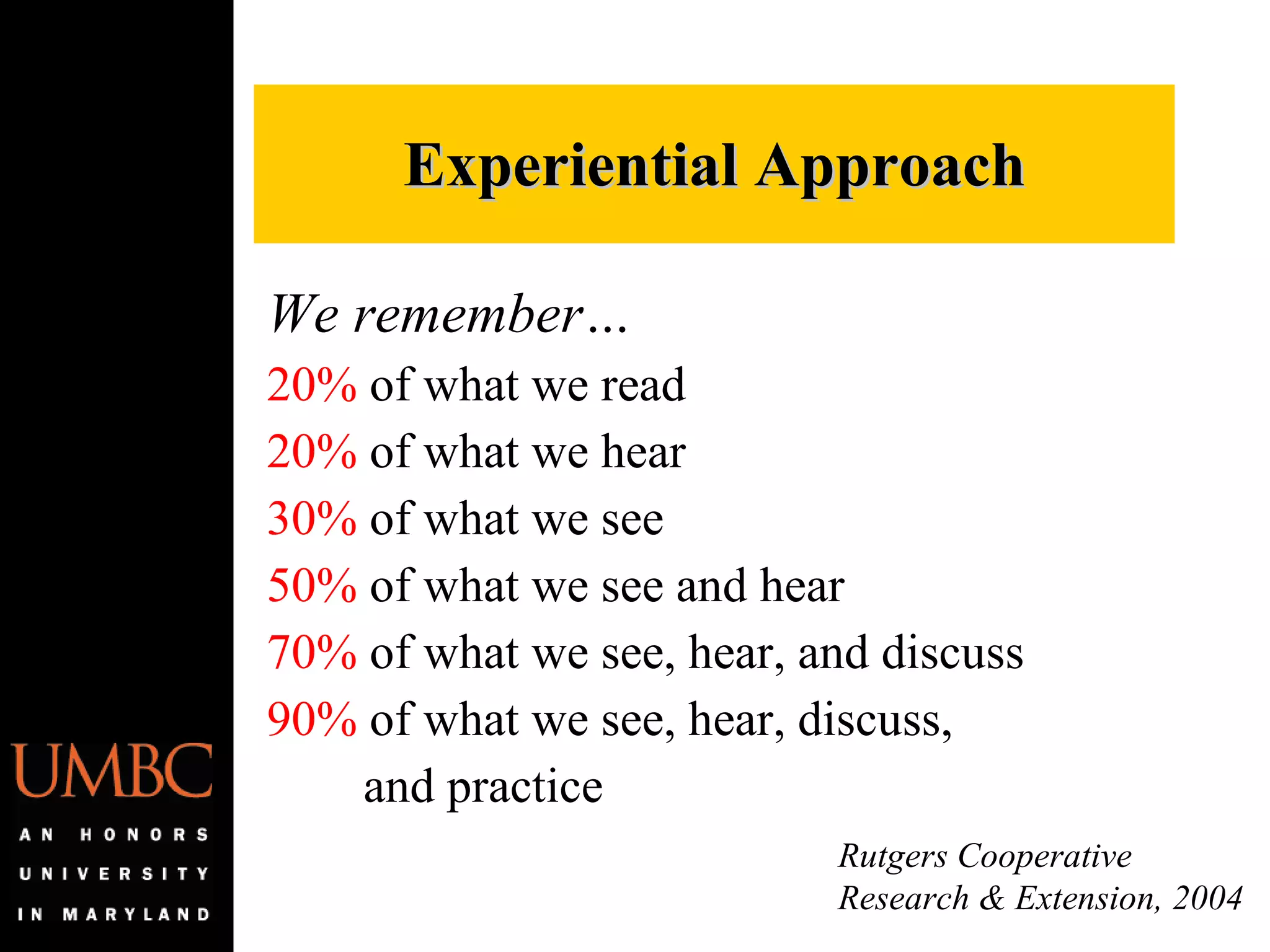
We remember… 20%  of what we read 20%  of what we hear 30%  of what we see 50%  of what we see and hear 70%  of what we see, hear, and discuss 90%  of what we see, hear, discuss,   and practice Experiential Approach Rutgers Cooperative Research & Extension, 2004
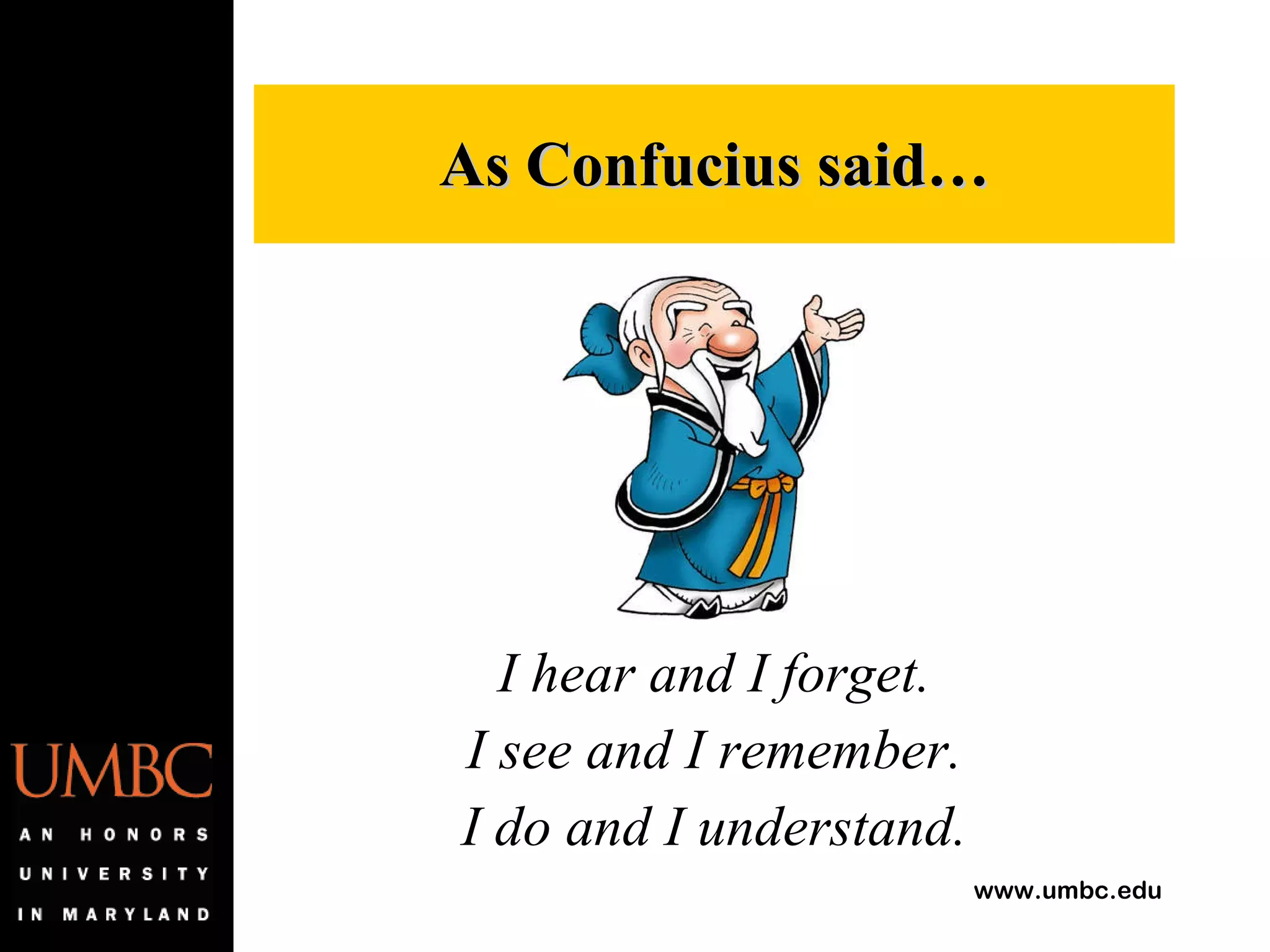
As Confucius said… I hear and I forget. I see and I remember. I do and I understand.
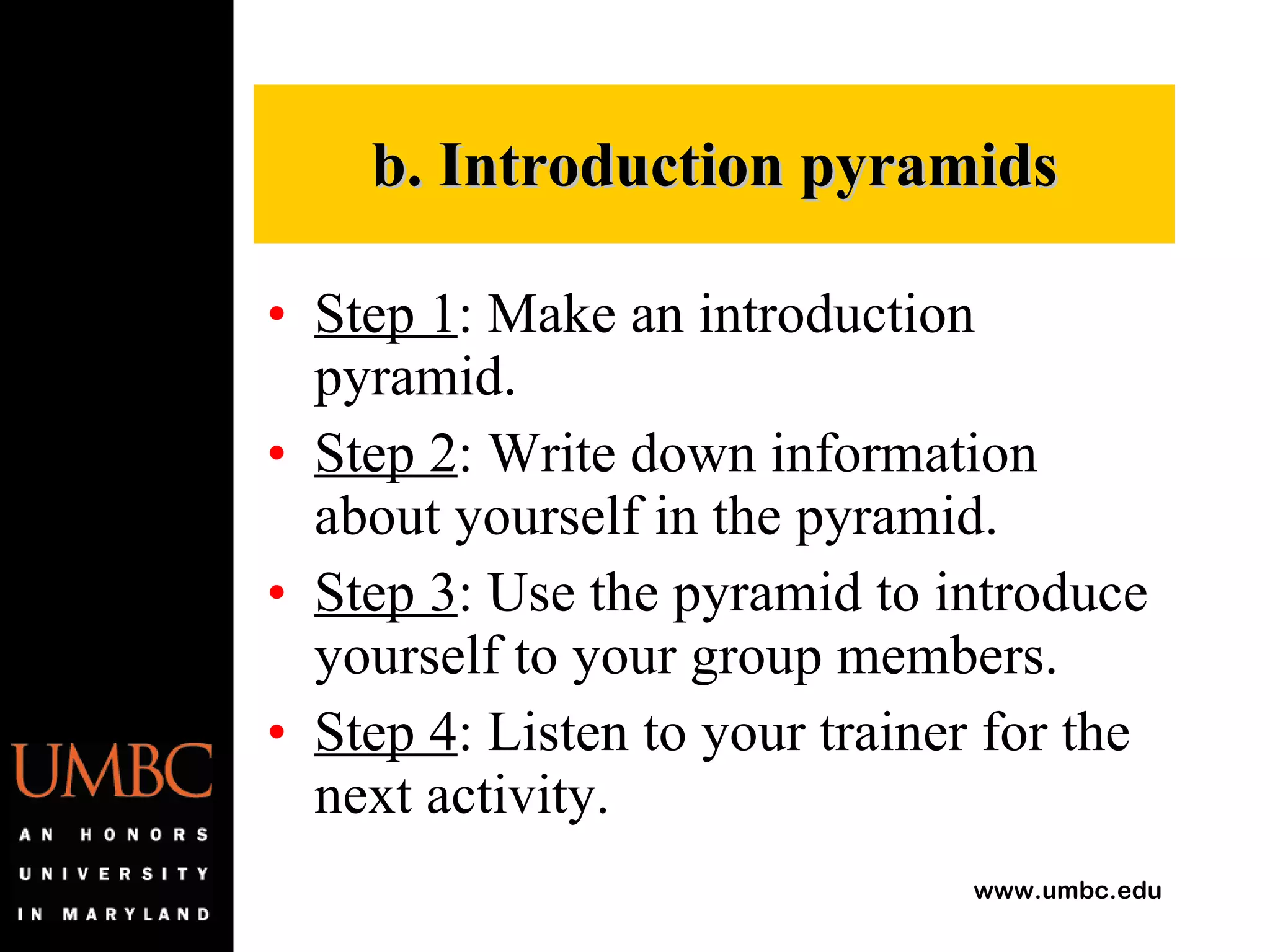
b. Introduction pyramids Step 1 : Make an introduction pyramid. Step 2 : Write down information about yourself in the pyramid. Step 3 : Use the pyramid to introduce yourself to your group members. Step 4 : Listen to your trainer for the next activity.
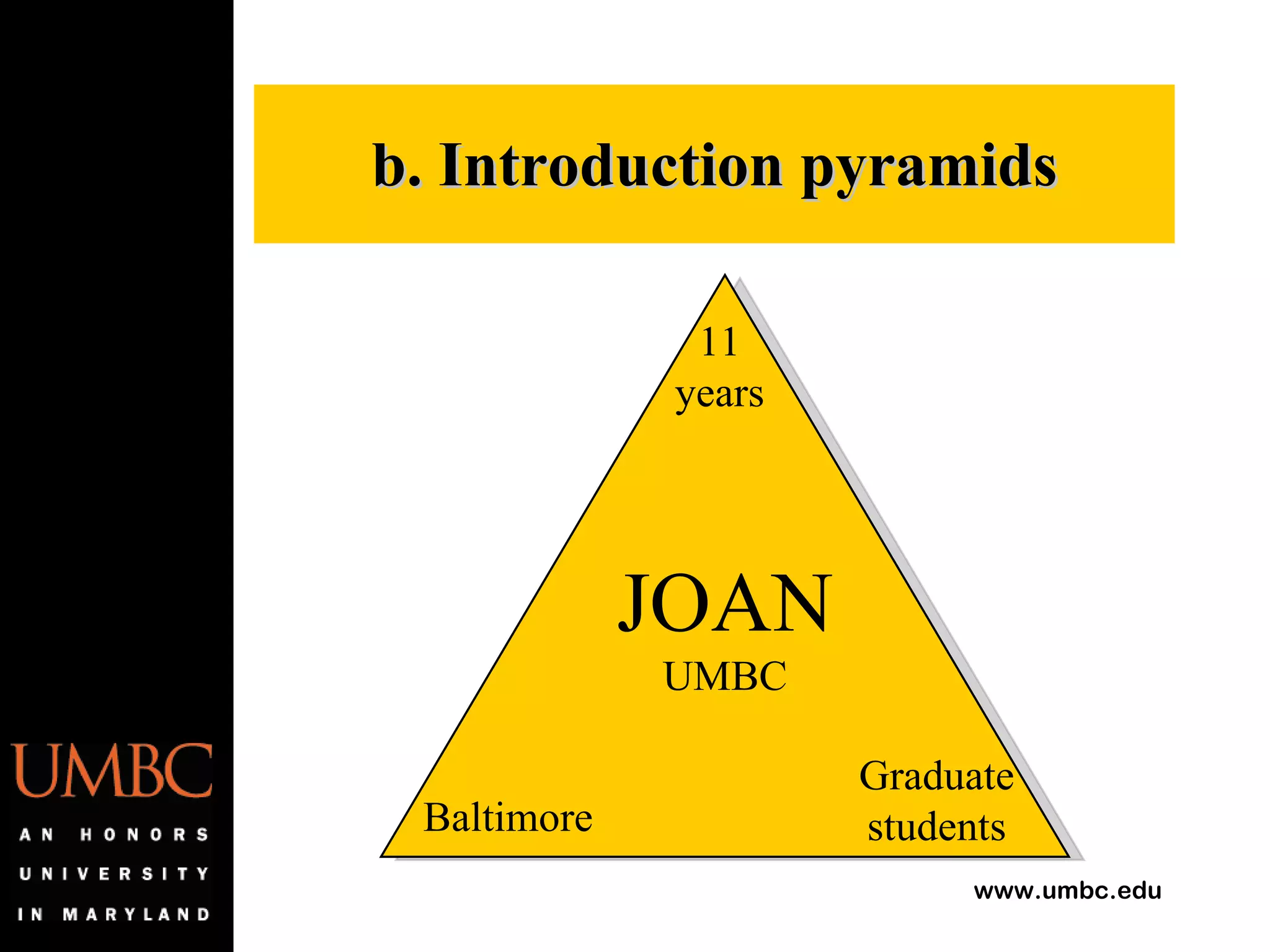
b. Introduction pyramids JOAN UMBC 11 years Graduate students Baltimore
II. Considerations for teaching YLs Adjective Splash Brainstorm adjectives about YLs.
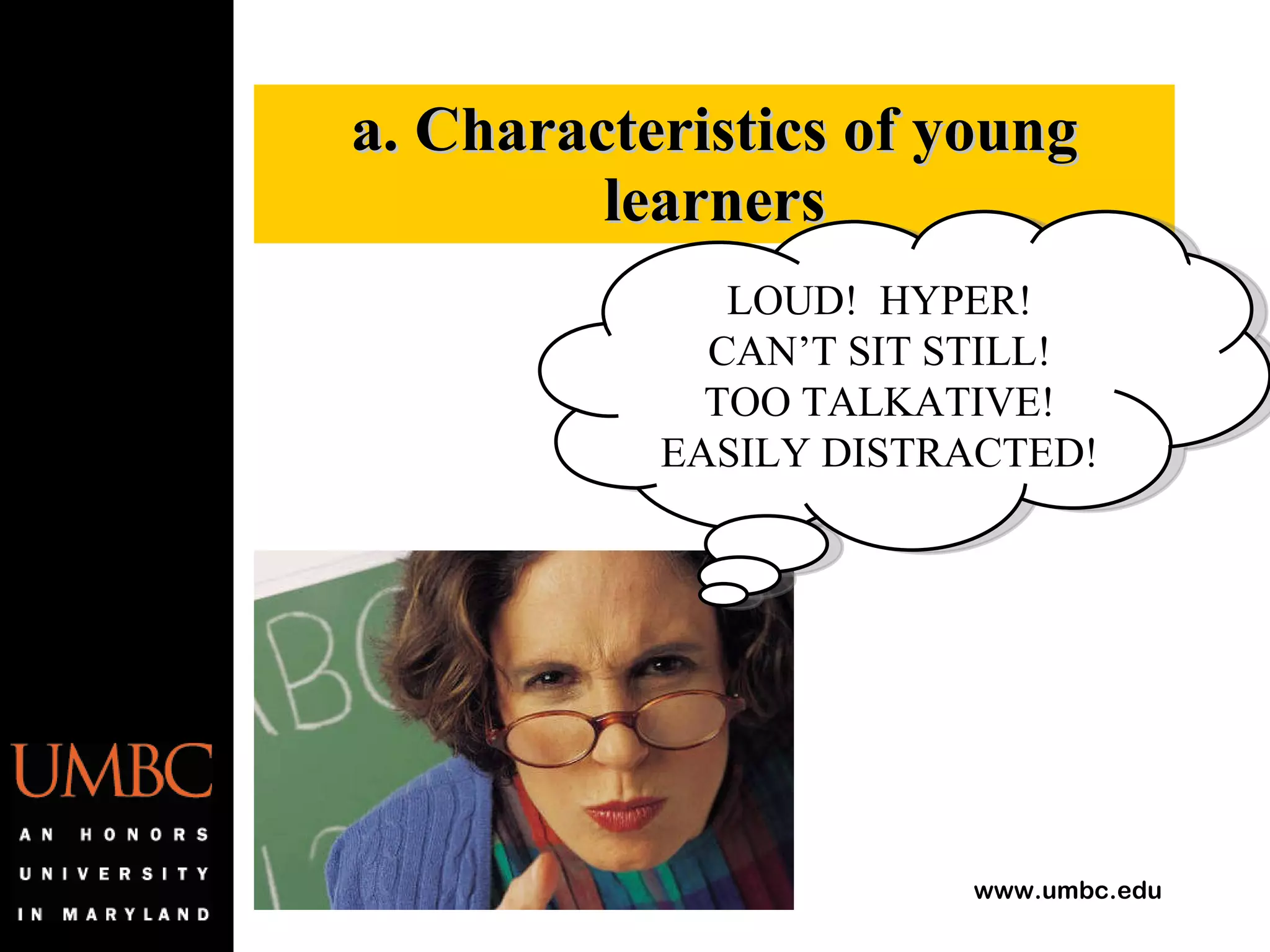
a. Characteristics of young learners LOUD!  HYPER! CAN’T SIT STILL! TOO TALKATIVE! EASILY DISTRACTED!
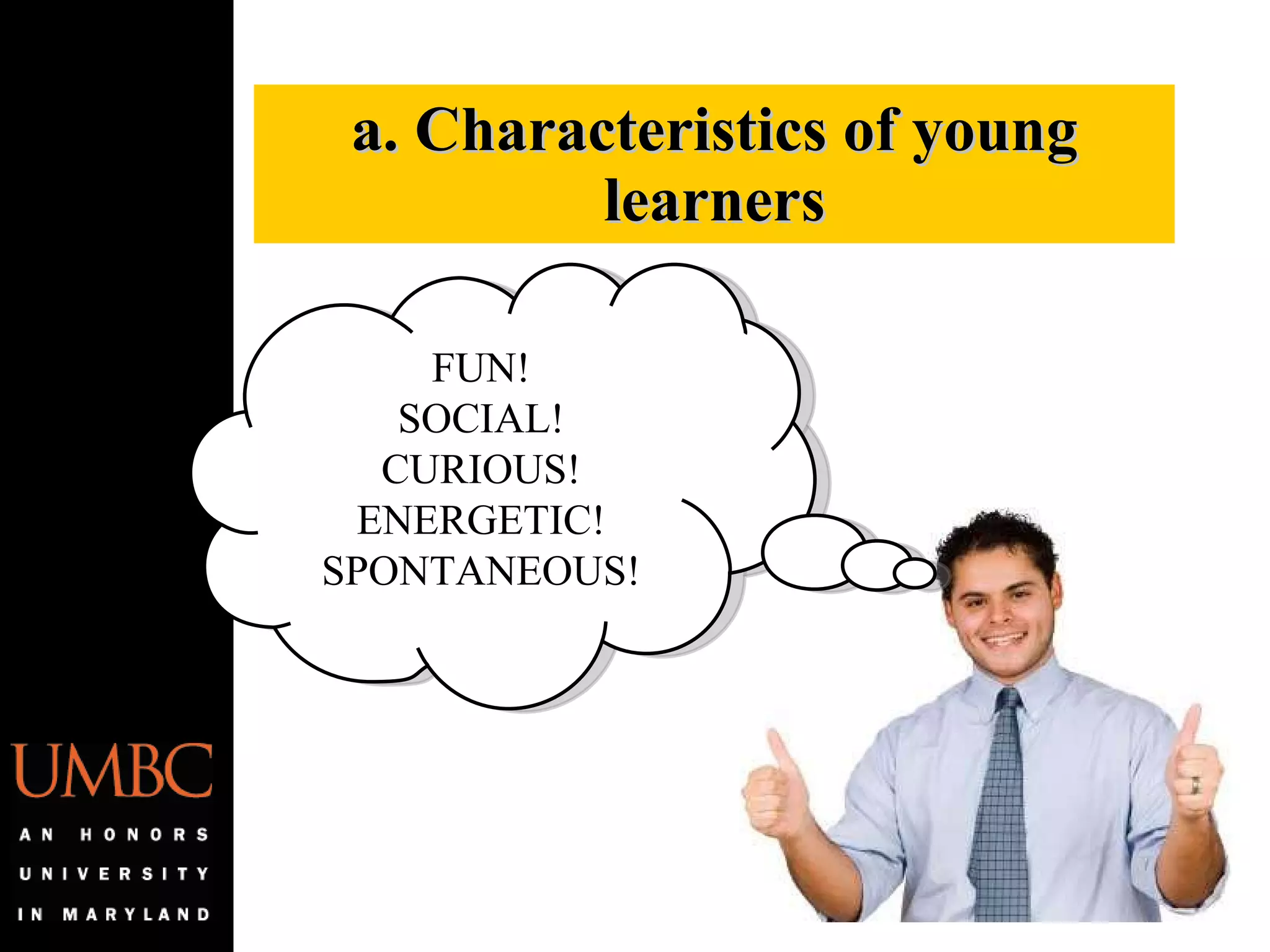
a. Characteristics of young learners FUN! SOCIAL! CURIOUS! ENERGETIC! SPONTANEOUS!
Children are active learners and thinkers.  (Piaget, 1970)  Children learn through social interaction.   (Vygotsky, 1962)  Children learn effectively through scaffolding by adults.   (Bruner, 1983)   b. How children learn
Parents who scaffolded effectively created interest in the task; broke the task down into smaller steps; modeled the task, including different ways to do the task; kept child “on task” by reminding him of the purpose or goal; pointed out the important parts of the task; controlled the child’s frustration during the task. Effective scaffolding
L1 environment Language highly contextualized Language used is authentic Learner is highly motivated L2 environment Language more decontextulized Language used more artificial Learners may not be highly motivated c. Language learning environment
Meaning-focused input  (Pinter, 2008) Grammar is “noticed”  (Cameron, 2001; Pinter, 2008) Learning-centered grammar teaching  (Cameron, 2001) Approach to grammar
… children see the foreign language ‘from the inside’ and try to find meaning in how the language is used in action, in interaction, and with intention, rather than ‘from the outside’ as a system and form. (Cameron, 2003) Approach to grammar
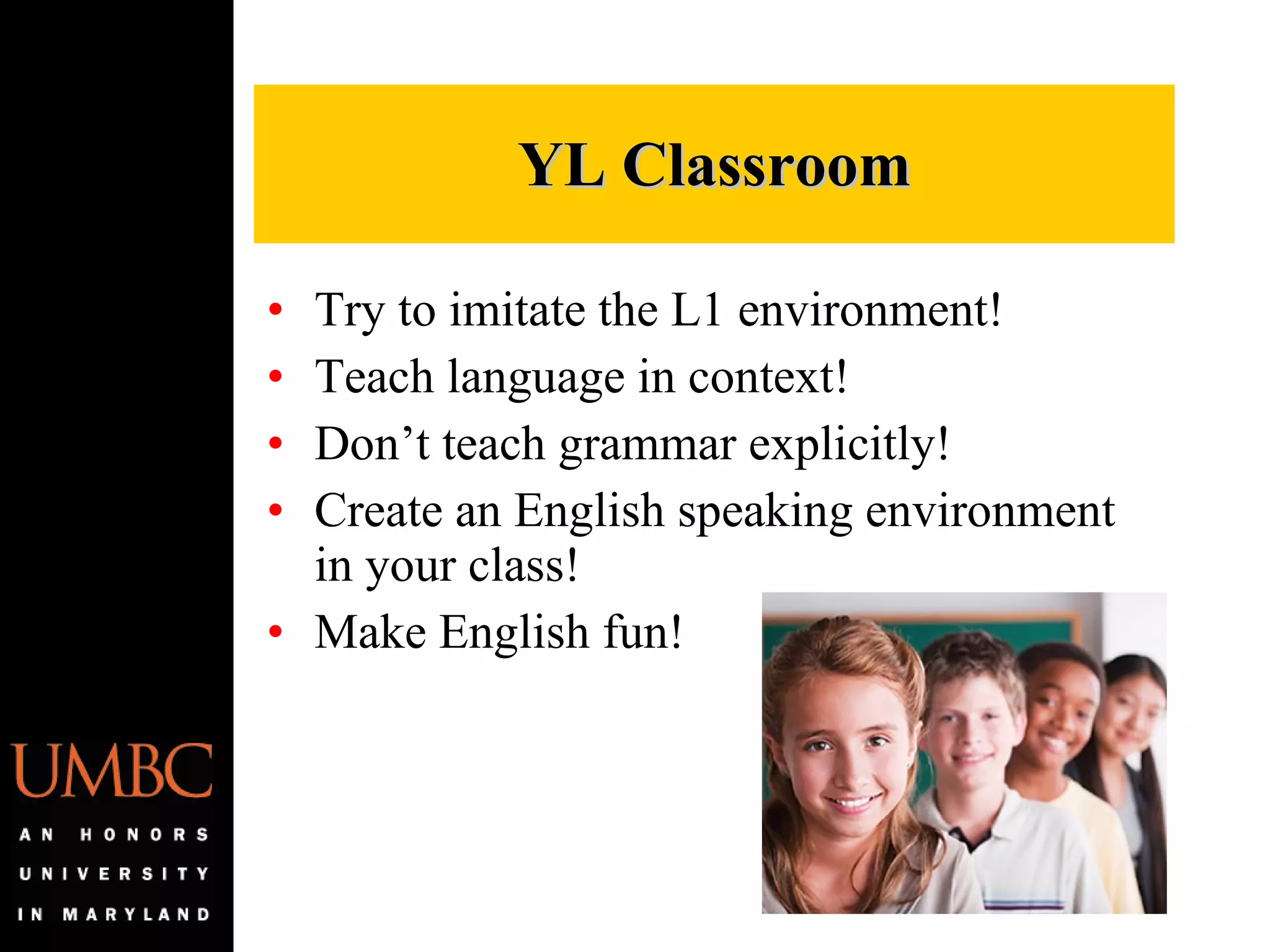
Try to imitate the L1 environment! Teach language in context! Don’t teach grammar explicitly! Create an English speaking environment in your class! Make English fun! YL Classroom
III. Teaching approaches for YLs Read, C. (1998, April). The challenge of teaching children.  English Teaching Professional, 7 : 8-10.
FOOD a. Demonstration
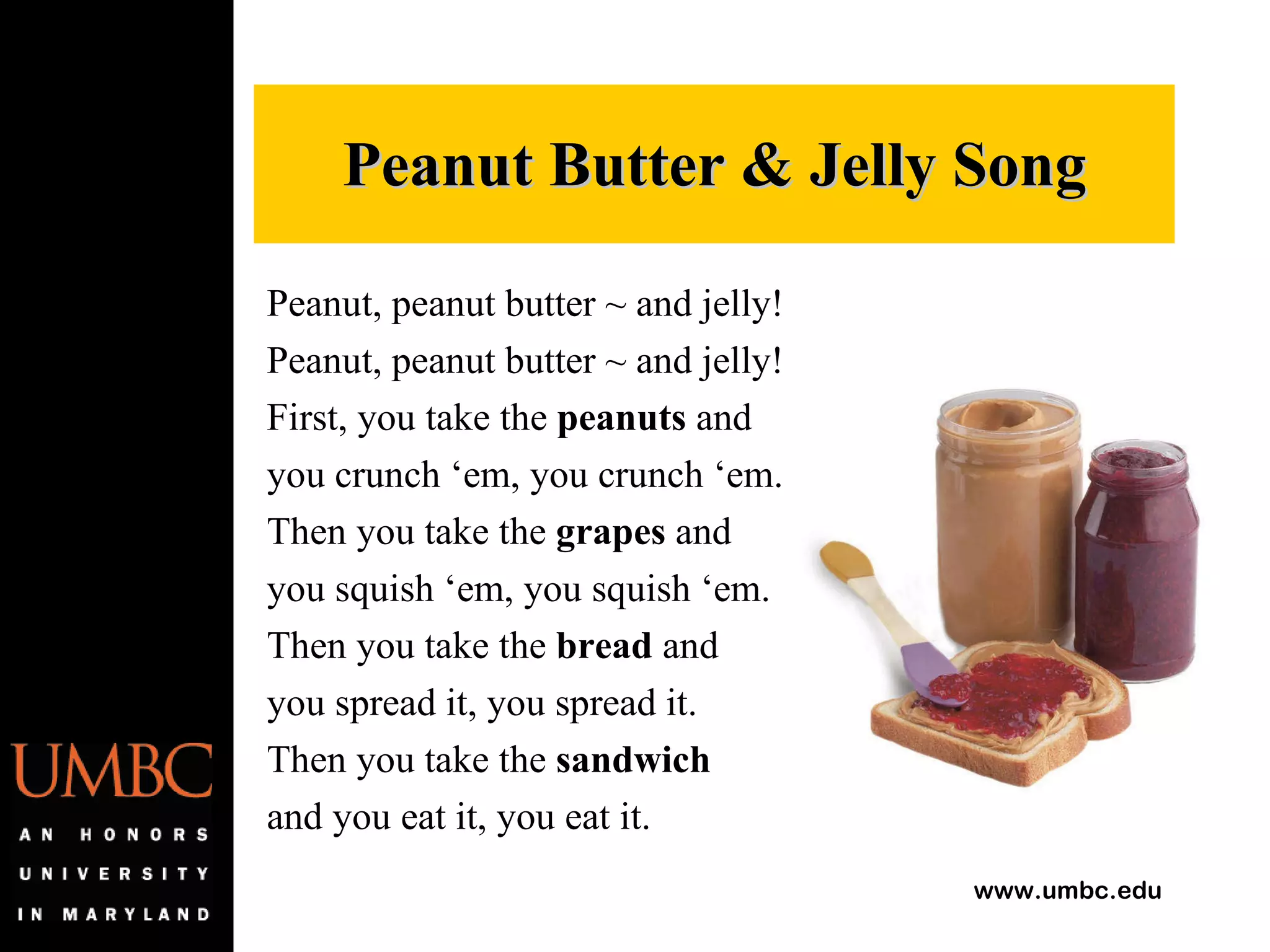
Peanut, peanut butter ~ and jelly! Peanut, peanut butter ~ and jelly! First, you take the  peanuts  and you crunch ‘em, you crunch ‘em. Then you take the  grapes  and you squish ‘em, you squish ‘em. Then you take the  bread  and you spread it, you spread it. Then you take the  sandwich and you eat it, you eat it. Peanut Butter & Jelly Song
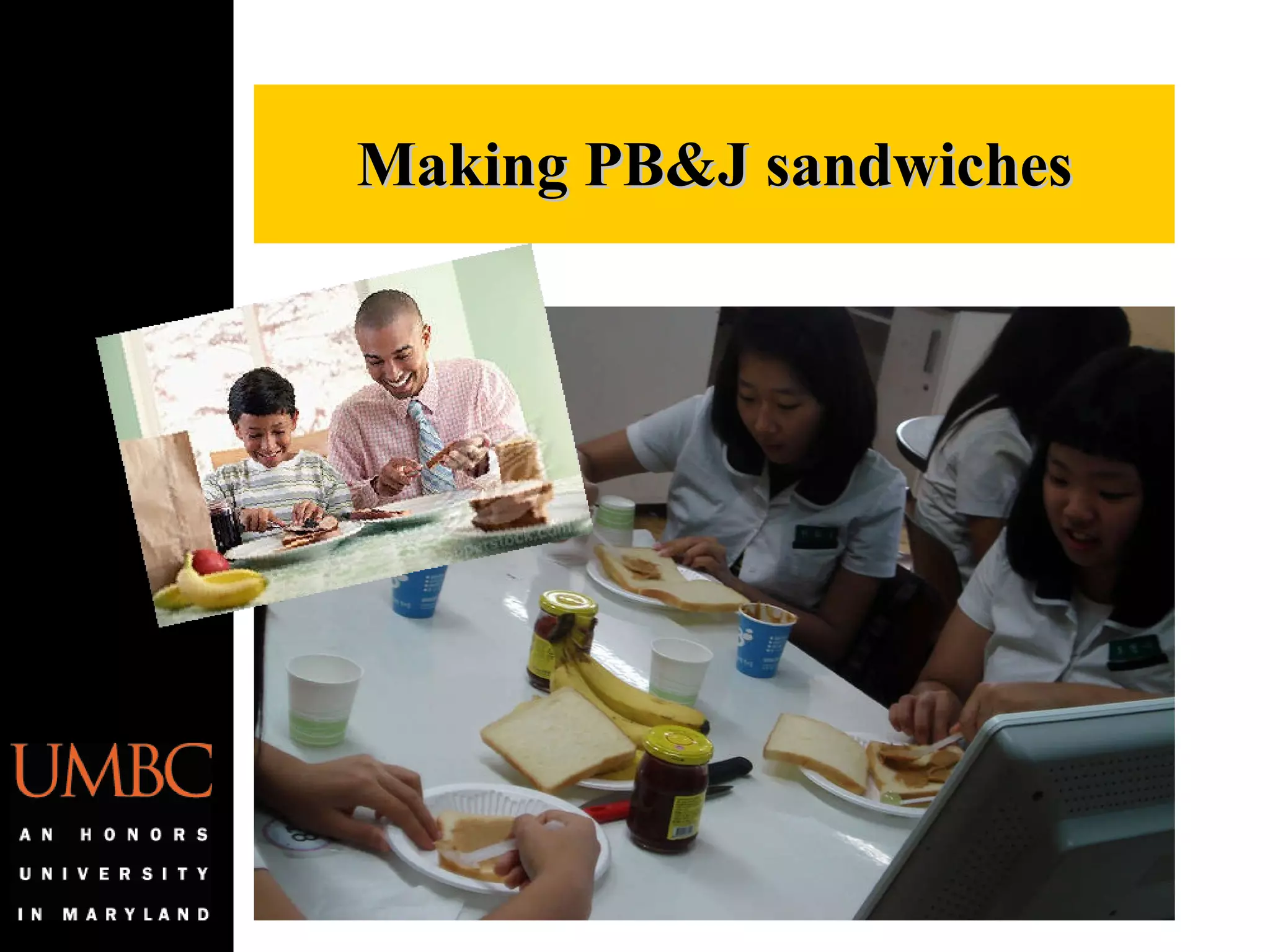
Making PB&J sandwiches
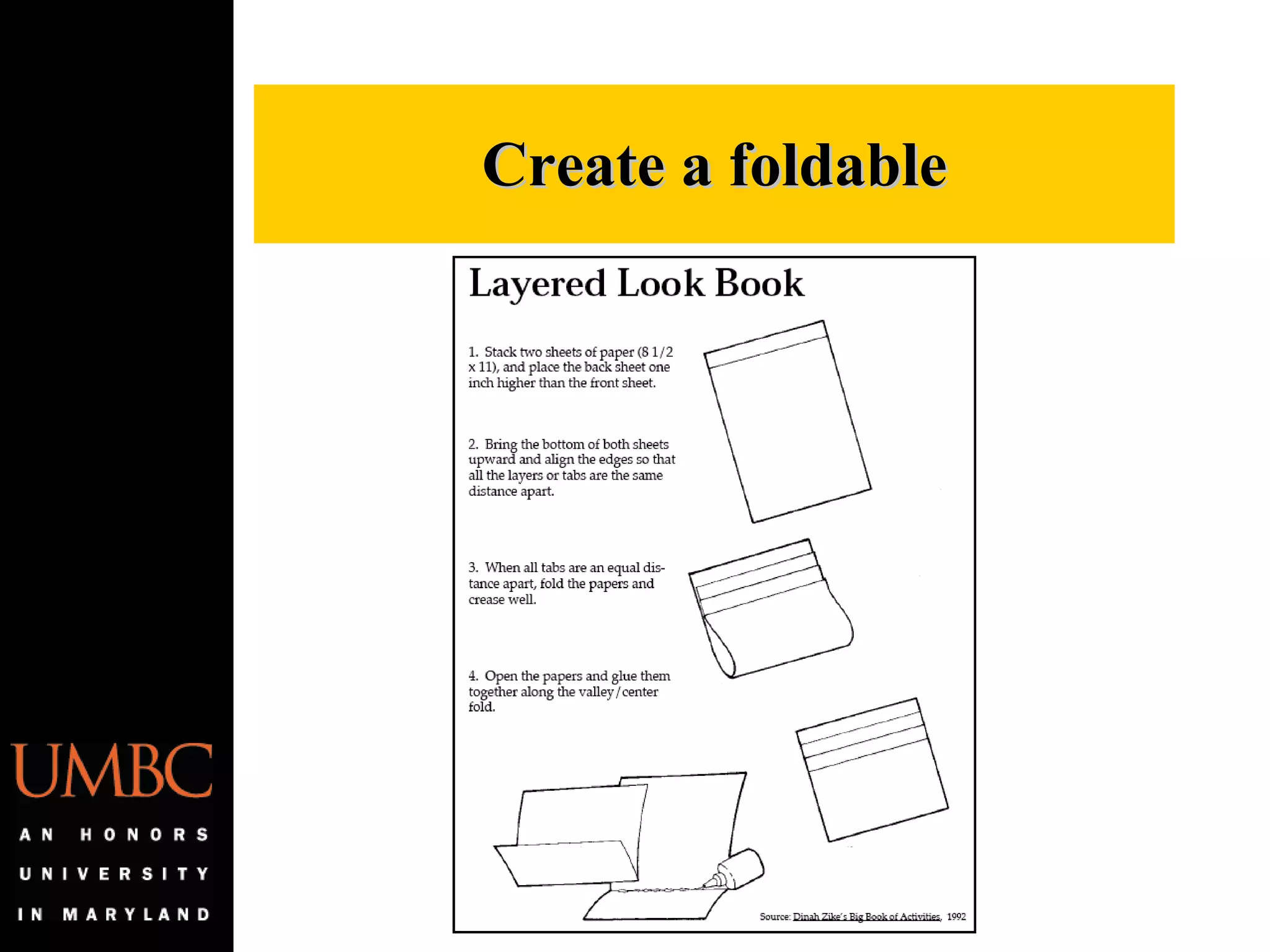
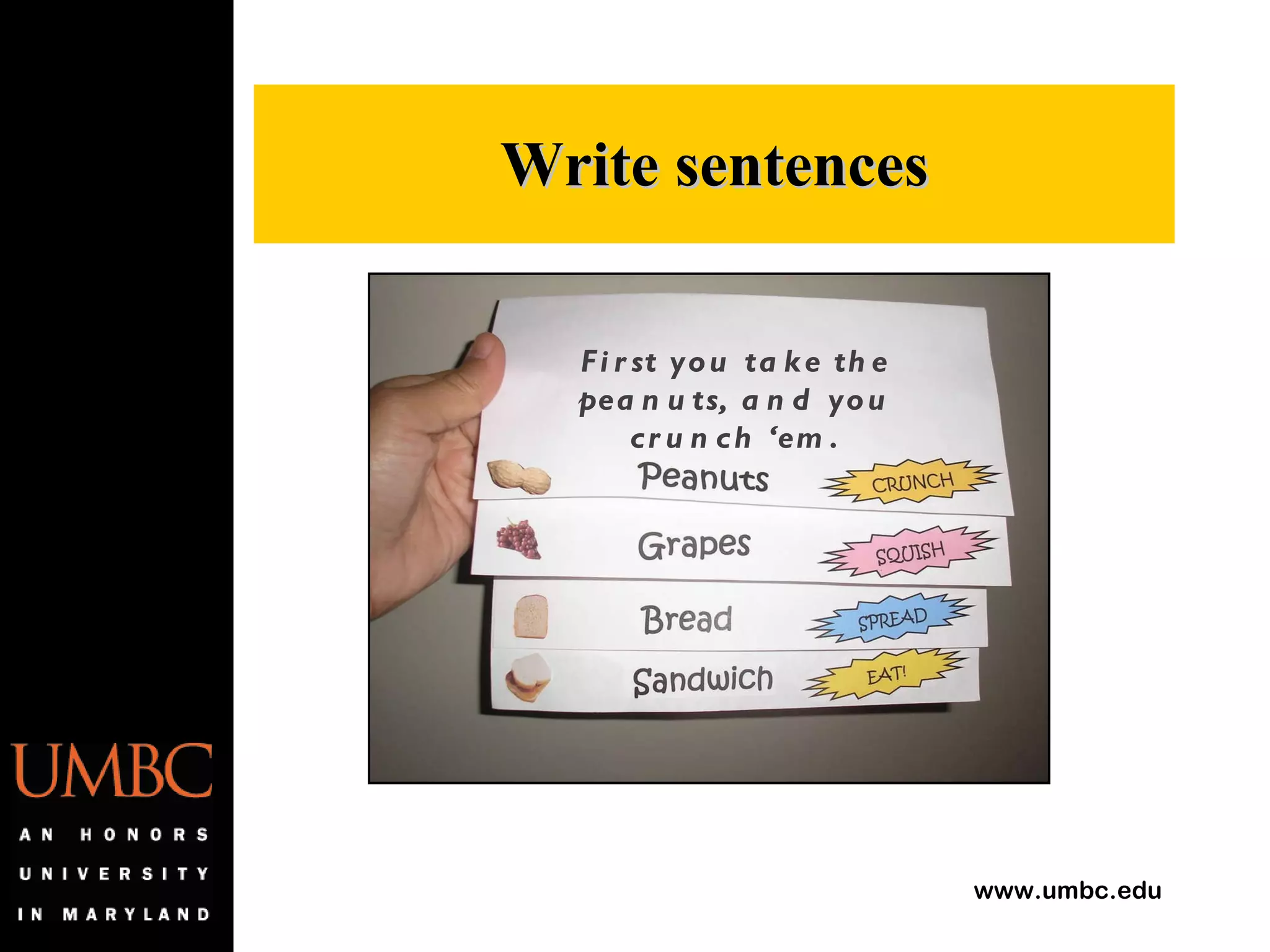
Create a foldable
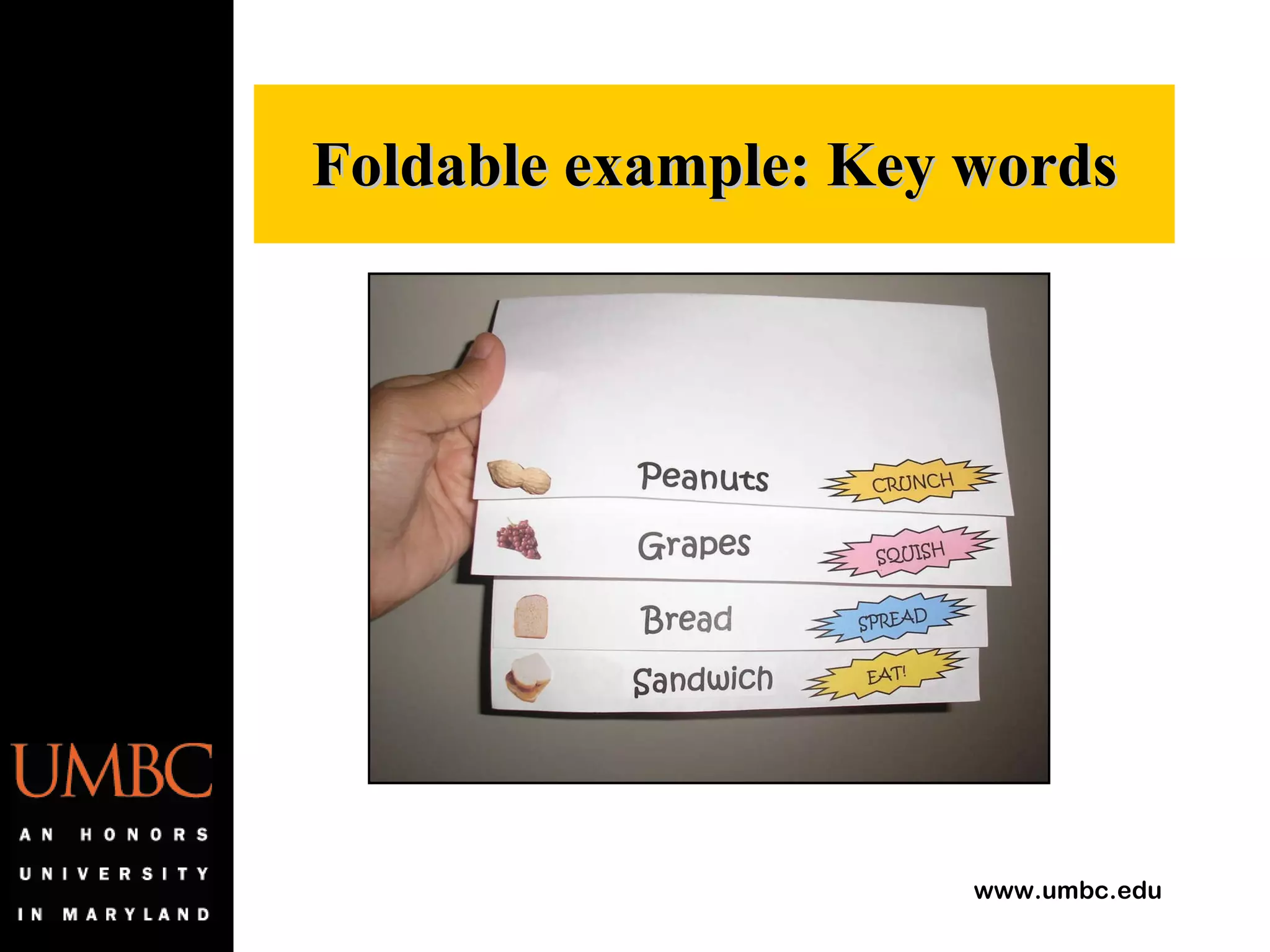
Foldable example: Key words
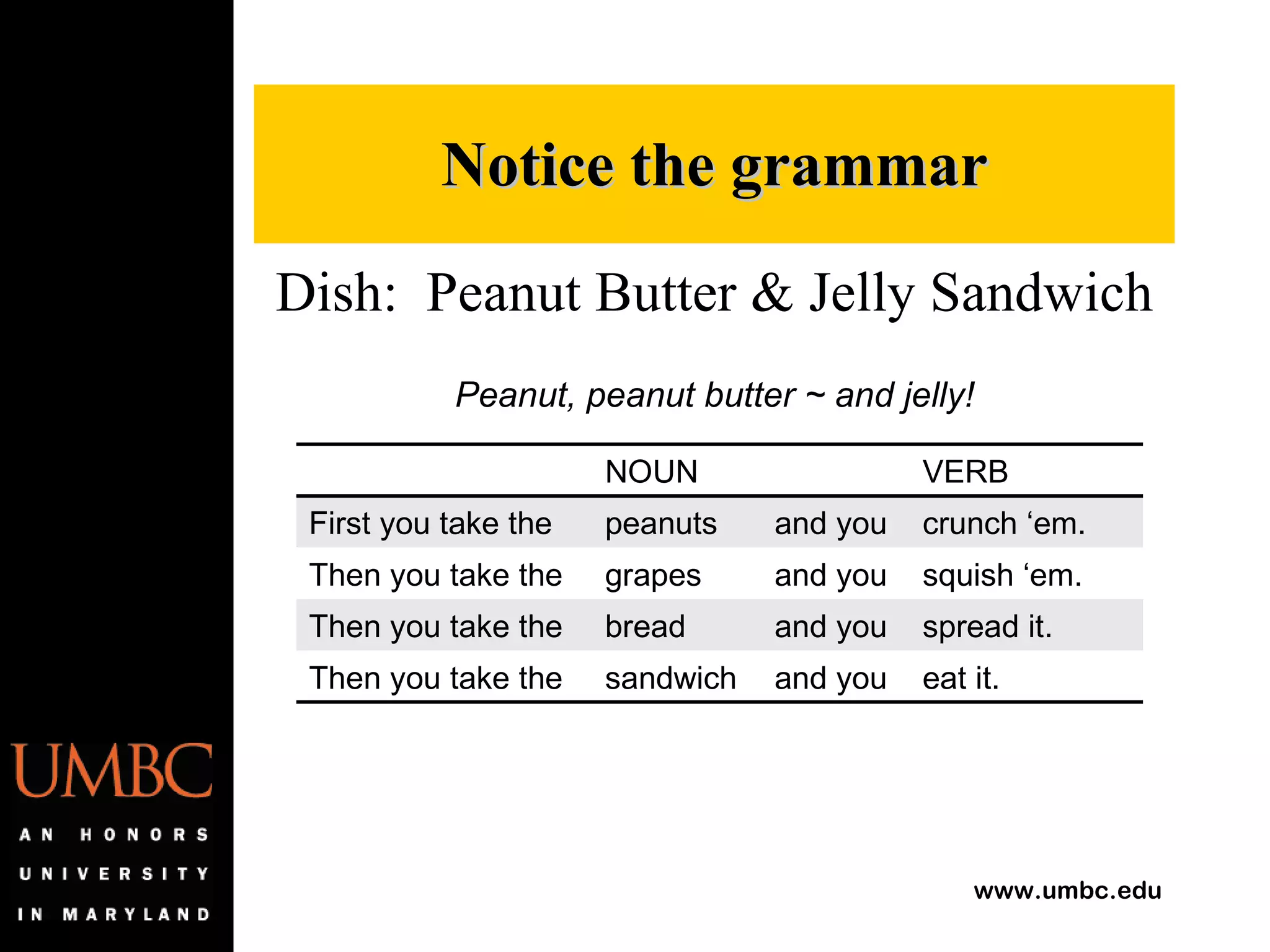
Dish:  Peanut Butter & Jelly Sandwich Peanut, peanut butter ~ and jelly! Notice the grammar NOUN VERB First you take the peanuts and you crunch ‘em. Then you take the grapes and you squish ‘em. Then you take the bread and you spread it. Then you take the sandwich and you eat it.
Write sentences First you take the peanuts, and you crunch ‘em.
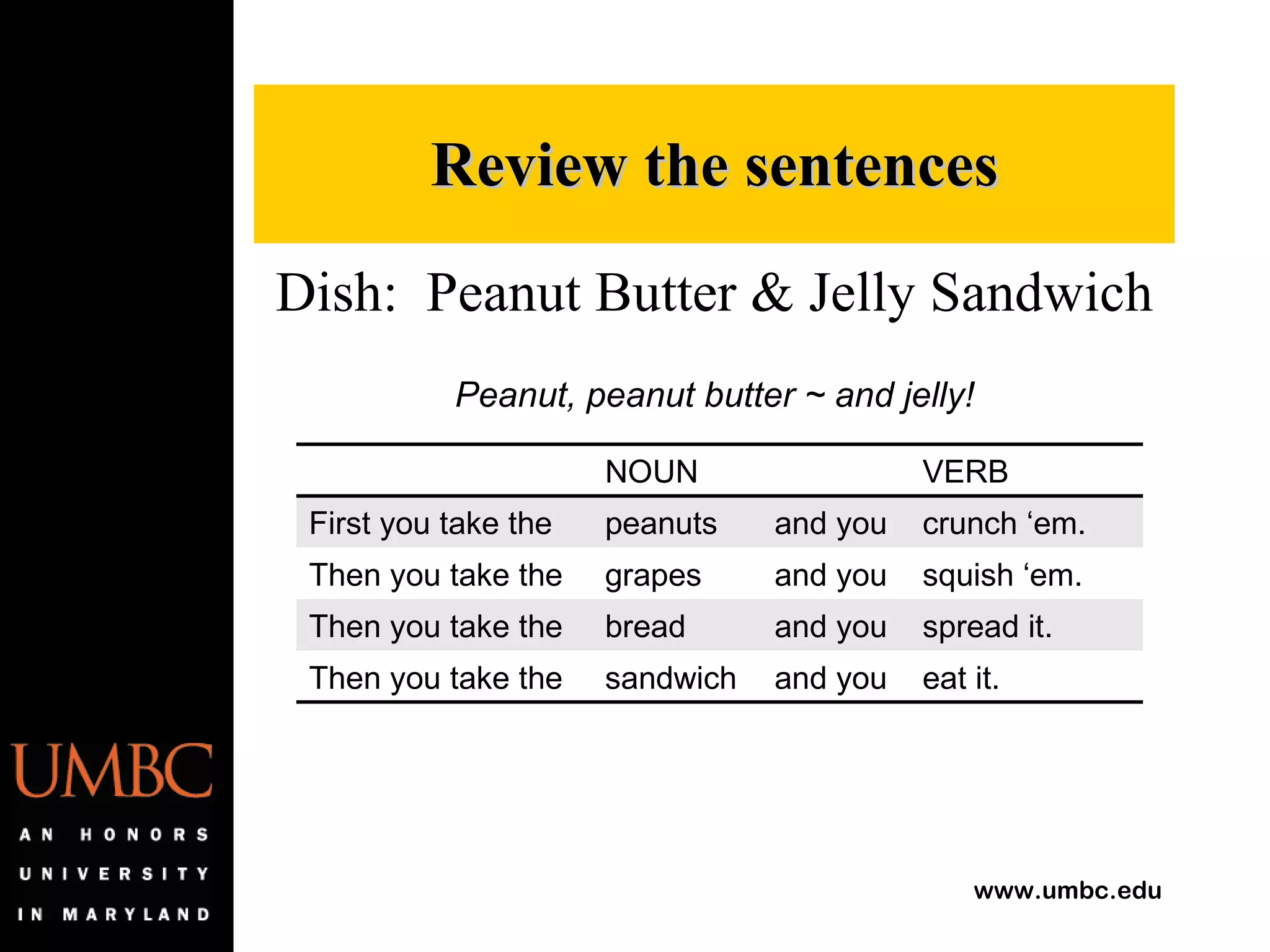
Dish:  Peanut Butter & Jelly Sandwich Peanut, peanut butter ~ and jelly! Review the sentences NOUN VERB First you take the peanuts and you crunch ‘em. Then you take the grapes and you squish ‘em. Then you take the bread and you spread it. Then you take the sandwich and you eat it.
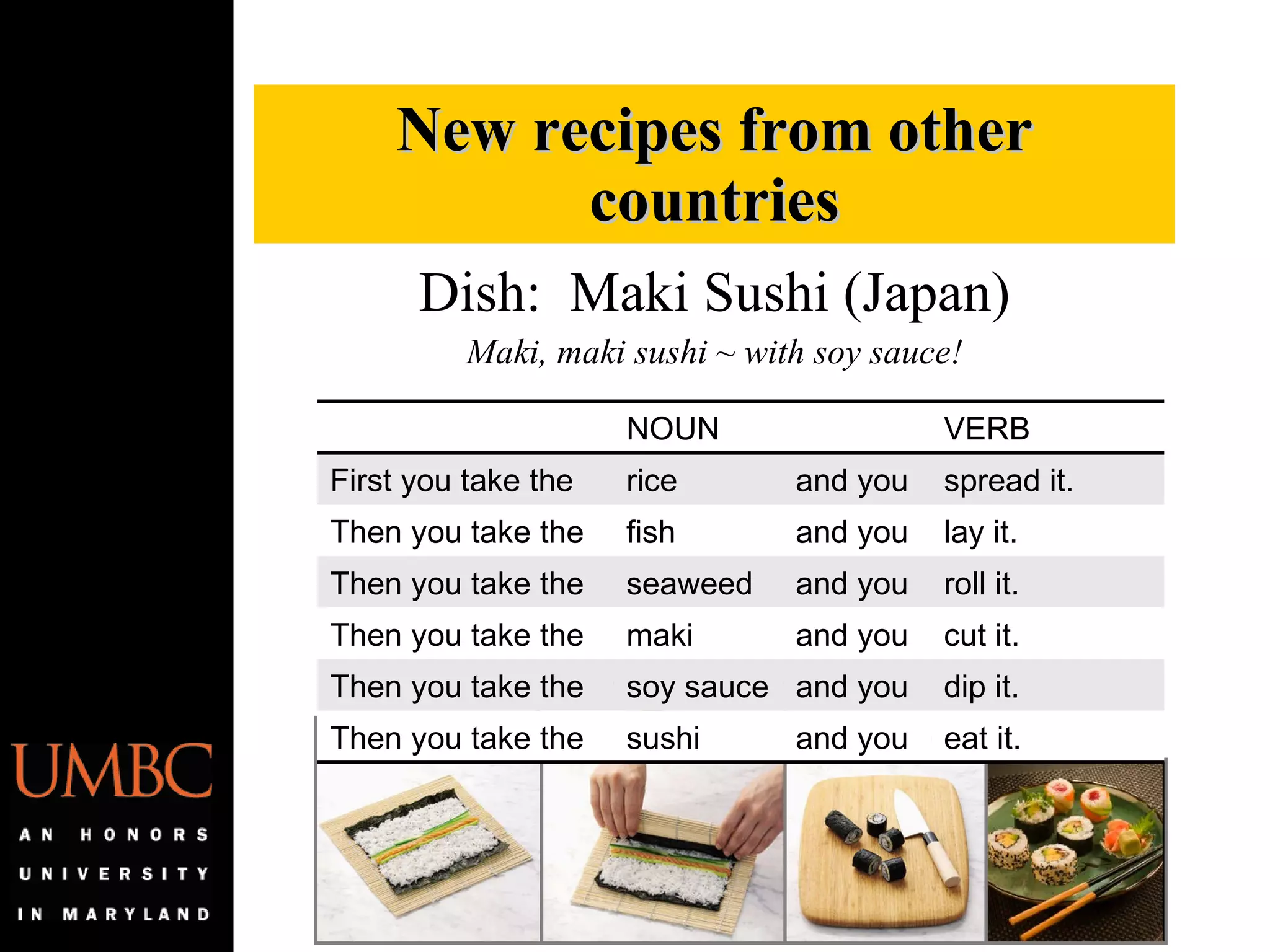
Dish:  Maki Sushi (Japan) Maki, maki sushi ~ with soy sauce! New recipes from other countries NOUN VERB First you take the rice and you spread it. Then you take the fish and you lay it. Then you take the seaweed and you roll it. Then you take the maki and you cut it. Then you take the soy sauce and you dip it. Then you take the sushi and you eat it.
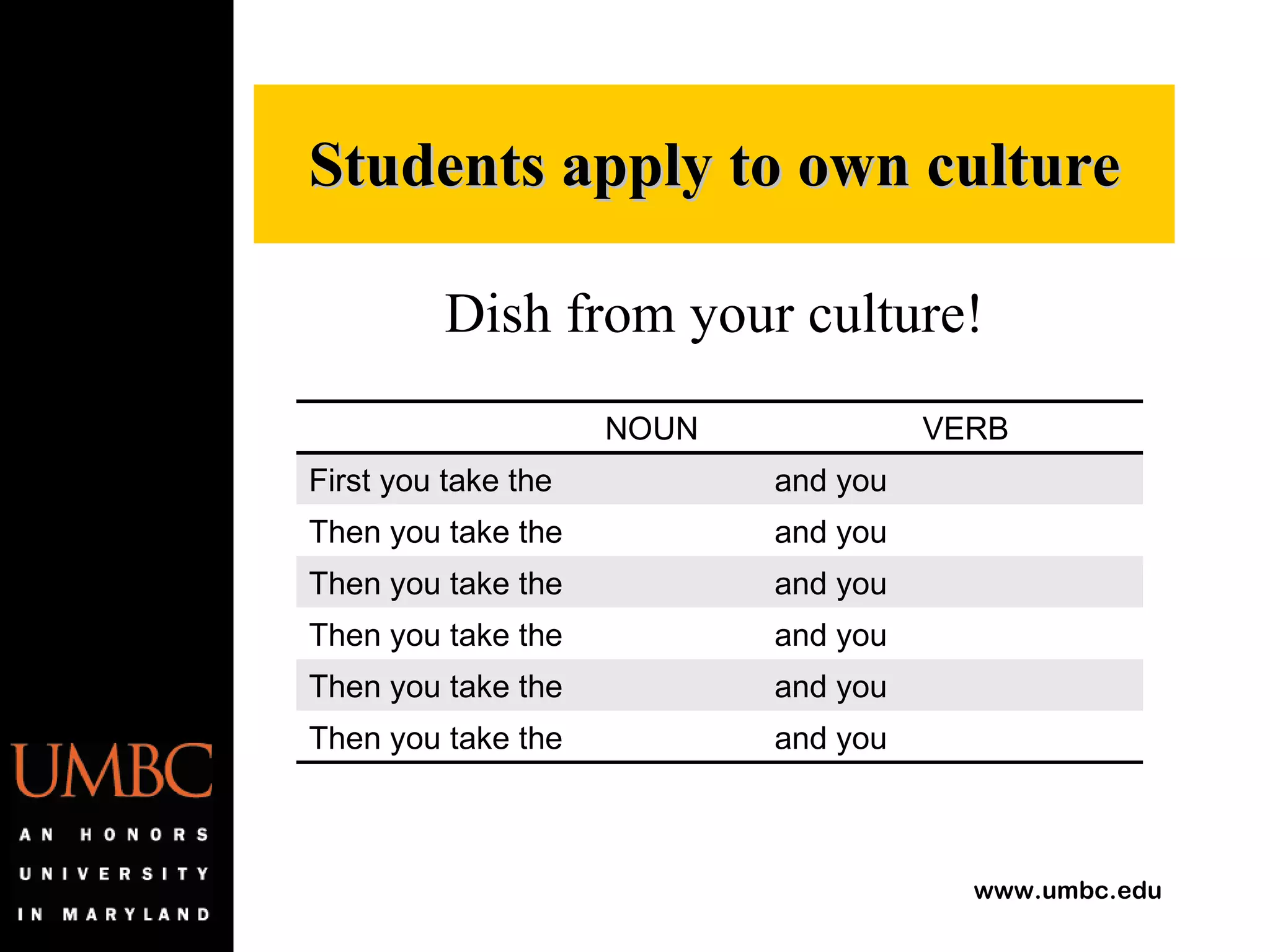
Dish from your culture! Students apply to own culture NOUN VERB First you take the and you Then you take the and you Then you take the and you Then you take the and you Then you take the and you Then you take the and you
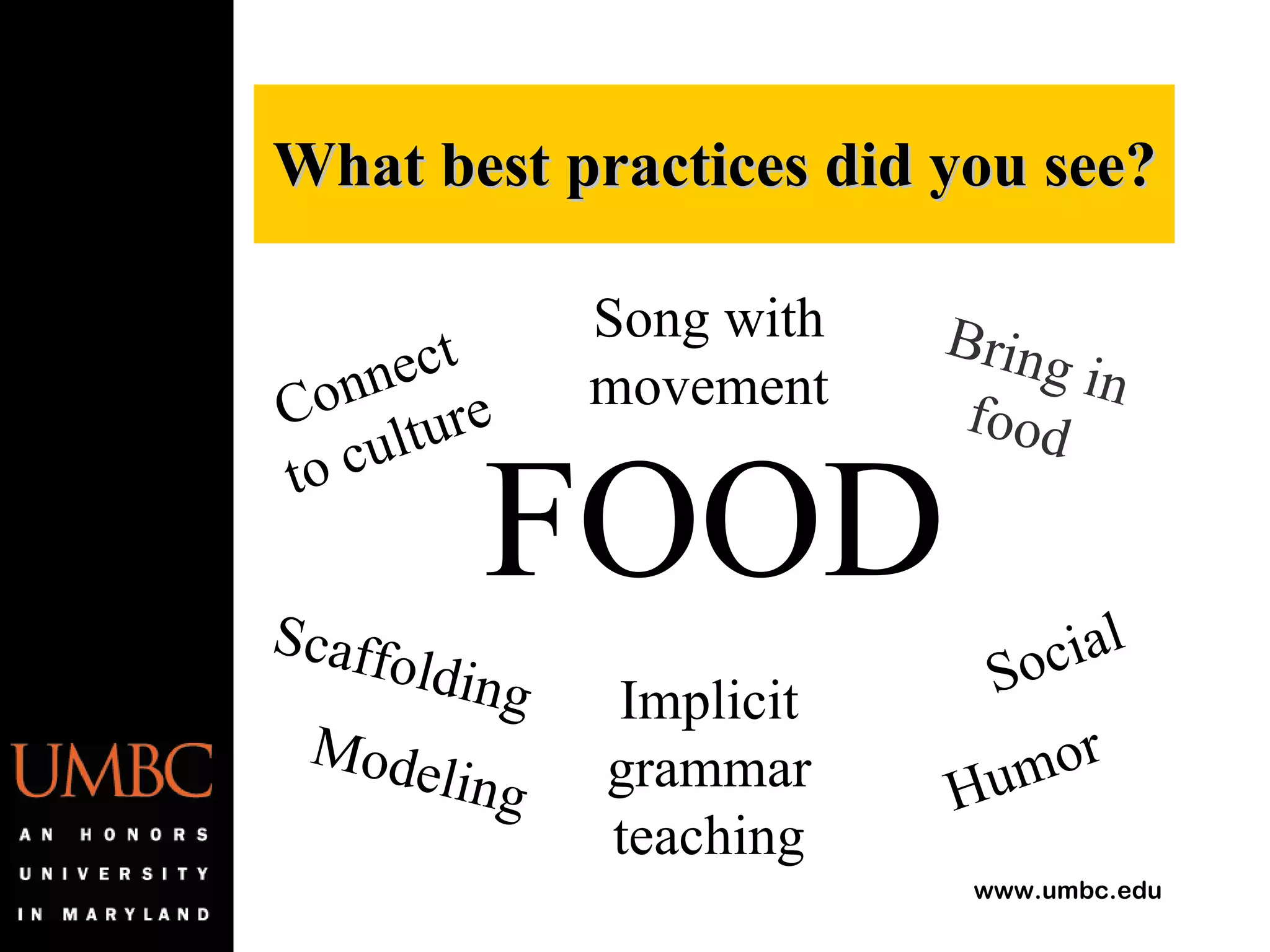
FOOD What best practices did you see? Humor Social Song with movement Modeling Implicit grammar teaching Scaffolding Connect to culture Bring in food
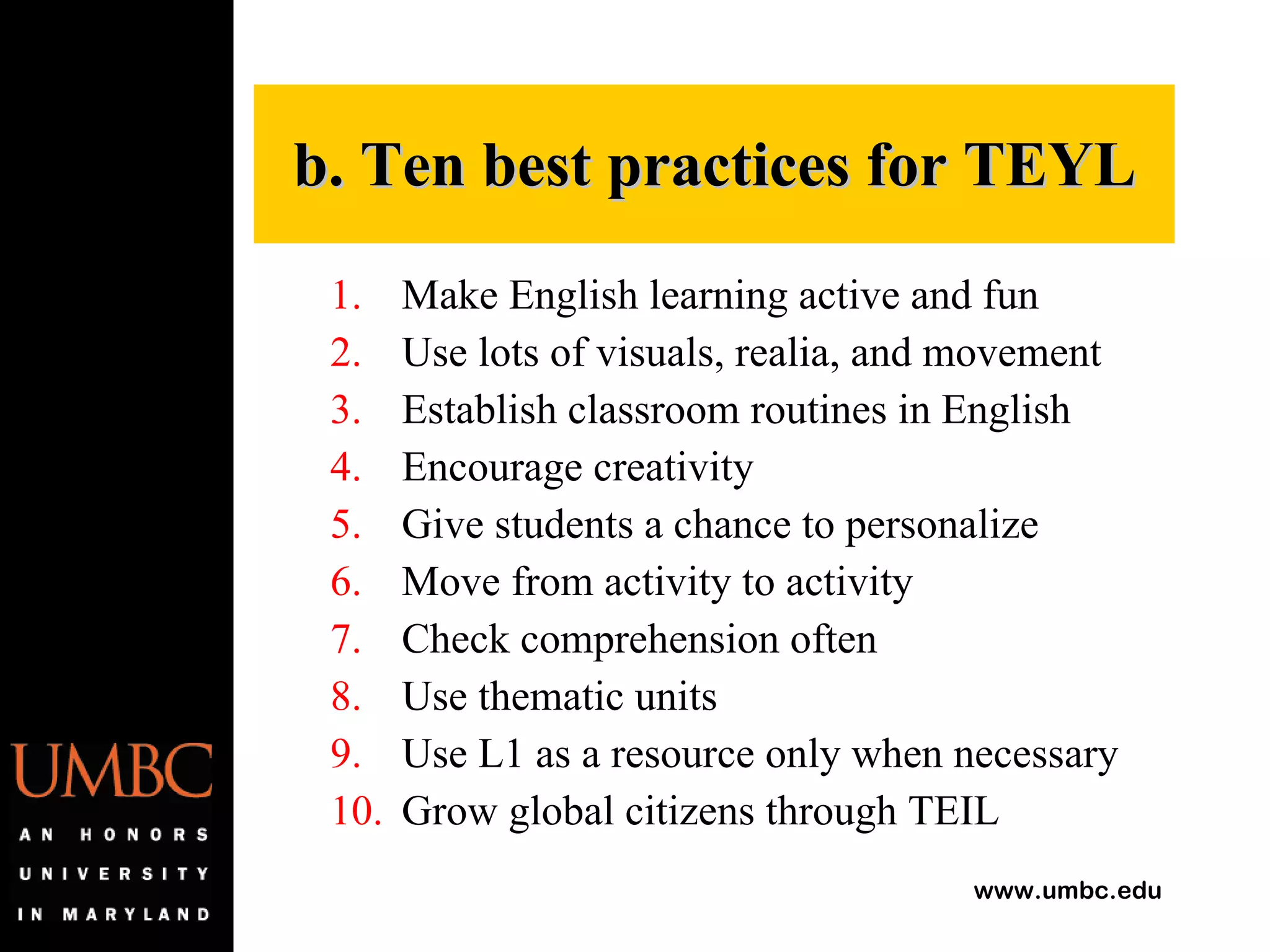
Make English learning active and fun Use lots of visuals, realia, and movement Establish classroom routines in English Encourage creativity Give students a chance to personalize Move from activity to activity Check comprehension often Use thematic units Use L1 as a resource only when necessary Grow global citizens through TEIL b. Ten best practices for TEYL
Do not train children to learning by force and harshness, but direct them to it by what amuses their minds, so that you may be better able to discover with accuracy the peculiar bent of the genius of each. ~ Plato Make English active and fun!
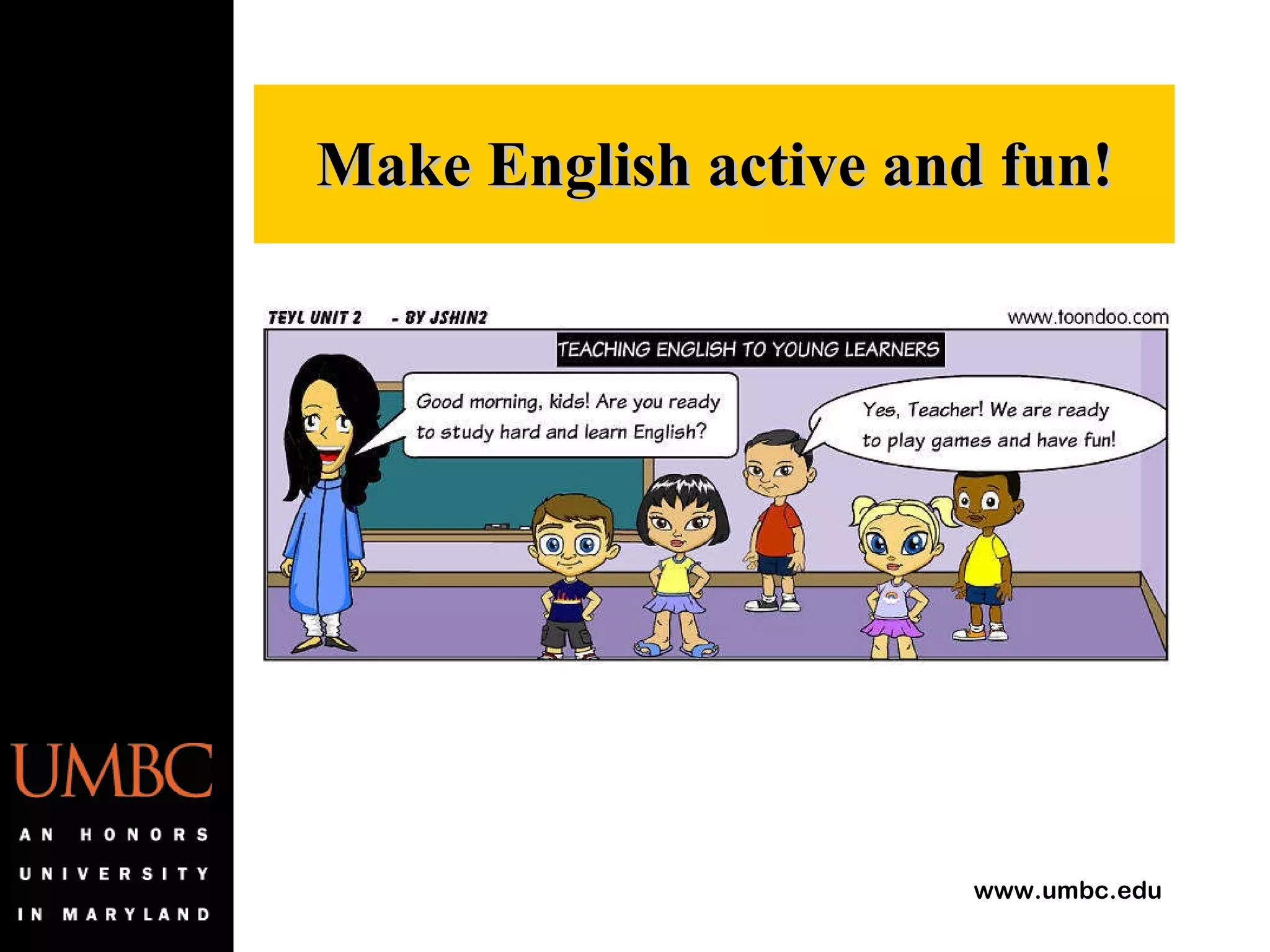
Make English active and fun!
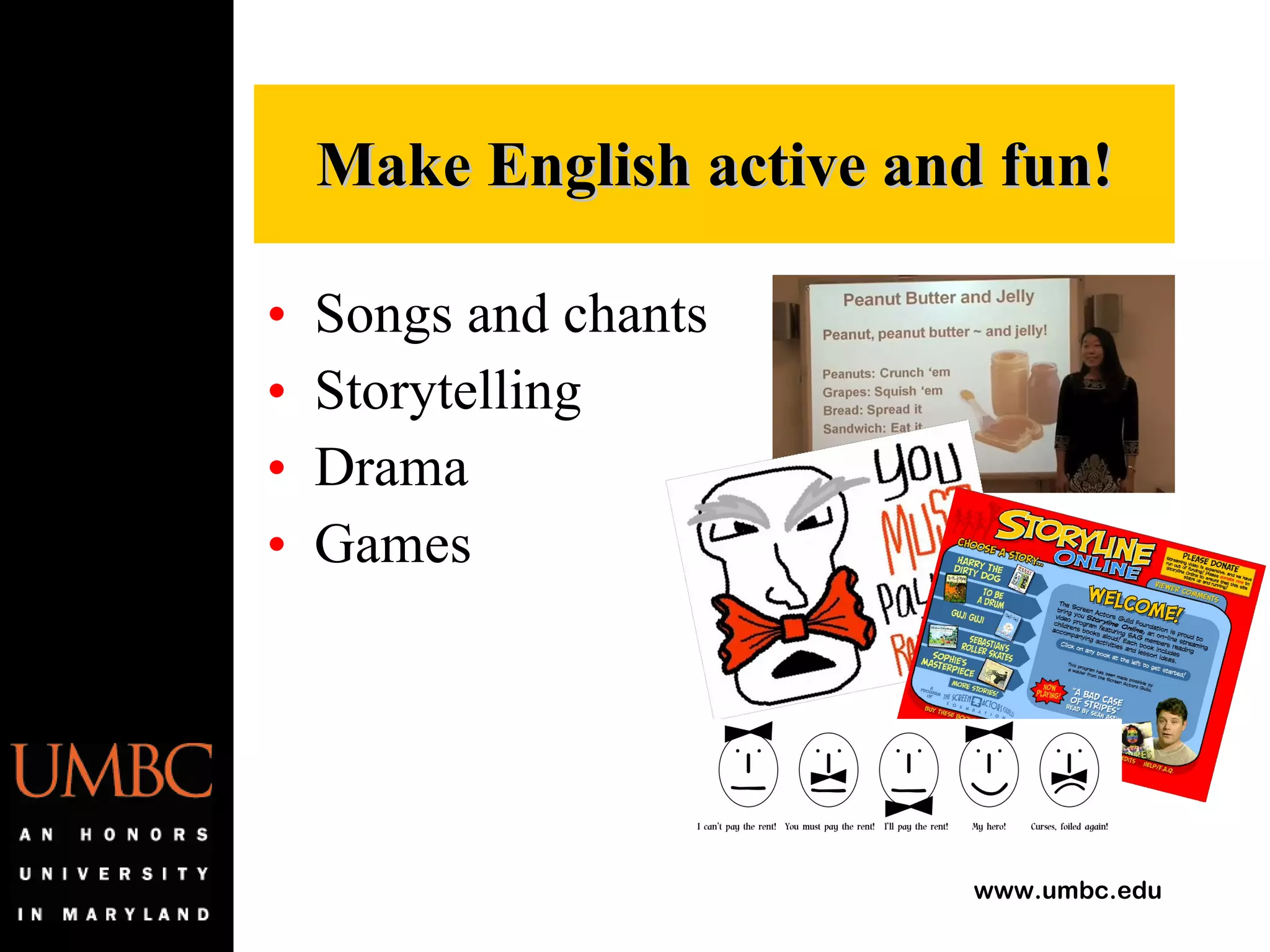
Songs and chants Storytelling Drama Games Make English active and fun!
ENGLISH IS FUN!  x x xx x ENGLISH IS COOL!  x x xx x  I SPEAK ENGLISH!  x x xx x AND SO DO YOU!  x x xx x YAAAAAY! ENGLISH! English cheers
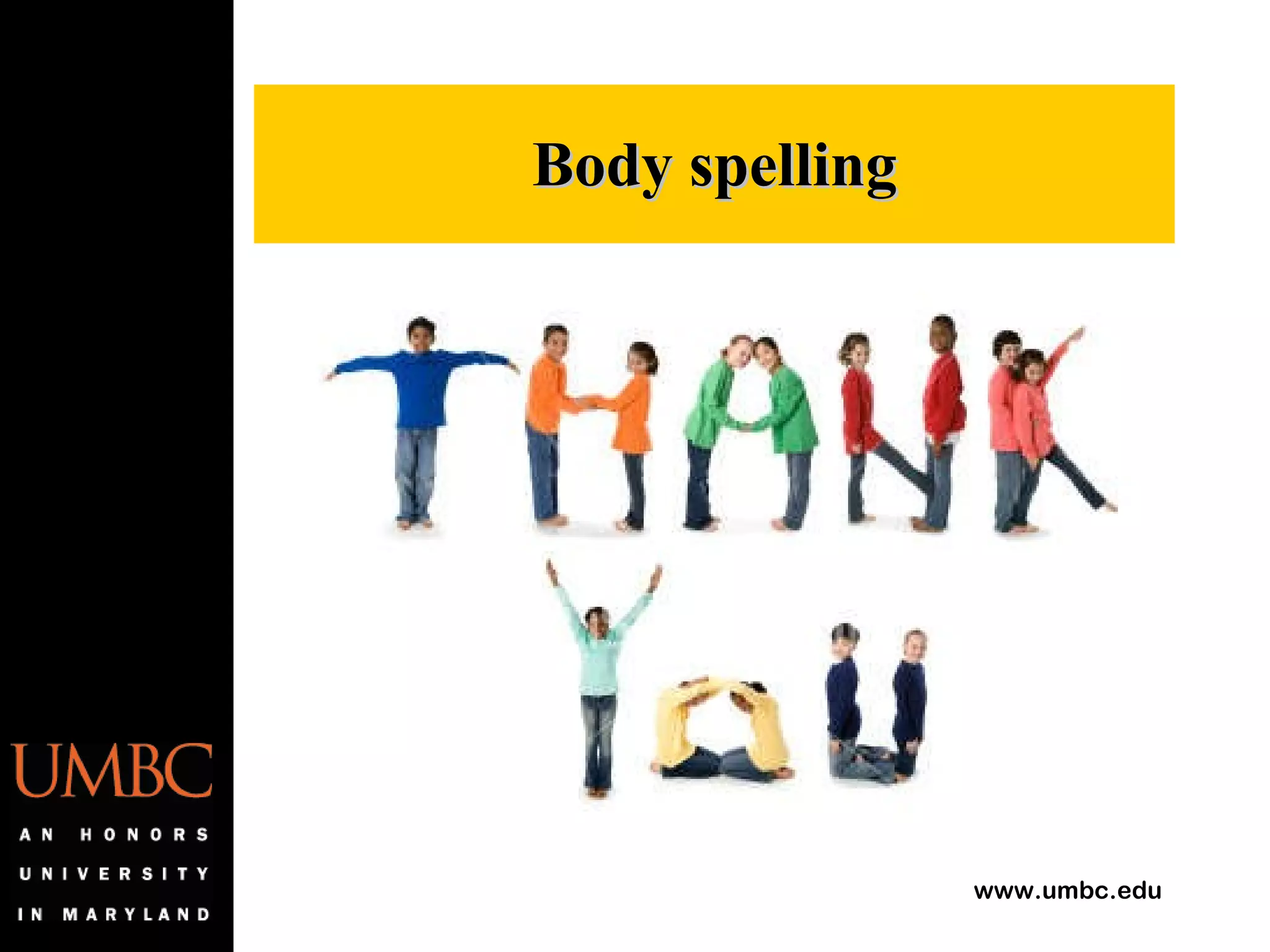
GIVE ME AN E! E! GIVE ME AN N! N! GIVE ME A G! G! GIVE ME AN L! L! GIVE ME AN I! I! GIVE ME AN S! S! GIVE ME AN H! H! WHAT DOES THAT SPELL?  ENGLISH! WHAT DO WE SPEAK?   ENGLISH! WHAT DO WE LOVE?   ENGLISH! YAAAAAY!  ENGLISH! English cheers
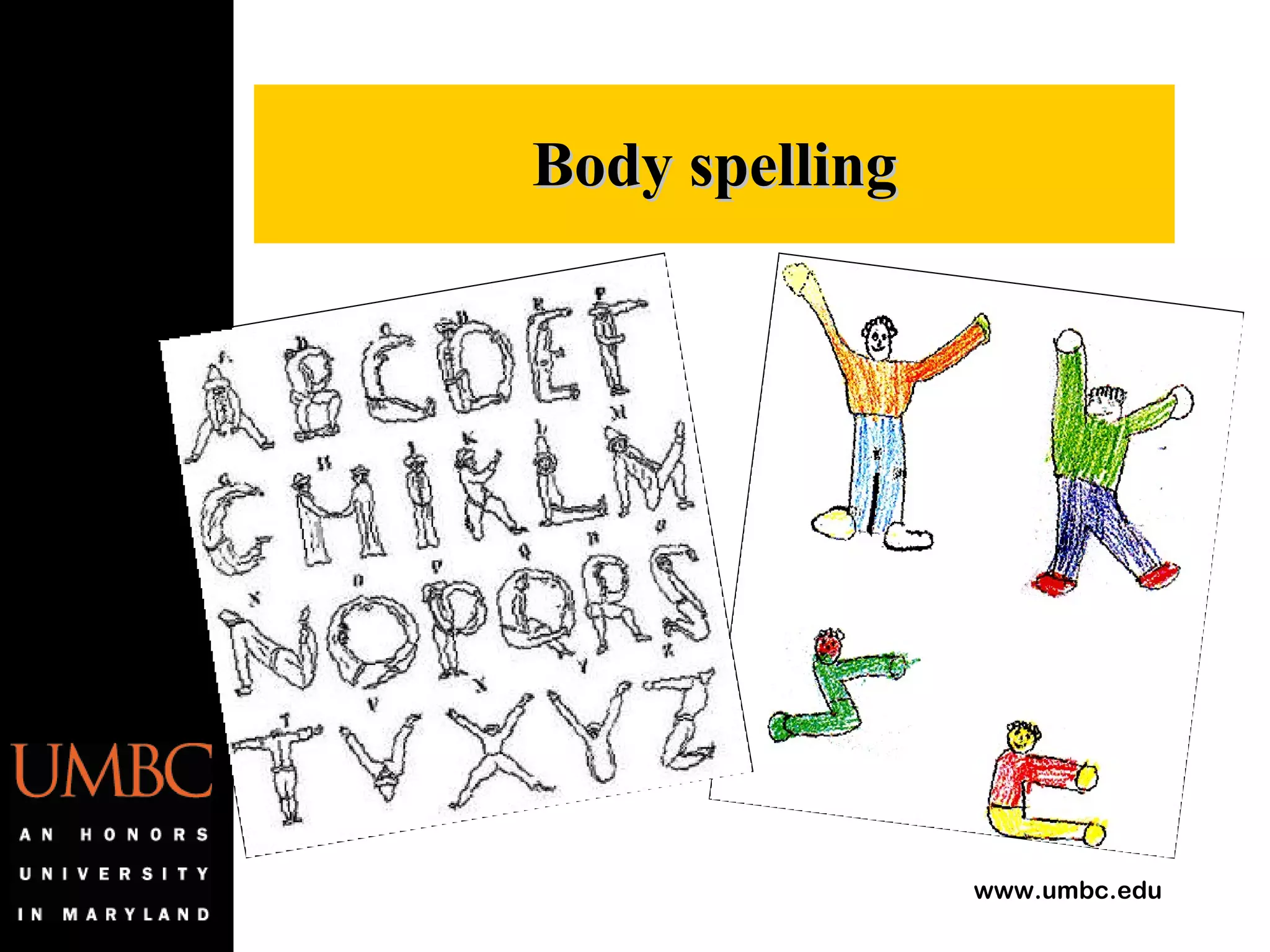
Body spelling
Body spelling
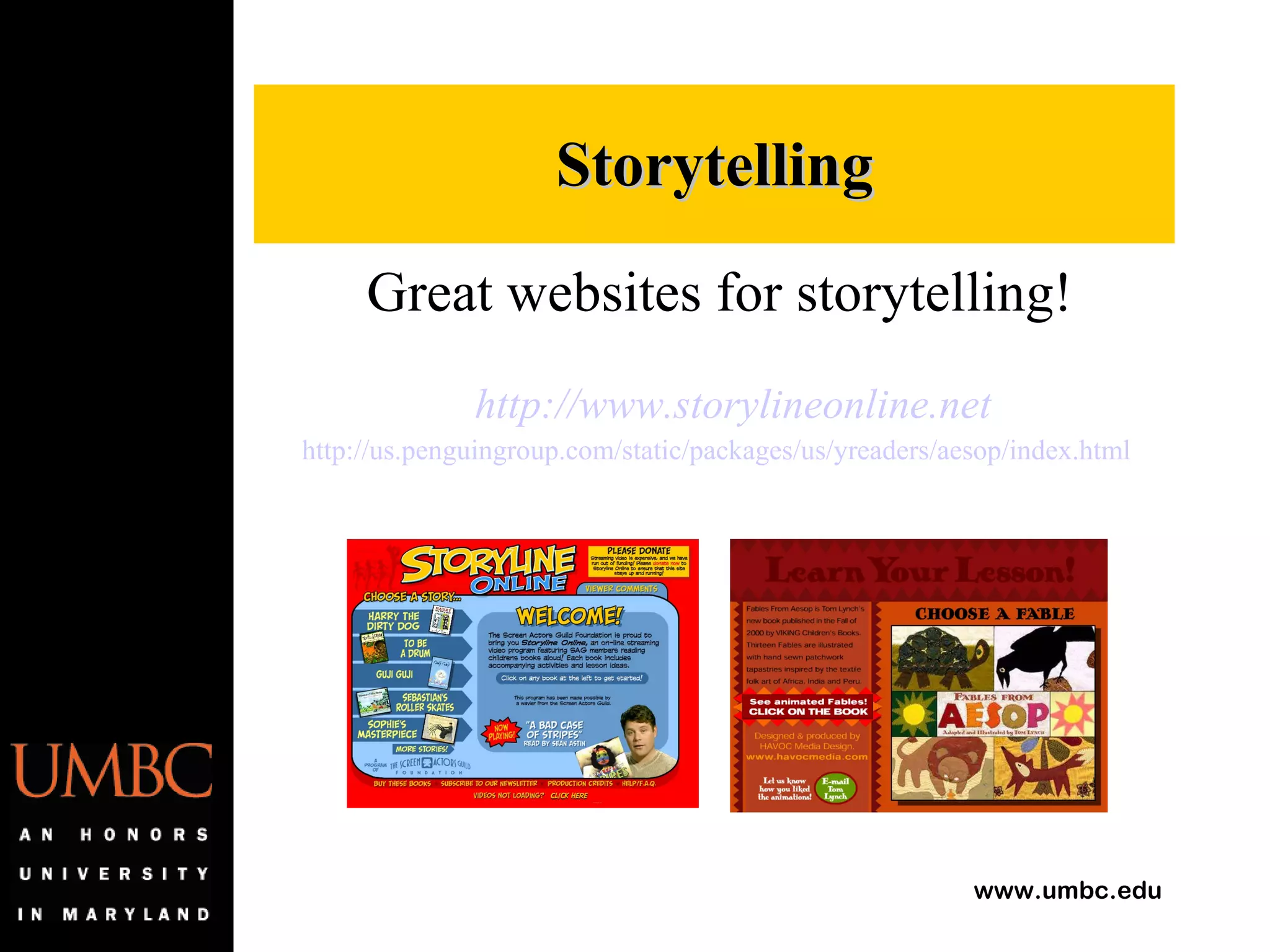
Great websites for storytelling! http://www.storylineonline.net   http://us.penguingroup.com/static/packages/us/yreaders/aesop/index.html   Storytelling
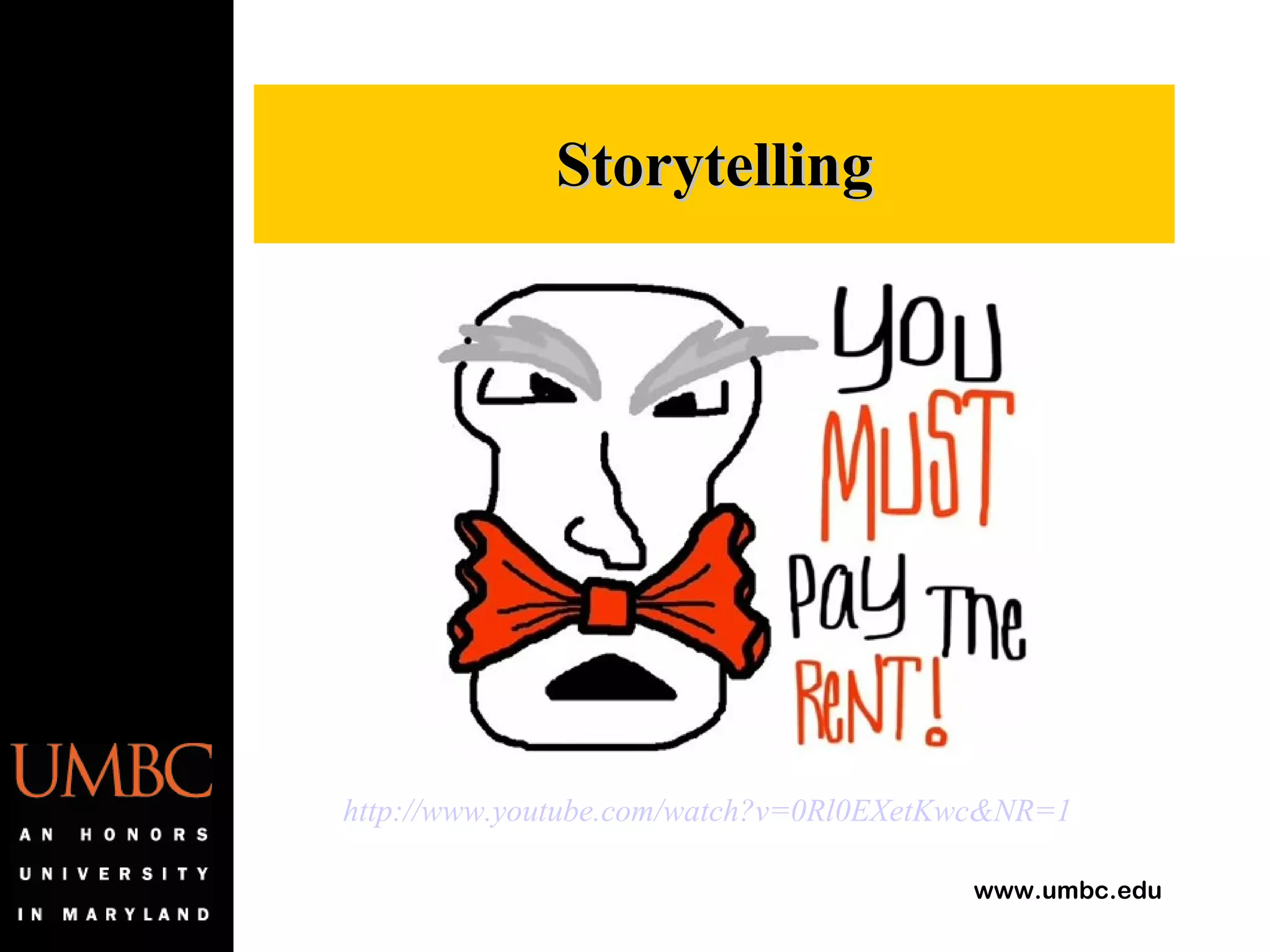
Storytelling http://www.youtube.com/watch?v=0Rl0EXetKwc&NR=1
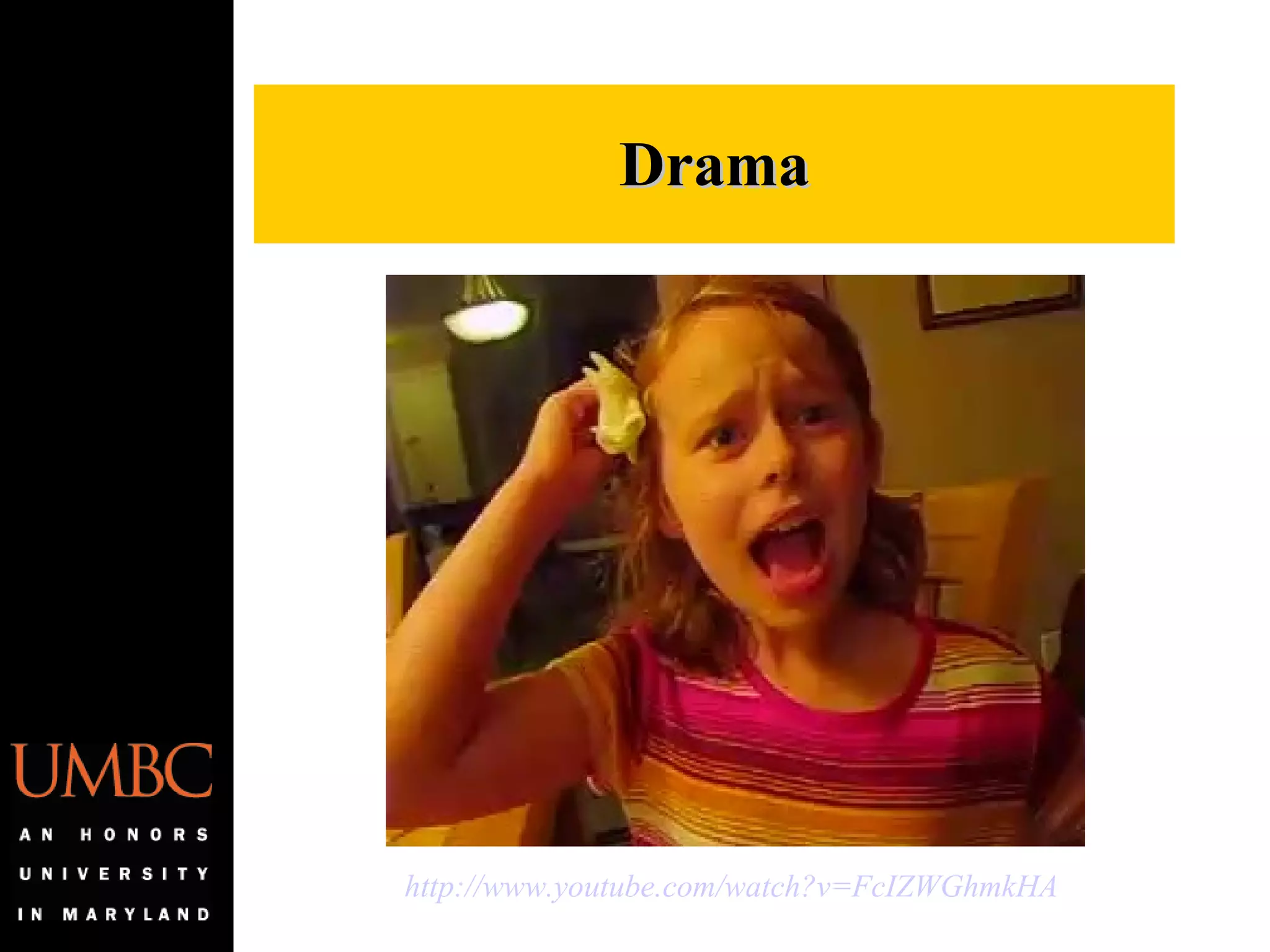
Drama http://www.youtube.com/watch?v=FcIZWGhmkHA
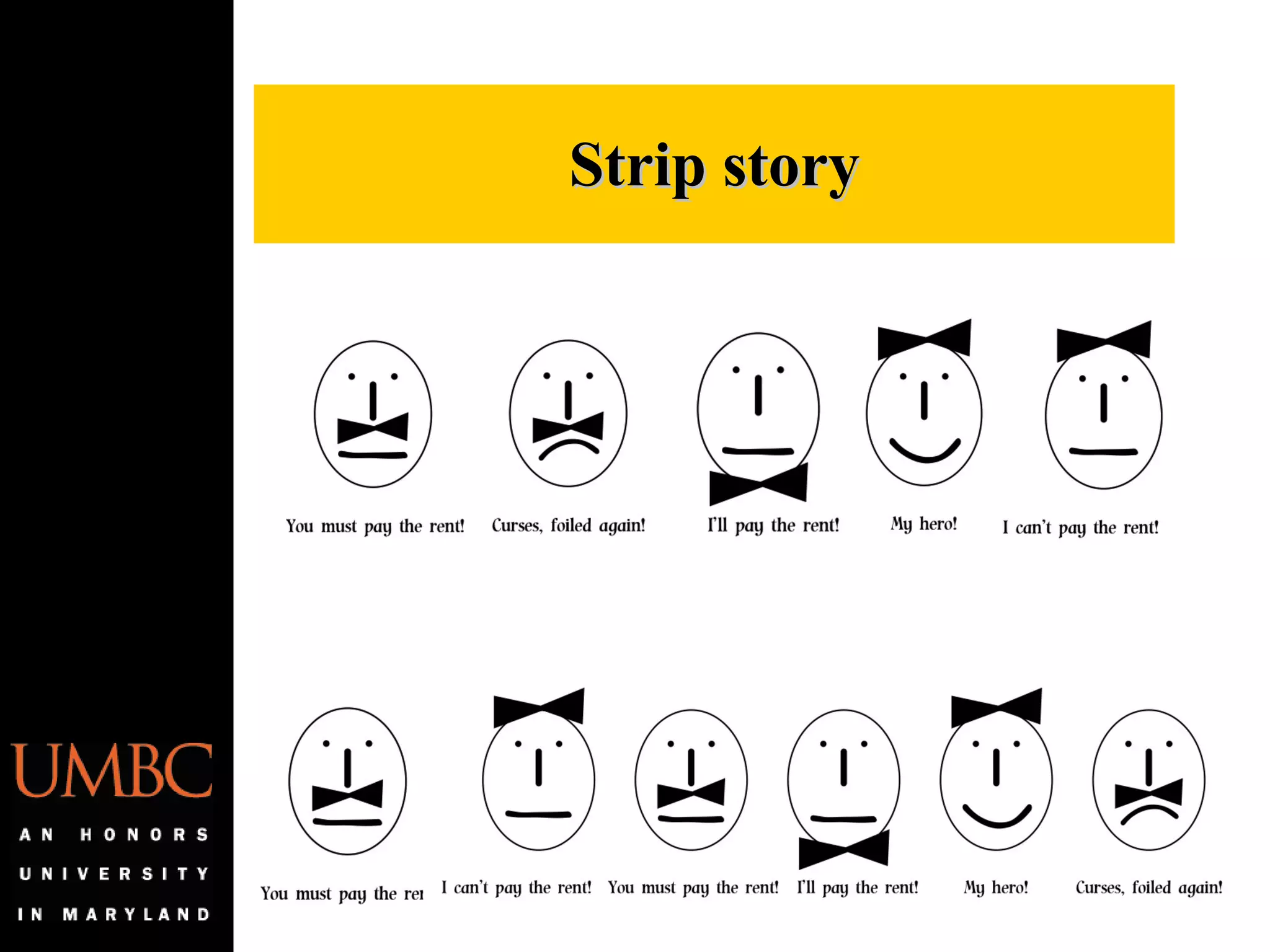
Strip story
Lisa and Rosa run into John on the street. Lisa: Hi, John!  How are you? John: Hi, Lisa!  I’m fine.  How are you? Lisa: I’m good.  This is my friend Rosa. Rosa: Hi! I’m Rosa.  (Shake hands with John.) John: Nice to meet you. Rosa: Nice to meet you too! Sample dialogue
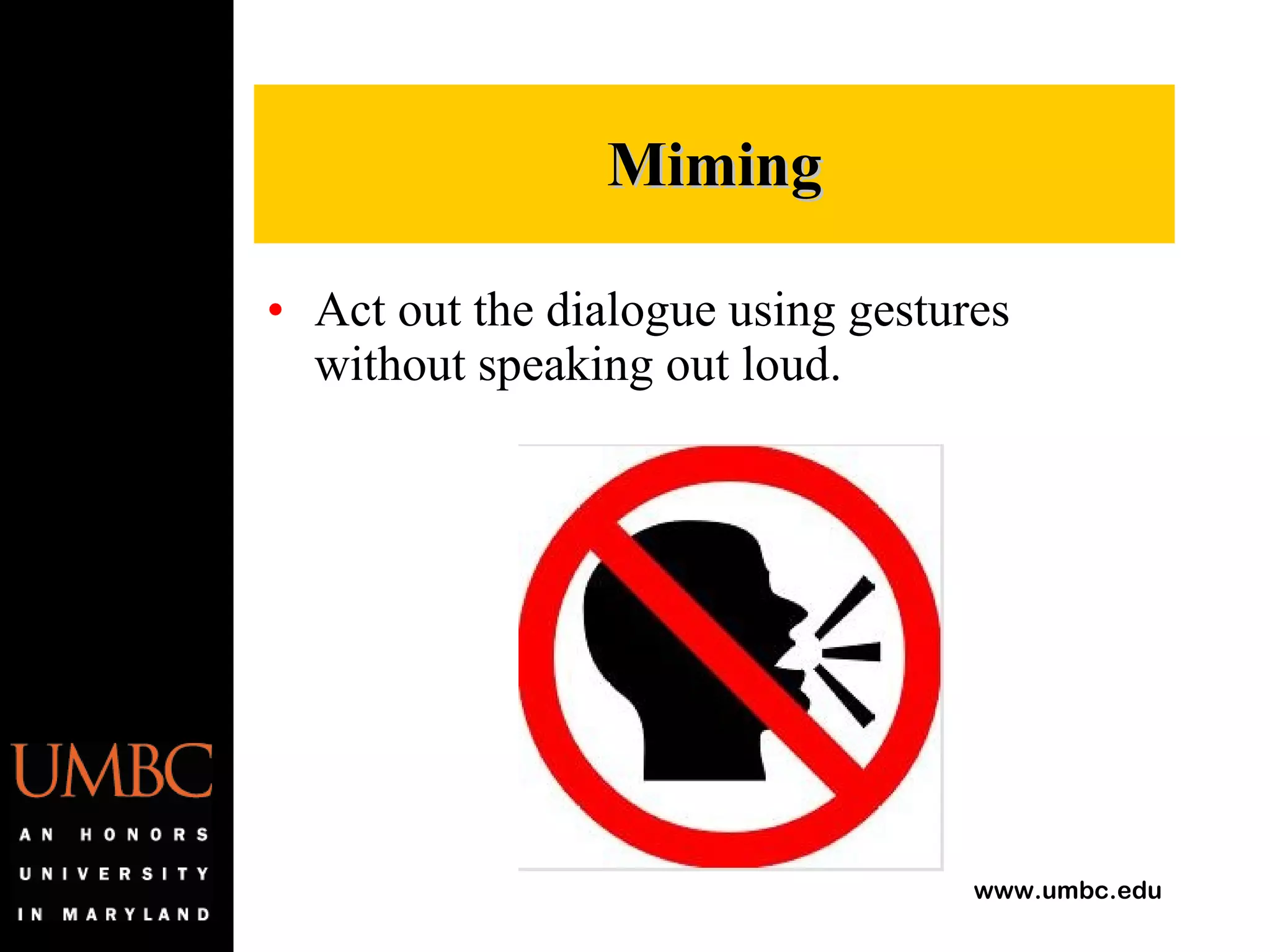
Act out the dialogue using gestures without speaking out loud. Miming Hi, John!  How are you?
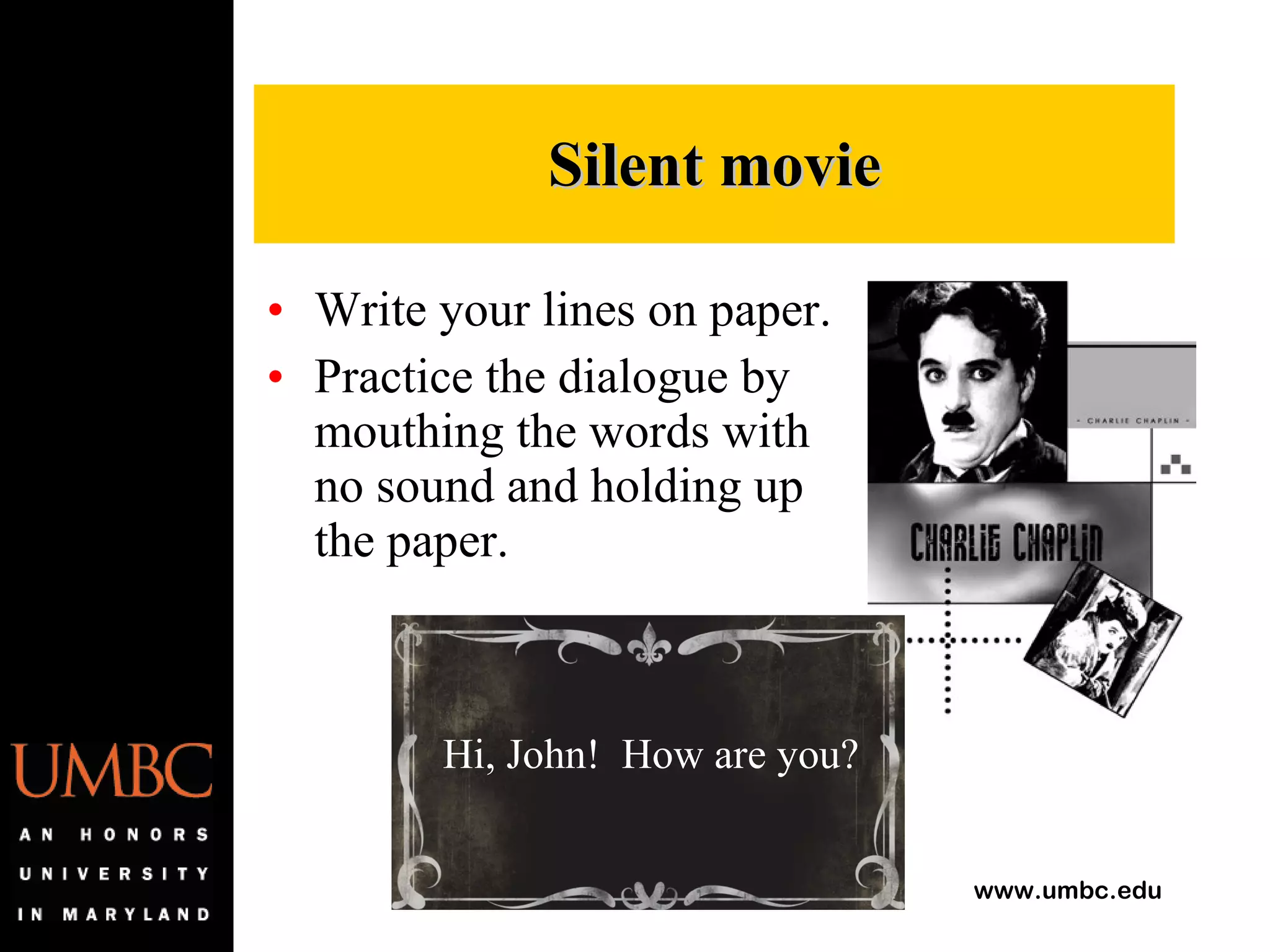
Write your lines on paper. Practice the dialogue by mouthing the words with no sound and holding up the paper. Silent movie Hi, John!  How are you?
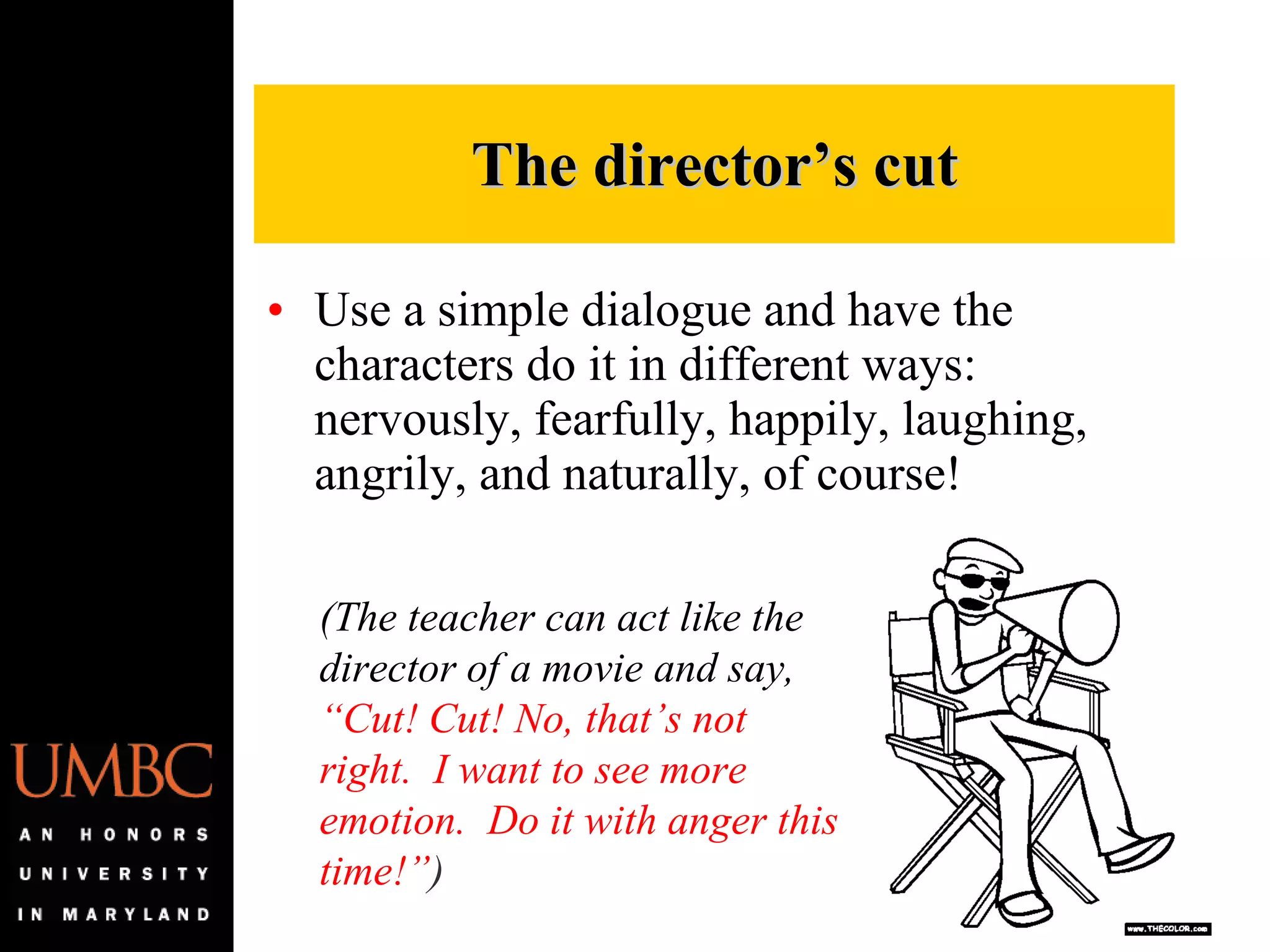
Use a simple dialogue and have the characters do it in different ways:  nervously, fearfully, happily, laughing, angrily, and naturally, of course! The director’s cut (The teacher can act like the director of a movie and say,  “Cut! Cut! No, that’s not right.  I want to see more emotion.  Do it with anger this time!” )
I hear, and I forget. I see, and I remember. I do, and I understand. ~ Confucius Use lots of visuals, realia, and movement
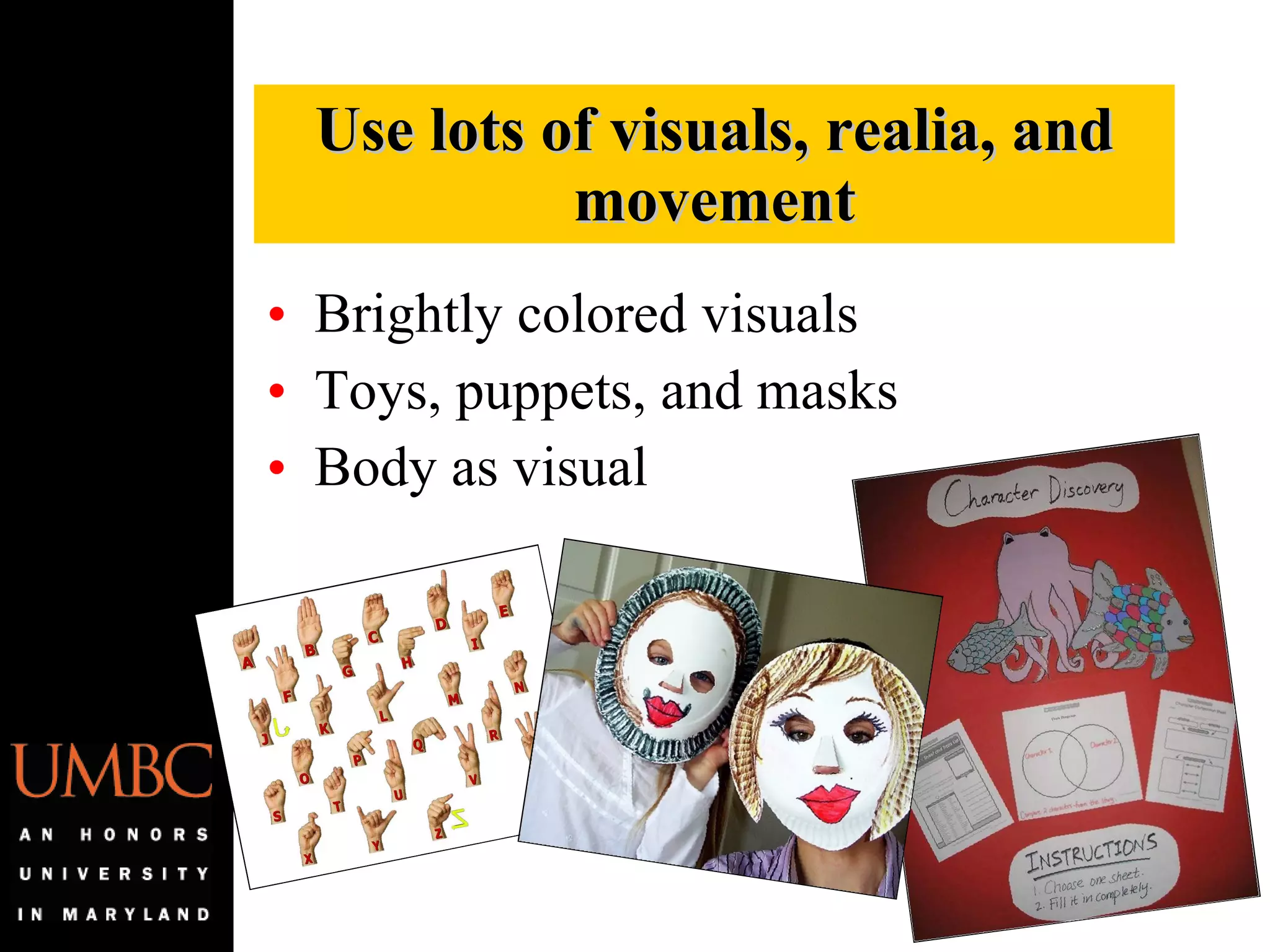
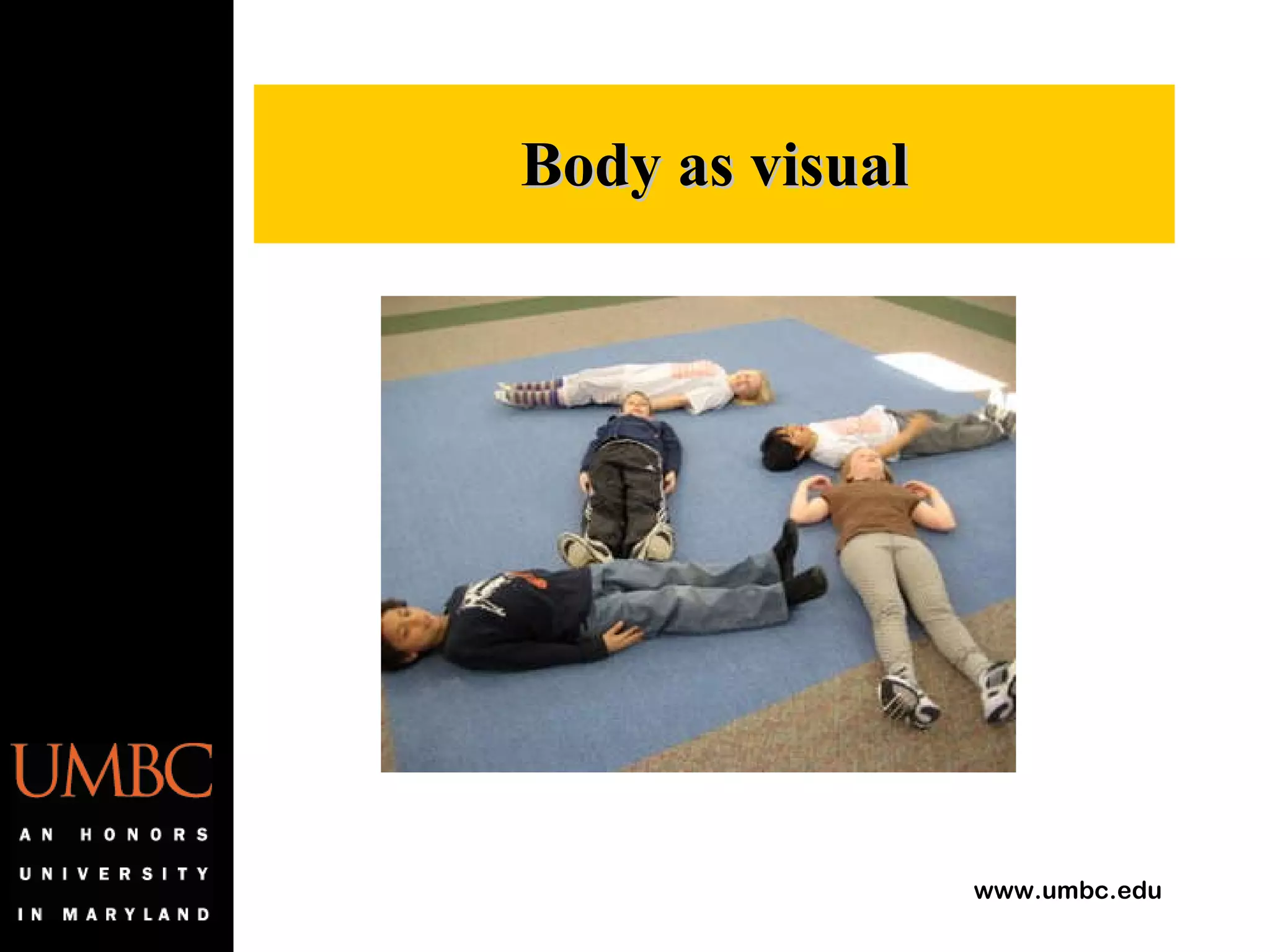
Brightly colored visuals Toys, puppets, and masks Body as visual Use lots of visuals, realia, and movement
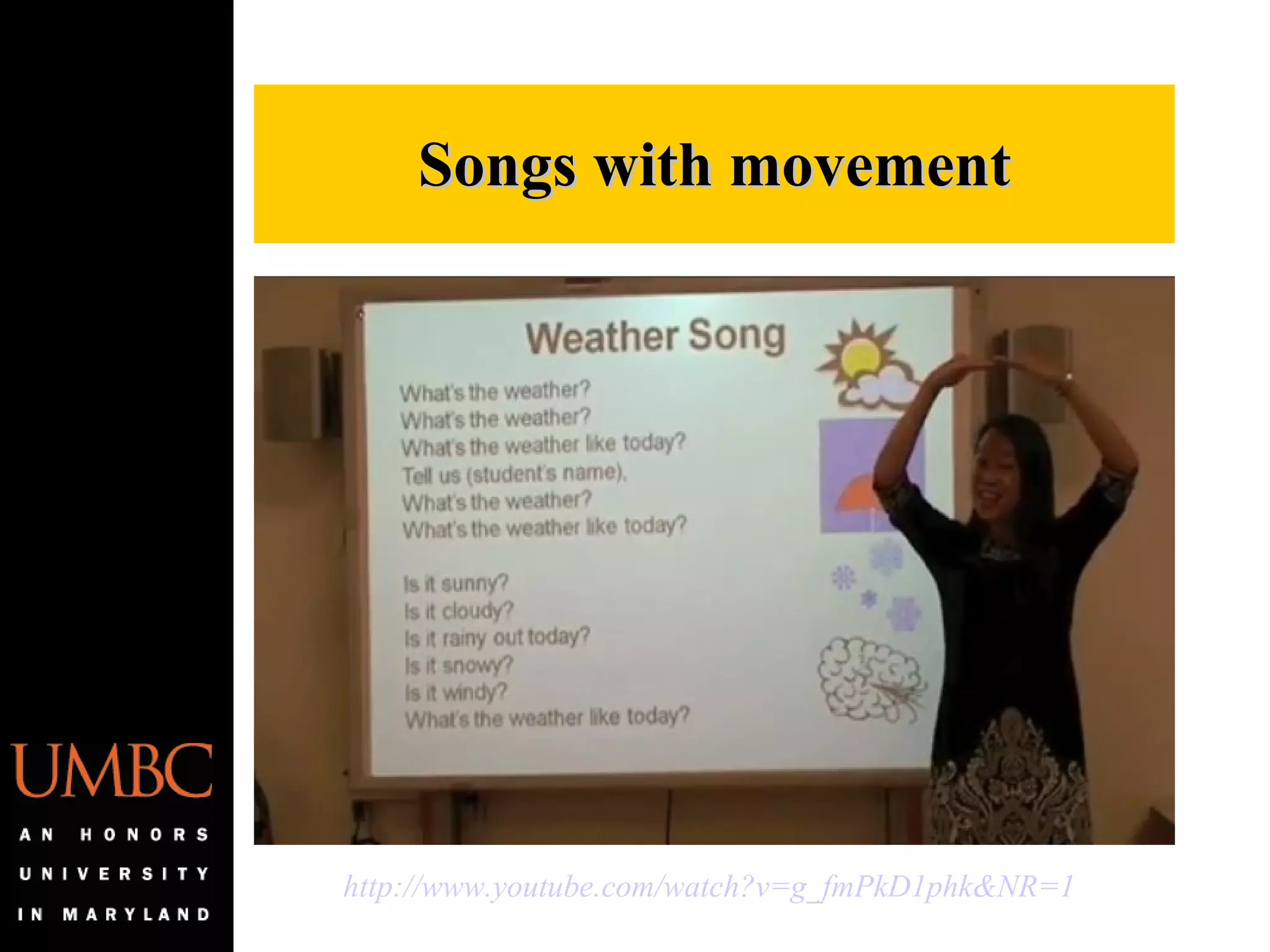
Songs with movement http://www.youtube.com/watch?v=g_fmPkD1phk&NR=1
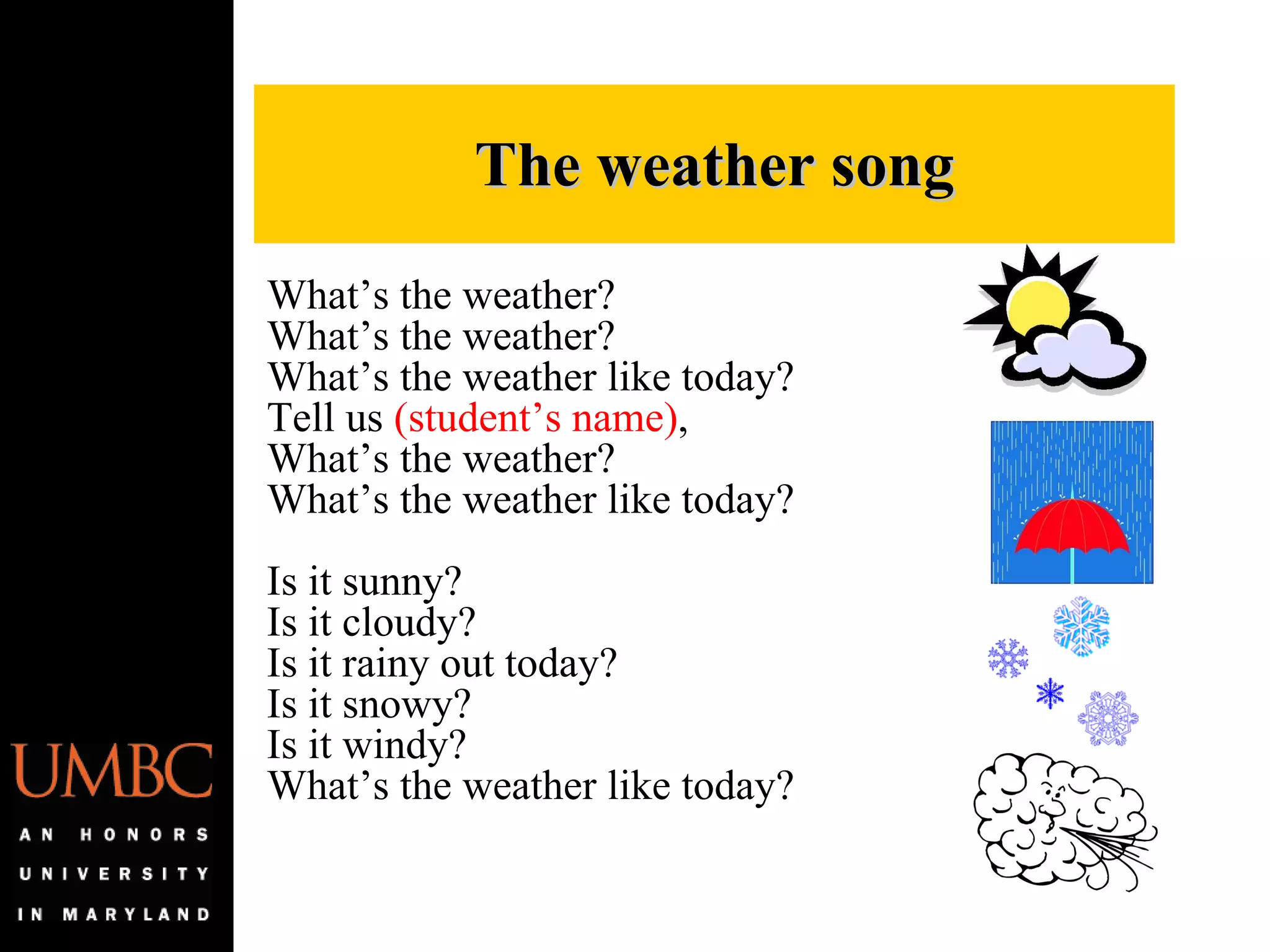
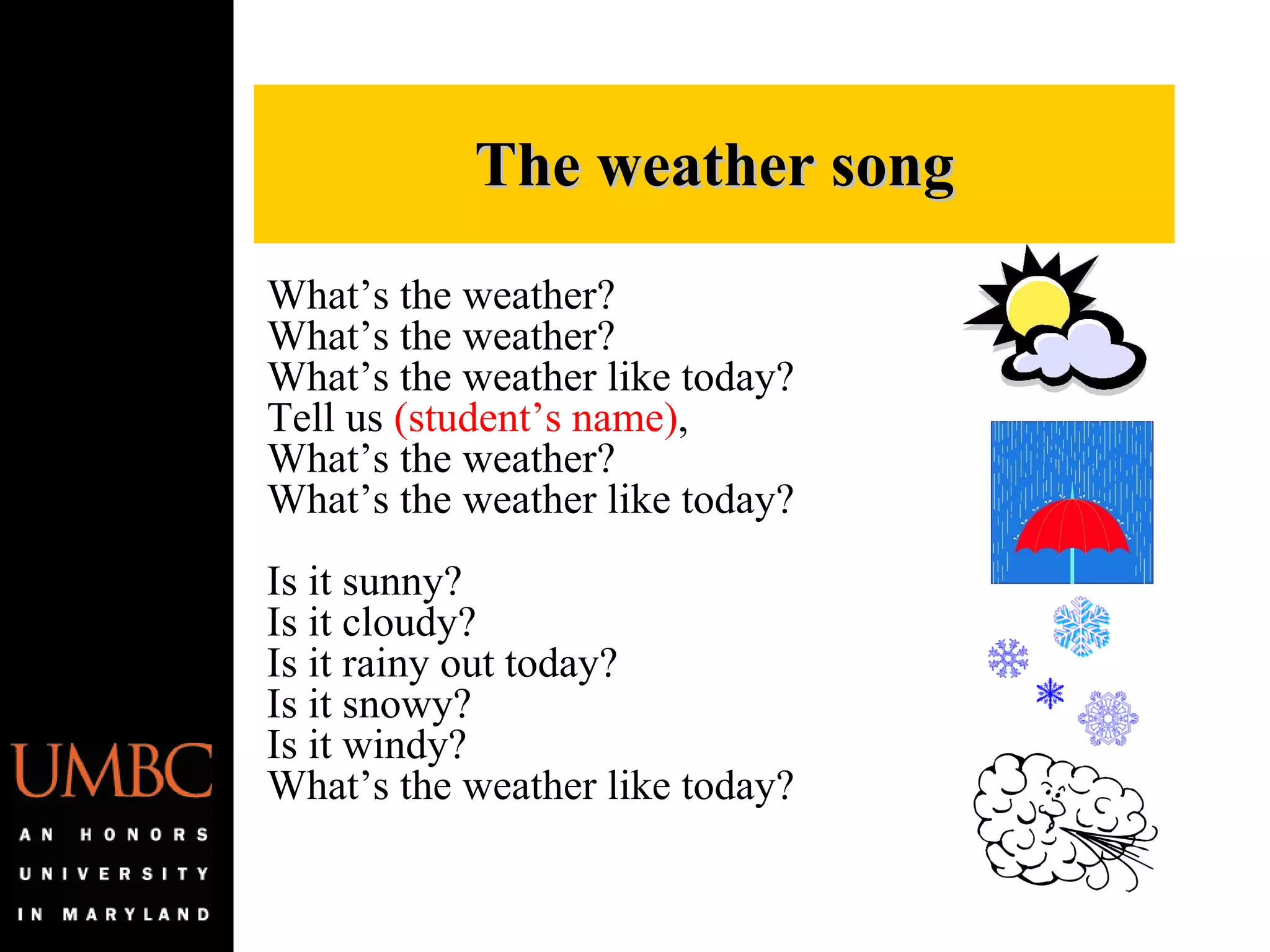
What’s the weather? What’s the weather? What’s the weather like today? Tell us  (student’s name) , What’s the weather? What’s the weather like today?   Is it sunny?  Is it cloudy?  Is it rainy out today?  Is it snowy? Is it windy?  What’s the weather like today? The weather song
Body as visual
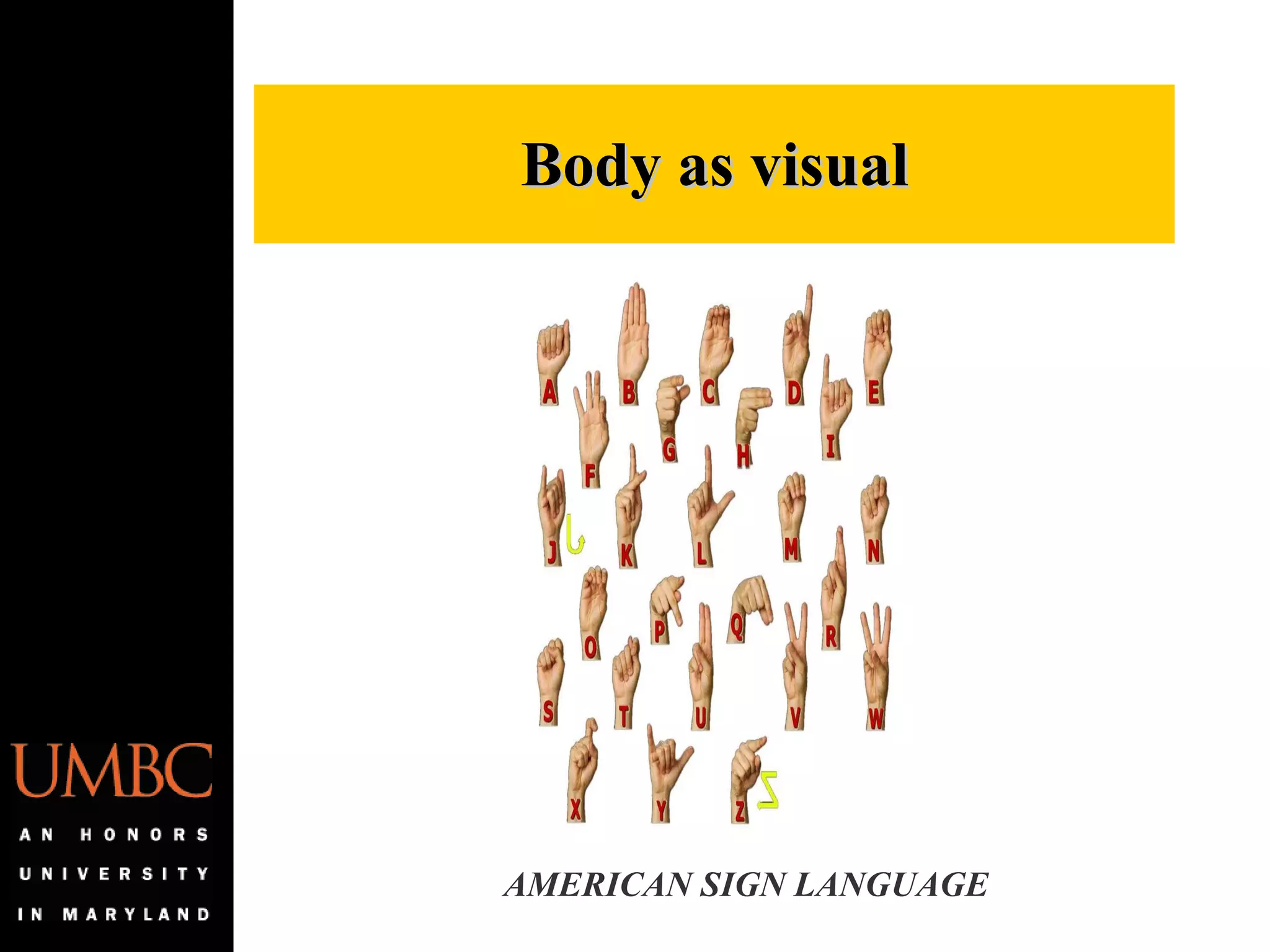
Body as visual AMERICAN SIGN LANGUAGE
Connect signs to letters
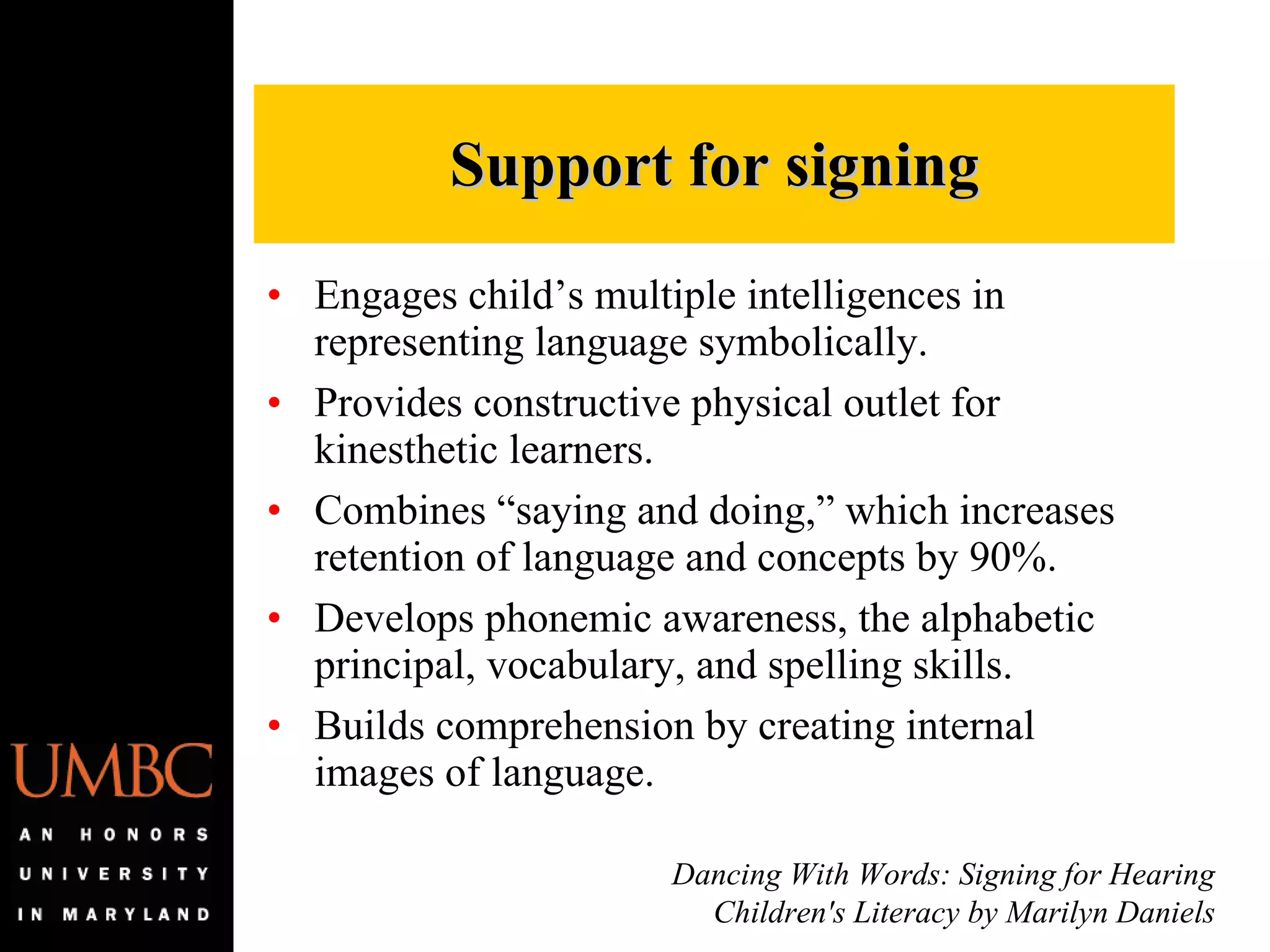
Engages child’s multiple intelligences in representing language symbolically. Provides constructive physical outlet for kinesthetic learners. Combines “saying and doing,” which increases retention of language and concepts by 90%. Develops phonemic awareness, the alphabetic principal, vocabulary, and spelling skills. Builds comprehension by creating internal images of language. Support for signing Dancing With Words: Signing for Hearing Children's Literacy by Marilyn Daniels
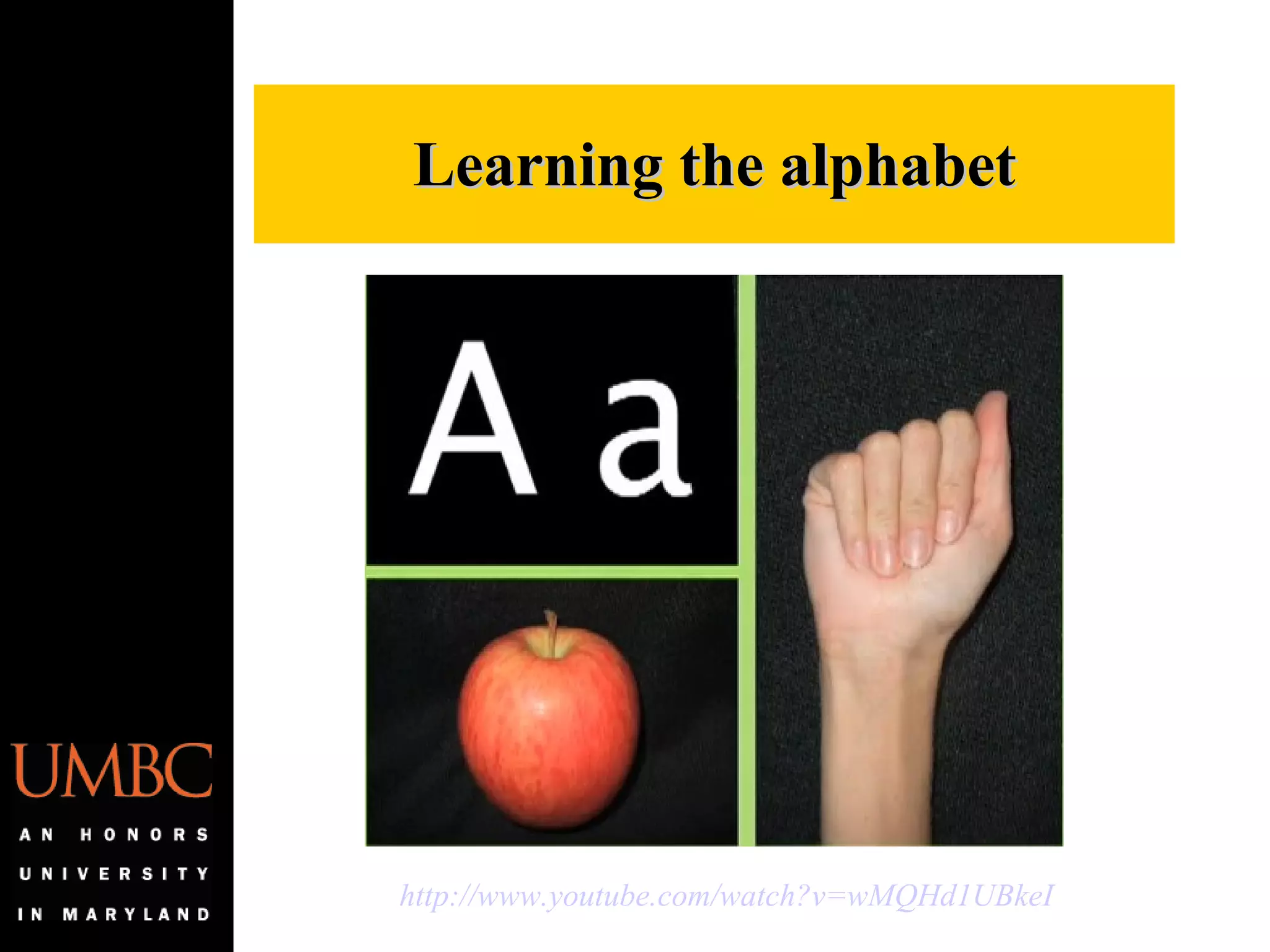
Learning the alphabet http://www.youtube.com/watch?v=wMQHd1UBkeI
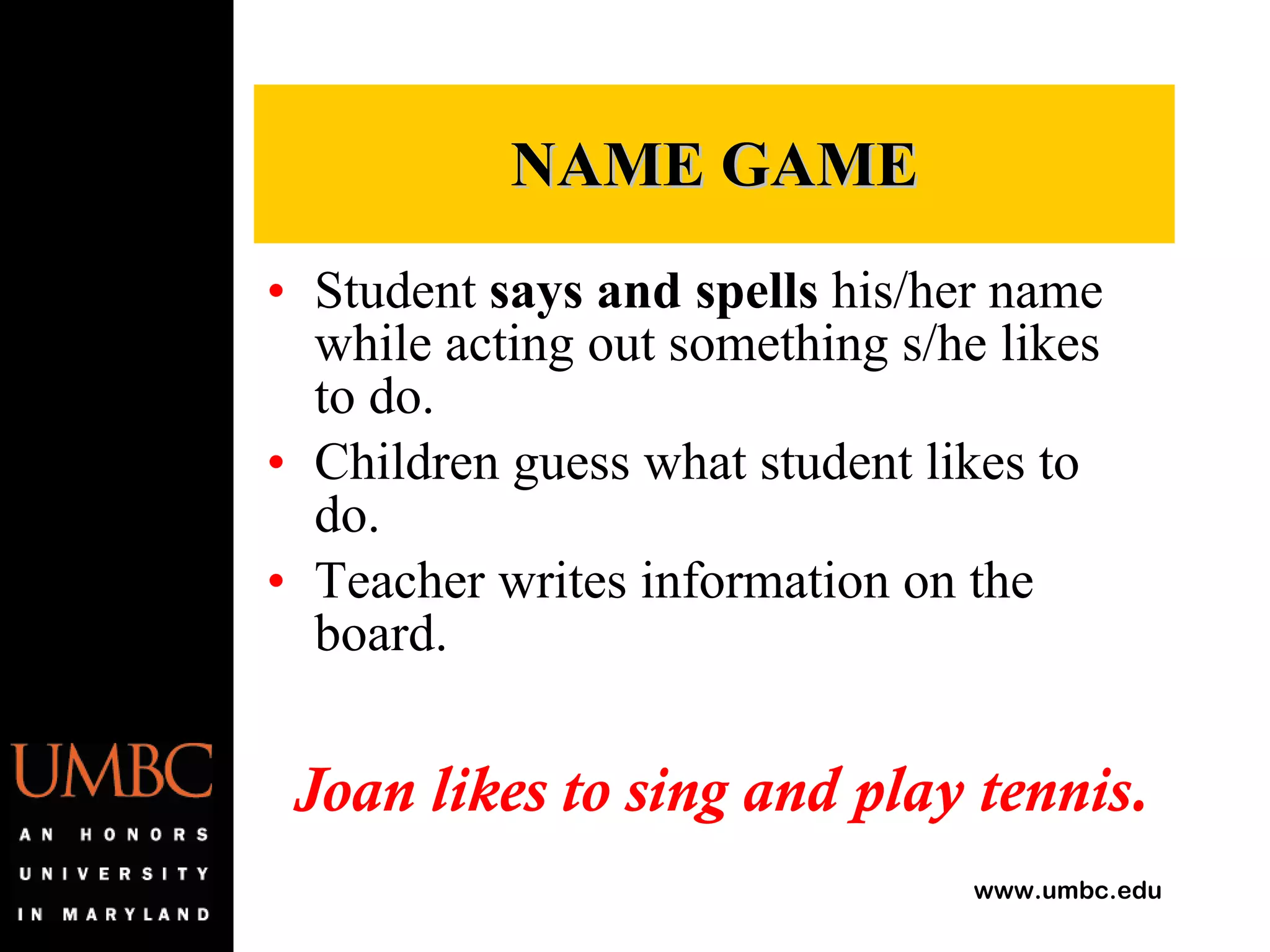
NAME GAME Student  says and spells  his/her name while acting out something s/he likes to do. Children guess what student likes to do. Teacher writes information on the board. Joan likes to sing and play tennis.
You can learn many things from children.  How much patience you have, for instance. ~Franklin P. Jones Establish classroom routines in English
 
Start of class or activity Attention getters Brain breaks End of class or activity Establish classroom routines in English
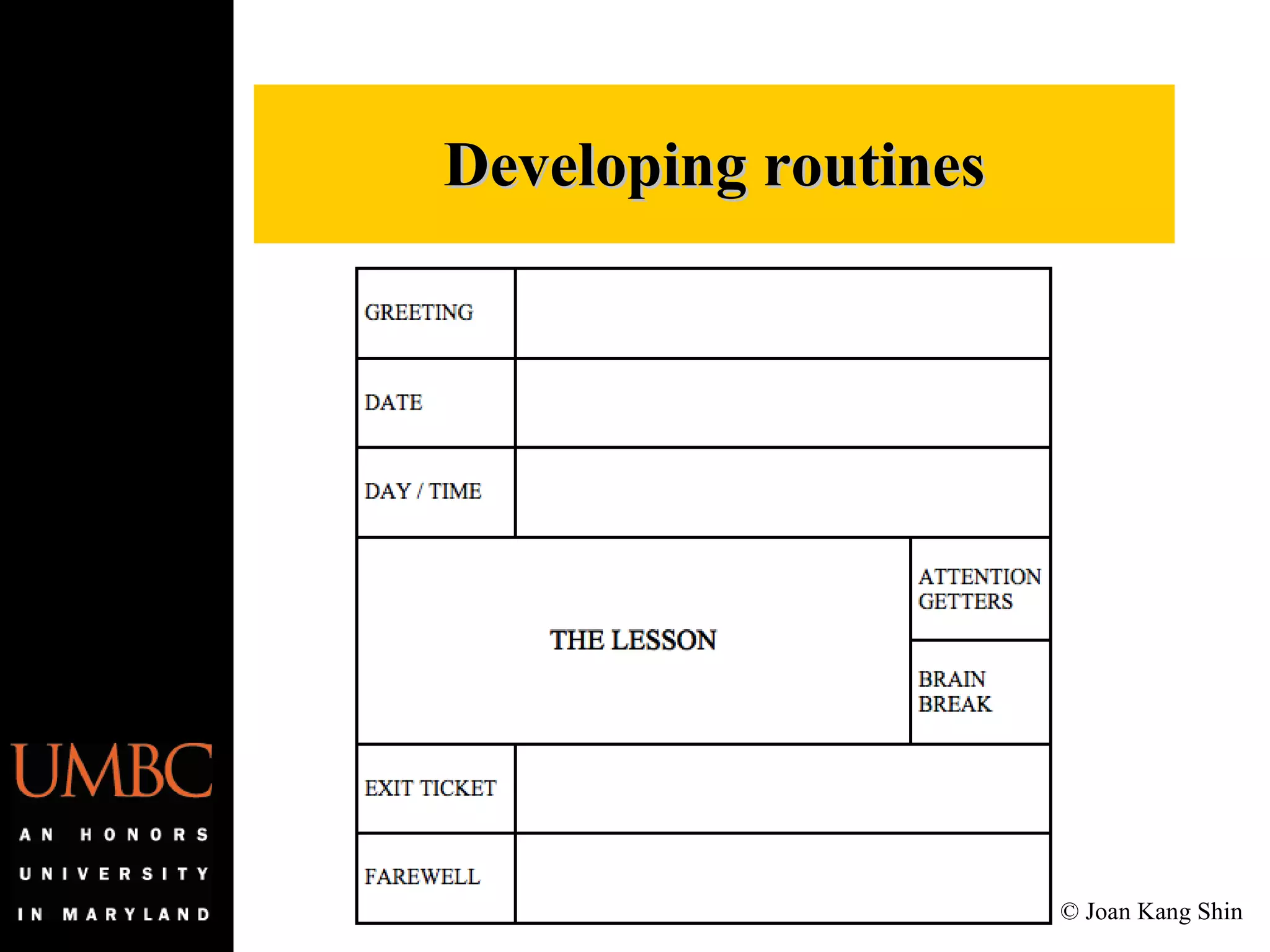
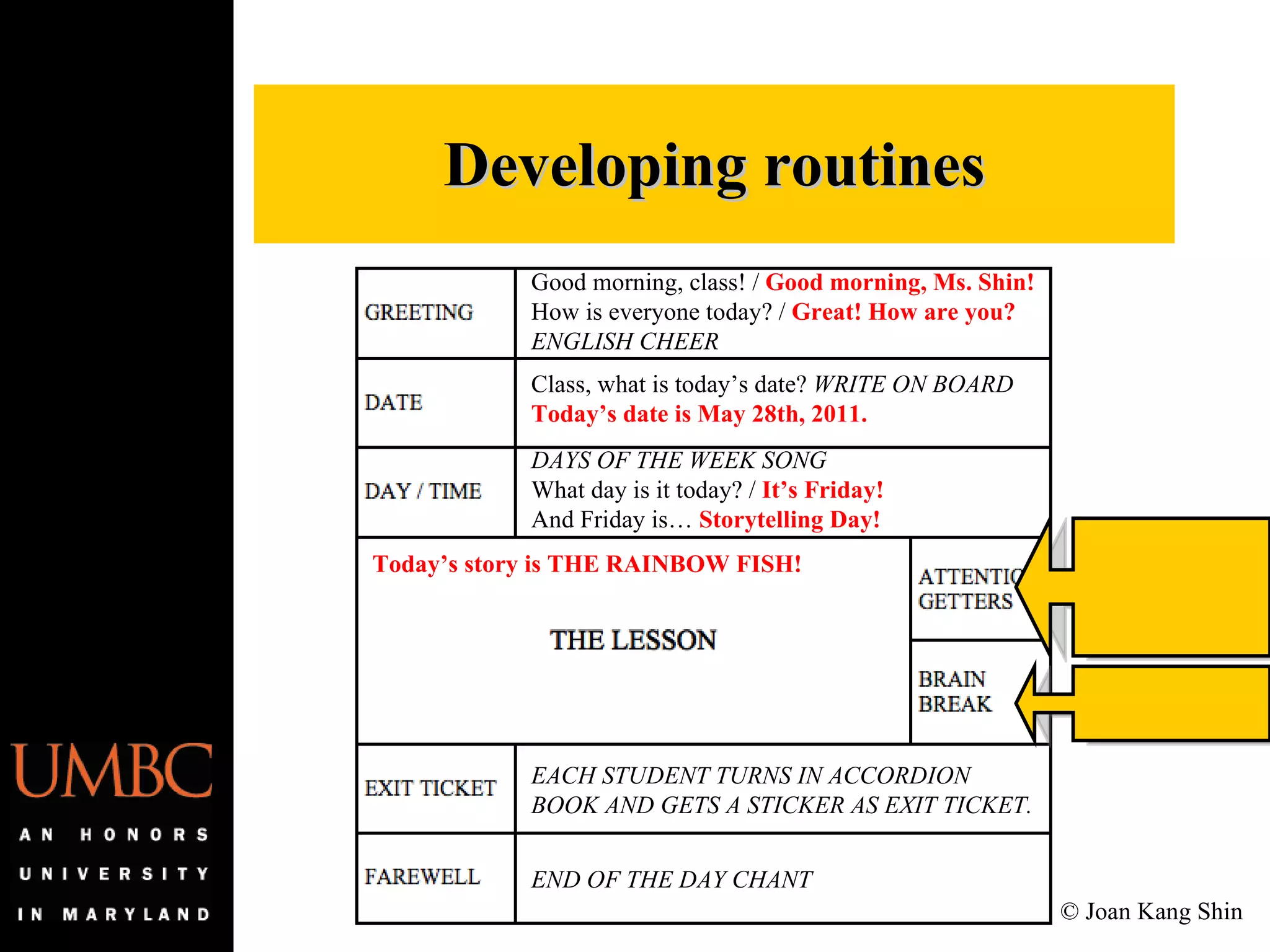
Developing routines © Joan Kang Shin
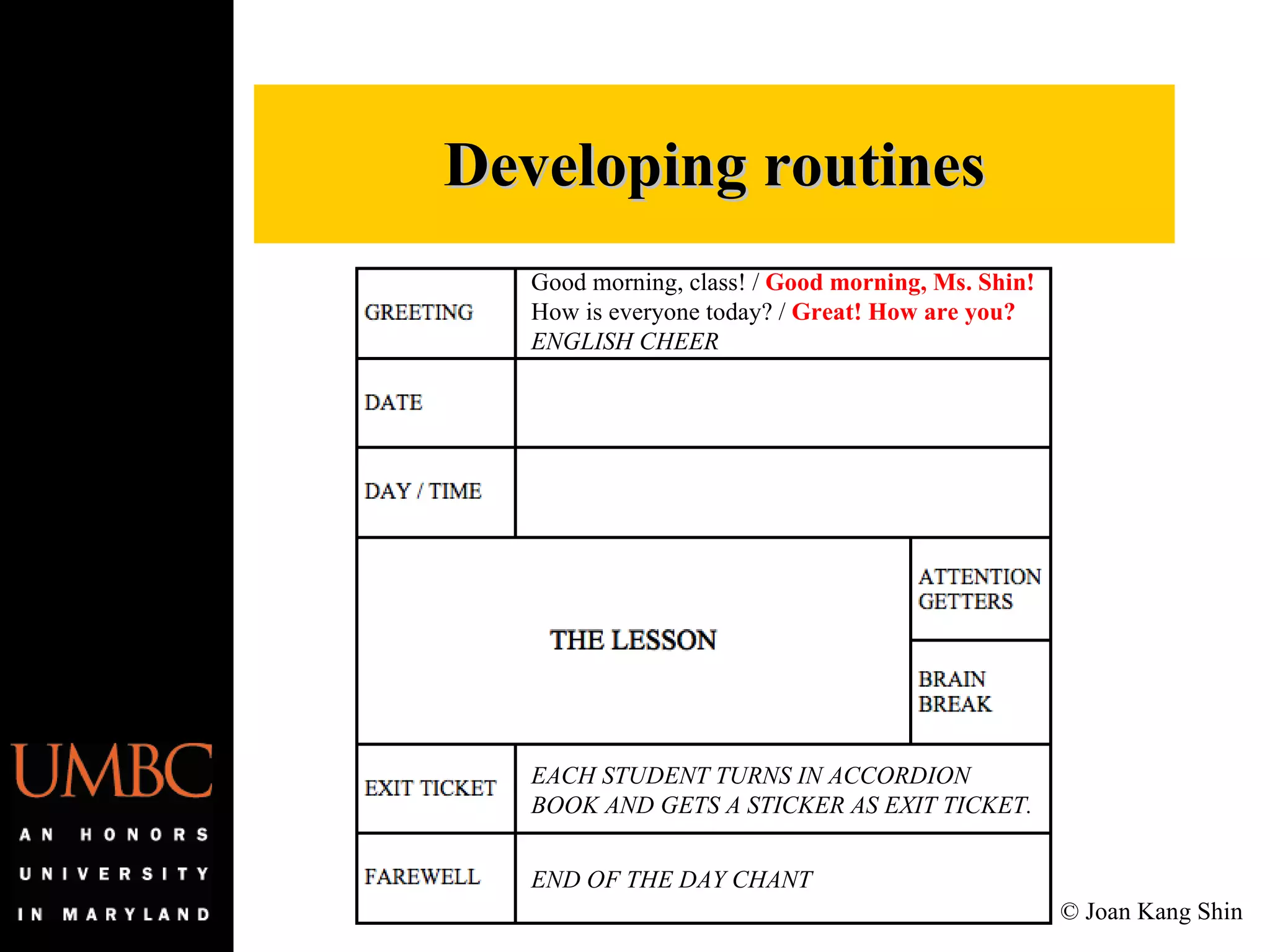
Developing routines Good morning, class! /  Good morning, Ms. Shin! How is everyone today? /  Great! How are you? ENGLISH CHEER EACH STUDENT TURNS IN ACCORDION BOOK AND GETS A STICKER AS EXIT TICKET. END OF THE DAY CHANT © Joan Kang Shin
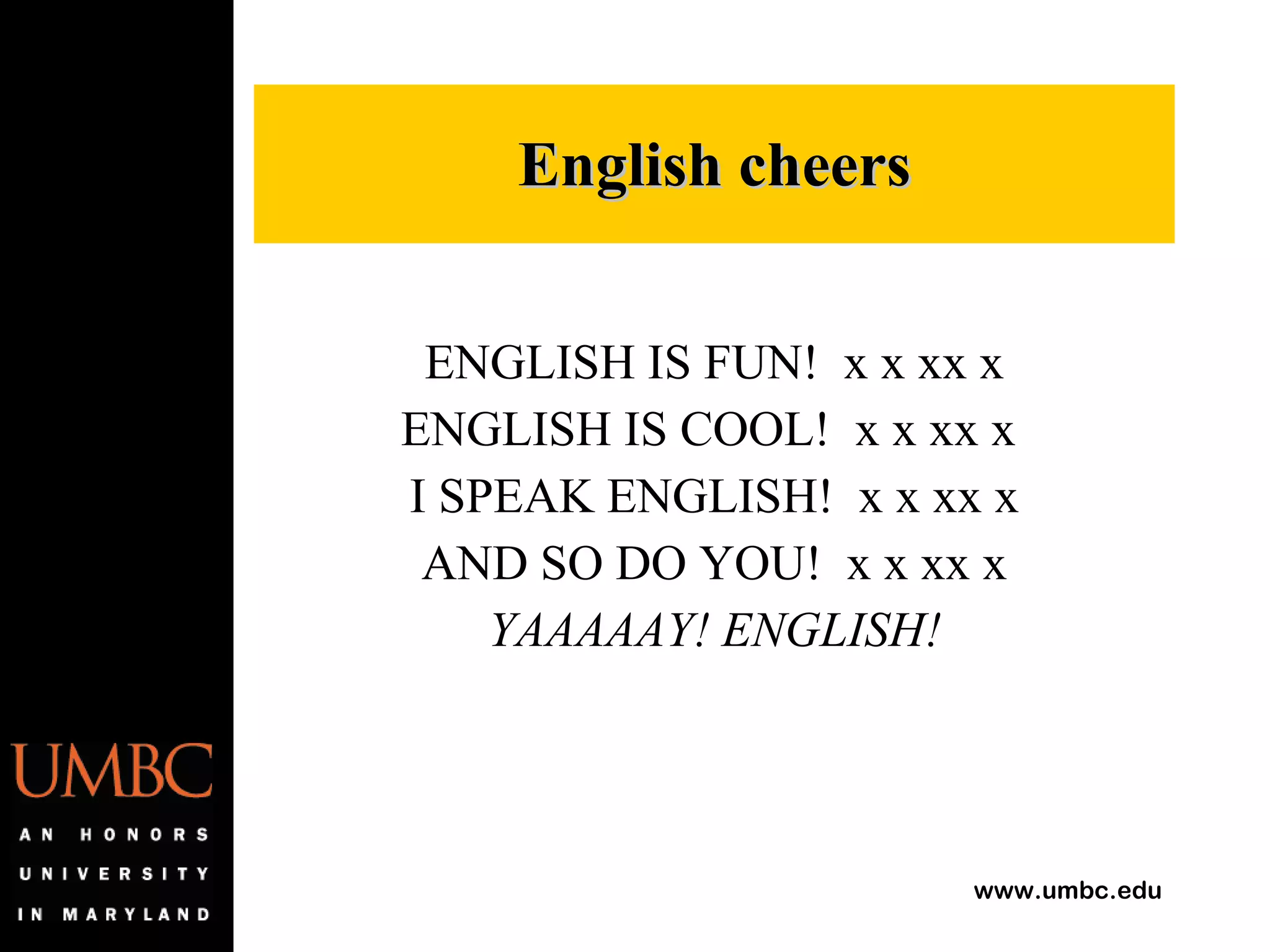
ENGLISH IS FUN!  x x xx x ENGLISH IS COOL!  x x xx x  I SPEAK ENGLISH!  x x xx x AND SO DO YOU!  x x xx x YAAAAAY! ENGLISH! English cheers
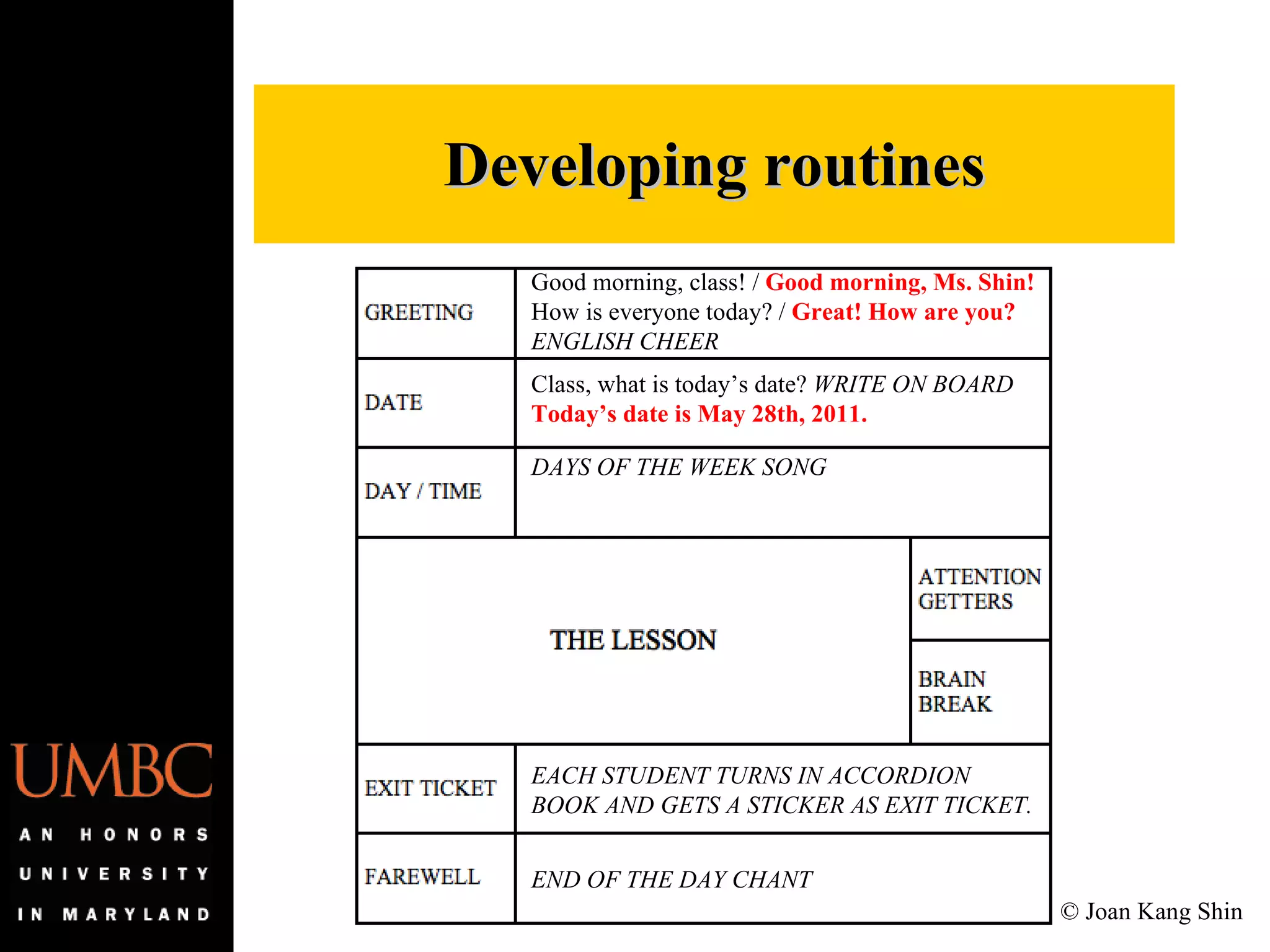
Developing routines Good morning, class! /  Good morning, Ms. Shin! How is everyone today? /  Great! How are you? ENGLISH CHEER Class, what is today’s date?  WRITE ON BOARD Today’s date is May 28th, 2011. DAYS OF THE WEEK SONG EACH STUDENT TURNS IN ACCORDION BOOK AND GETS A STICKER AS EXIT TICKET. END OF THE DAY CHANT © Joan Kang Shin
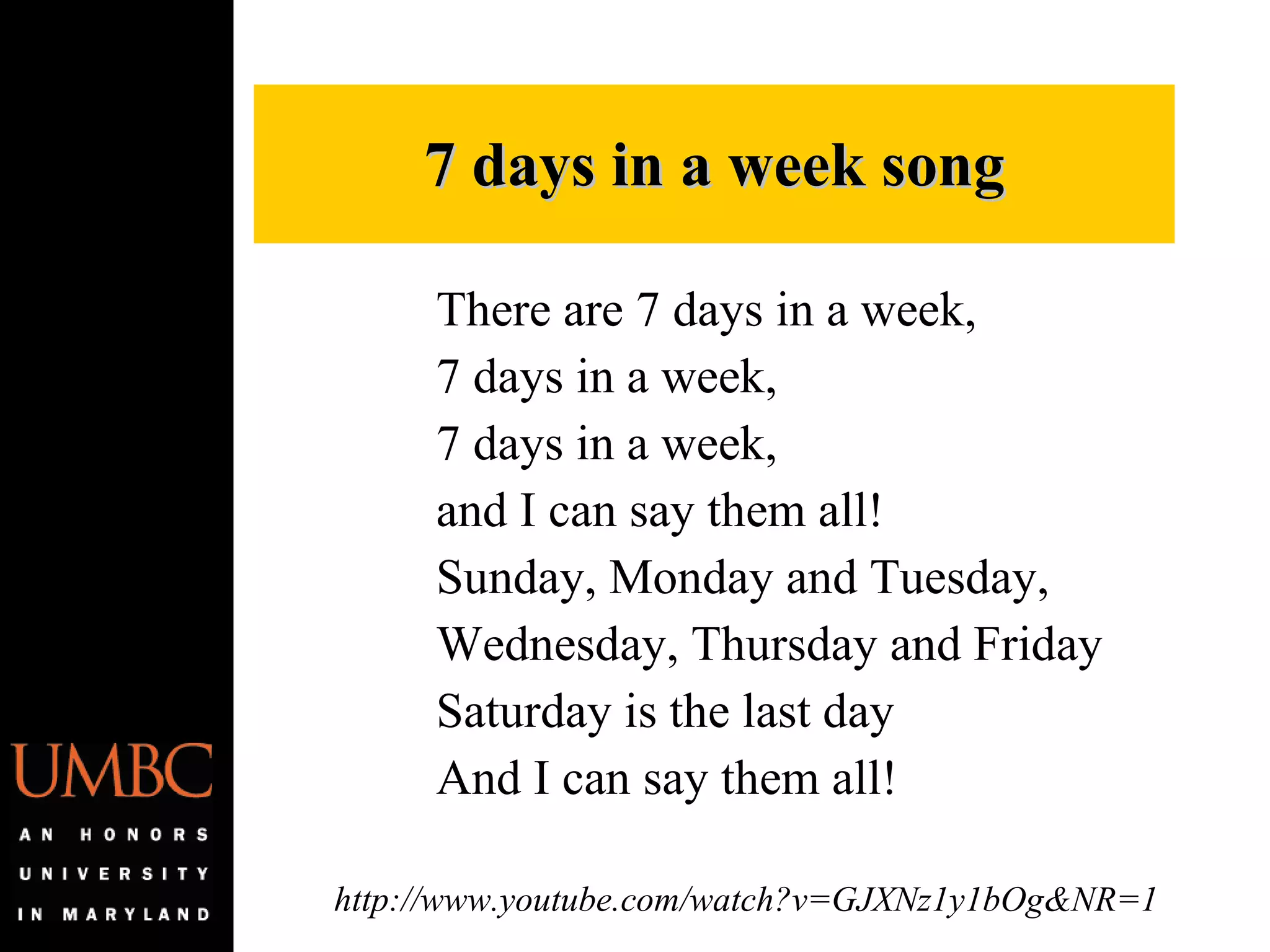
7 days in a week song There are 7 days in a week, 7 days in a week,  7 days in a week, and I can say them all! Sunday, Monday and Tuesday,  Wednesday, Thursday and Friday Saturday is the last day And I can say them all!  http://www.youtube.com/watch?v=GJXNz1y1bOg&NR=1
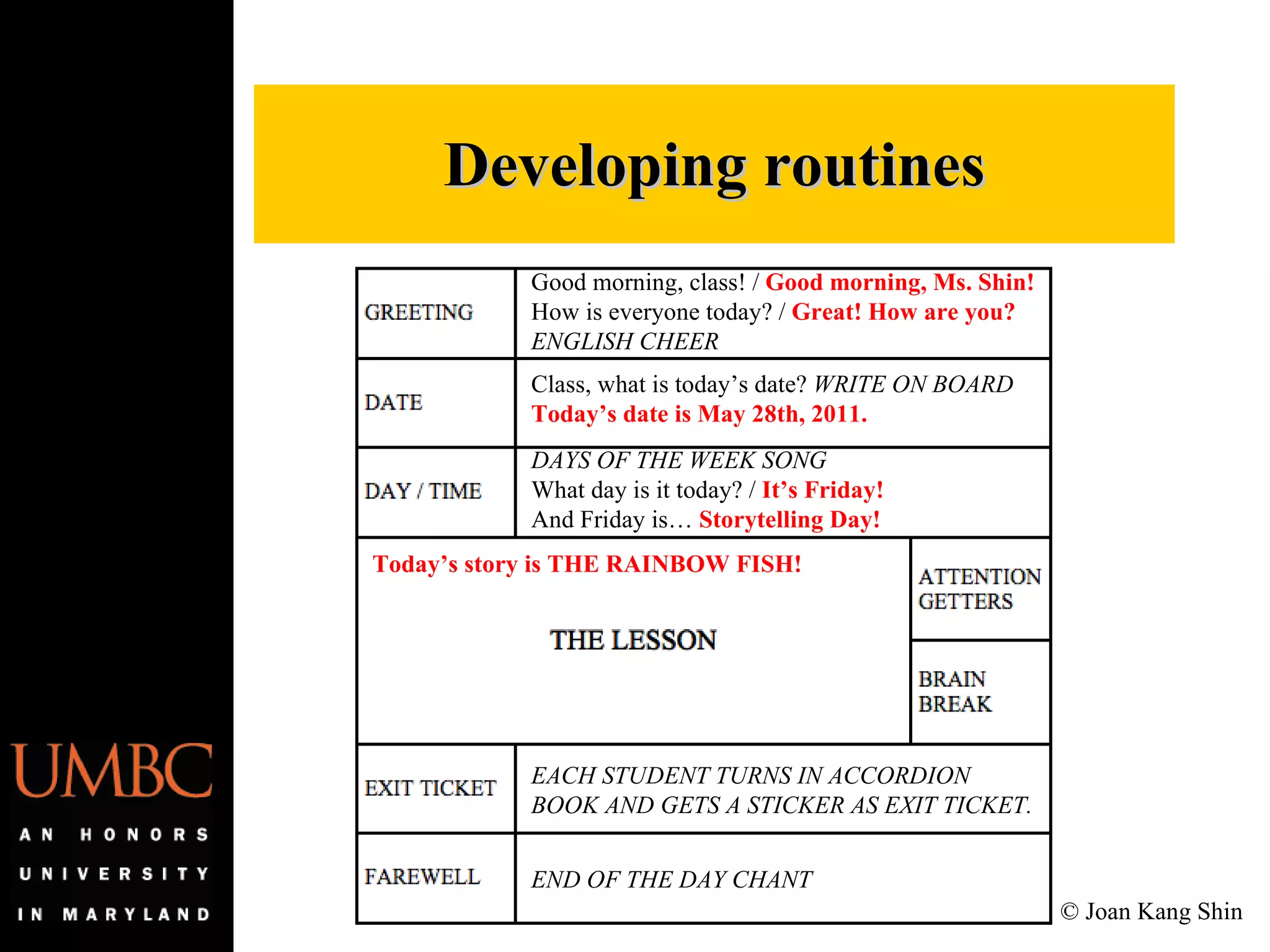
Developing routines Good morning, class! /  Good morning, Ms. Shin! How is everyone today? /  Great! How are you? ENGLISH CHEER Class, what is today’s date?  WRITE ON BOARD Today’s date is May 28th, 2011. DAYS OF THE WEEK SONG What day is it today? /  It’s Friday! And Friday is…  Storytelling Day! EACH STUDENT TURNS IN ACCORDION BOOK AND GETS A STICKER AS EXIT TICKET. END OF THE DAY CHANT Today’s story is THE RAINBOW FISH! © Joan Kang Shin
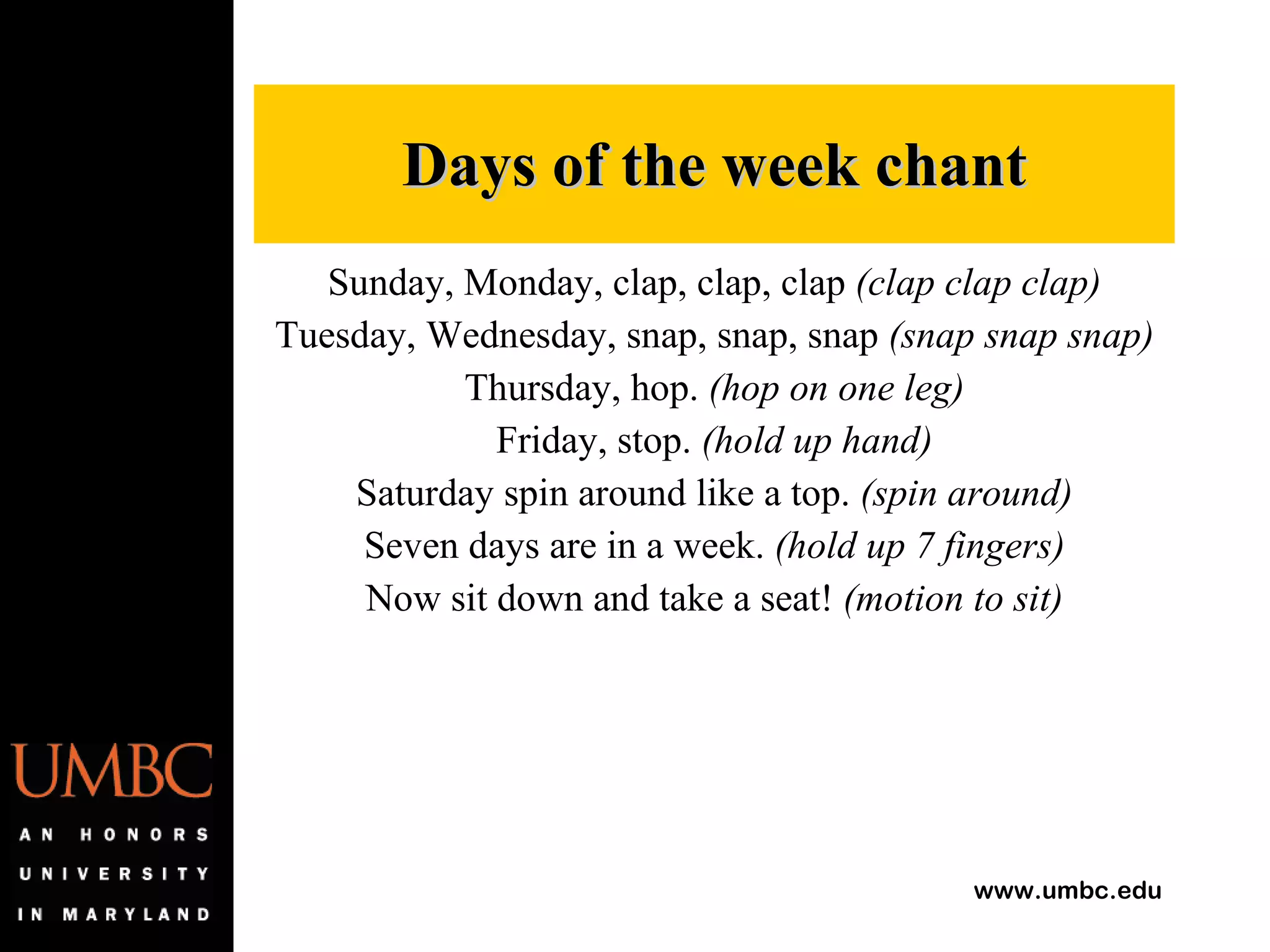
Sunday, Monday, clap, clap, clap  (clap clap clap) Tuesday, Wednesday, snap, snap, snap  (snap snap snap) Thursday, hop.  (hop on one leg) Friday, stop.  (hold up hand) Saturday spin around like a top.  (spin around) Seven days are in a week.  (hold up 7 fingers) Now sit down and take a seat!  (motion to sit) Days of the week chant
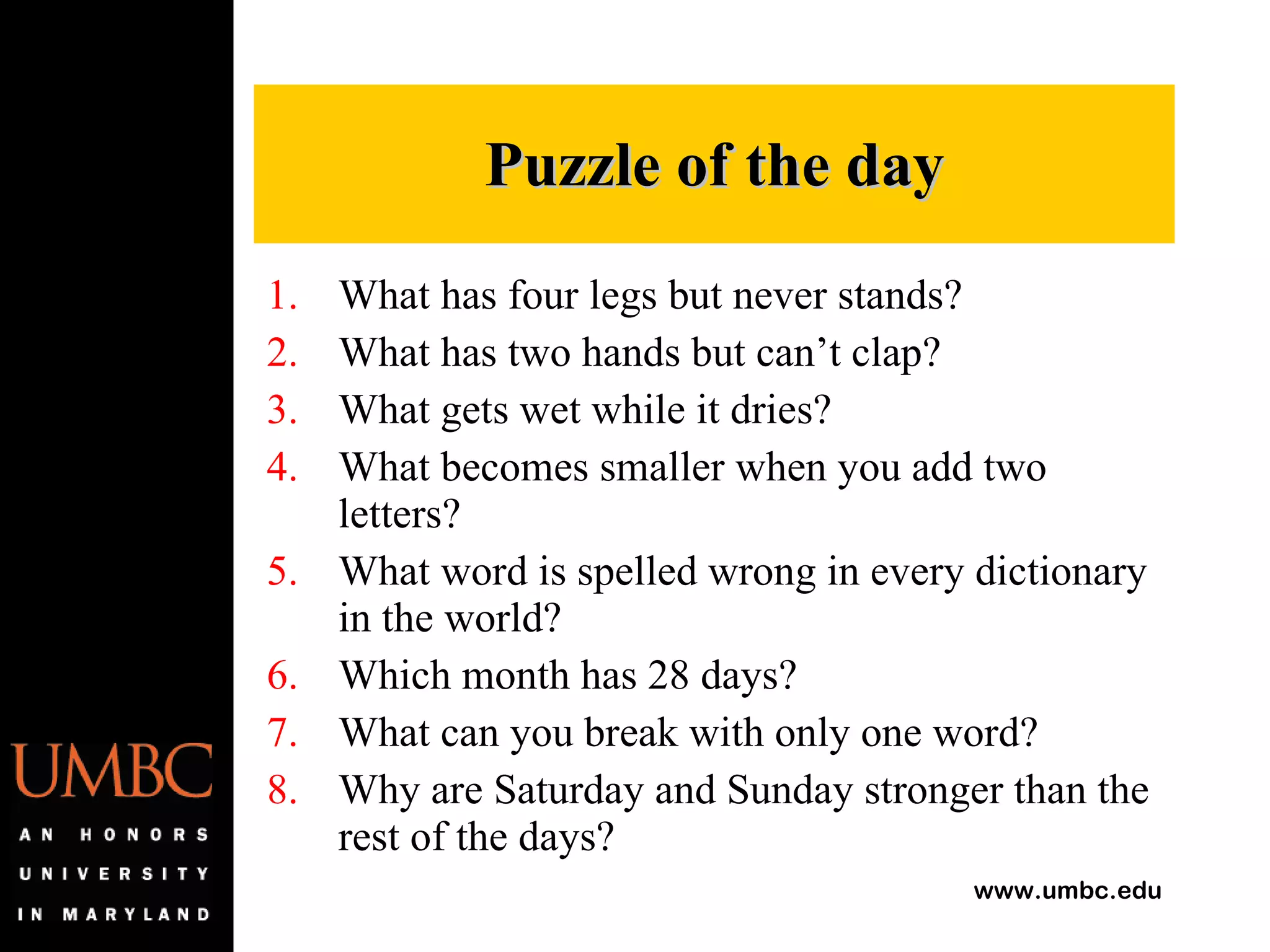
Puzzle of the day What has four legs but never stands? What has two hands but can’t clap?  What gets wet while it dries?  What becomes smaller when you add two letters? What word is spelled wrong in every dictionary in the world? Which month has 28 days? What can you break with only one word? Why are Saturday and Sunday stronger than the rest of the days?
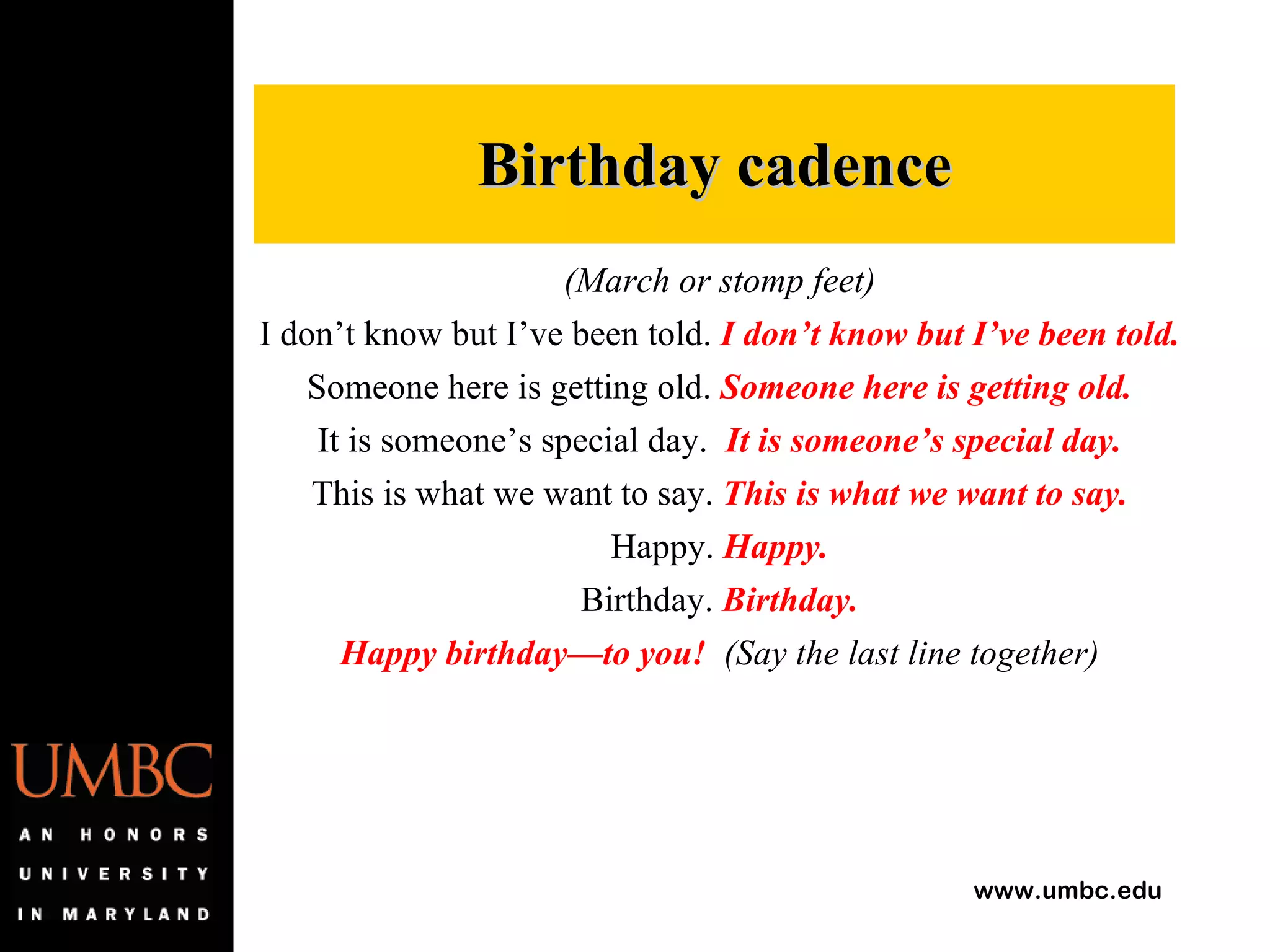
(March or stomp feet) I don’t know but I’ve been told.  I don’t know but I’ve been told. Someone here is getting old.  Someone here is getting old. It is someone’s special day.  It is someone’s special day. This is what we want to say.  This is what we want to say. Happy.  Happy. Birthday.  Birthday. Happy birthday—to you!   (Say the last line together) Birthday cadence
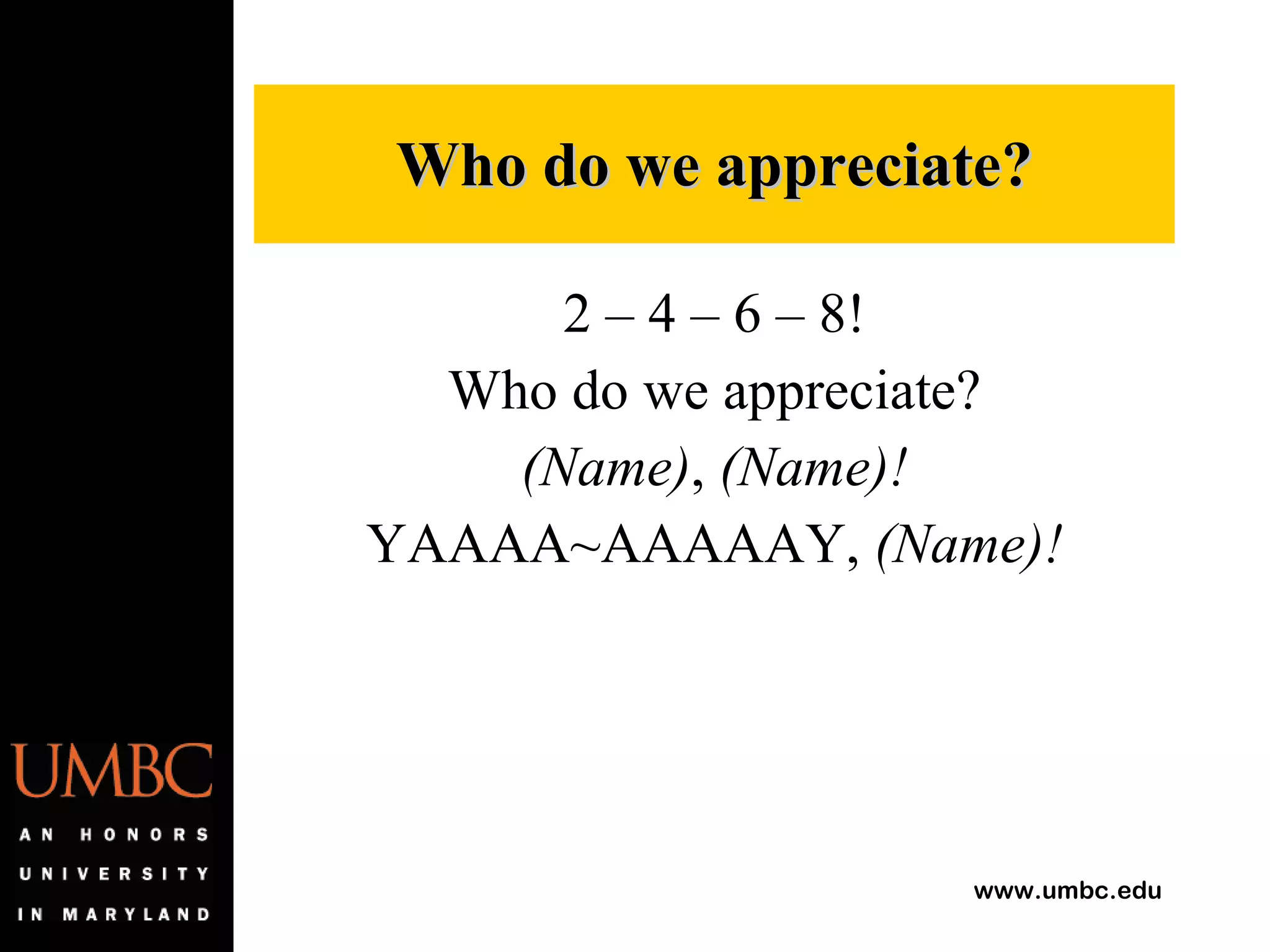
2 – 4 – 6 – 8! Who do we appreciate? (Name) ,  (Name)! YAAAA~AAAAAY,  (Name)! Who do we appreciate?
Developing routines Good morning, class! /  Good morning, Ms. Shin! How is everyone today? /  Great! How are you? ENGLISH CHEER Class, what is today’s date?  WRITE ON BOARD Today’s date is May 28th, 2011. DAYS OF THE WEEK SONG What day is it today? /  It’s Friday! And Friday is…  Storytelling Day! EACH STUDENT TURNS IN ACCORDION BOOK AND GETS A STICKER AS EXIT TICKET. END OF THE DAY CHANT Today’s story is THE RAINBOW FISH! © Joan Kang Shin
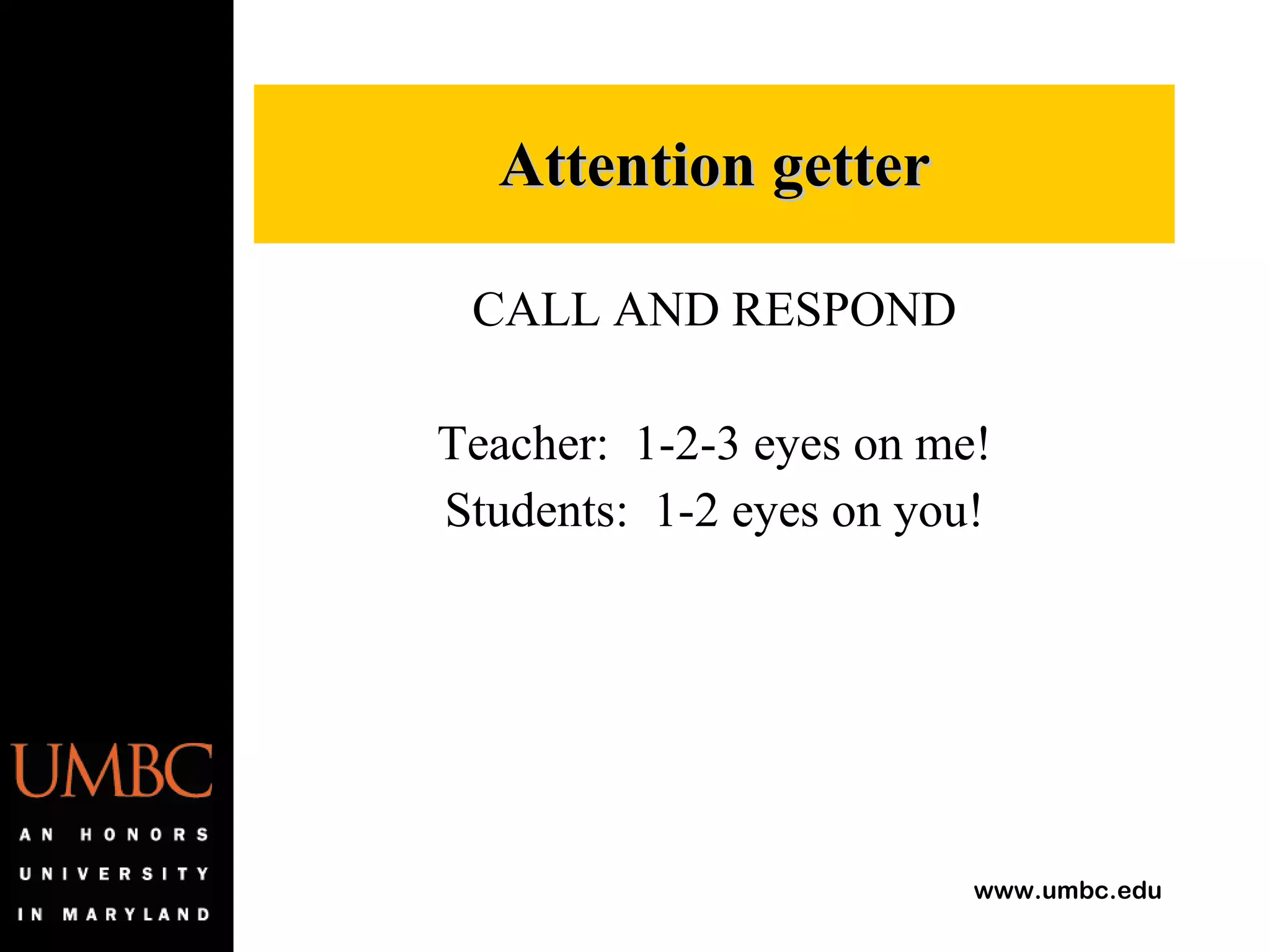
CALL AND RESPOND Teacher:  1-2-3 eyes on me! Students:  1-2 eyes on you! Attention getter
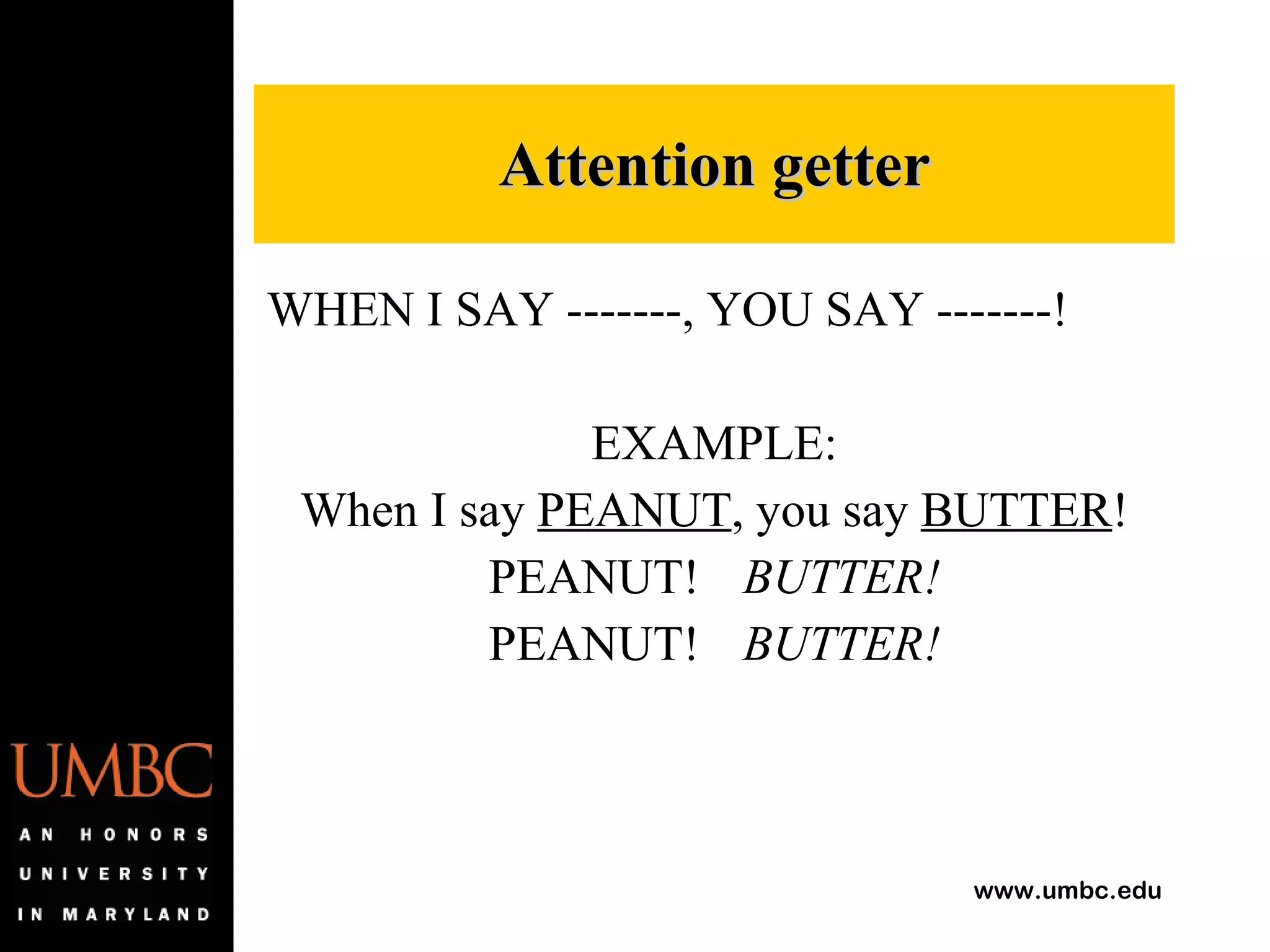
WHEN I SAY -------, YOU SAY -------! EXAMPLE: When I say  PEANUT , you say  BUTTER ! PEANUT! BUTTER! PEANUT! BUTTER! Attention getter
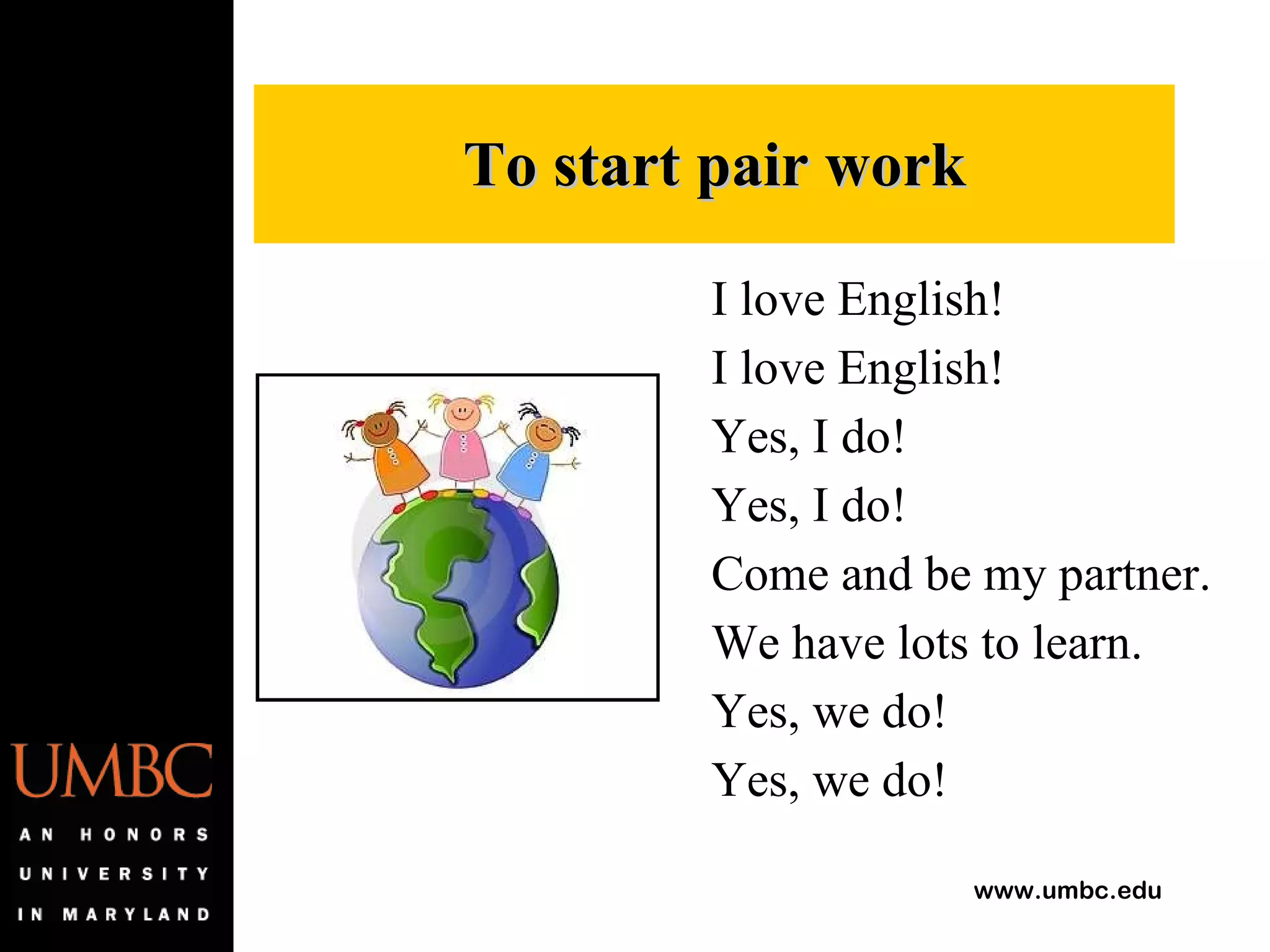
I love English! I love English! Yes, I do! Yes, I do! Come and be my partner. We have lots to learn. Yes, we do! Yes, we do! To start pair work
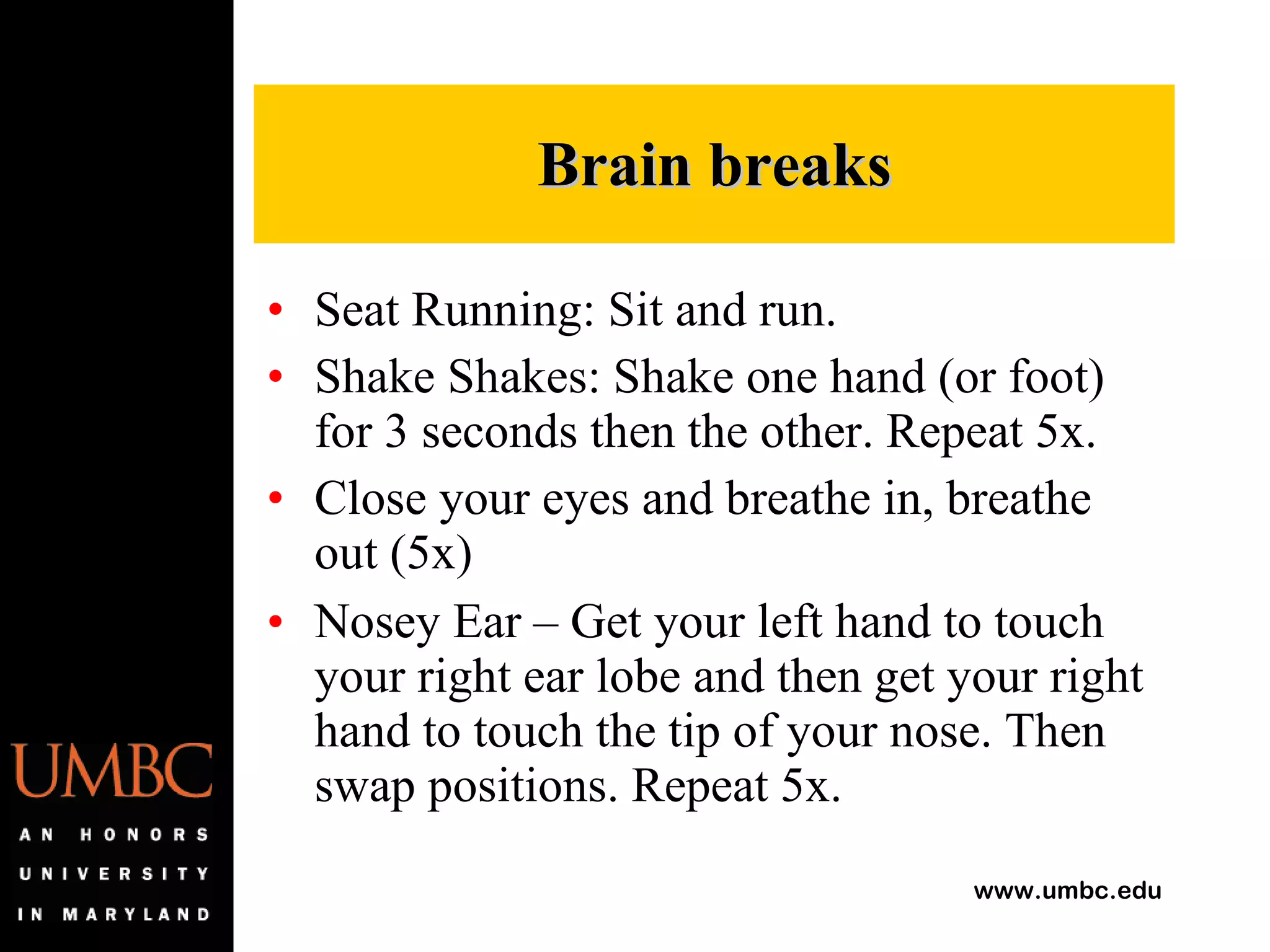
Seat Running: Sit and run. Shake Shakes: Shake one hand (or foot) for 3 seconds then the other. Repeat 5x. Close your eyes and breathe in, breathe out (5x) Nosey Ear – Get your left hand to touch your right ear lobe and then get your right hand to touch the tip of your nose. Then swap positions. Repeat 5x.  Brain breaks
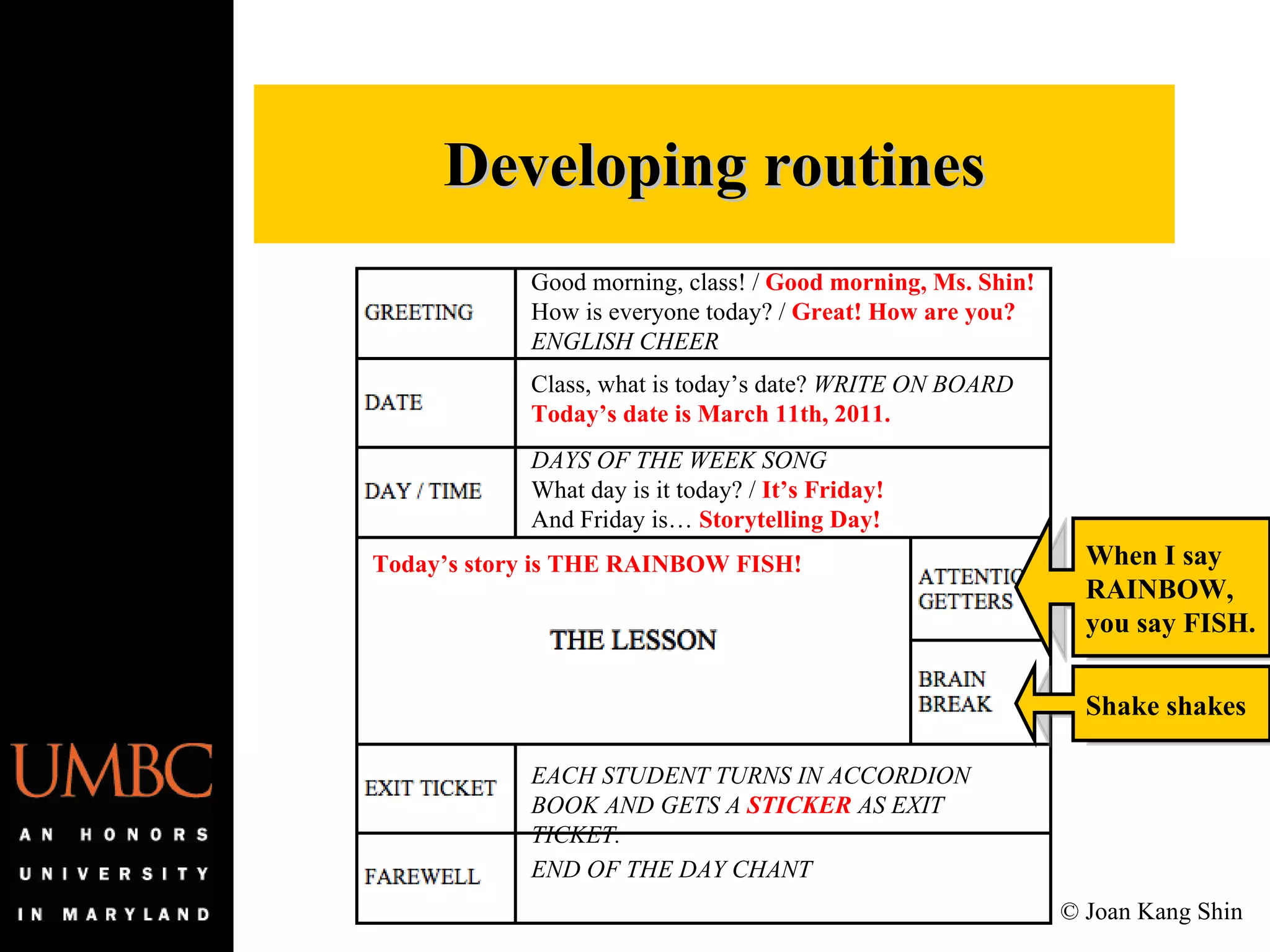
Developing routines Good morning, class! /  Good morning, Ms. Shin! How is everyone today? /  Great! How are you? ENGLISH CHEER Class, what is today’s date?  WRITE ON BOARD Today’s date is March 11th, 2011. DAYS OF THE WEEK SONG What day is it today? /  It’s Friday! And Friday is…  Storytelling Day! When I say RAINBOW, you say FISH. Shake shakes EACH STUDENT TURNS IN ACCORDION BOOK AND GETS A  STICKER  AS EXIT TICKET. END OF THE DAY CHANT Today’s story is THE RAINBOW FISH! © Joan Kang Shin
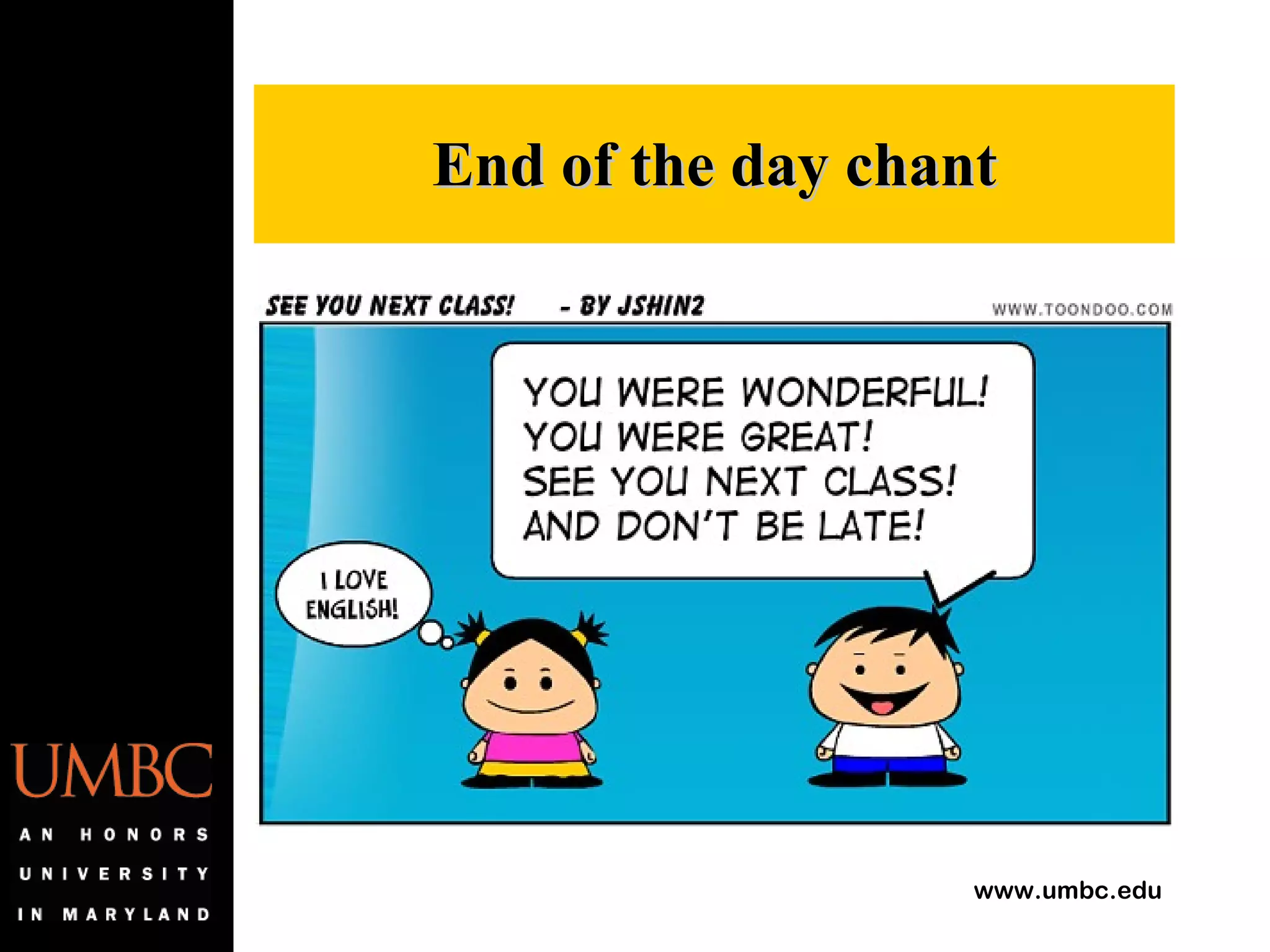
End of the day chant
There are no seven wonders of the world in the eyes of a child.  There are seven million. ~ Walt Streightiff Encourage creativity
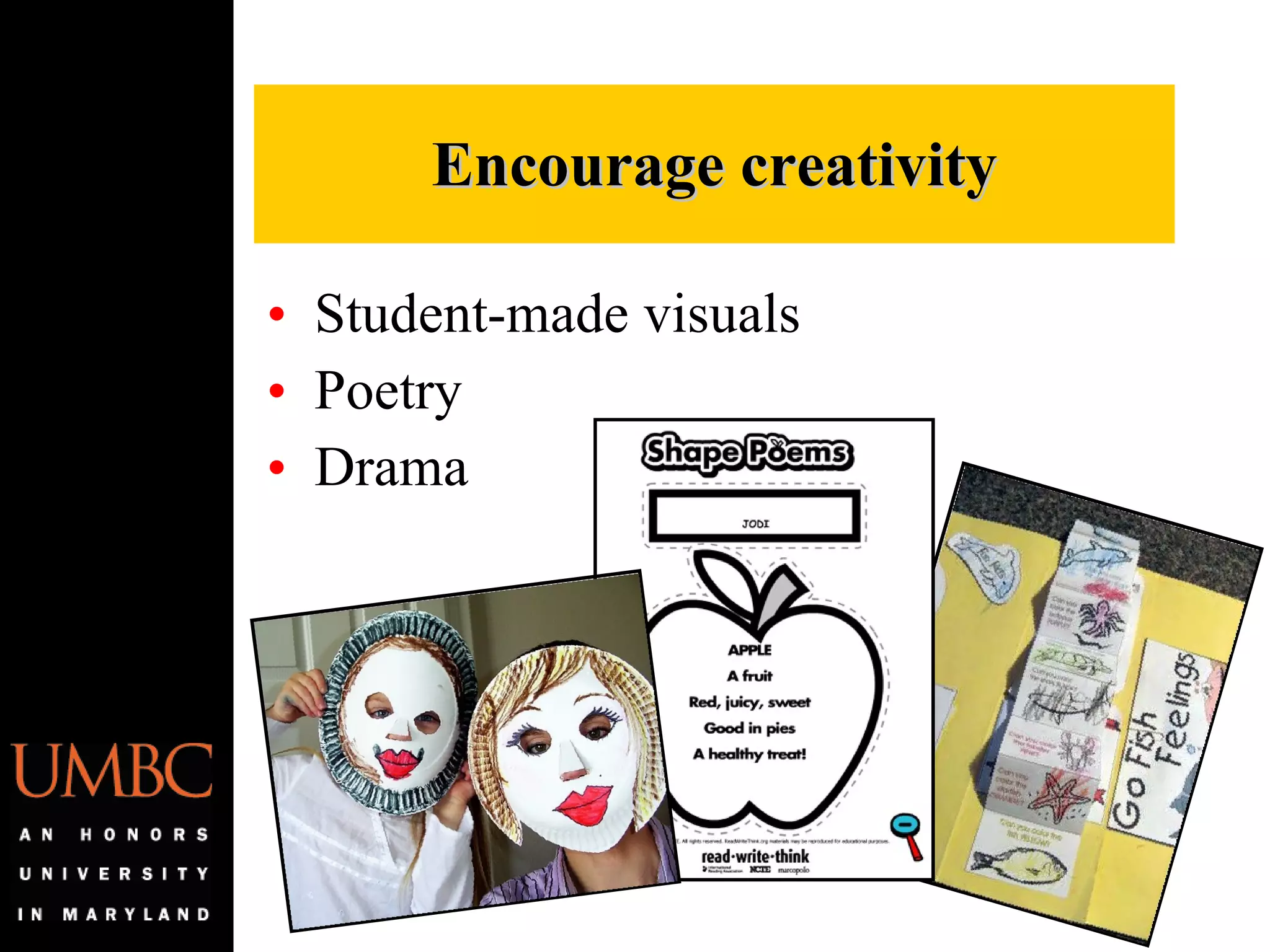
Student-made visuals Poetry Drama Encourage creativity
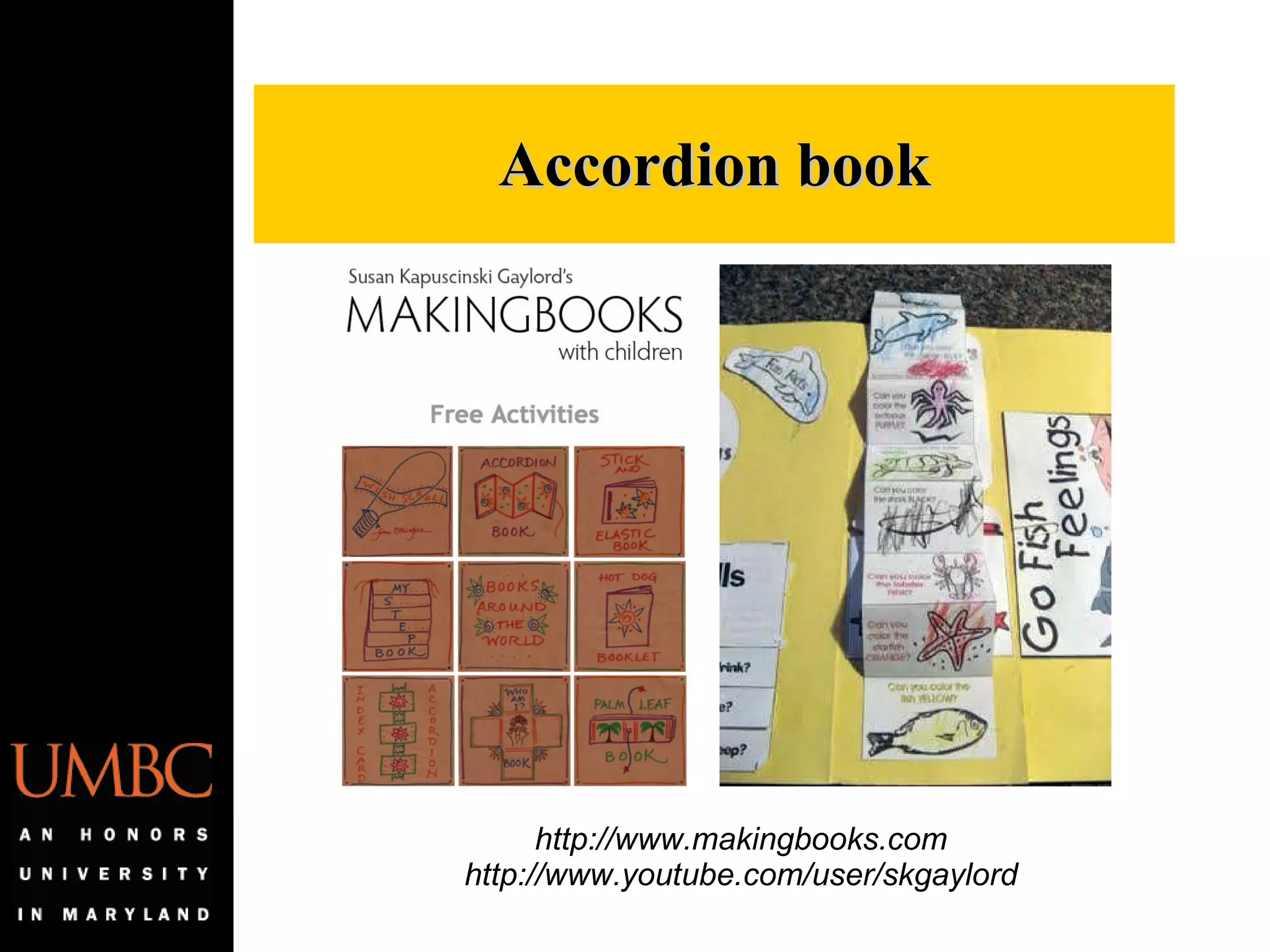
http://www.makingbooks.com http://www.youtube.com/user/skgaylord Accordion book
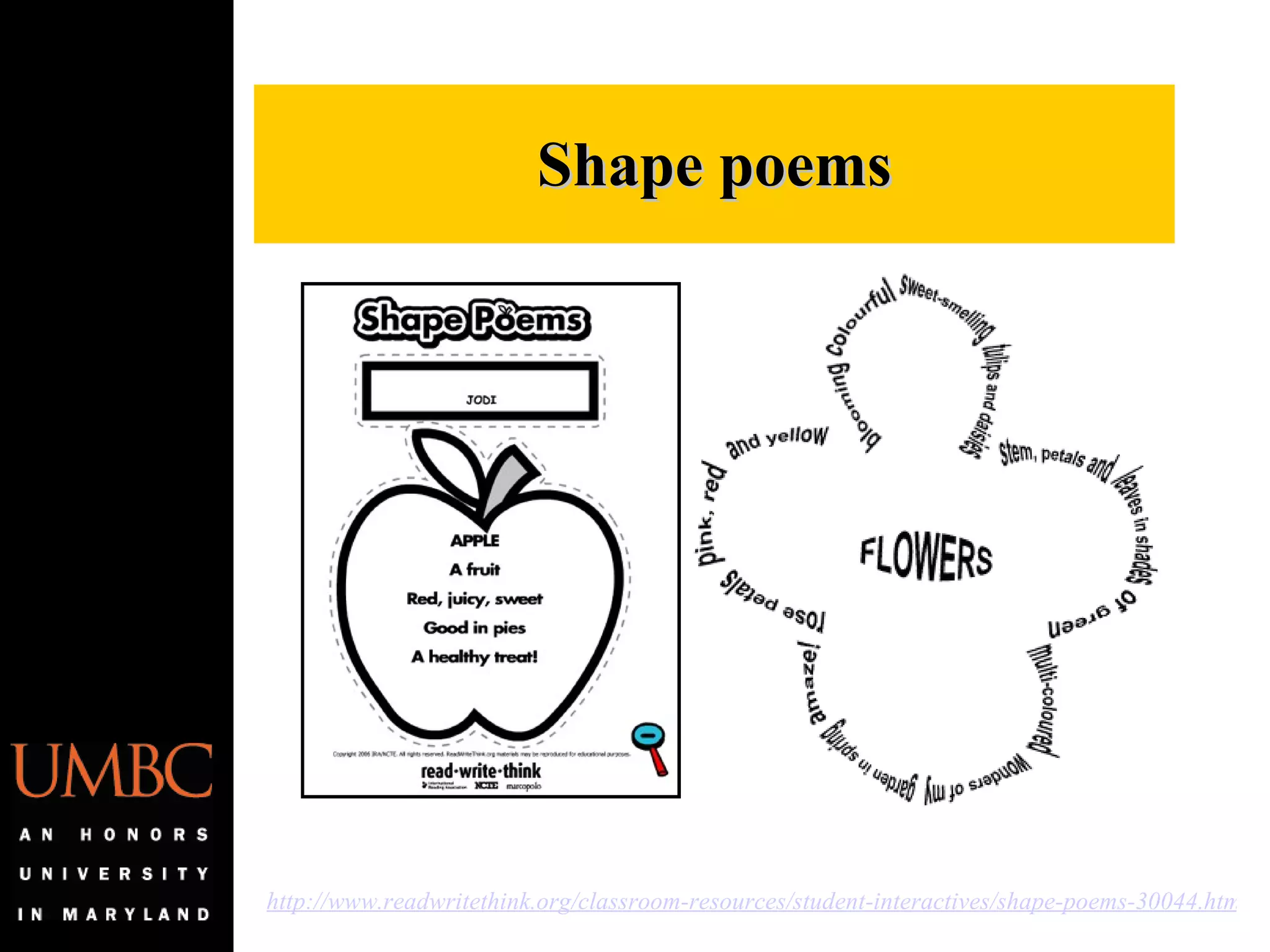
Shape poems http://www.readwritethink.org/classroom-resources/student-interactives/shape-poems-30044.html
We worry about what a child will become tomorrow, yet we forget that he is someone today. ~ Stacia Tauscher Give students a chance to personalize
Students write and talk about themselves Students compare content to their own culture and lives Give students a chance to personalize
J   umping O   verjoyed A   thletic N   ever tired! Acrostic name poem
Give learners chances to write and talk about themselves  (using the forms or models you provide) Give learners a chance to notice grammatical structures Give learners more chances to practice Personalize chants
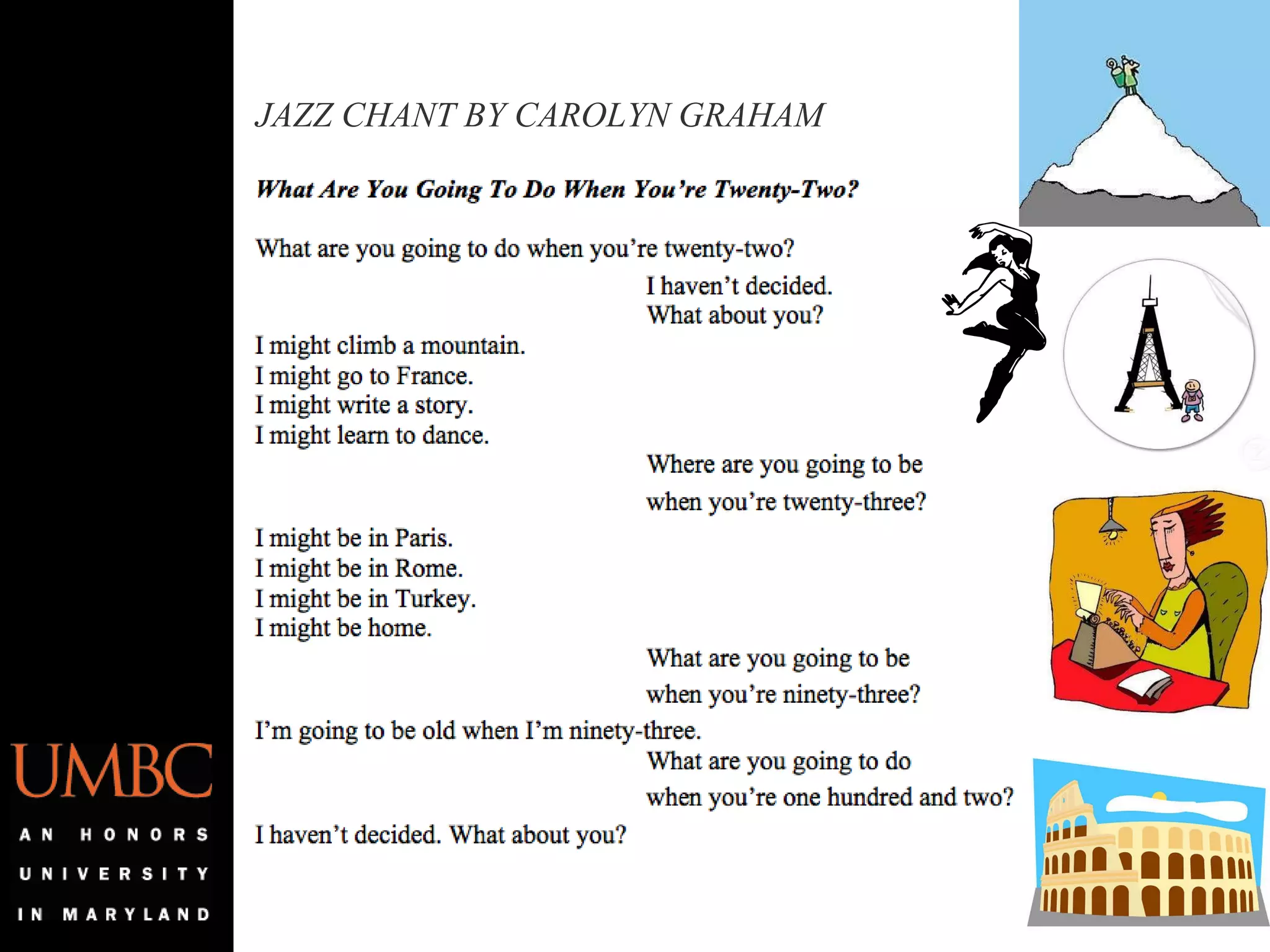
JAZZ CHANT BY CAROLYN GRAHAM
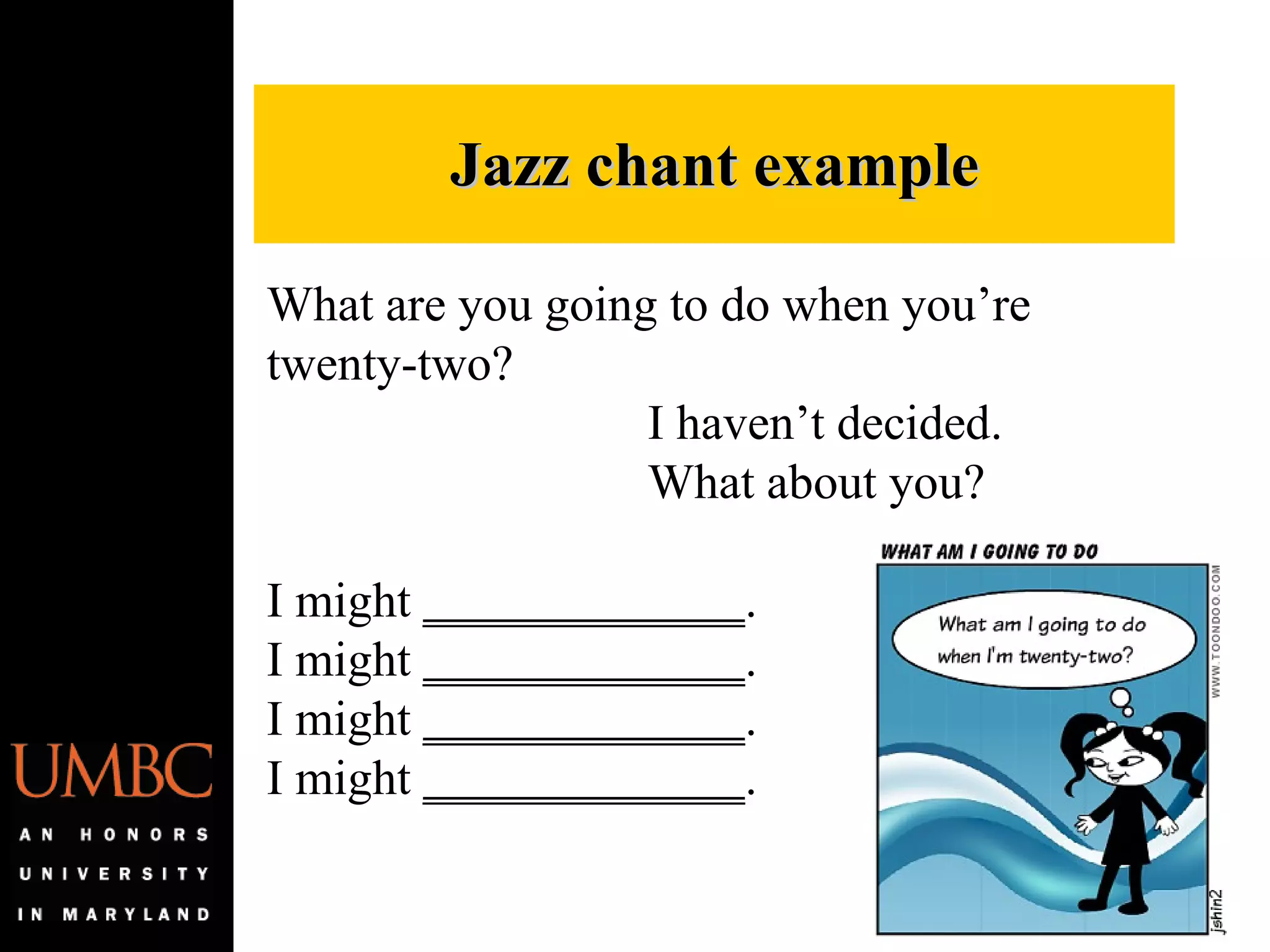
Jazz chant example What are you going to do when you’re twenty-two? I haven’t decided. What about you? I might  _____________ . I might  _____________ . I might  _____________ . I might  _____________ .
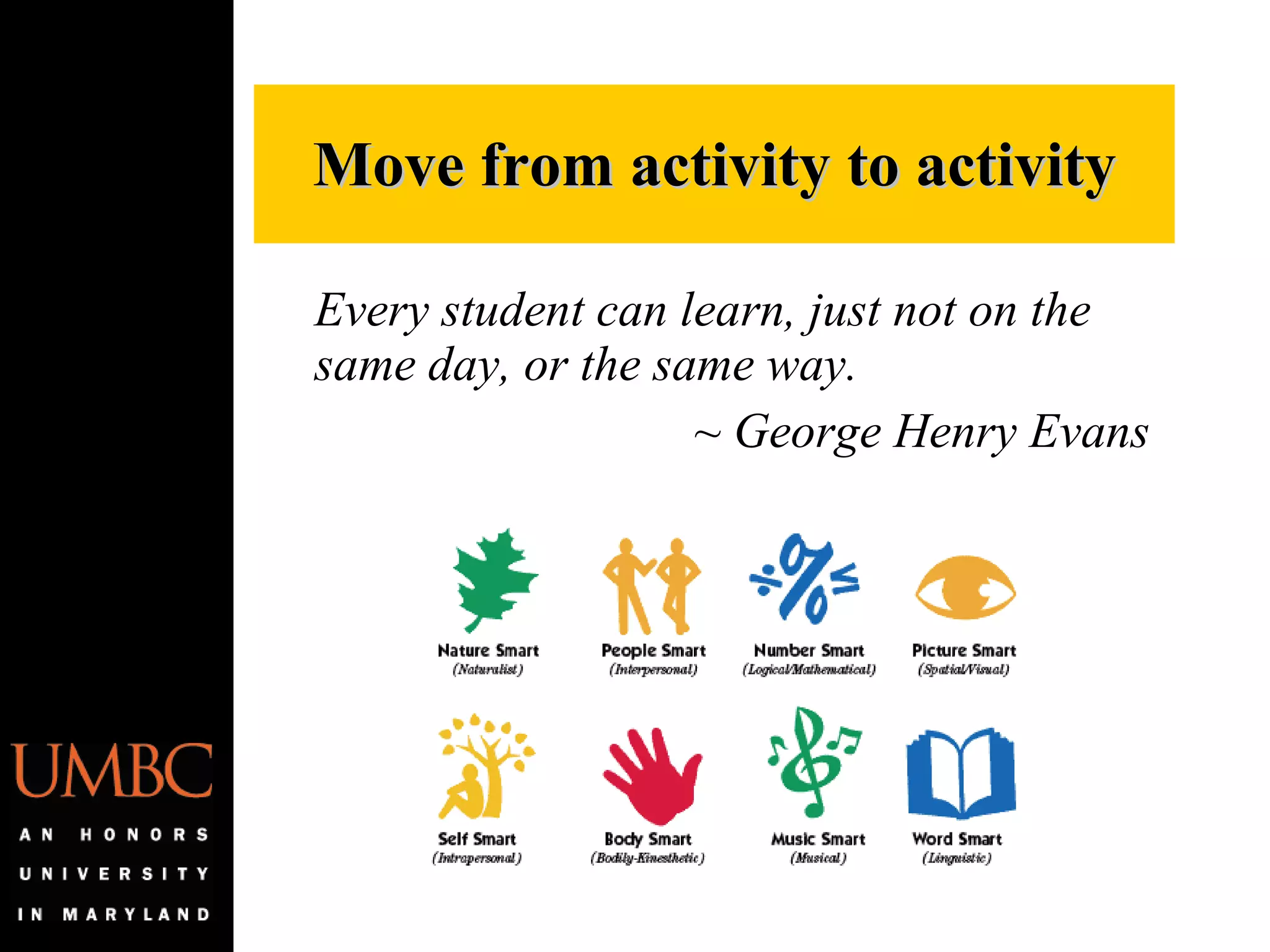
Every student can learn, just not on the same day, or the same way. ~ George Henry Evans   Move from activity to activity
Don’t spend too much time on one activity Use different kinds of activities Quiet vs noisy activities Listening, speaking, reading, writing Individual – pair work – group work – whole class Teacher-student and student-student Vary learning styles and intelligences Move from activity to activity
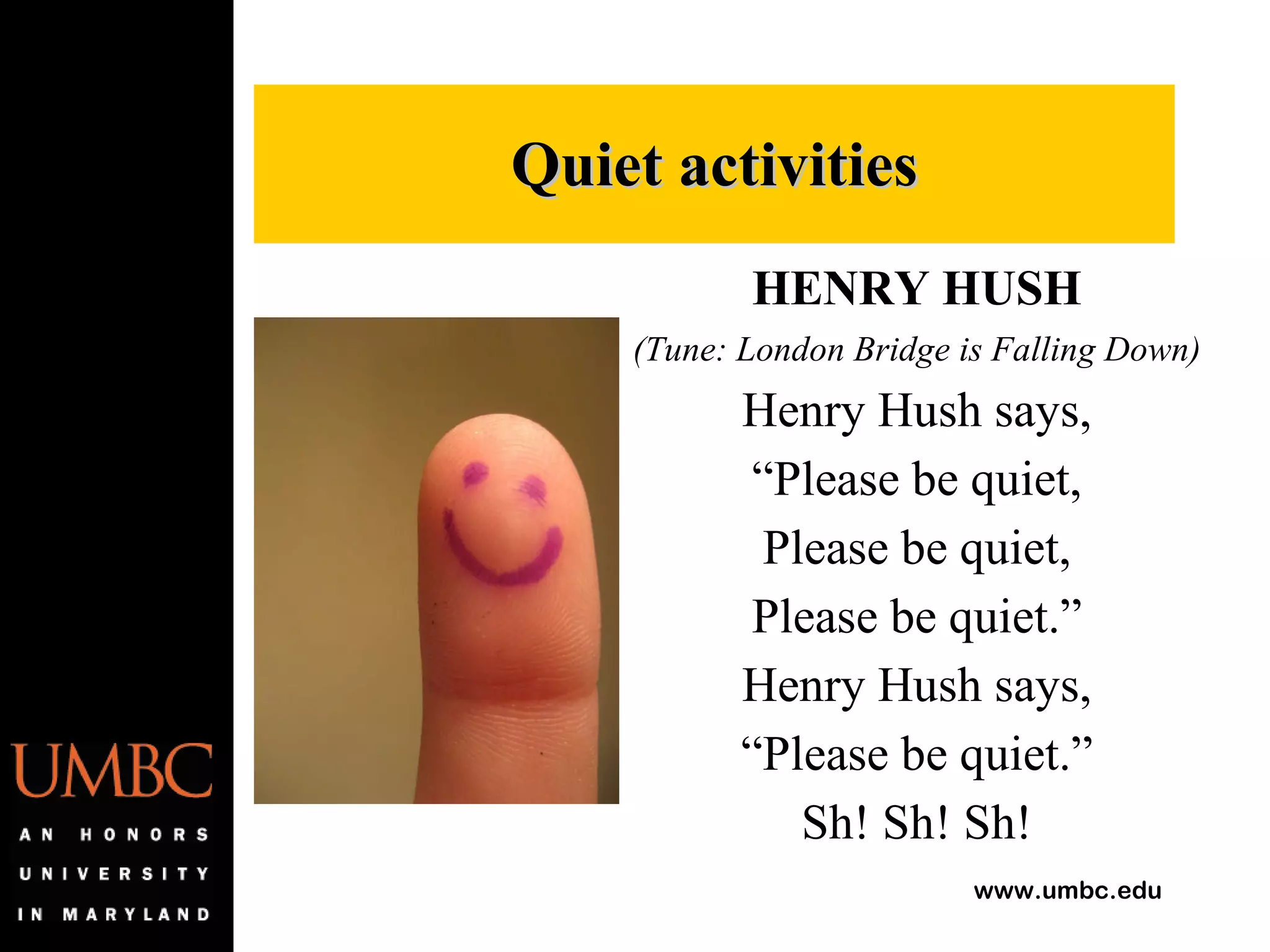
HENRY HUSH (Tune: London Bridge is Falling Down) Henry Hush says, “ Please be quiet, Please be quiet, Please be quiet.” Henry Hush says, “ Please be quiet.” Sh! Sh! Sh! Quiet activities
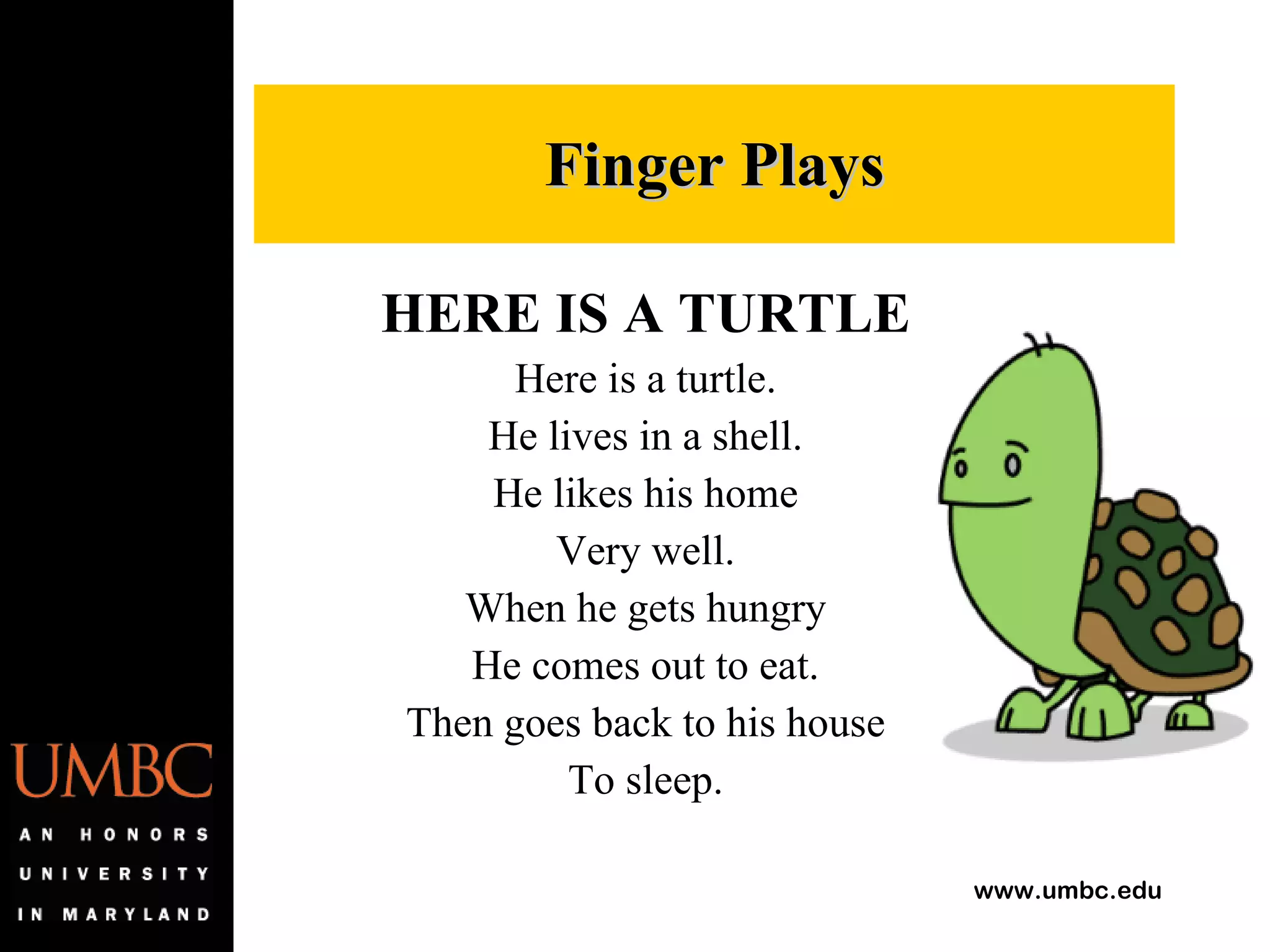
Finger Plays HERE IS A TURTLE Here is a turtle. He lives in a shell. He likes his home Very well. When he gets hungry He comes out to eat. Then goes back to his house To sleep.
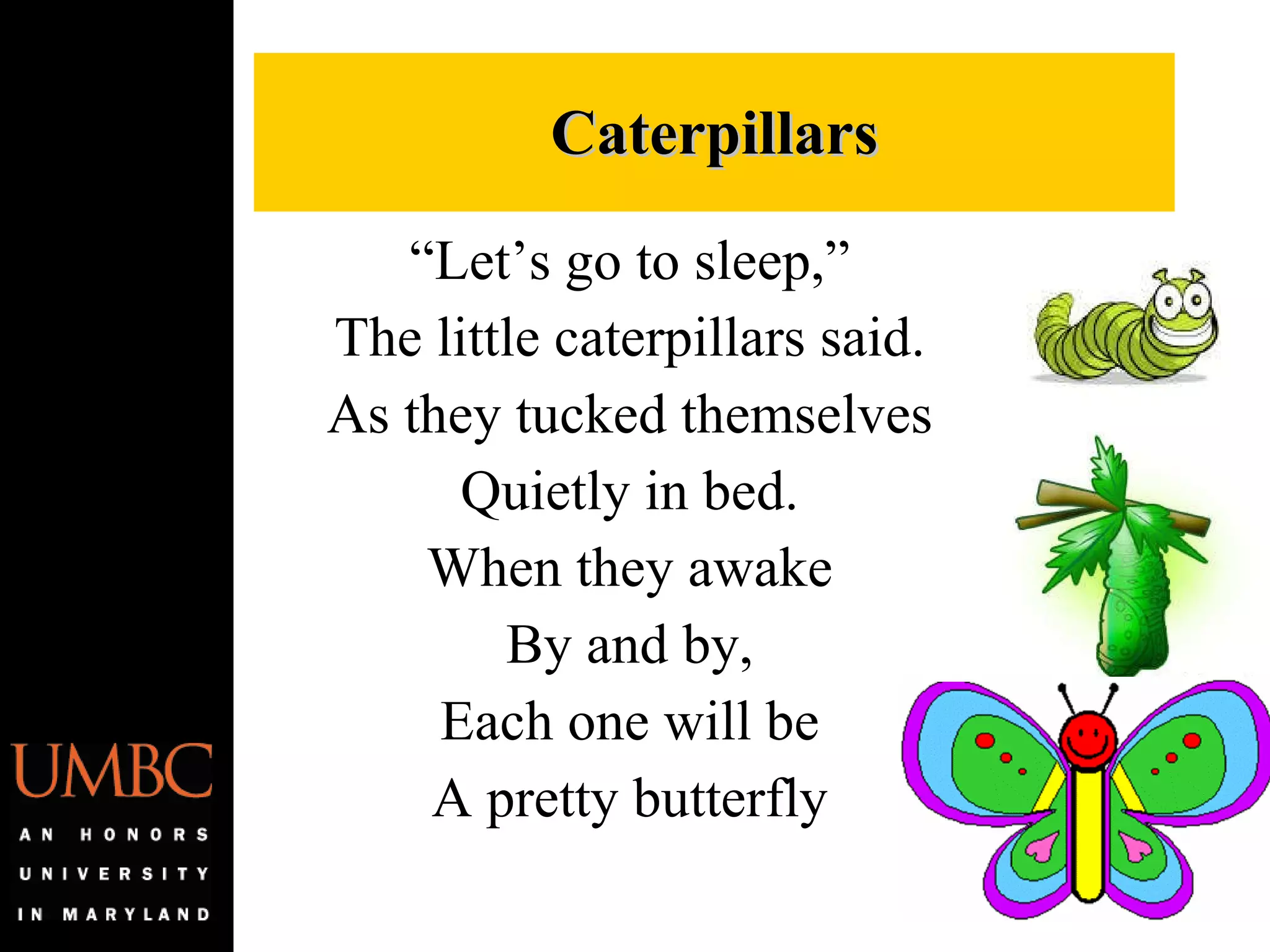
“ Let’s go to sleep,” The little caterpillars said. As they tucked themselves Quietly in bed. When they awake By and by, Each one will be A pretty butterfly Caterpillars
Quietly think about the riddle of the day Put your head down on your desk Close your eyes and breathe in, breathe out (5x) Close your eyes and roll your head around (5x) Quiet brain breaks
“ Do you understand?” ~ Every teacher “ Yes, teacher!” ~ Every student Check comprehension often
Check comprehension often
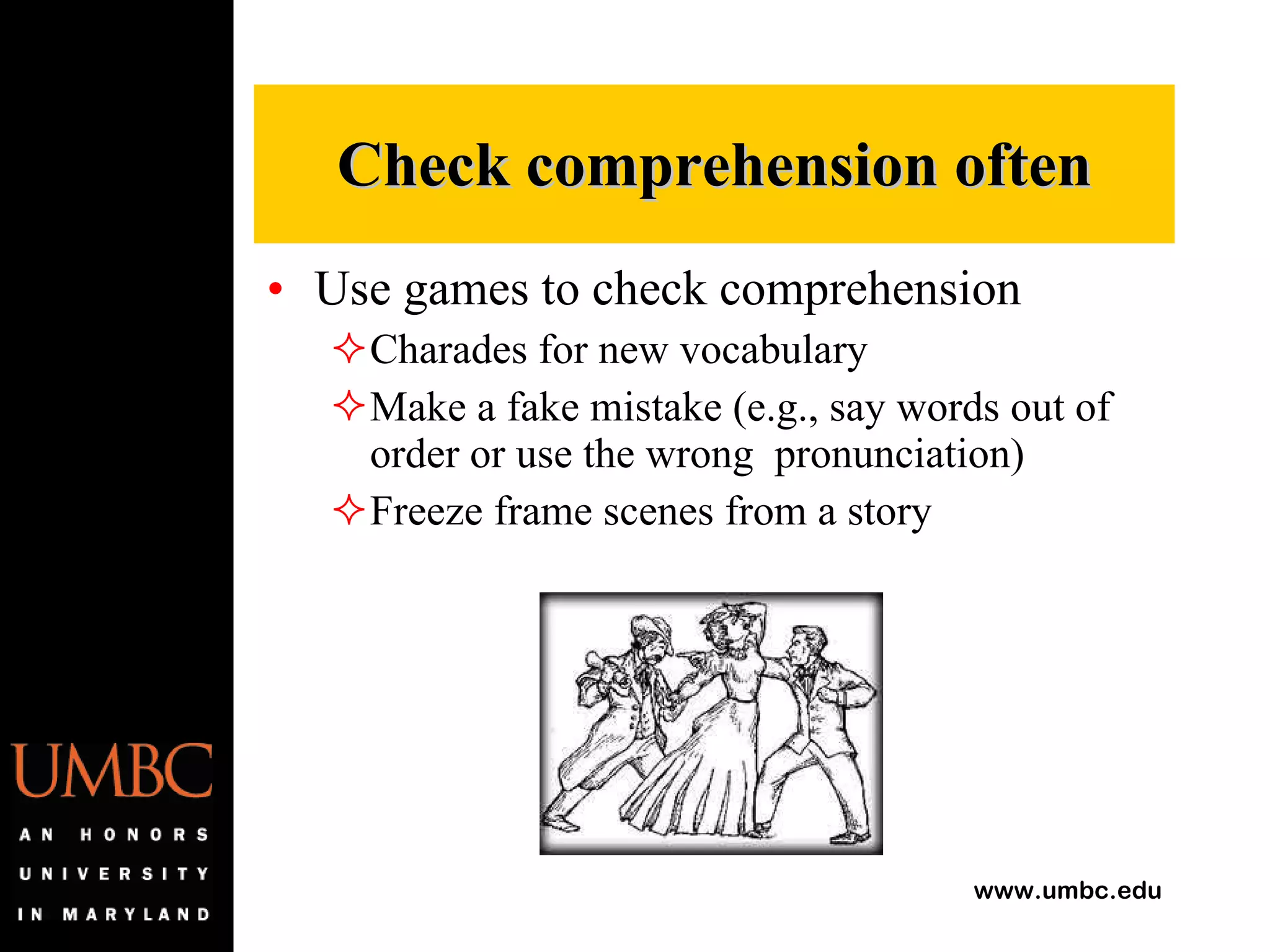
Use games to check comprehension Charades for new vocabulary Make a fake mistake (e.g., say words out of order or use the wrong  pronunciation) Freeze frame scenes from a story Check comprehension often
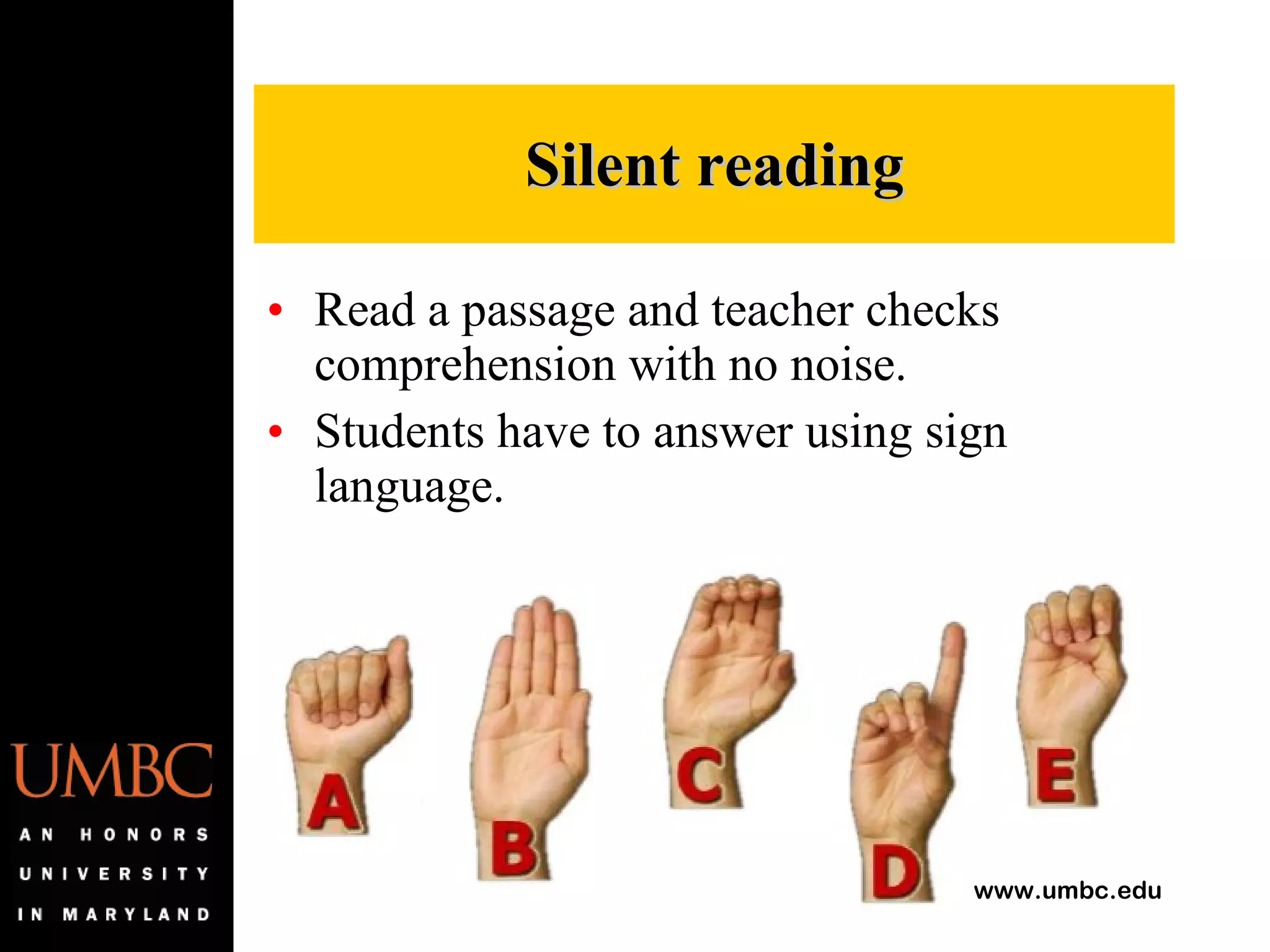
Read a passage and teacher checks comprehension with no noise. Students have to answer using sign language. Silent reading
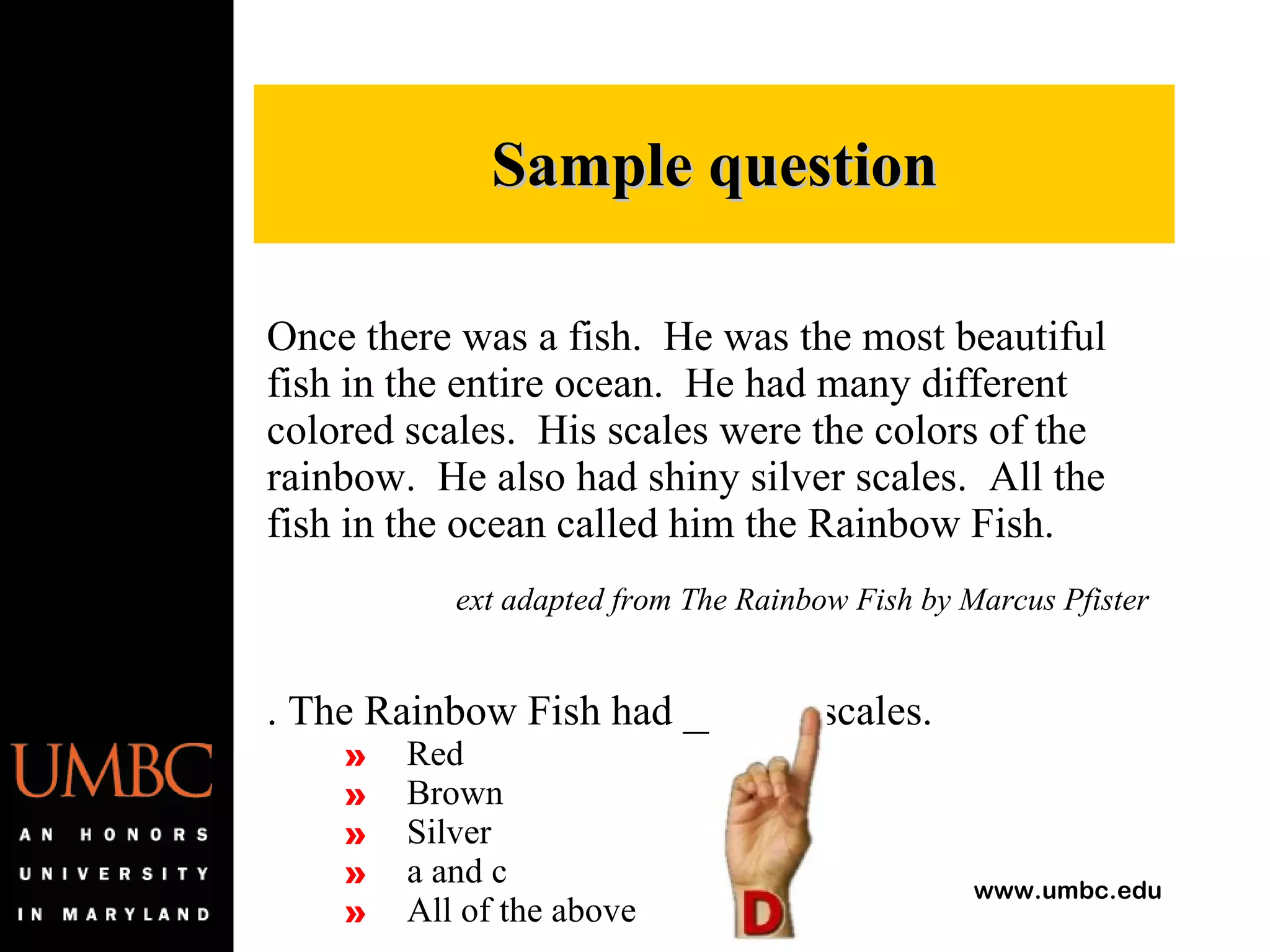
Once there was a fish.  He was the most beautiful fish in the entire ocean.  He had many different colored scales.  His scales were the colors of the rainbow.  He also had shiny silver scales.  All the fish in the ocean called him the Rainbow Fish. Text adapted from The Rainbow Fish by Marcus Pfister 1. The Rainbow Fish had ______ scales. Red Brown Silver a and c All of the above Sample question
You don't understand anything until you learn it more than one way. ~ Marvin Minsky Use thematic units
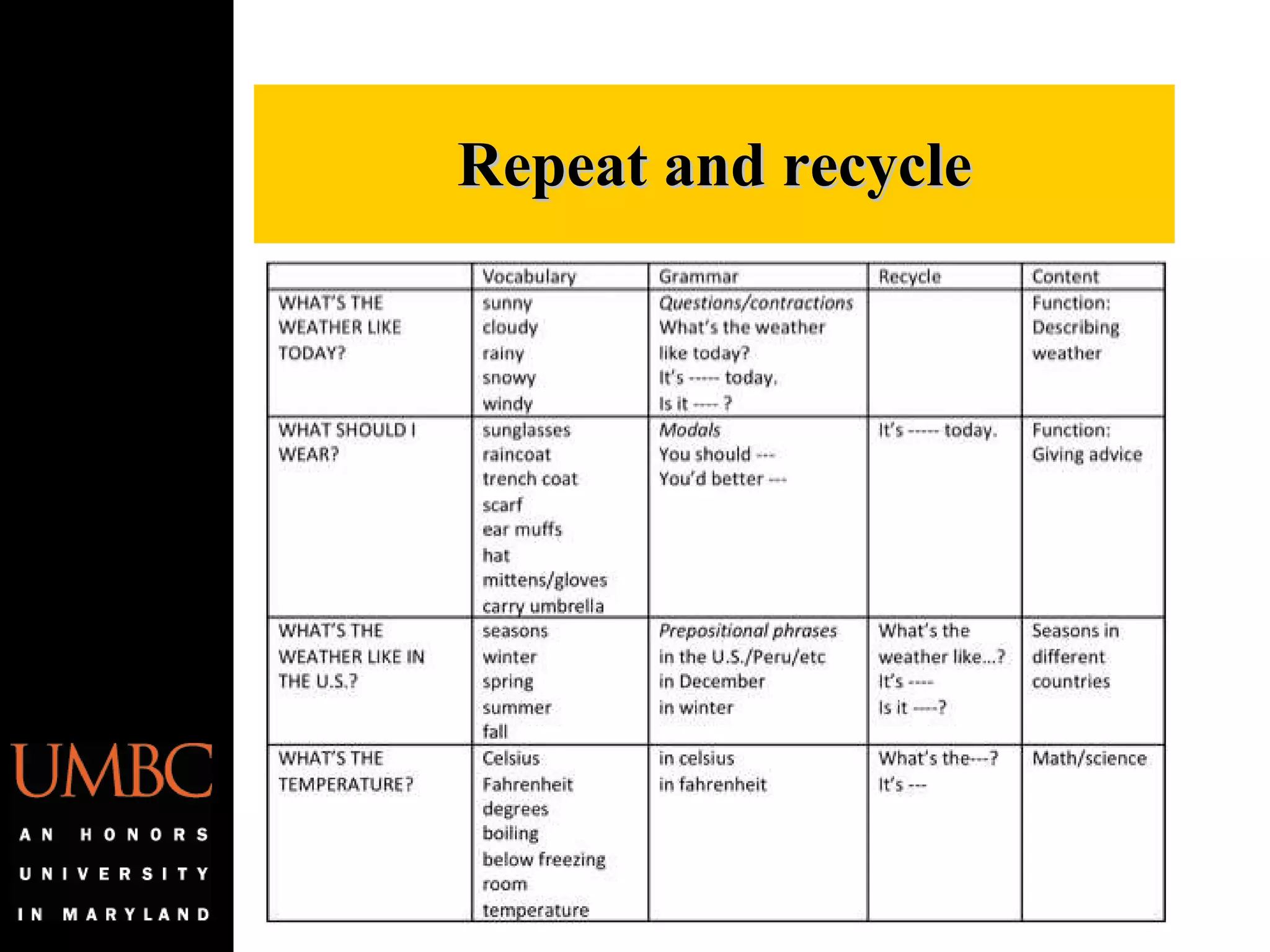
Repeat and recycle language as much as possible Connect language to other content areas Use thematic units
What’s the weather? What’s the weather? What’s the weather like today? Tell us  (student’s name) , What’s the weather? What’s the weather like today?   Is it sunny?  Is it cloudy?  Is it rainy out today?  Is it snowy? Is it windy?  What’s the weather like today? The weather song
Repeat and recycle
Don't handicap your children by making their lives easy. ~ Robert A. Heinlein Use L1 as a resource only when necessary
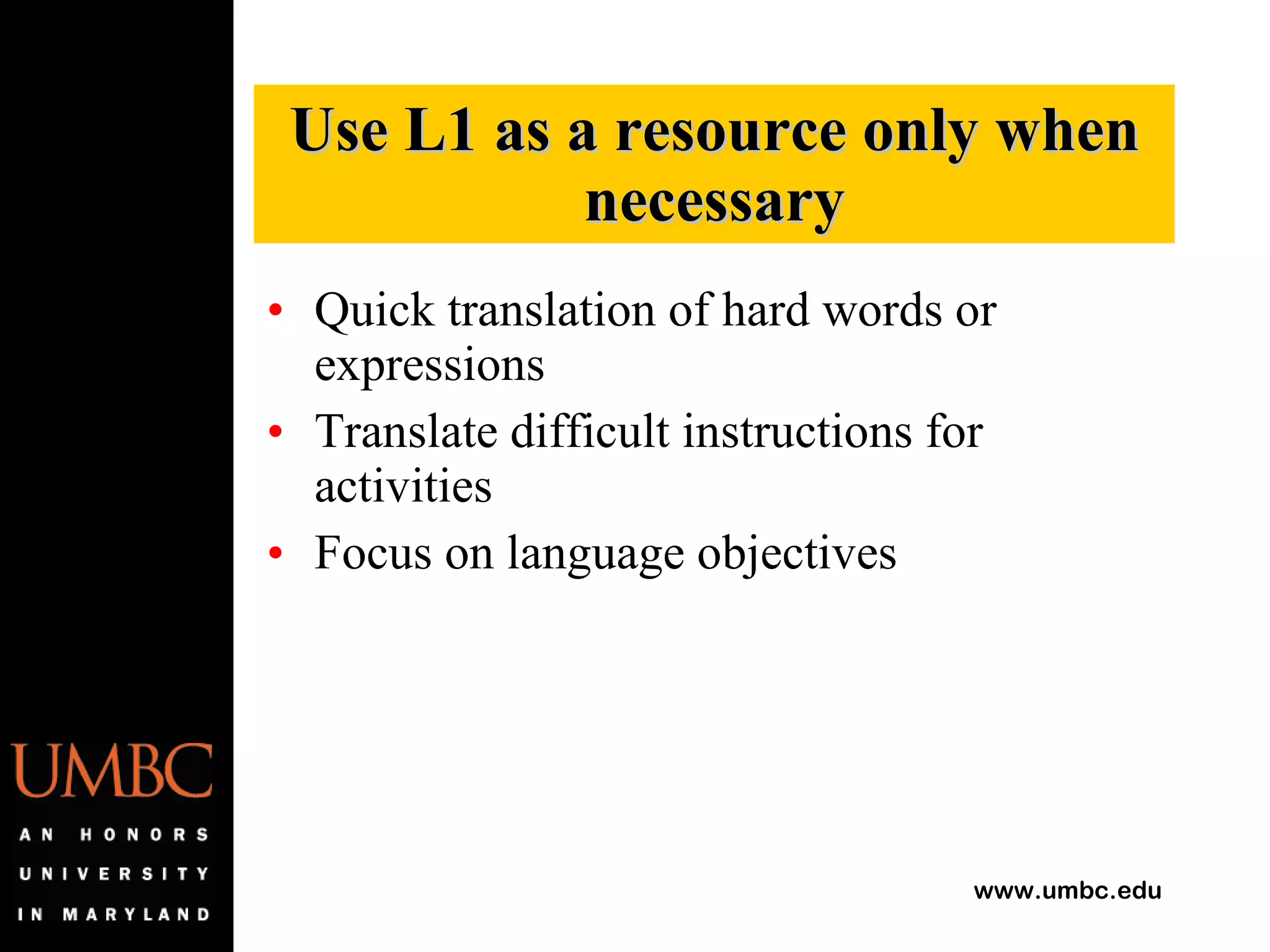
Quick translation of hard words or expressions Translate difficult instructions for activities Focus on language objectives Use L1 as a resource only when necessary
Children are the world's most valuable resource and its best hope for the future. ~ John Fitzgerald Kennedy   Grow global citizens
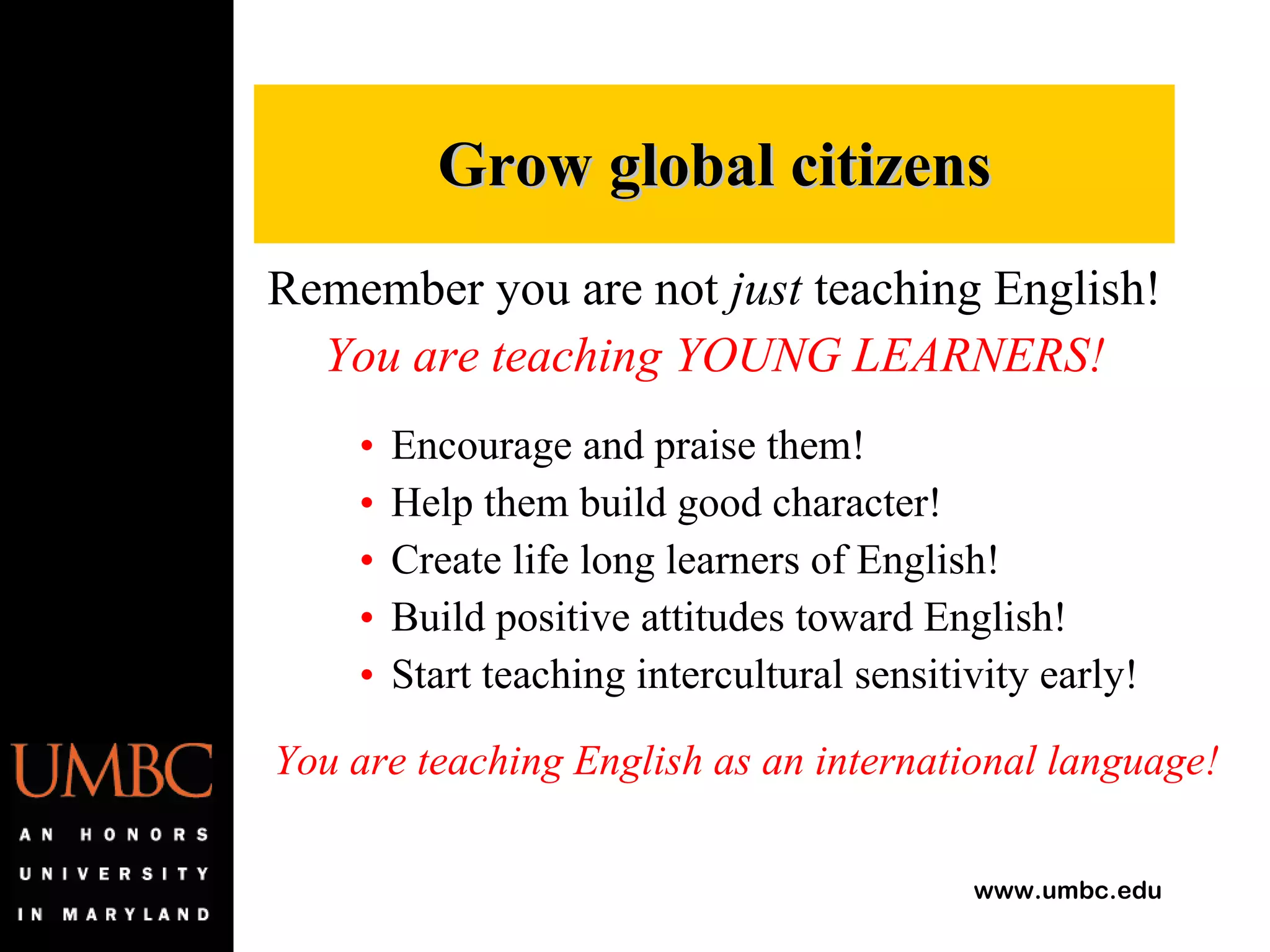
Remember you are not  just  teaching English! You are teaching YOUNG LEARNERS! Encourage and praise them! Help them build good character! Create life long learners of English! Build positive attitudes toward English! Start teaching intercultural sensitivity early! You are teaching English as an international language! Grow global citizens
3 2 1 GOOD-BYE! Conclusion: Exit ticket
Conclusion: Exit ticket 3   ways you can make English active and fun 2  routines you will use to help you manage YLs 1  sentence that starts with  “When you teach YLs, you must…” GOOD-BYE!
Helpful articles about TEYL: Ten Helpful Ideas for Teaching English to Young Learners by Joan Kang Shin  http://exchanges.state.gov/englishteaching/forum/archives/docs/06-44-2-b.pdf Teaching Young Learners by Kerstin Klein  http://exchanges.state.gov/englishteaching/forum/archives/docs/05-43-1-c.pdf For other useful articles, please browse these special issues of the English Teaching Forum focused specifically on TEYL. Volume 44, Number 2 http://exchanges.state.gov/englishteaching/forum/archives/2006/06-44-2.html Volume 43, Number 1  http://exchanges.state.gov/englishteaching/forum/archives/2005/05-43-1.html
Useful web resources for TEYL Songs and Chats Joan’s songs and chants:  http://www.youtube.com/user/steptforells  U.S. Department of State “Sing Out Loud”: http://exchanges.state.gov/englishteaching/resforteach/pubcat/classtext/iskills/solcs.html Storytelling Storyline Online:  http://www.storylineonline.net Aesop’s Fables:  http://us.penguingroup.com/static/packages/us/yreaders/aesop/index.html Interactive stories:  http://www.woodlands-junior.kent.sch.uk/interactive/onlinestory.htm Making stories online:  http://storybird.com American sign language http://www.lifeprint.com http://www.nellieedge.com Making books http://www.makingbooks.com http://www.youtube.com/user/skgaylord Writing poems http://www.readwritethink.org/classroom-resources Making cartoons http://www.toondoo.com
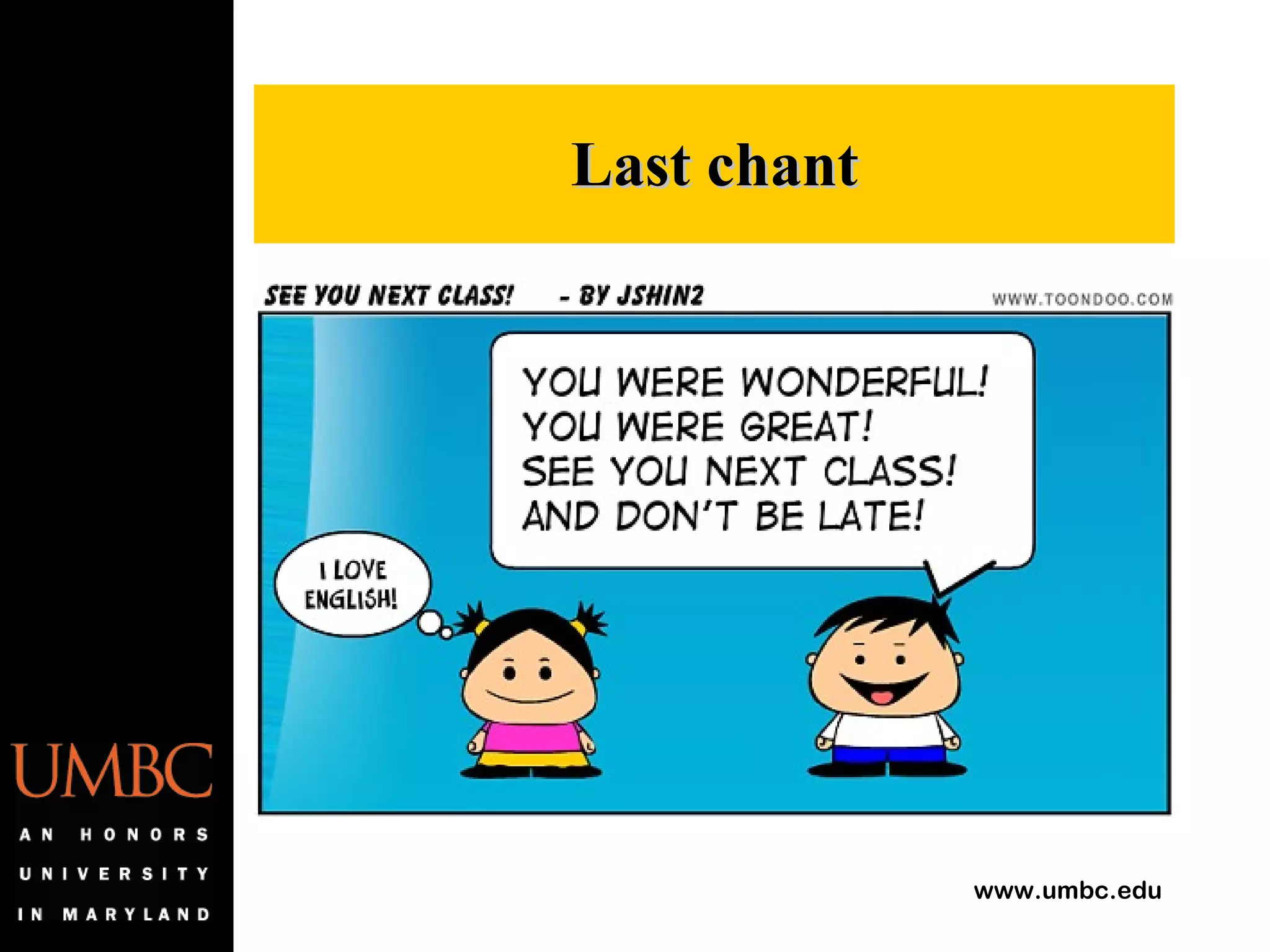
Last chant
 

Best Practices for Teaching English to Young Learners by Joan Shin

  • 1.
    Best Practices forTeaching English to Young Learners Joan Kang Shin, Ph.D. University of Maryland, Baltimore County Education Department
  • 2.
    Teaching English toYoung Learners (TEYL) is a rapidly growing field around the world, and English education is increasingly found at the primary levels. However, starting earlier is not necessarily the solution for producing better English speakers. Therefore, what can EFL teachers of young learners do to take advantage of the flexibility of young minds and the malleability of young tongues to grow better speakers of English?  
  • 3.
    Outline Introduction toTEYL Considerations for teaching young learners Effective teaching approaches for young learners Useful resources for TEYL
  • 4.
    VYLs Very YoungLearners Under 7 YLs Young Learners 7-12 years Defining the Group
  • 5.
    Data from 63countries 86% of countries start English instruction in primary school Majority start teaching English to very young learners TEYL around the world Data collected through the E-Teacher Scholarship Program in 2009-2010
  • 6.
    Is earlier reallybetter? Characteristics of young learners How children learn Language learning environment Considerations for TEYL
  • 7.
    Type of programand curriculum Number of hours spent in English Techniques and activities used FLEXIBILITY OF YOUNG MINDS MALLEABILITY OF YOUNG TONGUES Is earlier really better?
  • 8.
    a. Workshop approachE __ P __ R __ E __ T __ A __ E X P E R I E N T I A L
  • 9.
    Experiential Approach Weremember… ___% of what we read ___% of what we hear ___% of what we see ___% of what we see and hear ___% of what we see, hear, and discuss ___% of what we see, hear, discuss, and practice
  • 10.
    We remember… 20% of what we read 20% of what we hear 30% of what we see 50% of what we see and hear 70% of what we see, hear, and discuss 90% of what we see, hear, discuss, and practice Experiential Approach Rutgers Cooperative Research & Extension, 2004
  • 11.
    As Confucius said…I hear and I forget. I see and I remember. I do and I understand.
  • 12.
    b. Introduction pyramidsStep 1 : Make an introduction pyramid. Step 2 : Write down information about yourself in the pyramid. Step 3 : Use the pyramid to introduce yourself to your group members. Step 4 : Listen to your trainer for the next activity.
  • 13.
    b. Introduction pyramidsJOAN UMBC 11 years Graduate students Baltimore
  • 14.
    II. Considerations forteaching YLs Adjective Splash Brainstorm adjectives about YLs.
  • 15.
    a. Characteristics ofyoung learners LOUD! HYPER! CAN’T SIT STILL! TOO TALKATIVE! EASILY DISTRACTED!
  • 16.
    a. Characteristics ofyoung learners FUN! SOCIAL! CURIOUS! ENERGETIC! SPONTANEOUS!
  • 17.
    Children are activelearners and thinkers. (Piaget, 1970) Children learn through social interaction. (Vygotsky, 1962) Children learn effectively through scaffolding by adults. (Bruner, 1983) b. How children learn
  • 18.
    Parents who scaffoldedeffectively created interest in the task; broke the task down into smaller steps; modeled the task, including different ways to do the task; kept child “on task” by reminding him of the purpose or goal; pointed out the important parts of the task; controlled the child’s frustration during the task. Effective scaffolding
  • 19.
    L1 environment Languagehighly contextualized Language used is authentic Learner is highly motivated L2 environment Language more decontextulized Language used more artificial Learners may not be highly motivated c. Language learning environment
  • 20.
    Meaning-focused input (Pinter, 2008) Grammar is “noticed” (Cameron, 2001; Pinter, 2008) Learning-centered grammar teaching (Cameron, 2001) Approach to grammar
  • 21.
    … children seethe foreign language ‘from the inside’ and try to find meaning in how the language is used in action, in interaction, and with intention, rather than ‘from the outside’ as a system and form. (Cameron, 2003) Approach to grammar
  • 22.
    Try to imitatethe L1 environment! Teach language in context! Don’t teach grammar explicitly! Create an English speaking environment in your class! Make English fun! YL Classroom
  • 23.
    III. Teaching approachesfor YLs Read, C. (1998, April). The challenge of teaching children. English Teaching Professional, 7 : 8-10.
  • 24.
  • 25.
    Peanut, peanut butter~ and jelly! Peanut, peanut butter ~ and jelly! First, you take the peanuts and you crunch ‘em, you crunch ‘em. Then you take the grapes and you squish ‘em, you squish ‘em. Then you take the bread and you spread it, you spread it. Then you take the sandwich and you eat it, you eat it. Peanut Butter & Jelly Song
  • 26.
  • 27.
  • 28.
  • 29.
    Dish: PeanutButter & Jelly Sandwich Peanut, peanut butter ~ and jelly! Notice the grammar NOUN VERB First you take the peanuts and you crunch ‘em. Then you take the grapes and you squish ‘em. Then you take the bread and you spread it. Then you take the sandwich and you eat it.
  • 30.
    Write sentences Firstyou take the peanuts, and you crunch ‘em.
  • 31.
    Dish: PeanutButter & Jelly Sandwich Peanut, peanut butter ~ and jelly! Review the sentences NOUN VERB First you take the peanuts and you crunch ‘em. Then you take the grapes and you squish ‘em. Then you take the bread and you spread it. Then you take the sandwich and you eat it.
  • 32.
    Dish: MakiSushi (Japan) Maki, maki sushi ~ with soy sauce! New recipes from other countries NOUN VERB First you take the rice and you spread it. Then you take the fish and you lay it. Then you take the seaweed and you roll it. Then you take the maki and you cut it. Then you take the soy sauce and you dip it. Then you take the sushi and you eat it.
  • 33.
    Dish from yourculture! Students apply to own culture NOUN VERB First you take the and you Then you take the and you Then you take the and you Then you take the and you Then you take the and you Then you take the and you
  • 34.
    FOOD What bestpractices did you see? Humor Social Song with movement Modeling Implicit grammar teaching Scaffolding Connect to culture Bring in food
  • 35.
    Make English learningactive and fun Use lots of visuals, realia, and movement Establish classroom routines in English Encourage creativity Give students a chance to personalize Move from activity to activity Check comprehension often Use thematic units Use L1 as a resource only when necessary Grow global citizens through TEIL b. Ten best practices for TEYL
  • 36.
    Do not trainchildren to learning by force and harshness, but direct them to it by what amuses their minds, so that you may be better able to discover with accuracy the peculiar bent of the genius of each. ~ Plato Make English active and fun!
  • 37.
  • 38.
    Songs and chantsStorytelling Drama Games Make English active and fun!
  • 39.
    ENGLISH IS FUN! x x xx x ENGLISH IS COOL! x x xx x I SPEAK ENGLISH! x x xx x AND SO DO YOU! x x xx x YAAAAAY! ENGLISH! English cheers
  • 40.
    GIVE ME ANE! E! GIVE ME AN N! N! GIVE ME A G! G! GIVE ME AN L! L! GIVE ME AN I! I! GIVE ME AN S! S! GIVE ME AN H! H! WHAT DOES THAT SPELL? ENGLISH! WHAT DO WE SPEAK? ENGLISH! WHAT DO WE LOVE? ENGLISH! YAAAAAY! ENGLISH! English cheers
  • 41.
  • 42.
  • 43.
    Great websites forstorytelling! http://www.storylineonline.net http://us.penguingroup.com/static/packages/us/yreaders/aesop/index.html Storytelling
  • 44.
  • 45.
  • 46.
  • 47.
    Lisa and Rosarun into John on the street. Lisa: Hi, John! How are you? John: Hi, Lisa! I’m fine. How are you? Lisa: I’m good. This is my friend Rosa. Rosa: Hi! I’m Rosa. (Shake hands with John.) John: Nice to meet you. Rosa: Nice to meet you too! Sample dialogue
  • 48.
    Act out thedialogue using gestures without speaking out loud. Miming Hi, John! How are you?
  • 49.
    Write your lineson paper. Practice the dialogue by mouthing the words with no sound and holding up the paper. Silent movie Hi, John! How are you?
  • 50.
    Use a simpledialogue and have the characters do it in different ways: nervously, fearfully, happily, laughing, angrily, and naturally, of course! The director’s cut (The teacher can act like the director of a movie and say, “Cut! Cut! No, that’s not right. I want to see more emotion. Do it with anger this time!” )
  • 51.
    I hear, andI forget. I see, and I remember. I do, and I understand. ~ Confucius Use lots of visuals, realia, and movement
  • 52.
    Brightly colored visualsToys, puppets, and masks Body as visual Use lots of visuals, realia, and movement
  • 53.
    Songs with movementhttp://www.youtube.com/watch?v=g_fmPkD1phk&NR=1
  • 54.
    What’s the weather?What’s the weather? What’s the weather like today? Tell us (student’s name) , What’s the weather? What’s the weather like today?   Is it sunny? Is it cloudy? Is it rainy out today? Is it snowy? Is it windy? What’s the weather like today? The weather song
  • 55.
  • 56.
    Body as visualAMERICAN SIGN LANGUAGE
  • 57.
  • 58.
    Engages child’s multipleintelligences in representing language symbolically. Provides constructive physical outlet for kinesthetic learners. Combines “saying and doing,” which increases retention of language and concepts by 90%. Develops phonemic awareness, the alphabetic principal, vocabulary, and spelling skills. Builds comprehension by creating internal images of language. Support for signing Dancing With Words: Signing for Hearing Children's Literacy by Marilyn Daniels
  • 59.
    Learning the alphabethttp://www.youtube.com/watch?v=wMQHd1UBkeI
  • 60.
    NAME GAME Student says and spells his/her name while acting out something s/he likes to do. Children guess what student likes to do. Teacher writes information on the board. Joan likes to sing and play tennis.
  • 61.
    You can learnmany things from children. How much patience you have, for instance. ~Franklin P. Jones Establish classroom routines in English
  • 62.
  • 63.
    Start of classor activity Attention getters Brain breaks End of class or activity Establish classroom routines in English
  • 64.
    Developing routines ©Joan Kang Shin
  • 65.
    Developing routines Goodmorning, class! / Good morning, Ms. Shin! How is everyone today? / Great! How are you? ENGLISH CHEER EACH STUDENT TURNS IN ACCORDION BOOK AND GETS A STICKER AS EXIT TICKET. END OF THE DAY CHANT © Joan Kang Shin
  • 66.
    ENGLISH IS FUN! x x xx x ENGLISH IS COOL! x x xx x I SPEAK ENGLISH! x x xx x AND SO DO YOU! x x xx x YAAAAAY! ENGLISH! English cheers
  • 67.
    Developing routines Goodmorning, class! / Good morning, Ms. Shin! How is everyone today? / Great! How are you? ENGLISH CHEER Class, what is today’s date? WRITE ON BOARD Today’s date is May 28th, 2011. DAYS OF THE WEEK SONG EACH STUDENT TURNS IN ACCORDION BOOK AND GETS A STICKER AS EXIT TICKET. END OF THE DAY CHANT © Joan Kang Shin
  • 68.
    7 days ina week song There are 7 days in a week, 7 days in a week, 7 days in a week, and I can say them all! Sunday, Monday and Tuesday, Wednesday, Thursday and Friday Saturday is the last day And I can say them all! http://www.youtube.com/watch?v=GJXNz1y1bOg&NR=1
  • 69.
    Developing routines Goodmorning, class! / Good morning, Ms. Shin! How is everyone today? / Great! How are you? ENGLISH CHEER Class, what is today’s date? WRITE ON BOARD Today’s date is May 28th, 2011. DAYS OF THE WEEK SONG What day is it today? / It’s Friday! And Friday is… Storytelling Day! EACH STUDENT TURNS IN ACCORDION BOOK AND GETS A STICKER AS EXIT TICKET. END OF THE DAY CHANT Today’s story is THE RAINBOW FISH! © Joan Kang Shin
  • 70.
    Sunday, Monday, clap,clap, clap (clap clap clap) Tuesday, Wednesday, snap, snap, snap (snap snap snap) Thursday, hop. (hop on one leg) Friday, stop. (hold up hand) Saturday spin around like a top. (spin around) Seven days are in a week. (hold up 7 fingers) Now sit down and take a seat! (motion to sit) Days of the week chant
  • 71.
    Puzzle of theday What has four legs but never stands? What has two hands but can’t clap? What gets wet while it dries? What becomes smaller when you add two letters? What word is spelled wrong in every dictionary in the world? Which month has 28 days? What can you break with only one word? Why are Saturday and Sunday stronger than the rest of the days?
  • 72.
    (March or stompfeet) I don’t know but I’ve been told. I don’t know but I’ve been told. Someone here is getting old. Someone here is getting old. It is someone’s special day. It is someone’s special day. This is what we want to say. This is what we want to say. Happy. Happy. Birthday. Birthday. Happy birthday—to you! (Say the last line together) Birthday cadence
  • 73.
    2 – 4– 6 – 8! Who do we appreciate? (Name) , (Name)! YAAAA~AAAAAY, (Name)! Who do we appreciate?
  • 74.
    Developing routines Goodmorning, class! / Good morning, Ms. Shin! How is everyone today? / Great! How are you? ENGLISH CHEER Class, what is today’s date? WRITE ON BOARD Today’s date is May 28th, 2011. DAYS OF THE WEEK SONG What day is it today? / It’s Friday! And Friday is… Storytelling Day! EACH STUDENT TURNS IN ACCORDION BOOK AND GETS A STICKER AS EXIT TICKET. END OF THE DAY CHANT Today’s story is THE RAINBOW FISH! © Joan Kang Shin
  • 75.
    CALL AND RESPONDTeacher: 1-2-3 eyes on me! Students: 1-2 eyes on you! Attention getter
  • 76.
    WHEN I SAY-------, YOU SAY -------! EXAMPLE: When I say PEANUT , you say BUTTER ! PEANUT! BUTTER! PEANUT! BUTTER! Attention getter
  • 77.
    I love English!I love English! Yes, I do! Yes, I do! Come and be my partner. We have lots to learn. Yes, we do! Yes, we do! To start pair work
  • 78.
    Seat Running: Sitand run. Shake Shakes: Shake one hand (or foot) for 3 seconds then the other. Repeat 5x. Close your eyes and breathe in, breathe out (5x) Nosey Ear – Get your left hand to touch your right ear lobe and then get your right hand to touch the tip of your nose. Then swap positions. Repeat 5x. Brain breaks
  • 79.
    Developing routines Goodmorning, class! / Good morning, Ms. Shin! How is everyone today? / Great! How are you? ENGLISH CHEER Class, what is today’s date? WRITE ON BOARD Today’s date is March 11th, 2011. DAYS OF THE WEEK SONG What day is it today? / It’s Friday! And Friday is… Storytelling Day! When I say RAINBOW, you say FISH. Shake shakes EACH STUDENT TURNS IN ACCORDION BOOK AND GETS A STICKER AS EXIT TICKET. END OF THE DAY CHANT Today’s story is THE RAINBOW FISH! © Joan Kang Shin
  • 80.
    End of theday chant
  • 81.
    There are noseven wonders of the world in the eyes of a child. There are seven million. ~ Walt Streightiff Encourage creativity
  • 82.
    Student-made visuals PoetryDrama Encourage creativity
  • 83.
  • 84.
  • 85.
    We worry aboutwhat a child will become tomorrow, yet we forget that he is someone today. ~ Stacia Tauscher Give students a chance to personalize
  • 86.
    Students write andtalk about themselves Students compare content to their own culture and lives Give students a chance to personalize
  • 87.
    J umping O verjoyed A thletic N ever tired! Acrostic name poem
  • 88.
    Give learners chancesto write and talk about themselves (using the forms or models you provide) Give learners a chance to notice grammatical structures Give learners more chances to practice Personalize chants
  • 89.
    JAZZ CHANT BYCAROLYN GRAHAM
  • 90.
    Jazz chant exampleWhat are you going to do when you’re twenty-two? I haven’t decided. What about you? I might _____________ . I might _____________ . I might _____________ . I might _____________ .
  • 91.
    Every student canlearn, just not on the same day, or the same way. ~ George Henry Evans Move from activity to activity
  • 92.
    Don’t spend toomuch time on one activity Use different kinds of activities Quiet vs noisy activities Listening, speaking, reading, writing Individual – pair work – group work – whole class Teacher-student and student-student Vary learning styles and intelligences Move from activity to activity
  • 93.
    HENRY HUSH (Tune:London Bridge is Falling Down) Henry Hush says, “ Please be quiet, Please be quiet, Please be quiet.” Henry Hush says, “ Please be quiet.” Sh! Sh! Sh! Quiet activities
  • 94.
    Finger Plays HEREIS A TURTLE Here is a turtle. He lives in a shell. He likes his home Very well. When he gets hungry He comes out to eat. Then goes back to his house To sleep.
  • 95.
    “ Let’s goto sleep,” The little caterpillars said. As they tucked themselves Quietly in bed. When they awake By and by, Each one will be A pretty butterfly Caterpillars
  • 96.
    Quietly think aboutthe riddle of the day Put your head down on your desk Close your eyes and breathe in, breathe out (5x) Close your eyes and roll your head around (5x) Quiet brain breaks
  • 97.
    “ Do youunderstand?” ~ Every teacher “ Yes, teacher!” ~ Every student Check comprehension often
  • 98.
  • 99.
    Use games tocheck comprehension Charades for new vocabulary Make a fake mistake (e.g., say words out of order or use the wrong pronunciation) Freeze frame scenes from a story Check comprehension often
  • 100.
    Read a passageand teacher checks comprehension with no noise. Students have to answer using sign language. Silent reading
  • 101.
    Once there wasa fish. He was the most beautiful fish in the entire ocean. He had many different colored scales. His scales were the colors of the rainbow. He also had shiny silver scales. All the fish in the ocean called him the Rainbow Fish. Text adapted from The Rainbow Fish by Marcus Pfister 1. The Rainbow Fish had ______ scales. Red Brown Silver a and c All of the above Sample question
  • 102.
    You don't understandanything until you learn it more than one way. ~ Marvin Minsky Use thematic units
  • 103.
    Repeat and recyclelanguage as much as possible Connect language to other content areas Use thematic units
  • 104.
    What’s the weather?What’s the weather? What’s the weather like today? Tell us (student’s name) , What’s the weather? What’s the weather like today?   Is it sunny? Is it cloudy? Is it rainy out today? Is it snowy? Is it windy? What’s the weather like today? The weather song
  • 105.
  • 106.
    Don't handicap yourchildren by making their lives easy. ~ Robert A. Heinlein Use L1 as a resource only when necessary
  • 107.
    Quick translation ofhard words or expressions Translate difficult instructions for activities Focus on language objectives Use L1 as a resource only when necessary
  • 108.
    Children are theworld's most valuable resource and its best hope for the future. ~ John Fitzgerald Kennedy Grow global citizens
  • 109.
    Remember you arenot just teaching English! You are teaching YOUNG LEARNERS! Encourage and praise them! Help them build good character! Create life long learners of English! Build positive attitudes toward English! Start teaching intercultural sensitivity early! You are teaching English as an international language! Grow global citizens
  • 110.
    3 2 1GOOD-BYE! Conclusion: Exit ticket
  • 111.
    Conclusion: Exit ticket3 ways you can make English active and fun 2 routines you will use to help you manage YLs 1 sentence that starts with “When you teach YLs, you must…” GOOD-BYE!
  • 112.
    Helpful articles aboutTEYL: Ten Helpful Ideas for Teaching English to Young Learners by Joan Kang Shin http://exchanges.state.gov/englishteaching/forum/archives/docs/06-44-2-b.pdf Teaching Young Learners by Kerstin Klein http://exchanges.state.gov/englishteaching/forum/archives/docs/05-43-1-c.pdf For other useful articles, please browse these special issues of the English Teaching Forum focused specifically on TEYL. Volume 44, Number 2 http://exchanges.state.gov/englishteaching/forum/archives/2006/06-44-2.html Volume 43, Number 1 http://exchanges.state.gov/englishteaching/forum/archives/2005/05-43-1.html
  • 113.
    Useful web resourcesfor TEYL Songs and Chats Joan’s songs and chants: http://www.youtube.com/user/steptforells U.S. Department of State “Sing Out Loud”: http://exchanges.state.gov/englishteaching/resforteach/pubcat/classtext/iskills/solcs.html Storytelling Storyline Online: http://www.storylineonline.net Aesop’s Fables: http://us.penguingroup.com/static/packages/us/yreaders/aesop/index.html Interactive stories: http://www.woodlands-junior.kent.sch.uk/interactive/onlinestory.htm Making stories online: http://storybird.com American sign language http://www.lifeprint.com http://www.nellieedge.com Making books http://www.makingbooks.com http://www.youtube.com/user/skgaylord Writing poems http://www.readwritethink.org/classroom-resources Making cartoons http://www.toondoo.com
  • 114.
  • 115.