Advantages and disadvantages of presentation methods in EFL
This document discusses and compares several language teaching methods: Present-Practice-Produce (PPP), Total Physical Response (TPR), Guided Discovery, Test-Teach-Test (TTT), Task-Based Learning (TBL), and Grammar-Translation Method (GTM). For each method, both advantages and disadvantages are provided. Some key advantages included that PPP is easy to follow, TPR is engaging for young learners, guided discovery promotes higher-order thinking, and TBL encourages communication. However, disadvantages also discussed, such as PPP focusing more on accuracy, TPR potentially boring students, and GTM limiting interaction.
Analyzes the PPP method's advantages, such as its structure and focus, and disadvantages, including its teacher-centered approach.
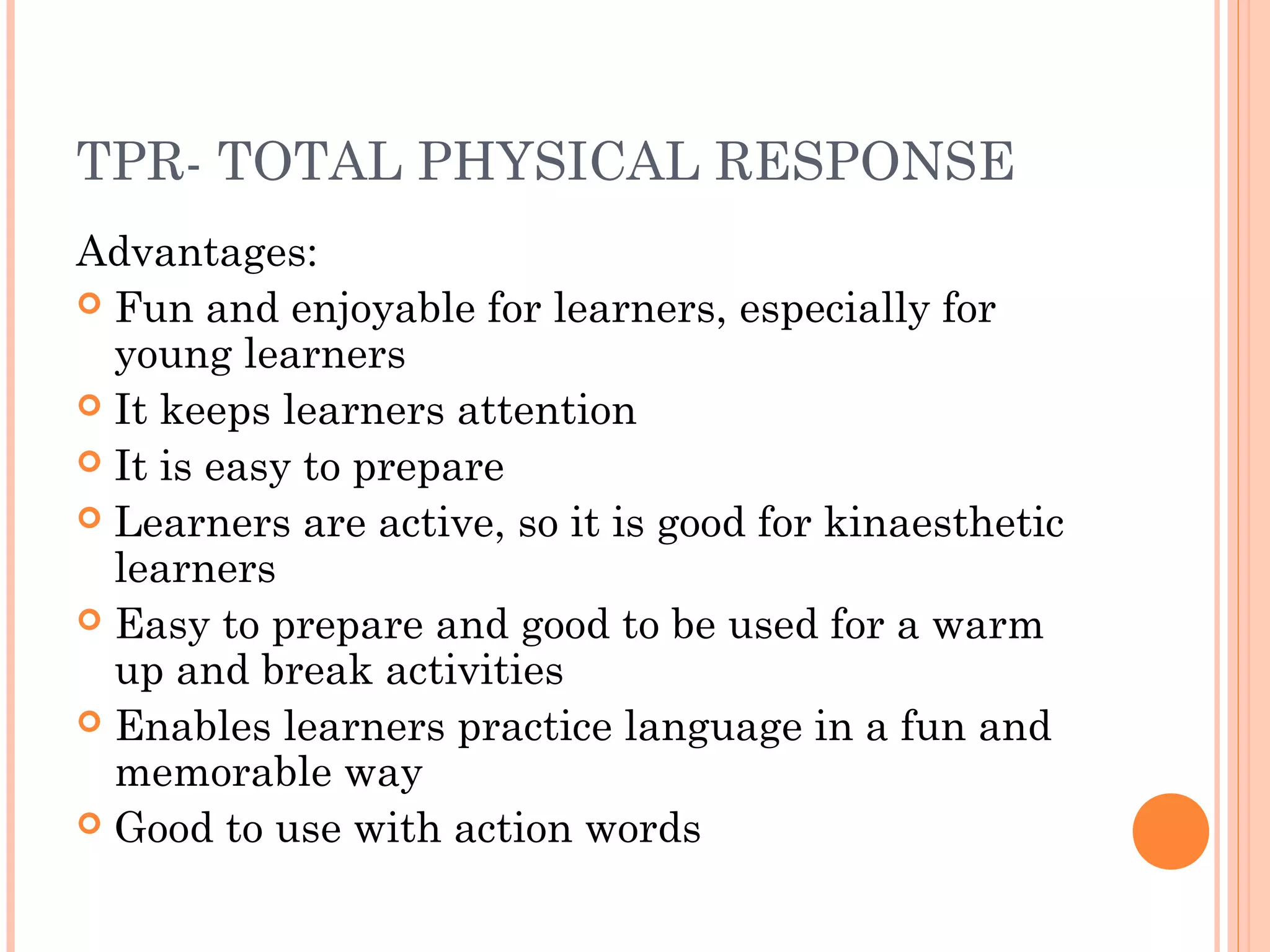
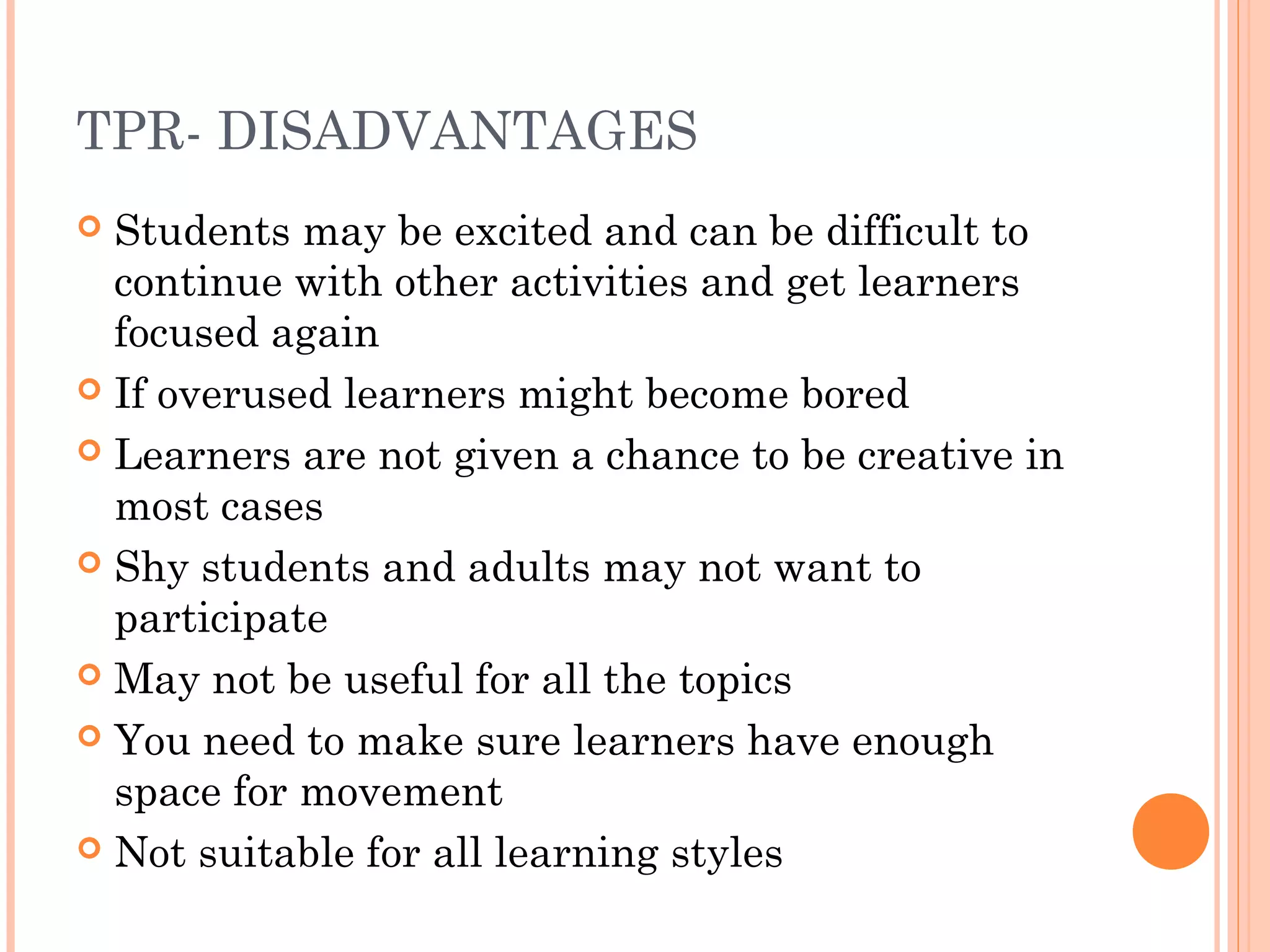
Discusses TPR advantages like engagement and suitability for kinesthetic learners; identifies disadvantages like over-excitement and limited creativity.
Highlights Guided Discovery's benefits of learner engagement and autonomy while addressing challenges like time consumption and potential learner confusion.
Examines TTT's ability to assess learner needs and promote engagement while acknowledging possible discouragement and preparation challenges.
Explores TBL's emphasis on collaboration and language use in tasks, facing challenges around group dynamics and resources.
Details GTM's strengths in grammar and vocabulary learning and its weaknesses in promoting interaction and communication skills.
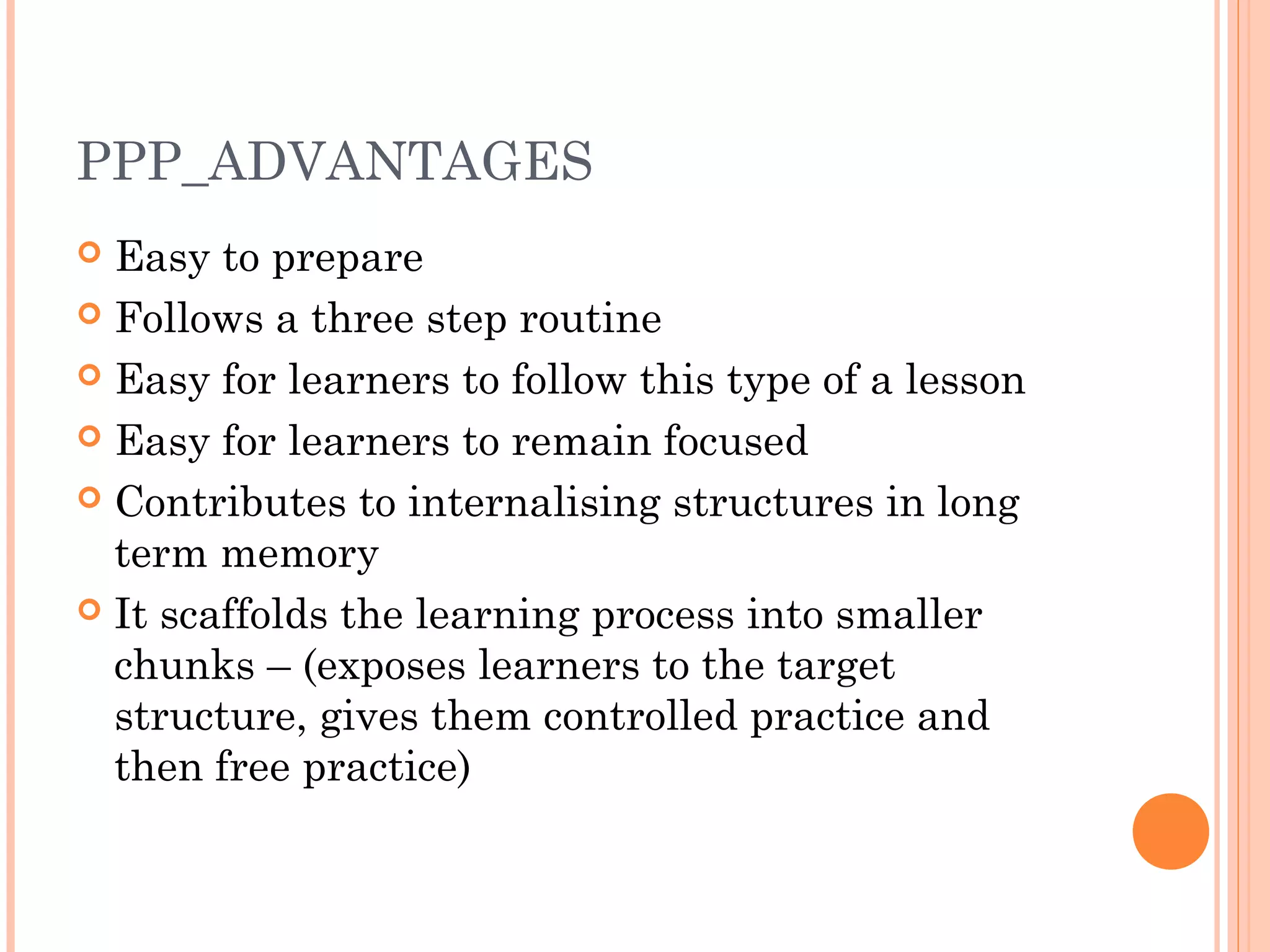
PPP_ADVANTAGES
Easy toprepare
Follows a three step routine
Easy for learners to follow this type of a lesson
Easy for learners to remain focused
Contributes to internalising structures in long
term memory
It scaffolds the learning process into smaller
chunks – (exposes learners to the target
structure, gives them controlled practice and
then free practice)
3.
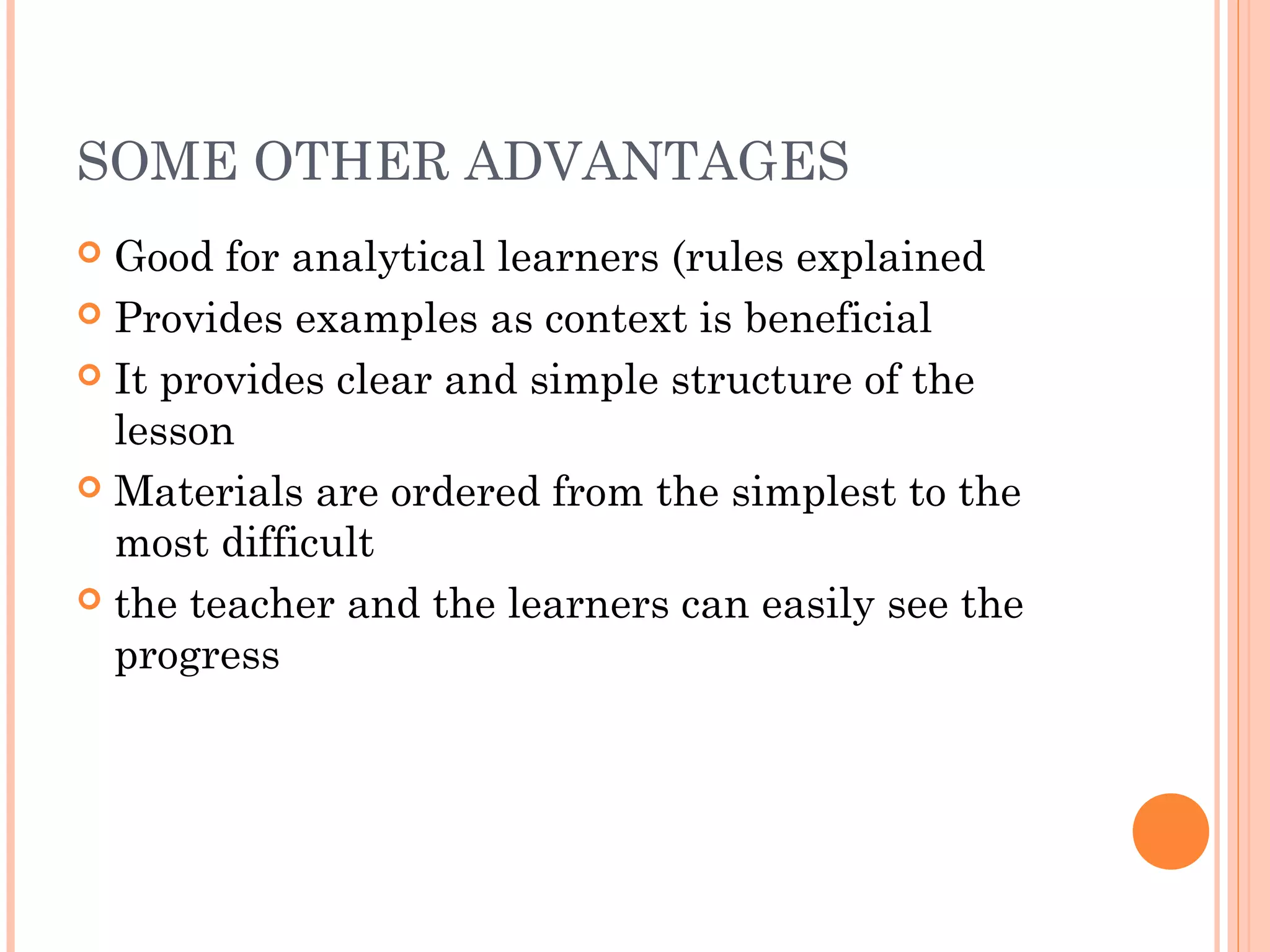
SOME OTHER ADVANTAGES
Good for analytical learners (rules explained
Provides examples as context is beneficial
It provides clear and simple structure of the
lesson
Materials are ordered from the simplest to the
most difficult
the teacher and the learners can easily see the
progress
4.
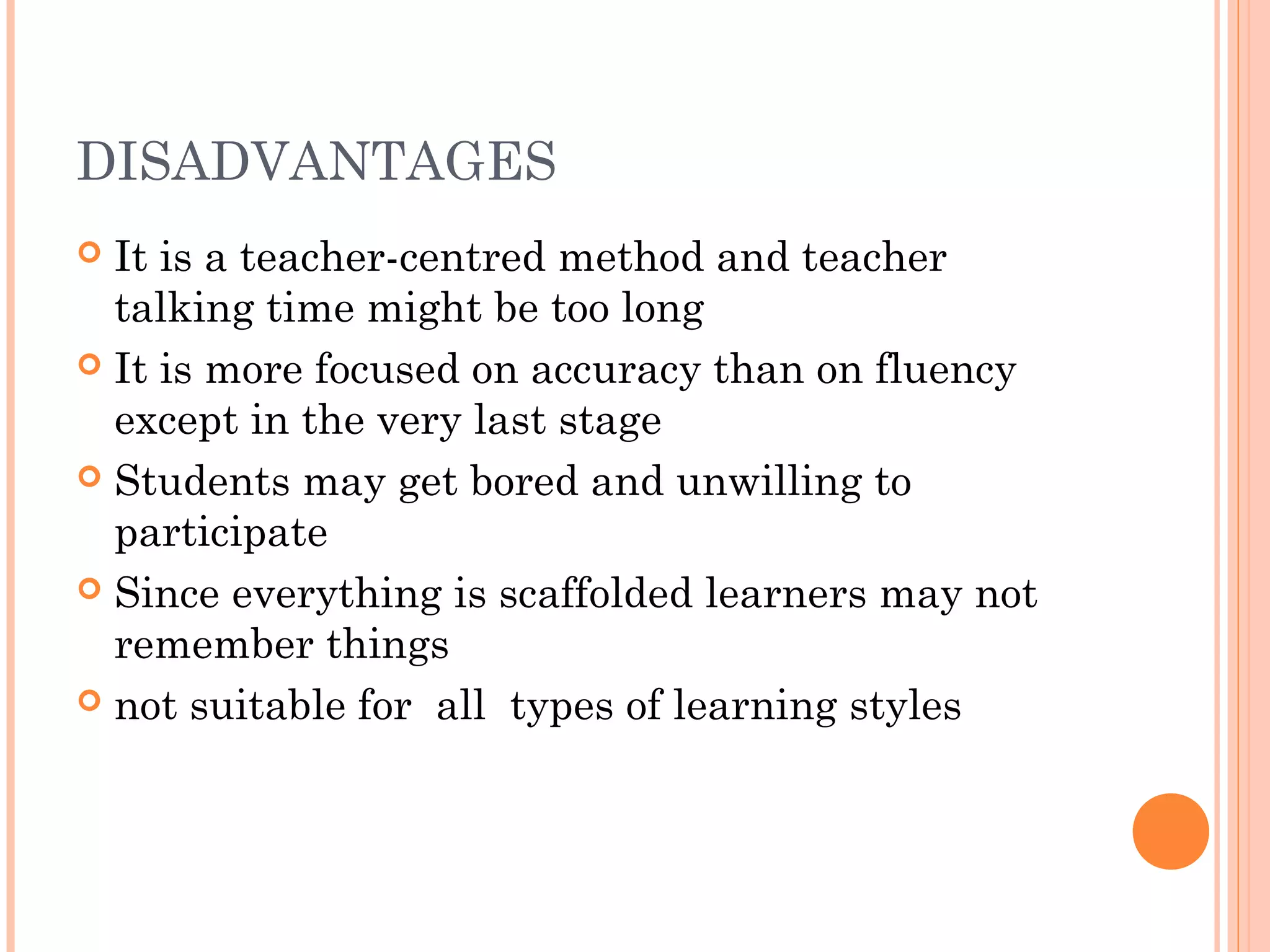
DISADVANTAGES
It isa teacher-centred method and teacher
talking time might be too long
It is more focused on accuracy than on fluency
except in the very last stage
Students may get bored and unwilling to
participate
Since everything is scaffolded learners may not
remember things
not suitable for all types of learning styles
TPR- TOTAL PHYSICALRESPONSE
Advantages:
Fun and enjoyable for learners, especially for
young learners
It keeps learners attention
It is easy to prepare
Learners are active, so it is good for kinaesthetic
learners
Easy to prepare and good to be used for a warm
up and break activities
Enables learners practice language in a fun and
memorable way
Good to use with action words
7.
TPR- DISADVANTAGES
Studentsmay be excited and can be difficult to
continue with other activities and get learners
focused again
If overused learners might become bored
Learners are not given a chance to be creative in
most cases
Shy students and adults may not want to
participate
May not be useful for all the topics
You need to make sure learners have enough
space for movement
Not suitable for all learning styles
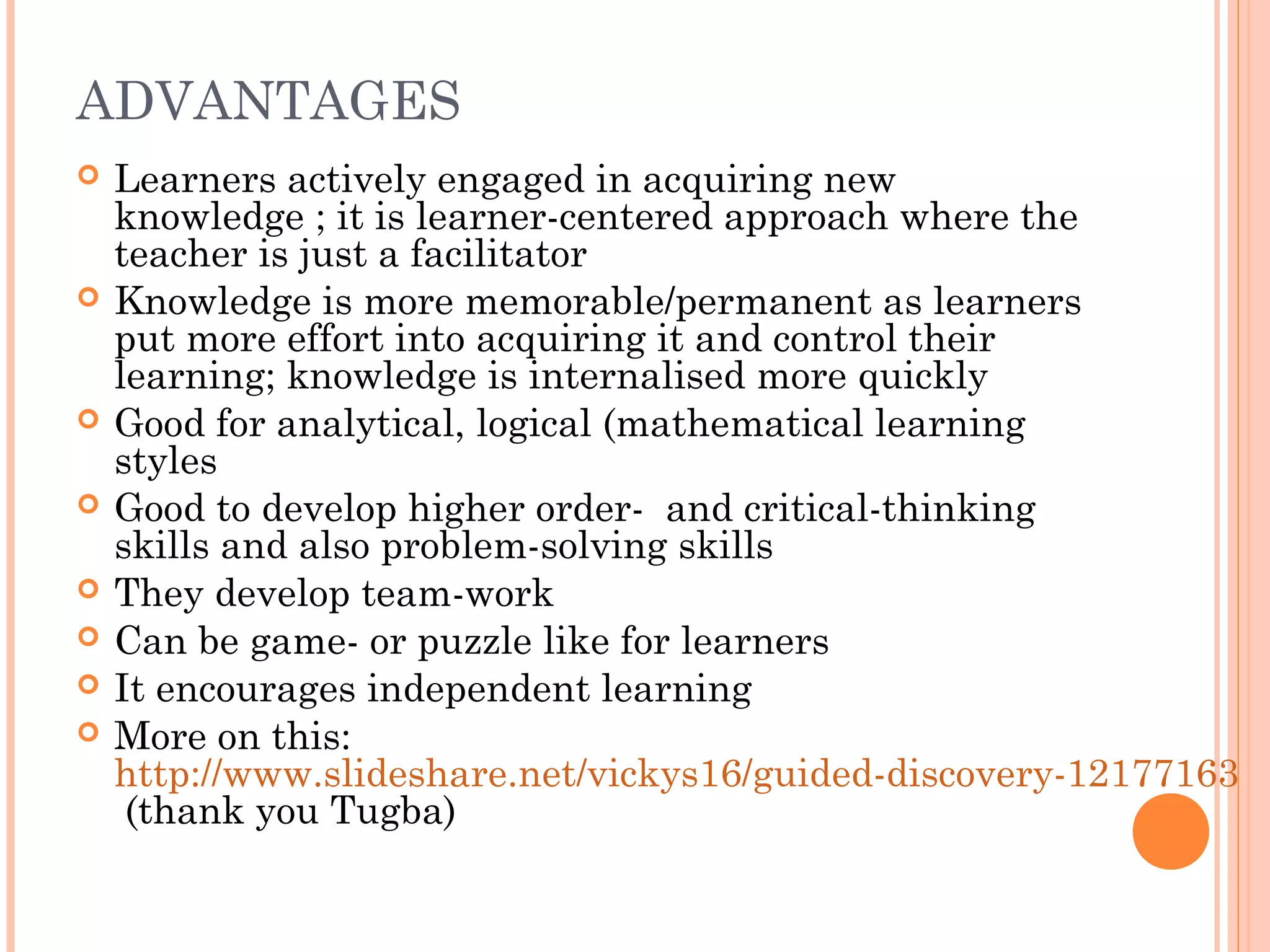
ADVANTAGES
Learners activelyengaged in acquiring new
knowledge ; it is learner-centered approach where the
teacher is just a facilitator
Knowledge is more memorable/permanent as learners
put more effort into acquiring it and control their
learning; knowledge is internalised more quickly
Good for analytical, logical (mathematical learning
styles
Good to develop higher order- and critical-thinking
skills and also problem-solving skills
They develop team-work
Can be game- or puzzle like for learners
It encourages independent learning
More on this:
http://www.slideshare.net/vickys16/guided-discovery-12177163
(thank you Tugba)
10.
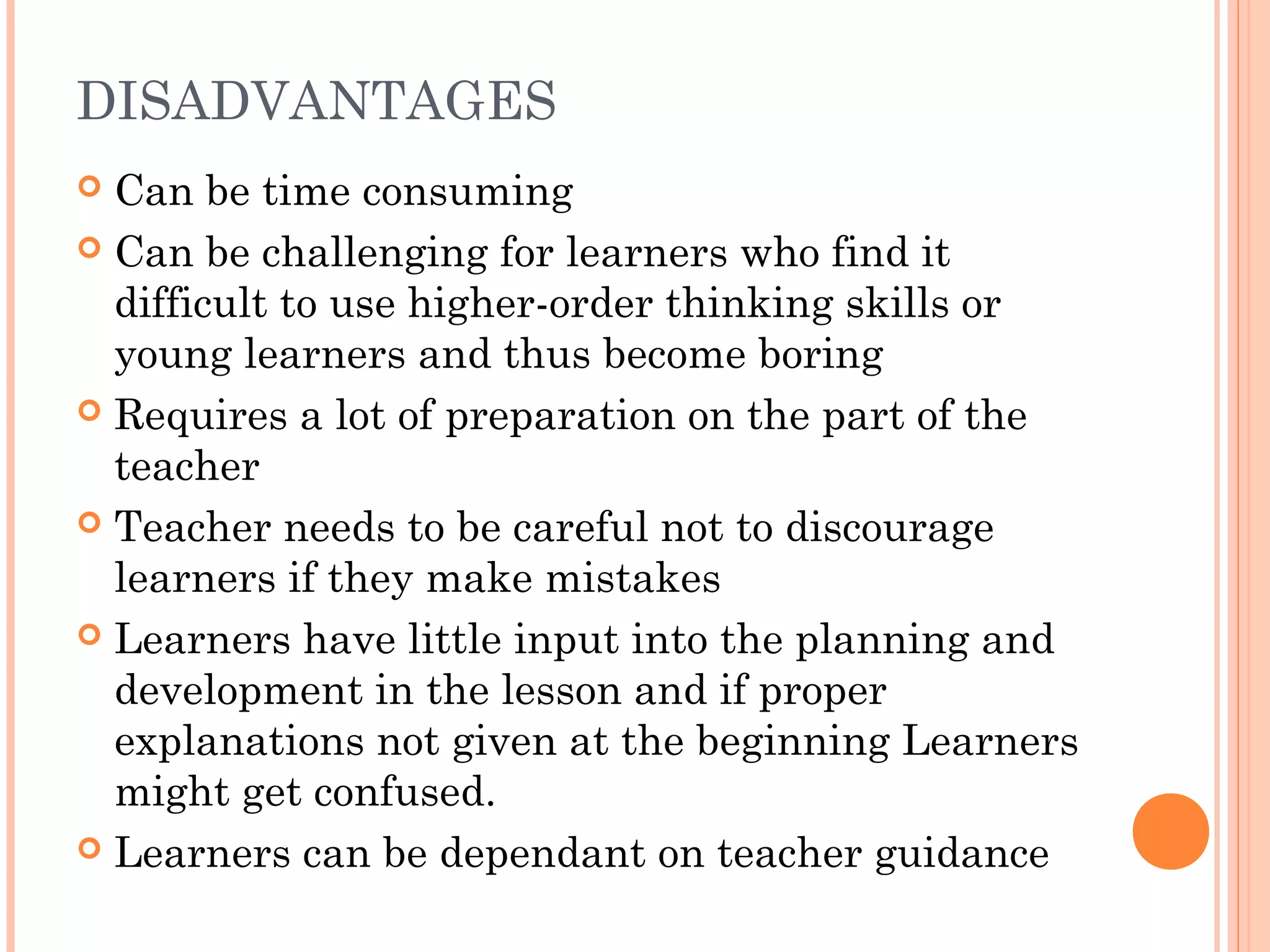
DISADVANTAGES
Can betime consuming
Can be challenging for learners who find it
difficult to use higher-order thinking skills or
young learners and thus become boring
Requires a lot of preparation on the part of the
teacher
Teacher needs to be careful not to discourage
learners if they make mistakes
Learners have little input into the planning and
development in the lesson and if proper
explanations not given at the beginning Learners
might get confused.
Learners can be dependant on teacher guidance
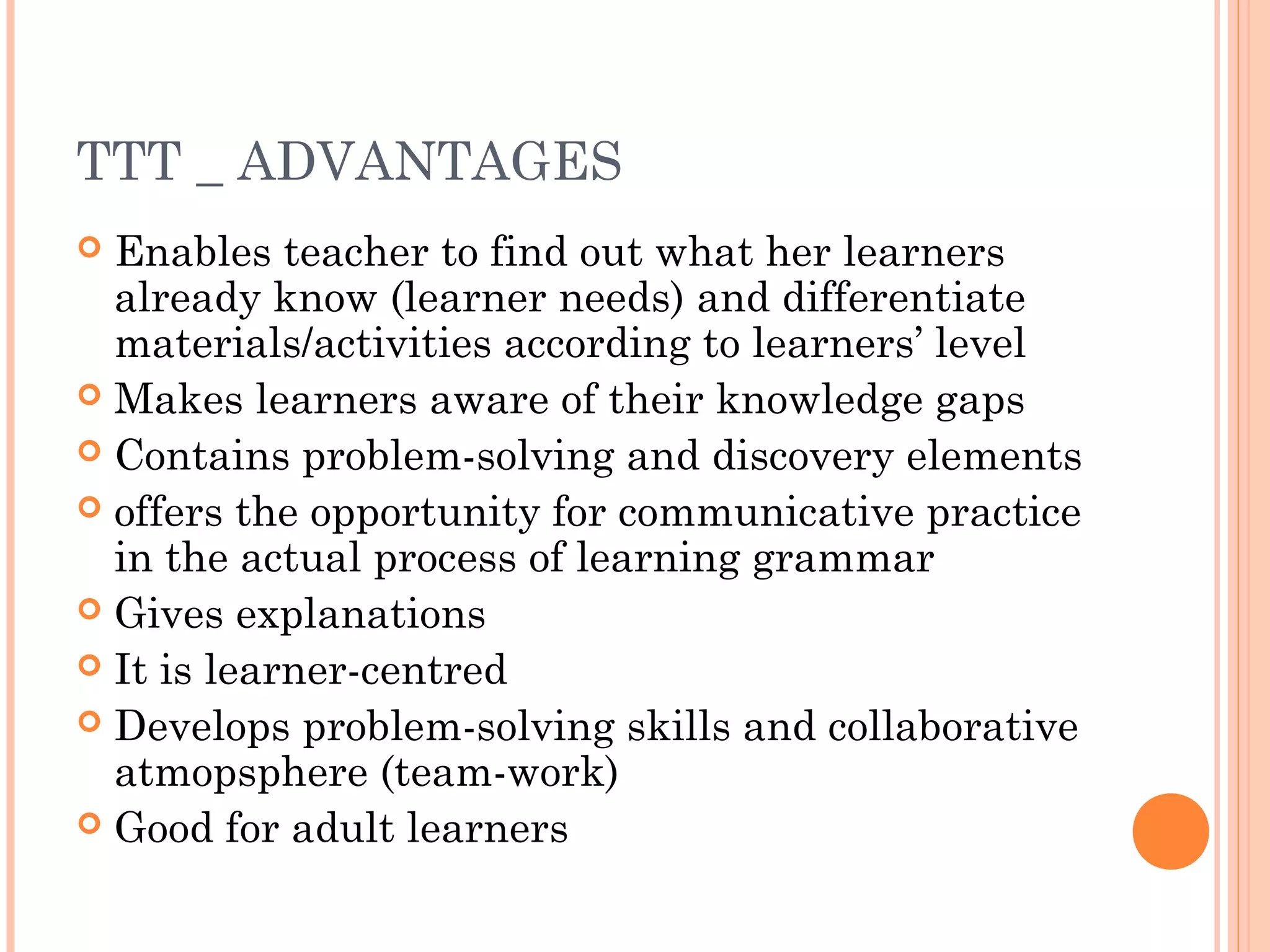
TTT _ ADVANTAGES
Enables teacher to find out what her learners
already know (learner needs) and differentiate
materials/activities according to learners’ level
Makes learners aware of their knowledge gaps
Contains problem-solving and discovery elements
offers the opportunity for communicative practice
in the actual process of learning grammar
Gives explanations
It is learner-centred
Develops problem-solving skills and collaborative
atmopsphere (team-work)
Good for adult learners
13.
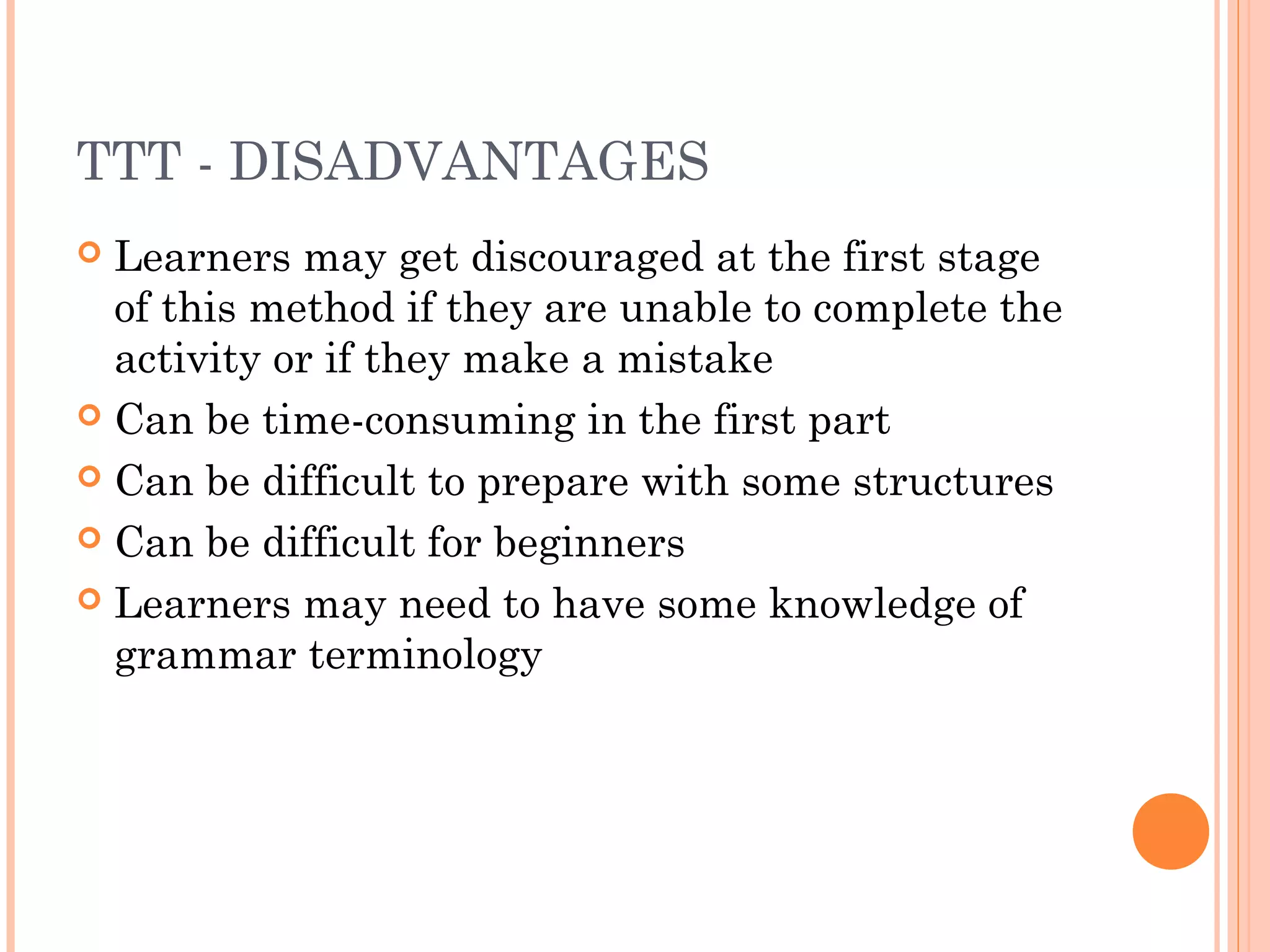
TTT - DISADVANTAGES
Learners may get discouraged at the first stage
of this method if they are unable to complete the
activity or if they make a mistake
Can be time-consuming in the first part
Can be difficult to prepare with some structures
Can be difficult for beginners
Learners may need to have some knowledge of
grammar terminology
14.
TASK BASED LEARNING-
TBL
Advantages and disadvantages
Nuray Gul, Demet, Esra
15.
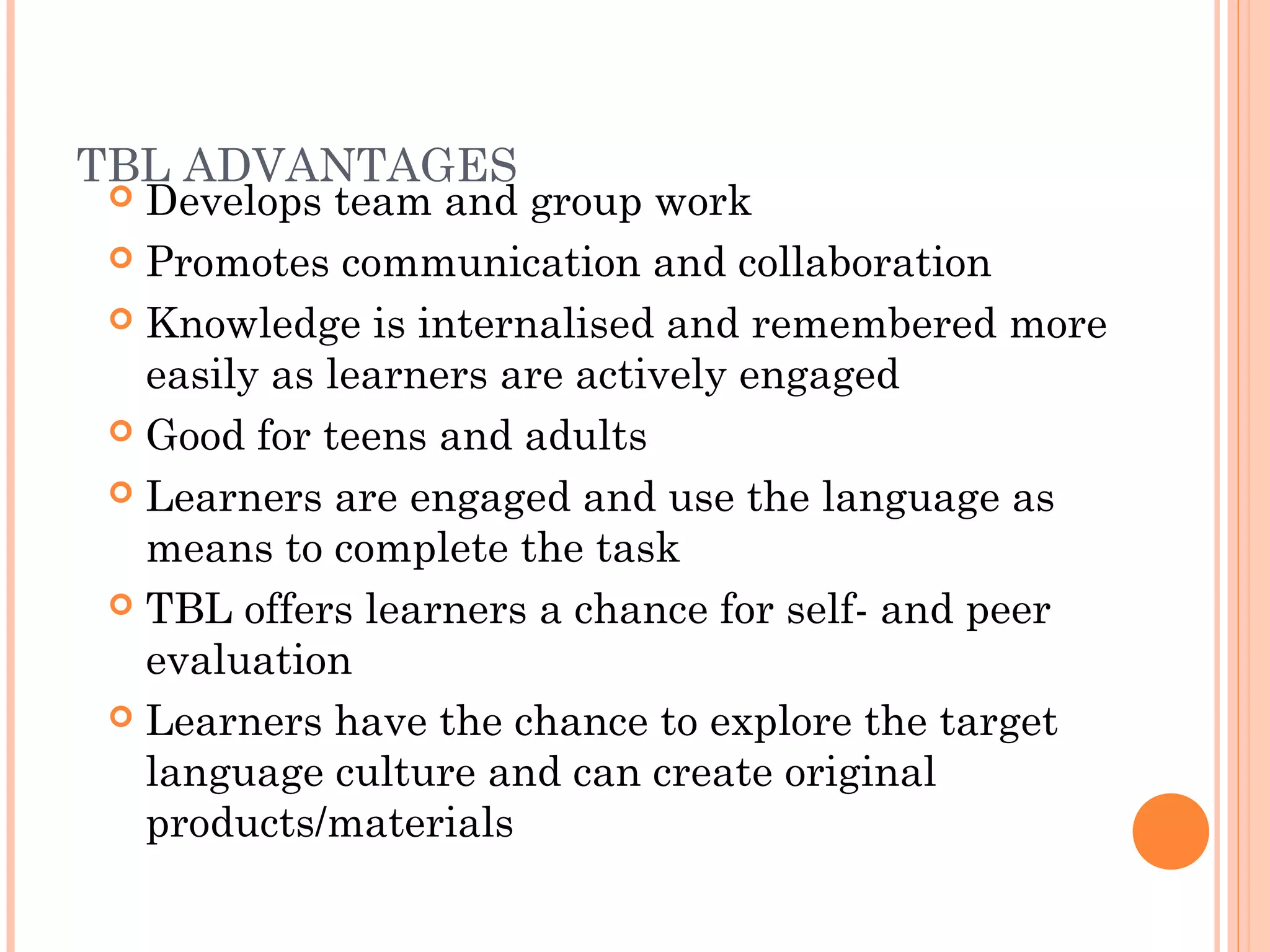
TBL ADVANTAGES
Developsteam and group work
Promotes communication and collaboration
Knowledge is internalised and remembered more
easily as learners are actively engaged
Good for teens and adults
Learners are engaged and use the language as
means to complete the task
TBL offers learners a chance for self- and peer
evaluation
Learners have the chance to explore the target
language culture and can create original
products/materials
16.
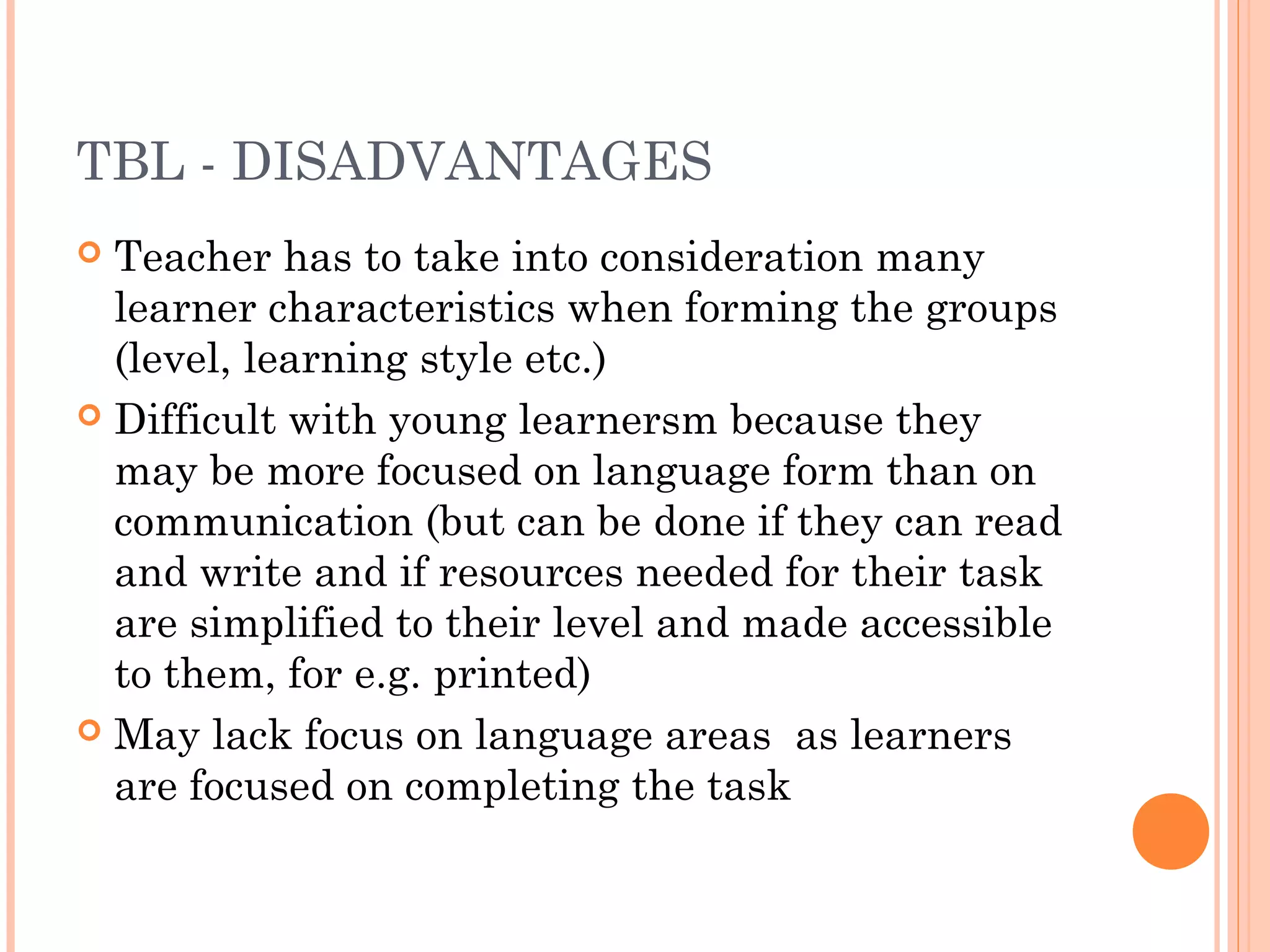
TBL - DISADVANTAGES
Teacher has to take into consideration many
learner characteristics when forming the groups
(level, learning style etc.)
Difficult with young learnersm because they
may be more focused on language form than on
communication (but can be done if they can read
and write and if resources needed for their task
are simplified to their level and made accessible
to them, for e.g. printed)
May lack focus on language areas as learners
are focused on completing the task
17.
TBL - Disadvantages
requires a high level of creativity and initiative
on the part of the teacher.
requires resources beyond the textbooks and
related materials usually found in language
classrooms
May use their mother language instead of the
target language.
Teacher should make sure that work load is
evenly distributed among learners, so that
everyone is active
GTM - ADVANTAGES
Learners can compare their mother language and
the target language, for the very complex rules it
may be helpful for them to understand the
language better.
reading and writing abilities are well trained.
Good for learning vocabulary and grammar
20.
GTM - DISADVANTAGES
interaction is very limited
Communication/speaking and listening skills are
not developed enough
Not suitable for young learners
Learners may find it challenging to find the
meaning of every single word


![Richards teaching-listening-speaking[1]](https://cdn.slidesharecdn.com/ss_thumbnails/richards-teaching-listening-speaking1-130611222232-phpapp01-thumbnail.jpg?width=640&height=640&fit=bounds)


![Grammar traslation method[1] (1)](https://cdn.slidesharecdn.com/ss_thumbnails/grammartraslationmethod11-140219123000-phpapp01-thumbnail.jpg?width=640&height=640&fit=bounds)
![Grammar traslation method[1] (1)](https://cdn.slidesharecdn.com/ss_thumbnails/grammartraslationmethod11-140219142728-phpapp02-thumbnail.jpg?width=640&height=640&fit=bounds)
![Grammar traslation method[1] (1)](https://cdn.slidesharecdn.com/ss_thumbnails/grammartraslationmethod11-140219120003-phpapp02-thumbnail.jpg?width=640&height=640&fit=bounds)


![Lecture_8-Contextualizing_Communicative_Approaches[1].pdf](https://cdn.slidesharecdn.com/ss_thumbnails/lecture8-contextualizingcommunicativeapproaches1-250206102402-7b22d3b4-thumbnail.jpg?width=640&height=640&fit=bounds)


