TEACHING CHILDREN ENGLISH
There are mountains of evidence from recent research into the workings of the child’s brain that early foreign language learning, if done properly, can contribute significantly to the cognitive development of the child. These findings come on top of observations of how  young  children are especially well able to learn a foreign   language.
THE ABILITY TO GRASP MEANING THE ABILITY TO MANAGE WITH LIMITED LINGUISTIC MEANS THE ABILITY TO LEARN INDIRECTLY THE ABILITY TO LEARN TROUGH FANTASY AND IMAGINATION THE ABILITY TO INTERACT AND SPEAK THE ABILITY TO THINK ABOUT THEIR THINKING
What are children like as learners? They  are developing quickly as individuals learn in a variaty of ways, for example, by watching, by listening, by imitating, by doing things are not able to understand grammatical rules and explanations about language try to make sense of situations by making use of non-verbal clues talk in their mother tongue about what they understand and do - this help them learn
What are children like as learners? Can generally imitate the sounds they hear quite accurately and copy the way adults speak are naturally curious love to play and use their imagination are comfortable with routines and enjoy repetition have quite a short attention span and so need variety
How can you as teacher help them ? Make English enjoyable and fun - remember you are influencing their attitude to language learning Don’t worry about mistakes. Be encouraging. Make sure children feel comfortable, and not afraid to take part Use a lot of gestures, actions, pictures to demonstrate what you mean Talk a lot to them in English, especially about things they can see Play games, sing songs, say rhymes and chants together
How can you as teacher help them ? Tell simple stories in English, using pictures and acting with different voices. Don’t worry when they use their mother tongue. You can answer a mother tongue question in English, and sometimes recast in English what they say in their mother tongue Constantly recycle new language but don’t be afraid to add new things or to use words they won’t know Plan lessons with varied activities, some quiet, some noisy, some sitting, some standing and moving
VERY YOUNG LEARNERS AND YOUNG LEARNERS WHAT ARE THE MAJOR DIFFERENCES ?
Teaching children under 7 Very young learners acquire through hearing and experiencing lots of English, in much the same ways as they acquire their first language learn trough doing things and playing; they are not consciously trying to learn new words or phrases love playing with language sounds, imitating and making funny noises are not able to organize their learning. Often they will not even realize that they are learning a foreign language. They simply see it as having fun!
Teaching children under 7 May not be able to read or write in their mother tongue, so it is important to recycle new words and expressions through talk and play their grammar will develop gradually on its own, provided they hear lots of English and learn to understand a lot of words and phrases.
Teaching children between 7-12 Children from 7 to 12 are learning to read and write in their own language are developing as thinkers understand the difference between the real and the imaginary can plan and organize how best to carry out an activity can work with others and learn from others can be reliable and take responsibility for class activities and routines
When you are teaching 7-12 years old you can encourage them to work meanings out for themselves explain things about language, but only very simple things use a wider range of language input as their model for language use encourage creative writing and help them to experiment with language explain your intentions and ask them to help with organization of activities
TEACHING YOUNG LEARNERS
FIRST LANGUAGE -  SECOND LANGUAGE Knowing how children learn their first language can help us teach them a second language. HOW DO THEY LEARN THEIR FIRST LANGUAGE ?
BABIES Hear voices from the time they were born respond to the voices of their mother, father, or carer listen to a lot of sound play with sounds and practice making sounds begin to associate the sounds with what they can see and understand begin to use language to interact with others and get what they want
YOUNG CHILDREN Say what they hear others saying pick up the accent of those around them will only acquire the language they hear around them need to hear a lot of English look on you - their teacher - as their new carer listen to you and try to make sense of what you say sound like the people they listen to
TEACHING TIPS Class teachers do something different so that everyone knows it’s time for English, e.g. sing a special song wear something special during the lesson, e.g. a badge, a hat... Stand in a different place or arrange the room differently put up a picture or get out toys that children associate with English speak English from the beginning of each lesson (greetings, calling the roll, etc )
EVERYDAY INSTRUCTIONS Get your books and pencils out Move the table back Close the window beside you Put all your things away Turn your chairs round to face the wall chart Open / Close your books etc
TEACHING TIPS  VERY YOUNG LEARNERS introduce English slowly with enjoyable activities support what you say with gestures, actions, movements, and facial expression help the children feel secure by repeating familiar activities repeat in English what children say to you in their mother tongue use a puppet to talk to in English.Tell the children the puppet can only speak English so they have to speak in English to the puppet. If a child speaks in his/her mother tongue to the puppet, you can recast and speak to the puppet. Use drawings and photos tell lots of stories using pictures for support
TEACHING TIPS YOUNG LEARNERS Adapt the approaches you use with VYLs, and in addition explain in mother tongue on the first day why you are using English during English lesson teach the class useful phrases about language use plan for success and a positive exprerience Talk about your own personal experiences, e.g. What you like / dislike. This is like telling stories. And above all, have fun!!
Listen and do - TPR Total Physical Response is when children listen and follow a whole sequence of instructions, doing what the teacher says. The teacher  tells the students what to do uses clear pronunciation and natural intonation helps them understand by gestures or by doing the actions
FOLLOW THE LEADER Teacher : Ok, now get in a line. Peter... You’re here. Now Anna. Now Lara. Ok, now follow me. Come on...round the class. Ok, we’re walking, walking, walking.Now, jumping like a kangoroo, jumping, jumping. Yes. Now flying...like a plane. We’re flying, flying, flying...down again. We’re driving...driving on the bus...driving...
FOLLOW THE LEADER It’s a good activity for very young learners starting to learn English. It’s good fun and they see and understand what to do at the same time. Later, when children are familiar with the activity, they can take turns calling out the instructions to the others.
TPR with clothes vocabulary Teacher : Now... Listen carefully. Now everyone who’s wearing jeans... Stand up. (  Children wearing jeans stand up ) Teacher : Ok. Good. Now... Now, if you are wearing a T-shirt, come up here.
TPR routines   You can use TPR to wake children up if they are feeling sleepy, or let children have a break when they have been concentrating on another activity. Example : an action routine Clap your hands. Slap your legs. Stamp your feet. Snap your fingers...
TPR   - teaching tips The first time you use TPR you can explain in the mother tongue before you start. Do simple actions and say what are you doing. If you have a large class, divide it up into groups depending on the space you have. The group(s) waiting will be watching the activity, so will still be learning.
Listening and performing  miming Miming is more complex than simple TPR activities. TPR involves children doing everything you say. Mime gives the children more freedom to be creative
Listening and performing - miming Give VYLs one instruction at a time. Increase the number of instructions ina sequence as learners progress. Make the activities simpler or more complicated. Use real things can make the mime more realistic. Let children use things they make or bring in.
Listening and responding games Examples of games : 01- RIGHT OR WRONG 02- SIMON SAYS 03- ACTIONS PLEASE 04- DEAD OR ALIVE
Listen and make Listening and making involves children in a more creative process. The children have to make decisions. There is more time to think and comment. There are opprtunities for co-operation between learners. The children have something to take home at the end of the class.
HOW TO PREPARE Prepare what o tell the class about the topic collect the thing you need practice explaning in English what they have to make think of gestures and actions think of things children might say to you in their mother tongue and plan how to recast in English
HOW TO SET UP  Begin by introducing the topic and talking a little about it. Explain tho the class in English ( as far as possible ) and show them what they are going to do or make. Repeat your instructions go round the class while they are working
LISTEN AND MAKE Examples of activities: 01- LISTEN AND COLOR 02- LISTEN AND DRAW 03- LISTEN AND MAKE THINGS  (CARDS, OBJECTS,... )
LISTEN AND MAKE example of an activity - Listen and draw THE WIZARD OF OZ - STORY
The Wizard of Oz  Dorothy lived in Kansas. One day a tornado picked up the house when she and her dog Toto were inside! The house went flying off into the sky.  This is a painting of Dorothy's house by Briana.
Dorothy's house stayed up in the air for a long time. After awhile she got sleepy. She lay down on her bed and went to sleep.  In this picture by Vanessa you can also see Toto curled up at the foot of the bed.
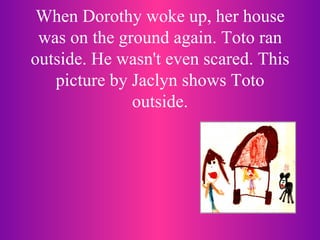
When Dorothy woke up, her house was on the ground again. Toto ran outside. He wasn't even scared. This picture by Jaclyn shows Toto outside.
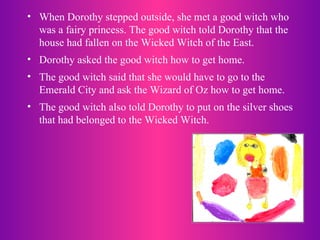
When Dorothy stepped outside, she met a good witch who was a fairy princess. The good witch told Dorothy that the house had fallen on the Wicked Witch of the East.  Dorothy asked the good witch how to get home.  The good witch said that she would have to go to the Emerald City and ask the Wizard of Oz how to get home.  The good witch also told Dorothy to put on the silver shoes that had belonged to the Wicked Witch.
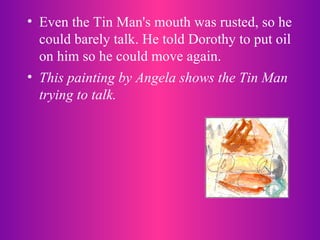
Even the Tin Man's mouth was rusted, so he could barely talk. He told Dorothy to put oil on him so he could move again.  This painting by Angela shows the Tin Man trying to talk.
DEVELOPING LEARNERS’MULTIPLE INTELLIGENCES
LINGUISTIC INTELLIGENCE Systematically developing the ability to decode the meaning of the foreign language through a multiplicity of different kinds of text. Developing the child's sense of hearing by using activities for phonetic and articulatory differentiation.  Encouraging the desire to play with language.  Stimulating the unintentional discovery of linguistic rules.  Offering associative aids to noting vocabulary and phrases.
MUSICAL INTELLIGENCE Encouraging the ability to differentiate rhythms through chants and rhymes.  Encouraging the ability to differentiate rhythms through songs and activity songs. Interpersonal intelligence  Developing fundamental social abilities as an inherent principle: learning to listen to one another, tolerating linguistic mistakes, developing patience etc.  Encouraging empathy through role-playing games. Encouraging the ability to work in a team by assigning co-operative tasks.
KINAESTHETIC INTELLIGENCE Using the whole body when learning the language, e.g. through action stories, activity songs, movement games and dances.  Developing fine motor skills through puzzles, drawing and painting tasks. Visual-spatial intelligence Developing the visual-spatial perception through discovery pictures. Encouraging the visual memory through picture puzzles.
VISUAL-SPATIAL INTELLIGENCE Developing the visual-spatial perception through discovery pictures Encouraging the visual memory through picture puzzles
MATHEMATICAL-LOGICAL INTELLIGENCE Sorting and putting pictures into order.  Establishing logical perception through logical sequences.  Puzzles.
INTERPERSONAL INTELLIGENCE Developing fundamental social abilities as an inherent principle : learning to listen to one another, tolerating linguistic mistakes, developing patience,etc Encouraging empathy through role-playing games. Encouraging the ability to work ina team by assigning co-opearive tasks.
INTRAPERSONAL INTELLIGENCE Establishing the ability to reflect as a basis for one's own speaking.  Prioritising and ranking, based on personal preferences.  Evaluating, making choices on the basis of one's own criteria.

Teaching children english

  • 1.
  • 2.
    There are mountainsof evidence from recent research into the workings of the child’s brain that early foreign language learning, if done properly, can contribute significantly to the cognitive development of the child. These findings come on top of observations of how young children are especially well able to learn a foreign language.
  • 3.
    THE ABILITY TOGRASP MEANING THE ABILITY TO MANAGE WITH LIMITED LINGUISTIC MEANS THE ABILITY TO LEARN INDIRECTLY THE ABILITY TO LEARN TROUGH FANTASY AND IMAGINATION THE ABILITY TO INTERACT AND SPEAK THE ABILITY TO THINK ABOUT THEIR THINKING
  • 4.
    What are childrenlike as learners? They are developing quickly as individuals learn in a variaty of ways, for example, by watching, by listening, by imitating, by doing things are not able to understand grammatical rules and explanations about language try to make sense of situations by making use of non-verbal clues talk in their mother tongue about what they understand and do - this help them learn
  • 5.
    What are childrenlike as learners? Can generally imitate the sounds they hear quite accurately and copy the way adults speak are naturally curious love to play and use their imagination are comfortable with routines and enjoy repetition have quite a short attention span and so need variety
  • 6.
    How can youas teacher help them ? Make English enjoyable and fun - remember you are influencing their attitude to language learning Don’t worry about mistakes. Be encouraging. Make sure children feel comfortable, and not afraid to take part Use a lot of gestures, actions, pictures to demonstrate what you mean Talk a lot to them in English, especially about things they can see Play games, sing songs, say rhymes and chants together
  • 7.
    How can youas teacher help them ? Tell simple stories in English, using pictures and acting with different voices. Don’t worry when they use their mother tongue. You can answer a mother tongue question in English, and sometimes recast in English what they say in their mother tongue Constantly recycle new language but don’t be afraid to add new things or to use words they won’t know Plan lessons with varied activities, some quiet, some noisy, some sitting, some standing and moving
  • 8.
    VERY YOUNG LEARNERSAND YOUNG LEARNERS WHAT ARE THE MAJOR DIFFERENCES ?
  • 9.
    Teaching children under7 Very young learners acquire through hearing and experiencing lots of English, in much the same ways as they acquire their first language learn trough doing things and playing; they are not consciously trying to learn new words or phrases love playing with language sounds, imitating and making funny noises are not able to organize their learning. Often they will not even realize that they are learning a foreign language. They simply see it as having fun!
  • 10.
    Teaching children under7 May not be able to read or write in their mother tongue, so it is important to recycle new words and expressions through talk and play their grammar will develop gradually on its own, provided they hear lots of English and learn to understand a lot of words and phrases.
  • 11.
    Teaching children between7-12 Children from 7 to 12 are learning to read and write in their own language are developing as thinkers understand the difference between the real and the imaginary can plan and organize how best to carry out an activity can work with others and learn from others can be reliable and take responsibility for class activities and routines
  • 12.
    When you areteaching 7-12 years old you can encourage them to work meanings out for themselves explain things about language, but only very simple things use a wider range of language input as their model for language use encourage creative writing and help them to experiment with language explain your intentions and ask them to help with organization of activities
  • 13.
  • 14.
    FIRST LANGUAGE - SECOND LANGUAGE Knowing how children learn their first language can help us teach them a second language. HOW DO THEY LEARN THEIR FIRST LANGUAGE ?
  • 15.
    BABIES Hear voicesfrom the time they were born respond to the voices of their mother, father, or carer listen to a lot of sound play with sounds and practice making sounds begin to associate the sounds with what they can see and understand begin to use language to interact with others and get what they want
  • 16.
    YOUNG CHILDREN Saywhat they hear others saying pick up the accent of those around them will only acquire the language they hear around them need to hear a lot of English look on you - their teacher - as their new carer listen to you and try to make sense of what you say sound like the people they listen to
  • 17.
    TEACHING TIPS Classteachers do something different so that everyone knows it’s time for English, e.g. sing a special song wear something special during the lesson, e.g. a badge, a hat... Stand in a different place or arrange the room differently put up a picture or get out toys that children associate with English speak English from the beginning of each lesson (greetings, calling the roll, etc )
  • 18.
    EVERYDAY INSTRUCTIONS Getyour books and pencils out Move the table back Close the window beside you Put all your things away Turn your chairs round to face the wall chart Open / Close your books etc
  • 19.
    TEACHING TIPS VERY YOUNG LEARNERS introduce English slowly with enjoyable activities support what you say with gestures, actions, movements, and facial expression help the children feel secure by repeating familiar activities repeat in English what children say to you in their mother tongue use a puppet to talk to in English.Tell the children the puppet can only speak English so they have to speak in English to the puppet. If a child speaks in his/her mother tongue to the puppet, you can recast and speak to the puppet. Use drawings and photos tell lots of stories using pictures for support
  • 20.
    TEACHING TIPS YOUNGLEARNERS Adapt the approaches you use with VYLs, and in addition explain in mother tongue on the first day why you are using English during English lesson teach the class useful phrases about language use plan for success and a positive exprerience Talk about your own personal experiences, e.g. What you like / dislike. This is like telling stories. And above all, have fun!!
  • 21.
    Listen and do- TPR Total Physical Response is when children listen and follow a whole sequence of instructions, doing what the teacher says. The teacher tells the students what to do uses clear pronunciation and natural intonation helps them understand by gestures or by doing the actions
  • 22.
    FOLLOW THE LEADERTeacher : Ok, now get in a line. Peter... You’re here. Now Anna. Now Lara. Ok, now follow me. Come on...round the class. Ok, we’re walking, walking, walking.Now, jumping like a kangoroo, jumping, jumping. Yes. Now flying...like a plane. We’re flying, flying, flying...down again. We’re driving...driving on the bus...driving...
  • 23.
    FOLLOW THE LEADERIt’s a good activity for very young learners starting to learn English. It’s good fun and they see and understand what to do at the same time. Later, when children are familiar with the activity, they can take turns calling out the instructions to the others.
  • 24.
    TPR with clothesvocabulary Teacher : Now... Listen carefully. Now everyone who’s wearing jeans... Stand up. ( Children wearing jeans stand up ) Teacher : Ok. Good. Now... Now, if you are wearing a T-shirt, come up here.
  • 25.
    TPR routines You can use TPR to wake children up if they are feeling sleepy, or let children have a break when they have been concentrating on another activity. Example : an action routine Clap your hands. Slap your legs. Stamp your feet. Snap your fingers...
  • 26.
    TPR - teaching tips The first time you use TPR you can explain in the mother tongue before you start. Do simple actions and say what are you doing. If you have a large class, divide it up into groups depending on the space you have. The group(s) waiting will be watching the activity, so will still be learning.
  • 27.
    Listening and performing miming Miming is more complex than simple TPR activities. TPR involves children doing everything you say. Mime gives the children more freedom to be creative
  • 28.
    Listening and performing- miming Give VYLs one instruction at a time. Increase the number of instructions ina sequence as learners progress. Make the activities simpler or more complicated. Use real things can make the mime more realistic. Let children use things they make or bring in.
  • 29.
    Listening and respondinggames Examples of games : 01- RIGHT OR WRONG 02- SIMON SAYS 03- ACTIONS PLEASE 04- DEAD OR ALIVE
  • 30.
    Listen and makeListening and making involves children in a more creative process. The children have to make decisions. There is more time to think and comment. There are opprtunities for co-operation between learners. The children have something to take home at the end of the class.
  • 31.
    HOW TO PREPAREPrepare what o tell the class about the topic collect the thing you need practice explaning in English what they have to make think of gestures and actions think of things children might say to you in their mother tongue and plan how to recast in English
  • 32.
    HOW TO SETUP Begin by introducing the topic and talking a little about it. Explain tho the class in English ( as far as possible ) and show them what they are going to do or make. Repeat your instructions go round the class while they are working
  • 33.
    LISTEN AND MAKEExamples of activities: 01- LISTEN AND COLOR 02- LISTEN AND DRAW 03- LISTEN AND MAKE THINGS (CARDS, OBJECTS,... )
  • 34.
    LISTEN AND MAKEexample of an activity - Listen and draw THE WIZARD OF OZ - STORY
  • 35.
    The Wizard ofOz Dorothy lived in Kansas. One day a tornado picked up the house when she and her dog Toto were inside! The house went flying off into the sky. This is a painting of Dorothy's house by Briana.
  • 36.
    Dorothy's house stayedup in the air for a long time. After awhile she got sleepy. She lay down on her bed and went to sleep. In this picture by Vanessa you can also see Toto curled up at the foot of the bed.
  • 37.
    When Dorothy wokeup, her house was on the ground again. Toto ran outside. He wasn't even scared. This picture by Jaclyn shows Toto outside.
  • 38.
    When Dorothy steppedoutside, she met a good witch who was a fairy princess. The good witch told Dorothy that the house had fallen on the Wicked Witch of the East. Dorothy asked the good witch how to get home. The good witch said that she would have to go to the Emerald City and ask the Wizard of Oz how to get home. The good witch also told Dorothy to put on the silver shoes that had belonged to the Wicked Witch.
  • 39.
    Even the TinMan's mouth was rusted, so he could barely talk. He told Dorothy to put oil on him so he could move again. This painting by Angela shows the Tin Man trying to talk.
  • 40.
  • 41.
    LINGUISTIC INTELLIGENCE Systematicallydeveloping the ability to decode the meaning of the foreign language through a multiplicity of different kinds of text. Developing the child's sense of hearing by using activities for phonetic and articulatory differentiation. Encouraging the desire to play with language. Stimulating the unintentional discovery of linguistic rules. Offering associative aids to noting vocabulary and phrases.
  • 42.
    MUSICAL INTELLIGENCE Encouragingthe ability to differentiate rhythms through chants and rhymes. Encouraging the ability to differentiate rhythms through songs and activity songs. Interpersonal intelligence Developing fundamental social abilities as an inherent principle: learning to listen to one another, tolerating linguistic mistakes, developing patience etc. Encouraging empathy through role-playing games. Encouraging the ability to work in a team by assigning co-operative tasks.
  • 43.
    KINAESTHETIC INTELLIGENCE Usingthe whole body when learning the language, e.g. through action stories, activity songs, movement games and dances. Developing fine motor skills through puzzles, drawing and painting tasks. Visual-spatial intelligence Developing the visual-spatial perception through discovery pictures. Encouraging the visual memory through picture puzzles.
  • 44.
    VISUAL-SPATIAL INTELLIGENCE Developingthe visual-spatial perception through discovery pictures Encouraging the visual memory through picture puzzles
  • 45.
    MATHEMATICAL-LOGICAL INTELLIGENCE Sortingand putting pictures into order. Establishing logical perception through logical sequences. Puzzles.
  • 46.
    INTERPERSONAL INTELLIGENCE Developingfundamental social abilities as an inherent principle : learning to listen to one another, tolerating linguistic mistakes, developing patience,etc Encouraging empathy through role-playing games. Encouraging the ability to work ina team by assigning co-opearive tasks.
  • 47.
    INTRAPERSONAL INTELLIGENCE Establishingthe ability to reflect as a basis for one's own speaking. Prioritising and ranking, based on personal preferences. Evaluating, making choices on the basis of one's own criteria.