Double the Work English Language Learners in the Middle School Glenn Wiebe [email_address] © 2007
Two hours!?  Are you kidding me?
Why is English so hard to learn? The bandage was wound around the wound. The farm was used to produce produce. The dump was so full that it had to refuse more refuse.
They were too close to the door to close it. To help with planting, the farmer taught his sow to sow. I had to subject the subject to a series of tests.
How can I intimate this to my most intimate friend? We must polish the Polish furniture. When shot at, the dove dove into the bushes.
Sticky ideas?
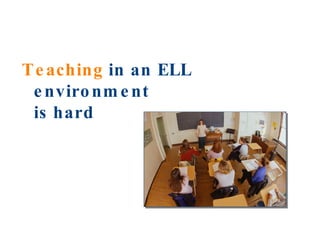
Teaching  in an ELL environment  is hard
Learning  in an ELL environment  is hard
It’s not something extra,  it’s a kid
“ My head hurts all the time. I’m supposed to be learning all of this ‘important’ stuff but I’m just so tired . . . trying to think in Spanish is hard.” Mary Ollenburger Peace Corps volunteer
“ When I'm in school, I don't speak English only if teachers ask me something.  I'm scare of them to laugh at me when I don't pronouns a word right.  With my friends I speak Spanish because I'm more cofidence to talk in Spanish . . .
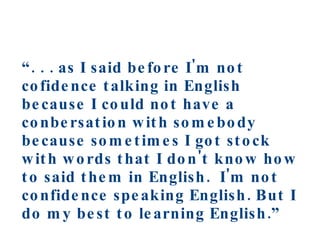
“ . . . as I said before I'm not cofidence talking in English because I could not have a conbersation with somebody because sometimes I got stock with words that I don't know how to said them in English.  I'm not confidence speaking English. But I do my best to learning English.” Secondary ELL student
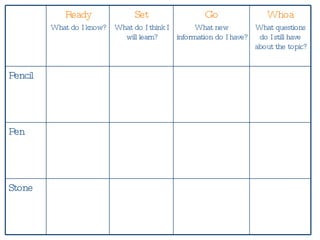
Ready, Set, Go, Whoa!
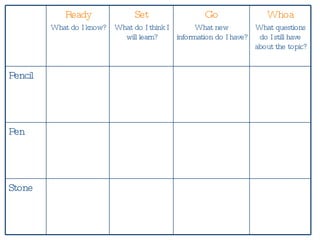
Stone Pen Pencil Whoa What questions do I still have about the topic? Go What new information do I have? Set What do I think I will learn? Ready What do I know?
True / false? Children acquire a second language primarily through imitation and repetition Maintaining the first language in the home will facilitate and enhance the acquisition of English Oral language is a sufficient indication that an ELL student has mastered the new language
An initial “silent period” can benefit an ELL student because it enables the student to process and decode the new language It may take some ELL students five to seven or more years to develop academic language Social cultural factors are important to acculturation but seldom influence language learning
Why worry about it?
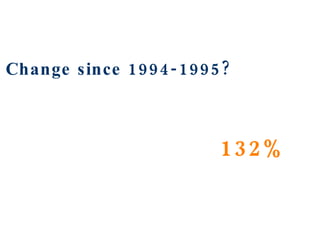
Kansas 2004-2005 George Washington University 2006
Change since 1994-1995? 132%
No easy answers  but . . . there are some “big ideas”
Newcomer  support Welcome & orientation program Language assessment Individualized placement & pacing “ Separate” programs for ELLs with prior education gaps
New teachers  and  ELLs  are a lot alike
Both must adjust  to the school culture Attitudes, beliefs, behaviors, language, relationships Reflect about similarities & differences
Teach  all domains Reading Writing Speaking Listening
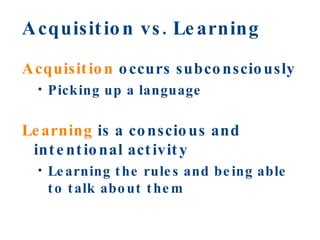
Acquisition vs. Learning Acquisition  occurs subconsciously   Picking up a language Learning  is a conscious and intentional activity Learning the rules and being able to talk about them
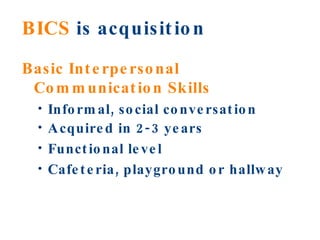
BICS  is acquisition Basic Interpersonal Communication Skills   Informal, social conversation Acquired in 2-3 years Functional level Cafeteria, playground or hallway
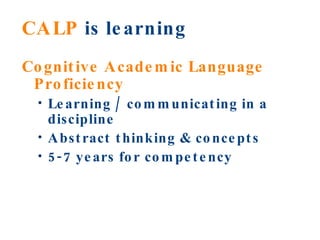
CALP  is learning Cognitive Academic Language Proficiency Learning / communicating in a discipline Abstract thinking & concepts 5-7 years for competency
Respect  diversity Differences in Level of English Culture Economics
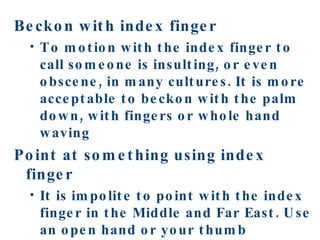
Beckon with index finger To motion with the index finger to call someone is insulting, or even obscene, in many cultures. It is more acceptable to beckon with the palm down, with fingers or whole hand waving Point at something using index finger It is impolite to point with the index finger in the Middle and Far East. Use an open hand or your thumb
Smile In other cultures a smile may be reserved for friends. It is important not to judge students or their parents because they do not smile or if they smile at what we would consider "inappropriate" times Sit with sole of feet or shoe showing In many cultures, you are exposing the dirtiest part of your body & is considered insulting
Form a circle with fingers to indicate “O.K.” To some South Americans and Germans, this gesture is obscene. In Japan, this means “money.” To the French, it means “zero” Pat a student on the head This is very upsetting to students from Asia. The head is the repository of the soul in the Buddhist religion
Pass an item to someone with one hand In parts of Asia, this is very rude. Even a very small item should be passed with two hands. Some consider it rude to pass something with your left hand Wave hand with palm facing outward to greet someone This means “no” to most Europeans.
Table groups read: “Developing Literacy through Culturally Relevant Texts”   or “ Promoting Native Language & Cultural in English-Only Programs”
Jigsaw  the content: Connection - circle Question   - question mark Send a rover  to share connections / get answers
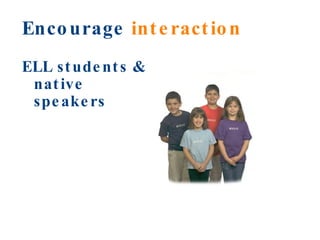
Encourage  interaction ELL students & native speakers
Remember  L-One First language can be key to CALP
Positive  environment Zero-tolerance policies  on harassment & discrimination Non-English cultures & resources in  plain view Minority  teachers School wide  cross-cultural activities
Know the  community Make your school a  “hub” Use the languages   in school communications Non-traditional  office hours
Family Resource Center Connect  families with other families On-site  visits
Continue to  learn Join on-going study group Learn another language
What do you do? What might you try?
Effective instruction Provide opportunities to practice before asking students to read aloud. Provide ample wait time. Smile and laugh with your students. Let students know it’s okay to take risks. Pair students in your class. (Same language or native English speaking peers provide security and invaluable learning experiences). Seat students purposefully (near the teacher or by supportive students).
Create routines Use consistent formats for assignments and worksheets. Keep a daily log or record of assignments. Display homework assignments in the same place each day. Model and allow class time for notebook organization. Require students to use assignment books regularly and check them for accuracy.
Setting realistic expectations Be clear and specific about expectations. Match expectations to students’ language proficiency. Participation increases with students’ language proficiency. Break long-term projects into manageable parts and check frequently on progress. Allow class time throughout to model steps for completion. Provide feedback along the way.
Use multiple modes  Write key points on the board or overhead for students to copy as you speak Use a variety of visuals (posters, charts, and pictures) and real objects when providing information. Use graphic organizers when presenting information Plan multi-sensory activities Attend to learning styles and multiple intelligences Involve students in physical activities

Introducing new material Tell students what they will learn as you present new units. Display unit objectives in the classroom Brainstorm what students already know about a topic Teach new vocabulary and concepts before beginning a unit Use hooks to engage students Relate material to what is already familiar Provide outlines of material and vocabulary prior to viewing activities
Introducing new material Prepare students before assigning reading by   Using anticipation guides Identify what to look for while reading Pointing out big ideas before reading Guide use of Textbooks: Using textbook inventories, tables of contents, glossaries, etc. Skimming for information Examining charts, graphs, and illustrations Bolded or italicized word
Guiding the learner Model and explain a variety of techniques for studying Taking notes Highlighting Making lists and charts Summarizing main ideas Using mnemonic devices Doing research Skimming for information
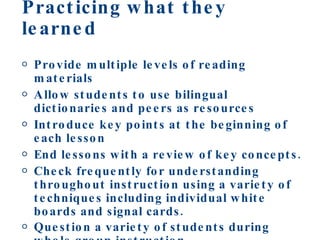
Practicing what they learned Provide multiple levels of reading materials Allow students to use bilingual dictionaries and peers as resources Introduce key points at the beginning of each lesson End lessons with a review of key concepts.  Check frequently for understanding throughout instruction using a variety of techniques including individual white boards and signal cards. Question a variety of students during whole group instruction.
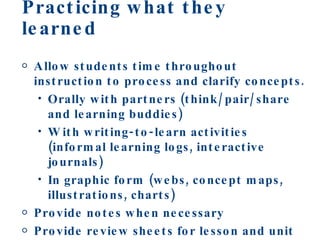
Practicing what they learned Allow students time throughout instruction to process and clarify concepts. Orally with partners (think/pair/share and learning buddies) With writing-to-learn activities (informal learning logs, interactive journals) In graphic form (webs, concept maps, illustrations, charts) Provide notes when necessary Provide review sheets for lesson and unit review
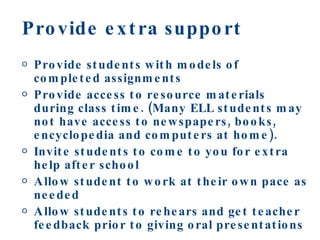
Provide extra support Provide students with models of completed assignments Provide access to resource materials during class time. (Many ELL students may not have access to newspapers, books, encyclopedia and computers at home). Invite students to come to you for extra help after school Allow student to work at their own pace as needed Allow students to rehears and get teacher feedback prior to giving oral presentations
Indian Woods ELL blog < indianwoodsell.wordpress.com >
True / false? Children acquire a second language primarily through imitation and repetition False Maintaining the first language in the home will facilitate and enhance the acquisition of English  True
Oral language is a sufficient indication that an ELL student has mastered the new language  False  An initial “silent period” can benefit an ELL student because it enables the student to process and decode the new language True
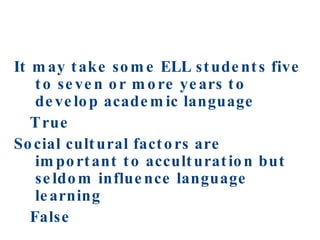
It may take some ELL students five to seven or more years to develop academic language  True  Social cultural factors are important to acculturation but seldom influence language learning False
Stone Pen Pencil Whoa What questions do I still have about the topic? Go What new information do I have? Set What do I think I will learn? Ready What do I know?
“ Teaching doesn’t cause learning, learning causes learning.” Grant Wiggins Understanding by Design
The wind was too strong to wind the sail. After a number of injections my jaw got number. Upon seeing the tear in the painting I shed a tear.
He could lead if he would get the lead out. The buck does funny things when the does are present. A seamstress and a sewer fell down into a sewer line.
I did not object to the object. The insurance was invalid for the invalid. There was a row among the oarsmen about how to row.
The soldier decided to desert his dessert in the desert. Since there is no time like the present, he thought it was time to present the present. A bass was painted on the head of the bass drum.

Double the Work

  • 1.
    Double the WorkEnglish Language Learners in the Middle School Glenn Wiebe [email_address] © 2007
  • 2.
    Two hours!? Are you kidding me?
  • 3.
    Why is Englishso hard to learn? The bandage was wound around the wound. The farm was used to produce produce. The dump was so full that it had to refuse more refuse.
  • 4.
    They were tooclose to the door to close it. To help with planting, the farmer taught his sow to sow. I had to subject the subject to a series of tests.
  • 5.
    How can Iintimate this to my most intimate friend? We must polish the Polish furniture. When shot at, the dove dove into the bushes.
  • 6.
  • 7.
    Teaching inan ELL environment is hard
  • 8.
    Learning inan ELL environment is hard
  • 9.
    It’s not somethingextra, it’s a kid
  • 10.
    “ My headhurts all the time. I’m supposed to be learning all of this ‘important’ stuff but I’m just so tired . . . trying to think in Spanish is hard.” Mary Ollenburger Peace Corps volunteer
  • 11.
    “ When I'min school, I don't speak English only if teachers ask me something.  I'm scare of them to laugh at me when I don't pronouns a word right.  With my friends I speak Spanish because I'm more cofidence to talk in Spanish . . .
  • 12.
    “ . .. as I said before I'm not cofidence talking in English because I could not have a conbersation with somebody because sometimes I got stock with words that I don't know how to said them in English.  I'm not confidence speaking English. But I do my best to learning English.” Secondary ELL student
  • 13.
  • 14.
    Stone Pen PencilWhoa What questions do I still have about the topic? Go What new information do I have? Set What do I think I will learn? Ready What do I know?
  • 15.
    True / false?Children acquire a second language primarily through imitation and repetition Maintaining the first language in the home will facilitate and enhance the acquisition of English Oral language is a sufficient indication that an ELL student has mastered the new language
  • 16.
    An initial “silentperiod” can benefit an ELL student because it enables the student to process and decode the new language It may take some ELL students five to seven or more years to develop academic language Social cultural factors are important to acculturation but seldom influence language learning
  • 17.
  • 18.
    Kansas 2004-2005 GeorgeWashington University 2006
  • 19.
  • 20.
    No easy answers but . . . there are some “big ideas”
  • 21.
    Newcomer supportWelcome & orientation program Language assessment Individualized placement & pacing “ Separate” programs for ELLs with prior education gaps
  • 22.
    New teachers and ELLs are a lot alike
  • 23.
    Both must adjust to the school culture Attitudes, beliefs, behaviors, language, relationships Reflect about similarities & differences
  • 24.
    Teach alldomains Reading Writing Speaking Listening
  • 25.
    Acquisition vs. LearningAcquisition occurs subconsciously Picking up a language Learning is a conscious and intentional activity Learning the rules and being able to talk about them
  • 26.
    BICS isacquisition Basic Interpersonal Communication Skills Informal, social conversation Acquired in 2-3 years Functional level Cafeteria, playground or hallway
  • 27.
    CALP islearning Cognitive Academic Language Proficiency Learning / communicating in a discipline Abstract thinking & concepts 5-7 years for competency
  • 28.
    Respect diversityDifferences in Level of English Culture Economics
  • 29.
    Beckon with indexfinger To motion with the index finger to call someone is insulting, or even obscene, in many cultures. It is more acceptable to beckon with the palm down, with fingers or whole hand waving Point at something using index finger It is impolite to point with the index finger in the Middle and Far East. Use an open hand or your thumb
  • 30.
    Smile In othercultures a smile may be reserved for friends. It is important not to judge students or their parents because they do not smile or if they smile at what we would consider &quot;inappropriate&quot; times Sit with sole of feet or shoe showing In many cultures, you are exposing the dirtiest part of your body & is considered insulting
  • 31.
    Form a circlewith fingers to indicate “O.K.” To some South Americans and Germans, this gesture is obscene. In Japan, this means “money.” To the French, it means “zero” Pat a student on the head This is very upsetting to students from Asia. The head is the repository of the soul in the Buddhist religion
  • 32.
    Pass an itemto someone with one hand In parts of Asia, this is very rude. Even a very small item should be passed with two hands. Some consider it rude to pass something with your left hand Wave hand with palm facing outward to greet someone This means “no” to most Europeans.
  • 33.
    Table groups read:“Developing Literacy through Culturally Relevant Texts” or “ Promoting Native Language & Cultural in English-Only Programs”
  • 34.
    Jigsaw thecontent: Connection - circle Question - question mark Send a rover to share connections / get answers
  • 35.
    Encourage interactionELL students & native speakers
  • 36.
    Remember L-OneFirst language can be key to CALP
  • 37.
    Positive environmentZero-tolerance policies on harassment & discrimination Non-English cultures & resources in plain view Minority teachers School wide cross-cultural activities
  • 38.
    Know the community Make your school a “hub” Use the languages in school communications Non-traditional office hours
  • 39.
    Family Resource CenterConnect families with other families On-site visits
  • 40.
    Continue to learn Join on-going study group Learn another language
  • 41.
    What do youdo? What might you try?
  • 42.
    Effective instruction Provideopportunities to practice before asking students to read aloud. Provide ample wait time. Smile and laugh with your students. Let students know it’s okay to take risks. Pair students in your class. (Same language or native English speaking peers provide security and invaluable learning experiences). Seat students purposefully (near the teacher or by supportive students).
  • 43.
    Create routines Useconsistent formats for assignments and worksheets. Keep a daily log or record of assignments. Display homework assignments in the same place each day. Model and allow class time for notebook organization. Require students to use assignment books regularly and check them for accuracy.
  • 44.
    Setting realistic expectationsBe clear and specific about expectations. Match expectations to students’ language proficiency. Participation increases with students’ language proficiency. Break long-term projects into manageable parts and check frequently on progress. Allow class time throughout to model steps for completion. Provide feedback along the way.
  • 45.
    Use multiple modes Write key points on the board or overhead for students to copy as you speak Use a variety of visuals (posters, charts, and pictures) and real objects when providing information. Use graphic organizers when presenting information Plan multi-sensory activities Attend to learning styles and multiple intelligences Involve students in physical activities
  • 46.
    Introducing new materialTell students what they will learn as you present new units. Display unit objectives in the classroom Brainstorm what students already know about a topic Teach new vocabulary and concepts before beginning a unit Use hooks to engage students Relate material to what is already familiar Provide outlines of material and vocabulary prior to viewing activities
  • 47.
    Introducing new materialPrepare students before assigning reading by Using anticipation guides Identify what to look for while reading Pointing out big ideas before reading Guide use of Textbooks: Using textbook inventories, tables of contents, glossaries, etc. Skimming for information Examining charts, graphs, and illustrations Bolded or italicized word
  • 48.
    Guiding the learnerModel and explain a variety of techniques for studying Taking notes Highlighting Making lists and charts Summarizing main ideas Using mnemonic devices Doing research Skimming for information
  • 49.
    Practicing what theylearned Provide multiple levels of reading materials Allow students to use bilingual dictionaries and peers as resources Introduce key points at the beginning of each lesson End lessons with a review of key concepts. Check frequently for understanding throughout instruction using a variety of techniques including individual white boards and signal cards. Question a variety of students during whole group instruction.
  • 50.
    Practicing what theylearned Allow students time throughout instruction to process and clarify concepts. Orally with partners (think/pair/share and learning buddies) With writing-to-learn activities (informal learning logs, interactive journals) In graphic form (webs, concept maps, illustrations, charts) Provide notes when necessary Provide review sheets for lesson and unit review
  • 51.
    Provide extra supportProvide students with models of completed assignments Provide access to resource materials during class time. (Many ELL students may not have access to newspapers, books, encyclopedia and computers at home). Invite students to come to you for extra help after school Allow student to work at their own pace as needed Allow students to rehears and get teacher feedback prior to giving oral presentations
  • 52.
    Indian Woods ELLblog < indianwoodsell.wordpress.com >
  • 53.
    True / false?Children acquire a second language primarily through imitation and repetition False Maintaining the first language in the home will facilitate and enhance the acquisition of English True
  • 54.
    Oral language isa sufficient indication that an ELL student has mastered the new language False An initial “silent period” can benefit an ELL student because it enables the student to process and decode the new language True
  • 55.
    It may takesome ELL students five to seven or more years to develop academic language True Social cultural factors are important to acculturation but seldom influence language learning False
  • 56.
    Stone Pen PencilWhoa What questions do I still have about the topic? Go What new information do I have? Set What do I think I will learn? Ready What do I know?
  • 57.
    “ Teaching doesn’tcause learning, learning causes learning.” Grant Wiggins Understanding by Design
  • 58.
    The wind wastoo strong to wind the sail. After a number of injections my jaw got number. Upon seeing the tear in the painting I shed a tear.
  • 59.
    He could leadif he would get the lead out. The buck does funny things when the does are present. A seamstress and a sewer fell down into a sewer line.
  • 60.
    I did notobject to the object. The insurance was invalid for the invalid. There was a row among the oarsmen about how to row.
  • 61.
    The soldier decidedto desert his dessert in the desert. Since there is no time like the present, he thought it was time to present the present. A bass was painted on the head of the bass drum.