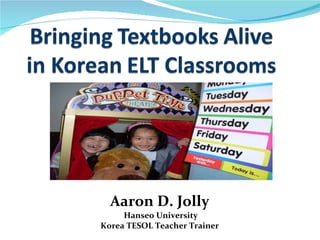



Aaron D. Jolly Hanseo University Korea TESOL Teacher Trainer
 
 
1. What is Motivation? 2. Classroom Management. 3. Classroom English. 4. Textbook Adaptation. 5. Textbook Supplementation.
Who am I? I  resemble  the  thinker , therefore I am.  (Rodin 1902, meets Descarte, 1637)
About me… I  reflect  therefore I teach.  (Descarte 1637 meets Farrell 2008)
- Reflective teaching practice. -Multiple intelligence theory. -Learner training/student centered. -Promoting acquisition over learning -Input based approaches like ER & EL
 
1 -Is the motivation OK in my class? 2. Is my classroom management OK? 3. Am I promoting classroom English? 4.  Am I adapting the textbook enough? 5. Am I supplementing the textbook?
Student responsibility for learning/acquisition Vs. Carrot and stick approach. (Rice cake and stick)
 
1 –Why am I here?  2- Why are my students here? 3- Do I ever ask them this? 4- Do I balance extrinsic v intrinsic? 5-How do I reward & punish or NOT?
 
 
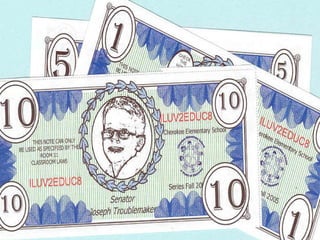
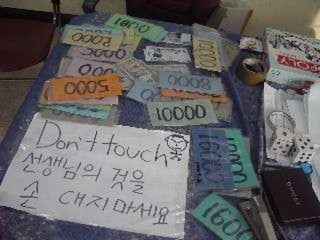
1 –Do the students have roles? 2- Are my teams/groups functioning? 3- Are individuals nurtured? 4- What is the currency in my class? 5- Am I systematic? Am I God-like?
Yes, you may George, but come back quickly!
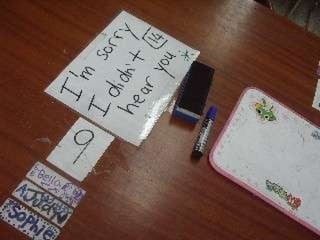
Techniques to encourage development of English in the classroom: Teach, display, repeat, recycle (& model, model, model)! 2. Make learning it fun! 3. Always be firm in enforcing the  rules, noticing success & giving praise!
Discuss  the question above with your partner. Find what is wrong with the textbook sample.
http://www.finchpark.com/courses/links/classroom.htm
 
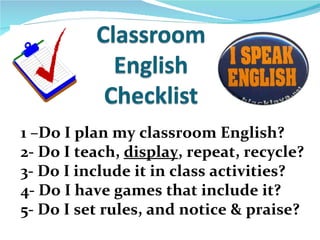
1 –Do I plan my classroom English? 2- Do I teach,  display , repeat, recycle? 3- Do I include it in class activities? 4- Do I have games that include it? 5- Do I set rules, and notice & praise?
Textbook Adaptation Change the color of your textbook!
i.  Using “Entry Points”.  ii.  5 minute “Brain Based” activities iii.  “Multiple Intelligence” lesson plans. iv.  Cooperative Learning activities. v.  “Thinking  Routines” from HGSE. vi.  Speaking frames using PPT
There are 5 kinds of Entry Points : -The Aesthetic.  -The Narrative.    -The Logical/Quantitative.  -The Foundational.  -The Experiential. Gardner, H. (1991),  The Unschooled Mind , New York:  Basic Books .
The entry point through  which learners respond  to  formal and sensory  qualities of a subject  or a work of art. http://brooklynartproject.ning.com/
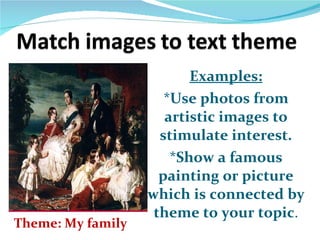
Examples: *Use photos from artistic images to stimulate interest. *Show a famous painting or picture which is connected by theme to your topic . Theme: My family
Is your dad like this?
Use all kinds of pictures What do you see,  think, wonder?
The entry point through  which learners respond  to the  narrative  (story)  elements  of a subject  or work of art.  Theme: My house
 
Remember your audience!   (Especially if you have 5 th -10th graders?) Theme: Mixed schools vs. boys or girls only?
The entry point through  which learners respond  to  aspects  of a subject, or  work of art that invite  deductive  reasoning or  numerical consideration .
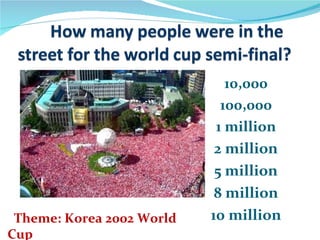
10,000 100,000 1 million 2 million 5 million 8 million 10 million Theme: Korea 2002 World Cup
1. They are using sign language . 2. The girl is probably deaf. 3. The woman is  a teacher/helper.  Theme: Deaf children
The entry point through which learners respond  to the broader concepts,  or  philosophical issues,   raised by a subject  or artwork.
Why is it so? Why do we need English? Why do you love your family? Why do you study so hard? Why do you play soccer? Why is Korea so busy? Why do you drive like that?
The entry point through which learners respond  to a subject  or work  art by  actually doing   something with their  hands or bodies.
*Play different  trust games *Pretend to be blind (for unit on physically challenged kids) Theme: Friendship  ---  Caring/service
Adapted from WIDEWORLD professional development  resources.  http://www.wideworld.pz.harvard.edu/ These examples were excerpted and adapted from: Davis, J. (1996).  The MUSE Book . Cambridge, MA: President and Fellows of Harvard College/Harvard Project Zero
Narrative & experiential
What is brain based learning? http://eduscapes.com/tap/topic70.htm
What’s the most delicious word? What’s the most dangerous word? What’s the ugliest word? What’s the tallest word? What’s the funniest word? What’s your favorite word?
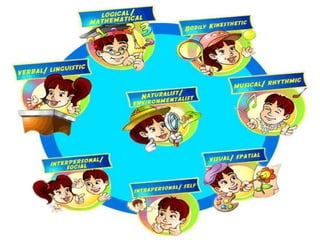
M.I. theory by Dr. Howard Gardner (1983), Professor of Education  at Harvard University.


1. Using  MI inventories , to evaluate students learning styles.  2. Creating a mix of different activities based on an  MI lesson plan schema .
http://www.spannj.org/BasicRights/appendix_b.htm#test
Aaron’s profile from website linked below: Interpersonal, Verbal-Linguistic  strength  90.   Kinesthetic, Intrapersonal strength  80.  Logical-mathematical strength  70 Naturalist strength, Visual-spatial strength  60. Musical strength  50. Existential strength  n/a. http://surfaquarium.com/MI/inventory.htm http://www.igs.net/~cmorris/inventories_on_mi.html
http://www.teach-nology.com/trilogy/
Advantages: *Maximize student talking time. *Maximize interaction. Activity examples:  Think Pair Share, Circle of Speakers,  Circle of Writers, & Snowball.
From George Jacobs’s wonderful website: http://www.georgejacobs.net/index.html
List all the things you know about  ants  ( in 1 minute) Next,  make a list with your partner … next share with the two people next to you or behind you . No duplications please!
http://www.pz.harvard.edu/Research/AERA06ThinkingRoutines.pdf
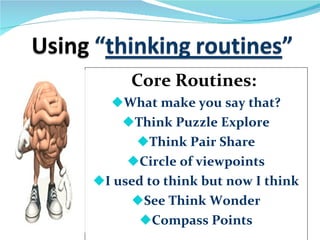
Core Routines:  What make you say that? Think Puzzle Explore Think Pair Share Circle of viewpoints I used to think but now I think See Think Wonder Compass Points
http://pzweb.harvard.edu/vt/VisibleThinking_html_files/03_ThinkingRoutines/03c_CoreRoutines.html
 
See. Think. Wonder This one is so easy to use!
 
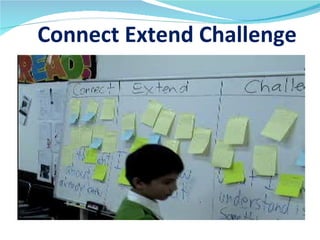
Connect Extend Challenge
Connect Extend Challenge Rachel video
Connect Extend Challenge
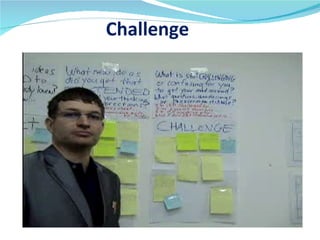
Challenge
For heaven’s sake use  PPT
Yes you can use PPT to  make your own: Word/phrase cards & speaking frames
PPT Speaking Frame Example: Prof. Jolly’s Speaking Frames 2010
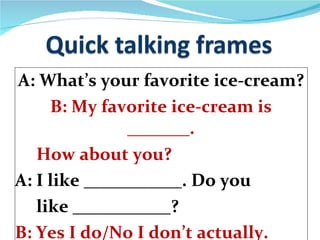
A: What’s your favorite ice-cream? B: My favorite ice-cream is _______. How about you? A: I like ___________. Do you  like ___________? B: Yes I do/No I don’t actually.
Connect How are the ideas connected to  what you already know? I thought about how______. I already knew __________. I remembered _____________.
Extend: What new ideas did you get that  extended or pushed your thinking  in new directions? I got new ideas about ________. I learned that ____________ which made me think that ___________.
Challenge What questions, wonderings or  puzzles do you still have? I am still challenged by _______. I am puzzled about why _______. I’m still wondering why ________. What I don’t fully understand yet  is _____________________.
1 –Do I use entry points to lessons? 2- Do I use “brain based”  cognivities ? 3- Are the MI’s of students factored? 4- Do I use cooperative learning? 5- Do I use thinking routines? 6- Do I use speaking frames?
Part 5:  Textbook Supplementation Use the 1 + 1 approach to add stuff!
i.  Extensive reading ii.  Video & audio materials iii.  Learner journals iv.  Dramatic skits and readings v.  PPT books & read alouds vi.  Online quizzes vii.  Vocabulary cards viii.  Blogs and webchat
i. Extensive reading Extensive   reading vs.  Intensive  reading. 2. Main principle is it  should be easy. 3.  Day & Bamford’s  10  characteristics (1998). 4.  Read a lot  for wide understanding  without using dictionary or translation.
Use Graded Readers! Graded Readers  are “books prepared so that  they stay within strictly limited vocabulary.”  (Nation, 2001)
Use Tar Heel Readers! Make books with pictures. The site  Has a voice which will read them! Also download them as PPT & use in class directly!  
Tar Heel Readers!    Crazy Cat Tricks
a.  Use Real-English.com to watch videos with subtitles, for all levels.  b.  Find video materials on DVD or  that are level appropriate. c.  Use you-tube videos with script  


  By Rob Waring  (distributed in Korea by YBM Sisa)
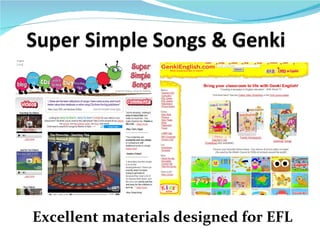
  Excellent materials designed for EFL
 
http://www.finchpark.com/videos/alt_assess/index.htm A few ideas for journal: Language Learning Ideas  Skills Self-Assessment Learning Contract Learning Preferences  Learning Style Inventory  Multiple Intelligences Survey
Create little skits or find adapt things from fables off the Internet Simple tips… 1. Video the role-plays to get better  student motivation. 2. Add an emotion to the role-play. 3. Ask students to make eye-contact.
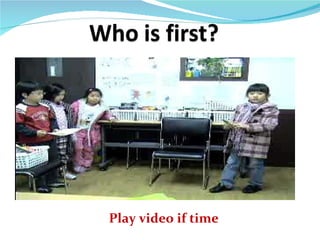
Play video if time
How to Teach English with Technology (Gavin Dudeney and Nicky Hockly 2007)
 
Vocabulary Instruction Many words are  learnt naturally  through repetition in a  variety of contexts , so  NOT  every word needs to be taught by teacher. (ii) Use  word lists  and  word cards.  It’s  very simple- English on one side & Korean  on the other. This is a very efficient way. (iii) Sight words 1 st  ( 200-300 ), then work on first 1000 words, then  2000.
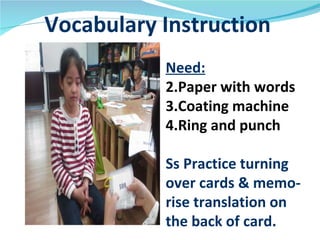
Vocabulary Instruction Need: Paper with words Coating machine Ring and punch Ss Practice turning  over cards & memo- rise translation on  the back of card.
?
1 –Do I have time for anything? 2 – How can I make (more) time? 3-Do I practice the 1 + 1 approach?  4- Is it for in-class only, or out too? 5- How do I assess learning, or do I? 6- What varies? What stays the same?
http://eflclassroom.ning.com/index.php
http://firesidelearning.ning.com/
Websites for YL 1)  http://eflclassroom.ning.com    EFL Classroom 2.0 Lots of resources, games, discussion and tips to using technology in the classroom. (For both students or teachers.)  2)  http://mes-english.com    -  MES English - flashcards, worksheets for young learners 3)  http://bogglesworldesl.com   -  Bogglesworld - lesson plans, activities, for young learners and M.S. / H.S.  4)  http://kindersay.com   - Kindersay -  Full vocabulary suite with slideshows and audio for teacher/student use 5) http://www.de.mingoville.com/content/view/13/29/lang,en/  -  Mingoville -  online learning suite for young learners. Free, great for practice  6)  http://barryfunenglish.com    Click N Learn - online learning suite with flash games.  Free.  
Websites for YL 7)  http://www.voicethread.com   -- Voicethread       Create an account, put up a picture and send your students there to practice speaking and to record messages. Really great for oral speaking practice.  8)  http://tarheelreader.org  – Tar Heel Reader          Make books with pictures. The site has a voice which will read them! Also download them as powerpoint and use in class directly!  9)  http://supersimplesongs.com  – Children’s songs      Great songs and tips for teaching them with young learners!  10)  http://real-english.com  – Real English      Watch videos with subtitles, for all levels. Unique!  11)  http://jr.naver.com/english/list.nhn?id=dongyo&cid1=2   - Jr. Naver  Many songs, chants, stories, games for young learners (Korean based)
 

Chungnam.u.textbook.alive.

  • 1.
    Aaron D. JollyHanseo University Korea TESOL Teacher Trainer
  • 2.
  • 3.
  • 4.
    1. What isMotivation? 2. Classroom Management. 3. Classroom English. 4. Textbook Adaptation. 5. Textbook Supplementation.
  • 5.
    Who am I?I resemble the thinker , therefore I am. (Rodin 1902, meets Descarte, 1637)
  • 6.
    About me… I reflect therefore I teach. (Descarte 1637 meets Farrell 2008)
  • 7.
    - Reflective teachingpractice. -Multiple intelligence theory. -Learner training/student centered. -Promoting acquisition over learning -Input based approaches like ER & EL
  • 8.
  • 9.
    1 -Is themotivation OK in my class? 2. Is my classroom management OK? 3. Am I promoting classroom English? 4. Am I adapting the textbook enough? 5. Am I supplementing the textbook?
  • 10.
    Student responsibility forlearning/acquisition Vs. Carrot and stick approach. (Rice cake and stick)
  • 11.
  • 12.
    1 –Why amI here? 2- Why are my students here? 3- Do I ever ask them this? 4- Do I balance extrinsic v intrinsic? 5-How do I reward & punish or NOT?
  • 13.
  • 14.
  • 15.
    1 –Do thestudents have roles? 2- Are my teams/groups functioning? 3- Are individuals nurtured? 4- What is the currency in my class? 5- Am I systematic? Am I God-like?
  • 16.
    Yes, you mayGeorge, but come back quickly!
  • 17.
    Techniques to encouragedevelopment of English in the classroom: Teach, display, repeat, recycle (& model, model, model)! 2. Make learning it fun! 3. Always be firm in enforcing the rules, noticing success & giving praise!
  • 18.
    Discuss thequestion above with your partner. Find what is wrong with the textbook sample.
  • 19.
  • 20.
  • 21.
  • 22.
    1 –Do Iplan my classroom English? 2- Do I teach, display , repeat, recycle? 3- Do I include it in class activities? 4- Do I have games that include it? 5- Do I set rules, and notice & praise?
  • 23.
    Textbook Adaptation Changethe color of your textbook!
  • 24.
    i. Using“Entry Points”. ii. 5 minute “Brain Based” activities iii. “Multiple Intelligence” lesson plans. iv. Cooperative Learning activities. v. “Thinking Routines” from HGSE. vi. Speaking frames using PPT
  • 25.
    There are 5kinds of Entry Points : -The Aesthetic. -The Narrative. -The Logical/Quantitative. -The Foundational. -The Experiential. Gardner, H. (1991), The Unschooled Mind , New York: Basic Books .
  • 26.
    The entry pointthrough which learners respond to formal and sensory qualities of a subject or a work of art. http://brooklynartproject.ning.com/
  • 27.
    Examples: *Use photosfrom artistic images to stimulate interest. *Show a famous painting or picture which is connected by theme to your topic . Theme: My family
  • 28.
    Is your dadlike this?
  • 29.
    Use all kindsof pictures What do you see, think, wonder?
  • 30.
    The entry pointthrough which learners respond to the narrative (story) elements of a subject or work of art. Theme: My house
  • 31.
  • 32.
    Remember your audience! (Especially if you have 5 th -10th graders?) Theme: Mixed schools vs. boys or girls only?
  • 33.
    The entry pointthrough which learners respond to aspects of a subject, or work of art that invite deductive reasoning or numerical consideration .
  • 34.
    10,000 100,000 1million 2 million 5 million 8 million 10 million Theme: Korea 2002 World Cup
  • 35.
    1. They areusing sign language . 2. The girl is probably deaf. 3. The woman is a teacher/helper. Theme: Deaf children
  • 36.
    The entry pointthrough which learners respond to the broader concepts, or philosophical issues, raised by a subject or artwork.
  • 37.
    Why is itso? Why do we need English? Why do you love your family? Why do you study so hard? Why do you play soccer? Why is Korea so busy? Why do you drive like that?
  • 38.
    The entry pointthrough which learners respond to a subject or work art by actually doing something with their hands or bodies.
  • 39.
    *Play different trust games *Pretend to be blind (for unit on physically challenged kids) Theme: Friendship --- Caring/service
  • 40.
    Adapted from WIDEWORLDprofessional development resources. http://www.wideworld.pz.harvard.edu/ These examples were excerpted and adapted from: Davis, J. (1996). The MUSE Book . Cambridge, MA: President and Fellows of Harvard College/Harvard Project Zero
  • 41.
  • 42.
    What is brainbased learning? http://eduscapes.com/tap/topic70.htm
  • 43.
    What’s the mostdelicious word? What’s the most dangerous word? What’s the ugliest word? What’s the tallest word? What’s the funniest word? What’s your favorite word?
  • 44.
    M.I. theory byDr. Howard Gardner (1983), Professor of Education at Harvard University.
  • 45.
  • 46.
  • 47.
  • 48.
    1. Using MI inventories , to evaluate students learning styles. 2. Creating a mix of different activities based on an MI lesson plan schema .
  • 49.
  • 50.
    Aaron’s profile fromwebsite linked below: Interpersonal, Verbal-Linguistic strength 90. Kinesthetic, Intrapersonal strength 80. Logical-mathematical strength 70 Naturalist strength, Visual-spatial strength 60. Musical strength 50. Existential strength n/a. http://surfaquarium.com/MI/inventory.htm http://www.igs.net/~cmorris/inventories_on_mi.html
  • 51.
  • 52.
    Advantages: *Maximize studenttalking time. *Maximize interaction. Activity examples: Think Pair Share, Circle of Speakers, Circle of Writers, & Snowball.
  • 53.
    From George Jacobs’swonderful website: http://www.georgejacobs.net/index.html
  • 54.
    List all thethings you know about ants ( in 1 minute) Next, make a list with your partner … next share with the two people next to you or behind you . No duplications please!
  • 55.
  • 56.
    Core Routines: What make you say that? Think Puzzle Explore Think Pair Share Circle of viewpoints I used to think but now I think See Think Wonder Compass Points
  • 57.
  • 58.
  • 59.
    See. Think. WonderThis one is so easy to use!
  • 60.
  • 61.
  • 62.
  • 63.
  • 64.
  • 65.
  • 66.
    Yes you canuse PPT to make your own: Word/phrase cards & speaking frames
  • 67.
    PPT Speaking FrameExample: Prof. Jolly’s Speaking Frames 2010
  • 68.
    PPT Speaking FrameExample: Prof. Jolly’s Speaking Frames 2010
  • 69.
    A: What’s yourfavorite ice-cream? B: My favorite ice-cream is _______. How about you? A: I like ___________. Do you like ___________? B: Yes I do/No I don’t actually.
  • 70.
    Connect How arethe ideas connected to what you already know? I thought about how______. I already knew __________. I remembered _____________.
  • 71.
    Extend: What newideas did you get that extended or pushed your thinking in new directions? I got new ideas about ________. I learned that ____________ which made me think that ___________.
  • 72.
    Challenge What questions,wonderings or puzzles do you still have? I am still challenged by _______. I am puzzled about why _______. I’m still wondering why ________. What I don’t fully understand yet is _____________________.
  • 73.
    1 –Do Iuse entry points to lessons? 2- Do I use “brain based” cognivities ? 3- Are the MI’s of students factored? 4- Do I use cooperative learning? 5- Do I use thinking routines? 6- Do I use speaking frames?
  • 74.
    Part 5: Textbook Supplementation Use the 1 + 1 approach to add stuff!
  • 75.
    i. Extensivereading ii. Video & audio materials iii. Learner journals iv. Dramatic skits and readings v. PPT books & read alouds vi. Online quizzes vii. Vocabulary cards viii. Blogs and webchat
  • 76.
    i. Extensive readingExtensive reading vs. Intensive reading. 2. Main principle is it should be easy. 3. Day & Bamford’s 10 characteristics (1998). 4. Read a lot for wide understanding without using dictionary or translation.
  • 77.
    Use Graded Readers!Graded Readers are “books prepared so that they stay within strictly limited vocabulary.” (Nation, 2001)
  • 78.
    Use Tar HeelReaders! Make books with pictures. The site Has a voice which will read them! Also download them as PPT & use in class directly!  
  • 79.
    Tar Heel Readers! Crazy Cat Tricks
  • 80.
    Tar Heel Readers! Crazy Cat Tricks
  • 81.
    Tar Heel Readers! Crazy Cat Tricks
  • 82.
    Tar Heel Readers! Crazy Cat Tricks
  • 83.
    Tar Heel Readers! Crazy Cat Tricks
  • 84.
    Tar Heel Readers! Crazy Cat Tricks
  • 85.
    a. UseReal-English.com to watch videos with subtitles, for all levels. b. Find video materials on DVD or that are level appropriate. c. Use you-tube videos with script  
  • 86.
  • 87.
  • 88.
  • 89.
      By RobWaring (distributed in Korea by YBM Sisa)
  • 90.
      Excellent materialsdesigned for EFL
  • 91.
  • 92.
    http://www.finchpark.com/videos/alt_assess/index.htm A fewideas for journal: Language Learning Ideas Skills Self-Assessment Learning Contract Learning Preferences Learning Style Inventory Multiple Intelligences Survey
  • 93.
    Create little skitsor find adapt things from fables off the Internet Simple tips… 1. Video the role-plays to get better student motivation. 2. Add an emotion to the role-play. 3. Ask students to make eye-contact.
  • 94.
  • 95.
  • 96.
  • 97.
    How to TeachEnglish with Technology (Gavin Dudeney and Nicky Hockly 2007)
  • 98.
  • 99.
    Vocabulary Instruction Manywords are learnt naturally through repetition in a variety of contexts , so NOT every word needs to be taught by teacher. (ii) Use word lists and word cards. It’s very simple- English on one side & Korean on the other. This is a very efficient way. (iii) Sight words 1 st ( 200-300 ), then work on first 1000 words, then 2000.
  • 100.
    Vocabulary Instruction Need:Paper with words Coating machine Ring and punch Ss Practice turning over cards & memo- rise translation on the back of card.
  • 101.
    Vocabulary Instruction Need:Paper with words Coating machine Ring and punch Ss Practice turning over cards & memo- rise translation on the back of card.
  • 102.
  • 103.
    1 –Do Ihave time for anything? 2 – How can I make (more) time? 3-Do I practice the 1 + 1 approach? 4- Is it for in-class only, or out too? 5- How do I assess learning, or do I? 6- What varies? What stays the same?
  • 104.
  • 105.
  • 106.
    Websites for YL1) http://eflclassroom.ning.com    EFL Classroom 2.0 Lots of resources, games, discussion and tips to using technology in the classroom. (For both students or teachers.)  2) http://mes-english.com    -  MES English - flashcards, worksheets for young learners 3) http://bogglesworldesl.com   -  Bogglesworld - lesson plans, activities, for young learners and M.S. / H.S. 4) http://kindersay.com   - Kindersay -  Full vocabulary suite with slideshows and audio for teacher/student use 5) http://www.de.mingoville.com/content/view/13/29/lang,en/ -  Mingoville -  online learning suite for young learners. Free, great for practice  6) http://barryfunenglish.com    Click N Learn - online learning suite with flash games.  Free.  
  • 107.
    Websites for YL7) http://www.voicethread.com   -- Voicethread      Create an account, put up a picture and send your students there to practice speaking and to record messages. Really great for oral speaking practice.  8) http://tarheelreader.org – Tar Heel Reader         Make books with pictures. The site has a voice which will read them! Also download them as powerpoint and use in class directly!  9) http://supersimplesongs.com – Children’s songs     Great songs and tips for teaching them with young learners!  10) http://real-english.com – Real English     Watch videos with subtitles, for all levels. Unique!  11) http://jr.naver.com/english/list.nhn?id=dongyo&cid1=2   - Jr. Naver Many songs, chants, stories, games for young learners (Korean based)
  • 108.

Editor's Notes

  • #4 Adapted for lesson with if_________ … _________ might happen
  • #6 Reflective teaching rocks!!! I’ve been reflecting a lot on the difficulties my students have had with authentic literature.
  • #7 Reflective teaching rocks!!! I’ve been reflecting a lot on the difficulties my students have had with authentic literature.
  • #9 Students and parents praying for success on the university entrance exams.
  • #17 A lot of “Classroom English” is actually teacher modeling language at the right input level for teachers.
  • #18 A lot of “Classroom English” is actually teacher modeling language at the right input level for teachers.
  • #19 Solve the riddle too: It’s not the English that is usually taught in EFL textbooks that’s for sure!
  • #20 Indeed… It’s not the English that is usually taught in EFL textbooks that’s for sure!
  • #27 For example: the color, line, expression, and composition of a painting; the intricate patterns on the surface of a beehive; or the alliteration and meter of a poem.
  • #28 For example: the color, line, expression, and composition of a painting; the intricate patterns on the surface of a beehive; or the alliteration and meter of a poem.
  • #30 Language Research has shown that comprehensible input is crucial, and also without narrative students cannot develop fluency.
  • #31 For example: the legend depicted in a painting, the sequence of events in a period of history, or the story behind the construction of a skyscraper.
  • #33 More about lexiled books later… joke about dark circles…
  • #34 For example: the question of what decisions led to the creation of an art object, the problem of calculating the overall dimensions of an automobile, or the determination of which character in a mystery is the real villain.
  • #35 For example: the question of what decisions led to the creation of an art object, the problem of calculating the overall dimensions of an automobile, or the determination of which character in a mystery is the real villain.
  • #36 For example: the question of what decisions led to the creation of an art object, the problem of calculating the overall dimensions of an automobile, or the determination of which character in a mystery is the real villain.
  • #37 For example: whether and why calculus is thought to be important to society, whether metaphors depict or defy reality, or why a painting of soup cans is considered art.
  • #38 For example: whether and why calculus is thought to be important to society, whether metaphors depict or defy reality, or why a painting of soup cans is considered art.
  • #39 For example: manipulating the same materials used in a work of art, producing a play about the history of a neighborhood, or setting a poem to music.
  • #40 For example: manipulating the same materials used in a work of art, producing a play about the history of a neighborhood, or setting a poem to music.
  • #42 -Think of an idea about an entry point that you might use for this example.
  • #43 Think of activities that challenge your students to think and to be invested in the words, find inventive ways for them to use them and to own them…
  • #45 -It suggests that the traditional notion of intelligence, based on I.Q. testing, is far too limited. Instead, he proposed 7 different intelligences to account for a broader range of human potential in children and adults.
  • #46 What about you? What are you’re strongest?
  • #47 What about you? What are you’re strongest?
  • #57 The core routines are a set of seven or so routines that target different types of thinking from across the modules. These routines are easy to get started with and are commonly found in Visible Thinking teachers' toolkits. Try getting started with with one of these routines. http://www.pz.harvard.edu/vt/VisibleThinking_html_files/03_ThinkingRoutines/03c_CoreRoutines.html
  • #60 Reflective teaching rocks!!! I’ve been reflecting a lot on the difficulties my students have had with authentic literature.
  • #62 Language Research has shown that comprehensible input is crucial, and also without narrative students cannot develop fluency.
  • #63 Language Research has shown that comprehensible input is crucial, and also without narrative students cannot develop fluency.
  • #64 Language Research has shown that comprehensible input is crucial, and also without narrative students cannot develop fluency.
  • #65 Language Research has shown that comprehensible input is crucial, and also without narrative students cannot develop fluency.
  • #66 Think of activities that challenge your students to think and to be invested in the words, find inventive ways for them to use them and to own them…
  • #67 For classroom English
  • #68 Always good to use PPT to keep a repertoire of speaking frames at hand, or plan them into your lesson plan…
  • #69 Always good to use PPT to keep a repertoire of speaking frames at hand, or plan them into your lesson plan…
  • #70 Think of activities that challenge your students to think and to be invested in the words, find inventive ways for them to use them and to own them…
  • #71 Think of activities that challenge your students to think and to be invested in the words, find inventive ways for them to use them and to own them…
  • #72 Think of activities that challenge your students to think and to be invested in the words, find inventive ways for them to use them and to own them…
  • #73 Think of activities that challenge your students to think and to be invested in the words, find inventive ways for them to use them and to own them…
  • #77 Reflective teaching rocks!!! I’ve been reflecting a lot on the difficulties my students have had with authentic literature.
  • #78 The books are the stars!!!
  • #79 The books are the stars!!!
  • #80 The books are the stars!!!
  • #81 The books are the stars!!!
  • #82 The books are the stars!!!
  • #83 The books are the stars!!!
  • #84 The books are the stars!!!
  • #85 The books are the stars!!!
  • #92 Insert – Silly Olympics Video Insert – Reading Videos
  • #95 -Think of an idea about an entry point that you might use for this example.
  • #100 Reflective teaching rocks!!! I’ve been reflecting a lot on the difficulties my students have had with authentic literature.
  • #101 Reflective teaching rocks!!! I’ve been reflecting a lot on the difficulties my students have had with authentic literature.
  • #102 Reflective teaching rocks!!! I’ve been reflecting a lot on the difficulties my students have had with authentic literature.
  • #109 If you beat me you I have to pay you a compliment and vice versa…