Engaging English
Language Learners
     by Rise” Cuellar
Student Engagement
• All students need to be engaged in the
  lesson in a fun and interesting way.
• ELL students especially need this to
  help bring their language to life.
• This is done at the beginning of a new
  theme or topic or as an introduction to a
  lesson.
HOW?


• Short and snappy.
• Not more than a few minutes.
• You want to grab their attention.
Sing songs or chants.
Read poems with visual
       support.
Visual Support Examples
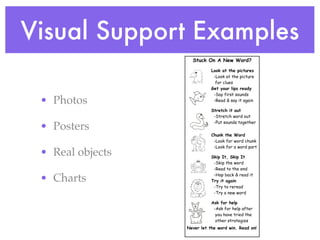
                    Stuck On A New Word?

                             Look at the pictures
                              -Look at the picture
                               for clues
                             Get your lips ready
                              -Say first sounds
 • Photos                     -Read & say it again

                             Stretch it out
                              -Stretch word out
                              -Put sounds together
 • Posters
                             Chunk the Word
                              -Look for word chunk
                              -Look for a word part
 • Real objects              Skip It, Skip It
                              -Skip the word
                              -Read to the end
                              -Hop back & read it
 • Charts                    Try it again
                              -Try to reread
                              -Try a new word

                             Ask for help
                              -Ask for help after
                               you have tried the
                               other strategies
                  Never let the word win. Read on!
Read Short Interesting Books

  • Act out actions.
  • Sketch key vocabulary.
  • Reread the story the next day.
  • Work on a theme or topic with several
    books during the unit.
Selected Passages

• Choose a few pages from a book to grab
  attention
• The pages should contain clear pictures.
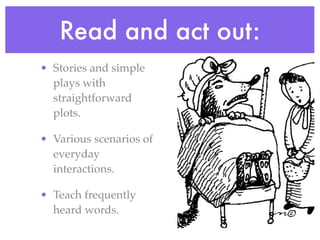
Read and act out:
• Stories and simple
  plays with
  straightforward
  plots.

• Various scenarios of
  everyday
  interactions.

• Teach frequently
  heard words.
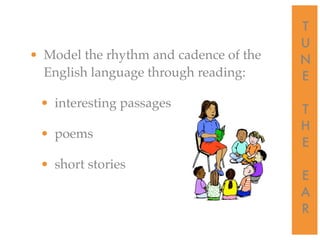
T
                                        U
• Model the rhythm and cadence of the   N
  English language through reading:     E

 • interesting passages                 T
                                        H
 • poems
                                        E
 • short stories
                                        E
                                        A
                                        R
Recreate scenarios or retell
  stories through actions,
 drawings, and sentences
using frames they complete
  with learned words and
          phrases.
Writing

Write sentences
of common
utterances and
read them
aloud.
Write then Read

• Write--One word at
  a time so students
  see and hear words.

• Read--Slowly as a
  whole, then at
  normal speaking
  speed.
Use known works to focus on
 phonological awareness.
      Make this brief and lively!
Language Pattern Songs
 • Use Language
   Pattern Songs to
   engage students at
   the beginning of a
   lesson.

 • These help the
   students to practice
   the vocabulary,
   language patterns
   and cadence.
Sing a New Song

• It tunes the ear to a language pattern.
• Helps to internalize the new language.

Ell presentation

  • 1.
  • 2.
    Student Engagement • Allstudents need to be engaged in the lesson in a fun and interesting way. • ELL students especially need this to help bring their language to life. • This is done at the beginning of a new theme or topic or as an introduction to a lesson.
  • 3.
    HOW? • Short andsnappy. • Not more than a few minutes. • You want to grab their attention.
  • 4.
    Sing songs orchants. Read poems with visual support.
  • 5.
    Visual Support Examples Stuck On A New Word? Look at the pictures -Look at the picture for clues Get your lips ready -Say first sounds • Photos -Read & say it again Stretch it out -Stretch word out -Put sounds together • Posters Chunk the Word -Look for word chunk -Look for a word part • Real objects Skip It, Skip It -Skip the word -Read to the end -Hop back & read it • Charts Try it again -Try to reread -Try a new word Ask for help -Ask for help after you have tried the other strategies Never let the word win. Read on!
  • 6.
    Read Short InterestingBooks • Act out actions. • Sketch key vocabulary. • Reread the story the next day. • Work on a theme or topic with several books during the unit.
  • 7.
    Selected Passages • Choosea few pages from a book to grab attention • The pages should contain clear pictures.
  • 8.
    Read and actout: • Stories and simple plays with straightforward plots. • Various scenarios of everyday interactions. • Teach frequently heard words.
  • 9.
    T U • Model the rhythm and cadence of the N English language through reading: E • interesting passages T H • poems E • short stories E A R
  • 10.
    Recreate scenarios orretell stories through actions, drawings, and sentences using frames they complete with learned words and phrases.
  • 11.
  • 12.
    Write then Read •Write--One word at a time so students see and hear words. • Read--Slowly as a whole, then at normal speaking speed.
  • 13.
    Use known worksto focus on phonological awareness. Make this brief and lively!
  • 14.
    Language Pattern Songs • Use Language Pattern Songs to engage students at the beginning of a lesson. • These help the students to practice the vocabulary, language patterns and cadence.
  • 15.
    Sing a NewSong • It tunes the ear to a language pattern. • Helps to internalize the new language.