VC Dimension in Machine Learning
Dr. Varun Kumar
Dr. Varun Kumar Lecture 18 1 / 10
Outlines
1 General Classification Problem
2 Usage of VC dimension in ML
3 Introduction to Vapnik-Chervonenkis (VC) Dimension
4 How to Determine VC Dimension for a Given Classifier or Hypothesis?
5 References
Dr. Varun Kumar Lecture 18 2 / 10
General classification problem
1 Always look for test error along with the training error.
2 Improving on training error does not improve the test error.
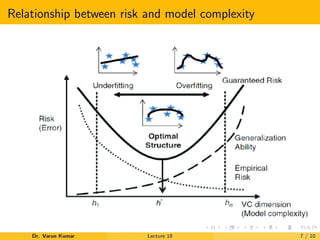
3 Increase in machine capacity may give the poor performance.
Is there any equation that relates the training and test error ?
Dr. Varun Kumar Lecture 18 3 / 10
Usage of VC dimension in ML
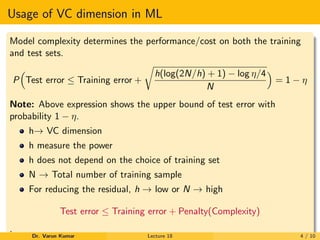
Model complexity determines the performance/cost on both the training
and test sets.
P

Test error ≤ Training error +
r
h(log(2N/h) + 1) − log η/4
N

= 1 − η
Note: Above expression shows the upper bound of test error with
probability 1 − η.
h→ VC dimension
h measure the power
h does not depend on the choice of training set
N → Total number of training sample
For reducing the residual, h → low or N → high
Test error ≤ Training error + Penalty(Complexity)
.
Dr. Varun Kumar Lecture 18 4 / 10
Continued–
⇒ Let us our training data are iid from some distribution fX (x).
⇒ Types of risk
(i) Risk R(θ)→ Long term observation→ Test observation
R(θ) = Test error = E[δ(c 6= ĉ(x; θ))]
(ii) Empirical risk Remp
(θ)→ Finite sample observation→ Training
observation
Remp
(θ) = Training error =
1
m
X
i
[δ(c(i)
6= ĉ(i)
(x; θ))]
Dr. Varun Kumar Lecture 18 5 / 10
Introduction to Vapnik-Chervonenkis (VC) Dimension
Key features:
⇒ VC dimension is a measure of the capacity (complexity, expressive
power, richness, or flexibility) of a set of functions.
⇒ It learns by a statistical binary classification algorithm.
⇒ It is defined as the cardinality of the largest set of points that the
algorithm can shatter.
Cardinality refers to the size of set. Ex- A = {1, 4, 6}, cardinality
|A| = 3
⇒ The capacity of a classification model is related to how complicated it
can be.→ Overfitting
VC dimension of a set-family
Let H be a set family (a set of sets) and C a set.
H ∩ C := {h ∩ C | h ∈ H}.
Dr. Varun Kumar Lecture 18 6 / 10
Relationship between risk and model complexity
Dr. Varun Kumar Lecture 18 7 / 10
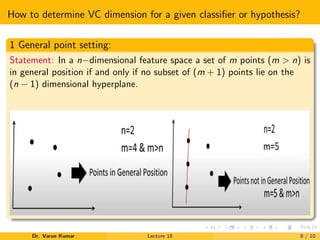
How to determine VC dimension for a given classifier or hypothesis?
1 General point setting:
Statement: In a n−dimensional feature space a set of m points (m  n) is
in general position if and only if no subset of (m + 1) points lie on the
(n − 1) dimensional hyperplane.
Dr. Varun Kumar Lecture 18 8 / 10
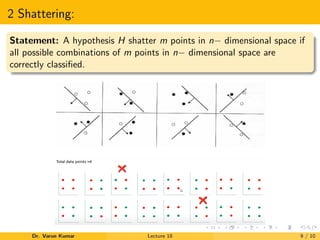
2 Shattering:
Statement: A hypothesis H shatter m points in n− dimensional space if
all possible combinations of m points in n− dimensional space are
correctly classified.
Dr. Varun Kumar Lecture 18 9 / 10
References
E. Alpaydin, Introduction to machine learning. MIT press, 2020.
T. M. Mitchell, The discipline of machine learning. Carnegie Mellon University,
School of Computer Science, Machine Learning , 2006, vol. 9.
J. Grus, Data science from scratch: first principles with python. O’Reilly Media,
2019.
Dr. Varun Kumar Lecture 18 10 / 10

Vc dimension in Machine Learning

  • 1.
    VC Dimension inMachine Learning Dr. Varun Kumar Dr. Varun Kumar Lecture 18 1 / 10
  • 2.
    Outlines 1 General ClassificationProblem 2 Usage of VC dimension in ML 3 Introduction to Vapnik-Chervonenkis (VC) Dimension 4 How to Determine VC Dimension for a Given Classifier or Hypothesis? 5 References Dr. Varun Kumar Lecture 18 2 / 10
  • 3.
    General classification problem 1Always look for test error along with the training error. 2 Improving on training error does not improve the test error. 3 Increase in machine capacity may give the poor performance. Is there any equation that relates the training and test error ? Dr. Varun Kumar Lecture 18 3 / 10
  • 4.
    Usage of VCdimension in ML Model complexity determines the performance/cost on both the training and test sets. P Test error ≤ Training error + r h(log(2N/h) + 1) − log η/4 N = 1 − η Note: Above expression shows the upper bound of test error with probability 1 − η. h→ VC dimension h measure the power h does not depend on the choice of training set N → Total number of training sample For reducing the residual, h → low or N → high Test error ≤ Training error + Penalty(Complexity) . Dr. Varun Kumar Lecture 18 4 / 10
  • 5.
    Continued– ⇒ Let usour training data are iid from some distribution fX (x). ⇒ Types of risk (i) Risk R(θ)→ Long term observation→ Test observation R(θ) = Test error = E[δ(c 6= ĉ(x; θ))] (ii) Empirical risk Remp (θ)→ Finite sample observation→ Training observation Remp (θ) = Training error = 1 m X i [δ(c(i) 6= ĉ(i) (x; θ))] Dr. Varun Kumar Lecture 18 5 / 10
  • 6.
    Introduction to Vapnik-Chervonenkis(VC) Dimension Key features: ⇒ VC dimension is a measure of the capacity (complexity, expressive power, richness, or flexibility) of a set of functions. ⇒ It learns by a statistical binary classification algorithm. ⇒ It is defined as the cardinality of the largest set of points that the algorithm can shatter. Cardinality refers to the size of set. Ex- A = {1, 4, 6}, cardinality |A| = 3 ⇒ The capacity of a classification model is related to how complicated it can be.→ Overfitting VC dimension of a set-family Let H be a set family (a set of sets) and C a set. H ∩ C := {h ∩ C | h ∈ H}. Dr. Varun Kumar Lecture 18 6 / 10
  • 7.
    Relationship between riskand model complexity Dr. Varun Kumar Lecture 18 7 / 10
  • 8.
    How to determineVC dimension for a given classifier or hypothesis? 1 General point setting: Statement: In a n−dimensional feature space a set of m points (m n) is in general position if and only if no subset of (m + 1) points lie on the (n − 1) dimensional hyperplane. Dr. Varun Kumar Lecture 18 8 / 10
  • 9.
    2 Shattering: Statement: Ahypothesis H shatter m points in n− dimensional space if all possible combinations of m points in n− dimensional space are correctly classified. Dr. Varun Kumar Lecture 18 9 / 10
  • 10.
    References E. Alpaydin, Introductionto machine learning. MIT press, 2020. T. M. Mitchell, The discipline of machine learning. Carnegie Mellon University, School of Computer Science, Machine Learning , 2006, vol. 9. J. Grus, Data science from scratch: first principles with python. O’Reilly Media, 2019. Dr. Varun Kumar Lecture 18 10 / 10