
Drugs that cause reversible block of nerve conduction
producing transient localized anesthesia without
significantly affecting consciousness.
According to their chemical structure:
 Esters:
Cocanie, Procaine, Benzocaine & Tetracaine
 Amides:
Lidocanie (xylocaine, ligocaine), Prilocaiine,
Mepivacaine & Dibucaine.
According to their solubility & therapeutic
application:
- Soluble Local anesthetics suitable for
injection: Procaine HCl, Lidocaine HCl
- Soluble Local anesthetics used only topically
on the eye: Cocaine HCl
- Local anesthetics of low solubility used as
powders & ointments: Benzocaine
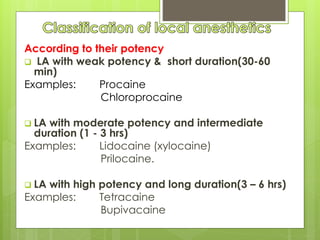
According to their potency
 LA with weak potency & short duration(30-60
min)
Examples: Procaine
Chloroprocaine
 LA with moderate potency and intermediate
duration (1 - 3 hrs)
Examples: Lidocaine (xylocaine)
Prilocaine.
 LA with high potency and long duration(3 – 6 hrs)
Examples: Tetracaine
Bupivacaine
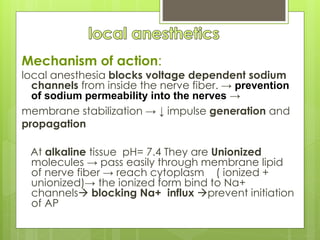
Mechanism of action:
local anesthesia blocks voltage dependent sodium
channels from inside the nerve fiber. → prevention
of sodium permeability into the nerves →
membrane stabilization → ↓ impulse generation and
propagation
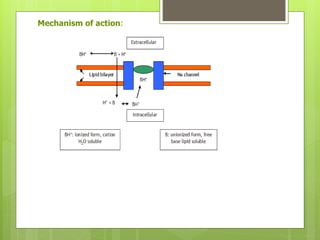
At alkaline tissue pH= 7.4 They are Unionized
molecules → pass easily through membrane lipid
of nerve fiber → reach cytoplasm ( ionized +
unionized)→ the ionized form bind to Na+
channels blocking Na+ influx prevent initiation
of AP
Mechanism of action:
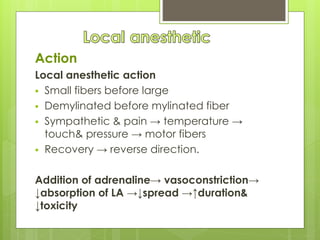
Action
Local anesthetic action
 Small fibers before large
 Demylinated before mylinated fiber
 Sympathetic & pain → temperature →
touch& pressure → motor fibers
 Recovery → reverse direction.
Addition of adrenaline→ vasoconstriction→
↓absorption of LA →↓spread →↑duration&
↓toxicity
Metabolism :
Esters are fastly metabolized by plasma
and tissues esterases. Thus , they have short
duration. They are metabolized to PABA
(cause allergy in some individuals).
Amides are metabolized slowly by liver
microsomal enzymes. Thus , they have
longer duration
Methods of administration and uses
 Surface anesthesia: Direct application of the drug on
accessible surface as skin or mucous membrane
LA with short or intermediate duration are used for this
purpose.
Dosage forms:
Powder , Solutions (spray) , Creams or Ointments.
Benoxinate ( ester LA) used in ophthalmology for corneal
anesthesia because :
 No mydriasis.
 No corneal injury.
Benzocaine used in form of powder or cream on skin
wounds or ulcer, because it is insoluble produces less
systemic toxicity
Methods of administration and uses (cont.)
 Infiltration anesthesia: They are injected directly
into the tissue by S.C injection e.g wound
suturing & cysts removal , Circumcisions .
 Nerve block anesthesia:
The anesthetic in injected close to the
appropriate nerve trunks or peripheral nerve at a
site proximal to where anesthesia is desired. e.g.
dental anesthesia
Methods of administration and uses (cont.)
 Sympathetic block: It is injected around
sympathetic ganglion.
 Para vertebral block: injected around spinal roots
as they emerge from the paravertebral foramina.
 Caudal anesthesia: injected in sacral canal.
Methods of administration and uses (cont.)
 Spinal anesthesia: LA injected in the subarachnoid
space in
the lumbar region.
 Epidural anesthesia Anesthetics injected in epidural
space
Uses
 abdominal, pelvic and lower limbs surgery in
patients unsuitable for general anesthesia.
 Epidural anesthesia is frequently used for painless
childbirth.
Some local anesthetic used for Treatment of cardiac
dysrhythmia e.g. Lidocaine
Side effects
The side effects of LA are usually minimum , because they are
applied Locally. They are combined with a vasoconstrictors
such as adrenaline to decrease systemic absorption. But
some side effects may occur due to :High dose is administered
OR They are injected (mistakenly ) into blood vessels
LA Side effects are
 Restlessness, headache &convulsions followed by respiratory
depression
 hypotension and bradycardia
 Hypersensitivity reaction (with ester type)
 Mucosal irritation (cocaine, dibuacine).
Side effects are more with local anesthetic that are potent and
have long duration
Influencing Factors
Dosage, high dose cause:
 Fast onset
 Longer duration.
 Increase risk of side effects.
Site of administration : high vascularity cause:
 Short duration.
 High risk of side effects.
Lipid solubility of LA: more lipid soluble more effective.
Infections/ inflammations cause:
- low pH
decrease action : LA are bases thus at low pH they
become more ionized . This will reduce their
penetrations across membranes this reduces
their effects.
- Vasodilation
This Increases absorption to blood and increase risk
of side effects and reduce duration of LA.
(LA- Influencing Factors (cont.
Type of solution : Alkalinization of LA solution :
 Less painful.
 Increases non ionization (uncharged)
 Increases diffusion through nerve
 Increases effects.
 Produce fast onset.
Addition of vasoconstrictor ( epinephrine) will:
 Decreases vascular absorption.
 Increases duration.
 Decreases risk of side effects.
 Contraindicated when LA injected around
end arteries ( fingers, toes, ear lobes, nose)
may lead to ischemia and gangrene
Other Methods of producing local
anesthesia
Application of cold:
Cooling decreases excitability and conductivity of
nerve
Ischemia to tissues:
by depriving any tissue from its blood supply e.g. by
tourniquet.
Paralysis of sensory nerve endings or fibers with drugs:
Astringents may lead to local anesthesia by
precipitating nerve proteins e.g. ethyl alcohol injected
perineurally in trigeminal neuralgia
Thank you

2.dental local anesth new

  • 2.
    Drugs that causereversible block of nerve conduction producing transient localized anesthesia without significantly affecting consciousness.
  • 3.
    According to theirchemical structure:  Esters: Cocanie, Procaine, Benzocaine & Tetracaine  Amides: Lidocanie (xylocaine, ligocaine), Prilocaiine, Mepivacaine & Dibucaine.
  • 4.
    According to theirsolubility & therapeutic application: - Soluble Local anesthetics suitable for injection: Procaine HCl, Lidocaine HCl - Soluble Local anesthetics used only topically on the eye: Cocaine HCl - Local anesthetics of low solubility used as powders & ointments: Benzocaine
  • 5.
    According to theirpotency  LA with weak potency & short duration(30-60 min) Examples: Procaine Chloroprocaine  LA with moderate potency and intermediate duration (1 - 3 hrs) Examples: Lidocaine (xylocaine) Prilocaine.  LA with high potency and long duration(3 – 6 hrs) Examples: Tetracaine Bupivacaine
  • 6.
    Mechanism of action: localanesthesia blocks voltage dependent sodium channels from inside the nerve fiber. → prevention of sodium permeability into the nerves → membrane stabilization → ↓ impulse generation and propagation At alkaline tissue pH= 7.4 They are Unionized molecules → pass easily through membrane lipid of nerve fiber → reach cytoplasm ( ionized + unionized)→ the ionized form bind to Na+ channels blocking Na+ influx prevent initiation of AP
  • 7.
  • 8.
    Action Local anesthetic action Small fibers before large  Demylinated before mylinated fiber  Sympathetic & pain → temperature → touch& pressure → motor fibers  Recovery → reverse direction. Addition of adrenaline→ vasoconstriction→ ↓absorption of LA →↓spread →↑duration& ↓toxicity
  • 9.
    Metabolism : Esters arefastly metabolized by plasma and tissues esterases. Thus , they have short duration. They are metabolized to PABA (cause allergy in some individuals). Amides are metabolized slowly by liver microsomal enzymes. Thus , they have longer duration
  • 10.
    Methods of administrationand uses  Surface anesthesia: Direct application of the drug on accessible surface as skin or mucous membrane LA with short or intermediate duration are used for this purpose. Dosage forms: Powder , Solutions (spray) , Creams or Ointments. Benoxinate ( ester LA) used in ophthalmology for corneal anesthesia because :  No mydriasis.  No corneal injury. Benzocaine used in form of powder or cream on skin wounds or ulcer, because it is insoluble produces less systemic toxicity
  • 11.
    Methods of administrationand uses (cont.)  Infiltration anesthesia: They are injected directly into the tissue by S.C injection e.g wound suturing & cysts removal , Circumcisions .  Nerve block anesthesia: The anesthetic in injected close to the appropriate nerve trunks or peripheral nerve at a site proximal to where anesthesia is desired. e.g. dental anesthesia
  • 12.
    Methods of administrationand uses (cont.)  Sympathetic block: It is injected around sympathetic ganglion.  Para vertebral block: injected around spinal roots as they emerge from the paravertebral foramina.  Caudal anesthesia: injected in sacral canal.
  • 13.
    Methods of administrationand uses (cont.)  Spinal anesthesia: LA injected in the subarachnoid space in the lumbar region.  Epidural anesthesia Anesthetics injected in epidural space Uses  abdominal, pelvic and lower limbs surgery in patients unsuitable for general anesthesia.  Epidural anesthesia is frequently used for painless childbirth. Some local anesthetic used for Treatment of cardiac dysrhythmia e.g. Lidocaine
  • 14.
    Side effects The sideeffects of LA are usually minimum , because they are applied Locally. They are combined with a vasoconstrictors such as adrenaline to decrease systemic absorption. But some side effects may occur due to :High dose is administered OR They are injected (mistakenly ) into blood vessels LA Side effects are  Restlessness, headache &convulsions followed by respiratory depression  hypotension and bradycardia  Hypersensitivity reaction (with ester type)  Mucosal irritation (cocaine, dibuacine). Side effects are more with local anesthetic that are potent and have long duration
  • 15.
    Influencing Factors Dosage, highdose cause:  Fast onset  Longer duration.  Increase risk of side effects. Site of administration : high vascularity cause:  Short duration.  High risk of side effects. Lipid solubility of LA: more lipid soluble more effective. Infections/ inflammations cause: - low pH decrease action : LA are bases thus at low pH they become more ionized . This will reduce their penetrations across membranes this reduces their effects. - Vasodilation This Increases absorption to blood and increase risk of side effects and reduce duration of LA.
  • 16.
    (LA- Influencing Factors(cont. Type of solution : Alkalinization of LA solution :  Less painful.  Increases non ionization (uncharged)  Increases diffusion through nerve  Increases effects.  Produce fast onset. Addition of vasoconstrictor ( epinephrine) will:  Decreases vascular absorption.  Increases duration.  Decreases risk of side effects.  Contraindicated when LA injected around end arteries ( fingers, toes, ear lobes, nose) may lead to ischemia and gangrene
  • 17.
    Other Methods ofproducing local anesthesia Application of cold: Cooling decreases excitability and conductivity of nerve Ischemia to tissues: by depriving any tissue from its blood supply e.g. by tourniquet. Paralysis of sensory nerve endings or fibers with drugs: Astringents may lead to local anesthesia by precipitating nerve proteins e.g. ethyl alcohol injected perineurally in trigeminal neuralgia
  • 18.