Synthon approach
Dr. Taj Khan
Dept. of Pharmaceutical Chemistry,
Oriental college of pharmacy
Sanpada, New Mumbai.
Ref: Stuart Warren , Iyer R P
Retrosynthesis is the process of “deconstructing” a target molecule into readily
available starting materials by means of
imaginary breaking of bonds (disconnections) and
by the conversion of one functional group into another (functional group
interconversions).
Its useful for finding out new route for synthesis of new drugs or existing drugs and
comparing them in logical & straightforward way
An operation that involves breaking of a bond between 2 atoms to produce
oppositely charged synthons.
Indicates disconnection
Functional group interconversion (FGI): process of converting 1 fun grp into
another by substitution, addition, elimination, oxidn or redn. Reverse operation is
used in analysis
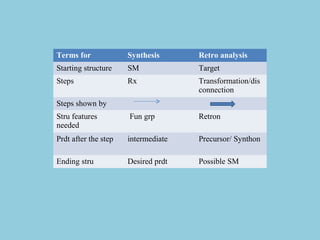
Terms for Synthesis Retro analysis
Starting structure SM Target
Steps Rx Transformation/dis
connection
Steps shown by
Stru features
needed
Fun grp Retron
Prdt after the step intermediate Precursor/ Synthon
Ending stru Desired prdt Possible SM
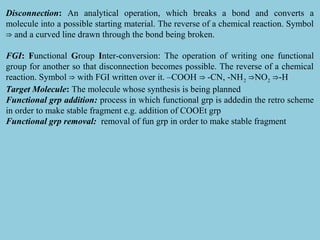
Disconnection: An analytical operation, which breaks a bond and converts a
molecule into a possible starting material. The reverse of a chemical reaction. Symbol
and a curved line drawn through the bond being broken.⇒
FGI: Functional Group Inter-conversion: The operation of writing one functional
group for another so that disconnection becomes possible. The reverse of a chemical
reaction. Symbol with FGI written over it. –COOH -CN, -NH⇒ ⇒ 2 NO⇒ 2 -H⇒
Target Molecule: The molecule whose synthesis is being planned
Functional grp addition: process in which functional grp is addedin the retro scheme
in order to make stable fragment e.g. addition of COOEt grp
Functional grp removal: removal of fun grp in order to make stable fragment
Transform: reverse of synthetic rx
Retrosynthetic analysis: Logical process of analysing stru of TM to transform the target to a
sequence of progressively simpler stru along a pathway which finally give simple & comm
viable SM.
“process of breaking down TM into available SM by FGI & disconnection”
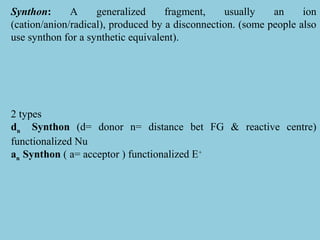
Synthon: A generalized fragment, usually an ion
(cation/anion/radical), produced by a disconnection. (some people also
use synthon for a synthetic equivalent).
2 types
dn Synthon (d= donor n= distance bet FG & reactive centre)
functionalized Nu
an Synthon ( a= acceptor ) functionalized E+
Reagent: A compound which reacts to give an intermediate in the planned synthesis or to
give the target molecule itself. The synthetic equivalent of a synthon. e.g. MeI is reagent for
Me+
Synthetic equivalent (SE ) A reagent carrying out the function of a synthon which cannot
itself be used, often because it is too unstable. Every synthon has its SE
H2SO4 and HNO3 mixture is SE of NO2
+
Retron: Minimal stru in mole in TM which causes transformation e.g. in Deil’s Alder rx 6
memb ring with pie electrons
B: SM and A TM
Arrow: it could be made from
Synthetic tree: Set of all possible disconnections and synthons leading from
TM to SM
Strategies for disconnection approach:
1) Simple route: good for industrial purpose. Avoid radical and photochemistry.
2) Disconnection shd be done such that it gives stable ion fragments. Break down
molecule 1 bond at a time. For heterocyclic compd disconnection is done such that 2
fragments in which 1 is +ve and other is -ve fragments generated e.g disconnection of
C-C bond
Strategies for disconnection approach:
contd
Stability of ion generated governs the mode to be followed
Carbanion (C-) fragment is stabilized by EWG like CN, NO2, COOEt
Carbonuim ion (C+) fragment stabilized by EDG or e releasing grp like R or OR
In this case route 1 is preferred because it gives Stabilized ion fragment , whereas route 2
gives both unstabilized fragments
3) No of fragments generated shd be small in number as possible i.e. few steps strategy is
preferred.
Examine
1) mole as whole
2) watch various fun grps and
3) positional relationship between fun grps
4) C-C db can be considered to result from dehydration, dehydrohalogenation or
Elimination of NH3, NH2OH....etc.
Addition of mole of water or NH3 to db can set up the target for further disconnection
5) A bond joining a C atom to hetero atom (O, N, S) is always broken with electron pair
remaining on hetero atom i.e. hetero atom shd have –ve charge
In this case disconnection follows principle of electronegativity i.e O, N, S > C
6) Sometimes disconnection does not generate stable fragments in such cases FGI concept
can be used to generate stabilized ion fragments
e.g. synthesis of alkylamine
7) Fun grp addition: Sometimes disconnection does not generate sufficiently stable
fragments in such cases stability could be achieved by introducing additional EWG &
removing after use.
8) In some cases reconnection of acyclic fragments can help to generate cyclic fragments that
could result in simpler starting material & Rxn sequences. Of course, strategy must be in place
for conversion of acyclic to cyclic fragments during synthetic sequence.
Retro analysis followed by synthesis:
One grp disconnection (C-X disconnection)
Disconnection of simple alcohols, alkyl halide, ethers
Alkyl halide:
C-X disconnection in aliphatic compds gives a Nu (XH) &
E+
carbon species usually represented by alkyl halide, tosylate and mesylate
Following types of compds can be made using alcohols
Methyl & 1o
alkyl deri : SN2
mech so powerful Nu and non polar solvent effective.
3o
SN1
Polar solvents and catalysis
e.g. 1)
Ethers:
1)
Ethers:
2)
Ether Synthesis: SN2
so base catalyst helps
Acids:
Carbonyl compd synthesis by Michael addition
Rings (5 & 6 membered), fused heterocyclic rings –more
common in drugs
3 & 4 memb less common tranyl cypromine (3 C) Beta
lactum ring (4C)
Retrosynthesis:
1) Follow similar rules with additional possibilities.
2) Rich in functional grps so handle only readily predictable
fragments like NH3, NH2NH2, NH2OH, guanidine, thiourea,
(NH2)2(CH2)2, HO(CH2)2NH2
3)Break C-Het
4) Addition of H2O to db ( NH3, NH2OH etc)
5) 3-component cyclization, DA rxn, 1,3 dipolar rxn
C+
+ -
Hetero atom
Sulfides:
One grp C-C dix
Alcohol: Best mtd is GR addition to ald/ketone
One grp C-C dix
Alcohol contd…
One grp C-C dix
Carbonyl compounds (Ester, ketone, acid):
Dix of heterocyclic rings: Any 1 eg
1)Pyridine e.g. Nifedipine
a)
b)
c)
d)
Dix of Het. Pyridine Contd..
Pyrimidine: eg barb, anticancer (MTX, 5FU),
Anti viral AZT
Dix of Het. Pyrimidine Contd..
Pyrrole: less common eg. Zomepirac (anti
inflammatory)
Imidazole: Metro (anti bacterial,
cimetidine H2 blocker
Indole: Indomethacin
Fischer indole synthesis:
1,5 diene cope rearrangement
Addition of NH3 in place of H2O
Dix of Het. Indole Contd..
Quinoline: Anitimalarial(prima, chloro)
ciprofloxacin
Piperazine: meclizine, cyclizine
Cinnarizine (Valodailator)
Dix of drugs
Dix of drugs contd..
Ibuprofen
Dix of drugs contd..
Strategies:
Guiding principles for selection of transform so as to keep size of retero-synthetic tree in control
Types of strategies in disconnection:
1)Transform based strategies depend on application of powerfully simplifying transformation
like DA, Robbinsons annulation, Birch rx
2)Structure based strategies depend on recognition of possible SM /key intermediate for synthesis
3) Functional grp based strategies identify functional grp as key structural subunit
OH, C=O , = etc can be useful for identifying suitable pts for disconnection
4) Topological based strategies depends on identification of 1/more individual bond disconnection
Or correlated bond-pair disconnection.
There are several types of strategic bonds e.g. bonds in polycyclic syst, poly fused ring syst, bond
connecting chai to ring, chain to fun grp
5) Stereochemical based strategies remove stereocenters stereorelationships under control.
Stereocontrol can be achieved by mechanistic or by substrate. Reconnection that moves
stereocenters from chain (where they r difficult to introduce) or into rings (where introduction
is much easier)
Basic rules of disconnection:
Rule 1: Bond shd be disconnected such that stable fragment(ion) obtd
Route A ok as carbcation stabilized by EDG like OR
Carbanions are stabilized by EWG like NO2, Cl
Rule 2: Total no of fragments shd be as min as possible i.e. synthesis shd be short. Disconnection
shd be made in middle of mole/ at branch pt
Rule 3: compds with 2 parts joined with hetero atom, disconnection shd be next to hetero atom,
e pair remain with het atom (het atom more negative than C & so accommodate -ve charge easily)
Rule 3: If disconnection doesn’t give stable fragment then FGI done/ simple grps introduced so
as to give stable fragments
Rule 5: Use disconnections corresponding to known reliable rx with high yields. +ve & -ve
fragments generated by disconnection r replaced by known available chemicals.
Positive fragments: +ve charge fragments equvt to good leaving grp/EWG
Positive fragments: -ve charge fragments equvt to their protonated species
Rule 6: Disconnection route that avoid chemoselectivity (Rx of 1 fun grp in presence of other)
shd be selected. For this reactive grps r disconnected first & 2 grp disconnection is done.
Route a involve 2 OH selectivity problem so route b is better
Guidelines for disconnection:
G1: Examine relation bet grps in TM. Disconnect grp which is proper directive at last
Guidelines for disconnection:
G2: Most EWG grp is to be disconnect first (It is to be added in last in synthesis)
Guidelines for disconnection:
G3: If FGI I needed it shd be done at proper stage to get right orientation. Other subs
added either before or after FGI
CCl3 is meta director (it is introduced by FGI)
CH3 is para director so FGI shd be done before C-Cl disconnection
Guidelines for disconnection:
G4: Avoid sequences that lead to unwanted rx at other site of mole
Route b is preferred as nitration e.g. benzaldehyde may lead to oxidation CHO oxidise to COOH
Guidelines for disconnection:
G5: when fun grp of unequal reactivity present in mole, more reactive grp to be considered for
Rx
e.g. In Phenyl ring containing both OH and COOH grps in basic soln (pH> 10) phenolate ion is
more reactive than carboxylate ion.
Guidelines for disconnection:
G6: For adding 2 O/ a P directing grp M to each other, dummy NH2 grp is added, which could
be removed by diazotization and reduction
Guidelines for disconnection:
G7: Grps like OH OR difficult to introduce so not disconnected instead use SM containing
them
Guidelines for disconnection:
G8: If 1 fun grp can react twice then SM & final prdt compete for same reagent. Rx will be
successful only when first prdt is less reactive than SM. Both contain COCl
Above Rx works as half ester TM is less reactive than phosgene b’se of conjugation
Guidelines for disconnection:
G9: If both O, P subst involved, avoid separation of isomers. P can be blocked
Guidelines for disconnection:
G10: Disconnect rings from chain
Disconnection involving 1 functional grp:
C-X Disconnection:
1) C-X means C joining to hetero atom X. It gives cationic Carbon syst
The reagent for R+ is good leaving grp attached to R
2) In case of Carbonyl deri RCOX
3) In case of Amine, prdt usually more reactive than SM
4) In case of alcohol, ether & alkyl halide
5) In case of sulfide & alkyl halide
Disconnection involving 1 functional grp:
C-C Disconnection:
a) Disconnection should be of C-C bond adjacent to fun grp specially next to -OH, -C=O
Disconnection involving 1 functional grp: (Contd)
C-C Disconnection:
b) If C=C is a part of conjugated system involving hetero atom then C=C may be
converted to C(OH)-CH before disconnection
c) If there is a branching branch pt shd be disconnected to get unbranched C synthon
Disconnection involving 1 functional grp: (Contd)
C-C Disconnection:
d) In a conjugated/ non conjugate system, of double bond the disconnection of C=C can be
done without adding H2O to C=C part
e) It is better to cut TM in middle rather than making uneven parts
Disconnection involving 1 functional grp: (Contd)
C-C Disconnection:
f) Branches must be disconnected from rings
g) Disconnect C-C bond bet 2 fung grp separated by NMT 3 other C atoms
Disconnection involving 2 functional grps:
1,1-dix: Synthons are obtd by 2 grp disconnection on single C atom. Acetal, cyanohydrin,
α hydroxy acid, α Amino acid, halohydrin r prepared from ald & ketone these TM need 1,1,dix
Disconnection involving 2 functional grps: Contd
1,2-dix: When 2 heteroatom r present on 2 adjacent C compound called 1,2 difunctionalised e.g.
Disconnection involving 2 functional grps: Contd
Disconnect C-C bond which has 1 hetero atom on each C
Disconnection involving 2 functional grps: Contd
1,3-dix (1,3 difunctionalized compounds)
In 3 carbon compound 2 het atom on 2 C at 1,3 position it is 1,3 difunctional compd
Disconnection involving 2 functional grps: Contd
1,4-dix (1,4 difunctionalized compounds)
In 4 carbon compound 2 het atom on 2 C at 1,4 position it is 1,4 difunctional compd
Disconnection involving 2 functional grps: Contd
1,5-dix (1,5 difunctionalized compounds)
1,5 Dicarbonyl compound can be disconnected at either α, β bond in reverse Michael Rx to give
Michael acceptor (a3 synthon)
Disconnection involving 2 functional grps: Contd
1,6-dix (1,6 difunctionalized compounds)
Such compound can be synthesised from Diels Alder Rx. Difficult synthon as C=O is
Electrophilic. Instead of disconnection Fun grp reconnection can be used.

Retrosynthesis

  • 1.
    Synthon approach Dr. TajKhan Dept. of Pharmaceutical Chemistry, Oriental college of pharmacy Sanpada, New Mumbai. Ref: Stuart Warren , Iyer R P
  • 3.
    Retrosynthesis is theprocess of “deconstructing” a target molecule into readily available starting materials by means of imaginary breaking of bonds (disconnections) and by the conversion of one functional group into another (functional group interconversions). Its useful for finding out new route for synthesis of new drugs or existing drugs and comparing them in logical & straightforward way An operation that involves breaking of a bond between 2 atoms to produce oppositely charged synthons. Indicates disconnection Functional group interconversion (FGI): process of converting 1 fun grp into another by substitution, addition, elimination, oxidn or redn. Reverse operation is used in analysis
  • 4.
    Terms for SynthesisRetro analysis Starting structure SM Target Steps Rx Transformation/dis connection Steps shown by Stru features needed Fun grp Retron Prdt after the step intermediate Precursor/ Synthon Ending stru Desired prdt Possible SM
  • 5.
    Disconnection: An analyticaloperation, which breaks a bond and converts a molecule into a possible starting material. The reverse of a chemical reaction. Symbol and a curved line drawn through the bond being broken.⇒ FGI: Functional Group Inter-conversion: The operation of writing one functional group for another so that disconnection becomes possible. The reverse of a chemical reaction. Symbol with FGI written over it. –COOH -CN, -NH⇒ ⇒ 2 NO⇒ 2 -H⇒ Target Molecule: The molecule whose synthesis is being planned Functional grp addition: process in which functional grp is addedin the retro scheme in order to make stable fragment e.g. addition of COOEt grp Functional grp removal: removal of fun grp in order to make stable fragment
  • 6.
    Transform: reverse ofsynthetic rx Retrosynthetic analysis: Logical process of analysing stru of TM to transform the target to a sequence of progressively simpler stru along a pathway which finally give simple & comm viable SM. “process of breaking down TM into available SM by FGI & disconnection”
  • 7.
    Synthon: A generalizedfragment, usually an ion (cation/anion/radical), produced by a disconnection. (some people also use synthon for a synthetic equivalent). 2 types dn Synthon (d= donor n= distance bet FG & reactive centre) functionalized Nu an Synthon ( a= acceptor ) functionalized E+
  • 8.
    Reagent: A compoundwhich reacts to give an intermediate in the planned synthesis or to give the target molecule itself. The synthetic equivalent of a synthon. e.g. MeI is reagent for Me+ Synthetic equivalent (SE ) A reagent carrying out the function of a synthon which cannot itself be used, often because it is too unstable. Every synthon has its SE H2SO4 and HNO3 mixture is SE of NO2 + Retron: Minimal stru in mole in TM which causes transformation e.g. in Deil’s Alder rx 6 memb ring with pie electrons B: SM and A TM Arrow: it could be made from Synthetic tree: Set of all possible disconnections and synthons leading from TM to SM
  • 9.
    Strategies for disconnectionapproach: 1) Simple route: good for industrial purpose. Avoid radical and photochemistry. 2) Disconnection shd be done such that it gives stable ion fragments. Break down molecule 1 bond at a time. For heterocyclic compd disconnection is done such that 2 fragments in which 1 is +ve and other is -ve fragments generated e.g disconnection of C-C bond
  • 10.
    Strategies for disconnectionapproach: contd Stability of ion generated governs the mode to be followed Carbanion (C-) fragment is stabilized by EWG like CN, NO2, COOEt Carbonuim ion (C+) fragment stabilized by EDG or e releasing grp like R or OR In this case route 1 is preferred because it gives Stabilized ion fragment , whereas route 2 gives both unstabilized fragments 3) No of fragments generated shd be small in number as possible i.e. few steps strategy is preferred.
  • 11.
    Examine 1) mole aswhole 2) watch various fun grps and 3) positional relationship between fun grps
  • 12.
    4) C-C dbcan be considered to result from dehydration, dehydrohalogenation or Elimination of NH3, NH2OH....etc. Addition of mole of water or NH3 to db can set up the target for further disconnection 5) A bond joining a C atom to hetero atom (O, N, S) is always broken with electron pair remaining on hetero atom i.e. hetero atom shd have –ve charge In this case disconnection follows principle of electronegativity i.e O, N, S > C
  • 13.
    6) Sometimes disconnectiondoes not generate stable fragments in such cases FGI concept can be used to generate stabilized ion fragments e.g. synthesis of alkylamine
  • 14.
    7) Fun grpaddition: Sometimes disconnection does not generate sufficiently stable fragments in such cases stability could be achieved by introducing additional EWG & removing after use.
  • 15.
    8) In somecases reconnection of acyclic fragments can help to generate cyclic fragments that could result in simpler starting material & Rxn sequences. Of course, strategy must be in place for conversion of acyclic to cyclic fragments during synthetic sequence.
  • 17.
    Retro analysis followedby synthesis: One grp disconnection (C-X disconnection) Disconnection of simple alcohols, alkyl halide, ethers Alkyl halide: C-X disconnection in aliphatic compds gives a Nu (XH) & E+ carbon species usually represented by alkyl halide, tosylate and mesylate
  • 18.
    Following types ofcompds can be made using alcohols
  • 19.
    Methyl & 1o alkylderi : SN2 mech so powerful Nu and non polar solvent effective. 3o SN1 Polar solvents and catalysis e.g. 1)
  • 20.
  • 21.
  • 22.
    Ether Synthesis: SN2 sobase catalyst helps
  • 23.
  • 24.
    Carbonyl compd synthesisby Michael addition
  • 26.
    Rings (5 &6 membered), fused heterocyclic rings –more common in drugs 3 & 4 memb less common tranyl cypromine (3 C) Beta lactum ring (4C) Retrosynthesis: 1) Follow similar rules with additional possibilities. 2) Rich in functional grps so handle only readily predictable fragments like NH3, NH2NH2, NH2OH, guanidine, thiourea, (NH2)2(CH2)2, HO(CH2)2NH2 3)Break C-Het 4) Addition of H2O to db ( NH3, NH2OH etc) 5) 3-component cyclization, DA rxn, 1,3 dipolar rxn C+ + - Hetero atom
  • 27.
  • 29.
    One grp C-Cdix Alcohol: Best mtd is GR addition to ald/ketone
  • 30.
    One grp C-Cdix Alcohol contd…
  • 31.
    One grp C-Cdix Carbonyl compounds (Ester, ketone, acid):
  • 32.
    Dix of heterocyclicrings: Any 1 eg 1)Pyridine e.g. Nifedipine a) b) c)
  • 33.
    d) Dix of Het.Pyridine Contd..
  • 34.
    Pyrimidine: eg barb,anticancer (MTX, 5FU), Anti viral AZT
  • 35.
    Dix of Het.Pyrimidine Contd..
  • 36.
    Pyrrole: less commoneg. Zomepirac (anti inflammatory)
  • 37.
    Imidazole: Metro (antibacterial, cimetidine H2 blocker
  • 38.
  • 39.
    Fischer indole synthesis: 1,5diene cope rearrangement Addition of NH3 in place of H2O Dix of Het. Indole Contd..
  • 40.
  • 41.
  • 42.
  • 44.
    Dix of drugscontd..
  • 45.
  • 48.
    Strategies: Guiding principles forselection of transform so as to keep size of retero-synthetic tree in control Types of strategies in disconnection: 1)Transform based strategies depend on application of powerfully simplifying transformation like DA, Robbinsons annulation, Birch rx 2)Structure based strategies depend on recognition of possible SM /key intermediate for synthesis 3) Functional grp based strategies identify functional grp as key structural subunit OH, C=O , = etc can be useful for identifying suitable pts for disconnection 4) Topological based strategies depends on identification of 1/more individual bond disconnection Or correlated bond-pair disconnection. There are several types of strategic bonds e.g. bonds in polycyclic syst, poly fused ring syst, bond connecting chai to ring, chain to fun grp 5) Stereochemical based strategies remove stereocenters stereorelationships under control. Stereocontrol can be achieved by mechanistic or by substrate. Reconnection that moves stereocenters from chain (where they r difficult to introduce) or into rings (where introduction is much easier)
  • 49.
    Basic rules ofdisconnection: Rule 1: Bond shd be disconnected such that stable fragment(ion) obtd Route A ok as carbcation stabilized by EDG like OR Carbanions are stabilized by EWG like NO2, Cl
  • 50.
    Rule 2: Totalno of fragments shd be as min as possible i.e. synthesis shd be short. Disconnection shd be made in middle of mole/ at branch pt
  • 51.
    Rule 3: compdswith 2 parts joined with hetero atom, disconnection shd be next to hetero atom, e pair remain with het atom (het atom more negative than C & so accommodate -ve charge easily)
  • 52.
    Rule 3: Ifdisconnection doesn’t give stable fragment then FGI done/ simple grps introduced so as to give stable fragments
  • 53.
    Rule 5: Usedisconnections corresponding to known reliable rx with high yields. +ve & -ve fragments generated by disconnection r replaced by known available chemicals.
  • 54.
    Positive fragments: +vecharge fragments equvt to good leaving grp/EWG
  • 55.
    Positive fragments: -vecharge fragments equvt to their protonated species
  • 56.
    Rule 6: Disconnectionroute that avoid chemoselectivity (Rx of 1 fun grp in presence of other) shd be selected. For this reactive grps r disconnected first & 2 grp disconnection is done. Route a involve 2 OH selectivity problem so route b is better
  • 57.
    Guidelines for disconnection: G1:Examine relation bet grps in TM. Disconnect grp which is proper directive at last
  • 58.
    Guidelines for disconnection: G2:Most EWG grp is to be disconnect first (It is to be added in last in synthesis)
  • 59.
    Guidelines for disconnection: G3:If FGI I needed it shd be done at proper stage to get right orientation. Other subs added either before or after FGI CCl3 is meta director (it is introduced by FGI) CH3 is para director so FGI shd be done before C-Cl disconnection
  • 60.
    Guidelines for disconnection: G4:Avoid sequences that lead to unwanted rx at other site of mole Route b is preferred as nitration e.g. benzaldehyde may lead to oxidation CHO oxidise to COOH
  • 61.
    Guidelines for disconnection: G5:when fun grp of unequal reactivity present in mole, more reactive grp to be considered for Rx e.g. In Phenyl ring containing both OH and COOH grps in basic soln (pH> 10) phenolate ion is more reactive than carboxylate ion.
  • 62.
    Guidelines for disconnection: G6:For adding 2 O/ a P directing grp M to each other, dummy NH2 grp is added, which could be removed by diazotization and reduction
  • 63.
    Guidelines for disconnection: G7:Grps like OH OR difficult to introduce so not disconnected instead use SM containing them
  • 64.
    Guidelines for disconnection: G8:If 1 fun grp can react twice then SM & final prdt compete for same reagent. Rx will be successful only when first prdt is less reactive than SM. Both contain COCl Above Rx works as half ester TM is less reactive than phosgene b’se of conjugation
  • 65.
    Guidelines for disconnection: G9:If both O, P subst involved, avoid separation of isomers. P can be blocked
  • 66.
    Guidelines for disconnection: G10:Disconnect rings from chain
  • 67.
    Disconnection involving 1functional grp: C-X Disconnection: 1) C-X means C joining to hetero atom X. It gives cationic Carbon syst The reagent for R+ is good leaving grp attached to R
  • 68.
    2) In caseof Carbonyl deri RCOX
  • 69.
    3) In caseof Amine, prdt usually more reactive than SM
  • 70.
    4) In caseof alcohol, ether & alkyl halide
  • 71.
    5) In caseof sulfide & alkyl halide
  • 72.
    Disconnection involving 1functional grp: C-C Disconnection: a) Disconnection should be of C-C bond adjacent to fun grp specially next to -OH, -C=O
  • 73.
    Disconnection involving 1functional grp: (Contd) C-C Disconnection: b) If C=C is a part of conjugated system involving hetero atom then C=C may be converted to C(OH)-CH before disconnection c) If there is a branching branch pt shd be disconnected to get unbranched C synthon
  • 74.
    Disconnection involving 1functional grp: (Contd) C-C Disconnection: d) In a conjugated/ non conjugate system, of double bond the disconnection of C=C can be done without adding H2O to C=C part e) It is better to cut TM in middle rather than making uneven parts
  • 75.
    Disconnection involving 1functional grp: (Contd) C-C Disconnection: f) Branches must be disconnected from rings g) Disconnect C-C bond bet 2 fung grp separated by NMT 3 other C atoms
  • 76.
    Disconnection involving 2functional grps: 1,1-dix: Synthons are obtd by 2 grp disconnection on single C atom. Acetal, cyanohydrin, α hydroxy acid, α Amino acid, halohydrin r prepared from ald & ketone these TM need 1,1,dix
  • 77.
    Disconnection involving 2functional grps: Contd 1,2-dix: When 2 heteroatom r present on 2 adjacent C compound called 1,2 difunctionalised e.g.
  • 78.
    Disconnection involving 2functional grps: Contd Disconnect C-C bond which has 1 hetero atom on each C
  • 79.
    Disconnection involving 2functional grps: Contd 1,3-dix (1,3 difunctionalized compounds) In 3 carbon compound 2 het atom on 2 C at 1,3 position it is 1,3 difunctional compd
  • 80.
    Disconnection involving 2functional grps: Contd 1,4-dix (1,4 difunctionalized compounds) In 4 carbon compound 2 het atom on 2 C at 1,4 position it is 1,4 difunctional compd
  • 81.
    Disconnection involving 2functional grps: Contd 1,5-dix (1,5 difunctionalized compounds) 1,5 Dicarbonyl compound can be disconnected at either α, β bond in reverse Michael Rx to give Michael acceptor (a3 synthon)
  • 82.
    Disconnection involving 2functional grps: Contd 1,6-dix (1,6 difunctionalized compounds) Such compound can be synthesised from Diels Alder Rx. Difficult synthon as C=O is Electrophilic. Instead of disconnection Fun grp reconnection can be used.