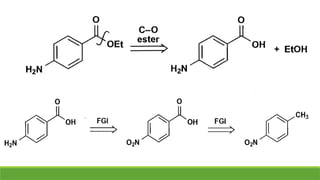
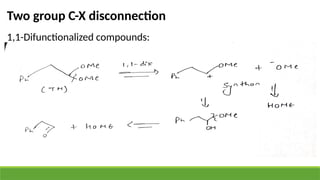
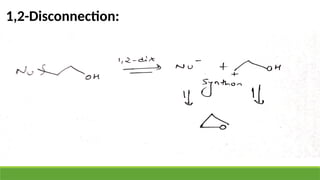
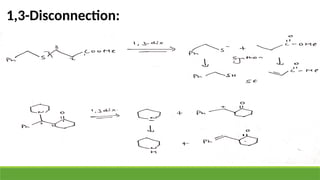
Disconnection approach
Imaginary approachfor organic synthesis which involve imaginary
breakdown of target molecule into available starting material by
imaginary breakdown [disconnection] or FGI called disconnection
approach.
The construction of synthetic pathway by working from Target
molecule (TM) called retrosynthesis analysis.
FGI : When real and workable reagents are not obtained than we
convert one functional groupto another functional group.
4.
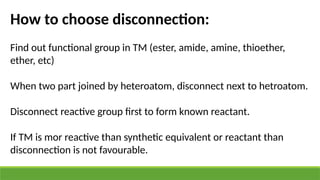
How to choosedisconnection:
Find out functional group in TM (ester, amide, amine, thioether,
ether, etc)
When two part joined by heteroatom, disconnect next to hetroatom.
Disconnect reactive group first to form known reactant.
If TM is mor reactive than synthetic equivalent or reactant than
disconnection is not favourable.
5.
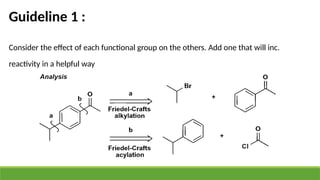
Guideline 1 :
Considerthe effect of each functional group on the others. Add one that will inc.
reactivity in a helpful way
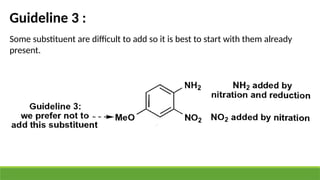
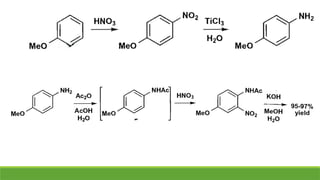
Guideline 3 :
Somesubstituent are difficult to add so it is best to start with them already
present.
9.
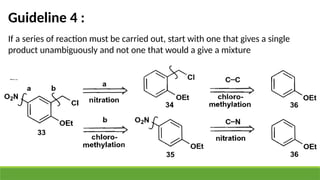
Guideline 4 :
Ifa series of reaction must be carried out, start with one that gives a single
product unambiguously and not one that would a give a mixture
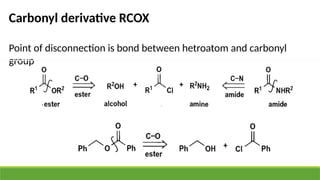
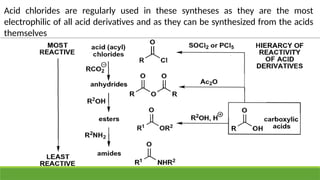
Acid chlorides areregularly used in these syntheses as they are the most
electrophilic of all acid derivatives and as they can be synthesized from the acids
themselves
12.
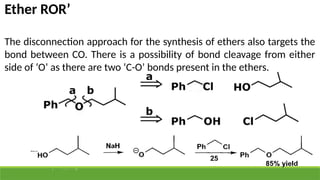
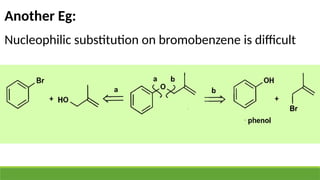
Ether ROR’
The disconnectionapproach for the synthesis of ethers also targets the
bond between CO. There is a possibility of bond cleavage from either
side of ‘O’ as there are two ‘C-O’ bonds present in the ethers.

![Disconnection approach
Imaginary approach for organic synthesis which involve imaginary
breakdown of target molecule into available starting material by
imaginary breakdown [disconnection] or FGI called disconnection
approach.
The construction of synthetic pathway by working from Target
molecule (TM) called retrosynthesis analysis.
FGI : When real and workable reagents are not obtained than we
convert one functional groupto another functional group.](https://image.slidesharecdn.com/retrosynthesisguidelinesforc-xdisconnection-250322140101-97971459/85/Retrosynthesis-guidelines-for-C-X-Disconnection-pptx-2-320.jpg)