Theory of Equations – 18UMTC12
Mrs.P.Kalaiselvi, M.Sc.,M.A.,
Ms.S.Swathi Sundari, M.Sc.,M.Phil.,
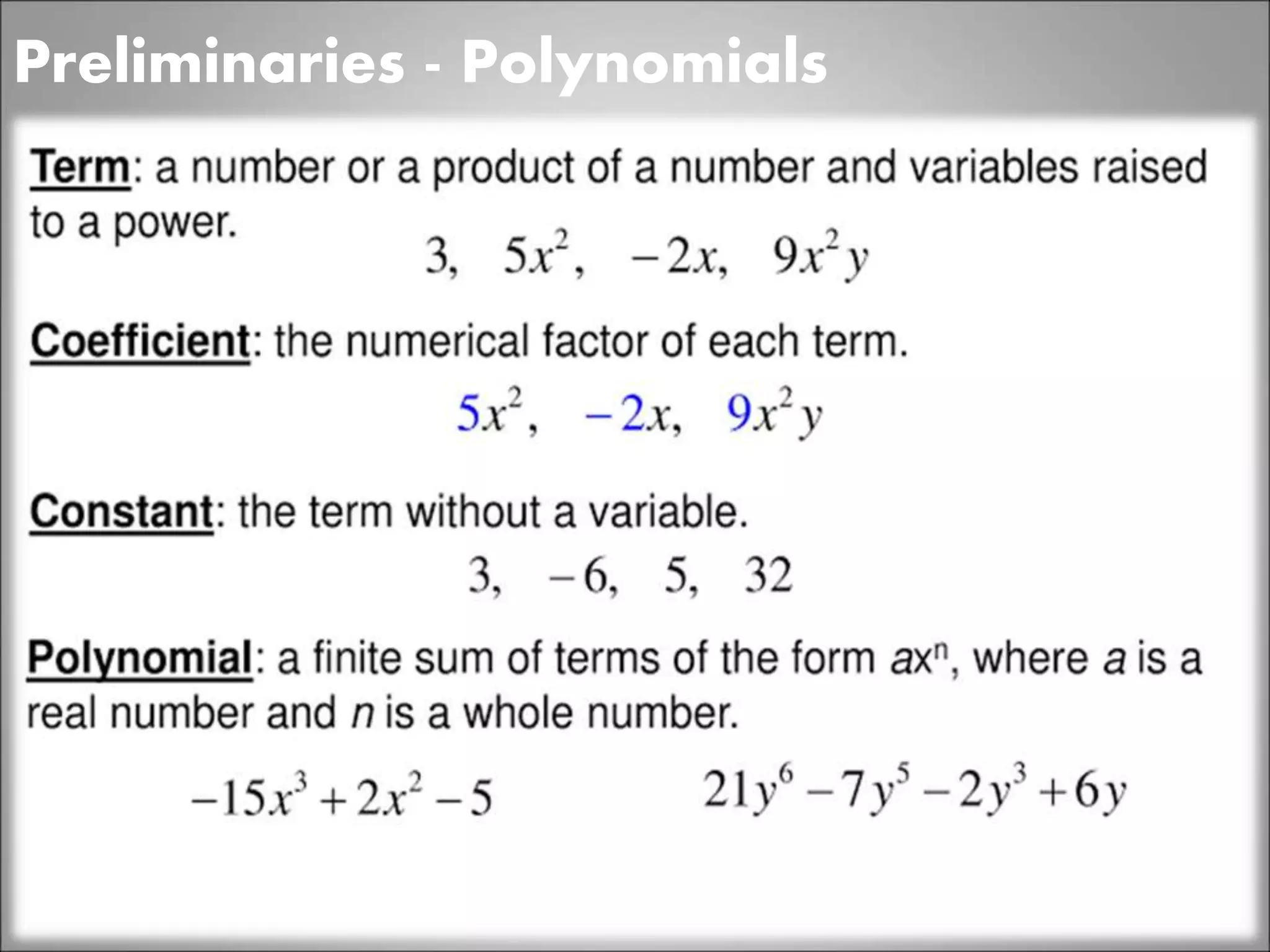
Preliminaries - Polynomials
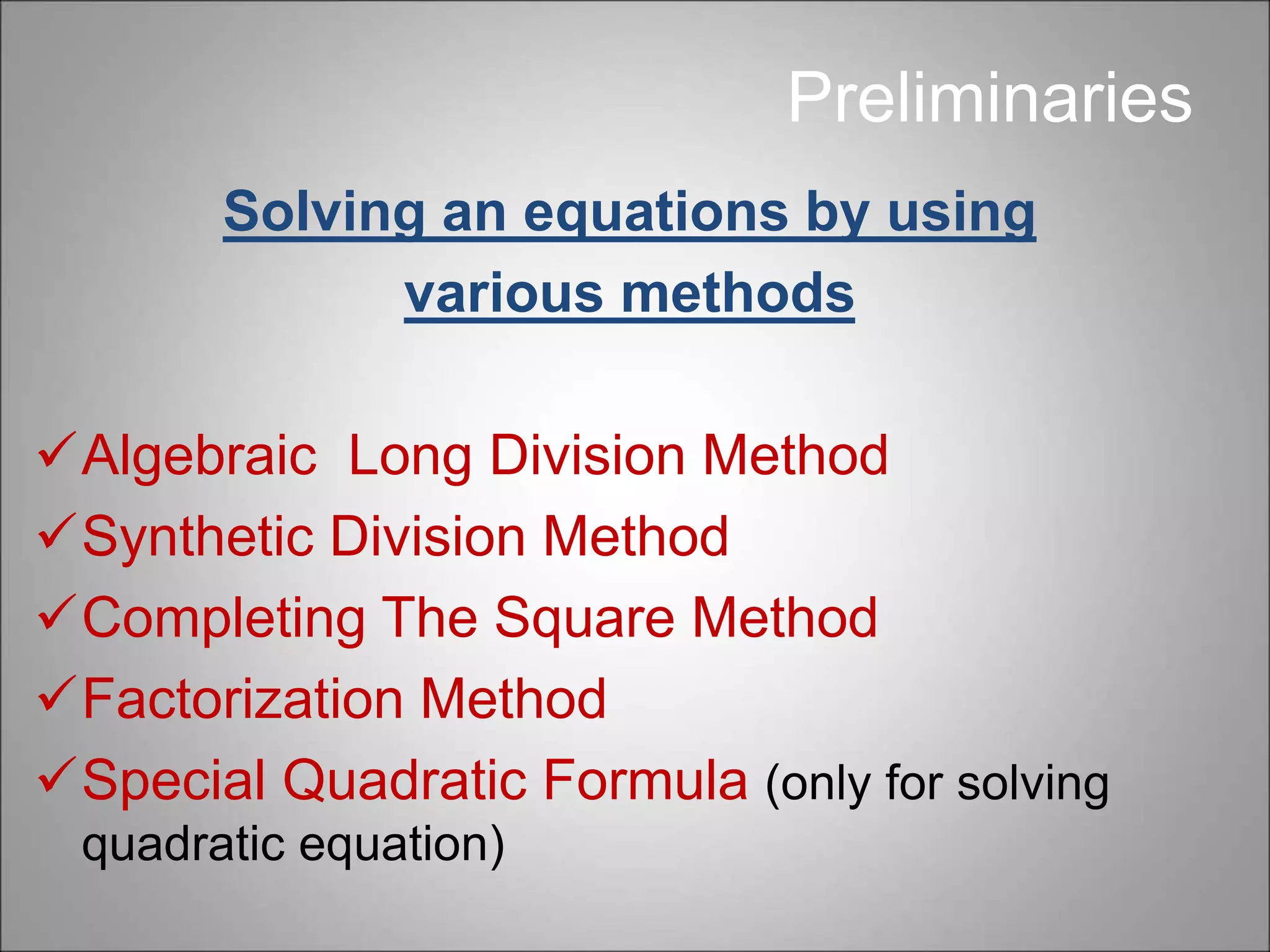
Preliminaries
Solving an equations by using
various methods
Algebraic Long Division Method
Synthetic Division Method
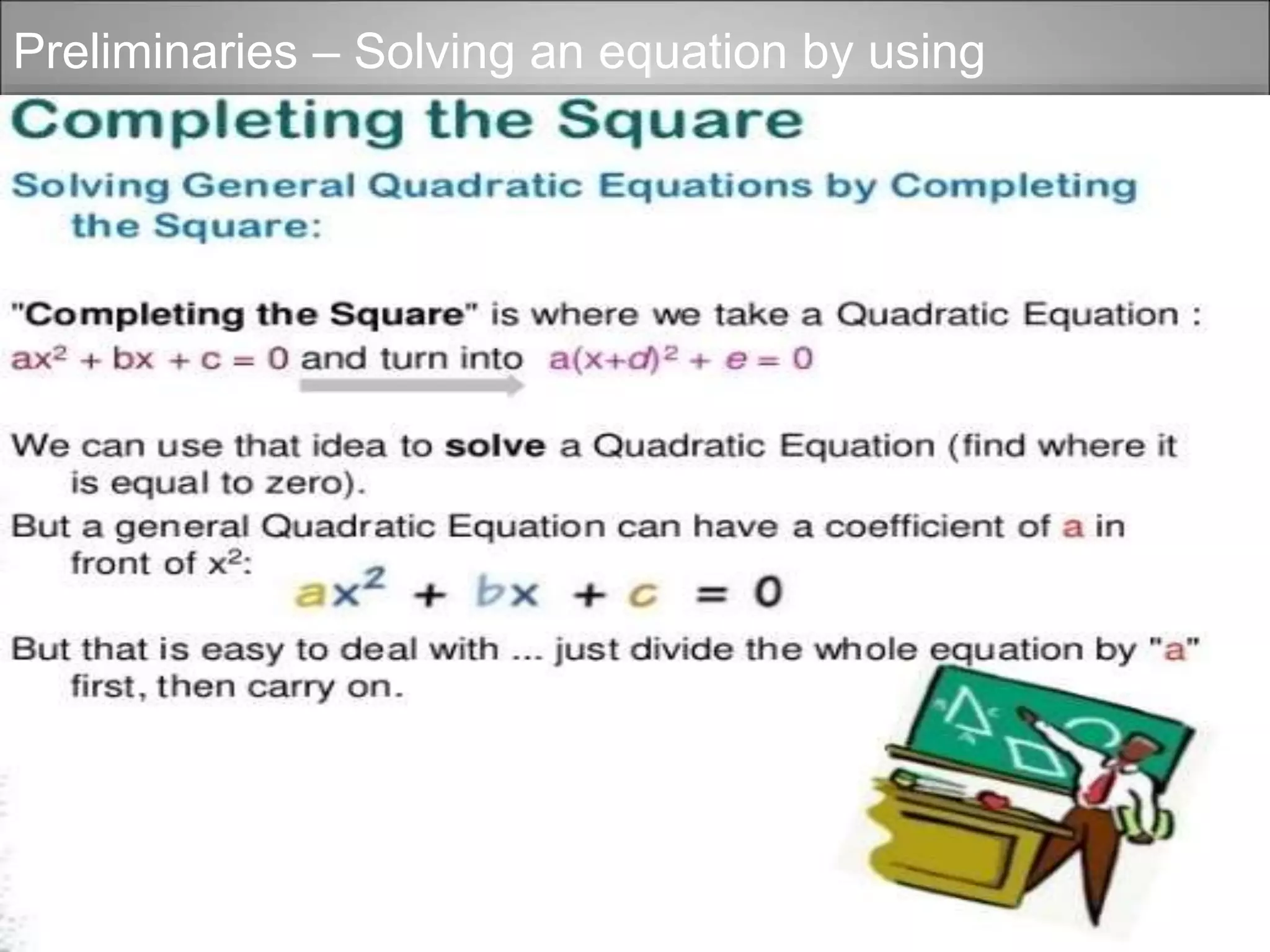
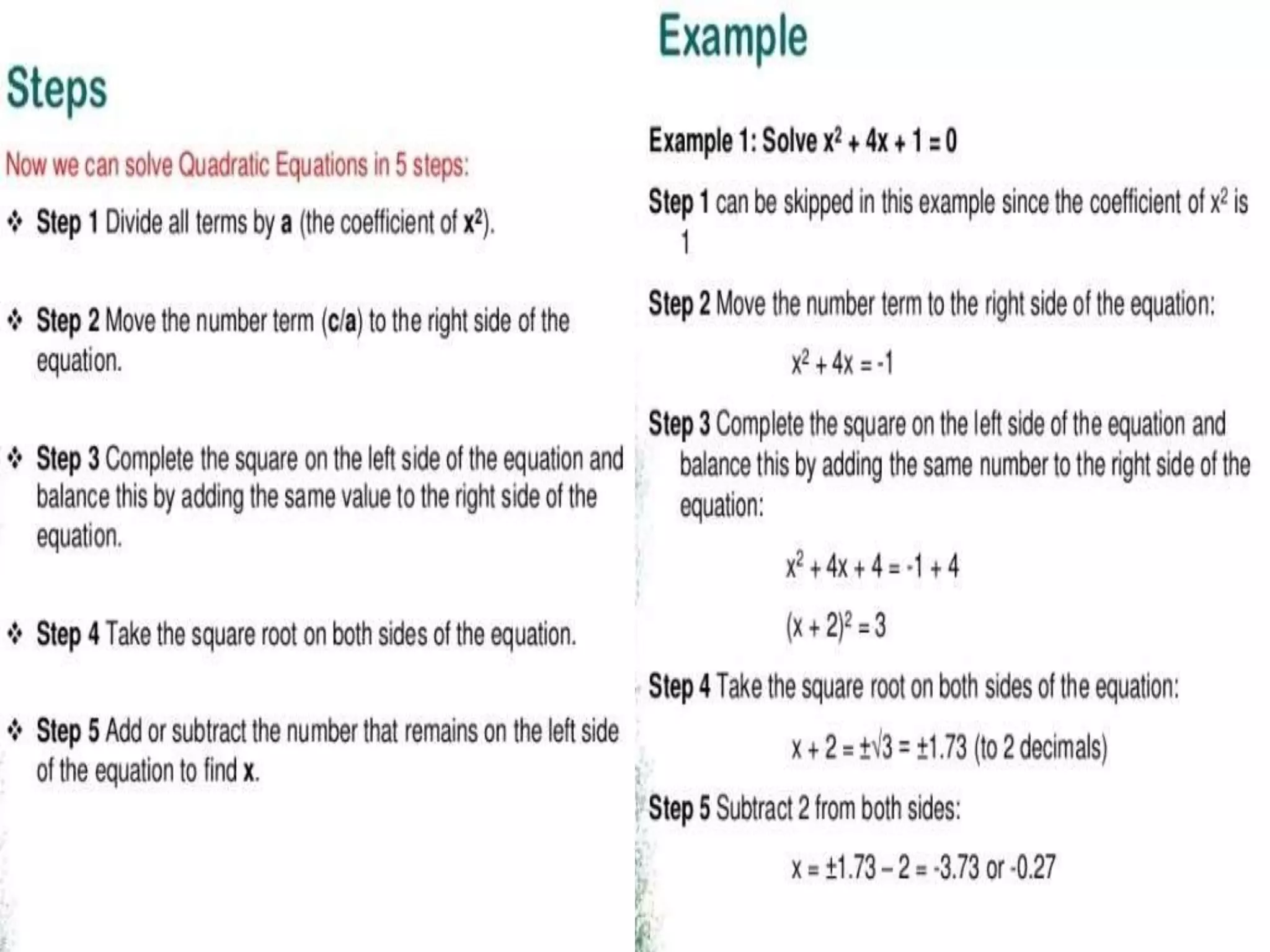
Completing The Square Method
Factorization Method
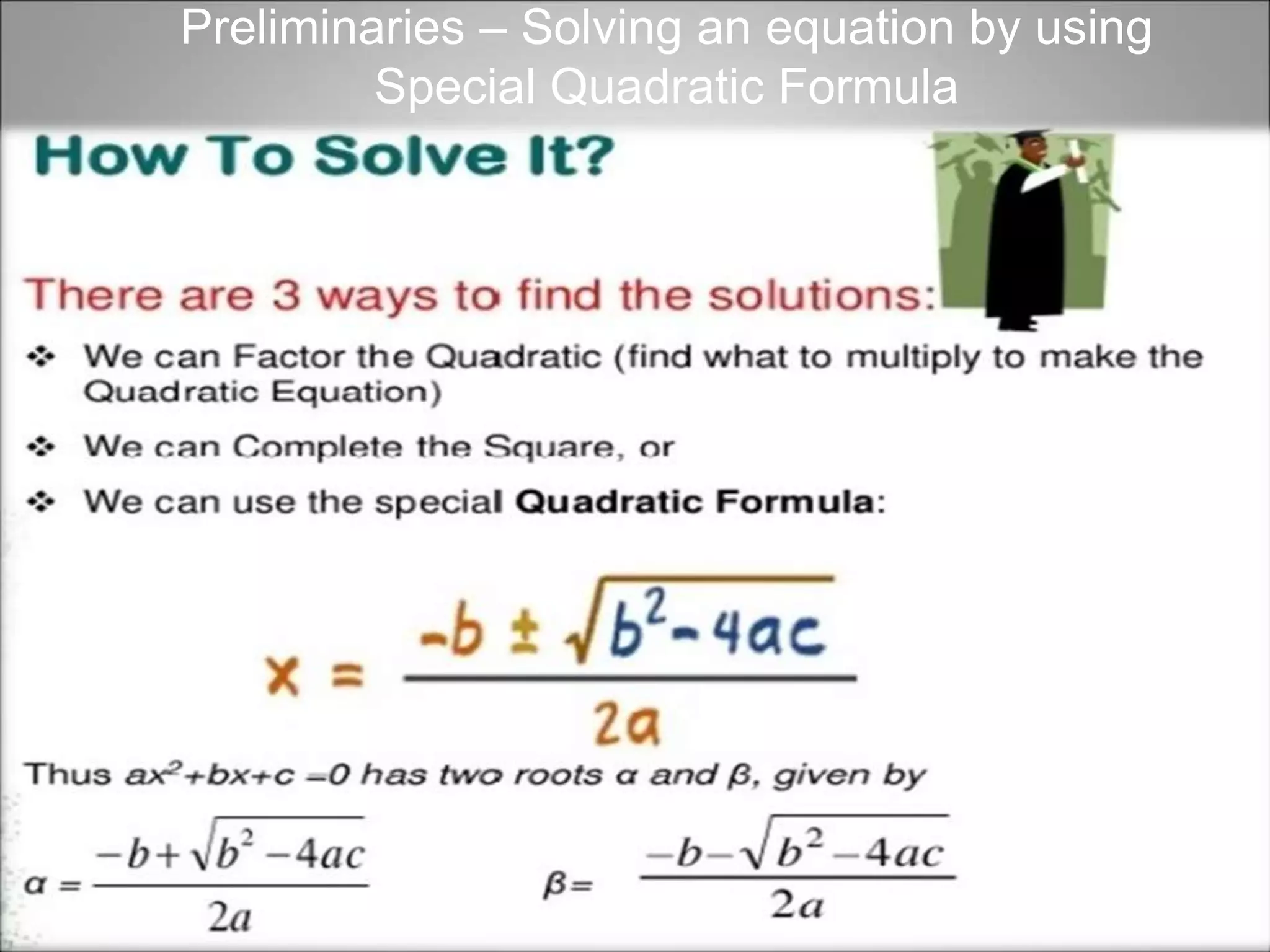
Special Quadratic Formula (only for solving
quadratic equation)
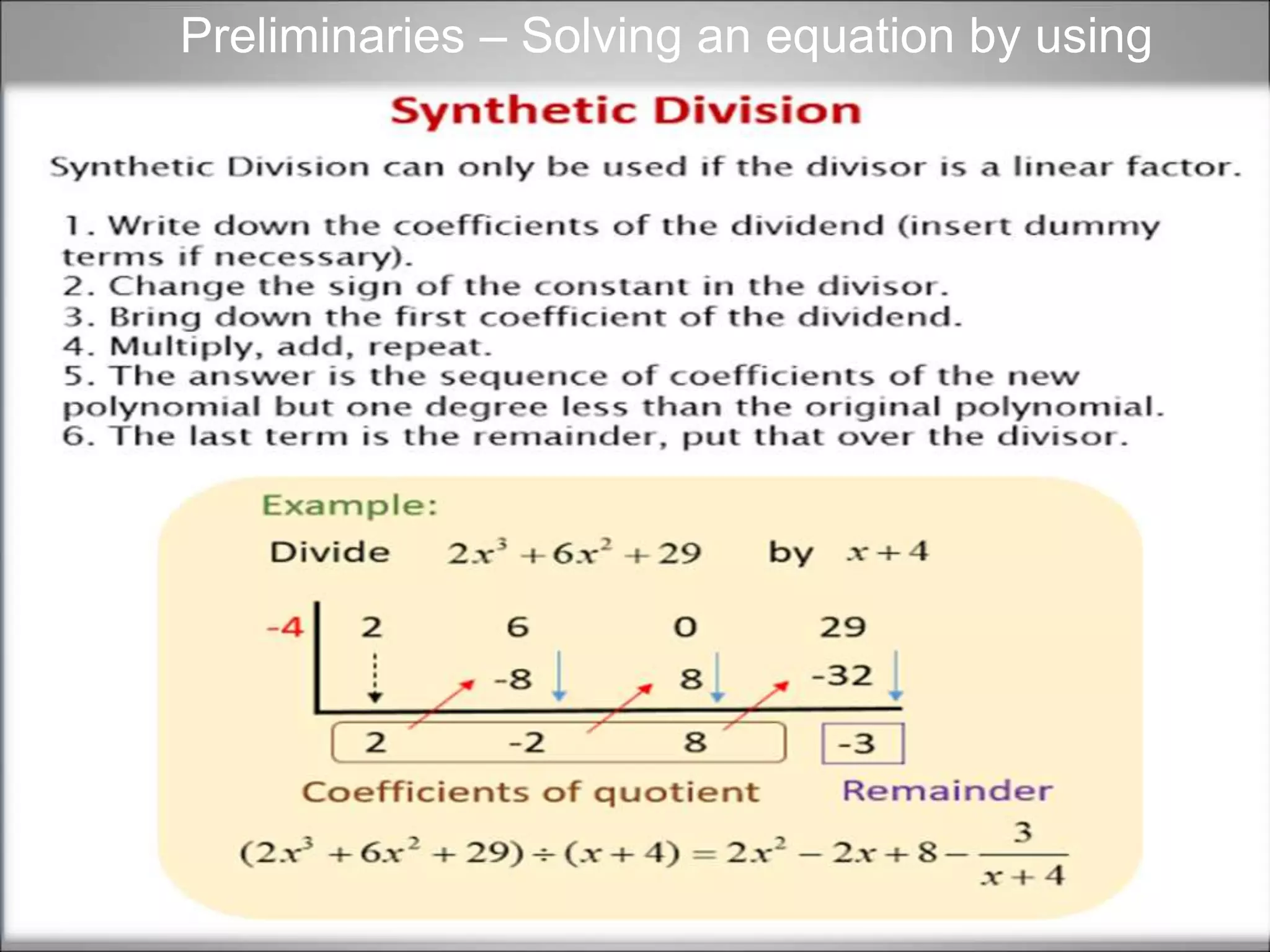
Preliminaries – Solving an equation by using
Algebraic Long Division Method
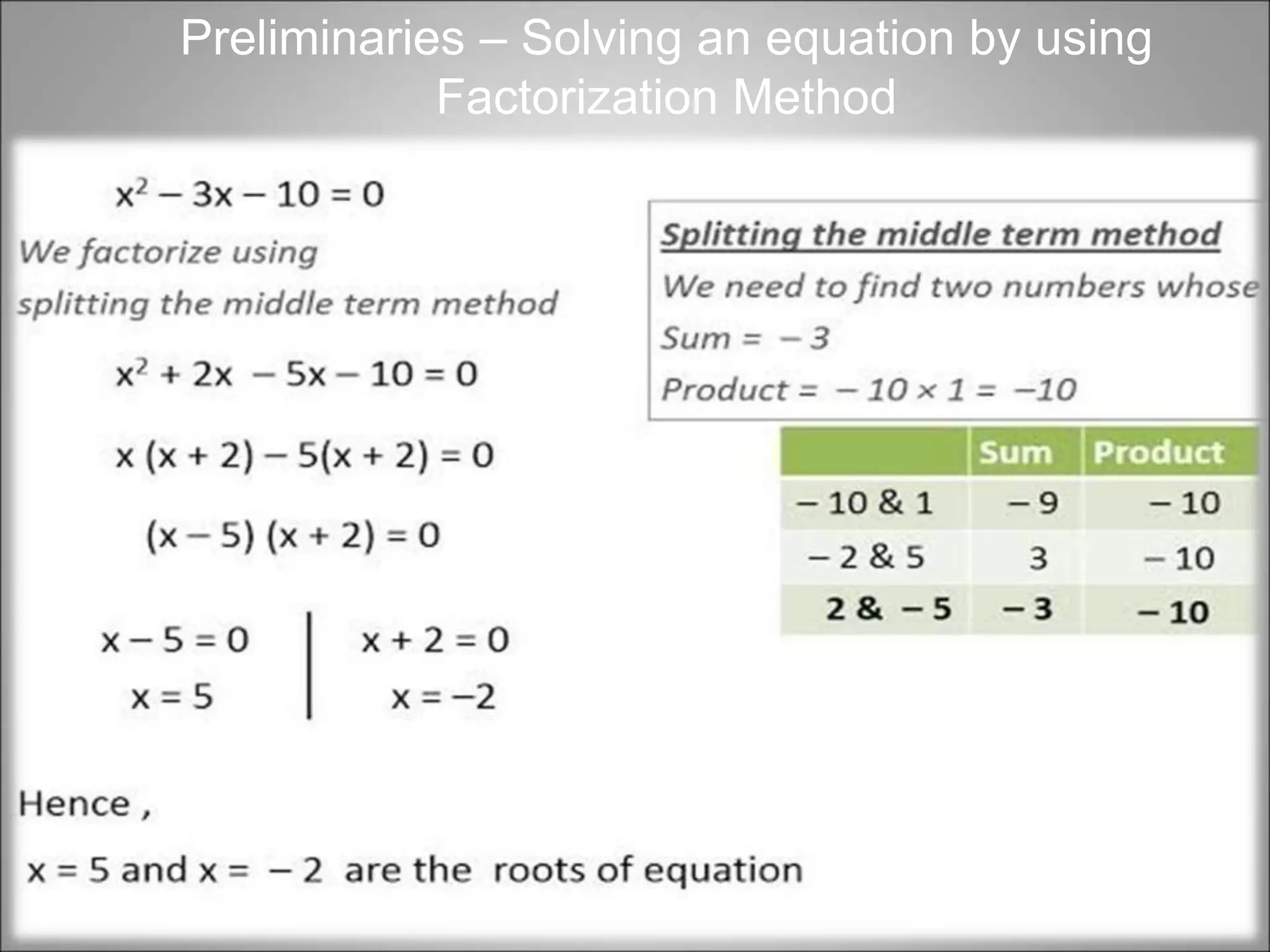
Preliminaries – Solving an equation by using
Factorization Method
Preliminaries – Solving an equation by using
Special Quadratic Formula
Preliminaries – Solving an equation by using
Special Quadratic Formula
RESULTS
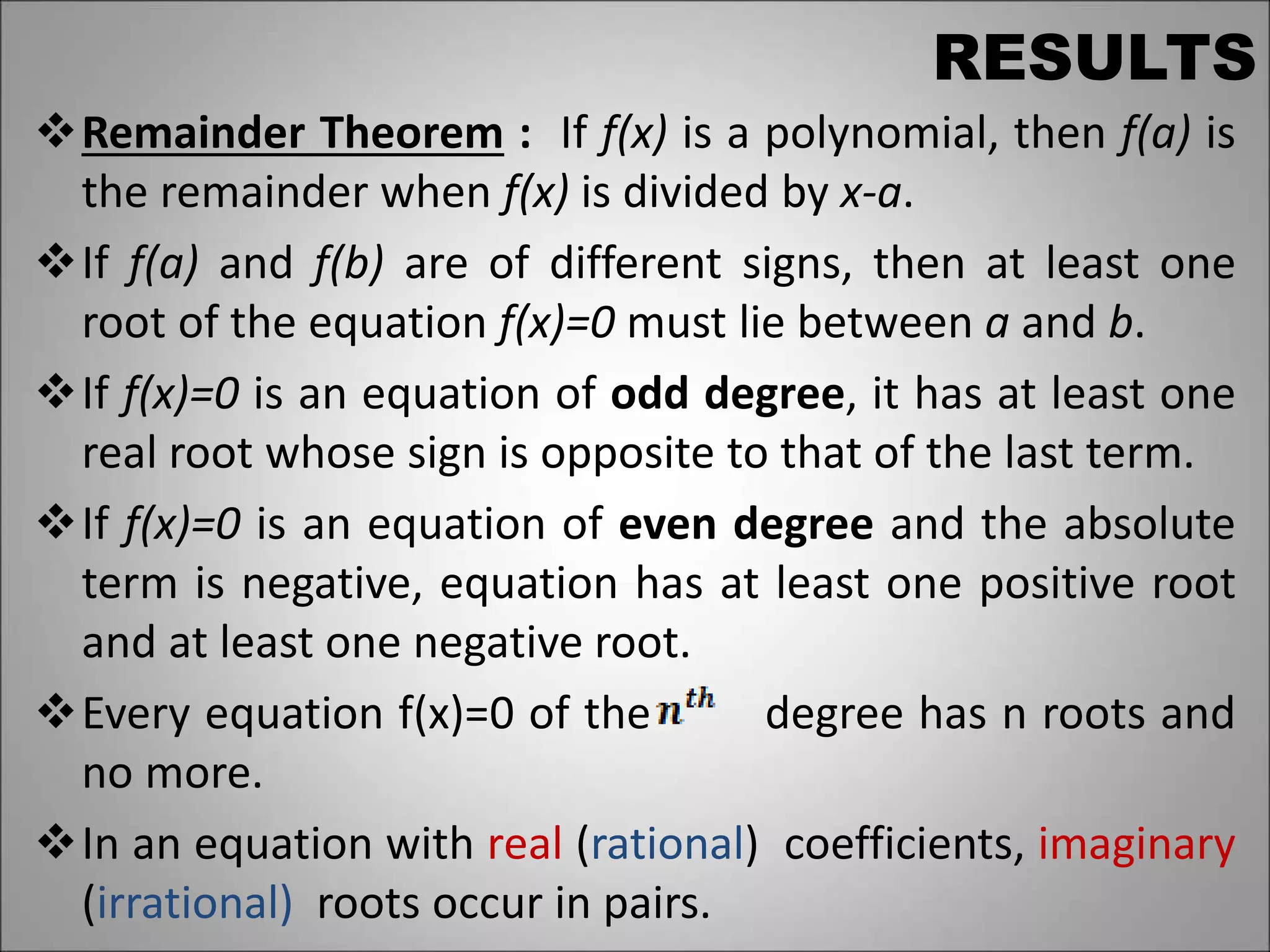
Remainder Theorem : If f(x) is a polynomial, then f(a) is
the remainder when f(x) is divided by x-a.
If f(a) and f(b) are of different signs, then at least one
root of the equation f(x)=0 must lie between a and b.
If f(x)=0 is an equation of odd degree, it has at least one
real root whose sign is opposite to that of the last term.
If f(x)=0 is an equation of even degree and the absolute
term is negative, equation has at least one positive root
and at least one negative root.
Every equation f(x)=0 of the degree has n roots and
no more.
In an equation with real (rational) coefficients, imaginary
(irrational) roots occur in pairs.
Relation Between Roots and the Coefficients
Transformations of Equations
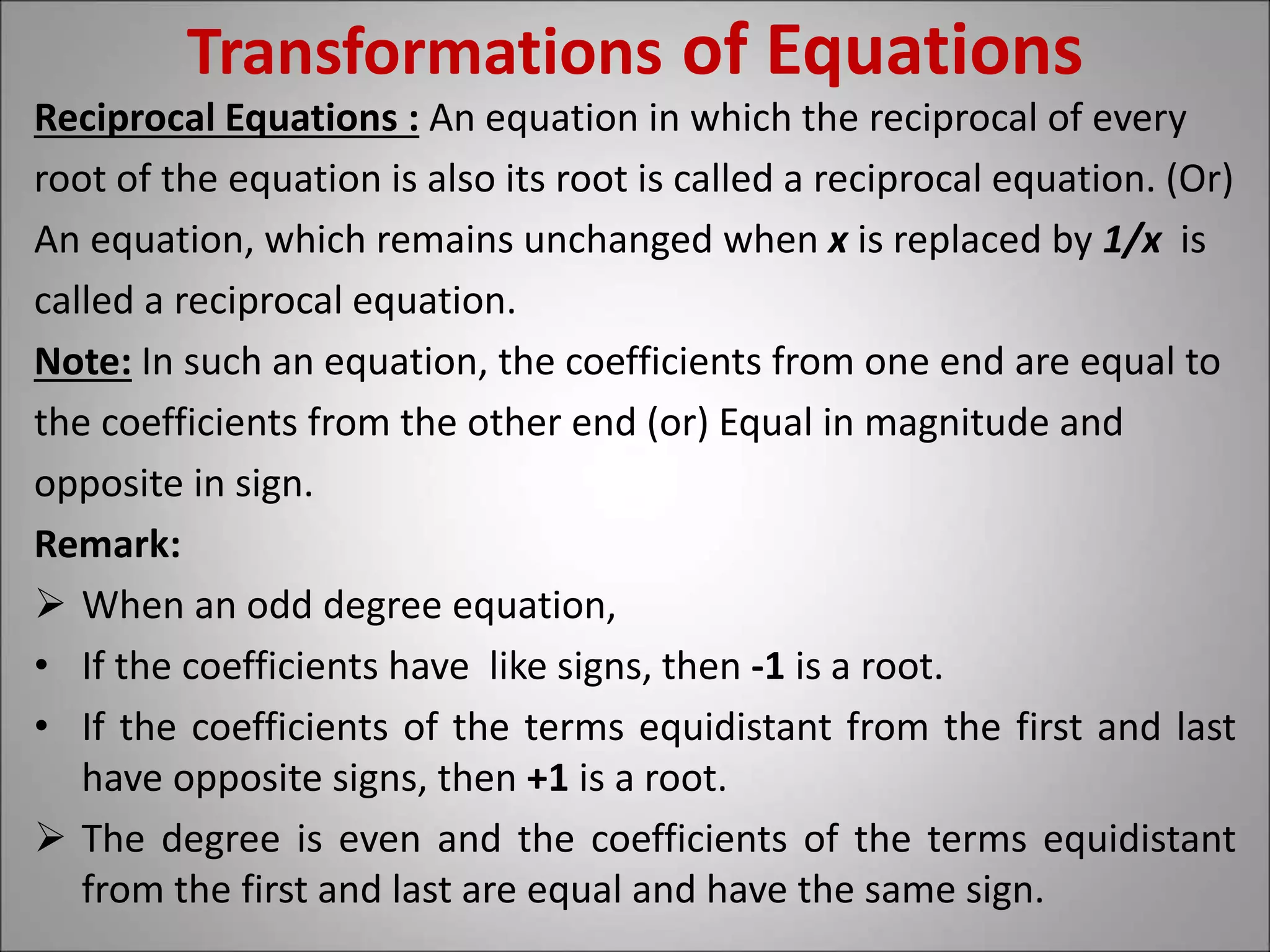
Reciprocal Equations : An equation in which the reciprocal of every
root of the equation is also its root is called a reciprocal equation. (Or)
An equation, which remains unchanged when x is replaced by 1/x is
called a reciprocal equation.
Note: In such an equation, the coefficients from one end are equal to
the coefficients from the other end (or) Equal in magnitude and
opposite in sign.
Remark:
 When an odd degree equation,
• If the coefficients have like signs, then -1 is a root.
• If the coefficients of the terms equidistant from the first and last
have opposite signs, then +1 is a root.
 The degree is even and the coefficients of the terms equidistant
from the first and last are equal and have the same sign.
Transformations of Equations
 If are the roots of f(x)=0, the equation
i. Whose roots are is f(1/x) =0.
ii. Whose roots are is f(x/k) =0.
iii.Whose roots are is f(x+h) =0.
iv.Whose roots are is f(x-h) =0.
v. Whose roots are is f(√x) =0.
 In an reciprocal equation, increasing by h the roots of the
equation is the same as diminishing the roots by –h.
Theory of Equation

Theory of Equation

  • 1.
    Theory of Equations– 18UMTC12 Mrs.P.Kalaiselvi, M.Sc.,M.A., Ms.S.Swathi Sundari, M.Sc.,M.Phil.,
  • 2.
  • 3.
    Preliminaries Solving an equationsby using various methods Algebraic Long Division Method Synthetic Division Method Completing The Square Method Factorization Method Special Quadratic Formula (only for solving quadratic equation)
  • 4.
    Preliminaries – Solvingan equation by using Algebraic Long Division Method
  • 5.
    Preliminaries – Solvingan equation by using
  • 6.
    Preliminaries – Solvingan equation by using Factorization Method
  • 7.
    Preliminaries – Solvingan equation by using
  • 9.
    Preliminaries – Solvingan equation by using Special Quadratic Formula
  • 10.
    Preliminaries – Solvingan equation by using Special Quadratic Formula
  • 11.
    RESULTS Remainder Theorem :If f(x) is a polynomial, then f(a) is the remainder when f(x) is divided by x-a. If f(a) and f(b) are of different signs, then at least one root of the equation f(x)=0 must lie between a and b. If f(x)=0 is an equation of odd degree, it has at least one real root whose sign is opposite to that of the last term. If f(x)=0 is an equation of even degree and the absolute term is negative, equation has at least one positive root and at least one negative root. Every equation f(x)=0 of the degree has n roots and no more. In an equation with real (rational) coefficients, imaginary (irrational) roots occur in pairs.
  • 12.
    Relation Between Rootsand the Coefficients
  • 13.
    Transformations of Equations ReciprocalEquations : An equation in which the reciprocal of every root of the equation is also its root is called a reciprocal equation. (Or) An equation, which remains unchanged when x is replaced by 1/x is called a reciprocal equation. Note: In such an equation, the coefficients from one end are equal to the coefficients from the other end (or) Equal in magnitude and opposite in sign. Remark:  When an odd degree equation, • If the coefficients have like signs, then -1 is a root. • If the coefficients of the terms equidistant from the first and last have opposite signs, then +1 is a root.  The degree is even and the coefficients of the terms equidistant from the first and last are equal and have the same sign.
  • 14.
    Transformations of Equations If are the roots of f(x)=0, the equation i. Whose roots are is f(1/x) =0. ii. Whose roots are is f(x/k) =0. iii.Whose roots are is f(x+h) =0. iv.Whose roots are is f(x-h) =0. v. Whose roots are is f(√x) =0.  In an reciprocal equation, increasing by h the roots of the equation is the same as diminishing the roots by –h.