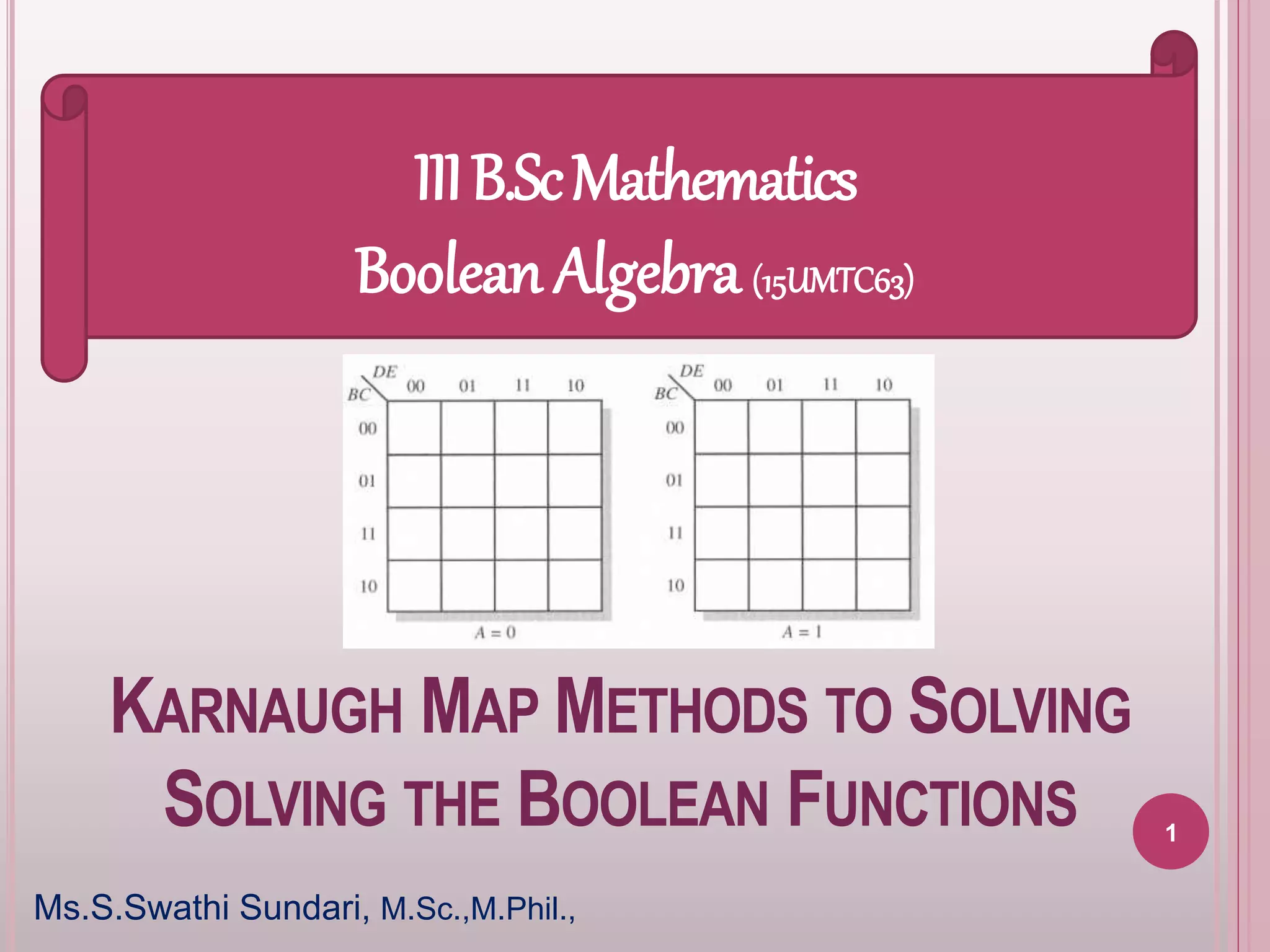
KARNAUGH MAP METHODS TO SOLVING
SOLVING THE BOOLEAN FUNCTIONS
Ms.S.Swathi Sundari, M.Sc.,M.Phil.,
IIIB.ScMathematics
Boolean Algebra(15UMTC63)
1
MINIMIZATION OF BOOLEANEXPRESSIONS
• The minimization will result in reduction
of the number of gates (resulting from
less number of terms) and the number
of inputs per gate (resulting from less
number of variables per term)
• The minimization will reduce cost,
efficiency and power
consumption.
• y(x+x`)=y.1=y
• y+xx`=y+0=y
2
MINIMUM SOP AND POS
SOP - SUM OF THE PRODUCTS AND POS – PRODUCT OF SUMS
• f= (xyz +x`yz+ xy`z+ …..) is called sum of
products.
The + is sum operator which is an OR gate.
The product such as xy is an AND gate for
the two inputs x and y.
• The minimum sum of products (MSOP) of a
function, f, is a SOP representation of f that
contains the fewest number of product terms
3
EXAMPLE
• Minimize the following Boolean
function using
sum of products (SOP):
• f(a,b,c,d) = m(3,7,11,12,13,14,15)
3
abcd
0011 a`b`cd
7 0111 a`bcd
11 1011 ab`cd
12 1100 abc`d`
13 1101 abc`d
14 1110 abcd`
15 1111 abcd
4
EXAMPLE
f(a,b,c,d) = m(3,7,11,12,13,14,15)
= a`b`cd + a`bcd + ab`cd + abc`d`+
abc`d + abcd` + abcd
= cd(a`b` + a`b + ab`) + ab(c`d` +
c`d + cd` + cd )
= cd(a`[b` + b] + ab`) + ab(c`[d` + d]
+ c[d` + d])
= cd(a`[1] + ab`) + ab(c`[1] + c[1])
= ab+ab`cd + a`cd
= ab+cd(ab` + a`)
= ab+ cd(a + a`)(a`+b`)
5
MINIMUM PRODUCT OF SUMS (MPOS)
• The minimum product of sums (MPOS)
of a function, f, is a POS representation
of f that contains the fewest number of
sum terms and the fewest number of
literals of any POS representation of f.
• The zeros are considered exactly the
same as ones in the case of sum
of product (SOP)
6
EXAMP
LE
f(a,b,c,d) = M(0,1,2,4,5,6,8,9,10)
= m(3,7,11,12,13,14,15)
=
[(a+b+c+d)(a+b+c+d`)(a+b`+c`+d`)
(a`+b+c`+d`)(a`+b`+c+
d)(a`+b`+c+ d`)
(a`+b`+c`+d)(a`+b`+c`+d`)] 7
KARNAUGH MAPS (K-MAPS)
•Karnaugh maps -- A tool for
representing Boolean functions of
up to six variables.
•K-maps are tables of rows and
columns with entries represent 1`s
or 0`s of SOP and POS
representations. 8
KARNAUGH MAPS (K-MAPS)
• An n-variable K-map has 2n cells
with each cell corresponding to an
n-variable truth table value.
• K-map cells are labeled with the
corresponding truth-table row.
• K-map cells are arranged such
that adjacent cells correspond to
truth rows that differ in only one
bit position (logical adjacency).
9
KARNAUGH MAPS (K-MAPS)
•If mi is a minterm of f, then place a 1
in cell i of the K-map.
•If Mi is a maxterm of f, then place a
0 in cell i.
•If di is a don’t care of f, then place a
d or x in cell i. 10
EXAMP
LES
• Two variable K-map
f(A,B)=m(0,1,3)=A`B`+A`B+AB
1 0
1 1
A 0 1
B01
11
THREE VARIABLE MAP
• f(A,B,C) = m(0,3,5)=
A`B`C`+A`BC+AB`C
A`B`
0 0
A`B
0 1
A B
1 1
A B`
1 0
1 C`
0 A`B`C `
1
A
C
`1BC
1
AB`C
12
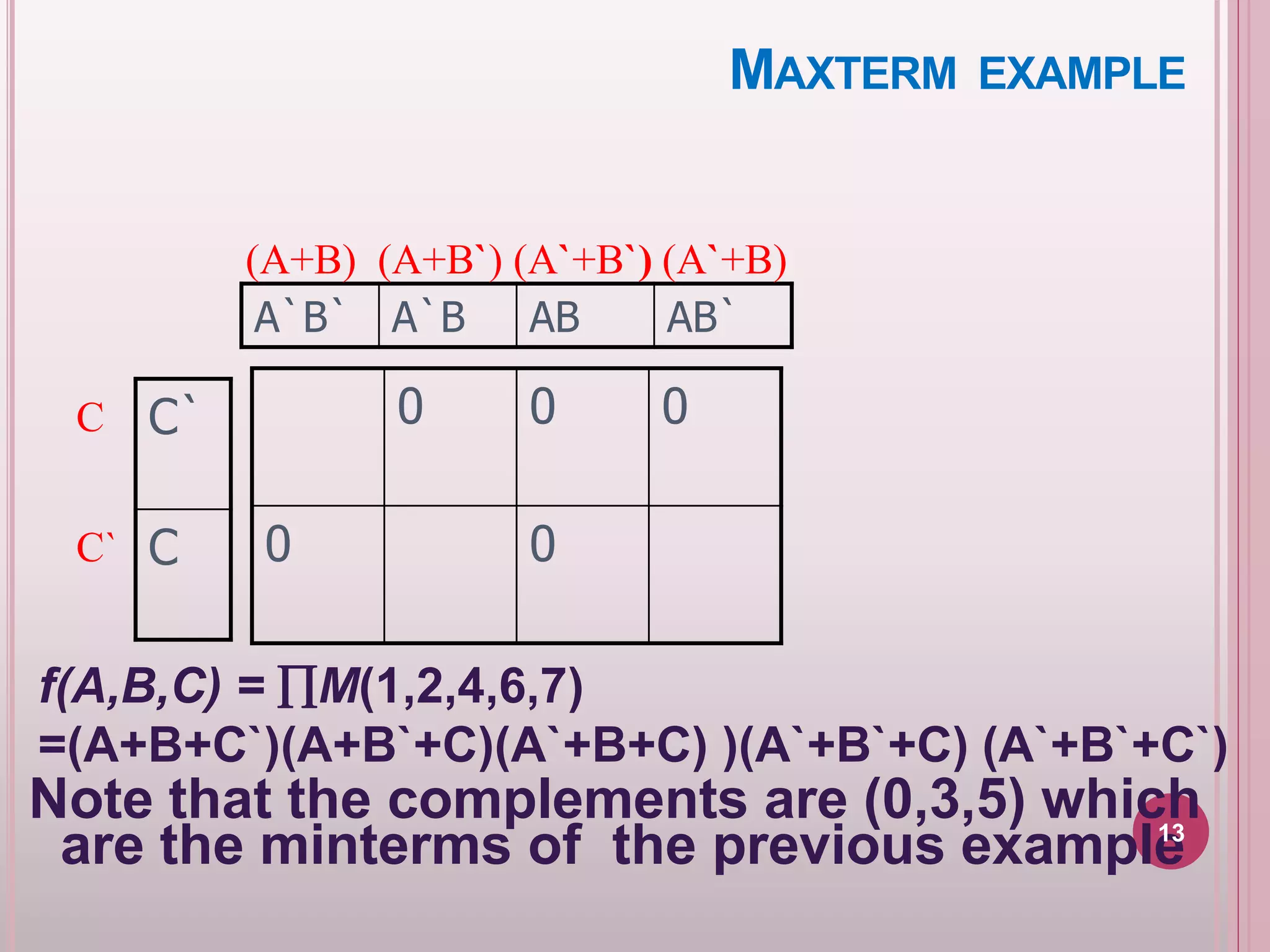
MAXTERM EXAMPLE
0 0 0
0 0
A`B` A`B AB AB`
C`
C
(A+B) (A+B`) (A`+B`) (A`+B)
C
C`
f(A,B,C) = M(1,2,4,6,7)
=(A+B+C`)(A+B`+C)(A`+B+C) )(A`+B`+C) (A`+B`+C`)
Note that the complements are (0,3,5) which
are the minterms of the previous example13
FOUR VARIABLE EXAMPLE
(a) Minterm form.
(b) Maxtermform.
f(a,b,Q,G) = m(0,3,5,7,10,11,12,13,14,15) = M(1,2,4,6,8,9)
14
SIMPLIFICATIONOFBOOLEANFUNCTIONS
USING K-MAPS
• K-map cells that are physically
adjacent are also logically adjacent.
Also, cells on an edge of a K-map are
logically adjacent to cells on the
opposite edge of the map.
• If two logically adjacent cells both
contain logical 1s, the two cells can
be combined to eliminate the variable
15
SIMPLIFICATIONOFBOOLEANFUNCTIONS
USING K-MAPS
•This is equivalent to the
algebraic operation,
aP + aP =P where P is a
product term not containing
a or a.
•A group of cells can be
16
SIMPLIFICATIONOFBOOLEANFUNCTIONS
USING K-MAPS
• Always combine as many cells in a group
as possible. This will result in the fewest
number of literals in the term that
represents the group.
• Make as few groupings as possible to
cover all minterms. This will result in
the fewest product terms.
• Always begin with the largest group,
which means if you can find eight
members group is better than two four
17
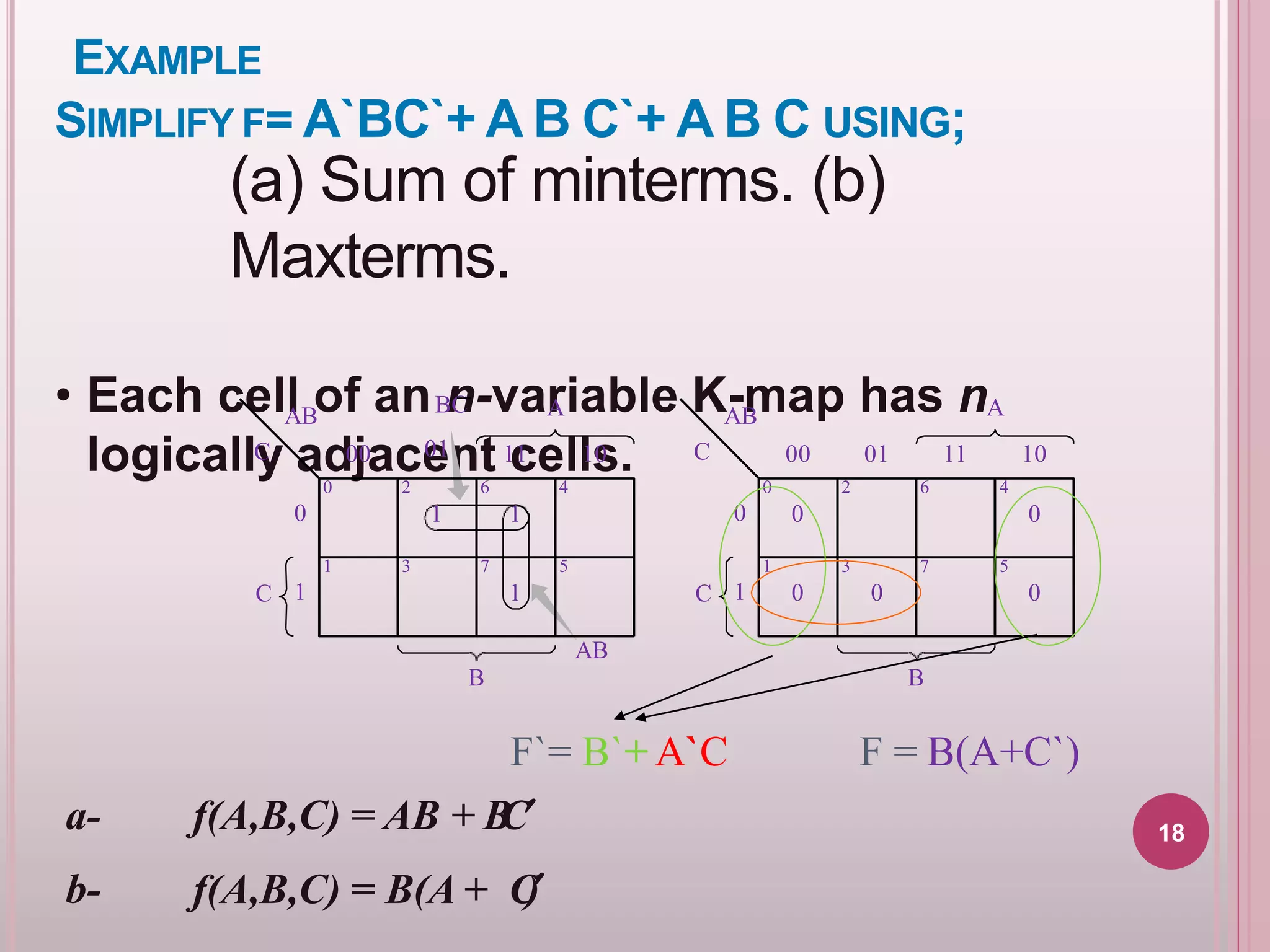
EXAMPLE
SIMPLIFY F= A`BC`+ A B C`+ A B C USING;
(a) Sum of minterms. (b)
Maxterms.
• Each cell of an n-variable K-map has n
logically adjacent cells. C
AB
10
0 2 6 4
1 3 7 5
1
B
0
0C
C
AB
00 11 10 00 01 11
0 2 6 4
1 3 7 5
0
1C
A A
B
AB
BC
01
1 1
1 0
0 0
0
a-
b-
F`= B`+ A`C
f(A,B,C) = AB + BC
f(A,B,C) = B(A + C)
F = B(A+C`)
18
EXAMPLE
SIMPLIFY
CD
AB
00 01 11
0 4
1
12 8
1
1 5
1
13
1
9
3
1
7
1
15
1
11
2
1
6 14 10
1
00
01
11
10
B
(a)
D
C
AB
10 CD 00 01 11 10
00
01
11
10
B
(b)
D
A A
0 4
1
12 8
1
1 5
1
13
1
9
3
1
7
1
15
1
11
2
1
6 14 10
1
C
CD
AB
00 01 11 10
0 4
1
12 8
1
1 5
1
13
1
9
3
1
7
1
15
1
11
2
1
6 14 10
1
00
01
11
10
B
(c)
D
A
C
CD
AB
00 01 11 10
0 4 12 8
1 5 13 9
3 7 15 11
2 6 14 10
00
01
11
10
D
A
C
B
(d)
1 1
1 1 1
1
1 1
1
f(A,B,C,D) = m(2,3,4,5,7,8,10,13,15)
19
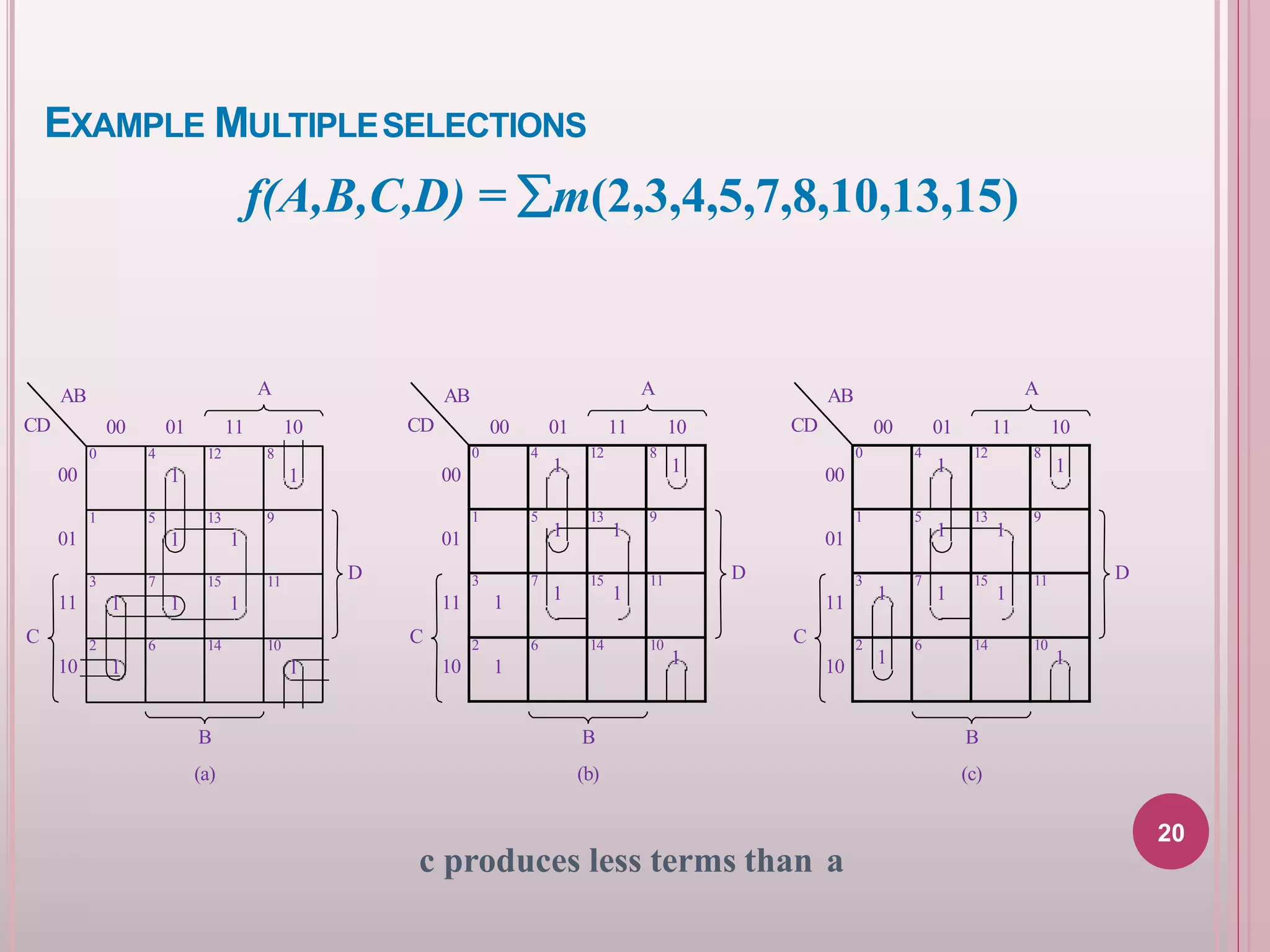
EXAMPLE MULTIPLESELECTIONS
CD
AB
00 01 11 10
0 4 12 8
1 5 13 9
3 7 15 11
2 6 14 10
00
01
11
D
A
C
B
(a)
CD
AB
00 01 11 10
0 4
1
12 8
1
1 5 13 9
1 1
3
1
7
1
15
1
11
2
1
6 14 10
1
00
01
11
10
B
(b)
D
A
C
1 1
1 1
1 1
10 1 1
1
CD
AB
00 01 11 10
0 4
1
12 8
1
1 5 13 9
1 1
3
1
7
1
15
1
11
2
1
6 14 10
1
00
01
11
10
B
(c)
D
A
C
f(A,B,C,D) = m(2,3,4,5,7,8,10,13,15)
c produces less terms than a
20
COMPLETE SIMPLIFICATION PROCESS
21
1.Construct the K map and place 1s and 0s in the squares
according to the truth table.
2.Group the isolated 1s which are not adjacent to any other 1s.
(single loops)
3.Group any pair which contains a 1 adjacent to only one other 1.
(double loops)
4.Group any octet even if it contains one or more 1s that have
already been grouped.
5.Group any quad that contains one or more 1s that have not
already been grouped, making sure to use the minimum number
of groups.
6.Group any pairs necessary to include any 1s that have not yet
been grouped, making sure to use the minimum number of
groups.
7.Form the OR sum of all the terms generated by each group.
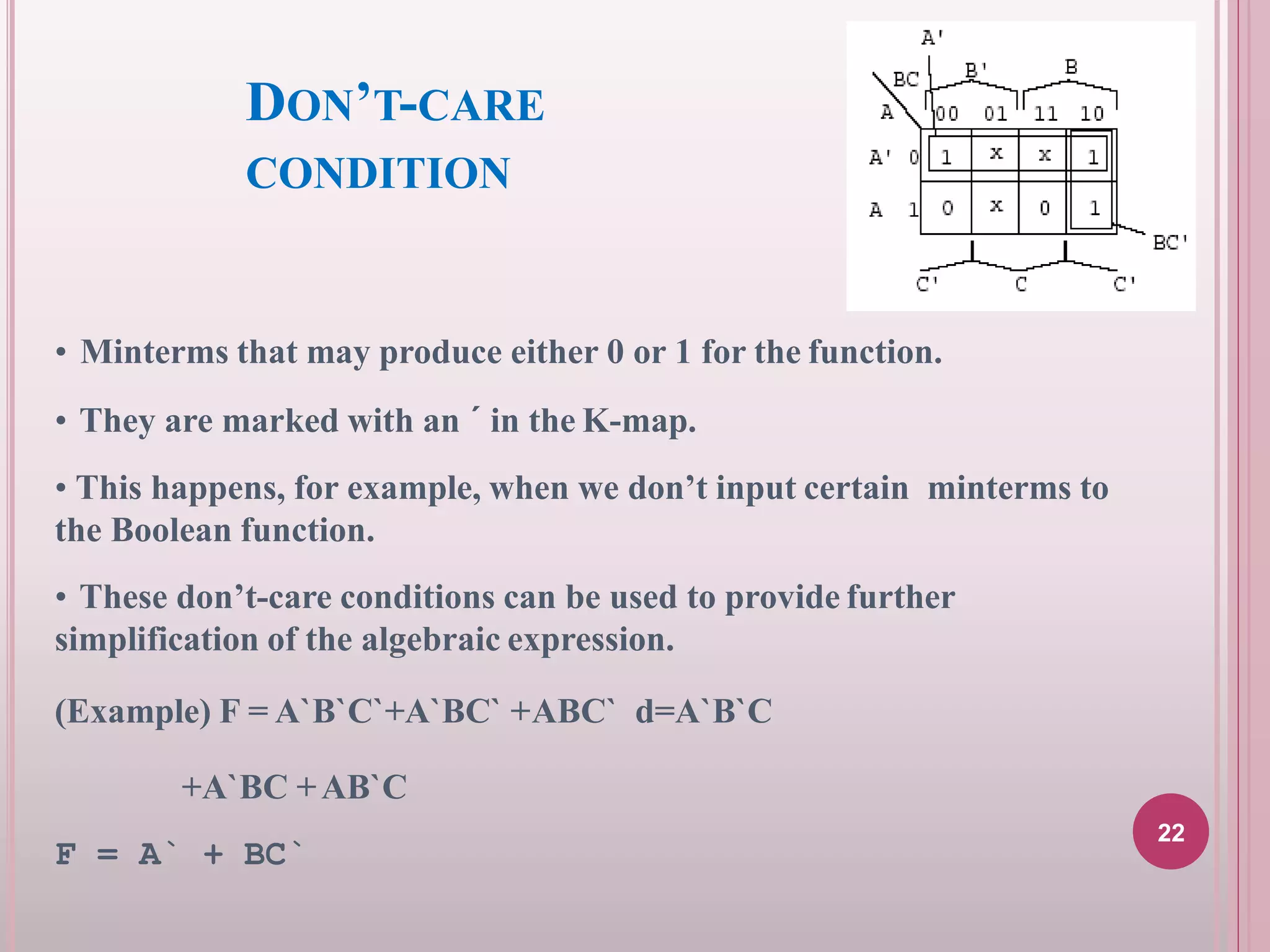
• Minterms that may produce either 0 or 1 for the function.
• They are marked with an ´ in the K-map.
• This happens, for example, when we don’t input certain minterms to
the Boolean function.
• These don’t-care conditions can be used to provide further
simplification of the algebraic expression.
(Example) F = A`B`C`+A`BC` +ABC` d=A`B`C
+A`BC +AB`C
F = A` + BC`
DON’T-CARE
CONDITION
22
23
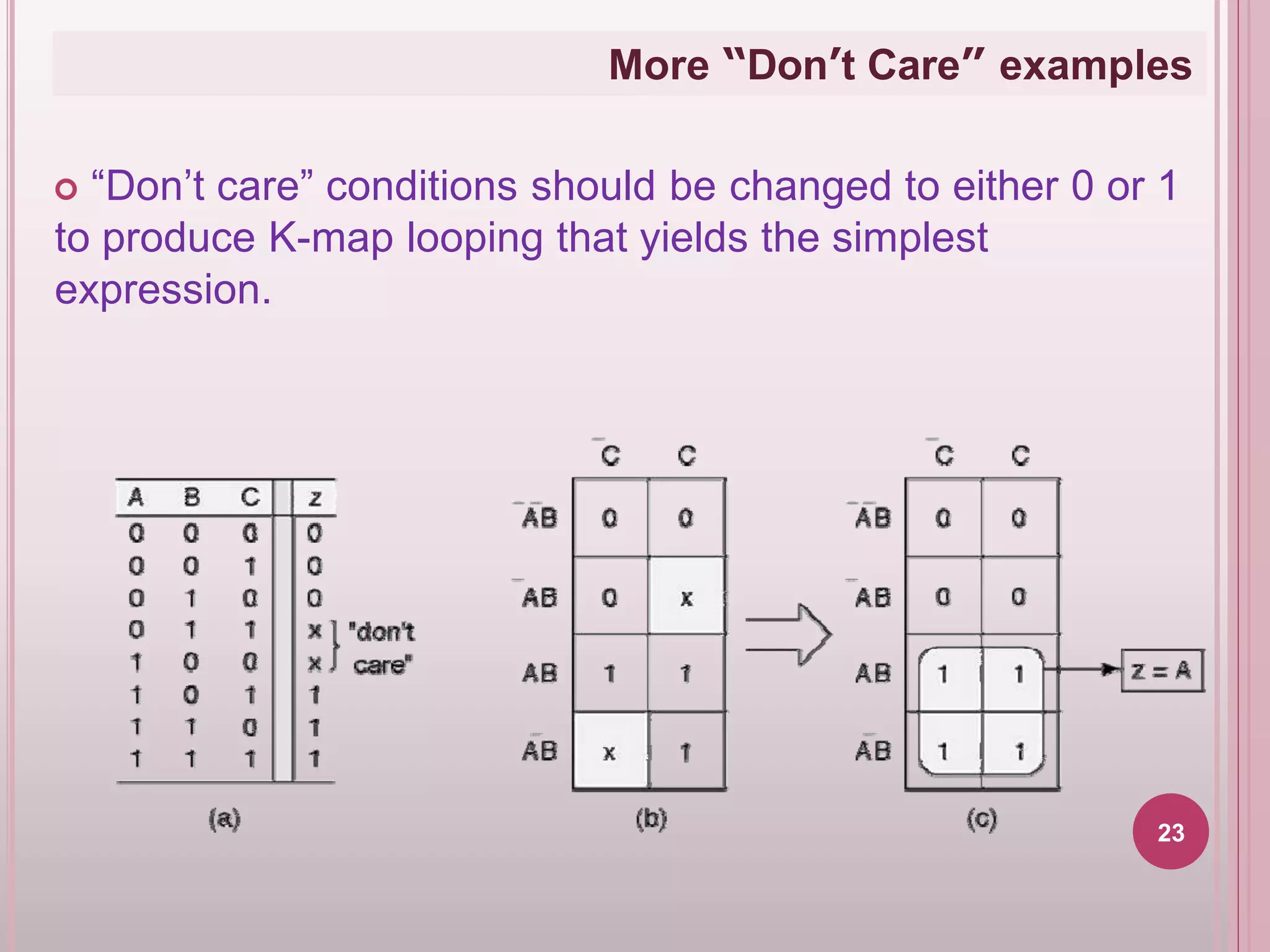
 “Don’t care” conditions should be changed to either 0 or 1
to produce K-map looping that yields the simplest
expression.
More “Don’t Care” examples
SUMMARY
 Compared to the algebraic method, the K-map process
is a more orderly process requiring fewer steps and
always producing a minimum expression.
 The minimum expression in generally is NOT unique.
 For the circuits with large numbers of inputs (larger
than four), other more complex techniques are used.
 SOP and POS –useful forms of Boolean equations.
24
25

Boolean Algebra

  • 1.
    KARNAUGH MAP METHODSTO SOLVING SOLVING THE BOOLEAN FUNCTIONS Ms.S.Swathi Sundari, M.Sc.,M.Phil., IIIB.ScMathematics Boolean Algebra(15UMTC63) 1
  • 2.
    MINIMIZATION OF BOOLEANEXPRESSIONS •The minimization will result in reduction of the number of gates (resulting from less number of terms) and the number of inputs per gate (resulting from less number of variables per term) • The minimization will reduce cost, efficiency and power consumption. • y(x+x`)=y.1=y • y+xx`=y+0=y 2
  • 3.
    MINIMUM SOP ANDPOS SOP - SUM OF THE PRODUCTS AND POS – PRODUCT OF SUMS • f= (xyz +x`yz+ xy`z+ …..) is called sum of products. The + is sum operator which is an OR gate. The product such as xy is an AND gate for the two inputs x and y. • The minimum sum of products (MSOP) of a function, f, is a SOP representation of f that contains the fewest number of product terms 3
  • 4.
    EXAMPLE • Minimize thefollowing Boolean function using sum of products (SOP): • f(a,b,c,d) = m(3,7,11,12,13,14,15) 3 abcd 0011 a`b`cd 7 0111 a`bcd 11 1011 ab`cd 12 1100 abc`d` 13 1101 abc`d 14 1110 abcd` 15 1111 abcd 4
  • 5.
    EXAMPLE f(a,b,c,d) = m(3,7,11,12,13,14,15) =a`b`cd + a`bcd + ab`cd + abc`d`+ abc`d + abcd` + abcd = cd(a`b` + a`b + ab`) + ab(c`d` + c`d + cd` + cd ) = cd(a`[b` + b] + ab`) + ab(c`[d` + d] + c[d` + d]) = cd(a`[1] + ab`) + ab(c`[1] + c[1]) = ab+ab`cd + a`cd = ab+cd(ab` + a`) = ab+ cd(a + a`)(a`+b`) 5
  • 6.
    MINIMUM PRODUCT OFSUMS (MPOS) • The minimum product of sums (MPOS) of a function, f, is a POS representation of f that contains the fewest number of sum terms and the fewest number of literals of any POS representation of f. • The zeros are considered exactly the same as ones in the case of sum of product (SOP) 6
  • 7.
    EXAMP LE f(a,b,c,d) = M(0,1,2,4,5,6,8,9,10) =m(3,7,11,12,13,14,15) = [(a+b+c+d)(a+b+c+d`)(a+b`+c`+d`) (a`+b+c`+d`)(a`+b`+c+ d)(a`+b`+c+ d`) (a`+b`+c`+d)(a`+b`+c`+d`)] 7
  • 8.
    KARNAUGH MAPS (K-MAPS) •Karnaughmaps -- A tool for representing Boolean functions of up to six variables. •K-maps are tables of rows and columns with entries represent 1`s or 0`s of SOP and POS representations. 8
  • 9.
    KARNAUGH MAPS (K-MAPS) •An n-variable K-map has 2n cells with each cell corresponding to an n-variable truth table value. • K-map cells are labeled with the corresponding truth-table row. • K-map cells are arranged such that adjacent cells correspond to truth rows that differ in only one bit position (logical adjacency). 9
  • 10.
    KARNAUGH MAPS (K-MAPS) •Ifmi is a minterm of f, then place a 1 in cell i of the K-map. •If Mi is a maxterm of f, then place a 0 in cell i. •If di is a don’t care of f, then place a d or x in cell i. 10
  • 11.
    EXAMP LES • Two variableK-map f(A,B)=m(0,1,3)=A`B`+A`B+AB 1 0 1 1 A 0 1 B01 11
  • 12.
    THREE VARIABLE MAP •f(A,B,C) = m(0,3,5)= A`B`C`+A`BC+AB`C A`B` 0 0 A`B 0 1 A B 1 1 A B` 1 0 1 C` 0 A`B`C ` 1 A C `1BC 1 AB`C 12
  • 13.
    MAXTERM EXAMPLE 0 00 0 0 A`B` A`B AB AB` C` C (A+B) (A+B`) (A`+B`) (A`+B) C C` f(A,B,C) = M(1,2,4,6,7) =(A+B+C`)(A+B`+C)(A`+B+C) )(A`+B`+C) (A`+B`+C`) Note that the complements are (0,3,5) which are the minterms of the previous example13
  • 14.
    FOUR VARIABLE EXAMPLE (a)Minterm form. (b) Maxtermform. f(a,b,Q,G) = m(0,3,5,7,10,11,12,13,14,15) = M(1,2,4,6,8,9) 14
  • 15.
    SIMPLIFICATIONOFBOOLEANFUNCTIONS USING K-MAPS • K-mapcells that are physically adjacent are also logically adjacent. Also, cells on an edge of a K-map are logically adjacent to cells on the opposite edge of the map. • If two logically adjacent cells both contain logical 1s, the two cells can be combined to eliminate the variable 15
  • 16.
    SIMPLIFICATIONOFBOOLEANFUNCTIONS USING K-MAPS •This isequivalent to the algebraic operation, aP + aP =P where P is a product term not containing a or a. •A group of cells can be 16
  • 17.
    SIMPLIFICATIONOFBOOLEANFUNCTIONS USING K-MAPS • Alwayscombine as many cells in a group as possible. This will result in the fewest number of literals in the term that represents the group. • Make as few groupings as possible to cover all minterms. This will result in the fewest product terms. • Always begin with the largest group, which means if you can find eight members group is better than two four 17
  • 18.
    EXAMPLE SIMPLIFY F= A`BC`+A B C`+ A B C USING; (a) Sum of minterms. (b) Maxterms. • Each cell of an n-variable K-map has n logically adjacent cells. C AB 10 0 2 6 4 1 3 7 5 1 B 0 0C C AB 00 11 10 00 01 11 0 2 6 4 1 3 7 5 0 1C A A B AB BC 01 1 1 1 0 0 0 0 a- b- F`= B`+ A`C f(A,B,C) = AB + BC f(A,B,C) = B(A + C) F = B(A+C`) 18
  • 19.
    EXAMPLE SIMPLIFY CD AB 00 01 11 04 1 12 8 1 1 5 1 13 1 9 3 1 7 1 15 1 11 2 1 6 14 10 1 00 01 11 10 B (a) D C AB 10 CD 00 01 11 10 00 01 11 10 B (b) D A A 0 4 1 12 8 1 1 5 1 13 1 9 3 1 7 1 15 1 11 2 1 6 14 10 1 C CD AB 00 01 11 10 0 4 1 12 8 1 1 5 1 13 1 9 3 1 7 1 15 1 11 2 1 6 14 10 1 00 01 11 10 B (c) D A C CD AB 00 01 11 10 0 4 12 8 1 5 13 9 3 7 15 11 2 6 14 10 00 01 11 10 D A C B (d) 1 1 1 1 1 1 1 1 1 f(A,B,C,D) = m(2,3,4,5,7,8,10,13,15) 19
  • 20.
    EXAMPLE MULTIPLESELECTIONS CD AB 00 0111 10 0 4 12 8 1 5 13 9 3 7 15 11 2 6 14 10 00 01 11 D A C B (a) CD AB 00 01 11 10 0 4 1 12 8 1 1 5 13 9 1 1 3 1 7 1 15 1 11 2 1 6 14 10 1 00 01 11 10 B (b) D A C 1 1 1 1 1 1 10 1 1 1 CD AB 00 01 11 10 0 4 1 12 8 1 1 5 13 9 1 1 3 1 7 1 15 1 11 2 1 6 14 10 1 00 01 11 10 B (c) D A C f(A,B,C,D) = m(2,3,4,5,7,8,10,13,15) c produces less terms than a 20
  • 21.
    COMPLETE SIMPLIFICATION PROCESS 21 1.Constructthe K map and place 1s and 0s in the squares according to the truth table. 2.Group the isolated 1s which are not adjacent to any other 1s. (single loops) 3.Group any pair which contains a 1 adjacent to only one other 1. (double loops) 4.Group any octet even if it contains one or more 1s that have already been grouped. 5.Group any quad that contains one or more 1s that have not already been grouped, making sure to use the minimum number of groups. 6.Group any pairs necessary to include any 1s that have not yet been grouped, making sure to use the minimum number of groups. 7.Form the OR sum of all the terms generated by each group.
  • 22.
    • Minterms thatmay produce either 0 or 1 for the function. • They are marked with an ´ in the K-map. • This happens, for example, when we don’t input certain minterms to the Boolean function. • These don’t-care conditions can be used to provide further simplification of the algebraic expression. (Example) F = A`B`C`+A`BC` +ABC` d=A`B`C +A`BC +AB`C F = A` + BC` DON’T-CARE CONDITION 22
  • 23.
    23  “Don’t care”conditions should be changed to either 0 or 1 to produce K-map looping that yields the simplest expression. More “Don’t Care” examples
  • 24.
    SUMMARY  Compared tothe algebraic method, the K-map process is a more orderly process requiring fewer steps and always producing a minimum expression.  The minimum expression in generally is NOT unique.  For the circuits with large numbers of inputs (larger than four), other more complex techniques are used.  SOP and POS –useful forms of Boolean equations. 24
  • 25.